
Vigilius: The Pope Who Rose Through Intrigue and Became an Emperor’s Prisoner
Vigilius — 537–555
When Vigilius became bishop of Rome in 537, the man he replaced was still alive. Pope Silverius had not died peacefully after a long pontificate, leaving the Roman clergy free to select a successor. He had been stripped of his office, dressed as a monk, driven from Rome, and sent into exile after being accused of treason during one of the most dangerous moments in the city’s history. In his place stood Vigilius, an aristocratic Roman deacon with powerful connections at the imperial court of Constantinople and, according to an enduring but disputed tradition, a secret understanding with Empress Theodora herself. Within months Silverius attempted to return, only to disappear once more into confinement on an island, where he died under conditions grim enough to ensure that suspicion would cling to his successor for centuries.
It was an ominous beginning to one of the strangest and most politically tortured pontificates in papal history. Vigilius has been portrayed as ambitious, opportunistic, weak, treacherous, corrupt, and willing to profit from the destruction of his predecessor. Some hostile accounts went much further, accusing him of effectively bargaining for the papacy by promising theological concessions to Theodora and later ensuring that Silverius would never reclaim his throne. Yet these accusations emerged from a vicious world of theological faction, imperial politics, personal hostility, and propaganda, and important parts of the traditional story remain disputed. Vigilius cannot responsibly be convicted of every crime later attached to his name simply because those accusations make for a spectacular story.
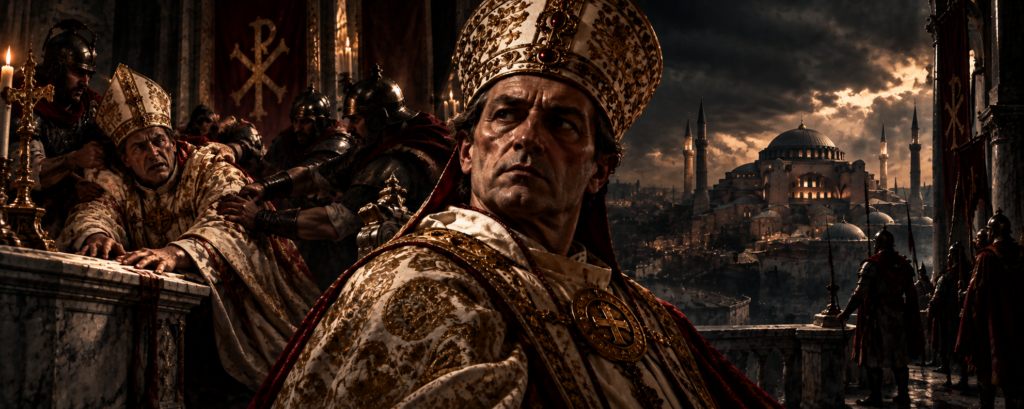
The documented history is extraordinary enough without embellishment. Vigilius rose while Silverius was being destroyed by Byzantine political and military power, inherited a papacy overshadowed by suspicion, and then discovered that the imperial influence surrounding his elevation could be turned against him just as easily. Emperor Justinian I eventually brought him to Constantinople, pressured him relentlessly during a theological dispute, kept him away from Rome for years, and pushed the confrontation so far that imperial officials attempted to seize the pope from sanctuary. At one astonishing moment, Vigilius clung to an altar while soldiers tried to drag him away, transforming the man once accused of benefiting from another pope’s deposition into the victim of imperial coercion himself.
His pontificate consequently reads less like a straightforward story of villainy than a dark political tragedy. Vigilius began as the man who gained a throne while another pope was dragged from it, but he ended as an exhausted and humiliated pontiff trapped far from Rome, battered by an emperor’s will and distrusted by significant portions of the Western Church. He repeatedly changed position during the theological crisis that consumed his reign, damaging his authority even as the pressures placed upon him became increasingly severe. When he was finally permitted to leave Constantinople after years of struggle, he began the journey toward the city whose bishop he remained but never reached it alive.
Rome Between Goths and Byzantines
The world into which Vigilius rose was violently unstable. The Western Roman Empire had disappeared in the previous century, but the city of Rome retained immense symbolic importance even after it ceased to be the seat of emperors. Italy was ruled by the Ostrogoths, while the Eastern Roman Empire survived from Constantinople and continued to regard the territories of the old Western Empire as legitimately Roman. The result was a dangerous political landscape in which popes could find themselves caught between Gothic kings ruling Italy and emperors hundreds of miles away who still claimed sovereignty over the Roman world.
The emperor who dominated Vigilius’s lifetime was Justinian I, one of the most ambitious rulers of late antiquity. Justinian dreamed of restoring imperial territories lost in the West and launched wars that brought North Africa, Italy, and portions of the western Mediterranean back under eastern Roman control. His reign produced monumental architecture, the codification of Roman law, spectacular military campaigns, devastating warfare, plague, religious persecution, and almost continuous theological controversy. Few emperors combined political ambition and religious intervention with such extraordinary intensity.
Beside Justinian stood Empress Theodora, whose influence within the imperial court was considerable. Ancient writers hostile to her produced some of the most lurid character assassination in Roman history, particularly Procopius in his notorious Secret History, and those accusations have shaped her reputation ever since. Many of the sensational stories concerning her sexuality and cruelty must therefore be approached with extreme caution. What is much more securely established is that Theodora possessed real political influence and took a strong interest in protecting Christians who rejected or were suspicious of the theological settlement established at the Council of Chalcedon.
The theological language involved in these conflicts can make them appear impossibly remote, but the political consequences were immediate. Arguments about the nature of Christ divided bishops, emperors, cities, monasteries, provinces, and entire populations. The Council of Chalcedon in 451 had declared Christ to exist in two natures, divine and human, united in one person, but large Christian communities—particularly in Egypt and Syria—rejected the council or deeply distrusted its language. Religious disagreement could therefore become political resistance, and an emperor seeking unity had powerful reasons to involve himself in disputes that modern readers might otherwise imagine belonged only to theologians.
For Justinian and Theodora, the bishops occupying the great Christian sees mattered enormously. Rome, Constantinople, Alexandria, Antioch, and Jerusalem possessed enormous prestige, and the men who controlled them could either support imperial religious policy or become formidable obstacles to it. The bishop of Rome carried particular symbolic importance because of the city’s apostolic associations and growing claims to ecclesiastical authority. Vigilius understood the importance of that office long before he finally possessed it.
An Ambitious Roman Deacon
Vigilius came from an aristocratic Roman family and entered the clerical hierarchy at a time when ecclesiastical office increasingly offered access to political as well as spiritual influence. His father, Johannes, belonged to the upper levels of Roman society, and Vigilius therefore grew up much closer to power than the image of an obscure monk suddenly elevated to greatness might suggest. He understood the social networks of the Roman elite and moved within a world where senators, bishops, imperial officials, wealthy patrons, and military commanders frequently interacted. Nothing about his background suggests a man unfamiliar with ambition or political calculation.
His prospects for the papacy appeared surprisingly early. Pope Boniface II attempted the extraordinary step of designating Vigilius as his own successor, apparently hoping to prevent another disputed election. The proposal provoked substantial opposition because the Roman bishopric was not supposed to operate like a hereditary possession that one pope could simply hand to a favored candidate. Boniface eventually abandoned the plan and publicly revoked the designation, but the episode demonstrates that Vigilius was already regarded as a serious candidate for the highest office in the Roman Church.
Vigilius subsequently served as a papal representative at Constantinople, a position that placed him near the center of imperial religious politics. There he encountered a court where theological arguments could determine careers and where an emperor or empress could profoundly influence the fate of bishops. The assignment also brought him into contact with Theodora and the religious figures she protected. Whether those relationships later developed into the corrupt bargain alleged by Vigilius’s enemies is uncertain, but his proximity to the court itself is beyond dispute.
Events accelerated when Pope Agapetus I traveled to Constantinople in 536. Agapetus had gone east partly on a diplomatic mission while Byzantine armies threatened Ostrogothic Italy, but he quickly became involved in the controversy surrounding Anthimus, patriarch of Constantinople. Anthimus was suspected of holding theological positions incompatible with Chalcedonian orthodoxy, and Agapetus refused to recognize him. Anthimus was removed, Theodora reportedly resented the outcome, and then Agapetus died unexpectedly in Constantinople in April 536, leaving the Roman bishopric vacant once again.
Theodora and the Alleged Bargain
This is where the darkest traditional accusation against Vigilius begins. According to hostile sources, Theodora offered to help him obtain the papacy if he would support her religious policies once he became bishop of Rome. The story eventually acquired spectacular details, including allegations that Vigilius was promised a huge quantity of gold and that he agreed to restore communion with Anthimus and other anti-Chalcedonian churchmen. In its most dramatic form, the episode becomes a secret transaction in which theological principle, money, imperial influence, and the papal throne were all placed on the bargaining table.
The accusation has been repeated for centuries because it fits the later events almost irresistibly well. Vigilius really was present at Constantinople, Theodora really was deeply interested in the controversy surrounding Anthimus, and Vigilius really did eventually become pope after a rival was removed under Byzantine pressure. These facts create a suspicious sequence and help explain why contemporaries or later writers found the conspiracy plausible. Suspicion, however, is not the same thing as proof.
The sources describing the alleged bargain were shaped by intense theological and political hostility, and their details cannot simply be accepted as a transcript of a secret meeting. Later traditions sometimes hardened accusations into facts, particularly after Vigilius became deeply unpopular during the controversies of his pontificate. Modern historians therefore disagree over exactly what understanding, if any, existed between him and Theodora. It is possible that imperial circles regarded Vigilius as a more cooperative candidate without there ever being the precise corrupt contract described by his enemies.
The distinction is important because Vigilius’s story does not need invented certainty. He was an ambitious and well-connected cleric positioned close to the imperial court, and powerful people in Constantinople had obvious reasons to care who became bishop of Rome. Traditions accusing him of promising theological concessions in exchange for support belong in any serious account of his career, but they must remain identified as accusations rather than proven transactions. What happened next moved from rumor into much firmer historical ground, because another man reached the papal throne before Vigilius could do so.
Silverius Takes the Throne
While Vigilius remained associated with Constantinople, events in Italy moved quickly. The Ostrogothic king Theodahad had powerful reasons to fear Byzantine influence over the Roman Church as Justinian’s armies advanced into Italy. A pope closely connected to Constantinople could become politically dangerous, particularly if the struggle between Goths and Byzantines reached Rome itself. The Gothic monarchy therefore had every incentive to ensure that the next bishop was not simply an imperial client.
Silverius was elevated to the papacy in 536 under strong Gothic influence. His election was unusual because he was only a subdeacon rather than one of the higher-ranking clerics normally expected to become bishop of Rome. Some Roman clergy apparently resisted or resented the circumstances of his elevation, but Gothic political power stood behind him. From the beginning, therefore, Silverius’s pontificate was entangled with the same struggle between secular powers that would later destroy it.
The military situation soon changed dramatically. General Belisarius, Justinian’s brilliant commander, entered Rome in December 536, placing the city under Byzantine control. The Ostrogoths responded by besieging Rome, creating an atmosphere of hunger, military danger, political paranoia, and fear of betrayal. Every rumor that someone inside the walls might cooperate with the besiegers could have deadly consequences.
Silverius suddenly occupied an extremely vulnerable position. He had become pope while Gothic power dominated Italy, but he now lived inside a city defended by Byzantine soldiers commanded by one of Justinian’s most important generals. His enemies needed only to persuade Belisarius that the pope remained secretly loyal to the Goths. Before long, precisely such an accusation appeared.
The Destruction of Pope Silverius
Silverius was accused of communicating with the Gothic enemy and offering to betray Rome by allowing their forces access to the city. A letter was produced as evidence of his supposed treason, but the authenticity of the document was questioned, and later tradition strongly suspected fabrication. In the atmosphere of a siege, however, even an uncertain accusation could become extraordinarily dangerous. Belisarius could not afford to ignore the possibility that the bishop of Rome might be conspiring with the army outside the walls.
Powerful personalities surrounded the case. Antonina, the formidable wife of Belisarius, was closely associated with Empress Theodora and appears prominently in hostile accounts of Silverius’s downfall. Vigilius was also in the political orbit surrounding the crisis and had everything to gain if Silverius ceased to be pope. The exact degree of coordination between these figures remains disputed, but the result is not.
In March 537, Silverius was summoned before Belisarius and effectively destroyed as pope. His episcopal garments were removed, he was dressed in the clothing of a monk, and he was declared deposed before being sent away from Rome. In the highly ceremonial society of late antiquity, stripping away the clothing associated with an office was a public destruction of status as well as a practical act. Silverius entered the confrontation as bishop of Rome and emerged from it as an exile whose enemies intended his pontificate to be over.
Vigilius was then elected and consecrated bishop of Rome. He accepted the office even though Silverius remained alive and even though the deposition had occurred under the pressure of Byzantine military authority. Whatever Vigilius had or had not promised Theodora, and whatever direct role he had or had not played in engineering the accusation against Silverius, he unquestionably became the beneficiary of his predecessor’s destruction. That uncomfortable fact would cast a shadow over everything that followed.
The Deposed Pope Who Came Back
Silverius was initially sent east to Patara in Lycia, where his story might easily have ended. A deposed bishop removed hundreds of miles from his supporters could disappear from political life, particularly during an age when communication was slow and imperial officials controlled movement. Silverius, however, encountered an unexpected defender. The bishop of Patara became convinced that the former pope had suffered a grave injustice and took the extraordinary step of bringing his case before Emperor Justinian.
Justinian apparently responded with more concern than Silverius’s enemies expected. He ordered that the accusations be reinvestigated and allowed Silverius to return toward Italy so that his case could be examined. If the evidence of treason proved genuine, his deposition could stand. If the accusation proved false, however, the possibility existed that Silverius might have to be restored.
For Vigilius, the situation was potentially catastrophic. He occupied a throne whose previous holder was now returning with imperial authorization for a reconsideration of the very charges used to remove him. If Silverius were vindicated, Vigilius’s legitimacy could collapse overnight. The former pope was therefore not merely an embarrassing survivor but an existential threat to the new pontificate.
Silverius never received the restoration that Justinian’s intervention seemed to make possible. Once back in Italy, he again fell under the control of forces hostile to him and was sent into confinement on an island off the Italian coast. The precise identification of the island varies in the sources and later tradition, but the essential outcome is clear: Silverius was isolated under harsh conditions and died later in 537. With his death, the most dangerous rival to Vigilius’s claim disappeared permanently.
The Death That Would Not Go Away
Silverius’s death inevitably produced suspicions of murder. Vigilius had an obvious motive because the former pope was the only man capable of claiming that he still possessed the Roman see. The timing looked terrible: Silverius returned after Justinian ordered his case reconsidered, was diverted into renewed confinement, and died before he could regain his office. Hostile tradition naturally connected these events and placed responsibility on Vigilius.
Some accounts went further and claimed that Silverius was deliberately starved. Others treated Vigilius as effectively responsible for ensuring that his predecessor never escaped the island alive. These accusations became part of the darker legend surrounding his pontificate and have often been repeated as though the details were firmly documented. The evidence does not justify that level of certainty.
There is no secure proof that Vigilius personally ordered Silverius murdered, nor can historians confidently reconstruct exactly how the former pope died. Exile itself could be lethal in late antiquity, particularly when a prisoner was deprived of adequate food, shelter, medical care, or protection. Silverius may have died from deliberate mistreatment, from conditions imposed with reckless indifference to whether he survived, or from hardships that were not specifically designed as an execution.
None of those possibilities makes the episode comfortable for Vigilius. He directly benefited from Silverius’s removal and remained pope after the former pontiff’s death eliminated the possibility of restoration. His position became secure because another man had been stripped, exiled, confined, and ultimately buried. The responsible historical conclusion is therefore neither to absolve Vigilius of every shadow nor to convict him of an unproven murder, but to acknowledge that his papacy was born from a process of political coercion that ended with his predecessor dead.
A Pope Under a Permanent Cloud
With Silverius gone, Vigilius finally possessed the Roman bishopric without a living rival. Yet legitimacy could not be manufactured merely by eliminating the practical problem of succession. People remembered how he had reached the throne, and hostile accounts continued to portray him as the product of Byzantine interference. The circumstances of his accession became inseparable from judgments about his character.
If Theodora expected Vigilius to become an obedient instrument of her religious policy, however, the new pope soon complicated that expectation. He maintained the authority of the Council of Chalcedon and did not simply restore Anthimus to communion in the manner the traditional conspiracy narrative says he had promised. This discrepancy has become one reason historians question the simplest version of the alleged bargain. A man who had sold his theological obedience for the papacy did not behave as consistently obediently as the story would suggest.
Several explanations remain possible. Vigilius may have made promises before becoming pope and then decided that fulfilling them would destroy his authority in the West. The alleged promises may have been vaguer than hostile writers later claimed, or there may never have been a formal bargain at all. What is certain is that possession of the papacy changed the political equation because Vigilius now had responsibilities and constituencies extending far beyond the imperial court.
The Western Church remained deeply committed to Chalcedon. A pope openly abandoning the council would face enormous resistance from bishops who regarded its decisions as a cornerstone of orthodoxy. Vigilius therefore could not simply behave as though he were still a Roman deacon maneuvering at Constantinople. The office he had desired imposed constraints of its own, and those constraints would soon place him in direct conflict with Justinian.
Justinian the Emperor-Theologian
Justinian possessed an extraordinary confidence in his ability to govern both empire and Church. He reorganized administration, codified centuries of Roman law, directed military reconquests, commissioned the magnificent Hagia Sophia, and immersed himself in theological controversies with the same energy he applied to politics. Religious unity was not peripheral to his conception of government. A divided Church meant a divided empire, and Justinian believed the emperor had both the right and responsibility to help restore agreement.
The greatest unresolved religious division concerned Christians who rejected or distrusted Chalcedon. Justinian repeatedly searched for formulas capable of reconciling these communities without formally repudiating the council. The task was extraordinarily difficult because concessions acceptable to anti-Chalcedonian Christians could look like betrayal to Chalcedon’s defenders. Every attempted compromise risked creating a new controversy while trying to end an old one.
Eventually the emperor focused upon what became known as the Three Chapters. The name referred not to three sections of a single text but to three groups of material associated with Theodore of Mopsuestia, Theodoret of Cyrus, and a letter attributed to Ibas of Edessa. Critics associated these figures or writings with theological tendencies considered dangerously close to Nestorianism, which appeared to divide Christ’s humanity and divinity too sharply.
Justinian believed that condemning the Three Chapters might reassure Christians who suspected Chalcedon of tolerating Nestorian theology. The plan had a certain political logic because it allowed the emperor to condemn controversial material without formally repudiating Chalcedon itself. Western bishops, however, feared that reopening the cases would indirectly undermine the council, particularly because Theodoret and Ibas had been accepted under particular circumstances at Chalcedon. What looked to Justinian like reconciliation looked to many Western Christians like an attack on settled doctrine.
The Pope Is Taken East
Vigilius initially resisted the emperor’s demand that he condemn the Three Chapters. His reluctance reflected both theological concerns and the political realities of the Western Church, where opposition was particularly intense. Justinian, however, possessed a method of persuasion far more effective than correspondence. He could bring the pope to Constantinople.
Vigilius was ordered or compelled to leave Rome in 545, beginning a journey that would separate him from his see for most of the remaining decade of his life. The circumstances surrounding his departure became another source of hostile tradition. The Liber Pontificalis associates his removal with imperial officials and describes an atmosphere in which many Romans were far from affectionate toward their bishop.
Some accounts describe crowds insulting the departing pope and even throwing objects toward his vessel. Such details may have been exaggerated by writers hostile to Vigilius, but his reputation in Rome was certainly troubled. Memories of Silverius had not vanished, and the suffering caused by war made any pope vulnerable to public resentment.
The departure occurred while Italy was descending deeper into catastrophe. The Ostrogothic king Totila was rebuilding Gothic resistance and placing enormous pressure on Rome, whose population endured hunger and repeated military threats. Vigilius attempted to send grain to the city and sought imperial assistance, but relief efforts achieved limited success. The bishop of Rome was being carried toward the eastern imperial court while his own city faced devastation.
Constantinople Closes Around Him
Vigilius eventually reached Constantinople in 547, where he encountered an emperor determined to resolve the Three Chapters controversy. The pope initially refused to accept the condemnation demanded of him and even excommunicated certain ecclesiastical opponents involved in the dispute. Justinian, however, could apply pressure continuously because Vigilius was now living inside the imperial capital. Distance no longer protected the Roman bishop from the emperor’s will.
The situation was complicated by the fact that the theological questions were genuinely difficult. Vigilius did not necessarily regard everything associated with the Three Chapters as doctrinally defensible. His concern centered partly upon the implications of condemning men and writings connected to decisions made at Chalcedon. He therefore attempted to distinguish between rejecting theological errors and appearing to overturn an ecumenical council.
In 548, Vigilius issued the document known as the Judicatum. It condemned the Three Chapters while explicitly attempting to preserve the authority of Chalcedon. From Vigilius’s perspective, the document may have represented a carefully balanced compromise capable of satisfying legitimate theological concerns without sacrificing the council.
Instead, it produced outrage.
Western opposition erupted, particularly among African bishops and other staunch defenders of Chalcedon. Critics accused Vigilius of surrendering to imperial pressure and betraying the council he was supposed to defend. The theological nuance of his position mattered little to those who saw the pope sitting in Constantinople and issuing the condemnation Justinian wanted. Vigilius had tried to stand between two hostile camps and discovered that both could accuse him of betrayal.
A Pontificate of Reversals
Vigilius eventually retreated from the Judicatum as resistance intensified. He and Justinian entered negotiations over how the controversy might be settled, and discussion turned toward convening a council. Yet even the composition of such a gathering became contentious because Western and Eastern bishops approached the dispute from very different positions. Vigilius feared that an overwhelmingly eastern council would simply ratify the emperor’s wishes.
His repeated changes of position became one of the defining features of his reputation. He condemned the Three Chapters, withdrew or suspended his condemnation, negotiated with Justinian, resisted new imperial measures, and later changed course again. To hostile observers, the pattern looked like cowardice and theological incoherence. A pope expected to provide certainty instead appeared to move according to whichever pressure was strongest at a given moment.
The reality was more complicated than simple weakness. Vigilius was attempting to reconcile positions that may have been impossible to reconcile, while also operating under increasingly coercive conditions. The emperor controlled the city in which he lived, while Western bishops could reject his decisions from hundreds of miles away. Every concession to Justinian threatened revolt in the West, but every act of resistance increased the danger surrounding Vigilius personally.
Nevertheless, leadership carries responsibility even when circumstances are terrible. Vigilius’s maneuvering steadily damaged confidence in him because neither side could be certain that today’s declaration would remain tomorrow’s position. His authority eroded precisely when the papacy needed unusual clarity. The man whose accession had already raised questions about political expediency now seemed unable to escape expediency once theological pressure intensified.
Theodora Dies, but the Trap Remains
Empress Theodora died in 548, removing the woman who had supposedly played such an important role in Vigilius’s original rise. If the traditional story of their bargain contained truth, the irony was considerable because the alleged architect of his papacy died while Vigilius remained trapped within the political world she had helped dominate. Her death did not free him. Justinian remained emperor, and the Three Chapters controversy continued.
The disappearance of Theodora also changes the shape of Vigilius’s story. The first half of his reputation is dominated by allegations concerning an ambitious cleric and a powerful empress. The second half is dominated by a direct confrontation between pope and emperor. Whatever Theodora may have promised or expected years earlier became almost irrelevant once Justinian decided that ecclesiastical unity required a settlement on his terms.
Vigilius increasingly resisted the emperor’s unilateral actions. Justinian issued a new condemnation of the Three Chapters in 551, intensifying a conflict the pope believed should be settled through a properly constituted council rather than imperial decree. Vigilius objected and moved toward open confrontation with imperial authority. The relationship that had once appeared advantageous to his career had become actively dangerous.
The danger was no longer merely reputational. Imperial officials could control Vigilius’s movements, isolate his supporters, and apply physical pressure. The theological dispute was approaching a point where the pope would discover just how little protection his office could provide inside the emperor’s capital.
Soldiers at the Altar
In 551, Vigilius sought sanctuary in the Basilica of Saint Peter within the Hormisdas Palace complex at Constantinople. Sanctuary carried enormous religious significance because churches and altars were traditionally regarded as places where secular violence should be restrained. A pope taking refuge there was already a dramatic sign that relations with imperial authority had collapsed. What happened next made the episode extraordinary.
Imperial officials and armed men entered the church to seize him. Vigilius clung to the altar while soldiers attempted to pull him away, and members of his clergy became caught in the struggle. According to accounts associated with Vigilius, the confrontation was violent enough that the altar itself was endangered and nearly collapsed under the force being exerted around it.
The image is almost impossible to separate from the earlier destruction of Silverius. Fourteen years before, Byzantine political power had stripped Vigilius’s predecessor of his papal identity and driven him into exile, clearing the way for Vigilius to become bishop of Rome. Now agents of the same imperial system were attempting to drag Vigilius physically from a Christian altar because he would not cooperate with imperial religious policy. The beneficiary of Byzantine intervention had become its victim.
The authorities eventually backed away, at least temporarily, because the spectacle created its own scandal. Seizing a pope from an altar risked appearing sacrilegious even to people who supported Justinian’s theological position. Guarantees of safety were offered, and Vigilius returned to his residence. His trust in imperial assurances, however, had been shattered.
Flight to Chalcedon
Vigilius eventually escaped from his residence in December 551 and fled across the Bosporus to Chalcedon. There he sought refuge in the Church of Saint Euphemia, a location carrying immense symbolic importance because the Council of Chalcedon had met in the same sacred complex a century earlier. The pope was therefore sheltering in a place intimately associated with the council whose authority he believed the Three Chapters controversy threatened. His choice of refuge transformed geography into a theological statement.
From Chalcedon, Vigilius publicized the treatment he had received. The conflict could no longer be contained as a private disagreement between pope and emperor conducted through theological memoranda. A bishop of Rome was publicly accusing imperial officials of coercion and presenting himself as a persecuted defender of ecclesiastical authority. Justinian’s attempts to force agreement had created a spectacle capable of damaging the emperor’s own religious credibility.
Eventually negotiations produced sufficient guarantees for Vigilius to leave sanctuary. The pope and emperor still had not resolved the fundamental controversy, however, and both sides continued maneuvering over the council Justinian intended to convene. Vigilius wanted substantial Western representation and conditions under which the outcome would not appear predetermined. Justinian wanted a settlement.
Neither man trusted the other.
The confrontation had become a contest of endurance, and Vigilius had already spent years far from Rome. His physical health and political authority were both suffering. The papacy he had once desired was now being exercised through documents, negotiations, threats, and refuge in foreign churches.
The Shadow of Silverius
The parallel between Vigilius and Silverius should not be exaggerated into a simple morality tale, but it is impossible to ignore. Silverius had been removed when Byzantine authorities decided that his presence threatened imperial interests during the Gothic siege. Vigilius was now being pressured because his theological resistance threatened Justinian’s effort to impose religious unity. In both cases, the independence of the Roman bishop collided with the power of Constantinople.
There were important differences. Justinian did not simply depose Vigilius and install another pope while he remained alive, and Vigilius retained his title throughout the conflict. His treatment was coercive and at moments violent, but it did not precisely reproduce what had happened to Silverius. Historical parallels become misleading when they are forced too neatly.
Even so, the political irony is striking. Vigilius had entered the papacy during an era in which Byzantine power could help determine who occupied the Roman see. If he had once imagined that such influence could be exploited safely for personal advancement, his experience in Constantinople revealed the flaw in that calculation. Imperial favor was useful only while imperial interests and papal interests remained aligned.
Once those interests diverged, favor became leverage. The emperor controlled soldiers, officials, travel, communication, and much of the ecclesiastical environment surrounding Vigilius. The pope possessed prestige and religious authority, but those things did not prevent armed men from entering a church to seize him. The same political world that had elevated him could humiliate him.
The Council Without the Pope
Justinian finally convened the Second Council of Constantinople in 553, later recognized as the Fifth Ecumenical Council. Vigilius refused to participate under the conditions presented to him because he remained concerned about representation and the likely condemnation of the Three Chapters. The result was extraordinary: an ecumenical council assembled in the imperial capital to resolve a controversy that had consumed the bishop of Rome for years, yet the pope himself would not sit with it. His absence became another visible symbol of the breakdown between Roman and imperial authority.
Instead of participating directly, Vigilius prepared his own formal judgment, known as the Constitutum. He rejected many theological propositions associated with Theodore of Mopsuestia but resisted condemning Theodore personally after death in the manner Justinian desired. He also refused to condemn Theodoret and the letter attributed to Ibas in ways he believed would undermine the decisions associated with Chalcedon. Vigilius was attempting once again to condemn perceived doctrinal error while protecting the authority of the earlier council.
Justinian rejected the maneuver. The council proceeded without papal participation and formally condemned the Three Chapters. Imperial authorities then intensified Vigilius’s isolation, and his name was removed from the liturgical diptychs while care was taken to distinguish the individual pope from the Roman see itself.
The political message was devastating. Justinian could claim respect for Rome while treating Vigilius personally as the obstacle. The pope’s office retained theoretical honor, but the man occupying it was increasingly isolated. After years of resistance, Vigilius was running out of room in which to maneuver.
The Pope Finally Breaks
Years of pressure eventually achieved what Justinian wanted. Vigilius had been away from Rome for most of a decade and had endured political isolation, theological warfare, attempted physical seizure, sanctuary, public humiliation, and repeated confrontations with one of the most powerful emperors of late antiquity. His health was deteriorating, his Western support was fractured, and the council had already acted without him. Continuing resistance threatened to leave him isolated from both Constantinople and portions of his own Church.
In December 553, Vigilius informed Patriarch Eutychius of Constantinople that he accepted the condemnation of the Three Chapters. The following year he issued another Constitutum confirming his changed position. He now accepted substantially the result he had resisted for years, although he continued to insist that the authority of Chalcedon remained intact.
The reversal damaged him badly in the West. Bishops who had already regarded the Three Chapters controversy as a test of fidelity to Chalcedon interpreted Vigilius’s final position as surrender. Northern Italy and other Western regions entered prolonged schisms connected with the controversy, and the consequences continued well beyond his death. Justinian had obtained papal assent, but the price included further fragmentation of the Western Church.
Whether Vigilius changed his mind because he became theologically convinced, because he was physically and politically exhausted, or because he concluded that continued resistance was impossible cannot be reduced to a single motive. His final decision probably reflected several pressures at once. What mattered to contemporaries was that he had reversed himself yet again. A pontificate already burdened by questions of legitimacy now carried the additional reputation of inconsistency.
Coward, Survivor, or Captive?
Calling Vigilius simply cowardly is tempting because his record contains so many retreats and reversals. He repeatedly attempted compromise, abandoned positions under pressure, and eventually accepted the council he had refused to join. Compared with popes remembered for dramatic defiance of secular rulers, his behavior can appear embarrassingly weak. Yet that judgment becomes less comfortable when the actual conditions surrounding him are considered.
The Three Chapters dispute was not an easy contest between obvious truth and obvious heresy. Serious theologians disagreed over whether condemning the disputed writings strengthened Chalcedonian orthodoxy or undermined the council’s authority. Vigilius could legitimately fear both theological error and ecclesiastical division. His problem was that almost every available choice carried consequences.
Nor was he negotiating as a free political actor. He had been removed from Rome by imperial authority and remained for years within Justinian’s reach. Officials attempted to seize him from an altar when resistance became sufficiently intense. The pope’s final concessions therefore occurred in an environment where physical coercion was not an abstract possibility but something he had personally experienced.
None of this eliminates his responsibility. A pope whose decisions could divide churches had an obligation to provide as much consistency as circumstances allowed, and Vigilius frequently failed to inspire confidence. His political maneuvering made it easier for critics to believe that he acted from expediency rather than principle. The fairest judgment is probably that he was both genuinely trapped and personally flawed, a combination far more historically interesting than either saintly victim or contemptible coward.
The Papacy He Could Not Control
Vigilius’s career demonstrates a recurring danger in the history of powerful institutions. The more valuable an office becomes, the more outside forces attempt to control it. By the sixth century, the Roman bishopric mattered enough that Gothic kings, Byzantine emperors, imperial generals, aristocratic families, and theological factions all cared intensely about who occupied it.
Silverius had risen under Gothic influence. Byzantine power then facilitated his removal, and Vigilius took his place. Justinian later used that same imperial power to pressure Vigilius when the pope’s decisions no longer aligned with Constantinople’s objectives. The papal throne was prestigious, but prestige did not equal independence.
This makes Vigilius’s alleged ambition especially tragic. If he really did maneuver aggressively for the papacy, he pursued an office whose limitations he may not have understood. He could become bishop of Rome and still be physically removed from Rome. He could claim apostolic authority and still find himself clinging to an altar while imperial agents pulled at him.
The office Vigilius had once wanted badly enough to become permanently associated with the downfall of Silverius eventually became the source of his greatest suffering. Every theological dispute became his responsibility, every imperial demand a test of his authority, and every concession another opportunity for enemies to accuse him of weakness. The papal crown did not free him from political power. It placed him directly in its path.
The Long Road Home
After Vigilius finally accepted the council’s condemnation, Justinian permitted him to leave Constantinople. Nearly eight years had passed since the pope reached the imperial capital, and almost a decade had elapsed since he left Rome. The length of his absence alone makes his pontificate extraordinary.
The man departing Constantinople was very different from the ambitious Roman cleric who had once moved confidently within the imperial court. Vigilius had endured years of theological combat, public humiliation, isolation, attempted seizure, sanctuary, and repeated political defeats. His reputation in the West had suffered enormously, and the controversies surrounding his decisions would continue long after his death.
His health had also deteriorated. In 555 he began the journey back toward Italy, presumably hoping finally to resume his pontificate in the city whose bishop he remained. The return could never restore what had been lost, but at least it offered escape from the imperial capital that had become almost a prison.
Vigilius never reached Rome. He died at Syracuse in Sicily on June 7, 555, while still traveling home. His body was eventually taken to Rome and buried in the Basilica of Saint Sylvester over the Catacomb of Priscilla rather than in Saint Peter’s, bringing to a subdued end a pontificate that had begun amid accusations of intrigue and unfolded through nearly two decades of conflict.
The Papacy Born Under Suspicion
The central challenge in judging Vigilius is separating what he certainly did from what hostile tradition said he did. The most sensational version of his career is almost irresistible: an ambitious Roman deacon secretly conspires with Theodora, promises to betray Chalcedon, accepts an enormous payment, helps destroy Silverius, takes the papal throne while his predecessor lives, breaks his promises, and then receives poetic punishment when the same imperial court turns against him. It has all the ingredients of a political thriller.
Some elements of that narrative may preserve genuine events. Vigilius certainly had connections at Constantinople, Theodora certainly possessed both influence and theological interests, and Silverius certainly fell under Byzantine pressure before Vigilius replaced him. These facts make the traditional accusations plausible enough that they cannot simply be dismissed as fantasy.
Plausibility, however, cannot substitute for evidence. The precise bargain with Theodora remains disputed, the alleged exchange of money is not securely established, and the claim that Vigilius arranged Silverius’s death cannot be proved. A responsible account must resist the temptation to transform hostile allegations into documented crimes simply because doing so produces a darker pope.
Removing the uncertain accusations does not leave Vigilius innocent of every uncomfortable implication. He accepted the papacy after Silverius was forcibly removed while still alive. When Silverius returned under imperial authorization for his case to be reconsidered, he was confined again and died before he could challenge Vigilius successfully. Vigilius remained the beneficiary of a process in which political coercion solved his greatest problem.
Betrayer and Betrayed
What makes Vigilius especially compelling is that he occupies both sides of the machinery of power. At the beginning of his pontificate, imperial intervention worked to his advantage. By the middle of it, imperial intervention had become the force controlling his movements and threatening his authority.
He was accused of betraying Silverius, and later he experienced what it meant to be abandoned by promises of imperial protection. He benefited from another pope’s deposition, only to discover how vulnerable a pope could become when secular power decided he was inconvenient. He was associated with a court that could make and unmake ecclesiastical careers, then spent years struggling against that court’s demands.
The reversal does not prove that Vigilius deserved what happened to him. History is not a courtroom in which suffering automatically establishes earlier guilt, and Justinian’s coercion cannot be transformed into divine punishment for an unproven conspiracy. Yet the symmetry gives Vigilius’s life an extraordinary dramatic shape.
The papacy he may once have believed would complete his ascent became a trap. The imperial connections that may have helped him acquire it became the chains restricting his freedom. The man who stood ready when Silverius fell eventually found himself discovering how frighteningly little protection the title of pope could offer.
The Woman Behind the Legend
Theodora remains essential to Vigilius’s reputation because she dominates the traditional account of his rise. She has long been one of history’s favorite political villainesses, portrayed as seductive, ruthless, vindictive, brilliant, and willing to manipulate almost anyone in pursuit of power. Much of that image derives from hostile ancient writing, particularly Procopius, whose hatred of Justinian and Theodora produced accusations so sensational that historians must use them carefully.
The story of Vigilius fits perfectly into this darker image of the empress. She supposedly wanted a compliant pope who would restore Anthimus and support religious figures she protected. Vigilius supposedly wanted the papacy badly enough to promise whatever she required. Their interests therefore converged in a secret bargain that doomed Silverius.
Reality may have been less theatrical while remaining politically murky. Theodora undoubtedly cared about the fate of anti-Chalcedonian Christians and possessed influence over imperial officials. Vigilius was a well-connected Roman cleric who had spent time at Constantinople and had already once been considered a potential papal successor. It would hardly be surprising if the imperial court regarded him as preferable to Silverius.
What cannot be recovered with confidence is the private understanding between them. Perhaps promises were made and later broken. Perhaps expectations existed without an explicit transaction, or perhaps Vigilius’s enemies constructed a corrupt bargain after the fact to explain events they already regarded as illegitimate. The uncertainty is part of the story because Byzantine court politics often operated through precisely these overlapping layers of patronage, expectation, rumor, and influence.
The Emperor Who Could Humiliate a Pope
The more securely documented villainous power in Vigilius’s later story belongs not to Theodora but to Justinian’s imperial system. The emperor’s treatment of Vigilius demonstrates the limits of papal independence in the sixth century. Later medieval popes would confront emperors from a much stronger institutional position, but Vigilius lived while Byzantine armies occupied much of Italy and Constantinople remained the center of Roman imperial government.
Justinian did not regard theology as territory belonging exclusively to bishops. He legislated on religious questions, supported and removed ecclesiastical leaders, summoned councils, issued theological statements, and expected the Church to contribute to imperial unity. His interventions were not unusual in principle for a late Roman emperor, but his energy and determination made them especially powerful.
When Vigilius resisted, Justinian possessed tools unavailable to the pope. The emperor controlled soldiers, officials, transportation, access to the imperial bureaucracy, and much of the environment in which eastern bishops operated. Vigilius could issue ecclesiastical judgments, but he could not command an army or simply sail away whenever he wished.
The conflict therefore exposed an uncomfortable difference between spiritual prestige and practical power. Vigilius was bishop of Rome and claimed the authority associated with the apostolic see. Justinian was emperor and controlled the machinery surrounding him. When those two forms of authority collided in Constantinople, the pope discovered how physically vulnerable spiritual authority could become.
Why Vigilius Belongs Among the Wicked Popes
Vigilius is not one of the easiest figures to place in a category called Wicked Popes. Later pontiffs provide far clearer examples of documented corruption, nepotism, simony, sexual scandal, dynastic manipulation, warfare, and political violence. Vigilius’s darkness lies somewhere less straightforward, in the morally uncomfortable territory between ambition, complicity, weakness, and survival.
He did not create the Gothic War, command Belisarius, or possess the imperial authority that removed Silverius. There is no reliable evidence proving that he personally murdered his predecessor. The most sensational accusations concerning his bargain with Theodora remain disputed and should never be presented as unquestioned fact.
Yet Vigilius cannot be separated from the circumstances that benefited him. Silverius was deposed through political and military intervention, and Vigilius accepted the vacant throne while the former pope remained alive. Silverius subsequently died in harsh confinement after an attempt to have his case reconsidered, leaving Vigilius without a rival.
That is enough to place a permanent shadow over his accession. The later story adds another kind of darkness because Vigilius became a demonstration of what happens when ecclesiastical authority becomes entangled with secular power. He had risen through circumstances shaped by imperial politics and then spent years being crushed by those same politics.
A Throne Surrounded by Ghosts
Silverius never truly disappears from Vigilius’s story. Behind every later confrontation with Justinian stands the memory of another pope stripped of power because imperial authorities found him inconvenient. Behind Vigilius’s own fear of coercion stands the uncomfortable reality that coercion had helped create his pontificate.
It would be too simple to describe the story as justice. We cannot prove that Vigilius arranged Silverius’s destruction, and suffering at the hands of Justinian does not somehow reveal divine judgment. History rarely provides moral symmetry that cleanly.
What it does provide is irony. Vigilius wanted an office that existed at the intersection of spiritual prestige and imperial politics. Once he possessed it, he learned that the forces capable of influencing who became pope were equally capable of deciding how much freedom that pope would enjoy.
Silverius lost his office and died in confinement. Vigilius kept his title but spent years unable to return to Rome, pressured by an emperor, rejected by bishops, and repeatedly forced to defend his authority from inside the capital of another ruler. Their experiences were different, but both exposed the same frightening truth about the sixth-century papacy.
The bishop of Rome might claim enormous spiritual authority.
An emperor could still control the door.
Vigilius and the Price of Ambition
The darkest stories in papal history are not always stories about monsters. Sometimes they concern ambitious men who enter political systems believing they can use power without eventually becoming vulnerable to it themselves. Vigilius fits that pattern with almost unnerving precision.
He entered the orbit of Justinian and Theodora during an age when emperors could make bishops tremble and theological controversies could destroy careers. He rose while Silverius fell, and whether or not the most sensational allegations against him were true, he accepted the benefits created by that fall. Once Silverius was dead, Vigilius possessed the papacy without a rival and might reasonably have believed that the dangerous struggle surrounding his accession was finally over.
Instead, it had only changed form. Justinian demanded theological cooperation, while Western bishops demanded resistance. Vigilius compromised, retreated, resisted, sought sanctuary, fled, issued judgments, reversed himself, and ultimately accepted a settlement he had spent years opposing.
The emperor’s officials pursued him into sacred space and attempted to drag him from an altar. The pope escaped across the Bosporus and took refuge in a church associated with the Council of Chalcedon, transforming himself from a suspected beneficiary of imperial intrigue into a public symbol of resistance to imperial coercion. Yet even this dramatic defiance could not provide him with a final victory.
Eventually Vigilius surrendered enough for Justinian to allow him to leave. The pope who had spent years struggling to obtain freedom from Constantinople finally began the journey toward Rome, only to die before he could reach it. There was no triumphant return to the city whose throne had once seemed worth so much political maneuvering.
That ending captures the tragedy of his pontificate better than any accusation of secret murder or bribery ever could. Vigilius had obtained the papacy under circumstances so murky that suspicion followed him from the first day, yet possession of the office brought him neither security nor independence. He discovered that a throne acquired in a world of imperial influence could remain hostage to the same forces that helped place him upon it.
Vigilius therefore belongs among the Wicked Popes without requiring us to turn allegation into fact. His career contains enough documented ambition, deposition, betrayal, coercion, imprisonment, theological warfare, political manipulation, and humiliation to stand on its own. The uncertain stories surrounding Theodora and Silverius deepen the mystery, but they do not need to be exaggerated.
Perhaps Vigilius conspired more deeply against Silverius than the surviving evidence allows us to prove. Perhaps he merely accepted an opportunity created by men and women more powerful than himself. Perhaps his greatest moral failure was not murder or bribery but the willingness to benefit from injustice when that injustice delivered something he had wanted for years.
Whatever the answer, the throne he gained never became the victory he may once have imagined. Silverius had been stripped of the papacy and died in exile, while Vigilius gained the papacy only to spend much of his reign effectively exiled from Rome. One pope lost the throne through imperial power, and the other discovered that sitting upon it did not place him beyond imperial reach.
By the time Vigilius died at Syracuse in 555, the political world that had once seemed capable of delivering everything he wanted had taken almost everything back. His health was broken, his reputation was damaged, Western Christians were divided over his decisions, and Rome remained ahead of him on a journey he would never finish. The papal throne survived, as institutions usually do, while the man who had struggled so hard to possess it disappeared.
That is the unsettling legacy of Vigilius. He may not have been the murderer his enemies portrayed, nor the shameless theological mercenary of later legend, but he was a pope whose rise cannot be separated from another man’s ruin and whose reign cannot be separated from his own humiliation. His story is not merely about the wickedness of one pontiff; it is about the corrupting danger of an age in which papal ambition and imperial power became so tightly intertwined that the difference between beneficiary and victim could disappear with a single change in political fortune.
Vigilius entered Silverius’s story as the man waiting to take his place, and Justinian entered Vigilius’s story as the emperor who showed him what that kind of power could do. The first pope was removed, the second was elevated, and then the second discovered that elevation offered no protection when the empire demanded obedience. Across those eighteen troubled years, the papal throne appears less like a prize than a dangerous seat positioned between rival armies, competing theologies, imperial ambitions, and men willing to destroy one another’s authority in the conviction that God stood on their side.
Vigilius spent years reaching for that throne and nearly two decades discovering its price. By the end, Silverius was long dead, Theodora was dead, the Gothic kingdom was collapsing, and Justinian had obtained the theological condemnation he wanted. Vigilius alone was still trying to make his way back to Rome when death overtook him in Sicily.
He had gained the papacy while another pope was driven into exile, and he died after enduring an exile of his own in everything but name. That symmetry cannot tell us whether the darkest accusations against him were true, but it leaves an image difficult to forget: a man who reached for one of Christianity’s most prestigious offices through a world of Byzantine intrigue, only to discover that the throne of Saint Peter could become a prison as easily as a prize.