
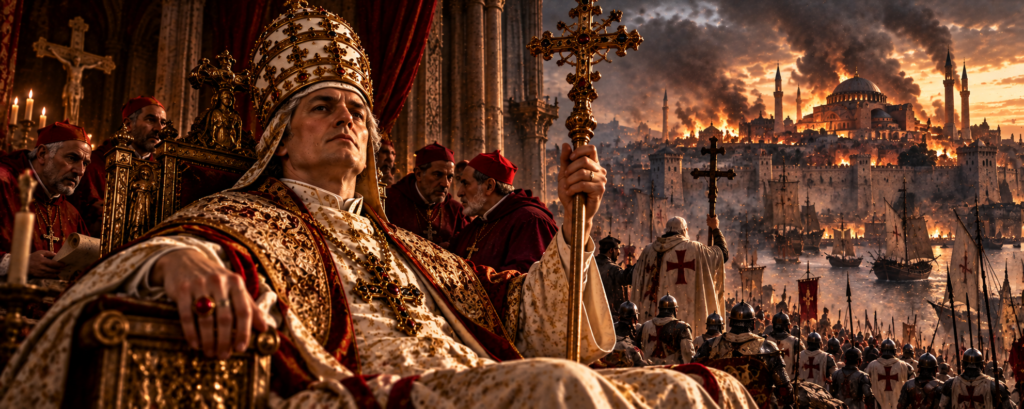
Innocent III: The Pope Who Made Kings Tremble and Christendom Bleed
Innocent III — 1198–1216
When Innocent III became pope in January 1198, he did not inherit the kind of papacy that merely blessed kings, settled theological disputes, and watched Europe’s rulers make history from a safe distance. He believed the pope stood at the summit of Christian society, entrusted with responsibilities that could reach into kingdoms, marriages, wars, disputed crowns, rebellious cities, and the souls of rulers who considered themselves answerable to no earthly superior. During the next eighteen years, he would excommunicate kings, place entire realms under interdict, intervene in imperial elections, organize crusades, attack heresy, reshape papal government, and preside over one of the greatest councils of the medieval Church. By the time he died in 1216, the papacy had reached heights of political authority that few of his predecessors could have imagined and few of his successors could permanently maintain.
Innocent was not a Benedict IX, John XII, or Stephen VI. There are no credible tales of him turning the papal palace into a den of sexual excess, digging up corpses for grotesque trials, or buying Saint Peter’s throne from a predecessor. He was intelligent, disciplined, theologically serious, administratively gifted, and deeply convinced that he was serving God. Yet those qualities did not make his pontificate gentle, because Innocent’s vision of papal responsibility was so expansive that religious conviction could become a justification for extraordinary coercion.
Under Innocent, the Fourth Crusade set out for the Muslim-controlled Holy Land and instead became entangled in debt, Venetian strategy, dynastic intrigue, and rebellion until crusaders stormed and brutally sacked Christian Constantinople in 1204. Innocent had not ordered that catastrophe and repeatedly opposed attacks upon fellow Christians, yet he had called the crusade, struggled unsuccessfully to control it, and eventually accepted much of the new political and ecclesiastical order created from its conquest. In southern France, his struggle against Cathar heresy moved even closer to direct responsibility when the murder of a papal legate helped trigger the Albigensian Crusade, a war in which towns were stormed, populations were slaughtered, territories were confiscated, and religious repression became inseparable from conquest.
His pontificate therefore presents a different kind of darkness. Innocent III was formidable not because he treated religion as meaningless, but because he took his understanding of religion, papal authority, and Christian order with extraordinary seriousness. He believed souls could be endangered by heresy, kings could threaten the Church through disobedience, and the pope possessed both the right and the duty to intervene when Christian society went astray. Once those assumptions were accepted, coercion could become not merely permissible but righteous.
That makes Innocent an unsettling figure for the Wicked Popes category. He was one of the greatest medieval popes by conventional measures of institutional achievement, yet some of the most devastating episodes of medieval religious warfare unfolded under his authority. His story is not about private depravity hiding beneath sacred robes. It is about what can happen when an exceptionally capable man acquires enormous power and becomes convinced that exercising it is a sacred obligation.
The Young Nobleman Who Became Pope
The future Innocent III was born Lotario dei Conti di Segni, probably in 1160 or 1161, into an aristocratic family from central Italy. His family connections gave him access to the elite world surrounding Rome, but his later rise cannot be explained by birth alone. Lotario received an impressive education, studying theology in Paris and law at Bologna, two of the great intellectual centers of medieval Europe. The combination would prove exceptionally useful for a man who came to understand the papacy through both theological principle and legal authority.
Paris exposed him to the increasingly sophisticated theological culture of the twelfth century. Bologna immersed him in canon law, the developing system through which the medieval Church defined rights, obligations, jurisdiction, marriage, discipline, and institutional authority. Innocent’s later pontificate would display both influences constantly. He could think like a theologian while governing like a lawyer.
His ecclesiastical career advanced under Pope Clement III, who was related to him. Lotario became a cardinal deacon in 1190, placing him within the inner circle of Roman church government while he was still relatively young. During the pontificate of Celestine III, however, his political prominence appears to have diminished, perhaps because of factional differences within the curia. He used at least some of that period for writing and reflection rather than disappearing from ecclesiastical life.
Among his best-known early works was De Miseria Condicionis Humane, usually rendered as On the Misery of the Human Condition. The work dwelt intensely upon human frailty, sin, bodily corruption, suffering, and death. It should not be read as a simple psychological key explaining every later decision, since meditations on human misery belonged to a broader medieval religious tradition. Nevertheless, it reveals a churchman profoundly conscious of judgment, mortality, and the gulf between earthly pride and divine authority.
When Celestine III died on January 8, 1198, the cardinals elected Lotario as his successor. He was only in his late thirties, exceptionally young for a pope, and had not yet been ordained a priest. He was ordained and consecrated in the necessary stages before assuming the full functions of the office. Taking the name Innocent III, he entered the papacy with energy, education, aristocratic confidence, and an extraordinarily elevated conception of what his office meant.
A Pope Above Princes
Innocent inherited centuries of developing claims about papal primacy, but he pushed those claims with unusual force and consistency. He regarded the pope as the successor of Saint Peter and the supreme spiritual authority within western Christendom. That did not mean he believed every king was simply a papal official or that the pope directly governed every secular kingdom. It did mean that he considered papal intervention legitimate whenever spiritual questions, sin, ecclesiastical rights, or the welfare of Christian society were involved.
One of the concepts associated with Innocent’s thought was the pope acting as the vicarius Christi, the vicar of Christ. The phrase itself was not entirely his invention, but its increasing prominence reflected the exalted papal monarchy developing around his office. Innocent’s language about papal authority could be breathtaking, particularly when he compared relationships between spiritual and temporal power. Modern readers should resist reducing a complex medieval constitutional worldview to a slogan, yet there is no doubt that Innocent believed the Roman pontiff possessed exceptional authority.
He also understood power practically. Papal letters traveled across Europe, legates represented Rome in distant courts, judges-delegate heard disputes under papal authority, and canon law offered mechanisms through which the pope could intervene far beyond Italy. Excommunication could isolate an individual from the sacramental community, while an interdict could suspend many public religious services across a territory. These were spiritual weapons, but in a society where religion permeated political legitimacy and daily life, their political effects could be devastating.
Innocent used those weapons against rulers. He intervened in disputes involving France, England, the Holy Roman Empire, Sicily, and other territories. He did not always win, and rulers could resist him for years, but no European monarch could safely assume that a conflict with Innocent would remain a private disagreement. The pope could transform a political dispute into a crisis of legitimacy.
This is central to understanding both his achievements and his place among the Wicked Popes. Innocent’s power did not rest primarily upon personal armies large enough to conquer Europe. It rested upon an institution capable of making obedience to Rome a matter of salvation, law, diplomacy, and political legitimacy simultaneously. He wielded that institution with remarkable confidence.
Philip Augustus and the Marriage Rome Would Not Ignore
One of Innocent’s early confrontations involved King Philip II Augustus of France. Philip had married Ingeborg of Denmark in 1193 but almost immediately attempted to have the marriage annulled. The reasons for his sudden rejection of her remain uncertain and have generated considerable speculation. What is clear is that Philip subsequently married Agnes of Merania while Ingeborg was still alive and while Rome continued to regard his marriage to Ingeborg as valid.
The dispute had begun before Innocent’s pontificate, but Innocent inherited it and refused to let it disappear. Marriage was a sacrament and therefore fell squarely within ecclesiastical jurisdiction. A king could not simply discard a wife because political or personal circumstances had changed. Innocent demanded that Philip separate from Agnes and restore Ingeborg to her proper status.
Philip resisted, forcing Innocent to escalate the confrontation. In 1200, a papal interdict was imposed over the king’s lands, restricting public religious services and placing enormous pressure upon the monarchy. The punishment did not fall solely upon Philip. Ordinary people experienced the consequences of a struggle between pope and king, which demonstrates the unsettling collective nature of medieval ecclesiastical sanctions.
The strategy eventually forced movement. Philip outwardly reconciled with Ingeborg sufficiently for the interdict to be lifted, although his treatment of her remained deeply problematic and the marital dispute continued for years. Agnes died in 1201, but Ingeborg did not immediately enjoy a normal married life with the king. Innocent continued pressing the issue.
The episode demonstrated how seriously Innocent took papal jurisdiction over Christian rulers. Philip was one of the most powerful kings in Europe, yet Innocent was willing to place his kingdom under spiritual pressure over the treatment of a queen. To admirers, this was a pope protecting sacramental marriage against royal selfishness. To critics, it revealed an authority capable of making entire populations bear the consequences of a ruler’s disobedience.
Both interpretations capture part of the reality. Innocent defended a woman whom a powerful king wanted to discard, but he did so using a weapon that affected countless people who had no control over Philip’s marriage. Papal power could protect the vulnerable and coerce the innocent through the same mechanism. That tension would recur throughout his pontificate.
The Crusade Innocent Wanted
Crusading occupied a central place in Innocent’s vision of Christian leadership. Jerusalem had fallen to Saladin in 1187, and although the Third Crusade had recovered important coastal territories, the Holy City remained outside Latin Christian control. Innocent wanted another major expedition capable of reversing that loss. He began preaching what became the Fourth Crusade soon after his election.
The pope attempted to place the expedition under strong ecclesiastical direction. He issued appeals, offered indulgences, sought financial support, and tried to mobilize nobles across western Europe. Major monarchs were preoccupied by their own wars and political struggles, so the leadership fell largely to powerful barons rather than kings. That absence would shape everything that followed.
The crusaders eventually negotiated with Venice for transportation across the Mediterranean. The Venetians agreed to construct and provide a vast fleet in return for a substantial payment. When the crusading army assembled in 1202, however, far fewer men arrived than expected, leaving the crusaders unable to pay the enormous sum promised to Venice. The expedition suddenly found itself financially dependent upon Venetian cooperation.
Doge Enrico Dandolo offered a solution. The crusaders could help Venice attack Zara, a Christian city on the Dalmatian coast that had rebelled against Venetian control, and the outstanding debt could be postponed. The proposal placed the crusaders in direct conflict with the purpose Innocent had given their expedition. They had taken the cross to fight for the Holy Land, not to conquer Christians for Venice.
Innocent explicitly opposed an attack on Christian territory. Zara was also connected with King Emeric of Hungary, who had himself taken the cross, making the proposed assault even more troubling. The pope warned against the action, but the crusading army was trapped by debt and dependent upon Venetian ships. In November 1202, the crusaders attacked and captured Zara anyway.
The expedition had barely begun, and Innocent had already lost effective control over it.
Zara: The First Betrayal of the Crusade
The attack on Zara revealed the dangerous gap between papal intention and crusading reality. Innocent had summoned the expedition and provided its spiritual framework, but he could not command thousands of armed men as though they were a disciplined papal army. The crusaders had financial obligations, political leaders, and strategic dependencies of their own. Venice possessed the fleet upon which the entire expedition depended.
When Innocent learned that Zara had been attacked, he reacted with anger. He excommunicated the crusaders responsible, although he later absolved many of the non-Venetian participants so that the expedition could continue toward its original goal. His response demonstrates clearly that the assault was not part of his intended crusading plan. It also reveals the dilemma created by his determination to preserve the crusade after it had already violated his orders.
The Venetians were treated more severely because their political interests had driven the diversion. Yet the crusaders remained dependent upon Venetian transport, making any clean separation nearly impossible. Innocent could condemn what had happened while still hoping that the army might finally proceed toward Muslim territory. His spiritual authority had collided with logistical reality.
Then another temptation appeared. A Byzantine prince named Alexios Angelos offered the crusaders extraordinary rewards if they helped restore his deposed father, Isaac II Angelos, to the imperial throne in Constantinople. The promises reportedly included enormous financial payments, military assistance for the crusade, and submission or reconciliation of the Greek Church with Rome. For an army drowning in debt, the proposal was extraordinarily attractive.
Innocent did not authorize the crusaders to overthrow the Byzantine government. He warned against attacks upon Christians except under narrowly defined circumstances and remained deeply suspicious of the diversion. Yet the army’s leaders accepted the Byzantine proposal. The crusade that had already attacked Zara now turned toward the greatest Christian city in the eastern Mediterranean.
The road to Constantinople was not a straight line drawn by Innocent III. It was a chain of debt, political bargaining, Venetian interests, dynastic intrigue, and decisions taken by crusading leaders despite papal warnings. Nevertheless, Innocent had created the crusading enterprise and continued trying to preserve it even as control slipped from his hands. The catastrophe that followed would forever remain part of the history of his pontificate.
Constantinople
Constantinople in 1203 was one of the great cities of the medieval world. It was the capital of the Byzantine Empire, filled with churches, palaces, relics, wealth, ancient monuments, and centuries of imperial history. Relations between Latin western Christians and Greek Byzantine Christians had deteriorated through theological disputes, political rivalry, cultural hostility, and memories of previous violence. The Fourth Crusade brought those tensions together inside an armed expedition already willing to attack fellow Christians.
The crusaders arrived and attempted to install Alexios Angelos, whose promises had helped lure them eastward. Military pressure eventually contributed to the flight of Emperor Alexios III, while the blinded former emperor Isaac II was restored and his son became co-emperor Alexios IV. The crusaders now expected the enormous payments and support they had been promised. The restored regime quickly discovered that fulfilling those promises was extraordinarily difficult.
Raising money intensified hostility inside Constantinople. Latin influence around the imperial government became increasingly unpopular, while religious tensions worsened. Violence between Greeks and Latins erupted, and fires devastated sections of the city. The crusaders found themselves trapped outside a capital whose population increasingly hated both them and the rulers they had restored.
Early in 1204, a palace revolution destroyed the arrangement. Alexios IV was overthrown and killed, while Alexios V Doukas emerged as emperor. The crusaders regarded the new regime as hostile and considered the promises made to them voided by violence. They prepared for another attack.
In April 1204, crusader forces stormed Constantinople. What followed became one of the most infamous episodes in medieval Christian history. Soldiers looted churches, houses, palaces, and religious institutions while precious objects, relics, artworks, and wealth were seized or destroyed.
Accounts of the sack describe sexual violence, killing, sacrilege, and widespread plunder. Some details vary among sources, and hostile rhetoric must always be handled carefully, but the fundamental brutality of the sack is beyond serious dispute. Christian crusaders who had taken vows to fight for the Holy Land devastated one of Christianity’s greatest cities. The expedition had reached the exact opposite of its proclaimed purpose.
Innocent’s Anger—and His Compromise
Innocent’s reaction to the sack of Constantinople is essential to judging his responsibility fairly. He did not order the sack, and he expressed outrage at the crusaders’ treatment of fellow Christians. In letters responding to events, he condemned acts of violence, greed, and sacrilege that had damaged the possibility of genuine church reconciliation. He recognized that brutality committed by Latins could deepen Greek hostility toward Rome rather than heal the division.
This matters because it would be historically false to portray Innocent as gleefully directing the destruction from Rome. The crusaders had repeatedly departed from his instructions, first at Zara and then in their Byzantine intervention. The sack was the product of decisions taken by military and political leaders operating far beyond effective papal control. Innocent’s authority, enormous in theory, had proven painfully limited when confronted with an armed expedition dependent upon Venice and driven by its own interests.
Yet the story does not end with condemnation. Once Constantinople had fallen, the crusaders created the Latin Empire and redistributed Byzantine territories among western conquerors. Latin ecclesiastical structures were imposed upon conquered regions, and the possibility of bringing the Greek Church under Roman authority suddenly appeared politically real. Innocent faced the choice between rejecting the conquest entirely or attempting to shape the new order.
He ultimately accommodated much of what had happened. He recognized the new political reality and sought to organize Latin ecclesiastical authority within the conquered territories. The pope who had condemned the methods could still see potential religious advantages in the outcome. That accommodation complicates any simple portrait of Innocent as an innocent bystander.
The conquest also inflicted a wound upon relations between eastern and western Christians that would endure for centuries. The schism between Rome and Constantinople had deeper roots and cannot be blamed solely upon 1204, but the sack became a powerful memory of Latin aggression. Attempts to establish unity through conquest produced resentment rather than reconciliation. Innocent understood at least part of that danger, yet his papacy became permanently associated with the disaster.
The Fourth Crusade therefore reveals both the reach and limits of his power. Innocent could summon a crusade and define its spiritual purpose, but he could not control every army that answered his call. He could condemn atrocities after they occurred, yet he was willing to work with the political order those atrocities created. His responsibility was real but indirect, complicated by repeated acts of disobedience he had explicitly opposed.
A Different War Begins in Southern France
If Constantinople demonstrates the limits of Innocent’s responsibility, the Albigensian Crusade brings him much closer to the center of events. Southern France contained religious movements that church authorities regarded as heretical, most famously the Cathars. Cathar beliefs varied and are difficult to reconstruct entirely through hostile inquisitorial and ecclesiastical sources, but many Cathars embraced forms of dualism that sharply contradicted orthodox Catholic teaching. Church authorities considered the movement a grave threat.
The region presented a political as well as religious challenge. Local nobles often tolerated Cathars, protected relatives or subjects accused of heresy, or resisted outside ecclesiastical pressure. The culture and political organization of Languedoc differed significantly from the more centralized monarchy developing in northern France. Attempts to suppress heresy therefore became entangled with questions of local autonomy and territorial ambition.
Innocent initially pursued reform and preaching rather than immediately declaring war. Papal legates were sent into the region, clergy were urged to improve their conduct, and efforts were made to debate or convert heretics. Innocent understood that corrupt or unimpressive Catholic clergy could undermine the Church’s credibility. The later success of Dominic and his companions as preachers emerged within this broader struggle.
The results disappointed Rome. Cathar communities survived, while powerful nobles remained resistant to papal demands. Count Raymond VI of Toulouse became a particular source of frustration because Innocent’s representatives believed he failed to suppress heresy effectively. The conflict between Raymond and the papal legates became increasingly bitter.
In 1207, Raymond was excommunicated by the papal legate Peter of Castelnau. The following year, Peter was murdered after a confrontation connected with the count. The identity and motives of the killer remain uncertain, and Raymond denied ordering the assassination. Innocent nevertheless regarded the murder as an intolerable escalation.
The death of a papal legate transformed the conflict. Innocent called upon Christian warriors to take up arms against the heretics and those accused of protecting them. The Albigensian Crusade was beginning.
The Albigensian Crusade
Innocent’s call offered crusading privileges to warriors who campaigned in southern France. This was a significant development because crusading warfare, originally associated particularly with the eastern Mediterranean and the recovery or defense of holy places, was now being directed against people inside western Christendom. Heresy had become an enemy against which the machinery of holy war could be mobilized. The implications were enormous.
Northern French nobles responded, and military ambition quickly intertwined with religious purpose. Lands confiscated from defeated southern lords could be redistributed, creating obvious incentives for conquest. Simon de Montfort emerged as the most formidable military leader of the crusade. Under his leadership, the campaign became both a war against heresy and a struggle for territorial domination.
The first great horror came at Béziers in July 1209. The crusading army demanded that the town surrender suspected heretics, but the population resisted. When fighting erupted and crusaders entered the city, a massacre followed. Contemporary reports vary dramatically in their casualty figures, and the largest medieval numbers are generally regarded as exaggerated, but substantial killing unquestionably occurred.
The notorious statement often translated as “Kill them all; God will know his own” has traditionally been attributed to the papal legate Arnaud Amalric. The phrase comes from Caesarius of Heisterbach, writing years later, and its authenticity cannot be established. It should therefore not be presented as a securely documented command uttered at Béziers. The massacre itself requires no invented or uncertain quotation to make it horrifying.
Catholics as well as suspected Cathars died in the violence. Medieval armies storming a resisting town could become brutally indiscriminate once defenses collapsed. The crusading framework added a terrifying religious dimension because the enemy population had already been associated with heresy and resistance to the Church. Béziers became a symbol of what could happen when religious condemnation and military conquest merged.
Innocent did not personally command soldiers through the streets of Béziers. He had, however, authorized the crusading campaign that brought the army there. Unlike Constantinople, where crusaders had repeatedly defied his explicit instructions, southern France was a theater of war created directly through papal policy. The distinction is crucial when evaluating his responsibility.
Carcassonne and the Rise of Simon de Montfort
After Béziers, the crusading army moved toward Carcassonne. The city faced siege conditions during the heat of summer, with water shortages worsening the suffering inside. Viscount Raymond Roger Trencavel attempted to negotiate but ended up in crusader custody. Carcassonne surrendered, and its inhabitants were expelled rather than massacred on the scale associated with Béziers.
Trencavel died in captivity later that year. His death generated suspicions and accusations, but there is insufficient evidence to claim confidently that he was murdered. What is certain is that his territories became available for redistribution. Simon de Montfort emerged as the principal beneficiary.
Montfort was an experienced nobleman and committed crusader who became the military engine of the campaign. He received lands taken from defeated southern lords and pursued the war with determination. Religious warfare and personal lordship now reinforced one another. Every victory against alleged protectors of heresy could expand Montfort’s territorial power.
This development created problems even for Innocent. A crusade called to suppress heresy was becoming a vehicle for political conquest. Local nobles who might not themselves be Cathars could lose territories because they were accused of tolerating heretics or resisting crusading authority. The distinction between spiritual correction and territorial dispossession became increasingly blurred.
Innocent sometimes attempted to moderate excesses or reconsider particular confiscations. His correspondence reveals a pope trying to manage a campaign whose political consequences were becoming enormous. Yet he had deliberately created the framework within which conquest could be rewarded. Once armed nobles were promised spiritual benefits and territorial opportunities, papal attempts at restraint faced powerful competing incentives.
The Albigensian Crusade therefore exposes a recurring problem in Innocent’s exercise of authority. He could create institutions of coercion more easily than he could control every consequence they produced. The crusading ideal transformed local religious conflict into international holy war. After that transformation, moderation became far more difficult.
Heresy, Fear, and the Medieval Mind
Modern readers can easily underestimate how seriously Innocent and his contemporaries regarded heresy. For Innocent, Cathar teaching was not simply an alternative philosophy that could be tolerated within a pluralistic society. Heresy endangered souls, disrupted Christian unity, rejected authoritative teaching, and threatened the social order built around the Church. If false doctrine led people away from salvation, allowing it to spread could appear profoundly irresponsible.
That worldview helps explain Innocent’s actions without excusing every consequence. He did not need to hate southern French people personally to authorize coercion against them. He could believe sincerely that suppressing heresy was an act of protection. The terrifying element lies precisely in the ability of sincere conviction to legitimize violence.
Catharism also challenged fundamental Christian doctrines as understood by the medieval Catholic Church. Many Cathar groups rejected or radically reinterpreted the material world, sacraments, ecclesiastical hierarchy, and other elements central to Catholic life. Their ascetic elite, often called the perfecti, could attract admiration through austere religious discipline. Catholic clergy whose own behavior appeared worldly or corrupt could struggle to compete with that example.
Innocent understood that repression alone would not solve the problem. He supported preaching and ecclesiastical reform, recognizing that Catholic credibility mattered. The eventual rise of the Dominican movement reflected this emphasis upon trained, mobile preaching capable of confronting heresy intellectually and pastorally. Innocent’s policies therefore combined persuasion with coercion rather than relying exclusively upon warfare.
The existence of peaceful methods makes the decision to authorize crusading warfare more significant, not less. Innocent eventually concluded that preaching and negotiation were insufficient when political authorities refused to cooperate. Once he reached that conclusion, military force became a legitimate instrument of religious policy. The result was years of warfare whose victims extended far beyond committed Cathar believers.
Understanding the medieval worldview is necessary for historical fairness. Judging Innocent solely by modern assumptions would obscure why intelligent and devout contemporaries supported him. Yet historical understanding does not require pretending that devastation becomes less devastating because the people responsible believed they were saving souls.
Raymond VI: The Count Who Would Not Stay Defeated
Count Raymond VI of Toulouse became one of the central political figures in the crusade. His relationship with Innocent was complicated by repeated excommunications, reconciliations, promises, accusations, and renewed conflict. Raymond was not simply a Cathar commander fighting Catholicism. He was a Catholic noble whose willingness or ability to suppress heresy within his territories was repeatedly questioned by papal representatives.
After Peter of Castelnau’s murder, Raymond faced enormous pressure. He submitted to humiliating public penance in 1209 and joined the crusading movement sufficiently to protect himself temporarily. The reconciliation did not last. Distrust between Raymond and the crusaders remained profound.
Simon de Montfort’s growing territorial ambitions made the political stakes increasingly obvious. If Raymond were permanently condemned as a protector of heresy, his lands could become vulnerable to confiscation. The war was no longer merely about eliminating Cathar communities. It was becoming a struggle over who would rule southern France.
Innocent sometimes hesitated over the increasingly aggressive treatment of Raymond. Papal policy could shift as new reports reached Rome, and the pope did not simply approve every action taken by Montfort and the legates. At moments, Innocent appeared concerned that the crusade had moved beyond its proper religious objective. Yet his attempts to restrain the process were inconsistent and often ineffective.
The conflict eventually drew in King Peter II of Aragon, who had interests and vassal relationships north of the Pyrenees. Peter was a celebrated Christian ruler who had participated in the great victory over Muslim forces at Las Navas de Tolosa in 1212. His involvement on Raymond’s side demonstrated how far the Albigensian conflict had moved beyond a simple war between Catholics and heretics. Catholic rulers could now find themselves fighting crusaders authorized by the pope.
At Muret in 1213, Simon de Montfort defeated the opposing coalition, and Peter II was killed. The victory dramatically strengthened Montfort and weakened Raymond. A crusade launched against heresy had helped destroy a Catholic king on a battlefield in Christian Europe.
Innocent and the Crown of England
While southern France burned, Innocent was fighting another extraordinary political battle with King John of England. The conflict began over the election of an archbishop of Canterbury after the death of Hubert Walter in 1205. Competing groups advanced different candidates, while John wanted his own choice. Innocent eventually rejected the disputed alternatives and supported Stephen Langton, a respected theologian and cardinal.
John refused to accept Langton. Innocent responded in 1208 by placing England under interdict. Public religious life was severely restricted, although the precise implementation varied and essential sacraments continued in certain circumstances. Once again, a disagreement between pope and ruler imposed spiritual consequences upon an entire kingdom.
John retaliated against church property and clergy. Innocent escalated further by excommunicating the king in 1209. By 1212, the confrontation had become so severe that Innocent declared John deposed or released his subjects from obligations of obedience in language that threatened the king’s political survival. Philip II of France was encouraged toward action that could have resulted in invasion.
John eventually capitulated in 1213. In one of the most extraordinary reversals of medieval kingship, he surrendered his kingdoms of England and Ireland to papal authority and received them back as papal fiefs, agreeing to pay an annual tribute. The king who had defied Innocent became, formally, the pope’s vassal. Innocent had transformed confrontation into a dramatic assertion of papal supremacy.
The arrangement soon produced an ironic reversal. When English barons rebelled against John and forced him to accept Magna Carta in 1215, Innocent defended the king. Because John was now a papal vassal, the barons’ coercion threatened papal rights as well as royal authority. Innocent annulled Magna Carta, condemning the circumstances under which it had been imposed.
Modern admiration for Magna Carta can make Innocent’s action appear particularly reactionary, but he was responding within a different political framework. He saw a sworn papal vassal being coerced by rebellious subjects and a settlement imposed without papal consent. Nevertheless, the episode illustrates the enormous reach of his claims. The pope who had once threatened John with deposition now used papal authority to protect John’s monarchy against his own barons.
Kings Beneath the Shadow of Rome
Innocent’s interventions in England and France were not isolated demonstrations. He involved himself deeply in the contested succession to the Holy Roman Empire after the death of Emperor Henry VI. Rival candidates Philip of Swabia and Otto of Brunswick struggled for the German crown, and Innocent treated the dispute as one in which papal interests and rights were directly engaged. His support shifted as political circumstances changed.
Initially, Innocent favored Otto, who made extensive promises concerning papal territories and imperial relations with the Church. Otto was eventually crowned emperor by Innocent in 1209. The alliance deteriorated almost immediately when Otto pursued policies in Italy that threatened papal interests. Innocent excommunicated the emperor he had helped elevate.
The pope then supported Frederick II, the young king of Sicily and son of Henry VI. Frederick’s rise created its own dangers because the papacy feared being geographically trapped between imperial territories in northern Italy and the Kingdom of Sicily in the south. Innocent nevertheless calculated that Frederick represented the best means of defeating Otto. Papal strategy once again involved manipulating the balance of secular power.
Otto’s fortunes collapsed after his defeat at the Battle of Bouvines in 1214, where forces aligned with Philip II of France defeated a coalition including the emperor. Frederick’s position strengthened dramatically. Innocent had helped shape another imperial succession, although the long-term consequences would extend beyond his lifetime. Frederick II would later become one of the papacy’s most formidable enemies.
These interventions reveal Innocent at the height of papal monarchy. Kings and emperors were not puppets, and Innocent could not simply command Europe at will. Yet his support, condemnation, excommunication, and recognition could alter the legitimacy of rulers. Few popes had ever intervened so confidently across so many kingdoms.
His defenders could point to his role as mediator and guardian of Christian order. His critics could see a priest claiming extraordinary authority over rulers whose subjects would suffer when conflicts escalated. Both perspectives help explain why Innocent inspired admiration and fear. He made the papacy impossible for Europe’s political elite to ignore.
The Fourth Lateran Council
In 1215, Innocent summoned the Fourth Lateran Council, one of the most important church councils of the Middle Ages. Hundreds of bishops, abbots, representatives, and ecclesiastical dignitaries gathered in Rome. The council addressed doctrine, clerical discipline, ecclesiastical reform, heresy, crusading, marriage, education, and many other aspects of Christian life. It represented the administrative and ideological culmination of Innocent’s pontificate.
The council famously affirmed language concerning the Eucharist that included the term later associated with transubstantiation, expressing the belief that bread and wine become the body and blood of Christ. It required Christians to confess their sins and receive communion at least annually. It issued reforming measures concerning clergy and attempted to improve ecclesiastical education and discipline. Innocent’s Church was not concerned only with political domination; it also sought to regulate and reform Christian religious life at an extraordinary level of detail.
The council also strengthened measures against heresy. Secular rulers were expected to assist in suppressing heretics, and failure to do so could bring severe consequences. The framework helped deepen the connection between religious orthodoxy and political obligation. The machinery used in southern France was becoming part of a broader institutional approach.
The council’s treatment of Jews is among the darker aspects of its legacy. Canon 68 required Jews and Muslims in Christian lands to be distinguished by their dress, although the exact implementation varied greatly across regions and later periods. Other provisions addressed public office and relations between religious communities. These measures contributed to a legal environment in which Jewish communities could be increasingly marked as socially separate.
It would be inaccurate to project every later persecution of European Jews backward onto Innocent personally. Medieval papal policy toward Jews was complex and could include protections against forced conversion and unauthorized violence alongside discriminatory restrictions. Innocent himself operated within that contradictory tradition. Nevertheless, measures approved under his leadership helped institutionalize distinctions that could reinforce exclusion.
The Fourth Lateran Council demonstrates why Innocent cannot be evaluated only through warfare. His influence reached deeply into doctrine, sacramental practice, law, clerical administration, interfaith relations, and everyday Christian obligations. He was constructing a more organized and authoritative Church. The same institutional strength capable of reform could also become a formidable instrument of coercion.
The Crusade Innocent Never Lived to See
The Fourth Lateran Council also prepared for another expedition to the Holy Land, later known as the Fifth Crusade. Innocent had never abandoned his desire to recover Jerusalem. The catastrophe of the Fourth Crusade had not destroyed his belief in crusading as a legitimate and necessary Christian enterprise. Instead, he sought to organize the next expedition more carefully.
He attempted to improve financing, preaching, coordination, and ecclesiastical oversight. Lessons had supposedly been learned from the failures of the previous crusade. The pope wanted a campaign less vulnerable to private diversion and political manipulation. Whether such control was realistically possible remained another question.
Innocent would not live to see the expedition depart. He died at Perugia in July 1216 while traveling in Italy. He was approximately fifty-five or fifty-six years old and had ruled for more than eighteen years. His death ended one of the most consequential pontificates of the Middle Ages.
A later story associated with Jacques de Vitry describes Innocent’s corpse in strikingly humiliating circumstances after death, allegedly stripped of valuable burial garments by thieves or attendants. Such accounts carry obvious moral symbolism and should be approached cautiously rather than treated as transparent reportage. Medieval writers often delighted in showing powerful men reduced by death to the same helplessness as everyone else. For a pope who had written so intensely about human misery and mortality, the image proved irresistible.
Innocent’s crusading ambitions continued after him. The Fifth Crusade eventually targeted Egypt as the strategic route toward recovering Jerusalem, but it too ended in failure. The dream of directing Christendom toward a unified sacred war remained far easier to proclaim from Rome than to control on distant battlefields.
His death therefore closed a pontificate without closing the projects he had created. Wars, legal structures, political settlements, and reform movements continued. The machinery of papal monarchy survived the man who had driven it with such extraordinary energy.
Was Innocent Responsible for Constantinople?
Any fair judgment of Innocent must distinguish between responsibility for initiating the Fourth Crusade and responsibility for the specific decision to sack Constantinople. Innocent unquestionably called the crusade and helped create the religious movement that placed the army in the eastern Mediterranean. He therefore belongs to the causal history of the expedition. Yet he did not instruct the crusaders to conquer Constantinople.
His opposition to attacks on Christians was genuine. He condemned the assault on Zara and attempted to prevent further diversions. He did not approve the crusaders’ initial decision to become involved in Byzantine dynastic politics. The final sack occurred far beyond his direct control.
It would therefore be inaccurate to write that Innocent “ordered the sack of Constantinople.” He did nothing of the sort. Crusading leaders, Venetian interests, Byzantine political struggles, financial desperation, and military decisions on the ground produced the catastrophe. Historical responsibility must be distributed accordingly.
Yet Innocent cannot be separated completely from what followed. He had helped sanctify an armed movement whose participants possessed powerful incentives of their own. After the conquest, he accommodated the Latin political and ecclesiastical structures established in Byzantine territory. His condemnation of the violence existed alongside acceptance of significant benefits created by victory.
That contradiction is historically important. Innocent could be horrified by sacrilege while believing that the resulting opportunity for church union should not simply be abandoned. From his perspective, providence might still draw spiritual benefit from sinful human actions. From the Byzantine perspective, such distinctions offered little comfort after churches had been plundered and an empire partitioned.
The Fourth Crusade therefore belongs in Innocent’s story as a warning about the limits of authorized violence. A pope could summon warriors under sacred vows, define their purpose, threaten disobedience, and still discover that armies develop their own momentum. Once thousands of armed men were mobilized beneath the language of holy war, papal intentions were only one force among many.
Was Innocent Responsible for the Albigensian Bloodshed?
The Albigensian Crusade requires a more direct answer. Innocent authorized the campaign against heresy and those accused of protecting it. He offered crusading privileges and helped transform a regional religious conflict into a major military enterprise. The warfare therefore cannot be dismissed as an accidental distortion of his intentions in the same way that the sack of Constantinople can.
That does not mean Innocent personally ordered every massacre. Medieval warfare routinely exceeded the intentions of distant political authorities, and crusading armies contained nobles pursuing their own ambitions. Simon de Montfort’s territorial expansion sometimes troubled Rome. Papal policy could be more hesitant and complicated than the actions of crusading commanders suggest.
Nevertheless, the framework of holy war came from papal authority. Innocent decided that military force could legitimately be mobilized against heresy within Christian Europe. He helped create the circumstances in which conquered lands could pass to crusading lords. Violence was not an accidental side effect entirely contrary to the campaign’s design; coercive military action was part of the design itself.
The scale of suffering is difficult to quantify precisely. Medieval chroniclers often exaggerated casualty figures, and modern estimates vary. Towns were nevertheless attacked, populations displaced, property seized, and people killed across years of warfare. The political map of southern France was transformed.
The campaign also established precedents for the increasingly systematic suppression of heresy. The medieval Inquisition in its developed form belongs primarily to the decades after Innocent’s death and should not simply be attributed to him. Yet his policies helped strengthen the assumption that identifying and eliminating heresy was a legitimate institutional responsibility of both church and secular authorities. Later mechanisms would build upon that foundation.
For Innocent, this was defense of Christian society. For the people trapped inside besieged towns, dispossessed territories, and devastated communities, theological justification did not make the consequences less real. The distance between those perspectives defines much of the darkness of his reign.
The Pope Who Could Humble a King
Perhaps no episode demonstrates Innocent’s political power more vividly than the submission of King John. A monarch who had confiscated church property, rejected Stephen Langton, and endured excommunication eventually surrendered his kingdoms to the pope and received them back as a vassal. Medieval symbolism rarely became more dramatic. Saint Peter’s successor had forced a king to acknowledge papal overlordship.
Yet Innocent’s later defense of John reveals that papal power did not consistently align with what modern readers might consider liberty or justice. When John’s barons forced Magna Carta upon him, Innocent viewed the charter through the framework of feudal authority, sworn obligations, and papal rights. He condemned the settlement and declared it invalid. The pope who had restrained royal defiance now restrained baronial resistance.
This does not mean Innocent opposed every limitation upon monarchy as a philosophical principle. Magna Carta emerged from a specific rebellion involving a king who had become a papal vassal, making the conflict unusually personal for Rome. Innocent believed his own rights had been violated along with John’s. His response followed logically from the political settlement of 1213.
The sequence nevertheless illustrates how expansive papal authority had become. Innocent claimed the power to discipline a king, receive a kingdom as a papal fief, protect that king against rebellious subjects, and invalidate a foundational political agreement. Whether every claim could be enforced was another matter. The ambition itself was remarkable.
Innocent’s papacy therefore operated far beyond the sanctuary. His letters and judgments could influence marriages, royal successions, imperial elections, territorial disputes, crusades, and rebellions. Religion and politics were not separate worlds in his imagination. Both belonged within a Christian order for which the pope bore ultimate spiritual responsibility.
That worldview made Innocent extraordinarily effective. It also meant that papal decisions could expose enormous populations to consequences originating in Rome. The greater the authority he claimed, the greater the moral weight attached to how he used it.
The Man Behind the Power
It is tempting to imagine Innocent as a cold political mastermind interested only in domination. The surviving evidence does not support so simple a portrait. He was deeply religious, intellectually serious, concerned with ecclesiastical reform, and capable of supporting new spiritual movements. His pontificate cannot be reduced to crusades and excommunications.
Innocent famously encountered the emerging movement associated with Francis of Assisi, although later stories about the meeting contain legendary embellishments. The precise details of Francis’s visit to Rome are difficult to reconstruct, but Innocent appears to have granted some form of approval to the early Franciscan way of life. The movement emphasized poverty, preaching, humility, and imitation of Christ. Its growth would become one of the most important religious developments of the century.
He also supported other forms of religious renewal and sought better preaching against heresy. Innocent understood that the Church needed credible spiritual leadership rather than coercion alone. He worked to improve clerical discipline and education. His reforming agenda was genuine.
This creates another important contrast. The same pope who could approve a movement built around radical poverty could wield extraordinary political authority over kings. The same pontificate that encouraged preaching could authorize crusading warfare against heresy. Innocent did not experience these policies as contradictions because all served his vision of a properly ordered Christian society.
That vision could be generous when protecting ecclesiastical rights, abandoned spouses, religious communities, or the poor. It could become harsh when confronting anyone defined as a threat to Christian unity. Innocent’s moral universe contained mercy and coercion without requiring him to choose permanently between them. Both could be instruments of pastoral responsibility.
This complexity is why calling him simply “evil” explains very little. Innocent’s historical significance lies precisely in the fact that intelligence, piety, reforming energy, and coercive power existed together. The unsettling question is not how a monster acquired papal authority. It is how a highly capable religious leader came to believe that immense authority was necessary for the salvation and order of Christian society.
Power Without Debauchery
Many notorious popes are remembered through stories of private vice. Innocent offers almost none of the usual material. There is no credible tradition of mistresses filling the Lateran, drunken banquets consuming papal revenues, or illegitimate children receiving kingdoms from their father. His scandal is institutional rather than sexual.
That distinction makes his inclusion among Wicked Popes particularly valuable. A corrupt pope does not need to be personally debauched if the consequences of his policies are enormous. Innocent’s decisions could help determine whether kingdoms received sacraments publicly, whether rulers retained political legitimacy, whether armies marched under crusading privileges, and whether populations accused of heresy faced military attack. His reach was vastly greater than that of many popes whose private behavior was far worse.
He also represents the danger of competence. An incompetent pope might possess grand ambitions but lack the administrative ability to realize them. Innocent understood law, diplomacy, theology, patronage, and political strategy. He knew how to use the growing machinery of papal government.
His successes therefore strengthened the institution he controlled. Papal correspondence expanded, legal appeals flowed toward Rome, legates represented papal authority abroad, and rulers negotiated seriously with the curia. The pope increasingly appeared not merely as bishop of Rome but as the central governor of Latin Christendom. Innocent pushed that model closer to reality than almost any predecessor.
Yet every expansion of authority increased the consequences of error. A mistaken parish priest could harm a community. A mistaken pope claiming jurisdiction across Europe could help unleash a war. Innocent’s greatness and his darkness came from the same source: the extraordinary scale upon which he believed he was entitled to act.
The High Point of Papal Monarchy
Historians often describe Innocent III’s pontificate as a high point of medieval papal power, although the phrase should not imply that he exercised uncontested sovereignty over Europe. Kings resisted him, crusaders disobeyed him, Roman politics remained difficult, and distant events could escape his control. His authority was formidable but never absolute. Even at its height, medieval papal monarchy depended upon negotiation, cooperation, reputation, law, and local enforcement.
Nevertheless, Innocent’s achievements were remarkable. He influenced imperial succession, humbled King John, pressured Philip Augustus, expanded papal administration, presided over the Fourth Lateran Council, promoted crusading, confronted heresy, and intervened across Europe. Few medieval rulers possessed such a broad geographical range of concerns. Fewer still could claim spiritual authority over the very rulers with whom they negotiated.
His conception of office helped shape later papal claims. The pope stood not simply within Christian society but, in crucial respects, above its competing political powers as guardian of spiritual order. When rulers sinned publicly or threatened ecclesiastical interests, Innocent believed intervention could become necessary. The boundaries between spiritual correction and political supremacy were consequently difficult to define.
That ambiguity allowed papal power to expand dramatically. Almost any major political dispute could contain a spiritual dimension if oaths, marriage, ecclesiastical property, crusading vows, heresy, or public sin were involved. Innocent did not need to claim ordinary administrative control over every kingdom. He needed only to establish that spiritual consequences justified papal intervention.
The system worked spectacularly at times. John submitted, Philip compromised, and imperial candidates sought papal recognition. Yet the same system depended heavily upon the personality and political skill of the pope. Later pontiffs would discover that claims created under a master strategist were not always easy to enforce.
Innocent’s pontificate therefore resembles a summit. From that height, the papacy appeared capable of directing Christian Europe. The view was magnificent, but the drop on every side was enormous.
The Cost of Certainty
The darkest thread running through Innocent’s reign is certainty. He possessed a coherent understanding of Christian society in which truth mattered eternally, heresy endangered souls, sacraments structured life, rulers had moral obligations, and the pope bore responsibility for defending the Church. Within that worldview, refusing to act could itself become sinful. Power was not merely a privilege but a burden requiring exercise.
This helps explain why Innocent could use coercion without seeing himself as abandoning pastoral responsibility. Excommunication was intended to correct as well as punish. Interdict could pressure a ruler toward repentance. Crusading warfare could be understood as defense of the faith.
The problem appears when certainty meets fallible human institutions. Papal legates could make mistakes, crusaders could pursue land, rulers could manipulate accusations, and armies could slaughter people who had little connection with theological disputes. Once coercive machinery existed, its consequences could exceed the intentions of the authority that created it. Constantinople demonstrated this spectacularly.
Southern France demonstrated something darker still because violence there remained connected to the original papal objective. Innocent wanted heresy suppressed and authorized armed force when other methods failed. He might object to excesses, disputed confiscations, or particular political ambitions, but he did not reject the fundamental premise of the crusade. Religious certainty had made warfare inside Christendom legitimate.
The resulting devastation cannot be separated from the theological assumptions behind it. Nor should those assumptions be mocked as merely irrational relics of an ignorant age. Intelligent, educated, sincere people believed them profoundly. That is precisely why they possessed such power.
Innocent’s story therefore raises a question extending beyond medieval Catholicism. What happens when leaders become convinced that the stakes are so high that ordinary restraints must yield? His pontificate offers no simple answer, but it provides an unforgettable warning. Certainty can inspire reform, courage, sacrifice, and justice while also making coercion appear virtuous.
Innocent III Among the Wicked Popes
Innocent III does not belong among the Wicked Popes because he was secretly living a life of personal depravity. There is no need to manufacture scandal where the historical record provides a much more consequential story. His importance lies in the extraordinary concentration and exercise of papal authority during his reign. The darkness is measured in institutions, armies, sanctions, and political consequences rather than bedroom gossip.
His responsibility for the Fourth Crusade must be stated carefully. He called the expedition but did not order its attacks on Zara or Constantinople. He condemned significant aspects of those actions and understood that violence against eastern Christians damaged hopes for genuine reunion. Blaming him personally for every atrocity of 1204 would be historically misleading.
His responsibility for the Albigensian Crusade is considerably more direct. He authorized military action against heresy and its alleged protectors, attached crusading privileges to the campaign, and helped create the religious framework within which northern warriors invaded southern France. He did not order every massacre, and he sometimes attempted to moderate political excesses. Nevertheless, the war itself formed part of his policy.
His use of interdict and excommunication likewise reveals both admirable and troubling dimensions. Innocent defended Ingeborg against a king who wanted to cast her aside, yet his pressure affected an entire kingdom. He challenged King John’s interference with the English Church, yet later defended that same king against Magna Carta once John became a papal vassal. Papal authority could switch from resistance to monarchy to protection of monarchy depending upon the institutional interests involved.
The Fourth Lateran Council similarly combined reform with exclusion. It strengthened sacramental practice, clerical discipline, and ecclesiastical organization while also intensifying measures against heresy and approving discriminatory rules affecting Jews and Muslims. Innocent’s Church was becoming more organized precisely as it became more capable of defining and policing boundaries. Institutional strength carried both possibilities simultaneously.
His place in Wicked Popes should therefore be understood as a study of power rather than depravity. Innocent was frightening not because he lacked principles. He was frightening because he possessed powerful principles, immense ability, and an office increasingly capable of turning those principles into political reality.
The Pope Who Wanted to Govern Christendom
Innocent’s ambitions were never merely personal. He did not build papal authority simply to enrich the Conti family or indulge private appetites. He believed Christendom required order and that the Roman Church possessed a unique responsibility for maintaining it. His political interventions followed from that conviction.
This makes his reign fundamentally different from those of popes whose scandals were rooted in nepotism or personal excess. Innocent’s power had an ideological architecture. Canon law, theology, crusading doctrine, papal primacy, sacramental discipline, and political strategy all supported one another. His pontificate became a system rather than a collection of impulses.
That system could achieve things medieval Christians considered admirable. It could restrain a king who mistreated his lawful wife, promote reform among clergy, encourage preaching, recognize new religious movements, and call rulers toward peace. Innocent was capable of thinking beyond local Roman politics toward the condition of the entire Latin Church. His administrative talent gave substance to that vision.
The same system could also identify communities as enemies of Christian order and mobilize force against them. It could punish populations through interdict, threaten rulers with deposition, and make religious conformity a matter of political obedience. Once the pope became guardian of an entire Christian society, almost every major dispute could become papal business. The potential for coercion expanded alongside the potential for reform.
Innocent therefore represents papal monarchy at its most intellectually confident. He did not merely seize opportunities as they appeared. He possessed a theory explaining why Rome should intervene. That theory gave extraordinary coherence to his actions.
It also made retreat difficult. A pope who believed he had responsibility for Christian order could not easily watch disorder and declare it someone else’s problem. Innocent’s greatest strength was his refusal to be passive, and some of his darkest legacies emerged from exactly the same refusal.
A Legacy Written in Fire and Law
Innocent III left behind no single legacy because his pontificate touched too many parts of medieval life. Canon lawyers remember the development of papal jurisprudence and government. Church historians remember the Fourth Lateran Council. Histories of England encounter him through King John, Stephen Langton, and Magna Carta.
Histories of crusading cannot escape him. The Fourth Crusade began under his authority and ended in Constantinople despite his attempts to prevent its diversion. The Albigensian Crusade was launched under his authority and transformed southern France. Plans for the Fifth Crusade occupied his final years.
His pontificate also shaped the relationship between papal and secular power. Innocent demonstrated how excommunication, interdict, feudal claims, diplomatic recognition, and ecclesiastical jurisdiction could be combined. Kings could resist, but resistance carried risks. Rome had become a political force capable of operating across borders.
The institutional consequences outlived him. Later popes inherited stronger claims and more sophisticated administrative machinery. They also inherited enemies increasingly suspicious of papal interference. The very success of Innocent’s model encouraged future confrontations.
His legacy therefore contains the seeds of later papal weakness as well as medieval papal strength. The more Rome claimed, the more rulers had reason to resist. A system dependent upon exceptional authority could provoke exceptional opposition. Innocent mastered the game better than many of his successors.
Yet the human cost remains the most difficult part of the legacy to ignore. Behind the councils, letters, treaties, and canonical arguments stood burned towns, conquered territories, frightened communities, displaced families, and bodies on battlefields. Medieval institutions recorded principles more easily than suffering. A modern history of Innocent has to remember both.
When Sacred Power Became Terrifying
Innocent III died in 1216 as one of the most powerful popes the medieval Church had ever produced. He had confronted kings, influenced emperors, organized crusades, fought heresy, reshaped papal administration, defended ecclesiastical jurisdiction, and presided over a council whose decisions would influence Catholic life for centuries. He had transformed the papacy into something far more formidable than the scandal-ridden Roman prize it had sometimes appeared to be in earlier centuries. Few pontificates demonstrate more clearly how far the office of pope had traveled.
That achievement is precisely why Innocent belongs in a darker history of the papacy. His story cannot be dismissed as another tale of a corrupt individual disgracing his office through private appetite. Innocent strengthened the office. He made it more organized, more respected, more legally sophisticated, and more capable of projecting authority across Europe.
The question is what happened when that strengthened authority encountered resistance. Philip Augustus discovered that a marital dispute could place his kingdom under interdict. King John discovered that an argument over Canterbury could end in excommunication and the surrender of his kingdoms as papal fiefs. Southern French nobles discovered that tolerating people Rome regarded as heretics could expose their territories to crusading conquest.
The people of Constantinople encountered another consequence of papal power, although in a more indirect and tragic form. Innocent summoned warriors for a sacred expedition and discovered that he could not control where those warriors went. He condemned their attacks on Christians, but his warnings could not reverse the sack once it happened. The crusade he wanted became something he had never intended.
That distinction matters enormously. Innocent should not be accused of ordering the sack of Constantinople, because he did not. His letters demonstrate disapproval of the crusaders’ diversions and outrage over their conduct. Historical judgment becomes meaningless when responsibility is exaggerated merely to make a dramatic story darker.
Yet the failure still belongs to his pontificate. Innocent had helped create a form of warfare endowed with extraordinary spiritual legitimacy. Crusaders marched believing that their vows possessed religious meaning and that their expedition existed within a sacred framework. Once debt, politics, greed, and military necessity redirected that army, papal authority proved unable to pull it back.
Constantinople therefore exposed the limits of Innocent’s control. Southern France exposed the danger when his control was more direct. The contrast between the two crusades is one of the most important distinctions in judging his reign.
The Albigensian Crusade was not an unauthorized expedition Innocent repeatedly ordered to stop. It emerged from his deliberate decision to mobilize armed force against heresy and those accused of protecting it. He believed the threat justified extraordinary action. The resulting war would devastate parts of southern France for years.
Béziers became its most infamous symbol. The exact medieval casualty figures cannot be trusted without qualification, and the famous command to kill everyone because God would recognize his own is not securely authenticated. None of those cautions diminishes the underlying event. A town was stormed and a large number of people were killed by an army fighting beneath the banner of crusade.
Carcassonne fell soon afterward, and Simon de Montfort emerged as the dominant crusading lord. Territory changed hands while religious condemnation and political conquest became increasingly difficult to separate. A war supposedly directed against heresy offered material rewards to warriors who defeated southern nobles. Spiritual warfare developed a territorial appetite.
Innocent sometimes recognized the danger. He could question confiscations, reconsider judgments, and worry that crusading leaders were pursuing political ambitions beyond the proper purpose of the campaign. These moments matter because they show that he was not blindly enthusiastic about every atrocity or conquest committed in the Church’s name. They also demonstrate how difficult it was to control machinery he had helped set in motion.
That pattern appears repeatedly across his pontificate. Innocent possessed enormous authority, but authority was never the same as perfect control. Legates interpreted instructions, nobles pursued interests, kings resisted, armies improvised, and distant communities reacted unpredictably. Medieval Europe was far too fragmented for any pope simply to command it from Rome.
Yet Innocent’s response to those limitations was rarely withdrawal. He created more procedures, sent more letters, appointed more legates, invoked more law, and asserted more clearly the responsibilities of his office. His solution to imperfect authority was usually to strengthen authority. That instinct helped create the formidable papal monarchy associated with his reign.
The results could be admirable. Ingeborg of Denmark had little ability to force Philip Augustus to respect their marriage on her own. Innocent’s insistence that sacramental law applied even to kings gave her a powerful institutional defender. A ruler’s desire was not automatically superior to the rights of the wife he wanted to abandon.
Yet the weapon Innocent used against Philip was an interdict affecting far more people than the king. Ordinary Christians became part of the pressure applied to their ruler. Their religious lives could be disrupted because of a royal marriage they had no power to control. The justice of one cause could therefore produce collective consequences of questionable fairness.
The conflict with King John revealed the same complexity on an even larger scale. Innocent defended the Church’s role in selecting the archbishop of Canterbury and resisted royal interference. John retaliated against clergy and church property, escalating the dispute. Innocent responded with interdict, excommunication, and eventually a threat to the king’s political position.
John surrendered. The papacy had won an astonishing victory. England and Ireland became papal fiefs, and the king who had defied Rome accepted a relationship of vassalage toward the pope.
Then the political landscape shifted. When John’s barons rebelled and imposed Magna Carta, Innocent defended the king whose resistance he had previously crushed. The papacy now possessed an interest in preserving John’s authority because John’s kingdom stood within a papal feudal relationship. Innocent annulled the charter and condemned the baronial challenge.
There is no need to force these actions into a simplistic narrative of hypocrisy. Innocent operated within a coherent medieval legal and political framework in which circumstances and relationships mattered. He could oppose John when John violated ecclesiastical rights and defend John when John’s rebellious subjects violated what Innocent regarded as legitimate royal and papal rights. The consistency lay in Innocent’s understanding of authority rather than in permanent loyalty to either kings or rebels.
That understanding placed the papacy near the center of Christian political life. Innocent did not believe rulers possessed unlimited autonomy merely because they wore crowns. Kings could sin, violate oaths, interfere with the Church, mistreat spouses, or endanger Christian order. When they did, Innocent believed the pope could have a duty to intervene.
The implications were enormous because almost every political action could eventually touch spiritual concerns. Royal marriages involved sacramental law. Imperial elections affected papal security. Treaties involved oaths, while crusading vows created ecclesiastical obligations.
Heresy threatened salvation itself. Once spiritual jurisdiction expanded into these areas, the boundary around papal intervention became extraordinarily wide. Innocent occupied that territory with greater confidence than almost any pope before him.
The Fourth Lateran Council represented the institutional culmination of his vision. The council did not merely celebrate papal authority; it attempted to reform Christian society systematically. Clerical behavior, theological doctrine, sacramental practice, heresy, education, marriage, crusading, and relations with religious minorities all came under consideration. The Church was becoming more administratively ambitious.
Many of those reforms would leave lasting positive legacies within Catholic life. Requirements surrounding confession and communion strengthened sacramental expectations. Measures concerning clerical education and discipline addressed genuine problems. Innocent wanted a Church capable of teaching effectively and governing responsibly.
Yet the council also reveals the harder edges of the same project. Heresy was treated not merely as mistaken belief but as a threat requiring coordinated suppression. Secular rulers were expected to cooperate. Religious boundaries could be reinforced through discriminatory regulations affecting Jews and Muslims.
This combination should prevent any easy judgment of Innocent as either great reformer or sinister tyrant. He was unquestionably a reformer, and he was capable of coercive policies whose consequences were devastating. The categories overlap because the medieval project of reform itself could include enforcement of conformity. Innocent did not see contradiction where modern readers often do.
His treatment of new religious movements makes the complexity even clearer. The pope associated with crusading warfare against Catharism could also recognize the spiritual promise of Francis of Assisi and his companions. He understood that voluntary poverty and preaching could revitalize Christian life. His Church possessed room for dramatic religious innovation when that innovation accepted ecclesiastical authority.
The boundary was obedience and orthodoxy. Reform operating within the Church could receive encouragement. Religious movements judged heretical could face escalating pressure and eventually armed suppression. Innocent’s tolerance was therefore neither meaningless nor unlimited.
His world was built around a conviction that truth possessed objective and eternal significance. If a belief endangered salvation, allowing it to spread could seem cruel rather than tolerant. If a king violated divine law, refusing to correct him could appear irresponsible. If Jerusalem remained outside Christian control, crusading could appear an act of religious duty.
Modern readers do not have to share those assumptions to understand them. Historical accuracy requires taking Innocent’s beliefs seriously rather than reducing them to excuses for greed. He was not secretly indifferent to Christianity while manipulating religion for political gain. Everything about his career suggests that religion was central to how he understood the world.
That sincerity makes the consequences more disturbing. A cynical leader knows that sacred language is a tool. A sincere leader may believe that using power is a moral obligation.
Innocent belonged overwhelmingly to the second category. He could exercise enormous authority without imagining himself as power-hungry in the ordinary sense. The papal office, in his understanding, required intervention because Christendom required guidance.
That conviction made him extraordinarily difficult to resist. A ruler negotiating with Innocent was not dealing merely with another prince seeking territory. He was confronting a pope capable of interpreting political resistance as a spiritual problem. The dispute could therefore move from diplomacy into excommunication, interdict, or crusading rhetoric.
The consequences extended far beyond palaces. When rulers and popes fought, ordinary people experienced suspended services, taxation, warfare, confiscation, displacement, and uncertainty. Institutional struggles at the top of medieval society could descend rapidly into everyday suffering. Innocent’s pontificate demonstrates that process repeatedly.
The Albigensian Crusade remains the clearest example. Innocent wanted to destroy heresy, not southern France for its own sake. Yet destroying heresy through military conquest inevitably placed communities, castles, towns, and political structures in the path of armies.
Those armies contained men with motives beyond theology. Some wanted land, advancement, prestige, adventure, or political influence. Religious authorization did not erase those ambitions. It gave them a sacred framework within which to operate.
Simon de Montfort embodied the convergence. He could regard himself as a crusader while simultaneously becoming the beneficiary of conquered territories. His military victories advanced the anti-heretical campaign and his own lordship. Separating those motives becomes almost impossible.
Innocent occasionally tried to separate them from Rome. He wanted heresy suppressed without allowing every crusading ambition to become legitimate. Yet the distinction was easier to write into letters than enforce on battlefields. Once land became available through conquest, political interests developed around keeping it.
The pope therefore confronted a recurring truth about coercive institutions. The authority that creates them does not necessarily control everyone who benefits from them. Incentives multiply, agendas diverge, and violence develops momentum. Innocent was powerful enough to unleash forces he was not always powerful enough to restrain.
That does not absolve him. It increases the importance of asking what responsibilities accompany the creation of such forces. Innocent believed the threat of heresy justified crusading warfare. The suffering that followed belonged partly to the consequences of that judgment.
The same principle should be applied more cautiously to Constantinople because Innocent explicitly opposed the diversion. His responsibility there lies more in the broader crusading system and his later accommodation of the conquest than in direct authorization. Distinguishing these levels of responsibility makes the historical judgment stronger rather than weaker. Innocent’s record is dark enough without assigning him crimes he did not command.
His achievements are equally impossible to deny. He strengthened papal government, advanced ecclesiastical law, confronted abuses, promoted preaching, presided over a monumental council, and made Rome a central diplomatic power. By the standards of medieval institutional history, his pontificate was extraordinary.
That is precisely why the word “wicked” needs nuance when applied to him. Innocent was not wicked because every action he took was cruel. He was not wicked because he lacked intelligence or morality. He was not wicked because lurid personal scandals filled his private life.
He belongs in the category because the immense exercise of his authority repeatedly crossed into coercion with lethal consequences. His papacy demonstrates how religious power can become dangerous without personal debauchery. Indeed, competence and conviction can make power more consequential than vice ever could.
A drunken pope can embarrass an institution. A violent aristocratic pope can terrorize a city. A pope like Innocent III could reshape kingdoms.
He could make a king fear excommunication. He could make another king surrender his realm. He could call warriors from distant lands and promise spiritual rewards for taking up arms.
He could define heresy as a danger requiring military suppression. He could summon a council whose laws reached into the religious lives of millions. Few medieval popes possessed such a combination of ideological confidence and practical ability.
Innocent’s own writings remind us that he understood earthly greatness as temporary. Before becoming pope, he had meditated upon the misery of human existence, the corruption of the body, and the certainty of death. The man who later stood above kings knew intellectually that every ruler eventually became dust. His own death in 1216 proved the point.
Yet institutions outlive bodies. Innocent’s laws, precedents, crusades, political interventions, and conceptions of papal authority continued after his burial. The consequences of power survive the person who exercised it.
Southern France did not instantly recover from the Albigensian wars. Relations between eastern and western Christians did not heal when Innocent condemned the sack of Constantinople. England’s political crisis did not end when he annulled Magna Carta.
The papacy itself did not retreat from the claims his pontificate had strengthened. Later popes inherited both the prestige and the conflicts produced by his model. The struggle between universal papal aspirations and powerful secular states would continue for generations.
Innocent III therefore left behind something more complicated than either triumph or disgrace. He demonstrated what medieval papal monarchy could accomplish at its height. He also demonstrated the price of attempting to make an entire Christian society conform to a single authoritative vision.
His life offers no convenient monster to hate. That would make the story easier. Instead, it offers an educated, disciplined, serious man who believed profoundly in the truth of his religion and the responsibilities of his office.
He could protect a discarded queen because he believed kings were subject to Christian marriage law. He could encourage Franciscan poverty because he recognized genuine religious renewal. He could demand reform from clergy because he understood that a corrupt Church undermined its own mission.
He could also authorize a crusade in southern France because he believed heresy threatened souls. He could impose interdicts because he believed spiritual pressure could correct rulers. He could accept political advantages created by a conquest whose brutality he had condemned.
These were not separate personalities. They belonged to the same pope and emerged from the same understanding of authority. Innocent believed Christian society possessed an objective order and that the papacy had been entrusted with defending it.
That belief made him one of the greatest popes of the Middle Ages.
It also made him one of the most frightening.
The paradox should remain intact because removing either side distorts the man. Innocent III was neither merely a blood-soaked fanatic nor merely a brilliant statesman unfairly blamed for events beyond his control. He was a brilliant statesman whose policies sometimes contributed directly to bloodshed and sometimes escaped his control in catastrophic ways.
His greatness magnified his mistakes. His sincerity magnified his certainty. His authority magnified the consequences of both.
That is the reason his name belongs beside the darker figures of papal history even though his private life offers little of their sensational scandal. Wickedness in power does not always arrive drunk, lustful, or obviously corrupt. Sometimes it arrives educated, disciplined, legally sophisticated, and absolutely convinced that it has a duty to act.
Innocent III reached toward an extraordinary vision of Christian unity. He wanted kings governed by moral law, clergy worthy of their offices, heresy defeated, Jerusalem recovered, and the Church organized beneath Roman leadership. It was an ambitious vision, and parts of it inspired genuine reform.
The cost appeared wherever people refused to fit inside that vision. Kings faced spiritual punishment, dissident believers faced persecution, rebellious territories faced crusading armies, and entire populations could become leverage in conflicts between rulers and Rome. Authority intended to preserve unity could produce division and violence.
The sack of Constantinople remains the most spectacular warning about the limits of that authority. Innocent called a crusade and watched it escape him. He condemned the destination it ultimately reached, but condemnation could not rebuild the city or erase the memory of Latin soldiers looting Christian churches.
The Albigensian Crusade provides the opposite warning. There, papal authority did not merely lose control of an unrelated diversion. Innocent deliberately authorized the use of crusading force against heresy. The resulting devastation showed what his vision could look like when spiritual judgment was translated into military action.
Together, the two crusades frame the contradiction of his reign. One showed that even the most powerful pope could not control everything done beneath a sacred banner. The other showed what could happen when the pope himself decided that the banner should be carried into war.
Innocent III died before the full consequences of either story had unfolded. The Cathar conflict continued, the political transformation of Languedoc deepened, and the Latin occupation of Constantinople endured until 1261. Later generations inherited memories he could no longer interpret or defend.
History therefore judges him from a distance he never possessed. We can see that the papal monarchy he strengthened would encounter fierce resistance. We can see that coercive suppression of religious difference would develop further after his death. We can see that the dream of Christian unity often produced new divisions.
Innocent could see only the responsibilities immediately before him. He acted with a confidence rooted in faith, law, education, and the immense prestige of his office. That confidence made him extraordinarily effective.
It also made restraint difficult.
The most unsettling thing about Innocent III is therefore not that he was secretly worse than he appeared. It is that he may have been almost exactly what he appeared to be: a deeply serious pope, convinced of his responsibilities, determined to reform the Church, and prepared to use enormous power to defend what he believed was true. His pontificate demonstrates that personal sincerity offers no guarantee against destructive consequences.
Some Wicked Popes disgraced the throne of Saint Peter because they treated it too lightly. They turned it into family property, a source of wealth, a stage for vendettas, or a vehicle for private pleasure. Innocent III presents the opposite danger.
He took the throne with immense seriousness.
He believed its authority mattered.
He believed its responsibilities reached across Christendom.
He spent eighteen years proving how much a pope could do when he acted upon those beliefs. Kingdoms bent, emperors negotiated, crusaders marched, councils legislated, and enemies of the Church discovered that spiritual condemnation could be followed by very earthly force. The papacy had rarely seemed more powerful.
That power left achievements worthy of admiration and wounds impossible to ignore. Innocent III’s legacy cannot be reduced to either one. The same hands that strengthened medieval church government helped set machinery of coercion into motion, while the same voice that condemned the desecration of Constantinople had summoned the crusading movement from which the disaster emerged.
He was not the most debauched pope in history.
He was something far more consequential.
Innocent III was a pope who believed that enormous power could be used in the service of sacred truth, and for eighteen extraordinary years much of Europe was forced to live with the consequences. His reign remains one of medieval history’s clearest demonstrations that power does not become harmless merely because the person wielding it believes his cause is righteous. When spiritual certainty, political ambition, legal authority, and armed force converge in a single institution, the line between shepherding souls and ruling lives can become frighteningly thin.