
Basil II: The Bulgar-Slayer — Byzantium’s Ruthless Warrior Emperor and the Terrifying Price of Victory
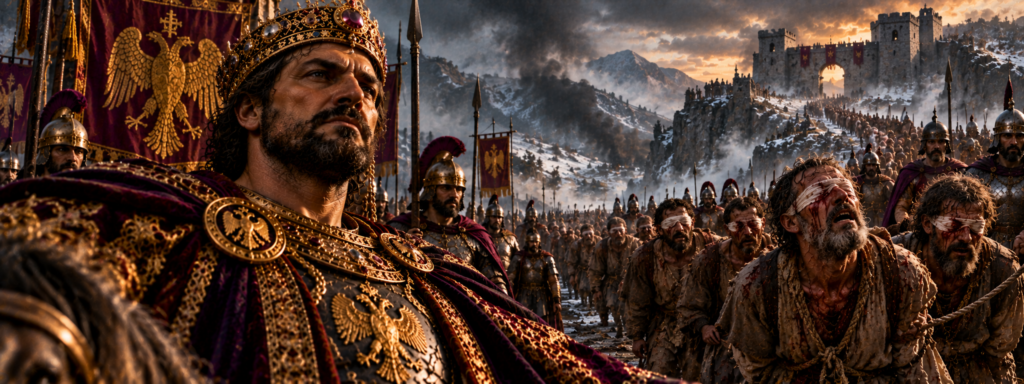
He ruled the Byzantine Empire for nearly fifty years, defeated some of its most dangerous enemies, crushed powerful aristocratic rebellions, and transformed Constantinople into the center of a formidable imperial state. Basil II was disciplined, relentless, and extraordinarily determined, a ruler who spent much of his adult life campaigning rather than enjoying the luxuries of the palace. Yet his greatest military triumph became inseparable from one of the most disturbing stories in medieval warfare. After defeating a Bulgarian army at the Battle of Kleidion in 1014, Basil allegedly ordered thousands of prisoners blinded, leaving one partially sighted man for every hundred captives to guide the others home. According to the Byzantine historical tradition, the sight of the mutilated survivors devastated Bulgaria’s ruler, Samuel, who died shortly afterward. The precise number of prisoners and the details of their punishment remain disputed, but the episode helped establish Basil’s enduring reputation as the Bulgar-Slayer. His reign raises a troubling question: how should history remember an emperor whose military achievements restored imperial power but whose victories could come at an appalling human cost?
The Emperor Who Sent an Army Home Without Its Eyes
In the summer of 1014, the mountains separating Byzantine territory from the Bulgarian heartland became the setting for a decisive confrontation. For decades, Emperor Basil II had fought to dismantle the Bulgarian state, pursuing a campaign that consumed enormous resources and much of his adult life. His opponent, Samuel of Bulgaria, had resisted through mountain defenses, fortified settlements, and repeated military campaigns. The conflict had become a struggle not merely over disputed territory but over the political future of the Balkans.
Near the village of Kleidion, in the region of the Struma River, Bulgarian forces attempted to block the Byzantine advance. Samuel’s troops had constructed defensive barriers across a narrow mountain passage, exploiting terrain that made a direct assault difficult. Basil’s army encountered determined resistance, and the position initially proved difficult to overcome. The confrontation threatened to become another exhausting engagement in a war that had already lasted for decades.
The Byzantine commander Nikephoros Xiphias eventually found a way around the Bulgarian defenses. His forces moved through difficult mountain terrain and attacked the defenders from behind while Basil pressed them from the front. The Bulgarian position collapsed, and large numbers of soldiers were captured. Samuel escaped, but his army suffered a devastating defeat.
What happened afterward became one of the most infamous episodes in Byzantine history.
According to the eleventh-century historian John Skylitzes, Basil ordered the captured Bulgarians blinded. The chronicler states that approximately 15,000 prisoners were mutilated, with one man in every hundred left with a single eye so that he could guide the others back to Samuel. The account describes the Bulgarian ruler suffering a fatal collapse after seeing the returning soldiers, although Samuel’s death occurred weeks after the battle rather than immediately.
The story has been repeated for centuries, often as an unquestioned historical fact. Yet historians must distinguish the central event from the precise details supplied by later narratives. Skylitzes wrote decades after the battle, and the figure of 15,000 prisoners may be exaggerated. The exact proportion blinded and the arrangement of guides cannot be independently confirmed. Some modern scholars also question whether the punishment occurred on the scale traditionally described.
Nevertheless, the account reflects a historical reputation for exceptional severity in Basil’s Bulgarian campaigns. The emperor pursued victory through relentless military pressure, destruction of enemy strongholds, and the systematic reduction of Bulgarian resistance. His government combined battlefield success with political calculation, seeking not simply to defeat Samuel but to eliminate Bulgaria as an independent rival.
The blinding story became the defining image of his reign. It overshadowed administrative achievements, diplomatic successes, and the extraordinary political struggles through which Basil had secured his throne. To later generations, the emperor appeared as a ruler capable of remarkable discipline and terrifying punishment.
Yet Basil had not begun his reign as an invincible conqueror. His early years were marked by humiliation, rebellion, and the constant danger of losing his crown.
Born Into the Purple: A Child of the Macedonian Dynasty
Basil was born in 958, the son of Emperor Romanos II and Empress Theophano. His family belonged to the Macedonian dynasty, which had ruled the Byzantine Empire since the ninth century and presided over a period of significant political and cultural revival. Constantinople remained one of the wealthiest and most sophisticated cities in the medieval world. Its imperial court combined Roman political traditions with Greek language, Orthodox Christianity, and elaborate ceremonial practices.
The Byzantine Empire of Basil’s childhood was considerably stronger than it had been during some earlier centuries. Its armies had recovered territory in the eastern Mediterranean, while administrative reforms and economic development supported renewed imperial expansion. Yet the state remained vulnerable to military rivals and internal political competition. Powerful generals controlled armies capable of influencing succession, while aristocratic families possessed estates and networks of supporters throughout Anatolia.
Basil’s father, Romanos II, became emperor in 959 after the death of Constantine VII. His reign was relatively brief but witnessed important military successes, including the Byzantine reconquest of Crete in 961 under the general Nikephoros Phokas. The island had been controlled by a Muslim emirate for more than a century and served as a base for maritime raids. Its recovery strengthened Byzantine security in the eastern Mediterranean.
Romanos died unexpectedly in March 963, leaving Basil and his younger brother Constantine as children. Basil was approximately five years old, far too young to exercise independent authority. Their mother Theophano assumed a prominent role in the government, but the political situation was unstable. The empire’s powerful military commanders possessed resources that could determine who controlled the throne.
Nikephoros Phokas, celebrated for his victories against Muslim powers, emerged as the dominant figure. He was proclaimed emperor by the army and entered Constantinople, where he married Theophano. The marriage strengthened his legitimacy by connecting him to the Macedonian dynasty. Basil and Constantine retained their imperial titles, but effective authority belonged to their stepfather.
The arrangement demonstrated a recurring feature of Byzantine politics. Dynastic legitimacy mattered enormously, yet military power could determine who actually governed. Child emperors could remain on the throne while adult rulers exercised authority in their names. Such arrangements preserved continuity but created opportunities for ambitious generals.
Basil grew up within this environment of ceremonial prestige and political uncertainty. He possessed the title of emperor, but he had little control over the government. His childhood was shaped by men who commanded armies and could seize power through force.
The lessons would prove decisive when he eventually attempted to rule independently.
The Palace of Assassins: Nikephoros Phokas and John Tzimiskes
Nikephoros II Phokas ruled from 963 until 969, pursuing aggressive military campaigns against Muslim powers in the east. His government achieved important victories, including the recovery of Cilicia and Antioch. These successes strengthened Byzantine influence and expanded imperial territory. Yet Nikephoros also faced opposition over taxation, military expenditure, and his increasingly unpopular court.
His marriage to Theophano became entangled in a conspiracy that ended with his assassination. In December 969, a group of conspirators entered the imperial palace and murdered Nikephoros. The plot involved the general John Tzimiskes, who subsequently seized the throne. Theophano’s precise role has been debated, but contemporary and later sources implicate her in the conspiracy.
The murder exposed the vulnerability of even successful military emperors. Nikephoros had commanded victorious armies and expanded imperial territory, yet he was killed inside the palace he controlled. Political survival depended on relationships with courtiers, military officers, and powerful families. A ruler could dominate foreign enemies while remaining exposed to betrayal at home.
John I Tzimiskes became emperor after the assassination, but his accession required political negotiation. Patriarch Polyeuktos demanded that he distance himself from those implicated in the murder and remove Theophano from power. Theophano was exiled, while Basil and Constantine retained their imperial positions. Tzimiskes thus ruled as senior emperor without eliminating the Macedonian heirs.
Tzimiskes proved an energetic military ruler. He campaigned against the Rus’ in the Balkans and against Muslim powers in the east, extending Byzantine influence through successful operations. His victories contributed to the military strength Basil would eventually inherit. Yet his government also reinforced the dominance of powerful generals over the young dynastic emperors.
Basil spent his adolescence watching successive military rulers exercise authority that nominally belonged to his family. He witnessed the consequences of palace conspiracy, the importance of military loyalty, and the fragility of imperial legitimacy. These experiences do not allow us to reconstruct his private emotions, but they provide essential context for his later suspicion of aristocratic power.
John Tzimiskes died in January 976. Basil, now approximately eighteen years old, finally faced the opportunity to exercise independent authority. His younger brother Constantine remained co-emperor, but Basil would become the dominant ruler.
The transition was far from secure. The generals who had controlled the empire during his childhood were not prepared to surrender influence without resistance.
A Young Emperor Surrounded by Enemies
When Basil assumed effective power in 976, he inherited a strong but politically divided empire. The Macedonian dynasty possessed considerable legitimacy, and the military successes of Nikephoros Phokas and John Tzimiskes had expanded Byzantine territory. Yet powerful aristocratic families controlled extensive estates and maintained influence over military commands. Their wealth and connections made them potential rivals to the emperor.
Basil initially relied on experienced officials, particularly the powerful eunuch Basil Lekapenos, who had served as a senior administrator under previous emperors. Lekapenos possessed enormous influence within the government and controlled important aspects of imperial administration. His position reflected the importance of palace officials who could manage the machinery of government while emperors concentrated on military affairs. Yet such officials could also become obstacles to independent rule.
The most immediate danger came from military commanders who believed they possessed stronger claims to leadership than the young emperor. Bardas Skleros, an experienced general associated with the eastern armies, emerged as a major rebel. His uprising began in 976 and quickly developed into a serious challenge. Skleros gained support among military units and threatened the imperial government.
Basil’s position was precarious because he lacked the battlefield reputation of his predecessors. He had inherited the throne through dynastic legitimacy rather than personal military achievement. The generals opposing him commanded experienced soldiers and possessed established relationships with provincial elites. Their rebellions threatened to reduce the young emperor to a ceremonial figure or remove him entirely.
The government responded by recalling Bardas Phokas, a member of the powerful Phokas family, to confront Skleros. Phokas had previously been involved in opposition to John Tzimiskes, but he now became an essential defender of Basil’s throne. The arrangement was dangerous because it relied on one ambitious general to defeat another. Nevertheless, the imperial government needed an experienced commander capable of confronting the rebellion.
The conflict continued for several years, devastating parts of Anatolia and consuming military resources. Skleros achieved successes but eventually suffered defeat in 979. His rebellion ended temporarily, allowing Basil to preserve his throne. Yet the victory depended heavily on Bardas Phokas, whose growing power would soon create another crisis.
The young emperor had survived his first major challenge, but he remained surrounded by men whose military authority could threaten his independence.
The Humiliation That Changed Basil’s Reign
Basil’s early military career included a disastrous campaign against Bulgaria in 986. The emperor attempted to capture Serdica, the important fortress city now known as Sofia, but the siege failed. Byzantine forces encountered supply difficulties and determined Bulgarian resistance. Basil eventually ordered a withdrawal, hoping to preserve his army.
The retreat became a catastrophe. Bulgarian forces attacked the Byzantine army near the Gates of Trajan, a mountain pass in present-day Bulgaria. The imperial troops suffered a severe defeat, losing equipment and supplies while retreating through difficult terrain. Basil narrowly escaped capture or death.
The defeat was humiliating for an emperor attempting to establish his military authority. His predecessors had achieved celebrated victories, while his own campaign ended in disaster. The battle demonstrated the dangers of operating in mountainous territory against an enemy familiar with the landscape. It also revealed weaknesses in Byzantine planning and command coordination.
The consequences extended beyond the battlefield. Military defeat damaged Basil’s reputation among aristocratic commanders who already questioned his leadership. Bardas Phokas and Bardas Skleros became involved in renewed opposition, creating a political crisis that threatened the throne. The emperor faced rebellion at home while Bulgaria remained a formidable enemy.
The Gates of Trajan became an important turning point in Basil’s military career. Later historians often portray the defeat as the experience that transformed him into a disciplined and relentless commander. Such interpretations are plausible, but the surviving sources do not provide direct access to his psychological development. What can be established is that Basil’s subsequent campaigns demonstrated greater persistence and attention to military organization.
The emperor would spend years recovering from the consequences of 986. He needed to defeat powerful rebels before he could concentrate on Bulgaria. The struggle for control of the Byzantine state became inseparable from his effort to establish personal military authority.
Basil’s later victories would be built upon the memory of an early defeat that nearly destroyed his reign.
The Rebellion of Bardas Phokas: A Throne Nearly Lost
In 987, Bardas Phokas openly rebelled against Basil II. The general possessed substantial military experience, aristocratic connections, and support among powerful families in Anatolia. His uprising represented one of the most dangerous challenges Basil faced during his reign. The rebellion threatened Constantinople and raised the possibility that another military commander would seize the throne.
Phokas’s forces advanced through Anatolia, while Basil struggled to organize resistance. The emperor faced a difficult strategic situation because rebel armies controlled important territories and could threaten communications. The government needed additional troops capable of confronting experienced Byzantine soldiers. Basil therefore turned toward an unconventional alliance.
He sought assistance from Vladimir, ruler of the Rus’ centered on Kyiv. The agreement involved military support in exchange for a dynastic marriage between Vladimir and Basil’s sister Anna. The arrangement was extraordinary because Byzantine imperial princesses were rarely married to foreign rulers outside carefully controlled diplomatic circumstances. Yet the severity of the rebellion made the alliance attractive.
Vladimir supplied a force traditionally associated with approximately 6,000 warriors, although the exact number is uncertain. These troops contributed to the formation of the imperial bodyguard later known as the Varangian Guard. Their loyalty to the emperor provided an important counterweight to Byzantine military factions. The alliance also became connected to Vladimir’s conversion to Christianity and the Christianization of the Rus’, although the chronology and details remain debated.
Basil used the new forces against the rebels. In 989, Bardas Phokas died during a confrontation near Abydos, apparently after collapsing before battle. The precise cause of his death is uncertain, and later stories suggesting poisoning cannot be established. His death shattered the rebellion’s leadership and allowed Basil to recover control.
Bardas Skleros, who had also renewed his challenge, eventually submitted. Basil negotiated his surrender and reduced the immediate danger from aristocratic military rivals. The emperor emerged from the crisis with greater personal authority and a clearer understanding of the political threat posed by powerful generals.
The rebellions had consumed years of his reign, but their defeat transformed his position. Basil was no longer merely a young dynastic emperor dependent on ambitious commanders. He had survived a series of challenges that could have destroyed his government.
The experience helped shape his later determination to control the military aristocracy and prevent rival families from accumulating excessive power.
The Emperor Who Distrusted the Nobility
Basil’s struggles against Bardas Skleros and Bardas Phokas reinforced his opposition to powerful aristocratic families. These families controlled extensive estates, possessed influence over provincial armies, and could organize rebellions capable of threatening the throne. Their wealth allowed them to maintain private networks of loyalty that competed with imperial authority. Basil regarded such concentrations of power as dangerous to the stability of the state.
The emperor pursued policies intended to strengthen central control and protect the government’s revenue. He sought to limit the expansion of large estates at the expense of smaller landholders, whose taxes and military obligations supported the empire. Earlier emperors had attempted similar measures, but enforcement remained difficult because aristocratic families possessed political influence. Basil’s government continued this struggle with considerable determination.
One important measure was the allelengyon, a fiscal obligation that required wealthy landowners to assume responsibility for certain taxes owed by poorer taxpayers who could not pay. The policy placed additional burdens on powerful property holders and reflected the government’s effort to preserve revenue. It also generated resentment among aristocratic and ecclesiastical landowners. The measure was later abolished after Basil’s death.
Basil also removed influential officials who threatened his independence. In 985, he dismissed Basil Lekapenos, the powerful administrator who had dominated government affairs during his early reign. The dismissal marked an important assertion of personal authority. Basil increasingly controlled appointments and policy without relying on the same network of senior courtiers.
His approach to government emphasized discipline and direct supervision. Later sources portray him as austere, uninterested in elaborate ceremonial display, and deeply committed to military affairs. These descriptions may contain elements of idealization, but they correspond with the broader pattern of his reign. Basil spent extensive periods campaigning and personally directing operations.
His relationship with the aristocracy remained complicated. He needed experienced commanders and administrators to govern a large empire, yet he feared allowing any individual to become too powerful. The resulting system depended heavily on his personal authority. It could function effectively under a determined ruler but might prove difficult to sustain after his death.
Basil’s success against internal rivals gave him the freedom to pursue his greatest military objective: the destruction of Bulgarian resistance.
Bulgaria: The Enemy That Refused to Die
The Bulgarian state had been one of Byzantium’s most formidable rivals for centuries. Its rulers controlled territories across the Balkans and periodically challenged Constantinople’s authority. The conversion of Bulgaria to Christianity in the ninth century created new religious and diplomatic relationships, but it did not eliminate political competition. Warfare continued as both states sought influence over strategic regions.
In 971, John Tzimiskes had conquered important eastern Bulgarian territories and captured the Bulgarian ruler Boris II. The Byzantine government presented the campaign as a major victory, but Bulgarian resistance survived in the western regions. A group of brothers associated with the family of a provincial governor emerged as leaders of the continuing struggle. Among them was Samuel, who eventually became the dominant ruler.
Samuel established a powerful military and political center in the western Balkans. His authority extended over territories in present-day North Macedonia, Albania, Bulgaria, and neighboring regions at different times. He conducted campaigns against Byzantine possessions and attempted to preserve Bulgarian independence. His forces exploited mountainous terrain and fortified settlements to resist imperial armies.
The relationship between Samuel’s state and the earlier Bulgarian monarchy has been debated, particularly in modern national historiography. Contemporary Byzantine sources generally treated Samuel’s realm as Bulgarian, while the geographic center of his power lay in the western Balkans. Modern political disputes have sometimes complicated discussions of its identity. A historically careful account recognizes both the Bulgarian political tradition and the regional complexity of Samuel’s government.
Basil initially struggled to confront Samuel effectively because internal rebellions consumed his attention. The defeat at the Gates of Trajan in 986 demonstrated the strength of Bulgarian resistance and the dangers of campaigning without adequate preparation. Samuel exploited Byzantine weakness to expand his influence. The conflict became increasingly difficult for Constantinople to resolve.
After suppressing the aristocratic rebellions, Basil began a more sustained offensive. His objective was not merely to win individual battles but to dismantle the military and political structures that allowed Samuel to resist. The campaign would require patience, repeated sieges, and control over strategic routes.
The war would dominate the next two decades of Basil’s reign.
A War of Fortresses, Mountains, and Exhaustion
Basil’s campaigns against Bulgaria differed from the dramatic single battles often emphasized in popular histories. Much of the war involved the gradual capture of fortresses, the destruction of defensive positions, and the securing of communications across difficult terrain. Mountain passes, river valleys, and fortified towns determined the movement of armies. Control of these locations allowed the Byzantines to isolate Bulgarian forces and restrict their ability to maneuver.
The emperor personally directed many operations, demonstrating a level of military involvement unusual even among Byzantine rulers. He traveled repeatedly through the Balkans, organizing sieges and supervising the reduction of enemy strongholds. His armies required extensive supplies, particularly when campaigning in regions where local resources had been damaged by prolonged warfare. Logistics became as important as battlefield tactics.
Samuel responded through mobile operations and defensive strategies. Bulgarian forces attacked Byzantine positions when opportunities arose and withdrew into difficult terrain when confronted by superior armies. The conflict therefore became a prolonged struggle of endurance. Neither side could easily achieve a decisive victory without controlling the network of fortresses and routes that sustained resistance.
Basil’s approach gradually produced results. Byzantine forces captured important settlements and strengthened their position in the Balkans. The emperor also exploited divisions among Bulgarian elites, offering terms to those willing to submit. Such arrangements reduced the need for prolonged sieges and weakened Samuel’s political support.
The campaign was not a continuous sequence of victories. Byzantine forces encountered resistance, and Samuel remained capable of organizing effective military operations. The war’s duration demonstrates the resilience of the Bulgarian state. Basil’s eventual success resulted from sustained pressure rather than a single brilliant maneuver.
The human consequences were considerable. Communities experienced repeated military movements, destruction of fortifications, disruption of agriculture, and the burdens of supporting armies. The sources focus primarily on rulers and commanders, leaving ordinary civilians largely invisible. Yet the prolonged conflict would have affected the lives of people throughout the contested regions.
By the early eleventh century, Basil’s armies had steadily reduced Samuel’s territory. The Bulgarian ruler continued resisting, but his strategic options were narrowing.
The decisive confrontation would come in 1014.
Kleidion: The Battle That Became a Legend
The Battle of Kleidion took place on July 29, 1014, according to the traditional chronology. Bulgarian forces occupied a defensive position in a mountain pass near the Struma River, where they had constructed barriers to block the Byzantine advance. The terrain favored defenders because narrow routes limited the ability of a large army to deploy effectively. Samuel hoped to prevent Basil from penetrating deeper into Bulgarian territory.
Basil’s army attacked the position but encountered determined resistance. The fortifications and surrounding mountains made a frontal assault difficult, while Bulgarian soldiers could exploit the natural defenses. The emperor needed an alternative approach to break the stalemate. The situation required coordination between forces operating in challenging terrain.
Nikephoros Xiphias, a Byzantine commander, led troops through mountain routes that allowed them to approach the Bulgarian position from behind. The maneuver was dangerous because movement through unfamiliar terrain could expose soldiers to ambush or exhaustion. Yet it succeeded in placing Byzantine forces beyond the main defensive barriers. The Bulgarians suddenly faced attacks from multiple directions.
The resulting battle ended in a major Byzantine victory. Bulgarian forces were overwhelmed, and many soldiers were captured. Samuel escaped, but the defeat severely weakened his military position. The loss of experienced troops damaged the Bulgarian state’s ability to continue resisting.
The precise number of casualties and prisoners remains uncertain. Medieval chroniclers frequently used large rounded figures to emphasize the scale of victories, and their numbers cannot always be verified. Skylitzes’s account of approximately 15,000 prisoners may reflect exaggeration or a later tradition. Nevertheless, the battle was clearly a significant defeat for Samuel.
The victory also demonstrated Basil’s strategic persistence. He had spent years reducing Bulgarian territory and weakening its defenses, creating conditions in which a successful maneuver could produce decisive results. Kleidion was not an isolated triumph but part of a long campaign of attrition. Its importance lay in the cumulative weakening of Bulgarian resistance.
Yet the battle’s military significance would be overshadowed by the punishment allegedly inflicted upon the prisoners.
The Blinding of the Bulgarian Prisoners
The most notorious account of Basil II concerns the treatment of prisoners captured after Kleidion. John Skylitzes reports that the emperor ordered the Bulgarians blinded, leaving one man in every hundred with a single eye to guide the others home. The traditional figure of 15,000 prisoners has been repeated in countless histories. The story became the foundation of Basil’s reputation as the Bulgar-Slayer.
The punishment was intended to destroy the military usefulness of the captives while sending a powerful message to Samuel and his supporters. Blinding was known in Byzantine political culture as a method of disabling rivals without necessarily killing them. Applied to prisoners of war on the scale described by Skylitzes, it would represent an extraordinary act of collective mutilation. The suffering of the survivors would have extended far beyond the battlefield.
The historical evidence requires caution. Skylitzes wrote several decades after the event, and the precise number of prisoners cannot be independently confirmed. The arrangement of one partially sighted guide for every hundred men has the quality of a memorable narrative detail, which may have been preserved accurately or shaped by later storytelling. Some scholars accept the broad outline of the punishment while questioning its scale; others regard the account with greater skepticism.
The episode also raises questions about Byzantine military practice. Basil was capable of negotiating submissions and incorporating defeated populations into imperial administration, making indiscriminate cruelty an incomplete description of his strategy. His government sometimes offered favorable terms to communities that surrendered. The alleged mass blinding therefore stands out as an especially severe punishment within a broader campaign that combined force and accommodation.
One explanation sometimes offered is that Basil regarded the Bulgarians as rebels against legitimate Roman authority rather than ordinary foreign enemies. The Byzantine government had claimed sovereignty over Bulgaria after the campaigns of John Tzimiskes, while Samuel continued resisting. This interpretation may help explain the ideological framework of the war, but it does not establish Basil’s personal reasoning for the punishment. The sources do not preserve a reliable statement of his motives.
The story’s enduring power lies in its imagery. Thousands of defeated soldiers, deprived of sight and forced to depend on a small number of guides, became a symbol of imperial vengeance. Whether the numbers were exaggerated or not, the narrative shaped how later generations understood Basil’s military achievements. His greatest victory became inseparable from the suffering attributed to his orders.
The next part of the tradition concerns Samuel’s reaction.
Samuel’s Final Days: A King Broken by Defeat
According to Skylitzes, Samuel suffered a devastating reaction when he saw the blinded soldiers returning from Kleidion. The chronicler describes the Bulgarian ruler collapsing after witnessing the condition of his men. Samuel reportedly suffered a severe illness and died on October 6, 1014. The account connects his death emotionally and politically to the catastrophe suffered by his army.
The chronology is important. Samuel did not die immediately after the battle, as some popular retellings suggest. Approximately two months passed between the traditional date of Kleidion and his death. The surviving sources do not provide medical evidence sufficient to determine the precise cause. Claims that he died from a heart attack brought on by grief are interpretations rather than established diagnoses.
Samuel’s death nevertheless represented a major turning point. He had been the central figure in Bulgarian resistance for decades, organizing campaigns and maintaining political authority despite repeated Byzantine offensives. His leadership helped preserve the state after the loss of eastern territories in the tenth century. His death removed an experienced ruler at a moment of severe military weakness.
His son Gavril Radomir succeeded him, but the succession was unstable. Rivalries within the Bulgarian ruling family created opportunities for Byzantine intervention. Ivan Vladislav, a relative with competing claims, eventually murdered Gavril Radomir and seized power in 1015. The internal conflict weakened Bulgarian resistance further.
Basil exploited these divisions while continuing military operations. His armies captured additional fortresses and advanced through contested regions. The emperor also negotiated with local leaders willing to surrender, offering titles and positions within the Byzantine hierarchy. These arrangements reduced opposition and facilitated the eventual incorporation of Bulgarian territories.
The death of Samuel did not immediately end the war. Bulgarian forces continued resisting under successive rulers, demonstrating that the state possessed institutions and loyalties beyond one individual. Yet the strategic situation had changed decisively. Basil now confronted a weakened and divided enemy.
The final collapse would come in 1018.
The Fall of Bulgaria: Basil Completes His Conquest
After Samuel’s death, Bulgarian resistance continued under Gavril Radomir and Ivan Vladislav. Both rulers faced the difficult task of preserving a state weakened by decades of warfare and territorial losses. Byzantine armies maintained pressure on fortresses and communications, while internal rivalries complicated Bulgarian leadership. The struggle became increasingly unfavorable to the defenders.
Ivan Vladislav attempted to resist through military operations and diplomacy. He sought to maintain support among Bulgarian elites and defend remaining strongholds. Yet Basil’s forces continued advancing, capturing important positions and reducing the territory under Bulgarian control. The emperor’s sustained campaign left fewer opportunities for effective resistance.
In 1018, Ivan Vladislav was killed during an attack on Dyrrachium, an important Adriatic city. His death deprived the Bulgarian state of its remaining central leadership. Members of the ruling family and regional aristocracy began negotiating surrender. The Byzantine government offered terms that allowed many elites to retain status and property under imperial authority.
Basil entered Bulgarian territories as the recognized victor. The conquest ended the independent Bulgarian state that had resisted Byzantine expansion for decades. Its territories were incorporated into the empire, although the administrative process involved negotiation and adaptation. Basil did not simply destroy every existing institution.
One important measure concerned the Bulgarian church. The emperor preserved an autonomous archbishopric centered on Ohrid, although its position was now defined within the Byzantine ecclesiastical system. This arrangement helped maintain religious continuity and reduced the danger of resistance. It demonstrated Basil’s willingness to accommodate local institutions when doing so strengthened imperial control.
The conquest also expanded Byzantine influence across the Balkans. Constantinople gained authority over territories that had been contested for generations, improving strategic communications and reducing the immediate threat from Bulgaria. The victory represented one of the most important territorial achievements of the Macedonian dynasty. It strengthened the empire’s position in southeastern Europe.
Yet the human cost of the war remained substantial. Decades of campaigning had disrupted communities, destroyed fortifications, and produced repeated military casualties. The alleged blinding after Kleidion became the most memorable example of suffering, but it was only one episode in a prolonged conflict. The conquest was achieved through persistence, military organization, and the gradual exhaustion of Bulgarian resistance.
Basil had finally accomplished the objective that had dominated much of his reign.
The Bulgar-Slayer: How a Reputation Was Created
Basil II is commonly known as Boulgaroktonos, meaning Bulgar-Slayer. The title has become inseparable from his identity in popular history, appearing in books, articles, and historical summaries. Yet the chronology of the epithet is more complicated than the familiar story suggests. The surviving evidence does not establish that Basil regularly used the title during his lifetime.
The epithet became prominent in later Byzantine historical memory, particularly as the empire confronted renewed conflicts in the Balkans. It celebrated Basil as the conqueror of Bulgaria and a symbol of imperial military strength. The title therefore reflects not only his achievements but also the political needs of later generations. Remembering a victorious emperor could serve as a source of legitimacy and inspiration.
The blinding story contributed enormously to the epithet’s meaning. Later readers associated Basil’s conquest with the punishment inflicted upon prisoners after Kleidion. The narrative transformed military success into an image of terrifying severity. It encouraged interpretations of Basil as a ruler whose determination could cross into extraordinary cruelty.
Yet the conquest of Bulgaria involved more than violence. Basil negotiated submissions, preserved certain local institutions, and incorporated regional elites into the imperial hierarchy. These policies were essential to maintaining control after military victory. A purely destructive approach would have made the administration of conquered territories far more difficult.
The emperor’s reputation therefore contains an important contradiction. He could employ severe military pressure while also demonstrating administrative pragmatism. His government sought to eliminate independent resistance but did not necessarily seek to destroy the population or institutions of conquered regions. The distinction matters when assessing the historical significance of the Bulgarian campaigns.
Modern historians also recognize that medieval rulers were frequently celebrated for acts that later audiences regard as deeply disturbing. Military conquest could enhance legitimacy, while harsh punishment might be interpreted as evidence of strength. The values expressed in contemporary sources do not always correspond to modern ethical expectations. Understanding those differences does not require excusing the suffering described.
Basil’s epithet remains powerful because it captures both the scale of his achievement and the darkness associated with his methods.
Beyond Bulgaria: Campaigns Across the Empire
Although the Bulgarian war dominated Basil’s reputation, his military activities extended far beyond the Balkans. The Byzantine Empire faced continuing challenges along its eastern frontier, particularly in regions bordering Muslim states and Armenian territories. Basil conducted campaigns intended to secure imperial authority and expand influence where opportunities arose. His reign therefore formed part of a broader period of Byzantine military resurgence.
In Syria and neighboring regions, Byzantine forces confronted the Fatimid Caliphate, whose rulers controlled Egypt and competed for influence in the eastern Mediterranean. Basil intervened in campaigns around Antioch and other strategic centers, seeking to preserve imperial possessions and protect allied communities. The conflict involved both military operations and diplomatic negotiation. Neither side could easily achieve permanent dominance.
Basil’s campaigns in the east demonstrated his ability to respond to threats while maintaining pressure on Bulgaria. He traveled across considerable distances and coordinated operations in multiple theaters. Such campaigns required substantial logistical organization, including the movement of supplies and the maintenance of fortified positions. The empire’s administrative resources supported these efforts.
Armenia and Georgia also became important areas of Byzantine expansion. Basil pursued diplomatic arrangements and military interventions that increased imperial influence in the Caucasus. Some territories were acquired through agreements with local rulers, while others became subjects of conflict. The process reflected the complex relationship between Byzantine power and regional aristocracies.
The incorporation of Armenian territories strengthened Byzantine strategic positions but also created long-term administrative challenges. Local political traditions and religious institutions did not always align easily with Constantinople’s authority. The empire needed to manage diverse communities while maintaining military defenses. Basil’s policies therefore combined conquest with negotiation.
His military achievements contributed to the empire’s territorial expansion and international prestige. By the end of his reign, Byzantine authority extended across a broad region from the Balkans to the eastern frontier. The state possessed formidable armies and substantial financial resources. Yet its strength depended heavily on the administrative and military structures Basil had personally supervised.
The emperor’s success created an inheritance that would prove difficult for weaker successors to manage.
The Emperor Who Refused the Luxuries of Power
Later Byzantine writers frequently portrayed Basil as an austere ruler who preferred military discipline to palace luxury. He reportedly avoided elaborate clothing and unnecessary ceremonial display, favoring practical habits associated with campaigning. Such descriptions contrast him with emperors remembered for extravagance or courtly indulgence. They also contribute to an image of Basil as a ruler devoted almost entirely to government and war.
The accuracy of every detail cannot be independently established. Medieval historians often used personal habits to express judgments about a ruler’s character. Simplicity could symbolize virtue, while luxury could suggest weakness or corruption. Basil’s reputation for austerity therefore reflects both historical behavior and literary convention.
Nevertheless, the broader pattern of his reign supports the importance of military activity in his life. He spent extensive periods away from Constantinople, directing campaigns and supervising operations. His government emphasized financial control, military readiness, and the limitation of aristocratic power. These priorities distinguished him from rulers whose authority depended primarily on palace politics.
Basil never married and left no children. The reasons remain unknown, and speculation about his private life cannot be treated as historical fact. His unmarried status had important political consequences because it left the Macedonian dynasty dependent on his younger brother Constantine and other relatives. The absence of a direct heir created uncertainty about the future.
His relationship with Constantine VIII appears to have involved a practical division of authority. Constantine retained imperial status but generally played a limited role in government while Basil dominated political and military affairs. The brothers’ arrangement avoided the kind of open conflict that had destroyed other dynasties. Yet it also meant that Constantine had relatively little experience managing the empire independently.
Basil’s personal discipline became central to his historical reputation. He was remembered as a ruler who devoted his life to the state, resisted aristocratic domination, and pursued military objectives with extraordinary persistence. Yet the same determination could produce harsh policies and prolonged warfare. His austerity did not make his government gentle.
The emperor’s greatest strength was his ability to concentrate power and resources toward long-term objectives. The danger was that the system depended heavily on his personal capacity to direct it.
Wealth, Taxes, and the Machinery of Imperial Power
Basil’s military achievements required a strong financial foundation. Byzantine armies depended on regular supplies, equipment, salaries, and transportation, while fortresses required maintenance and garrisons. The empire’s administrative system collected revenue through taxation and managed resources across diverse provinces. Effective fiscal control was therefore essential to sustained campaigning.
Basil sought to protect the government’s revenue from powerful landowners who could evade obligations or absorb smaller properties. His policies reflected a longstanding concern that the expansion of aristocratic estates threatened the fiscal and military foundations of the state. Small landholders contributed taxes and, in some circumstances, military service. Their disappearance into large estates could weaken imperial resources.
The allelengyon represented one attempt to address these pressures. By imposing responsibility on wealthy landowners for certain unpaid taxes, the government sought to preserve revenue and prevent fiscal burdens from falling entirely on vulnerable communities. The measure was controversial because it challenged powerful interests. Its later abolition suggests that opposition remained significant.
Basil also accumulated substantial reserves in the imperial treasury. Later sources describe enormous quantities of gold and other valuables left at his death, although the exact figures may be exaggerated. The broader impression of a wealthy treasury is consistent with his reputation for fiscal discipline. Such resources strengthened the empire’s ability to respond to emergencies.
Financial strength did not eliminate social tensions. Taxation remained burdensome for many communities, and military campaigns could disrupt local economies. The government’s effort to protect small landholders did not necessarily produce equal prosperity across the empire. Basil’s policies were designed primarily to sustain imperial authority and military effectiveness.
His administrative achievements nevertheless contributed to the stability of his reign. He preserved resources while conducting extensive campaigns and limiting the power of aristocratic rivals. The combination of military success and fiscal control helped establish Byzantium as a dominant regional power. Yet the durability of these achievements depended on the decisions of his successors.
Basil’s government demonstrated the effectiveness of concentrated imperial authority under a determined ruler. It also revealed how difficult such a system might be to maintain without comparable leadership.
The Final Years: An Empire at Its Height
By the early 1020s, Basil had achieved many of the objectives that had once seemed impossible. The Bulgarian state had been incorporated into the empire, aristocratic rebellions had been suppressed, and Byzantine influence had expanded in the Caucasus. The emperor’s military reputation was formidable. His government controlled extensive territories and possessed substantial financial resources.
The conquest of Bulgaria transformed the strategic position of the Balkans. Byzantine authority extended over regions that had resisted imperial control for generations, while the threat of a powerful independent Bulgarian monarchy had been removed. The government could redirect resources toward other frontiers. Yet maintaining the new territories required administrative adaptation and cooperation with local elites.
Basil continued to involve himself in military affairs despite his advancing age. His campaigns in the Caucasus demonstrated that he remained active in directing imperial strategy. The emperor’s determination had not diminished after decades of warfare. His government continued seeking opportunities to strengthen Byzantine positions.
One of his final ambitions involved southern Italy, where Byzantine territories faced pressure from Lombard powers and emerging Norman forces. Preparations were made for further military operations, although Basil died before any major expedition under his personal leadership could occur. The western frontier remained an area of strategic concern. His successors would inherit these unresolved challenges.
The emperor died on December 15, 1025, at approximately sixty-seven years of age. He had ruled as emperor since 976, although his imperial title dated from childhood. His reign was one of the longest in Byzantine history. The political transformation achieved during those decades was extraordinary.
Basil was succeeded by his younger brother Constantine VIII, who had long held the title of co-emperor but exercised limited independent authority. Constantine inherited a powerful empire, yet he lacked the same experience of military command and administrative control. The transition exposed the dependence of Basil’s system on his personal leadership.
The emperor left no children and no direct successor trained through years of independent government. His death therefore marked both the culmination of Byzantine expansion and the beginning of a more uncertain political period.
The Empire After Basil: A Victory That Could Not Last Forever
Basil’s death did not immediately destroy the empire he had strengthened. Byzantium remained wealthy, militarily formidable, and territorially extensive. Its administrative institutions continued functioning, while the Macedonian dynasty retained legitimacy through Constantine VIII and his daughters. Yet the political system faced challenges that Basil’s personal authority had previously contained.
Constantine VIII ruled until 1028, after which succession passed through his daughters and their husbands. The following decades witnessed repeated changes of government, aristocratic competition, and shifting military priorities. Some rulers pursued policies that differed from Basil’s emphasis on direct military leadership. The empire’s political structure became increasingly vulnerable to factional conflict.
The long-term decline of Byzantine power after Basil should not be attributed solely to the absence of one exceptional emperor. Economic pressures, military developments, regional politics, and institutional changes all contributed. The empire remained capable of significant achievements after 1025. Nevertheless, Basil’s reign represented a period of unusually concentrated authority and sustained military success.
The Bulgarian territories remained under Byzantine control for generations, although local resistance and administrative tensions persisted. The preservation of the Archbishopric of Ohrid helped maintain religious continuity, while imperial officials governed the conquered regions. The integration was therefore more complex than a simple military occupation. Basil’s administrative arrangements contributed to the durability of the conquest.
The eastern frontier also remained strategically important. Byzantine expansion into Armenian and neighboring territories created new defensive responsibilities. The arrival of Seljuk Turkish power later in the eleventh century transformed the military environment. The empire would face challenges very different from those Basil had confronted.
His reputation continued growing after his death. Later Byzantine writers celebrated his victories and contrasted his discipline with the perceived weaknesses of subsequent rulers. The epithet Bulgar-Slayer became a powerful symbol of imperial military strength. Yet the blinding story remained inseparable from that reputation.
Basil’s legacy therefore survived in two forms: the memory of an emperor who restored Byzantine power and the image of a conqueror whose victory at Kleidion was associated with mass mutilation.
Military Genius or Merciless Conqueror?
Basil II’s military achievements were substantial. He defeated major aristocratic rebellions, secured his throne against experienced generals, expanded imperial territory, and completed the conquest of Bulgaria after decades of resistance. His campaigns demonstrated persistence, logistical organization, and the ability to coordinate military operations across difficult terrain. These achievements explain why later generations remembered him as one of Byzantium’s most formidable rulers.
Yet his success should not be reduced to personal brilliance alone. The empire possessed experienced commanders, effective administrative institutions, substantial financial resources, and military traditions developed over centuries. Generals such as Nikephoros Xiphias played important roles in particular victories. Basil’s achievement lay partly in his ability to direct these resources toward long-term objectives.
His methods could also be severe. The alleged blinding after Kleidion became the most notorious example, but the broader Bulgarian war involved prolonged campaigns that devastated contested regions. Fortresses were captured, armies destroyed, and communities subjected to the burdens of conquest. Such violence was common in medieval warfare, but its prevalence does not diminish the suffering involved.
The historical record also complicates the image of Basil as indiscriminately cruel. He negotiated submissions, incorporated defeated elites, and preserved certain local institutions after conquering Bulgaria. These policies reveal an understanding that military victory needed to be followed by effective administration. His government could combine harsh punishment with pragmatic accommodation.
The precise scale of the Kleidion blinding remains uncertain. Skylitzes’s figure of 15,000 prisoners and the arrangement of guides may contain exaggeration, while the broad tradition of severe punishment remains influential. Historians must resist treating memorable numbers as automatically reliable. The distinction between documented events and later narrative details is essential to understanding the episode.
Basil’s reign also raises questions about the relationship between military success and political morality. A ruler could strengthen institutions, secure borders, and preserve imperial resources while authorizing acts that inflicted terrible suffering. His achievements and his brutality were not mutually exclusive. They formed part of the same political and military system.
The most revealing interpretation recognizes Basil as a highly effective ruler whose methods reflected the harsh realities of Byzantine imperial warfare. His reputation cannot be understood solely through admiration for victory or condemnation of cruelty. Both dimensions shaped his historical significance.
The Emperor Who Conquered Bulgaria—and Became a Legend
Basil II began his effective reign as a young emperor surrounded by powerful generals who doubted his authority. He inherited a state strengthened by earlier military victories but threatened by aristocratic rebellion and foreign enemies. His early campaigns included humiliating defeats, particularly the disaster at the Gates of Trajan in 986. For years, his survival depended on defeating rivals who possessed the military experience and resources to challenge his throne.
The suppression of Bardas Skleros and Bardas Phokas transformed his position. Basil emerged as the dominant ruler of the Byzantine Empire, determined to prevent aristocratic families from threatening imperial authority again. He strengthened financial control, supervised appointments, and devoted extensive attention to military affairs. His government became increasingly centered on his personal discipline and strategic persistence.
The war against Bulgaria defined much of his adult life. Samuel’s state resisted through fortified positions, mountain defenses, and repeated campaigns, forcing Basil into a prolonged struggle. The emperor gradually reduced Bulgarian territory, captured strategic strongholds, and exploited divisions among the ruling elite. His victory at Kleidion in 1014 became a decisive moment in the conflict.
The alleged blinding of thousands of Bulgarian prisoners transformed that victory into one of the most disturbing stories in medieval history. According to Skylitzes, Basil ordered approximately 15,000 captives blinded, leaving one partially sighted guide for every hundred men. The exact numbers and details remain disputed, but the account became central to his reputation. Samuel’s death later that year intensified the narrative of a ruler destroyed by the suffering of his soldiers.
Basil completed the conquest of Bulgaria in 1018, incorporating its territories into the Byzantine Empire. He preserved certain local institutions and negotiated with regional elites, demonstrating that his government relied on administration as well as military force. The conquest strengthened Byzantine authority across the Balkans and contributed to the empire’s territorial expansion. It also marked the end of an independent Bulgarian state that had resisted Constantinople for generations.
When Basil died in 1025, he left behind a wealthy and powerful empire. His reign had lasted nearly fifty years, and his military achievements shaped the political geography of southeastern Europe. Yet his unmarried status and the limited governing experience of his successor created uncertainty about the future. The strength of his government had depended heavily on his personal authority.
His reputation continued developing after his death. Later generations celebrated him as the Bulgar-Slayer, a title that symbolized Byzantine military power and the conquest of a longstanding rival. The epithet also preserved the memory of the alleged mass blinding, ensuring that his greatest victory remained associated with extraordinary suffering. His legacy became a mixture of admiration, fear, and controversy.
Basil II did not seize power through a single spectacular coup, nor did he rule through the chaotic violence associated with some notorious emperors. He spent decades consolidating authority, defeating rebels, strengthening imperial finances, and pursuing military objectives with relentless determination. His achievements were real, and their consequences reshaped the Byzantine Empire. Yet the story of Kleidion reveals the darker possibilities of a government capable of directing enormous resources toward the destruction of an enemy. Whether the traditional figure of 15,000 blinded prisoners is accurate or exaggerated, the episode became an enduring symbol of the human cost of imperial conquest. Basil left Byzantium stronger than he had found it, but his reputation was permanently marked by the suffering attributed to his orders. The emperor who conquered Bulgaria became a legend, and the legend has never allowed history to forget the prisoners who were said to have returned home without their sight.