
Elagabalus: The Teenage Emperor Murdered by His Own Guards and Thrown Into the Tiber
Marcus Aurelius Antoninus, known as Elagabalus (c. 203–222 CE) | Roman Emperor, 218–222 CE | Assassinated March 222 CE
The Emperor They Dragged Through Rome
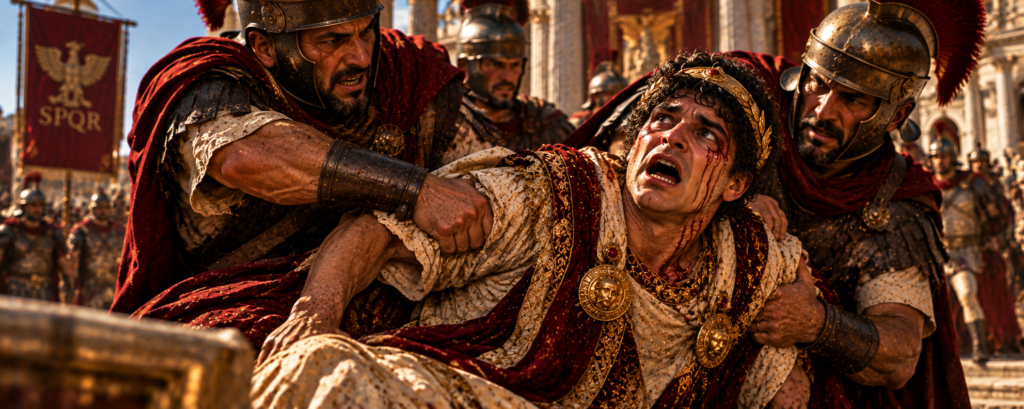
In March 222 CE, the soldiers who were supposed to protect the Roman emperor Elagabalus turned against him, murdered him alongside his mother, and subjected their bodies to a final humiliation intended to erase every trace of imperial dignity. The emperor was still a teenager, barely eighteen or nineteen years old, and had ruled the Roman world for less than four years. His reign had become associated with religious upheaval, bitter palace rivalries, scandalous accusations, and an increasingly dangerous struggle over who would inherit his throne. When the Praetorian Guard finally rebelled, the young ruler discovered that the soldiers who had helped his family seize power could destroy him just as easily.
The final confrontation unfolded at the Praetorian camp in Rome, where Elagabalus had gone amid growing hostility toward his younger cousin and designated successor, Severus Alexander. According to the historian Herodian, the guards greeted Alexander enthusiastically while treating their reigning emperor with conspicuous indifference. Elagabalus reacted angrily, ordering punishment for soldiers whose loyalty appeared to have shifted toward the younger prince. The order transformed resentment into open rebellion, and the guards decided that the emperor himself had to die.
His mother, Julia Soaemias, was with him when the violence erupted. She had helped elevate her son to the throne and remained closely associated with his government, making her an obvious target when the soldiers turned against him. Cassius Dio describes the young emperor attempting to escape, possibly by hiding inside a chest, before being discovered and killed. His mother reportedly clung to him during the attack, and both were murdered.
Their deaths were only the beginning of the humiliation. Ancient accounts describe the soldiers stripping the bodies, dragging them through Rome, and subjecting them to deliberate abuse. Herodian says the mutilated corpses were eventually thrown into a public sewer that emptied into the Tiber, while Cassius Dio distinguishes between the disposal of the emperor’s body and that of his mother. The details differ, but the central horror is unmistakable: the ruler of the Roman Empire and the woman who had helped place him on the throne were denied the dignity normally associated with imperial death.
The emperor’s corpse became a public declaration that his authority had been extinguished. The same city that had witnessed his religious processions, imperial ceremonies, and extravagant displays of sacred power now watched his body treated as refuse. The soldiers who had once acclaimed him as Augustus made certain that nobody could mistake the meaning of his downfall. His reign was over, his family had been defeated, and a new emperor would occupy the palace before the bloodshed had faded from public memory.
Yet the story of Elagabalus is more complicated than the lurid portrait handed down by hostile ancient historians. He has been remembered as one of Rome’s most scandalous emperors, a ruler supposedly obsessed with outrageous ceremonies, sexual experimentation, and deliberate violations of Roman tradition. Some accusations reflect genuine conflicts over religion, court appointments, and imperial behavior, while others come from sources whose hostility makes them difficult to trust. Understanding his assassination requires separating the young emperor who actually ruled Rome from the monstrous caricature created after his death.
Behind the scandal was a struggle for power within one of Rome’s most ambitious imperial families. Behind the religious controversy was a Syrian priest attempting to place his ancestral god at the center of Roman worship. Behind the final Praetorian mutiny was a grandmother who had helped make one grandson emperor and increasingly saw the other as the family’s best hope of survival. The murder of Elagabalus was therefore not simply the violent end of an unpopular ruler, but the culmination of a family conflict in which military loyalty, dynastic ambition, and personal survival became inseparable.
A Boy Born Far From Rome
Elagabalus was born around 203 or 204 CE into a wealthy and influential family connected with the Syrian city of Emesa, modern Homs. His original name was Varius Avitus Bassianus, and his upbringing took place within a cultural world shaped by Roman imperial politics and the religious traditions of the eastern Mediterranean. His father, Sextus Varius Marcellus, had pursued a successful career in imperial service, while his mother, Julia Soaemias, belonged to the powerful family of Julia Domna. Through that maternal connection, the boy was related to the reigning Severan dynasty.
His grandmother, Julia Maesa, was the sister of Julia Domna, the wife of Emperor Septimius Severus. This relationship placed Maesa’s descendants close to the imperial family even though they did not belong to its direct male line. Maesa possessed wealth, influence, and considerable political experience acquired through years spent near the imperial court. She would eventually become one of the most important figures in the young emperor’s rise and fall.
Emesa was not an isolated provincial settlement untouched by Roman civilization. It was a prosperous city with an influential local aristocracy and religious traditions that connected its ruling families to wider networks of power. Members of the family could participate in Roman administration while maintaining their distinctive regional identity. The combination was not unusual in an empire that stretched across numerous languages, peoples, and religious communities.
The young Bassianus was closely associated with the priesthood of the local god Elagabal. The deity was worshipped through a sacred black stone, probably a meteorite or similarly revered object, which occupied a central place in the city’s religious life. As hereditary high priest, the boy participated in ceremonies that would later become famous throughout the Roman world. His religious position was an important source of local prestige before he ever became emperor.
The name Elagabalus, by which history remembers him, derives from the god rather than from the emperor’s official Roman identity. As ruler, he used the name Marcus Aurelius Antoninus, deliberately connecting himself with the Antonine imperial tradition and his supposed relative Caracalla. Modern historians generally call him Elagabalus to distinguish him from other emperors named Antoninus. The nickname also reflects how thoroughly his religious identity shaped his reputation.
His childhood offered little indication that he would become ruler of an empire stretching from Britain to Mesopotamia. He was born into privilege and possessed valuable dynastic connections, but the imperial succession was already occupied by other members of the family. His future might have remained centered upon the priesthood at Emesa. The assassination of Caracalla changed everything.
The Severan Dynasty and the Murder That Opened the Throne
The Severan dynasty had been founded through civil war. Septimius Severus seized power after the assassination of Pertinax and the collapse of Didius Julianus’s brief government in 193 CE. He defeated rival claimants and established a military monarchy supported by loyal legions. His sons, Caracalla and Geta, were intended to preserve the dynasty after his death.
Instead, the brothers became bitter enemies. Following Severus’s death in 211, they briefly shared imperial authority before Caracalla arranged Geta’s murder. Ancient accounts describe the younger brother being killed in the presence of their mother, Julia Domna. Caracalla then eliminated numerous suspected supporters of Geta and attempted to erase his brother’s public memory.
Caracalla ruled alone until April 217, when a soldier named Julius Martialis assassinated him during a journey near Carrhae. The praetorian prefect Macrinus was widely suspected of arranging the murder, although the precise conspiracy remains uncertain. Macrinus became emperor shortly afterward. His accession disrupted the Severan dynasty because he possessed no direct familial claim to the throne.
Julia Domna died soon after Caracalla, leaving her sister Julia Maesa as one of the most prominent surviving members of the imperial family. Macrinus permitted Maesa and her relatives to return to Emesa. The decision removed them from the immediate political environment of the imperial court. It also allowed Maesa to regroup in a region where her family possessed considerable wealth and influence.
Maesa had no intention of surrendering the family’s imperial ambitions permanently. Her elder daughter Julia Soaemias had a teenage son serving as priest of Elagabal, while her younger daughter Julia Mamaea had another son, Alexianus, later known as Severus Alexander. Both boys could potentially become useful dynastic figures. Maesa began with the older grandson.
The central obstacle was legitimacy. Bassianus was not publicly recognized as Caracalla’s son, and his claim to the throne depended upon creating a convincing connection with the murdered emperor. Maesa and her supporters promoted the allegation that Julia Soaemias had conceived him through a relationship with Caracalla. The claim was politically powerful but cannot be established as historical fact.
The rumor offered soldiers an appealing explanation for supporting a new claimant. Many troops had admired Caracalla because of his generosity toward the army and his cultivated military identity. A supposed son of the murdered emperor could inherit that emotional loyalty. Maesa understood that a convincing dynastic story, supported by money, might succeed where ordinary political persuasion failed.
Julia Maesa: The Grandmother Who Made an Emperor
Julia Maesa was one of the most formidable political figures of the Severan period. She had witnessed the rise of Septimius Severus, the rivalry between Caracalla and Geta, and the assassination that brought Macrinus to power. She understood the importance of military loyalty and the danger of allowing an imperial family to disappear from public life. Her experience made her far more politically sophisticated than the teenage grandson she intended to elevate.
The eastern armies provided an opportunity. Macrinus had inherited an unpopular military situation following Caracalla’s Parthian campaign and had attempted to manage the financial burdens associated with generous military pay. Soldiers who had benefited from Caracalla’s policies were increasingly dissatisfied. Their resentment made them receptive to a claimant presented as his son.
Maesa’s wealth was another advantage. Money could encourage officers, reward supporters, and strengthen the credibility of the rebellion. Ancient accounts describe payments and promises playing an important role in attracting military backing. The Severan family was not simply relying upon sentiment or religious enthusiasm.
A key figure in the uprising was Gannys, a supporter associated with the family who helped organize the military effort. The surviving accounts differ over his precise position and relationship to Julia Soaemias. What matters is that the rebellion developed through a network of family retainers, soldiers, and officers willing to challenge Macrinus. Maesa supplied the dynastic strategy.
On May 16, 218 CE, soldiers associated with Legio III Gallica proclaimed the young Bassianus emperor. He was still only about fourteen years old. The soldiers presented him as Marcus Aurelius Antoninus, the supposed son and rightful successor of Caracalla. A Syrian priest had suddenly become the center of a military rebellion against the Roman emperor.
Macrinus attempted to suppress the uprising. His forces initially possessed advantages, but their loyalty proved uncertain. The decisive confrontation occurred near Antioch in June 218. Macrinus’s army was defeated, and the emperor fled.
Ancient accounts emphasize the courage and determination of the women associated with the Severan cause. Julia Maesa and Julia Soaemias were portrayed as playing important roles in sustaining the rebellion when its outcome remained uncertain. Some details may have been dramatized, but their political involvement was unmistakable. The dynasty’s restoration depended heavily upon them.
Macrinus was eventually captured and executed, while his young son Diadumenian was also killed. The Severan family had regained imperial power. Bassianus, now officially Marcus Aurelius Antoninus, was recognized as emperor. The boy who had been raised to serve a Syrian god was preparing to rule Rome.
The Teenage Priest Becomes Master of the Roman World
Elagabalus’s accession was extraordinary even by the standards of Roman imperial history. He was a teenager with limited administrative experience, elevated through a military rebellion organized largely by older relatives and their supporters. His legitimacy depended upon a disputed claim of descent from Caracalla. His personal identity remained closely tied to a religious tradition unfamiliar to many Romans.
The new emperor did not immediately arrive in Rome. He spent time in the eastern provinces and traveled westward with his entourage. His court included members of his family, religious attendants, military officers, and supporters who had helped overthrow Macrinus. The journey itself became an opportunity to establish the image of the new regime.
Ancient sources claim that Elagabalus sent a portrait ahead to Rome depicting himself in elaborate priestly clothing. Herodian describes the image as emphasizing his eastern religious identity rather than conventional Roman imperial dress. The story may reflect genuine attempts to introduce the emperor’s appearance and cult to the capital. It also served ancient writers as a dramatic warning of the cultural conflict they believed was approaching.
The young ruler reached Rome in 219 CE. He entered a city accustomed to foreign cults, elaborate religious ceremonies, and emperors who promoted personal divine patrons. Rome was not inherently hostile to every nontraditional deity. Its religious world had long incorporated gods and practices from across the Mediterranean.
The problem was the status Elagabalus intended to give his god. He did not merely wish to maintain the Syrian cult as a private devotion. He wanted Elagabal to occupy an extraordinary position within the religious hierarchy of the Roman state. That ambition challenged established expectations about the relationship between the emperor, the gods, and Rome’s traditional institutions.
Elagabalus was not simply importing an unfamiliar religion. He was attempting to transform the public religious identity of imperial government. His own role as high priest remained central to the ceremonies. The emperor and the god became closely associated in the public presentation of power.
For a teenager who had spent his early life serving Elagabal, the arrangement may have seemed natural. For senators accustomed to Roman religious traditions, it could appear deeply unsettling. The conflict would become one of the most enduring features of his reign.
The Black Stone That Came to Rule Rome
The sacred black stone of Elagabal became the visible center of the emperor’s religious program. Ancient accounts describe its transportation to Rome and its installation in an elaborate temple complex on the Palatine Hill. The sanctuary is commonly called the Elagabalium. Its location near the heart of imperial power made the religious message unmistakable.
Elagabalus intended his god to enjoy supremacy over other deities. Herodian describes elaborate ceremonies in which the sacred stone was carried through Rome in a richly decorated procession. The emperor participated as priest, wearing distinctive clothing and performing ritual movements associated with the cult. The ceremonies attracted enormous public attention.
The processions were designed to impress. Soldiers, attendants, sacred objects, and imperial officials participated in displays of wealth and religious devotion. The emperor’s presence transformed a regional cult into an imperial spectacle. The young ruler appeared determined to make Rome acknowledge the importance of his god.
Ancient historians describe Elagabalus attempting to associate the deity with other major religious traditions. Sacred objects connected with Roman worship were reportedly brought into the new temple. The emperor also promoted symbolic divine marriages intended to establish relationships between Elagabal and other deities. Such measures could be interpreted as religious integration, but they also appeared to subordinate established cults to the emperor’s chosen god.
The religious program was politically risky. Roman religion was closely connected with the legitimacy of the state, the Senate, and traditional priesthoods. Altering established hierarchies could be perceived as an attack upon the institutions that supported imperial authority. The emperor was challenging expectations that even powerful rulers usually approached with caution.
The surviving accounts emphasize the strangeness of the ceremonies. Herodian describes dancing, elaborate clothing, musical performances, and the distribution of gifts during religious festivals. His language frequently conveys aristocratic disapproval. The descriptions reveal as much about elite Roman expectations as they do about the rituals themselves.
Religious difference became a weapon in the emperor’s reputation. Practices associated with Emesa could be presented as evidence of irrationality or moral corruption simply because they departed from Roman norms. This does not mean every account of religious conflict is invented. It means that the hostility surrounding the cult must be separated from the practices being described.
Elagabalus’s devotion was genuine enough to shape major public policies. His determination to elevate the god contributed to political resistance. The religious ceremonies became one of the most visible signs that the emperor did not intend to govern according to conventional expectations.
The Marriage That Outraged Rome
One of the most controversial episodes of Elagabalus’s reign involved his marriage to the Vestal Virgin Aquilia Severa. Vestals occupied a uniquely sacred position in Roman religion. Their duty to maintain ritual purity and observe vows of chastity was closely associated with the security of the Roman state. Violations of those vows had historically been treated as serious religious offenses.
Elagabalus married Aquilia Severa despite these expectations. The marriage is historically well attested and cannot be dismissed as a hostile invention. It created an immediate religious controversy because the emperor appeared to violate one of Rome’s most respected sacred institutions. Ancient writers regarded the act as particularly offensive.
Herodian reports that Elagabalus justified the marriage through religious reasoning, suggesting that the union of a high priest and a priestess would produce children worthy of divine association. The precise explanation may reflect the historian’s interpretation rather than a reliable transcript of the emperor’s intentions. Nevertheless, the marriage clearly possessed religious significance. It was not merely an ordinary dynastic alliance.
Elagabalus married several women during his short reign. His first wife, Julia Cornelia Paula, came from an aristocratic background and offered a conventional imperial marriage. He divorced her and married Aquilia Severa, later entered another marriage with Annia Faustina, and eventually returned to Aquilia Severa. The rapid changes contributed to his reputation for instability.
Marriage was an important instrument of imperial legitimacy. An emperor’s wife could strengthen connections with influential families and provide heirs. Repeated marriages and divorces could therefore appear politically disruptive. Elagabalus’s choices also challenged the expectation that imperial marriage should reinforce traditional religious and social norms.
The marriage to Aquilia Severa became particularly useful to hostile writers because it combined religious controversy with personal scandal. The emperor could be portrayed as someone who deliberately violated sacred institutions. Whether he understood the marriage as sacrilegious is another question. His own religious framework may have differed substantially from that of Roman senators.
The controversy illustrates a central difficulty of his reign. Elagabalus possessed the formal authority to make extraordinary decisions, but he lacked the political experience to manage their consequences. Imperial power could compel public recognition of a marriage. It could not compel private approval.
The Scandals That Made Him Infamous
Few Roman emperors have attracted as many sensational accusations as Elagabalus. Ancient writers describe extravagant banquets, sexual relationships, elaborate costumes, humiliating entertainments, and deliberate violations of social conventions. Some stories portray the emperor as obsessed with shocking his guests. Others present him as incapable of distinguishing imperial responsibility from personal amusement.
The most notorious collection of anecdotes appears in the Historia Augusta, a late Roman work notorious for invention, exaggeration, and unreliable documents. Its biography of Elagabalus is particularly sensational. Stories about elaborate practical jokes, dangerous banquet arrangements, and bizarre sexual behavior frequently come from this source. They should not be repeated as established historical events.
One famous anecdote claims that the emperor overwhelmed banquet guests beneath a shower of flower petals. The story has inspired numerous artistic depictions, but its historical reliability is extremely doubtful. It belongs to a literary tradition portraying bad emperors as extravagantly cruel and absurd. There is no secure evidence that the event occurred.
Other accounts accuse Elagabalus of appointing entertainers and socially disreputable favorites to important offices. Some appointments involving unusual court figures may have a historical basis. Yet the sources often emphasize the social background of these individuals because aristocratic writers regarded such promotions as inherently offensive. A former performer or freedman could be condemned as unworthy regardless of administrative ability.
The emperor’s personal relationships became another target. Cassius Dio describes a close association with a man named Hierocles, a charioteer who allegedly exercised considerable influence over him. Other accounts mention additional male favorites and intimate relationships. The existence of such relationships is plausible, but the surviving narratives are shaped by hostility toward behavior that violated Roman expectations of imperial masculinity.
Modern discussions sometimes interpret these accounts through contemporary categories of sexuality and gender identity. That requires considerable caution. Ancient Roman writers used accusations of sexual passivity, effeminacy, and gender nonconformity as political insults. Their language does not provide a transparent record of how Elagabalus understood himself.
The historical challenge is not to deny every unconventional aspect of his behavior. It is to avoid treating hostile allegations as direct access to his private life. Elagabalus may genuinely have challenged contemporary gender and sexual conventions. The extent, meaning, and personal significance of those actions remain uncertain.
His reputation became a collection of everything Roman aristocratic society considered improper in a ruler. Foreign religion, youthful extravagance, sexual scandal, unconventional appointments, and contempt for tradition were combined into a single portrait. The result was one of antiquity’s most enduring images of imperial decadence. It was also a portrait created largely by people who despised him.
A Young Emperor Surrounded by Powerful Women
Elagabalus’s reign cannot be understood without Julia Maesa and Julia Soaemias. His grandmother had organized the rebellion that placed him on the throne, while his mother remained closely involved in his court. Both women possessed political influence unusual in its visibility, although imperial women had long exercised power through family connections and patronage. Their prominence became another subject of criticism among hostile writers.
Julia Soaemias was especially closely associated with her son’s government. Ancient accounts portray her as ambitious, influential, and deeply invested in preserving his authority. She accompanied him during important political events and remained near him during the final crisis. Her murder alongside him demonstrates how completely the guards identified her with his regime.
Julia Maesa occupied a more complicated position. She had created the conditions for Elagabalus’s accession and initially benefited from his rule. Yet she also had another grandson through her younger daughter Julia Mamaea. As Elagabalus became increasingly unpopular, Alexander offered a possible alternative.
Maesa’s political priorities appear to have centered upon preserving the dynasty. The family’s survival mattered more than the fortunes of any single member. That calculation could become ruthless when one grandson threatened the position of the other. The same grandmother who had elevated Elagabalus would eventually support the political arrangement that made Alexander his successor.
Julia Mamaea understood the opportunity. She carefully cultivated her son’s reputation as a disciplined, respectable young prince. Ancient sources contrast Alexander’s education and restraint with Elagabalus’s supposed extravagance. The comparison was politically useful, even if it was sharpened by later propaganda.
The two mothers therefore represented competing branches of the same imperial family. Julia Soaemias defended the reigning emperor, while Julia Mamaea protected the increasingly popular heir. Their rivalry gave personal intensity to an already dangerous succession struggle. The imperial household became divided against itself.
The situation was particularly threatening because both young men were minors or barely beyond childhood. Older relatives and advisers exercised considerable influence over their decisions. Political disputes could be presented as personal quarrels between cousins, but they involved the ambitions of powerful adults. The young emperor’s authority was increasingly undermined by people within his own family.
The Cousin Waiting in the Shadows
The future Severus Alexander was born around 208 CE and was several years younger than Elagabalus. His mother Julia Mamaea was Julia Soaemias’s sister, making the two boys first cousins. Both were grandsons of Julia Maesa. Their family relationship should have offered a basis for dynastic cooperation.
Instead, Alexander became the focus of growing opposition to the reigning emperor. His supporters portrayed him as serious, modest, and properly educated. He appeared more acceptable to senators and soldiers who disliked Elagabalus’s religious and personal behavior. His youth also made him a convenient figure for adults seeking influence over the next reign.
Julia Maesa reportedly encouraged Elagabalus to adopt Alexander as his son and designate him Caesar. The arrangement was politically unusual because the reigning emperor was himself only a teenager. Nevertheless, Roman imperial adoption had long served as a means of establishing succession. Formal adoption could provide legitimacy regardless of the biological relationship between the participants.
In 221 CE, Alexander received the title Caesar. Elagabalus publicly recognized him as his successor. The decision initially appeared to strengthen the dynasty by providing an accepted heir. It also created an alternative center of loyalty within the imperial household.
Alexander’s popularity soon became a threat. Soldiers increasingly favored the younger prince, while senators welcomed the possibility of a more conventional ruler. Elagabalus began to fear that his adopted son would replace him. The situation resembled earlier Roman dynastic conflicts in which the existence of a designated successor made the reigning emperor less secure.
Herodian describes Elagabalus attempting to influence Alexander’s education and religious practices. Julia Mamaea resisted, keeping her son away from ceremonies and attendants she considered unsuitable. The details reflect Herodian’s moralizing contrast between the two boys. The political reality was that Alexander’s household was becoming increasingly independent.
Elagabalus reportedly attempted to remove Alexander from the succession and may have considered having him killed. Ancient accounts describe plots against the younger prince, although the exact details are difficult to verify. Whether every alleged attempt occurred, the emperor clearly came to regard Alexander as a dangerous rival. The family had entered a struggle from which only one branch was likely to emerge victorious.
The Grandmother’s Impossible Choice
Julia Maesa had created the Severan restoration through Elagabalus. Without her wealth, connections, and political calculation, the teenage priest would almost certainly never have become emperor. His success had returned her family to the center of Roman government. Yet by 221, his position was becoming increasingly difficult to defend.
The religious controversies alienated influential Romans. His personal reputation was deteriorating, and the Praetorian Guard was becoming more receptive to Alexander. The family faced the possibility that a military rebellion might destroy the dynasty altogether. Maesa needed a solution that would preserve Severan power.
Alexander offered that solution. He was young, closely related to the reigning emperor, and already associated with a more conventional style of government. His mother Julia Mamaea was politically experienced and capable of directing his upbringing. A transition to Alexander could preserve the family’s position while removing the most controversial aspects of Elagabalus’s reign.
The problem was Elagabalus himself. He had no reason to welcome a successor who was becoming more popular than he was. His title of Augustus still gave him supreme authority, and he could interpret attempts to strengthen Alexander as a conspiracy against his life. The arrangement therefore encouraged the very rivalry it was intended to resolve.
Maesa appears to have attempted to manage the conflict, but her influence had limits. Herodian describes her frustrating Elagabalus’s attempts to harm Alexander. The account portrays her as protecting one grandson from the other. It also suggests that her political allegiance was shifting.
The surviving sources do not prove that Maesa personally ordered Elagabalus’s murder. Such a conclusion would go beyond the available evidence. Nevertheless, she helped create the political circumstances in which Alexander became the preferred alternative. Her actions made the younger prince increasingly difficult for the reigning emperor to remove.
The tragedy was intensely personal. A grandmother who had raised one grandson to the throne now watched him become a danger to another. Two sisters stood on opposite sides of the succession struggle. The family that had survived civil war and assassination was preparing to destroy itself from within.
The Praetorian Guard Changes Its Loyalty
The Praetorian Guard had long played a decisive role in Roman imperial succession. Its soldiers protected the emperor, guarded the capital, and possessed immediate access to the palace. Their position made them dangerous when political loyalty weakened. Elagabalus had inherited an institution with a long history of making and murdering emperors.
Only twenty-nine years earlier, the Guard had killed Pertinax after becoming dissatisfied with his attempts to restore discipline. Its soldiers then supported Didius Julianus following a notorious competition involving enormous promises of money. Septimius Severus eventually disarmed and replaced the old Guard. Yet the institution’s political importance survived that humiliation.
Elagabalus initially possessed military support because his accession had depended upon soldiers willing to overthrow Macrinus. His supposed connection to Caracalla helped attract loyalty. The Severan family also understood the value of financial generosity. Military support was essential to the dynasty’s survival.
By the final year of his reign, however, the Praetorians were increasingly drawn toward Alexander. Herodian emphasizes their admiration for the younger prince’s education and behavior. Such explanations reflect the historian’s preference for conventional Roman virtues. Political calculations were probably equally important.
Alexander offered continuity without the controversies associated with Elagabalus. He belonged to the same family and had already been formally designated Caesar. Supporting him did not require the guards to embrace an unrelated usurper. They could present a change of emperor as the preservation of the dynasty.
Julia Mamaea reportedly strengthened her son’s position through gifts to the soldiers. The use of money was consistent with Roman military politics. Praetorian loyalty had repeatedly been influenced by financial expectations. The younger prince’s supporters understood that admiration alone might not be sufficient.
Elagabalus became increasingly aware of the danger. His attempts to remove Alexander or restrict his public appearances only intensified suspicion. Soldiers interpreted threats against the heir as threats against the candidate they preferred. The emperor was losing control over the armed institution responsible for his safety.
The Rumor That Alexander Was Dying
The immediate crisis developed when Elagabalus attempted to test or manipulate the soldiers’ loyalty toward Alexander. Herodian reports that the emperor circulated a rumor suggesting that his cousin was gravely ill or dying. The purpose was apparently to discover how the Praetorians would react. The result was disastrous.
The guards became alarmed when Alexander disappeared from public view. They feared that the emperor had harmed him or intended to do so. Their concern quickly developed into open resistance. They refused to provide the usual guard contingent and remained within their camp.
The soldiers demanded to see Alexander alive. Their insistence demonstrated that the emperor no longer controlled the terms of military obedience. The Praetorians were issuing conditions to their ruler. Elagabalus could either comply or risk immediate confrontation.
The situation was especially humiliating because Alexander was supposed to be subordinate to him. As Caesar, the younger prince held an important but lesser imperial title. Elagabalus remained Augustus and possessed supreme formal authority. The soldiers’ behavior suggested that those titles no longer reflected the actual balance of power.
Elagabalus apparently recognized the danger. He arranged to bring Alexander to the Praetorian camp, hoping to calm the soldiers and demonstrate that the prince was unharmed. The decision may have seemed sensible. A public appearance could dispel the rumor and restore normal military relations.
Yet the emperor was entering an environment where his own authority had become uncertain. The guards were gathered together, armed, and emotionally invested in Alexander’s safety. Their loyalty was no longer guaranteed. The visit would expose the division more clearly than any rumor.
Julia Soaemias accompanied her son during the final crisis. Her presence reflected both her political role and her close association with the emperor. She had helped make him ruler and remained beside him when his position became most dangerous. That loyalty would cost her life.
The Visit to the Praetorian Camp
Elagabalus and Alexander arrived at the Praetorian camp in Rome amid extraordinary tension. According to Herodian, the soldiers welcomed the younger prince with enthusiastic cheers. Their reaction demonstrated relief that Alexander was alive and affection for the boy they increasingly regarded as the empire’s future ruler. The reception was politically devastating for Elagabalus.
The reigning emperor received no comparable welcome. Herodian emphasizes the contrast between the soldiers’ enthusiasm for Alexander and their indifference toward Elagabalus. The humiliation was public and unmistakable. The young Augustus was forced to watch his own guards celebrate the man he feared would replace him.
For an emperor accustomed to ceremonial honor, the experience must have been deeply threatening. Roman imperial authority depended partly upon public displays of loyalty. Soldiers were expected to salute and acclaim the ruler. Their refusal to offer comparable enthusiasm suggested that the foundations of his power were collapsing.
Elagabalus reacted angrily. Herodian reports that he ordered the arrest and punishment of soldiers who had openly supported Alexander. The emperor apparently intended to reassert discipline by making examples of those who had challenged his authority. Instead, he transformed resentment into rebellion.
The Praetorians regarded the punishment of their comrades as intolerable. They had already gathered to protect Alexander from a perceived threat. Now the emperor was ordering action against soldiers whose loyalty had become suspect. Their fear and anger reinforced one another.
The guards concluded that Elagabalus had to be removed. Herodian presents the decision as a response to his behavior and the immediate danger to their comrades. Other sources emphasize the wider rivalry between the two imperial households. Both explanations point toward a military mutiny that had become politically irreversible.
The emperor had entered the camp hoping to demonstrate control. Instead, he discovered that the soldiers were prepared to exercise control over him. The distinction between protector and executioner disappeared. The final violence was only moments away.
The Emperor Tries to Escape
Cassius Dio preserves a particularly disturbing account of Elagabalus’s final attempt to survive. Realizing that the soldiers intended to kill him, the emperor allegedly tried to escape by concealing himself inside a chest. The image is a brutal reversal of imperial ceremony. A ruler who had appeared before Rome in elaborate religious processions was reduced to hiding among ordinary objects.
The precise details of the attempted escape cannot be independently confirmed. Dio’s account survives in an epitomized form, and ancient historians often emphasized humiliating circumstances when describing the deaths of despised rulers. Nevertheless, the tradition suggests that Elagabalus understood the danger and attempted to avoid immediate capture. He was not simply standing defiantly before the soldiers.
The escape failed. The guards discovered him and attacked. Julia Soaemias was reportedly beside him, attempting to protect or remain with her son. Dio describes her embracing him as the soldiers killed them both.
Herodian places the killings within the Praetorian camp and emphasizes the soldiers’ anger over the attempted punishment of Alexander’s supporters. He describes Elagabalus and Soaemias being murdered together with attendants associated with their household. The accounts differ in emphasis but agree on the essential outcome. The emperor and his mother were killed by the Praetorian Guard.
The violence was not limited to the two principal victims. Ancient writers report that several officials and favorites connected with Elagabalus also died. Some were targeted because of their political influence, while others had become symbols of the unpopular regime. The assassination therefore developed into a purge of the emperor’s immediate circle.
Among those reportedly killed was Hierocles, the charioteer closely associated with the emperor. Cassius Dio also describes the destruction of other prominent officials and courtiers. The surviving accounts do not permit a complete list of victims. They do indicate that the soldiers intended to eliminate more than the person occupying the throne.
Elagabalus was dead before reaching adulthood in the modern sense. His mother died with him, and the network that had supported his rule was violently dismantled. The Praetorians had chosen Alexander. They now intended to make the transfer of power unmistakable.
Julia Soaemias: The Mother Who Died With Her Son
Julia Soaemias’s death is one of the most tragic elements of the assassination. She had belonged to a powerful family connected with the Severan dynasty and had helped restore that dynasty after the murder of Caracalla. Her political influence depended heavily upon her son’s position. When his rule collapsed, she had little protection independent of him.
Ancient writers often portray Soaemias as an ambitious and morally questionable influence. Such judgments should be approached cautiously because Roman historians frequently criticized politically active imperial women. The sources were particularly hostile toward women perceived as exercising authority outside conventional expectations. Their descriptions may reveal aristocratic discomfort as much as individual misconduct.
Soaemias nevertheless played a genuine political role. She accompanied her son during important events, supported his position, and remained closely associated with his household. Her presence at the Praetorian camp was not accidental. She was part of the regime the soldiers intended to overthrow.
Cassius Dio’s account of her final moments emphasizes her physical closeness to Elagabalus. She reportedly embraced him as the soldiers attacked. Whether the detail is precisely accurate, it captures the inseparability of their political fates. The mother who had helped raise her son to imperial power died attempting to remain with him.
Her murder also reflects the ruthlessness of Roman succession politics. The Praetorians could have confined her, exiled her, or removed her from public life. Instead, they killed her alongside the emperor. Her status as Augusta offered no protection.
The contrast with Julia Maesa is striking. Maesa had helped elevate Elagabalus and remained influential enough to survive his downfall. Soaemias, whose political identity was more closely tied to the reigning emperor, did not. Two women from the same family experienced radically different outcomes because the succession shifted toward different branches.
The ancient accounts leave little room for Soaemias’s own perspective. We do not possess her private writings explaining her ambitions, fears, or relationship with her son. Her political choices must be reconstructed through authors who often treated influential women with suspicion. What remains certain is that she shared the final danger of the regime she had helped create.
The Bodies Dragged Through Rome
After the murders, the soldiers subjected the bodies to deliberate public humiliation. Herodian describes the corpses being handed over for abuse and dragged through the city. The violence continued after death because the assassins wanted to demonstrate that the former emperor and his mother no longer possessed sacred or political protection. Their bodies became symbols of the defeated regime.
Cassius Dio also describes the bodies being stripped and dragged through Rome. He adds that their heads were cut off. The treatment resembled earlier episodes in which defeated emperors or political enemies were publicly degraded. Roman civil conflict had repeatedly turned corpses into instruments of political communication.
The practice was intended to destroy dignity as well as life. An emperor’s body ordinarily carried immense ceremonial significance. Imperial funerals could involve elaborate processions, public mourning, and eventual deification. Elagabalus received the opposite treatment.
His remains were exposed to public contempt. The soldiers denied him the respectful handling normally expected for a ruler. The same imperial body that had participated in sacred ceremonies was now subjected to humiliation. The contrast was deliberate.
The abuse also served a practical political purpose. Displaying the dead emperor’s body made it impossible for supporters to claim that he had escaped. It demonstrated that the old regime had ended. Anyone considering resistance could see what had happened to its leader.
Such spectacles were not unique to Elagabalus. Vitellius had been dragged through Rome and killed after losing the civil war of 69 CE. Galba’s head had been displayed following his assassination earlier that year. Roman political violence frequently extended beyond death into the public degradation of defeated rulers.
Yet the murder of Elagabalus was especially striking because of his youth and the inclusion of his mother. The soldiers did not merely remove an unpopular emperor. They attacked the family structure that had sustained his rule. The humiliation of both bodies emphasized the complete rejection of their branch of the dynasty.
The Tiber and the Final Humiliation
The disposal of Elagabalus’s body became one of the defining details of his assassination. Herodian reports that the mutilated remains of the emperor and Julia Soaemias were thrown into a public sewer that flowed into the Tiber. Cassius Dio states that the emperor’s body was cast into the river while his mother’s body was discarded elsewhere. The accounts therefore agree on the disgraceful treatment but differ over the precise disposal of Soaemias.
The distinction matters because later retellings often present every detail as certain. The surviving evidence does not establish exactly where both bodies ended up. It does establish that Elagabalus was denied a conventional imperial burial and that his remains were associated with the Tiber. The humiliation was sufficiently memorable to become central to his posthumous reputation.
Throwing a body into the river carried powerful symbolic meaning. It denied the deceased the ceremonies normally associated with burial and remembrance. In Roman political culture, such treatment could express the belief that a person was unworthy of honor. The river became a means of removing the defeated ruler from the civic landscape.
The act also inverted Elagabalus’s religious self-presentation. He had claimed an extraordinary relationship with a powerful deity and had placed sacred ceremonies at the center of imperial life. His killers treated his body as something to be discarded. The contrast reinforced the message that his sacred authority had failed to protect him.
Later writers sometimes associated the emperor with humiliating nicknames connected to his death and disposal. Such traditions reflect the persistence of public contempt after the assassination. His reputation became inseparable from the manner in which his body was treated. The story survived because it offered an unforgettable image of imperial power collapsing into degradation.
The soldiers had no intention of allowing his death to become a rallying point for loyalists. A dignified funeral might have encouraged sympathy. Public humiliation instead presented him as a disgraced ruler whose removal was justified. The violence against the corpse therefore continued the political work begun by the assassination.
The Tiber had received the bodies of Rome’s defeated and condemned before. Elagabalus joined that grim tradition. The emperor who had tried to elevate his god above Rome’s traditional deities ended his reign without the honors normally granted to an emperor. His final journey was not a sacred procession but an act of public rejection.
Severus Alexander Takes the Throne
The Praetorians proclaimed Severus Alexander emperor after killing Elagabalus. The new ruler was still a young teenager, but he possessed the dynastic connection and military support necessary to secure immediate recognition. His mother Julia Mamaea and grandmother Julia Maesa became central figures in the new government. The branch of the family that had supported Alexander emerged victorious.
The transition was presented as a restoration of proper imperial behavior. Ancient writers emphasize the new regime’s commitment to conventional administration, senatorial consultation, and religious order. The contrast with Elagabalus was politically useful. Alexander could be portrayed as everything his cousin had supposedly failed to become.
Religious measures formed an important part of the change. Sacred objects associated with Elagabalus’s reforms were returned to their previous locations. The Syrian god lost the extraordinary position he had occupied during the preceding reign. The black stone was sent back to Emesa.
The removal of the cult from its privileged Roman position did not mean that eastern religion disappeared from the empire. Rome remained a religiously diverse society. The issue had been the emperor’s attempt to elevate one regional deity above established institutions. Alexander’s government sought to restore a more familiar balance.
The new regime also removed or punished figures associated with Elagabalus. Some officials had already been killed during the Praetorian mutiny. Others lost influence as the court was reorganized. The transition involved both religious reversal and political cleansing.
Julia Maesa survived to see another grandson become emperor. Her political achievement was extraordinary, but its human cost was severe. One daughter and one grandson had been murdered, while the other daughter and grandson now occupied the center of imperial power. The family’s survival had depended upon the destruction of part of itself.
Alexander would rule until 235 CE, when soldiers murdered him and his mother during a military crisis. The dynasty’s final ruler therefore met a fate disturbingly similar to that of Elagabalus. The Praetorian assassination of 222 had not solved the deeper problem of military control over imperial succession. It had merely postponed another violent collapse.
The Senate Condemns His Memory
After Elagabalus’s death, his public reputation was subjected to systematic attack. His name was removed from inscriptions, and his images were destroyed or altered. Such measures formed part of the broader Roman practice commonly described as damnatio memoriae. The purpose was to deny a disgraced ruler the honors normally associated with imperial authority.
The Senate had strong reasons to support the condemnation. Many senators had resented Elagabalus’s religious program, court appointments, and perceived disregard for aristocratic expectations. His removal offered an opportunity to restore senatorial dignity. Condemning the dead emperor also demonstrated loyalty to Alexander.
The process influenced how later generations remembered him. Official condemnation encouraged the circulation of hostile stories and discouraged favorable representations. Writers could portray the previous reign as an era of disorder that justified the new government’s reforms. The political needs of Alexander’s regime therefore shaped the historical narrative.
Cassius Dio was particularly hostile toward Elagabalus. As a senator, he viewed the emperor’s conduct through the expectations of Roman aristocratic government. His account contains valuable information, but it also uses language designed to ridicule and degrade the young ruler. The hostility must be considered whenever his testimony is used.
Herodian provides a somewhat different perspective but also emphasizes moral and religious scandal. His narrative contrasts Elagabalus with Alexander and presents the assassination as the result of growing public and military disgust. The account is important for reconstructing the final crisis. It is not a neutral description of the emperor’s personality.
The Historia Augusta goes much further in sensationalism. Its biography contains numerous stories that cannot be verified and are widely regarded as fictional or heavily embellished. The work should be treated as evidence for later literary traditions rather than a straightforward record of Elagabalus’s private life. Its influence upon popular portrayals has nevertheless been enormous.
The result is an unusually distorted historical reputation. Elagabalus became a symbol of everything later Roman writers associated with bad government. His religious devotion was presented as fanaticism, his personal behavior as depravity, and his political failures as evidence of complete unfitness to rule. Some criticisms reflected real problems, but the surviving portrait was shaped by his enemies.
Was Elagabalus Really Rome’s Most Scandalous Emperor?
Elagabalus has often been placed alongside Caligula, Nero, and Commodus in lists of Rome’s most notorious rulers. The comparison reflects the sensational nature of the surviving stories. Yet his case is distinctive because he was extremely young and ruled within a court dominated by powerful relatives. His personal responsibility for every decision attributed to him is therefore difficult to assess.
He unquestionably promoted a major religious transformation. His marriage to Aquilia Severa challenged Roman sacred traditions, and his elevation of Elagabal created conflict with established institutions. His relationship with Alexander deteriorated into a dangerous succession struggle. These events provide substantial grounds for historical criticism.
Other allegations are far less secure. Stories of extravagant cruelty, bizarre entertainments, and extreme sexual behavior often come from hostile or unreliable sources. Some may preserve distorted memories of real events. Others may be literary inventions designed to make the emperor appear monstrous.
The accusations concerning gender and sexuality require particular care. Roman writers frequently treated departures from conventional masculine behavior as evidence of political weakness. Clothing, cosmetics, dancing, and sexual roles could become weapons in elite criticism. Their descriptions do not necessarily reveal how the emperor understood his own identity.
Elagabalus may have expressed himself in ways that genuinely challenged Roman gender expectations. That possibility should not be dismissed merely because the sources are hostile. At the same time, modern categories cannot be applied confidently to a person whose own testimony has not survived. Historical uncertainty is not a reason to replace one simplistic narrative with another.
His religious identity also deserves a more balanced interpretation. The worship of Elagabal was not inherently irrational or illegitimate. It belonged to an established regional tradition with deep cultural significance. The controversy arose primarily from the emperor’s attempt to give that cult supremacy within Roman state religion.
The most defensible conclusion is that Elagabalus was an inexperienced young ruler whose religious priorities, court politics, and succession decisions alienated powerful groups. His behavior may have been unconventional in ways that ancient writers exaggerated. His government nevertheless experienced genuine instability. The assassination resulted from that instability rather than from any single scandalous anecdote.
The Politics Behind the Moral Outrage
Ancient accounts frequently suggest that the Praetorians killed Elagabalus because they were disgusted by his personal behavior. Religious ceremonies, unconventional clothing, and alleged sexual conduct appear repeatedly in explanations of the soldiers’ hostility. Such claims fit the moral framework of the surviving historians. They do not fully explain the political circumstances of the murder.
The immediate crisis centered upon Alexander. The guards had developed affection for the younger prince and feared that Elagabalus intended to harm him. Their refusal to provide normal service demonstrated that loyalty had already shifted. The emperor’s attempt to punish Alexander’s supporters triggered the final rebellion.
Dynastic politics therefore played a decisive role. Alexander was not merely a symbol of conventional morality. He was an alternative emperor with a recognized title, powerful relatives, and growing military support. His existence made it possible to remove Elagabalus without abandoning the Severan dynasty.
Julia Maesa’s political calculations were equally important. She had helped establish Elagabalus’s reign and later supported Alexander’s position. Her family possessed the wealth and influence necessary to cultivate military loyalty. The succession struggle developed within a network of relationships that extended far beyond the emperor’s personal behavior.
The Praetorians also had institutional interests. They wanted a ruler who would reward them, respect their position, and avoid threatening soldiers who supported Alexander. Elagabalus’s order to punish guardsmen directly challenged those interests. Their decision to kill him was therefore both political and self-protective.
Moral outrage may have made the assassination easier to justify. Soldiers could tell themselves that they were removing an unworthy emperor. Senators could celebrate the restoration of proper government. The new regime could portray Alexander’s accession as a rescue of Rome from disgrace.
Yet the underlying mechanism was familiar. Armed men decided that another candidate would serve their interests better. They killed the reigning emperor and proclaimed his replacement. The scandalous reputation of Elagabalus obscured how closely his death resembled other Roman military assassinations.
A Family That Devoured Its Own
The Severan dynasty repeatedly demonstrated how dangerous family relationships could become when connected with imperial power. Septimius Severus had established the dynasty through military victory and attempted to secure its future through his sons. Caracalla murdered Geta after their father’s death. Caracalla himself was assassinated only a few years later.
Julia Maesa restored the dynasty by elevating Elagabalus. Her strategy succeeded because she understood the importance of military loyalty and dynastic legitimacy. Yet the same family connections that made the young emperor valuable eventually produced a rival in Alexander. The dynasty became divided between two grandsons.
The conflict was intensified by the ambitions of their mothers. Julia Soaemias defended Elagabalus, while Julia Mamaea protected Alexander. Both women understood that their sons’ positions determined their own security. Their rivalry became part of the wider struggle for imperial power.
Julia Maesa occupied the most difficult position. She was grandmother to both young men and had helped create the political system that placed them in competition. Preserving the dynasty increasingly meant choosing which grandson would rule. The surviving evidence does not establish that she ordered Elagabalus’s death, but her political support for Alexander helped make the transition possible.
The assassination destroyed one branch of the family. Elagabalus and Soaemias were killed, while Alexander and Mamaea survived. Maesa retained influence under the new government. The dynasty continued, but its survival had been purchased through bloodshed.
The pattern would repeat. Severus Alexander eventually became dependent upon his mother and advisers, while military dissatisfaction increased during his reign. In 235 CE, soldiers murdered Alexander and Julia Mamaea. The family that had survived so many political crises finally lost the throne.
The history of the Severans therefore resembles a succession of attempts to secure power through family loyalty that repeatedly ended in family destruction. Brothers killed brothers, cousins became rivals, and mothers died beside sons. The dynasty’s greatest political strength was also one of its most dangerous weaknesses. Every family relationship could become a claim to the throne.
The Praetorians and the Power to Kill Emperors
The assassination of Elagabalus belongs to a long tradition of Praetorian involvement in Roman imperial politics. The Guard had helped elevate Claudius after Caligula’s murder in 41 CE. It had participated in the violent succession struggles of 69 CE. It had murdered Pertinax in 193 and then supported Didius Julianus.
Septimius Severus had attempted to solve the problem by dismissing the old Guard and replacing it with soldiers loyal to him. The measure temporarily strengthened his position. Yet the institutional power of the Praetorians remained. Their proximity to the emperor continued to make them decisive during political crises.
Elagabalus’s death demonstrated that even a dynasty restored through military support could not permanently control the Guard. The soldiers had accepted him as emperor in 218. Four years later, they preferred Alexander. Their allegiance shifted when the political balance changed.
The assassination was not a spontaneous eruption of violence without context. The guards had become increasingly concerned about Alexander’s safety and their own position. They refused ordinary duties, demanded to see the prince, and openly demonstrated their preference. The final attack followed the emperor’s attempt to punish them.
Their behavior revealed the weakness of formal imperial authority. Elagabalus remained Augustus until the moment of his death. Alexander remained Caesar until the soldiers elevated him. Yet the guards had already decided which title mattered. Military power determined the succession.
The treatment of the bodies reinforced that authority. The Praetorians did not merely kill the emperor and announce his replacement. They publicly degraded the former ruler and his mother. The spectacle warned supporters of the old regime that resistance would be dangerous.
The Guard’s power would remain a recurring problem. Even emperors who cultivated military loyalty could be killed when soldiers changed their minds. The institution was designed to protect imperial authority, but its members could become the most immediate threat to that authority. Elagabalus learned the lesson in the most brutal possible way.
The Assassination That Became a Public Execution
Elagabalus was not killed in a formal judicial proceeding. There was no lawful trial, no recognized sentence, and no opportunity for defense. The Praetorians acted through military violence to remove a ruler they no longer supported. His death was therefore a political assassination carried out during a mutiny.
The subsequent abuse of his body gave the killing the character of a public punishment. The soldiers treated the corpse as though the emperor had been condemned for crimes against the state. Dragging the body through Rome transformed the assassination into a spectacle of disgrace. The disposal in the Tiber completed the rejection of imperial dignity.
The distinction matters for understanding the category of regicide. Rome officially rejected the title of king, but its emperors exercised monarchical power. Killing an emperor through a conspiracy or military revolt can therefore be understood as the violent elimination of a sovereign. Elagabalus’s death fits that broader historical pattern.
The murder also had elements of dynastic execution. Julia Soaemias was killed because she was closely associated with her son’s rule. Other officials and favorites were eliminated as part of the same political transition. The guards were destroying a regime rather than merely removing an individual.
The public humiliation served to legitimize Alexander. The more completely Elagabalus was portrayed as disgraced, the easier it became to present his cousin as a necessary replacement. Political violence and historical memory worked together. The assassination created the new government, while the treatment of the bodies helped justify it.
Later historians reinforced that justification. They described Elagabalus as morally unworthy and Alexander as disciplined and respectable. The contrast made the transfer of power appear almost inevitable. Yet the reality was a violent military coup against a teenage ruler.
The assassination should therefore be understood through both its immediate circumstances and its later presentation. The guards killed Elagabalus because the succession struggle had become intolerable. The new regime benefited from portraying his death as the deserved end of a scandalous reign. Those two explanations overlap but are not identical.
What the Ancient Sources Want Us to Believe
Cassius Dio, Herodian, and the Historia Augusta form the principal literary foundation for modern accounts of Elagabalus. Each preserves valuable information, but each must be approached with caution. Their narratives were shaped by political assumptions, social prejudices, and the needs of historical storytelling. None provides an entirely neutral record.
Cassius Dio was a senator who lived through the period. His proximity to events makes his testimony especially important. Yet he strongly disliked Elagabalus and repeatedly used language intended to ridicule him. His account of the emperor’s sexuality, religion, and personal behavior reflects that hostility.
Herodian offers a more continuous narrative of the reign and assassination. He describes the religious ceremonies, the growing rivalry with Alexander, and the final Praetorian mutiny in considerable detail. His account is essential for reconstructing the political sequence. Nevertheless, he also presents Elagabalus through a moralizing contrast with the supposedly virtuous Alexander.
The Historia Augusta is considerably less reliable. Written long after the events, it contains fabricated documents, invented anecdotes, and sensational material. Its treatment of Elagabalus is among its most extravagant biographies. Many popular stories about the emperor derive from this work rather than from contemporary evidence.
Material evidence provides an important corrective. Coins, inscriptions, and surviving representations confirm aspects of the emperor’s official identity, religious program, and dynastic presentation. They demonstrate that the cult of Elagabal occupied a prominent place in imperial imagery. They also show how the regime sought legitimacy through the name Antoninus and connections with the Severan dynasty.
Such evidence cannot reveal every aspect of private behavior. It does, however, remind us that the emperor was a functioning ruler whose government issued coinage, maintained administration, and participated in established imperial institutions. The sensational literary portrait does not encompass the entire reign. Ordinary government continued beneath the scandals.
The most responsible approach is therefore selective. The accession, religious reforms, marriage to Aquilia Severa, adoption of Alexander, Praetorian rebellion, and assassination are supported by substantial evidence. Many lurid anecdotes remain uncertain or implausible. Distinguishing between them allows the historical Elagabalus to emerge from the legend.
Was Elagabalus a Victim of His Own Reputation?
Elagabalus’s reputation became a political liability while he was still alive. His religious ceremonies challenged established expectations, and his court appointments alienated influential groups. His personal behavior was widely criticized in elite accounts. Such hostility made it easier for opponents to promote Alexander as a more acceptable ruler.
Yet reputation alone did not kill him. The decisive factor was the existence of an alternative emperor supported by powerful relatives and increasingly favored by the Praetorians. Without Alexander, dissatisfaction might have produced a different conspiracy or a period of instability. With Alexander available, the guards possessed a ready successor.
The emperor’s attempts to protect himself accelerated the crisis. He feared that Alexander would replace him and reportedly tried to remove or harm him. The soldiers interpreted those actions as threats against the prince they preferred. Their determination to protect Alexander made Elagabalus more suspicious, creating a cycle of escalating hostility.
Julia Maesa’s political calculations intensified the problem. She had helped create Elagabalus’s authority but increasingly supported the alternative offered by Alexander. The emperor could not easily challenge his grandmother without damaging the family network that sustained him. His political position became trapped between dependence and distrust.
His youth made the situation even more dangerous. Elagabalus lacked decades of administrative experience and had entered imperial power through a military rebellion rather than a gradual political career. He faced older relatives who understood Roman politics far better than he did. His formal authority was immense, but his practical control was limited.
The surviving sources often present his downfall as the inevitable result of moral corruption. That explanation is too simple. Elagabalus was removed through a combination of religious controversy, political miscalculation, dynastic rivalry, and military defection. His reputation contributed to the crisis, but the assassination was ultimately a struggle over power.
The tragedy is that the young emperor may never have possessed the independence later writers attributed to him. He became ruler because powerful adults saw political value in his identity. He remained ruler while their interests aligned with his survival. When those interests shifted toward Alexander, his position collapsed.
The Boy Who Was Made Emperor and Then Discarded
Elagabalus was approximately fourteen when soldiers proclaimed him emperor in 218. He had not spent decades preparing for government, commanding armies, or navigating senatorial politics. His elevation resulted from a family strategy designed to restore the Severan dynasty. The boy’s religious identity and alleged descent from Caracalla made him useful to that strategy.
Julia Maesa supplied the political experience. Julia Soaemias provided maternal support and dynastic connections. Military officers supplied armed force. The young priest became the public face of a rebellion organized by people with far greater experience of imperial politics.
Once he reached Rome, however, Elagabalus attempted to shape the empire according to his own religious priorities. His devotion to Elagabal became central to public life. The resulting controversies weakened support among groups whose cooperation was necessary for stable government. The family began looking for alternatives.
Alexander offered a more conventional image. His mother carefully cultivated his education and reputation. His grandmother increasingly supported his position. Soldiers began to regard him as a preferable ruler.
Elagabalus was therefore caught in a cruel contradiction. His family had elevated him because his identity served its ambitions. When that identity became politically inconvenient, the family promoted another member. The emperor’s attempt to defend his position made him appear increasingly dangerous.
This does not mean he was innocent of every political mistake. He appears to have attempted to undermine Alexander and may have contemplated violence against him. His religious policies were implemented without sufficient sensitivity to Roman institutions. His court generated genuine resentment.
Yet the broader story remains one of extraordinary exploitation. A teenage priest was transformed into emperor through dynastic propaganda and military rebellion. He was then destroyed when the same political system found another teenager more useful. The people who made him powerful had also created the conditions of his death.
The Emperor Who Could Not Protect His Mother
The murder of Julia Soaemias gives Elagabalus’s assassination a particularly disturbing emotional dimension. Roman emperors could command armies and order executions, but their families remained vulnerable during political collapse. Soaemias had helped secure her son’s throne and continued to defend his position. Her loyalty placed her directly in the path of the mutineers.
The ancient accounts do not preserve a detailed record of their final words. It would be irresponsible to invent a dramatic exchange between mother and son. What the sources do preserve is their physical closeness during the attack. Dio’s description of Soaemias embracing Elagabalus has become one of the defining images of the murder.
The scene contrasts sharply with the public ceremonies of their reign. Soaemias had occupied a position of imperial honor, while her son had appeared as both emperor and priest. Their status depended upon the obedience of soldiers and the recognition of political institutions. When those supports disappeared, their titles offered no protection.
The guards did not distinguish between the emperor and his mother when deciding whom to kill. Both represented the defeated branch of the Severan family. Their deaths removed the immediate possibility of a counterclaim organized around Soaemias. The violence was politically calculated even if carried out amid anger.
The subsequent treatment of their bodies deepened the humiliation. The soldiers denied both the dignity of a conventional imperial funeral. Their remains were dragged and discarded in ways intended to express contempt. The spectacle made their downfall public and irreversible.
For Julia Maesa, the outcome was both a political success and a family catastrophe. Alexander became emperor, preserving the dynasty. Yet her daughter Soaemias and grandson Elagabalus were dead. The surviving sources do not reveal her private reaction.
The assassination therefore exposes the human cost of dynastic ambition. Imperial families could gain extraordinary wealth and influence, but their internal rivalries could become fatal. The throne promised power while making every relationship politically dangerous. Elagabalus and his mother paid the ultimate price.
The Death That Did Not End the Cycle
The accession of Severus Alexander initially appeared to restore stability. Ancient writers praised his more conventional style of government and the influence of experienced advisers. His mother Julia Mamaea played an important role in administration. The Senate welcomed a ruler who appeared more respectful of traditional institutions.
Yet the underlying political system remained unchanged. The emperor still depended upon military loyalty. Provincial armies continued to possess enormous influence. The Praetorian Guard remained capable of challenging imperial authority.
Alexander ruled for thirteen years, considerably longer than his cousin. His government faced military pressures along the eastern and northern frontiers. Relations with soldiers became increasingly difficult. The emperor’s reliance upon advisers and his mother attracted criticism.
In 235 CE, soldiers murdered Alexander and Julia Mamaea during a military crisis. Their deaths ended the Severan dynasty. The emperor who had replaced Elagabalus through Praetorian violence eventually fell victim to military violence himself. The resemblance was grim.
The assassination of Alexander is traditionally associated with the beginning of the Crisis of the Third Century. The empire entered a prolonged period of civil wars, rapid imperial turnover, external invasions, and economic instability. Military commanders increasingly competed for power. The succession problem that had destroyed Elagabalus became even more severe.
The cycle reveals the limitations of changing emperors without changing institutions. The Praetorians could remove an unpopular ruler and install a more acceptable candidate. They could not guarantee that the new emperor would retain military loyalty indefinitely. Every succession remained vulnerable to the ambitions of armed men.
Elagabalus’s murder was therefore part of a larger pattern. Roman emperors possessed immense formal authority but depended upon soldiers whose loyalty could change. The same forces that elevated rulers could destroy them. The dynasty’s repeated assassinations demonstrated how fragile imperial power had become.
The Emperor Whose Body Was Denied the Dignity of Death
Elagabalus entered Roman history as a teenage priest from Emesa, raised to the throne through the ambitions of a powerful family and the support of soldiers dissatisfied with Macrinus. His grandmother Julia Maesa understood how to use dynastic legitimacy, money, and military resentment to restore the Severan dynasty. His mother Julia Soaemias helped sustain the new regime. The boy himself became emperor before he had acquired the experience normally required to govern even a modest province.
His reign challenged Roman expectations in ways that made him deeply controversial. He elevated the Syrian god Elagabal, transformed religious ceremonies into imperial spectacles, and married a Vestal Virgin despite the sacred obligations associated with her office. His court became notorious for unconventional appointments and personal scandals. Some accusations reflected genuine conflicts, while others were exaggerated or invented by hostile writers.
The surviving portrait is therefore both revealing and deceptive. Elagabalus was not simply the monstrous figure described by later sensationalists. He was a young ruler whose religious identity, political inexperience, and personal choices collided with the expectations of Rome’s governing elite. His enemies transformed those conflicts into a narrative of almost limitless depravity.
Yet the immediate cause of his death was not a banquet, a religious procession, or a scandalous marriage. It was the succession struggle involving his cousin Alexander. The younger prince became increasingly popular with soldiers and influential relatives. Elagabalus recognized the threat and attempted to protect his position.
The Praetorians eventually demanded proof that Alexander was alive. When Elagabalus brought him to their camp, the guards welcomed the younger prince with enthusiasm and treated the reigning emperor with indifference. The humiliation provoked an angry response. Elagabalus ordered punishment for soldiers who had openly supported his rival.
That decision destroyed him. The guards rebelled, attacked the emperor, and killed Julia Soaemias alongside him. The young ruler who had once been acclaimed as the supposed son of Caracalla was murdered by the same military institution upon which his family’s power depended. His reign ended before he reached twenty.
The treatment of the bodies ensured that the assassination would become one of Rome’s most infamous acts of regicide. The soldiers stripped and dragged the corpses through the city, subjecting them to deliberate public humiliation. Ancient sources differ over the precise disposal of Soaemias’s remains, but they agree that Elagabalus’s body was ultimately cast into the Tiber. The emperor was denied the ceremonial dignity normally associated with imperial death.
His fall was also a family tragedy. Julia Maesa had helped place him on the throne, while Julia Mamaea cultivated the cousin who replaced him. Julia Soaemias remained beside her son and died with him. The Severan dynasty survived, but one branch of the family was destroyed so that another could rule.
The new emperor, Severus Alexander, was presented as a return to moderation and proper government. His reign lasted considerably longer, but it ended in another military assassination. The cycle of violence continued because the underlying struggle between imperial authority and military power remained unresolved. Rome could change its emperor without changing the forces that made emperors vulnerable.
Elagabalus’s reputation has endured largely through the words of enemies who found his religion, behavior, and youth convenient symbols of imperial decadence. His assassination became the apparent conclusion to a story of moral corruption. Yet the political reality was darker and more complicated. A teenage ruler had been elevated through military ambition, undermined by family rivalry, and destroyed when the soldiers decided another candidate would serve them better.
In March 222 CE, Elagabalus entered the Praetorian camp as emperor and discovered that the soldiers had already chosen his replacement. His mother remained beside him as the guards turned violent, and neither imperial rank nor family loyalty could save them from the weapons of men sworn to protect the throne. Their bodies were dragged through Rome and denied the honors that had once surrounded them, while another teenage prince was proclaimed ruler in their place. The emperor who had tried to place his god above the gods of Rome ended his life stripped of every earthly symbol of power, his remains discarded in the Tiber by the very soldiers who had once helped make him master of the Roman world.