
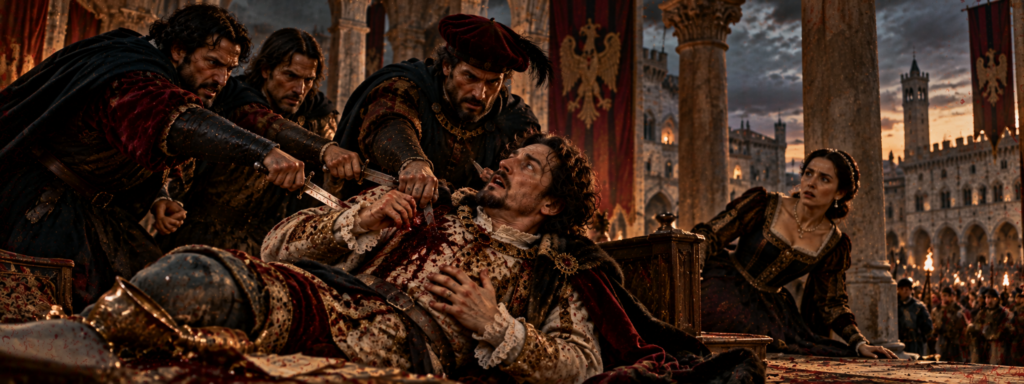
Girolamo Riario: The Hated Lord of Forlì Who Was Butchered in His Own Palace
Papal Nepotism, the Pazzi Conspiracy, a Marriage to the Fearsome Caterina Sforza, and the Bloody Assassination That Unleashed One of Renaissance Italy’s Most Extraordinary Women
Girolamo Riario (1443–14 April 1488) was an Italian nobleman, military commander, and lord of Imola and Forlì whose rise to power depended heavily upon his relationship with Pope Sixtus IV. Traditionally identified as the pope’s nephew, although rumors circulated about his actual parentage, Riario became one of the most ambitious beneficiaries of papal patronage during the Italian Renaissance. His marriage to Caterina Sforza, daughter of the murdered Duke of Milan, connected him to one of Italy’s most powerful dynasties, while his involvement in the political intrigues surrounding the notorious Pazzi conspiracy of 1478 helped establish his reputation as a dangerous and unscrupulous prince. His government in Romagna became increasingly unpopular as financial difficulties, heavy taxation, political favoritism, and conflicts with local elites undermined his authority. On 14 April 1488, members of the Orsi family and their associates attacked him inside his palace in Forlì, stabbed him to death, and threw his mutilated body into the public square below. The assassination was intended to overthrow his family’s rule, but it instead unleashed a fierce struggle for control of the city, with his widow, Caterina Sforza, emerging as the most formidable opponent of the conspirators.
The Night the Palace Became a Slaughterhouse
On 14 April 1488, the lord of Forlì was murdered in the very palace from which he had ruled his subjects. Girolamo Riario had spent years cultivating powerful allies, enriching himself through papal favor, and struggling to maintain authority over a city that increasingly resented him. He had survived the death of his greatest patron, the hostility of rival Italian states, and the dangerous political intrigues that had consumed other Renaissance princes. Yet the enemies who finally destroyed him were not foreign soldiers or powerful monarchs, but men from his own city who had been allowed close enough to strike.
The assassination was swift, violent, and humiliating. Members of the Orsi family and their associates entered the palace, attacked Riario, and stabbed him repeatedly before he could escape. His household was thrown into confusion as the conspirators seized control of the building and attempted to turn a private murder into a public revolution. The dead lord’s body was thrown from the palace into the piazza, where the spectacle of his destruction announced that his authority had ended.
For the assassins, the killing was supposed to be the beginning of a new political order. Girolamo had become deeply unpopular, and his enemies believed the citizens of Forlì would welcome his removal. The conspirators expected support from powerful families, discontented townspeople, and perhaps neighboring rulers who had little reason to mourn the fall of a papal favorite. What they failed to appreciate was that the dead man’s widow had no intention of surrendering her family’s possessions.
Caterina Sforza was not an ordinary Renaissance noblewoman accustomed to remaining quietly in the background while men fought over political power. She was the daughter of Galeazzo Maria Sforza, the Duke of Milan who had himself been assassinated inside a church in 1476. She had grown up in a dynasty where political survival depended upon force, calculation, and an extraordinary willingness to confront danger. The murder of her husband would reveal just how much she had learned from that brutal world.
The Orsi conspirators had eliminated Girolamo, but they had not secured the fortress that dominated Forlì. They had also failed to destroy the political loyalties that could be mobilized in the name of Riario’s young son. Their apparent triumph therefore contained a dangerous weakness from the beginning. Within days, the assassination would become the opening act of a struggle that transformed Caterina into one of the most famous women of the Italian Renaissance.
To understand how a lord could be hated enough to be murdered in his own palace, it is necessary to look beyond the final hours of Girolamo Riario’s life. His career was shaped by the corruption and magnificence of papal politics, the ruthless ambitions of Renaissance dynasties, and the extraordinary instability of the Italian city-states. He rose because he was connected to a pope, ruled because powerful men helped him acquire territories, and fell when those connections could no longer protect him. His assassination was the violent conclusion of a political career built upon privilege, ambition, and enemies who had waited for an opportunity to strike.
Born Without a Throne: The Making of a Papal Favorite
Girolamo Riario was born in 1443 into a family from Savona, a Ligurian city whose political fortunes were closely connected to the wider struggles of northern Italy. His father was Paolo Riario, and his mother was Bianca della Rovere, sister of the man who would become Pope Sixtus IV. The Riarios were not hereditary sovereigns of a great Italian state, and Girolamo did not begin life with an obvious claim to rule Imola, Forlì, or any other important city. His future would depend upon the remarkable political opportunities created by his mother’s family.
The della Rovere connection became decisive when Francesco della Rovere was elected pope in 1471, taking the name Sixtus IV. The new pontiff belonged to the Franciscan order and had risen through the Church’s intellectual and administrative hierarchy. His election placed him at the head of one of Europe’s most powerful religious institutions, but the papacy was also a major territorial and diplomatic force in Italy. A pope could command armies, negotiate alliances, distribute offices, and intervene in the affairs of rulers far beyond Rome.
Sixtus IV soon became notorious for the advantages he bestowed upon his relatives. Such favoritism was not unique to his pontificate, and the practice of promoting nephews and other family members had deep roots in papal government. Popes often relied upon relatives because family loyalty seemed more dependable than the shifting allegiance of Roman nobles and Italian princes. Yet the scale of Sixtus’s patronage made the della Rovere and Riario families particularly prominent.
Girolamo benefited enormously from this system. While other young nobles had to acquire military reputations, negotiate marriages, or inherit estates, he enjoyed access to the patronage of the supreme head of the Catholic Church. Papal favor could open doors that would otherwise have remained closed. It could also create resentment among those who believed church resources were being used to enrich a pontiff’s relatives.
Rumors about Girolamo’s parentage circulated during and after his lifetime. Some writers suggested that he was not merely Sixtus IV’s nephew but the pope’s illegitimate son, an allegation that fitted the hostile image of a corrupt and worldly pontificate. The claim is not established by reliable evidence, and the conventional identification of Girolamo as the son of Bianca della Rovere remains the appropriate historical description. Nevertheless, the rumor illustrates how easily papal nepotism could provoke accusations of sexual scandal and hypocrisy.
The distinction between Girolamo’s documented family relationship and the allegations surrounding it matters because Renaissance political propaganda often relied upon personal dishonor. A pope who promoted relatives could be accused of violating the spiritual responsibilities of his office, while the relatives themselves could be portrayed as unworthy opportunists. Such attacks were particularly effective when papal policy became entangled with warfare and territorial expansion. Girolamo’s career would provide his enemies with abundant material.
The young Riario was therefore drawn into a world where religious authority and secular ambition were inseparable. He did not inherit a kingdom through an ancient bloodline, nor did he conquer one through a long military career. His advancement was made possible by a family connection that placed him close to the center of papal power. That advantage would eventually become one of the greatest weaknesses of his political position.
Pope Sixtus IV: The Man Who Made Girolamo Powerful
Sixtus IV was a complex figure whose pontificate combined important cultural achievements with aggressive political ambition. He is remembered for the Sistine Chapel, which was constructed during his reign and named in his honor, as well as for his patronage of artists, architects, and scholars. His government contributed to the transformation of Renaissance Rome into a major center of artistic and architectural activity. Yet his political methods also brought the papacy into conflicts that damaged its reputation and endangered the peace of Italy.
The pope’s family occupied an increasingly prominent place in his administration. Relatives received ecclesiastical offices, military commands, financial advantages, and opportunities to acquire territorial power. Pietro Riario, another nephew, became a cardinal and was associated with extraordinary displays of luxury before his early death in 1474. Giuliano della Rovere, the future Pope Julius II, also rose through the network of family patronage. Girolamo’s ambitions developed within this environment of extraordinary opportunity.
Unlike relatives whose advancement centered upon ecclesiastical careers, Girolamo pursued secular power. His objective was to establish a territorial lordship that could survive beyond the lifetime of his papal patron. The Papal States contained cities and territories whose political loyalties were complicated, and the pope’s authority over them was often contested. Such conditions offered opportunities for a favored relative to acquire land and titles.
Sixtus IV supported Girolamo’s efforts to become a ruler in Romagna, a region stretching across the northeastern portion of the Italian peninsula. Romagna was strategically important because it lay between territories influenced by Florence, Venice, Milan, and the papacy. Its cities possessed strong local traditions and powerful families, making them difficult to govern from a distance. Control of a city in Romagna could provide revenue, military resources, and a foothold in the political struggles of northern Italy.
The pope’s willingness to use his position for family advancement created serious diplomatic consequences. Other Italian powers regarded the expansion of papal relatives with suspicion, particularly when it threatened their own interests. Florence was especially sensitive to changes in the balance of power near its borders. Milan, Venice, and Naples also watched papal policy carefully.
Girolamo’s rise therefore depended upon more than personal ambition. It formed part of a wider strategy through which Sixtus IV attempted to strengthen the territorial influence of his family and the papacy. The distinction between those two objectives was often blurred. What could be presented as the restoration of papal authority might also enrich the pope’s nephew.
This system gave Girolamo remarkable advantages but left him exposed to a dangerous future. A papal nephew could become powerful while his uncle lived, yet a new pope might have little interest in preserving his predecessor’s family projects. Girolamo would eventually discover how quickly the foundations of his authority could weaken. The patronage that elevated him would not guarantee his survival.
The Purchase of Imola: A Lordship Built on Money and Influence
Girolamo’s acquisition of Imola was one of the most important steps in his rise to power. The city had been connected to the political interests of the Sforza family, and its transfer required complicated negotiations involving Milan, the papacy, and financial arrangements. In 1473, Sixtus IV secured Imola for Girolamo through a transaction that demonstrated the extraordinary reach of papal patronage. The acquisition transformed a favored nephew into the prospective ruler of a strategically valuable city.
The purchase involved substantial sums of money, and the financing of the arrangement became politically controversial. Papal financial policy was already a source of tension among Italian bankers and ruling families. Florence’s Medici banking interests were closely associated with papal finances, but relations between the Medici and Sixtus IV deteriorated during the decade. The struggle over financial influence became entangled with the pope’s territorial ambitions.
Imola was not simply a piece of property that could be transferred without political consequences. Its inhabitants had established loyalties, institutions, and expectations concerning government. The surrounding powers understood its strategic importance. A ruler installed through papal influence had to secure obedience from people who had not necessarily chosen him.
For Girolamo, however, the acquisition represented a remarkable transformation. He could now present himself as a territorial prince rather than merely a relative of the pope. The lordship offered revenues, a court, and the prospect of founding a dynasty. His ambitions increasingly centered upon preserving and expanding that position.
The transaction also strengthened the case for a politically advantageous marriage. Girolamo needed connections that would enhance his legitimacy and provide support beyond the papal court. The Sforza dynasty of Milan offered precisely such an opportunity. A marriage to one of its daughters would connect his new lordship to a powerful northern Italian family.
The acquisition of Imola therefore marked the beginning of a new phase in his career. He had gained territory, but he also acquired obligations and enemies. His authority rested upon political arrangements that could be challenged when alliances changed. The city that elevated him into the ranks of Renaissance rulers would also tie his future to the dangerous rivalries of northern Italy.
Caterina Sforza: Marriage to a Daughter of Blood and Power
Caterina Sforza was born in 1463, the daughter of Galeazzo Maria Sforza, Duke of Milan, and his mistress Lucrezia Landriani. Although she was born outside her father’s legitimate marriage, she was acknowledged within the Sforza family and raised in the political environment of one of Italy’s most powerful courts. Her childhood exposed her to the wealth, sophistication, and ruthlessness of Renaissance princely government. Those experiences would profoundly influence her later life.
Galeazzo Maria Sforza was notorious for his extravagant court and accusations of cruelty. He was also a capable patron of music and culture, embodying the contradictions of Renaissance power. His government generated serious resentment among Milanese nobles, and in December 1476 he was murdered inside the Church of Santo Stefano by three conspirators. Caterina was still a young teenager when her father died, but the assassination demonstrated how quickly a powerful dynasty could be thrown into crisis.
Girolamo Riario’s marriage to Caterina was arranged as part of the political negotiations surrounding his acquisition of Imola. The marriage agreement was made while she was still very young, and the union was celebrated in 1477. She joined Girolamo in Rome soon afterward, entering a court where papal politics and dynastic ambition shaped almost every important decision. The age difference and political purpose of the marriage reflected the conventions of elite Renaissance society.
The union offered advantages to both families. Girolamo gained a connection to the Sforzas, strengthening his status as a territorial ruler. Caterina’s family secured an alliance with the pope’s favored nephew, whose influence could be valuable in the shifting politics of Italy. The marriage also created the possibility of heirs who would combine the Riario and Sforza lineages.
Caterina’s personality would eventually become one of the most remarkable features of the marriage. She possessed political intelligence, courage, and a willingness to exercise authority in circumstances where women were often expected to remain subordinate to male relatives. Her later actions demonstrated that she understood military and political affairs. Girolamo’s career cannot be separated from hers because she became essential to the survival of his dynasty.
Their relationship was shaped by the responsibilities of government and the demands of producing heirs. Caterina bore several children, including their eldest son, Ottaviano Riario, born in 1479. The children strengthened the hereditary claims of the family in Imola and Forlì. They would also become central to the political crisis following Girolamo’s assassination.
The marriage did not eliminate the dangers surrounding Riario’s position. His authority still depended upon papal support, local obedience, and the cooperation of neighboring powers. Yet Caterina brought more than dynastic prestige to the household. When his enemies finally killed him, she would prove capable of fighting for the inheritance he left behind.
The Pazzi Conspiracy: Florence, Murder, and the Shadow of Girolamo Riario
The Pazzi conspiracy of 1478 was one of the most notorious political plots of the Italian Renaissance. Its central objective was to overthrow the Medici family’s dominance in Florence, and its most dramatic moment occurred during an attack upon Lorenzo de’ Medici and his brother Giuliano inside Florence Cathedral. Giuliano was murdered, while Lorenzo escaped with his life. The conspiracy failed to produce the intended political revolution and instead provoked savage reprisals.
Girolamo Riario’s name became closely associated with the plot because of his connections to Pope Sixtus IV and the political interests that opposed the Medici. The conspiracy involved members of the Pazzi family, Archbishop Francesco Salviati, and other figures whose ambitions intersected with papal policy. The precise extent of Sixtus IV’s knowledge and approval of the planned murders remains debated. It is important to distinguish the documented political support for action against the Medici from proof that every participant explicitly authorized assassination.
Riario had strong reasons to welcome a change of government in Florence. Lorenzo de’ Medici was an important political opponent of the papal faction, and Florence’s influence could obstruct the expansion of Riario’s territorial interests. A government more favorable to the pope and his relatives would strengthen Girolamo’s position. The plot therefore fitted the wider political ambitions surrounding his career.
The attack took place on 26 April 1478 during Mass in Florence Cathedral. The conspirators struck at the Medici brothers in a setting that should have been protected by religious reverence. Giuliano was stabbed repeatedly and died, while Lorenzo escaped to safety. The attempted seizure of political power failed as Florentine supporters rallied to the Medici.
The aftermath was brutal. Conspirators and suspected accomplices were arrested, killed, or publicly executed, while the bodies of some were displayed as warnings. Archbishop Salviati was hanged, an act that intensified the conflict between Florence and the papacy. Sixtus IV responded with ecclesiastical and military pressure, helping to turn the failed conspiracy into a wider Italian crisis.
Girolamo’s involvement in the political campaign against the Medici contributed to his reputation as a dangerous figure. His ambitions were increasingly associated with conspiracies, warfare, and the willingness to destabilize rival governments. Even where the surviving evidence leaves uncertainty about his direct responsibility for particular acts, his political alignment is clear. He belonged to the faction that hoped to weaken Medici power.
The Pazzi conspiracy also demonstrated a lesson that would later become painfully relevant to Girolamo himself. Killing a prominent ruler or political leader did not necessarily produce the collapse of the government surrounding him. Giuliano’s murder failed to destroy the Medici, just as Galeazzo Sforza’s assassination had failed to destroy the Sforza dynasty. In 1488, Riario’s own enemies would make a similar calculation and discover that the consequences of assassination could be far less predictable than its perpetrators imagined.
The War That Followed the Failed Conspiracy
The failure of the Pazzi conspiracy did not end the struggle between Florence and the papacy. Instead, it intensified the hostility between Lorenzo de’ Medici and Sixtus IV, drawing other Italian powers into a dangerous conflict. The pope sought to punish Florence and weaken the Medici government, while Lorenzo attempted to preserve his city’s independence. Girolamo Riario’s territorial ambitions formed part of the broader political environment in which these hostilities unfolded.
The papacy could not rely solely upon religious authority to achieve its objectives. Italian warfare required money, soldiers, alliances, and commanders capable of conducting campaigns. Sixtus IV therefore pursued military and diplomatic arrangements with powers whose interests overlapped with his own. Such alliances were often temporary and vulnerable to sudden changes.
Florence faced serious pressure during the conflict. Its enemies hoped that military setbacks would undermine Medici authority and encourage political opposition within the city. Lorenzo responded through diplomacy as well as military resistance, eventually seeking an accommodation with King Ferrante of Naples. His efforts helped weaken the coalition against Florence.
Girolamo’s position remained closely tied to the pope’s ambitions. A successful papal campaign could strengthen his lordship and create opportunities for further territorial expansion. A failure could leave him exposed to the hostility of neighboring states. His fortunes therefore rose and fell with the broader political strategies of Sixtus IV.
The conflict also demonstrated the instability of the Italian balance of power. Alliances could shift rapidly when rulers feared that one state was becoming too strong. The same pope who had pursued war against Florence might later cooperate with former enemies when circumstances changed. Such reversals made long-term political security difficult for smaller rulers.
For Girolamo, the lesson was that power acquired through patronage had to be defended through constant negotiation. His enemies were not limited to the subjects of Imola or Forlì. He had become entangled in rivalries involving Florence, Naples, Venice, Milan, and Rome. The larger his ambitions grew, the more vulnerable he became to changes beyond his control.
The wars surrounding the Pazzi conspiracy therefore helped shape the political environment of his later rule. They strengthened his reputation for aggressive ambition and connected his name to one of the most infamous assassination plots of the century. They also showed that spectacular violence could produce consequences very different from those intended. Riario would eventually become the victim of that same political reality.
Forlì: The City That Became His Most Dangerous Possession
Forlì was an important city in Romagna whose political history included struggles between local ruling families, papal authorities, and neighboring powers. Its position made it strategically valuable, but its inhabitants possessed strong traditions of local political identity. The city was not an empty territory waiting to be assigned to a favored nobleman. Its government involved powerful families whose interests could conflict with those of an outside lord.
Girolamo acquired control of Forlì in 1480, following the displacement of the Ordelaffi family’s rule. Papal influence was decisive in the transfer of authority, and Riario became lord of both Imola and Forlì. The acquisition substantially increased his territorial importance. It also created new responsibilities that would prove difficult to manage.
Forlì’s population had experienced earlier political conflicts and changes of government. Local elites were accustomed to defending their privileges and negotiating with rulers. A lord who relied upon external support could face resistance if he appeared to disregard those interests. Girolamo’s authority therefore required more than a papal grant.
The city possessed fortifications, administrative institutions, and economic resources that made it worth controlling. Its fortress, the Rocca di Ravaldino, would later become central to Caterina Sforza’s defense of the family. Whoever controlled the fortress possessed a powerful advantage over the surrounding city. This distinction between control of the palace and control of the stronghold would prove decisive in 1488.
Girolamo’s government in Forlì was marked by financial and political difficulties. He needed revenue to maintain his household, support military commitments, and preserve his position among the Italian powers. Taxation became a source of resentment, particularly when local subjects believed that their resources were being consumed by the ambitions of an unpopular ruler. Conflicts with prominent families intensified the problem.
His authority was also weakened by the perception that he owed his position to papal favoritism. Unlike a ruler whose family had governed a city for generations, Girolamo had acquired Forlì through the political arrangements of his uncle. Such a background did not make effective government impossible, but it created a legitimacy problem. His enemies could portray him as an outsider imposed upon the city.
Forlì therefore became both the center of his ambitions and the place where his political weaknesses were most exposed. The lordship gave him status, revenue, and the possibility of establishing a hereditary dynasty. Yet it also placed him among subjects who could resent his taxes and aristocrats who might prefer another ruler. The city that represented his greatest achievement would eventually become the scene of his murder.
The Death of Sixtus IV: When the Patronage Disappeared
Pope Sixtus IV died on 12 August 1484, and his death transformed Girolamo Riario’s political position. For more than a decade, Girolamo had benefited from the protection and influence of a pope who was personally committed to advancing his family’s fortunes. The papal connection had helped him acquire territory, negotiate alliances, and maintain his place among the rulers of Italy. With Sixtus gone, the foundation of that influence suddenly weakened.
The death occurred during a period of intense conflict involving Venice, Ferrara, and the wider Italian powers. Girolamo had become involved in the shifting alliances surrounding these struggles, and his position was already complicated. The pope’s death deprived him of a powerful patron at precisely the moment when political circumstances demanded careful judgment. The transition to a new pontificate created uncertainty about his future.
Rome itself became unstable in the aftermath of Sixtus’s death. The papal relatives who had benefited from his favor faced hostility, and the political arrangements of the previous reign were vulnerable to reversal. Girolamo had to consider how to preserve his possessions while navigating the interests of a new pope. The security he had enjoyed could no longer be taken for granted.
Innocent VIII was elected pope later in 1484. His priorities differed from those of Sixtus IV, and Girolamo could not assume that papal resources would continue to support his ambitions in the same manner. Although he remained an important territorial lord, he had lost the extraordinary advantages associated with being the reigning pope’s favored nephew. His political independence was now more apparent than real.
The change also affected his finances. Maintaining a princely household, military forces, and political influence required substantial resources. Papal patronage had helped sustain his position, but the loss of that support increased the pressure upon his own territories. The revenues of Imola and Forlì became increasingly important.
The resulting financial difficulties contributed to tensions with his subjects. Taxes and fiscal demands that might have been tolerated under more prosperous circumstances became more controversial. Local elites resented interference with their privileges, while ordinary inhabitants could resent the burdens imposed upon them. Girolamo’s political weakness therefore became intertwined with economic dissatisfaction.
The death of Sixtus IV was not the immediate cause of Girolamo’s assassination, but it was a major turning point. It removed the most powerful protector he had ever possessed and forced him to rely upon less dependable alliances. His enemies could now calculate that the consequences of attacking him might be less severe. The ruler who had risen through papal favoritism was beginning to discover how dangerous life could become without it.
Taxes, Debts, and the Growing Hatred of Forlì
Girolamo’s government faced serious financial pressures during the final years of his life. His court, military obligations, and political ambitions required money, while the loss of direct papal patronage reduced his ability to rely upon outside support. The resources of Imola and Forlì became increasingly important to the survival of his regime. That dependence intensified the conflict between the lord and his subjects.
Taxation was one of the most sensitive issues. Renaissance rulers frequently relied upon direct and indirect taxes, customs duties, and extraordinary levies to finance their governments. Such demands could be accepted when subjects believed they served legitimate public purposes. They became dangerous when associated with extravagance, favoritism, or arbitrary rule.
Girolamo’s reputation suffered as fiscal pressure increased. Accounts of his government describe resentment over taxation and the treatment of local families. Some chroniclers portrayed him as harsh and oppressive, although their descriptions should be considered alongside the political interests of the writers. The existence of serious discontent is nevertheless supported by the events that followed.
The financial difficulties also affected relations with creditors and officials. A ruler who needed money could become dependent upon wealthy subjects, creating opportunities for conflict when loans, payments, or privileges were disputed. Prominent families might initially support the government because they expected rewards. If those expectations were disappointed, their loyalty could disappear.
The Orsi family became central to this atmosphere of resentment. Its members possessed standing within Forlì and had relationships with the political establishment. Their eventual participation in the assassination suggests that opposition had penetrated circles close to the ruler. The danger did not come solely from anonymous crowds or foreign enemies.
Girolamo’s position was especially precarious because his legitimacy remained tied to the circumstances of his accession. He had not inherited Forlì from generations of Riario ancestors. His authority had been established through papal power and maintained through political alliances. When those alliances weakened, local grievances became more threatening.
The city therefore entered a period of growing tension. Girolamo needed revenue and obedience, while important subjects believed they had reasons to resent him. His household remained the visible center of government, but its authority was increasingly contested. By 1488, the conditions for a violent confrontation were developing.
The Orsi Family: Enemies Inside the Walls
The Orsi family belonged to the political world of Forlì and possessed the connections necessary to challenge Girolamo from within his own city. Its members were not foreign invaders attempting to seize a distant territory. They were local figures whose grievances developed through the relationships, rivalries, and financial disputes of the lordship. Their position made them especially dangerous because they understood the political environment surrounding the palace.
Checco Orsi became one of the principal figures associated with the conspiracy. His family had grievances against Girolamo, including disputes involving money and political treatment. The precise details of every grievance are not preserved consistently in the surviving accounts, but the conflict was sufficiently serious to produce a plot against the ruler’s life. Personal resentment became the foundation of political rebellion.
The conspirators also recognized the broader weakness of Riario’s position. His powerful papal uncle was dead, his financial difficulties were well known, and his popularity had declined. The possibility of support from other Italian powers made the situation more dangerous. A successful assassination could create an opportunity to replace his government before his allies could respond.
The Orsi family did not act in complete isolation. The conspiracy involved associates and supporters who were prepared to participate in the attack and its aftermath. Their success depended upon gaining access to the palace and overwhelming Girolamo before his guards could organize an effective defense. The plot therefore required both personal determination and practical coordination.
The conspirators also had to consider Caterina Sforza. She was the daughter of the murdered Duke of Milan and had connections to powerful families beyond Forlì. Her political ability was already evident, and she could potentially rally support for her children. Any attempt to destroy the Riario government would therefore need to neutralize her influence.
The Orsi conspirators appear to have underestimated that problem. They concentrated upon killing Girolamo and seizing the palace, believing that the removal of the lord would allow them to control the city. Yet Forlì’s fortress remained a separate center of military power. The survival of Caterina and her children created the possibility of resistance.
The conspiracy was therefore bold but incomplete. The Orsi family had identified the weaknesses of Girolamo’s government and prepared a direct attack upon his person. They had not fully secured the political and military resources necessary to preserve their victory. Their success in murder would soon be overshadowed by their failure to defeat the dead man’s widow.
April 14, 1488: The Murder of Girolamo Riario
On 14 April 1488, the conspiracy against Girolamo Riario reached its violent conclusion. Members of the Orsi family and their associates entered the palace in Forlì and attacked the lord. The assault occurred within the seat of his government, where he should have been protected by household servants, guards, and the authority of his office. Instead, the conspirators were able to reach him and strike.
The attack was sudden and brutal. Contemporary accounts describe Girolamo being stabbed repeatedly, with the conspirators determined to ensure that he could not survive. The precise number of wounds varies in later retellings, and dramatic descriptions should not be treated as exact forensic evidence. The essential fact is clear: the lord of Imola and Forlì was murdered by men who had conspired to overthrow him.
The palace became a scene of confusion as the assassins attempted to consolidate control. Household members faced immediate danger, and the conspirators moved to prevent organized resistance. The killing was not intended to remain a secret. It was meant to announce that Girolamo’s government had ended.
His body was thrown from the palace into the public square below. The act was both violent and symbolic, transforming the ruler’s corpse into a public demonstration of his enemies’ triumph. A man who had governed from an elevated position of authority was now displayed before the city as a defeated victim. The humiliation was part of the political message.
Accounts of the treatment of the body contain gruesome details, some of which may have been amplified by later chroniclers. The spectacle of a murdered ruler exposed in the piazza was already shocking without the addition of uncertain embellishments. It communicated that the conspirators intended to destroy not only Girolamo’s life but also the dignity of his lordship. The palace and square became the stage for a public repudiation of his authority.
The assassination succeeded in its immediate objective. Girolamo was dead, and the conspirators had seized an important center of government. Yet the city was not securely theirs. Caterina Sforza and the Riario children remained alive, and the fortress had not been brought under the conspirators’ control.
The murder therefore marked the beginning rather than the end of the struggle. The Orsi family had eliminated the ruler whose taxes and political conduct they resented. They now faced the far more difficult task of preventing his dynasty from returning to power. The woman who would lead that resistance was about to become the central figure in the story.
The Body in the Piazza: A Public Humiliation
Throwing Girolamo Riario’s body into the piazza was more than an act of cruelty. In Renaissance political culture, the treatment of a ruler’s corpse could communicate the destruction of his authority. Public spaces were used for ceremonies, punishments, proclamations, and demonstrations of political power. By displaying the dead lord before the city, the conspirators attempted to make their victory unmistakable.
The palace had represented Girolamo’s government. From its rooms, officials issued orders, received petitioners, and administered the lordship. The ruler’s presence within the building symbolized his command over the city. His violent removal from that space reversed the relationship between lord and subject.
The public square became the setting for that reversal. The dead ruler was no longer surrounded by guards and attendants but exposed to the gaze of the population. The conspirators intended the spectacle to encourage acceptance of the new political situation. They hoped that the humiliation of the corpse would weaken any remaining loyalty to the Riario family.
Such displays were not unusual in the violent politics of Renaissance Italy. Bodies of defeated enemies could be exposed, mutilated, or treated with deliberate contempt to communicate political messages. The practice reflected a world in which punishment and humiliation were closely connected to authority. The Orsi conspirators used similar symbolism against Girolamo.
Yet public humiliation did not guarantee political legitimacy. Some citizens may have welcomed the death of an unpopular lord, while others feared the consequences of disorder. The spectacle could inspire satisfaction, horror, or uncertainty depending upon the observer. The surviving sources do not allow every reaction to be reconstructed with confidence.
The treatment of Girolamo’s body also created a powerful memory that would outlive the conspirators. Later accounts repeatedly emphasized the contrast between his former power and his degrading end. A papal favorite who had acquired cities through political influence was reduced to a corpse in the street. The image captured the instability of Renaissance princely government.
The humiliation was intended to erase the authority of the Riario dynasty. Instead, it became part of the story through which Caterina Sforza justified her determination to recover power. The assassins had created a spectacle of victory, but they had not secured the institutions necessary to preserve it. Their triumph was already beginning to unravel.
Caterina Sforza Taken Prisoner
The assassination placed Caterina Sforza and her children in immediate danger. The conspirators understood that the widow possessed political connections and that her eldest son, Ottaviano, represented the legitimate continuation of Riario rule. They therefore needed to prevent her from organizing resistance. Caterina was seized along with members of her household during the upheaval.
The situation was extraordinarily dangerous. Her husband had been murdered, the palace was under hostile control, and the conspirators possessed the ability to threaten her children. A woman in her position might have been expected to negotiate surrender in exchange for safety. Caterina instead began searching for a way to reverse the situation.
The key to her strategy was the Rocca di Ravaldino, the fortress that dominated Forlì. The stronghold remained outside the conspirators’ secure control, and its garrison could provide a base for resistance. As long as the fortress remained loyal to the Riario family, the Orsi victory was incomplete. Caterina understood the military significance of that fact.
Accounts describe negotiations in which Caterina persuaded the conspirators to allow her to enter the fortress, ostensibly to arrange its surrender. The precise details vary among chroniclers, and some later versions heighten the drama through elaborate dialogue. The central event is well established: Caterina gained access to the fortress and refused to hand it over. Her escape from the conspirators’ immediate control transformed the political situation.
Once inside, she could rely upon the fortress’s defenses and loyal personnel. The Orsi family no longer possessed the most important military position in the city. Their ability to compel surrender was weakened. Caterina had turned an apparent defeat into an opportunity for resistance.
The conspirators responded by threatening her children, hoping to force her compliance. This episode became the basis of one of the most famous and sensational stories associated with Caterina Sforza. Later writers described her answering the threats with an extraordinary gesture of defiance. The precise details of that legend are disputed and should not be treated as a verbatim account of her conduct.
What is certain is that Caterina refused to surrender the fortress. Her determination prevented the conspirators from consolidating their victory. The widow of the murdered lord had become the principal defender of the dynasty. Girolamo’s assassination had unexpectedly placed one of Renaissance Italy’s most formidable political figures at the center of the struggle.
The Legend of Caterina’s Defiance
One of the most famous stories about Caterina Sforza concerns the threats made against her children during the crisis of April 1488. According to a widely repeated tradition, the conspirators threatened to kill the children unless she surrendered the fortress. Caterina supposedly responded with a shocking declaration that she could produce more heirs. Some versions add a dramatic gesture intended to emphasize her contempt for the threats.
The story became a defining element of her reputation. It portrayed Caterina as a woman of almost terrifying courage, willing to defy enemies even when her children’s lives were at stake. Renaissance and later writers found the episode irresistible because it challenged conventional expectations about female behavior. It transformed a political negotiation into a scene of legendary defiance.
The historical evidence, however, is complicated. The surviving accounts differ in wording and detail, and the most sensational versions may reflect literary embellishment. Chroniclers often shaped memorable events into dramatic speeches that expressed a character’s supposed nature. It is therefore unsafe to present the famous declaration as an exact quotation.
The underlying political situation is more secure. Caterina had entered the fortress and refused to surrender it, despite pressure from the conspirators. Her children were vulnerable, and the Orsi family attempted to use that vulnerability to force compliance. Her refusal demonstrated extraordinary determination. The episode does not require an embellished quotation to reveal her courage.
The legend also raises uncomfortable questions about the treatment of children in Renaissance political conflict. The heirs of a murdered ruler could become bargaining instruments because their survival represented a continuing claim to power. Threatening them was a way of attacking the dynasty itself. The conspirators understood that Caterina’s maternal responsibilities might be used against her.
Caterina’s response demonstrated that she was thinking politically as well as personally. Surrendering the fortress might have destroyed her family’s position without guaranteeing the children’s safety. Holding it preserved the possibility of military rescue and dynastic survival. Her decision was therefore both courageous and calculated.
The legend became famous because it condensed those political realities into a single shocking image. Yet the actual achievement was more substantial than any theatrical gesture. Caterina maintained control of a strategic fortress, resisted coercion, and created the conditions for outside intervention. Her defiance would soon bring the Orsi conspiracy to an end.
The Fortress of Ravaldino: The Stronghold That Saved the Dynasty
The Rocca di Ravaldino was one of the most important military positions in Forlì. Its walls and defensive arrangements gave its occupants a major advantage over forces controlling the surrounding city. In a period when artillery was becoming increasingly important, fortresses remained central to the defense of Italian lordships. Control of such a stronghold could determine whether a political uprising succeeded or failed.
The Orsi conspirators had seized the palace and killed Girolamo, but they had not secured Ravaldino. This failure left them vulnerable to resistance from within the city and intervention from outside. The fortress could shelter loyal personnel and provide a base from which Caterina could negotiate. It also served as a visible symbol that the Riario dynasty had not been completely overthrown.
Caterina’s decision to enter the fortress was therefore decisive. Once inside, she could refuse demands for surrender and rely upon the defensive strength of the position. The conspirators could threaten her family, but they could not easily compel the garrison to submit. Their political victory was incomplete as long as the fortress remained hostile.
The stronghold also allowed Caterina to communicate with potential allies. The Riario children possessed dynastic claims, while Caterina’s Sforza connections provided access to powerful relatives. The prospect of military assistance increased the pressure upon the conspirators. Time began working against them.
The Orsi family had expected a rapid transformation of government. Instead, it faced a prolonged confrontation with a fortified position that could not be taken immediately. The conspirators lacked the resources necessary to conduct a major siege while also maintaining political control of the city. Their supporters could begin to doubt the success of the rebellion.
Caterina’s resistance demonstrated the importance of military infrastructure in Renaissance politics. A ruler’s palace could be seized through surprise, but a fortress required different methods. The distinction allowed a determined defender to survive the initial collapse of political authority. In Forlì, that defender was the murdered lord’s widow.
The fortress therefore became the place where the assassination’s consequences were reversed. Girolamo’s enemies had destroyed his person but failed to destroy the means by which his family could retain power. Caterina used that opportunity with remarkable effectiveness. The Orsi conspirators would soon face forces they could not resist.
The Sforza Response and the Collapse of the Orsi Conspiracy
Caterina Sforza’s family connections became crucial during the crisis following Girolamo’s assassination. The Sforza dynasty remained an important power in northern Italy, and its interests extended into the political affairs of Romagna. The murder of a family member’s husband and the danger to her children created reasons for intervention. Caterina’s control of Ravaldino made such assistance militarily useful.
Supporters of the Riario family organized resistance, and forces connected with Milanese interests moved toward Forlì. The prospect of outside intervention weakened the conspirators’ position. They had not secured the fortress, and their control of the city depended upon uncertain loyalties. Their ability to withstand a determined military response was limited.
The Orsi family had hoped that the assassination would produce a stable new government. Instead, the rebellion became increasingly vulnerable as Caterina maintained resistance and external support developed. The conspirators faced the possibility of being trapped between the fortress and approaching forces. Their political calculations had failed.
Within a short period, the Orsi position collapsed. The conspirators and their supporters were unable to maintain control against the forces defending the Riario succession. Caterina emerged from the crisis with her family’s authority restored. The assassination had not achieved the permanent overthrow of the dynasty.
The aftermath involved reprisals against those associated with the conspiracy. Renaissance governments frequently treated rebellion and assassination as crimes deserving severe punishment. The restoration of authority could therefore be accompanied by executions, confiscations, and political humiliation. The struggle for Forlì followed that harsh pattern.
Caterina’s role in the restoration strengthened her reputation. She had faced the murder of her husband, threats against her children, and the apparent collapse of her government. By maintaining control of the fortress and securing support, she prevented the conspirators from consolidating their victory. Her actions became central to her later political identity.
The collapse of the Orsi conspiracy also exposed the weakness of assassination as a political strategy. Killing Girolamo had removed the ruler but had not eliminated his family’s claims or military resources. The conspirators had underestimated Caterina and the importance of Ravaldino. Their failure transformed a successful murder into a disastrous rebellion.
The Widow Who Became the Ruler
After the restoration of Riario authority, Caterina Sforza became the dominant political figure in Forlì and Imola. Her eldest son, Ottaviano Riario, inherited his father’s titles, but he was still a child. Caterina therefore exercised power as regent and protector of the family’s interests. The assassination had unexpectedly elevated her into a position of direct political responsibility.
Her government reflected the lessons of the crisis. She understood that local loyalty could not be taken for granted and that military strength was essential to survival. The fortress remained an important symbol of her authority. She also needed to manage relations with neighboring states whose ambitions could threaten her territories.
Caterina’s reputation for courage became an important political asset. The story of her resistance to the Orsi conspirators circulated widely, presenting her as a woman capable of confronting danger with extraordinary determination. Such a reputation could discourage enemies and strengthen the loyalty of supporters. It also attracted attention from writers who were fascinated by her defiance of conventional gender expectations.
Her rule was not free from conflict. Romagna remained politically unstable, and the ambitions of the papacy, Florence, Venice, and Milan continued to affect the region. Caterina had to defend her territories against rival claims and shifting alliances. The murder of Girolamo had not ended the dangers surrounding the lordship.
She also faced the practical challenges of government. Revenue collection, military expenses, appointments, and relations with local families required constant attention. A ruler who had survived an assassination crisis still needed to maintain daily administration. Caterina proved capable of exercising authority in that demanding environment.
Her later career would include further marriages, political conflicts, and military resistance. She became particularly famous for her defense of Forlì against Cesare Borgia at the end of the fifteenth century. That struggle eventually ended in defeat and captivity, but it reinforced her reputation as one of Renaissance Italy’s most formidable women. The courage displayed in 1488 became part of a much larger political story.
Girolamo’s assassination therefore had an unexpected historical consequence. It removed a deeply unpopular lord but brought his widow to the forefront of Italian politics. The conspirators had attempted to destroy a dynasty by killing its ruler. Instead, they helped create the circumstances in which Caterina Sforza became a legend.
Cesare Borgia and the Final Destruction of Riario Power
The Riario family’s authority in Forlì and Imola survived Girolamo’s assassination, but it did not remain secure indefinitely. During the 1490s, the political situation in Italy became increasingly unstable as foreign monarchs intervened in the peninsula. The Italian Wars began in 1494, transforming the balance of power among the states. Smaller lordships such as Forlì faced growing danger.
The rise of Cesare Borgia created a particularly serious threat. Cesare was the son of Pope Alexander VI and pursued an ambitious campaign to establish territorial power in central Italy. His military operations targeted several rulers in Romagna whose authority depended upon complicated relationships with the papacy. Caterina Sforza’s territories became part of that struggle.
The irony was striking. Girolamo Riario had acquired power through the patronage of Pope Sixtus IV, and his widow would eventually lose that power to another pope’s son. The same system of papal family ambition that elevated the Riarios could be used against them. Renaissance politics offered little security to dynasties whose legitimacy depended upon the favor of powerful patrons.
Cesare Borgia’s campaign against Forlì culminated in the siege of the Rocca di Ravaldino in 1499–1500. Caterina resisted with determination, relying upon the fortress that had saved her dynasty in 1488. Yet the military resources available to Cesare were formidable, and the development of siege artillery had changed the balance between attackers and defenders. The stronghold eventually fell.
Caterina was captured, and Riario control of Forlì came to an end. Her resistance became one of the most celebrated episodes of her career, but courage could not overcome the military and political forces arrayed against her. The dynasty that had survived the Orsi assassination was finally displaced. Girolamo’s territorial ambitions had not produced the lasting hereditary state he had hoped to establish.
The fall of Forlì demonstrated the continuing instability of Renaissance lordships. A family could acquire territory through papal patronage, defend it through military courage, and lose it when another powerful faction gained control of Rome. Dynastic claims were vulnerable to the changing interests of popes, kings, and military commanders. The Riario story illustrates that instability across two generations.
Girolamo’s assassination therefore belongs to a longer history of political violence and territorial ambition. His death did not immediately destroy his family, but the state he had built remained vulnerable. Caterina prolonged its survival through determination and political skill. Ultimately, the forces that had made Girolamo powerful contributed to the destruction of his descendants’ rule.
Was Girolamo Riario a Tyrant or a Victim of Political Revenge?
Girolamo Riario’s historical reputation has been shaped by his association with papal nepotism, political conspiracy, and unpopular government. His rise depended heavily upon the favor of Sixtus IV, and his territorial ambitions contributed to the tensions among the Italian states. His name became associated with the Pazzi conspiracy, while his rule in Forlì generated resentment over taxation and political treatment. These circumstances help explain why his enemies came to regard assassination as an acceptable means of removing him.
Yet the label of tyrant requires careful interpretation. Renaissance political opponents frequently used accusations of oppression to justify rebellion against rulers they disliked. A lord who imposed taxes or interfered with aristocratic privileges could be condemned as tyrannical even when his actions resembled those of other contemporary governments. Personal grievances could be presented as struggles for public liberty.
Girolamo’s financial difficulties were real, and his government faced serious opposition. The loss of papal patronage weakened his position, while conflicts with local families created dangerous enemies. The Orsi conspiracy emerged from that environment of resentment. Its success in reaching the ruler demonstrates how deeply his authority had been compromised.
The assassination, however, was not simply an expression of popular justice. It was organized by members of a prominent local family whose interests had been damaged by the lord’s government. Their motives included personal and political grievances. The surviving evidence does not justify assuming that every inhabitant of Forlì supported their actions.
The treatment of Girolamo’s body also reveals the brutality of the conspiracy. Throwing the murdered ruler into the piazza was intended to humiliate him and demonstrate the destruction of his authority. Such behavior reflected the violent political culture of the period. It does not become less disturbing because the victim had been unpopular.
The conspirators’ failure further complicates their claim to have liberated the city. They killed Girolamo but failed to secure the fortress or prevent Caterina from organizing resistance. Their uprising collapsed, and the Riario dynasty survived. The assassination produced bloodshed without achieving a lasting political transformation.
Girolamo was therefore both a ruler whose conduct generated serious resentment and a victim of deliberate political murder. His career illustrates the dangers of acquiring power through patronage and attempting to maintain it through unpopular government. His death demonstrates how aristocratic grievances could become lethal when political authority weakened. The historical story is more complex than a simple struggle between a wicked tyrant and heroic liberators.
The Sources Behind the Assassination
The assassination of Girolamo Riario is documented through Renaissance chronicles, diplomatic reports, and later historical narratives concerning Forlì and the Sforza family. These sources establish the broad sequence of events: the murder on 14 April 1488, the involvement of the Orsi family, the public humiliation of the body, and Caterina Sforza’s resistance from the fortress. They also preserve dramatic details about the conspirators’ motives and the threats made against Caterina’s children. Their value is considerable, but they require careful interpretation.
Renaissance chroniclers often wrote with strong political sympathies. Supporters of the Riario family could portray the conspirators as treacherous murderers, while hostile observers might emphasize Girolamo’s oppressive government. Such differences affected the language used to describe the assassination and its aftermath. The historian must therefore distinguish between the core events and the moral judgments attached to them.
The most famous story about Caterina’s defiance is particularly vulnerable to embellishment. Later writers repeated versions in which she responded to threats against her children with an extraordinary declaration and gesture. The scene became central to her legend, but the precise wording and physical details cannot be verified with confidence. It is more responsible to describe the episode as a tradition associated with her resistance.
The number of wounds inflicted upon Girolamo is another detail that varies among accounts. Chroniclers sometimes used precise numbers to emphasize the brutality of an assassination. Such figures may reflect eyewitness testimony, but they can also acquire symbolic or literary significance. The essential fact of repeated stabbing is secure without requiring certainty about every wound.
The treatment of the body is better established in its broad outline. Girolamo was killed in the palace and his corpse was thrown into the public square. Later accounts may add details of further humiliation, but the central act was already a deliberate public statement. It demonstrated the conspirators’ desire to destroy the dignity of the fallen ruler.
The political consequences are also clear. Caterina secured the fortress, resisted the conspirators, and helped preserve the succession of her son. The Orsi rebellion collapsed after outside support reached the Riario cause. These events explain why the assassination failed to achieve its intended political result.
Historical accuracy does not require stripping the story of drama. The documented events are already extraordinary: a papal favorite murdered in his palace, his body thrown into the piazza, his widow threatened with the loss of her children, and a fortress held against the men who killed him. The surviving evidence provides ample material for a compelling narrative. The challenge is to preserve its intensity without turning uncertain legends into established facts.
The Legacy of Girolamo Riario
Girolamo Riario’s life illustrates the extraordinary opportunities and dangers of Renaissance Italian politics. He began as a member of a family whose greatest advantage was its connection to a powerful churchman. When that relative became Pope Sixtus IV, Girolamo acquired influence far beyond what his birth alone would have provided. Papal patronage transformed him into the ruler of Imola and Forlì.
His marriage to Caterina Sforza strengthened his dynastic position. The union connected him to the ruling family of Milan and produced children who could inherit his territories. It also brought into his household a woman whose political ability would eventually overshadow his own reputation. Caterina became the most enduring figure associated with the Riario lordship.
Girolamo’s involvement in the politics surrounding the Pazzi conspiracy damaged his historical image. His ambitions placed him among the enemies of Lorenzo de’ Medici, and the failed attempt to overthrow Medici power became one of the most infamous episodes of the century. The association reinforced the perception that he was willing to pursue power through dangerous intrigue. His career became inseparable from the darker side of papal politics.
The death of Sixtus IV exposed the weakness of his position. Without the protection of his uncle, Girolamo had to maintain his territories through less dependable alliances and limited financial resources. His government became increasingly unpopular, and local grievances intensified. The Orsi conspiracy emerged from that deteriorating political environment.
His assassination was both a personal catastrophe and a political turning point. The conspirators killed him inside his palace and threw his body into the piazza, hoping to destroy his authority. Yet they failed to secure the fortress and underestimated Caterina’s determination. The dynasty survived through her resistance.
The events of April 1488 became central to Caterina’s legend. Her refusal to surrender Ravaldino demonstrated extraordinary courage and political calculation. The threats against her children and the stories of her defiance captured the imagination of later writers. Her actions transformed the aftermath of Girolamo’s murder into one of the most famous episodes of Renaissance female leadership.
The Riario family’s rule eventually ended under pressure from Cesare Borgia. Caterina’s defense of Forlì in 1499–1500 was courageous but unsuccessful, and the family’s territorial ambitions collapsed. The same papal politics that had elevated Girolamo helped destroy his descendants’ power. His career therefore became a striking example of the instability of states built through family patronage.
Girolamo’s memory remains overshadowed by the circumstances of his death and the extraordinary actions of his widow. He is remembered less for his achievements as a ruler than for his association with conspiracy, taxation, political ambition, and assassination. The spectacle of his body in the piazza became a symbol of the sudden reversal of princely fortune. His death revealed how quickly the protections of wealth and rank could disappear.
The Lord Who Lost His Palace, His City, and His Life
Girolamo Riario rose to power because he belonged to the family of a pope. His uncle’s election as Sixtus IV transformed his prospects, giving him access to wealth, influence, and opportunities that would otherwise have been difficult to obtain. Through papal patronage, he acquired Imola and later Forlì, establishing himself as a territorial ruler in one of Italy’s most politically contested regions. His career demonstrated how effectively religious authority could be used to advance secular family ambitions.
The marriage to Caterina Sforza strengthened his position. She brought the prestige of the Sforza dynasty and the prospect of heirs who could preserve his lordship. Their union connected two families whose histories were marked by military ambition, political calculation, and violent succession struggles. Yet the marriage would ultimately become more important for the survival of his dynasty than for the stability of his own reign.
Girolamo’s ambitions drew him into the dangerous politics of Renaissance Italy. His association with the Pazzi conspiracy placed him among the enemies of the Medici and connected his name to one of the century’s most notorious assassination plots. The failed attack in Florence Cathedral demonstrated the risks of attempting to transform government through murder. Girolamo would later become the victim of a similar political calculation.
The death of Sixtus IV in 1484 removed the greatest source of his power. Without the pope’s protection, Girolamo struggled to maintain his position amid financial difficulties and changing alliances. His government in Forlì became increasingly unpopular, particularly as taxation and conflicts with local families intensified. The authority he had acquired through papal influence proved difficult to preserve through ordinary government.
The Orsi family emerged as one of his most dangerous enemies. Its members possessed local connections and grievances against the lord, and they recognized the weakness of his position. Their conspiracy developed within the political world surrounding the palace rather than among distant foreign rivals. The danger came from men who understood the city and believed they could replace its ruler.
On 14 April 1488, they acted. Girolamo was attacked inside his palace and stabbed to death, his authority destroyed in the place where it had been exercised. The conspirators threw his body into the public square, turning his corpse into a symbol of their victory. The spectacle was intended to announce that the Riario government had ended.
Yet the assassination did not produce the result the conspirators expected. Caterina Sforza survived, and the fortress of Ravaldino remained outside their control. The Orsi family had killed the lord but failed to eliminate the military and dynastic foundations of his authority. Their triumph was therefore incomplete from the beginning.
Caterina transformed that weakness into an opportunity. She gained access to the fortress, refused to surrender it, and resisted the conspirators despite threats against her children. Her actions allowed the Riario cause to survive until outside support could intervene. The widow became the defender of the dynasty.
The Orsi rebellion collapsed, and the family that had murdered Girolamo failed to establish lasting control over Forlì. The conspirators had underestimated both Caterina’s determination and the resilience of the political structure surrounding her children. Their attempt to destroy a dynasty through assassination produced a violent but temporary upheaval. The dead lord’s son inherited the title, while his widow exercised the power necessary to defend it.
The story did not end with that restoration. Caterina continued ruling through a period of extraordinary instability, eventually confronting Cesare Borgia and the military power of another papal dynasty. Her final defeat demonstrated that even courage and political intelligence could not guarantee survival in Renaissance Italy. The territories Girolamo had acquired through papal favor were eventually lost to the ambitions of another pope’s family.
His life therefore reveals the dangers of power built upon personal connections rather than durable political legitimacy. A favored nephew could acquire cities, titles, and military authority while his patron lived. When that patron died, the ruler was left to confront the grievances of subjects and the ambitions of rivals without the same protection. Girolamo’s fall was shaped by that vulnerability.
His assassination also demonstrates the limitations of political murder. The Orsi family succeeded in killing the man they hated, but they failed to secure the government they hoped to control. Their actions created a crisis that allowed Caterina Sforza to display extraordinary courage and preserve the Riario succession. The assassination removed Girolamo without immediately destroying his dynasty.
The most haunting image remains the body in the piazza. A man who had once enjoyed the protection of the pope and the prestige of the Sforza family lay exposed before the city he had ruled. The palace above him had become the scene of his murder, while the fortress beyond it remained in the hands of those determined to avenge him. His enemies had achieved the destruction of his person but not the complete destruction of his power.
Girolamo Riario entered history as a beneficiary of papal nepotism and left it as the victim of a violent aristocratic conspiracy. His ambitions had made him a ruler, his government had made him enemies, and the collapse of his political protection had made him vulnerable. Yet his death produced an outcome that his assassins had not anticipated: the rise of Caterina Sforza as one of the most formidable women of Renaissance Italy. In the end, the men who threw Girolamo’s body into the square discovered that murdering a lord was far easier than defeating the woman he left behind.