
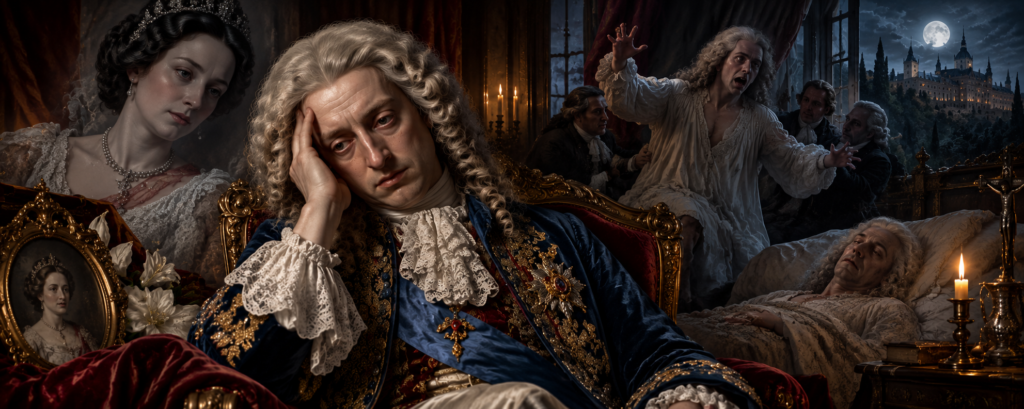
Ferdinand VI of Spain: The Grieving King and the Terrible “Year Without a King”
King of Spain, 1746–1759 | The Peaceful King
A King Disappears While Still Wearing the Crown
In the summer of 1758, Ferdinand VI of Spain was not an old man waiting quietly for death. He was forty-four years old, had ruled for nearly twelve years, and had presided over a period remembered more for peace, administrative reform, and financial recovery than for the great dynastic wars that had consumed the reign of his father, Philip V. He was cautious, private, emotionally dependent upon his wife, and never entirely free from the shadow of the troubled Bourbon household in which he had grown up, but he was capable of governing. Then, on August 27, 1758, Queen Bárbara of Braganza died, and something inside Ferdinand seemed to collapse with terrifying speed.
Grief came first. The king withdrew, lost interest in ordinary pleasures, slept badly, ate irregularly, and increasingly abandoned the routines expected of a Spanish monarch. Yet what followed soon went far beyond anything that can safely be described as bereavement alone. Ferdinand’s personality changed. His behavior became disorganized and unpredictable, his judgment deteriorated, and periods of profound apathy alternated with agitation and physical aggression. He neglected his appearance, wandered in his nightclothes, struck and bit attendants, and developed alarming physical symptoms. By the final months of his life, he was bedridden, incontinent, suffering convulsive seizures, profoundly cognitively impaired, and almost completely absent from the government whose authority technically remained his. Modern neurological research based on the surviving documentary record has therefore argued that although his collapse began with symptoms resembling major depression after Bárbara’s death, the rapid progression toward severe dementia and focal seizures points toward an organic neurological disorder rather than grief or a primary mood disorder alone.
Spain consequently experienced one of the strangest interludes in the history of European monarchy. Ferdinand remained king, but increasingly there was no functioning king at the center of government. He did not abdicate. No regent formally replaced him. His half-brother and heir, the future Charles III, was hundreds of miles away ruling Naples. Ministers continued to administer the monarchy while the sovereign deteriorated behind the walls of the castle of Villaviciosa de Odón. The extraordinary period between Bárbara’s death in August 1758 and Ferdinand’s death in August 1759 became known in Spanish historiography as el año sin rey—the “year without a king.”
The story has accumulated grotesque anecdotes. Ferdinand supposedly believed himself dead, behaved like a ghost, danced half-dressed through his rooms, constructed strange beds from furniture, screamed that he was drowning, refused religion, mocked his servants, headbutted courtiers, attempted suicide, and became convinced that catastrophe was perpetually about to strike. Some of these details have roots in accounts of his final illness; others have become distorted through retelling or are less securely documented than modern popular histories imply. Fortunately, Ferdinand’s final collapse is unusually well recorded because his physician Andrés Piquer left an extensive contemporary account of the illness, and modern researchers have examined more than a thousand surviving documents concerning the king’s condition. The genuine record is disturbing enough that embellishment is unnecessary.
Ferdinand VI was not simply a sad king who lost his beloved wife and died of a broken heart. Nor can his final year responsibly be reduced to the claim that he inherited his father’s “bipolar madness.” What happened at Villaviciosa appears to have been a catastrophic collapse of mind and body whose precise cause remains unknowable. Behind the romantic story of royal grief lies something darker: the spectacle of a living monarch progressively losing his personality, judgment, independence, and finally his grasp upon the world around him while an entire government waited helplessly for a king who was never coming back.
The Son of a Troubled King
Ferdinand was born in Madrid on September 23, 1713, the fourth son of Philip V and his first wife, Maria Luisa Gabriella of Savoy. His childhood unfolded inside a court already shaped by instability. Philip, the first Bourbon king of Spain, suffered recurrent episodes of severe melancholy and increasingly unusual behavior. Ferdinand therefore grew up not merely as a prince but as the son of a monarch whose psychological difficulties could transform the daily rhythms of royal life.
His mother died in February 1714, when Ferdinand was only a few months old. Philip remarried before the year was over, choosing Elisabeth Farnese of Parma. The new queen was intelligent, ambitious, politically formidable, and fiercely concerned with advancing the interests of her own children. Ferdinand and his older brother Louis belonged to Philip’s first marriage and therefore stood ahead of Elisabeth’s sons in the succession. This created a family structure in which affection, dynastic rivalry, inheritance, and politics could never be completely separated.
Ferdinand was not originally expected to become king. His elder brother Louis stood before him and briefly inherited the throne when Philip V unexpectedly abdicated in January 1724. Louis was only seventeen, and his reign lasted barely seven months before smallpox killed him that August. Philip returned to the throne, and the eleven-year-old Ferdinand suddenly became Prince of Asturias and heir to the Spanish monarchy.
The restored Philip’s mental health became increasingly problematic during the decades that followed. His household adapted itself to his irregular hours, prolonged melancholy, religious anxieties, and periods of extreme personal neglect. Elisabeth Farnese became indispensable to the operation of the court, while the famous castrato Farinelli eventually provided the king with musical comfort during some of his darkest periods. Ferdinand therefore had an unusually intimate example of what happened when a hereditary monarch remained alive but became psychologically incapable of performing his role consistently.
Whether Ferdinand inherited a predisposition toward psychiatric illness from his father is impossible to establish retrospectively. Later physicians and historians understandably noticed similarities between the two men, and Andrés Piquer’s observations contributed to his remarkably early thinking about the relationship between melancholy and mania. Yet resemblance within a family does not prove identical disease, and Ferdinand’s catastrophic final deterioration possessed neurological features that make a simple father-to-son diagnosis particularly doubtful.
Bárbara of Braganza: The Woman at the Center of His World
In 1729, Ferdinand married the Portuguese infanta Bárbara of Braganza, daughter of King John V of Portugal and Maria Anna of Austria. The marriage had been arranged for dynastic reasons, as royal marriages almost always were, but the relationship developed into something much deeper. Ferdinand and Bárbara became unusually close, and their attachment would define both his reign and his eventual collapse.
Bárbara was intelligent, cultivated, musically gifted, and better suited to Ferdinand than appearances at their first meeting may have suggested. Contemporary royal courts could be merciless about physical beauty, particularly in women, and Bárbara was subjected to unflattering commentary about her appearance and increasing weight. Ferdinand nevertheless became devoted to her. Their shared interests included music and a quieter domestic existence than the relentless ceremonial display associated with some other European courts.
The great tragedy of the marriage was childlessness. Ferdinand and Bárbara never produced an heir, despite almost three decades together. In a hereditary monarchy, infertility was never merely private disappointment. It determined the future of the dynasty and meant that Ferdinand’s eventual successor would come from the children of Elisabeth Farnese, the stepmother whose political dominance had overshadowed much of his youth.
Yet the absence of children may also have strengthened the emotional exclusivity of Ferdinand and Bárbara’s relationship. They became one another’s principal family. Bárbara was not simply a ceremonial queen standing beside the king at public occasions; she was his companion, confidante, and emotional anchor. Later descriptions emphasizing how profoundly her death affected Ferdinand make sense only when this dependence is understood.
Their marriage also possessed a political dimension, although Bárbara was generally less openly interventionist than Elisabeth Farnese had been. She could influence her husband and had particular importance in relations with Portugal. Her intelligence, discretion, and closeness to Ferdinand gave her access that ministers could never completely replicate.
For nearly thirty years, she was the constant presence beside him. In August 1758, that presence disappeared.
Becoming King
Philip V died on July 9, 1746, after a reign extending, with the brief interruption of 1724, across almost half a century. Ferdinand became king at thirty-two. His accession immediately changed the political atmosphere around the Spanish court because Elisabeth Farnese’s extraordinary influence depended heavily upon her marriage to Philip. With her husband dead and her stepson on the throne, she was removed from the center of power.
Ferdinand’s reign became associated with a more cautious foreign policy than the dynastic adventures pursued during the later years of his father’s rule. The king and his ministers sought to navigate between France and Britain rather than allowing Spain to become automatically subordinate to either. This preference for neutrality earned Ferdinand a reputation as a peaceful monarch, although eighteenth-century neutrality was always vulnerable to the ambitions of larger powers.
The king was not an intellectual giant or charismatic political visionary. He was reserved, cautious, and more comfortable within familiar routines than in spectacular displays of authority. Yet this should not be confused with incompetence. For most of his reign, the Spanish monarchy functioned effectively under ministers of considerable ability.
Two figures became especially important: José de Carvajal y Lancaster and Zenón de Somodevilla, Marquis of Ensenada. Their rival approaches and networks shaped Spanish policy, while Ferdinand often sought balance between competing factions. After Carvajal’s death in 1754 and Ensenada’s fall shortly afterward, Ricardo Wall emerged as a central minister.
The Spain Ferdinand governed was therefore not a kingdom drifting helplessly toward disaster. Its finances improved, the navy received attention, infrastructure and administration developed, and the crown pursued reform. The contrast with the chaos of his final year would be profound.
The Quiet King and the Music He Loved
Ferdinand’s personality suited the relatively restrained atmosphere of his reign. He enjoyed hunting and music, particularly the elaborate musical culture surrounding the royal court. Farinelli, who had become famous during Philip V’s final years, retained an important position under Ferdinand and Bárbara.
Music was more than decoration for the royal couple. Bárbara was herself an accomplished keyboard player and had studied with the great composer Domenico Scarlatti, who spent many years in the Iberian Peninsula. The queen’s musical interests helped make the Spanish court an important center of eighteenth-century performance.
Farinelli flourished in this environment. Under Ferdinand and Bárbara, he became associated not merely with private singing but with lavish theatrical and musical productions. His influence demonstrates the unusually intimate place that music occupied in Bourbon court culture.
Ferdinand’s quieter personality has sometimes caused his reign to be overshadowed by more spectacular rulers. He lacked the imperial drama of Charles V, the grim religious reputation of Philip II, the physical tragedy of Charles II, and the dramatic psychological history of Philip V. For much of his reign, there was relatively little material from which to construct a lurid legend.
Then Bárbara became ill.
The Queen Begins to Die
By the late 1750s, Bárbara’s health had deteriorated seriously. She suffered respiratory problems, including a persistent cough, and became increasingly unwell during 1758. The court moved to Aranjuez in the hope that the change might benefit her, but any improvement proved temporary. By July her condition was worsening, with fever and increasing exhaustion, and by late August she was dying.
Ferdinand remained beside the woman who had shared almost three decades of his life. There was little anyone could do. Eighteenth-century royal medicine offered status and attention but few effective remedies for serious internal disease, and physicians could observe the decline without possessing the tools necessary to reverse it.
On August 25, Bárbara lost her voice. Her final agony continued for two days. She died in the early hours of August 27, 1758, aged forty-six. Her remains were eventually associated with the Salesas Reales in Madrid, the religious foundation she had established and where Ferdinand would later join her.
The king was devastated. Had his reaction remained grief, withdrawal, sleeplessness, poor appetite, and despair, his final year might have entered history simply as the story of a widower who never recovered from losing his wife. Instead, the symptoms accelerated.
Within weeks, Spain began losing Ferdinand too.
From Grief Into Something More Dangerous
Andrés Piquer’s medical account is invaluable because it allows Ferdinand’s deterioration to be followed with unusual detail. Piquer noted that around the time of Bárbara’s illness Ferdinand had seemed physically well, but after her death he began losing interest in ordinary activities such as eating and sleeping. What initially resembled profound bereavement gradually developed into a far more complex syndrome.
The king became increasingly withdrawn and difficult. He neglected his appearance and resisted the routines that had structured his life. His sleep became disturbed, his eating irregular, and his behavior less predictable. Familiar activities ceased to interest him.
Depression following the death of a beloved spouse offers an obvious explanation for the beginning of this process. Indeed, modern neurological researchers acknowledge that Ferdinand’s earliest symptoms can resemble a major depressive episode. The problem is what happened afterward. Instead of stabilizing within a recognizable pattern of bereavement or depression, his condition rapidly expanded into severe behavioral disorganization, personality change, impaired judgment, physical aggression, neurological episodes, incontinence, and ultimately a cognitive state compatible with severe dementia.
This progression is one reason the traditional diagnosis of inherited “Bourbon madness” has been questioned. Philip V certainly suffered severe recurrent mental illness, but Ferdinand’s final disease appears to have moved with frightening speed toward neurological destruction.
Grief may have opened the door. Something else seems to have come through it.
Villaviciosa de Odón
After Bárbara’s death, Ferdinand withdrew to the royal castle at Villaviciosa de Odón, west of Madrid. The setting became the stage for the final and darkest chapter of his life. Removed from the ordinary visibility of court, the king lived increasingly within a restricted world of attendants, physicians, servants, and officials trying to manage a condition they could neither understand nor cure.
His isolation served practical purposes. The king’s behavior was becoming unsuitable for public view, and the court needed to protect royal dignity. Eighteenth-century monarchy depended upon appearances. A sovereign who wandered unwashed and unshaven in a nightgown was not merely a sick man; he threatened the carefully constructed image of kingship itself.
Seclusion also made the true severity of Ferdinand’s condition difficult for outsiders to judge. Diplomats wanted information because the king’s health had international consequences. Ferdinand had no children. His death would bring his half-brother Charles, then king of Naples and Sicily, to the Spanish throne, altering dynastic arrangements in Italy and potentially affecting the European balance of power.
Inside Villaviciosa, however, questions of diplomacy became increasingly remote. The immediate problem was keeping Ferdinand alive, fed, clothed, relatively calm, and safe.
The king of Spain had retreated into a castle. Soon the monarchy would discover that it had no reliable way to bring him back.
The King in His Nightgown
One of the most consistently repeated features of Ferdinand’s final decline is his abandonment of normal grooming and dress. He stopped maintaining the appearance expected of a monarch and could wander unshaven, unwashed, and dressed only in informal nightclothes. The behavior was so conspicuous that it became emblematic of his deterioration.
For an eighteenth-century king, clothing carried political meaning. Royal dress communicated rank, dignity, order, and control. Ferdinand’s refusal to participate in these routines therefore exposed his illness in a way that could not easily be dismissed as private eccentricity.
The neglect also resembled aspects of Philip V’s depressive episodes, which is one reason observers and later historians linked father and son. Philip had experienced periods in which grooming and ordinary daily routines became difficult. Ferdinand now seemed to be following a grim family pattern.
Yet Ferdinand’s decline soon surpassed ordinary self-neglect. He did not merely stop caring about his clothes. His behavior became disorganized, impulsive, and sometimes physically dangerous. Modern researchers studying the surviving documents describe a syndrome involving apathy combined with impulsivity and an early loss of judgment.
The nightgown therefore became only the visible surface of a much deeper collapse. Behind the neglected clothing, Ferdinand’s ability to regulate himself was disappearing.
The Strange Bed
Accounts of Ferdinand’s final illness describe increasingly unusual sleeping habits. One of the most striking stories concerns his refusal to use a conventional royal bed, instead arranging furniture into an improvised sleeping place. Versions describe chairs and a stool being positioned so that he could lie or rest across them in a manner that must have been extraordinarily uncomfortable.
Such behavior fits the broader documentary picture of severe behavioral disorganization, but precise descriptions vary and should not be elevated beyond the evidence available for each incident. Ferdinand’s final year produced many reports from people around him, and later retellings sometimes transform an isolated episode into a permanent ritual.
What matters is that ordinary physical arrangements could become difficult. Sleeping, eating, dressing, walking, and resting—activities that had once required little thought—became subjects of resistance and strange preference. The king could reject comfort without providing a rational alternative.
This is one feature that makes his final illness difficult to interpret purely as depression. Profound depression can certainly cause bizarre sleep patterns and refusal of normal routines, but Ferdinand’s increasingly disorganized choices accompanied broader changes in judgment and personality.
The castle slowly became organized around behaviors that no one could predict.
Fear Without Safety
Ferdinand also became intensely preoccupied with his health and bodily sensations. He expressed fears that something catastrophic was happening or about to happen to him. Hypochondriacal concerns and panic-like states became part of the illness.
Some accounts describe him declaring that he was internally ruined or felt as though he were drowning. Others suggest an overwhelming conviction that some fatal event was imminent. Such statements should be understood within the broader context of a man whose capacity to interpret bodily sensations and external reality was deteriorating.
It is tempting to classify each fear with a modern diagnostic label. Doing so can create more certainty than the evidence allows. Ferdinand’s doctors could record words and behavior, but they could not perform modern neurological imaging, psychiatric assessment, laboratory testing, or neuropsychological evaluation.
What is clear is that the king increasingly experienced his own body as threatening. Ordinary sensations could become terrifying. Attempts by physicians to reassure or treat him did not restore stable judgment.
The safest place in Spain could not make the king feel safe inside himself.
Violence Behind the Royal Door
By late 1758, Ferdinand’s agitation sometimes became physical. The extensive documentary study of his illness identifies descriptions of the king as furious, restless, and exceptionally ill-tempered during November, followed later that month by renewed episodes in which he struck and bit attendants and physicians. Physical aggression remained a serious problem into the spring of 1759.
The situation was terrifyingly awkward because the violent patient was also an absolute monarch. A physician could restrain an ordinary patient if necessary. Restraining the king of Spain raised questions of etiquette, authority, physical safety, and treasonous appearance.
Doctors reportedly became afraid to remain alone with him. Attendants faced similar dangers. Ferdinand might be apathetic and unresponsive at one moment, then impulsively aggressive at another.
Popular accounts add headbutting to the list of assaults and describe attendants constantly bracing themselves for attack. Such details are plausible within the well-documented pattern of aggression, but individual anecdotes deserve separate scrutiny. The secure historical point is already extraordinary: Ferdinand repeatedly became physically violent enough that those responsible for caring for him feared his behavior.
This was not the personality for which he had previously been known. The peaceful, restrained king had become capable of biting the people trying to help him.
Laughter, Mockery, and a Changing Personality
Ferdinand’s personality itself appeared to change. Modern researchers emphasize behavioral disorganization, impulsivity, and an intensification or distortion of pre-existing personality traits. These changes are particularly important because they support the possibility that his illness involved frontal regions of the brain rather than representing uncomplicated grief.
Later narratives describe him mocking attendants, laughing inappropriately, pacing in his nightclothes, or behaving with a cruelty that those who knew the earlier Ferdinand found uncharacteristic. Not every theatrical version of these scenes can be independently verified, but inappropriate social behavior is consistent with the broader clinical reconstruction.
Frontal-lobe dysfunction can alter inhibition, judgment, emotional regulation, motivation, and socially appropriate behavior. This does not prove Ferdinand had a tumor in a particular location, but it helps explain why neurologists have taken the pattern seriously.
The transformation must have been especially unsettling for longtime servants. Physical illness was familiar at royal courts. Fever, gout, digestive disease, and painful death were ordinary features of eighteenth-century life. Watching a familiar personality disintegrate was something else entirely.
The face remained Ferdinand’s. The behavior increasingly did not.
Did Ferdinand Believe He Was Dead?
One of the darkest stories surrounding Ferdinand claims that he sometimes behaved as though he were already dead or imagined himself a ghost. Similar stories appear in the biographies of several mentally ill historical rulers, and they should therefore be approached carefully. Delusions of death certainly exist in psychiatric history, but the popularity of such motifs makes transmission and embellishment possible.
Ferdinand’s documented cognitive and behavioral deterioration was severe enough that bizarre beliefs would not be surprising. Yet a historian should distinguish “not surprising” from “proven.” The strongest modern neurological reconstruction emphasizes disorganization, apathy, impulsivity, loss of judgment, abnormal eating, seizures, incontinence, and progressive dementia rather than making a ghost delusion central to the diagnosis.
If contemporary evidence for an individual episode is accepted, it still should not be transformed into a stable identity in which Ferdinand spent months convinced that he was literally a corpse. His mental state changed throughout the illness, and the severity of impairment itself fluctuated.
The legend survives because it perfectly suits the atmosphere of the final year: a king still legally alive but politically disappearing, wandering through a castle while Spain continued without him. In that metaphorical sense, Ferdinand did become something like a ghost before he died.
The monarchy still possessed a king. It increasingly possessed only his name.
The Question of Religion
Another dramatic claim is that Ferdinand abandoned religious observance during his final illness. For an eighteenth-century Spanish king, refusal to participate in Mass or customary devotion would have been striking. Religion was not a private hobby that could simply be neglected without comment; it was woven into royal identity, political legitimacy, and daily routine.
Severe illness, however, can disrupt practices that had previously seemed fundamental. If Ferdinand refused religious observances, this need not imply a philosophical rejection of Catholicism. Apathy, cognitive impairment, agitation, confusion, and behavioral disorganization could make participation impossible.
Courtiers living in a deeply Catholic culture might naturally interpret such behavior in spiritual terms. A king refusing prayer while behaving irrationally could appear morally or spiritually transformed. Earlier centuries might even have entertained demonic explanations.
Modern readers should be more cautious. There is no need to imagine that Ferdinand consciously renounced his faith. His capacity to maintain ordinary patterns of behavior was deteriorating across nearly every part of his life.
If religion disappeared from his routine, it was likely another sign that the structures holding Ferdinand together were failing.
Eating, Refusing, Wasting
Ferdinand’s relationship with food became erratic. Loss of appetite can accompany grief and depression, but his eating disturbance developed within a broader pattern of cognitive and behavioral collapse. At times he resisted food; at others his behavior around eating was disorganized.
This posed an immediate medical danger. A king could survive political inactivity for months if ministers continued working, but a human body could not survive indefinitely without adequate nutrition and hydration. Attendants therefore faced the problem of persuading or compelling Ferdinand to consume enough to remain alive.
Malnutrition likely contributed to his physical deterioration. Prolonged inactivity, irregular food intake, sleep disruption, and later confinement to bed created a cascade of secondary problems. Modern neurological discussion of the case recognizes that complications from immobility, malnutrition, and infection probably contributed substantially to the king’s decline and early death.
This is another reason simple psychiatric labels are inadequate. By 1759, Ferdinand’s mind and body were failing together. Neurological disease could produce behavioral disturbance, while poor nutrition and immobility could worsen cognition and physical resilience.
The man who had once presided over royal banquets eventually required others to struggle simply to keep him fed.
The Seizures Begin
The appearance of convulsive episodes is among the most important clues in Ferdinand’s medical history. The documentary record indicates that episodes occurred during late 1758, although researchers caution that the earliest events cannot all confidently be classified as epileptic seizures. By mid-January 1759, however, descriptions become much more consistent with genuine epilepsy.
This dramatically changes the medical picture. Severe grief does not ordinarily progress into focal seizures, profound dementia, loss of sphincter control, and terminal neurological deterioration within a year. The seizures therefore support the argument that Ferdinand suffered an organic brain disorder.
Modern investigators have identified features suggesting right frontal-lobe semiology. A disorder affecting the frontal region could potentially account for several elements of his decline: loss of judgment, impulsivity, personality change, apathy, behavioral disorganization, aggression, and focal seizures.
What caused such dysfunction remains uncertain. A tumor, structural lesion, vascular process, infection, degenerative condition, or another neurological disease could theoretically produce some combination of these symptoms. Without Ferdinand’s remains undergoing meaningful modern examination—and without contemporary imaging or pathology—identifying a precise lesion is impossible.
The important correction is therefore not “Ferdinand definitely had a brain tumor.” It is that the documented syndrome provides substantial reason to suspect neurological disease rather than explaining his final collapse solely as inherited bipolar disorder or grief.
Andrés Piquer Watches a King Disappear
Few mad monarchs were fortunate enough—or unfortunate enough—to have their deterioration recorded by a physician as observant as Andrés Piquer. Born in 1711, Piquer became an important Spanish physician and intellectual associated with the developing scientific culture of the Enlightenment. His account of Ferdinand’s illness survives as a remarkable document in the history of medicine. The manuscript preserved by the University of Valladolid extends across dozens of folios and records the course of the king’s disease into July 1759.
Piquer did not possess modern neurology or psychiatry, but he observed carefully. His work later became significant in histories of mood disorder because he considered relationships between melancholy and mania in ways that anticipated later psychiatric concepts. Scholars have noted his use of the idea of a melancholic-manic illness as a unified condition long before nineteenth-century psychiatrists formalized similar concepts.
That history helped encourage later interpretations of Ferdinand as suffering from the same broad hereditary mood disorder attributed to Philip V. Piquer’s own conceptual framework naturally influenced how the illness was described. Modern investigators, however, can reconsider his observations using neurological knowledge unavailable to him.
The irony is striking. Piquer’s account became important evidence in the history of bipolar disorder, yet the king whose illness he recorded may have been suffering from something more structurally neurological in his final year.
Piquer could describe the destruction with extraordinary care. He could not stop it.
A Physician Without a Cure
Eighteenth-century medicine offered Ferdinand little effective treatment. Physicians still worked within traditions involving humoral imbalance, diet, purging, bleeding, physical regulation, and environmental management. Piquer was intellectually sophisticated for his era, but he lacked antiseptics, modern anticonvulsants, psychiatric medication, neuroimaging, neurosurgery, antibiotics, intravenous nutrition, and nearly every diagnostic tool that would now be considered basic in a rapidly progressive neurological illness.
The court could provide the king with the best medical attention available in Spain. It could not provide medicine that did not yet exist. Doctors watched symptoms emerge and attempted treatments based upon the theories and experience of their time.
The king’s aggression made treatment still more difficult. A patient who struck, bit, resisted, or refused cooperation could not easily be examined. His royal status placed additional limits on what attendants could force upon him.
There was also no reliable way to determine whether a treatment helped or harmed him. Periods of temporary improvement might be credited to an intervention even if they reflected natural fluctuation. Deterioration might prompt increasingly aggressive remedies that further weakened him.
Ferdinand therefore occupied the cruelest possible position: surrounded by physicians yet living centuries too early for them to understand what was happening inside his brain.
The “Year Without a King”
As Ferdinand deteriorated, Spain confronted a political problem for which hereditary monarchy had no elegant solution. The sovereign was alive, but his ability to govern was disappearing. Because he had no children, the heir was his half-brother Charles, king of Naples and Sicily, who could not simply abandon his Italian throne and move to Madrid while Ferdinand still lived.
The period became remembered as el año sin rey. The phrase does not mean that every administrative function literally stopped for twelve months. Spain possessed ministers, councils, secretaries, governors, military commanders, judges, financial officials, and institutions capable of continuing routine government. The monarchy was more than the daily personal labor of Ferdinand VI.
Yet the absence of an effective sovereign mattered. Major decisions requiring royal authority became difficult, and ministers had to navigate a situation in which the legal source of executive power could no longer reliably exercise it. Ricardo Wall and others continued managing affairs, but uncertainty hung over the government.
The phrase “near-total halt” therefore requires qualification. Spain did not cease functioning, nor did every affair of state freeze. Rather, the political system operated under severe constraint because the monarch who should have resolved high-level questions was increasingly incapable of doing so.
It was a year without a functioning king, not a year without a state.
The Government Behind the Curtain
The secrecy surrounding Ferdinand’s illness made the political situation still more delicate. Foreign ambassadors naturally wanted accurate information about the king’s health because his death would immediately change the succession. Every report of improvement or decline could influence diplomatic calculations.
Ministers had to protect royal dignity while preparing for the increasingly obvious possibility that Ferdinand would never recover. Publicly declaring the king insane or incapable carried constitutional and dynastic implications. Continuing to behave as though nothing were wrong became equally impossible.
The Bourbon monarchy therefore existed in an uncomfortable middle state. Ferdinand’s name and authority remained necessary, but practical government increasingly depended upon people outside his room. This resembled the later years of Philip V, although Ferdinand’s deterioration was faster and ultimately more complete.
The absence of a formal regency illustrates how much early modern monarchy depended upon improvisation. Institutions could compensate for royal weakness, but the system was not designed around temporary medical incapacity in the modern sense. There was no standardized constitutional procedure equivalent to transferring powers because a head of state was neurologically incapable.
Spain simply waited.
The Brother in Naples
The man waiting to inherit was Charles, Ferdinand’s younger half-brother and the eldest surviving son of Philip V and Elisabeth Farnese. Charles had already accumulated considerable experience as a ruler. He had governed Parma and then conquered Naples and Sicily, establishing himself as king there.
The relationship between Ferdinand and the children of Elisabeth Farnese had always been complicated by the dynastic politics of their parents’ generation. Yet by 1758 the succession was clear. Ferdinand and Bárbara had no children, leaving Charles as heir.
Charles’s position created another problem. The diplomatic settlements governing Europe meant that the crowns of Spain and Naples could not simply remain united indefinitely in his hands. If Ferdinand died, arrangements would have to be made for the Italian kingdom.
Everyone therefore knew that Ferdinand’s death would produce a major dynastic transition. What nobody knew was exactly when it would come.
The king remained alive through the winter of 1758–59, then through spring, his condition worsening while Charles remained abroad. Spain had an heir capable of governing but no lawful means simply to replace the living brother who could not.
The monarchy was caught between biological life and political death.
From Violence to Prostration
During the earlier stages of the illness, Ferdinand could be restless, impulsive, and aggressive. As 1759 progressed, that energy increasingly disappeared. His physical condition deteriorated and prolonged confinement to bed became unavoidable.
The transition from agitation to prostration did not signal recovery. It indicated that the disease had advanced. Cognitive impairment became profound, while the king’s body weakened from poor nutrition, inactivity, neurological illness, and likely secondary complications.
Eventually he lost control of his bodily functions. Sphincter incontinence is specifically identified in the modern neurological analysis of his final illness and is one of the symptoms distinguishing the terminal condition from ordinary depression.
For attendants who had once feared being struck or bitten, the problem became one of basic nursing. The king who had violently resisted control was becoming incapable of controlling himself.
The transformation is grim. Within less than a year, Ferdinand moved from bereaved widower to severely cognitively impaired and bedridden patient. Modern researchers characterize his final state as compatible with severe dementia.
The “mad king” was no longer performing eccentricities. He was dying.
Was There a Suicide Attempt?
Claims that Ferdinand attempted suicide during his final illness appear in popular accounts and deserve careful handling. Severe grief and depression can certainly produce suicidal behavior, and the king’s despair after Bárbara’s death was profound. His later impulsivity and cognitive deterioration could also have placed him at risk of harming himself.
Yet the exact nature of alleged attempts varies across retellings, and self-endangering behavior in a confused neurological patient is not necessarily equivalent to a deliberate suicide attempt. A person with impaired judgment may refuse food, resist treatment, behave recklessly, or injure himself without possessing a coherent intention to die.
The distinction matters historically. Ferdinand’s mental state changed rapidly, and assigning a stable motive to behavior during severe cognitive deterioration can be misleading. It is safer to say that attendants had reason to fear for his safety and that some behavior could be self-destructive.
His refusal to eat was itself dangerous regardless of intent. So were physical agitation, seizures, prolonged insomnia, and resistance to care. The king did not need consciously to attempt suicide for his illness to threaten his life every day.
By the spring of 1759, his body was already being destroyed by the disease and its complications.
A Brain Disease Behind the Madness?
The most important modern reassessment of Ferdinand’s final year comes from neurological research examining the historical evidence systematically. A 2016 study in Revista de Neurología concluded that while the illness began after Bárbara’s death with symptoms resembling major depression, its rapidly progressive course included personality and behavioral changes, loss of judgment, bed confinement, sphincter incontinence, epileptic seizures, and ultimately severe dementia. The authors therefore argued that the terminal illness was compatible with a rapidly progressive dementia rather than a primary psychiatric disorder alone.
Subsequent archival research expanded the evidentiary base dramatically. Santiago Fernández Menéndez’s doctoral work examined 1,176 documents from multiple witnesses, including Andrés Piquer, Ferdinand’s half-brother Infante Luis, and minister Ricardo Wall. That research reconstructed a syndrome characterized by behavioral disorganization, impulsivity, altered eating, progressive cognitive deterioration, early loss of judgment, severe dementia, and seizures with features suggesting a right frontal origin.
This does not establish a brain tumor. The phrase “right frontal-lobe syndrome” describes a pattern of dysfunction, not a proven pathology discovered inside Ferdinand’s skull. Many diseases can damage or disrupt frontal networks.
A tumor is one possibility. Other structural, vascular, infectious, inflammatory, toxic, metabolic, or degenerative causes cannot be excluded. The historical record simply cannot supply the tests needed to choose confidently among them.
The responsible conclusion is therefore more fascinating than a false certainty. Ferdinand’s final “madness” may have been the outward expression of a brain physically failing in ways neither he nor his doctors could understand.
The Problem With the Hereditary Madness Story
The resemblance between Ferdinand and Philip V is difficult to ignore. Both experienced severe psychological distress. Both could withdraw from ordinary court life, neglect personal routines, and become difficult for attendants to manage. Both were observed by physicians interested in melancholy and mania.
That resemblance encouraged a straightforward narrative: Philip suffered bipolar disorder and passed it to Ferdinand. The story is tidy, medically modern, and perhaps partly true. It is also insufficient.
Ferdinand’s final syndrome differed in important ways from his father’s recurrent course. Philip experienced serious episodes over decades but repeatedly recovered enough to resume significant activity. Ferdinand’s terminal decline unfolded rapidly over approximately one year and progressed toward profound cognitive impairment, incontinence, seizures, and death.
Those features suggest something more destructive than a familiar recurrence of inherited mood disorder. Ferdinand may have possessed a pre-existing vulnerability to depression or another psychiatric condition, and Bárbara’s death may genuinely have triggered a depressive episode. None of that excludes a simultaneous neurological disease.
Human beings can have more than one illness at once. The desire to find a single elegant diagnosis can obscure that simple reality.
Ferdinand may have inherited vulnerability from his father. What killed his mind appears to have been something more.
The Death of Kingship Before the Death of the King
By the summer of 1759, Ferdinand’s political reign existed largely on paper. He remained Ferdinand VI by law, but the man who had once made decisions, listened to ministers, hunted, enjoyed music, and lived beside Bárbara had been reduced to profound incapacity.
This creates a distinction rarely visible so starkly in monarchy: the difference between the biological sovereign and the functioning sovereign. Ferdinand’s heart continued beating, so Spain could not simply declare Charles king. Yet the mental capacities through which Ferdinand exercised kingship were disappearing.
Royal ideology often treated the crown as something larger than the person wearing it. Ferdinand’s final year demonstrated why. The institution survived precisely because ministers, councils, officials, and established procedures could continue when the individual monarch could not.
Yet there were limits. Decisions accumulated. Uncertainty persisted. Foreign governments watched. The succession hovered over every report from Villaviciosa.
The king was alive enough to prevent a new reign and too ill to conduct the old one.
That was the terrible logic of the year without a king.
August 1759
Ferdinand’s decline continued through July. Piquer’s surviving medical account extends almost to the end, with material dated at Villaviciosa on July 29, 1759. By then there was little realistic prospect of recovery.
On August 10, 1759, Ferdinand VI died at Villaviciosa de Odón. He was forty-five years old and had reigned for thirteen years. The date was the anniversary of his proclamation as king.
His body was taken to the Salesas Reales in Madrid, where Bárbara had been buried. In death, the couple whose attachment had defined Ferdinand’s emotional life were reunited within the foundation associated with the queen. Their elaborate monuments would later be completed during the reign of Charles III.
Charles inherited Spain and became Charles III. Ferdinand’s death therefore ended not merely an illness but an extraordinary political suspension. Spain once again possessed a monarch capable of governing.
The year without a king was over.
The Brother Who Inherited the Silence
Charles III entered the Spanish succession with an advantage Ferdinand had never enjoyed when he became king: extensive governing experience. He had already ruled in Italy and developed his own political habits, advisers, and understanding of monarchy. His accession would open a new phase of Bourbon reform.
Ferdinand left no children and therefore no direct dynasty of his own. The crown passed through the second marriage of Philip V, the branch represented by Elisabeth Farnese’s children. The stepmother whose ambitions had shaped Ferdinand’s youth ultimately became the mother of his successor.
There is an almost cruel symmetry to the family story. Ferdinand had spent his early life in a household dominated by his father’s mental illness and Elisabeth’s political strength. He eventually escaped her influence by becoming king. Twelve years later, his own mental and neurological collapse left Spain waiting for Elisabeth’s son to replace him.
Charles’s arrival also helped restore ordinary royal authority after months of uncertainty. Decisions that had been postponed could be resolved by a functioning sovereign. The court no longer needed to maintain the fiction that Ferdinand might recover sufficiently to resume normal rule.
The monarchy moved on with remarkable speed because monarchies had to. Ferdinand’s suffering had been intensely personal, but the crown could not remain in mourning forever.
Spain had waited a year for its king to die. Now it had another.
The Myth of the King Who Simply Died of Grief
There is an emotionally satisfying version of Ferdinand’s story in which Bárbara dies, the heartbroken king loses the will to live, and exactly one year later he follows his beloved wife into the grave. It has the shape of tragedy and the simplicity of romance. It is also medically incomplete.
Bárbara’s death clearly mattered. The timing is too striking to dismiss, and Ferdinand’s emotional dependence upon her was profound. His earliest deterioration closely followed the loss and contained features compatible with severe depression.
But grief does not adequately explain the entire course. Personality disintegration, severe cognitive decline, focal epileptic seizures, sphincter incontinence, and terminal dementia demand a broader explanation. The neurological evidence makes the “broken heart” narrative insufficient.
This does not make Bárbara irrelevant. Psychological stress can interact with physical disease, and the queen’s death may have exposed, accelerated, or coincided with an underlying process. It may also have deprived Ferdinand of the person most capable of stabilizing his emotional life at precisely the moment his health began failing.
The tragedy is therefore not diminished by medical complexity. It becomes more unsettling.
Ferdinand lost the woman who had anchored his world at almost exactly the moment he began losing the mental capacity to navigate that world without her.
The Mad King Who May Have Been Neurologically Dying
Ferdinand VI belongs within the history of “mad monarchs,” but his case exposes the weakness of the label itself. People witnessing bizarre behavior naturally interpret it through the categories available to them. Eighteenth-century observers saw melancholy, mania, madness, bodily imbalance, moral disorder, or perhaps divine affliction. Modern observers are tempted to replace those words with bipolar disorder, psychosis, major depression, or dementia.
Sometimes both generations can be wrong in different ways. A behavior that appears psychiatric may arise from epilepsy, tumor, infection, stroke, neurodegeneration, metabolic disease, medication, or structural brain injury. Without modern testing, the outward symptom can conceal its biological origin.
Ferdinand’s final year demonstrates this vividly. His aggression, apathy, strange habits, poor judgment, emotional changes, and disorganized behavior could easily be described as insanity. Once seizures, incontinence, and severe cognitive decline are added, the possibility of neurological disease becomes much harder to ignore.
Modern researchers have therefore done something important: they have not “proved” Ferdinand had a particular tumor or lesion. They have shown that the old explanation of inherited psychiatric madness does not adequately account for the documented syndrome.
The distinction restores something of Ferdinand’s humanity. He may not have been a madman descending voluntarily into grotesque eccentricity. He may have been a neurologically devastated patient whose damaged brain progressively stripped away the behavior by which everyone around him recognized the king.
The Castle as a Waiting Room for Death
Villaviciosa de Odón became less a royal residence than a place of suspension. Ferdinand was kept away from ordinary court life while attendants tried to manage his changing condition. Ministers governed elsewhere. Diplomats gathered rumors. Charles waited in Italy. Physicians documented symptoms that grew progressively more alarming.
Within the castle, the rhythms of royal existence collapsed. Formal dress gave way to nightclothes. Ceremonial meals gave way to struggles over eating. Audiences gave way to isolation. Political deliberation gave way to cognitive confusion. The carefully choreographed body of the king became an incontinent, weakened body requiring constant care.
The contrast would have been almost unbearable for those who remembered the earlier Ferdinand. Kingship depended upon the fiction of continuity: the sovereign was always sovereign, whether eating, sleeping, praying, hunting, or presiding over council. Illness exposed the vulnerable human being underneath.
Ferdinand’s final months destroyed that fiction. His attendants did not encounter an abstract embodiment of monarchy when they entered his room. They encountered a sick man who might ignore them, fear them, strike them, bite them, resist food, suffer a seizure, or lie helplessly in bed.
Outside the castle, documents still carried royal authority.
Inside, the king was disappearing.
The Man Before Villaviciosa
The horror of Ferdinand’s final year can obscure the first forty-four years of his life. He was not always the wandering, unwashed figure preserved in accounts of 1758 and 1759. Nor was his reign simply an extended prelude to madness.
He had survived a complicated Bourbon childhood, the death of his mother, the brief kingship and sudden death of his elder brother, his father’s abdication and restoration, and decades beneath the formidable influence of Elisabeth Farnese. He had married Bárbara and built a deeply affectionate partnership. As king, he supported a policy of relative peace while capable ministers pursued reform and financial stabilization.
His government made mistakes and contained political rivalries, but it was not defined by personal chaos. Indeed, Ferdinand’s reign has often been remembered as comparatively calm. That makes the final transformation especially striking.
Had he died in 1757, his entry in the history of Spanish monarchy would look completely different. There would be no year without a king, no Villaviciosa nightmare, no famous medical account of progressive mental collapse, and far less reason to include him among Europe’s troubled monarchs.
One year transformed his historical identity.
Father and Son
The temptation to compare Ferdinand with Philip V remains irresistible because both men suffered extraordinary psychological difficulties. Philip’s later court had already become accustomed to unusual schedules, self-neglect, intense dependence upon his wife, and the need to govern around a monarch who periodically withdrew from ordinary life. Ferdinand had watched that system operate.
There may indeed have been hereditary vulnerability. Mood disorders can cluster in families, and Piquer’s observations helped him think about relationships between melancholy and mania with unusual sophistication for the eighteenth century.
Yet the differences matter as much as the similarities. Philip’s illness fluctuated over many years. Ferdinand’s terminal syndrome raced toward severe dementia. Philip could emerge from depressive periods and again become politically engaged. Ferdinand never meaningfully recovered after the final deterioration began.
This makes Ferdinand’s story darker in a different way. Philip’s court could wait for better days because better days sometimes came. Ferdinand’s attendants waited through autumn, winter, spring, and summer while the evidence increasingly suggested that recovery was not coming.
The father lived for decades with recurring mental illness.
The son appears to have suffered a rapidly progressive destruction from which there was no return.
The Limits of Historical Diagnosis
It is tempting to finish Ferdinand’s medical mystery by selecting a diagnosis. A right frontal brain tumor would fit parts of the story. So might another focal structural lesion. Rapidly progressive dementia provides a useful syndromic description, while seizures offer evidence of neurological dysfunction.
But history cannot provide the missing MRI.
The surviving evidence is extraordinary by eighteenth-century standards, particularly because Piquer documented the illness and modern researchers have assembled more than a thousand additional records. Even so, symptoms recorded by observers are not equivalent to neurological examination, imaging, laboratory testing, pathology, or autopsy findings interpreted according to modern standards.
The responsible conclusion therefore has boundaries. Ferdinand experienced rapidly progressive cognitive and behavioral deterioration after Bárbara’s death. His illness included severe affective symptoms, behavioral disorganization, impaired judgment, aggression, seizures, physical decline, incontinence, and eventual profound dementia. Modern neurological analysis considers this course inconsistent with explaining the entire terminal illness as uncomplicated depression and suggests an organic neurological process, with right frontal dysfunction particularly plausible.
Anything more specific remains hypothesis.
There is no shame in leaving a historical mystery partly unsolved. False certainty would tell us less about Ferdinand than the uncertainty itself.
The King Who Became a Ghost Without Needing to Believe He Was One
Perhaps Ferdinand really did say that he was dead. Perhaps an episode later became exaggerated into the story of a king pretending to be a ghost. The documentary record of his illness is rich enough that individual anecdotes may eventually be traced more precisely, but the broader symbolism is almost too perfect.
By early 1759, Ferdinand occupied the throne without truly occupying kingship. His name remained on the structure of government while his presence vanished from it. Ministers worked around the empty space where royal judgment should have been. Foreign courts waited for his death. His successor remained unable to succeed because the man he would replace was still breathing.
In that sense, Ferdinand did not need to believe himself a ghost. Politically, he had already become one.
The phrase año sin rey captures the paradox more effectively than any lurid anecdote. Spain possessed a king whose incapacity had become so complete that later generations remembered the period as though the throne had been empty.
There are few darker descriptions of royal illness.
The Cruelty of an Absolute Crown
Hereditary monarchy could tolerate an incompetent king, a lazy king, a cruel king, or an eccentric king. It struggled much more profoundly with a king who was medically incapable yet still alive. Ferdinand’s final year exposed that weakness.
An absolute crown could command armies but could not solve neurological disease. Ministers could issue instructions but could not easily replace the legal source of their authority. Doctors could attend the king but could not remove him from office. The heir could prepare but could not inherit.
The result was paralysis at precisely the level where monarchy claimed to be strongest. The political theology of kingship imagined a continuous sovereign authority embodied in one person. Biology produced a person whose consciousness and judgment could fail long before his heart stopped.
Ferdinand became trapped by the crown just as the crown became trapped by Ferdinand. He could no longer exercise kingship, yet he remained the king whose death was necessary before the system could fully repair itself.
The monarchy therefore waited beside his sickbed.
It had no other choice.
The Woman Whose Death Divided His Life
Bárbara’s role in Ferdinand’s story deserves a final reconsideration because it is easy to make her either the entire explanation or merely an incidental trigger. She was neither. She had been his wife for nearly thirty years, his closest companion, and a stabilizing presence throughout his adult life.
Her death was therefore a genuine psychological catastrophe. Even if Ferdinand already carried an undetected neurological disease, losing Bárbara removed the person around whom much of his emotional world had been organized. The first symptoms of the final collapse emerged immediately after that loss, making the connection historically undeniable even if the medical mechanism remains uncertain.
There is something particularly cruel about the timing. Had an organic brain disorder begun while Bárbara remained healthy, she might have helped manage his fears, routines, doctors, and attendants. Instead, Ferdinand confronted the first unmistakable phase of his terminal deterioration while simultaneously experiencing the greatest grief of his life.
The romantic version says that Ferdinand could not live without Bárbara.
The medical record suggests something more complicated and more terrible: after Bárbara died, Ferdinand increasingly lost the ability to live as the person he had been with her.
Within twelve months, he was dead too.
The Last Months
By the final months, the violent episodes that had frightened physicians gave way increasingly to profound physical and cognitive exhaustion. Ferdinand spent long periods confined to bed. His nutritional condition worsened, bodily control deteriorated, and seizures added further danger.
The court had passed beyond realistic expectations of restoring him to normal kingship. The remaining task was care. Political planning focused increasingly upon succession, while physicians confronted a patient whose disease had moved beyond their understanding.
There was no dramatic recovery before death, no final return to the calm king of earlier years, and no last burst of political authority that restored order. Ferdinand’s decline was relentless.
That absence of recovery strengthens the modern neurological interpretation. Recurrent psychiatric illnesses can certainly produce devastating and prolonged episodes, but the combination of progressive dementia, focal seizures, incontinence, and terminal physical decline forms a pattern difficult to reduce to melancholy alone.
The illness had begun with a bereaved man unable to sleep or eat normally.
It ended with the destruction of nearly every capacity required to be Ferdinand VI.
A Different Kind of Mad Monarch
Ferdinand’s place among the Mad Monarchs should therefore be approached differently from that of rulers remembered for paranoia, cruelty, extravagance, or political recklessness. His final catastrophe was not a reign-long pattern of tyranny driven by delusion. It was a medical collapse.
He did not spend thirteen years governing through psychosis. Most of his reign preceded the terminal syndrome and was comparatively stable. His illness became politically decisive only during the final year, when it progressed with extraordinary speed.
Nor should the grotesque behaviors become entertainment detached from disease. Biting attendants, wandering unwashed, behaving irrationally, losing bodily control, or lying cognitively devastated in bed were not colorful royal quirks. They were symptoms of a human being in catastrophic decline.
This distinction makes Ferdinand an especially important figure for the Mad Monarchs category. His story demonstrates how easily neurological disease can be remembered as “madness,” particularly when observers lack the medical concepts necessary to distinguish them.
The frightening behavior was real.
The old explanation for it may not have been.
The Year Without a King
The phrase has survived because it says almost everything. Ferdinand did not lose his crown in battle. He was not deposed by rebels. He did not abdicate like his father. He was not imprisoned by a rival dynasty.
He simply ceased, gradually and then catastrophically, to be capable of performing the role.
Spain continued around him. Taxes were collected, officials worked, ships sailed, correspondence moved, courts judged disputes, ministers negotiated, and subjects lived lives largely untouched by the bizarre scenes inside Villaviciosa. The monarchy proved more resilient than the monarch.
Yet at its highest level there remained an absence. Matters requiring decisive royal intervention became more difficult. Political factions maneuvered around uncertainty. Foreign governments watched the succession. Everyone knew that the situation could truly end only when Ferdinand died.
For nearly a year, Spain waited for death to perform the constitutional act that medicine and politics could not.
That is why el año sin rey is more than a memorable nickname. It describes the moment when the distinction between the crown and the person beneath it became impossible to ignore.
Ferdinand VI: The King Who Vanished Before He Died
Ferdinand VI died without children, without recovering his mind, and without ever understanding his illness in terms recognizable to modern medicine. He left behind no diary explaining what Villaviciosa felt like from inside his own consciousness. What survives comes overwhelmingly from those who watched him: doctors, ministers, relatives, servants, diplomats, and officials trying to make sense of a king becoming progressively unreachable.
Andrés Piquer’s observations give the story unusual medical depth. Modern archival research has made it deeper still, revealing a clinical progression much more complicated than the traditional tale of hereditary Bourbon melancholy. Ferdinand’s grief was genuine, his depression was real, and family vulnerability may have mattered, but the final syndrome developed neurological features too severe to ignore.
The precise disease remains beyond recovery. Perhaps there was a tumor. Perhaps another structural or degenerative process attacked the frontal regions of his brain. Perhaps a pre-existing psychiatric vulnerability and an organic disease converged at the worst possible moment. History cannot perform the examination that medicine needed in 1759.
What history can recover is the human destruction.
A king who had once governed cautiously became unable to judge. A man known for a relatively peaceful temperament became aggressive enough to frighten his doctors. A monarch surrounded by servants abandoned ordinary hygiene. A devout Catholic could no longer reliably maintain familiar rituals. A husband who had built his emotional world around his wife survived her by less than a year. A sovereign with command over a global monarchy eventually lost control over his own body.
Those facts are darker than the legends because they do not require imagination.
The Empty Throne Behind a Closed Door
Ferdinand VI’s story ends not with the spectacle usually associated with royal madness but with absence. There was no Caligulan reign of terror, no Nero-like legend of theatrical cruelty, no Charles VI racing through the countryside convinced enemies pursued him, and no Charles II surrounded by decades of dynastic panic. Ferdinand’s horror was concentrated into a single year in which a previously functioning monarch seemed to disappear piece by piece.
First went his ordinary pleasures. Then sleep and appetite became disturbed. His appearance deteriorated, his routines fractured, and his judgment weakened. Impulsivity and aggression emerged. Convulsive seizures followed. Eventually continence, mobility, cognition, and independence disappeared as well. Modern research reconstructs that progression not from a single sensational chronicler but from a large body of surviving documentation, including Piquer’s extraordinary medical record.
Behind the walls of Villaviciosa de Odón, the distance between Ferdinand the king and Ferdinand the patient became almost impossible to bridge. Attendants still had to treat him as their sovereign even when they feared being struck or bitten. Physicians still had to preserve royal dignity even when the man before them required the most intimate physical care. Ministers still governed in his name even when meaningful consultation had become impossible.
The crown remained majestic only at a distance.
Up close, there was a frightened, deteriorating man in a nightgown.
That image should not be used to humiliate Ferdinand. It is precisely what strips away the caricature and restores the tragedy. Mental and neurological illness do not become less human because their symptoms are disturbing. Ferdinand’s dignity lies not in pretending those symptoms did not exist, but in refusing to turn them into a grotesque sideshow.
He was sick. He was profoundly sick. And nobody in eighteenth-century Spain knew how to save him.
The King, the Queen, and the Silence Afterward
The tombs of Ferdinand and Bárbara eventually stood within the Salesas Reales, monuments to a royal couple whose marriage had become inseparable from the story of Ferdinand’s death. The arrangement gives their history a quiet ending that Villaviciosa never provided. Bárbara died first, Ferdinand followed less than twelve months later, and the political world immediately passed to another branch of the Bourbon family.
Charles III would become one of the most significant Spanish monarchs of the eighteenth century. His reign brought a different energy, different ministers, different reforms, and a different image of Bourbon monarchy. The strange suspended year of Ferdinand’s incapacity receded quickly into the past.
Yet the medical record preserved what political history might otherwise have reduced to a sentence. It preserved the stages by which a king ceased to function, the fear of those caring for him, and the inability of one of Europe’s great monarchies to do anything except wait.
Ferdinand’s reign had begun in 1746 with the death of a father whose own psychological illness had dominated the Spanish court. It ended thirteen years later with Ferdinand suffering a collapse even more rapidly destructive than Philip V’s recurrent melancholy. The family resemblance tempted generations to connect the two illnesses as though they were identical.
Modern evidence complicates that inheritance. Ferdinand may have shared vulnerabilities with his father, but his final year appears to tell a different medical story.
It is a story in which grief and disease met at exactly the wrong moment.
The Madness That May Not Have Been Madness
The word “mad” is convenient because it compresses everything disturbing into a single category. A king bites his doctor: mad. A king wanders unwashed: mad. A king behaves irrationally, refuses food, loses judgment, experiences seizures, and no longer recognizes the ordinary demands of his position: mad.
Neurology makes the story less simple.
A damaged frontal lobe can transform personality. Epileptic activity can produce bizarre behavior and altered consciousness. Rapidly progressive neurological disorders can destroy judgment, inhibition, memory, motivation, and bodily control. What an eighteenth-century court interpreted as madness may therefore have been the visible consequence of physical disease within the brain.
That possibility does not mean Ferdinand was secretly mentally healthy. By the final months he was profoundly cognitively impaired. The distinction concerns cause rather than severity.
He experienced madness in the historical sense that his thoughts and behavior became dramatically disordered. Whether the underlying disease belonged primarily to what modern medicine calls psychiatry is another question.
For Ferdinand VI, the boundary between a mad king and a dying neurological patient may be the central mystery of his life.
The Last King in the Room
There is a final irony in Ferdinand’s story. The Spanish monarchy had spent centuries constructing the king as a figure of almost overwhelming symbolic power. Ceremonies surrounded him. Ministers approached him according to rank. Servants organized his physical world. Diplomats measured his words. Portraits transformed the mortal body into an image of dynastic permanence.
Villaviciosa stripped those layers away.
When Ferdinand refused clothing, ceremony could not dress him. When he would not eat, rank could not feed him. When he struck attendants, etiquette could not calm him. When seizures came, royal blood could not stop them. When cognitive deterioration advanced, the legal fiction of sovereign wisdom could not restore judgment.
In the final months, kingship could do almost nothing for the man who embodied it. Its primary function became keeping the government operating until his body finally allowed the crown to pass to somebody else.
That may be the darkest element of the entire episode. Ferdinand possessed one of the most powerful identities in eighteenth-century Europe, but his title could not protect the person beneath it.
The disease did not recognize majesty.
The King Who Died Twice
Ferdinand VI died physically on August 10, 1759. Politically and psychologically, something resembling a first death had occurred gradually during the preceding year. The affectionate husband, cautious ruler, music-loving monarch, hunter, and participant in government disappeared while the legal king remained.
That is why the story of the ghost, whether literally true in the form later repeated or not, remains so haunting. Ferdinand’s court spent months living beside a man who was simultaneously present and absent. His body occupied Villaviciosa while his effective kingship had receded almost beyond reach.
The monarchy could not mourn him because he was not yet dead. It could not restore him because medicine did not understand the disease. It could not replace him cleanly because succession required death. It could only maintain government and wait.
When death finally came, it was almost administrative relief as well as personal tragedy. Charles III could inherit. The political uncertainty ended. Ministers once again possessed a monarch capable of making decisions.
Ferdinand was buried beside the woman whose death had marked the beginning of his collapse.
The year without a king ended because the king was finally gone.
Ferdinand VI and the Darker Meaning of “Mad Monarch”
Ferdinand’s place among history’s troubled rulers should leave us uncomfortable with the category itself. “Mad monarch” can suggest entertainment: eccentric kings, bizarre rituals, screaming fits, strange delusions, grotesque courts, and scandals preserved because ordinary rulers are less memorable. Ferdinand’s final year certainly contains disturbing behavior, but reducing it to spectacle misses what the evidence actually shows.
The most compelling interpretation is not that Ferdinand became fantastically eccentric after his wife died. It is that a relatively functional forty-four-year-old monarch suffered a rapidly progressive disorder that attacked emotion, personality, judgment, behavior, cognition, and ultimately physical control. His wife’s death may have triggered or revealed the first stage, but the disease developed beyond grief into something that modern neurological research regards as compatible with rapidly progressive dementia.
That makes the story more frightening because it removes moral explanations. Ferdinand did not choose to become violent, confused, incontinent, or cognitively devastated. His attendants could not reason him back into health. His doctors could not bleed, feed, pray, persuade, or medicate him back into the man he had been.
The king’s authority ended at the boundary of his own brain.
For nearly a year, Spain watched that boundary collapse.
The Year Without a King—and the Man Without Himself
Ferdinand VI’s reign is often overshadowed by the rulers on either side of him. His father, Philip V, founded Bourbon Spain and left behind a dramatic record of recurrent mental illness. His half-brother Charles III became associated with energetic Enlightenment reform. Between them stands Ferdinand, the quieter king whose most famous year was the year in which he scarcely ruled at all.
That reputation is unfair to the first twelve years of his reign but understandable because the final year is unforgettable. The contrast is simply too severe. A monarch associated with caution and relative peace ended his life behind castle walls, psychologically and neurologically devastated while ministers governed in the shadow of his incapacity.
The legends can be allowed to remain legends. Perhaps he sometimes imagined himself dead. Perhaps some of the strangest sleeping arrangements and bizarre statements happened exactly as later writers described them. Other stories may have been sharpened by repetition until confusion became theatrical madness and isolated behavior became permanent habit.
We do not need them to understand what happened.
We have Piquer. We have ministerial correspondence. We have family testimony. We have hundreds upon hundreds of archival documents. We have descriptions of aggression, disturbed eating, behavioral disorganization, cognitive decline, seizures, incontinence, and final prostration. Modern researchers have examined 1,176 documents in an effort to reconstruct the illness rather than merely repeat the legend.
The record they reveal is more tragic than the caricature of an insane Bourbon.
Ferdinand VI did not simply “go mad” because his wife died. Bárbara’s death shattered him emotionally, but the speed and neurological character of what followed suggest a deeper catastrophe. Something was happening to the king’s brain, something eighteenth-century medicine could observe but could neither identify nor stop.
By the time Ferdinand died, the question was no longer whether he could overcome his grief. The man who had experienced that grief had himself been progressively dismantled by disease.
His final year became known as the year without a king because Spain continued to possess Ferdinand’s crown without reliably possessing Ferdinand’s judgment. Yet there is an even darker way to understand those months. They were not merely a year in which Spain lost access to its monarch.
They were a year in which Ferdinand VI appeared, piece by piece, to lose access to himself.
And that is why his story belongs among the Mad Monarchs—not as a collection of grotesque anecdotes about a king dancing in his nightclothes, biting servants, or believing himself a ghost, but as something much more disturbing. It is the documented story of a ruler whose mind deteriorated while he was still young, whose body followed it into collapse, and whose kingdom could do almost nothing except continue around him until death finally released both the man and the monarchy from the terrible waiting room of Villaviciosa de Odón.