
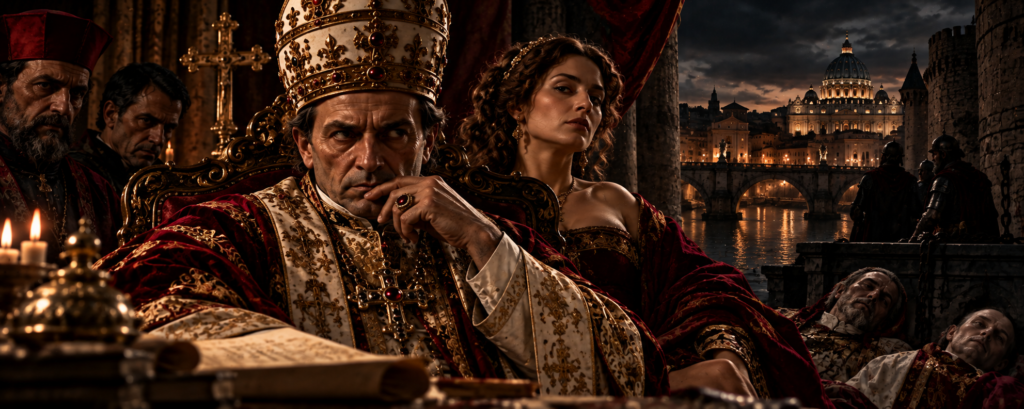
Sergius III: The Pope Who Rose from Rome’s Age of Blood
Sergius III — 904–911
Rome had barely finished putting dead popes on trial when Sergius III came back to claim the papal throne. The mutilated corpse of Formosus had been dragged from its grave, condemned before the infamous Cadaver Synod, stripped of its vestments, and thrown into the Tiber. Pope Stephen VI, who presided over that grotesque spectacle, had then been deposed and strangled in prison, while his successors desperately attempted to undo the damage. The Roman Church entered the tenth century not as an institution enjoying peace after the scandal, but as a battlefield divided between factions determined to control the papacy and punish their enemies.
Sergius belonged to that world completely. He was not an outsider who arrived after the violence had subsided, nor was he a reformer attempting to leave the Formosan controversy behind. He had been one of the leading opponents of Formosus, had already attempted to become pope during the struggle that followed the Cadaver Synod, and had suffered defeat and exile for his part in the conflict. When he returned to Rome in 904, he came not merely to occupy the papal throne but to reverse the settlement imposed by his enemies.
His arrival coincided with another bewildering succession crisis. Pope Leo V had been overthrown by a cleric named Christopher, who was then himself overthrown when Sergius entered Rome with powerful aristocratic support. Both Leo and Christopher subsequently died under dark circumstances, and later hostile sources accused Sergius of having them strangled. The accusation has followed him for more than a thousand years, but the surviving evidence does not allow us to state confidently that Sergius ordered either death.
That uncertainty would become characteristic of his reputation. Sergius has been remembered as a murderer, a usurper, the lover of the powerful Roman noblewoman Marozia, and the father of a future pope. Some of those accusations rest upon sources written by bitter enemies or authors separated from the events by decades, while others describe political realities that are far better documented. Separating them is essential because the genuine story of Sergius III is already dark enough without converting every later allegation into fact.
What can be established is that Sergius returned to power through aristocratic backing, reopened the wounds of the Formosan conflict, and governed during the rise of the formidable Roman family of Theophylact and Theodora. Their dynasty would increasingly dominate Rome and influence papal elections, creating the political environment later remembered as the Saeculum Obscurum, the “Dark Age” of the papacy. Sergius did not single-handedly create that system, but his pontificate stands close to its beginning and reveals how easily papal government could become entangled with the ambitions of Rome’s aristocratic houses.
The man who emerged from the chaos of the Cadaver Synod had finally won. His enemies had fallen, his old rival faction was vulnerable, and the papal throne he had once failed to seize was his at last. Yet the victory did not bring Rome out of its age of blood. It helped usher the papacy into another.
The Corpse That Divided Rome
The political career of Sergius III cannot be understood without returning to Formosus. Pope Formosus had become deeply involved in the struggle over who would control Italy and wear the imperial crown, eventually turning against Lambert of Spoleto and inviting Arnulf of Carinthia into Italy. Formosus crowned Arnulf emperor in 896, but Arnulf’s campaign collapsed after he became incapacitated by illness. Formosus died shortly afterward, leaving his enemies alive, powerful, and furious.
The revenge that followed produced the Cadaver Synod of 897. Pope Stephen VI ordered Formosus’s corpse removed from its tomb, dressed in papal vestments, seated before an ecclesiastical assembly, and formally prosecuted. The dead pope was condemned, his acts were attacked, and the fingers associated with episcopal blessing were mutilated before his remains eventually ended up in the Tiber. Instead of ending the political struggle, the spectacle divided Rome even more violently between Formosans and anti-Formosans.
Stephen’s enemies soon overthrew him, and he was strangled in prison. His successors Theodore II and John IX moved to rehabilitate Formosus, restore the validity of his ordinations, and condemn the proceedings of the Cadaver Synod. The Roman Church was therefore attempting to reverse the revenge carried out by Stephen and prevent the controversy from continuing indefinitely. Sergius stood firmly on the losing side of that settlement.
He had already been deeply involved in the anti-Formosan faction. Sergius had become bishop of Caere, modern Cerveteri, and appears among the churchmen associated with opposition to Formosus and his supporters. When the papacy became disputed after the brief pontificate of Theodore II, Sergius made his first serious attempt to claim the Roman see. He was not successful, but his defeat would not extinguish his ambitions.
Sergius’s First Attempt at the Papacy
After Theodore II died around the end of 897, Rome once again faced a contested papal election. John IX emerged as pope, but Sergius was supported by an opposing faction and put himself forward as a rival candidate. The struggle reflected the larger division between those seeking to rehabilitate Formosus and those determined to preserve the anti-Formosan position associated with Stephen VI. The papal election had become another battle in a conflict that seemed incapable of ending.
John IX possessed powerful support, including that of Emperor Lambert of Spoleto. This was particularly striking because Lambert himself had once been one of the political figures most threatened by Formosus’s decision to crown Arnulf. Political circumstances had changed, however, and Lambert now supported efforts to restore stability rather than perpetuate the corpse trial’s consequences. Sergius and his supporters found themselves isolated.
A council held at Rome and another at Ravenna in 898 formally addressed the damage created by the Cadaver Synod. The proceedings against Formosus were nullified, his ordinations were recognized, and those involved in the attack upon him were condemned. Sergius and some of his closest allies were specifically excluded from the general reconciliation and faced deposition and excommunication. The man who wanted to become pope had instead been defeated by a council defending the pope his faction despised.
Sergius left Rome, but exile did not mean disappearance. The political world of early medieval Italy changed too rapidly for any defeat to be assumed permanent. Emperors died, noble families rose, popes survived for only months or years, and alliances that appeared secure could collapse almost overnight. Sergius had lost in 898, but he remained available for the moment when the political balance shifted again.
That moment would come six years later.
A Papal Throne Surrounded by Fallen Men
The years following John IX did little to stabilize the Roman Church. John died around the beginning of 900 and was succeeded by Benedict IV, whose pontificate lasted until 903. After Benedict came Leo V, a pope whose reign lasted only a matter of weeks before another cleric seized power. The succession had become so unstable that the papal throne seemed capable of changing hands before Rome had adjusted to its latest occupant.
Christopher, a cardinal priest, overthrew Leo V in 903. The exact circumstances remain obscure, but Leo was imprisoned and Christopher took control of the papacy. Christopher’s status is itself disputed in later papal tradition, and he is generally treated today as an antipope rather than a legitimate successor. His triumph proved even shorter-lived than Leo’s pontificate.
Early in 904, Sergius returned. He possessed the support of powerful aristocratic interests and enough political force to overthrow Christopher. By January 29, Sergius was recognized as pope, finally obtaining the office he had unsuccessfully sought during the crisis of 897–898.
The sequence was extraordinary even by the standards of the age. Leo had been pope, Christopher had imprisoned Leo and replaced him, and Sergius had then displaced Christopher. Both of Sergius’s immediate rivals were subsequently dead, creating the foundation for one of the darkest accusations attached to his name.
Later writers claimed that Leo and Christopher were strangled in prison on Sergius’s orders. The allegation fits the brutal political environment of the period, but fitting the environment is not the same thing as proving the accusation. Sergius certainly benefited from their disappearance, yet the evidence connecting him directly to their deaths is too uncertain to describe him confidently as their murderer.
Did Sergius Murder Two Popes?
The accusation that Sergius ordered Leo V and Christopher strangled has become one of the defining elements of his reputation. It appears in later hostile traditions and has been repeated frequently in histories emphasizing the corruption of the tenth-century papacy. Two displaced claimants dying after Sergius’s seizure of power creates an understandably suspicious picture. A pope who had returned with aristocratic backing after years of factional conflict certainly had reasons to eliminate rivals capable of challenging his legitimacy.
Yet the historian faces a familiar problem. Much of what survives about Sergius comes from sources with strong political or moral agendas, and the chronology of Leo’s and Christopher’s deaths is not perfectly secure. Some traditions place both deaths after Sergius’s accession, while other reconstructions leave room for uncertainty concerning when Leo actually died. The surviving record simply does not provide the kind of direct evidence necessary to identify Sergius as the man who ordered their execution.
That does not require pretending the deaths were ordinary. Leo had been deposed and imprisoned, Christopher had seized the papacy and was then himself removed, and both vanished from political life during a period when imprisoned rivals often faced lethal consequences. Sergius emerged as the beneficiary of a succession struggle in which his principal competitors ceased to be threats. The circumstances are grim even when the murder charge remains unproven.
This distinction is particularly important for the Wicked Popes category. Sergius should not be made darker by presenting allegations as established facts, because doing so obscures the genuinely documented ruthlessness of the political system that brought him to power. His papacy arose from a world of deposition, imprisonment, disputed elections, excommunication, factional revenge, and possible political killing. Certainty about who gave a particular order is not required to recognize the violence surrounding his accession.
The Return of the Anti-Formosan Pope
Once Sergius possessed the papacy, he moved against the settlement created by John IX. The Formosan controversy that earlier popes had attempted to bury was reopened, and Sergius revived the anti-Formosan position. The dead pope who had already been exhumed, condemned, rehabilitated, and reburied once again became the center of Roman ecclesiastical politics. Formosus had been dead for approximately eight years, yet Rome was still fighting over him.
Sergius reaffirmed the condemnation associated with Stephen VI and challenged the validity of ordinations performed by Formosus. Clergymen who had received holy orders from Formosus could consequently find their status threatened again. The practical implications were enormous because those men might themselves have ordained others during the intervening years. A dispute over one dead bishop could spread through an expanding network of ecclesiastical careers.
The controversy generated a new wave of polemical writing. Auxilius of Naples, himself ordained by Formosus, became one of the strongest defenders of the dead pope and argued that the validity of ordination did not simply disappear because the ordaining bishop was later condemned. Eugenius Vulgarius likewise wrote in defense of Formosus before eventually adopting a more conciliatory attitude toward Sergius. Their writings reveal how deeply the dispute continued to affect the Church.
Sergius’s actions were therefore more than symbolic nostalgia for Stephen VI. They threatened living clergy and reopened questions that previous councils had attempted to settle. Instead of allowing the Cadaver Synod to become a shameful episode from the recent past, Sergius revived the conflict that had produced it. His pontificate became another chapter in Rome’s inability to escape the corpse of Formosus.
Fighting Over a Dead Pope
The Formosan controversy can appear almost absurd from a modern perspective. Formosus had died in 896, yet years later churchmen were still debating whether his papacy had been legitimate and whether his ordinations possessed validity. The intensity makes more sense when the dispute is understood as a struggle over living power rather than merely dead reputation. Whoever controlled the interpretation of Formosus could strengthen one network of clergy while weakening another.
Sergius had personal reasons to favor the anti-Formosan position. His own political career had been damaged by the settlement imposed under John IX, and he had been specifically condemned during the earlier attempt to reconcile the factions. Returning to Rome meant reversing not only an abstract theological judgment but the decision that had once excluded him from power. His victory in 904 therefore contained an element of political restoration.
There were also questions surrounding episcopal transfers and canonical legitimacy. Formosus had moved from the bishopric of Porto to the Roman see, and opponents had used that transfer as one of the principal arguments against him. Sergius himself had been bishop of Caere before becoming pope, creating another awkward example of a bishop moving from one see to another. The legal arguments surrounding these transfers became tangled with the larger partisan struggle.
The result was an ecclesiastical conflict in which consistency could easily yield to factional necessity. Canon law became another weapon available to whichever group controlled Rome. Sergius’s treatment of the Formosan question illustrates how difficult it was to separate sincere concerns about church discipline from political efforts to delegitimize opponents. The theological language was real, but so were the careers and power structures hiding beneath it.
Rome’s New Power Brokers
Sergius did not return to Rome alone. His accession depended upon powerful aristocratic support, and among the most important figures emerging during his pontificate were Theophylact and his wife Theodora. Their family would become one of the dominant forces in Roman politics during the first half of the tenth century. Their rise would transform the relationship between the papacy and the city’s nobility.
Theophylact held important secular and administrative positions in Rome and eventually accumulated extraordinary influence. His titles reflected a man operating near the center of Roman government rather than a nobleman watching papal politics from a distance. Theodora was also remembered as a powerful political figure, although later hostile writers frequently described her through sexual accusations rather than analyzing her authority directly. Together they created a family network capable of shaping papal succession.
Sergius relied upon this aristocratic environment. The exact balance of power between pope and noble patrons is difficult to reconstruct, but there is little doubt that Theophylact’s family became closely associated with his government. Their support helped stabilize Sergius after years in which popes had been deposed with alarming frequency. In return, proximity to the papacy strengthened the family’s position within Rome.
This arrangement foreshadowed the political system that would dominate the following decades. Roman aristocrats increasingly became kingmakers whose approval could determine who occupied the papal throne. Popes remained spiritual leaders of the Western Church, but in Rome their survival could depend upon the favor of families possessing wealth, armed supporters, offices, and extensive networks of patronage.
The papacy had escaped neither secular domination nor factional politics. Imperial intervention had once shaped Roman elections from outside the city, while aristocratic houses were now increasingly capable of shaping them from within. Sergius’s pontificate stood near the threshold of this transformation.
Theophylact, Theodora, and the Making of a Roman Dynasty
Theophylact and Theodora should not be reduced to caricatures of corrupt nobles circling a helpless papacy. They were political operators responding to the vacuum created by the collapse of strong Carolingian imperial authority in Italy. Rome required government, military protection, financial administration, and political leadership, while the papacy itself lacked the ability to operate independently of local power. Families capable of providing those things naturally accumulated influence.
Theophylact eventually held titles such as vestararius and magister militum, placing him near the center of Roman administration and military authority. His influence cannot be separated neatly into “secular” and “papal” categories because the government of Rome and the government of the papal territories overlapped. The family became indispensable precisely because institutional boundaries were weak. Sergius benefited from their power while also helping legitimize their position.
Theodora appears prominently enough in the surviving traditions to suggest that she exercised influence in her own right. Later authors, particularly those hostile to the Roman aristocratic regime, transformed her into a symbol of female sexual corruption. Such portrayals tell us something about medieval attitudes toward politically powerful women as well as about Theodora herself. A woman exercising authority could easily be accused of obtaining influence through seduction rather than political skill.
Their daughters would carry the family’s influence into another generation. The most famous was Marozia, whose career became so closely associated with papal politics that later historians treated her almost as the embodiment of Rome’s aristocratic domination. Her connection with Sergius produced one of the most sensational accusations attached to his name. It is also one of the accusations requiring the greatest caution.
Marozia Enters the Story
Marozia was born into the heart of Rome’s emerging aristocratic elite. As the daughter of Theophylact and Theodora, she belonged to a family already becoming essential to the political life of the city. Later in her career she would marry powerful noblemen, dominate Roman politics, participate in the overthrow of a pope, and eventually place her own son on the papal throne. Whatever else may be said about her, she was not merely a passive woman remembered because powerful men desired her.
The most notorious claim concerning Sergius is that Marozia became his mistress. According to later traditions, their relationship produced a son who eventually became Pope John XI. If true, the story would mean that a pope fathered a future pope with a woman belonging to the aristocratic family upon which his government depended. Unsurprisingly, the allegation became central to later portrayals of tenth-century papal corruption.
The chronology makes a relationship possible, but possibility is not proof. The principal scandalous narrative is associated especially with Liutprand of Cremona, who wrote decades later and was openly hostile toward the Roman aristocratic women he described. The Liber Pontificalis tradition has also been read as supporting Sergius’s paternity, but historians have long debated the evidence. John XI was certainly Marozia’s son, while the identity of his father is less secure.
Another possibility is that John XI was the son of Marozia’s husband Alberic I of Spoleto. That interpretation would fit the legitimate dynastic relationships surrounding Marozia and would eliminate the need for an affair with Sergius. The surviving evidence does not allow the paternity question to be resolved with complete confidence. Sergius may have fathered John XI, but the statement belongs in the category of plausible historical allegation rather than established fact.
The Problem With Liutprand
Much of the lurid reputation surrounding Marozia, Theodora, and the tenth-century Roman papacy comes through Liutprand of Cremona. He was a gifted writer with a taste for scandal, insult, sexual accusation, and vivid character assassination. His works are invaluable historical sources, but they are anything but neutral. Reading him requires constantly distinguishing useful information from rhetorical hostility.
Liutprand wrote about powerful Roman women with particular contempt. Theodora and Marozia became examples in his narrative of what he considered the moral degradation of Rome. Their political influence was repeatedly sexualized, turning female authority into stories about seduction, adultery, and lust. This does not mean every sexual allegation he recorded was false, but it does mean they cannot simply be copied into modern history as unquestionable fact.
His treatment of Sergius belongs within that problem. The alleged relationship with Marozia fit perfectly into a broader narrative portraying Rome as controlled by sexually corrupt women and morally compromised clergy. A pope fathering a future pope through an aristocratic mistress was almost too perfect an illustration of the decadence Liutprand wanted his readers to see. Historians therefore have good reason to approach the story cautiously.
At the same time, caution should not become automatic dismissal. Sergius was closely connected to Marozia’s family, clerical celibacy and sexual misconduct certainly existed, and the paternity tradition is not inherently impossible. The responsible position lies between credulity and denial. We can acknowledge the allegation, explain why it became famous, and admit that the surviving evidence does not permit certainty.
A Pope and a Powerful Young Woman
If Sergius and Marozia did have a sexual relationship, reconstructing its nature would be almost impossible. Their respective ages are not known with enough precision to create the confident narratives sometimes found in popular histories, and we possess no personal correspondence revealing affection, coercion, ambition, or intimacy. The later scandal has swallowed whatever private reality may once have existed. What remains is a political rumor amplified by the extraordinary careers of the people involved.
Marozia’s later life ensured that the allegation would never seem trivial. She married Alberic I, who became a major political figure, and after his death she continued building her own power. She later married Guy of Tuscany and eventually Hugh of Provence, king of Italy. Her marriages were political instruments linking her to some of the most important men in Italy.
By 931, Marozia was powerful enough to secure the papacy for her son John XI. If Sergius was indeed John’s father, then the consequences of their alleged relationship reached the throne of Saint Peter itself. If Alberic was the father instead, the event remains equally revealing of aristocratic control because Marozia still succeeded in placing her own son in the papacy. Either interpretation demonstrates the extraordinary political reach of her family.
The scandalous paternity question can therefore distract from the more securely documented story. The remarkable fact is not merely that Marozia may have slept with a pope. It is that the Roman aristocratic dynasty associated with Sergius became powerful enough to make and unmake popes for decades.
The Beginning of the Saeculum Obscurum
The term Saeculum Obscurum, usually translated as the “Dark Age” or “Dark Century,” has traditionally been applied to the period of papal history beginning around the early tenth century. Older writers sometimes used even more sensational labels, including the notorious “pornocracy,” emphasizing stories about Theodora, Marozia, and their supposed sexual domination of popes. Those labels reflect later moral judgments and often exaggerate the role of sexual scandal at the expense of political analysis. The underlying aristocratic domination of Roman papal politics, however, was very real.
Sergius’s pontificate is commonly associated with the beginning of this period because the Theophylact family rose dramatically under his rule. They did not merely influence a single election and disappear. Their network became deeply embedded in Roman government and continued shaping papal succession after Sergius died. The papacy increasingly functioned within an aristocratic political system controlled by families capable of determining who could rule Rome.
This did not mean every pope was simply a puppet. Individual pontiffs retained varying degrees of independence, and Roman aristocratic politics itself contained competing interests. The papacy also continued conducting diplomacy, issuing privileges, addressing ecclesiastical disputes, and interacting with rulers far beyond Rome. Describing the period solely as corruption would flatten a complicated political landscape.
Yet the structural weakness was unmistakable. A universal spiritual office had become extraordinarily dependent upon local families. The successor of Saint Peter might claim authority across western Christendom while remaining politically vulnerable to whichever aristocratic faction controlled the streets surrounding the Lateran. Sergius was both beneficiary and participant in that transformation.
Sergius and the Ruins of the Lateran
Sergius’s pontificate was not devoted entirely to factional revenge and aristocratic intrigue. One of his most substantial achievements was the restoration of the Basilica of Saint John Lateran, the cathedral church of Rome. The building had suffered severe damage, traditionally associated with an earthquake occurring around the period of the Cadaver Synod. Rebuilding it became an important project of Sergius’s government.
The Lateran mattered enormously. Saint Peter’s possessed the grave of the apostle and extraordinary devotional prestige, but the Lateran was the cathedral of the bishop of Rome and a central complex of papal government. Restoring it therefore carried both religious and political significance. Sergius was rebuilding one of the physical centers of papal authority after years in which that authority had nearly torn itself apart.
The contrast is striking. The same pope who revived the condemnation of Formosus also participated in rebuilding the institutional architecture of the Roman Church. Medieval rulers rarely fit neatly into categories of villainy or virtue, and Sergius is no exception. A man could pursue factional vengeance while simultaneously supporting churches, administration, liturgy, and religious institutions.
Recognizing those achievements does not rehabilitate Sergius into a misunderstood saint. It simply prevents the Wicked Popes category from becoming a collection of caricatures in which controversial pontiffs spend every waking hour committing crimes. Sergius governed for more than seven years, a comparatively substantial pontificate for his turbulent era, and ordinary papal administration continued alongside the scandals that later dominated his reputation.
A Marriage Crisis in Constantinople
Sergius also became involved in a major dispute within the Byzantine Church concerning Emperor Leo VI. The emperor desperately wanted a legitimate male heir and had married repeatedly after earlier wives died without producing the succession he needed. His fourth marriage to Zoe Karbonopsina created a serious ecclesiastical crisis because Byzantine religious practice strongly opposed fourth marriages. Patriarch Nicholas Mystikos resisted the emperor’s actions, while Leo sought support elsewhere.
Rome became involved in the dispute during Sergius’s pontificate. The Western Church’s approach to repeated marriage differed from Byzantine practice, and Sergius was prepared to allow a dispensation in Leo’s case. The decision was politically understandable because imperial succession mattered enormously and the emperor now possessed the male heir he had sought. It nevertheless complicated relations with those in Constantinople who regarded a fourth marriage as unacceptable.
The controversy illustrates the strange contrast between Sergius’s local weakness and international religious significance. In Rome, his authority depended heavily upon aristocratic alliances and emerged from years of factional warfare. Yet Constantinople still looked toward the bishop of Rome for an opinion in a dispute involving the emperor himself. The papacy could therefore be politically vulnerable at home while remaining ecclesiastically important abroad.
Sergius’s intervention did not permanently resolve the Byzantine conflict. The tetragamy controversy continued after his death and required later negotiations before reconciliation was achieved. Even so, the episode reminds us that his pontificate cannot be understood solely through Roman scandal. The pope associated with corpses, aristocratic intrigue, and alleged murder was simultaneously participating in one of the major church disputes of the eastern Mediterranean.
The Pope Behind the Legend
Once the murder accusations, Marozia story, and Formosan controversy are stripped of later embellishment, Sergius remains a difficult figure. He was clearly ambitious enough to contest the papacy in 897 and persistent enough to return years later after his faction regained strength. He reversed decisions made by his political enemies and revived a controversy that had already inflicted extraordinary damage upon the Roman Church. His survival depended upon aristocratic support from a family that would eventually dominate Rome.
None of those conclusions requires accepting every accusation made against him. We cannot establish with certainty that Sergius ordered Leo V and Christopher strangled. We cannot establish with certainty that Marozia was his mistress or that John XI was his biological son. We cannot reconstruct secret conversations between Sergius and Theophylact explaining the terms under which aristocratic support was given.
The distinction matters because hostile sources often create an illusion of intimate knowledge. They tell us not merely what political figures did but why they supposedly did it, whom they slept with, what moral defects motivated them, and how wicked their private intentions were. Those narratives are seductive because they transform complicated politics into vivid personal drama. They are also precisely where historians must become most careful.
The documented Sergius remains dark enough. He was an anti-Formosan partisan who returned from political defeat, captured the papacy during another violent succession crisis, reversed previous settlements, and governed through close cooperation with a rising aristocratic dynasty. The accusations surrounding him should deepen the atmosphere of uncertainty rather than become substitutes for evidence.
The Deaths That Would Not Leave Him
Leo V and Christopher remained shadows over Sergius’s reign even though surviving evidence cannot convict him of their deaths. Medieval politics frequently eliminated deposed rulers through imprisonment, monastic confinement, mutilation, or killing because a defeated claimant remained dangerous while alive. A former pope possessed supporters, symbolic authority, and the possibility of restoration. Keeping such men alive could therefore be politically risky.
Sergius had already experienced how quickly papal fortunes could reverse. He had lost his own bid for the papacy around 898, been condemned, and spent years away from power before returning successfully. Few men would have understood better that a defeated claimant could become dangerous again. Leo and Christopher represented exactly the kind of lingering alternatives capable of destabilizing a new pontificate.
That circumstance gives the murder allegations their plausibility, but plausibility must remain distinct from proof. Sergius had motive, opportunity, and political benefit, yet those categories alone cannot establish an execution order issued more than eleven centuries ago. The hostile nature and later date of important testimony demand restraint. His historical reputation should therefore carry the suspicion without pretending the case has been solved.
There is something appropriate about that uncertainty. Sergius lived in a political culture where imprisonment could conceal the final fate of defeated men and where victors controlled much of the surviving institutional record. Leo and Christopher disappeared into that darkness, leaving later generations to argue over who was responsible. The uncertainty itself tells us something about the violent opacity of the age.
The Women Rome’s Enemies Loved to Hate
Theodora and Marozia became almost legendary villains in later accounts of the Saeculum Obscurum. They were accused of seducing popes, arranging appointments through sexual influence, manipulating weak men, and transforming the Roman Church into a family possession. The imagery proved irresistible to later writers who wanted a dramatic explanation for the papacy’s political degradation. Powerful women became convenient symbols for an institution supposedly corrupted by lust.
The reality was more complicated and, in some ways, more politically interesting. Theodora and Marozia belonged to a dynasty that possessed genuine wealth, offices, military connections, marriage alliances, and influence over Roman government. Their authority did not need to depend upon sexual relationships with popes because their family already controlled substantial political resources. Reducing them to seductresses obscures the mechanisms through which aristocratic power actually worked.
Marozia in particular demonstrated formidable political ability over several decades. She survived changes of husbands and rulers, accumulated titles and influence, helped determine papal succession, overthrew opponents, and reached a position from which her son became pope. Her eventual downfall came not because a cleric exposed her supposed immorality but because her own son Alberic II led a Roman revolt against her political arrangements. Her career belonged to dynastic politics far more than to bedroom gossip.
This context also changes how Sergius should be understood. Even if a sexual relationship with Marozia occurred, his alliance with her family cannot be explained by romance alone. Theophylact’s house possessed the political machinery Sergius needed to rule. Sex may or may not have been part of the story, but power unquestionably was.
The Dark Century Takes Shape
After Sergius, the influence of the Roman aristocracy continued to grow. Anastasius III and Lando followed him, but the Theophylact family remained powerful enough to shape the political environment in which popes were chosen. John X, elected in 914, would later become entangled in the same family’s internal struggles. Marozia eventually turned against him, and he was deposed and imprisoned in 928.
John X’s fate demonstrated how dangerous aristocratic control could become. Sources disagree about the exact circumstances of his death, with some traditions describing murder and others leaving room for a natural death in captivity. What is not disputed is that a powerful Roman faction could remove a reigning pope and imprison him. The office possessed enormous sacred prestige but frighteningly little political security.
Marozia subsequently became the dominant figure in Rome and eventually secured the papacy for John XI in 931. Her control did not last indefinitely, because Alberic II revolted against her in 932 and became the effective ruler of Rome. John XI, whether Sergius’s biological son or not, found his secular authority heavily constrained under Alberic’s regime. The papacy remained trapped within aristocratic politics even when the identity of the dominant aristocrat changed.
The system that emerged around Sergius therefore outlived him by decades. Theophylact’s descendants and related families continued exercising enormous influence over Rome. Eventually the papacy would begin escaping this environment through broader political transformations and reform movements, but Sergius belonged to the period when local aristocratic domination was becoming entrenched.
Was Sergius a Usurper?
Calling Sergius a usurper seems straightforward until the chaotic succession preceding him is examined closely. He had unsuccessfully claimed the papacy in 897–898 against John IX and was condemned after losing that contest. In 904 he returned, overthrew Christopher, and was accepted as pope. Whether this constituted restoration, conquest, election under pressure, or some combination of all three depends heavily upon which faction’s perspective is adopted.
Christopher’s own legitimacy was questionable because he had overthrown Leo V. If Christopher was an antipope, Sergius could be portrayed as removing an illegitimate claimant. Yet Sergius’s accession itself occurred through political force and aristocratic backing rather than an obviously peaceful canonical transition. The sequence resists attempts to impose clean modern categories upon it.
What mattered most was effective control. Sergius secured Rome, obtained recognition, and remained pope for more than seven years. Unlike many predecessors, he was not rapidly overthrown. His aristocratic alliances gave his pontificate a degree of stability absent from the frantic succession immediately preceding him.
That stability came at a price. The same alliance that helped Sergius survive strengthened the families capable of dominating future papal elections. A pope could obtain security by attaching himself to a powerful Roman dynasty, but doing so increased that dynasty’s influence over the institution. Sergius solved one immediate political problem while helping normalize another.
Seven Years on a Dangerous Throne
Sergius’s pontificate lasted from January 904 until April 911, which was significant longevity compared with several popes immediately before him. He survived the office rather than being deposed, imprisoned, or murdered, and that fact alone suggests the effectiveness of his political alliances. Rome under Sergius remained factional, but the frantic cycle of papal replacement temporarily slowed. The man who had once lost the throne proved considerably more difficult to remove after finally obtaining it.
His survival should not be mistaken for complete political independence. The Theophylact family became increasingly powerful during these years, and Sergius’s government existed within their sphere of influence. The pope and aristocratic dynasty appear to have benefited from one another. Sergius received stability while the family gained access, prestige, and greater influence over Roman government.
This mutual dependence became one of the defining patterns of the coming decades. Popes needed powerful protectors because no strong emperor consistently guaranteed Roman security. Aristocratic families needed the papacy because control over the office provided wealth, legitimacy, patronage, and influence extending far beyond the city. The resulting relationship could be cooperative one moment and coercive the next.
Sergius’s reign therefore represents more than the biography of one controversial pope. It marks a stage in the transformation of papal politics after the collapse of Carolingian power. The Roman bishop remained one of the most prestigious religious figures in Europe, but the man wearing the papal vestments could increasingly depend upon a handful of families living only streets away.
Sergius and the Memory of Stephen VI
Sergius’s revival of the anti-Formosan cause inevitably connected him with Stephen VI. He did not repeat the Cadaver Synod by digging Formosus up again, but he restored the central judgment that Stephen had tried to impose. The dead pope’s ordinations once more came under attack, and churchmen who thought the controversy settled discovered that political victory could reverse ecclesiastical decisions years later. The corpse remained in its grave, but the war surrounding it resumed.
This connection is essential to understanding Sergius’s place among the Wicked Popes. Stephen’s actions had been spectacularly grotesque, while Sergius’s were more institutional. Stephen attacked Formosus’s physical body; Sergius attacked the legitimacy of the ecclesiastical legacy that survived him. The second campaign lacked the horrifying imagery of a corpse sitting on a throne but threatened living clergy in ways that could be equally consequential.
Sergius’s persistence also demonstrates how political memory operated in medieval Rome. Defeat did not necessarily end a faction’s cause, and reconciliation decreed by one pope could be rejected by another. Sergius had waited years for the opportunity to reverse the settlement imposed after his first defeat. When he returned, he used the papacy to vindicate the side to which he had long belonged.
The Formosan dispute eventually faded, but not because Sergius resolved it. Exhaustion, political change, and the rise of new conflicts gradually made the old struggle less useful. By then, however, it had already inflicted enormous damage upon the credibility and stability of Roman ecclesiastical government. Sergius belongs to that damage as surely as Stephen VI does.
What Sergius Actually Left Behind
When Sergius died in Rome on April 14, 911, he had occupied the papal throne for more than seven years. Unlike Stephen VI, Leo V, Christopher, and several other figures surrounding his rise, he apparently died without being violently removed from office. He was buried at Saint Peter’s, ending a pontificate born in factional conflict but stabilized through aristocratic alliance. His death did not end the political system that had sustained him.
The Lateran stood restored, providing a tangible monument to a constructive aspect of his reign. His interventions in ecclesiastical affairs extended from Rome to Constantinople, demonstrating that the papacy retained international importance despite its domestic weakness. The Formosan controversy remained one of the darker elements of his legacy. The Theophylact family, meanwhile, was only beginning the period of extraordinary influence that would make its members central to Roman politics.
The murder accusations also survived. Leo V and Christopher remained dead, and later generations continued asking whether Sergius had ordered their deaths. The allegation became so closely attached to him that it is often presented as though a surviving execution warrant existed. No such certainty is justified.
The Marozia story proved even more enduring. When John XI became pope two decades later, the possibility that he was Sergius’s son transformed an old rumor into something resembling a dynastic legend. The idea of one pope secretly fathering another perfectly captured everything later critics wanted to believe about the tenth-century Roman Church. Whether it actually happened remains unresolved.
A Reputation Built by Enemies
Sergius presents an unusually difficult problem because the sources surrounding him are so openly partisan. Auxilius, writing from the Formosan side, treated him as a criminal persecutor. Eugenius Vulgarius could defend Formosus fiercely and later address Sergius in dramatically different terms. Liutprand, writing later, supplied some of the most scandalous material associated with Rome’s aristocratic families.
This does not make the sources useless. Partisan writers often preserve information unavailable anywhere else, and hostility does not automatically make an accusation false. The problem arises when moral judgments and political claims are repeated without acknowledging the agendas behind them. Sergius’s reputation has frequently been built from precisely that kind of repetition.
A more careful portrait remains disturbing but becomes less theatrical. Sergius was a determined anti-Formosan partisan who sought the papacy, lost, returned years later with aristocratic support, and finally secured the office amid another violent succession struggle. He revived policies threatening clergy associated with Formosus and became closely allied with the Roman dynasty that would dominate papal politics. Those facts alone make him a central figure in the papacy’s troubled transition into the tenth century.
Around those facts hover the darker possibilities. Perhaps he ordered Leo and Christopher killed, perhaps Marozia became his mistress, and perhaps John XI was his son. None is impossible, and some have substantial historical tradition behind them, but they belong in the shadows surrounding Sergius rather than in the column of facts that can be stated without qualification.
Why Sergius III Belongs Among the Wicked Popes
Sergius III belongs in the Wicked Popes category not because every scandal attached to his name can be proven, but because his documented career places him at the heart of one of the papacy’s most violent political transformations. He emerged directly from the struggle that produced the Cadaver Synod, attempted unsuccessfully to seize the papacy during its aftermath, returned years later with aristocratic backing, and reversed the rehabilitation of Formosus. His pontificate carried the bitterness of the ninth century directly into the tenth.
His accession also occurred amid deposition and imprisonment. Leo V had been removed by Christopher, Christopher was then removed by Sergius, and both men disappeared from the political stage under circumstances dark enough to generate allegations of murder. Even without assigning Sergius direct responsibility, the sequence reveals a papacy in which losing office could mean losing freedom and possibly life. The throne of Saint Peter had become a prize around which factions fought with consequences far beyond ordinary ecclesiastical rivalry.
His alliance with the Theophylact family is even more historically significant. Under Sergius, the aristocratic dynasty that would dominate Roman politics for decades moved closer to the center of papal power. Whether Marozia was his lover is less important than the indisputable fact that her family became deeply entwined with the government of Rome and the papacy. The sexual scandal may be uncertain, but the political relationship is not.
Sergius therefore represents something darker than a single corrupt personality. He stands at the transition between the violence of the Formosan crisis and the aristocratic domination of the Saeculum Obscurum. His career links the corpse trial of 897 with the Roman dynastic politics that would shape popes for generations.
The Pope Who Came Back
There is something relentless about Sergius’s career. He had been defeated, condemned, and driven from the center of Roman power, yet he did not disappear. Six years later he returned to the same city, overcame the man occupying the papacy, and finally sat upon the throne he had once failed to secure. The political world that rejected him had changed enough to make his return possible.
His comeback reveals how little permanence existed in Roman politics. A council could condemn a faction, a pope could declare a controversy settled, and an emperor could endorse reconciliation, but all of those decisions depended upon power structures capable of enforcing them. Once those structures collapsed, yesterday’s outlaw could become tomorrow’s pope. Sergius was living proof that defeat in Rome did not necessarily mean the end.
He also understood the importance of allies. His relationship with Theophylact’s family gave him something several predecessors lacked: a durable base of Roman political support. That alliance helped him survive for seven years and gave his government enough stability to rebuild churches and intervene in wider ecclesiastical affairs. It simultaneously strengthened an aristocratic dynasty whose influence over future popes would become notorious.
The cost of Sergius’s victory was therefore larger than his personal reputation. His pontificate demonstrated how successfully local aristocratic power could capture the machinery surrounding papal government. A pope could become stronger by relying upon a Roman dynasty while the papacy itself became more vulnerable to dynastic domination. Sergius won his throne, but the institution he controlled became increasingly entangled with the family that helped him win it.
The Darkness Behind the Legend
It would be easy to end Sergius’s story with the most sensational version of his reputation. In that version, he is the murderous pope who strangled two predecessors, slept with a teenage Marozia, fathered a future pope, resurrected the policies of the Cadaver Synod, and handed Rome to a sexually corrupt aristocratic dynasty. It is memorable, lurid, and far more certain than the evidence permits. History rarely provides villains quite as conveniently complete as later polemic would like them to be.
The more cautious version is less simple but ultimately more disturbing. Sergius lived in a Rome where disputed popes could be imprisoned, where rivals disappeared, where church councils reversed one another according to political fortune, and where powerful families increasingly determined who could govern. He did not need to murder every opponent personally to participate successfully in that system. He only needed to understand how it worked.
He had learned that lesson through defeat. Sergius watched the anti-Formosan faction lose after Stephen VI’s overthrow, experienced condemnation under John IX, and waited until political conditions allowed him to return. When he finally possessed the papacy, he used it to reverse the victories of his enemies. His career was shaped not by a single moment of scandal but by years of patient participation in a struggle over who had the right to define legitimacy itself.
That is what makes Sergius III such an effective subject for Wicked Popes. The uncertainty surrounding the murders and sexual allegations should not weaken his place in the category. Instead, it reveals the nature of an age in which political violence, rumor, aristocratic propaganda, ecclesiastical rivalry, and moral accusation became almost impossible to separate.
Rome Enters Its Dark Century
Sergius died in 911, but the world that had carried him to power continued without him. Theophylact and Theodora remained influential, Marozia would become more powerful still, and the papacy would spend decades caught within the rivalries of Roman aristocratic houses. Popes would be elevated, controlled, deposed, imprisoned, and occasionally killed as local dynasties fought over the city. The era later condemned as the Saeculum Obscurum had taken shape.
It is important not to imagine a sudden curtain falling over Rome the moment Sergius became pope. The decline in papal political independence had been developing for decades as Carolingian protection weakened and Italian rulers competed for control. Nor was every pope of the following period corrupt, incompetent, or entirely controlled by aristocrats. Historical periods rarely conform as neatly to their later labels as those labels imply.
Sergius nevertheless occupies a symbolic threshold. Behind him stood the Cadaver Synod and the savage struggle over Formosus. Ahead stood Theophylact, Theodora, Marozia, Alberic II, John XI, and generations of Roman nobles capable of treating papal succession as part of family politics. Sergius belonged to both worlds and helped connect them.
The corpse of Formosus still cast its shadow across his reign, but another kind of power was already replacing the old factional struggle. The future would belong increasingly to families who did not need to exhume dead popes because they could influence the selection of living ones. That development would prove far more enduring than the grotesque spectacle of the Cadaver Synod.
The Pope Between Blood and Dynasty
Sergius III is difficult to judge precisely because legend and history have been tangled around him for more than a thousand years. The accusations are irresistible: two dead rivals, a powerful mistress, an illegitimate son who became pope, aristocratic corruption, and renewed persecution of Formosus’s followers. Some may contain substantial truth, but responsible history cannot convert suspicion into certainty merely because the resulting portrait is compelling. The real Sergius remains partially hidden behind the propaganda generated by the battles he fought.
What emerges clearly is a man of formidable political persistence. He survived defeat, exile, condemnation, and the collapse of his faction before returning to Rome and obtaining the office he had sought years earlier. Once there, he did not reconcile himself to the settlement created by his enemies but reopened the Formosan controversy and restored the position for which his faction had fought. His victory was personal, political, and ideological.
His greatest long-term significance may nevertheless lie in the people surrounding him. The alliance with Theophylact’s family helped provide the stability his pontificate needed, but it also coincided with the rise of a Roman dynasty capable of dominating the papacy long after Sergius was buried. Theophylact, Theodora, Marozia, and their descendants would become more powerful than any rumor about Sergius’s private life. Their influence turned papal politics into a family battleground whose consequences lasted for generations.
Perhaps Sergius ordered Leo V and Christopher killed, or perhaps later enemies placed those deaths at his feet because he was the obvious beneficiary. Perhaps Marozia was his mistress and John XI his son, or perhaps a hostile tradition transformed political alliance into sexual scandal and confused John’s paternity. Those questions remain open because the evidence does not permit the certainty later storytellers often claimed.
There is no comparable uncertainty about the larger world Sergius helped shape. The papacy had become vulnerable to men with soldiers, families with money, aristocrats controlling Roman offices, and factions capable of overturning ecclesiastical judgments whenever political fortunes changed. Sergius did not invent that world, but he mastered it well enough to become pope after it had once rejected him.
That may be the darkest part of his story. Sergius did not need to be the monster described by every hostile source to belong among the Wicked Popes. He needed only to be what the surviving political record shows him to have been: an ambitious churchman who emerged from one of the bloodiest factional struggles in papal history, returned after defeat, took power with aristocratic support, reopened old wounds, and governed at the moment when Roman dynasties were learning just how completely the throne of Saint Peter could be drawn into their orbit.
Stephen VI had tried to control the Church by putting a dead pope on trial. Sergius III discovered something more effective: survive long enough for your enemies to fall, return when the alliances change, and make yesterday’s condemnation into tomorrow’s law. The corpse on the throne had revealed how savage papal politics could become, but Sergius’s Rome revealed something more lasting and perhaps more dangerous. Violence could remove a pope, while aristocratic power could decide who replaced him.
When Sergius died in 911, he left Saint John Lateran rebuilt and the papal office outwardly intact. Beneath that restoration, however, Rome had entered a new political age. The families surrounding the papacy were becoming powerful enough to shape its future, and the woman later alleged to have been Sergius’s mistress would eventually become powerful enough to place her own son upon the papal throne.
Whether that son carried Sergius’s blood can no longer be known with certainty. The more consequential inheritance required no biological connection at all. Sergius helped preside over a Rome in which papal power and aristocratic power had become dangerously intertwined, and that political inheritance survived him far more securely than any scandalous rumor.
The Cadaver Synod had shown Rome desecrating the body of a dead pope because his enemies could not tolerate his memory. Sergius’s pontificate showed the next stage of the descent, when old enemies returned, councils were reversed, imprisoned rivals vanished, and powerful families moved ever closer to the center of the Church. The darkness of his reign lies not in proving every accusation attached to his name, but in recognizing how plausible those accusations seemed within the world he inhabited.
Sergius III had spent years fighting for the throne of Saint Peter, and in 904 he finally won it. The victory should have marked the end of his struggle, yet historically it marks something closer to a beginning. Rome was moving into an age when the papal throne could become a prize in aristocratic dynastic politics, and Sergius stood at the doorway as the old Formosan blood feud gave way to a new contest for control.
He had risen from the aftermath of a trial in which a corpse was dressed as pope and condemned by the living. By the time his own pontificate ended, Rome no longer needed a dead pope to demonstrate how vulnerable the papacy had become. The living occupants of the throne would soon provide evidence enough.