
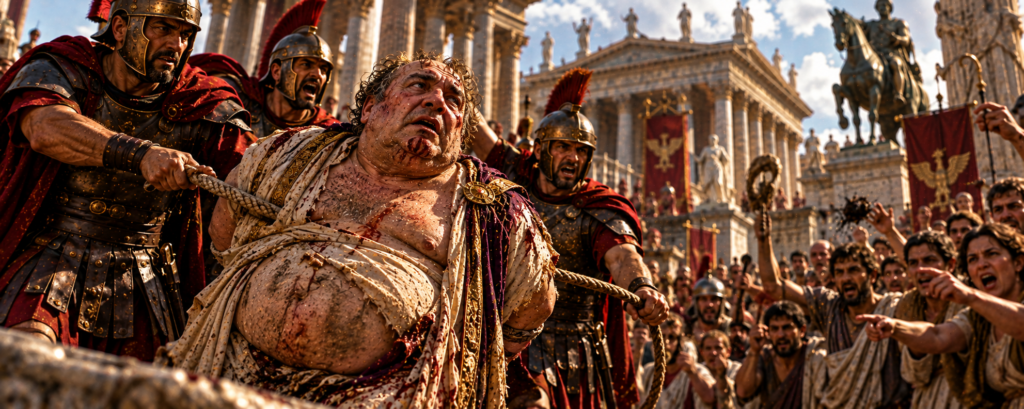
Vitellius: The Emperor Dragged Through Rome and Beaten to Death on the Gemonian Stairs
- Aulus Vitellius (15–69 CE) | Roman Emperor, April–December 69 CE | Killed December 20, 69 CE*
The Emperor Who Was Dragged Through His Own Capital
On December 20, 69 CE, the streets of Rome became the setting for one of the most degrading imperial deaths in Roman history. Aulus Vitellius, who had commanded the empire only months earlier, was dragged from his hiding place by soldiers who had captured the city in the name of his rival, Vespasian. His hands were bound behind his back, a rope was placed around his neck, and his clothing was torn as his captors forced him through the streets. The emperor who had entered Rome surrounded by victorious soldiers was now being paraded through the same city as a condemned criminal.
The humiliation was deliberate. According to the ancient historian Suetonius, soldiers pulled Vitellius’s head backward by his hair and held a weapon beneath his chin so that he could not lower his face. Crowds gathered along the Sacred Way, jeering at the fallen ruler and mocking the physical appearance that hostile writers had already made notorious. Some reportedly threw filth at him, while others shouted accusations of gluttony, cowardice, and responsibility for the violence that had devastated Rome. Every step of the procession was intended to strip away the dignity of a man who had once possessed the highest authority in the Roman world.
Vitellius had spent much of his final day attempting to escape the fate now overtaking him. As Vespasian’s forces fought their way into Rome, the emperor abandoned the public confidence he had displayed during his brief reign and sought refuge within the imperial palace. Ancient accounts describe him hiding in a secluded room, possibly near the quarters of the palace doorkeeper, while soldiers searched the building. His attempt to disappear among the servants and abandoned rooms of his own residence failed when the victors discovered him.
The soldiers did not immediately kill their prisoner. Instead, they dragged him through Rome toward the Gemonian Stairs, a place associated with the public exposure of executed criminals and disgraced enemies of the state. Vitellius was forced to witness the destruction of his own authority as statues bearing his likeness were pulled down and the crowd turned against him. The man who had once received public acclamations now endured the abuse of people eager to demonstrate their loyalty to the victorious side.
Tacitus preserves a final exchange in which Vitellius reminded an insulting soldier that he had once been his emperor. Whether the precise words were spoken cannot be established, but the sentiment captures the extraordinary reversal of fortune. The soldiers then killed him near the Gemonian Stairs, striking him repeatedly before disposing of his remains. Other ancient accounts describe additional mutilation, including the severing and public display of his head.
The killing ended the reign of Rome’s third emperor of 69 CE, but it did not immediately end the violence. Soldiers loyal to Vespasian continued hunting defeated enemies through the streets, and the city endured looting, executions, and reprisals. Rome had witnessed the murder of Galba in January, the suicide of Otho in April, and now the public destruction of Vitellius in December. The Year of the Four Emperors had transformed the imperial throne into a prize that armies could seize and defend through civil war.
Vitellius’s death was especially disturbing because it was not a secret assassination carried out by conspirators inside a palace. It was a public killing performed after his enemies had captured the capital, with humiliation forming an essential part of the punishment. The violence was intended to demonstrate that his authority had been completely destroyed. Yet behind the familiar image of a disgraced glutton dragged toward execution lies a more complicated story of military ambition, political miscalculation, competing loyalties, and an empire that had temporarily lost the ability to transfer power without bloodshed.
Born Into Privilege: The Making of Aulus Vitellius
Aulus Vitellius was born in September 15 CE, during the reign of Tiberius, into a family that had risen to considerable prominence within the Roman aristocracy. His father, Lucius Vitellius, became one of the most influential senators of his generation and enjoyed the confidence of several emperors. The family’s political connections offered opportunities that most Romans could never have imagined. Yet those same connections placed its members close to a court where favor could change suddenly and survival often depended upon pleasing the ruler.
Ancient writers disagreed about the family’s origins. Some traditions presented the Vitellii as descendants of an ancient and distinguished Italian lineage, while hostile accounts claimed that their ancestors had risen from humble or disreputable circumstances. Suetonius acknowledged these conflicting stories rather than accepting one without qualification. The disagreements reveal how ancestry could become a political weapon when later writers attempted to praise or discredit an emperor.
Whatever the family’s distant origins, Vitellius’s father had unquestionably achieved high office. Lucius Vitellius served as governor of Syria and held the consulship three times, an extraordinary distinction during the early empire. He also exercised considerable influence under Claudius, whose confidence allowed him to occupy important administrative positions. His career demonstrated how a skilled aristocrat could prosper by maintaining close relationships with successive rulers.
The younger Vitellius grew up surrounded by imperial privilege and the expectations of elite Roman society. He was educated for a public career and became familiar with the customs of the imperial household. His family’s position brought him into contact with powerful figures long before he held significant authority himself. These relationships would later help him advance through a political system in which personal connections could matter as much as administrative talent.
Suetonius claimed that Vitellius spent part of his youth among the attendants and companions of Tiberius on Capri. The biographer associated this period with allegations of sexual misconduct and humiliating behavior, drawing upon the scandalous traditions surrounding Tiberius’s final years. Such stories are difficult to verify and may reflect later attempts to portray Vitellius as morally corrupt from childhood. They should not be treated as established facts about his early life.
His later career nevertheless confirms that he possessed the connections necessary to enter the highest levels of government. Vitellius held the consulship in 48 CE, during the reign of Claudius, and subsequently served in other prestigious positions. He became proconsul of Africa, an appointment that carried considerable honor and responsibility. His public career was not simply a sequence of banquets and court entertainments, despite the impression created by some hostile biographies.
Vitellius also developed a reputation for sociability and generosity. Ancient writers frequently criticized his appetite and luxurious habits, but they also acknowledged his ability to cultivate friendships. He appears to have been skilled at making himself agreeable to powerful men and those around them. This quality would later help explain why soldiers who barely knew him could nevertheless embrace him as their emperor.
The central contradiction of his life was already emerging. Vitellius possessed aristocratic status, administrative experience, and influential connections, yet he was not widely regarded as an exceptional military commander. He had prospered through relationships and accommodation rather than through great victories. In the extraordinary circumstances of 69 CE, those qualities would unexpectedly carry him to the throne.
A Courtier Who Survived Four Emperors
Vitellius’s political survival required him to navigate the reigns of Tiberius, Caligula, Claudius, and Nero. Each emperor presented different dangers, and prominent aristocrats could be destroyed by personal rivalries, accusations of treason, or sudden changes in imperial favor. Vitellius managed to remain within the political establishment throughout these transitions. His adaptability became one of his defining characteristics.
Under Caligula, Vitellius reportedly cultivated the emperor’s interest in chariot racing. The imperial court valued entertainment, spectacle, and personal companionship, and men who shared the ruler’s interests could gain access and influence. Ancient writers later portrayed such behavior as humiliating flattery. Yet participating in the emperor’s favored activities was also a practical means of maintaining political connections.
During Claudius’s reign, the influence of Vitellius’s father strengthened the family’s position. The younger Vitellius benefited from the family’s standing and continued his advancement. His consulship placed him among the leading members of the senatorial aristocracy. The appointment demonstrated that he was regarded as a legitimate participant in imperial government.
Vitellius also cultivated Nero, whose enthusiasm for music, performance, and public competition created another set of opportunities for courtly advancement. Suetonius claimed that Vitellius encouraged Nero’s performances and helped persuade him to appear before audiences. Such stories fit the hostile image of an aristocrat willing to flatter any emperor. They also illustrate the political importance of understanding a ruler’s personal interests.
The surviving evidence does not justify treating every allegation of flattery as proof of dishonorable behavior. Roman politics depended heavily upon patronage, public deference, and personal relationships. Senators routinely participated in ceremonies and activities designed to honor the emperor. Vitellius may have been unusually skilled at these practices, but he was hardly alone in employing them.
His governorship of Africa is particularly important because it complicates the image of complete incompetence. Ancient accounts suggest that he administered the province without the spectacular scandals later associated with his imperial reign. He possessed experience in managing officials and public responsibilities. His career therefore cannot be dismissed as entirely ceremonial.
Nevertheless, Vitellius did not emerge from these decades with a reputation comparable to that of Rome’s most successful generals. He had not conquered new territories or commanded armies in celebrated campaigns. His strengths lay in personal relationships, aristocratic standing, and political accommodation. When he received command of the Rhine armies, few observers could have anticipated the consequences.
His appointment would transform him from a courtier into a contender for supreme power. The opportunity arose not because he had spent years preparing a rebellion, but because the Roman imperial system was entering a period of extraordinary instability. The collapse of Nero’s dynasty created a vacuum that ambitious soldiers and commanders were eager to fill. Vitellius was about to discover that military popularity could become more dangerous than imperial disfavor.
Nero’s Death and the Empire Without an Heir
The crisis that eventually destroyed Vitellius began with the collapse of Nero’s government in 68 CE. Nero had ruled since 54 CE, but his later reign became increasingly associated with political executions, financial pressures, and strained relationships with the aristocracy. His public performances and personal scandals attracted hostile criticism, although elite disapproval alone did not bring him down. The decisive danger emerged when provincial commanders and military forces began withdrawing their support.
In Gaul, Gaius Julius Vindex organized a rebellion against Nero and sought assistance from other provincial governors. Servius Sulpicius Galba, governor of Hispania Tarraconensis, eventually joined the movement. Although Vindex was defeated, the rebellion exposed the weakness of Nero’s political position. Once the Praetorian Guard abandoned him, the emperor could no longer rely upon the forces responsible for his immediate protection.
Nero died by suicide in June 68 CE, ending the Julio-Claudian dynasty. For nearly a century, imperial succession had been closely associated with the family of Augustus. Even when individual rulers were unpopular, dynastic connections helped provide continuity. Nero’s death removed that familiar framework.
Galba became emperor, but his accession did not settle the question of legitimacy. He had risen through provincial rebellion and military defection rather than through an orderly dynastic succession. His position depended upon the willingness of soldiers, senators, and governors to accept the new political arrangement. That willingness proved far less secure than he expected.
The Praetorian Guard had been promised substantial rewards for supporting Galba, but the new emperor refused to provide the expected payment. His insistence upon military discipline and financial restraint alienated men who believed they had helped place him on the throne. Other military units resented changes in command and questioned the treatment of soldiers who had served under Nero. The new government accumulated enemies with alarming speed.
The Rhine armies became particularly dissatisfied. These forces guarded one of the empire’s most important frontiers and possessed considerable military strength. Their soldiers had played complicated roles during the rebellion against Nero, and some believed their loyalty and achievements had been insufficiently recognized. Galba’s policies deepened their resentment.
The situation created an opportunity for a new claimant. The Rhine legions needed a figure around whom they could unite, and their commanders understood that imperial authority was no longer confined to the Julio-Claudian family. A provincial army could proclaim its own emperor and attempt to impose that choice upon Rome. Vitellius would become the beneficiary of this revolutionary possibility.
The Appointment That Changed Everything
In late 68 CE, Galba appointed Vitellius governor of Lower Germany, one of the two military provinces along the Rhine. The appointment placed him in command of important legions and auxiliary forces stationed near the frontier. It also brought him into direct contact with soldiers whose loyalty to Galba was already weakening. What appeared to be a prestigious provincial assignment soon became the foundation of a rebellion.
Ancient writers suggested that Galba considered Vitellius relatively harmless. Suetonius preserves a tradition that the emperor believed a man chiefly interested in eating and drinking would pose little political danger. The anecdote may have been shaped by hindsight and the later caricature of Vitellius as a glutton. Nevertheless, it reflects the surprise with which his rise to power was remembered.
Vitellius arrived among soldiers who were angry, suspicious, and increasingly willing to challenge the government in Rome. His approachable manner and willingness to grant favors made him popular. He reportedly relaxed disciplinary measures and treated soldiers with a generosity they had not experienced under Galba. These actions helped create personal loyalty.
Suetonius describes Vitellius granting requests with remarkable freedom. Men facing punishment received relief, while others found their grievances addressed. Such generosity could appear irresponsible to traditional commanders, but it was politically effective. The soldiers began to regard Vitellius as someone who understood their interests.
The Rhine armies were not united solely by affection for their new governor. They possessed broader grievances against Galba and recognized the opportunity to elevate a commander of their own choosing. Their dissatisfaction had been developing before Vitellius arrived. His personality and position provided a convenient focus for rebellion.
On January 1, 69 CE, troops in Upper Germany refused to renew their oath of loyalty to Galba. The annual oath was a formal expression of obedience to the emperor, and refusing it represented a serious act of defiance. Soldiers in Lower Germany soon went further by proclaiming Vitellius emperor. The rebellion had become a direct challenge to the government in Rome.
Vitellius did not initially command overwhelming support throughout the empire. His power depended upon the Rhine legions and the willingness of other military units to join them. Yet the soldiers’ decision gave him something Galba could no longer take for granted: an army prepared to fight for his claim. The imperial throne had become the object of military competition.
An Emperor Proclaimed in the German Provinces
The proclamation of Vitellius was an extraordinary moment in Roman political history. A provincial army had chosen its own emperor without waiting for the Senate or the political establishment in Rome. The soldiers acted as though military strength entitled them to determine who should rule the empire. Their decision challenged the foundations of the existing imperial system.
Suetonius describes Vitellius being hailed as emperor while still wearing ordinary clothing. The scene contrasts sharply with the elaborate ceremonies normally associated with imperial authority. According to the account, soldiers carried him through nearby communities and celebrated his elevation. The details may have been embellished, but the essential fact is clear: his accession began in a military camp.
The soldiers’ enthusiasm did not mean that Vitellius possessed a coherent plan for governing the empire. His immediate priority was securing recognition and maintaining the support of the armies that had proclaimed him. Experienced commanders would be essential to turning their enthusiasm into military success. Vitellius depended upon men capable of organizing an invasion of Italy.
Two commanders became especially important: Aulus Caecina Alienus and Fabius Valens. Both possessed military experience and political ambitions of their own. They would lead forces southward while Vitellius remained behind. Their campaigns would determine whether the Rhine proclamation could become an imperial victory.
The rebellion developed rapidly because Galba’s authority was already collapsing. His refusal to satisfy the Praetorian Guard had created resentment in Rome, while his adoption of Piso alienated Marcus Salvius Otho. The empire faced simultaneous threats from different directions. Vitellius’s supporters could therefore hope that the government would collapse before a united resistance formed.
That collapse came sooner than expected. On January 15, 69 CE, Otho organized a Praetorian coup against Galba. Soldiers murdered the elderly emperor in the Roman Forum and killed Piso, his newly adopted heir. Otho then secured recognition as emperor.
The assassination changed the political situation without ending the rebellion in Germany. Vitellius’s soldiers had already committed themselves to replacing Galba, and they had no reason to accept Otho simply because he had seized power in Rome. The rival claimants now faced each other across the empire. Their dispute would be settled through civil war.
Otho and Vitellius: Two Emperors, One Throne
Otho’s accession created a political crisis that neither claimant could easily resolve. He controlled Rome and possessed the support of the Praetorian Guard, while Vitellius commanded the loyalty of powerful Rhine armies. Both could claim to have been elevated by soldiers acting in the interests of the state. Neither possessed a universally accepted right to rule.
Otho had helped overthrow Galba because he believed the emperor had betrayed his expectations of succession. Vitellius’s supporters had rejected Galba because they resented his treatment of the German armies. The two rebellions arose from different grievances, but they produced the same result. Armed forces had selected competing emperors.
Attempts at negotiation failed to prevent war. Ancient sources preserve accounts of proposals and exchanges between the rival claimants, although the details vary. Neither side was prepared to surrender the throne without securing its interests. The conflict became increasingly difficult to resolve peacefully.
Vitellius’s commanders moved toward Italy with substantial forces. Caecina and Valens advanced along different routes before combining their efforts. Their armies included experienced legionaries and auxiliary troops accustomed to frontier warfare. The military strength of the Rhine provinces gave Vitellius a formidable advantage.
Otho assembled forces to resist the invasion. His supporters included Praetorians, soldiers stationed in Italy, and units from other provinces. Yet some of his troops lacked the battlefield experience of the Rhine veterans. His commanders also disagreed about the best strategy.
The war moved toward northern Italy, where control of roads and river crossings became crucial. Both sides sought to concentrate forces and prevent the enemy from gaining a decisive advantage. The campaign involved marches, skirmishes, and disputes among commanders. Its outcome would determine who occupied the imperial throne.
Vitellius himself remained away from the main fighting during much of the campaign. His generals conducted the operations that would make him emperor. This arrangement later contributed to criticism that he owed his success entirely to others. Yet Roman rulers frequently depended upon capable subordinates, and the decisive question was whether those subordinates could secure victory.
The First Battle of Bedriacum and Otho’s Destruction
The decisive confrontation between Otho’s forces and the armies supporting Vitellius occurred near Bedriacum in northern Italy in April 69 CE. The region became a battlefield because it controlled important routes connecting the northern provinces with the Italian peninsula. Both armies had maneuvered through difficult circumstances before the engagement. The fighting would determine the fate of Otho’s brief reign.
Otho’s commanders disagreed about whether to attack immediately or wait for additional reinforcements. Some favored caution, believing that time might strengthen their position. Others argued that delay would allow the enemy to consolidate its advantage. The resulting uncertainty contributed to the difficulties facing Otho’s army.
The battle ended in defeat for Otho’s forces. The Rhine veterans demonstrated their effectiveness, while the opposing army suffered from problems of coordination and morale. Casualties were substantial, although ancient figures should be treated cautiously. The defeat made Otho’s political position increasingly difficult to sustain.
Otho was not personally present at the decisive fighting. When news of the defeat reached him, he faced the possibility of continuing the war with remaining forces. Some supporters urged resistance, arguing that the conflict was not yet hopeless. Otho nevertheless decided to end his life.
His suicide in April 69 CE became one of the most striking episodes of the civil war. Ancient writers often praised his final decision as an attempt to spare Rome further bloodshed. Whether that interpretation fully captures his motives is uncertain. His death nevertheless removed the principal obstacle to Vitellius’s recognition.
Vitellius now appeared victorious. His generals had defeated the rival emperor, and the Senate eventually acknowledged his authority. The soldiers who had proclaimed him in Germany had successfully imposed their choice upon the empire. Their victory demonstrated the extraordinary political power of provincial armies.
Yet the triumph contained the seeds of future disaster. Vitellius owed his throne to soldiers who expected rewards, influence, and recognition. His commanders possessed considerable prestige because they had won the war. The emperor would need to manage competing military interests while governing a state already exhausted by conflict.
The first battle of Bedriacum also established a grim precedent. Roman armies had fought and killed one another to determine the succession. The empire had survived the battle, but the willingness to settle political disputes through civil war had been reinforced. Within months, the same region would witness another decisive confrontation.
The Road to Rome: Victory, Celebration, and Growing Resentment
After Otho’s death, Vitellius began moving toward Rome. His journey through Italy became an opportunity to celebrate victory and establish his authority. Soldiers accompanied him, while communities along the route prepared to receive the new emperor. Yet the triumphal atmosphere concealed growing tensions.
The victorious armies expected generous treatment. Their success had secured the throne, and they regarded themselves as entitled to rewards. Vitellius’s willingness to accommodate soldiers strengthened their personal attachment to him. It also created difficulties when military demands conflicted with civilian interests.
Ancient writers describe disorder among the troops during the march. Soldiers reportedly seized supplies, intimidated communities, and engaged in violence. Some accounts may exaggerate the scale of misconduct to emphasize the new emperor’s lack of discipline. Nevertheless, the movement of large armies through Italy placed substantial pressure upon local populations.
Vitellius’s behavior attracted criticism from writers who regarded him as insensitive to the suffering caused by civil war. Suetonius describes him visiting the battlefield near Bedriacum and making remarks about the smell of the dead. The anecdote is disturbing, but its precise wording and circumstances cannot be independently verified. It belongs to a hostile tradition that emphasized his appetite and lack of restraint.
The battlefield itself offered a grim reminder of the price of imperial ambition. Roman soldiers had killed fellow Romans, and the dead remained evidence of the conflict that had brought Vitellius to power. The new emperor’s supporters celebrated victory, but the families of the defeated faced grief and uncertainty. The empire had paid heavily for another change of ruler.
Vitellius’s arrival in Rome was accompanied by elaborate military display. Ancient accounts describe soldiers entering the city with weapons, standards, and the confidence of conquerors. The spectacle demonstrated the strength of the armies that had elevated him. It also reminded the population that his authority rested upon military victory.
The emperor entered a capital already shaken by political murder and civil war. Galba had been killed in the Forum only months earlier, and Otho had died after a brief reign. Citizens had watched the throne change hands with extraordinary speed. Vitellius needed to convince them that his victory would finally restore stability.
Instead, his government soon acquired a reputation for extravagance, favoritism, and military indiscipline. Some accusations were undoubtedly sharpened by later Flavian propaganda. Yet the political challenges were real. Vitellius had won the throne through war, and the demands of victory made peaceful government difficult.
The Emperor Remembered for His Appetite
Few Roman emperors became as closely associated with gluttony as Vitellius. Ancient writers portrayed him as a man whose appetite dominated his life and whose banquets consumed enormous resources. Suetonius devoted substantial attention to his eating habits, presenting elaborate meals as evidence of moral weakness. The resulting image became one of the most enduring caricatures in imperial history.
According to Suetonius, Vitellius regularly attended multiple meals and banquets in a single day. He allegedly arranged his schedule around invitations and expected hosts to provide extravagant dishes. The biographer described enormous expenditures and unusual combinations of expensive ingredients. Such stories were designed to shock readers and illustrate a ruler supposedly enslaved by appetite.
One particularly famous anecdote concerns a dish associated with Minerva, prepared from rare and costly ingredients. Suetonius described it as containing delicacies gathered from across the empire. The story presents imperial wealth being consumed in a display of excess. Its precise details cannot be independently confirmed, and the account may have been exaggerated for literary effect.
The emphasis on food served a political purpose. Roman moralists often associated excessive consumption with weakness, lack of self-control, and unfitness for public responsibility. A ruler unable to govern his own appetite could be portrayed as incapable of governing an empire. Vitellius’s enemies used that association to undermine his reputation.
The surviving accounts also reflect the prejudices of elite historians. Lavish dining was common among wealthy Romans, and emperors were expected to provide impressive hospitality. Vitellius may genuinely have enjoyed extravagant meals, but the scale of his alleged consumption is difficult to establish. His appetite became a convenient explanation for every failure of his government.
The caricature obscures other aspects of his personality. Tacitus acknowledged that Vitellius possessed qualities of generosity and approachability. His willingness to reward supporters helped explain his popularity among soldiers. Those same qualities could become politically destructive when exercised without restraint.
The problem was therefore not simply that Vitellius enjoyed luxury. His government faced serious financial and military pressures, and extravagant expenditure could worsen them. Yet the historical evidence does not justify reducing his entire reign to a succession of feasts. The empire was not lost because one man ate too much.
Vitellius’s reputation for gluttony nevertheless shaped the way his death was remembered. When soldiers dragged him through Rome, crowds reportedly mocked his body and appetite. The insults transformed a political defeat into a moral spectacle. His enemies wanted the public to see not merely a defeated emperor, but a man whose alleged excesses made his humiliation deserved.
The Women and Children Behind the Imperial Throne
Vitellius’s family relationships receive less attention than his banquets and political failures, but they formed an important part of his personal life. His first marriage was to Petronia, with whom he had a son. The marriage ended, and ancient accounts preserve allegations concerning the son’s death. These stories are difficult to verify and should not be accepted uncritically.
Suetonius accused Vitellius of involvement in the death of his son by Petronia, presenting the episode as evidence of cruelty and greed. The accusation belongs to a hostile biographical tradition and lacks independent confirmation. It may reflect genuine family conflict, but the surviving evidence does not establish murder. Treating the allegation as proven would give undue authority to a source eager to emphasize the emperor’s moral failings.
Vitellius later married Galeria Fundana, who became his wife during his imperial reign. She was the daughter of a former consul and belonged to the aristocratic world in which Vitellius had spent his life. Ancient sources generally portray her more favorably than her husband. Her position became increasingly dangerous as the civil war turned against him.
The couple had children, including a young son whose speech impairment was noted by ancient writers. The boy became associated with his father’s imperial ambitions because he represented a possible continuation of the family line. Vitellius publicly displayed affection toward him, and his existence raised questions about succession. In a period when rival dynasties were being violently eliminated, such a child could become politically vulnerable.
Vitellius’s daughter also became part of the complicated arrangements surrounding his family. Ancient sources describe marriages and alliances intended to strengthen relationships among prominent households. These connections mattered because imperial survival depended partly upon the loyalty of influential aristocrats. Family relationships were therefore inseparable from politics.
As Vespasian’s forces advanced, Vitellius’s concern for his family became increasingly urgent. Ancient accounts suggest that negotiations concerning his abdication included attempts to secure protection for his wife and children. Such arrangements would have been understandable given the violence already witnessed during the year. The emperor knew that defeat could expose his family to revenge.
Galeria Fundana survived her husband’s fall, but the fate of their son was more tragic. The boy was eventually killed under the Flavian regime, apparently because his connection to Vitellius made him a potential dynastic threat. The precise circumstances are not fully preserved. His death demonstrates how civil war could continue destroying families after the principal combatants were gone.
Vitellius’s household therefore complicates the image of a ruler concerned only with pleasure. He was a husband and father whose political decisions exposed those closest to him to danger. His failure did not end with his own execution. The collapse of his regime carried consequences for relatives who had little control over the struggle for power.
A Government Built on Soldiers Who Expected Rewards
Vitellius’s greatest strength was also his greatest vulnerability. He had become emperor because the Rhine armies supported him, and those soldiers expected their victory to be rewarded. Their loyalty had been cultivated through generosity, relaxed discipline, and personal attention. Once Vitellius occupied the throne, maintaining that loyalty became an expensive and politically difficult responsibility.
The victorious soldiers were not a single unified group. Different legions and auxiliary units had participated in the campaign, while commanders competed for prestige and influence. The Praetorian Guard, previously associated with Otho, presented an additional problem. Vitellius needed to reorganize the military forces responsible for protecting the emperor.
He replaced or reorganized elements of the Praetorian Guard, favoring soldiers loyal to his own cause. The decision was understandable because the Guard had helped murder Galba and elevate Otho. Yet it also created resentment among displaced men. Soldiers who lost their privileged positions could become supporters of a rival claimant.
The emperor’s dependence upon the Rhine armies made him vulnerable to their demands. He could not easily impose severe discipline upon men who believed they had given him the throne. Attempts to restrain them risked alienating his principal supporters. Allowing disorder, however, damaged his reputation among civilians and senators.
His commanders also exercised considerable influence. Caecina and Valens had won the campaign against Otho and possessed military prestige. Their rivalry complicated the administration of the empire. Vitellius needed their support but could not always control their ambitions.
Financial pressures intensified these difficulties. Civil war had disrupted revenue, required enormous military expenditure, and created expectations of rewards. Vitellius’s reputation for extravagance made the situation appear even worse. Whether every allegation of waste was accurate, the government faced genuine fiscal challenges.
The Senate continued to function, but its ability to influence military politics remained limited. Senators could debate policy and confer honors, yet they could not guarantee the loyalty of provincial armies. Vitellius possessed formal recognition but depended upon soldiers for survival. His authority therefore remained vulnerable to another military rebellion.
That rebellion would emerge from the eastern provinces. The same system that had elevated Vitellius could elevate another commander. Once a rival possessed sufficient military support, the emperor’s legitimacy would be challenged again. Vitellius had benefited from the collapse of dynastic succession, but he had not found a way to replace it with lasting stability.
Vespasian: The General Who Would Take Everything
Titus Flavius Vespasianus was an experienced Roman commander whose career had developed through military service and imperial appointments. He had participated in the conquest of Britain and later received command of Roman forces suppressing the Jewish revolt. By 69 CE, he controlled substantial military resources in the eastern Mediterranean. His position made him a formidable potential claimant.
Vespasian’s rise was not inevitable. He came from a family that had achieved prominence relatively recently compared with Rome’s oldest aristocratic houses. His reputation rested heavily upon military competence and practical administration. Those qualities distinguished him from the image of Vitellius preserved by hostile writers.
The eastern armies possessed their own grievances and ambitions. Commanders in Syria, Judaea, and Egypt recognized that the empire’s succession crisis created opportunities. The defeat of Otho had not necessarily convinced them that Vitellius should rule. They could choose another candidate and attempt to impose him through military force.
Vespasian gained the support of important eastern figures, including Gaius Licinius Mucianus, governor of Syria, and Tiberius Julius Alexander, prefect of Egypt. Their cooperation provided military strength, political influence, and control over valuable resources. Egypt was especially important because its grain supplies were essential to Rome. The eastern coalition therefore possessed advantages beyond the number of soldiers it could deploy.
On July 1, 69 CE, troops in Egypt proclaimed Vespasian emperor. Other eastern armies soon followed. The proclamation created another rival claimant and reopened the struggle for the throne. Vitellius’s victory over Otho had lasted only a few months before a new rebellion threatened his position.
Vespasian did not immediately march upon Rome. His supporters developed a strategy that involved eastern resources and military action from other provinces. Mucianus prepared to move westward, while forces along the Danube began supporting the Flavian cause. The rebellion spread beyond the eastern armies.
The Danubian legions became particularly important. Some had previously supported Otho and remained dissatisfied with the outcome of the civil war. Their commanders recognized an opportunity to challenge Vitellius. The forces available to Vespasian began expanding rapidly.
Vitellius now faced the same problem that had destroyed Galba and Otho. His authority depended upon soldiers whose loyalty was not universal. Powerful armies had proclaimed another emperor and were preparing to fight for him. The political system had become a cycle in which every successful military claimant invited another rebellion.
Antonius Primus and the Army Marching Toward Rome
One of the most important commanders supporting Vespasian was Marcus Antonius Primus. He possessed military experience and considerable ambition, and he became a leading figure among the Danubian forces that embraced the Flavian cause. His decisions would play a decisive role in the campaign against Vitellius. The emperor’s fate would ultimately depend upon armies commanded by men far from the imperial palace.
Antonius Primus moved into northern Italy with forces supporting Vespasian. His advance threatened the military position established by Vitellius after the defeat of Otho. The region around Bedriacum once again became strategically important. The same roads and towns that had witnessed the first civil war battle would soon experience another.
Vitellius’s commanders attempted to organize resistance. Caecina and Valens remained important figures, but their rivalry and political calculations complicated the response. Caecina eventually attempted to defect to Vespasian’s side. His troops did not immediately follow him, and the resulting confusion weakened the Vitellian cause.
The attempted defection was a devastating example of the instability of military loyalty. A commander who had helped make Vitellius emperor was now prepared to abandon him. Personal ambition and calculations about the likely outcome of the war outweighed earlier allegiance. The emperor’s military foundations were beginning to collapse.
Valens attempted to preserve the Vitellian position, but events moved faster than he could control. The Flavian forces advanced aggressively, seeking to defeat their opponents before they could reorganize. The campaign became a struggle between armies whose commanders were increasingly uncertain of one another. The outcome would determine whether Vitellius could retain the throne.
The second battle of Bedriacum occurred in October 69 CE. The fighting was fierce and prolonged, involving attacks, counterattacks, and confusion among the opposing forces. Vitellius’s army suffered a decisive defeat. The victory gave the Flavian forces control over northern Italy and opened the road toward Rome.
The defeat destroyed much of Vitellius’s remaining military credibility. His soldiers had already witnessed attempted defections and disputes among commanders. The loss at Bedriacum demonstrated that the Flavian armies possessed the strength to defeat them. Confidence in the emperor began collapsing.
Vitellius remained in Rome while the military situation deteriorated. He depended upon reports from commanders and hoped that remaining forces could prevent the enemy’s advance. Yet the defeat had changed the balance of power. The emperor who had won the throne through military victory was now facing destruction through military defeat.
Cremona: The City Destroyed by Roman Soldiers
The aftermath of the second battle of Bedriacum produced one of the most notorious atrocities of the civil war. The city of Cremona became a target for victorious soldiers, who subjected it to widespread violence and plunder. Ancient accounts describe destruction, looting, and suffering among the inhabitants. The episode demonstrated how civilians could become victims of conflicts fought between rival Roman armies.
Cremona had strategic importance because of its location in northern Italy. It had also become associated with the military operations of the Vitellian forces. The victorious Flavian soldiers regarded the city as a legitimate source of plunder or punishment. Their actions transformed military victory into a catastrophe for the population.
Tacitus described the sack with particular horror. Soldiers reportedly seized valuables, attacked inhabitants, and destroyed buildings. The violence extended beyond the immediate needs of military operations. Greed and revenge became powerful motives.
The destruction also exposed the weakness of command discipline. Victorious soldiers could be difficult to restrain, particularly after prolonged fighting. Their commanders depended upon maintaining morale and loyalty. Allowing plunder could become a means of rewarding troops.
Cremona’s suffering was not an isolated consequence of civil war. Earlier conflicts had devastated communities across Italy and the provinces. The struggle between Vitellius and Vespasian continued that tradition. Roman citizens and subjects paid the price for disputes over imperial authority.
The episode also damaged the moral claims of the victorious side. Vespasian’s supporters presented their cause as a means of restoring order, but their soldiers were capable of extreme violence. The contrast between political promises and military behavior was stark. Victory did not automatically produce restraint.
For Vitellius, the destruction of Cremona was another sign that the war had moved beyond his control. His armies had been defeated, and the enemy was advancing. The emperor’s remaining supporters faced increasingly difficult choices. Some continued fighting, while others considered surrender or defection.
The road to Rome was now open. Antonius Primus and the Flavian forces could advance toward the capital. Vitellius’s government was entering its final crisis. The emperor who had celebrated victory over Otho would soon confront the possibility of losing everything.
The Emperor Who Tried to Abdicate
As the Flavian armies approached Rome, Vitellius began considering the possibility of surrendering the throne. Ancient sources describe negotiations involving prominent senators and Flavius Sabinus, Vespasian’s brother. The objective was to arrange a peaceful transfer of power and prevent further bloodshed. Vitellius’s willingness to negotiate reflected the desperate condition of his government.
Sabinus held an important position in Rome and possessed connections that made him a natural intermediary. He was also personally invested in Vespasian’s success. His presence offered the possibility of an agreement that might protect Vitellius and his family. Yet any settlement depended upon the willingness of soldiers to accept it.
Vitellius reportedly agreed to relinquish imperial authority under certain conditions. Ancient accounts differ over the precise terms and the extent to which he acted voluntarily. Some suggest that he hoped to secure his personal safety and financial support. Others emphasize his fear of continued conflict.
The emperor attempted to make his abdication public. Suetonius describes him appearing before soldiers and citizens, announcing that he intended to surrender power. He reportedly offered to give up the symbols of imperial authority. The gesture was intended to demonstrate that the conflict could end without further fighting.
His supporters refused to accept the decision. Soldiers who had fought for Vitellius feared the consequences of surrender. They understood that a victorious rival might punish them, remove their privileges, or pursue revenge. Their opposition made peaceful abdication difficult.
The crowd also played a role in the confusion. Ancient accounts describe public demonstrations urging Vitellius not to abandon the throne. Some participants may have been genuinely loyal, while others feared the consequences of political change. The emperor found himself trapped between his desire to escape and the demands of those who still supported him.
The attempted abdication collapsed. Vitellius remained emperor in name, but his authority was increasingly hollow. He could not compel his soldiers to accept surrender, and he could not defeat the approaching Flavian armies. The political crisis was moving toward violence.
His failure to abdicate became one of the most tragic aspects of his final days. He appears to have recognized that continued resistance might destroy him. Yet the forces that had elevated him were unwilling to relinquish the struggle. The emperor had become a prisoner of the military loyalties that had made him powerful.
Flavius Sabinus and the Burning of the Capitol
The breakdown of negotiations led to a violent confrontation in Rome. Flavius Sabinus and his supporters became targets of Vitellian soldiers who opposed surrender. Sabinus sought refuge on the Capitoline Hill, one of the city’s most sacred and politically important locations. The conflict would soon engulf the religious heart of Rome.
The Capitol housed the Temple of Jupiter Optimus Maximus, a central symbol of Roman religious and political identity. Its destruction would carry significance far beyond the immediate military struggle. The temple represented centuries of Roman tradition and the protection of the state. Fighting around it therefore threatened one of the most important monuments in the empire.
Sabinus gathered supporters and attempted to defend the position. His group included men associated with Vespasian’s cause and members of the political establishment who hoped to end the conflict. The defenders were not prepared for a prolonged siege. Their situation became increasingly desperate as Vitellian forces approached.
Fighting broke out around the Capitoline Hill. During the struggle, fire spread through the area and the great temple was destroyed. Ancient sources disagree about responsibility for the blaze. Some blamed Vitellius’s soldiers, while others suggested that the fire began amid the fighting without a clear deliberate order.
The destruction shocked Roman observers. The Temple of Jupiter had survived many earlier crises and represented the continuity of the Roman state. Its burning during a civil war between Roman armies symbolized the depth of political collapse. The empire’s own soldiers had brought destruction to its most sacred center.
Sabinus was captured and killed. Ancient accounts describe Vitellius as unable or unwilling to prevent the violence, although the extent of his responsibility remains disputed. His death eliminated an important intermediary who might have negotiated a peaceful settlement. It also intensified the determination of the Flavian forces to defeat the Vitellian regime.
Vespasian’s younger son Domitian was also present during the crisis. He escaped the destruction of the Capitol and survived to witness his family’s victory. His escape became an important episode in the history of the Flavian dynasty. The young man would eventually become emperor himself.
The burning of the Capitol marked a decisive turning point. Peaceful negotiation had failed, a prominent Flavian supporter had been killed, and Rome’s most sacred temple lay in ruins. The approaching armies now had additional reasons to seek revenge. Vitellius’s final hope of avoiding catastrophe was disappearing.
Rome Prepares for Its Final Battle
By December 69 CE, the Flavian forces were approaching Rome, and Vitellius’s remaining supporters prepared for resistance. The capital was no longer merely the political center of the empire. It was becoming a battlefield. Soldiers occupied strategic positions, while civilians faced the prospect of fighting in their streets.
Vitellius’s forces were weakened by earlier defeats and defections. Some soldiers remained fiercely loyal, particularly those who feared punishment if Vespasian triumphed. Others had lost confidence in the emperor and were unwilling to risk their lives for a collapsing regime. The result was an unstable mixture of resistance, fear, and opportunism.
The Flavian armies advanced under commanders determined to secure the capital. Their victory at Bedriacum had given them momentum, but capturing Rome still required overcoming armed defenders. Urban fighting presented dangers different from those of open battle. Narrow streets, buildings, and fortified positions could turn the city into a series of deadly obstacles.
Civilians attempted to navigate the crisis as best they could. Some remained inside their homes, while others watched the movements of soldiers and political factions. The city’s population had already experienced repeated changes of emperor during the year. Many understood that survival might depend upon appearing loyal to whichever side emerged victorious.
Ancient accounts describe a disturbing contrast between ordinary urban activity and the violence of civil war. Tacitus emphasized the spectacle of people continuing their amusements while soldiers fought nearby. His description may have been shaped by moral criticism, but it captures the surreal atmosphere of a capital divided between fear and curiosity. Rome was witnessing its own political destruction.
The emperor’s personal position became increasingly desperate. Vitellius had attempted to negotiate surrender, but the effort had failed. His supporters continued fighting, while the enemy approached. He could no longer rely upon a coherent strategy for preserving his authority.
The final battle for Rome would determine more than the fate of one ruler. It would decide which military coalition controlled the empire after a year of civil war. Vespasian’s supporters expected victory and rewards. Vitellius’s remaining soldiers faced defeat and possible revenge.
The city itself would suffer regardless of the outcome. Roman armies were preparing to fight one another among the monuments, temples, and homes of their own capital. The conflict that had begun with provincial military proclamations was returning to the center of imperial power. Vitellius’s reign was approaching its violent conclusion.
The Fall of Rome to Vespasian’s Forces
The Flavian assault on Rome unfolded amid fierce resistance and widespread confusion. Soldiers fought through streets and public spaces, while defenders attempted to hold strategic positions. The fighting was brutal because both sides understood the consequences of defeat. The city became the final battlefield of the Year of the Four Emperors.
Antonius Primus and the Flavian commanders pressed their advantage. Their forces had already defeated Vitellius’s principal armies in northern Italy. The remaining defenders could delay the advance but lacked the strength to reverse the overall situation. The military balance had shifted decisively toward Vespasian.
The fighting produced heavy casualties. Ancient writers described streets filled with bodies and buildings damaged by combat. Soldiers pursued enemies through neighborhoods and public spaces. The distinction between battlefield and civilian environment largely disappeared.
Some Vitellian soldiers continued resisting even after defeat became inevitable. Their loyalty may have reflected personal attachment to the emperor, fear of punishment, or unwillingness to surrender to former enemies. Others abandoned their positions or attempted to escape. The collapse of organized resistance occurred unevenly.
The Flavian soldiers were not always restrained in victory. Tacitus described looting and violence that continued after the principal fighting ended. Victorious troops pursued defeated opponents and seized property. The restoration of imperial authority began amid disorder.
Vitellius’s supporters were especially vulnerable. Men identified with the fallen regime could be attacked regardless of their individual responsibility for earlier violence. Personal enemies also had opportunities to settle grievances under the cover of political revenge. Civil war created conditions in which private hostility could become deadly.
As the Flavian forces secured the capital, the emperor’s position became hopeless. His military support had collapsed, and the city was falling into enemy hands. He could no longer negotiate from a position of strength. His survival depended upon escaping or persuading his captors to spare him.
The final hours of Vitellius’s life would unfold inside the imperial palace and along the streets of Rome. The ruler who had entered the capital with victorious soldiers was now hunted by another army. His authority had vanished, but his identity made him impossible to ignore. The victors wanted proof that the old emperor could never return.
The Emperor Hiding Inside His Own Palace
Ancient accounts describe Vitellius attempting to hide as the Flavian forces took control of Rome. His movements during the final hours are not preserved with complete consistency. Some sources suggest that he considered escaping to join remaining supporters outside the capital. Others emphasize his desperate efforts to conceal himself within the palace.
Suetonius describes him abandoning the imperial residence and later returning to seek refuge in a secluded room. He reportedly attempted to conceal the entrance with a bed or other furniture. The image became one of the most humiliating episodes in the hostile tradition surrounding his death. A man who had commanded the Roman world was reduced to hiding among the neglected spaces of his own household.
Cassius Dio preserves a related account in which Vitellius concealed himself in an area associated with dogs. The historian describes him as dirty and disheveled when soldiers discovered him. Such details may have been embellished to heighten the contrast between imperial luxury and final degradation. Nevertheless, the surviving traditions agree that he attempted to hide and was found.
The emperor’s decision was understandable given the fate of earlier rulers. Galba had been murdered by soldiers in the Forum, while Otho had chosen suicide after military defeat. Vitellius had reason to fear that capture would bring execution. His attempted concealment suggests that he still hoped to survive.
He may also have believed that he possessed information or influence that could persuade the victors to spare him. Suetonius reports that Vitellius asked to be kept alive because he had something important to communicate concerning Vespasian’s safety. The claim may have been a desperate attempt to delay execution. Its truth cannot be established.
The soldiers searching the palace were unlikely to regard him as an ordinary prisoner. Vitellius remained the most prominent symbol of the defeated regime. His survival could provide a rallying point for remaining supporters. Eliminating him would make Vespasian’s victory more secure.
When the soldiers discovered him, they seized him and prepared to lead him through the city. The emperor’s attempts to hide had failed, and he possessed no effective means of resistance. His captors controlled both his movements and his fate. The public humiliation that followed would be as deliberate as the killing itself.
The palace setting intensified the reversal. Vitellius had occupied rooms associated with imperial luxury and authority. Now those same rooms offered no protection from armed enemies. The building that symbolized his power became the place where his helplessness was exposed.
Bound, Mocked, and Dragged Through the Sacred Way
The soldiers who captured Vitellius did not immediately execute him inside the palace. Instead, they prepared a public procession designed to humiliate the fallen emperor. According to Suetonius, his hands were bound behind his back and a rope was placed around his neck. His clothing was torn, leaving him exposed to the insults of the crowd.
The procession moved along the Sacred Way, one of Rome’s most important ceremonial routes. Victorious generals had traditionally passed through this area during triumphal celebrations. Vitellius now traveled the same route as a defeated prisoner. The contrast was impossible to miss.
His captors reportedly forced him to keep his head raised. Suetonius describes soldiers pulling his hair backward and placing a weapon beneath his chin. The purpose was to prevent him from hiding his face from the crowd. His humiliation was intended to be visible to everyone.
People gathered to watch the spectacle. Some shouted insults, while others reportedly threw filth at him. The crowd mocked his appearance and accused him of gluttony and responsibility for Rome’s recent destruction. Ancient writers emphasized the cruelty of the scene.
The insults drew upon the reputation that hostile accounts had already attached to Vitellius. His appetite, physical appearance, and alleged extravagance became weapons used against him. The crowd transformed familiar political accusations into public abuse. His body became part of the spectacle of defeat.
Tacitus described the fallen emperor being forced to look at statues of himself that had been pulled down. The destruction of imperial images was a powerful symbol of political reversal. Statues that had recently represented legitimate authority now became objects of contempt. The same city that had honored Vitellius was erasing his presence.
The procession also passed places associated with earlier imperial violence. Tacitus emphasized the location where Galba had been murdered only eleven months earlier. The reference connected Vitellius’s fate to the wider catastrophe of 69 CE. Rome had become a city where emperors were repeatedly destroyed by soldiers.
Vitellius’s captors controlled every aspect of the spectacle. They determined where he walked, how he held his head, and how long the humiliation continued. The emperor had no authority to stop them. His public degradation demonstrated that the political order had been reversed.
The Gemonian Stairs: Rome’s Place of Public Disgrace
The Gemonian Stairs occupied a notorious place in Roman political memory. Located near the Forum and the Capitoline Hill, they were associated with the public exposure of executed criminals and enemies of the state. Bodies could be displayed there as warnings and objects of humiliation. The location therefore carried a meaning far beyond ordinary execution.
During the reign of Tiberius, the stairs became associated with the aftermath of political purges and treason trials. The bodies of disgraced figures were sometimes exposed to public contempt. The practice reinforced the power of the state over those it condemned. It also transformed death into a public spectacle.
For Vitellius, being taken to the Gemonian Stairs represented the final destruction of imperial dignity. He had not been granted a formal trial or an orderly opportunity to defend himself. His captors treated him as a defeated enemy whose fate had already been decided. The location announced that he would die in disgrace.
Tacitus described the soldiers driving Vitellius toward the stairs after the humiliating procession through Rome. The historian emphasized the contrast between the emperor’s former authority and his present helplessness. Vitellius was forced to endure insults from men who had once acknowledged his position. The scene became a moral judgment upon the instability of imperial power.
Suetonius described prolonged abuse before the killing. His account suggests that Vitellius was tortured or beaten for some time before being dispatched. The exact duration and sequence cannot be established. The surviving sources nevertheless agree that his death was violent and degrading.
The stairs also connected Vitellius’s fate to the death of Flavius Sabinus. Tacitus noted that Sabinus’s body had recently lain there after his murder during the fighting around the Capitol. The location therefore represented the cycle of revenge that had consumed Rome. One faction’s victim was followed by another.
The public nature of the killing served a political purpose. Vespasian’s supporters needed to demonstrate that the old regime had ended. Vitellius’s death removed the most obvious rival claimant. Displaying his humiliation also discouraged those who might consider resisting the new emperor.
Yet the spectacle revealed the brutality of the victors. The killing was not simply an unavoidable consequence of battle. Vitellius had already been captured and rendered helpless. His continued abuse reflected revenge, contempt, and the desire to make political victory visible through suffering.
The Final Words of a Fallen Emperor
Tacitus preserved a final statement attributed to Vitellius during his humiliation. When a soldier insulted him, the emperor reportedly reminded the man that he had once been his ruler. The words were brief, but they carried extraordinary significance. They asserted a dignity that his captors were determined to destroy.
The precise wording cannot be verified. Ancient historians frequently preserved memorable final statements because they offered opportunities to summarize a person’s character. Such speeches and remarks could be shaped by literary tradition. Nevertheless, the sentiment fits the circumstances described by multiple sources.
Vitellius had been proclaimed emperor by soldiers and recognized by the Senate. He had occupied the imperial palace, received honors, and exercised authority over the Roman world. His captors now treated him as though those experiences had never mattered. The reported statement challenged their attempt to erase his former position.
Tacitus interpreted the remark as evidence that Vitellius retained some dignity in his final moments. The historian was otherwise highly critical of his character and government. His willingness to preserve a moment of courage complicates the image of an entirely contemptible ruler. Even hostile writers could recognize the horror of the emperor’s treatment.
The soldiers did not respond with mercy. The procession continued toward the Gemonian Stairs, where Vitellius was killed. His reminder of former authority could not change the military reality. The men who held him possessed the power to decide his fate.
The scene also exposed the instability of personal loyalty. Soldiers who had once served an emperor could later participate in his humiliation. Political allegiance had become dependent upon victory and survival. The defeated ruler’s former authority offered no protection.
Vitellius’s final words therefore became more than a personal protest. They expressed the central tragedy of the Year of the Four Emperors. The empire had elevated rulers through military support and destroyed them when that support disappeared. Imperial dignity lasted only as long as soldiers were willing to defend it.
Beaten to Death and Thrown Toward the Tiber
The killing of Vitellius was the final act of the public humiliation. Tacitus described soldiers striking him repeatedly near the Gemonian Stairs. Suetonius presented an even more disturbing account involving prolonged abuse before death. Cassius Dio preserved additional details concerning mutilation and the display of his head.
The surviving accounts agree that Vitellius was killed after being captured. He was not slain in battle while commanding troops. He was a prisoner whose captors deliberately subjected him to public degradation. His death therefore belongs among the most notorious political killings of the Roman imperial period.
Suetonius described the body being dragged away with a hook and disposed of in the Tiber. Such treatment was associated with the disgrace of condemned criminals. The act denied the former emperor the dignity normally expected for a member of the ruling elite. It also transformed his remains into another symbol of political defeat.
Cassius Dio described the severing and public display of the emperor’s head. The detail resembles the treatment of Galba earlier that year. Both accounts reflect a tradition in which the bodies of defeated rulers became trophies. The precise sequence of mutilation is difficult to reconstruct, but the broader pattern of humiliation is unmistakable.
Vitellius was approximately fifty-four years old when he died, although ancient chronological traditions contain some inconsistencies. His reign had lasted only about eight months from the defeat of Otho to his own death. He had entered the year as a provincial commander and ended it as a murdered emperor. Few political careers illustrate the speed of Roman imperial fortune more dramatically.
The killing did not occur under the direct supervision of Vespasian, who was still in the eastern Mediterranean. His supporters controlled the forces that captured Rome, but the precise responsibility for every act of violence cannot be established. Ancient writers often described the brutality of soldiers acting amid the collapse of military discipline. The distinction matters when assessing individual responsibility.
Nevertheless, Vitellius’s death benefited Vespasian politically. It eliminated the principal rival claimant and made resistance to the Flavian regime more difficult. The Senate could now recognize Vespasian without confronting another emperor in Rome. Military victory had once again determined the succession.
The final image of Vitellius is therefore one of complete political reversal. A man elevated by soldiers was destroyed by soldiers. His body was treated as an object of contempt, while the empire prepared to honor another ruler. The violence demonstrated that supreme power offered no lasting protection against the ambitions of armed men.
The Crowd That Cheered His Death
The behavior of the Roman crowd became an important part of the ancient accounts of Vitellius’s execution. Tacitus described people who had once flattered the emperor now joining in the abuse of his body. The observation reflected the historian’s contempt for public opportunism. It also captured the frightening speed with which political loyalty could change.
Roman emperors depended upon public ceremonies and displays of popular support. Crowds greeted them during processions, attended games, and participated in celebrations of imperial authority. Such demonstrations helped reinforce the ruler’s legitimacy. Yet they did not necessarily represent durable personal loyalty.
Vitellius had entered Rome as a victorious emperor only months earlier. Citizens had watched his military procession and acknowledged his position. His supporters had celebrated the defeat of Otho. The same city now witnessed his humiliation.
The crowd’s behavior may have reflected genuine anger over the civil war and the destruction of the Capitol. Some inhabitants had suffered from military violence, requisitions, or political instability. Others may have feared that failing to join the victors’ celebrations would make them appear disloyal. Public abuse could become a form of self-protection.
Ancient historians often portrayed crowds as fickle and morally weak. Such judgments reflected elite suspicion of popular political behavior. The surviving accounts do not allow us to determine the motives of every spectator. They do, however, demonstrate that Vitellius received little visible protection from the population.
The insults directed at his body reveal how political propaganda could become personal cruelty. His alleged gluttony and physical appearance were repeatedly mocked. These attacks reduced the defeated emperor to a caricature. The crowd participated in stripping away the dignity associated with his former office.
The spectacle also served the interests of the victorious regime. Public contempt helped establish that Vitellius no longer possessed legitimacy. His death could be presented as the deserved punishment of a failed ruler. The brutality of the killing was therefore connected to the political need to justify the transfer of power.
Yet the crowd’s participation exposed a disturbing contradiction. The people who mocked Vitellius had lived under his authority and, in many cases, accepted it. Their sudden hostility demonstrated how dangerous imperial defeat could become. A ruler who lost military protection could also lose the public respect that had surrounded him.
Vespasian’s Victory and the Birth of a New Dynasty
Vitellius’s death cleared the way for Vespasian’s recognition as emperor. The Senate accepted the new political reality created by the Flavian victory. Vespasian remained away from Rome during the immediate aftermath, leaving supporters and family members to manage the transition. His accession marked the beginning of the Flavian dynasty.
The new regime faced enormous challenges. Civil war had damaged military discipline, disrupted administration, and devastated parts of Italy. Rome itself had suffered fighting, destruction, and looting. The burning of the Temple of Jupiter Optimus Maximus symbolized the need for reconstruction.
Vespasian possessed substantial military experience and a reputation for practical administration. His supporters hoped that he could restore stability after the chaos of 69 CE. He also had sons who could provide dynastic continuity. Titus and Domitian would eventually succeed him, creating a family line that lasted until 96 CE.
The establishment of a new dynasty did not erase the lessons of the civil war. Vespasian had gained power through military rebellion and victory. His legitimacy depended upon the same fundamental forces that had elevated Galba, Otho, and Vitellius. The difference was that he succeeded in consolidating authority.
The Flavian government worked to restore order and rebuild damaged institutions. The reconstruction of the Capitoline temple became an important symbol of renewal. Public works and administrative reforms helped demonstrate that the empire had emerged from civil war. Yet the violence of the transition remained part of its foundation.
Vitellius’s memory suffered under the new dynasty. Historians writing during or after the Flavian period inherited traditions hostile to the defeated emperor. His appetite, alleged cruelty, and political incompetence became central features of his reputation. The victors had strong reasons to portray their predecessor as unworthy.
The contrast between Vitellius and Vespasian became a powerful narrative. One was remembered as extravagant, weak, and dependent upon favorites. The other was celebrated as disciplined, practical, and capable of restoring stability. The comparison may contain elements of truth, but it was also shaped by the political interests of the successful dynasty.
Vitellius’s death therefore marked both an ending and a beginning. It ended the violent struggle among the principal claimants of 69 CE. It also established the Flavian dynasty through military victory. The empire regained stability, but the precedent of soldiers choosing emperors remained.
Was Vitellius Really the Monster Ancient Writers Described?
The surviving portrait of Vitellius is overwhelmingly hostile. Suetonius emphasized his appetite, alleged cruelty, and personal degradation. Tacitus criticized his weakness, dependence upon others, and inability to control military forces. Cassius Dio preserved additional stories of extravagance and humiliation. Together, these accounts created the familiar image of an emperor unfit to rule.
Yet the evidence requires careful interpretation. Vitellius was defeated by Vespasian, whose dynasty had strong reasons to discredit him. Ancient historians often explained political failure through moral weakness. A ruler who lost power could be portrayed as corrupt or incompetent because defeat appeared to confirm the judgment.
The allegations of gluttony are particularly difficult to evaluate. Vitellius may genuinely have enjoyed extravagant dining, but the extraordinary details preserved by Suetonius cannot all be independently verified. The stories fit a traditional Roman literary pattern in which luxury symbolized political decay. They should be read as moral commentary as well as biography.
Accusations of cruelty require similar caution. Suetonius described murders and punishments allegedly ordered by Vitellius for personal reasons. Some may reflect genuine abuses, but others lack corroboration. The surviving evidence does not justify accepting every sensational anecdote as established fact.
Vitellius’s administrative career also complicates the caricature. He had held prestigious offices and governed Africa before becoming emperor. He possessed the connections and experience necessary to participate in imperial government. His rise was not simply the triumph of a man interested only in food.
Tacitus acknowledged that Vitellius could be generous and approachable. These qualities helped explain his popularity among soldiers. His willingness to grant favors was politically effective, particularly when contrasted with Galba’s severity. The same generosity could become destructive when it encouraged indiscipline.
His military failures were also more complicated than personal incompetence. Vitellius depended upon commanders who possessed their own ambitions and rivalries. Caecina’s attempted defection and the defeat at Bedriacum undermined his position. The emperor could not easily control armies spread across the empire.
Nevertheless, Vitellius bears responsibility for his political decisions. He failed to establish a stable government after defeating Otho. He could not manage the competing interests of his supporters or prevent the collapse of military discipline. His attempted abdication came too late to avert disaster.
The historical Vitellius was therefore neither an innocent victim nor necessarily the grotesque monster of later tradition. He was an experienced aristocrat who gained power through military rebellion and failed to retain it. His weaknesses contributed to his downfall, but the political system itself was dangerously unstable. His death reveals as much about Roman imperial politics as it does about his personal character.
The Assassination That Was Really a Public Execution
Vitellius’s death occupies an unusual place within the history of assassinated rulers. Unlike Julius Caesar or Caligula, he was not killed by conspirators while still securely occupying power. His enemies had already defeated his armies and captured the capital. The killing occurred after he had become a prisoner.
For that reason, the event can be described more precisely as a politically motivated killing or extrajudicial execution following military defeat. It was not a formal judicial sentence imposed through established legal procedures. Soldiers seized him, humiliated him, and killed him. His status as a defeated emperor made the act both a regicide in the broader sense and an example of revolutionary political violence.
The distinction matters because it reveals the different forms that violence against rulers could take. Caesar’s assassins claimed to defend the Republic from tyranny. Caligula’s killers acted through a palace conspiracy. Galba was murdered by soldiers who had transferred their allegiance to Otho. Vitellius was destroyed after losing a civil war.
His death nevertheless shared important features with those earlier assassinations. It involved betrayal, political ambition, and the use of violence to settle questions of legitimacy. The killers acted in circumstances where ordinary legal protections had collapsed. The ruler’s former authority offered no protection once armed opponents controlled the situation.
The public humiliation was especially significant. Vitellius’s captors could have killed him immediately after discovering his hiding place. Instead, they dragged him through the city and subjected him to abuse. The procession transformed the killing into a political spectacle.
The Gemonian Stairs reinforced the message. By taking Vitellius to a place associated with disgraced criminals, the victors denied him the dignity of imperial office. They presented his death as the punishment of a man who had forfeited the right to rule. The location became part of the political meaning of the killing.
The event also demonstrated the danger of allowing soldiers to determine the fate of defeated rulers. Military victory could become a justification for revenge. Prisoners who might otherwise have been protected by law were exposed to the anger of armed men. Vitellius’s death belonged to that broader collapse of restraint.
His killing therefore deserves attention beyond its sensational details. It reveals how imperial authority could be dismantled through humiliation and violence. The emperor was not merely removed from office. He was publicly transformed from ruler into criminal before being killed.
The Human Cost of the Year of the Four Emperors
The death of Vitellius ended a year of extraordinary political violence. Four emperors had occupied or claimed the throne, and three had died before Vespasian secured power. The struggle involved armies stationed across the empire and battles fought on Italian soil. Its consequences extended far beyond the rulers themselves.
Galba had been murdered in January after losing the loyalty of the Praetorian Guard. His adopted heir Piso was also killed, demonstrating that succession arrangements offered little protection. Otho seized power through conspiracy and assassination. His reign ended with suicide after military defeat.
Vitellius gained the throne through the victory of the Rhine armies. His commanders defeated Otho’s forces at Bedriacum, allowing him to enter Rome as emperor. Yet his government failed to secure the loyalty of other provincial armies. Vespasian’s supporters soon challenged him.
The second battle of Bedriacum brought another round of Roman casualties. The destruction of Cremona demonstrated the suffering inflicted upon civilians. The fighting around the Capitol destroyed one of Rome’s most sacred temples. The final capture of Rome brought further bloodshed.
Ordinary soldiers also paid a terrible price. Men who had served under the same empire fought one another because their commanders supported different claimants. Victory brought rewards for some and death for others. The military system had become a mechanism for internal destruction.
Civilians faced uncertainty, requisitions, looting, and violence. Political loyalties could become dangerous overnight. Families associated with defeated rulers risked punishment. The empire’s instability reached into households far removed from the imperial palace.
The violence also damaged confidence in traditional institutions. The Senate repeatedly recognized emperors whose authority had been established through military force. Its decisions followed events rather than controlling them. The political order depended upon armies willing to accept a common ruler.
Vitellius’s death was therefore the culmination of a wider catastrophe. It did not merely remove an unpopular emperor. It marked the final stage of a struggle that had consumed lives, destroyed cities, and exposed the fragility of imperial succession. The empire survived, but the cost of restoring stability had been enormous.
The Emperor Who Could Not Escape the System That Made Him
Vitellius’s rise and fall reveal a central contradiction of Roman imperial politics. He became emperor because soldiers rejected the authority of Galba and chose another ruler. Their decision was successful because the imperial system lacked a universally accepted mechanism for succession after Nero’s death. Military loyalty became the decisive source of power.
Vitellius benefited from that instability. His supporters defeated Otho and secured recognition from the Senate. He entered Rome as a victorious emperor and occupied the imperial palace. His authority appeared legitimate because his armies had won.
Yet the same logic allowed Vespasian’s supporters to challenge him. Eastern and Danubian armies refused to accept Vitellius as the final choice. They proclaimed another commander and prepared to fight. The emperor could not deny their right to act without questioning the circumstances of his own accession.
The problem was not simply that Vitellius lacked military talent. He had inherited a political system in which powerful armies could make competing claims. His commanders possessed their own ambitions, and their loyalty could change. The throne remained vulnerable to anyone capable of assembling sufficient military support.
His attempted abdication demonstrated how little control he ultimately possessed. Vitellius appears to have recognized that surrender might save his life and prevent further bloodshed. Yet soldiers who feared the consequences of defeat resisted the arrangement. The emperor could not easily escape the conflict because his supporters refused to abandon it.
The destruction of the Capitol made peaceful settlement even more difficult. The death of Flavius Sabinus intensified hostility between the factions. The approaching Flavian forces had additional reasons to seek revenge. Vitellius’s political options narrowed rapidly.
His final hiding place symbolized the collapse of personal authority. The man who had commanded armies could no longer command the soldiers searching for him. His palace offered no protection, and his imperial titles carried no weight. The military system that had elevated him now delivered him into the hands of his enemies.
The tragedy of Vitellius is therefore inseparable from the tragedy of the Year of the Four Emperors. He was both a beneficiary and a victim of military politics. His personal failures contributed to his destruction, but the instability that destroyed him had existed before his accession. His death exposed a system in which power could be gained through rebellion and lost through the same means.
The Emperor Who Was Forced to Watch His Own Fall
Aulus Vitellius began 69 CE as a provincial commander whose soldiers unexpectedly proclaimed him emperor. He had spent decades navigating the imperial court, cultivating powerful relationships, and advancing through prestigious offices. His reputation for sociability and generosity helped him gain the support of the Rhine armies. Within months, those soldiers had defeated Otho and made him ruler of the Roman world.
His victory appeared to settle the crisis that followed Nero’s death. Galba had been murdered, Otho had died by suicide, and Vitellius entered Rome surrounded by victorious troops. The Senate recognized his authority, and the imperial palace became his residence. Yet the foundations of his power remained dangerously unstable.
The emperor depended upon soldiers who expected rewards and commanders whose ambitions were difficult to control. His government acquired a reputation for extravagance and indiscipline, while other provincial armies refused to accept his authority. Vespasian emerged as a rival with powerful support in the east and along the Danube. The empire was once again divided between competing military claimants.
The second battle of Bedriacum destroyed Vitellius’s principal military position. The Flavian armies advanced through Italy, and the destruction of Cremona demonstrated the brutality of the conflict. In Rome, negotiations over abdication failed, and fighting around the Capitol ended with the death of Flavius Sabinus and the burning of the Temple of Jupiter. The emperor’s remaining hope of a peaceful settlement disappeared.
As Vespasian’s forces captured Rome, Vitellius attempted to hide inside the imperial palace. The ruler who had entered the city in triumph now sought refuge in a secluded room. Soldiers discovered him and dragged him into the streets. His imperial titles offered no protection.
The humiliation that followed was deliberate and prolonged. His hands were bound, his clothing was torn, and a rope was placed around his neck. Soldiers forced him along the Sacred Way while crowds shouted insults and mocked his appearance. He was made to witness the destruction of his own statues and the public rejection of his authority.
At the Gemonian Stairs, the humiliation ended in death. Ancient accounts describe soldiers beating and killing him before disposing of his remains. Some preserve details of additional mutilation and the display of his head. The emperor who had commanded the Roman world was treated as a disgraced criminal.
Vitellius’s reputation has never fully escaped the hostility of ancient writers. His appetite and alleged extravagance became defining features of his historical image, while his administrative experience and political circumstances received less attention. Some accusations may reflect genuine weaknesses, but others belong to a tradition shaped by the interests of his victorious enemies. The man behind the caricature was more complicated than the familiar portrait of an emperor destroyed by gluttony.
His death nevertheless reveals a truth that cannot be dismissed as propaganda. Vitellius had gained the throne because soldiers were willing to fight for him, and he lost it when other soldiers proved stronger. The Senate’s recognition could not save him, and his attempt to abdicate could not control the ambitions of his supporters. The empire had become a place where military victory determined political legitimacy.
The cruelty of his final procession also exposes the fragility of public honor. Vitellius had been celebrated as emperor only months earlier, yet the crowd that witnessed his downfall joined in his humiliation. His captors deliberately forced him to confront the destruction of his own authority. The spectacle demonstrated how quickly imperial dignity could disappear.
The Year of the Four Emperors ended with Vespasian’s victory and the establishment of a new dynasty. Rome would recover from the fighting, rebuild its damaged monuments, and restore a measure of political stability. Yet the events of 69 CE had permanently revealed the danger of military succession. The throne could be seized by force, defended through civil war, and lost through betrayal.
Vitellius had entered Rome as a conqueror, surrounded by soldiers who had made him emperor. Eight months later, other soldiers dragged him through the same streets, forced him to watch his statues fall, and beat him to death near the Gemonian Stairs. His final humiliation was not simply the punishment of a defeated ruler, but a terrifying demonstration of how completely power could vanish when military loyalty changed. The emperor who had once commanded the Roman world died unable even to lower his face from the crowd that had gathered to watch him suffer.