
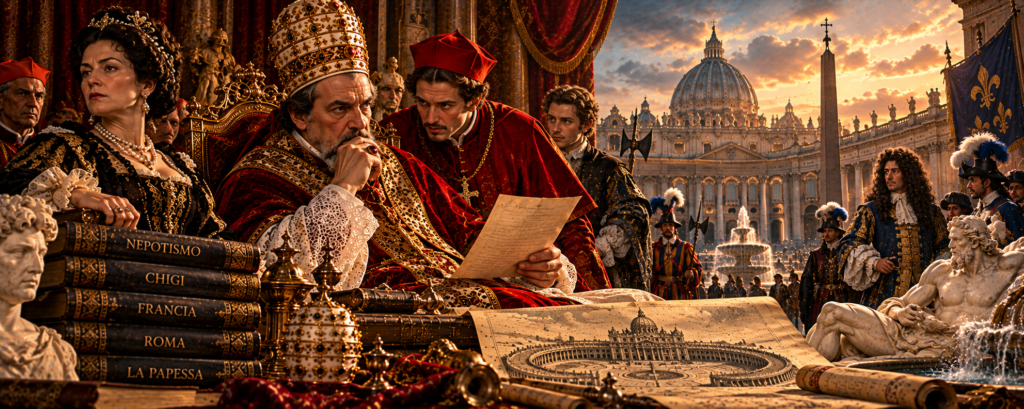
Alexander VII: The Pope Who Promised to End Nepotism and Built a Dynasty Instead
Pope Alexander VII (1599–1667) | Reigned 1655–1667
The Pope Who Promised Rome Something Different
When Alexander VII became pope in April 1655, Rome had every reason to be suspicious of promises about reform. For generations, the papacy had operated as both the spiritual government of the Catholic Church and a magnificent opportunity for whichever Italian family managed to place one of its members on the throne of St. Peter. Popes had elevated nephews into the College of Cardinals, rewarded brothers with lucrative positions, arranged advantageous marriages for relatives, and transformed family fortunes with property acquired during their reigns. By the time one pope died and another was elected, the only certainty was that a different family would soon be reaching for the same privileges.
Alexander appeared determined to break that pattern. The newly elected pontiff, born Fabio Chigi, had watched the spectacular enrichment of the Barberini under Urban VIII and the controversial influence of Olimpia Maidalchini during the pontificate of Innocent X. He understood how deeply nepotism had damaged the reputation of the papacy, and he initially made an unusually public effort to distance himself from the practice. His relatives were instructed to remain away from Rome, and the new pope cultivated an image of personal austerity, religious seriousness, and independence from family interests.
For a brief period, it seemed that something extraordinary might actually happen. Rome had acquired a pope who apparently intended to govern without transforming the Vatican into a family business. Cardinals who had complained about the corruption of previous pontificates could congratulate themselves on having elected a reformer. Observers who had grown accustomed to the sight of papal nephews becoming rich and powerful began to wonder whether the system might finally change.
Then Alexander changed his mind.
In April 1656, barely a year after his election, the pope announced that his relatives would be permitted to come to Rome. The decision was presented as a practical necessity, a concession to the argument that the papacy needed trusted family members to assist with government. Soon the Chigi began receiving the very privileges Alexander had appeared determined to deny them. His nephew Flavio became a cardinal, other relatives acquired offices and estates, and the family embarked upon a remarkable transformation into one of the great aristocratic dynasties of Baroque Rome.
The reversal was embarrassing, but it was also revealing. Alexander had not simply been caught committing a private indiscretion after preaching public virtue. He had confronted an institution so thoroughly organized around family patronage that even a pope who initially resisted nepotism eventually embraced it. His pontificate became a demonstration of how difficult it was to separate the spiritual office of the pope from the political and financial interests of the man occupying it.
Yet nepotism was only one part of Alexander’s story. His reign also witnessed a bitter confrontation with Louis XIV of France, culminating in an extraordinary diplomatic humiliation that forced the pope to accept demands imposed by a powerful Catholic monarch. A violent clash involving the papal Corsican Guard escalated into an international crisis, while French troops occupied Avignon and threatened further action. Alexander, who believed deeply in papal dignity, discovered that the king of France had little intention of treating Rome as an authority beyond challenge.
Meanwhile, the pope poured resources into transforming the Eternal City. Under his patronage, Gian Lorenzo Bernini created the magnificent colonnades embracing St. Peter’s Square, and Rome acquired some of the most recognizable monuments of its Baroque golden age. Alexander was a serious intellectual, an experienced diplomat, a patron of scholarship, and a man of genuine religious convictions. He was also a ruler who abandoned his most conspicuous promise of reform and allowed his family to benefit enormously from his elevation.
The contradiction makes Alexander VII one of the more fascinating figures in the history of papal nepotism. He was not a notorious libertine or a bloodthirsty tyrant, and portraying him as one would distort the historical record. His failure was more institutional, more respectable, and perhaps more revealing. He became the pope who tried to prove that Rome could be governed without family favoritism, only to demonstrate how firmly that favoritism had become embedded in the machinery of power.
Fabio Chigi: Born Into a Family That Understood Power
Fabio Chigi was born in Siena on February 13, 1599, into a family whose name already carried considerable prestige. The Chigi had accumulated wealth and influence through banking, commerce, landownership, and connections with the highest levels of Italian society. One of their most celebrated ancestors, Agostino Chigi, had been an immensely wealthy Renaissance banker whose patronage helped finance some of the great artistic achievements of sixteenth-century Rome. The family therefore understood long before Fabio became pope that money, culture, and political influence could reinforce one another.
The Chigi were not newcomers struggling to establish a respectable name. Their ancestry and connections gave them advantages that many ambitious ecclesiastics could only dream of acquiring. Nevertheless, branches of even distinguished families experienced changes in fortune, and Fabio’s immediate household was not necessarily surrounded by the extravagant wealth associated with the family’s most famous ancestors. Education and ecclesiastical service offered a path toward renewed prominence.
Fabio received a careful education, initially under private tutors. Accounts of his youth describe periods of poor health that affected his schooling, although the precise medical circumstances should not be interpreted through modern diagnostic assumptions. He developed strong intellectual interests and became particularly attracted to theology, philosophy, literature, and law. These subjects would remain important throughout his life.
He eventually studied at the University of Siena, acquiring advanced qualifications in disciplines useful for a career in the Church. His legal training was especially valuable because papal government required administrators capable of navigating disputes involving property, jurisdiction, diplomacy, and ecclesiastical privilege. The Roman Curia was not simply an assembly of priests discussing doctrine. It was also an elaborate political and judicial institution whose decisions could affect entire territories.
Fabio entered ecclesiastical service during the pontificate of Urban VIII. He benefited from connections and patronage, as almost every ambitious churchman did, but he also demonstrated genuine administrative ability. His advancement took him into positions requiring judgment, discretion, and an understanding of the competing interests that shaped Italian politics. By the time he reached the highest levels of the Church, he had spent decades learning how its institutions operated.
His career would eventually expose him to the contradiction that defined his pontificate. He knew the damage nepotism could cause because he had witnessed it from inside the system. He also knew why popes relied upon relatives, why cardinals cultivated family networks, and why aristocratic households considered ecclesiastical advancement an essential source of security. Alexander’s eventual surrender to nepotism was therefore not the mistake of an inexperienced outsider. It was the decision of a man who understood the system remarkably well.
The Diplomat Who Learned That Kings Could Defy Popes
Fabio Chigi’s ecclesiastical career took him far beyond Siena and Rome. In the late 1620s, he served in Ferrara, gaining experience in the administration of papal territory. He subsequently held responsibilities connected with Malta, where the interests of the Church, the Knights of St. John, and Mediterranean politics intersected. These appointments introduced him to the difficult practical business of governing institutions whose members did not always agree.
His most important diplomatic experience came when he became papal nuncio at Cologne in 1639. Europe was still suffering through the Thirty Years’ War, a devastating conflict that had begun in the Holy Roman Empire and expanded into a struggle involving many of the continent’s major powers. Religious divisions mattered enormously, but dynastic rivalry, territorial ambition, and political survival had become inseparable from the fighting. Catholic France was even opposing Catholic Habsburg powers when French interests demanded it.
Chigi represented papal interests during the negotiations that eventually produced the Peace of Westphalia in 1648. He sought to defend Catholic ecclesiastical rights and resist arrangements that Rome considered harmful to the Church. The negotiations were difficult because the powers involved increasingly treated the pope as one interested party rather than the final judge of Europe’s political order. Chigi encountered firsthand the growing distance between traditional claims of papal authority and the realities of seventeenth-century diplomacy.
The settlement ultimately disappointed Rome. Protestant rights were confirmed, disputed ecclesiastical property arrangements were recognized, and political compromises were accepted despite papal objections. Innocent X condemned objectionable provisions, but the major powers proceeded with the peace. Chigi had helped defend the papal position, yet he could not prevent a diplomatic outcome the Holy See regarded as damaging.
The experience left him with an intimate understanding of the ambitions of European monarchies. France in particular was becoming increasingly assertive, and Cardinal Mazarin had little patience for papal diplomats who obstructed French objectives. Chigi’s resistance to French positions during the peace negotiations contributed to the suspicion with which Mazarin later regarded him. The conflict would follow him into the papacy.
In 1651, Innocent X recalled Chigi to Rome and appointed him secretary of state. This was one of the most important offices in papal government, placing him close to the center of diplomacy and administration. He was created a cardinal in 1652, further consolidating his position. His reputation combined learning, administrative competence, and a seriousness that appealed to those dissatisfied with the excesses of papal family politics.
Yet his diplomatic career had also taught him an uncomfortable lesson. Popes could condemn treaties, defend ecclesiastical privileges, and invoke centuries of tradition, but powerful kings could still refuse to obey. When Chigi eventually became Alexander VII, he would confront that reality more personally than he could have imagined. The king who humiliated him would not be a Protestant enemy of Rome, but Louis XIV, the Catholic ruler of France.
The Conclave of 1655: A Reformer’s Reputation Becomes His Greatest Advantage
Innocent X died on January 7, 1655, leaving behind a papacy burdened by political rivalries and family controversies. His relationship with Olimpia Maidalchini had become notorious, and the Pamphilj court was widely associated with the influence of relatives over appointments and finances. The next pope would inherit not only the responsibilities of governing the Church but also the task of restoring confidence in an institution whose reputation had suffered. The conclave therefore unfolded amid intense discussion about reform and the dangers of another family-dominated pontificate.
The election was prolonged by divisions among the cardinals and the competing interests of European powers. French and Spanish influence remained important, while different factions within the Sacred College pursued their own preferred candidates. Chigi’s diplomatic history made him unacceptable to some French interests, particularly because of his resistance to Mazarin’s policies. Nevertheless, his personal reputation and administrative experience gradually made him an attractive compromise.
After approximately eighty days of negotiations and voting, Fabio Chigi was elected on April 7, 1655. He chose the name Alexander VII. At fifty-six, he was considerably younger than Innocent X had been at his election, raising the possibility of a relatively long pontificate. His age, experience, and reputation for seriousness made him appear capable of sustained reform.
The new pope’s initial conduct strengthened that impression. He maintained a comparatively restrained household and resisted the immediate arrival of relatives who might seek to profit from his elevation. The decision attracted attention because it broke with the expectations surrounding a new pontificate. Families ordinarily hurried to Rome when one of their members became pope, eager to secure offices before opportunities disappeared.
Alexander appeared to understand that reform required more than speeches. By keeping his relatives away, he deprived them of the immediate access through which nepotism normally operated. The gesture was visible, comprehensible, and politically significant. For observers exhausted by decades of Barberini and Pamphilj family politics, it offered a reason for cautious optimism.
The experiment, however, depended upon the pope’s willingness to resist pressures from within the very institution he governed. Cardinals expected a functioning system of patronage, officials needed powerful protectors, and ambitious courtiers sought influential intermediaries. The absence of papal relatives did not eliminate these interests. It merely forced them to operate through other channels.
Alexander soon confronted the argument that a pope without trusted family members could become dangerously dependent upon unrelated officials. Supporters of the traditional system claimed that relatives provided loyalty unavailable from ambitious courtiers. They could protect the pope’s interests, manage sensitive affairs, and offer continuity within a government vulnerable to intrigue. The reasoning was not entirely absurd, but it conveniently justified the continuation of an institution that enriched the families of successive popes.
The First Year Without Nephews
During the opening year of his pontificate, Alexander’s refusal to summon his relatives became one of his defining characteristics. The contrast with Innocent X was especially striking. Rome had recently watched Olimpia Maidalchini become an influential figure whose access to the pope attracted petitioners, diplomats, and bitter criticism. Alexander appeared determined not to create another such court.
The new pope devoted attention to ecclesiastical affairs, scholarship, and administration. His intellectual interests were genuine, and he enjoyed the company of learned churchmen. He had already demonstrated that he could manage complicated diplomatic matters, and he possessed a strong sense of the dignity of his office. Nothing about his background suggested that he needed relatives to tell him how to govern.
Nevertheless, the practical pressures surrounding him increased. Papal government was built upon personal relationships and networks of obligation, and the pope could not simply replace them overnight with an impersonal civil service. Cardinals and officials who possessed their own patrons could become powerful precisely because the pope lacked trusted family representatives. Alexander’s supporters argued that excluding his relatives might actually weaken his independence.
This reasoning reveals the central difficulty of reforming nepotism. The institution was criticized because it placed family interest above public responsibility, but it was defended because family loyalty supposedly protected the pope from manipulation by outsiders. Both arguments contained elements of truth. The danger was that the second argument could justify virtually any degree of family advancement.
The pope also faced the ordinary human pressures of kinship. His relatives had their own expectations, ambitions, and financial interests. They belonged to a distinguished family whose prestige could be enhanced enormously by the pontificate. Refusing them the advantages enjoyed by other papal households required Alexander to maintain a boundary that generations of predecessors had crossed.
For nearly a year, he held that boundary. His relatives remained outside the immediate center of Roman power, and the papacy appeared to be operating without a conventional cardinal-nephew. The experiment was sufficiently unusual to attract praise. It was also sufficiently fragile that its collapse would become one of the most memorable aspects of his reign.
April 1656: The Promise Begins to Collapse
On April 24, 1656, Alexander announced that his relatives would be allowed to come to Rome. The decision followed pressure from advisers who argued that the pope required the assistance of trusted family members. It was presented as a concession to administrative necessity rather than an abandonment of principle. Nevertheless, the practical consequences were unmistakable.
The Chigi family began entering the world of papal patronage. Alexander’s brother Mario and other relatives received opportunities associated with the government of the Papal States. His nephew Flavio Chigi emerged as the principal ecclesiastical beneficiary. The family that had initially been kept at a distance was now moving toward the center of power.
The change did not mean that Alexander suddenly became personally extravagant or abandoned his religious convictions. Contemporary accounts continued to describe him as a man interested in scholarship and serious ecclesiastical affairs. The problem was that personal austerity did not prevent institutional nepotism. A pope could live relatively modestly while allowing relatives to acquire immense wealth.
The distinction mattered because it enabled Alexander to reconcile his self-image with his actions. He could believe that he remained personally detached from luxury while his nephews accumulated offices and property. He could regard family advancement as a necessary feature of stable government rather than as corruption. Such reasoning allowed nepotism to survive even among men who recognized its dangers.
Rome noticed the reversal. The spectacle of a reforming pope welcoming relatives into the familiar machinery of patronage was too obvious to ignore. Those who had praised his original restraint now had to explain why the same pope was doing what his predecessors had done. Critics could point to the decision as evidence that promises of reform meant little once the temptations of power became available.
Alexander’s decision was especially revealing because it was not forced upon him by an immediate dynastic emergency. He had already demonstrated that government without a dominant family faction was possible for a limited period. What he had not demonstrated was that such an arrangement could be sustained against political pressure and entrenched expectations. His surrender exposed the weakness of reform that depended entirely upon the personal determination of a single ruler.
The Chigi were now in Rome, and the opportunity would not be wasted. A papacy could end without warning, and relatives understood that every year mattered. Offices, property, marriages, and titles could convert temporary access into permanent aristocratic status. Alexander had opened the door, and his family began walking through it.
Flavio Chigi: The Cardinal-Nephew Takes His Place
Flavio Chigi, Alexander’s nephew, became the most important symbol of the pope’s reversal. He was elevated to the cardinalate in 1657 and assumed a prominent position within the papal government. His advancement followed the familiar pattern by which a pope transformed a young relative into an influential ecclesiastical prince. The cardinal’s authority rested partly upon his office and partly upon the knowledge that he enjoyed privileged access to the pope.
The position carried enormous opportunities. A cardinal-nephew could influence appointments, cultivate foreign diplomats, distribute favors, and build networks of clients. Even when formal responsibilities were shared with experienced administrators, proximity to the pope made the nephew politically valuable. Those seeking advancement naturally paid attention to him.
Flavio also became an important collector and patron. His interests included paintings, decorative arts, books, and objects associated with aristocratic display. The accumulation of cultural treasures helped establish the Chigi as a family of refinement and distinction. In Baroque Rome, a great collection was not merely a private pleasure but a public declaration of status.
His wealth and influence attracted criticism, although it would be misleading to portray every aspect of his patronage as illicit. Ecclesiastical offices carried legitimate revenues, aristocratic families invested in art, and patronage was an accepted part of Roman society. The deeper problem was the concentration of opportunity around the pope’s relatives. Flavio’s rapid rise depended upon a family relationship unavailable to other ambitious churchmen.
Alexander could justify the arrangement by emphasizing loyalty and administrative convenience. Yet Flavio’s position made the initial promise of excluding relatives increasingly difficult to defend. The pope had not merely allowed his nephew to visit Rome. He had helped transform him into one of the most influential cardinals of the pontificate.
The Chigi also cultivated relationships with other powerful Roman families. Marriage alliances, property transactions, and aristocratic titles strengthened their long-term position. Such arrangements ensured that the benefits of Alexander’s reign would survive after his death. The family was not simply enjoying temporary privilege; it was constructing a durable dynasty.
Flavio’s career therefore embodied the contradiction at the center of Alexander’s pontificate. The pope who had initially rejected nepotism eventually created a cardinal-nephew whose position resembled those of earlier papal favorites. The process was neither accidental nor invisible. It was the deliberate restoration of a political structure Alexander had once seemed determined to avoid.
The Chigi Family Becomes a Roman Dynasty
The Chigi family’s rise extended well beyond Flavio’s cardinalate. Alexander’s relatives acquired property, offices, titles, and connections that elevated their position within Roman aristocratic society. The family already possessed a distinguished history, but the pontificate provided an opportunity to convert inherited prestige into renewed political and financial power. Such transformations were among the most enduring consequences of papal nepotism.
Agostino Chigi, another nephew, became central to the family’s secular ambitions. His marriage to Maria Virginia Borghese connected the Chigi to one of Rome’s most prominent papal dynasties. The Borghese had risen spectacularly under Paul V, and their wealth and social position made the alliance especially advantageous. Through marriage, the benefits of two papal regimes could be joined.
The family acquired important estates and developed a more substantial territorial identity. Aristocratic property offered security that ecclesiastical offices could not provide indefinitely. A cardinal’s income might disappear with his death, and political influence could vanish when a new pope was elected. Land, palaces, and hereditary titles offered a more permanent foundation.
Alexander’s relatives therefore pursued the same strategy followed by earlier papal families. They used the temporary opportunity created by a pontificate to establish lasting social advantages. The process required money, patronage, and carefully negotiated relationships with other noble houses. It was dynastic politics conducted through the institutions of the Church.
Criticism of nepotism often focused upon spectacular individual abuses, but the broader pattern was more important. The papacy repeatedly served as a mechanism through which families could transform their position within Italian society. One generation supplied the pope, and subsequent generations inherited the wealth and prestige created during his reign. The Church’s highest office became an extraordinary instrument of aristocratic advancement.
Alexander’s personal intentions remain important, but they cannot erase the outcome. He had initially attempted to separate papal government from family interests. By the end of his reign, the Chigi had benefited enormously from the very system he had questioned. His pontificate demonstrated that nepotism could survive without a pope who openly celebrated greed.
The Chigi family’s success also complicated Alexander’s reputation among contemporaries. Admirers could point to his learning, piety, and patronage of magnificent public works. Critics could point to relatives who had become rich and powerful through their connection to him. Both observations could be true, and that uncomfortable coexistence is essential to understanding his reign.
Rome in the Shadow of Plague
In 1656, the same year Alexander reversed his initial policy toward his relatives, plague threatened Rome. The epidemic formed part of a wider outbreak that devastated communities in central and southern Italy, particularly Naples. News of the catastrophe created fear throughout the region. Rome faced the possibility of suffering a similarly destructive disaster.
Alexander’s government responded with restrictive public-health measures. Movement into the city was controlled, quarantine procedures were enforced, and authorities attempted to identify and isolate infection. The measures interfered with commerce and ordinary life, but the government considered them necessary to limit transmission. Religious ceremonies and public gatherings also had to be managed in the shadow of contagion.
The pope’s response demonstrated that his administration could act decisively when confronted with an emergency. Rome did experience deaths, but the city avoided the catastrophic mortality suffered by Naples. The precise extent to which particular measures account for the difference is difficult to establish, because epidemics are shaped by many interacting conditions. Nevertheless, the response was regarded as an important achievement of Alexander’s government.
The crisis also revealed the harshness inherent in early modern public-health enforcement. Quarantine could separate families, interrupt livelihoods, and place vulnerable people under strict supervision. Officials possessed powers that frightened residents even when their purpose was protective. The struggle against disease therefore required balancing collective survival against individual hardship.
Alexander’s conduct during the epidemic complicates any portrayal of him as merely an indulgent patron of relatives. He was capable of serious administrative leadership and understood the importance of coordinated government. His papacy included genuine efforts to protect the population under his authority. The same ruler who permitted family enrichment could also respond effectively to a public emergency.
The plague years reinforced Rome’s awareness of mortality. Death could arrive suddenly, and even the most magnificent aristocratic household remained vulnerable. For a pope who had already developed a strong interest in the transience of earthly life, the epidemic offered a grim reminder of human fragility. It also provided a stark contrast to the wealth and dynastic ambition flourishing within his own family.
Queen Christina of Sweden Arrives in Rome
One of the most remarkable visitors to Alexander’s Rome was Christina, the former queen of Sweden. Born into a Protestant royal dynasty, Christina had abdicated her throne in 1654 and converted to Catholicism. Her conversion carried enormous symbolic importance because Sweden had been one of the major Protestant powers of the Thirty Years’ War. Rome recognized the propaganda value of welcoming such a distinguished convert.
Christina arrived in Rome in December 1655 and received an elaborate reception. Alexander treated her with considerable honor, and her presence became a major event in the city’s ceremonial life. The former queen possessed intelligence, confidence, and an appetite for intellectual conversation that made her an unusual figure within Roman society. She also had a strong sense of her own royal dignity.
Her relationship with the papal court was not always uncomplicated. Christina disliked restrictions and expected treatment appropriate to her former rank. She cultivated artists, scholars, and political contacts, while her financial difficulties and ambitions occasionally caused embarrassment. The pope therefore gained a prestigious convert who could also become a troublesome guest.
Christina’s residence in Rome added another layer to the city’s cultural life. She became an important patron and participated in intellectual circles that extended beyond conventional court ceremony. Her presence reinforced Rome’s claim to be a center of European learning and artistic achievement. Alexander, himself a scholar, had reasons to appreciate that dimension of her activities.
Yet the relationship also illustrated the tension between spiritual prestige and political practicality. Welcoming a former Protestant queen was a triumph for Catholic Rome, but managing an independent and politically ambitious royal personality required patience. Christina did not intend to become a silent ornament of the papal court. Her ambitions occasionally intersected awkwardly with the interests of European governments.
For Alexander, the episode was a diplomatic and ceremonial success tempered by complications. It displayed the universal aspirations of the papacy at a time when its political authority was increasingly challenged. Rome could attract a former queen through religion, culture, and prestige. Controlling her conduct was another matter entirely.
Bernini and the Pope Who Wanted to Remake Rome
Alexander VII’s artistic patronage became one of the most enduring achievements of his reign. He worked closely with Gian Lorenzo Bernini, the extraordinary sculptor and architect whose career had already transformed the appearance of Baroque Rome. Under Alexander, Bernini received commissions that reshaped some of the city’s most important religious and ceremonial spaces. The pope understood that architecture could communicate authority more effectively than many official proclamations.
The most famous project was the transformation of St. Peter’s Square. Bernini designed the immense curving colonnades that embrace the space before the basilica, creating a monumental setting for papal ceremonies and gatherings. The arrangement was both practical and symbolic. It organized crowds while presenting the Church as a vast institution welcoming the faithful into its embrace.
The project required extensive planning, labor, and financial resources. Columns, statues, paving, and architectural elements had to be coordinated on a scale that few patrons could contemplate. Alexander’s government supported the work because the square was central to the ceremonial identity of the papacy. Its transformation would outlast the pope who commissioned it.
Bernini also worked on the Scala Regia, the grand ceremonial staircase connecting important Vatican spaces. The project manipulated perspective to create an impression of greater depth and magnificence. Such effects were characteristic of Baroque architecture, which often used movement, light, and theatrical presentation to impress viewers. The Vatican became an environment designed to communicate grandeur at every turn.
The Cathedra Petri, or Chair of St. Peter, was another major undertaking associated with Alexander’s patronage. Bernini created an extraordinary sculptural and architectural composition within St. Peter’s Basilica, combining bronze, light, and religious symbolism. The work presented the authority of the apostolic tradition through overwhelming visual drama. It was theology translated into spectacle.
Alexander’s patronage was not confined to the Vatican. He supported urban improvements, church projects, and changes to important public spaces. The transformation of Piazza del Popolo and other areas reflected a broader ambition to make Rome more orderly, impressive, and suitable for its ceremonial role. His interest in architecture was genuine and sustained.
These achievements complicate the moral assessment of papal wealth. The same government that enriched relatives also financed works of lasting public and religious significance. Family ambition and artistic patronage were not mutually exclusive. They frequently reinforced one another.
The problem was that magnificence could make the system appear more legitimate than it was. Visitors admired fountains, churches, and colonnades without necessarily seeing the patronage networks behind them. Marble and bronze concealed the political arrangements that made their creation possible. Alexander’s Rome became one of the most beautiful demonstrations of how power could transform money into enduring prestige.
The Pope Who Loved Books More Than Court Ceremony
Alexander was a serious scholar whose intellectual interests had developed long before his election. He enjoyed literature, history, theology, and the company of learned men. His correspondence and patronage reflected a cultivated mind rather than the interests of a ruler concerned only with political display. Even critics of his nepotism generally recognized that he possessed genuine intellectual ability.
He supported libraries and scholarly institutions, including improvements connected with the University of Rome and the Vatican’s collections. Books and manuscripts were important instruments of prestige in seventeenth-century intellectual culture. A great library demonstrated wealth, learning, and the ability to preserve knowledge. Alexander understood their importance both personally and institutionally.
His interest in scholarship also influenced his circle of advisers. Learned cardinals and theologians could enjoy his confidence, and intellectual conversation formed part of his private life. The Jesuit historian Pietro Sforza Pallavicino, known for his history of the Council of Trent, belonged to the scholarly world Alexander valued. Such figures provided a different kind of court culture from the more flamboyant displays associated with some earlier papacies.
Nevertheless, intellectual refinement did not necessarily produce political reform. Alexander could discuss theology and literature while permitting his relatives to acquire substantial advantages. His education helped him recognize institutional problems, but recognition was not the same as resistance. The distinction is central to his historical character.
His preference for scholarship may also have encouraged reliance upon relatives and trusted administrators. A pope who wished to devote time to intellectual pursuits needed others to manage routine political affairs. Supporters of nepotism could present family government as a practical solution. The arrangement allowed the pope to pursue his interests while relatives handled the demanding business of patronage.
That division of responsibility carried obvious dangers. Delegating authority to trusted family members could reduce direct oversight of their financial and political activities. A pope might remain personally detached from extravagance while benefiting from the security provided by an increasingly wealthy household. Alexander’s scholarly reputation therefore coexisted with the familiar machinery of dynastic government.
The contrast is particularly striking because he was not ignorant of history. He knew what earlier papal families had done, and he had personally witnessed the controversies surrounding the Barberini and Pamphilj. His failure to maintain his original reforming position was not caused by a lack of education. It demonstrated that knowledge alone could not overcome institutional incentives.
Jansenism: The Religious Conflict That Refused to Die
Alexander inherited the bitter controversy surrounding Jansenism, a movement associated with the theological writings of Cornelius Jansen and the religious community of Port-Royal in France. The dispute concerned grace, free will, salvation, and the interpretation of St. Augustine. Opponents accused Jansenist thinkers of advancing propositions dangerously close to Calvinism. Supporters insisted that they were defending authentic Augustinian theology.
Innocent X had condemned five propositions associated with Jansen’s work in 1653. The condemnation did not settle the matter because Jansenists disputed whether the propositions accurately represented their author’s intended teaching. The controversy therefore shifted toward questions of interpretation and authority. Could Rome determine not only that certain statements were heretical but also that a particular author had taught them in the condemned sense?
Alexander took a firm position. In 1656, he issued Ad sanctam beati Petri sedem, reaffirming the condemnation and declaring that the propositions were found in Jansen’s work in the condemned sense. The decision strengthened the papal position but did not eliminate resistance. French theologians continued to debate the relationship between doctrinal condemnation and the factual interpretation of a text.
The dispute became entangled with French politics and ecclesiastical authority. Port-Royal had influential supporters, and opposition to Jansenism was particularly strong among Jesuits and other defenders of papal orthodoxy. The French monarchy also had reasons to distrust religious movements that resisted imposed formulas of obedience. Theology became inseparable from institutional rivalry.
In 1665, Alexander issued further measures associated with a formulary requiring acceptance of the papal condemnations. The policy placed pressure upon clergy and religious communities suspected of Jansenist sympathies. Refusal to sign could have serious consequences for individuals and institutions. The controversy would continue long after Alexander’s death.
His actions reflected genuine concern for doctrinal unity, but they also demonstrated the coercive dimensions of seventeenth-century ecclesiastical government. Rome expected obedience not merely to abstract theological principles but to authoritative judgments about disputed writings. Those who believed their consciences prevented acceptance faced difficult choices. The conflict raised enduring questions about the limits of institutional authority over intellectual conviction.
Alexander’s involvement in Jansenism should not be reduced to personal wickedness. He acted within a theological controversy that serious Catholic thinkers considered important. Yet the episode belongs within the broader history of religious authority and its enforcement. The pope who struggled to free his government from family influence was far less hesitant about demanding doctrinal submission from others.
Louis XIV: The King Who Would Not Bow to Rome
The most dramatic political confrontation of Alexander’s reign involved Louis XIV of France. The young king inherited a monarchy increasingly determined to assert its independence in matters of diplomacy and state authority. Although France remained Catholic, its government had no intention of allowing papal claims to override French interests. The relationship between Paris and Rome was therefore marked by tension long before open conflict erupted.
Cardinal Mazarin had already regarded Fabio Chigi with suspicion because of his conduct during the Westphalian negotiations. Alexander’s election did little to improve relations. French diplomacy remained sensitive to questions of precedence, jurisdiction, and the treatment of French representatives in Rome. Even ceremonial disputes could become matters of national honor.
The death of Mazarin in 1661 altered the political landscape. Louis XIV began exercising personal control over his government and became increasingly determined to assert royal authority. His ambitions extended beyond military and territorial expansion. He also expected foreign rulers, including the pope, to acknowledge the dignity of the French crown.
Rome’s diplomatic culture made conflict particularly likely. Ambassadors enjoyed privileges and protections, while their households could become sources of disorder. Disputes over immunity, policing, and ceremonial precedence were common. The French embassy proved especially difficult because its representatives insisted upon expansive interpretations of diplomatic privilege.
Alexander viewed these claims as challenges to his authority within Rome. The pope was not merely a spiritual leader receiving foreign ambassadors. He was also the sovereign of the Papal States and expected his officials to maintain order in his capital. When foreign diplomats behaved as though portions of Rome were beyond papal jurisdiction, the issue became politically explosive.
The French ambassador appointed in 1662, Charles III de Créquy, entered this already tense environment. His household and the papal authorities soon became involved in disputes over privileges and conduct. Neither side was eager to appear weak. The stage was set for a confrontation that would transform a violent street incident into a humiliation for the papacy.
The Corsican Guard Affair: Gunfire in the Streets of Rome
On August 20, 1662, tensions involving the French ambassador’s household and members of the papal Corsican Guard erupted into violence. The Corsican Guard was a military force employed in papal service, and its members were involved in maintaining security in Rome. Disputes between guards and the ambassador’s attendants had already created a dangerous atmosphere. The confrontation escalated into armed conflict near the French embassy.
Shots were fired, and members of the ambassador’s household were attacked. Casualties resulted, including the death of a member of the French ambassador’s entourage. The precise sequence of events became the subject of competing accounts, with each side attempting to establish responsibility. What mattered politically was that the French embassy had been involved in a violent confrontation with troops serving the pope.
Créquy reacted with outrage. He treated the incident as an intolerable insult to the French crown and demanded satisfaction. The French government embraced the dispute as a matter of national honor. Louis XIV was unwilling to accept an apology that might suggest the attack was merely an unfortunate local disturbance.
Alexander faced an extremely difficult situation. He could punish members of the guard and express regret, but Louis demanded a public and unmistakable acknowledgment of papal responsibility. The king also possessed the military power to enforce his demands. The pope’s spiritual prestige offered little protection against the possibility of French intervention.
The affair exposed the weakness of papal territorial sovereignty in an age of increasingly powerful monarchies. Rome could claim jurisdiction over its streets, but a foreign ambassador could appeal to a king capable of threatening the Papal States. The dispute was therefore no longer simply about the behavior of soldiers. It concerned whether the pope could maintain his dignity against a Catholic monarch determined to impose his will.
The violence also revealed the dangerous culture of diplomatic immunity. Ambassadors expected privileges that sometimes shielded their households from ordinary policing, while papal officials resented the resulting disorder. Conflicts could escalate because neither side wished to surrender authority. The Corsican Guard affair was an extreme example of a wider problem.
For Alexander, the incident became a personal and institutional humiliation. He had spent years defending papal rights against powerful states. Now an armed confrontation in his own capital threatened to force him into concessions he considered degrading. Louis XIV understood that the pope’s vulnerability could be used to extract more than a conventional apology.
Avignon Falls Under French Pressure
Louis XIV responded to the Corsican Guard affair with extraordinary force. France seized control of Avignon and the Comtat Venaissin, territories associated with papal sovereignty but geographically vulnerable to French power. The occupation demonstrated that the king was prepared to use territorial pressure rather than rely upon diplomatic protests. It also warned Alexander that further resistance could produce additional consequences.
The seizure was particularly humiliating because Avignon possessed immense historical significance for the papacy. During the fourteenth century, popes had resided there for decades, creating one of the most controversial periods in Church history. Although the papal court had long since returned to Rome, the territory remained an important symbol of papal temporal authority. Its occupation by Catholic France exposed the limits of that authority.
Louis also threatened further military action against papal interests. The French monarchy possessed resources far beyond those available to Alexander. The pope could appeal to other Catholic rulers, but European politics offered little guarantee of effective assistance. States were reluctant to become involved in a conflict merely to defend papal prestige.
Alexander’s position became increasingly untenable. Refusing French demands risked territorial losses and possibly war. Accepting them would demonstrate that the pope could be compelled to submit to a secular monarch. Neither outcome was attractive.
The dispute was especially painful because Alexander had devoted much of his earlier career to defending the independence and dignity of the Holy See. He understood diplomatic language, legal claims, and the symbolic importance of precedence. Yet those skills could not overcome the imbalance of military power. Louis XIV was prepared to make the pope’s resistance expensive.
The French king also benefited from presenting the dispute as a defense of royal honor. The attack upon his ambassador provided a justification that could be understood by other courts. Whether the king’s response was proportionate was another matter. The scale of the retaliation reflected broader ambitions to establish French prestige and influence in Italy.
Alexander eventually recognized that compromise was unavoidable. The negotiations would culminate in the Treaty of Pisa in 1664. The agreement ended the immediate crisis but required concessions that contemporaries regarded as humiliating. The pope who had once defended papal rights at Westphalia now faced the painful task of accepting terms imposed by France.
The Treaty of Pisa: A Pope Forced to Accept Humiliation
The Treaty of Pisa, concluded in February 1664, brought the confrontation between Alexander VII and Louis XIV toward resolution. Its provisions required the papal government to provide satisfaction for the Corsican Guard affair. France demanded not merely private assurances but visible acknowledgment that the king’s honor had been offended. The settlement therefore became an exercise in political humiliation.
Among the most notorious requirements was the erection of a commemorative monument in Rome associated with the disgrace of the Corsican Guard. The guard was to be disbanded, and the monument served as a public reminder of the papal government’s concession. The arrangement transformed a diplomatic settlement into something intended to be seen and remembered. It was a calculated assertion of French superiority.
The pope also agreed to send a special representative to France to offer formal satisfaction. Cardinal Flavio Chigi, Alexander’s own nephew, eventually undertook the mission. The choice carried obvious symbolic significance because the cardinal-nephew represented both the papal government and the family closest to the pope. His presence at the French court demonstrated the seriousness of Rome’s submission.
France restored the occupied papal territories after the settlement’s terms were implemented. Alexander therefore recovered what had been taken, but the political cost was considerable. The king had demonstrated that he could seize papal territory and force concessions from the pope. The restoration did not erase the humiliation that preceded it.
The affair also exposed the changing balance of power within Catholic Europe. Medieval popes had sometimes claimed the authority to judge kings and release subjects from allegiance. Alexander confronted a monarch who expected the pope to satisfy royal demands under threat of military force. The contrast was stark.
Louis XIV emerged from the crisis with his prestige enhanced. Alexander retained his spiritual office and recovered his territories, but he had been compelled to accept an agreement shaped by French pressure. The pope’s formal authority remained immense within the Church. His ability to dictate terms to powerful Catholic states was another matter.
The Treaty of Pisa became one of the defining embarrassments of Alexander’s pontificate. It demonstrated that the papacy could still command devotion, commission magnificent architecture, and influence theological disputes while remaining vulnerable in international politics. The pope could surround St. Peter’s Square with monumental colonnades, but he could not surround his territories with enough power to deter France. The lesson was uncomfortable and impossible to ignore.
Flavio Chigi Goes to France
The mission of Cardinal Flavio Chigi to France in 1664 placed Alexander’s nephew at the center of the diplomatic settlement. Flavio traveled as a papal representative charged with fulfilling the terms demanded by Louis XIV. His reception involved elaborate ceremonies, negotiations, and displays of royal magnificence. The mission was designed to restore relations while making the superiority claimed by France unmistakable.
For Flavio, the journey was an important diplomatic assignment but also a reminder of his uncle’s vulnerability. A cardinal-nephew who had risen through family privilege now represented a pope forced to make concessions. The French court was determined to demonstrate its grandeur. The encounter placed Roman ecclesiastical prestige beside the increasingly theatrical monarchy of Louis XIV.
Ceremony mattered enormously in seventeenth-century diplomacy. The order of processions, the reception of ambassadors, and the language of formal apologies all communicated political hierarchy. Small details could provoke serious disputes because rulers treated them as expressions of sovereignty. Flavio’s mission therefore required careful management.
The visit also demonstrated the cultural sophistication of both courts. French and Roman elites shared an enthusiasm for art, architecture, luxury, and elaborate ceremonial display. Their political rivalry did not prevent mutual admiration. Indeed, the competition for prestige encouraged both sides to invest heavily in magnificence.
The mission ultimately helped restore diplomatic relations. It did not eliminate the deeper conflict between papal authority and French royal ambition. Louis XIV would continue to challenge Rome over ecclesiastical and political matters during later pontificates. Alexander’s experience was an early indication of how difficult those confrontations would become.
Flavio returned with his position within the Chigi dynasty intact. The humiliation belonged principally to the papal government rather than to his personal fortunes. He remained an influential cardinal and collector. The family continued consolidating its wealth even as Alexander’s international prestige suffered.
The contrast is revealing. Nepotism could provide a pope with trusted representatives capable of conducting sensitive missions. It could also ensure that family advancement continued regardless of diplomatic failure. Flavio’s career demonstrated both the practical usefulness and the institutional dangers of the cardinal-nephew system. Alexander’s attempt to eliminate it now seemed a distant memory.
The Pope, the King, and the Artist Between Them
The conflict with Louis XIV did not prevent cultural exchange between France and Rome. In 1665, Bernini traveled to France at the invitation of the French king. The journey was one of the most remarkable artistic encounters of the century. The sculptor who had transformed papal Rome entered the court of the monarch who had recently humiliated the pope.
Louis hoped Bernini could contribute to the development of the Louvre and enhance the architectural prestige of the French monarchy. Bernini was already famous throughout Europe, and his presence offered the king an opportunity to associate himself with one of the greatest living artists. The invitation was therefore as much a political statement as an artistic commission. France intended to compete with Rome in the language of magnificence.
Bernini received honors and attention during his stay, but his architectural proposals encountered resistance. French architects and officials possessed their own ideas about the Louvre’s development. The encounter exposed differences in artistic taste and institutional priorities. Bernini’s plans were not ultimately adopted as the basis for the palace’s principal new façade.
The sculptor nevertheless produced an extraordinary portrait bust of Louis XIV. The work presented the king with dramatic confidence, flowing hair, and a commanding expression. It became one of the defining images of the Sun King’s royal persona. Bernini’s artistic genius could serve a monarch whose political ambitions conflicted sharply with those of his papal patron.
Alexander’s Rome and Louis’s France were therefore rivals and cultural partners at the same time. Both courts understood that art could make power appear natural, magnificent, and enduring. Both invested heavily in buildings, ceremonies, and images that celebrated authority. Their rivalry helped produce some of the most recognizable artistic achievements of the Baroque age.
The irony would not have been lost on attentive observers. The pope who had commissioned Bernini’s grand embrace of St. Peter’s Square watched the same artist travel to serve the king who had forced Rome into submission. Art moved across borders more easily than political trust. Genius could be welcomed where papal authority had been resisted.
For Alexander, the episode belonged to a broader reality he could not escape. Rome remained an artistic and spiritual center of extraordinary importance. France was becoming an increasingly powerful political and cultural competitor. The pope’s magnificence could impress Europe, but it could not guarantee obedience from its rulers.
Venice, the Ottoman Empire, and the Limits of Catholic Unity
Alexander’s pontificate also unfolded during the prolonged struggle between Venice and the Ottoman Empire over Crete. The conflict had begun in 1645 and placed enormous pressure upon Venetian resources. The defense of Candia became one of the most famous sieges of the seventeenth century. Catholic powers regarded Ottoman expansion as a serious concern, but their responses were shaped by competing political interests.
Alexander supported efforts to assist Venice against the Ottomans. The papacy contributed to broader Catholic efforts aimed at defending Venetian positions in the eastern Mediterranean. Such support reflected the pope’s responsibilities as a religious leader and his interest in the balance of power around Italy. It also offered opportunities to improve relations with a republic that had previously clashed bitterly with Rome.
Venice had been placed under papal interdict during the reign of Paul V, and the conflict had left lasting memories. Relations between the republic and the Holy See therefore carried a history of suspicion. Under Alexander, cooperation against the Ottoman threat helped produce a more constructive atmosphere. The restoration of the Jesuits to Venice in 1657 marked an important improvement in relations.
Yet Catholic unity remained difficult to achieve. France, Spain, Venice, the Habsburg territories, and the papacy possessed overlapping but frequently conflicting interests. Religious solidarity could encourage cooperation, but it rarely eliminated political rivalry. The same Catholic monarchies that might support resistance to Ottoman expansion could also quarrel bitterly over Italian influence.
Alexander’s diplomatic difficulties therefore extended beyond his confrontation with Louis XIV. He governed in a Europe where the language of Catholic unity often concealed competing state ambitions. The pope could appeal to common religious interests, but rulers calculated the costs of military intervention. His ability to coordinate collective action was limited.
The struggle over Crete continued beyond Alexander’s death. Candia eventually fell to the Ottomans in 1669, ending the long Venetian defense. Alexander did not live to witness that outcome. His efforts nevertheless belonged to the wider history of papal attempts to influence Mediterranean politics through diplomacy, finance, and religious appeals.
The episode reinforces the complexity of his pontificate. Alexander was not simply concerned with enriching the Chigi or beautifying Rome. He confronted international crises involving war, diplomacy, and the security of Catholic territories. His failures and compromises should be understood against the enormous difficulties of coordinating states that rarely agreed for long.
The Problem of Portugal
Another diplomatic challenge involved Portugal’s struggle for recognition following its restoration of independence from Spain in 1640. The Portuguese monarchy sought recognition of its new ruling dynasty, while Spain resisted the loss of its former kingdom. The papacy found itself trapped between conflicting Catholic interests. Decisions about diplomatic recognition and episcopal appointments became politically dangerous.
Portugal needed bishops to govern its dioceses, but appointments became entangled with the dispute over legitimate royal authority. The Spanish monarchy opposed arrangements that might imply acceptance of Portuguese independence. Rome hesitated to take steps that would alienate Spain. The result was a serious ecclesiastical problem with political causes.
Alexander inherited this difficulty and struggled to resolve it. The needs of Portuguese Catholics did not disappear simply because European governments disagreed over sovereignty. Vacant bishoprics created practical problems for church administration. The pope’s inability to satisfy all parties exposed the tension between spiritual responsibility and diplomatic calculation.
The dispute demonstrated that Catholic monarchies could obstruct papal decisions even when the religious needs involved were obvious. Spain and Portugal were not Protestant states rejecting papal authority on principle. Both considered themselves Catholic powers. Their conflict nevertheless made ordinary ecclesiastical administration extraordinarily difficult.
Alexander’s response reflected caution rather than dramatic confrontation. He sought to avoid a rupture with Spain while navigating Portuguese demands. Such caution was understandable in diplomatic terms but frustrating for those affected by prolonged vacancies. The episode revealed the costs of trying to preserve relations with powerful governments at the expense of decisive action.
Portugal’s independence would eventually be recognized by Spain in 1668, after Alexander’s death. The ecclesiastical complications associated with the dispute were part of a longer process. Alexander’s pontificate therefore occupied an uncomfortable transitional period. He faced the consequences of a political transformation that Rome could neither reverse nor easily accommodate.
The Portuguese question belongs beside Westphalia and the conflict with France as evidence of the papacy’s changing position in Europe. Spiritual authority remained important, but national governments increasingly controlled the practical conditions under which it operated. Alexander had spent his career defending papal interests against that trend. His reign repeatedly demonstrated how difficult the struggle had become.
The Chigi Palaces and the Architecture of Family Glory
While Alexander confronted diplomatic difficulties, his relatives continued establishing their place among Rome’s great families. Palaces, collections, and estates became instruments of dynastic memory. A successful papal family needed visible monuments that would survive the death of its patron. The Chigi understood this as well as the Barberini, Borghese, and Pamphilj before them.
The family’s association with major Roman buildings strengthened its public identity. Architectural patronage provided opportunities to display heraldic symbols, celebrate ancestry, and demonstrate cultural sophistication. Visitors could recognize the presence of a powerful family through façades, chapels, fountains, and collections. Such displays helped convert recent political advancement into an appearance of established greatness.
Alexander’s own artistic projects often served the Church more directly than his relatives’ private acquisitions. Yet the distinction between public and dynastic prestige was not always clear. A magnificent papal commission enhanced the reputation of the pope, and that reputation benefited his family. The Chigi name became associated with one of Rome’s most impressive periods of architectural transformation.
The family also invested in collections and property that could be inherited. Paintings, sculptures, libraries, and furnishings represented wealth, but they also communicated taste and education. A great Roman household was expected to display refinement. Cultural patronage therefore became part of the social language through which new aristocratic power was legitimized.
This process could generate genuine artistic achievement. Patrons employed skilled architects, painters, sculptors, and craftsmen whose work enriched the city. The resulting monuments were not necessarily inferior because family ambition helped finance them. Nevertheless, their beauty should not obscure the political structures that directed resources toward a privileged household.
Alexander’s case is particularly revealing because his personal interests in art and scholarship were sincere. He did not need to invent an enthusiasm for culture to justify spending. Yet the same cultural environment provided opportunities for relatives to establish their own prestige. Personal taste and dynastic ambition became mutually reinforcing.
The Chigi emerged from the pontificate with a position that would have been difficult to achieve through ordinary aristocratic advancement alone. Their transformation was not merely the result of inherited distinction. It was accelerated by privileged access to the highest office in the Church. Alexander had initially tried to prevent precisely that kind of outcome.
The Pope’s Personal Austerity and His Family’s Wealth
One of the most striking contradictions of Alexander VII is that his reputation for personal religious seriousness did not disappear when his relatives became powerful. He continued to be associated with scholarship, devotion, and an awareness of mortality. His personal conduct was not generally compared with the notorious excesses of some Renaissance popes. Yet the wealth accumulated around his family remained difficult to reconcile with his original reforming image.
This distinction between personal virtue and institutional conduct is essential. A ruler may avoid extravagant private pleasures while tolerating arrangements that benefit relatives at public expense. The absence of personal scandal does not prove that government is free from favoritism. Alexander’s pontificate demonstrates how nepotism could survive even under a pope who considered himself morally serious.
His supporters could argue that family patronage was necessary to preserve stability. They could point to capable relatives, legitimate offices, and the importance of trusted agents. They could also emphasize the public works and ecclesiastical achievements of his reign. Such arguments were not entirely without substance.
Critics could respond that the same reasoning had justified nepotism for generations. Every papal family claimed to provide loyal service. Every new cardinal-nephew could be described as capable, necessary, or deserving. The result was a system in which the pope’s relatives repeatedly acquired advantages unavailable to others.
Alexander’s failure was therefore not simply that he broke a promise. It was that he accepted the logic of an institution he had initially recognized as dangerous. Once family government was treated as necessary, the question shifted from whether relatives should benefit to how much they should receive. The original principle gradually disappeared.
The process also illustrates why reforms dependent upon personal restraint often fail. Alexander could keep his relatives away while he remained determined to do so. He could not easily prevent their advancement once he accepted the premise that they belonged at the center of government. The institution had no durable barrier separating papal authority from family opportunity.
His pontificate consequently became an example cited in discussions of nepotism long after his death. He had provided an unusually clear demonstration of both the possibility and fragility of reform. For one year, Rome had seen a different model. For the remainder of his reign, it watched the old model return.
The Tomb That Reminded a Pope He Would Die
Alexander possessed a strong awareness of death and the transience of earthly power. His interest in mortality was reflected in devotional practices and in the artistic culture surrounding his pontificate. The contrast between his personal meditation upon death and his family’s pursuit of lasting wealth is one of the most striking features of his reign. The pope knew that his life would end, even as his relatives worked to ensure that their dynasty would endure.
The monument eventually created for Alexander in St. Peter’s Basilica expresses that tension with extraordinary force. Designed by Bernini and completed after the pope’s death, the tomb presents the pontiff kneeling in prayer above allegorical figures. Beneath the drapery, a skeletal representation of Death emerges holding an hourglass. The imagery reminds viewers that time eventually claims even the most powerful rulers.
The monument is magnificent, but its message is unsettling. Marble, bronze, and theatrical composition celebrate the pope while simultaneously confronting the inevitability of his disappearance. Death appears not as an abstract theological idea but as a figure intruding into the carefully ordered world of papal grandeur. The effect is both devotional and dramatic.
The tomb also demonstrates the artistic sophistication of Alexander’s circle. Bernini transformed a funerary monument into a meditation on mortality, authority, and salvation. The work belongs to the same Baroque culture that produced the colonnades of St. Peter’s Square. Its emotional intensity reflects an age fascinated by the relationship between worldly splendor and human fragility.
For Alexander, such imagery was not merely decorative. His religious seriousness included reflection upon the limits of earthly achievement. He understood that offices, honors, and possessions could not prevent death. The question is why that awareness did not lead him to maintain a stronger separation between his family and the benefits of papal power.
Perhaps the answer lies in the distinction between personal mortality and dynastic survival. A pope could accept that he would die while believing that he had obligations to secure his relatives’ future. Family advancement could be presented as prudent stewardship rather than vanity. The logic was familiar throughout aristocratic Europe.
Alexander’s tomb therefore captures an uncomfortable truth about his reign. He commissioned works that proclaimed the insignificance of earthly power before eternity, while his relatives accumulated the material advantages that earthly power could provide. The contradiction was not unique to him. It was one of the defining features of the papal monarchy.
The Final Years: A Pope Surrounded by His Own Contradictions
By the middle of the 1660s, Alexander had spent nearly a decade as pope. His family was firmly established in Rome, major architectural projects were transforming the city, and the conflict with France had ended through an agreement that damaged papal prestige. He remained engaged in ecclesiastical affairs and continued supporting artistic and intellectual projects. Yet the optimism that had accompanied his election had long since faded.
His health declined during the final years of his life. The responsibilities of office remained demanding, and the political pressures surrounding him did not disappear. France continued to assert its interests, theological controversies remained unresolved, and the Papal States required constant administration. The pope who had once been celebrated as a reformer now presided over a government familiar in its reliance upon relatives.
Alexander’s declining health also increased the urgency of dynastic planning. The Chigi understood that the pontificate could end at any moment. Offices might be lost under a successor, and rivals could challenge arrangements made during the family’s period of favor. Property, titles, and marriages therefore assumed even greater importance.
The family had already achieved considerable success. Flavio occupied a prominent position within the College of Cardinals, while secular relatives possessed estates and connections that would endure. The Chigi name had become inseparable from major Roman artistic achievements. Alexander’s reign had secured a legacy far beyond his personal career.
His spiritual responsibilities nevertheless remained central to his understanding of the papacy. He continued to regard himself as a defender of Catholic doctrine and ecclesiastical authority. The fact that his family benefited from his office did not necessarily appear to him as incompatible with those duties. That self-understanding helps explain how a pope could sincerely embrace religious ideals while participating in a system widely criticized as corrupt.
Alexander died on May 22, 1667, at the age of sixty-eight. His twelve-year pontificate had witnessed dramatic changes in Rome and significant conflicts abroad. The reforming promise of 1655 had given way to a familiar pattern of family advancement. The pope who had tried to keep his relatives away left behind a dynasty whose fortunes had been transformed by his reign.
His successor would inherit both the achievements and the problems of his government. The Chigi would retain wealth and prestige, while the Church continued confronting the institutional question Alexander had failed to resolve. Nepotism had survived another opportunity for reform. The next pope would face the same temptations.
Rome After Alexander VII
Alexander’s death did not erase the architectural transformation he had sponsored. Bernini’s colonnades continued framing St. Peter’s Square, while the Scala Regia and Cathedra Petri remained among the Vatican’s most impressive achievements. The city’s public spaces reflected the artistic ambitions of his pontificate. Visitors could admire those works without knowing the political controversies that had surrounded their creation.
The Chigi family also continued to occupy an important position within Roman aristocratic society. The wealth, property, and alliances accumulated during Alexander’s reign provided a foundation for later generations. Their success demonstrated the enduring value of a papal connection. The temporary possession of the throne had produced permanent social advantages.
Flavio Chigi remained a significant ecclesiastical and cultural figure after his uncle’s death. His collections and patronage contributed to the family’s reputation for refinement. Other relatives continued managing estates and participating in aristocratic society. The dynasty had successfully converted ecclesiastical opportunity into hereditary status.
The wider papacy, however, still faced the problem of nepotism. Later popes would continue struggling with the relationship between family interests and ecclesiastical government. Some would attempt restrictions, while others would embrace the established pattern. The eventual weakening of the cardinal-nephew system required more than the personal intentions of individual pontiffs.
Alexander’s example remained particularly instructive because his reversal had been so visible. He had not entered office openly promising to enrich his family. He had done the opposite. The contrast between his initial policy and subsequent conduct made his reign an unusually clear demonstration of the forces sustaining nepotism.
His diplomatic legacy was similarly complicated. The Treaty of Pisa had exposed the vulnerability of papal sovereignty to pressure from a powerful Catholic monarchy. The episode anticipated further disputes between Rome and France during the reign of Louis XIV. The papacy remained spiritually influential but increasingly constrained by the ambitions of sovereign states.
Alexander therefore left behind two very different kinds of monument. One was visible in the stone and marble of Baroque Rome. The other was institutional, preserved in the memory of a failed reform and a humiliating diplomatic confrontation. Together they reveal a pope whose achievements were substantial but whose limitations were equally revealing.
Was Alexander VII Really a Wicked Pope?
Alexander VII is not among the most personally scandalous popes in Catholic history. There is no convincing reason to portray him as a sexual libertine, a murderous tyrant, or a ruler driven primarily by cruelty. He possessed genuine religious convictions, intellectual ability, and administrative experience. His pontificate included important public-health measures, artistic achievements, and serious engagement with theological and diplomatic affairs.
His inclusion in the Wicked Popes category therefore requires a different explanation. The central issue is nepotism and the failure of reform. Alexander recognized the dangers of family government, initially attempted to resist them, and then permitted his relatives to enjoy the privileges he had appeared determined to prevent. His conduct illustrates the persistence of an institution that repeatedly placed family advantage beside the responsibilities of spiritual leadership.
The Chigi did not merely receive symbolic honors. They acquired offices, wealth, property, and social connections that transformed their long-term position. The family’s advancement was closely connected to Alexander’s authority as pope. That relationship raises legitimate questions about the use of ecclesiastical power for dynastic purposes.
Yet it would be misleading to suggest that Alexander personally invented or uniquely intensified papal nepotism. He inherited a system that had developed over centuries. Many predecessors had used it more aggressively, and some had produced scandals far more spectacular than those associated with the Chigi. Alexander’s significance lies partly in the fact that he understood the problem and still failed to overcome it.
His confrontation with Louis XIV also deserves careful interpretation. The Corsican Guard affair involved real violence, and the papal government bore responsibility for the conduct of troops serving under its authority. Nevertheless, the French response was shaped by broader ambitions and employed military pressure far beyond an ordinary diplomatic protest. Alexander’s humiliation was not proof of personal wickedness.
The Jansenist controversy raises different questions about religious authority. Alexander sought to defend doctrinal unity, but his policies also placed pressure upon dissenting theologians and religious communities. His actions reflected the expectations of seventeenth-century Catholic government rather than an exceptional appetite for persecution. Historical judgment should distinguish institutional coercion from sensational accusations of personal cruelty.
His artistic patronage presents another complication. The same papacy that enriched relatives created monuments of extraordinary beauty and lasting religious significance. Bernini’s work under Alexander remains central to the visual identity of Catholic Rome. Those achievements do not excuse nepotism, but they prevent the reign from being reduced to corruption alone.
Alexander belongs in this category as an example of institutional contradiction. He demonstrates how a pope could be personally devout, intellectually distinguished, and capable of effective government while participating in practices that compromised the moral authority of his office. His story is not one of spectacular depravity. It is a study of how respectable power can preserve an unhealthy system even while claiming to reform it.
The Reform That Never Came
The failure of Alexander’s anti-nepotism policy raises a larger question about the structure of papal government. Why was the system so difficult to change? The answer lies partly in the relationship between personal authority and institutional organization. Early modern popes governed through networks of cardinals, officials, relatives, and clients whose loyalties were often shaped by patronage.
A pope who excluded relatives did not automatically eliminate favoritism. He still needed advisers, administrators, and trusted representatives. Those individuals could cultivate their own clients and interests. Supporters of family government argued that relatives were at least bound to the pope by obligations stronger than ordinary political loyalty.
The argument was persuasive because it addressed a real problem. Papal government lacked the kind of professionalized, impersonal administration expected in modern states. Offices could be treated as rewards, and political influence often depended upon personal relationships. A pope attempting to govern without relatives risked becoming dependent upon other powerful factions.
Yet nepotism created its own dangers. Relatives possessed incentives to accumulate wealth quickly because they knew the pontificate would end. Their interests could diverge from those of the Church, and their privileged position made accountability difficult. The result was a recurring cycle of enrichment, resentment, and reforming promises.
Alexander briefly interrupted that cycle. His first year demonstrated that a pope could resist the immediate establishment of a dominant family faction. The reversal of 1656 showed how easily the old structure could reassert itself. Without durable institutional changes, personal restraint proved insufficient.
His pontificate therefore offers a lesson extending beyond the seventeenth-century Church. Systems of favoritism survive partly because their defenders can present them as practical necessities. Loyalty, efficiency, and stability become arguments for concentrating opportunities among trusted insiders. Reform fails when the underlying incentives remain unchanged.
Alexander’s tragedy was that he understood enough to begin resisting but not enough, or not with sufficient determination, to continue. His family benefited from the retreat, and Rome returned to familiar habits. The pope who might have become a landmark reformer instead became an illustration of the system’s resilience. His failure was not spectacular, but it was historically significant.
The Pope Who Could Not Escape His Family
When Alexander VII first ordered his relatives to remain away from Rome, he offered the city a glimpse of something different. After decades of papal nephews, wealthy favorites, family rivalries, and accusations of corruption, the new pope appeared determined to separate his spiritual office from the ambitions of his household. His decision was simple enough for everyone to understand and bold enough to attract admiration. For a brief moment, the papacy seemed capable of governing without turning another Italian family into a dynasty.
The experiment lasted barely a year. Alexander yielded to arguments that trusted relatives were necessary for stable government, and the Chigi entered Rome to claim the opportunities that had enriched so many papal families before them. Flavio became a cardinal, secular relatives acquired property and titles, and advantageous marriages strengthened the family’s future. By the end of the pontificate, the Chigi had achieved precisely the transformation Alexander had initially appeared determined to prevent.
The reversal did not erase his accomplishments. He protected Rome during a dangerous epidemic, engaged seriously with theological controversies, welcomed a remarkable royal convert, supported scholarship, and commissioned some of the greatest works of Baroque architecture. Bernini’s colonnades still embrace St. Peter’s Square, creating an impression of grandeur that has survived for centuries. Alexander helped give Catholic Rome a visual identity that remains instantly recognizable.
Yet magnificence could not conceal political weakness. The confrontation with Louis XIV demonstrated that the pope’s authority had limits even among Catholic rulers. French troops occupied papal territory, and the Treaty of Pisa forced Alexander into concessions designed to satisfy the honor of a secular monarch. The pope who had defended ecclesiastical rights at Westphalia discovered that the king of France could compel him to accept public humiliation.
His reign therefore unfolded between two contradictions. At home, he possessed enough authority to enrich his relatives but failed to maintain his own policy against nepotism. Abroad, he claimed the dignity of the papacy but lacked the military power to defend that dignity against an ambitious king. The contrast reveals the peculiar position of the seventeenth-century pope, simultaneously spiritual leader, territorial prince, aristocratic patron, and diplomatic participant in a changing European order.
Alexander’s personal seriousness makes the story more unsettling rather than less. He was not a man whose obvious depravity made reform impossible from the beginning. He was educated, experienced, and aware of the damage nepotism had caused. His failure demonstrates that corruption does not always require an openly corrupt personality.
The Chigi family emerged from his reign wealthy and distinguished, while the institutions that had enabled their rise remained largely intact. Alexander died, but his relatives retained the advantages created by his temporary possession of the papal throne. That was the enduring attraction of nepotism: a pope’s reign was temporary, but a family’s rewards could last for generations. Every pontificate offered another opportunity to convert sacred authority into hereditary prestige.
In St. Peter’s Basilica, Bernini’s monument to Alexander presents the pope kneeling in prayer while Death emerges beneath him holding an hourglass. The image is a reminder that no ruler can escape mortality, however magnificent his surroundings or powerful his office. Alexander understood that truth and made it part of the artistic legacy of his reign. Yet the family he had initially tried to exclude spent his pontificate securing everything that might endure after he was gone.
That is the central irony of Alexander VII. He began as a pope who wanted to demonstrate that the Church could rise above the interests of one family. He ended as the patron of a dynasty whose wealth and influence had been transformed by his office. Between those two moments lay twelve years of genuine achievements, political humiliations, magnificent art, and an abandoned promise.
Alexander did not need to be a monster to belong in the darker history of the papacy. His reign exposes something more ordinary and more enduring than spectacular wickedness: the ability of an institution to absorb reform, accommodate criticism, and continue rewarding the very behavior it claims to reject. Rome had been promised a pope who would govern without nephews, but the Chigi eventually received their palaces, titles, offices, and fortunes. The promise disappeared, the dynasty survived, and the magnificent city Alexander helped create still stands as a monument to both his achievements and the system he could not bring himself to change.