
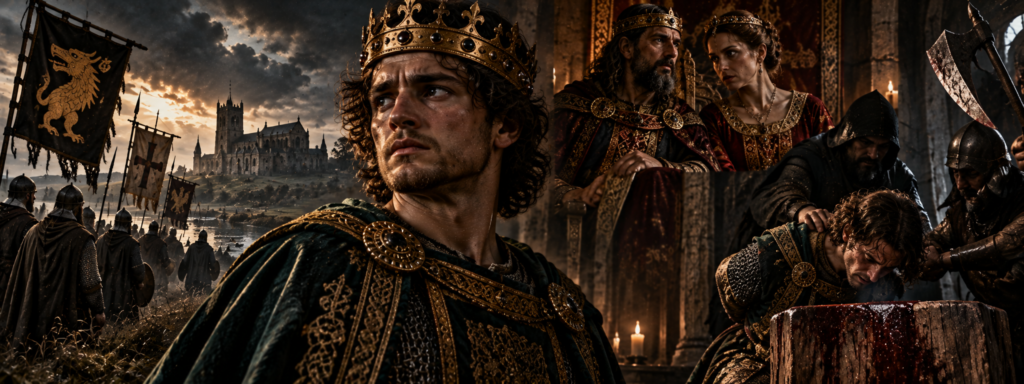
Æthelberht II of East Anglia: The Murdered King, Offa’s Betrayal, and the Royal Wedding That Ended in Blood
Æthelberht II of East Anglia (d. c. 794) | King of the East Angles | Beheaded on the orders of Offa of Mercia, according to the Anglo-Saxon Chronicle; the circumstances of his death remain uncertain
The King Who Never Returned From Mercia
Sometime near the end of the eighth century, a king of East Anglia met a violent death far from the kingdom he ruled. His name was Æthelberht, and the surviving historical record preserves one devastating fact about his fate: Offa, the powerful king of Mercia, ordered his head to be struck off. There is no surviving contemporary eyewitness description of the execution, no reliable account of a trial, and no explanation from Offa himself. Yet the killing was remembered for centuries, eventually becoming one of the most elaborate stories of royal betrayal in early medieval England.
According to later tradition, Æthelberht had traveled to Mercia seeking the hand of Offa’s daughter in marriage. The proposed union should have strengthened relations between two Anglo-Saxon kingdoms, bringing together powerful families through the familiar political language of dynastic marriage. Instead, the young king supposedly entered a court where his prospective father-in-law, or perhaps the queen who feared his growing influence, was already considering his destruction. The marriage never took place, and Æthelberht’s visit ended with his death.
The later stories describe a betrayal worthy of a medieval tragedy. Some versions portray Offa as a calculating ruler who feared that his prospective son-in-law would become too powerful, while others blame Queen Cynethryth for encouraging or arranging the murder. One particularly elaborate tradition describes a concealed pit beneath a seat, turning what should have been a private meeting into a carefully prepared death trap. Another version places the execution directly under Offa’s authority and describes Æthelberht being seized and beheaded.
These stories are memorable, but they are not equally reliable. The marriage proposal, the queen’s involvement, the concealed pit, and the dramatic warnings that supposedly preceded the journey come from sources written centuries after Æthelberht’s death. The earlier evidence is much more restrained, recording the killing without explaining the circumstances. The difference matters because the historical murder is real, while much of the familiar narrative surrounding it belongs to the uncertain territory between political memory and religious legend.
Æthelberht’s death nevertheless had consequences that extended far beyond the disappearance of one ruler. He became venerated as a martyr, and his supposed burial place at Hereford developed into an important religious center. Churches were dedicated to him, stories of miracles accumulated around his memory, and the king who had apparently been eliminated for political reasons became a figure whose reputation outlived that of many more successful rulers. Offa possessed the military power to end Æthelberht’s reign, but he could not prevent the dead king from acquiring a different kind of authority.
The murder also reveals the dangerous political world of Anglo-Saxon England before its eventual unification. The kingdoms of Mercia, East Anglia, Wessex, Kent, and Northumbria competed for territory, influence, tribute, and prestige. Powerful kings could dominate their neighbors, but that dominance was rarely permanent or uncontested. A smaller kingdom’s ruler might be recognized as an ally one year and treated as a dangerous rival the next.
Æthelberht lived within that unstable system, and his death appears inseparable from it. Whether he was murdered during a marriage negotiation, eliminated after a political dispute, or killed in circumstances now lost to history, his fate illustrates the vulnerability of kings who stood in the shadow of a stronger monarch. The crown of East Anglia offered dignity and authority, but it could not protect its wearer from the ambitions of Mercia. In the end, Æthelberht became more famous for the manner of his death than for anything he accomplished while alive.
England Before There Was an England
To understand Æthelberht’s murder, it is necessary to enter a world in which England did not yet exist as a unified kingdom. During the eighth century, much of the territory now known as England was divided among several Anglo-Saxon kingdoms with their own rulers, aristocracies, military traditions, and political interests. Their boundaries shifted as armies advanced, alliances changed, and powerful kings imposed authority upon weaker neighbors. The relationships between these kingdoms were rarely simple enough to be described as either complete independence or permanent subjection.
Mercia occupied a central position in this political landscape. Its rulers controlled much of the English Midlands and repeatedly extended their influence into neighboring territories. East Anglia lay to the east, encompassing much of what would become Norfolk and Suffolk, along with adjoining areas whose political boundaries changed over time. Although smaller than Mercia, it possessed agricultural wealth, trading connections, established religious institutions, and a royal tradition of its own.
The kingdom of East Anglia had emerged during the early Anglo-Saxon period and developed a distinctive identity under successive ruling families. Its most famous early royal burial is associated with Sutton Hoo, where the extraordinary ship burial discovered in the twentieth century revealed the wealth and sophistication of an East Anglian elite. The precise identity of the individual buried there remains debated, although King Rædwald is a leading candidate. The burial nevertheless demonstrates that East Anglian kingship could command impressive resources and participate in far-reaching networks of exchange.
Christianity had transformed the region during the seventh century, although the process was neither immediate nor entirely peaceful. Kings, bishops, monasteries, and aristocratic patrons helped establish churches and religious communities. Royal support for Christianity became increasingly important to the legitimacy of rulers throughout Anglo-Saxon England. By Æthelberht’s lifetime, a king’s relationship with the church could influence both his political standing and the way later generations remembered him.
East Anglia’s position between stronger neighbors created persistent vulnerabilities. Mercian kings repeatedly sought influence over eastern territories, while political developments in Kent, Essex, and Wessex could affect the balance of power. An East Anglian ruler needed to defend his kingdom without provoking an enemy capable of overwhelming it. Diplomacy, tribute, marriage, and military resistance were all possible strategies, but none guaranteed security.
This was the world into which Æthelberht entered as king. His personal ambitions are difficult to reconstruct because the surviving evidence for his reign is exceptionally limited. We cannot confidently describe his childhood, education, military training, or the personalities of the advisers who surrounded him. What can be established is that he ruled East Anglia during a period when Mercian power posed an enormous challenge to the independence of smaller kingdoms.
The Shadow of Offa
Offa became king of Mercia in 757 after a period of internal conflict. His accession followed the killing of King Æthelbald, whose long reign had made Mercia a dominant force in southern England. Offa initially faced resistance and uncertainty, but he eventually established himself as one of the most powerful Anglo-Saxon rulers of the eighth century. By the later decades of his reign, his influence extended across much of southern England.
Offa’s reputation rests upon more than military success. He issued sophisticated coinage, maintained diplomatic relationships with continental rulers, supported ecclesiastical institutions, and sought to strengthen the prestige of his dynasty. His reign also became associated with the great frontier earthwork known as Offa’s Dyke, although questions remain about the precise dating, construction, and extent of the surviving earthwork. These achievements reveal a ruler capable of organizing resources on an impressive scale.
His relationship with Charlemagne, king of the Franks and later emperor, demonstrates the international importance of Mercia. The two rulers exchanged diplomatic communications and negotiated matters involving trade and marriage. Offa clearly wanted recognition as a sovereign whose authority deserved respect beyond Britain. His ambitions therefore extended far beyond controlling the Midlands.
Yet the power that made Offa impressive also made him dangerous to neighboring rulers. His influence in Kent, Sussex, and other southern territories fluctuated as local kings resisted or submitted. Mercian authority could be expressed through military campaigns, political agreements, control over coinage, or the recognition of subordinate rulers. A neighboring king who appeared cooperative might retain considerable local authority, but one who challenged Mercian supremacy risked retaliation.
East Anglia occupied an uncomfortable position within this system. Its rulers had their own royal identity, yet Mercian influence could threaten their ability to act independently. The precise relationship between Offa and Æthelberht before the killing is uncertain, partly because the surviving documentary record is so thin. Nevertheless, the political context makes conflict over East Anglian autonomy a plausible explanation for the murder.
Offa’s position also depended upon securing his dynasty’s future. His son Ecgfrith was associated with royal authority during Offa’s lifetime, reflecting the king’s determination to arrange a stable succession. The existence of other rulers with independent royal claims could complicate that ambition, especially if they possessed enough wealth or support to challenge Mercian dominance. The murder of Æthelberht must therefore be considered within the broader struggle over political authority in southern England.
The Mysterious King of East Anglia
Æthelberht’s personal history is frustratingly obscure. Later medieval accounts supply names for his parents, describe his upbringing, and present him as a deeply religious young ruler whose character distinguished him from more worldly kings. These details belong largely to traditions written long after his death and cannot be accepted as secure biography. The historical Æthelberht emerges from the surviving evidence only briefly before disappearing into the violence that ended his reign.
Even the numbering of East Anglian kings can create confusion. Æthelberht is commonly styled Æthelberht II to distinguish him from earlier rulers or namesakes, but early medieval royal lists are incomplete and sometimes reconstructed from scattered evidence. The title is a modern convenience rather than something he would necessarily have used himself. What matters is that he was recognized as king of the East Angles when he was killed.
His age is also uncertain. Later accounts frequently portray him as young, handsome, devout, and unmarried, creating the image of an innocent ruler whose life was cut short before he could establish a family. That portrayal may preserve an authentic memory, but it also serves the conventions of royal martyrdom. Medieval saints’ lives often emphasized youth, purity, and innocence to heighten the moral contrast between victim and persecutor.
We do not know precisely when Æthelberht began ruling. The chronology of East Anglian kingship during this period is difficult to reconstruct, and the surviving sources do not provide a continuous narrative of political succession. His reign may have been brief, or it may simply be poorly documented. The absence of evidence should not be mistaken for evidence that nothing important happened.
The political significance of his kingship is nevertheless clear. Æthelberht represented an independent royal tradition within a region increasingly exposed to Mercian pressure. His title gave him authority among the East Angles and made him a potential partner or opponent for neighboring rulers. Even if he possessed fewer military resources than Offa, he could still complicate Mercian ambitions.
A ruler did not need to command a vast army to become politically dangerous. He might attract alliances, refuse tribute, support rebellious factions, or claim authority over disputed territories. Marriage into another royal family could strengthen those possibilities. This helps explain why later generations imagined Æthelberht’s death arising from a proposed dynastic union with Offa’s household.
The Marriage That Might Have Changed Everything
The most familiar version of Æthelberht’s story begins with a proposed marriage to a daughter of Offa. In later traditions, the young East Anglian king travels to Mercia hoping to secure a bride whose family connections would strengthen his position. The daughter is commonly identified as Ælfthryth, although medieval accounts vary in names and details. The marriage would have linked the ruling houses of East Anglia and Mercia at a moment when political relations between the kingdoms were potentially delicate.
Such a proposal was entirely plausible within the diplomatic practices of the period. Royal marriages could create alliances, reduce hostility, and provide a framework for cooperation between neighboring kingdoms. Offa himself used marriage arrangements to strengthen his family’s position. His daughters were connected through marriage negotiations or unions to other important Anglo-Saxon royal houses.
A marriage between Æthelberht and Offa’s daughter might therefore have served several possible purposes. It could have recognized East Anglia’s royal status while bringing its king into a relationship of kinship with Mercia. It might also have strengthened Offa’s influence by making the East Anglian ruler his son-in-law. Depending upon the political circumstances, the arrangement could have benefited either side or created new anxieties.
The difficulty is that the proposed marriage is not established by the earliest surviving account of Æthelberht’s death. The Anglo-Saxon Chronicle records the killing without mentioning a bride, negotiations, or a visit to Offa’s court. The elaborate marriage narrative appears in later medieval writing, when Æthelberht was already remembered as a saint. Historians therefore cannot confidently state that the marriage proposal actually occurred.
That uncertainty does not make the story historically meaningless. It reveals how later generations understood the relationship between royal marriage and political danger. A king seeking an alliance could expose himself to enemies by entering another ruler’s territory. The hospitality that should protect a guest could become the means of trapping him.
If Æthelberht did travel to Mercia for marriage negotiations, he would have entered a court where Offa possessed overwhelming advantages. The Mercian king controlled the surrounding territory, commanded the household, and could determine the conditions under which foreign guests were received. An East Anglian ruler might arrive with companions and retainers, but those men could be separated or disarmed under the conventions of royal hospitality. The same ceremony that displayed friendship could conceal a dangerous imbalance of power.
The later legend exploited precisely that possibility. It transformed a plausible diplomatic encounter into a story of calculated betrayal. The young king came seeking kinship and left as a corpse. Whether the actual murder unfolded in anything resembling that fashion remains unknown.
Queen Cynethryth and the Woman Blamed for Murder
One of the most striking features of Æthelberht’s legend is the prominence given to Queen Cynethryth, Offa’s wife. Later accounts sometimes portray her as the driving force behind the killing, suggesting that she feared the East Anglian king’s growing influence or resented the proposed marriage. In these versions, Offa may initially appear reluctant to murder his guest, only to be persuaded or manipulated by the queen. The result is a familiar medieval narrative in which a powerful woman becomes responsible for an act of political treachery.
Cynethryth was a real and important historical figure. She enjoyed an unusually prominent position for an Anglo-Saxon queen, appearing in surviving evidence associated with royal authority and ecclesiastical patronage. Coins bearing her name are particularly remarkable because they demonstrate a degree of public recognition rarely available to queens of the period. Her prominence makes her historically significant regardless of the accusations later attached to her.
The problem is that the murder stories were written long after Cynethryth’s lifetime. They reflect the concerns, moral assumptions, and political loyalties of later authors. Medieval writers frequently blamed women for encouraging male rulers toward destructive decisions, particularly when a narrative required a contrast between an otherwise respectable king and a morally corrupt adviser. Such conventions should make readers cautious before accepting Cynethryth as the architect of Æthelberht’s death.
Some versions of the legend go further by portraying the queen as arranging the murder herself. In one elaborate account, she prepares a concealed pit beneath a seat and lures Æthelberht into a chamber where he can be killed. The story combines courtly hospitality, sexual or marital expectation, deception, and sudden violence. Its dramatic structure is so carefully arranged that it resembles a moral tale rather than a straightforward historical report.
The attribution of blame also served institutional interests. Offa became associated with the foundation and patronage of important religious institutions, including St Albans. Writers connected with those institutions had reasons to preserve a favorable image of their royal benefactor. Shifting responsibility toward Cynethryth could allow them to acknowledge Æthelberht’s martyrdom without presenting Offa as wholly irredeemable.
None of this proves that Cynethryth was innocent of every political intrigue. She occupied a position of influence, and royal women could participate meaningfully in diplomacy, patronage, and court politics. What the evidence does not permit is a confident accusation that she ordered or engineered Æthelberht’s murder. Her role belongs to the later legend, not to the securely established facts.
The contrast between the historical queen and her literary reputation is revealing. Cynethryth’s surviving coinage demonstrates genuine public authority, while later stories turn that authority into something sinister. Her prominence made her memorable enough to become a character in the murder narrative. It also made her vulnerable to being cast as the woman whose ambition destroyed an innocent king.
The Fatal Visit in Later Tradition
Later accounts describe Æthelberht traveling westward from East Anglia toward Offa’s court. His journey is sometimes accompanied by warnings, ominous signs, and the anxieties of relatives who fear that he is entering dangerous territory. These details create a sense of approaching disaster, but they are characteristic of medieval hagiography rather than reliable evidence for the actual journey. They should be understood as elements of the story told about Æthelberht, not as documented events.
The king is portrayed as devout and trusting. His willingness to enter Mercia becomes proof of innocence, while the treachery awaiting him reveals the moral corruption of those who betray royal hospitality. In some versions, his prospective bride recognizes his worth and admires him. Her affection or admiration then becomes another reason for the queen to fear his influence.
The location of the supposed meeting varies across the traditions. Places around Hereford, Sutton, and Marden became associated with the murder and the subsequent movement of Æthelberht’s remains. Local geography helped anchor the story in recognizable landscapes. A place where a king had supposedly been killed could become a destination for pilgrimage and an explanation for the existence of a church, shrine, or holy well.
The most elaborate versions describe the murder as carefully planned. Æthelberht is invited into a setting where he expects hospitality, only to be seized by men acting under royal authority. His death is presented not as the result of battle but as an execution carried out against a guest who has been denied the protection normally associated with peaceful diplomacy. The moral outrage depends upon the contrast between the apparent purpose of the visit and its violent conclusion.
The stories differ over who gives the decisive order. Some blame Offa directly, while others make Cynethryth the principal conspirator. Certain accounts introduce named executioners or describe specific mechanisms of betrayal. These variations demonstrate how the narrative changed as different writers adapted it to their purposes.
The historical core remains much smaller than the legend. Æthelberht was a king of East Anglia, and an early chronicle attributes his beheading to Offa’s command. We cannot securely identify the precise room, building, or gathering in which he was seized. We also cannot establish whether he had arrived for a marriage negotiation, a political meeting, or some other purpose.
The later tradition nevertheless captures a genuine danger of early medieval kingship. Diplomatic encounters could become lethal when political trust collapsed. A ruler who entered another king’s territory might find that his royal title offered little protection once his host decided he was an enemy. Æthelberht’s death became the enduring example of that vulnerability.
What the Anglo-Saxon Chronicle Actually Says
The Anglo-Saxon Chronicle provides the essential early testimony for Æthelberht’s killing. In one version, the entry appears under the year 792 and states that Offa, king of the Mercians, ordered Æthelberht’s head to be struck off. The statement is brief and contains no explanation of the motive. It does not describe a marriage proposal, a treacherous banquet, a queen’s conspiracy, or a miraculous aftermath.
The difference between 792 and the frequently cited date of 794 requires explanation. Anglo-Saxon chronicle chronology is not always consistent across manuscripts and later historical traditions. The killing is commonly dated to 794 in modern accounts, including local commemorative traditions associated with Hereford. Some chronicle versions, however, place the event under 792.
It is therefore safest to describe Æthelberht’s death as occurring around 794 while acknowledging the chronological variation. The uncertainty concerns the precise year, not whether the killing occurred. The chronicle’s attribution of the order to Offa remains the strongest early statement about responsibility. The later traditions expanded that statement into a detailed story of royal treachery.
The chronicle itself was compiled after the events it describes. Its earliest compilation belongs to the late ninth century, meaning that even this comparatively early account was not written by an eyewitness to Æthelberht’s death. It nevertheless preserves information much closer to the event than the elaborate saints’ lives composed centuries later. Its brevity is therefore historically important.
The entry also demonstrates that the murder was memorable enough to enter a broader record of Anglo-Saxon political events. Æthelberht’s reign may have left few surviving details, but his death was not forgotten. The chronicler considered the killing significant enough to record alongside other royal and ecclesiastical developments. The event had become part of the remembered political history of England.
The absence of an explanation should not be filled with invented certainty. Offa may have regarded Æthelberht as a rebellious subordinate, an independent rival, or a threat to Mercian interests. The murder may have followed failed negotiations or a broader political confrontation. None of those possibilities can be proved from the chronicle alone.
This is where responsible historical storytelling must resist the temptation to turn possibility into fact. The murder was real, and Offa’s responsibility is supported by the early record. The precise circumstances remain uncertain. The dramatic marriage narrative should be told as tradition rather than presented as an eyewitness account.
Was Æthelberht Killed for His Kingdom?
A political explanation for Æthelberht’s death is plausible because East Anglia lay within the sphere of Mercian ambitions. Offa sought to dominate southern England, and an independent East Anglian ruler could complicate that objective. The killing may therefore have been connected with resistance to Mercian overlordship. Later historians have frequently interpreted it within that wider struggle.
If Æthelberht had attempted to assert greater independence, Offa might have regarded him as a dangerous example to other subordinate rulers. A powerful king who depended upon tribute and recognition could not easily tolerate repeated challenges. Removing a rebellious ruler might appear to offer a swift solution. The political calculation would have been ruthless but not unusual within early medieval kingship.
There is also the possibility that the murder followed negotiations that broke down. A marriage alliance could have been intended to settle relations between Mercia and East Anglia, but the parties might have disagreed over authority, territory, or succession. Such a dispute could explain why later generations remembered the killing in connection with a proposed wedding. Yet the existence of the marriage negotiations remains unproven.
Offa may also have feared the symbolic power of another king. Royal authority was not merely military; it depended upon recognition, ancestry, religious support, and public reputation. Æthelberht’s continued independence could encourage resistance elsewhere. Eliminating him might strengthen Mercian influence in the short term.
The consequences of the killing are consistent with a political struggle over East Anglia. Mercian influence appears to have become stronger after Æthelberht’s death, although the precise sequence of political control is difficult to reconstruct. The disappearance of an East Anglian king would have removed an important obstacle to Mercian dominance. This does not establish the motive beyond doubt, but it gives the murder a credible political context.
The central difficulty is that no surviving contemporary statement explains Offa’s reasoning. We cannot know whether he acted from fear, ambition, anger, suspicion, or a combination of motives. Later accounts supplied explanations that reflected their own moral and political concerns. The historical Offa left no surviving defense of his decision.
The murder therefore remains a political crime whose purpose can be investigated but not conclusively established. It occurred within a struggle for power between unequal kingdoms. The victim was a ruler whose independence mattered. The man blamed for ordering his death was the strongest king in southern England.
A Crown That Offered No Protection
Royal status could be both an advantage and a danger in Anglo-Saxon politics. A king possessed authority over land, people, military resources, and religious patronage. His title gave him a place among the rulers who negotiated alliances and determined the political future of their kingdoms. Yet that same status made him a potential threat to neighboring monarchs.
Æthelberht’s death demonstrates the limits of royal protection. If the later tradition of a visit to Mercia contains a historical core, he may have entered Offa’s territory expecting the conventions of diplomacy to protect him. Even if the circumstances were different, he was evidently unable to prevent his capture and execution. His kingship did not shield him from the authority of a stronger ruler.
The beheading itself carried political significance. Removing a ruler’s head was an unmistakable act of domination, transforming a living sovereign into a defeated enemy. It could serve as punishment, warning, and demonstration of power. In a world where royal authority was expressed through public ceremony and personal leadership, such a death represented the most complete possible reversal.
The surviving chronicle does not tell us whether the execution was public. It does not identify the executioner or describe the treatment of Æthelberht’s body immediately afterward. Later traditions fill those gaps with scenes of dishonorable burial, miraculous signs, and eventual recognition of sanctity. Those additions reveal how the murder was remembered rather than precisely how it occurred.
For the East Angles, the disappearance of their king must have had political consequences. A ruler’s death could create uncertainty over succession, invite intervention by a stronger neighbor, and divide aristocratic factions. If Offa intended to weaken East Anglian independence, eliminating Æthelberht may have achieved that objective temporarily. Yet the surviving evidence does not allow a detailed reconstruction of the immediate response within East Anglia.
The lack of such evidence is one of the story’s most frustrating features. We know much more about how later generations imagined Æthelberht’s death than about how his own subjects reacted. The men who mourned him, feared Mercian retaliation, or attempted to preserve East Anglian authority remain largely anonymous. Their silence is a reminder that early medieval history often preserves the actions of powerful rulers while leaving the experiences of ordinary people almost entirely hidden.
The Body That Became a Relic
Æthelberht’s death did not end his importance. Over time, he became venerated as a royal martyr, and his memory became closely associated with Hereford. The development of his cult transformed a political killing into a religious narrative. The king who had apparently been eliminated by a stronger ruler became a saint whose death could be interpreted as evidence of innocence and divine favor.
Later traditions describe the treatment of his body in considerable detail. Some accounts claim that he was initially buried without honor and that miraculous signs revealed the sanctity of his remains. Others describe the movement of the body through places associated with the Hereford region. These stories belong to the development of his cult and cannot be treated as secure evidence for the events immediately following the murder.
The association with Hereford is nevertheless historically significant. Æthelberht became one of the principal patrons of Hereford Cathedral, alongside the Virgin Mary. His shrine attracted devotion, and the cathedral’s identity became closely connected with the murdered king. The institution preserved his memory long after the political circumstances of his death had become obscure.
The cult also created a geographical puzzle. Æthelberht ruled East Anglia, yet his most important shrine developed far to the west, in territory associated with Mercian power. The later murder narrative explains this by placing his death near Hereford. Whether the precise locations in those accounts preserve authentic memory is uncertain, but the western focus of his cult is an important part of his historical legacy.
Royal saints were especially powerful figures in Anglo-Saxon religious culture. Their deaths could be interpreted as martyrdom, even when the immediate cause was political rather than persecution for Christian belief. A murdered ruler might become a symbol of innocence, legitimate kingship, or divine judgment against unjust power. Æthelberht’s cult developed within that tradition.
The transformation was remarkable. Offa’s order had ended Æthelberht’s earthly rule, but religious memory gave the dead king a new authority. Pilgrims could seek his intercession, churches could invoke his patronage, and stories of miracles could reinforce his reputation. His name became associated not merely with a lost kingdom but with sanctity.
The Miracles That Followed the Murder
The later accounts of Æthelberht’s martyrdom contain numerous miraculous elements. Lights supposedly appeared around his body, revealing that the murdered king had been favored by God. Springs or wells became associated with his remains, and stories circulated of healing connected with the movement of his body. Such motifs were common in medieval accounts of saints and served to demonstrate divine approval.
One tradition describes a miracle involving a blind man who regained his sight through contact with the saint’s remains. The story presents Æthelberht’s body as a source of healing power rather than merely the evidence of a political crime. It also reinforces the idea that the king’s sanctity was recognized after death through supernatural signs. These details belong to religious tradition and cannot be independently verified as historical events.
The location of the supposed miracles helped establish places of devotion. Wells, churches, burial sites, and local landmarks became connected with the saint’s story. Communities could preserve these associations through oral tradition, religious observance, and the dedication of buildings. Over generations, the landscape itself became a record of the martyr’s remembered journey.
Miracle stories also served practical institutional purposes. A church possessing the relics of a recognized saint could attract pilgrims, gifts, and prestige. The saint’s reputation strengthened the religious community responsible for preserving his remains. This does not mean the devotion was insincere, but it helps explain why detailed narratives developed around a death that earlier sources described so briefly.
The miraculous traditions also changed the moral meaning of Æthelberht’s murder. In political terms, Offa had apparently eliminated a rival. In religious terms, the killing became an act of wickedness that revealed the victim’s holiness. The murderer might possess worldly power, but the victim enjoyed divine favor.
That reversal gave Æthelberht a kind of victory unavailable to him during life. His kingdom could be dominated, and his body could be destroyed, but his memory became increasingly difficult to suppress. The cult ensured that the murdered king remained present in the religious imagination of communities far removed from the political crisis of the eighth century. The execution that ended his reign became the foundation of his enduring fame.
Offa’s Repentance and the Problem of Convenient Legends
Later traditions frequently describe Offa repenting after Æthelberht’s murder. In these accounts, the Mercian king recognizes the gravity of his crime and attempts to make amends through religious gifts, foundations, or support for the murdered king’s cult. The story transforms Offa from an unrepentant tyrant into a ruler capable of acknowledging his wrongdoing. It also offers an explanation for religious patronage associated with his reign.
The historical difficulty is that these accounts were written long after Offa’s death. Offa was a genuine patron of religious institutions, but his acts of patronage cannot automatically be interpreted as penance for Æthelberht’s killing. Kings supported churches for many reasons, including devotion, political legitimacy, dynastic commemoration, and the consolidation of territorial authority. Later writers could reinterpret those gifts within the moral framework of the martyrdom.
St Albans became particularly important in the development of Offa’s posthumous reputation. Medieval writers associated the Mercian king with the foundation or endowment of the abbey, creating a strong institutional interest in his memory. A narrative that blamed Cynethryth for Æthelberht’s death could protect Offa’s standing as a royal benefactor. A narrative that emphasized his repentance could achieve a similar purpose.
These traditions reveal the competing needs of medieval religious communities. Hereford had reason to emphasize the innocence and sanctity of Æthelberht, while institutions associated with Offa had reason to preserve a more favorable image of the Mercian king. The resulting stories could acknowledge the murder while distributing responsibility differently. Historical memory became a negotiation between the reputations of victim and ruler.
The question of Offa’s personal remorse therefore remains unanswered. He may have regretted the killing, regarded it as necessary, or given it little further thought. No surviving contemporary confession establishes his feelings. The later stories tell us more securely how medieval authors believed a Christian king ought to respond to such a crime.
The contrast between Offa’s historical achievements and the murder attributed to him is nevertheless striking. He was a capable ruler whose reign strengthened Mercia and attracted international recognition. He also appears in the early chronicle record as the king who ordered another ruler’s beheading. Those two aspects of his reign cannot be separated simply because later writers found the contradiction uncomfortable.
The Queen Who Outlived the Accusation
Cynethryth’s historical reputation deserves reconsideration because the later legends made her one of the most memorable figures in the murder. As Offa’s queen, she possessed unusual prominence in the surviving evidence. Her name appeared on coinage, and she was associated with religious and political authority. After Offa’s death, she became connected with ecclesiastical life, reflecting the continued importance of royal women within religious institutions.
Her prominence may have made her an attractive target for later storytellers. A queen capable of exercising visible authority could be portrayed as unusually ambitious or dangerous. Medieval narratives often treated female political influence with suspicion, especially when explaining the downfall of male rulers. Cynethryth’s alleged role in Æthelberht’s murder fits that broader literary pattern.
The accusation should therefore be distinguished from the historical evidence for her life. We know that she was a powerful queen, but we do not know that she planned Æthelberht’s execution. The stories assigning her responsibility were written centuries after the event. Their details changed according to the interests of different authors.
The marriage narrative itself may have encouraged the accusation. If Æthelberht was remembered as seeking Offa’s daughter, the queen could easily become a central character in the story. A mother’s supposed concern for her daughter’s marriage or the family’s political position provided a motive that medieval audiences would understand. The legend then developed that motive into a conspiracy.
Some versions make Cynethryth more ruthless than Offa, while others portray the king as fully responsible. The variation is significant because it demonstrates that the tradition never preserved one stable account of the murder. Instead, different writers reshaped the story to explain the same basic event. The historical queen became a character whose actions depended upon the moral lesson being told.
A responsible account must therefore resist repeating the accusation as fact. Cynethryth may have known Æthelberht, participated in diplomatic discussions, or influenced Offa’s decisions, but none of those possibilities is securely documented in connection with the killing. Her alleged role belongs to the later tradition. The only early attribution of the execution order points to Offa.
The Political Silence After Æthelberht
The immediate political consequences of Æthelberht’s death are difficult to reconstruct. East Anglia’s surviving records for the late eighth century are fragmentary, and the kingdom’s rulers are not documented in a continuous sequence. Mercian influence appears to have strengthened, but the exact arrangements of government are uncertain. We cannot confidently describe the negotiations, military movements, or succession decisions that followed the killing.
If Offa intended to suppress East Anglian independence, the death of its king may have served that purpose. Removing a recognized ruler could weaken local resistance and create opportunities for Mercian officials or allies. It might also intimidate neighboring kings who were considering challenging Offa’s authority. Such consequences would fit the broader pattern of Mercian dominance.
Yet political control was rarely permanent in this period. East Anglia retained a distinct identity, and its royal tradition did not simply disappear. Later rulers emerged, and the region continued to participate in the changing balance of Anglo-Saxon power. The murder of Æthelberht therefore did not permanently erase East Anglian kingship.
Offa himself died in 796, only a short time after the traditionally accepted date of Æthelberht’s death. His son Ecgfrith succeeded him but survived as king for only a few months. The rapid disappearance of Offa’s immediate dynastic settlement created another period of uncertainty in Mercia. The political order that had seemed so formidable under Offa proved less secure after his death.
The coincidence of these events encouraged later moral interpretations. A king who had ordered the death of another ruler was followed by the swift failure of his own succession plans. Medieval writers could interpret such reversals as divine judgment. Modern historians must be more cautious because political instability after Offa’s death had causes that cannot be reduced to supernatural punishment.
Nevertheless, the contrast is memorable. Offa had sought to establish a powerful dynasty and extend Mercian authority across southern England. Æthelberht had apparently stood in the way of that ambition, or at least become entangled in its consequences. Within a few years, both men were dead, and the political future remained unsettled.
The Murdered Kings Who Became Saints
Æthelberht was not the only Anglo-Saxon ruler whose violent death eventually became the foundation of a religious cult. Early medieval England produced several royal saints whose reputations developed around murder, betrayal, or political persecution. Their stories often emphasized innocence, legitimate kingship, and the wickedness of those who killed them. The transformation of political victims into saints became an important feature of Anglo-Saxon religious culture.
One of the best-known later examples is Edmund of East Anglia, who was killed during the Viking invasions of the ninth century. His martyrdom tradition differs from Æthelberht’s because it developed around conflict with pagan invaders rather than the actions of a neighboring Christian king. Nevertheless, both figures became powerful symbols of East Anglian identity. Their cults helped preserve memories of royal authority after the political circumstances of their deaths had changed.
Another important comparison is Edward the Martyr, the young king of England murdered in 978. His death occurred in a very different political environment, but his subsequent veneration likewise transformed a disputed royal killing into a religious narrative. The circumstances of Edward’s murder remain contested, and later accounts assigned blame in ways shaped by political and ecclesiastical interests. The comparison demonstrates how easily royal martyrdom could become entangled with the rewriting of political history.
Æthelberht’s cult belongs within this broader tradition. The murdered king became a figure through whom communities could express ideals of legitimate rule, innocence, and divine justice. His sanctity did not depend upon a detailed surviving record of his achievements as king. Instead, the manner of his death became the central fact around which his identity was reconstructed.
This process created both preservation and distortion. Without the cult, Æthelberht might have remained little more than a name in a chronicle. Religious devotion ensured that his memory survived through churches, feast days, stories, and local traditions. Yet the same devotion encouraged the addition of miraculous and dramatic details that obscured the historical circumstances.
The result is a paradox familiar to historians of medieval saints. We know Æthelberht because people remembered him intensely, but much of what they remembered cannot be verified. His murder became a story that communities needed to tell, and each retelling could add another layer of meaning. The historical king survives beneath those layers, visible but difficult to recover completely.
Hereford and the Memory of a Dead King
Hereford became the principal center of Æthelberht’s cult. The cathedral’s dedication to the Virgin Mary and St Æthelberht preserved his name within one of the most important religious institutions of the region. His shrine attracted devotion, and the story of his murder became part of the city’s religious identity. The connection endured long after the Anglo-Saxon kingdoms had disappeared.
The cathedral’s early history is complex because its buildings were repeatedly altered, damaged, and rebuilt. The religious community associated with Æthelberht existed long before the surviving medieval cathedral took its later form. His relics were traditionally believed to have been kept there, although their precise history is difficult to establish. The development of the shrine reflects centuries of devotion rather than a single uninterrupted documentary record.
Hereford suffered serious destruction during a Welsh attack in 1055. The cathedral and its treasures were damaged, and later accounts describe the loss or dispersal of relics associated with Æthelberht. The event illustrates how vulnerable medieval religious institutions remained to warfare. Even a saint’s shrine could be destroyed when political violence reached the community responsible for preserving it.
The cult nevertheless survived. Dedications, commemorations, and written traditions continued to associate Æthelberht with Hereford. His feast day remained part of the religious calendar, and the memory of the murdered king persisted through changing political and ecclesiastical circumstances. The physical loss of relics did not erase the saint’s identity.
The relationship between Hereford and East Anglia is especially revealing. Æthelberht’s political kingdom lay far to the east, but his most prominent religious commemoration developed near the supposed place of his death. The geography of martyrdom became more important than the geography of kingship. The place where he was remembered as a victim acquired a stronger claim upon his memory than the region he had ruled.
This was one of the most enduring consequences of the murder. Offa’s political power eventually disappeared, and the kingdoms of Mercia and East Anglia were absorbed into larger political structures. Yet the story of Æthelberht remained attached to churches and local landscapes. His name survived because religious communities continued to find meaning in the death of a king whose earthly reign had left so little evidence.
The Problem With the Perfect Murder Story
The traditional account of Æthelberht’s death possesses almost every element of a compelling royal tragedy. A young king seeks a politically advantageous marriage, enters the court of a powerful neighbor, and encounters a conspiracy concealed beneath the appearance of hospitality. A queen fears his influence, a father-in-law betrays him, and an executioner carries out the fatal order. Miracles then reveal the victim’s innocence and transform him into a saint.
The story is so dramatically satisfying that it can be difficult to separate from the historical event. Every character has a recognizable role, and every action appears to lead naturally toward the murder. The marriage explains why Æthelberht traveled to Mercia, the queen’s jealousy explains the conspiracy, and the miracles explain his later veneration. The narrative leaves little room for uncertainty.
Real political murders are rarely so convenient. Motives overlap, witnesses disagree, and important decisions may never be recorded. A king can be killed because of several competing pressures rather than one easily identified grievance. The historical death of Æthelberht may have involved circumstances far more complicated than the later legend suggests.
The earliest record’s silence is therefore important. It does not prove that the marriage story is false, but it prevents historians from treating it as established fact. The detailed accounts were composed in religious and institutional settings where the purpose was often to honor a saint rather than reconstruct political events according to modern standards. Their authors could preserve authentic traditions while also reshaping them.
The concealed pit is a particularly revealing example. It transforms the murder into an almost theatrical betrayal, with the victim literally falling into a trap prepared beneath a place of apparent safety. Such imagery communicates moral meaning with extraordinary force. Yet there is no reliable early evidence that Æthelberht was killed through this mechanism.
The same caution applies to the queen’s alleged jealousy, the bride’s admiration, and the warnings that supposedly preceded the journey. These details make the story vivid, but vividness is not proof. The historical murder is sufficiently important without presenting every later embellishment as fact. The challenge is to preserve the drama while acknowledging the limits of the evidence.
Offa’s Power and Its Limits
Offa’s reign represents one of the great achievements of pre-unification Anglo-Saxon kingship. He strengthened Mercian authority, participated in international diplomacy, issued impressive coinage, and pursued ambitious political and ecclesiastical policies. His influence extended across much of southern England, making him one of the dominant rulers of his generation. The murder of Æthelberht belongs within that wider history of power.
A king capable of commanding such authority could also become dangerously intolerant of opposition. Mercian dominance depended upon the cooperation or submission of neighboring rulers, and challenges could threaten the entire political arrangement. If Æthelberht resisted Offa’s supremacy, the Mercian king may have viewed his removal as necessary. The available evidence does not prove that motive, but it makes political sense within the circumstances.
The killing also reveals the limitations of coercive power. Offa could order another king’s execution, but he could not control how later generations interpreted the act. Æthelberht’s transformation into a saint turned the murder into a lasting moral accusation. The victim’s reputation grew even as the immediate political purpose of his death faded.
Offa’s own memory became divided. He remained celebrated for his achievements and associated with major religious foundations, yet the story of Æthelberht continued to shadow his reign. Later writers attempted to reconcile the contradiction through accounts of repentance or by shifting responsibility toward Cynethryth. Their efforts demonstrate that the murder remained difficult to explain within the image of a powerful Christian king.
The problem was not simply that Offa had killed another ruler. Warfare and political violence were familiar features of Anglo-Saxon kingship. The accusation of treachery made Æthelberht’s death especially troubling because it suggested that Offa had violated the expectations of hospitality and peaceful negotiation. The later marriage story intensified that accusation by placing the murder within a proposed family alliance.
Whether the treachery occurred exactly as described remains uncertain. Yet the persistence of the tradition reveals how strongly later communities associated Æthelberht’s death with injustice. The murder became an event through which the moral limits of royal power could be explored. Offa’s strength made the killing possible, but it did not prevent the victim from becoming the more sympathetic figure in historical memory.
A King Remembered for Dying
Æthelberht’s historical reputation is unusual because almost everything memorable about him concerns his death and its aftermath. We cannot confidently describe major battles he fought, laws he issued, or diplomatic achievements he secured. His reign survives only in fragments, while the circumstances of his killing generated centuries of narrative. The imbalance makes him both fascinating and difficult to understand.
Later hagiography attempted to fill the silence by presenting him as an ideal Christian ruler. He became devout, virtuous, innocent, and reluctant to pursue worldly ambition. Such qualities were appropriate for a saint whose death needed to appear morally unjustified. Yet they cannot be accepted as a complete portrait of the historical king.
The real Æthelberht may have been ambitious, politically calculating, or determined to resist Mercian domination. He may have pursued alliances that Offa regarded as threatening. He may also have been a relatively inexperienced ruler caught in circumstances beyond his control. The surviving evidence does not allow historians to choose confidently among these possibilities.
What can be said is that his royal status made his death politically significant. Offa did not merely order the execution of an anonymous opponent. The victim was a king whose authority represented the independence or identity of East Anglia. His killing therefore belonged to the struggle over who would dominate southern England.
The later cult preserved that political significance in transformed language. Æthelberht became a martyr rather than simply a defeated ruler. His death was interpreted as a moral crime rather than merely a successful act of statecraft. The transformation allowed communities to remember him long after the political structures of his lifetime had vanished.
His story also illustrates the uneven survival of historical evidence. Powerful rulers like Offa left coinage, charters, diplomatic correspondence, and institutional memories that allow historians to reconstruct substantial portions of their reigns. Smaller kings often survive only through scattered references or the circumstances of their deaths. Æthelberht’s murder became the event that preserved his name.
The King Whose Death Outlived His Kingdom
Near the end of the eighth century, Æthelberht of East Anglia entered the historical record through an act of extraordinary violence. Offa of Mercia, the most powerful ruler in southern England, ordered his beheading according to the Anglo-Saxon Chronicle. The record does not explain why the killing occurred, and the precise circumstances remain uncertain. Yet the murder was remembered long enough to become the foundation of one of medieval England’s most enduring stories of royal betrayal.
Later generations imagined Æthelberht traveling to Mercia in search of a bride. They described a young king hoping to secure a dynastic alliance with Offa’s family, only to discover that the proposed marriage concealed deadly political danger. Some blamed Offa directly, while others accused Queen Cynethryth of encouraging or arranging the murder. The most elaborate accounts transformed the betrayal into a carefully staged trap, complete with secret chambers, concealed pits, and miraculous signs.
Those details cannot be accepted as established history. They emerged from traditions written centuries after the event, shaped by religious devotion and the interests of institutions that preserved the memories of Offa and Æthelberht. The historical evidence supports the killing but does not establish the wedding negotiations, the queen’s alleged conspiracy, or the precise manner in which the victim was captured. The distinction between fact and legend is essential to understanding the story.
Yet the uncertainty does not diminish the significance of the murder. Æthelberht was a king whose existence mattered within the struggle between East Anglia and Mercia. Offa was a ruler determined to maintain influence across southern England. Their relationship unfolded in a political world where independence could be challenged, alliances could become dangerous, and royal status offered no guarantee of safety.
If Æthelberht resisted Mercian domination, his death may have been intended to eliminate a political obstacle. If he traveled to Mercia for marriage negotiations, the killing may have represented a devastating betrayal of diplomatic trust. Other circumstances are also possible, and the surviving evidence does not permit a definitive reconstruction. What remains certain is that the East Anglian king died through violence attributed to the command of his powerful neighbor.
The consequences extended beyond the immediate political struggle. Æthelberht became venerated as a saint, and his memory developed into a cult centered particularly upon Hereford. Churches were dedicated to him, miracles were attributed to his remains, and religious communities preserved stories of his innocence and martyrdom. The king who had apparently been removed from political life became a figure of enduring spiritual importance.
Offa’s achievements were substantial, and his reign remains central to the history of Anglo-Saxon England. He strengthened Mercia, cultivated international relationships, and left material evidence of a sophisticated royal administration. Yet his reputation also carried the accusation that he had ordered another king’s death. Later writers struggled to reconcile those two aspects of his memory, sometimes portraying him as repentant and sometimes shifting blame toward his queen.
The contrast between the two kings is striking. Offa possessed the armies, wealth, political influence, and authority necessary to dominate his neighbors. Æthelberht possessed a smaller kingdom and left behind little evidence of his personal achievements. Yet the murdered king acquired a religious reputation that survived the disappearance of both their political worlds.
The story also reveals the power of historical memory to transform defeat. In earthly terms, Æthelberht lost everything when he was killed. His reign ended, his political ambitions disappeared, and his kingdom became vulnerable to stronger powers. In religious memory, however, the death became evidence of innocence rather than failure.
That transformation was not historically neutral. The saints’ lives added details that cannot be verified and sometimes reflected the interests of the institutions preserving them. They created an idealized victim and a morally charged account of betrayal. Yet they also ensured that a ruler otherwise nearly forgotten remained part of England’s historical imagination.
Æthelberht’s murder therefore belongs to two histories at once. The first is the political history of Anglo-Saxon England, where powerful kings competed for authority and weaker rulers could be eliminated when they became inconvenient. The second is the religious history of royal martyrdom, where the violent death of a king could become the foundation of sanctity. The two histories overlap, but they should not be confused.
The uncertainty surrounding his final journey will probably never be resolved. We may never know whether Æthelberht genuinely intended to marry Offa’s daughter, whether Cynethryth participated in any conspiracy, or whether the killing followed a dispute over East Anglian independence. The surviving sources preserve too little evidence to answer those questions with confidence. Their silence is part of the tragedy.
What survives is the extraordinary reversal between murderer and victim. Offa’s command ended Æthelberht’s life, but the act became a permanent feature of the Mercian king’s reputation. Æthelberht’s earthly authority vanished, yet his memory grew through centuries of devotion. The king who died under another ruler’s power became a figure whose story could no longer be controlled by that ruler.
Æthelberht II of East Anglia remains one of the most haunting victims of early medieval English politics because the certainty of his death stands beside the mystery of its circumstances. A powerful king ordered his beheading, but the reason was never securely preserved, leaving later generations to imagine a fatal marriage proposal, a treacherous court, and a young ruler destroyed by the ambitions of his neighbors. The legends may have transformed the details, yet they preserved the central injustice that made his death unforgettable: a king who should have possessed the dignity of his crown was instead killed at the command of another. Offa could end Æthelberht’s reign, but he could not end the story, and the murdered king’s name endured long after the power that destroyed him had passed into history.