
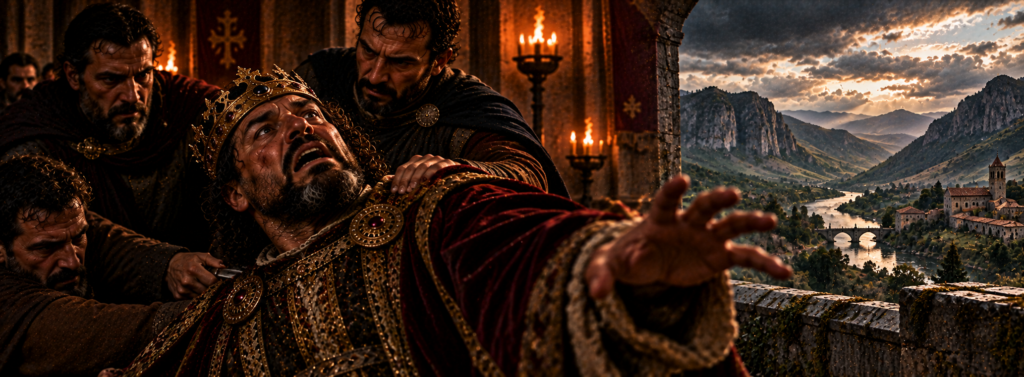
Alfonso V of León: The King Killed by an Arrow at the Siege of Viseu
Alfonso V of León (c. 994–1028) | King of León, 999–1028 | Known as Alfonso the Noble and Alfonso of the Good Laws | Son of Bermudo II and Elvira García of Castile | Husband of Elvira Menéndez and later Urraca of Pamplona | Father of Bermudo III and Sancha of León | Remembered for rebuilding León and establishing the Fuero de León | Killed by an arrow during the siege of Viseu in 1028.
The Arrow That Ended a King’s Reign
On 7 August 1028, the king of León died beneath the defenses of a city he had come to conquer. Alfonso V had spent almost three decades restoring a kingdom devastated by invasion, political instability, and the collapse of royal authority. He had rebuilt his capital, strengthened his government, and helped establish laws that would influence the development of medieval León. Yet his reign ended not in the security of a royal palace, surrounded by courtiers and clergy, but during a military campaign against the Muslim-held city of Viseu.
The traditional account of his death contains a particularly cruel detail. According to later historical narratives, the summer heat was so oppressive that Alfonso had removed part of his protective armor while inspecting the siege. An arrow fired from the city’s defenses struck the exposed king, inflicting the wound that killed him. The man who had survived childhood amid the devastation of his father’s kingdom was brought down by a single missile.
The essential event is well established: Alfonso V died from an arrow wound during the siege of Viseu in 1028. The precise circumstances are less certain, particularly the popular claim that he deliberately removed his armor because of the heat. The surviving medieval accounts do not establish the identity of the archer, and they do not prove that the king was specifically selected as a target rather than struck during the ordinary violence of the siege. His death is therefore best understood as a fatal battlefield shooting, not a conclusively documented assassination plot.
That distinction does not make the episode any less dramatic. Alfonso was a reigning monarch commanding an army against a fortified enemy position, and his death immediately changed the political future of his kingdom. The arrow removed an experienced ruler at a moment when León was still recovering from decades of upheaval. His successor, Bermudo III, was only a child, and the kingdom would soon face another period of dangerous instability.
The location of Alfonso’s death added another layer of significance. Viseu stood within the contested territories of western Iberia, where Christian and Muslim rulers had struggled for control over cities, fortresses, and agricultural lands. The campaign represented the continuing effort to recover territory lost during the devastating wars of the previous generation. Alfonso had come to extend his authority, but the expedition ended with his own life extinguished.
The king’s death also exposed the vulnerability of medieval military leadership. A monarch was expected to demonstrate courage and command his soldiers, yet appearing near the fighting placed him within reach of enemy weapons. Fortified cities offered defenders opportunities to attack commanders who approached too closely. Even the most powerful ruler could become an exposed figure beneath the walls of an enemy stronghold.
Alfonso’s story is especially compelling because his death interrupted a reign devoted to reconstruction. He was not merely another warrior king seeking territory. He had inherited a monarchy weakened by repeated invasions and had worked to restore its institutions, settlements, and prestige. The arrow at Viseu ended a career that had helped rebuild León from the devastation of the late tenth century.
A Kingdom That Had Almost Been Destroyed
To understand Alfonso’s reign, it is necessary to return to the crisis that preceded his birth. During the final decades of the tenth century, the kingdom of León faced an exceptionally dangerous enemy in the armies of the Umayyad state of al-Andalus. The military leader known as Almanzor, or al-Mansur, directed repeated campaigns against Christian territories. His expeditions devastated towns, attacked fortresses, and undermined the prestige of northern rulers.
León was among the cities that suffered during this period. Almanzor’s campaigns demonstrated the ability of the Cordoban government to penetrate deep into Christian territory. The attacks damaged settlements and religious institutions while disrupting agricultural and political life. The kingdom’s rulers struggled to respond effectively to an enemy possessing substantial military resources.
The consequences extended beyond immediate destruction. A devastated city could lose inhabitants, economic activity, and the administrative structures necessary for government. Monasteries and churches might suffer damage or lose valuable property. Aristocratic families could exploit the resulting instability to increase their own independence.
The monarchy itself was weakened by internal disputes. Powerful counts exercised considerable authority in Castile, Galicia, and other regions. Their cooperation was essential for military defense, but their interests did not always coincide with those of the king. External invasion therefore aggravated political divisions that already threatened royal authority.
Alfonso’s father, Bermudo II, inherited many of these problems. His reign was marked by conflict with aristocratic rivals and repeated Muslim campaigns. Although he attempted to preserve royal authority, he could not prevent the devastation of important territories. His death in 999 left the kingdom facing an uncertain future.
The child who succeeded him would inherit more than a crown. He would inherit damaged cities, powerful nobles, vulnerable frontiers, and the memory of military humiliation. His reign would become an attempt to reverse those losses. The work of reconstruction would define his historical reputation.
Bermudo II: The Father Who Left a Broken Kingdom
Bermudo II became king during a period of serious political instability. His rise was connected with aristocratic opposition to Ramiro III, whose authority had been challenged by powerful regional factions. Bermudo eventually established himself as ruler of León, but his position remained vulnerable. The kingdom’s internal divisions complicated its response to external threats.
Almanzor’s campaigns placed enormous pressure upon Bermudo’s government. Muslim forces attacked important settlements and demonstrated the weakness of Leonese defenses. The king struggled to maintain control over territories whose aristocratic leaders possessed considerable independence. His reign became associated with repeated military setbacks.
The destruction of León during this period was particularly significant. The city had emerged as the principal political center of the monarchy after the earlier Asturian period. Damage to its buildings and institutions threatened the symbolic foundations of royal authority. Recovering the capital would become an important task for Bermudo’s successor.
Bermudo’s political relationships were also complicated by marriage alliances. His second wife, Elvira García, belonged to the powerful comital family of Castile. Her father was García Fernández, an influential Castilian count. The marriage connected the royal dynasty to a family whose political ambitions could both support and challenge the monarchy.
Alfonso was born from this union, probably around 994. His ancestry therefore linked him to the Leonese royal family and the powerful aristocracy of Castile. Those connections would prove valuable during his minority. They would also place him within a complicated network of competing regional interests.
When Bermudo died in 999, Alfonso was approximately five years old. The kingdom faced the dangerous prospect of government under a child monarch. Powerful relatives and aristocrats would have to manage royal affairs until he was old enough to rule. The succession preserved the dynasty but created opportunities for political interference.
A Five-Year-Old King
Alfonso’s accession was extraordinary because of his youth. At approximately five years old, he could not personally command armies, negotiate complex political agreements, or administer the kingdom. His survival depended upon the loyalty and competence of the adults governing in his name. The monarchy therefore entered a regency at a moment of considerable danger.
His mother, Elvira García, played an important role in the early government. As a member of the Castilian comital family, she possessed influential relatives and political connections. Her position helped provide continuity after Bermudo’s death. Nevertheless, she operated within a political environment where aristocratic loyalties could change rapidly.
Another central figure was Menendo González, a powerful Galician count. He became Alfonso’s guardian and one of the principal administrators of the kingdom during the minority. The young king spent important years under his protection in Galicia. Menendo’s influence would shape Alfonso’s early political experience.
The regency faced difficult circumstances. Almanzor’s military power remained formidable, and Christian territories continued suffering attacks. Powerful regional aristocrats could exploit the absence of an adult monarch. The survival of the kingdom required careful diplomacy and the maintenance of political alliances.
Alfonso’s childhood therefore unfolded within a world of insecurity. He inherited the title of king before possessing the ability to exercise its responsibilities. His guardians had to preserve the monarchy while defending its territories. Their success would determine whether he eventually received a functioning kingdom or merely the remains of one.
The experience also demonstrated the importance of aristocratic support. Menendo González and other powerful nobles possessed resources that the crown needed. Their loyalty could protect the young king, but their influence also limited the independence of royal government. Alfonso would later have to govern within the political system that had sustained his childhood reign.
Menendo González: The Count Who Raised a King
Menendo González belonged to one of the most influential aristocratic families in the western territories of the kingdom. His family controlled extensive lands and maintained relationships with important religious institutions. These connections gave him considerable political authority. He was therefore well positioned to serve as guardian and protector of the young Alfonso.
The relationship between the count and the king appears to have been unusually close. Alfonso later remembered Menendo as a guardian and foster father, acknowledging the role he had played during the minority. Such language suggests that the relationship extended beyond ordinary political administration. The count helped shape the young ruler’s upbringing.
Menendo’s authority also reflected the importance of Galicia within the monarchy. The region possessed powerful aristocratic families whose support could determine the success of royal government. Alfonso’s residence there strengthened his connections with western noble networks. Those relationships would remain important throughout his reign.
The count’s influence was not necessarily uncontested. Other aristocrats possessed their own ambitions, and the monarchy remained vulnerable to regional disputes. Menendo had to protect the young king while managing political relationships across the kingdom. His position required both military resources and diplomatic skill.
Menendo died in 1008, bringing an important phase of the regency to an end. Alfonso was still young, but he increasingly assumed responsibility for government. The loss of his guardian removed a powerful protector. It also created an opportunity for the king to establish his own authority.
The relationship would continue through marriage. Alfonso eventually married Menendo’s daughter, Elvira Menéndez, strengthening the connection between the royal family and the count’s descendants. The alliance demonstrates how personal guardianship and dynastic politics could become closely intertwined. Menendo’s influence continued shaping the monarchy after his death.
Almanzor: The Enemy Who Haunted Alfonso’s Childhood
Almanzor dominated the military history of the Iberian Peninsula during the final decades of the tenth century. Acting as the effective ruler of the Umayyad state, he directed numerous campaigns against Christian territories. His armies attacked cities, fortresses, and religious centers. The devastation left a lasting impression upon the northern kingdoms.
His campaigns were not simply acts of destruction. They also served political purposes by demonstrating Cordoban military superiority and weakening Christian rulers. Victories could produce tribute, captives, and valuable resources. They also strengthened Almanzor’s prestige within al-Andalus.
For León, the consequences were severe. The kingdom suffered repeated invasions during Bermudo II’s reign. Its military defenses were weakened, and its political authority was challenged. The young Alfonso inherited a monarchy still struggling with the aftermath.
Almanzor died in 1002, only a few years after Alfonso’s accession. His death did not immediately end Muslim military pressure, but it marked the beginning of changes within the Cordoban political system. His son Abd al-Malik al-Muzaffar continued exercising substantial power. The northern kingdoms therefore remained vulnerable.
The eventual weakening of the Cordoban caliphate would create opportunities for Alfonso. Political conflict within al-Andalus reduced the ability of its rulers to maintain the same level of military pressure. Christian monarchs could exploit these divisions to strengthen their positions. Alfonso’s reign would benefit from this changing balance.
The contrast between his childhood and adulthood was significant. He had inherited a kingdom threatened by a powerful Muslim military state. As he matured, that state entered a period of internal crisis. The opportunity allowed him to pursue reconstruction and territorial recovery.
The Collapse of Córdoba and the Changing Balance of Power
The political order of al-Andalus began to fracture during the early eleventh century. After the deaths of Almanzor and his immediate successors, rival factions struggled for control of the Umayyad government. The resulting civil conflict, commonly known as the Fitna of al-Andalus, weakened the caliphate. Its authority became increasingly fragmented.
The crisis transformed the political landscape of Iberia. Muslim rulers who had previously commanded substantial resources now faced internal opposition. Regional leaders began asserting greater independence. The ability of Córdoba to direct coordinated campaigns against the Christian kingdoms declined.
For Alfonso, these developments created opportunities that had been unavailable to his father. The kingdom could devote greater attention to rebuilding settlements and strengthening internal administration. Military campaigns could be directed toward recovering territory. Diplomatic relationships with neighboring powers also became increasingly important.
The weakening of Córdoba did not mean that Muslim resistance disappeared. Local rulers and garrisons continued controlling important cities and fortresses. Frontier warfare remained dangerous, and Christian armies could still suffer defeats. The political fragmentation of al-Andalus created opportunities but did not guarantee success.
Alfonso’s government therefore operated within a changing military environment. The kingdom was no longer confronting the same unified power that had devastated it during Almanzor’s campaigns. Yet the frontier remained contested. The king’s later expedition against Viseu would demonstrate that local Muslim defenses could still inflict devastating losses.
The transformation also encouraged political ambition among Christian rulers. Territory lost during earlier campaigns could now become the object of renewed conquest. Alfonso’s efforts to strengthen León belonged to this broader process. His death at Viseu would occur during an attempt to extend royal authority into the contested western frontier.
Rebuilding León from the Ruins
One of Alfonso’s most important achievements was the reconstruction of León. The city had suffered severely during the campaigns of the late tenth century. Its recovery was essential for restoring the prestige and administrative effectiveness of the monarchy. A functioning capital provided a center for government, religious institutions, and economic activity.
Rebuilding involved more than repairing damaged walls. The city required inhabitants, markets, churches, and the institutions necessary for daily life. Royal support could encourage settlement and economic recovery. Alfonso’s government became associated with these efforts.
The king’s reputation as a restorer reflected the scale of the work. Later tradition remembered him as a ruler who repopulated León and helped revive its institutions. Such descriptions may emphasize royal initiative while overlooking the contributions of local communities and religious institutions. Nevertheless, his association with reconstruction is well established.
The rebuilding also possessed symbolic significance. León had become the principal political center of the monarchy, replacing the earlier importance of Oviedo. Restoring the city demonstrated that the dynasty had survived the devastation of Almanzor’s campaigns. The capital’s recovery became a visible expression of renewed royal authority.
Religious institutions played an important role in the process. Churches and monasteries possessed economic resources and relationships with surrounding communities. Royal patronage could strengthen these institutions while reinforcing the legitimacy of the monarchy. Alfonso’s government operated within this network of political and religious cooperation.
The work of reconstruction helps distinguish Alfonso from rulers remembered primarily for military conquest. His reign was concerned with restoring a damaged political society. The rebuilding of León represented an effort to create stability after years of destruction. His later death during a siege would interrupt that work.
Alfonso the Noble and the Good Laws
Alfonso acquired the reputation of a ruler concerned with law and government. He became known as Alfonso the Noble and Alfonso of the Good Laws, titles associated with his efforts to strengthen the kingdom’s institutions. His most important legal achievement was the Fuero de León. The collection of provisions became a landmark in the history of medieval Iberian law.
The Fuero de León is traditionally associated with an assembly held in 1017. Some aspects of its transmission and dating remain subjects of scholarly discussion. The surviving text reflects efforts to regulate legal relationships and establish principles affecting the kingdom and the city. It represents an important stage in the development of Leonese political institutions.
The provisions addressed matters involving property, judicial procedures, and the relationship between rulers and subjects. They also contained regulations relevant to urban life. Such measures helped create a framework for government in a society recovering from warfare and instability. Their significance extended beyond Alfonso’s lifetime.
The assembly associated with the Fuero included important political and ecclesiastical figures. This reflected the collaborative nature of medieval government, where kings relied upon bishops and aristocrats to implement decisions. Royal authority was exercised through negotiation as well as command. The legal reforms therefore reveal the institutional character of Alfonso’s reign.
The Fuero also contributed to the growing importance of León as a political and urban center. Legal privileges could encourage settlement and economic activity. They could also define obligations and protections for inhabitants. Such measures supported the broader reconstruction of the kingdom.
Alfonso’s legal reputation makes his death especially tragic. He was remembered not only as a military ruler but as a king who attempted to strengthen institutions. The arrow at Viseu ended a reign associated with the restoration of law and government. His achievements would outlive him, but their author would not survive the campaign.
The Marriage That Joined Crown and Aristocracy
Alfonso’s first marriage was to Elvira Menéndez, daughter of his former guardian Menendo González. The union connected the royal dynasty with one of the most influential aristocratic families in Galicia. Such marriages were central to medieval political strategy. They strengthened alliances and helped secure the cooperation of powerful regional families.
Elvira belonged to a family whose members had played important roles during Alfonso’s minority. Her father had protected and educated the young king. The marriage therefore reinforced an existing relationship between the monarchy and the western aristocracy. It also demonstrated the political value of personal connections formed during childhood.
The couple had children who would become central to the kingdom’s future. Their son Bermudo III would inherit the throne after Alfonso’s death. Their daughter Sancha would later marry Ferdinand, the future Ferdinand I of León. Through Sancha, Alfonso’s dynasty would become connected to major political transformations in the eleventh century.
Elvira’s role as queen was connected with royal patronage and the administration of the kingdom. Medieval queens could participate in donations, religious foundations, and political relationships. Their influence often depended upon family networks and personal circumstances. The surviving evidence does not permit every aspect of Elvira’s activities to be reconstructed.
The marriage also reflected the continuing importance of Galicia. Alfonso had been raised under the protection of a Galician count, and his wife came from the same powerful family. These connections strengthened the monarchy’s relationships with western territories. They also demonstrated the dependence of royal government upon aristocratic cooperation.
Elvira died before Alfonso, leaving him to arrange another marriage. Her death altered the dynastic relationships surrounding the throne. The king would subsequently marry into the royal family of Pamplona. That alliance would become important to the political circumstances following his death.
Urraca of Pamplona and a Dangerous New Alliance
After Elvira’s death, Alfonso married Urraca of Pamplona, a sister of Sancho III, often called Sancho the Great. The marriage connected León to one of the most powerful rulers in northern Iberia. Sancho III was expanding his influence through dynastic relationships and political intervention. His ambitions would eventually affect the future of the Leonese monarchy.
The marriage strengthened diplomatic connections between the two kingdoms. Royal unions could reduce conflict and create opportunities for cooperation. They also introduced new claims and obligations that might become politically significant. In a world where dynastic relationships shaped territorial authority, marriage could be as consequential as warfare.
Urraca’s position became especially important after Alfonso’s death. His son Bermudo III was still a child and required protection and political support. The young king’s relationship with the Pamplonese royal family would influence the balance of power. The alliance therefore had consequences beyond Alfonso’s lifetime.
The marriage also illustrates the complexity of northern Iberian politics. Christian kingdoms frequently cooperated against Muslim powers while competing among themselves. Family relationships could encourage alliances but did not eliminate territorial ambitions. The same ruler might be a relative and a political rival.
Sancho III’s growing power would become increasingly important during the final years of Alfonso’s reign. The Pamplonese king possessed extensive influence and strong connections with Castile. His ambitions would eventually intersect with the succession in León. Alfonso’s death would create an opportunity for those interests to expand.
The second marriage therefore belongs to the larger story of the kingdom’s vulnerability. Alfonso sought to strengthen his position through dynastic alliance. Yet the political consequences of that alliance were not entirely under his control. His death would leave a child king facing powerful relatives and neighboring rulers.
The Western Frontier and the Road to Viseu
The western territories of the Iberian Peninsula had long been contested between Christian and Muslim rulers. Cities such as Viseu possessed strategic importance because they controlled routes, agricultural lands, and regional networks. Their fortifications provided defensive advantages. Possession of such places could strengthen a ruler’s authority over surrounding territory.
Viseu lay in a region that had experienced repeated changes in political control. The campaigns of the late tenth century had altered the frontier and weakened Christian authority in several areas. Alfonso’s reign offered opportunities to recover lost positions. The city became an important objective within that broader struggle.
The campaign of 1028 therefore had political and military significance. Alfonso was attempting to extend his authority into a contested region. Capturing Viseu could strengthen the kingdom’s position and improve control over surrounding territories. The expedition belonged to the continuing process of frontier warfare.
The surviving evidence does not provide a complete account of the campaign’s planning. We do not know the exact size of Alfonso’s army or the full composition of its forces. The identities of all participating commanders are not securely preserved. Nor can the sequence of every military operation be reconstructed.
What is clear is that Alfonso personally accompanied the expedition. His presence reflected the expectation that medieval kings should participate in military leadership. A ruler who commanded troops could reinforce loyalty and demonstrate courage. Yet direct participation also exposed him to the dangers of battle.
The decision to besiege Viseu would prove fatal. The city remained defended by Muslim forces capable of resisting the attackers. Its walls provided protection for the garrison and opportunities to strike at exposed enemies. Alfonso’s death would demonstrate the continuing danger posed by fortified frontier settlements.
The Siege of Viseu
A medieval siege was a contest of endurance, resources, and military pressure. Attackers sought to isolate a fortified position, weaken its defenders, and create opportunities for surrender or assault. Defenders relied upon walls, supplies, and the ability to inflict casualties upon the besieging army. Even when one side possessed superior numbers, the outcome was not guaranteed.
Viseu’s defenses presented Alfonso with precisely such a challenge. The city could not simply be occupied without overcoming its garrison. The king’s forces had to maintain pressure while protecting themselves from attacks launched from the fortifications. The campaign required coordination and persistence.
The surviving sources provide limited information about the siege itself. They do not describe a complete sequence of assaults, negotiations, or siege-engine operations. The duration of the siege is also uncertain. The historical record focuses primarily upon the king’s death.
That limitation is important because later retellings sometimes present elaborate scenes of battle. They may describe specific formations, dramatic assaults, or detailed movements along the walls. Such accounts often reflect literary reconstruction rather than securely documented events. A responsible narrative must avoid treating them as established fact.
The essential circumstances remain dramatic enough. Alfonso was present during an active siege against a defended city. The garrison possessed missile weapons capable of reaching attackers near the fortifications. The king was struck by an arrow and died.
The siege therefore became one of the defining moments of his reign. Alfonso had come to Viseu as a conqueror seeking to recover territory. Instead, the city became the place of his death. The campaign ended with the loss of the monarch whose leadership had helped restore León.
The Summer Heat and the Missing Armor
One of the most familiar details surrounding Alfonso’s death concerns the summer heat. Later narratives describe the king removing part of his armor because the temperature made it uncomfortable to wear. The image is powerful because it suggests that a momentary decision exposed him to a fatal arrow. It also gives the story an element of tragic irony.
The claim must be treated cautiously. The surviving medieval accounts establish that Alfonso was killed by an arrow at Viseu, but the exact circumstances of his exposure are less securely documented. The detail about removing armor appears in later historical tradition. It should not be presented as an eyewitness account.
The practical difficulties of wearing armor in summer are nevertheless easy to understand. Military equipment could be heavy and uncomfortable, particularly during prolonged operations. Commanders might adjust their protection according to circumstances. Such decisions could increase vulnerability if enemy missiles remained within range.
Yet the historical record does not establish precisely what Alfonso was wearing when he was struck. We cannot identify the location of the wound with certainty or determine whether armor would have prevented it. The popular account offers a plausible explanation for his vulnerability. Plausibility, however, is not the same as documentation.
The story also reflects a broader medieval theme concerning the unpredictability of death. A ruler could survive major battles and political crises only to be killed during an apparently ordinary moment of military activity. The contrast between royal power and bodily vulnerability made such deaths memorable. Later writers naturally emphasized details that heightened the irony.
For Alfonso, the essential tragedy does not depend upon whether he removed his armor. He was a king participating in a siege, and an arrow from the defenders killed him. The weapon crossed the distance between the fortified city and the royal army. His reign ended because warfare placed even a monarch within reach of death.
The Arrow from the Walls
The fatal shot is the central event in the historical record of Alfonso’s death. During the siege of Viseu, an arrow struck the king and caused his death. The surviving tradition associates the missile with the Muslim defenders of the city. The identity of the person who fired it is unknown.
The lack of an identified archer is significant. Later accounts sometimes describe the shot as a deliberate assassination carried out by a Muslim marksman. Yet the sources do not establish that the archer recognized Alfonso or intentionally selected him as a target. The death occurred during an active military operation, where missiles could strike commanders and ordinary soldiers alike.
The distinction between battlefield killing and assassination matters historically. An assassination generally implies a deliberate attempt to eliminate a particular individual. A soldier firing upon enemy forces during a siege may kill a king without knowing his identity. Alfonso’s death could have involved deliberate targeting, but the surviving evidence does not prove it.
The shot nevertheless had extraordinary consequences. A single arrow removed the commander of the besieging army and the ruler of a major Christian kingdom. The defenders achieved an outcome far more significant than an ordinary casualty. The political effect was immediate, regardless of the archer’s intentions.
The surviving accounts do not describe the king’s final moments in detail. They do not preserve his words, the reactions of individual soldiers, or the precise sequence of events following the wound. Such details cannot responsibly be invented. The historical record gives us the fatal injury and the death that followed.
The absence of dramatic detail does not diminish the event. Alfonso had spent nearly thirty years as king and had become associated with the reconstruction of León. His government had survived the aftermath of Almanzor’s campaigns and strengthened the monarchy’s institutions. At Viseu, all of that experience was suddenly removed from the kingdom’s leadership.
7 August 1028: The Death of Alfonso V
Alfonso V died at Viseu in 1028, with 7 August commonly accepted as the date of his death. The date is preserved in historical and commemorative traditions associated with the king. His death occurred during the campaign against the Muslim-held city. The siege became the final event of his reign.
The king was approximately thirty-four years old, although his exact birth date remains uncertain. He had inherited the throne as a small child and spent most of his life as monarch. His reign therefore extended across nearly three decades despite his relatively young age. Few rulers of his generation experienced such a long period of nominal kingship.
His death was especially consequential because he left a young heir. Bermudo III was approximately eleven years old and could not immediately exercise the full responsibilities of government. The kingdom therefore faced another minority succession. Powerful aristocrats and royal relatives would become increasingly important.
The immediate military consequences of the king’s death are not described in complete detail. The surviving sources do not permit a full reconstruction of the army’s withdrawal or the decisions made by its commanders. The campaign’s central objective was not achieved through the king’s death. Viseu remained a contested frontier position.
The political consequences extended beyond the battlefield. Alfonso had provided continuity during a period of reconstruction and institutional development. His removal created uncertainty about the future direction of the monarchy. The young Bermudo inherited both his father’s achievements and the unresolved tensions of the kingdom.
The death also became an important element of Alfonso’s historical memory. Later chroniclers repeatedly associated him with the arrow at Viseu. His burial traditions preserved the circumstances of his death. The fatal shot became inseparable from the story of the king who rebuilt León.
What the Medieval Chronicles Actually Tell Us
The principal medieval narratives of Alfonso’s death were written after the event. The Historia Silense, also known in modern scholarship as the Historia Legionensis or Chronica Seminensis, preserves important material concerning the Leonese monarchy. Other chronicles and later historical traditions also record the king’s death at Viseu. Their accounts form the foundation of the surviving narrative.
The chronological distance between the event and some of the surviving texts requires caution. Chroniclers could rely upon earlier records, oral traditions, and institutional memory. They could also interpret events according to political and religious concerns. Their testimony must therefore be evaluated rather than accepted uncritically.
The central fact of Alfonso’s death at Viseu is supported by multiple traditions. His fatal arrow wound became part of the historical memory of the monarchy. The event was sufficiently important to appear in later accounts and commemorative material. There is little reason to doubt that he died during the siege.
The more elaborate details are less secure. The sources do not identify the archer or establish a deliberate assassination plot. The popular story about removing armor because of the heat belongs to the later narrative tradition. It may preserve an authentic memory, but its accuracy cannot be independently demonstrated.
The chronicles also reflect the importance of royal reputation. Alfonso was remembered as a restorer and legislator, making his sudden death particularly striking. His achievements encouraged later writers to present his reign as a period of recovery after devastation. The arrow at Viseu provided a dramatic ending to that narrative.
A historically responsible account must therefore distinguish between established event and later embellishment. Alfonso was killed by an arrow during the siege of Viseu. The exact circumstances of the shot remain uncertain. The story is powerful without claiming knowledge that the surviving sources do not provide.
The Body Returned to León
After his death, Alfonso’s remains were taken back to León. The return of the king’s body carried political and religious significance. Royal burial reinforced dynastic continuity and provided a place for commemoration. It also allowed the monarchy to honor a ruler whose reign had been closely associated with the city’s reconstruction.
Alfonso was buried in the royal religious complex associated with the church of Saint John the Baptist and San Pelayo. The site later became connected with the Basilica of San Isidoro of León. It developed into one of the most important royal burial places in the kingdom. The association linked Alfonso’s memory to the religious and dynastic history of León.
His burial beside his first wife Elvira Menéndez reflected the importance of their marriage and family connections. Elvira had belonged to the influential Galician aristocracy and was the mother of his principal heirs. Their union had strengthened the monarchy’s political relationships. The burial preserved that dynastic association.
The king’s epitaph remembered his achievements and the circumstances of his death. It associated him with the repopulation of León, the granting of good laws, and the rebuilding of religious structures. It also recorded that he had fought against Muslim forces and was killed by an arrow at Viseu. The inscription therefore connected his military death with his broader reputation as a restorer.
Such commemorative language should be understood as both historical testimony and royal praise. Epitaphs were intended to preserve the virtues and achievements of the deceased. They could emphasize favorable interpretations of a reign. Nevertheless, they provide valuable evidence of how Alfonso was remembered.
The burial transformed the dead king into a figure of dynastic memory. His body returned to the city he had helped rebuild. His name became associated with legal reform and reconstruction. The arrow at Viseu remained the final event in a reign remembered for restoring a damaged kingdom.
Bermudo III: A Child King in a Dangerous World
Bermudo III succeeded Alfonso V in 1028 while still a child. His accession preserved the hereditary line but created immediate political difficulties. A young king required guardians and advisers capable of managing powerful aristocrats. The monarchy therefore entered another period of regency government.
The circumstances resembled Alfonso’s own childhood accession in 999. Both father and son inherited the throne at an age when they could not personally exercise full authority. Both depended upon the cooperation of influential adults. The repetition demonstrated the vulnerability of hereditary monarchy when rulers died before their heirs reached maturity.
Bermudo inherited a kingdom stronger than the one Alfonso had received. León had been rebuilt, and royal institutions had been strengthened. The political balance of Iberia had also changed following the weakening of Córdoba. Yet the monarchy still faced serious external and internal challenges.
Sancho III of Pamplona possessed growing influence across northern Iberia. His family relationships connected him to León and Castile. The death of Alfonso created opportunities for political intervention. Bermudo’s minority made the kingdom particularly vulnerable.
The young king would eventually confront disputes involving Castile and the expanding influence of neighboring rulers. These conflicts reflected tensions that Alfonso had not fully resolved. His death removed an experienced monarch who might have managed them differently. The consequences would shape the next generation.
Bermudo’s reign would end violently in 1037 at the Battle of Tamarón. His death marked the end of the direct male line of the old Leonese royal dynasty. The throne would pass to Ferdinand I through his marriage to Sancha, Alfonso V’s daughter. The events following Viseu therefore contributed to a major dynastic transformation.
Sancha of León and the Future of the Dynasty
Alfonso’s daughter Sancha became one of the most important figures in the kingdom’s subsequent history. Her marriage to Ferdinand, son of Sancho III of Pamplona, connected the Leonese royal dynasty with the emerging power of Castile. The union would eventually influence the succession to León. Sancha’s royal ancestry provided an important foundation for Ferdinand’s claim.
The political circumstances surrounding the marriage were complicated. Relations between León, Castile, and Pamplona were shaped by competing territorial ambitions. Marriage alliances could reduce conflict while creating new claims. Sancha’s position therefore possessed significance beyond ordinary dynastic diplomacy.
After Bermudo III died in 1037, Ferdinand became king of León. His authority was strengthened through his marriage to Sancha. The transition marked an important change in the political organization of northern Iberia. The dynasty that Alfonso had represented continued through his daughter.
Sancha’s later career demonstrated the influence of royal women in preserving dynastic legitimacy. She participated in religious patronage and the political life of the monarchy. Her relationship with Ferdinand helped connect different ruling traditions. Through their descendants, Alfonso’s family remained central to Iberian history.
The long-term consequences of Alfonso’s death therefore extended beyond the immediate succession of Bermudo III. The loss of an experienced king contributed to the political circumstances in which neighboring dynasties increased their influence. His children inherited a kingdom facing powerful external pressures. Their lives would shape the future of León and Castile.
The arrow at Viseu thus became part of a much larger dynastic story. Alfonso’s death did not end his family’s importance. Instead, his descendants continued influencing the monarchy through marriage and succession. The political order he had helped rebuild would evolve in ways he could not have foreseen.
The King Who Rebuilt a City but Died Before Its Future Was Secure
Alfonso’s historical reputation rests heavily upon his role in rebuilding León. The city had suffered during the devastating campaigns of the late tenth century. Its recovery required political stability, economic resources, and royal support. Alfonso’s reign became associated with these efforts.
The Fuero de León strengthened his reputation as a legislator. Its provisions reflected attempts to regulate government and urban life. The legal tradition became an important part of the kingdom’s institutional development. Alfonso’s name remained connected with these reforms long after his death.
His military activities also formed part of the reconstruction process. Recovering territory could strengthen the kingdom’s resources and improve its strategic position. Frontier campaigns were therefore connected to broader political objectives. The expedition against Viseu belonged to this pattern.
Yet warfare also threatened the stability that reconstruction required. A king who personally led campaigns exposed himself to the possibility of sudden death. Alfonso’s presence at Viseu demonstrated his willingness to participate directly in military operations. The fatal arrow revealed the danger of that responsibility.
His death interrupted a reign that had achieved substantial recovery. The kingdom was no longer in the desperate condition it had faced during his childhood. Nevertheless, its political institutions remained vulnerable to succession crises. The loss of an experienced monarch created new uncertainty.
The tragedy lies in the contrast between achievement and vulnerability. Alfonso had survived the collapse of royal authority during his father’s reign and helped restore the kingdom. He had strengthened León’s institutions and pursued territorial recovery. Yet he could not protect himself from the ordinary dangers of siege warfare.
Was Alfonso V Assassinated?
Alfonso’s death is sometimes described as an assassination because an enemy arrow killed a reigning monarch. The description emphasizes the possibility that the archer deliberately targeted the king. However, the surviving evidence does not establish that intention. The event occurred during an active siege, making battlefield killing the more secure classification.
A deliberate assassination would require evidence that the attacker intended to eliminate Alfonso specifically. The chronicles do not identify the archer or preserve a plot against the king. They do not establish whether the shooter recognized his target. The fatal shot may have been aimed at an exposed commander, but that remains uncertain.
The distinction is important because medieval warfare frequently placed rulers within reach of enemy weapons. A king killed during battle or siege was not necessarily the victim of an assassination plot. The death could be deliberate in the ordinary military sense without being a targeted political murder. Alfonso’s case illustrates this difference.
The later story about his missing armor may encourage the impression of a carefully selected target. An exposed king would certainly have been vulnerable to enemy missiles. Yet the detail does not establish the archer’s intentions. It provides a possible explanation for the wound rather than proof of assassination.
Alfonso therefore belongs most securely among rulers killed in warfare. His death can still be examined within a broader category devoted to violent royal deaths and regicides. The episode demonstrates how a single act of violence could remove a monarch and alter a kingdom’s political future. Its significance does not depend upon proving a conspiracy.
A responsible historical account should preserve the uncertainty. Alfonso V was killed by an arrow during the siege of Viseu in 1028. The identity and intentions of the archer remain unknown. The event was a fatal military encounter whose consequences extended far beyond the battlefield.
The Fatal Vulnerability of Medieval Kings
Alfonso’s death illustrates the dangers faced by rulers who personally participated in warfare. Medieval kings were expected to demonstrate military leadership and courage. Their presence could inspire troops and reinforce loyalty. Yet it also exposed them to the same weapons that threatened ordinary soldiers.
Sieges were particularly dangerous because defenders possessed protected positions from which to attack exposed enemies. Archers could fire from walls and towers while remaining difficult to reach. Commanders approaching the fortifications risked being struck by missiles. The danger existed even when the besieging army possessed superior strength.
Royal armor could reduce some risks but could not eliminate them. Protective equipment varied according to period, resources, and circumstances. Even a well-equipped warrior remained vulnerable to certain wounds. The later tradition concerning Alfonso’s missing armor reflects awareness of these dangers.
The king’s death also demonstrates the unpredictability of military events. A campaign might be carefully planned and supported by substantial resources. Yet a single wound could transform its outcome. The loss of a commander could disrupt operations and create political uncertainty.
For Alfonso, the consequences were especially severe because his heir was a child. The kingdom required continuity at a moment when frontier warfare and aristocratic politics remained dangerous. His death removed the ruler who had guided reconstruction for nearly three decades. The succession therefore became a matter of immediate political importance.
The episode reminds us that royal authority did not provide physical invulnerability. A monarch could command armies and issue laws while remaining exposed to ordinary weapons. The arrow at Viseu reduced the distance between king and soldier to a single fatal moment. Alfonso’s power could not prevent the wound that ended his reign.
The Long Shadow of Viseu
The death of Alfonso V became an enduring part of Leonese historical memory. Chroniclers remembered the king as a restorer and legislator whose reign ended during a military campaign. His burial inscription preserved the connection between his achievements and his death. The event remained significant because it marked the sudden loss of a ruler associated with recovery.
The city of Viseu also retained its place in the story. It represented the contested frontier where Christian and Muslim forces struggled for control. The siege demonstrated that local Muslim defenses remained dangerous despite the weakening of the Cordoban caliphate. The king’s death became a reminder that territorial recovery was neither simple nor inevitable.
Later literary traditions elaborated upon the episode. Accounts of the king’s death developed dramatic details that emphasized the tragedy of the fatal arrow. Such narratives contributed to the popular memory of Alfonso. They also created difficulties for historians attempting to distinguish early testimony from later embellishment.
The story of the missing armor belongs to this process. It provides a vivid explanation for the king’s vulnerability and creates an image of a ruler exposed by the summer heat. Yet the surviving evidence does not establish every detail. The historian must preserve the distinction between memorable tradition and documented fact.
Alfonso’s broader achievements remained important. The reconstruction of León and the legal tradition associated with the Fuero continued shaping his reputation. His descendants influenced the political development of León and Castile. The king’s death did not erase the institutions he had helped strengthen.
The long shadow of Viseu therefore contains both tragedy and continuity. Alfonso died during an unfinished campaign, leaving a child to inherit his throne. Yet the kingdom he had rebuilt survived. His legacy continued through its institutions and through the descendants who would shape its future.
The King Who Rebuilt León and Died Beneath an Enemy Wall
Alfonso V inherited the throne at approximately five years old, when the kingdom of León was still suffering from the devastation of Almanzor’s campaigns. His father had struggled against invasion and aristocratic instability. The capital had been damaged, and royal authority remained fragile. The young king’s future depended upon the ability of his guardians to preserve the monarchy.
His mother Elvira García and the Galician count Menendo González played important roles during his minority. Their support helped maintain continuity through a dangerous period. Alfonso grew up within the political networks of the western aristocracy. Those relationships would shape his government and his marriage alliances.
The weakening of the Cordoban caliphate created opportunities for recovery. Alfonso’s reign became associated with the rebuilding of León and the restoration of royal institutions. The Fuero de León strengthened his reputation as a legislator. His achievements helped transform a damaged kingdom into a more stable political society.
Yet the monarchy remained exposed to military danger. Muslim-held cities and fortresses continued resisting Christian expansion. Frontier campaigns required armies, resources, and royal leadership. Alfonso’s decision to besiege Viseu belonged to this continuing struggle.
The campaign of 1028 brought the king to a fortified city whose defenders remained capable of inflicting serious losses. The surviving sources do not describe every stage of the siege. They do not identify the archer who fired the fatal shot. What they establish is that Alfonso was killed by an arrow during the operation.
Later tradition added the memorable detail that the king had removed part of his armor because of the summer heat. The story gives his death an especially tragic character, suggesting that a moment of exposure made him vulnerable. Yet the detail cannot be treated as certain. The historical record does not permit a complete reconstruction of his final moments.
The fatal arrow nevertheless ended a remarkable reign. Alfonso had spent nearly three decades as king, although much of his early rule occurred under guardianship. He had helped restore a kingdom devastated by invasion. His death removed an experienced monarch at a moment when stability remained essential.
His son Bermudo III inherited the throne while still a child. The succession preserved the dynasty but created new political vulnerabilities. Powerful neighboring rulers and aristocratic families would influence the kingdom’s future. The loss of Alfonso therefore had consequences extending far beyond Viseu.
The king’s remains returned to León, where his memory became associated with the city’s reconstruction and the development of its laws. His burial tradition preserved the circumstances of his death. The arrow at Viseu became part of the historical identity of a ruler remembered for restoring royal authority. His achievements and his violent end remained inseparable.
Alfonso’s death also illustrates the difference between assassination and battlefield killing. The arrow was fired during a siege, and the surviving sources do not establish a deliberate plot to eliminate him personally. His death was a violent military event rather than a securely documented political assassination. The distinction matters because historical accuracy requires more than a dramatic interpretation.
Yet the absence of a proven assassination plot does not diminish the tragedy. A reigning monarch was killed while attempting to extend his authority over contested territory. His death altered the succession and removed a central figure from the kingdom’s political life. The consequences were immediate and lasting.
Alfonso’s story is ultimately one of reconstruction interrupted by war. He inherited a kingdom weakened by devastation and worked to restore its capital, institutions, and prestige. He became remembered as a ruler of good laws and renewed authority. His final campaign demonstrated that the frontier remained dangerous despite those achievements.
The king who had survived the political dangers of childhood and the instability of a weakened monarchy died beneath the defenses of Viseu. His crown could not protect him from an arrow, and his achievements could not guarantee his survival. The city he had come to conquer became the place where his reign ended. Alfonso V left behind a restored capital, a vulnerable heir, and a legacy that would outlive the fatal shot.
His death remains a powerful reminder of the fragility of medieval kingship. Royal authority could command armies, rebuild cities, and establish laws, but it could not remove the dangers of warfare. The ruler who had helped restore León was killed during the very struggle to expand its power. In the end, Alfonso V’s greatest achievements belonged to the kingdom he left behind, while the arrow at Viseu marked the abrupt and violent end of the man who had helped make them possible.