
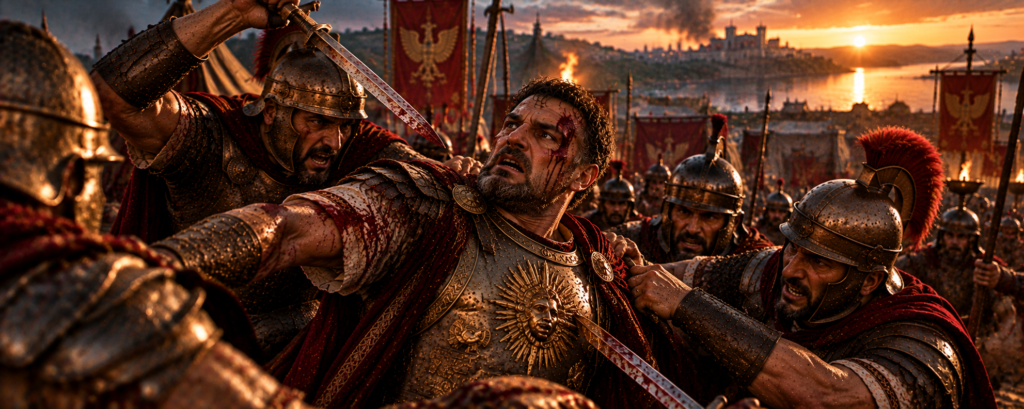
Probus: The Emperor Murdered by His Own Soldiers After Saving Rome From Its Enemies
Marcus Aurelius Probus (232–282 CE) | Roman Emperor, 276–282 CE | Murdered by Mutinous Soldiers at Sirmium, 282 CE
The Emperor Who Survived Rome’s Enemies but Not His Own Army
In the autumn of 282 CE, the Roman emperor Probus found himself surrounded by the very soldiers who had helped him restore order to an empire ravaged by decades of warfare. For six years, he had marched across the Roman world, defeating invading armies, crushing rebellions, rebuilding defenses, and imposing the discipline that had made his military victories possible. His reputation as a commander was formidable, and his achievements had brought a measure of stability to provinces that had endured years of devastation. Yet near Sirmium, the city where he had been born, the emperor’s authority collapsed in the face of a mutiny that would end with his own soldiers killing him.
The most dramatic ancient account describes an emperor who had ordered his troops to undertake exhausting construction and drainage work near the city. Probus believed that soldiers should remain useful even when they were not fighting, and he had repeatedly employed military manpower to improve roads, reclaim land, and strengthen provincial infrastructure. According to later tradition, the men assigned to drain marshes near Sirmium became increasingly resentful of their labor. Their anger eventually erupted into open rebellion, forcing the emperor to seek refuge in a fortified tower.
The soldiers pursued him, overwhelmed his refuge, and killed him. The precise circumstances remain uncertain, and the familiar story of the marsh-draining mutiny may simplify a more complicated political crisis involving the rival commander Carus. Nevertheless, the central fact is firmly established: Probus was murdered by his own troops in 282, ending a reign that had brought significant military recovery to the Roman Empire. His death was not the result of defeat by a foreign enemy or execution after a lawful judgment, but another violent intervention by soldiers who had decided that their emperor should no longer live.
The irony was particularly cruel because Probus had devoted his reign to restoring military discipline. He had inherited an empire in which armies frequently proclaimed rival emperors, abandoned commanders, and murdered rulers when their interests changed. He believed that strong leadership, constant activity, and uncompromising obedience were necessary to prevent Rome from descending into another period of chaos. His methods produced impressive results, but they also created tensions within the army upon which his authority depended.
Ancient writers remembered him as an exceptionally capable emperor whose achievements rivaled those of Aurelian, the ruler who had reunited the empire only a few years earlier. Probus had defeated Germanic invaders, suppressed usurpers in several provinces, and restored security to regions that had suffered repeated attacks. He had also encouraged agricultural development and used military labor for projects intended to benefit the wider population. His reign appeared to demonstrate that Rome could recover from the terrible instability of the third century.
Yet the soldiers who had followed him through years of campaigning eventually turned against him. Whether they were driven primarily by resentment over exhausting labor, fear of punishment, loyalty to Carus, or a combination of grievances remains disputed. The surviving sources preserve fragments of the story rather than a complete account of the conspiracy. What they reveal is the destruction of a successful emperor by the military institution that had elevated him.
Probus’s assassination was another chapter in the Crisis of the Third Century, but it was also a particularly revealing one. He was not a helpless ruler whose authority had collapsed through incompetence. He was an experienced soldier-emperor who had repeatedly demonstrated his ability to command armies and defeat dangerous enemies. His murder exposed a weakness that military success alone could not eliminate: Roman emperors depended upon armed men who could become their executioners.
Born in the Military Heartland of the Empire
Marcus Aurelius Probus was born in 232 CE, traditionally on August 19, in or near Sirmium, a major Roman city in the province of Pannonia Inferior. The city stood near the River Sava, in a region that connected the Danubian frontier with the wider Balkan provinces. Its strategic position made it an important center for military movement, administration, and imperial campaigns. Probus grew up in a landscape where the presence of soldiers was an ordinary feature of life.
His family background is uncertain. Later accounts identify his father as Maximus or Dalmatius and offer conflicting descriptions of the family’s status. Some traditions portray Probus as emerging from relatively modest circumstances, while others attempt to connect him with more distinguished ancestry. The evidence is insufficient to reconstruct his childhood in detail, but his subsequent career suggests that military service provided his principal route to advancement.
Sirmium was an appropriate birthplace for a future soldier-emperor. The Danubian provinces had become increasingly important as Rome struggled to defend its northern frontiers against Gothic, Sarmatian, and other groups. Military communities in the region produced experienced officers accustomed to constant campaigning. Several of the most important emperors of the later third century came from this wider Balkan and Danubian military world.
The city also occupied a place in Rome’s history of imperial warfare. Earlier emperors had used Sirmium and nearby centers as bases for operations along the Danube. Soldiers, officials, merchants, and civilian workers supported the military economy of the region. A young man growing up there would have been familiar with the importance of the army, even if the details of Probus’s personal upbringing remain unknown.
The year of his birth was itself a warning of the political world he would inherit. Emperor Alexander Severus still occupied the throne, but his government faced growing military dissatisfaction. Only three years later, Alexander and his mother Julia Mamaea would be murdered by mutinous troops near the German frontier. Their deaths marked the beginning of a period in which military violence repeatedly determined who ruled Rome.
Probus therefore came of age during an era when emperors were created and destroyed by armies. His future would be shaped by the same institution that had murdered Alexander Severus. Military service offered opportunities for extraordinary advancement, but it also exposed commanders to the dangers of mutiny and political ambition. The contradiction would define his life from beginning to end.
The Crisis That Turned Soldiers Into Kings
The decades following the murder of Alexander Severus were among the most unstable in Roman history. Emperors rose through military acclamation, fought rivals for control of the state, and frequently died through assassination or battlefield defeat. Foreign enemies exploited the disorder, crossing frontiers that had once seemed secure. The Roman Empire remained enormous, but its political foundations were repeatedly shaken.
Maximinus Thrax, the soldier-emperor who succeeded Alexander, was murdered by his troops during the siege of Aquileia in 238. That same year witnessed the brief reigns and violent deaths of several other emperors. Gordian III eventually emerged as ruler, but his reign ended during a Persian campaign in 244. Philip the Arab succeeded him and was later overthrown by Decius.
Decius died fighting the Goths at Abrittus in 251, while Trebonianus Gallus and his son Volusian were murdered by their own soldiers in 253. Aemilian then seized the throne but was killed by his troops after only a few months. Valerian became emperor and elevated his son Gallienus as co-ruler. The empire had entered a cycle in which military success could produce imperial authority, but military dissatisfaction could destroy it almost immediately.
The capture of Valerian by the Persians in 260 created an unprecedented catastrophe. Gallienus became the sole effective ruler while major western provinces broke away under Postumus. In the east, the powerful city of Palmyra developed an increasingly independent political position. The Roman world appeared to be fragmenting into competing governments.
Probus’s military career developed against this background of almost continuous emergency. A capable officer could gain experience fighting foreign enemies, suppressing rebellions, and organizing troops across threatened provinces. The army needed men who could maintain discipline and respond quickly to changing conditions. Probus eventually emerged as one of those commanders.
His later assassination cannot be understood without this history. Roman soldiers had become accustomed to exercising political power through their commanders. They could proclaim an emperor, demand rewards, abandon a ruler, or support a rival claimant. Probus would spend his reign attempting to control this dangerous military culture, only to become another victim of it.
The Young Officer Who Rose Through the Ranks
Ancient biographies describe Probus as an exceptionally capable young soldier who attracted the attention of his superiors. The Historia Augusta claims that he received military honors at an unusually early age and distinguished himself through repeated acts of bravery. It also preserves elaborate accounts of his promotions, rewards, and battlefield achievements. Unfortunately, many of these details cannot be independently verified.
The Historia Augusta is particularly unreliable for the later third century. Its author frequently invented letters, speeches, official documents, and colorful anecdotes. The biography of Probus contains material designed to portray him as an ideal military ruler. Such stories may preserve genuine traditions, but they cannot automatically be treated as factual records.
The broader outline of his career is more secure. Probus served in the Roman military and rose to senior command during the reigns of the soldier-emperors. His eventual selection as emperor suggests that he possessed considerable military prestige. Soldiers were unlikely to elevate an unknown or inexperienced commander during a major succession crisis.
His career probably exposed him to operations along the Danube and in other threatened regions. Roman commanders of the period needed experience with infantry, cavalry, siege warfare, and the logistical demands of long campaigns. They also had to understand the political dangers of military leadership. A general could win battles and still be destroyed if his soldiers became dissatisfied.
Probus developed a reputation for personal energy and strict discipline. Later writers praised his willingness to endure hardship and his insistence that soldiers remain active. These qualities would become central to his government. They also contributed to the circumstances surrounding his eventual death.
The young officer who rose through the army therefore embodied both the strengths and dangers of third-century military leadership. His ability to command soldiers brought him toward the imperial throne. His belief in relentless discipline would later make him a formidable ruler. Yet the same expectations could create resentment among troops who believed they had already sacrificed enough.
Aurelian and the Restoration of Roman Power
The political environment changed dramatically when Aurelian became emperor in 270. Aurelian inherited an empire fragmented by rebellion and threatened by foreign enemies. During his five-year reign, he defeated invading forces, recovered the eastern provinces from Palmyra, and restored the Gallic Empire to Roman control. His achievements earned him the title Restitutor Orbis, the Restorer of the World.
Probus is traditionally associated with the military leadership of this period. Later accounts describe him serving under Aurelian and receiving important commands. The precise details remain uncertain, but his rise fits the broader pattern of experienced officers advancing during the empire’s recovery. Aurelian’s campaigns required capable subordinates who could operate across distant provinces.
The restoration of Roman unity did not eliminate the danger of military rebellion. Aurelian himself was assassinated in 275 by officers within his own entourage. According to the traditional account, a secretary forged a list of men supposedly marked for execution, convincing frightened officers that they needed to kill the emperor first. The story illustrates how fear and distrust could destroy even a successful ruler.
Aurelian’s death left the empire without the commander who had restored its territorial integrity. His successor, Tacitus, ruled only briefly before dying in 276. Ancient sources disagree about the circumstances of Tacitus’s death, with some describing illness and others suggesting violence. His passing created another succession crisis.
Florianus, generally identified as Tacitus’s brother or close relative, claimed the throne. His authority was recognized by some military forces, but it was not universally accepted. In the eastern provinces, Probus emerged as a rival candidate. The Roman Empire once again faced the possibility of civil war.
The crisis demonstrated that Aurelian’s achievements had not solved the problem of succession. Rome possessed restored territories and capable armies, but it still lacked a reliable method of choosing emperors. Probus would gain the throne through this unstable system. Six years later, the same system would destroy him.
The Army Chooses Probus
In 276, Probus was proclaimed emperor by troops in the eastern provinces. Ancient accounts place his elevation within the military environment of Syria or the wider eastern command. The precise circumstances remain uncertain, but his supporters clearly regarded him as a capable alternative to Florianus. His military reputation became the foundation of his claim.
Florianus was unwilling to surrender the throne. The rival emperors prepared for confrontation, and their forces moved toward one another in Asia Minor. Ancient writers describe the struggle as influenced by differences in military strength, climate, and the endurance of the opposing armies. The details are not entirely secure, but Probus appears to have gained the advantage without requiring a prolonged decisive battle.
Florianus’s soldiers eventually turned against him. He was killed after a reign lasting only a few months, removing the immediate obstacle to Probus’s accession. The circumstances resemble many other third-century successions in which troops abandoned a ruler when they believed his position had become hopeless. Military loyalty remained conditional.
Probus emerged as emperor without having inherited the throne through a stable dynastic arrangement. His authority depended upon military recognition and the acceptance of Roman political institutions. The Senate subsequently acknowledged his position. Yet the decisive events had occurred within the army.
The new emperor understood the danger of the system that had elevated him. Florianus had been destroyed by soldiers who no longer supported him. Aurelian had been murdered by officers who feared punishment. Gallienus had fallen to conspiracy during a military campaign.
Probus therefore began his reign with a lesson written in blood. Military success could bring him the throne, but it could not guarantee that he would remain there. He needed to maintain discipline, reward loyalty, and prevent rival commanders from gathering sufficient support to challenge him. His reign would become a continuous struggle to balance these demands.
The Emperor Who Refused to Remain in Rome
Probus inherited an empire that was more united than it had been under Gallienus, but it remained threatened by foreign enemies and internal instability. Aurelian’s victories had restored central authority, yet the frontiers still required constant attention. Germanic groups continued raiding western provinces, while unrest persisted in other regions. The new emperor could not govern effectively by remaining in Rome.
His reign was therefore dominated by travel and military campaigning. Probus moved between threatened provinces, supervising operations and responding to emergencies. Ancient writers emphasized his extraordinary energy and willingness to endure the hardships of military life. His government resembled a moving military headquarters rather than a court permanently established in the capital.
The emperor’s personal presence mattered because Roman armies often expected their rulers to lead campaigns directly. A successful commander could inspire loyalty through shared hardship and victory. Yet prolonged campaigning also exposed him to the dangers of military dissatisfaction. Soldiers who lived under constant discipline could become resentful of a ruler who demanded too much.
Probus attempted to maintain control through a combination of military success and strict expectations. He rewarded effective service but insisted that troops remain obedient. His campaigns required substantial logistical organization, including supplies, transportation, and the repair of damaged infrastructure. Military labor became an important part of this effort.
His approach reflected the needs of the empire. Roads had been damaged, fortifications neglected, and agricultural communities devastated by repeated invasions. Soldiers could help restore these resources when they were not fighting. Probus regarded such work as part of their responsibility to the state.
Yet the distinction between useful labor and excessive demands was not always clear to the men carrying out the orders. Soldiers who had endured years of warfare might resent being assigned to draining marshes or constructing roads. Probus believed that constant activity strengthened discipline. Some of his troops eventually appear to have reached a very different conclusion.
The Devastated Provinces of Gaul
One of Probus’s most important achievements was the restoration of security in Gaul. The region had suffered repeated Germanic invasions and political instability during the third-century crisis. Although Aurelian had recovered the Gallic provinces from the breakaway empire, the frontier remained vulnerable. Raiding groups continued crossing the Rhine and threatening Roman settlements.
The destruction was not confined to isolated military posts. Agricultural communities, towns, and trade routes could all suffer when invading forces penetrated Roman territory. Families might abandon farms, merchants could lose access to markets, and local governments struggled to maintain public services. The cumulative effects weakened the region’s economy and population.
Probus launched major campaigns against Germanic groups operating in and around Gaul. Ancient accounts associate his victories with the Franks, Alamanni, and other peoples along the Rhine frontier. The terminology is sometimes imprecise, and the scale of individual operations remains difficult to reconstruct. Nevertheless, the campaigns appear to have achieved substantial success.
The emperor’s forces defeated invading groups and pushed Roman military activity beyond the Rhine in some areas. He sought to prevent future raids by demonstrating that Roman armies could still strike across the frontier. His victories restored confidence in the central government’s ability to defend the provinces. They also strengthened his reputation as a successful military ruler.
Ancient writers praised Probus for recovering territories that had been devastated by foreign enemies. Eutropius, writing in the fourth century, described his achievements in Gaul as particularly impressive. The praise is significant because Probus’s reign was relatively brief. His western campaigns nevertheless left a strong impression upon later historians.
The restoration of Gaul also served an important political purpose. The region had only recently returned to central imperial authority after years under the Gallic Empire. Successful defense helped demonstrate that reunification offered practical benefits. Probus was not merely claiming authority over the provinces; he was attempting to protect them.
The Rhine Campaigns and the Return of Roman Confidence
Probus’s operations along the Rhine were intended to restore the frontier’s effectiveness after years of disruption. The river had long served as a major boundary between Roman provinces and territories beyond direct imperial administration. Fortifications, roads, and military bases supported its defense. Repeated invasions had exposed weaknesses in that system.
The emperor responded with aggressive campaigning and reconstruction. Ancient accounts describe victories over Germanic forces and the restoration of military installations. Some traditions claim that he defeated enormous numbers of enemies, but such figures should be treated cautiously. Roman writers frequently exaggerated casualties to celebrate imperial success.
Probus also appears to have used diplomatic arrangements and settlements to strengthen frontier security. Captured or surrendered groups could be relocated, incorporated into military service, or placed under obligations to Rome. Such policies were not entirely new, but they became increasingly important during the third century. The empire needed manpower as well as battlefield victories.
The emperor’s strategy combined punishment with practical reconstruction. Defeating raiders could provide temporary relief, but preventing future attacks required stronger defenses and reliable local support. Roads and fortifications allowed troops to move more effectively. Agricultural recovery helped sustain the military presence.
These achievements contributed to the restoration of Roman confidence. Provinces that had experienced years of insecurity could again expect imperial protection. Probus’s victories demonstrated that the army remained capable of offensive operations. His military reputation grew accordingly.
Yet success also increased the demands placed upon his soldiers. Campaigns beyond the Rhine required endurance, discipline, and logistical effort. Rebuilding defenses after battle meant additional labor rather than immediate rest. The emperor’s expectations remained relentless even when the enemy had been defeated.
Soldiers, Settlers, and the Reconstruction of the Frontier
Probus understood that military victories alone could not restore devastated provinces. Communities needed people to cultivate land, maintain roads, and support local economies. Repeated invasions and warfare had disrupted settlement patterns across frontier regions. The emperor therefore encouraged measures intended to rebuild agricultural and military capacity.
Ancient sources describe the settlement of defeated or surrendered groups within Roman territory. These arrangements could provide agricultural labor and additional recruits for the army. They also allowed the government to supervise populations that might otherwise remain hostile beyond the frontier. The precise terms varied and are not always documented.
Such policies carried risks. Settled groups might retain their own leaders or cultural identities, and their loyalty could change under pressure. Roman authorities needed to balance the benefits of additional manpower against the possibility of future rebellion. Probus nevertheless recognized that the empire could not simply destroy every enemy it encountered. Incorporation could sometimes serve Rome better than continued warfare.
The use of soldiers for reconstruction reflected the same practical approach. Military manpower could repair roads, build defenses, and improve land that had been neglected during the crisis. These projects supported long-term security. They also kept troops occupied between campaigns.
Probus’s belief in productive military labor became one of the most distinctive features of his reign. Later writers praised him for making soldiers useful to the provinces. The policy presented the army as an instrument of recovery rather than merely destruction. It also reinforced the emperor’s reputation for demanding discipline.
The difficulty was that soldiers did not necessarily share his enthusiasm. Men who expected military rewards and periods of rest might resent being assigned to civilian construction projects. The tension between imperial reconstruction and military expectations would eventually become central to the traditional explanation of his assassination.
The Emperor Who Planted Vineyards With His Soldiers
One of the most memorable traditions associated with Probus concerns his encouragement of viticulture. Ancient writers credit him with permitting or promoting vineyard cultivation in regions where restrictions had previously limited production. Eutropius specifically mentions Gaul and Pannonia. The emperor’s policies became associated with the expansion of wine production in parts of the Roman world.
The historical details require caution. The idea that Probus single-handedly introduced vineyards to entire regions is an exaggeration, since wine production existed in many areas before his reign. Earlier restrictions and their enforcement are also difficult to reconstruct. Nevertheless, the tradition reflects a genuine association between Probus and agricultural development.
Eutropius describes soldiers being employed to plant vineyards near Sirmium and in Upper Moesia. The projects were intended to improve provincial land and provide lasting economic benefits. Such work fitted Probus’s broader belief that the army should contribute to reconstruction during periods without active campaigning. It also connected his government with the recovery of regions damaged by war.
The use of military labor for agriculture was not inherently unusual in Roman history. Soldiers had long built roads, bridges, forts, and other infrastructure. Yet Probus appears to have emphasized such activities particularly strongly. His reign became remembered for the idea that soldiers should never remain idle.
The policy also carried a symbolic message. An army that had spent years fighting invaders could help transform devastated land into productive countryside. Vineyards represented stability, settlement, and the return of ordinary economic life. The emperor’s military victories were therefore linked to a vision of peaceful recovery.
Yet the same projects that later writers praised may have contributed to resentment among his troops. Soldiers who had survived difficult campaigns might not welcome orders to perform exhausting agricultural labor. The emperor saw productive work as a duty. Some of his men may have regarded it as an intolerable burden.
The Campaigns Beyond the Rhine
Probus’s military ambitions extended beyond simply defending Roman territory. Ancient accounts describe operations across the Rhine intended to punish hostile groups and discourage future invasions. These campaigns reflected a long Roman tradition of carrying war into enemy territory. The strategy aimed to prevent opponents from gathering strength near the frontier.
The emperor reportedly defeated several groups and imposed terms upon them. Some were required to provide hostages, surrender weapons, or supply recruits. The exact details of individual agreements remain uncertain. Later writers may have simplified a series of complex operations into a narrative of overwhelming Roman victory.
The campaigns nevertheless appear to have restored substantial security to the western provinces. Probus’s achievements were celebrated through imperial titles and coinage. His government presented him as a victorious commander who had brought peace through military strength. Such imagery was essential to maintaining legitimacy during the third century.
The emperor’s successes also demonstrated the continuing effectiveness of Roman military organization. Despite decades of civil war and invasion, the army could still conduct large operations across difficult terrain. Experienced commanders and disciplined troops remained capable of defeating formidable enemies. Probus benefited from the military recovery begun under Aurelian.
Yet these victories required enormous effort. Soldiers marched through hostile territory, maintained supply lines, and endured difficult conditions. Even successful campaigns could produce exhaustion and resentment. The emperor’s insistence upon further labor after battle may have intensified those pressures.
Probus appears to have believed that military discipline must remain constant regardless of circumstances. Victory did not justify idleness, and peace did not eliminate the need for useful work. His philosophy was practical from the perspective of imperial administration. From the perspective of exhausted soldiers, it could become increasingly oppressive.
The East Was Not Yet Secure
While Probus restored order in the western provinces, the eastern empire continued to face serious challenges. The region had experienced the rise and fall of Palmyra, Persian pressure, and repeated political instability. Aurelian’s victories had restored central authority, but local disturbances and frontier threats persisted. Probus needed to demonstrate that his government could defend the entire empire.
Ancient accounts associate his reign with campaigns against groups identified as Isaurians in Asia Minor. The mountainous regions of southern Anatolia had long presented difficulties for Roman administration. Local communities and armed bands could exploit difficult terrain to resist imperial authority. Suppressing such resistance required sustained military operations.
The sources describe a campaign against a leader named Lydius, who allegedly occupied a fortified position and resisted Roman forces. The story contains dramatic details that may have been embellished by later writers. Its broad setting reflects the challenges of maintaining authority in mountainous regions. Probus’s government appears to have conducted operations intended to restore control.
The emperor also faced disturbances in Egypt and the eastern desert regions. Ancient sources mention conflicts involving the Blemmyes, groups associated with territories south of Roman Egypt. Their activities threatened important routes and settlements. Roman military operations sought to restore security.
The precise chronology of these eastern campaigns remains uncertain. Ancient writers sometimes compress events or attribute victories to the emperor personally when they may have been achieved by subordinate commanders. Nevertheless, the evidence indicates that Probus’s government remained militarily active across several regions. His reign was not confined to the Rhine frontier.
The eastern operations reinforced his reputation as an emperor who responded energetically to threats. They also increased the demands placed upon the army. Probus needed soldiers capable of campaigning across enormous distances. His government depended upon maintaining their loyalty despite the burdens of constant service.
The Isaurian Resistance and the Siege of Cremna
One of the more dramatic episodes associated with Probus’s reign concerns the suppression of resistance in Isauria and neighboring regions of Asia Minor. Ancient accounts describe a leader named Lydius who gathered followers and established himself in a strongly defended position. The rugged landscape offered advantages to forces familiar with the terrain. Roman troops faced the difficult task of reducing fortified resistance.
The story is often associated with the city of Cremna, although the chronology and details require careful interpretation. Later archaeological work has identified evidence of siege activity at the site, supporting the broader historical reality of serious conflict in the region. The surviving literary narratives nevertheless contain dramatic embellishments. Individual incidents should not be treated as certain merely because they appear in ancient accounts.
The resistance reportedly involved careful use of defensive positions and attempts to withstand Roman pressure. Mountain warfare could be particularly demanding because supply routes were vulnerable and attackers struggled to bring large forces into confined terrain. Probus’s commanders needed persistence as well as battlefield skill. The campaign demonstrated that restoring imperial authority sometimes required prolonged operations against relatively small but determined opponents.
Ancient writers describe the eventual collapse of the resistance after the death of its leader. The precise circumstances remain uncertain, including stories involving betrayal and the intervention of a skilled archer. Such details may preserve genuine memories, but they also resemble familiar literary motifs. The broader outcome was the restoration of Roman control.
The campaign reveals another aspect of Probus’s reign. His government did not simply fight large foreign armies. It also confronted regional resistance, banditry, and local military challenges that threatened administration and communications. These operations were essential to restoring normal government.
For the soldiers involved, however, such campaigns could be exhausting and frustrating. Siege warfare required patience, labor, and constant vigilance. The emperor’s reputation for demanding discipline would have been reinforced by operations of this kind. His army remained active even when the enemy was not a great foreign power.
Egypt and the Southern Frontier
Egypt occupied a uniquely important position within the Roman Empire. Its agricultural production contributed substantially to the food supply of Rome and other major cities. The province also controlled routes connecting the Mediterranean world with regions farther south and east. Maintaining security there was therefore essential to imperial stability.
During Probus’s reign, Roman forces confronted threats associated with the Blemmyes and other groups operating near Egypt’s southern frontier. Ancient sources describe military successes and the restoration of order. The exact scale of the campaigns is difficult to determine. Nevertheless, the emperor’s government appears to have taken the disturbances seriously.
Egypt had already experienced political instability during the third-century crisis. The rise of Palmyra had temporarily altered control over the province, and repeated military struggles disrupted administration. Aurelian restored central authority, but the region still required careful supervision. Probus continued the effort to secure it.
The emperor’s military activity in Egypt contributed to his broader reputation as a restorer of peace. Victories in distant provinces demonstrated that the central government could still project power across the empire. They also reinforced the legitimacy of his rule. An emperor who defended Egypt protected one of Rome’s most valuable possessions.
Yet the campaigns added to the burdens carried by Roman soldiers. Men serving in Egypt faced different conditions from those stationed along the Rhine or Danube. Heat, distance, and unfamiliar terrain created logistical difficulties. Maintaining an effective army across such varied environments required considerable organization.
Probus’s government therefore depended upon a military system that was both flexible and disciplined. His success demonstrated the continuing strength of Roman institutions. His assassination would reveal how fragile that strength became when soldiers rejected their commander’s authority.
The Usurpers Who Challenged His Throne
Foreign enemies were not Probus’s only concern. Like many third-century emperors, he faced rival commanders who attempted to seize imperial authority. Ancient sources identify several usurpers during his reign, including Saturninus, Proculus, and Bonosus. Their rebellions reveal the continuing instability of military politics despite the empire’s territorial recovery.
The precise chronology and details of these uprisings remain uncertain. The Historia Augusta preserves colorful stories about the rebels, but many are unreliable or exaggerated. Some claims concerning their origins, personal lives, and deaths cannot be independently verified. Nevertheless, the existence of significant opposition to Probus is supported by broader historical evidence.
The rebellions were dangerous because they could divert military resources from frontier defense. An emperor who marched against a usurper might leave another province vulnerable to invasion. Rival claimants could also encourage foreign enemies to exploit the resulting disorder. Suppressing internal opposition was therefore essential to maintaining imperial security.
Probus responded with military force. His government defeated rival claimants and restored central authority in the affected regions. These successes strengthened his reputation as a capable ruler. They also demonstrated his willingness to confront challenges decisively.
Yet every suppressed rebellion could create new grievances. Officers associated with defeated claimants might fear punishment, while soldiers who had supported the wrong side could become resentful. The emperor needed to balance discipline with reconciliation. His reputation for severity made that task difficult.
The repeated emergence of usurpers also revealed that Rome’s political system remained unstable. Military success did not prevent ambitious commanders from seeking the throne. Probus could defeat individual rivals, but he could not eliminate the incentives that produced rebellion. His own death would ultimately follow the same pattern of military intervention in imperial politics.
Saturninus and the Rebellion in the East
Julius Saturninus is traditionally described as a commander who rebelled against Probus in the eastern provinces. Ancient accounts place his uprising around 280 or 281, although the chronology remains uncertain. He appears to have possessed sufficient military authority to attract supporters. His rebellion threatened the emperor’s control over an important region.
The Historia Augusta portrays Saturninus as a reluctant usurper who was pressured into accepting imperial power. The story includes dramatic claims about his fear of Probus and his expectation that rebellion would lead to disaster. Such details should be treated cautiously because they serve a clear literary purpose. They present Probus as a ruler whose reputation inspired both respect and terror.
The rebellion was suppressed, and Saturninus was killed. Ancient accounts suggest that soldiers may have acted against him before Probus could personally intervene. The precise circumstances remain uncertain. His death nevertheless removed another challenge to central imperial authority.
The episode illustrates the danger faced by provincial commanders. A successful general could become a focus for discontent even if he had not initially intended to rebel. Once proclaimed emperor, retreat could become difficult. The reigning ruler might regard him as a threat regardless of his original intentions.
Probus’s government survived the challenge, but the rebellion demonstrated that military loyalty remained divided. Officers and soldiers could still support alternative rulers when circumstances encouraged them. The emperor’s victories had not produced universal obedience. His authority required constant enforcement.
The story of Saturninus also foreshadows the final crisis of 282. Probus would eventually face another commander whose military support threatened his position. This time, however, the emperor would not survive long enough to suppress the challenge. The pattern that had destroyed his rivals would turn against him.
Proculus and Bonosus: Rebels on the Rhine
The western provinces also witnessed rebellions associated with Proculus and Bonosus. Ancient sources place their activities in or around the Rhine region, although the precise circumstances remain disputed. Both men appear in accounts of attempts to challenge Probus’s authority. Their stories became heavily embellished in later literature.
The Historia Augusta presents Proculus as a man of extraordinary physical strength and sexual excess. Such descriptions belong to the sensational traditions that make the source unreliable. They reveal more about the author’s literary interests than about the historical individual. The essential political fact is that Proculus was remembered as a rival claimant.
Bonosus is similarly surrounded by colorful anecdotes. Later writers describe him as an exceptional drinker and associate his rebellion with military failure or fear of punishment. These claims cannot be accepted without caution. The surviving evidence does not permit a confident reconstruction of his personality or motives.
Probus suppressed the western challenges and restored control. Ancient traditions describe Proculus being captured or betrayed and Bonosus dying after defeat. The exact circumstances remain uncertain. Their removal nevertheless strengthened the emperor’s position along the Rhine.
The rebellions demonstrate how quickly military authority could become political ambition. Commanders responsible for defending threatened provinces possessed troops and local influence. If they believed the central government was weak, they might attempt to seize the throne. Probus needed to prevent such challenges while maintaining enough autonomy for commanders to operate effectively.
His success against Proculus and Bonosus contributed to his reputation as a restorer of order. Yet the repeated need to suppress usurpers also placed additional strain upon his army. Soldiers were required to fight not only foreign enemies but fellow Romans. The exhaustion and resentment created by such conflicts could become politically dangerous.
The Triumph of 281
By 281, Probus had achieved a remarkable series of military successes. He had restored security in Gaul, strengthened the Rhine frontier, suppressed rebellions, and conducted operations in the eastern provinces. His government presented these achievements as evidence that the Roman world was recovering from decades of crisis. The emperor returned to Rome to celebrate his victories.
Ancient accounts describe a magnificent triumph featuring military displays, captured enemies, and public entertainment. The Historia Augusta preserves elaborate descriptions of the celebrations, including exotic animals and staged spectacles. Many details may be exaggerated, but the broader tradition of a major victory celebration is credible. Probus had strong reasons to display his achievements before the Roman population.
The triumph served several political purposes. It reinforced his legitimacy as emperor and demonstrated the benefits of military recovery. It also allowed the people of Rome to witness symbols of victory after years of fear and instability. The spectacle connected distant campaigns with the prestige of the capital.
Probus’s successes were especially significant because his predecessor Aurelian had already restored the empire’s territorial unity. Probus could now present himself as the ruler who secured that restoration. His campaigns helped prevent the recovered provinces from falling back into chaos. The continuity between the two reigns was important.
The triumph also marked a moment when Probus appeared to have overcome the greatest threats to his authority. Major foreign invasions had been defeated, and several usurpers had been eliminated. The empire remained vulnerable, but the immediate situation was more stable than it had been during the worst years of the crisis. The emperor could begin thinking about longer-term reconstruction.
Yet the celebration concealed the dangers that remained within the army. Soldiers had endured years of demanding campaigns and strict discipline. Their loyalty was essential to the emperor’s continued rule. Within approximately a year, that loyalty would collapse.
The Emperor Who Believed Soldiers Should Never Be Idle
Probus’s philosophy of military discipline was simple in principle but demanding in practice. He believed that soldiers should remain active even when they were not engaged in warfare. Idleness could encourage disorder, indiscipline, and political unrest. Productive labor offered a way to maintain obedience while benefiting the provinces.
Roman soldiers had long performed construction work. They built roads, bridges, forts, walls, and other infrastructure necessary for military operations. Probus expanded or emphasized this tradition through projects involving agriculture, drainage, and land improvement. His government used military manpower to support economic recovery.
Ancient writers generally praised the policy. Eutropius described Probus employing soldiers to plant vineyards and improve land. The Historia Augusta offered additional stories about construction and reclamation projects. Such accounts presented the emperor as a ruler who transformed military strength into civilian prosperity.
The policy made practical sense in an empire recovering from decades of devastation. Roads needed repair, agricultural land required cultivation, and defensive works had to be maintained. Soldiers possessed organization, tools, and manpower that could accomplish these tasks. Their labor could provide lasting benefits.
Yet the soldiers themselves might not have welcomed the arrangement. Military service was already dangerous and exhausting. Men who had fought repeated campaigns could expect rewards, rest, or opportunities for personal advancement. Being ordered to undertake difficult civilian labor might seem like an additional punishment.
The tension became particularly important during the final year of Probus’s reign. According to later tradition, his insistence upon using soldiers for land reclamation near Sirmium contributed directly to the mutiny that killed him. The story may simplify the political circumstances, but it reflects a genuine conflict between imperial expectations and military resentment.
The Famous Claim That Rome Would No Longer Need Soldiers
One of the most striking statements attributed to Probus concerns his hopes for a future without war. Eutropius reports that the emperor believed the empire might soon reach a condition in which soldiers would no longer be necessary. The sentiment was later repeated in different forms by other writers. It became central to the moral interpretation of his assassination.
The statement should not be treated as a securely recorded quotation from Probus. Ancient historians frequently attributed memorable remarks to rulers in order to summarize their character or policies. The wording may reflect later interpretation rather than an exact declaration. Nevertheless, it expresses an idea associated with his reign.
Probus had spent years defeating enemies and restoring security. It is plausible that he hoped sustained military success would eventually reduce the need for constant warfare. Such hopes were not entirely unrealistic after the recovery achieved under Aurelian and himself. The empire had survived a period that once threatened its existence.
Yet the idea could sound threatening to soldiers whose livelihoods depended upon military service. If peace reduced the need for armies, what would happen to the men who had fought to create it? Would they lose rewards, status, or employment? The surviving sources do not establish that Probus actually planned mass demobilization, but the possibility helps explain why later writers connected his words with military resentment.
The emperor’s use of soldiers for civilian labor may have reinforced such anxieties. Men who expected to fight might increasingly find themselves assigned to construction and agriculture. The distinction between military service and civilian work could appear to be changing. Some soldiers may have feared that their traditional privileges were being undermined.
The irony became central to the story of his death. Probus had supposedly hoped to create a world in which soldiers were no longer needed. Instead, soldiers killed him before that vision could be realized. The ancient tradition transformed his assassination into a warning about the dangers of demanding too much from an army.
Carus: The Commander Waiting in the Background
The final crisis of Probus’s reign involved the emergence of Marcus Aurelius Carus, a senior military commander who would become his successor. Carus possessed considerable experience and authority within the Roman military system. Ancient accounts associate him with important commands, including responsibility for troops in the western provinces. His position made him a potential rival.
The precise circumstances of Carus’s elevation remain uncertain. Some traditions describe his soldiers proclaiming him emperor while Probus was still alive. Others compress the sequence of events or emphasize the mutiny that killed Probus. The surviving evidence does not allow a complete reconstruction of the relationship between the two developments.
Carus’s military standing was significant because successful commanders could attract support independently of the reigning emperor. Soldiers might prefer a leader who offered greater rewards or appeared more sympathetic to their interests. Such calculations had repeatedly shaped Roman succession during the third century. Probus himself had benefited from military support against Florianus.
The possibility of a rival emperor created additional pressure upon Probus. He needed to maintain the loyalty of his troops while responding to any challenge from Carus. If soldiers believed that another commander had a stronger claim or offered better prospects, they might abandon him. The emperor’s authority remained dependent upon military calculations.
Ancient sources do not establish that Carus personally ordered Probus’s murder. It would therefore be misleading to portray him as the proven mastermind of the assassination. Nevertheless, his emergence as emperor was closely connected to the collapse of Probus’s regime. The mutiny occurred within a political environment where an alternative ruler was available.
The relationship between Carus’s proclamation and the soldiers’ resentment over labor remains one of the central uncertainties of the assassination. Both elements appear in the surviving tradition, but their exact interaction is unclear. The murder may have involved a combination of military dissatisfaction and political realignment. Probus’s death was therefore more complicated than a simple dispute over drainage work.
The Return to Sirmium
In 282, Probus returned to the region of Sirmium, the city traditionally identified as his birthplace. The location carried personal significance, but it was also strategically important. Sirmium stood within the Danubian military heartland and provided access to routes connecting the Balkan provinces with the wider empire. It was an appropriate center for organizing further military operations.
The emperor appears to have been preparing for additional campaigning, possibly including operations directed toward the eastern frontier. The precise objectives remain uncertain. His government had achieved considerable stability, but the empire still faced potential threats. Probus had not abandoned his role as an active military commander.
Ancient accounts describe him employing soldiers in extensive construction and drainage work near the city. The region contained marshy areas that could be reclaimed or improved through organized labor. Such projects fitted his broader policy of using military manpower for practical purposes. The work may have been intended to support agriculture, communications, or local infrastructure.
The tasks were physically demanding. Draining marshland required digging, moving earth, controlling water, and maintaining organized labor over extended periods. Soldiers who had endured years of campaigning might have regarded such work as an unwelcome burden. The emperor’s insistence upon discipline could intensify resentment.
The Historia Augusta presents the project as a direct cause of the mutiny. According to its account, Probus ordered soldiers to drain a marsh and perform extensive labor near Sirmium. Their anger grew until they rebelled against him. The story provides a vivid explanation for the assassination, but its details cannot be independently confirmed.
What is certain is that Probus was killed in the Sirmium region during a military uprising. The connection with exhausting labor is plausible but not beyond doubt. Political developments involving Carus may have been equally important. The emperor’s return to his homeland became the setting for the final collapse of his authority.
The Soldiers Who Had Finally Had Enough
The traditional account of the mutiny portrays soldiers driven to desperation by the demands of their commander. Probus had required them to fight repeated campaigns, maintain strict discipline, and undertake civilian construction projects. Near Sirmium, the burden allegedly became intolerable. The men who had obeyed him through years of warfare finally turned against him.
The surviving sources do not preserve a reliable account of the soldiers’ private discussions. We do not know whether they planned the uprising in advance or whether anger erupted suddenly. Nor can historians establish the exact number of participants. The narrative of a spontaneous rebellion may conceal a more organized political movement.
The presence of Carus as a rival claimant complicates the picture. Soldiers dissatisfied with Probus might have been more willing to rebel if they believed another emperor was already available. Military mutinies often involved calculations about future rewards and political survival. The troops may have feared punishment if they remained loyal to a ruler whose position was weakening.
Nevertheless, resentment over labor should not be dismissed entirely. Probus’s policies placed heavy demands upon his soldiers, and ancient writers repeatedly associated him with relentless activity. His belief that troops should never remain idle could become unpopular among men expecting rest after years of campaigning. The tension was real even if the precise events remain uncertain.
The emperor’s reputation for discipline may also have discouraged compromise. Soldiers who believed their grievances would be punished might resort to violence rather than negotiation. A ruler who demanded unquestioning obedience could find it difficult to recognize growing resentment. The same authority that maintained order could prevent dissatisfaction from being expressed peacefully.
By the time the mutiny erupted, Probus’s position had become dangerous. The men responsible for protecting him were no longer willing to obey. His military victories offered little protection once the soldiers surrounding him decided to act. The emperor who had defeated so many enemies faced a rebellion within his own army.
The Tower Where the Emperor Tried to Escape
The most dramatic account of Probus’s final moments describes him seeking refuge in a fortified tower near Sirmium. Eutropius states that the emperor was killed in an iron tower during a military uprising. The Historia Augusta also preserves a tradition involving his retreat to a tower after soldiers rebelled. The precise nature of the structure remains uncertain.
The image is striking because it reverses the normal relationship between emperor and army. Probus had spent years commanding soldiers in battle, directing their movements, and demanding obedience. Now he was attempting to escape from those same men. The commander had become the hunted.
The sources do not provide a reliable account of every movement during the attack. We cannot know precisely how many soldiers pursued him, what weapons they carried, or how long the confrontation lasted. The tower story may preserve a genuine memory, but its details are too limited for a complete reconstruction. Inventing a dramatic siege would obscure rather than clarify the evidence.
What remains clear is that Probus could not rely upon his own troops for protection. Once the mutiny began, the emperor’s formal authority ceased to matter. The soldiers possessed the weapons and numerical strength necessary to overwhelm him. His personal courage and military experience could not reverse the collapse of loyalty.
The location added a bitter irony. Probus was killed near the city where he had been born, in the military heartland that had produced so many successful Roman commanders. He had traveled across the empire defeating enemies and restoring order. His final danger came not from a distant frontier but from soldiers gathered in his homeland.
The tower became a symbol of the fragility of imperial power. An emperor who commanded armies and governed provinces could be reduced to seeking shelter from his own men. The structure offered temporary refuge but no lasting protection. Probus’s reign ended when the soldiers reached him.
The Murder of Probus
Probus was killed in 282 CE, probably in September or October, after ruling for approximately six years. His death occurred during a mutiny among his soldiers near Sirmium. Ancient sources agree upon the essential fact of military murder, although they differ over the precise circumstances. The assassination ended one of the most successful reigns of the late third century.
The emperor was not killed by a foreign enemy. He had survived campaigns against Germanic groups, eastern resistance, and multiple Roman usurpers. His military record demonstrated considerable skill and endurance. Yet none of those achievements could protect him once his own troops turned against him.
The immediate cause of the mutiny remains debated. The traditional explanation emphasizes resentment over exhausting labor, particularly the drainage of marshes near Sirmium. Other evidence suggests that the political challenge posed by Carus was important. The two explanations are not necessarily mutually exclusive.
The surviving accounts do not establish the identity of the soldier who delivered the fatal blow. Nor do they preserve a reliable description of Probus’s final words. Later writers sometimes constructed moral lessons around imperial deaths, but such embellishments should not be confused with documented events. The assassination is sufficiently significant without invented dialogue.
The murder was an act of military regicide in the broader sense of the deliberate killing of a reigning sovereign. Probus was removed by armed men who had previously served under his authority. Their actions destroyed the government that had directed them through years of successful campaigning. The army once again determined the fate of the Roman throne.
His death also revealed the limits of military discipline. Probus had demanded obedience because he believed it was necessary for Rome’s survival. Yet discipline imposed without sufficient loyalty could collapse into rebellion. The emperor’s greatest instrument of power became the means of his destruction.
Did the Soldiers Regret Killing Him?
Later accounts suggest that the soldiers who killed Probus eventually regretted their actions. The Historia Augusta describes remorse and the erection of a monument honoring the dead emperor. Such stories fit a familiar literary pattern in which soldiers recognize the value of a ruler only after murdering him. The details cannot be independently verified.
Nevertheless, the tradition reflects the favorable reputation Probus acquired among later historians. Eutropius praised his military achievements, energy, and justice. Other writers regarded him as one of the most capable emperors of the period. His assassination was remembered as a loss to the Roman state.
The idea of remorse also emphasizes the contradiction between immediate resentment and long-term judgment. Soldiers might have hated exhausting labor or feared punishment while Probus was alive. After his death, they could recognize that his leadership had brought victories and stability. The benefits of his government may have become clearer once he was gone.
Yet it would be misleading to assume that every participant regretted the murder. Some soldiers may have welcomed Carus as emperor. Others may have believed that Probus’s demands had become intolerable. The surviving sources do not preserve the full range of opinions within the army. Later moralizing accounts simplify the complexity of military politics.
The alleged monument is also difficult to evaluate. Ancient writers sometimes invented inscriptions or memorials to reinforce their narratives. Without independent confirmation, the details remain uncertain. The broader tradition nevertheless demonstrates that Probus was not remembered simply as a tyrant whose death brought relief.
His assassination therefore acquired a tragic interpretation. A successful emperor had been destroyed by men who failed to appreciate his achievements. Whether that judgment accurately reflects the feelings of the soldiers is uncertain. It does reveal how later Roman writers understood the loss of a capable ruler.
Carus Takes the Throne
After Probus’s death, Carus became emperor. His accession was accepted by the military forces that had supported his claim, and the Roman state moved into another succession. The transition followed the familiar third-century pattern in which armed power determined political legitimacy. Probus’s murder cleared the way for a new ruler.
Carus was an experienced commander, and his government initially appeared capable of continuing the military recovery achieved by his predecessors. He elevated his sons Carinus and Numerian to positions of imperial authority. The arrangement was intended to provide dynastic continuity. Yet the family would soon experience its own violent and uncertain succession.
Carus launched a major campaign against the Sasanian Persian Empire. His forces achieved important successes and advanced into Mesopotamia. Ancient accounts describe the capture of major Persian cities, including Ctesiphon. The campaign demonstrated that Roman military power remained formidable.
The emperor died in 283 under uncertain circumstances. Later traditions famously claimed that he was struck by lightning, but the evidence does not establish that explanation securely. His death interrupted the eastern campaign. Once again, a successful Roman military ruler disappeared before consolidating his achievements.
Carinus and Numerian continued as emperors, but their government soon faced further instability. Numerian died under suspicious circumstances, and Diocletian emerged as a rival claimant. Carinus was eventually killed during the struggle for power in 285. The cycle of military succession continued.
Probus’s assassination therefore did not solve the problems that had troubled his army. It replaced one capable emperor with another military ruler whose dynasty would also collapse. The Roman Empire remained vulnerable to sudden changes of leadership. Only later reforms would attempt more systematic solutions.
The Emperor Who Tried to Turn Soldiers Into Builders
One of Probus’s most distinctive legacies was his use of military labor for reconstruction. His government employed soldiers in projects intended to improve agriculture, infrastructure, and provincial security. These activities reflected the practical needs of an empire recovering from decades of devastation. Roads, vineyards, drainage systems, and fortifications all contributed to stability.
The policy was not entirely new. Roman soldiers had long built infrastructure as part of their duties. What distinguished Probus was the emphasis later writers placed upon his insistence that troops remain constantly productive. His reign became associated with the belief that military manpower should benefit civilian society whenever possible.
The projects could provide lasting advantages. Improved roads allowed armies and merchants to move more efficiently. Reclaimed land increased agricultural production. Vineyards and other cultivation supported local economies. The emperor’s military authority therefore became an instrument of economic recovery.
Yet the policy also exposed a conflict between the interests of the state and those of individual soldiers. The government benefited from organized labor, but the men performing it might experience exhaustion and resentment. Military service already involved danger and hardship. Additional work could appear excessive.
The traditional explanation of Probus’s death turns this conflict into the central tragedy of his reign. He was killed because he demanded useful labor from soldiers who no longer wished to obey. The story may be simplified, but it captures an important tension. A ruler could pursue policies beneficial to the empire while alienating the army that made those policies possible.
His assassination therefore raises questions about the limits of military authority. Probus believed that discipline and productivity were essential to recovery. His soldiers apparently reached a point where obedience collapsed. The result was not negotiation or reform but murder.
Was Probus Too Demanding?
Probus’s reputation for relentless discipline invites comparison with Aurelian, who had also been murdered by men within his military command. Both emperors were successful soldiers who restored order after periods of instability. Both demanded obedience and imposed severe expectations upon their troops. Both died through military betrayal rather than defeat by foreign enemies.
Yet their assassinations differed in important respects. Aurelian was reportedly killed after officers believed a forged execution list. Probus was traditionally murdered after soldiers rebelled against exhausting labor, possibly amid a political challenge from Carus. The immediate circumstances were different, but both deaths exposed the dangers of military resentment. Their authority depended upon men who could turn against them.
It would be simplistic to conclude that Probus was merely cruel or unreasonable. The empire genuinely needed reconstruction, and military labor could provide enormous benefits. His policies reflected a practical understanding of the relationship between security and economic recovery. He was attempting to rebuild a state damaged by decades of warfare.
Nevertheless, successful leadership required more than issuing useful orders. Soldiers needed to believe that their sacrifices were recognized and that their commanders understood their limits. Probus’s insistence upon constant activity may have weakened that relationship. His achievements could not guarantee affection or loyalty.
The emperor also faced political pressures beyond labor disputes. Carus’s emergence as a rival claimant may have encouraged soldiers to reconsider their allegiance. Men who were already dissatisfied could find an alternative leader attractive. Military mutiny often resulted from several overlapping causes rather than one grievance.
Probus’s death therefore should not be reduced to a simple moral lesson about overworking soldiers. It was the result of a political system in which military loyalty remained unstable. His demanding leadership may have contributed to the crisis, but the broader problem was the army’s power to determine who ruled. The emperor became another victim of that system.
The Personal Life History Barely Preserved
Despite the detailed accounts of his military achievements, remarkably little is known about Probus’s private life. Ancient sources provide limited reliable information about his family relationships, marriage, or children. Later biographies contain claims about his ancestry and personal character, but many cannot be verified. The emperor remains far more visible as a commander than as a husband, father, or private individual.
This absence reflects the nature of surviving third-century evidence. Political histories focused heavily upon military campaigns, succession crises, and imperial deaths. Private relationships were often mentioned only when they influenced political events. A ruler without a prominent dynastic household could leave relatively little personal information behind.
Probus’s lack of a clearly established successor became important after his assassination. Unlike Carus, who elevated his sons, Probus did not leave behind an obvious dynastic arrangement that could secure the throne. The army therefore remained the decisive institution in determining who would rule next. His death created an opportunity for Carus.
The absence of detailed family information should not encourage invention. There is no reliable basis for constructing elaborate marital scandals, secret romances, or dramatic domestic conflicts. His personal experiences remain largely unknown. Historical accuracy requires acknowledging those gaps.
What can be reconstructed is the life of a man whose career was dominated by military responsibility. He spent years campaigning across the empire and confronting threats to Roman authority. His reputation was built upon discipline, energy, and success. His personal identity became inseparable from his role as emperor and commander.
The lack of private detail also makes his assassination particularly stark. The surviving narrative centers upon soldiers, labor, mutiny, and political succession. The human relationships that might have shaped his final decisions have largely disappeared. What remains is the story of a ruler destroyed by the institution to which he devoted his life.
The Empire Probus Left Behind
Probus’s death did not erase the achievements of his reign. The western provinces were more secure than they had been during the worst years of the crisis. Major rebellions had been suppressed, and Roman authority remained established across territories recovered under Aurelian. His campaigns helped preserve the empire’s territorial unity.
The Rhine frontier benefited from his military operations and reconstruction efforts. Agricultural projects contributed to the recovery of damaged regions. His government demonstrated that Roman armies could still defeat foreign enemies and maintain effective administration. These achievements provided a foundation for later rulers.
Yet the political system remained dangerously unstable. Probus had been murdered by his own soldiers, and his successor gained power through military support. The empire still lacked a reliable method of peaceful succession. Military commanders continued to possess the ability to challenge or replace emperors.
The years following his death confirmed the problem. Carus died after a brief reign, Numerian’s death produced another crisis, and Carinus was killed during the struggle against Diocletian. The cycle of military violence continued. Probus’s assassination was therefore part of a larger pattern rather than an isolated event.
Diocletian eventually attempted to address these weaknesses through major administrative and military reforms. His government reorganized imperial authority and established a system of multiple rulers intended to improve stability. The reforms were not entirely successful in preventing civil war, but they represented a significant response to the problems of the third century. Probus had helped preserve the empire that Diocletian would later transform.
His legacy therefore belongs to the history of Roman recovery. He did not end the crisis permanently, but he contributed to the stabilization that made later reforms possible. His military achievements were substantial, and his reconstruction policies reflected long-term concerns. The tragedy is that he did not survive to consolidate them.
The Murder as an Act of Military Regicide
Probus’s death belongs firmly within the history of assassinated rulers and regicides. He was a reigning emperor deliberately killed by soldiers who had previously served under his command. The murder was not a conventional battlefield death or an execution imposed by a recognized court. It was a violent overthrow carried out by armed men within the imperial military system.
The assassination differed from conspiracies organized by senators or palace officials. Probus was killed in a military environment, apparently during a mutiny involving troops dissatisfied with his authority. The traditional account emphasizes immediate anger over labor, while the political context includes the rise of Carus. The combination makes the episode particularly revealing.
His death also demonstrates the blurred boundary between mutiny and political assassination. Soldiers might initially rebel over working conditions or discipline, but killing the emperor transformed their actions into a change of government. The consequences extended far beyond the immediate grievance. The entire Roman state required a new ruler.
The murder was especially striking because Probus had repeatedly defeated rival claimants. He understood the danger of military rebellion and had spent years suppressing it. Yet his experience did not protect him when dissatisfaction emerged within his own forces. The emperor who had mastered the army as a commander could not guarantee its loyalty as sovereign.
The assassination therefore reveals a fundamental weakness of the third-century imperial system. Military authority was both the foundation of government and its greatest threat. An emperor needed soldiers to defend the provinces, enforce laws, and defeat rebels. Those same soldiers could decide that their ruler should die.
Probus’s murder was another reminder that Roman emperors possessed extraordinary power but often lacked personal security. Their authority depended upon the willingness of armed men to obey. Once that willingness disappeared, the imperial title offered little protection. The emperor could become a victim of the army that had created him.
The Soldier-Emperors and the Endless Cycle of Betrayal
Probus’s assassination was not an isolated tragedy. The third century had witnessed repeated murders of emperors by their own troops. Maximinus Thrax, Trebonianus Gallus, Aemilian, Gallienus, and Aurelian all died through forms of military betrayal or conspiracy. Their deaths demonstrated how deeply the army had become involved in imperial succession.
The pattern was especially destructive because it undermined continuity. A successful emperor might restore order, but his murder could interrupt campaigns and administrative reforms. A new ruler then needed to secure military support, reward followers, and suppress rivals. The process consumed resources that might otherwise have strengthened the empire.
Probus inherited this system and attempted to impose discipline upon it. His campaigns demonstrated that a strong commander could restore security. His reconstruction projects showed that military manpower could contribute to civilian recovery. Yet he could not prevent soldiers from exercising their political power through violence.
The contradiction was difficult to resolve. Weak emperors risked being overthrown because they failed to command respect. Strong emperors risked assassination because their discipline created fear or resentment. Military success could strengthen legitimacy, but it could also elevate ambitious officers. The system offered no reliable protection.
Probus’s death therefore belongs to a broader history of imperial instability. His soldiers were not the first to murder a successful ruler, and they would not be the last. The Roman Empire continued to experience violent succession even after its territorial unity had been restored. Political recovery lagged behind military recovery.
The assassination also illustrates why later emperors sought more systematic methods of governing the army. Personal charisma and battlefield success were not enough. The state needed institutions capable of surviving the death or removal of individual rulers. Probus’s fate demonstrated the urgency of that problem.
The Emperor Who Almost Brought Peace
Later historians admired Probus partly because he appeared to have brought the empire close to lasting peace. His victories reduced the immediate danger from foreign enemies, while his suppression of usurpers strengthened central authority. Agricultural and infrastructure projects suggested a transition from emergency warfare toward reconstruction. The empire seemed to be recovering from its long crisis.
The famous claim that soldiers might soon become unnecessary reflects this optimistic interpretation. Whether Probus actually expressed the idea in those words is uncertain. Nevertheless, his government appears to have pursued a vision in which military strength created the conditions for civilian prosperity. War was not supposed to remain the permanent condition of Roman life.
The tragedy was that the army did not necessarily welcome such a future. Soldiers possessed status, rewards, and political influence because of their military role. A ruler who emphasized civilian labor and reduced warfare might appear to threaten those interests. The traditional account of his murder turns that tension into the central explanation for the mutiny.
Yet peace itself was not the enemy of the soldiers. Roman armies had long served during periods of relative stability. The problem was the relationship between military expectations and imperial authority. Probus may have demanded more than some troops were willing to provide.
His assassination therefore represents the collapse of a promising transition. The emperor had spent years defeating enemies and restoring security. He was beginning to emphasize reconstruction and productive labor. Instead of consolidating peace, his government ended in military violence.
The empire survived, but the opportunity for continuity was lost. Carus inherited a stronger state than Probus had received, yet his own reign would be brief. The cycle of military succession continued. Probus’s achievements remained, but his vision of stability was interrupted.
The Reputation That Survived the Murder
Ancient writers generally remembered Probus more favorably than many other third-century emperors. Eutropius praised his military achievements, energy, and justice. Later accounts compared him with Aurelian and emphasized his contribution to restoring Roman security. His reputation became that of a capable ruler destroyed by the ingratitude or resentment of his soldiers.
The favorable portrait should still be examined critically. Ancient historians often shaped imperial biographies around moral lessons. A successful emperor murdered by his own troops offered an especially powerful example of the dangers of military indiscipline. The narrative could exaggerate his virtues while minimizing the grievances that contributed to the mutiny.
Nevertheless, his achievements are substantial enough to justify a positive assessment. He restored security in Gaul, strengthened the Rhine frontier, suppressed rival claimants, and conducted military operations across several regions. His government maintained the territorial unity recovered under Aurelian. These were significant accomplishments during a difficult period.
His reconstruction policies also reveal a ruler concerned with the empire’s long-term recovery. He encouraged agricultural development and used military labor for public projects. Such measures reflected an understanding that security depended upon functioning communities and infrastructure. His reign was not devoted solely to warfare.
The circumstances of his death complicate the favorable image. A ruler who inspired widespread resentment among his troops may have misjudged the limits of military obedience. His insistence upon constant labor could become oppressive, even if the projects served useful purposes. His political judgment may have failed at the moment when he most needed loyalty.
Probus therefore deserves neither uncritical praise nor condemnation as a tyrant. He was an effective soldier-emperor whose methods produced impressive results but may have contributed to his downfall. His assassination illustrates the dangers of governing through military discipline without sufficient political stability. His legacy remains both admirable and tragic.
The Emperor Who Worked His Soldiers Until They Turned on Him
Probus rose from the military world of the Danubian provinces to become one of the most successful Roman emperors of the late third century. Born at Sirmium during an age of growing instability, he entered military service when the empire desperately needed capable commanders. His career developed through decades of warfare, rebellion, and violent succession. By the time he became emperor in 276, he had acquired the reputation necessary to command armies and challenge rival claimants.
His accession followed the familiar pattern of the Crisis of the Third Century. Soldiers proclaimed him emperor, and the rival ruler Florianus was killed after his military support collapsed. Probus inherited a throne that depended upon armed loyalty rather than secure dynastic succession. He understood the dangers of military politics because he had benefited from them.
During the following six years, he achieved remarkable success. He defeated Germanic invaders, restored security in Gaul, strengthened the Rhine frontier, and suppressed rebellions in several provinces. His government conducted operations in Asia Minor and Egypt while maintaining the territorial unity restored under Aurelian. Rome emerged from his reign stronger than it had been when he took power.
Probus also attempted to rebuild the empire’s damaged foundations. He encouraged agricultural development, supported vineyard cultivation, and employed soldiers in construction and land reclamation. His policies reflected a belief that military strength should serve civilian prosperity. The army was not merely an instrument of destruction but a resource for reconstruction.
Yet the emperor’s methods created tensions within the military. He demanded constant activity and strict obedience from soldiers who had already endured years of exhausting campaigns. His belief that troops should never remain idle may have been practical from the perspective of imperial administration. For the men carrying out the orders, it could become increasingly burdensome.
The final crisis came in 282, when Probus was near Sirmium. Ancient tradition describes soldiers becoming enraged over exhausting drainage work and rebelling against their emperor. The political challenge posed by Carus may also have contributed to the collapse of loyalty. The surviving evidence does not allow every motive to be reconstructed with certainty.
What is clear is that Probus was killed by his own soldiers. The emperor who had defeated foreign enemies and suppressed rival claimants could not survive the mutiny within his army. According to the traditional account, he sought refuge in a fortified tower but was overwhelmed. His reign ended not through defeat by an external enemy but through the betrayal of men who had served under his command.
The murder was especially bitter because Probus had spent his reign attempting to restore military discipline. He believed that obedience was essential to Rome’s recovery, and his victories appeared to prove him right. Yet discipline could not substitute for loyalty when soldiers became resentful or politically divided. The army that had made him emperor ultimately destroyed him.
His death also interrupted a promising period of recovery. The empire had regained much of its security, and Probus was beginning to emphasize reconstruction. His agricultural projects and public works suggested a government concerned with more than immediate military survival. The assassination ended that continuity and opened another succession crisis.
Later writers remembered him as a capable and energetic ruler whose soldiers failed to appreciate his achievements. Their accounts may exaggerate the simplicity of the mutiny, but they preserve a genuine sense of loss. Probus had helped stabilize an empire that had nearly collapsed. His murder deprived Rome of an experienced commander at a moment when continued leadership might have produced further recovery.
The tragedy of Probus lies in the contradiction between his achievements and his fate. He restored order through discipline, yet his soldiers eventually rejected that discipline. He used military manpower to rebuild devastated provinces, yet the demands of that labor may have contributed to his death. He sought to create the conditions for peace, but his own army answered with violence.
His assassination was therefore more than another bloody succession in the Roman Empire. It exposed the limits of military authority and the danger of depending upon soldiers whose loyalty could change. Probus could defeat invading armies, rebuild defenses, and suppress rebellions, but he could not guarantee obedience from the men closest to him. The emperor’s power remained vulnerable to the very institution that sustained it.
The final irony is that Probus died near the city where his life had begun. Sirmium had produced a soldier who rose to command the Roman world, and it became the setting for his destruction. After years spent campaigning across distant provinces, he returned to his homeland only to face rebellion from his own troops. The emperor who had survived the dangers of war could not survive the resentment of the men he commanded.
Probus left behind a stronger empire, but he did not live to enjoy the peace he had worked to create. His victories endured, his reconstruction projects contributed to provincial recovery, and his reputation survived the violence of his death. Yet his assassination remained a warning about the unstable relationship between military discipline and political loyalty. The emperor who had spent six years teaching Rome’s soldiers to obey finally discovered that the men who could rebuild an empire could also destroy the ruler who commanded them.