
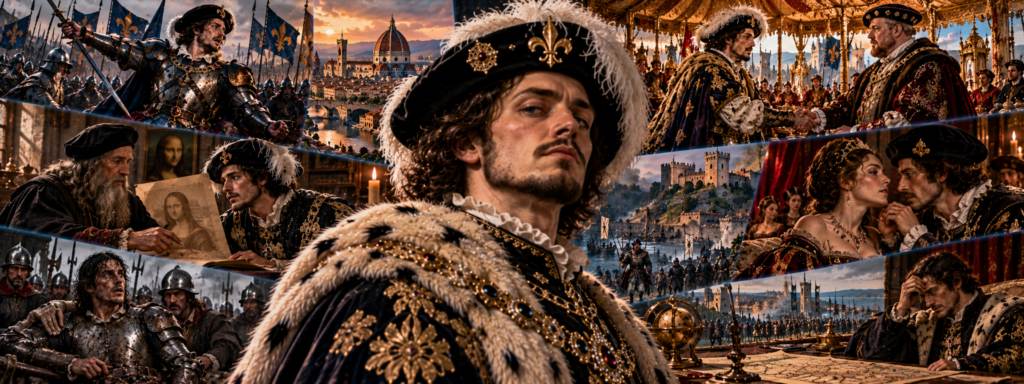
Francis I of France: The Renaissance King, His Ruinous Wars, and the Dangerous Pursuit of Glory
King of France, 1515–1547
He surrounded himself with artists, mistresses, magnificent palaces, and some of the most celebrated minds of the Renaissance. He brought Leonardo da Vinci to France, transformed royal architecture, challenged the most powerful emperor in Europe, and spent extraordinary sums pursuing military glory in Italy. Yet behind the splendor of his court lay a darker history of battlefield catastrophe, political humiliation, religious persecution, financial pressure, and family tragedy. Francis I of France was a king of enormous ambition and seemingly inexhaustible appetite for prestige. His enemies accused him of arrogance, extravagance, and reckless behavior, while later writers transformed his romantic adventures and personal eccentricities into stories of royal excess. His reign ended not in triumph but in illness, disappointment, and an unresolved struggle against the Habsburg dynasty. Francis was not clinically insane, but his determination to pursue glory at almost any cost made him one of the most fascinating and controversial monarchs of Renaissance Europe.
The Dying King and the Empire He Could Never Conquer
In the spring of 1547, Francis I lay seriously ill at the Château de Rambouillet. The king who had once dazzled Europe with his physical presence, elaborate entertainments, and military ambitions was approaching the end of his life. Years of illness had weakened him, and the political world he had spent decades attempting to dominate remained stubbornly beyond his control.
Francis had ruled France for thirty-two years. During that time, he had invaded Italy, captured Milan, suffered a catastrophic defeat at Pavia, endured imprisonment in Spain, and surrendered his own children as hostages to secure his release. He had repeatedly returned to war against Charles V, the Holy Roman Emperor, whose territories and alliances threatened French interests across Europe.
Yet the same king who exhausted resources in military campaigns also transformed French cultural life. He invited Italian artists to his court, supported scholars, collected paintings, and commissioned magnificent residences. His patronage helped establish the French Renaissance as a major cultural movement, leaving achievements that outlasted his territorial ambitions.
By his final years, however, his health had deteriorated considerably. Contemporary accounts describe recurring illness, fever, weakness, and painful physical complaints. Later writers frequently attributed his decline to syphilis, but the surviving evidence does not establish that diagnosis, much less the claim that an infection caused neurological deterioration or mental instability.
Francis died on March 31, 1547, aged fifty-two. His longtime rival Henry VIII of England had died only two months earlier, and Charles V would outlive them both. The European struggle that had defined much of Francis’s reign remained unresolved.
The king left his son Henry II a powerful monarchy, an expensive military inheritance, and a court whose cultural ambitions had permanently changed the image of French kingship. His life demonstrated the extraordinary possibilities of Renaissance monarchy, but also the danger of allowing dynastic rivalry to consume resources and political attention.
To understand how Francis became such a contradictory figure, it is necessary to return to the childhood of a prince who had not originally been expected to inherit the French crown.
The Unexpected Heir: A Childhood Shaped by Ambition
Francis was born on September 12, 1494, at Cognac, the son of Charles, Count of Angoulême, and Louise of Savoy. He belonged to the Valois-Angoulême branch of the French royal dynasty and was related to the reigning king, Charles VIII.
His father died in 1496, leaving Louise responsible for raising Francis and his elder sister Marguerite. Louise became one of the most influential figures in her son’s life, overseeing his upbringing and cultivating the dynastic connections that would eventually place him on the throne.
Francis grew up during a period of extraordinary political change. Charles VIII had invaded Italy in 1494, beginning a series of conflicts that would dominate French foreign policy for decades. Italian cities and courts possessed cultural wealth that fascinated French aristocrats, while their political divisions offered opportunities for intervention.
When Charles VIII died without a surviving son in 1498, the crown passed to Louis XII. Francis became an increasingly important potential successor because Louis lacked a surviving male heir.
Louise of Savoy understood the significance of her son’s position. She ensured that he received an education appropriate to a prince who might eventually become king. His training included military exercises, courtly accomplishments, religion, and exposure to the intellectual culture of the Renaissance.
Unlike the frequently repeated image of an intellectually indifferent monarch, Francis developed genuine interests in literature, languages, architecture, and artistic patronage. His later cultural achievements cannot be explained simply as the work of advisers operating around an uninterested king.
He also acquired the aristocratic ideals that would shape his public identity. Hunting, tournaments, military courage, and personal magnificence were central to the image of Renaissance kingship. Francis embraced these expectations with enthusiasm.
In 1514, he married Claude of France, daughter of Louis XII and Anne of Brittany. The marriage strengthened his dynastic position and connected him to the territorial inheritance associated with Brittany.
When Louis XII died on January 1, 1515, Francis inherited the throne at the age of twenty. He was young, physically energetic, ambitious, and eager to establish a reputation worthy of the great monarchs celebrated in history and romance.
His first major decision would announce the direction of his reign.
Marignano: The Young King Who Won His Glory in Blood
Within months of becoming king, Francis launched a campaign to recover French influence in northern Italy. The Duchy of Milan was particularly important because earlier French monarchs had asserted dynastic claims to it. Control of Milan promised prestige, revenue, and strategic advantages within the Italian peninsula.
Francis assembled a substantial army and crossed the Alps in 1515. The campaign demonstrated impressive military organization, particularly the movement of artillery through difficult mountain terrain. His forces included French cavalry, infantry, and German mercenaries.
The decisive confrontation came at the Battle of Marignano, fought on September 13–14, 1515, against Swiss forces supporting the existing political order in Milan. The battle was exceptionally bloody and lasted into a second day, with French artillery, cavalry, infantry, and Venetian reinforcements contributing to the eventual victory.
Francis personally participated in the campaign and emerged with a reputation for courage. The victory became one of the defining events of his early reign, celebrated through poetry, courtly imagery, and political propaganda.
A famous tradition holds that Francis received knighthood on the battlefield from Pierre Terrail, Seigneur de Bayard, the celebrated French commander. The story became a powerful symbol of chivalric monarchy, although historians have questioned aspects of the ceremony and its later presentation.
The victory secured French control over Milan for a time and established Francis as a formidable European ruler. It also reinforced his confidence in personal military leadership.
Marignano shaped the king’s identity. He had entered Italy as a young monarch seeking glory and returned with a triumph that appeared to justify his ambitions. The danger was that an early success could encourage expectations that later campaigns would prove unable to satisfy.
His attachment to Italy would become one of the most persistent features of his reign. What began as a celebrated victory eventually developed into a prolonged struggle against the Habsburg dynasty.
The Rival Who Had Everything: Francis I and Charles V
The central political rivalry of Francis’s reign was his conflict with Charles V, who inherited an extraordinary collection of territories through the Habsburg, Burgundian, Spanish, and Austrian dynastic lines.
Charles became king of Spain in 1516 and was elected Holy Roman Emperor in 1519. His inheritance included Spain and its overseas possessions, the Burgundian Netherlands, Austrian lands, and substantial influence within Italy and the Holy Roman Empire.
Francis regarded this concentration of power as a threat to French security. Habsburg territories and allied interests surrounded France on several fronts, complicating the kingdom’s diplomatic and military position.
The rivalry intensified during the imperial election of 1519. Francis sought the imperial title himself, but Charles secured the election. The contest involved extensive diplomatic activity and financial commitments, and its outcome contributed to the hostility between the two monarchs.
Their struggle was not simply a personal feud between men with excessive pride. It involved territorial claims, commercial interests, dynastic inheritance, Italian politics, and the balance of power in western Europe.
Nevertheless, personality and royal honor influenced their conduct. Both rulers cultivated images of legitimate Christian monarchy, and each considered his claims and dignity worthy of defense.
Francis increasingly portrayed himself as resisting Habsburg encirclement. Charles viewed French intervention in Italy and alliances with his enemies as threats to his own territories.
The resulting conflicts would repeatedly draw France into expensive campaigns. Their rivalry survived treaties, marriages, military defeats, and diplomatic negotiations because the underlying territorial disputes remained unresolved.
Later writers often described Francis as obsessed with Charles V. The term captures the persistence of the rivalry but risks reducing a complex geopolitical conflict to an individual psychological fixation.
Francis’s decisions could be costly and unsuccessful, but they emerged from a recognizable struggle over European power rather than a clinical delusion.
The Field of the Cloth of Gold: When Two Kings Tried to Outshine Each Other
In June 1520, Francis I met Henry VIII of England near Calais at an extraordinary diplomatic gathering remembered as the Field of the Cloth of Gold. The event became famous for its magnificent temporary structures, lavish textiles, tournaments, banquets, and elaborate displays of royal wealth.
Both monarchs sought prestige and diplomatic advantage. Francis hoped to cultivate English cooperation or neutrality during his rivalry with Charles V, while Henry and his advisers attempted to preserve England’s influence within European politics.
The meeting took place between June 7 and June 24. Elaborate preparations transformed the surrounding countryside into a ceremonial landscape filled with tents, pavilions, decorations, and temporary buildings. The event’s name reflected the extraordinary use of expensive cloth woven with gold thread.
Francis and Henry participated in carefully staged ceremonies emphasizing friendship and equality. Their courts competed in magnificence, but the festivities also served diplomatic purposes.
Tournaments and athletic entertainments reinforced the image of the monarchs as vigorous Renaissance princes. A famous anecdote describes Henry challenging Francis to a wrestling match and losing. Although the encounter appears in historical accounts, its precise circumstances have been retold with varying degrees of embellishment.
The gathering required substantial expenditure from both kingdoms. Its magnificence became a symbol of Renaissance royal extravagance, especially when contrasted with the continuing financial demands of warfare.
Yet the claim that the event achieved absolutely nothing is too sweeping. It maintained diplomatic communication and publicly affirmed a relationship between the monarchs, even though it failed to produce a durable alliance capable of preventing future conflict.
Henry subsequently pursued relations with Charles V, and England entered war against France in 1522. The changing diplomatic alignment demonstrated the limits of ceremonial friendship when competing strategic interests remained.
For Francis, the Field of the Cloth of Gold revealed both the strengths and weaknesses of his approach to kingship. He understood the political value of spectacle, but magnificent displays could not guarantee lasting cooperation.
The gold-covered pavilions eventually disappeared. The financial costs and diplomatic uncertainties remained.
Pavia: The Day the King Lost Everything Except His Life
The Battle of Pavia, fought on February 24, 1525, became the greatest military catastrophe of Francis’s reign. French forces had entered northern Italy seeking to recover control of Milan and challenge Habsburg influence. Francis personally commanded the army during the campaign.
The French besieged Pavia, where an imperial garrison resisted. Imperial forces under commanders including Charles de Lannoy and Fernando d’Avalos, Marquis of Pescara, advanced to relieve the city.
The battle unfolded in and around the park of Mirabello, where terrain, artillery, cavalry, and infantry formations created a complicated tactical environment. Francis’s forces possessed formidable cavalry, but the imperial army included experienced infantry and effective arquebusiers.
Popular accounts blame the defeat entirely upon Francis launching an impulsive cavalry charge that obstructed his own artillery. His tactical decisions contributed to the disaster, but the precise sequence was more complicated than this familiar explanation suggests.
Imperial troops exploited the terrain and the vulnerability of French mounted forces. Firearms and disciplined infantry played important roles in defeating the French cavalry. Several prominent French commanders were killed, and the army suffered severe losses.
Francis fought personally and was captured during the battle. His imprisonment transformed the military defeat into a dynastic and diplomatic crisis.
A famous phrase associated with his message to his mother declares that all was lost except honor. The familiar wording was shaped by later retellings and should not be treated as a verbatim transcript of his original communication.
The defeat shattered the image of invincibility cultivated after Marignano. The king who had once been celebrated as a victorious knight was now a prisoner of his greatest rival.
His capture also exposed the danger of personal royal command. When a monarch entered battle, the consequences of defeat could extend far beyond military losses. Francis’s captivity deprived France of its king and forced the government to confront an extraordinary emergency.
Louise of Savoy assumed a central role in managing affairs during his absence. Her political experience became essential to maintaining the monarchy while negotiations for his release proceeded.
For Francis, Pavia was both a personal humiliation and a strategic catastrophe. It would shape his relationships with Charles V, his children, and his kingdom for years.
The Prisoner of Madrid: Humiliation Behind Imperial Walls
Following his capture, Francis was taken into Habsburg custody and eventually transported to Spain. His imprisonment became a prolonged diplomatic confrontation over the conditions of his release.
Charles V demanded substantial concessions, particularly concerning Burgundy and French claims in Italy. Francis resisted surrendering territories he regarded as essential to the French crown.
His captivity also affected his health. Contemporary accounts describe serious illness during his imprisonment, adding physical suffering to political humiliation. The precise medical conditions involved remain uncertain.
The king’s sister Marguerite traveled to Spain in 1525 and participated in efforts to secure his release. Her involvement demonstrated the importance of dynastic women in diplomacy and the close relationship between Francis and his family.
Negotiations culminated in the Treaty of Madrid, signed in January 1526. Under its terms, Francis agreed to major concessions, including the surrender of Burgundy and the renunciation of claims in Italy.
The treaty also required arrangements involving his sons as hostages to guarantee compliance. Francis returned to France in March 1526, while his two eldest surviving sons, Francis the dauphin and Henry, were delivered into Spanish custody.
The exchange became one of the most painful episodes of his reign. The princes were children, and their detention continued for approximately four years while negotiations over the treaty remained unresolved.
Francis subsequently repudiated important provisions of the Treaty of Madrid, arguing that the agreement had been obtained under coercion and that he could not lawfully surrender certain crown territories. His refusal was politically consequential, but it was not simply an impulsive betrayal without legal or diplomatic context.
The hostage arrangement nevertheless imposed a terrible burden upon his sons. Their confinement became an enduring source of criticism directed at Francis, particularly because he resumed resistance to Charles V while they remained prisoners.
The princes were eventually released in 1530 following the Peace of Cambrai and associated financial arrangements. Their return required substantial payments and diplomatic concessions.
Francis had regained his freedom, but the cost was enormous. The king’s determination to preserve his territorial claims had become entangled with the captivity of his own children.
Leonardo da Vinci: The Genius Who Found His Final Home in France
Among Francis I’s many achievements, his relationship with Leonardo da Vinci remains one of the most remarkable. Their association brought together a young monarch determined to establish a magnificent Renaissance court and an aging artist whose interests extended far beyond painting into engineering, anatomy, architecture, mechanics, and the study of nature.
By the time Francis became king, Leonardo was already famous. He had worked for influential Italian patrons, including the Sforza dynasty in Milan, and had produced paintings and designs that established his extraordinary reputation. Yet his career had also been marked by unfinished projects, changing political circumstances, and the difficulty of finding patrons willing to support his broad intellectual interests.
Francis encountered Italian Renaissance culture through his military campaigns and diplomatic connections. He recognized that artists and scholars could enhance the prestige of the French monarchy just as effectively as magnificent buildings or military victories. Patronage offered a way to associate the crown with intellectual achievement and artistic innovation.
In 1516, Leonardo accepted an invitation to settle in France. He traveled with companions including his devoted pupil Francesco Melzi and established himself at the Château du Clos Lucé near Amboise. Francis granted him a prestigious position as the king’s first painter, engineer, and architect, together with an annual pension traditionally recorded as one thousand écus.
The arrangement gave Leonardo financial security and considerable freedom. He was already in his sixties, and his physical abilities had begun to decline. Nevertheless, he continued working on artistic and technical projects, refining paintings and considering ambitious architectural schemes.
Leonardo brought important works to France, including paintings generally identified as the Mona Lisa, Saint John the Baptist, and The Virgin and Child with Saint Anne. Their presence helped establish the foundations of the French royal collection that would eventually contribute to the Louvre’s extraordinary holdings.
The relationship between Francis and Leonardo has often been described as one of almost obsessive devotion. Such language exaggerates what can be established. Francis clearly admired Leonardo’s abilities and rewarded him generously, but there is no evidence that the king’s patronage constituted an unhealthy psychological fixation.
Their association was significant because Francis treated artistic and scientific expertise as a source of royal distinction. Leonardo could contribute to the monarchy’s cultural ambitions without producing a constant stream of finished paintings. His ideas concerning architecture, engineering, and landscape design were themselves valuable.
One especially ambitious project concerned the development of a planned royal residence and settlement at Romorantin. Leonardo prepared designs involving buildings, waterways, and urban arrangements, although the project was never realized on the scale envisioned.
His influence has also been connected with the design of Chambord, particularly its centralized plan and remarkable double-helix staircase. The exact authorship of Chambord remains debated, and Leonardo died before construction began, but comparisons with his drawings suggest that his architectural ideas helped shape the project.
A famous painting by Jean-Auguste-Dominique Ingres depicts Leonardo dying in Francis’s arms. The image is emotionally compelling, presenting the king as a devoted protector of genius. However, it was created centuries after the event and should not be mistaken for documentary evidence that Francis attended Leonardo’s final moments.
Leonardo died at Clos Lucé on May 2, 1519. His final years in France had provided him with an unusually prestigious position and an environment in which his intellectual interests could continue receiving royal support.
For Francis, the relationship represented something greater than the acquisition of famous paintings. It demonstrated that a king could strengthen his reputation through the patronage of knowledge and creativity. The monarch who struggled to establish lasting authority in Italy helped bring one of Italy’s greatest artistic minds permanently into the cultural history of France.
Chambord: The Palace Built for Glory Rather Than Comfort
If Leonardo represented Francis’s intellectual ambitions, the Château de Chambord represented his determination to make those ambitions visible in stone. Construction began in 1519 in the Sologne region, where the king possessed extensive hunting interests.
Chambord was unlike an ordinary medieval fortress. Its design combined monumental towers and architectural references to traditional castles with Renaissance innovations in planning, decoration, and circulation. The result was a building intended to astonish visitors and proclaim royal magnificence.
Its famous double-helix staircase became one of its most remarkable features. Two intertwined routes allow people to ascend or descend while remaining on separate stairways, creating an architectural effect that still fascinates visitors. Leonardo’s work is often cited as an important influence, although the identity of the château’s principal designer remains uncertain.
The building was enormous, and its construction required substantial labor, materials, engineering, and financial resources. Its many rooms, towers, fireplaces, and elaborate roofline expressed an ambition that extended beyond ordinary domestic requirements.
Yet Francis did not intend Chambord to function as a permanent residence in the modern sense. It served as a royal hunting lodge and a setting for displaying power and hospitality. He stayed there only intermittently, and the château remained incomplete during his lifetime.
This fact has encouraged stories portraying Francis as a man who built extravagant palaces only to abandon them after a few days. The description captures the apparent contradiction between enormous expenditure and limited residence, but it overlooks the political function of Renaissance architecture.
A palace did not need to be occupied continuously to justify its existence within the culture of royal magnificence. Buildings could proclaim dynastic legitimacy, impress ambassadors, support ceremonial occasions, and demonstrate the financial resources available to the crown.
Francis understood these purposes. His architectural projects formed part of a broader effort to transform the visual language of French monarchy. The king wanted his residences to reflect the artistic innovations he admired in Italy while preserving symbols associated with French royal authority.
Chambord’s decorative program repeatedly incorporated Francis’s emblem, the salamander, together with royal monograms and heraldic devices. The building thus transformed architecture into a permanent statement about the king’s identity.
Nevertheless, the financial burden was real. Construction consumed resources during a reign already marked by military expenditure and diplomatic competition. The pursuit of magnificence could strain the treasury, particularly when combined with expensive campaigns abroad.
Chambord therefore embodies the central contradiction of Francis’s reign. It was an extraordinary cultural achievement and an expensive expression of royal ambition. Its beauty cannot erase its cost, but its cost does not make its creation irrational.
Fontainebleau: The Palace Where France Became Renaissance Europe
Francis’s transformation of French architecture extended beyond Chambord. At Fontainebleau, he developed an existing royal residence into one of the most important artistic centers of his reign.
The château had long served French kings, particularly as a hunting residence. Francis undertook extensive renovations and commissioned artists to create interiors that reflected contemporary Italian styles. The resulting decorative program helped establish what later became known as the School of Fontainebleau.
Among the artists associated with the project were Rosso Fiorentino and Francesco Primaticcio. Their work introduced sophisticated combinations of painting, stucco sculpture, classical imagery, and elaborate ornamentation into French court culture.
The Galerie François Ier became especially significant. Its decorative scheme combined mythological and allegorical subjects with architectural ornament and royal symbolism. The imagery was complex, designed for a sophisticated courtly audience capable of appreciating references to classical literature and princely virtues.
Francis’s enthusiasm for Italian art did not mean that he abandoned French cultural traditions. Instead, he encouraged a process of adaptation in which imported techniques and ideas were incorporated into the monarchy’s existing artistic identity.
His architectural patronage also provided employment for craftsmen, painters, sculptors, engineers, and administrators. Large building projects required coordination and expertise, creating networks of artistic production that extended beyond the immediate royal household.
The king’s interest in design appears to have been personal as well as political. Accounts and surviving material suggest that he engaged actively with architectural ideas rather than merely approving whatever his advisers proposed.
This involvement complicates claims that Francis possessed an invincible aversion to serious work. He may have preferred certain activities over routine administrative business, but his sustained commitment to major artistic projects required attention, decision-making, and the ability to coordinate specialists.
Fontainebleau became a lasting symbol of the French Renaissance. Unlike temporary diplomatic entertainments or failed military campaigns, its artistic achievements continued influencing French court culture after Francis’s death.
The king’s greatest successes were not always found on the battlefield. Sometimes they emerged in galleries, workshops, libraries, and the imagination of the artists he supported.
The Wandering Court: Hunting, Travel, and the Myth of the Restless King
Francis’s court was highly mobile. The king traveled between royal residences, hunting grounds, cities, and administrative centers, accompanied by members of his household and varying numbers of attendants.
To modern observers, such constant movement can appear inefficient or erratic. Later descriptions sometimes portray Francis suddenly abandoning important negotiations to disappear into the forests, driven by an uncontrollable urge to hunt.
The historical reality was more complicated. French monarchy retained strong itinerant traditions, and royal movement served political, ceremonial, and practical purposes. Visiting different regions allowed the king to demonstrate his presence, maintain relationships, supervise affairs, and enjoy residences suited to particular seasons or activities.
Hunting was especially important. It provided aristocratic recreation, physical exercise, opportunities for informal discussion, and a public demonstration of royal privilege. Francis’s enthusiasm was substantial, but hunting itself was not an eccentric activity for a sixteenth-century monarch.
The movement of the royal household was expensive. Servants, horses, furniture, clothing, food, records, and equipment had to be transported or supplied at successive residences. The logistics required considerable organization and placed demands upon local communities.
Nevertheless, the traveling court also served the monarchy’s interests. Royal presence could reinforce authority in territories where noble families and local institutions retained influence. Ceremonies and audiences helped maintain relationships essential to government.
Foreign ambassadors sometimes complained about the difficulty of obtaining access to Francis or conducting sustained negotiations while the court moved. Such frustrations are valuable evidence of diplomatic inconvenience, but they do not establish that the king suffered from pathological restlessness.
The claim that he repeatedly fled government because he could not tolerate responsibility is therefore too sweeping. Francis delegated substantial administrative work to ministers and councils, but delegation was an ordinary feature of monarchy.
His preferences undoubtedly shaped the rhythm of court life. Hunting, entertainment, and artistic patronage occupied significant places within his schedule. Yet the surviving evidence does not justify describing him as neurologically incapable of concentration or chronically detached from reality.
His court moved because the political and social world of Renaissance monarchy remained mobile, not because the king was necessarily unable to remain in one place.
Claude of France: The Quiet Queen Behind the Magnificent Court
Francis’s first wife, Claude of France, occupied a very different position within the royal household from the celebrated mistresses and flamboyant courtiers who dominate popular accounts of his reign.
Claude was the daughter of Louis XII and Anne of Brittany. Her marriage to Francis strengthened the dynastic succession and connected him to Brittany’s inheritance. She became queen when Francis ascended the throne in 1515.
Unlike her husband, Claude did not cultivate a reputation for public magnificence or political spectacle. Contemporary descriptions frequently emphasize her piety, modesty, and dedication to family responsibilities, although such accounts were influenced by conventional expectations of queenship.
Claude bore seven children during their marriage, including the future Henry II. Repeated pregnancies imposed considerable physical demands, particularly in an age when childbirth carried substantial risks.
Her health deteriorated, and she died in July 1524 at the age of twenty-four. The precise cause of death remains uncertain. Later suggestions that she died from syphilis transmitted by Francis are not securely established and should not be repeated as fact.
Her death occurred during a difficult period for the monarchy. Francis was engaged in military struggles against the Habsburgs, and the disastrous Battle of Pavia would follow the next year.
Claude’s life illustrates the unequal visibility of royal men and women in historical narratives. Francis’s military campaigns, artistic projects, and romantic relationships generated extensive commentary, while Claude’s contribution to dynastic continuity was often treated as a background detail.
Yet the children she bore shaped the future of France. Her surviving sons and daughters became central to royal succession and international marriage arrangements.
Her position also reveals the difference between a queen’s formal status and the informal influence exercised by royal mistresses. Claude remained the legitimate queen, while other women could obtain access to Francis and influence patronage through personal relationships.
The contrast became particularly pronounced after the rise of Anne de Pisseleu, whose prominence during Francis’s later reign contributed to factional struggles within the court.
The King’s Mistresses: Passion, Patronage, and Dangerous Court Rivalries
Francis I acquired a lasting reputation for romantic and sexual relationships outside marriage. Contemporary and later writers associated his court with flirtation, elaborate entertainments, and the political influence of favored women.
One of the best-known figures was Françoise de Foix, Countess of Châteaubriant, who became associated with the king during the early part of his reign. Her position illustrates how personal intimacy could translate into influence within the court’s patronage networks.
Later, Anne de Pisseleu d’Heilly emerged as Francis’s principal favorite. She eventually received the title Duchess of Étampes and became an important figure in court politics. Her influence extended beyond personal companionship into relationships with ministers, noble families, and diplomatic factions.
The prominence of royal mistresses attracted resentment. Courtiers seeking advancement might cultivate their support, while rivals accused them of manipulating the king for private advantage.
Anne de Pisseleu became involved in tensions surrounding the dauphin Henry and his associates. Henry’s political circle increasingly included Diane de Poitiers, who would become his influential mistress after his accession.
These competing relationships contributed to factional rivalries during Francis’s later reign. Court politics involved more than personal jealousy: appointments, access to information, diplomatic preferences, and financial rewards were at stake.
Francis’s romantic reputation also generated stories concerning Mary Boleyn, sister of Anne Boleyn, the future queen of England. Mary spent time at the French court, and later traditions associated her with Francis.
However, the evidence for a sexual relationship between Mary Boleyn and Francis is less secure than popular accounts often suggest. The notorious nicknames comparing her to a mare or a hired horse appear in later hostile or anecdotal traditions and should not be presented as verified statements made by the king.
Such stories illustrate the danger of treating court gossip as straightforward biography. Women associated with powerful men frequently became targets of sexual accusations intended to undermine their reputations.
Francis undoubtedly cultivated a court in which personal relationships mattered politically. His favorites could influence patronage and become associated with competing factions. Yet the claim that he elevated and destroyed advisers entirely through unpredictable emotional swings ignores the more complicated political interests operating around him.
His private conduct could be scandalous by contemporary moral standards, but the evidence does not establish a psychiatric disorder or compulsive pattern of behavior.
The more significant historical issue is how access to the monarch could become a form of power. At Francis’s court, affection, family connections, ambition, and political calculation were frequently intertwined.
The Duel That Never Happened: Francis Challenges an Emperor
One of the most theatrical episodes in Francis’s rivalry with Charles V involved proposals for a personal duel between the monarchs. The idea emerged during the diplomatic confrontations following Francis’s release from captivity, when disputes over the Treaty of Madrid and the honor of both rulers intensified.
Francis had repudiated important treaty obligations, arguing that the concessions had been extracted under duress. Charles considered the king’s conduct a violation of his promises. Their disagreement became increasingly personal, with accusations concerning honor and good faith entering the diplomatic exchange.
In 1528, the confrontation produced a formal challenge associated with the possibility of settling their dispute through single combat. The proposal reflected the continuing influence of aristocratic traditions in which personal honor could be defended through combat.
To modern observers, the idea of two sovereigns risking their lives in a duel over international disputes appears extraordinary. Yet challenges of this kind also served rhetorical and political purposes. They allowed rulers to assert courage and defend their reputations without necessarily expecting an actual fight to occur.
The suggestion that Francis experienced a delusional conviction that a duel would settle every European conflict is unsupported. The episode belonged to the language of princely honor, even if the practical consequences of such a confrontation would have been enormous.
Neither monarch ultimately fought the proposed duel. Negotiations continued, and the conflict was eventually addressed through diplomatic arrangements, including the Peace of Cambrai in 1529.
The peace became associated with Louise of Savoy and Margaret of Austria, Charles V’s aunt, who played important roles in negotiations. Their participation helped produce a settlement involving territorial concessions, dynastic arrangements, and the eventual release of Francis’s sons.
The episode reveals how Renaissance monarchy combined medieval ideals with increasingly sophisticated diplomacy. Francis could present himself as a knight prepared to defend his honor personally while simultaneously relying upon experienced negotiators to secure practical objectives.
His challenge was theatrical, provocative, and politically charged. It was not evidence that he had lost contact with reality.
The Most Christian King and the Muslim Sultan
Among Francis’s most controversial diplomatic decisions was his cooperation with Suleiman the Magnificent, the Ottoman sultan. The relationship shocked observers because Francis held the traditional title of Most Christian King while seeking assistance from a Muslim ruler against the Habsburg emperor.
The alliance developed from the strategic realities of European politics. Charles V controlled extensive territories, and Francis sought partners capable of challenging Habsburg power from multiple directions.
The Ottoman Empire possessed formidable military resources and was engaged in its own conflicts with Habsburg interests in central Europe and the Mediterranean. Cooperation therefore offered advantages to both monarchies.
French-Ottoman contacts intensified during the 1530s, particularly through diplomatic missions and arrangements associated with the ambassador Jean de La Forêt. Their relationship involved military coordination and commercial interests, although the precise legal character of early agreements has sometimes been exaggerated in later accounts.
The cooperation became especially visible during the war of 1542–1544. Ottoman naval forces under Hayreddin Barbarossa operated in the western Mediterranean in coordination with French interests.
In 1543, French and Ottoman forces participated in operations against Nice, then associated with the Duke of Savoy. Ottoman ships subsequently wintered at Toulon, where extraordinary arrangements accommodated the fleet.
The presence of Ottoman forces in a French port provided Francis’s opponents with powerful propaganda. Critics portrayed the arrangement as a betrayal of Christian solidarity and an example of the king placing dynastic ambition above religion.
Yet alliances across religious boundaries were not unprecedented, and European politics frequently involved cooperation shaped by strategic necessity rather than confessional identity alone. Francis’s policy was controversial because of its scale and visibility, not because it emerged from inexplicable irrationality.
The alliance also exposed the contradictions within Renaissance ideas of Christian monarchy. Francis sponsored religious institutions, defended Catholic orthodoxy in his kingdom, and cultivated the image of a Christian prince while cooperating militarily with a Muslim empire.
For the king, these positions could coexist within a political worldview that prioritized the security and prestige of France. For his enemies, the contradiction offered evidence of hypocrisy.
The Ottoman relationship therefore reveals the flexibility of Francis’s diplomacy. He was willing to challenge conventional expectations when doing so offered an advantage against Charles V.
It also demonstrates why describing his foreign policy as simply mad is historically inadequate. The alliance emerged from recognizable strategic interests, even when it generated religious outrage.
The Price of Magnificence: Taxes, Debt, and Financial Pressure
Francis’s wars and courtly projects placed substantial demands upon royal finances. Armies required recruitment, wages, artillery, transport, supplies, and fortifications. Diplomatic payments, pensions, household expenditure, and construction projects added further obligations.
The monarchy relied upon a complicated financial system involving taxation, borrowing, royal revenues, and the sale or creation of offices. The taille, a major direct tax, remained an important source of income, while indirect taxation and extraordinary financial measures contributed to the treasury.
The pressure of war encouraged the expansion of fiscal mechanisms. Francis’s government increasingly relied upon credit and financial arrangements that anticipated future revenues. These practices could provide immediate funds but also created long-term obligations.
In 1523, the monarchy introduced the rentes sur l’Hôtel de Ville de Paris, an important development in the history of French public borrowing. Such arrangements allowed the crown to obtain money from lenders in exchange for income secured against designated revenues.
Financial administration remained vulnerable to corruption, favoritism, and disputes over responsibility. Royal officials could accumulate substantial wealth, and accusations of misconduct sometimes became entangled with political struggles.
One important example involved Jacques de Beaune, Baron de Semblançay, a prominent financial official who had served the monarchy for years. He fell from favor and was executed in 1527 following proceedings concerning royal finances.
His downfall became notorious, and later accounts frequently portrayed him as a scapegoat for financial problems created by royal extravagance. The full circumstances were complicated by disputes over accounting, obligations, and court politics.
The execution demonstrates the danger faced by officials responsible for managing enormous royal expenditures. When resources proved insufficient, the search for blame could become a matter of life and death.
Nevertheless, the claim that Francis routinely selected random paymasters for execution whenever the treasury emptied is unsupported. Semblançay’s case was significant precisely because of its circumstances and political implications.
Francis’s expenditure cannot be attributed exclusively to personal luxury. Warfare accounted for immense financial demands, while court patronage and architecture served political as well as cultural purposes.
The consequences for subjects were nonetheless substantial. Taxation and borrowing transferred the burdens of royal ambitions onto communities, merchants, landholders, and future revenues.
The magnificent world of Francis’s court depended upon a financial structure whose pressures extended far beyond the palace walls.
The King’s Conscience: Humanism, Reform, and Religious Persecution
Francis’s reputation as a Renaissance patron sometimes obscures the religious conflicts that intensified during his reign. He supported humanist scholarship and maintained relationships with intellectual figures interested in education, classical learning, and religious renewal.
His sister Marguerite of Navarre became an important patron of writers and reform-minded thinkers. She participated in religious and intellectual networks that sometimes attracted suspicion from defenders of traditional orthodoxy.
During the early Reformation, Francis’s policies fluctuated according to political circumstances, theological concerns, and the perceived threat to royal authority. He could protect certain scholars while permitting or supporting action against religious dissent.
The Affair of the Placards in October 1534 marked an important turning point. Anti-Catholic posters attacking the Mass appeared in several French locations, including near the king’s own chambers.
The incident was interpreted as a direct challenge to religious and political order. Authorities responded with investigations, arrests, and executions, while the crown adopted a more forceful public position against perceived heresy.
Francis participated in religious ceremonies affirming Catholic orthodoxy, and persecution intensified during parts of his later reign. The treatment of Protestant reformers became an increasingly significant feature of French political and religious life.
The king’s policies were not perfectly consistent. Diplomatic circumstances could influence his approach, especially when he sought cooperation with German Protestant princes against Charles V.
This apparent contradiction reflected the competing demands of religious legitimacy and international strategy. Francis could oppose religious dissent within France while cultivating relationships with Protestant political authorities abroad.
The persecution of the Waldensians in Provence in 1545 became one of the darkest episodes associated with his reign. Military and judicial action against these communities resulted in killings, destruction, and displacement.
The events cannot be explained as the product of a sudden psychological breakdown. They emerged from religious hostility, institutional decisions, local interests, and royal authorization within a period of intensifying confessional conflict.
Francis’s cultural patronage and religious repression therefore belonged to the same reign. The king who supported learning and artistic innovation also presided over violent measures against people whose beliefs challenged established religious authority.
The contradiction is central to understanding Renaissance monarchy. Intellectual curiosity did not necessarily produce religious tolerance, and admiration for classical scholarship could coexist with severe punishment of dissent.
The Ordinance of Villers-Cotterêts: A Lasting Administrative Legacy
In 1539, Francis issued the Ordinance of Villers-Cotterêts, a major legal measure associated with the administration of justice and the keeping of official records. Its provisions included requirements concerning the language used in certain judicial and administrative documents.
The ordinance is especially remembered for requiring specified legal records to be written in French rather than Latin. This contributed to the development of French as a language of royal administration, although it did not instantly establish a uniform spoken language throughout the kingdom.
The measure also addressed registration practices and procedures connected with births, deaths, and ecclesiastical recordkeeping. Its significance extended beyond language into the growing organization of royal government.
The ordinance demonstrates that Francis’s reign was not simply a succession of wars and entertainments. Important administrative developments occurred alongside military campaigns and artistic patronage.
His government relied upon ministers, councils, jurists, and officials capable of preparing complex legislation. Francis retained royal authority over these processes, but the monarchy functioned through institutions rather than the king’s uninterrupted personal attention.
The ordinance also complicates claims that he was incapable of serious government. A ruler could dislike particular administrative routines while still supporting significant institutional measures.
Francis’s political record included costly failures, but it also included decisions with enduring consequences for the French state.
The Final Illness: Syphilis, Infection, and the Limits of Medical Evidence
Francis’s declining health became increasingly important during the later years of his reign. Contemporary accounts describe recurring illness, physical discomfort, weakness, and episodes that interfered with his activities.
Later historians and popular writers frequently attributed these symptoms to syphilis. The disease was widespread in early modern Europe, and its association with the Italian Wars encouraged speculation about royal infection.
However, the surviving evidence does not establish a definitive diagnosis. Francis’s symptoms have been interpreted in different ways, including possible urinary disorders, infections, and other conditions. Some modern discussions mention severe urological complications, but precise medical conclusions remain uncertain.
Claims that syphilis caused neurological deterioration, violent outbursts, or lapses into insanity are especially problematic. Neurosyphilis can produce neurological and psychiatric symptoms in some cases, but there is no adequate evidence to establish that Francis suffered from it.
The king’s medical difficulties may have affected his stamina, travel, and participation in government. Serious illness can constrain any ruler’s activities, particularly in an age when treatments were limited and infections could become life-threatening.
Yet it is difficult to connect specific late-reign policies directly to his symptoms. The continued conflict with Charles V, the persecution of religious dissent, and the management of court factions involved broader political circumstances and institutional decisions.
Francis remained engaged in royal affairs during his later years, although important responsibilities were increasingly handled by advisers and members of his household. Delegation should not be mistaken for mental incapacity.
His final illness worsened in 1547, and he died at Rambouillet on March 31. The precise immediate cause of death remains uncertain.
The tendency to interpret his final years through a presumed diagnosis of syphilis illustrates the hazards of retrospective medical history. Physical suffering was real, but the evidence does not justify transforming it into an explanation for every controversial decision of his reign.
The Death of the Dauphin: A Family Tragedy and a Poisoning Scandal
One of the most painful events of Francis’s later reign was the death of his eldest surviving son, Francis, Dauphin of France, in August 1536. The young prince had endured years of captivity in Spain following the Treaty of Madrid and represented the future of the dynasty.
His sudden illness and death provoked grief and suspicion. Rumors of poisoning circulated, reflecting the atmosphere of distrust surrounding international politics and courtly rivalries.
Sebastiano de Montecuccoli, an Italian associated with the dauphin’s household, became a suspect. He was arrested, interrogated, and ultimately executed after proceedings connected with the alleged poisoning.
The accusation was politically explosive because suspicion extended toward the Habsburg world. The rivalry between Francis and Charles V created circumstances in which the death of a royal heir could readily become the subject of conspiracy theories.
Modern historians have questioned whether the dauphin was poisoned at all. His symptoms may have resulted from natural illness, and the evidence produced against Montecuccoli does not establish the conspiracy with certainty.
The episode demonstrates the dangers of political justice in an environment where grief, international hostility, and suspicion could influence investigations. A sudden royal death became the foundation for accusations with consequences far beyond the immediate household.
The dauphin’s death also changed the succession. His younger brother Henry became heir to the throne and eventually succeeded as Henry II.
For Francis, the loss added another tragedy to a reign already marked by the death of Claude, the captivity of his children, and repeated military disappointments.
The poisoning scandal became part of the darker history of his court, where dynastic vulnerability and international rivalry could transform illness into allegations of murder.
Was Francis I Mad? Ambition, Excess, and the Problem With Retrospective Labels
Francis I is sometimes described as reckless, extravagant, impulsive, or obsessed with glory. These judgments arise primarily from his military ambitions, costly court culture, diplomatic rivalries, and reputation for romantic indulgence.
None establishes that he suffered from clinical insanity. The historical record does not document recurring psychotic episodes comparable to those experienced by Charles VI, nor does it establish a progressive psychiatric disorder explaining his political conduct.
His attachment to chivalric ideals reflected the culture of Renaissance monarchy. Personal military leadership, aristocratic honor, and dynastic conquest remained important sources of legitimacy and prestige.
His rivalry with Charles V was persistent and expensive, but it concerned genuine territorial disputes and the distribution of power across Europe. Describing the conflict as a pathological obsession risks obscuring the strategic circumstances that sustained it.
His architectural projects were costly, yet they served political and cultural purposes. Chambord and Fontainebleau expressed royal magnificence while encouraging artistic developments that shaped French culture for generations.
His personal relationships influenced court politics, but the most sensational stories about mistresses, insulting nicknames, and uncontrolled sexual behavior frequently depend upon later anecdotal sources.
His illnesses likewise require caution. Although Francis suffered serious physical problems, the available evidence does not support diagnosing neurosyphilis or attributing his policies to neurological decline.
The most important distinction concerns responsibility. Francis made decisions that contributed to prolonged warfare, financial pressure, and religious persecution. Those decisions deserve historical examination without being explained away as symptoms of mental illness.
He also supported artists, scholars, architectural innovation, and administrative developments whose effects outlasted his reign. These achievements do not cancel the suffering associated with his wars, just as his failures do not erase his cultural influence.
Francis belongs in the Mad Monarchs category as an example of how accusations of irrationality can become attached to rulers whose ambitions appear excessive or whose decisions produce disastrous consequences. His history is one of political contradiction rather than established psychiatric instability.
The King Who Wanted Everything: Francis I and the Dangerous Price of Glory
Francis I began his reign with a spectacular military victory and ended it after decades of struggle against an emperor he could never decisively overcome. His early success at Marignano encouraged a vision of monarchy rooted in courage, prestige, and the pursuit of territorial glory. The catastrophe at Pavia exposed the vulnerability beneath that image, leaving the king imprisoned and his dynasty facing extraordinary pressure.
His captivity and the detention of his sons revealed the personal costs of international rivalry. Treaties offered temporary relief, but disputes over Italy and Burgundy continued to produce conflict. The king repeatedly returned to the diplomatic and military struggle because the underlying competition for European power remained unresolved.
At the same time, Francis transformed the cultural identity of the French monarchy. He welcomed Leonardo da Vinci, supported Renaissance scholarship, and commissioned buildings that remain among the most recognizable achievements of sixteenth-century architecture. His court became a center of artistic experimentation, intellectual ambition, and elaborate ceremonial display.
Those accomplishments existed alongside financial strain, factional rivalry, religious persecution, and the suffering associated with war. The magnificent palaces of his reign were constructed within a kingdom whose subjects helped bear the costs of royal ambition. His patronage of humanist learning did not prevent violent repression of religious dissent, while his celebration of Christian kingship coexisted with diplomatic cooperation with the Ottoman Empire.
Francis’s personal reputation became entangled with stories of romantic excess, unpredictable moods, and an almost compulsive desire for magnificence. Some accounts reflect genuine characteristics of his court, while others emerged from hostile commentary or later traditions. The evidence does not justify portraying him as a clinically unstable ruler whose decisions were driven by mental illness.
His final years brought physical suffering and political disappointment. The king who had once presented himself as a victorious Renaissance prince increasingly depended upon physicians and advisers while confronting the limitations of his health. He died without securing the Italian dominance that had occupied so much of his reign.
Francis I remains one of the great contradictions of Renaissance kingship. He possessed the resources to surround himself with extraordinary beauty, the authority to summon artists and scholars from across Europe, and the ambition to challenge an emperor whose territories stretched across continents. Yet he repeatedly discovered that military courage could not guarantee victory, magnificent ceremonies could not secure lasting alliances, and enormous expenditure could not purchase control over events. His achievements were real, but so were the costs of his ambitions. The palaces, paintings, and artistic traditions associated with his name survived long after the armies he commanded had disappeared. His wars left a different inheritance: financial burdens, political rivalries, and conflicts that continued into the reigns of his successors. Francis was not a mad monarch in the medical sense. He was a king whose hunger for glory sometimes exceeded the practical limits of his power, and whose most enduring triumphs emerged not from conquest but from creation. His story leaves a question that reaches far beyond the sixteenth century: when a ruler possesses extraordinary power and limitless ambition, who ultimately bears the cost of the dreams that cannot be fulfilled?