
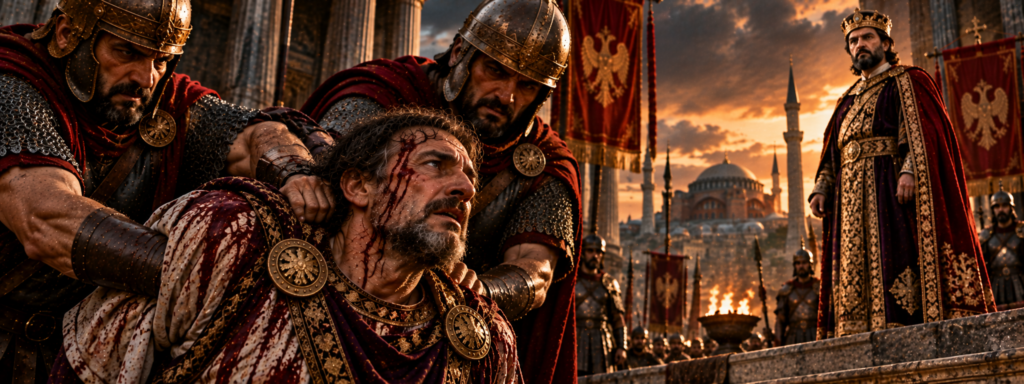
Tiberius III: The Emperor Who Seized Byzantium’s Throne and Lost His Head to a Dead Man’s Revenge
The Fall of Carthage, the Mutiny That Made an Emperor, and the Terrifying Return of Justinian II
Tiberius III (died 705 CE) was Byzantine emperor from 698 to 705, a naval officer originally known as Apsimar who rose to power during a military rebellion following the disastrous loss of Carthage. He overthrew Emperor Leontius, ordered his nose cut off, and confined him to a monastery before taking the imperial crown for himself. Unlike many short-lived usurpers, Tiberius proved an energetic ruler, overseeing military campaigns against the Umayyad Caliphate and attempting to strengthen an empire threatened by enemies on several frontiers. His downfall came when Justinian II, the mutilated emperor deposed in 695, returned from exile with foreign military assistance and reclaimed Constantinople in 705. Tiberius was captured, publicly humiliated alongside Leontius, and executed on Justinian’s orders, ending a seven-year reign in one of the most spectacular acts of imperial revenge in Byzantine history.
The Day Two Emperors Were Brought Before Their Executioner
In Constantinople, the throne could elevate an ordinary soldier above millions of subjects, surround him with gold and ceremony, and make his commands the law of an empire. Yet the same throne could become a death sentence when the soldiers guarding it decided that another man deserved to sit upon it. Few emperors experienced that terrible reversal more completely than Tiberius III, a former naval officer who had risen from the wreckage of a military disaster to become ruler of the Byzantine Empire. For seven years, he had governed from the imperial capital, directed campaigns against powerful enemies, and exercised authority over one of the most sophisticated states in the medieval world. Then, in 705, the emperor whose political career had once seemed secure found himself a prisoner awaiting execution.
The man responsible for his downfall was someone Tiberius had every reason to believe would never return. Justinian II had been overthrown a decade earlier, mutilated, and sent into exile on the distant Black Sea frontier. His enemies had deliberately cut off his nose because they believed such a visible injury would make him permanently unacceptable as emperor. Yet Justinian had survived, escaped his confinement, secured foreign allies, and returned to Constantinople determined to reclaim everything that had been taken from him. The supposedly disqualified ruler had come back, and he had no intention of forgiving those who had occupied his throne.
Tiberius was not the only former emperor facing Justinian’s vengeance. Leontius, the general who had overthrown Justinian in 695, had himself been deposed by Tiberius three years later. He had suffered the same mutilation he had inflicted upon Justinian and spent the following years confined to a monastery. Now the two men who had successively ruled during Justinian’s absence were prisoners of the emperor they had believed permanently defeated. Their fates were linked by a decade of rebellion, humiliation, and political violence.
Later Byzantine chroniclers describe the two fallen emperors being brought before Justinian in a public spectacle associated with Constantinople’s Hippodrome. Some accounts portray Justinian placing his feet upon their necks while the crowd witnessed their degradation, a detail that became one of the most memorable images of his restoration. The precise ceremonial details come from later narrative traditions and cannot all be independently verified, but the central outcome is secure. Tiberius and Leontius were executed in 705, with beheading reported in the surviving accounts.
The execution represented more than the destruction of two political rivals. It was the culmination of an extraordinary struggle in which three emperors had successively overthrown one another, mutilated their predecessors, and attempted to secure the throne through violence. Justinian had lost his crown to Leontius, Leontius had lost his to Tiberius, and Tiberius had lost his to the very man whose disfigurement was supposed to make restoration impossible. The Byzantine Empire had survived foreign invasions, military disasters, and repeated coups, but its rulers had become trapped in a cycle of betrayal from which none would ultimately escape.
What makes Tiberius’s story especially fascinating is that he was not merely an incompetent usurper who briefly seized power before being swept aside. He had military experience, understood the dangers confronting the empire, and presided over a government that achieved some important successes. His downfall was not caused by a single catastrophic defeat comparable to the one that had destroyed Leontius. Instead, he was undone by an enemy who had spent years gathering the allies and determination necessary to accomplish what almost everyone believed impossible.
An Empire Fighting for Its Survival
The Byzantine Empire of the late seventh century was still, in the eyes of its rulers and subjects, the Roman Empire. Constantinople had replaced Rome as the center of imperial government, Greek had become dominant in administration and public life, and Christianity shaped the political identity of the state. Nevertheless, the emperors continued to claim the inheritance of Augustus, Constantine, and Justinian I. They regarded their authority as a continuation of Roman sovereignty rather than the rule of an entirely new kingdom.
The empire that Tiberius would eventually govern was very different from the Mediterranean superpower of earlier centuries. During the seventh century, Muslim armies had conquered Syria, Palestine, Egypt, and other territories that had once supplied enormous wealth to Constantinople. The Sasanian Persian Empire, Byzantium’s great eastern rival for centuries, had collapsed under the pressure of the Arab conquests. In its place stood a new and expanding caliphate whose military resources threatened Byzantine possessions across the eastern Mediterranean and North Africa.
The loss of Egypt had been particularly devastating. Its agricultural wealth, commercial connections, and strategic position had made it one of the empire’s most valuable provinces. Syria and Palestine had also been major centers of population, taxation, and religious life. Their loss reduced imperial revenues while forcing the government to reorganize its military defenses around territories that remained under Byzantine control.
Asia Minor became increasingly important to imperial survival. Its cities, agricultural regions, and military districts provided the resources necessary to resist repeated incursions from the east. The military organization commonly associated with the themes developed during this period, although historians continue to debate the precise chronology of its emergence. Provincial commanders possessed considerable influence because they controlled troops essential to the defense of the state.
Constantinople remained the empire’s greatest advantage. Its formidable land walls, maritime defenses, and strategic position between Europe and Asia made it extraordinarily difficult to conquer. The city also contained the imperial palace, the patriarchate, major administrative institutions, and the ceremonial center of Roman government. Whoever controlled Constantinople could claim to govern the empire, even if his authority remained contested elsewhere.
Yet the city’s political importance created a dangerous concentration of power. Military commanders, court officials, religious leaders, and influential urban factions could all become involved in imperial struggles. A ruler might lose his throne not because an enemy conquered the empire but because his own supporters abandoned him. Rebellion was especially tempting when military failure undermined confidence in the emperor’s ability to protect the state.
This was the world in which Apsimar, the future Tiberius III, began his rise. His military career unfolded against a background of repeated campaigns, uncertain loyalties, and enormous pressure upon imperial resources. A capable officer could gain advancement through service, but the same circumstances could place him at the center of a mutiny. The distinction between defending the empire and overthrowing its ruler could become dangerously thin.
Apsimar Before the Crown: The Man Behind the Imperial Name
Before he became Tiberius III, the future emperor was known as Apsimar. The surviving sources provide very little reliable information about his childhood, family, or early career. His exact date of birth is unknown, and his ancestry cannot be reconstructed with confidence. Some modern discussions have suggested a Germanic background on the basis of his name, but such an inference does not establish a secure ethnic identity.
Apsimar first emerges clearly in the historical narrative as a naval officer. He is often described as holding the position of droungarios, a military title associated with command responsibilities. The precise scope of his duties before the rebellion is not fully documented. What matters is that he belonged to the imperial military establishment and possessed enough standing among the troops to become a plausible leader during a crisis.
His naval background was significant because sea power remained essential to Byzantine strategy. The empire depended upon fleets to defend Constantinople, maintain communication with distant territories, and conduct expeditions across the Mediterranean. Ships transported soldiers, supplies, officials, and messages between regions that could not easily be reached by land. A naval officer therefore operated within a military system whose effectiveness could determine the survival of entire provinces.
The late seventh-century Mediterranean was increasingly contested. Byzantine fleets faced the naval forces of the Umayyad Caliphate, which had developed substantial maritime capabilities after conquering the eastern Mediterranean’s coastal provinces. The empire could no longer assume that the sea was an uncontested Roman highway. Naval campaigns carried considerable risks, particularly when conducted far from the main centers of imperial power.
Apsimar’s career placed him in this dangerous environment. He was not a member of the established imperial dynasty, and there is no secure evidence that he initially possessed a claim to the throne. His eventual accession would depend upon military support rather than hereditary legitimacy. Like many successful usurpers, he would acquire the symbols of imperial authority only after gaining control of the forces necessary to seize them.
The absence of detailed information about his early life should not be mistaken for evidence that he was insignificant. Byzantine chronicles often preserve extensive accounts of emperors while offering only fragmentary information about commanders before their accession. Apsimar may have spent years developing the experience and relationships that later made his rebellion possible. The surviving record simply does not allow those years to be narrated in detail.
His transformation from naval officer to emperor began with a disaster that threatened the empire’s remaining possessions in North Africa. The expedition that brought him to prominence was intended to reverse a major military defeat. Instead, it would produce another defeat, a mutiny, and the overthrow of the reigning emperor. Apsimar’s rise was therefore born not from victory but from the fear and anger of soldiers who believed their government had failed them.
The Shadow of Justinian II
The political instability that made Apsimar’s rise possible had begun before the African expedition. In 685, Justinian II succeeded his father, Constantine IV, and became emperor while still young. He inherited a state that had achieved important defensive successes but continued to face serious military and financial challenges. His government pursued ambitious policies intended to strengthen imperial authority, yet those policies also generated considerable resentment.
Justinian’s reputation in later Byzantine historical writing is exceptionally dark. Chroniclers accused him of harsh taxation, brutal treatment of opponents, and excessive reliance upon unpopular officials. Two administrators, Stephen and Theodotus, became particularly associated with the oppressive character of his government. Although hostile sources may exaggerate individual episodes, the political dissatisfaction that eventually brought Justinian down was real.
His military policies also produced mixed results. Some campaigns and diplomatic arrangements initially strengthened the empire’s position, but renewed conflict with the Umayyad Caliphate brought serious setbacks. The emperor’s handling of powerful commanders created additional tensions. Among those who suffered his displeasure was Leontius, an experienced general whose later rebellion would transform Byzantine politics.
Leontius had served in important military positions before being imprisoned under Justinian. In 695, the emperor restored him to military responsibility, apparently believing that the disgraced commander could again serve the state. The decision proved disastrous. Leontius joined forces with opponents of the government and helped organize an uprising in Constantinople.
The rebellion succeeded, and Justinian was captured. His hated officials were killed, and Leontius took the imperial throne. Justinian himself was subjected to rhinotomy, the cutting off of his nose, before being exiled to Cherson on the Black Sea. The mutilation was intended to make him visibly unfit for future imperial rule.
Leontius’s accession established a precedent that would soon return to haunt him. A commander had overthrown an emperor, mutilated him, and claimed the throne through military and political support. The ceremony of imperial succession could provide an appearance of legitimacy, but the underlying fact remained that force had decided the outcome. Any other commander capable of gathering sufficient support might attempt the same thing.
Apsimar would eventually do exactly that. He did not begin his rebellion as Justinian’s champion or as a defender of the displaced dynasty. His opportunity arose from dissatisfaction with Leontius’s handling of a military catastrophe. Yet the earlier coup demonstrated that the imperial throne could be seized by a determined military leader, even when the reigning emperor had previously appeared secure.
The mutilated Justinian remained alive in exile throughout these events. Leontius believed that he had neutralized his predecessor, but he had preserved a dangerous enemy whose dynastic claim survived. Apsimar would later inherit the consequences of that decision. The man who seemed permanently removed from power would eventually become the greatest threat to Tiberius’s reign.
Carthage: The City That Could Destroy an Emperor
Carthage had been one of the great cities of the Mediterranean for more than a thousand years. Founded by Phoenician settlers, it became the center of a powerful commercial and military state before its destruction by Rome in 146 BCE. The Romans later rebuilt the city, transforming it into a major center of imperial administration and economic life. Its surrounding agricultural regions supplied wealth that helped sustain Roman power for centuries.
The city experienced another dramatic transformation in 439, when the Vandals captured it and established their North African kingdom. Nearly a century later, the armies of Justinian I reconquered Carthage in 533, restoring imperial authority over much of the region. The victory became one of the most celebrated achievements of the sixth-century Byzantine state. Carthage once again served as a major administrative and military center.
By the late seventh century, however, Byzantine control over North Africa was increasingly precarious. Muslim armies had advanced westward from Egypt, and the empire struggled to defend its remaining positions. Local Berber communities, Byzantine forces, and Muslim commanders participated in a complicated struggle involving military campaigns and shifting alliances. The region’s political transformation unfolded over decades rather than through a single uninterrupted conquest.
Carthage remained strategically valuable because it provided access to the western Mediterranean. Its harbors could support naval operations, and its possession represented the survival of Roman authority in a region once central to imperial prosperity. Losing the city would therefore be a severe military and symbolic defeat. For an emperor who had recently seized power, the consequences could be catastrophic.
During Leontius’s reign, Umayyad forces under the commander Hasan ibn al-Nu’man advanced against Carthage. The city fell to Muslim forces, prompting the Byzantine government to organize a major naval expedition. The chronology of individual operations is not perfectly consistent across the surviving Byzantine and Arabic accounts. Nevertheless, the broad sequence is clear: the Byzantines attempted to recover the city, achieved a temporary success, and ultimately failed to retain it.
Leontius sent a fleet westward to restore imperial authority. Apsimar was among the officers associated with the expedition, although he was not necessarily its overall commander. The operation initially succeeded in retaking Carthage, demonstrating that Byzantine naval power remained capable of mounting ambitious campaigns. The recovery offered hope that the empire might preserve its remaining North African possessions.
That hope proved short-lived. Hasan returned with forces capable of defeating the Byzantine position, and the imperial troops were compelled to withdraw. Carthage was lost permanently to effective Byzantine control in 698. The defeat marked a decisive stage in the disappearance of the empire’s principal North African stronghold.
The retreating soldiers faced an uncertain future. They had participated in an expedition intended to reverse a major defeat, only to return after another failure. They feared the emperor’s reaction and the possibility that commanders or troops would be punished for the disaster. Their fear, resentment, and loss of confidence in Leontius created the conditions for rebellion.
The fall of Carthage therefore destroyed more than a military position. It undermined the political authority of the emperor who had ordered the expedition. The men who returned from Africa were not merely defeated soldiers seeking safety. They were an armed force whose anger could overturn the government in Constantinople.
The Mutiny That Made an Emperor
The rebellion that brought Apsimar to power began among troops returning from the failed African campaign. The surviving accounts emphasize their fear that Leontius would punish them for the loss of Carthage. Such fear was not irrational in a political culture where commanders could be disgraced, imprisoned, or executed after military failures. Yet the decision to rebel also offered ambitious officers an opportunity to transform military dissatisfaction into political power.
The troops refused to accept the existing government and selected Apsimar as their leader. His naval position gave him a connection to the forces involved in the expedition, while his military experience made him a plausible figure around whom opposition could gather. The sources do not preserve a detailed account of the discussions that led to his selection. We cannot know precisely which officers promoted his candidacy or what promises he made to secure their support.
Once chosen, Apsimar became the center of an organized challenge to Leontius. The mutineers moved toward Constantinople, where control of the capital would determine whether their rebellion succeeded. The city’s fortifications made it difficult to capture by direct assault, but internal political support could change the situation dramatically. A ruler who lost the loyalty of influential groups inside the capital might find his defenses compromised.
The rebellion gained assistance from elements associated with the Green faction. The Greens were one of the major circus factions of Constantinople, whose influence could extend beyond chariot racing into public demonstrations and political activity. Their precise role in the events of 698 is not entirely clear, but the surviving narratives connect them with the successful entry of the rebels. Their involvement illustrates how military rebellion and urban politics could reinforce one another.
Leontius was unable to maintain control. The emperor who had overthrown Justinian only three years earlier now faced an uprising led by soldiers dissatisfied with his own government. His earlier success had demonstrated that imperial authority could collapse when military and political support disappeared. He was about to experience that lesson personally.
Apsimar entered Constantinople and was elevated to the throne. He adopted the imperial name Tiberius, becoming known to historians as Tiberius III. The name carried associations with earlier Roman emperors and helped present his accession within the established tradition of imperial rule. The naval officer had become the ruler of the Roman Empire.
The new emperor’s accession was a remarkable reversal of fortune. Apsimar had participated in a failed expedition that might have ended his career in disgrace. Instead, the disaster placed him among troops willing to overthrow the government. His ability to lead their rebellion transformed military failure into personal advancement.
Yet his victory created an immediate problem. Leontius remained alive, and the former emperor had supporters who might one day attempt to restore him. Tiberius needed to secure his position against the man he had displaced. He chose a punishment that had already become a grim feature of Byzantine imperial politics.
Leontius Falls: The Emperor Who Suffered His Own Punishment
When Leontius was captured, Tiberius faced the same dilemma that Leontius had confronted after overthrowing Justinian II. Killing a defeated emperor could eliminate a dangerous rival, but it might also provoke opposition or create the appearance of excessive brutality. Allowing him to remain free was even more dangerous. Mutilation and confinement offered a solution that had already been used against the previous ruler.
Tiberius ordered Leontius’s nose cut off. The punishment deliberately echoed the treatment of Justinian in 695, when Leontius had mutilated the emperor he overthrew. The man who had once believed facial disfigurement would permanently exclude a rival from power now suffered the same injury. The symmetry was extraordinary, even by the violent standards of Byzantine imperial politics.
The former emperor was then confined to a monastery. Religious institutions could serve as places of political imprisonment, removing defeated rulers from public life while keeping them under supervision. Such confinement did not necessarily represent a voluntary embrace of monastic life. It could be a means of preventing political activity without resorting to immediate execution.
Tiberius had therefore eliminated Leontius as an active ruler while sparing his life. The decision may have appeared prudent because a mutilated prisoner was unlikely to command armies or gather supporters. Yet the continued survival of a former emperor always carried some risk. A future rebellion might use his name as a source of legitimacy, especially if the reigning government became unpopular.
The punishment also revealed the insecurity beneath Tiberius’s new authority. He had gained the throne through mutiny, and he knew that another military revolt could remove him. By mutilating Leontius, he attempted to prevent a rival from exploiting the same political instability. His action was both an assertion of power and an acknowledgment of vulnerability.
The historical record does not establish the precise physical consequences of Leontius’s mutilation or the conditions of his subsequent imprisonment. Nor does it reveal whether Tiberius maintained any personal contact with the former emperor. What is certain is that Leontius remained alive throughout Tiberius’s reign. He would reappear in the historical narrative only when Justinian returned to exact revenge.
Tiberius now possessed the throne, but his position was more complicated than it appeared. One former emperor remained imprisoned within the empire, while another survived in exile beyond its immediate control. Both had claims rooted in previous possession of imperial authority. The new ruler had secured his accession without eliminating either man permanently.
That decision would ultimately prove fatal. Tiberius could control Leontius through confinement, but Justinian remained beyond his reach. The mutilated former emperor was gathering experience, contacts, and opportunities on the Black Sea frontier. While Tiberius concentrated upon defending the empire, Justinian’s ambition continued to survive.
A Naval Officer in the Imperial Palace
Tiberius III’s accession in 698 placed a military officer at the head of an empire confronting enormous strategic difficulties. He had no established hereditary claim to the throne, and his legitimacy depended upon successful control of the capital, recognition by influential institutions, and continued military support. His government therefore needed to demonstrate competence quickly. A ruler elevated through rebellion could not easily survive repeated disasters.
The new emperor inherited a state weakened by the loss of Carthage. Byzantine authority in North Africa had suffered a decisive blow, while the Umayyad Caliphate continued to threaten imperial territories in Asia Minor. The empire also faced challenges in the Balkans and along its maritime frontiers. Maintaining effective defenses required careful allocation of limited military resources.
Tiberius appears to have concentrated much of his attention upon military affairs. Unlike Leontius, whose brief reign is remembered primarily for the African catastrophe, Tiberius became associated with campaigns that placed pressure upon the caliphate. His government attempted to restore confidence in Byzantine arms and protect vulnerable territories. These efforts suggest a ruler who understood that military success was essential to his political survival.
The surviving sources provide relatively little information about his domestic administration. We know far more about his wars and eventual downfall than about his fiscal policies, court appointments, or personal habits. It would therefore be misleading to invent a detailed reform program or portray him as a visionary administrator without sufficient evidence. His reign must be reconstructed primarily through the military and political developments preserved in the chronicles.
Tiberius also faced the challenge of building a reliable ruling circle. Emperors depended upon trusted commanders and officials to govern territories beyond the capital. A successful usurper had particular reason to reward men whose loyalty could strengthen his position. Yet appointing powerful military leaders also created the possibility that those men might become rivals.
One of the most important figures associated with his reign was his brother Heraclius. Tiberius entrusted him with major military responsibilities, particularly in campaigns against the Arabs. The appointment suggests that the emperor relied upon family connections to reinforce his authority. A brother commanding troops might appear more dependable than an unrelated general whose ambitions were uncertain.
Heraclius would achieve notable military successes, although the precise chronology and details of individual campaigns remain subject to historical debate. His operations demonstrated that the Byzantine army retained the ability to strike effectively against the caliphate. These victories helped distinguish Tiberius’s reign from the disastrous circumstances that had brought him to power. They also reveal why his eventual overthrow cannot be explained simply as the collapse of an incompetent government.
Tiberius had risen because soldiers lost confidence in Leontius. He now attempted to preserve his own position by restoring confidence in the empire’s military leadership. For several years, that strategy appeared to work. Yet the greatest threat to his throne was developing far from the battlefields where his armies fought.
The Brother Who Fought the Caliphate
Heraclius, the brother of Tiberius III, became one of the most important military commanders of the reign. The surviving sources associate him with campaigns against the Umayyad Caliphate in Asia Minor and neighboring regions. His appointment to a major command reflected the emperor’s need for trusted officers capable of confronting a powerful enemy. It also strengthened the connection between the imperial household and the army.
The eastern frontier remained dangerous throughout this period. Umayyad forces launched raids and campaigns into Byzantine territory, while imperial armies attempted to resist incursions and conduct counteroffensives. The fighting involved fortified cities, mountain routes, supply networks, and shifting strategic priorities. Victory in one campaign rarely settled the broader conflict.
Heraclius is credited with significant successes against Arab forces, including operations in the region of Cilicia and surrounding frontier territories. Some accounts describe heavy casualties inflicted upon Muslim armies and the capture of prisoners. The numerical claims preserved in medieval chronicles should be treated cautiously because such figures were often exaggerated or transmitted imperfectly. Nevertheless, the general pattern of successful Byzantine counterattacks is supported by the surviving tradition.
These campaigns were important because they demonstrated that the empire had not become incapable of offensive warfare. Despite losing much of its former territory, Byzantium still possessed experienced commanders, disciplined troops, and the ability to exploit weaknesses along the frontier. Military success could disrupt enemy operations and strengthen defensive positions. It could also improve the political standing of the emperor who authorized the campaigns.
For Tiberius, his brother’s victories offered valuable prestige. A ruler who had gained power after a humiliating defeat needed to demonstrate that his government could protect imperial interests. Successful operations against the caliphate helped establish a contrast with the failed African expedition under Leontius. They provided evidence that the new emperor was capable of directing the state’s military resources effectively.
The relationship between Tiberius and Heraclius also illustrates the importance of family loyalty in imperial politics. A brother could be trusted with commands that might otherwise place dangerous power in the hands of unrelated officers. Yet family connections were not a guarantee of security, and the empire’s history contained many examples of relatives becoming political rivals. The surviving evidence does not suggest that Heraclius rebelled against Tiberius, but his prominence demonstrates how much authority the emperor delegated to trusted kin.
The campaigns did not eliminate the threat posed by the Umayyad Caliphate. Muslim armies continued to pressure Byzantine frontiers, and the balance of power remained difficult. The empire’s resources were still limited compared with those available during earlier centuries. Tiberius’s government could achieve victories without reversing the larger territorial losses of the seventh century.
Even so, the military record of his reign deserves recognition. Tiberius was not simply a palace usurper waiting to be overthrown. He presided over an active military government that attempted to stabilize the empire after a major defeat. His failure to retain the throne would come from a different direction, through the return of a former emperor whose political survival had seemed impossible.
The War That Never Truly Ended
The conflict between Byzantium and the Umayyad Caliphate shaped nearly every aspect of Tiberius’s reign. The empire’s eastern territories faced repeated raids, while the caliphate possessed the resources to sustain military pressure over long periods. Both states employed armies, fleets, fortified positions, and diplomatic arrangements to pursue their objectives. The struggle was not a continuous battle but a succession of campaigns separated by periods of preparation and negotiation.
Byzantine strategy increasingly emphasized the defense of Asia Minor. The region contained important cities and agricultural territories that supported imperial military organization. Its mountainous terrain and fortified settlements offered defensive advantages, but repeated incursions could devastate local communities. Protecting the population and preserving military manpower were essential to the empire’s survival.
The caliphate’s ambitions extended beyond simple raiding. Its rulers sought to expand their territories and weaken Byzantine resistance. The conquest of North Africa had demonstrated the capacity of Muslim armies to eliminate major imperial positions. Continued pressure in the east threatened the remaining heartlands of Byzantine power.
Tiberius’s government responded through active military operations. His commanders attempted to disrupt enemy movements, raid hostile territory, and exploit opportunities for victory. Such campaigns could produce prisoners, booty, and temporary strategic advantages. They also served a political purpose by demonstrating that the emperor remained capable of defending the Roman state.
The fighting was brutal for the populations caught between the two powers. Raids could destroy crops, seize livestock, damage settlements, and carry captives into slavery. Fortified cities might endure sieges or repeated threats, while rural communities faced uncertainty over whether armies would arrive before harvests. The surviving sources often concentrate upon commanders and victories, leaving much of the civilian suffering only indirectly visible.
The war also consumed resources that might otherwise have supported domestic stability. Maintaining troops, ships, fortifications, and supply networks required taxation and administrative organization. Military failure could provoke political resentment, while military success could strengthen the emperor’s authority. The connection between warfare and legitimacy was therefore constant.
Tiberius appears to have understood that relationship. His government pursued military activity rather than retreating entirely into defensive passivity. The successes associated with Heraclius helped sustain his reign and distinguish it from the failures of Leontius. Yet even an energetic military policy could not eliminate the danger of internal rebellion.
The empire’s political structure remained vulnerable to ambitious commanders and competing claims to legitimacy. A ruler could win battles against external enemies while losing the struggle for Constantinople. Tiberius would eventually discover that the most dangerous campaign of his reign was not being fought along the eastern frontier. It was being organized by a mutilated former emperor beyond the Black Sea.
The Man Who Should Have Been Forgotten
While Tiberius governed Constantinople, Justinian II remained in exile. The former emperor had been removed from power in 695, mutilated, and sent to Cherson in the Crimean region. His enemies believed that the punishment had ended his political career. Yet Justinian continued to regard himself as the legitimate ruler of the empire.
His claim was not entirely without foundation. He had inherited the throne from his father, Constantine IV, and belonged to the Heraclian dynasty. His deposition had been accomplished through rebellion rather than voluntary abdication. Although his mutilation was intended to disqualify him, it did not erase his dynastic identity or the memory of his previous reign.
Cherson was a distant but strategically important settlement connected to the Black Sea world. Its position placed it near the political influence of the Khazars and other regional powers. The area maintained commercial and diplomatic relationships that could provide opportunities for a determined exile. Justinian’s confinement therefore did not isolate him completely from the wider political environment.
The surviving accounts describe growing tension between Justinian and local authorities. He reportedly became involved in plans for restoration, causing concern among those responsible for supervising him. Some narratives describe attempts to arrest or kill him, although the details differ and should not be accepted uncritically. What is clear is that Justinian eventually escaped the position in which his enemies had placed him.
He sought refuge among the Khazars, whose ruler possessed significant influence across the northern Black Sea region. Justinian formed a marriage alliance with a woman associated with the Khazar ruling family, traditionally known by the Byzantine name Theodora. The marriage strengthened his connections to a foreign political power. It also demonstrated that he was willing to seek assistance beyond the empire’s borders to recover his throne.
The alliance did not provide permanent security. Later accounts describe pressure from Constantinople upon the Khazar ruler and threats against Justinian’s life. The exact sequence is uncertain, but Justinian eventually fled again. His continued survival depended upon navigating a dangerous world of diplomacy, personal loyalty, and shifting political interests.
Tiberius had reason to regard these developments as threatening. A former emperor with foreign allies could become the center of a restoration attempt, especially if political dissatisfaction emerged within Constantinople. Yet the sources do not preserve a complete account of Tiberius’s efforts to neutralize Justinian. Some traditions suggest attempts to have him killed, but the details are difficult to verify.
The exiled emperor’s determination was extraordinary. He had lost his throne, suffered permanent disfigurement, and spent years far from the capital. Nevertheless, he continued seeking the alliances necessary to return. The man whom Leontius had mutilated and Tiberius had inherited as an inconvenient exile was becoming an increasingly serious danger.
The Khazars, the Bulgars, and the Road Back to Constantinople
Justinian’s path toward restoration eventually led him from the Khazars to the Bulgars. The Bulgar ruler Tervel possessed military forces capable of threatening Byzantine territory in the Balkans. His relationship with Constantinople was shaped by both conflict and diplomacy. Supporting a claimant to the imperial throne offered an opportunity to gain rewards and political recognition.
Justinian approached Tervel with promises in exchange for military assistance. The precise terms of their arrangement are described differently in the surviving sources, but the alliance was clearly important to the restoration attempt. Tervel agreed to support Justinian, providing forces that could accompany him toward Constantinople. The partnership brought together a displaced Roman emperor and a foreign ruler seeking advantage from Byzantine instability.
The arrangement was politically remarkable. Byzantine emperors had long used diplomacy, subsidies, and alliances to manage neighboring powers, but Justinian was now seeking foreign military assistance against the government occupying his own capital. His restoration would depend partly upon troops who did not belong to the imperial army. The very empire he hoped to rule might be forced to accept him through the intervention of an outside power.
Tervel’s motives were practical rather than sentimental. Supporting Justinian offered the possibility of territorial concessions, gifts, titles, and influence over Byzantine affairs. A restored emperor would owe a significant debt to the ruler who helped him regain power. The alliance therefore served both men’s interests, even if their ultimate ambitions differed.
In 705, Justinian and his Bulgar allies advanced toward Constantinople. Their arrival created a crisis for Tiberius, whose government now faced an armed claimant with an established dynastic history. The capital’s defenses remained formidable, and a direct assault was difficult. Yet Justinian possessed something that many foreign invaders lacked: personal knowledge of the city and a claim to the imperial office.
The sources describe Justinian attempting to gain entry through negotiations and then resorting to a more secretive approach. According to the narrative tradition, he and a small group of supporters entered Constantinople through a water conduit or passage associated with the city’s infrastructure. The precise details have been embellished in later retellings, but the central fact is that Justinian succeeded in entering the capital despite its defenses. His arrival transformed the political situation.
Once inside, he was able to gather support and reclaim authority. The circumstances of the city’s political collapse are not fully documented, but Tiberius’s position rapidly became untenable. The emperor who had ruled for seven years was suddenly confronted with the return of the man his predecessors had tried to eliminate. Constantinople had changed rulers again.
The restoration was one of the most astonishing reversals in Byzantine history. Justinian had overcome mutilation, exile, diplomatic danger, and military obstacles to reclaim the throne. His success demonstrated that physical disfigurement did not necessarily prevent imperial restoration. It also exposed the fragility of Tiberius’s authority despite years of military government.
The Siege That Was Not Supposed to Succeed
Constantinople’s defenses were among the strongest in the medieval world. Its land walls had resisted powerful armies, while the surrounding waters complicated attempts to blockade or assault the city. A ruler who controlled the capital possessed enormous strategic advantages. Yet those defenses were designed primarily to repel external attack, not to guarantee loyalty among the city’s inhabitants and military personnel.
Justinian’s arrival with Bulgar support placed Tiberius in a difficult position. The former emperor possessed a dynastic claim that could appeal to some sections of the population. His foreign allies created military pressure outside the walls. His own determination made it unlikely that he would abandon the attempt without exhausting every opportunity.
The surviving narratives suggest that Justinian initially encountered resistance. The city did not simply open its gates at the first appearance of the mutilated claimant. Tiberius still possessed the machinery of government and the ability to defend the capital. Yet the balance of political loyalty was uncertain, and Justinian’s supporters may have been able to exploit weaknesses within the city’s defenses.
The famous account of entry through a water conduit has become central to the story. It presents Justinian as a ruler who overcame the greatest fortress of the age through daring rather than overwhelming force. Such details are dramatic, and historians must remain cautious about accepting every element of the later narratives. Nevertheless, the restoration itself is beyond doubt, and the accounts consistently emphasize an unexpected penetration of the capital.
The political consequences were immediate. Once Justinian gained a foothold inside Constantinople, Tiberius’s authority collapsed. The reigning emperor could no longer rely upon the city’s institutions to sustain his government. His position became increasingly dangerous as supporters transferred their loyalty to the restored dynasty.
Tiberius’s downfall demonstrates the limitations of military success as a foundation for legitimacy. His commanders had fought effectively against the caliphate, and his government had survived for seven years. Yet those achievements did not prevent the sudden loss of Constantinople. Imperial power depended upon control of the capital, and once that control disappeared, the emperor’s previous victories offered little protection.
The restoration also created an immediate problem for Justinian. Tiberius remained alive and might attempt to rally supporters if allowed to escape. Leontius, the earlier usurper, was still confined in a monastery. The restored emperor therefore faced two surviving men who had occupied his throne during his exile.
Justinian chose to eliminate them. His return had already demonstrated that mutilation and exile were insufficient to prevent restoration. He had personally survived both punishments and regained the crown. He would not allow his defeated rivals the same opportunity.
Tiberius Flees, but the Empire Has No Place Left for Him
The fall of Constantinople forced Tiberius to abandon the capital. The surviving sources indicate that he fled as Justinian regained control, although the precise sequence of his movements is not entirely clear. Some accounts connect his flight with an attempt to seek refuge away from the immediate reach of the restored emperor. His escape was temporary, and he was eventually captured.
The reversal was devastating. Tiberius had entered Constantinople in 698 as the leader of a successful military rebellion. He had taken the imperial name, occupied the palace, and governed for seven years. Now he was a fugitive whose former authority had vanished. The troops and officials who once obeyed him could no longer guarantee his safety.
His situation was particularly dangerous because Justinian’s restoration carried a strong personal element. Tiberius had not been the original leader of the rebellion that mutilated Justinian, but he had occupied the throne during much of the former emperor’s exile. His government had benefited from Justinian’s exclusion. He had also mutilated Leontius, reinforcing the political practice that Justinian’s return had exposed as ineffective.
The surviving sources do not preserve a reliable account of Tiberius’s private thoughts during his flight. We cannot know whether he expected to escape, hoped to negotiate, or believed that his supporters might organize resistance. Such possibilities are plausible but undocumented. The historical record establishes his loss of power and subsequent capture without providing a detailed psychological portrait.
The speed of his downfall is nevertheless striking. A ruler who had commanded armies and controlled the capital could become powerless once his political coalition collapsed. His imperial title did not protect him from arrest. His previous military achievements did not guarantee the loyalty of the men who had served him.
Tiberius’s capture placed him at Justinian’s mercy. The restored emperor had experienced the consequences of being spared by a usurper and had returned to reclaim his throne. He now possessed the power to decide whether his predecessor would live or die. The choice would not be difficult to predict.
The former emperor’s fate was linked with that of Leontius. Both had occupied the throne during Justinian’s exile, and both represented the humiliation of the Heraclian dynasty. Their continued survival could provide opportunities for future conspiracies. Justinian intended to remove that possibility permanently.
The Hippodrome of Humiliation
The execution of Tiberius III and Leontius became one of the most memorable episodes of Justinian II’s restoration. Later Byzantine chroniclers describe the two former emperors being brought before him in a public spectacle associated with the Hippodrome. The arena was one of Constantinople’s most important ceremonial spaces, where emperors appeared before their subjects and political authority could be displayed through elaborate public rituals. Turning the humiliation of defeated rulers into a spectacle reinforced the message that the restored emperor had triumphed completely.
The Hippodrome had long served purposes beyond entertainment. Chariot racing attracted enormous crowds, and the circus factions could become involved in political demonstrations. Imperial appearances allowed rulers to receive acclamations and communicate their authority to the population. The arena therefore provided a powerful setting for public punishment.
According to the later narrative tradition, Justinian ordered Tiberius and Leontius brought before him and subjected them to deliberate degradation. Some accounts describe the restored emperor placing his feet upon their necks while the crowd watched. The image symbolized the complete submission of the men who had occupied his throne. Although the precise details cannot be independently verified in every respect, they reflect the way Byzantine writers remembered the restoration as an act of overwhelming vengeance.
The humiliation was particularly severe because both prisoners had once possessed imperial authority. They had worn the crown, issued commands, and occupied the ceremonial position now held by Justinian. Their public degradation demonstrated that the dignity of the imperial office did not necessarily survive deposition. A former emperor could be treated as a criminal once another man controlled the state.
The crowd’s participation is described in accounts that emphasize the spectacle of punishment. Public acclamations and expressions of loyalty were important elements of Byzantine political culture, but the surviving narratives should not be treated as precise records of every spectator’s reaction. Some people may have welcomed Justinian’s restoration, while others may have feared the violence that accompanied it. The sources do not allow us to reconstruct the full range of public opinion.
For Tiberius, the humiliation marked the complete destruction of his political identity. He had become emperor through military rebellion and governed for seven years. Now he was displayed as a defeated usurper before the man who had reclaimed the throne. His previous achievements were overshadowed by the fact that he had lost the struggle for power.
Leontius’s presence added a grim symmetry to the scene. He had overthrown Justinian in 695, only to be overthrown by Tiberius in 698. Both men had used mutilation to neutralize their predecessors. Now they stood together as prisoners of the ruler whose survival had made their assumptions meaningless.
The public spectacle transformed Justinian’s personal revenge into a political declaration. The restored emperor intended to show that the men who had replaced him were no longer legitimate rulers but defeated enemies. Their humiliation prepared the way for their execution. The final act would eliminate both rivals permanently.
Beheaded in 705: The End of Tiberius III
Tiberius III was executed in 705 on the orders of Justinian II. The surviving accounts commonly report that he and Leontius were beheaded after their public humiliation. Their deaths ended the sequence of imperial usurpations that had begun with Justinian’s overthrow a decade earlier. The former naval officer who had risen through mutiny now died as a condemned rival of the restored dynasty.
The execution was political rather than the outcome of an independent judicial process in any modern sense. Justinian possessed the authority to punish those who had occupied his throne, and he used that authority decisively. Tiberius had seized power through rebellion against Leontius, but his rule had also prolonged Justinian’s exclusion from the imperial office. His death removed a surviving claimant who might otherwise become the center of another conspiracy.
The precise circumstances of the beheading are not described consistently across all surviving narratives. Later accounts emphasize the spectacle of humiliation and the restored emperor’s vengeance. It would be misleading to invent final words, private pleas, or detailed exchanges between Tiberius and Justinian. The historical record establishes the execution without preserving a complete eyewitness account of the condemned emperor’s final moments.
Tiberius’s death was especially striking because his reign had not been an obvious military failure. He had presided over successful operations against the caliphate and maintained control of Constantinople for several years. His government had not collapsed immediately after accession, as some short-lived usurpations did. He had demonstrated enough competence to survive in a difficult political environment.
Yet his military record could not protect him from the consequences of Justinian’s return. The restored emperor possessed a dynastic claim, foreign military support, and the determination to punish his enemies. Once Constantinople fell, Tiberius’s previous achievements became irrelevant to his immediate survival. The man who had governed the empire was reduced to a prisoner whose fate depended entirely upon his successor.
The execution also revealed the failure of the political methods Tiberius had used to secure his own throne. He had mutilated Leontius and confined him to a monastery, believing that the punishment would prevent restoration. Yet Justinian had returned despite suffering the same injury. The restored emperor now chose death rather than mutilation as the final means of eliminating rivals.
Tiberius therefore died because he had occupied a throne that another man still claimed. His personal responsibility for Justinian’s original mutilation was indirect, but his reign had benefited from the earlier overthrow. Justinian’s vengeance made little distinction between the man who first removed him and the man who later ruled in his place. Both were executed.
The former emperor’s death completed one of the most extraordinary sequences of political violence in Byzantine history. Justinian had been mutilated by Leontius, Leontius had been mutilated by Tiberius, and Justinian had returned to execute both men. The throne had passed through three rulers in ten years, leaving two dead and one restored through foreign assistance. The empire survived, but the men who had fought for its crown paid an appalling price.
The Brother Left Behind: Heraclius and the Collapse of a Dynasty
Tiberius’s execution did not end the danger faced by those associated with his government. His brother Heraclius had held important military commands and achieved successes against the caliphate. Such prominence made him a potential threat to the restored emperor. A commander with military prestige and family ties to a defeated ruler could become the focus of opposition.
The surviving accounts indicate that Heraclius also suffered punishment after Justinian’s restoration. He is commonly reported to have been executed, along with other members of the defeated regime’s military leadership. The precise chronology and circumstances are not fully documented. Nevertheless, his fate demonstrates that Justinian’s vengeance extended beyond the two former emperors.
The destruction of Tiberius’s ruling circle served a political purpose. Removing prominent commanders reduced the possibility that supporters of the previous government could organize resistance. It also allowed Justinian to replace potentially disloyal officers with men more closely connected to his restored authority. Such measures were common in periods of violent succession, although they could weaken military continuity.
Heraclius’s death was particularly significant because he had contributed to the empire’s defense. His campaigns against the caliphate had strengthened Byzantine military prestige during Tiberius’s reign. Yet those achievements did not protect him once his brother lost the throne. Political loyalty outweighed military service in the restored emperor’s calculations.
The episode illustrates a recurring problem in Byzantine politics. Successful commanders could become indispensable during war but dangerous during changes of government. Their military reputation might make them attractive leaders for rebellion, even if they had not personally sought the throne. A new emperor could therefore regard experienced officers as threats rather than assets.
The consequences for the empire were potentially serious. Removing capable commanders during a period of continuing conflict could disrupt military operations and weaken institutional knowledge. The state still faced the Umayyad Caliphate and other external challenges. Political purges therefore risked sacrificing military effectiveness for immediate security.
Tiberius’s family connections also reveal the limitations of dynastic protection. He had entrusted Heraclius with major responsibilities, presumably believing that family loyalty would strengthen his government. Yet the fall of the emperor exposed his relatives to retaliation. The very relationships that supported his rule became sources of danger after his deposition.
The destruction of Tiberius’s political circle reinforced Justinian’s restored authority, but it did not create lasting stability. The emperor would eventually face another rebellion and violent death. The executions of 705 eliminated immediate rivals without resolving the deeper causes of imperial instability. The cycle of political violence continued.
Was Tiberius III a Better Emperor Than the Men Who Destroyed Him?
Tiberius III occupies an unusual position among Byzantine rulers of the late seventh and early eighth centuries. He gained power through rebellion, mutilated his predecessor, and ultimately died at the hands of another restored ruler. These circumstances might suggest that he was simply another violent usurper in an age of instability. Yet his military record indicates a more complicated figure.
Unlike Leontius, whose reign ended after the loss of Carthage, Tiberius presided over successful operations against the Umayyad Caliphate. His brother Heraclius achieved victories that demonstrated the continuing strength of Byzantine arms. The government appears to have devoted serious attention to frontier defense. These achievements deserve recognition even though they did not secure the emperor’s throne.
Tiberius also ruled for seven years, a substantial period in the unstable political environment of the time. He maintained control of Constantinople and directed imperial affairs while facing powerful external enemies. His reign was not merely a brief interruption between the two reigns of Justinian II. It represented a significant period of government during which the empire continued to function and fight.
Nevertheless, the surviving evidence does not support an idealized portrait. Tiberius gained power through a military mutiny rather than lawful dynastic succession. He ordered the mutilation of Leontius and confined him to a monastery. These actions reveal his willingness to use brutality as an instrument of political security.
His domestic policies remain poorly documented, making it difficult to assess his administration beyond military affairs. We cannot confidently describe him as a reformer, a popular ruler, or a champion of ordinary subjects. The sources concentrate upon warfare and political conflict rather than detailed social or economic policy. Any broader judgment must acknowledge those limitations.
Comparisons with Justinian II are especially difficult because the latter’s reputation was shaped by hostile chroniclers. Justinian’s government was associated with harsh taxation, political repression, and revenge, but some accounts may exaggerate his cruelty. Tiberius appears less notorious for domestic violence, yet the evidence is uneven. Absence of detailed accusations does not necessarily prove that his rule was unusually mild.
The most defensible conclusion is that Tiberius was a capable military ruler who gained power through rebellion and failed to secure his legitimacy against a surviving dynastic claimant. His achievements were real, but so were the brutal methods of his accession. He understood the military needs of the empire better than some of his predecessors, yet he underestimated the danger posed by Justinian’s continued survival. His reign illustrates how competence could coexist with political vulnerability.
Tiberius’s downfall was therefore not simply a punishment for incompetence. It was the result of a struggle over legitimacy in which military success proved insufficient. Justinian’s restoration demonstrated that dynastic identity, foreign alliances, and political determination could overturn years of established government. The former naval officer had become emperor through force, but force ultimately failed to preserve him.
The Emperor Who Could Not Escape the Past
One of the most striking features of Tiberius’s reign is the way it remained haunted by events that occurred before he took power. Justinian’s overthrow in 695 had created a surviving claimant whose legitimacy was damaged but not extinguished. Leontius’s decision to mutilate rather than execute him allowed that claimant to remain alive. Tiberius inherited the consequences when he seized the throne three years later.
The new emperor attempted to secure his position by repeating the same punishment against Leontius. He ordered the former ruler’s nose cut off and confined him to a monastery. The act demonstrated his acceptance of the political belief that visible mutilation could prevent a rival from returning to power. Yet Justinian’s eventual restoration would expose the weakness of that belief.
Tiberius also faced the challenge of ruling without hereditary legitimacy. His authority depended upon successful military leadership, control of Constantinople, and the continued loyalty of influential groups. These foundations could sustain a government for years, as his reign demonstrated. They could also collapse rapidly when a rival acquired sufficient support.
Justinian possessed a different source of legitimacy. He had inherited the throne from an established dynasty and had previously ruled as emperor. His mutilation did not erase that history. Once he secured foreign military assistance, he could present his restoration as the recovery of an office wrongfully taken from him.
The contrast between the two men was therefore fundamental. Tiberius represented the authority of a successful military usurper who had governed competently for several years. Justinian represented the persistence of dynastic legitimacy despite deposition and bodily injury. Their confrontation was not merely a personal rivalry but a struggle between competing claims to imperial authority.
The outcome demonstrated that neither form of legitimacy guaranteed stability. Tiberius lost the throne despite his military record, while Justinian eventually lost it again despite his restoration. The Byzantine political system remained vulnerable to rebellion because no single principle could consistently determine who deserved to rule. Dynastic inheritance, military support, public acclamation, and control of the capital all mattered.
Tiberius’s execution in 705 therefore belongs to a larger history of imperial insecurity. He had risen through mutiny, ruled through military authority, and fallen when another claimant captured Constantinople. His death was not an isolated act of cruelty but the culmination of a political system in which defeated rulers could rarely trust their successors. The crown offered extraordinary power while making its wearer an extraordinary target.
Justinian’s Revenge and the Price of Restoration
Justinian II’s return to power in 705 was an astonishing achievement, but his second reign became associated with renewed political violence. The restored emperor sought to punish enemies, consolidate authority, and reassert control over territories and institutions that had escaped his influence. His actions reflected both the personal bitterness of exile and the political insecurity of a ruler who had already been overthrown once. The distinction between revenge and government became increasingly difficult to maintain.
The executions of Tiberius and Leontius were central to this process. Both men had occupied the imperial throne during Justinian’s absence, and their continued survival represented potential threats. Killing them eliminated immediate rivals and demonstrated that the restored emperor would not tolerate competing claims. The spectacle also served as a warning to officials and commanders who might contemplate rebellion.
Yet the executions could not erase the political conditions that had produced the earlier coups. Military commanders still possessed substantial influence, and provincial grievances remained capable of provoking unrest. The empire continued to face external enemies whose campaigns placed pressure upon its resources. Justinian’s restored authority therefore required more than the destruction of personal rivals.
His relationship with foreign allies also created complications. Tervel had assisted his restoration and expected rewards in return. The use of Bulgar forces to recover Constantinople demonstrated the extent to which imperial politics could become entangled with neighboring powers. Such alliances might secure a throne temporarily while creating new diplomatic obligations.
The restored emperor’s policies eventually generated further opposition. His second reign was marked by conflict involving Cherson and other regions associated with his exile. Later accounts describe harsh punitive measures, although the precise details and chronology are not always secure. The atmosphere of political fear contributed to the instability that ultimately destroyed him.
In 711, another rebellion overthrew Justinian. The movement elevated Philippicus Bardanes, and the emperor was captured and killed. His young son Tiberius was also murdered, ending the direct male line of the Heraclian dynasty. The man who had returned from exile to execute two predecessors now suffered the consequences of another successful coup.
The final downfall of Justinian casts the executions of 705 in a grim light. His vengeance had eliminated Tiberius III and Leontius, but it had not secured lasting peace or dynastic continuity. The same political forces that destroyed his enemies eventually destroyed him. The cycle of violence continued beyond the deaths of the men who had occupied his throne.
Tiberius did not live to witness Justinian’s final defeat. Yet the later events reveal the broader pattern that shaped his own fate. Imperial power could be seized through military force, defended through punishment, and lost through another rebellion. The men who participated in that system rarely escaped its dangers.
The Lost Emperor of a Vanishing Roman World
Tiberius III is often overshadowed by the more dramatic figures who surrounded him. Justinian II’s mutilation, exile, restoration, and violent death have attracted far more attention than the military administration of the man who ruled between his two reigns. Leontius is remembered for initiating the cycle of mutilation and rebellion. Tiberius frequently appears as the second usurper who briefly interrupted Justinian’s dynastic claim.
Yet reducing him to that role obscures important aspects of his reign. He emerged from a naval mutiny caused by one of the empire’s greatest western military disasters. He took power at a moment when Byzantine authority in North Africa was collapsing. He then directed military efforts against the caliphate and maintained the empire’s government for seven years. His career therefore connects the loss of Carthage with the continuing struggle for survival in Asia Minor.
His naval background also distinguishes him from many emperors who rose through court politics or hereditary succession. Apsimar began as an officer whose authority depended upon military service. His elevation reflected the power of the armed forces to determine imperial leadership. The same soldiers who defended the state could become the agents of political revolution.
The loss of Carthage during the preceding reign was especially consequential. It marked the end of effective Byzantine control over one of the most important centers of Roman North Africa. The Mediterranean world was being transformed by the expansion of the caliphate, while Constantinople struggled to preserve its remaining territories. Tiberius’s reign unfolded during this larger transformation, making his military policies historically significant.
His downfall also reveals the persistence of Roman political traditions. Despite the empire’s changing language, religion, and territorial boundaries, the struggle for the imperial office continued to resemble earlier Roman contests between generals and dynastic claimants. Military acclamation, control of the capital, and the elimination of rivals remained central to succession. The political violence of 705 belonged to a long history of imperial usurpation.
At the same time, the use of mutilation reflected developments particularly associated with Byzantine political culture. Cutting off a rival’s nose was intended to make him visibly unsuitable for imperial rule. The punishment combined cruelty with a belief that bodily integrity affected political legitimacy. Justinian’s restoration demonstrated that such assumptions could be overturned by military and political success.
Tiberius’s life therefore illustrates both continuity and change within the Roman imperial tradition. He rose through military rebellion, governed a shrinking but resilient empire, and died when a rival reclaimed the throne. His career was shaped by the military pressures of the early medieval Mediterranean and the political practices of Constantinople. He was a Roman emperor in a world very different from that of Augustus, yet the dangers of imperial ambition remained familiar.
His execution deserves attention not merely because it was brutal but because it completed a sequence of political reversals that exposed the instability of the imperial system. Tiberius had seized the throne from a mutilated predecessor and then lost it to another mutilated predecessor. The punishment intended to prevent restoration had failed spectacularly. The former naval officer paid for that failure with his life.
The Crown That Could Not Save Him
Tiberius III began his rise as Apsimar, a naval officer serving an empire under enormous military pressure. The disastrous loss of Carthage created the circumstances that brought him to prominence, as returning soldiers rebelled against Emperor Leontius rather than face possible punishment. Apsimar became their leader, marched upon Constantinople, and seized the imperial throne in 698. His accession demonstrated that military loyalty could elevate a man of uncertain background to the highest office in the Roman world.
Once emperor, Tiberius attempted to secure his authority through the same brutal methods used by his predecessor. He ordered Leontius’s nose cut off and confined him to a monastery, believing that the punishment would remove a dangerous rival from political competition. The act repeated the mutilation Leontius had inflicted upon Justinian II three years earlier. Both usurpers assumed that a disfigured former emperor could never again claim the crown.
Tiberius’s reign was not without achievement. His government pursued active military campaigns against the Umayyad Caliphate, and his brother Heraclius became associated with important victories. The empire remained under severe pressure, but it retained the ability to defend its territories and conduct offensive operations. Tiberius proved more than a temporary occupant of the throne, governing for seven years during a difficult period.
Yet the greatest danger to his authority came from the past. Justinian II had survived mutilation and exile, escaped from the Black Sea frontier, and secured the assistance of foreign rulers. His alliance with the Bulgar ruler Tervel provided the military support necessary to challenge Constantinople. In 705, the former emperor returned and accomplished what his enemies believed impossible.
Tiberius’s government collapsed, and he was captured after losing control of the capital. Justinian ordered him brought before him alongside Leontius, the man who had originally overthrown and mutilated him. Later accounts describe their public humiliation in a spectacle intended to demonstrate the restored emperor’s complete triumph. Both former rulers were executed, ending their political careers in a final act of vengeance.
The execution revealed the terrible uncertainty of Byzantine imperial power. Tiberius had commanded armies, occupied the palace, and governed the empire for years, yet none of those achievements protected him once his political support disappeared. His military victories could not erase Justinian’s dynastic claim, and his possession of the throne could not prevent another man from seizing it. The emperor who had risen through rebellion was destroyed by the same principle that had made him powerful.
His death also exposed the limitations of mutilation as a political weapon. Leontius had cut off Justinian’s nose to prevent his restoration, and Tiberius had inflicted the same punishment upon Leontius. Yet Justinian returned despite his disfigurement, proving that political legitimacy could survive bodily injury. He then chose execution as the final means of eliminating the men who had occupied his throne.
The story did not end with Justinian’s revenge. Six years later, the restored emperor was himself overthrown and killed, while his young son was murdered to eliminate the dynasty’s surviving heir. The cycle of rebellion and execution continued, demonstrating that violence could destroy rivals without creating lasting stability. The imperial crown remained magnificent, but the men who wore it lived beneath the constant threat of betrayal.
Tiberius III had risen from the wreckage of a failed expedition to become emperor of the Romans, and for seven years he ruled a state that continued to fight for survival. He had defeated one emperor, mutilated him, and believed that the throne was finally secure. Yet far beyond Constantinople, another defeated ruler was gathering the allies necessary to return. When Justinian II reclaimed the capital in 705, Tiberius discovered that the crown he had seized could offer no protection against the vengeance of the man who still claimed it. The naval officer who had become emperor ended his life beneath the authority of another, and the throne that had once raised him above millions could not save his head.