
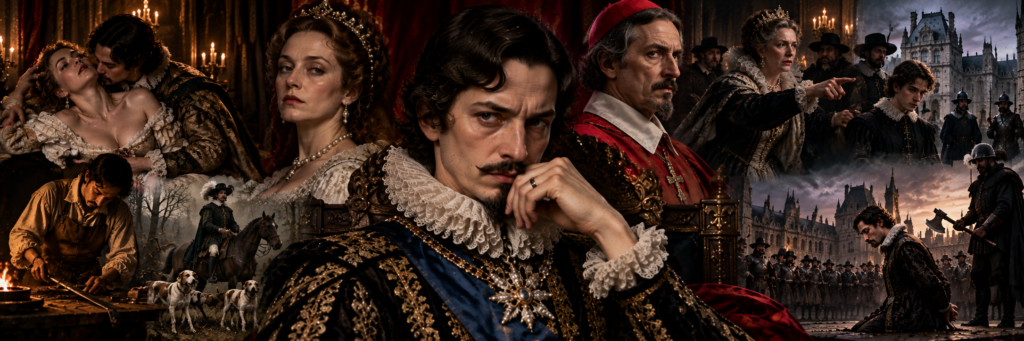
Louis XIII of France: The Suspicious King, His Treacherous Family, and the Bloody Struggle for Absolute Power
King of France and Navarre, 1610–1643
On the morning of April 22, 1627, a young nobleman named François de Montmorency-Bouteville walked into the Place Royale in Paris, determined to settle a matter of honor with a sword. Dueling had become a deadly obsession among the French aristocracy, and the practice had already claimed countless lives. Louis XIII had forbidden it, but powerful noblemen continued to behave as though royal decrees were suggestions rather than laws. Bouteville believed that his distinguished ancestry and influential connections would protect him from serious consequences. He was about to discover that the king he had defied was not interested in making another exception.
The duel ended with one participant dead and Bouteville facing prosecution. His family appealed for mercy, expecting the traditional privileges of the aristocracy to outweigh the demands of royal justice. Louis refused to intervene. On June 22, 1627, Bouteville was executed in Paris, sending a chilling message to the French nobility: even the most distinguished bloodlines would not necessarily protect a man who openly challenged the king’s authority. The execution shocked aristocratic society, where personal honor had long been defended through violence. To Louis, however, the issue was larger than a single duel. If noblemen could disregard his commands whenever they wished, what did it mean to be king?
The episode captures the unsettling contradictions of Louis XIII. He was a ruler who could appear withdrawn, hesitant, emotionally guarded, and painfully uncomfortable with the elaborate social expectations of monarchy. Yet he could also display extraordinary determination when he believed his authority was threatened. His reign witnessed the imprisonment of powerful nobles, the destruction of fortified strongholds, the exile of his own mother, and the execution of men who had once enjoyed his confidence. Court favorites could rise to astonishing heights before falling into disgrace, while family relationships became entangled with conspiracies that threatened the survival of his government. His closest political partnership, with Cardinal Richelieu, helped transform France into a more centralized and formidable European power.
Behind this political severity stood a king whose childhood had been overshadowed by assassination, family conflict, and an unusually public upbringing. Louis became king at eight years old after his father, Henry IV, was murdered in the streets of Paris. His mother, Marie de’ Medici, assumed control of the government, while ambitious courtiers competed for influence over the young monarch. As he grew older, Louis struggled to establish independence from the people who had governed in his name. His marriage to Anne of Austria produced no surviving child for more than two decades, creating constant anxiety over the succession. Meanwhile, recurring illness and a complicated emotional life made the demands of kingship increasingly difficult.
Later descriptions sometimes portray Louis as pathologically paranoid, psychologically unstable, or even mad. Such characterizations go beyond what the historical evidence can establish. Unlike rulers whose severe mental disturbances were clearly recorded, Louis XIII is not known to have experienced a sustained psychotic illness. His suspicion developed within a court where genuine conspiracies occurred, while his emotional reserve and unusual personal interests became targets for gossip and retrospective interpretation. His medical difficulties were real, but assigning modern psychiatric diagnoses to his behavior would be speculative.
Louis XIII’s story is therefore more complicated than that of a supposedly unstable king manipulated by a brilliant minister. He was a sovereign who learned early that the people closest to him could become political enemies, who struggled to reconcile private attachments with public responsibilities, and who helped build a monarchy powerful enough to dominate France long after his death. His reign was marked by betrayal, religious warfare, political violence, and deeply troubled family relationships. Yet it also laid foundations for the extraordinary power eventually exercised by his son, Louis XIV.
The Child King Who Watched His World Collapse
Louis was born on September 27, 1601, at the Château de Fontainebleau, the eldest surviving son of Henry IV and Marie de’ Medici. His birth was celebrated throughout France because it secured the succession of the relatively new Bourbon dynasty. Henry IV had spent years struggling to establish his authority after the French Wars of Religion, and the arrival of a legitimate male heir promised greater political stability. Louis grew up surrounded by the privileges of royalty, but his childhood was also shaped by the tensions of a complicated household. His father maintained relationships with several mistresses and acknowledged children born outside his marriage, while his mother struggled to assert her position within a court where personal relationships carried political consequences.
Much of Louis’s early life is unusually well documented because his physician, Jean Héroard, maintained an extensive journal recording his development, health, daily activities, and behavior. Héroard’s observations provide an extraordinary window into the upbringing of a seventeenth-century prince. They describe illnesses, meals, games, lessons, emotional reactions, and interactions with adults, sometimes in intimate detail. The journal is invaluable, although it also reflects the interests and assumptions of a physician observing a royal child rather than those of a modern psychologist. Later writers have sometimes extracted isolated incidents from its pages to construct dramatic theories about Louis’s personality. Such interpretations require caution because childhood behavior recorded without modern clinical context cannot establish an adult psychiatric diagnosis.
Louis’s relationship with his father appears to have included moments of affection and familiarity. Henry IV possessed a reputation for informality and was remembered for playing with his children in ways that surprised observers accustomed to more rigid royal ceremony. The young prince nevertheless grew up in a household governed by attendants, tutors, and expectations appropriate to his position. His education included religious instruction, military exercises, music, and preparation for government, although his interests did not always correspond to the scholarly ideals promoted by educators. He enjoyed practical activities and developed a strong attachment to hunting, riding, and other pursuits that would remain important throughout his life.
Everything changed on May 14, 1610, when François Ravaillac assassinated Henry IV in Paris. Louis was only eight years old, and the murder immediately placed the French crown upon his head. The assassination revived memories of the religious violence that had devastated France during the previous generation, while creating uncertainty over the direction of the monarchy. Marie de’ Medici assumed the regency, governing on behalf of her young son with the support of powerful advisers. Louis possessed the title and ceremonial dignity of kingship, but meaningful political authority remained in adult hands. The distinction between being king and actually exercising power would become one of the defining frustrations of his youth.
The psychological effect of his father’s assassination cannot be measured with certainty. Losing a parent violently at such an early age was unquestionably a serious event, but claims that it directly produced every later instance of suspicion, emotional reserve, or political severity oversimplify the evidence. Louis’s circumstances were also shaped by the demands of monarchy, the personalities of his guardians, and the unstable political environment surrounding the regency. He grew up knowing that his father had been murdered by a man motivated by religious hostility. He also learned that royal authority could be challenged by nobles, ministers, and members of the royal family itself. These were not imaginary dangers, and they would become increasingly important as he approached adulthood.
Marie de’ Medici: A Mother Who Would Not Surrender Power
Marie de’ Medici was determined to preserve her authority after becoming regent. As an Italian-born queen with powerful family connections, she faced hostility from courtiers who resented her influence and questioned the policies pursued during her government. She relied increasingly upon Concino Concini, an Italian favorite who rose to extraordinary prominence, and his wife, Leonora Dori, who had long enjoyed Marie’s confidence. Their influence became a source of resentment among French nobles, particularly those who believed that royal offices and rewards were being distributed through personal favoritism. Concini accumulated wealth, titles, and political power, eventually becoming Marshal of France despite lacking the military reputation traditionally associated with that rank. His advancement made him a symbol of the perceived corruption and foreign influence surrounding the regency.
Louis grew increasingly dissatisfied with his mother’s government as he approached adulthood. Although he was declared of age in 1614, Marie continued to exercise considerable influence, and Concini remained an important figure at court. The young king’s frustration was intensified by the presence of advisers who appeared to treat him as politically inexperienced. He was surrounded by ceremonies proclaiming his sovereignty while others controlled many of the decisions made in his name. The contradiction created opportunities for ambitious courtiers who encouraged him to assert himself against the regency’s dominant figures. Among those who gained his confidence was Charles d’Albert, a courtier whose relationship with Louis would transform the balance of power.
Accounts of Marie’s treatment of Louis sometimes describe severe emotional neglect and physical punishment. The historical record does show that royal children could be subjected to disciplinary practices now considered harsh, and Héroard recorded incidents involving correction and punishment. Nevertheless, the sweeping claim that Marie personally subjected Louis to continuous brutal abuse is not established simply by the existence of a troubled adult relationship. Their conflict developed within a political environment where control over the monarchy involved immense wealth, influence, and prestige. Marie’s determination to retain authority was not necessarily evidence that she lacked affection for her son, just as Louis’s later hostility does not prove that every childhood interaction was traumatic. Their relationship became destructive because maternal authority and royal sovereignty were increasingly difficult to reconcile.
The crisis reached its decisive moment in April 1617. Encouraged by Luynes and other supporters, Louis authorized action against Concini, who was killed while being arrested at the Louvre on April 24. The circumstances made the operation effectively a political assassination, even though it was carried out under royal authority. Leonora Dori was subsequently prosecuted on charges that included sorcery and was executed later that year. Marie de’ Medici lost control of the government and was removed from the center of political power, eventually being sent to Blois. Louis had finally asserted himself as king, but he had done so through an act of violence against the man who symbolized his mother’s government.
The events of 1617 demonstrated that Louis was capable of decisive action when his authority was at stake. They also established a pattern in which intimate relationships became inseparable from political survival. His mother had been displaced, her closest favorite killed, and her household dismantled. Luynes emerged as the new dominant figure at court, benefiting enormously from the king’s confidence. Yet the removal of Concini did not end the struggle between Louis and Marie. Their conflict would continue through rebellion, negotiation, reconciliation, and renewed political hostility, revealing how difficult it was for the Bourbon monarchy to separate family relationships from the exercise of power.
The King’s Favorite: Charles d’Albert, Duke of Luynes
Charles d’Albert, Duke of Luynes, became one of the most influential men in France after the fall of Concini. His rise was closely connected to his personal relationship with Louis, whom he had befriended through shared interests and court activities. Luynes understood how to gain the confidence of a young ruler who felt overshadowed by his mother’s advisers. He encouraged Louis’s independence while presenting himself as a loyal servant whose interests were aligned with those of the crown. The king rewarded him with titles, offices, and political influence, provoking resentment among nobles who believed that another favorite had merely replaced Concini. The change of personnel did not eliminate the underlying problem of access to royal authority.
Louis’s attachment to Luynes has attracted considerable attention from historians interested in his emotional life. Some accounts portray the relationship as unusually intense, emphasizing the king’s dependence upon a trusted companion and his difficulty forming equally close relationships with others. Such observations may illuminate the importance of personal confidence within his political world, but they do not establish the nature of his private sexuality. Early modern royal favorites occupied positions that combined friendship, patronage, service, and political intimacy, making modern categories difficult to apply without direct evidence. Louis’s relationship with Luynes was unquestionably significant because it shaped the distribution of power at court. Its emotional dimensions remain less certain than its political consequences.
Luynes accumulated substantial influence, but his position became vulnerable when military and political difficulties exposed the limitations of his abilities. During campaigns against Protestant strongholds, the crown struggled to achieve decisive success, and criticism of the royal favorite increased. Luynes died in December 1621, removing the man who had dominated Louis’s early independent government. His death created another transition in the king’s political life, eventually opening the way for Cardinal Richelieu’s rise. Louis had learned that favorites could help him escape dependence upon one faction while creating new problems of their own. Personal loyalty remained valuable, but it was not enough to guarantee effective government.
The Luynes period also challenges the familiar portrayal of Louis as entirely passive. He had participated in the removal of Concini and accepted the political consequences of that decision. Although Luynes exercised great influence, the king’s authority remained essential to his position. Louis could be hesitant in some circumstances and determined in others, depending upon the issue and the people involved. His behavior therefore cannot be reduced to a simple pattern of dependence or emotional instability. The monarchy operated through relationships of confidence, and Louis’s reliance upon favorites reflected the political structures of his age as well as his individual temperament.
A Mother Who Became a Political Enemy
Marie de’ Medici did not accept her removal from power without resistance. In 1619, she escaped from Blois and became involved in opposition to her son’s government, supported by nobles dissatisfied with the influence of Luynes. Negotiations temporarily reduced the conflict, but tensions continued, leading to renewed armed confrontation in 1620. Royal forces defeated troops associated with Marie’s supporters at the Battle of Ponts-de-Cé, demonstrating Louis’s determination to enforce his authority. The conflict was extraordinary because it placed the king and his mother on opposing sides of a military struggle. Yet it was not simply a private family quarrel transformed into warfare. Powerful aristocratic interests used Marie’s position to challenge the distribution of royal favor and influence.
The mother-son conflict became one of the defining features of Louis’s early reign. Marie retained political ambitions and connections, while Louis resisted efforts to restore her former authority. Their relationship was further complicated by the role of churchmen and courtiers who attempted to negotiate reconciliation. Among those involved was Armand Jean du Plessis, the future Cardinal Richelieu, who initially advanced through service to Marie before becoming indispensable to Louis. Richelieu’s career demonstrates how political alliances could shift within the royal household, sometimes transforming former opponents into essential advisers. The king eventually recognized the value of Richelieu’s administrative abilities, despite his association with Marie. That decision would have enormous consequences for France.
Marie returned to political influence for a period, but the reconciliation remained fragile. Her opposition to Richelieu eventually created a direct conflict between her ambitions and the king’s chosen minister. She believed that her position as the king’s mother entitled her to considerable authority over appointments and policy, while Louis increasingly insisted that his ministers serve the crown according to his own judgment. The struggle reached its climax in 1630 during the episode remembered as the Day of the Dupes. By then, Richelieu had become central to the monarchy’s efforts to strengthen royal government and confront powerful opponents. Marie’s attempt to remove him would force Louis to choose between his mother and the minister upon whom much of his government depended.
Cardinal Richelieu: The Minister Who Understood the King
Cardinal Richelieu entered Louis’s council in 1624 and gradually became the dominant minister of the reign. His intelligence, administrative skill, and determination made him an unusually effective servant of royal authority. Richelieu understood that France’s political stability depended upon reducing the independence of powerful nobles, controlling internal rebellion, and resisting the strategic encirclement created by Habsburg power. These objectives aligned with Louis’s desire to strengthen the monarchy and prevent rival factions from undermining his government. Their partnership became one of the most consequential political relationships in early modern European history. Yet the familiar image of Richelieu as the true ruler of France, with Louis reduced to a weak figurehead, oversimplifies their relationship.
Louis retained the authority to appoint, dismiss, and support his ministers. Richelieu’s influence depended upon the king’s confidence, particularly when powerful courtiers and members of the royal family attempted to destroy him. The cardinal provided administrative continuity, political strategy, and an extensive network of information, while Louis supplied the sovereign authority necessary to implement difficult decisions. Their collaboration was not always harmonious, and the king could disagree with his minister or become irritated by the burdens of government. Nevertheless, Louis repeatedly defended Richelieu against enemies who expected personal pressure to secure his dismissal. Such decisions demonstrate that the king understood the political value of the partnership.
Richelieu’s relationship with Louis has sometimes been interpreted as an attempt to manage a psychologically unstable monarch. That description risks reducing complex political interactions to speculative medical explanations. The cardinal certainly needed to understand the king’s preferences, emotional reactions, and relationships, just as any powerful minister needed to navigate the personality of the sovereign. Louis’s reserve, illnesses, and attachment to trusted companions may have affected how he conducted business, but they did not prevent sustained political cooperation. Richelieu succeeded partly because he translated broad royal objectives into practical policies. The partnership was effective because both men shared an interest in strengthening the crown, even when their methods generated intense opposition.
Their government became associated with a growing emphasis upon the authority of the state. Noble rebellions, private military power, fortified Protestant strongholds, and independent political negotiations all threatened the monarchy’s ability to govern consistently. Richelieu pursued policies intended to reduce these competing sources of authority, often using force when negotiation failed. Louis supported these measures because he believed that royal sovereignty required obedience from subjects regardless of rank. The resulting government could be severe, but its severity was connected to recognizable political objectives. The executions and imprisonments of prominent opponents reflected a struggle over the distribution of power rather than random violence produced by an irrational king.
The Day of the Dupes: When Louis Chose His Minister Over His Mother
The Day of the Dupes in November 1630 became one of the most dramatic political crises of Louis XIII’s reign. Marie de’ Medici and her supporters believed that Richelieu’s influence had become intolerable and that the king could be persuaded to dismiss him. The confrontation unfolded amid court maneuvering and private discussions in which Marie attempted to use her maternal authority against the cardinal. For a time, Richelieu’s position appeared endangered, and his enemies anticipated his downfall. The atmosphere was one of intense uncertainty because the king’s decision would determine not merely the fate of a minister but the direction of French government. Louis’s personal relationship with his mother was placed directly against his political confidence in Richelieu.
Contrary to Marie’s expectations, Louis ultimately reaffirmed his support for the cardinal. Richelieu survived the crisis, while several of his opponents lost influence and office. Marie’s position deteriorated further, and she eventually left France, spending her final years in exile. The episode acquired its memorable name because those who believed they had secured Richelieu’s dismissal discovered that they had misunderstood the king’s intentions. Louis had chosen political continuity over his mother’s demands, demonstrating a willingness to endure a painful family rupture in defense of his government. The decision was emotionally consequential, but it was also politically coherent. Richelieu had become central to the policies Louis wished to pursue, and dismissing him would have strengthened factions the king distrusted.
The Day of the Dupes is sometimes presented as evidence of Louis’s extraordinary emotional coldness. He allowed his mother to lose influence and eventually remain abroad, despite the dynastic importance of her position. Yet the political conflict had developed over many years and involved repeated challenges to royal authority. Marie was not merely an offended parent; she was a former regent with influential supporters and ambitions that threatened the ministerial system Louis had established. The king’s decision therefore reflected the realities of sovereignty within a monarchy where family members could become centers of opposition. His conduct may appear harsh, but it cannot be explained adequately through speculation about psychological dysfunction. The crisis demonstrated that Louis was prepared to sacrifice personal relationships when he believed the authority of the crown was at stake.
Anne of Austria: A Marriage Without Trust
Louis XIII married Anne of Austria in November 1615, when both were fourteen years old. Anne was the daughter of Philip III of Spain, and the marriage formed part of a diplomatic arrangement intended to strengthen relations between the French and Spanish monarchies. Their union was politically important, but it developed into one of the most troubled royal marriages of the seventeenth century. The couple experienced long periods of emotional distance, and the absence of a surviving child for more than two decades created serious anxiety about the succession. Court observers speculated about their relationship, while factions attempted to exploit the queen’s position for political advantage. The marriage became especially difficult as France’s relations with Spain deteriorated and Anne’s family connections attracted suspicion.
Popular accounts sometimes portray Louis as terrified of women or incapable of intimacy, claiming that advisers physically forced him into Anne’s bedchamber. Such descriptions exaggerate a complicated marital history and often rely upon anecdotes whose precise circumstances are uncertain. The couple’s relationship involved ceremonial expectations, personal tensions, intermittent intimacy, and political disagreements. Their failure to produce an heir for many years does not establish a particular medical or psychological condition in either spouse. Early modern observers frequently interpreted infertility through moral, religious, or bodily theories that do not correspond to modern reproductive medicine. The marriage also unfolded under extraordinary pressure because the future of the Bourbon dynasty depended upon the birth of a legitimate son. Every delay encouraged speculation and intensified the attention directed toward the royal couple.
Anne’s position became more dangerous as political tensions between France and Spain increased. Her correspondence with members of her family and associates attracted suspicion, particularly because Richelieu’s foreign policy increasingly opposed Habsburg interests. In 1637, the queen became embroiled in a serious investigation concerning secret correspondence with Spain. The affair damaged her standing and reinforced Louis’s concerns about the possibility that family loyalties could conflict with the interests of the French crown. Yet it would be misleading to portray Anne simply as a foreign conspirator working against her husband. Her circumstances were shaped by dynastic obligations, personal relationships, and the difficulties of being a Spanish-born queen in a kingdom moving toward open war with Spain. The conflict revealed how royal marriages intended to secure peace could become sources of suspicion when international alliances changed.
In September 1638, Anne gave birth to a son, the future Louis XIV, after more than twenty-two years of marriage. The birth was celebrated as an extraordinary event, securing the succession and reducing the political importance of Louis’s younger brother Gaston. A second son, Philippe, followed in 1640, strengthening the dynasty further. The arrival of heirs did not erase every difficulty within the marriage, but it transformed the political position of the queen and the monarchy. Anne would eventually become regent for her son after Louis XIII’s death, occupying a role similar to that once held by Marie de’ Medici. The irony was considerable because Louis had spent much of his reign resisting the political influence of his own mother. His death would once again place the government of France in the hands of a queen mother ruling for a child king.
Gaston d’Orléans: The Brother Who Could Not Be Trusted
Gaston, Duke of Orléans, was Louis XIII’s younger brother and, for many years, the most important potential heir to the French throne. His position made him a natural focus for nobles dissatisfied with Richelieu’s policies and the growing authority of the monarchy. Gaston repeatedly became involved in opposition movements, conspiracies, and political intrigues that threatened the government. His ambitions were complicated by the fact that Louis had no surviving child until 1638, making Gaston’s succession a realistic possibility for much of the reign. The resulting uncertainty encouraged factions to cultivate his favor and imagine alternative political arrangements. His conduct contributed substantially to the atmosphere of suspicion surrounding the court.
Gaston participated in the rebellion associated with Henri II de Montmorency in 1632, a conflict that challenged royal authority in southern France. Montmorency was defeated and captured at the Battle of Castelnaudary, while Gaston avoided the consequences imposed upon his ally. The duke’s involvement demonstrated how royal relatives could provide legitimacy to aristocratic opposition. Louis faced a difficult choice between protecting dynastic family members and punishing those who undermined his government. His treatment of Gaston was often more restrained than his treatment of noble associates, reflecting the political significance of the royal bloodline. Nevertheless, the repeated conspiracies damaged their relationship and reinforced the king’s reluctance to trust his brother.
Gaston later became connected to additional intrigues, including the conspiracy involving the Marquis de Cinq-Mars in 1642. His recurring involvement in opposition movements revealed both personal ambition and the continuing resistance of aristocratic factions to Richelieu’s centralizing policies. Yet the claim that Gaston spent decades continuously organizing assassination plots against Louis exaggerates the surviving evidence. His political record includes rebellion, conspiracy, negotiation, and retreat, but not every episode involved a documented plan to murder the king. Distinguishing these forms of opposition matters because accusations of assassination could serve political purposes within an already hostile court. Louis had genuine reasons to distrust Gaston, but those reasons should be described accurately rather than inflated into an uninterrupted campaign of attempted murder.
The birth of Louis XIV in 1638 transformed Gaston’s position by removing him from immediate proximity to the succession. The arrival of a legitimate heir reduced the incentive for factions to imagine Gaston as the next king, although it did not eliminate his political ambitions. His continued involvement in court intrigue demonstrated that dynastic stability could reduce certain dangers without resolving the underlying struggle over aristocratic influence. Louis’s relationship with his brother therefore remained a source of anxiety throughout the reign. The conflict illustrates how family connections could become political liabilities in a monarchy where succession determined access to power. Gaston was not simply a disloyal sibling, but a prince whose position encouraged opposition movements to gather around him.
The Artisan King: Blacksmithing, Cooking, and Unusual Royal Hobbies
Louis XIII possessed practical interests that distinguished him from the conventional image of a monarch devoted exclusively to ceremony, warfare, and government. He enjoyed music, hunting, riding, and various manual activities, while contemporary accounts describe his interest in working with his hands. Later writers have emphasized his fascination with crafts such as metalworking, cooking, and mechanical tasks, sometimes portraying these pursuits as obsessive or undignified. The king’s enjoyment of practical work was unusual enough to attract attention, but it should not be interpreted automatically as evidence of psychological disturbance. Royal households contained workshops, kitchens, stables, and skilled artisans whose activities could interest an intellectually curious ruler. Louis’s preferences reflected a personality drawn toward tangible tasks and familiar routines rather than constant ceremonial display.
Some accounts claim that Louis shoed horses, worked as a blacksmith, prepared sweets, cut hair, shaved attendants, and experimented with firearms. Individual activities appear in traditions concerning his hobbies, but the more elaborate lists often combine observations from different sources without establishing how frequently he performed each task. The familiar story that he cultivated early green peas and sold them to courtiers for profit is especially picturesque and should be treated cautiously unless supported by a reliable contemporary account. Similarly, claims that he personally manufactured gunpowder with obsessive precision require stronger evidence than repetition in popular biographies. His documented enjoyment of music and practical pursuits is sufficient to establish that he possessed interests beyond politics. The transformation of those interests into a catalogue of compulsive behaviors reflects later attempts to explain his personality through eccentricity.
Louis’s musical interests deserve particular attention because they complicate the image of a king who supposedly hated intellectual or artistic pursuits. He played instruments, enjoyed musical performance, and participated in the court culture that helped shape French ballet and ceremonial entertainment. His involvement in the Ballet de la Merlaison in 1635 is a notable example of royal participation in artistic performance. Such activities required attention, practice, and creative engagement, contradicting the sweeping claim that he rejected all forms of learning or culture. His preferences may have differed from those of more scholarly rulers, but that distinction does not establish intellectual incapacity. Louis’s interests reveal a personality capable of discipline and artistic enjoyment, even while he struggled with the demands of court politics.
The fascination with his manual hobbies also reflects the social expectations of monarchy. Noble identity was closely associated with warfare, hunting, landholding, and ceremonial authority, while many skilled trades were performed by people of lower social status. A king who enjoyed practical tasks could therefore appear unusual to observers who expected royal dignity to be expressed through distance from ordinary labor. Yet aristocrats often possessed technical interests, particularly in weapons, horses, engineering, and military equipment. Louis’s activities were not entirely disconnected from the skills valued by his social class. Their eccentricity depended partly upon how they were described and the assumptions of those observing them. The artisan king was therefore less mysterious than later caricatures suggest.
Versailles: The Hunting Lodge That Became a Royal Obsession
Louis XIII’s attachment to hunting played an important role in the development of Versailles. In 1623, he established a modest hunting lodge in the area, which offered access to forests and hunting grounds beyond the crowded political environment of Paris. The site was relatively unimportant compared with the great royal residences of the period, but it appealed to Louis’s preference for hunting and a smaller household. During the 1630s, he expanded and rebuilt the lodge into a more substantial residence. The project remained modest compared with the enormous palace later created by Louis XIV, but it established the royal presence that would eventually transform Versailles into the symbolic center of French absolutism. The contrast between father and son became especially striking because Louis XIII valued the site partly for its relative simplicity.
Later accounts sometimes describe Louis retreating to Versailles because he could not tolerate human company or wished to escape every form of political responsibility. His preference for hunting and smaller residences certainly suggests that he sometimes found relief away from the pressures of court. Nevertheless, royal hunting was not merely an antisocial pastime. It was a traditional aristocratic activity that reinforced social relationships, displayed physical skill, and provided opportunities for informal political discussion. Louis’s enjoyment of the countryside therefore belonged to established royal culture as well as to his personal temperament. His use of Versailles does not prove that he suffered from a pathological fear of social interaction. It demonstrates that he valued an environment where he could exercise greater control over his surroundings and enjoy activities that interested him.
The later transformation of Versailles under Louis XIV created an extraordinary historical irony. The modest hunting retreat favored by a relatively reserved king became the most elaborate ceremonial palace in Europe, designed to display royal magnificence and organize aristocratic life around the sovereign. Louis XIV used Versailles to make proximity to the monarch a central instrument of political power. His father had helped strengthen the monarchy through military campaigns, administrative centralization, and the suppression of rebellion, while the son expressed that power through architecture and ceremony. The connection between the two reigns is therefore more than architectural. Versailles became a visible symbol of the authority Louis XIII and Richelieu had worked to consolidate. What began as a hunting residence eventually embodied the political transformation of the Bourbon monarchy.
The King’s Health: Chronic Pain and the Limits of Medical Knowledge
Louis XIII experienced recurring illnesses throughout his life, and his physical health became increasingly fragile during his later years. Contemporary records describe digestive problems, episodes of fever, weakness, and other symptoms that caused considerable suffering. His physicians treated him according to the medical theories of the seventeenth century, using interventions that could be uncomfortable, exhausting, or potentially harmful. Bloodletting, purging, and other practices reflected prevailing ideas about bodily balance rather than modern understanding of disease. The king’s illnesses affected his ability to travel, participate in military campaigns, and conduct government business. They also contributed to an atmosphere in which the health of the sovereign was a matter of national concern because political stability depended upon his survival.
Modern writers have proposed several possible explanations for Louis’s chronic digestive problems, including inflammatory bowel disease and intestinal tuberculosis. Crohn’s disease is sometimes suggested, but the surviving descriptions do not permit a definitive diagnosis. Symptoms recorded by early modern physicians may correspond to multiple conditions, while the absence of modern examinations makes retrospective identification uncertain. It is therefore misleading to state that Louis definitely suffered from Crohn’s disease or that a particular illness explains his personality. Chronic pain and repeated medical treatment could reasonably affect anyone’s mood, energy, and behavior, but the extent of that influence cannot be measured precisely in his case. His physical suffering was real, while modern diagnostic labels remain hypotheses.
Claims that Louis experienced severe migraines, a congenital speech disorder, or specific neurological conditions also require careful handling. Some accounts describe difficulties with speech or a tendency toward reserve, but these observations do not automatically establish a lifelong neurological disability. Similarly, reports of unusual habits involving bodily functions should not be treated as reliable medical symptoms without contemporary evidence and context. Early modern observers frequently interpreted physical characteristics through theories of temperament, morality, and inherited constitution. Their descriptions can provide valuable information, but they do not always correspond to modern clinical categories. Louis’s health should therefore be discussed through documented symptoms and the limitations of historical medicine rather than through an accumulated list of speculative diagnoses.
The relationship between illness and political conduct is especially difficult to establish. Louis could become frustrated, withdrawn, or irritable during periods of physical suffering, but such reactions are not evidence of psychiatric illness. His political decisions also developed within complex circumstances involving ministers, military threats, religious conflicts, and dynastic rivalries. Attributing executions or diplomatic policies directly to intestinal disease would ignore the political reasoning behind those decisions. His illnesses undoubtedly imposed burdens upon his daily life, yet they did not prevent him from sustaining a long and consequential reign. The historical record therefore supports an image of a physically vulnerable king who remained politically engaged rather than one whose government was simply driven by medical instability.
Religious War and the Siege of La Rochelle
The struggle against Huguenot political and military independence became one of the central conflicts of Louis XIII’s reign. Although the Edict of Nantes had granted important protections to French Protestants, some Huguenot communities retained fortified positions and political structures that royal ministers regarded as threats to centralized authority. La Rochelle, a major Atlantic port with strong Protestant connections, became the most important symbol of this resistance. Its strategic location and commercial importance made it a formidable opponent, particularly when foreign support complicated the conflict. Richelieu and Louis viewed the reduction of such independent military power as essential to strengthening the monarchy. Their campaign therefore combined religious tensions with questions of sovereignty and state authority.
The siege of La Rochelle began in 1627 and continued into 1628, producing severe suffering among the inhabitants. Royal forces constructed extensive siege works, including a barrier intended to restrict access to the harbor and prevent relief by sea. English intervention failed to break the siege, while food shortages devastated the population. Thousands died from hunger and disease before the city surrendered in October 1628. The victory represented a major achievement for the crown, but it came at an appalling human cost. Louis and Richelieu had demonstrated that the monarchy could overcome a powerful fortified community whose independence challenged royal authority. The siege also revealed the ruthless methods that early modern governments could employ when military objectives were considered essential.
The settlement that followed did not abolish Protestant worship throughout France. The Peace of Alès in 1629 removed important political and military privileges from Huguenot communities while preserving the core religious protections associated with the Edict of Nantes. This distinction is essential because Louis’s policy was not simply an attempt to eliminate Protestantism by force. The government sought to prevent Protestant communities from maintaining autonomous military structures capable of challenging the crown. Religious discrimination and political coercion remained part of the system, but the settlement did not require universal conversion to Catholicism. The result strengthened centralized authority while preserving a limited framework for Protestant religious life. It also demonstrated the monarchy’s determination to separate religious toleration from political independence.
The campaign against La Rochelle illustrates the severity of Louis’s government without requiring psychiatric explanations. The siege was a calculated military operation intended to achieve strategic and political objectives, even though its consequences for civilians were devastating. The king’s willingness to continue the siege despite suffering reflected the harsh logic of early modern warfare and the priority placed upon royal authority. Such decisions deserve historical scrutiny because they involved enormous human costs. Yet they cannot be understood adequately through labels such as mania or irrational cruelty. Louis and Richelieu pursued a coherent, if coercive, vision of monarchy in which independent armed communities were incompatible with sovereign government. Their success helped reshape the political structure of France.
The Reign of the Axe: Noble Blood on the Scaffold
Louis XIII’s government became associated with severe punishments imposed upon nobles who challenged royal authority. The execution of Montmorency-Bouteville in 1627 demonstrated that aristocratic privilege would not necessarily protect individuals who openly defied royal decrees. Other prominent nobles faced prosecution, imprisonment, exile, or execution when their actions were judged threatening to the crown. These punishments shocked a society in which noble families expected special consideration because of their ancestry and service. The monarchy’s determination to enforce obedience therefore appeared unusually harsh to those accustomed to negotiating exceptions. Louis’s reputation for severity grew as the government used exemplary punishment to discourage rebellion and conspiracy.
The execution of Henri II de Montmorency in 1632 was particularly significant. Montmorency belonged to one of France’s most distinguished noble families and had served the crown in important military and administrative roles. His involvement in rebellion alongside Gaston d’Orléans placed him in direct opposition to the king’s government. After his defeat and capture at Castelnaudary, he was tried and condemned to death. Appeals for clemency failed, and he was executed at Toulouse in October 1632. The decision shocked aristocratic society because Montmorency’s lineage and reputation had traditionally been associated with exceptional prestige. Louis’s refusal to spare him demonstrated that rebellion against the crown could outweigh even the most distinguished noble ancestry.
The severity of these punishments has sometimes encouraged descriptions of Louis’s reign as exceptionally bloodthirsty. Such language should be used cautiously because comparisons with other French reigns require consistent evidence about executions, prosecutions, and political violence. It would be inaccurate to declare his court the bloodiest in French history without a reliable basis for that ranking. Nevertheless, the execution of prominent nobles was an important feature of the government’s efforts to strengthen royal authority. The monarchy sought to demonstrate that private military power and aristocratic rebellion could no longer operate with impunity. The resulting violence was politically calculated, even when contemporaries considered it excessive. Louis’s severity reflected a struggle over sovereignty rather than an inexplicable appetite for blood.
The executions also had a psychological effect upon the aristocracy because they weakened assumptions about inherited immunity from royal punishment. Noble families had long participated in factional politics, private warfare, and regional power struggles, sometimes negotiating with the crown from positions of considerable strength. Richelieu and Louis attempted to reduce these forms of independence by strengthening central administration and enforcing royal commands. The process was incomplete, and aristocratic opposition continued after Louis’s death. Nevertheless, the reign marked an important stage in the development of a more centralized monarchy. The scaffold became one instrument through which the government communicated the consequences of defiance. The message was unmistakable: noble blood no longer guaranteed safety when royal authority was challenged.
Cinq-Mars: The Favorite Who Betrayed His King
Henri Coiffier de Ruzé, Marquis de Cinq-Mars, became one of Louis XIII’s most prominent favorites during the later years of the reign. Young, ambitious, and closely associated with the king’s household, he gained access to royal confidence and received important honors. His position attracted resentment from courtiers who believed that personal favor had once again become a route to extraordinary advancement. Louis’s attachment to Cinq-Mars appears to have been emotionally significant, although the precise nature of their relationship remains uncertain. Later interpretations have sometimes suggested a romantic or sexual dimension, but the surviving evidence does not establish such claims definitively. What can be demonstrated is that Cinq-Mars enjoyed privileged access to the king and eventually became dissatisfied with the political limits imposed upon his ambitions.
Cinq-Mars’s relationship with Richelieu deteriorated as he sought greater influence over government. The cardinal regarded him as politically unreliable and resisted efforts that might undermine established policy. Cinq-Mars eventually became involved in a conspiracy intended to remove Richelieu and alter the direction of French foreign policy. The plot included negotiations with Spain, a power against which France was actively fighting. Such dealings were extraordinarily dangerous because they involved potential cooperation with a foreign enemy during wartime. The conspiracy also drew upon the involvement of Gaston d’Orléans and other dissatisfied figures. Once discovered, it placed Cinq-Mars in direct conflict with the king whose favor had enabled his rise.
Cinq-Mars was arrested, tried, and executed at Lyon in September 1642, alongside François-Auguste de Thou. His death became one of the most dramatic examples of Louis’s willingness to punish a former favorite. The king did not save him from the consequences of conspiracy, despite their previous closeness. Later accounts sometimes portray Louis as emotionally devastated by the betrayal, shifting suddenly from affection to icy cruelty. Such descriptions may capture the perceived drama of the relationship, but the king’s private feelings cannot be reconstructed with certainty. The political facts are clearer: Cinq-Mars had participated in a conspiracy involving foreign interests, and the government treated the offense as treason. His execution demonstrated that personal access to the sovereign offered no guaranteed protection when royal authority was threatened.
The affair also revealed the limitations of favoritism within Louis’s court. A favorite could enjoy extraordinary intimacy and influence, but those advantages depended upon continued royal confidence and political loyalty. Cinq-Mars’s ambitions brought him into conflict with Richelieu, whose policies remained central to the government’s direction. Louis ultimately chose to preserve the political system he had supported rather than protect a companion who threatened it. The decision resembles his earlier choice during the Day of the Dupes, when he supported Richelieu against his mother. In both cases, personal relationships were subordinated to the preservation of royal authority. The pattern suggests political consistency rather than random emotional volatility.
Fear, Nighttime Rituals, and the Legends of a Troubled King
Louis XIII’s reserved personality and complicated emotional relationships encouraged numerous anecdotes about his private habits. Some portray him as frightened of darkness, ghosts, ridicule, or solitude, while others describe elaborate nighttime arrangements involving attendants and trusted companions. Such stories have sometimes been interpreted as evidence of severe phobias or psychological dependence. Yet early modern royal sleeping arrangements differed considerably from modern expectations, and the presence of attendants near a monarch’s bedchamber was not inherently unusual. Royal households operated through elaborate systems of service, security, and ceremony, making privacy a complicated concept. The claim that Louis routinely required servants to share his bed because he was terrified of sleeping alone needs stronger evidence than later repetition. Without reliable documentation, it should not be presented as an established psychological symptom.
The king’s sensitivity to ridicule is more plausible within the context of his upbringing and political position. A child monarch surrounded by ambitious adults could reasonably become conscious of how others interpreted his behavior. Royal authority depended partly upon dignity, and public embarrassment could have political consequences when nobles were already inclined to challenge the crown. Louis’s preference for trusted companions and familiar activities may therefore reflect the pressures of kingship rather than a clinical fear of social judgment. His reserve was certainly noted by observers, but reserve does not establish pathological anxiety. The distinction matters because historical personalities are often simplified through modern psychological language that appears explanatory while exceeding the evidence.
Other sensational anecdotes attribute cruel practical jokes and deliberate mistreatment of animals to Louis. Some stories claim that he enjoyed injuring birds, humiliating servants, or causing pain for amusement. These allegations should not be accepted automatically, particularly when their sources are unclear or hostile. Hunting and falconry were established aristocratic pursuits that involved killing animals, but participation in those activities does not prove enjoyment of cruelty outside their conventional context. Early modern standards concerning animals differed from contemporary expectations, making interpretation especially difficult. Louis’s documented political severity is substantial enough to examine without adding poorly supported stories of private sadism. A responsible account distinguishes between actions established by reliable evidence and allegations that may have developed through hostile commentary or later embellishment.
War Against the Habsburgs: France Enters the Thirty Years’ War
Louis XIII’s reign unfolded during the Thirty Years’ War, a conflict that transformed the political and religious landscape of Europe. France initially supported opponents of Habsburg power through diplomacy and financial assistance, even when those allies were Protestant. The policy reflected strategic concerns about the territories controlled by the Spanish and Austrian branches of the Habsburg dynasty. Richelieu argued that France’s security required resistance to encirclement, regardless of the religious identity of potential allies. This approach could appear contradictory because the French monarchy was suppressing Protestant political independence at home while supporting Protestant powers abroad. Yet the distinction reflected the government’s prioritization of state interests over simple confessional alignment in foreign policy. Louis supported this strategy because it promised to strengthen France’s position in Europe.
France entered the war directly against Spain in 1635, committing substantial resources to a prolonged conflict. The decision increased financial pressure and exposed French territory to military threats, particularly during the difficult early years of intervention. Royal armies experienced setbacks as well as successes, while taxation and wartime demands contributed to domestic unrest. The government nevertheless continued its efforts to weaken Habsburg power, demonstrating a willingness to accept considerable costs for strategic objectives. Louis participated in military affairs and maintained an interest in campaigns despite recurring health difficulties. His involvement challenges the portrayal of him as a king who simply abandoned government to Richelieu. The partnership between monarch and minister remained central to the conduct of war.
The conflict also contributed to the strengthening of administrative institutions because sustained warfare required taxation, recruitment, logistics, and coordination on an increasingly large scale. Richelieu’s government expanded mechanisms for enforcing royal decisions in the provinces, including the use of officials who helped supervise administration and revenue. These developments did not create a fully modern bureaucratic state, but they marked important stages in the consolidation of central authority. Louis’s reign therefore helped establish structures that later Bourbon rulers would develop further. The costs were considerable, and ordinary communities often bore the burden through taxation, requisitions, and disruption. The strengthening of the monarchy was inseparable from the expansion of its capacity to demand resources from subjects. Political centralization brought greater state power, but it did not necessarily bring immediate relief to those required to finance it.
Richelieu’s Death and the King’s Final Months
Cardinal Richelieu died on December 4, 1642, ending the political partnership that had defined much of Louis XIII’s reign. His death occurred only months after the execution of Cinq-Mars, whose conspiracy had represented one of the most serious challenges to the cardinal’s position. Louis was already suffering from deteriorating health, and the loss of his principal minister created uncertainty over the government’s future. The king nevertheless continued to exercise authority, supporting the continuation of policies associated with Richelieu. Cardinal Mazarin emerged as an increasingly important figure, helping preserve continuity during the transition. The government therefore did not collapse when its most prominent minister died. Louis’s ability to sustain the political direction of the monarchy demonstrated that Richelieu’s influence had depended upon a broader royal commitment rather than personal domination alone.
During the final months of his life, Louis’s physical condition worsened considerably. Contemporary descriptions suggest severe digestive illness and progressive weakness, although the precise underlying disease remains uncertain. His physicians continued to administer treatments consistent with seventeenth-century medical practice, while members of the court prepared for the possibility of his death. The king’s deteriorating health made the succession increasingly important, particularly because his heir was still a young child. Louis attempted to establish arrangements intended to regulate the regency and limit the concentration of authority after his death. Such measures reflected his long experience of the dangers associated with minority government and the influence of powerful courtiers. Yet the effectiveness of these arrangements would depend upon the political circumstances following his death.
Louis XIII died on May 14, 1643, at Saint-Germain-en-Laye, exactly thirty-three years after the assassination of his father, Henry IV. He was forty-one years old and had reigned for nearly thirty-three years. His son succeeded him as Louis XIV at the age of four, placing France once again under a child monarch. Anne of Austria became regent, supported by Mazarin, whose influence would shape the early years of the new reign. The succession preserved the Bourbon dynasty but revived familiar questions about the authority of regents, ministers, and powerful nobles. Louis had spent much of his life attempting to prevent rival factions from dominating the monarchy. His death demonstrated that the political structures he had strengthened would still face serious challenges when royal authority passed to a child.
The Father of the Sun King: Louis XIII’s Lasting Legacy
Louis XIII is frequently overshadowed by his son, Louis XIV, whose long reign became synonymous with royal absolutism and the magnificence of Versailles. The contrast between father and son has encouraged a simplified historical narrative in which Louis XIII appears weak, withdrawn, and dependent upon Richelieu, while Louis XIV emerges as the confident ruler who perfected absolute monarchy. Such a portrayal underestimates the importance of the earlier reign. Louis XIII helped reduce the independence of powerful nobles, strengthened the authority of the crown, confronted fortified political opposition, and supported policies that increased France’s influence in Europe. His partnership with Richelieu was essential to these developments, but it did not eliminate his own political agency. The king repeatedly made decisions that sustained the minister’s position against formidable opposition.
The centralization achieved during Louis’s reign was incomplete, and the monarchy continued to face aristocratic resistance after his death. The Fronde rebellions during Louis XIV’s minority demonstrated that powerful nobles and political institutions remained capable of challenging royal government. Nevertheless, the foundations of stronger central authority had been established, allowing later rulers to develop systems of control that would have been difficult to imagine during the regency of Marie de’ Medici. Louis XIII’s policies therefore formed an important bridge between the restoration of royal power under Henry IV and the more elaborate absolutism associated with his son. The transformation involved violence, coercion, administrative reform, and military expansion. Its consequences were profound for France and for the wider European balance of power.
Louis’s personal reputation remained complicated because his reserved temperament and unusual interests did not fit the popular image of a commanding monarch. He lacked the flamboyant charm associated with Henry IV and the theatrical magnificence later cultivated by Louis XIV. His relationships with favorites attracted speculation, while his marriage and family conflicts became subjects of gossip and political interpretation. Chronic illness further contributed to the image of a physically vulnerable king struggling under the burdens of government. Yet these characteristics did not prevent him from exercising decisive authority when he considered it necessary. His political career demonstrates that royal power could be expressed through persistence, suspicion, and reliance upon capable ministers rather than through constant public display.
Was Louis XIII Mad? The Difference Between Suspicion and Insanity
The claim that Louis XIII was mad rests largely upon retrospective interpretations of his personality rather than evidence of a clearly documented psychiatric disorder. His childhood was marked by the assassination of his father and the political dominance of his mother, while his adult life involved repeated conspiracies and conflicts with powerful relatives. These experiences provide a plausible context for caution and mistrust, but they do not establish a particular psychological diagnosis. His emotional reserve, attachments to favorites, and discomfort with some aspects of court life may reflect temperament, upbringing, or personal preference. Chronic illness added further difficulties, but the precise relationship between physical suffering and emotional behavior cannot be determined. The historical evidence supports a complex and sometimes troubled personality rather than a definitive conclusion of clinical insanity.
Louis’s political suspicion was frequently directed toward genuine threats. His mother became involved in armed opposition, his brother participated in repeated conspiracies, and powerful nobles negotiated with foreign enemies or challenged royal authority. The Cinq-Mars conspiracy demonstrated that even a favored courtier could become involved in treasonous dealings. Under such circumstances, vigilance was not necessarily pathological. The king’s willingness to punish prominent opponents could be severe, but the punishments generally followed identifiable political conflicts. His government pursued a coherent program of centralization, military strength, and resistance to rival centers of authority. These objectives do not excuse every act of coercion, but they demonstrate that his decisions were connected to political reasoning rather than unexplained psychological impulses.
The more sensational anecdotes about his private habits require similar caution. Stories about sleeping arrangements, cruelty to animals, unusual bodily functions, and obsessive manual labor are often repeated without sufficient attention to their sources. Some may preserve genuine observations, while others reflect exaggeration or the tendency to interpret unconventional behavior as evidence of instability. Louis’s interest in music, hunting, and practical activities is well established, but those interests do not constitute symptoms of mental illness. His marital difficulties and close relationships with male favorites also resist simple interpretation through modern assumptions. The historical record cannot establish his private sexuality or emotional life with the certainty sometimes claimed by popular accounts. A responsible assessment must acknowledge those limits rather than transforming uncertainty into diagnosis.
The King Who Trusted Almost No One—and Built a Stronger Monarchy
Louis XIII inherited a crown surrounded by uncertainty. His father had been murdered, his mother controlled the government, and powerful nobles competed for influence over a child who possessed royal dignity without meaningful independence. As he matured, he discovered that establishing authority required confronting the people who had governed in his name. He removed Concini, displaced his mother, elevated Luynes, and eventually entrusted much of the administration to Richelieu. Each transition exposed him to accusations of weakness, favoritism, or cruelty, while the recurring threat of conspiracy reinforced his determination to defend the monarchy. His reign became a struggle to transform royal authority from a contested inheritance into an effective instrument of government.
The cost of that transformation was considerable. Noblemen died on the scaffold, rebellious communities suffered siege and starvation, and family relationships deteriorated under the pressure of political conflict. Louis’s mother spent her final years in exile, his brother repeatedly challenged the government, and his marriage endured decades of tension before producing an heir. His closest favorites could become sources of political instability, while chronic illness imposed suffering that grew more severe toward the end of his life. Yet the king continued to support policies that strengthened the crown and expanded France’s influence. He was not simply a passive figure controlled by Richelieu, nor was he an irrational tyrant acting without recognizable objectives. His political severity emerged from a consistent determination to prevent rival factions from weakening the monarchy.
Louis XIII’s greatest historical significance lies in the contrast between his private vulnerabilities and his public achievements. He could appear reserved, physically fragile, and uncomfortable with the social expectations of kingship, but he repeatedly defended his authority against powerful opponents. His government helped dismantle important sources of independent military power, strengthened central administration, and prepared France for a more dominant role in European politics. The magnificent monarchy later associated with Louis XIV did not emerge from nothing. It rested partly upon the difficult, coercive, and often bloody work undertaken during his father’s reign. The hunting lodge at Versailles would become a palace, the young heir would become the Sun King, and the authority Louis XIII had struggled to defend would eventually be displayed with unprecedented magnificence.
Louis XIII was not demonstrably mad, but he ruled in a world where suspicion was often justified and betrayal could emerge from the most intimate relationships. His mother challenged his government, his brother became involved in conspiracies, and a favored courtier eventually faced execution for treason. He endured recurring illness, a troubled marriage, and the constant pressure of defending a crown inherited through assassination. Yet beneath the image of a withdrawn and vulnerable monarch stood a ruler whose determination helped reshape France. His legacy was neither the madness of an unstable king nor the triumph of a flawless statesman, but the creation of a stronger monarchy through methods that could be ruthless, unforgiving, and deeply destructive. The son who inherited his throne would become one of Europe’s most celebrated absolute rulers, but the foundations of that power had been laid by a father who spent much of his life fighting to ensure that the crown belonged to the king—and not to the people surrounding him.
Give feedback