
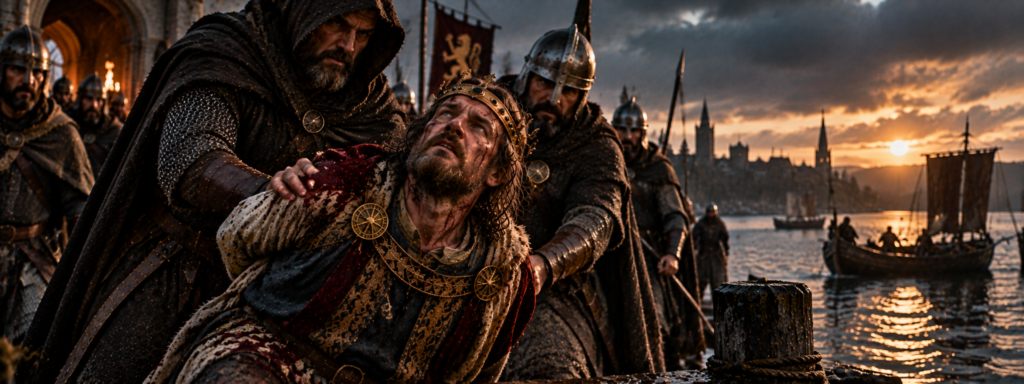
Eric IV of Denmark: The Murdered King, the Treacherous Brother, and the Body Beneath the Schlei
The Bloody Assassination of Eric Ploughpenny in 1250, the Brothers Who Turned Denmark into a Battlefield, and the Royal Murder That Haunted a Dynasty
The King Who Walked into His Brother’s Trap
On a summer night in 1250, the king of Denmark disappeared into the darkness near the waters of the Schlei, an inlet cutting deep into the disputed lands of Schleswig. Eric IV had survived years of warfare, rebellion, political betrayal, and bitter conflict with the younger brother who had repeatedly challenged his authority. He had fought to preserve a kingdom increasingly threatened by powerful nobles, ambitious relatives, and the competing interests of Denmark and the German territories to the south. Yet the danger that finally destroyed him did not come from a foreign army or an enemy encountered on the battlefield. It came from within his own family, from a brother whose political ambitions had become inseparable from the struggle for the Danish crown.
Eric had been taken into the custody of men associated with his brother Abel, Duke of Schleswig, following a meeting at Schleswig. What happened next became one of the darkest episodes in medieval Danish royal history. According to the surviving narrative tradition, the king was removed from the ducal residence, taken toward the water, and murdered by men acting within Abel’s political circle. His body was reportedly mutilated and thrown into the Schlei, an act that transformed a dynastic struggle into an accusation of fratricide and regicide.
The details of the murder were preserved in accounts written from different perspectives and at different distances from the event. Some traditions describe the king being beheaded, while others emphasize his violent killing and the disposal of his remains in the water. The precise sequence cannot be reconstructed with the certainty of a modern criminal investigation. Nevertheless, Eric’s murder on 10 August 1250 and Abel’s subsequent accession are firmly established elements of Danish history, while Abel’s personal responsibility remains a question that historians must distinguish from the accusations made by his contemporaries and later chroniclers.
The most disturbing feature of the case is not simply that a king was murdered. Medieval rulers frequently faced violent deaths, and Denmark had already endured generations of dynastic rivalry. What makes Eric’s assassination especially compelling is that the man who benefited most directly from it was his own brother, a prince who had spent years fighting against him and who inherited the crown almost immediately afterward. Abel denied responsibility, and his supporters presented his accession as legitimate, but the suspicion surrounding him proved impossible to erase.
The murder also exposed the extraordinary weakness of royal authority during Denmark’s thirteenth-century civil conflicts. Eric had inherited a kingdom in which the monarchy was struggling to control powerful regional interests, maintain its influence in Schleswig, and enforce taxation against resistance. His attempts to strengthen royal power earned him enemies, while his relationship with Abel deteriorated into open warfare. By the time the brothers confronted one another in 1250, their conflict had already damaged the kingdom they were supposed to defend.
Eric’s death did not bring lasting peace. Abel became king, but his reign was short, and the political tensions surrounding the murder continued to shape Danish succession. The crown eventually passed to another brother, Christopher, while Abel’s descendants retained claims and interests that would fuel further disputes. The assassination therefore became the beginning of another chapter in a prolonged dynastic crisis rather than its conclusion.
For centuries, the image of Eric’s body disappearing beneath the waters of the Schlei has remained one of the most unsettling symbols of medieval Danish kingship. It suggests an attempt not merely to kill a ruler but to remove him from the political world so completely that his enemies could claim the crown without his presence. Yet the king’s death proved impossible to bury. The accusations, the family rivalry, and the struggle over responsibility survived long after the men involved had disappeared.
Eric IV: The King Behind the Bloodstained Crown
Eric IV of Denmark, commonly known as Eric Ploughpenny or Erik Plovpenning, was born around 1216 and became king in 1241 following the death of his father, Valdemar II, one of Denmark’s most powerful medieval monarchs. His mother was Berengaria of Portugal, Valdemar’s second wife, and Eric belonged to a royal family whose internal rivalries would become increasingly destructive after his father’s death. He was crowned as his father’s co-king in 1232, an arrangement intended to strengthen the succession but one that failed to prevent later conflict among Valdemar’s sons. Eric’s reign was dominated by struggles with his brothers Abel, Duke of Schleswig, and Christopher, as well as disputes involving taxation, aristocratic privilege, and the kingdom’s southern territories. His nickname, Ploughpenny, is traditionally associated with a tax levied upon agricultural land or ploughs, reflecting the fiscal pressures and controversies of his government. He married Jutta of Saxony and fathered several daughters, including Sophia, who would become queen of Sweden, and Ingeborg, who would become queen of Norway. On 10 August 1250, Eric was murdered near Schleswig after falling into the hands of men associated with his brother Abel, and his body was reportedly thrown into the Schlei. Abel succeeded him as king, but allegations of complicity in the murder followed him throughout his brief reign and became inseparable from his historical reputation.
Eric inherited more than a crown from Valdemar II. He inherited a political system that had been strained by military expansion, territorial losses, noble ambitions, and the increasing independence of powerful princes. His father had been one of the most formidable rulers in northern Europe, but even Valdemar’s authority had been challenged by foreign enemies and internal disputes. The kingdom that passed to Eric in 1241 was therefore far less secure than the royal title might suggest.
The relationship between Eric and his brothers became the central tragedy of his reign. Abel possessed the Duchy of Schleswig, a strategically important territory between the Danish kingdom and the German political world. Christopher, another younger brother, also had ambitions and interests that complicated royal politics. The division of authority among the sons of Valdemar II created rival centers of power within the same family.
Eric’s position as king gave him superior formal authority, but it did not make his brothers obedient subjects. Abel possessed military resources, aristocratic supporters, and a territorial base from which he could resist royal demands. Their conflict gradually escalated from political disagreement into armed struggle. By the late 1240s, Denmark was being damaged by warfare between members of its own ruling dynasty.
The nickname Ploughpenny became one of the most enduring features of Eric’s reputation. It suggests a king remembered for extracting money from his subjects, particularly through taxation associated with agricultural production. Yet the fiscal measures of his reign must be understood within the financial pressures facing the monarchy. Warfare was expensive, and a ruler attempting to maintain military authority required revenue.
Eric’s assassination brought together all the tensions that had defined his kingship. The dispute with Abel, the struggle over Schleswig, and the weakness of the succession system created the circumstances in which a royal murder could occur. His death was therefore not an isolated tragedy but the culmination of a political crisis that had been developing for years. The man who inherited the crown after him was also the man whose conflict with him had helped bring the kingdom to the edge of collapse.
The Sons of Valdemar the Victorious
To understand Eric’s death, it is necessary to begin with his father, Valdemar II, known as Valdemar the Victorious. Valdemar had become king of Denmark in 1202 and pursued an ambitious policy of expansion around the Baltic Sea. His reign brought military successes, political influence, and a reputation for royal strength. Yet it also exposed Denmark to serious dangers when the kingdom’s expansion encountered resistance from powerful neighbors.
Valdemar’s rule reached its greatest territorial ambitions during the early thirteenth century. Danish influence extended across parts of the Baltic region, and the monarchy became involved in conflicts with German princes and neighboring rulers. The conquest of northern Estonia in 1219 became one of the most famous episodes associated with his reign. Later Danish tradition connected that campaign with the legendary origin of the national flag, although the familiar story developed long after the event.
The king’s fortunes changed dramatically in 1223 when he and his eldest son were captured by Count Henry of Schwerin. Their imprisonment exposed the vulnerability of Denmark’s expansive political position. The kingdom was forced to confront demands from its enemies, and Valdemar eventually secured release through difficult negotiations and concessions. His attempt to recover lost influence ended in defeat at the Battle of Bornhöved in 1227.
The defeat marked a major turning point. Denmark’s ability to dominate the southern Baltic was sharply reduced, and the monarchy had to adjust to a more constrained political position. Valdemar remained king, but the kingdom he governed was no longer the expansive power it had briefly appeared to become. His successors would inherit the consequences of these reverses.
Valdemar’s family also contained the seeds of future conflict. His first marriage to Dagmar of Bohemia produced his eldest son, Valdemar the Young, who was crowned as co-king but died in 1231. His second marriage to Berengaria of Portugal produced Eric, Abel, Christopher, and daughters whose marriages connected Denmark with other European dynasties. The death of Valdemar the Young altered the succession and increased the political importance of the sons of Berengaria.
Eric became the principal heir after his elder half-brother’s death. In 1232, he was crowned as co-king, strengthening his position within the royal succession. The arrangement was intended to provide continuity and reduce uncertainty. Yet it did not eliminate the competing ambitions of his younger brothers.
Abel received authority in Schleswig, a territory whose strategic importance made it especially valuable. The duchy lay between the Danish kingdom and the German lands, and its rulers operated within a complicated network of political relationships. Control of Schleswig could provide military resources, revenues, and connections with influential neighboring princes. Abel’s position therefore gave him considerable independence.
Christopher also occupied an important place within the royal family. Although he did not possess the same territorial base as Abel, he remained a potential claimant and political actor. The division of interests among the brothers made the monarchy vulnerable to internal competition. Valdemar’s authority had been strong enough to contain many disputes, but his death would remove the figure who held the family together.
When Valdemar II died in 1241, Eric inherited the crown and the unresolved tensions of his father’s political arrangements. Abel remained Duke of Schleswig, and Christopher retained his own ambitions. The kingdom faced external pressures, aristocratic interests, and the continuing consequences of territorial losses. Eric’s reign began under circumstances that demanded political skill and military strength.
The tragedy was that the brothers possessed enough authority to challenge one another but not enough trust to cooperate. Their father’s arrangements had distributed power within the family without establishing a stable system for resolving disputes. The result was a monarchy divided against itself. Eric would spend much of his reign fighting the very men who should have been his closest allies.
Berengaria of Portugal and the Royal Family That Turned Against Itself
Eric’s mother, Berengaria of Portugal, was a daughter of King Sancho I of Portugal and Dulce of Aragon. Her marriage to Valdemar II connected the Danish royal family with the dynasties of the Iberian Peninsula. She became queen of Denmark in 1214, following the death of Valdemar’s first wife, Dagmar. Her position placed her at the center of a royal household whose children would later compete for the crown.
Berengaria died in 1221, when Eric and his brothers were still young. Her death meant that she did not live to witness the political rivalry that eventually destroyed the relationship among her sons. The surviving sources provide limited information about her personal influence within the household. Nevertheless, her children became central figures in Danish history.
The contrast between the brothers’ shared ancestry and their later hostility is striking. Eric, Abel, and Christopher were sons of the same king and queen, raised within the political environment of the Danish monarchy. Their family connections gave each of them status and opportunities unavailable to most noblemen. Yet those same connections created competing claims to power.
Medieval royal families frequently treated younger sons as potential sources of both support and danger. Granting them territories or offices could help secure their loyalty and provide them with suitable positions. It could also create independent power bases that enabled rebellion. Abel’s control of Schleswig demonstrated the risks of such arrangements.
The political world of the thirteenth century offered few reliable mechanisms for preventing conflict among ambitious royal brothers. A reigning king might expect obedience, but a younger brother with substantial lands and powerful allies could resist. Personal relationships became entangled with questions of jurisdiction, taxation, and territorial control. Disputes that began as negotiations could escalate into warfare.
The death of a parent often intensified these problems. Valdemar II had possessed the authority of a long reign and the prestige of earlier military successes. His sons inherited different parts of his political legacy but lacked a common figure capable of compelling cooperation. The result was a struggle over the meaning of royal authority itself.
Eric’s relationship with Abel became especially destructive because the Duchy of Schleswig occupied such an important position. Abel could not easily be reduced to the status of an ordinary subordinate. He governed a territory with its own political relationships and military significance. His resistance therefore threatened the unity of the kingdom.
The eventual murder of Eric would become the most terrible expression of the family’s collapse. A dispute among brothers over power and territory ended with one brother dead and another wearing his crown. Their shared ancestry did not prevent violence. It made the crime appear even more shocking to later generations.
Schleswig: The Duchy That Became a Battlefield
The Duchy of Schleswig was one of the most contested territories in medieval Danish politics. Located between the Danish kingdom and the German lands to the south, it occupied a strategic position along important routes of trade, military movement, and political influence. Its rulers possessed authority that connected them with both Danish royal politics and the wider world of the Holy Roman Empire. Control of Schleswig therefore carried consequences far beyond the immediate interests of a single duke.
Abel’s position as Duke of Schleswig gave him a substantial territorial base. He could draw upon local resources, cultivate relationships with nobles, and maintain political connections beyond the Danish kingdom. These advantages made him a formidable rival to Eric. A dispute between the brothers could therefore become a conflict between competing centers of power.
The duchy also possessed a complicated history within the Danish monarchy. Royal relatives had frequently governed southern territories, and the relationship between ducal authority and kingship was not always straightforward. A duke might acknowledge the king’s superior position while resisting interference in local affairs. Such arrangements depended heavily upon personal relationships and political compromise.
Eric’s reign exposed the fragility of this system. The king sought to maintain authority over the kingdom and its southern territories, while Abel defended his position in Schleswig. Their disagreements involved jurisdiction, political influence, and the broader question of how much independence a royal duke could exercise. The surviving sources do not preserve every negotiation, but the escalation into warfare demonstrates the seriousness of the conflict.
The geography of Schleswig also made it a natural center of military activity. Its towns, roads, and waterways connected Denmark with neighboring territories. Armies moving between the kingdom and the German lands often passed through the region. Control of strategic locations could therefore determine the outcome of campaigns.
The Schlei inlet was especially important. It extended inland from the Baltic Sea and provided access to the area around Schleswig. The waterway had long been associated with trade and settlement, including the nearby early medieval commercial center of Hedeby. Its shores formed part of a landscape shaped by political and economic competition.
The same waters would later become associated with Eric’s murder. The tradition that his body was thrown into the Schlei gave the inlet a grim place in Danish royal history. A waterway that connected communities and supported commerce became the setting for the disposal of a murdered king. The symbolism was powerful, although the precise details of the killing must be treated cautiously.
Schleswig was therefore more than the background to a family quarrel. It was the political and geographical center of a struggle over the relationship between royal and ducal authority. Abel’s control of the duchy gave him the means to challenge Eric. The conflict over that authority eventually created the circumstances in which the king was killed.
The Ploughpenny Tax and a Kingdom Running Out of Patience
Eric IV’s nickname, Ploughpenny, is one of the most recognizable features of his historical identity. In Danish, he is commonly known as Erik Plovpenning, a name traditionally connected with taxation levied upon agricultural production or ploughs. The nickname suggests that fiscal policy became a defining aspect of his reputation. It also reflects the tensions between royal financial demands and the interests of those expected to pay.
Medieval kings required substantial resources to maintain their households, reward supporters, defend territories, and conduct warfare. Military campaigns were especially expensive because they involved equipment, supplies, transport, and the mobilization of armed followers. A ruler facing repeated rebellion could find his financial needs increasing rapidly. Eric’s conflicts with his brothers therefore placed additional pressure upon royal revenues.
The precise history of the tax associated with Eric’s nickname is complicated by the surviving evidence. Later accounts connect the name with a levy imposed upon agricultural holdings, but the details of its introduction and administration are not always clear. It would be misleading to reconstruct a complete national tax system from the nickname alone. Nevertheless, the association demonstrates that Eric became remembered as a ruler who demanded money from his subjects.
Taxation could become politically dangerous when it was perceived as excessive or unjust. Powerful nobles might resist royal demands that threatened their privileges, while agricultural communities could resent levies imposed during periods of economic difficulty. The king’s ability to enforce taxation depended upon local cooperation and military authority. Resistance could therefore become part of a broader political challenge.
Eric’s financial policies must be understood within the circumstances of his reign. He inherited a kingdom weakened by earlier territorial losses and faced continuing disputes with powerful relatives. Maintaining royal authority required resources. The need to finance conflict may have contributed to the fiscal measures associated with his reputation.
The nickname Ploughpenny should not automatically be interpreted as proof that Eric was uniquely oppressive. Medieval rulers were often remembered through hostile political traditions, and fiscal measures could acquire negative reputations among those who opposed them. A tax unpopular with one group might be defended by another as necessary for government. The surviving evidence does not permit a simple judgment about Eric’s personal character based upon the nickname.
Nevertheless, the political consequences of taxation were real. A king who demanded additional revenue could alienate influential subjects at the very moment he needed their support. Fiscal disputes could strengthen opposition factions and provide rivals with arguments against royal authority. In a kingdom already divided by dynastic conflict, such tensions were especially dangerous.
Eric’s reputation as Ploughpenny therefore belongs within the broader story of his troubled kingship. His attempts to finance royal government were intertwined with the warfare that consumed his reign. The nickname survived because it captured a recognizable source of conflict between ruler and subjects. It also contributed to the image of a king whose authority was repeatedly challenged.
Brothers at War: Eric and Abel Turn Denmark Against Itself
The relationship between Eric and Abel deteriorated into open conflict during the 1240s. Their dispute centered upon the authority of the crown and the independence of the Duchy of Schleswig, but it also reflected the personal ambitions of two royal brothers. Each possessed a political position that he was unwilling to surrender. The resulting warfare damaged the kingdom and deepened the hostility between their supporters.
Abel’s position in Schleswig gave him access to military resources and influential allies. Eric, as king, possessed the formal authority of the monarchy and could mobilize forces to defend his claims. The conflict therefore involved more than a disagreement within the royal household. It became a struggle between competing political networks.
The surviving sources describe campaigns and confrontations between the brothers, although the precise chronology and details vary. Warfare affected the southern territories and threatened the stability of the kingdom. The repeated use of force demonstrated the failure of negotiation. Each new confrontation made reconciliation more difficult.
The political consequences extended beyond the royal family. Nobles were forced to choose sides or attempt to preserve their interests amid the conflict. Communities could suffer from military movement, demands for supplies, and disruption of trade. The struggle therefore imposed costs upon people who had little control over the ambitions of the brothers.
The Church also had an interest in ending the conflict. Ecclesiastical leaders generally favored political stability and the protection of church property. Prolonged warfare threatened religious institutions and undermined the authority of Christian kingship. Attempts at mediation were therefore consistent with the broader interests of the Church.
Eric and Abel eventually reached agreements intended to restore peace, but the underlying rivalry remained unresolved. Temporary reconciliation could reduce immediate fighting without eliminating competing claims. The political relationship between the crown and the duchy remained fragile. Both brothers retained reasons to distrust the other.
The conflict also affected Eric’s reputation. A king unable to secure obedience from his own brother appeared vulnerable, while a duke repeatedly resisting royal authority could be portrayed as rebellious. Each side possessed arguments intended to justify its actions. The surviving narratives reflect a political environment in which legitimacy was contested.
By 1250, the rivalry had become dangerous enough that the king’s presence in Schleswig carried serious risks. Eric had fought against Abel and had attempted to assert royal authority over the duchy. The possibility of renewed negotiation did not erase the history of violence. Their final encounter would demonstrate how little trust remained.
The Campaign of 1250 and the Road to Schleswig
The final year of Eric’s reign unfolded amid renewed conflict with Abel. The brothers had struggled over Schleswig for years, and their political relationship remained unstable despite earlier attempts at reconciliation. Eric continued to assert royal authority, while Abel defended his position within the duchy. The confrontation eventually brought the king into the region where he would be murdered.
The surviving sources do not provide a complete day-by-day account of Eric’s final campaign. Later narratives describe the circumstances leading to his capture and death, but they differ in emphasis and detail. The broad context is clear: the king was involved in the continuing struggle over Schleswig. His presence near Abel’s center of power placed him in a dangerous political environment.
The conflict had already demonstrated the willingness of both sides to use military force. Armies had been mobilized, territories contested, and political agreements broken or challenged. The atmosphere of distrust made any meeting between the brothers potentially dangerous. A reconciliation required confidence that neither side would exploit the other’s vulnerability.
Eric nevertheless entered circumstances in which he became exposed to Abel’s supporters. The precise decisions that led to his capture remain uncertain. Later accounts emphasize betrayal and the violation of expectations of safety. These themes became central to the moral interpretation of the murder.
The political stakes were enormous. If Eric could reassert royal authority over Schleswig, Abel’s independence would be weakened. If Abel could resist successfully, the king’s prestige would suffer. The conflict therefore concerned the structure of Danish government as well as the ambitions of two brothers.
The possibility of negotiation also created opportunities for deception. Medieval political meetings could involve guarantees of safe conduct, exchanges of hostages, or agreements intended to reduce violence. The surviving evidence does not allow every arrangement surrounding Eric’s final encounter to be established. Nevertheless, the tradition that he was betrayed became one of the defining elements of the story.
By August 1250, Eric’s position had become fatally vulnerable. He was in the area of Schleswig, where Abel’s influence was strongest. The king’s enemies possessed access to the political and military resources of the duchy. The confrontation that followed ended not with another temporary settlement but with his death.
The road to Schleswig therefore marked the final stage of a conflict that had consumed much of Eric’s reign. Years of rivalry, warfare, and failed reconciliation had brought the brothers to a point where political compromise was increasingly difficult. The king entered the territory of a brother whose ambitions threatened his crown. He would never return to Denmark as a living ruler.
The Night of 10 August 1250
The traditional date of Eric IV’s murder is 10 August 1250. The killing occurred near Schleswig after the king had fallen into the hands of men associated with his brother Abel. Later accounts describe his removal from a place of custody and his violent death near the Schlei. The precise sequence of events remains uncertain, but the assassination itself is a central fact of Danish medieval history.
The most famous narratives present the murder as an act of deliberate betrayal. Eric was allegedly taken from the security of a meeting or residence and placed under the control of men who intended to kill him. The accounts emphasize his vulnerability and the role of Abel’s political circle. Such details contributed to the enduring accusation that the duke had arranged the murder.
The identity of the men who physically killed Eric is discussed in later traditions, but the surviving evidence does not permit every attribution to be treated as certain. Medieval chronicles often preserved names and circumstances through political or moral narratives shaped after the event. Their testimony is valuable but requires critical examination. A detailed reconstruction of the attackers’ movements would exceed what can securely be established.
The king was reportedly killed and his body disposed of in the Schlei. Some accounts describe beheading, while others emphasize the violent murder and concealment of the remains. The image of a royal body thrown into the water became one of the most memorable features of the case. It suggested an attempt to remove the king from the political world and prevent immediate public control of his remains.
The disposal of a body could carry serious political implications. A king’s corpse was not merely a private matter because burial, mourning, and public recognition of death were connected with royal legitimacy. Concealing or dishonoring the remains could complicate the response of supporters. It could also deepen the moral outrage surrounding the killing.
The surviving tradition presents Eric as a victim of treachery rather than a ruler who died openly in battle. That distinction became central to the accusation against Abel. A king killed during warfare might be regarded as a casualty of political conflict, but a king murdered while in custody raised more serious questions about responsibility and honor. The circumstances therefore made the death especially damaging to Abel’s reputation.
The exact moment of Eric’s death cannot be recreated with certainty. No reliable contemporary account preserves his final words, the expressions of his attackers, or the precise sequence of wounds. Such details belong to later storytelling rather than secure historical knowledge. The known facts are already sufficient to establish the horror of the event.
Eric IV, king of Denmark, was murdered in the territory controlled by his brother’s political network. His body was reportedly thrown into the Schlei, and Abel became king soon afterward. The assassination ended a reign dominated by fraternal conflict. It also created one of the most enduring accusations of royal murder in Scandinavian history.
The Body in the Schlei
The Schlei is a long, narrow inlet extending inland from the Baltic Sea toward Schleswig. Its waters have been associated with trade, settlement, and political activity for centuries. In 1250, they became the setting for one of Denmark’s most notorious royal murders. The tradition that Eric’s body was thrown into the inlet transformed the landscape into a symbol of dynastic betrayal.
The disposal of the king’s remains was more than a practical detail in the later narrative. It represented the apparent degradation of a monarch whose authority had been challenged by his own brother. A royal body ordinarily required appropriate treatment and burial, particularly within a Christian kingdom. Casting it into the water could be interpreted as an act of contempt or concealment.
The surviving accounts differ in the details of the killing and disposal. Some describe the body being weighted or otherwise concealed, while others focus upon the discovery and recovery of the remains. These variations must be treated as elements of the medieval narrative tradition rather than a single verified forensic record. The broad association between Eric’s death and the Schlei is much more secure than every specific detail.
The recovery of the body became important to the story. Eric was eventually buried at Schleswig and later reinterred at Ringsted, where members of the Danish royal family were commemorated. The movement of his remains helped restore a measure of royal dignity after the circumstances of his death. It also ensured that his murder remained publicly remembered.
Ringsted occupied an important place in Danish royal burial traditions. The church of St. Bendt became associated with members of the monarchy and the preservation of dynastic memory. Eric’s burial there connected him with a broader history of Danish kingship. The murdered ruler was therefore restored to a recognized place within the royal past.
The treatment of his remains also contributed to later religious interpretations of his death. A king murdered through alleged betrayal could be portrayed as an innocent victim, particularly when his body had been dishonored. Such narratives could encourage sympathy and even devotional attention. Eric’s reputation acquired elements of martyrdom, although his status should not be confused with that of a universally recognized canonized saint.
The image of the body beneath the Schlei endured because it captured the apparent cruelty of the assassination. The king had not merely been defeated; he had been killed and removed from sight. His enemies had apparently attempted to dispose of the physical evidence of his existence. Yet the recovery and burial of his remains ensured that the death could not be forgotten.
The waters of the Schlei therefore became part of the historical memory of the crime. They represented the final setting of Eric’s life and the place where the consequences of his conflict with Abel reached their most terrible expression. The inlet remained a geographical feature of Schleswig, but the murder gave it an enduring association with royal bloodshed. The king disappeared into the water, but the accusations surrounding his death continued to surface.
Abel: The Brother Who Became King
Abel was born around 1218, the second surviving son of Valdemar II and Berengaria of Portugal. He became Duke of Schleswig and developed a political position that allowed him to challenge his elder brother Eric. His marriage to Matilda of Holstein connected him with influential German aristocratic interests. These relationships strengthened his authority within the duchy and complicated his relationship with the Danish crown.
Abel’s political career was dominated by the struggle with Eric. He resisted royal authority, fought against his brother, and maintained a power base in Schleswig. The conflict damaged Denmark and contributed to the instability of the monarchy. By 1250, Abel had become the principal rival to the reigning king.
Eric’s murder placed Abel in an extraordinary position. The king was dead, and the duke who had fought against him was the most obvious beneficiary. Abel subsequently became king of Denmark. The speed and circumstances of his accession made suspicion almost inevitable.
Abel denied responsibility for his brother’s death. The surviving tradition describes efforts to establish his innocence, including the use of oaths and formal declarations. Such procedures reflected medieval political and legal practices, in which public assertions supported by influential men could play an important role. They did not, however, eliminate the doubts surrounding the assassination.
The distinction between suspicion and proof is essential. Abel’s conflict with Eric gave him a clear political motive, and his accession provided an obvious benefit. The murder occurred within the political environment of Schleswig, where Abel possessed authority and supporters. Yet the surviving evidence does not provide a definitive contemporary record proving that Abel personally ordered the killing.
Later chroniclers often treated Abel as morally responsible. His reputation became associated with fratricide, betrayal, and the seizure of the crown through murder. Such judgments were influenced by the political interests and religious values of those who preserved the story. They remain historically important but must be distinguished from independently verified evidence.
Abel’s reign was brief. He became king in 1250 and died in 1252 during a campaign against the Frisians. His death prevented him from establishing a long-lasting personal monarchy. The crown then passed to his younger brother Christopher.
The brevity of Abel’s reign added a further dimension to his reputation. Later writers could interpret his violent death as a form of divine punishment for the murder of Eric. Such moral explanations were common in medieval historical writing. They reveal how the assassination was remembered, but they do not establish supernatural causation.
Abel therefore remains one of the most controversial figures in Danish royal history. He was a duke who challenged his brother, became king after that brother’s murder, and died only two years later. His personal responsibility for the assassination cannot be established beyond dispute from the surviving evidence. Yet the suspicion became so deeply embedded in his reputation that his kingship has never been separated from the crime.
Did Abel Order His Brother’s Murder?
The question of Abel’s responsibility lies at the center of Eric IV’s assassination. The political circumstances provide strong reasons for suspicion. Abel had fought against Eric for years, possessed authority in Schleswig, and became king after his brother’s death. The murder occurred in a setting closely associated with his power.
These facts establish motive, opportunity, and political benefit, but they do not by themselves prove a direct order to kill. Medieval sources frequently attributed crimes to political rivals, and later chroniclers could shape narratives to support particular dynasties. The surviving evidence must therefore be examined critically. A historical accusation is not identical to a modern finding of guilt.
Abel’s denial of responsibility is also part of the record. He sought to establish his innocence through procedures recognized within medieval political society. The use of oaths and supporting testimony could provide a formal basis for acceptance. Yet such declarations did not necessarily persuade everyone.
The political consequences of the murder made the issue especially difficult to resolve. Abel’s accession meant that the man most suspected of benefiting from the crime possessed royal authority. His supporters had reasons to defend his legitimacy. His opponents had reasons to portray him as a murderer.
The surviving narratives were also shaped by the later rivalry between Abel’s descendants and those of Christopher. Dynastic interests could influence how earlier events were remembered. A family seeking to strengthen its claim might emphasize or minimize accusations against an ancestor. The murder therefore remained politically useful long after 1250.
Historians generally recognize Abel as deeply implicated in the circumstances of Eric’s death, but the degree of his personal involvement remains debated. Some interpretations treat him as the likely instigator, while others emphasize the lack of definitive evidence establishing a direct command. The distinction is important because it separates a plausible historical conclusion from an assertion of certainty. The surviving record does not permit the case to be closed beyond all doubt.
The possibility that Abel’s supporters acted without an explicit order cannot be excluded. Political followers sometimes anticipated the wishes of powerful patrons, particularly when the elimination of a rival offered obvious advantages. Yet this possibility is itself an interpretation rather than a documented fact. It should not be used to replace one unproven certainty with another.
The most responsible conclusion is therefore cautious but not evasive. Eric was murdered within the political environment of his conflict with Abel, and Abel became the principal beneficiary. His personal responsibility was suspected by contemporaries and emphasized by later tradition. The surviving evidence, however, does not establish the precise chain of command with certainty.
The unresolved question is part of what makes the assassination so compelling. The political circumstances point strongly toward the duke, while the documentary record stops short of providing an unambiguous confession or order. Abel’s denial did not erase suspicion, and his brief reign did not allow the controversy to fade. The murder remained a permanent shadow over his name.
The Crown Bought with a Brother’s Blood
Abel’s accession in 1250 was one of the most controversial transfers of power in Danish medieval history. He became king after the murder of his elder brother, a ruler with whom he had been engaged in prolonged conflict. The circumstances made his legitimacy vulnerable to accusations of fratricide. Yet he succeeded in obtaining recognition and exercising royal authority.
The succession demonstrates the practical importance of political support. A claimant could become king even when serious allegations surrounded his rise. Aristocratic acceptance, military strength, and formal procedures could outweigh unresolved accusations. Medieval kingship depended upon the ability to command recognition as well as upon hereditary right.
Abel’s position was nevertheless precarious. His reputation had been damaged by the murder, and his relationship with powerful political interests remained complicated. The conflict over Schleswig had not disappeared. The new king inherited the same structural problems that had contributed to his brother’s downfall.
His reign also faced challenges from the kingdom’s southern territories and neighboring political communities. The relationship between Denmark and the German lands remained unstable. Abel’s authority in Schleswig did not automatically translate into uncontested control of the entire kingdom. The monarchy continued to face competing interests.
The accusation of fratricide gave his opponents a powerful moral argument. A king believed to have murdered his brother could be portrayed as unworthy of legitimate authority. Such accusations could weaken loyalty and provide justification for resistance. Even if formal procedures accepted Abel’s innocence, political memory could preserve the charge.
Abel’s short reign prevented him from establishing a lasting settlement. In 1252, he was killed during a campaign against the Frisians. His death brought another abrupt change in the monarchy. The crown passed to Christopher, the youngest surviving brother.
The succession after Abel’s death demonstrated the continuing importance of the royal family’s competing branches. Abel left descendants who retained interests and claims, particularly in Schleswig. Christopher’s accession created new tensions between the crown and the ducal line. The political consequences of Eric’s murder therefore continued.
Abel’s reign remains inseparable from the circumstances of his accession. His political achievements were overshadowed by the accusation that he had obtained the crown through his brother’s death. The brevity of his kingship reinforced the dramatic character of the story. A prince who had fought for power became king only to die violently two years later.
Abel’s Death and the Medieval Idea of Divine Justice
Abel died in 1252 during a campaign against the Frisians, ending a reign that had lasted only two years. His death occurred amid conflict in the southern territories, where Danish rulers faced resistance from communities determined to defend their interests. The precise circumstances are described in medieval sources with varying details. What is clear is that Abel’s kingship ended violently.
The timing invited moral interpretation. A man suspected of arranging his brother’s murder had obtained the crown and then died after a remarkably short reign. Medieval chroniclers frequently understood political events through the language of divine justice. Abel’s death could therefore be presented as punishment for the crime attributed to him.
Such interpretations were powerful because they offered a moral order to a world of political violence. If a murderer became king, his eventual downfall could be understood as evidence that justice had not been permanently defeated. The narrative provided reassurance that wrongdoing would ultimately be punished. It also strengthened the reputation of the murdered victim.
Yet historical analysis must distinguish religious interpretation from demonstrable causation. Abel died during a military campaign, and his death can be explained within the political and military circumstances of the period. There is no historical method for proving that it represented divine punishment. The belief itself remains important because it shaped later memory.
The idea of providential justice also influenced the way Eric’s death was remembered. The murdered king could be portrayed as an innocent victim whose brother’s downfall confirmed the wickedness of the assassination. Such narratives reinforced the contrast between Eric and Abel. They helped turn a complicated political struggle into a moral drama.
The reality was less simple. Eric had been involved in warfare against his brother and faced opposition from powerful interests. Abel possessed his own political claims and supporters. Their conflict emerged from structural problems within the monarchy as well as personal hostility.
Nevertheless, the moral interpretation became part of the historical tradition. Abel’s brief reign and violent death appeared to complete a tragic sequence. The brother accused of murder had obtained the crown but failed to enjoy it for long. The story offered a powerful warning about ambition and betrayal.
Abel’s death did not end the political consequences of the assassination. His descendants continued to possess claims and territorial interests. The rivalry between the royal line and the dukes of Schleswig persisted. The supposed punishment of one man therefore failed to resolve the underlying conflict.
Christopher I and the Third Brother’s Crown
After Abel’s death in 1252, the Danish crown passed to Christopher I, the youngest surviving son of Valdemar II and Berengaria of Portugal. His accession meant that all three brothers had occupied positions at the center of the monarchy’s succession struggles. Eric had been murdered, Abel had become king and died violently, and Christopher now inherited the crown. The family’s political history had become a sequence of conflict and premature death.
Christopher’s accession did not eliminate the interests of Abel’s descendants. The ducal line retained connections with Schleswig and continued to challenge the authority of the Danish crown. The relationship between the monarchy and the duchy therefore remained unstable. The same territorial problem that had divided Eric and Abel continued into the next generation.
Christopher’s reign also involved conflict with the Church and powerful nobles. The monarchy struggled to assert authority in a political environment where aristocratic and ecclesiastical interests could resist royal demands. The kingdom had not recovered from the instability of the preceding decade. The death of Eric remained part of the background to these disputes.
The succession also raised questions about the legitimacy of Abel’s descendants. If Abel had obtained the crown through murder, his family’s claim could be politically controversial. Yet hereditary rights did not disappear simply because an ancestor’s reputation was damaged. The ducal line continued to assert its interests.
Christopher’s government therefore inherited a divided royal family. The crown and the duchy remained associated with competing branches of Valdemar’s descendants. Their rivalry influenced Danish politics for decades. The assassination of Eric had failed to create a stable succession.
The political consequences extended beyond the immediate royal household. Nobles and neighboring rulers could exploit divisions between the competing branches. Schleswig’s strategic position made the dispute especially significant. The duchy became a recurring source of tension between Danish kings and regional powers.
Christopher’s reign illustrates the persistence of the structural problems that had destroyed Eric. Royal authority remained contested, and powerful relatives could challenge the monarchy. The crown could change hands without resolving the relationship between king and duke. Political instability therefore continued.
The murder of Eric IV was not simply a family tragedy that ended with Abel’s death. It helped shape the political landscape inherited by Christopher and his successors. The accusations surrounding Abel influenced dynastic legitimacy, while the territorial conflict over Schleswig persisted. The consequences of the assassination reached far beyond the summer of 1250.
The Queen and Daughters Eric Left Behind
Eric IV married Jutta of Saxony, a woman whose family connections linked the Danish monarchy with important German princely houses. Their marriage reflected the diplomatic importance of alliances between Denmark and its southern neighbors. Such relationships could strengthen royal authority and provide support during political conflict. They also connected the succession interests of Denmark with other European dynasties.
The couple had several daughters, whose marriages would later become politically significant. Sophia became queen of Sweden through her marriage to Valdemar Birgersson. Ingeborg became queen of Norway through her marriage to Magnus VI. These connections demonstrate the continuing importance of Eric’s descendants within Scandinavian royal politics.
Eric’s death left his immediate family in a vulnerable position. The crown passed to Abel, the brother whose political circle was associated with the murder. The surviving sources do not provide a complete account of Jutta’s personal response or the immediate experiences of the children. Their political circumstances, however, were transformed by the assassination.
Royal daughters could become important instruments of dynastic diplomacy. Their marriages connected ruling families and created relationships that influenced future political alliances. Eric’s daughters therefore remained significant even though the Danish crown passed to his brothers. The family’s political influence extended beyond the direct male succession.
The marriage of Sophia to the Swedish king Valdemar Birgersson connected Eric’s line with the developing Swedish monarchy. Ingeborg’s marriage to Magnus VI of Norway established another important Scandinavian relationship. These unions placed the daughters of the murdered king within the ruling families of neighboring kingdoms. The assassination had not erased their dynastic importance.
The surviving evidence concerning Jutta’s later life is limited and sometimes complicated by genealogical traditions. It would be misleading to invent scenes of grief, revenge, or political conspiracy without documentary support. The historical record reveals the broad consequences of her husband’s death but not every private experience. Her position as queen and mother of royal daughters remains significant.
The fate of Eric’s family also demonstrates the wider effects of regicide. A king’s murder could alter the security, status, and marriage prospects of his children. It could reshape alliances across kingdoms and create new claims to political influence. The consequences therefore extended beyond the immediate transfer of the crown.
Eric’s daughters became part of the interconnected history of Scandinavian monarchy. Their marriages helped preserve the political importance of his line. The king who had been murdered and thrown into the Schlei remained an ancestor of future royal generations. His death ended his personal rule but did not eliminate his family’s place in European dynastic history.
Eric’s Burial and the Making of a Royal Martyr
The recovery and burial of Eric’s remains became important elements of his posthumous history. After his murder, his body was associated with burial at Schleswig and later with Ringsted, an important center of Danish royal commemoration. The movement of his remains helped restore royal dignity after the reported disposal of his body in the Schlei. It also provided a physical focus for remembrance.
Ringsted’s church of St. Bendt became closely associated with the Danish monarchy. Several members of the royal family were buried there, making it an important place of dynastic memory. Eric’s burial connected him with the broader history of Danish kingship. The murdered ruler was therefore incorporated into a sacred and political landscape that extended beyond the circumstances of his death.
The violent nature of Eric’s murder encouraged interpretations of him as an innocent victim. Medieval religious culture often attached special significance to rulers killed through betrayal or injustice. Such deaths could acquire elements of martyrdom, particularly when the victim was portrayed as morally superior to the murderer. Eric’s reputation developed within this environment.
His cult and commemoration should nevertheless be distinguished from formal canonization. Eric IV was not universally recognized as a canonized saint in the same sense as certain other medieval royal martyrs. The traditions surrounding his death included religious elements, but they did not produce the same enduring ecclesiastical status as the cult of Saint Canute IV. Historical accounts must therefore avoid exaggerating his official religious position.
The accusation against Abel strengthened the moral interpretation of Eric’s death. A king murdered by his own brother could be portrayed as a victim of unnatural betrayal. The violation of family loyalty made the crime appear especially shocking. Later writers could use the story to illustrate the destructive consequences of ambition.
The treatment of the body also contributed to this interpretation. The reported disposal of Eric’s remains in the Schlei suggested an attempt to dishonor or conceal the victim. His eventual burial restored him to the community of Christian kings. The contrast between degradation and commemoration gave the narrative emotional force.
Royal burial was politically significant because it preserved the memory of legitimate kingship. A tomb could become a place where descendants and supporters affirmed dynastic continuity. The murdered ruler’s body therefore remained important after death. Its treatment influenced how later generations understood the crime.
Eric’s burial and commemoration ensured that the assassination remained visible within Danish historical memory. The king who had been removed from power through violence was restored to a recognized place among the monarchy’s dead. His reputation continued to be shaped by the circumstances of his murder. The body beneath the Schlei became a symbol of betrayal, while the royal tomb represented the endurance of memory.
The House of Abel and the Long Shadow of Schleswig
Abel’s death in 1252 did not end the political importance of his descendants. His family retained claims and interests connected with the Duchy of Schleswig. The duchy remained a major source of tension between the Danish crown and regional powers. The conflict that had divided Eric and Abel therefore continued through later generations.
The descendants of Abel became associated with a ducal line that exercised authority in Schleswig. Their position reflected the complicated relationship between royal ancestry and territorial power. They belonged to the wider Danish royal family but could pursue interests that conflicted with those of the reigning king. The result was recurring political instability.
Schleswig’s geographical position made these disputes especially difficult to resolve. The duchy connected Denmark with the German lands and possessed relationships with neighboring princes. Its rulers could draw upon alliances that extended beyond the Danish monarchy. Royal attempts to impose direct control therefore encountered resistance.
The legacy of Eric’s murder influenced perceptions of the ducal line. Abel’s reputation as the brother suspected of regicide remained part of the family’s historical identity. Yet his descendants were not simply defined by the accusation against him. They possessed their own political claims and participated in the continuing struggles over Schleswig.
The conflict also demonstrates the long-term consequences of dividing royal authority among family members. Valdemar II’s arrangements had given Abel a powerful territorial position. After Eric’s death, that position continued through Abel’s descendants. The monarchy therefore faced a rival branch of the royal family with an established regional base.
The relationship between Denmark and Schleswig remained contested for centuries, although later conflicts developed under different political circumstances. The disputes of the thirteenth century contributed to a longer history of tension over the duchy’s status. Eric’s murder was one dramatic episode within that broader process. It revealed how dynastic rivalry could become intertwined with territorial politics.
The assassination therefore had consequences beyond the immediate succession. It helped shape the division between the royal line and the ducal descendants of Abel. The struggle over Schleswig continued to influence Danish political life. The family conflict that destroyed Eric became part of a much larger territorial problem.
The long shadow of Schleswig is essential to understanding the murder. Abel’s power did not arise simply from personal ambition; it rested upon a strategically important duchy with substantial resources and political connections. Eric’s attempt to assert royal authority brought him into conflict with that power. The assassination occurred at the point where dynastic rivalry and territorial autonomy became inseparable.
Fratricide, Regicide, and the Medieval Politics of Blood
The murder of Eric IV belongs to a long history of royal violence in medieval Europe. Kings were frequently threatened by rivals, rebellious nobles, and ambitious relatives. Yet the killing of a monarch by men associated with his own brother carried a particularly disturbing significance. It violated both the political hierarchy of kingship and the expected bonds of family loyalty.
Fratricide occupied a powerful place in medieval moral thought. Christian teaching emphasized the duties of kinship and condemned the deliberate killing of close relatives. A brother accused of murdering a brother could therefore be portrayed as guilty of a crime that violated both divine and human order. The accusation against Abel acquired extraordinary force within this moral framework.
Regicide also raised questions about legitimate authority. A king was not merely a powerful nobleman but the recognized ruler of a political community. His killing could threaten the stability of succession and encourage further rebellion. The circumstances of Eric’s death therefore affected the entire kingdom.
The combination of fratricide and regicide made the case especially memorable. Abel was not accused of killing an unrelated rival on a battlefield. He was suspected of arranging the murder of his elder brother, the reigning king, after years of conflict. The crime therefore appeared to unite personal betrayal with political ambition.
The surviving evidence does not establish every detail of Abel’s responsibility, but the accusation itself shaped historical memory. Later writers repeatedly returned to the image of the treacherous brother. His short reign and violent death reinforced the moral drama. The story became a warning about the destructive consequences of ambition.
The political reality was more complicated than the moral narrative alone suggests. Eric and Abel had been involved in a prolonged struggle over royal authority and Schleswig. Their conflict reflected structural tensions within the monarchy as well as personal rivalry. The assassination emerged from a political environment in which competing claims could not be resolved peacefully.
The case also demonstrates how the successful seizure of power could coexist with unresolved accusations. Abel became king despite suspicion surrounding Eric’s murder. His accession was recognized through the political mechanisms available at the time. The crown therefore passed to a man whose legitimacy remained morally controversial.
Eric’s death illustrates the danger of a monarchy in which hereditary claims, territorial power, and military strength were not balanced by stable succession rules. The brothers possessed competing interests that neither could easily surrender. Their conflict escalated until one was dead and the other became king. The result was a political victory overshadowed by an accusation of murder.
Was Eric IV a Tyrant or a Victim?
Eric’s nickname Ploughpenny has sometimes encouraged a harsh interpretation of his reign. A king remembered for taxation can easily be portrayed as oppressive, particularly when his government faced rebellion and political resistance. Yet the surviving evidence does not justify reducing his entire kingship to a story of fiscal exploitation. His policies must be understood within the military and financial pressures of the period.
Eric inherited a kingdom weakened by earlier territorial losses and divided by competing political interests. He faced resistance from his brother Abel and struggled to maintain authority over Schleswig. Warfare required resources, and taxation was one means of obtaining them. The fiscal measures associated with his nickname therefore belonged to a broader struggle over royal power.
The opposition to Eric was not necessarily motivated by concern for ordinary subjects. Powerful nobles and territorial rulers could resist taxation because it threatened their own privileges. Abel’s conflict with the king involved political autonomy and control of Schleswig. The interests of the opposing factions were therefore complex.
Eric’s murder also does not prove that he was a benevolent ruler. A victim of assassination could have pursued controversial policies or exercised authority harshly. The historical record is too limited to provide a complete moral assessment of his government. His death should not automatically transform him into an ideal king.
The same caution applies to Abel. His political opposition to Eric does not by itself prove that he ordered the murder. The accusation is historically serious because of the circumstances and the benefit he received. Yet personal guilt must be distinguished from the broader political conflict.
The most convincing interpretation recognizes Eric as a ruler attempting to maintain royal authority under difficult conditions. His taxation and military policies created opposition, while his brothers possessed independent ambitions. The resulting conflict damaged the kingdom. His assassination was the violent culmination of that struggle.
The distinction between political controversy and murder is important. Even if Eric’s policies were unpopular, his killing while in the power of his enemies represented a separate act of violence. The circumstances raised questions about betrayal and legitimate succession. His reputation as Ploughpenny does not explain away the crime.
Eric IV therefore remains a complicated historical figure. He was neither simply a saintly victim nor merely an oppressive tax collector. He was a medieval king whose government faced serious political challenges and whose family relationships became fatally destructive. His assassination deserves to be understood within that complexity.
The Murder That Failed to Bring Peace
The immediate political result of Eric’s death was Abel’s accession to the Danish throne. The duke who had fought against the king became king himself. Yet the transfer of power did not resolve the problems that had divided the brothers. The monarchy remained vulnerable to territorial disputes and competing family interests.
Abel’s reign lasted only two years. His death in 1252 brought another succession, this time in favor of Christopher I. The rapid change demonstrated the continuing instability of the royal family. The assassination of Eric had failed to create a durable settlement.
The descendants of Abel retained interests in Schleswig, while Christopher’s line held the crown. The relationship between these branches of the family remained complicated. Territorial autonomy and dynastic legitimacy continued to generate conflict. The same structural tensions that had contributed to Eric’s death survived.
The accusation of fratricide also remained politically significant. Abel’s reputation could be used to question the legitimacy of his line. His supporters could emphasize his formal accession and deny responsibility for the murder. The controversy therefore became part of the political memory of competing dynasties.
The kingdom’s broader problems also continued. Denmark faced disputes involving nobles, church leaders, and neighboring rulers. The monarchy struggled to maintain authority over territories with powerful local interests. The death of one king did not eliminate these challenges.
Eric’s assassination therefore illustrates the limitations of political murder as a solution to succession disputes. Removing a ruler could create an immediate opportunity for a rival. It could not necessarily eliminate the surviving claims of other family members. The conflict might simply pass into another generation.
The case also reveals the destructive effects of prolonged family rivalry. Eric and Abel had spent years fighting over authority, and their conflict damaged the kingdom. The murder transformed their political struggle into a lasting moral controversy. Their descendants inherited the consequences.
The peace that followed Eric’s death was therefore temporary and incomplete. Abel obtained the crown but died before establishing a lasting reign. Christopher succeeded him, while the ducal line continued to challenge royal authority. The assassination changed the ruler without healing the divisions that had made the murder possible.
Eric IV Among Denmark’s Murdered Kings
Denmark’s medieval history contains several notorious examples of royal violence. Canute IV was killed in Odense in 1086 during a rebellion against his government. Canute V was murdered during the Bloodfeast of Roskilde in 1157, when a struggle among rival claimants erupted into violence. These events demonstrate that Eric IV’s assassination belonged to a broader pattern of contested kingship.
The circumstances of the killings differed, but they shared important features. Each involved a ruler whose authority was challenged by powerful opponents. Political grievances became connected with violence, and the death of the king altered the succession. The monarchy remained vulnerable when competing claims could be pursued through force.
Canute IV’s death became associated with religious martyrdom and formal sainthood. His cult transformed a political killing into an important part of Danish Christian memory. Canute V’s murder, by contrast, became famous for the treachery associated with the Bloodfeast of Roskilde. The event illustrated the dangers of dynastic rivalry.
Eric IV’s case combined elements of both traditions. His death was remembered as a betrayal, while the treatment of his body encouraged religious and moral interpretations. Yet the central accusation concerned his own brother, making the crime especially shocking. The suspicion of fratricide distinguished his assassination from many other royal killings.
The broader Scandinavian context is equally important. Sweden experienced repeated murders of kings during the twelfth century, including Sverker the Elder, Eric IX, and Karl Sverkersson. Norway endured prolonged civil wars in which royal claimants were killed or executed. The instability reflected the difficulty of establishing uncontested hereditary succession.
Eric’s murder also demonstrates the importance of territorial power. Abel’s position in Schleswig gave him resources and political independence. The conflict therefore involved the relationship between a king and a powerful royal duke. Similar tensions appeared elsewhere in medieval Europe when princes governed territories that could support rebellion.
The assassination was not simply a private crime committed within a royal family. It altered the government of Denmark and influenced the future relationship between the crown and Schleswig. Its consequences extended across generations. The murder therefore belongs within the history of political institutions as well as the history of personal betrayal.
Eric IV occupies a distinctive place among Denmark’s assassinated rulers. He was a king whose nickname preserved the memory of controversial taxation, whose reign was consumed by conflict with his brothers, and whose death became inseparable from the accusation against Abel. His body was reportedly thrown into the Schlei, but the political consequences could not be concealed. The assassination remained one of the defining scandals of the Danish monarchy.
The Historical Evidence and the Limits of the Story
The assassination of Eric IV is well established as a historical event, but the surviving sources do not provide a complete modern reconstruction of the crime. Medieval chronicles preserve the broad circumstances, including the conflict with Abel, the murder near Schleswig, and the disposal of the body in the Schlei. They also preserve accusations against Abel and accounts of his denial. These sources must be evaluated according to their political context and distance from the events.
The date of 10 August 1250 is widely accepted. Eric’s death occurred during the final stage of his conflict with Abel, and the duke became king afterward. These facts provide the essential framework of the case. They do not, however, establish every detail of the murder.
The precise circumstances of Eric’s capture remain uncertain. Later accounts describe betrayal and the king’s removal from custody, but they differ in emphasis. It is therefore hazardous to reconstruct a detailed scene involving specific conversations or movements. Such embellishments can make the story more dramatic while weakening its historical reliability.
The treatment of the body is also described through medieval narrative traditions. The association with the Schlei is central to the story, but individual details of mutilation, weighting, and recovery require careful treatment. Different accounts may preserve genuine memories while also incorporating dramatic elements. The historian’s task is to distinguish the broad event from details that cannot be independently verified.
Abel’s responsibility remains the most important unresolved question. His motive and political benefit are clear, and the murder occurred within the environment of his conflict with Eric. Yet the surviving evidence does not establish an unambiguous direct order. The accusation remains historically compelling without being equivalent to definitive proof.
The political context also shaped later interpretations. Christopher’s descendants and Abel’s ducal line had competing interests, and historical narratives could support one side or the other. A story emphasizing Abel’s guilt could weaken the reputation of his descendants. A story defending him could strengthen their claims.
Religious interpretations added another layer. Medieval writers often understood violent royal deaths through the language of sin, punishment, and providence. Abel’s death in 1252 could be presented as divine justice, while Eric’s murder could be portrayed as martyrdom. These interpretations reveal the moral framework of the sources but do not replace historical analysis.
The responsible account therefore preserves both the drama and the uncertainty. Eric was murdered, his body was reportedly thrown into the Schlei, and Abel became king. The political circumstances strongly implicated Abel, but the precise chain of responsibility remains debated. The case is historically significant precisely because its consequences were clear even when its most important accusation could not be conclusively resolved.
The King Who Could Not Escape His Own Family
Eric IV’s life illustrates the dangers of a monarchy in which royal relatives possessed enough power to challenge the reigning king. His father had distributed authority among his sons in ways intended to preserve the family’s position. Yet those arrangements created rival centers of power. The brothers eventually became enemies whose conflict damaged the kingdom.
Eric’s position as eldest surviving son gave him the crown, but Abel’s authority in Schleswig made him difficult to control. Christopher’s ambitions added another complication. The family possessed a shared inheritance but lacked a stable agreement about how that inheritance should be governed. Their rivalry became increasingly destructive.
The political environment encouraged confrontation. Noble supporters could benefit from backing one brother against another, while neighboring rulers could exploit divisions within Denmark. The duchy’s strategic position made the conflict especially dangerous. The struggle therefore extended beyond the personal relationship between Eric and Abel.
The repeated attempts at reconciliation failed to produce lasting peace. Political agreements could reduce immediate fighting but could not eliminate competing ambitions. The brothers continued to distrust one another. By 1250, their relationship had deteriorated beyond effective repair.
Eric’s murder represented the ultimate failure of dynastic cooperation. The king died in circumstances associated with his brother’s political circle, and Abel inherited the crown. The event transformed years of rivalry into a permanent accusation of fratricide. The family’s conflict had become a crime remembered across centuries.
The consequences continued after Abel’s death. Christopher became king, while Abel’s descendants retained interests in Schleswig. The political divisions therefore survived the generation that had created them. The assassination failed to establish a lasting settlement.
Eric’s story also demonstrates the vulnerability of rulers whose authority depended upon personal relationships. A king could command armies and levy taxes, yet remain exposed when powerful relatives refused obedience. The monarchy lacked institutions strong enough to resolve every dynastic dispute peacefully. The result was a political system in which family rivalry could become fatal.
The tragedy was therefore larger than the death of one man. The sons of Valdemar II inherited a kingdom that had once exercised formidable power around the Baltic. Their conflicts weakened royal authority and prolonged territorial disputes. Eric’s body disappeared into the Schlei, but the damage caused by the family’s rivalry remained.
The Brother, the Crown, and the Water That Could Not Hide a Murder
Eric IV of Denmark inherited a kingdom already weakened by military reverses, territorial disputes, and the competing ambitions of powerful nobles. His father, Valdemar II, had once exercised extraordinary influence around the Baltic Sea, but the monarchy’s position had become more constrained by the time Eric succeeded him in 1241. The new king faced the difficult task of maintaining authority while his younger brothers possessed their own political interests. His reign became dominated by the struggle to control Schleswig and preserve the supremacy of the crown.
The conflict with Abel was the central tragedy of Eric’s kingship. Abel’s position as Duke of Schleswig gave him resources and allies that enabled him to resist royal demands. Years of warfare and failed reconciliation deepened the hostility between the brothers. The kingdom suffered as their rivalry became increasingly destructive.
Eric’s nickname Ploughpenny preserved the memory of taxation associated with his reign. His fiscal policies reflected the financial pressures of government and warfare, but they also contributed to his controversial reputation. The king was therefore a complicated political figure rather than a simple innocent hero. His policies could provoke opposition, yet that opposition did not make his murder inevitable or justified.
On 10 August 1250, Eric was killed near Schleswig after falling into the hands of men associated with Abel. His body was reportedly mutilated and thrown into the Schlei, creating one of the most disturbing images in Danish royal history. Abel became king afterward, but the circumstances of the murder left him permanently exposed to accusations of fratricide. His denial of responsibility did not eliminate suspicion.
The surviving evidence does not establish every detail of the assassination or prove beyond dispute that Abel personally ordered the killing. His political motive, opportunity, and benefit were substantial, and later tradition treated him as deeply implicated. Yet historical responsibility must be distinguished from the certainty of a direct command. The unresolved question became part of the enduring fascination of the case.
Abel’s reign lasted only two years before he was killed during a campaign against the Frisians. Christopher I then became king, while Abel’s descendants retained their interests in Schleswig. The murder of Eric therefore failed to settle the dynastic conflict. The political divisions that had destroyed him continued through later generations.
Eric’s daughters carried his dynastic legacy into the royal families of Sweden and Norway, while his burial at Ringsted preserved his place within Danish royal memory. His assassination became a symbol of the dangers of family rivalry and the weakness of medieval succession. The story also illustrates how political violence could produce immediate victory without lasting stability. The crown passed to Abel, but the accusation surrounding the transfer could not be erased.
Eric IV had spent his reign struggling to preserve the authority of a crown inherited from one of Denmark’s greatest medieval kings, only to discover that the most dangerous enemy of his monarchy was a brother who shared his blood. Their rivalry transformed Schleswig into a battlefield, exhausted the kingdom, and ended with the king murdered near the waters of the Schlei. The reported disposal of his body in the inlet became a grim symbol of betrayal, as though removing the corpse might also remove the political consequences of the crime. Yet the murder proved impossible to conceal within the waters or the silence of the dead. Abel obtained the crown, but his brief reign was overshadowed by suspicion, and his descendants inherited a conflict that continued long after his death. Eric’s own family survived through daughters whose marriages connected his bloodline with other Scandinavian monarchies, ensuring that the murdered king remained part of the region’s dynastic history. The assassination therefore achieved an immediate transfer of power while failing to resolve the struggle that had produced it. In the end, the most terrible lesson of Eric Ploughpenny’s death was that a crown could turn brothers into enemies, and that the blood spilled to obtain it could stain a dynasty long after the body had vanished beneath the water.