
Donald III of Scotland: The Twice-Crowned King Who Was Blinded and Left to Die in Captivity
Donald III (c. 1033–1099/1100) | King of Scots, 1093–1094 and 1094–1097 | Younger brother of Malcolm III | Overthrown twice by his nephews | Traditionally said to have been blinded and imprisoned after his final deposition | Died in captivity, possibly following the blinding
The King Who Lost His Crown, His Sight, and His Freedom
Donald III had already lost the Scottish throne once when his own family came to destroy him for the second time. He had survived his brother’s long reign, outmaneuvered rival claimants, endured deposition, and somehow managed to recover the crown that had been taken from him. By 1097, however, the old king faced a new enemy, and this time the threat came from another of his brother’s sons. His nephew Edgar was marching into Scotland with English support, determined to remove Donald and claim the kingdom for himself.
The first time Donald had been overthrown, he escaped with his life and eventually returned to power. The second time, there would be no restoration, no triumphant return, and no opportunity to gather another army. Donald was defeated, stripped of his kingship, and imprisoned, while later accounts describe a punishment designed to ensure that he could never again become a serious contender for the crown. According to those traditions, his enemies had him blinded.
The fate of the old king is one of the darker episodes in Scotland’s violent history of royal succession. Donald had spent much of his life watching his family fight over the throne, and when his own opportunity finally arrived, he discovered that kingship offered little protection against ambitious relatives. His nephews had already driven him out once, and one of them had died violently during the struggle that followed. Now another nephew had won, and Donald’s future depended entirely upon the mercy of the family he had fought.
Later Scottish tradition places his imprisonment at Rescobie in Angus, where he is said to have remained until his death around 1099 or 1100. Some historical accounts suggest that the blinding itself may have contributed to his death, while one medieval writer offered a more explicitly lethal version of his overthrow. The surviving evidence does not establish that Donald was secretly assassinated in captivity, and the circumstances of his final illness or death remain uncertain. What is clear is that the king who had twice worn the Scottish crown ended his life as a defeated prisoner.
Donald III’s story is particularly unsettling because he was not a foreign invader or an obscure adventurer who had briefly seized power. He was the son of Duncan I, the brother of Malcolm III, and a member of the royal dynasty that had ruled Scotland for generations. His enemies were his nephews, men who possessed the same royal blood and who believed that their own claims outweighed his. The struggle that destroyed him was therefore not simply a rebellion against a king, but a family war in which uncles, brothers, and sons repeatedly turned against one another.
His fate also exposes the brutality hidden beneath the familiar language of dynastic restoration. Donald’s opponents could present themselves as the rightful heirs of Malcolm III, but their victory required the destruction of an elderly king who had already been recognized and crowned. Imprisonment removed him from politics, while blinding, if the accounts are accurate, inflicted a punishment whose purpose extended beyond physical suffering. It transformed a rival monarch into a man whose enemies hoped would never again threaten their power.
Born Into a Dynasty Already Drenched in Blood
Donald was born around 1033, probably during the final years of his grandfather Malcolm II’s reign. His father was Duncan I, who became king in 1034, while his mother is traditionally identified as Suthen, although the surviving evidence concerning her identity and ancestry is uncertain. Donald was therefore born close to the Scottish throne, but his early life unfolded during a period when royal ancestry offered no guarantee of security. Kingship in eleventh-century Alba was frequently decided through military conflict, and even the closest relatives of a reigning king could become rivals.
His father Duncan inherited the crown after Malcolm II’s death, continuing a dynastic project intended to secure royal authority within Malcolm’s descendants. Duncan’s accession did not eliminate the competing claims of other powerful families, particularly those associated with Moray. In 1040, Duncan confronted Macbeth, the powerful northern ruler whose ancestry and regional support made him a formidable challenger. Duncan was killed during the resulting conflict, and Macbeth became king.
Donald was still a child when his father died. His older brother Malcolm, the future Malcolm III, would eventually become the most famous member of the family, but both brothers grew up under the shadow of Macbeth’s victory. Their father’s death deprived them of the position they might otherwise have expected within the royal household. It also created the dynastic grievance that would dominate the next generation of Scottish politics.
Later accounts suggest that Donald spent considerable time outside Scotland during Macbeth’s reign, although the details of his movements remain obscure. Some traditions associate him with exile among Gaelic-speaking communities beyond Scotland, while Malcolm’s own years away from power have been connected with England and other political centers. The evidence is too fragmentary to reconstruct Donald’s childhood as a continuous story of flight and hardship. Nevertheless, his father’s violent death and Macbeth’s accession profoundly altered the political world into which he had been born.
For the next seventeen years, Macbeth remained king. He was not the universally despised tyrant familiar from Shakespeare, but a ruler who possessed substantial support and maintained his authority despite repeated challenges. Donald and Malcolm therefore grew toward adulthood while another dynasty occupied the throne their father had held. Their eventual opportunity to return depended upon Macbeth’s defeat.
In 1057, Malcolm finally killed Macbeth at Lumphanan, but the crown did not immediately pass to Duncan’s descendants. Macbeth’s stepson Lulach succeeded him and continued resisting Malcolm for several months. Only after Lulach was killed in March 1058 did Malcolm become king. Donald had now witnessed the deaths of his father and two subsequent Scottish kings during the struggle that restored his family to power.
The lessons of those years were unlikely to have encouraged sentimental ideas about hereditary loyalty. A crown could be lost through battle, recovered through battle, and transferred through the death of a rival. The same men who were celebrated as rightful kings by their supporters could be condemned as usurpers by their enemies. Donald would eventually discover that these rules applied just as mercilessly within his own family.
The Brother Who Ruled for Thirty-Five Years
Malcolm III became king in 1058 and remained on the throne until 1093. His long reign transformed Scotland’s political relationships, particularly through his dealings with England and his marriages into powerful aristocratic families. Donald, meanwhile, remained a royal prince without becoming king himself. The contrast between the brothers would eventually become one of the central tensions surrounding the succession.
Malcolm’s first known wife was Ingibiorg Finnsdottir, a woman connected to the powerful Norse aristocracy of Orkney. Their son Duncan would later become Donald’s first successful challenger. Malcolm subsequently married Margaret, a member of the displaced Anglo-Saxon royal family, after the Norman Conquest of England. That marriage produced another group of sons whose ambitions would eventually prove disastrous for Donald.
Margaret was the sister of Edgar Ætheling, the surviving male representative of the old English royal house who had briefly been regarded as a possible successor after Harold II’s death in 1066. Her marriage to Malcolm connected the Scottish monarchy to a family whose claims had been displaced by William the Conqueror. Margaret also became associated with religious reform, royal patronage, and cultural changes at the Scottish court. Later generations revered her as a saint, although her historical influence should be understood separately from the idealized portrait preserved by her admirers.
Malcolm’s court increasingly reflected connections with England and the wider Anglo-Norman world. English-speaking clergy, aristocrats, and refugees acquired influence, while the king’s political interests extended across the border. These developments did not suddenly transform Scotland into an English kingdom, but they created tensions among groups with different political loyalties and expectations. Donald would later benefit from opposition to the growing influence of outsiders at the royal court.
The brothers’ relationship during Malcolm’s reign is poorly documented. We do not possess letters describing affection, rivalry, resentment, or political disagreements between them. Donald may have held regional authority or maintained relationships with powerful families, but the evidence does not allow a detailed reconstruction of his position. What matters is that he survived Malcolm’s long reign and remained a plausible claimant when the succession crisis finally arrived.
By the early 1090s, Malcolm had several sons who could expect to inherit. Duncan, his eldest surviving son, had important connections with the English court, while the sons of Margaret formed another influential branch of the royal household. Donald was therefore an uncle surrounded by ambitious nephews whose competing claims threatened to divide the dynasty. When Malcolm died, the struggle would not be between strangers, but between men who all believed royal blood entitled them to rule.
The Death at Alnwick
On November 13, 1093, Malcolm III was killed during a campaign in Northumberland. He had invaded northern England amid a period of strained relations with William II, the Norman king commonly known as William Rufus. Near Alnwick, Malcolm’s forces encountered English resistance, and the Scottish king was killed. His son Edward, one of the children of Margaret, also died during the campaign or shortly afterward.
The precise circumstances of Malcolm’s death became the subject of differing traditions. Some later accounts portrayed the killing as treacherous, while others emphasized military confrontation. The surviving evidence does not justify treating every dramatic detail as established fact. What is certain is that Malcolm’s death abruptly ended a reign lasting approximately thirty-five years.
The disaster was made worse by the death of Edward, who had been a prominent son of Malcolm and Margaret. His loss weakened the immediate succession prospects of Margaret’s branch of the family. The royal household was suddenly deprived of both its king and one of its most important potential heirs. Scotland faced a dangerous vacancy at precisely the moment when rival family members possessed competing claims.
Margaret herself was seriously ill when news of the catastrophe reached her. Accounts associated with her religious household describe her final days in devotional language, emphasizing her piety and acceptance of death. She died on November 16, 1093, only three days after Malcolm. The royal family had lost its king, a leading prince, and its queen within a matter of days.
For Donald, the disaster created an opportunity that had not existed during Malcolm’s lifetime. He was the dead king’s younger brother, an adult member of the older generation, and a man whose royal ancestry was beyond dispute. Malcolm’s sons could claim inheritance through their father, but Donald could argue that his own maturity and dynastic standing made him a suitable successor. In a political system where succession customs remained flexible, that argument could carry considerable weight.
The death of Malcolm also unsettled the balance between different factions within the kingdom. Supporters of Margaret’s sons had strong connections with the English court, while other nobles may have preferred a ruler less closely associated with Anglo-Norman influence. Donald’s claim offered those groups an alternative. Within a short time, the aging prince became king.
Donald Bán: The Fair-Haired King
Donald is commonly remembered as Donald Bane, an English rendering of the Gaelic name Domnall Bán. The epithet bán generally means fair or white and may have referred to his complexion or hair. It should not be confused with a judgment that he was morally good or innocent. Like many medieval royal nicknames, its precise original significance cannot be established with certainty.
He was probably around sixty years old when he took the throne in 1093. That was an advanced age for a ruler entering a period of civil conflict, especially in a society where kings were expected to command military support and maintain personal authority. Donald nevertheless possessed something his younger rivals lacked: membership in the generation that had witnessed the restoration of Duncan’s dynasty. His claim rested upon more than opportunism.
Later writers sometimes explain his accession through tanistry, a term associated with Gaelic systems of selecting successors from among eligible members of a ruling lineage. The word can be useful as a broad comparison, but applying it as a rigid legal formula to eleventh-century Scotland risks oversimplifying a complicated political system. Scottish kingship had long allowed powerful adult relatives to compete for recognition. Donald’s accession reflected those traditions, although military and aristocratic support were just as important as genealogy.
Donald appears to have secured enough backing to take control after Malcolm’s death. His supporters may have included men hostile to the influence of English and Norman courtiers who had become prominent during Malcolm’s later years. Some accounts describe the expulsion of foreigners associated with the previous royal household. Such reports should not be transformed into a simplistic struggle between pure Gaelic nationalism and foreign domination, but they do indicate that cultural and political tensions influenced the succession.
Margaret’s surviving sons were placed in a vulnerable position. Their father and mother were dead, and their uncle now controlled the crown. Several of them sought safety or support outside Scotland, particularly in England. The royal family was beginning to divide into factions that would soon fight openly.
Donald had achieved what might once have seemed impossible. After decades living in his brother’s shadow, he had become king of Scots. Yet his victory was insecure because Malcolm had left sons with powerful connections and ambitions of their own. Donald’s first reign would last only months before one of those nephews returned to overthrow him.
The Nephew Waiting in England
Duncan, the eldest surviving son of Malcolm III, had spent much of his life connected to the English royal court. His mother Ingibiorg belonged to the Norse aristocratic world, making his family background different from that of Margaret’s sons. He had been held in England during periods of Anglo-Scottish tension and later developed close relationships with the Norman monarchy. By the time Malcolm died, Duncan was well positioned to seek English support for his own claim.
William II had strategic reasons to favor a Scottish ruler dependent upon his assistance. Scotland had repeatedly challenged English authority in the borderlands, and Malcolm’s campaigns had created lasting tensions. Supporting Duncan offered William an opportunity to influence the Scottish succession without necessarily conquering the kingdom outright. A king installed with English military assistance might be more cooperative than Donald.
Duncan also possessed a strong hereditary argument. He was Malcolm’s eldest surviving son and could present himself as the natural successor to his father. Donald’s supporters might favor the king’s brother, but Duncan’s supporters could argue that the crown should pass to the next generation. Neither claim was automatically absurd under the political conditions of the period.
The struggle therefore exposed a fundamental uncertainty within Scottish kingship. Should the crown pass to an experienced adult brother of the dead king, or to his son? How much should military strength influence the answer, and what role could an English king play in deciding Scotland’s ruler? These questions were not settled through peaceful debate.
Duncan prepared to return with armed support. His campaign would bring Anglo-Norman soldiers into Scotland and force Donald to defend the crown he had only recently obtained. For Donald, the danger was especially bitter because the challenger was not an unrelated noble. He was the son of Donald’s own brother.
The First Deposition: Duncan II Takes the Throne
In 1094, Duncan entered Scotland with military assistance associated with William Rufus. His forces included men connected to the Anglo-Norman world, and their presence gave him an immediate advantage against Donald. The campaign succeeded in removing Donald from power, and Duncan became King Duncan II. Donald’s first reign had lasted only a short time.
The details of Donald’s defeat are not sufficiently documented to reconstruct a dramatic battlefield scene. We do not know exactly where he stood when his position collapsed or how narrowly he escaped capture. What matters is that he survived the overthrow. His enemies had removed him from the throne without permanently eliminating him.
Duncan’s success created a new problem almost immediately. The foreign soldiers who had helped install him became a source of resentment among sections of the Scottish political elite. Duncan’s authority depended upon men whose presence could make him appear beholden to English power. The same assistance that had allowed him to seize the crown threatened to undermine his ability to retain it.
Pressure mounted for Duncan to dismiss his Anglo-Norman supporters. He appears to have complied with demands that many of them leave, a decision that may have reduced hostility but also weakened his military position. A ruler who loses the forces responsible for his victory becomes vulnerable to enemies who have not accepted defeat. Donald remained alive, and his supporters had not disappeared.
Duncan’s reign lasted only months. His attempt to reconcile competing interests failed to produce stability, and opposition continued gathering against him. Donald’s opportunity to return was approaching far sooner than anyone might have expected. The old king had lost the crown, but he had not lost the struggle.
The Murder of Duncan II
On November 12, 1094, Duncan II was killed during the conflict that had followed his accession. The killing is traditionally associated with Monthechin in the Mearns, and the name Máel Petair, a powerful regional figure, appears in accounts of the event. The exact circumstances remain uncertain, including whether Duncan died in battle, during an ambush, or through a more specifically arranged killing. What is beyond serious doubt is that his reign ended violently.
The question of Donald’s responsibility is more troubling. The Annals of Ulster associate Duncan’s killing with Donald and Edmund, another son of Malcolm III, although the surviving annalistic wording contains genealogical confusion. William of Malmesbury also connects Donald and Edmund with responsibility for Duncan’s death. These accounts make their involvement a serious historical allegation rather than a modern invention.
They do not, however, provide a detailed reconstruction of a conspiracy. We cannot identify every participant, establish exactly who gave which order, or confidently describe Donald personally directing an assassination. Medieval chroniclers frequently compressed complicated political events into brief statements assigning responsibility to leading figures. Donald may have authorized the killing, encouraged the rebellion that produced it, or benefited from actions taken by supporters acting in his name.
The political consequences were immediate. Duncan’s death removed the man who had overthrown Donald only months earlier. His dependence upon Anglo-Norman support had already weakened his position, and his enemies now possessed the opportunity to restore the former king. Donald returned to the throne before the end of 1094.
This was an extraordinary reversal. A man around sixty years old had been crowned, deposed, and restored within approximately a year. His nephew had seized the throne with English help, only to be killed during the backlash against his rule. Donald had survived a struggle that could easily have ended with his own execution.
Yet the restoration carried a dangerous legacy. Duncan’s death deepened the divisions within Malcolm III’s family and made reconciliation increasingly difficult. Donald had regained power, but other nephews remained alive and capable of seeking revenge. His second reign began under the shadow of a royal killing for which contemporary and near-contemporary sources implicated him.
Edmund: The Nephew Who Chose His Uncle
One of the strangest features of Donald’s restoration was the involvement of Edmund, a son of Malcolm III and Margaret. Edmund belonged to the branch of the royal family whose interests might seem naturally opposed to Donald’s kingship. His brothers had reasons to challenge their uncle, and Duncan II was their half-brother. Yet Edmund became associated with Donald rather than consistently supporting his siblings.
The reasons for this alliance remain uncertain. Edmund may have believed that Donald offered him a better opportunity for advancement than his brothers would. He may have disagreed with Duncan’s reliance upon English forces or feared being excluded from the succession. Personal ambition, factional pressure, and genuine political disagreement could all have played a part.
Later accounts suggest that Donald and Edmund reached an arrangement involving a division of authority. William of Malmesbury describes Edmund receiving a substantial share of the kingdom, although the exact territorial and constitutional meaning of this arrangement is debated. Some historians have suggested that Donald exercised primary authority in the north while Edmund held power farther south. The evidence does not establish a neatly divided kingdom with clearly defined borders.
The alliance nevertheless reveals how complicated the succession had become. Donald was not simply fighting all of Malcolm’s sons as a united group. One nephew had overthrown him and died, while another was now cooperating with him. Family loyalties were being rearranged according to political advantage.
Edmund’s support also helped address a problem Donald faced because of his age. He had no securely documented surviving son who could naturally inherit the crown after him. A younger nephew could provide continuity and reassure supporters that Donald’s death would not create another dangerous vacancy. Edmund may therefore have been viewed as a potential successor as well as a political partner.
That arrangement made the second reign more durable than the first, but it also created new enemies. Edmund’s brothers could regard his alliance with Donald as betrayal, especially if they believed the two men were responsible for Duncan II’s death. The royal family was no longer merely divided between uncle and nephews. It was divided among the nephews themselves.
A Kingdom Divided Against Itself
Donald ruled again from late 1094 until 1097, but his restored kingship existed in an atmosphere of continuing danger. The political settlement involving Edmund did not eliminate the claims of Malcolm’s other sons. Edgar, Alexander, and David remained important figures with connections to the English court and their mother’s powerful family. Their exclusion from the throne gave them reasons to seek another change of ruler.
The wider kingdom was also divided by competing loyalties. Some nobles preferred Donald’s established royal ancestry and his apparent willingness to resist excessive English influence. Others favored Malcolm’s sons, particularly those associated with Margaret’s household and the Anglo-Norman world. Regional interests complicated these choices, and it would be misleading to imagine every Gaelic-speaking lord supporting Donald or every southern noble supporting Edgar.
Scotland in the 1090s was not a centralized state whose government could be transferred simply by capturing a capital. Kings depended upon personal relationships with powerful regional families, military followings, and the recognition of influential communities. A ruler might possess strong support in one region while facing resistance elsewhere. Donald’s ability to remain king depended upon maintaining enough of these relationships to prevent another successful invasion.
The arrangement with Edmund may have been intended to broaden his support. By sharing authority with a son of Malcolm and Margaret, Donald could demonstrate that his government was not simply hostile to the entire next generation. Edmund’s presence offered a bridge between rival branches of the royal family. Yet it also gave Edgar and his supporters an argument that Donald had corrupted or manipulated one of their own.
For three years, Donald survived these tensions. His reign was not merely a brief accident between two invasions, because he maintained power long enough to require another major intervention. The continued support he received suggests that his kingship retained a meaningful political base. Nevertheless, the English court had not abandoned its interest in Scotland.
William Rufus had already demonstrated his willingness to support a claimant against Donald. Duncan II’s death had frustrated that earlier effort, but other candidates remained available. The English king could therefore choose another nephew and attempt the same strategy again. By 1097, that opportunity had arrived.
William Rufus and the Politics of a Puppet King
William II of England was a formidable and often controversial ruler. Known as William Rufus, he inherited the English crown after William the Conqueror’s death in 1087 and spent much of his reign managing conflicts involving Normandy, Wales, Scotland, and powerful aristocratic families. His relationship with Scotland was shaped by military pressure, diplomacy, and the desire to prevent a hostile northern monarchy from threatening English interests. Supporting Scottish claimants offered him a relatively inexpensive way to exert influence.
Donald was unlikely to be William’s preferred ruler. His accession had followed Malcolm’s death during conflict with England, and his political support appears to have included men suspicious of Anglo-Norman influence. Duncan II had already shown that an English-backed prince could remove him. William had little reason to accept Donald’s restoration as permanent.
Edgar, another son of Malcolm III and Margaret, offered a new possibility. He possessed a strong dynastic claim and important family connections through his mother. His maternal uncle, Edgar Ætheling, was a prominent figure with experience in English and Scottish politics. Together, they provided William with a claimant and an experienced military leader capable of organizing an expedition.
The arrangement was mutually beneficial but politically dangerous. Edgar needed support to overthrow Donald, while William wanted a Scottish king who would acknowledge English influence and avoid the confrontational policies associated with Malcolm’s later years. Neither objective required Scotland to become an English province. The goal was a favorable relationship in which the Scottish crown would be held by a ruler indebted to English assistance.
For Donald, the threat was familiar. He had already been overthrown by one nephew backed by William Rufus. Now another nephew was preparing to return under similar circumstances. The first invasion had failed to remove Donald permanently because Duncan II had lost support and been killed. The second would be designed to avoid that outcome.
The old king faced a dynasty increasingly determined to exclude him. Malcolm’s sons possessed youth, powerful connections, and access to English military resources. Donald possessed the crown and whatever loyalty he could still command within Scotland. The coming campaign would determine whether those advantages were enough.
Edgar Comes North
In 1097, Edgar launched his campaign to seize the Scottish throne. The expedition received the support of William Rufus and was associated with the leadership of Edgar Ætheling, the claimant’s maternal uncle. The presence of this experienced aristocrat connected the invasion to the displaced Anglo-Saxon royal family as well as to Norman English power. Donald was now confronting a coalition that combined Scottish dynastic ambition with substantial external support.
The precise military course of the campaign is imperfectly recorded. Later narratives include religious and ceremonial details, including traditions involving St. Cuthbert and the protection of the expedition. Such accounts reflect the importance medieval writers attached to divine favor in determining political legitimacy. They should not be treated as straightforward military reports.
What is clear is that Edgar’s campaign succeeded. Donald’s position collapsed, and the old king was removed from power for the second time. Edmund, his nephew and political partner, was also defeated. The government established after Duncan II’s death came to an end.
This time, Donald did not escape to recover his crown. He fell into the power of the victorious faction and was deprived of his freedom. Edgar became king, beginning a reign that would last until 1107. The man who had twice ruled Scotland was now a prisoner of his own family.
The contrast with 1094 was devastating. During his first deposition, Donald had retained enough liberty and support to return after Duncan II’s death. In 1097, his enemies understood that allowing him another opportunity could endanger the new regime. They therefore had strong reasons to prevent him from becoming the center of a third restoration.
The fate of Edmund was different. He was eventually associated with monastic life at Montacute in Somerset, effectively removing him from secular political competition. Donald, however, was subjected to a harsher fate in the traditions that describe his final years. The old king was not simply sent into religious retirement.
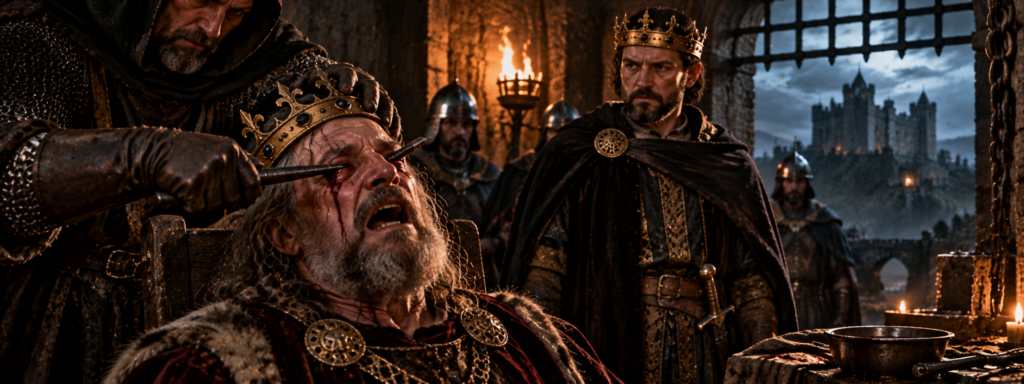
The Blinding of Donald III
The most disturbing accounts of Donald’s downfall describe his blinding. Medieval sources differ over the exact circumstances, and the chronology is not entirely secure, but the tradition is too substantial to dismiss as a modern invention. The Annals of Tigernach record a blinding associated with Donald’s defeat, while later Scottish historical writing describes his condemnation to permanent imprisonment. Some reconstructions place the blinding in 1097, while others associate it with events around 1099.
Blinding was an especially brutal method of removing a political rival. It could destroy a claimant’s ability to lead armies, travel independently, recognize allies, or perform the public duties expected of a ruler. It also marked the victim permanently, making his defeat visible to everyone who encountered him. The punishment could leave a rival alive while making his return to kingship far more difficult.
Such mutilation had precedents in medieval political culture, particularly in the Byzantine world, where blinding was repeatedly used against deposed emperors and rival claimants. The practice was not confined to Byzantium, however, and similar forms of political mutilation occurred elsewhere in medieval Europe. The logic was grimly practical. A living but physically incapacitated rival might be considered less dangerous than an able-bodied claimant capable of returning with an army.
For Donald, the punishment would have been particularly devastating because he had already demonstrated an extraordinary capacity to recover from defeat. He had lost the throne in 1094 and regained it within months. Edgar’s supporters therefore had direct historical evidence that deposition alone was insufficient. If Donald remained physically capable of leading another challenge, the danger might continue.
The surviving sources do not provide a trustworthy eyewitness description of the procedure. We cannot say where Donald was held, who physically carried out the mutilation, what instrument was used, or whether Edgar personally witnessed it. Any vivid reconstruction of a heated blade or knife entering the old king’s eyes would be invented unless clearly presented as a general description of possible medieval methods rather than Donald’s documented experience. The historical record supports the punishment in important traditions but not the intimate scene.
There is also uncertainty about the responsibility of particular members of Malcolm’s family. Edgar was the victorious king and therefore bears political responsibility for the treatment of Donald under his regime, but some medieval accounts implicate David, Edgar’s younger brother, in the events surrounding Donald’s downfall. The details are disputed, and later chroniclers may have shaped their stories according to the reputations of the princes involved. It is safer to recognize the dynasty’s responsibility than to invent a precise order issued in a private chamber.
A Punishment Worse Than Deposition
For a king accustomed to public authority, blinding was more than a physical injury. Royal power depended heavily upon personal presence, ceremonial display, the ability to recognize supporters, and participation in military and political gatherings. A ruler deprived of sight could still possess intelligence and influence, but his practical ability to command an unstable kingdom was severely reduced. The punishment attacked the public functions of kingship as well as the body of the individual.
The psychological consequences are impossible to reconstruct in Donald’s case. No reliable personal testimony survives describing his reaction, and medieval chroniclers did not preserve a detailed account of his thoughts. It would be tempting to portray him as raging against Edgar, begging for mercy, or falling into despair. None of those scenes can be established from the evidence.
What can be said is that Donald’s enemies had reasons to make his exclusion permanent. He was an experienced claimant with an established following and a history of recovering power after deposition. Simply stripping him of the royal title had failed before. Blinding, combined with imprisonment, offered a more decisive solution.
The punishment also carried a symbolic message to Donald’s supporters. The man they had crowned twice was no longer free to lead them, and his physical condition would make another restoration difficult. Edgar’s government could present the mutilated former king as a defeated relic of an unsuccessful political order. The warning extended beyond Donald himself to anyone considering renewed resistance.
Yet blinding did not necessarily mean that a victim immediately died. Medieval examples show that blinded rulers and princes could survive for years, sometimes retaining limited political significance through supporters acting in their names. The punishment therefore did not eliminate every possible threat. Permanent confinement remained necessary if Edgar wanted to ensure Donald could never again become a rallying point.
The combination of blinding and imprisonment explains the bleakness of Donald’s final years. He had lost the crown, his freedom, and, according to the prevailing tradition, his sight. His nephews had accomplished what Duncan II’s earlier victory had failed to achieve. Donald would never return to the Scottish throne.
Rescobie: The Prison of a Fallen King
Later tradition places Donald’s imprisonment at Rescobie in Angus, near Forfar. The association appears in accounts describing the fate of the deposed king after Edgar’s victory. It is not possible to reconstruct the precise building in which he was confined or the conditions under which he lived. The image of Donald imprisoned in a recognizable later medieval stone dungeon should therefore be treated cautiously.
Rescobie lay within a region connected to the political heartland of eastern Scotland. Confinement there would have placed Donald away from the centers where he might most easily gather supporters. It also allowed his captors to keep him under supervision while the new king consolidated authority. The location fits the practical requirements of holding a dangerous royal prisoner.
The sources do not tell us whether Donald was kept in chains, guarded continuously, or permitted limited movement. We do not know whether attendants cared for him or whether relatives were allowed to visit. We cannot reconstruct his meals, sleeping arrangements, or daily routine. Later romantic descriptions of his captivity often supply details that the surviving evidence simply does not preserve.
His status as a former king may have influenced how he was treated. Medieval royal prisoners could receive accommodations reflecting their rank, but they could also suffer harsh confinement when their captors feared rebellion. Donald’s reported blinding suggests that his enemies were willing to use severe measures to neutralize him. That fact makes it difficult to imagine his imprisonment as comfortable retirement.
The psychological cruelty of his situation requires little embellishment. Donald had spent decades waiting for a chance to rule and had finally achieved the crown at an advanced age. He had lost it, recovered it, and then lost it again to another nephew. Now the political world continued without him while he remained powerless to influence events.
Somewhere beyond his place of confinement, Edgar was establishing his kingship. Donald’s former supporters faced decisions about submission, exile, or resistance. Edmund had been removed from secular politics, and the remaining sons of Malcolm were increasingly positioned to inherit the future. The old king’s political life had ended even though his physical life continued.
Did Edgar Order His Uncle’s Death?
The question of Donald’s death is more complicated than the traditional account of imprisonment suggests. Some medieval writers describe him as blinded and confined until he died, while another tradition presents his overthrow in more explicitly lethal terms. William of Malmesbury associated Donald’s destruction with the cunning of David, the future David I, and the power of William Rufus. The wording has encouraged debate about whether Donald was killed outright, died as a result of his treatment, or was simply described as destroyed politically.
The distinction matters because assassination is a specific historical allegation. Donald’s removal from the throne is well established, and his blinding is supported by important medieval traditions. His death in or after captivity is also generally accepted. What remains uncertain is whether anyone deliberately killed him after he had already been imprisoned.
A modern summary by historian Dauvit Broun, published in The Oxford Companion to British History, places Donald’s blinding around 1099 and suggests that he may have died as a result. That interpretation recognizes the possibility of a direct connection between the mutilation and his death without pretending that the surviving sources provide a medical diagnosis. It also highlights the uncertainty surrounding the exact chronology. Other accounts place the blinding closer to the deposition in 1097.
The evidence does not justify confidently describing Donald as stabbed, poisoned, or secretly murdered in a prison cell. No trustworthy narrative supplies such details. Nor can we prove that Edgar issued an explicit order to kill him. The circumstances may have involved a deliberate mutilation that proved fatal, prolonged confinement followed by illness, or another form of death that the sources failed to explain.
Even without proof of assassination, Donald’s fate remains an example of extreme dynastic violence. His nephews’ victory resulted in his permanent removal, imprisonment, and reported mutilation. The old king died without regaining freedom or authority. Whether his captors intended his death or merely accepted it as a consequence of their treatment cannot be established.
This uncertainty is central to understanding his place among assassinated rulers and regicides. Donald was not a securely documented murder victim in the same sense as a king whose killing is described by contemporary eyewitnesses. He was a deposed monarch subjected to severe political punishment and possibly killed, directly or indirectly, through that punishment. His case belongs to the darker history of royal elimination precisely because the boundary between imprisonment, mutilation, and death remains unresolved.
The Final Years of Donald Bane
Donald probably died around 1099 or 1100, only a few years after his final deposition. The commonly given date is 1099, although medieval chronological traditions are not entirely consistent. He was likely in his mid-to-late sixties, an advanced age for a man who had spent much of his life amid political upheaval. His death ended the career of a ruler who had occupied the Scottish throne twice.
The surviving accounts do not provide a reliable description of his final illness. If he had been blinded shortly before death, the injury itself may have contributed to his decline through infection, trauma, or other complications. That possibility is medically plausible but cannot be established without evidence about the procedure or his physical condition. It should therefore remain a possibility rather than a conclusion.
Donald may also have died from an unrelated illness while imprisoned. His age and the stresses of captivity could have increased his vulnerability, but the sources do not allow a precise explanation. A royal prisoner did not need to be murdered for confinement to become a deadly experience. The loss of liberty, uncertain care, and physical suffering could themselves make survival difficult.
The silence surrounding his final days is striking because his political career had been so turbulent. He had survived Macbeth’s reign, watched Malcolm rule for decades, seized the crown after Alnwick, lost it to Duncan II, and recovered it after Duncan’s death. He had then ruled for another three years before Edgar overthrew him. The man who had twice escaped political defeat could not escape his final captivity.
There is no reliable deathbed speech, confession, or dramatic reconciliation with his nephews. We do not know whether Donald believed himself betrayed, whether he regretted his involvement in Duncan II’s death, or whether he still considered his claim legitimate. Such questions are emotionally compelling but historically unanswerable. The sources preserve the political outcome while withholding the private man.
His death nevertheless removed the last immediate possibility of another Donald restoration. Edgar’s government no longer needed to fear that the old king might somehow recover his freedom and gather supporters. The succession struggle that had consumed the years after Malcolm III’s death was moving toward a more durable settlement. Donald’s body had finally achieved what his enemies had sought from his imprisonment: he could never again claim the crown.
The Fate of Edmund
Edmund’s fate provides a revealing contrast with Donald’s. He had supported his uncle against other members of his family and was associated with the political settlement following Duncan II’s death. When Edgar defeated Donald in 1097, Edmund also lost his position. Yet he did not suffer the same remembered punishment as the old king.
Instead, Edmund was associated with monastic life at Montacute in Somerset. Entering a monastery removed him from ordinary secular competition and reduced the danger that he would return as a royal claimant. The arrangement could be presented as religious retirement, but it also served a clear political purpose. A prince who had once participated in a disputed kingship was being taken out of the succession struggle.
The different treatment of uncle and nephew may reflect their respective political significance. Donald had already been king twice and had demonstrated his ability to return after deposition. Edmund possessed royal blood and ambition, but he had not independently established the same durable kingship. Edgar may therefore have considered religious confinement sufficient for Edmund while treating Donald as a more serious threat.
Family relationships may also have influenced the outcome. Edmund was Edgar’s brother, while Donald was their uncle and a rival who had repeatedly opposed their branch of the dynasty. The sources do not reveal Edgar’s private reasoning, so it would be wrong to assume affection or hatred determined every decision. Nevertheless, medieval rulers often distinguished between relatives according to their perceived danger and political usefulness.
Edmund’s later life remains obscure. He did not return to the Scottish throne, and his name gradually disappeared from the central political narrative. His monastic fate was less physically brutal than Donald’s reported blinding, but it achieved a similar objective. Both men were removed from the struggle for kingship.
Their contrasting punishments reveal the range of methods available to victorious medieval rulers. One claimant could be confined within religious life, while another could be imprisoned and mutilated. Neither required a public execution to cease being politically effective. The goal was to prevent the defeated rival from becoming king again.
Edgar’s Victory and the New Scotland
Edgar ruled Scotland from 1097 until 1107. His accession marked the triumph of the branch descended from Malcolm III and Margaret over Donald’s claim. The English support that helped install him remained politically significant, and his reign was closely connected with the wider Anglo-Norman world. The violent succession struggles of the preceding years gradually gave way to a more stable royal government.
That stability should not be exaggerated. Scotland remained a kingdom of powerful regional interests, and its rulers continued to face challenges from within and beyond their borders. The authority of the crown was still negotiated through personal relationships, military strength, and aristocratic cooperation. Edgar’s success did not instantly create a centralized monarchy governed by uncontested hereditary rules.
Nevertheless, his victory helped establish the political direction followed by his brothers. Alexander I succeeded Edgar in 1107, while David I later became one of the most influential kings in medieval Scottish history. Their reigns brought major developments in religious patronage, aristocratic settlement, administration, and relationships with England. The family that had defeated Donald became the central dynasty of the following century.
Donald consequently acquired an uncomfortable place in later historical narratives. His accession could be portrayed as a temporary interruption of the line descending from Malcolm and Margaret. His opposition to Anglo-Norman influence could be interpreted as backward-looking resistance to changes that later historians regarded as beneficial. His eventual defeat could then appear necessary rather than tragic.
Such interpretations overlook the legitimacy of Donald’s own position. He was Duncan I’s son and Malcolm III’s brother, not an unrelated invader. His accession reflected real support within Scotland and a succession system that had not yet settled into later expectations. His enemies’ victory did not retroactively make his kingship meaningless.
The future belonged to Edgar’s branch because that branch won. Donald’s political world was defeated, his supporters were displaced or reconciled, and his memory was increasingly filtered through the dynasty that replaced him. His fate demonstrates how easily the history of a defeated king can become a justification for the men who destroyed him.
Was Donald a Usurper?
Donald III is frequently described as a usurper, particularly in narratives sympathetic to Malcolm III’s sons. The label suggests that he seized a crown belonging unquestionably to someone else. Yet eleventh-century Scottish succession was more complicated than that. Donald was an adult son of Duncan I and brother of the previous king, giving him a serious dynastic claim.
Malcolm’s sons also possessed legitimate claims through their father. Duncan II could argue that he was Malcolm’s eldest surviving son, while Edgar and his brothers represented the powerful branch descended from Margaret. The difficulty was that multiple claimants could plausibly present themselves as rightful heirs. The political system did not automatically produce a universally accepted answer.
Donald also had substantial support inside Scotland. He was recognized as king in 1093 and returned to power after Duncan II’s death in 1094. His second reign lasted approximately three years, long enough to demonstrate that his authority was not merely a momentary seizure by an isolated faction. Powerful men considered his kingship worth defending.
Calling him a usurper therefore reflects one interpretation of the succession rather than an uncontested fact. From Edgar’s perspective, Donald occupied a throne that should have passed to Malcolm’s descendants. From Donald’s perspective, he may have been the most suitable adult member of the royal dynasty. The surviving sources do not allow us to reconstruct his own arguments in detail.
The accusation becomes especially complicated when considering how other Scottish kings had acquired power. Macbeth had defeated Duncan in battle, Malcolm III had killed Macbeth and Lulach, and Donald’s own father had inherited after a period of violent dynastic consolidation. Royal succession had repeatedly depended upon the removal of rivals. Donald’s actions were not uniquely alien to the political culture around him.
His eventual defeat should therefore not be mistaken for proof that he never possessed a legitimate claim. The victor’s genealogy became the dominant genealogy because the victor survived. Donald’s story reminds us that legitimacy in medieval Scotland was often decided through conflict before being explained through history.
The Cruel Logic of Blinding a King
Blinding a defeated ruler was a punishment with an especially disturbing political logic. Unlike immediate execution, it allowed the victor to preserve the appearance of sparing a relative’s life while inflicting permanent damage. The victim could remain alive as evidence of the winner’s power. His survival became part of the punishment rather than an act of mercy in any ordinary sense.
For a king, the consequences extended beyond physical suffering. Military leadership, ceremonial appearances, travel, and the management of personal relationships all depended heavily upon abilities that blindness could impair. A blinded claimant might still possess supporters, but organizing a return to power became far more difficult. The punishment therefore attacked the practical foundations of royal authority.
It also created a lasting public symbol of defeat. A dead rival could become a martyr, while a blinded rival remained visibly diminished in the eyes of contemporaries who associated physical wholeness with royal fitness. Such attitudes were not universal or consistent, but they influenced the use of mutilation as a political weapon. The victor could point to the surviving prisoner as proof that the old claim had been neutralized.
Donald had already demonstrated why his enemies might fear leaving him untouched. His first deposition in 1094 had not ended his career because he survived and returned after Duncan II’s death. By 1097, Edgar’s supporters had reason to believe that ordinary exile or temporary imprisonment might fail. The blinding tradition therefore fits the political circumstances even though its exact chronology and details remain uncertain.
The cruelty of the punishment should not be softened by calling it a practical solution. It involved deliberately inflicting severe and permanent injury upon a defeated human being. Donald was an elderly man who had lost his crown and was already vulnerable to his captors. If the traditional account is accurate, his nephews’ victory culminated in a form of violence intended to destroy his future while leaving him alive.
That is what makes his fate so unsettling. The man who had once commanded royal loyalty became dependent upon those who controlled his confinement. His enemies did not merely prevent him from ruling. They reportedly ensured that the body of the former king would carry the consequences of his defeat until death.
The Family That Destroyed Itself
The succession crisis after Malcolm III’s death was remarkable for the number of close relatives who fought one another. Donald was Malcolm’s brother, Duncan II was Malcolm’s son, Edmund was another son, and Edgar was yet another. Their claims were not separated by distant generations or obscure branches of ancestry. They belonged to the same immediate royal family.
The sequence began with Malcolm and Edward dying at Alnwick in 1093. Donald then took the throne, displacing the expectations of Malcolm’s surviving sons. Duncan II overthrew Donald in 1094 with English assistance, only to be killed later that year. Donald returned with Edmund’s support before Edgar finally removed them in 1097.
The violence was not confined to battlefield casualties. Duncan II’s death was attributed by important sources to the political actions of Donald and Edmund. Donald himself was later imprisoned and reportedly blinded after Edgar’s victory. Edmund was removed from secular politics through monastic confinement. Within four years, the family had experienced death, deposition, betrayal, mutilation, and forced retirement.
The struggle reveals how royal kinship could intensify rather than prevent conflict. Every claimant possessed ancestry that could justify ambition, while each successful accession threatened the prospects of brothers, uncles, and nephews. A ruler’s relatives were therefore both his most natural allies and his most dangerous rivals. The closer their relationship to the crown, the more serious the threat they could represent.
Donald had lived long enough to see this pattern repeatedly. His father had been killed by Macbeth, his brother had killed Macbeth and Lulach, and his nephews now fought over the throne their father left behind. The same dynasty that had survived external challenges began consuming itself. Donald’s final captivity was one of the darkest consequences.
The eventual stability of Edgar’s reign should not obscure the cost. The victorious branch consolidated power only after several relatives had been killed or permanently removed. Donald’s story belongs to a wider pattern in which dynastic survival required the destruction of competing members of the dynasty itself.
Donald’s Daughter and the Bloodline That Survived
Although Donald had no securely documented surviving son, later genealogical traditions associate him with a daughter named Bethóc. She is linked with the family of Uhtred of Tynedale and with lines that later became important in Scottish aristocratic politics. The details of these genealogies are not equally secure, and some connections depend upon evidence recorded considerably later. They should therefore be treated cautiously rather than presented as an unquestionable family tree.
The tradition is nevertheless significant because it suggests that Donald’s descendants may have continued to influence Scottish politics long after his death. Medieval royal claims could pass through women as well as men, particularly when powerful aristocratic families sought to establish connections to earlier kings. A defeated ruler’s daughter could therefore preserve dynastic significance even when his sons had been eliminated or excluded. Royal blood did not disappear simply because one man lost his crown.
Later claimants to the Scottish throne drew upon complicated networks of descent from earlier royal houses. Families such as the Comyns eventually became central to succession disputes, although tracing every claimed connection back to Donald requires care. Medieval genealogy was frequently used to strengthen political arguments, and later writers sometimes arranged ancestry to support contemporary ambitions. Donald’s possible descendants belong within that broader context.
The existence of such traditions also complicates the idea that blinding and imprisonment could erase a dynasty completely. Donald’s enemies could prevent him from ruling again, but they could not necessarily extinguish every line of descent connected to him. His political defeat was permanent in his own lifetime, yet royal ancestry remained a resource that later generations might invoke. The memory of a defeated king could survive through genealogy even when chronicles treated him harshly.
For Donald himself, however, any surviving descendants offered little immediate consolation. By the time of his final captivity, he had lost control over the succession and could no longer determine who would inherit his claims. Edgar’s government possessed the power to define the future. Donald’s family connections would matter to later historians more than they mattered to the imprisoned king.
Burial and the Return to Iona
Donald is traditionally associated with burial at Dunkeld, although accounts of his original resting place differ. Later tradition holds that his remains were eventually transferred to Iona, the sacred island associated with the burial of numerous Scottish and Gaelic rulers. The precise history of these movements cannot be reconstructed with complete certainty. Nevertheless, the association with royal burial sites reflects the fact that Donald remained a recognized former king despite his violent deposition.
Iona possessed enormous religious and dynastic significance. Founded by St. Columba in the sixth century, its monastery became one of the most important centers of Gaelic Christianity. Burial there connected rulers with a sacred landscape and with generations of royal predecessors. Even kings whose political careers ended disastrously could be incorporated into this memory of legitimate succession.
If Donald’s remains were transferred to Iona, the act created a striking contrast with his final years. In life, his enemies had removed him from power, confined him, and reportedly mutilated him. In death, he could be remembered among the royal dead. The same society capable of destroying a king could preserve his name within a sacred tradition of kingship.
The physical evidence cannot resolve the circumstances of his death. No securely identified remains allow investigators to determine whether Donald suffered injuries associated with blinding or whether he died from another cause. Centuries of disturbance and uncertainty surrounding royal burials make such questions difficult to answer. The surviving written record therefore remains the principal source for his final fate.
His burial tradition nevertheless challenges the idea that Donald was merely an illegitimate intruder. A man remembered within the royal burial tradition had occupied a recognized position in the succession. His enemies defeated him, but they could not entirely erase the fact that he had been king. The crown had been taken from him twice, yet his name remained in the royal lists.
The Last King of an Older Order?
Donald III is sometimes presented as one of the final representatives of an older Gaelic political order before the increasing influence of Anglo-Norman institutions under Malcolm III’s descendants. There is some historical basis for associating his support with opposition to foreign courtiers and with succession customs that allowed adult royal relatives to compete for kingship. Yet describing him as the last defender of an unchanged Celtic Scotland would be misleading. The kingdom was already culturally and politically diverse before his accession.
Malcolm III himself had deep Gaelic roots while also maintaining important relationships with Norse and English aristocratic families. Donald’s nephew Duncan II had connections to the Norse world through his mother, while Edgar’s claim came through the same Scottish royal dynasty as Donald’s. The conflict was therefore not simply between native Scots and foreign-backed invaders. It was a dynastic struggle complicated by different political alliances.
Nevertheless, Donald’s defeat helped consolidate a line of kings increasingly connected with the Anglo-Norman world. Edgar, Alexander I, and David I would govern during a period of substantial institutional change. Their reigns saw developments in royal administration, religious patronage, aristocratic landholding, and relationships with England. Donald’s political defeat therefore coincided with a significant shift in the kingdom’s future direction.
That does not mean Donald consciously opposed every development later associated with his nephews. We know too little about his government to assign him a detailed ideological program. His supporters may have resisted particular individuals, policies, or forms of English influence without rejecting all external connections. Medieval political loyalties were rarely as neat as later national narratives suggest.
What can be said is that Donald represented a viable alternative at a crucial moment. Had he retained power, Scotland’s dynastic and political development might have followed a different course. His death did not single-handedly create the changes that followed, but his removal helped ensure that the men who promoted those changes would control the crown. The old king’s fate therefore belongs within a much larger transformation of Scottish monarchy.
The King History Treated as an Interruption
Donald III is often reduced to a brief entry between the long reign of Malcolm III and the more celebrated kingship of Edgar. His two reigns are usually listed with a short explanation that he was deposed, restored, and finally overthrown. The violence of his final years is sometimes mentioned almost casually. Such summaries make it easy to overlook how extraordinary his career actually was.
He was the son of a king killed by Macbeth and the brother of the man who defeated Macbeth. He survived decades without becoming king, then seized the throne at an age when many medieval rulers were already dead. He was overthrown by one nephew, returned after that nephew’s violent death, and ruled for another three years. Finally, another nephew defeated him and reportedly had him blinded.
Few Scottish kings experienced such a dramatic sequence of reversals. Donald’s career was not simply a failed attempt to seize power because he actually ruled twice. His first defeat did not end his political life, and his restoration demonstrated considerable resilience or continuing support. The second defeat succeeded only because his enemies ensured he could not return again.
The treatment of Donald in later historical memory reflects the success of Edgar’s branch. The kings who followed Edgar shaped Scotland’s political institutions and became central to later national history. Donald, by contrast, represented a line of succession that had been rejected. His career could therefore be portrayed as a temporary disturbance before the proper dynasty resumed control.
Yet that interpretation obscures the uncertainty contemporaries faced. In 1093, Donald’s accession was not obviously doomed. In 1094, Duncan II’s victory was not permanent. In 1097, Edgar’s success became decisive only after Donald was removed from the political world.
History looks inevitable when viewed backward from the winner’s throne. Donald’s life demonstrates how uncertain it felt to those living through it. He became king twice because the succession remained genuinely contested, not because everyone already knew Edgar would eventually triumph.
Regicide Without a Scaffold
Donald III’s death occupies an unusual place in the history of royal killing. He was not publicly beheaded like Charles I, stabbed by conspirators like Julius Caesar, or murdered in a palace chamber in a securely documented assassination. His downfall involved military defeat, deposition, imprisonment, and a reported act of deliberate mutilation. His subsequent death may have resulted from that punishment, although the evidence does not establish the cause conclusively.
This makes him an important example of how rulers could be eliminated without an ordinary execution. A victorious claimant might choose to imprison a rival rather than kill him immediately. Blinding could further reduce the threat while avoiding the public consequences of openly executing a royal relative. The prisoner might then die in confinement, leaving later historians uncertain whether the outcome had been intended from the beginning.
Donald was especially vulnerable because he had already demonstrated that deposition alone did not work. His return after Duncan II’s death showed that a defeated king could recover power if circumstances changed. Edgar’s government had reason to fear another restoration. Permanent confinement and reported mutilation were methods of ensuring that the danger would not recur.
The question of whether Donald was assassinated therefore cannot be answered with certainty. Some medieval language suggests a more directly lethal overthrow, while other accounts emphasize blinding and imprisonment. A modern historian has suggested that the blinding may have caused his death. None of these interpretations provides enough evidence to reconstruct a secret murder as established fact.
His inclusion among assassinated rulers and regicides is justified by the broader history of deliberate royal elimination, provided the uncertainty is made clear. Donald was a reigning king violently removed by rival claimants and subsequently subjected to severe punishment. He died without freedom after his enemies had ensured that he could no longer rule. His fate illustrates how the destruction of kingship could continue long after the crown itself had been taken away.
The absence of a scaffold does not make the story less brutal. Donald’s enemies reportedly chose a punishment that allowed him to survive while permanently damaging his ability to reclaim authority. If his death followed from that injury, the boundary between mutilation and killing becomes especially thin. Even if he died from unrelated causes, his final years were shaped by the coercive power of the relatives who had defeated him.
The King His Nephews Would Not Allow to Return
Donald III spent much of his life waiting for a crown that seemed destined to belong to someone else. His father Duncan I was killed when Donald was still young, and Macbeth occupied the throne for seventeen years. His brother Malcolm eventually defeated Macbeth and ruled Scotland for another thirty-five years. By the time Donald’s own opportunity arrived, he was an aging prince surrounded by nephews who believed the kingdom should pass to them.
The deaths of Malcolm III and his son Edward at Alnwick in November 1093 transformed Donald’s position almost overnight. Within days, Queen Margaret was also dead, leaving the royal household in turmoil. Donald stepped into the resulting uncertainty and secured recognition as king. His accession was not the act of a stranger stealing a crown, but the claim of an experienced royal relative within a succession system that still allowed competing interpretations of legitimacy.
His victory immediately threatened Malcolm’s surviving sons. Duncan, the eldest, returned with English support and overthrew him in 1094. Donald lost the throne he had waited decades to obtain, but he escaped the fate that had overtaken so many earlier Scottish rulers. He survived.
That survival changed everything. Duncan’s reliance upon Anglo-Norman troops generated opposition, and his political position weakened after he dismissed much of his military support. Before the year ended, Duncan was killed during the conflict surrounding his reign. Donald returned to power, demonstrating that the first attempt to remove him had failed.
The restoration was extraordinary, but it came at a terrible cost. Important sources associated Donald and Edmund with responsibility for Duncan’s death, an allegation that would haunt the political struggle even though the precise circumstances remain uncertain. The royal family had now moved beyond rivalry into a cycle of violence. Nephews fought uncles, brothers opposed brothers, and one king’s death created the opportunity for another’s return.
Donald ruled again for approximately three years. His alliance with Edmund gave his government a connection to Malcolm and Margaret’s descendants, but it also deepened divisions among the surviving princes. Edgar, Alexander, and David remained potential rivals with powerful English connections. Donald’s second reign was therefore never free from danger.
In 1097, Edgar came north with the support of William Rufus and the assistance of his maternal uncle Edgar Ætheling. The campaign succeeded where Duncan’s earlier victory had failed. Donald was overthrown, and this time his enemies did not leave him free to recover his crown. He became their prisoner.
The traditions describing what happened next are among the darkest in Scottish royal history. Donald was reportedly blinded, a punishment intended to make another restoration far more difficult. The exact date and circumstances are disputed, and the sources do not preserve a reliable eyewitness account of the mutilation. Nevertheless, the tradition appears in important medieval evidence and cannot simply be dismissed.
For Donald, the consequences were final. The man who had twice occupied the throne was now deprived of his freedom and, according to the prevailing account, his sight. His enemies had removed more than his royal title. They had attacked the physical abilities that helped make him a viable political leader.
Later tradition places his imprisonment at Rescobie in Angus. We do not know the conditions of his confinement or whether he received treatment appropriate to his former rank. We cannot reconstruct the conversations he had with guards, attendants, or visitors. The sources leave him largely alone in the historical record, a defeated king whose political life had ended.
His death followed around 1099 or 1100. Some accounts suggest that the blinding may have caused or contributed to his death, while others simply record that he remained imprisoned until he died. A more explicitly lethal version of his overthrow also survives in medieval writing. The evidence does not allow us to choose confidently between deliberate killing, death resulting from mutilation, and unrelated illness during captivity.
That uncertainty should not diminish the severity of what happened. Donald was a king whose nephews fought to remove him, whose first deposition failed, and whose second deposition was followed by permanent confinement and reported mutilation. His enemies had compelling political reasons to ensure that he never returned. The measures associated with his final defeat achieved exactly that result.
His story is particularly disturbing because the men responsible for his downfall belonged to the family he had spent his life defending and opposing in different circumstances. Malcolm III had been his brother, Duncan II his nephew, Edmund his nephew and ally, and Edgar his nephew and conqueror. The struggle did not divide Scotland neatly between one royal family and another. It divided a single dynasty against itself.
The men who defeated Donald eventually became associated with some of the most important developments in medieval Scottish history. Edgar’s reign was followed by those of Alexander I and David I, whose policies helped reshape the kingdom. Their success encouraged later generations to view Donald as an obstacle that had to be removed before Scotland could advance. Yet the achievements of the victors do not erase the suffering of the defeated.
Donald had a genuine royal claim and substantial support. He was recognized as king twice, survived an earlier deposition, and maintained his second reign for several years. His career cannot be reduced to the actions of a foolish old man who briefly stole a throne. He was a serious participant in one of Scotland’s most dangerous succession crises.
The punishment reportedly inflicted upon him also reveals the cruelty of a political system in which kingship depended upon physical survival. A defeated ruler could be spared immediate execution yet subjected to treatment intended to destroy his future. Blinding transformed mercy into something deeply ambiguous. The victim lived, but the life left to him could be one of confinement, dependence, and permanent exclusion.
Donald may have spent his final years hearing news of the kingdom he had twice ruled while remaining powerless to influence it. That possibility is consistent with his imprisonment, although the sources do not tell us what he heard or understood. His nephews were securing the future of their branch of the dynasty, while his own political world disappeared. The crown had passed beyond his reach.
His reported burial and later association with Iona preserved something his enemies could not entirely remove. Donald remained a king in the historical record, however brief and troubled his reigns had been. His name survived alongside those of the relatives who had defeated him. The royal title could be taken away in life, but the fact that he had worn it could not be erased.
What makes Donald’s story memorable is not simply that he was overthrown. Medieval Scotland produced many rulers who lost power violently. Donald was unusual because he lost the crown, recovered it, and then suffered a final defeat so severe that his enemies reportedly mutilated him to prevent another return. His life became a demonstration of how dangerous a surviving royal claimant could remain.
The first time his nephews took the throne, Donald came back. The second time, they made certain he would not. Whether his death was deliberately engineered or followed from the injuries and confinement imposed upon him remains uncertain. The political intention behind his permanent exclusion is much clearer.
By the end, the old king had lost everything that had once made him powerful. His followers could no longer rally around a free and active monarch. His nephews controlled the kingdom, his ally Edmund had been removed from secular politics, and his own future had been reduced to captivity. The man who had survived so many earlier reversals had finally reached a defeat from which there was no recovery.
Donald III’s story therefore belongs among the darkest episodes of Scottish dynastic history. It is a story of an aging prince who became king, a nephew who overthrew him, another nephew whose death restored him, and a final nephew whose victory ended his freedom. It is also a story about how political violence could be disguised as the orderly transfer of legitimate authority. The victor inherited the crown, while the defeated king inherited the consequences.
The precise circumstances of Donald’s death may never be known. No surviving account allows us to describe his final moments with confidence, and no trustworthy evidence establishes a secret assassination in his prison. Yet the uncertainty does not make his ending peaceful. He died after being stripped of his throne, imprisoned by his enemies, and reportedly blinded.
For a man who had twice fought his way back to kingship, the final cruelty was that there would be no third chance. Donald had survived the loss of his father, the long reign of his brother, the invasion of Duncan II, and the violent turmoil that restored him to power. He had outlasted enemies and recovered from defeats that would have ended the careers of lesser claimants. Only his final captors succeeded in making his removal permanent.
The Scottish crown passed to Edgar and then to the brothers whose descendants would shape the kingdom’s future. Donald disappeared into the darker margins of royal history, remembered as the old king who had resisted them and paid for that resistance with his freedom and perhaps his sight. His fate remains a warning about the cruelty that could lie beneath medieval succession. A king might survive the battlefield and still be destroyed by the family that inherited his throne.
Donald III had worn the crown twice, but his enemies ensured he would never wear it again. His final years were spent not in a royal hall surrounded by supporters, but in the custody of those who had defeated him. Whether he died from deliberate violence, the consequences of blinding, or illness in captivity, his kingship had already been extinguished. The man who had once ruled Scotland was left to die while his nephews ruled in his place.