
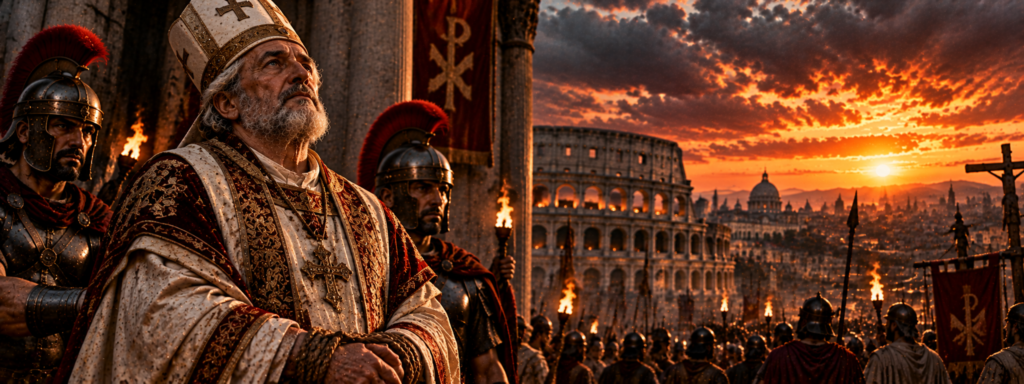
Pope Anacletus: The Forgotten Bishop of Rome and the Martyrdom That History Cannot Prove
The Mysterious Third Pope, the Shadow of Domitian, and the Ancient Christian Succession That Nearly Lost His Identity
Pope Anacletus, also known as Cletus (died c. AD 88–92, according to differing traditional chronologies), is traditionally recognized as the third bishop of Rome, following Saint Peter and Pope Linus. His pontificate is variously dated, often approximately AD 79–92, although the surviving evidence does not establish its precise beginning or end. Early Christian tradition identifies him as an important link in the succession of Roman church leaders, while later accounts describe him as a Greek or Roman Christian who organized the clergy and was buried near Saint Peter. He was traditionally venerated as a martyr, but no reliable early account establishes that he was executed, assassinated, or otherwise killed for his faith, leaving both his life and death among the enduring mysteries of the early papacy.
The Pope Whose Death Became a Legend
Rome had already swallowed emperors, senators, generals, and countless ordinary people by the time Anacletus entered the history of the Christian Church. Its streets had witnessed political assassinations, its prisons had held men condemned by imperial suspicion, and its public punishments had demonstrated how easily Roman authority could turn suffering into spectacle. The city was recovering from civil war and the tyranny associated with Nero, yet the machinery of imperial power remained as formidable as ever. Somewhere within this enormous capital, a small religious community continued to gather around teachings that many Romans scarcely understood, preserving the memory of apostles who had reportedly died under imperial persecution.
According to the traditional succession of the Roman Church, the man who followed Linus was Anacletus, sometimes called Cletus. He inherited no throne, commanded no army, and possessed none of the political authority that later popes would exercise over kings and emperors. His leadership belonged to a period when Christianity was still establishing its identity, when communities gathered in private homes, and when the distinction between religious authority and political vulnerability could be painfully clear. Nevertheless, his name would eventually occupy a permanent place in the history of one of the world’s most enduring institutions.
For centuries, Anacletus was remembered as a martyr, one of the earliest bishops supposedly killed because of his Christian faith. The story seemed entirely believable to later generations familiar with the persecutions of Nero and the violent deaths associated with other early Christian leaders. Yet when historians examine the surviving evidence, the supposed execution begins to dissolve into uncertainty. No contemporary account describes his arrest, no reliable early source identifies his executioner, and no surviving record establishes how he died.
Even his identity became confused. Medieval traditions sometimes treated Cletus and Anacletus as two different men, creating an additional pope in the succession and assigning separate commemorations to individuals who are now generally understood to be the same person. Other writers supplied a birthplace, a father’s name, religious regulations, and a burial place, although much of this information appeared centuries after his lifetime. The man whose name was supposed to preserve continuity in the Roman Church became the subject of one of its most persistent historical confusions.
The uncertainty surrounding Anacletus makes his story unusually revealing. Unlike rulers whose murders were described by eyewitnesses or chroniclers, he left almost no trace beyond a handful of ancient references and a growing collection of later traditions. His supposed martyrdom cannot be reconstructed as a documented killing, and the traditional chronology places much of his leadership before the reign of Domitian, whose reputation for persecuting Christians would later become central to the story of the early Church. Understanding Anacletus therefore requires examining not only the dangers of imperial Rome but also the ways religious memory transformed obscure leaders into recognizable saints and martyrs.
His story begins in a city where political power could be terrifyingly unstable, where Christianity remained a vulnerable minority movement, and where the death of a community leader might pass unnoticed by the historians of the empire. The most unsettling aspect of his biography is not a documented execution or a secret assassination. It is the realization that a man remembered for nearly two thousand years as a successor of Peter could disappear so completely from the historical record that even the manner of his death became impossible to establish.
Rome After Nero: A Capital Built on Fear and Survival
The world into which Anacletus emerged had been profoundly shaped by the reign of Nero. In AD 64, a devastating fire destroyed large sections of Rome, leaving inhabitants homeless and provoking rumors about the emperor’s responsibility. The Roman historian Tacitus later reported that Nero blamed Christians for the disaster and subjected members of the community to exceptionally cruel punishments. Some were crucified, others were attacked by animals, and still others were burned as part of public spectacles.
The persecution described by Tacitus was not necessarily a continuous campaign extending across the entire empire. The evidence points instead to a particularly brutal episode centered on Rome after the great fire. Nevertheless, the event became deeply embedded in Christian memory, especially because later tradition associated the martyrdoms of Peter and Paul with Nero’s reign. For subsequent generations, the emperor became a symbol of pagan cruelty and the terrifying vulnerability of believers living under Roman authority.
The deaths of Peter and Paul, although not documented in all their traditional details, were central to the developing identity of Roman Christianity. Peter was remembered as having been crucified, with the distinctive tradition of upside-down crucifixion appearing in later Christian literature. Paul was traditionally said to have been beheaded, a form of execution often associated with Roman citizens. The precise circumstances remain debated, but the memory of both apostles’ deaths gave Rome an exceptional place in Christian history.
Nero’s government eventually collapsed under the pressure of military rebellion and political opposition. In AD 68, abandoned by important supporters and facing the prospect of capture, he died by suicide. His death ended the Julio-Claudian dynasty and unleashed a struggle for imperial power that exposed the violence underlying Roman politics. The following year would become one of the bloodiest episodes of the early empire.
Galba, Otho, Vitellius, and Vespasian competed for the imperial throne during the Year of the Four Emperors. Their struggle involved military defections, battles, political betrayals, and executions, culminating in the victory of Vespasian. Rome itself experienced violence as rival forces fought for control of the capital. The destruction of the great Temple of Jupiter on the Capitoline Hill during the conflict demonstrated that even the city’s most sacred monuments were not immune to political catastrophe.
The Christian community survived these upheavals, although its precise experiences remain unknown. No surviving account describes Anacletus participating in the civil war or organizing believers during the fighting. The traditional chronology generally places his leadership after the immediate crisis, but the instability of the period helps explain the world inherited by Rome’s early Christian generations. Imperial government could collapse, emperors could be murdered, and military loyalties could shift almost overnight.
For ordinary inhabitants, such events created an atmosphere of uncertainty extending far beyond the imperial palace. Food supplies, public order, economic stability, and personal safety could all be affected by political conflict. Those without wealth or powerful patrons were particularly vulnerable when violence disrupted the city. Christians belonged to this broader urban population, sharing many of the dangers faced by their neighbors while also maintaining a religious identity that could attract suspicion.
By the time Anacletus is traditionally placed in Roman leadership, the empire had entered a period of relative stabilization under the Flavian dynasty. Yet the memory of Nero’s persecution and the civil wars remained close enough to shape how later Christians understood their past. The early Church had survived imperial cruelty and political collapse, but survival did not guarantee safety. Its leaders still lived within a society where the state possessed overwhelming power over anyone it chose to punish.
Who Was Anacletus? The Man Hidden Behind Two Names
The first difficulty in reconstructing Anacletus’s life is that historians cannot establish his personal background with confidence. Later tradition sometimes describes him as a Greek, while other accounts associate him with Rome itself. The Liber Pontificalis, a compilation of papal biographies whose earliest entries were written centuries after the events they describe, identifies him as Roman and gives his father’s name as Emilianus. Such details cannot be independently verified and should not be treated as established facts.
The names Anacletus and Cletus are closely related Greek forms associated with the idea of being called or summoned. In ancient sources, variations in personal names were common, particularly when names moved between Greek and Latin. Differences in spelling, abbreviation, and transmission could create confusion for later copyists. In this case, the variations eventually contributed to the mistaken belief that two separate Roman bishops had existed.
The earliest important succession list comes from Irenaeus of Lyons, writing in the late second century. He identified Linus as the successor of Peter and Paul in the Roman episcopal office, followed by Anacletus and then Clement. This testimony is particularly valuable because it was produced relatively close to the period in question. It demonstrates that Anacletus was remembered as a significant Roman Christian leader by the time Irenaeus wrote.
Yet Irenaeus supplied almost no personal information. He did not describe Anacletus’s childhood, occupation, family, education, or relationship with Peter. He offered no detailed account of his leadership and did not report that he died violently. Anacletus appeared primarily as a link in a succession intended to demonstrate continuity of Christian teaching.
This limited testimony creates a remarkable contrast between historical evidence and later reputation. The traditional third pope became a recognized saint, acquired a feast day, and was associated with religious regulations and martyrdom. Yet the earliest substantial evidence preserves little more than his name and place in the succession. The detailed figure familiar from later devotional accounts cannot be reconstructed from contemporary records.
His supposed Greek identity is especially difficult to establish. Rome contained a large Greek-speaking population, including immigrants, freedmen, enslaved people, merchants, and educated members of wealthy households. Greek names were common and did not necessarily indicate a person’s birthplace or ethnicity. Even if Anacletus bore a Greek name, that fact alone cannot prove that he was born in Greece.
The same caution applies to his social status. Some early Christian leaders came from modest backgrounds, while others belonged to households possessing substantial resources and connections. The Christian movement attracted people from different social positions, and Roman congregations likely reflected this diversity. Nothing in the surviving evidence permits a confident description of Anacletus as wealthy, impoverished, enslaved, freed, or aristocratic.
We do not know whether he was married or had children, whether he had personally encountered Peter or Paul, or whether he had been a Christian during Nero’s persecution. Later narratives sometimes create the impression that every early bishop was closely acquainted with the apostles. Such relationships are possible in some cases, but they require evidence rather than assumption. For Anacletus, the historical record remains silent.
His identity therefore survives in a strangely incomplete form. He is remembered as a leader, but his personal history is largely inaccessible. He occupies a recognized position in the traditional papal succession, yet the circumstances that brought him to prominence are unknown. The mystery begins not with his death but with the almost complete disappearance of the man himself.
Cletus and Anacletus: How One Pope Became Two
One of the most fascinating features of Anacletus’s history is the confusion surrounding his name. For centuries, some ecclesiastical lists treated Cletus and Anacletus as separate individuals, assigning them different positions in the succession of Roman bishops. The result was a duplication that altered the numbering of the earliest popes. What began as a problem of names became an institutional puzzle lasting well into modern times.
The earliest succession preserved by Irenaeus does not clearly support the existence of two separate bishops bearing these names. He lists Anacletus between Linus and Clement. Other ancient sources preserve variations of the name, contributing to later uncertainty. The differences became more consequential when compilers attempted to combine traditions into a single chronological sequence.
The Liber Pontificalis played an important role in perpetuating the distinction. Its early biographies sometimes presented Cletus and Anacletus separately, assigning each a place within the Roman succession. Because the work became highly influential in medieval papal history, the duplication was repeated in later reference traditions. The authority of the compilation helped preserve a distinction that modern scholarship generally rejects.
The confusion extended into liturgical commemoration. Cletus and Anacletus were at times honored on different dates, reinforcing the impression that they were separate saints. The Roman liturgical calendar historically reflected this distinction, although later revisions removed the duplication. Today the two names are ordinarily understood as referring to one early bishop of Rome.
The problem illustrates the limitations of ancient recordkeeping. The first-century Roman Church did not preserve a surviving archive comparable to the administrative records of later centuries. Names and sequences were transmitted through Christian communities, historical works, and manuscript copying. Variations could become established before scholars possessed the evidence necessary to evaluate them critically.
It also reveals the tendency of later institutions to impose precise chronological order upon uncertain material. Once a succession list became important, compilers sought to assign each figure a distinct term of office. Conflicting traditions could be reconciled by treating variant names as separate people. Such solutions produced an appearance of completeness while sometimes creating additional historical problems.
The duplication is especially striking because Anacletus’s personal biography was already so poorly documented. A man whose activities were almost entirely unknown acquired a second identity through the transmission of his name. Later readers encountered two supposed popes where earlier evidence indicated one. The confusion became part of the history of the papacy itself.
Modern historians generally regard Cletus and Anacletus as the same person. This conclusion does not resolve every question about his dates or responsibilities, but it removes an unnecessary duplication from the early succession. It also provides a reminder that even apparently straightforward lists can conceal centuries of misunderstanding. The names preserved in historical records are not always as stable as later traditions suggest.
The Third Pope and the Problem of Apostolic Succession
Anacletus is traditionally numbered as the third pope, following Peter and Linus. This description is firmly established within Catholic ecclesiastical history, but it requires historical context. The office of bishop of Rome developed over time, and the authority exercised by its earliest leaders was not identical to that of later medieval or modern popes. The institutional structures familiar today cannot simply be projected backward into the first century.
Early Christian communities were organized around networks of believers, teachers, elders, and other recognized leaders. The New Testament uses terms such as bishop and presbyter in ways that do not always correspond neatly to later ecclesiastical offices. Some communities may have developed strong individual leadership relatively early, while others appear to have been governed by groups of elders. The precise arrangements varied across the developing Christian movement.
Rome presents particular difficulties because the earliest evidence is limited. Scholars debate whether the Roman Christian community initially possessed a single presiding bishop or a more collective form of leadership. The later succession lists identify individual names, but they do not establish exactly how authority was exercised during each generation. Anacletus may have been a prominent leader without occupying an office identical to the later papacy.
Irenaeus’s account must be understood within its theological purpose. He was arguing against religious teachings he considered false and wanted to demonstrate continuity between apostolic Christianity and the churches of his own time. The succession of Roman leaders served as evidence that authentic teaching had been preserved through identifiable individuals. Anacletus’s importance lay in his position within that chain.
The Roman Church possessed special significance because of its association with Peter and Paul. Both apostles were remembered as having ministered in Rome, and their deaths gave the city considerable religious prestige. Later bishops drew upon this association when asserting their authority. Yet the development of Roman primacy was a complex process involving centuries of theological and political debate.
The early succession therefore represents both historical memory and institutional interpretation. The names preserved by Irenaeus may reflect genuine leadership traditions, but the meaning of the office changed as Christianity developed. Anacletus was not a sovereign ruler governing territories, appointing kings, or commanding armies. He belonged to a community that remained politically marginal within the Roman Empire.
This distinction matters when discussing his supposed martyrdom. The death of a first-century Roman Christian leader would not have been a regicide in the conventional political sense. Even if Anacletus had been executed, the event would belong to the history of religious persecution rather than the assassination of a reigning monarch. His place within a broader category of assassinated rulers must therefore be understood as a traditional account of a religious leader’s disputed death.
The later importance of the papacy nevertheless gives his position enormous historical significance. Anacletus became part of the institution’s foundational genealogy, connecting the apostolic generation with subsequent bishops. His name was repeated in lists, prayers, and histories long after the circumstances of his life had been forgotten. The development of the papacy transformed an obscure first-century leader into a figure of enduring symbolic importance.
Vespasian’s Rome: Stability Beneath the Shadow of Empire
The traditional beginning of Anacletus’s leadership is often placed near the end of Vespasian’s reign. Vespasian had emerged victorious from the civil wars of AD 69 and established the Flavian dynasty. His government focused upon restoring finances, rebuilding damaged structures, and strengthening imperial authority. After years of instability, Rome entered a period of relative political order.
The new emperor understood the importance of public monuments and visible displays of legitimacy. Construction began on the great amphitheater later known as the Colosseum, built on land associated with Nero’s extravagant palace complex. The project symbolized the return of public space to the Roman people under the Flavian dynasty. It also demonstrated the enormous resources available to an emperor who controlled the Mediterranean world.
For ordinary Romans, however, imperial stability did not eliminate social inequality or political vulnerability. The city remained crowded, economically divided, and dependent upon systems of patronage. Enslaved people and freedmen formed important parts of its population, while wealthy families enjoyed privileges unavailable to most inhabitants. A small religious community could survive within this environment without attracting sustained imperial attention.
The surviving evidence does not identify a systematic persecution of Christians under Vespasian. This is significant because some traditional chronologies place Anacletus’s leadership during the final years of his reign. The absence of a documented campaign does not prove that Christians experienced no hostility, but it cautions against imagining constant state-sponsored violence. Early Christian life included ordinary communal activity as well as the possibility of persecution.
The destruction of Jerusalem in AD 70 also shaped the broader religious environment. Roman forces commanded by Titus captured the city after a devastating siege, and the Second Temple was destroyed. The consequences for Jewish communities were immense, affecting religious life, political identity, and relations with Roman authority. Christianity, which had emerged from Jewish religious traditions, developed within the aftermath of these events.
The Roman Christian community likely contained believers with different relationships to Judaism. Some may have come from Jewish backgrounds, while others were Gentiles attracted to the movement. Questions concerning religious law, identity, and communal practice continued to shape Christian teaching. Yet the surviving evidence does not reveal how Anacletus personally addressed these issues.
Vespasian died in AD 79, and his son Titus succeeded him. The transition was comparatively orderly, demonstrating the growing stability of the Flavian dynasty. Rome had moved away from the immediate chaos of the civil wars, but the imperial system remained centered upon the authority of one ruling family. The Christian community continued its development beneath a political structure that offered it little formal recognition.
For Anacletus, this period is historically important mainly as context. No surviving contemporary source records his actions under Vespasian or identifies a personal relationship with imperial officials. The contrast between the richly documented emperor and the obscure Christian leader is striking. One left monuments and political histories, while the other survived primarily as a name in a religious succession.
Titus: Disaster, Spectacle, and the Christian Community
Titus became emperor in AD 79, the same year traditionally associated with the beginning of Anacletus’s pontificate. His short reign was marked by several major disasters, including the eruption of Mount Vesuvius and a devastating fire in Rome. These events became central to his historical reputation, particularly because ancient writers praised his response to suffering. The period offers a vivid picture of the dangers and uncertainties confronting inhabitants of the Roman world.
The eruption of Vesuvius destroyed Pompeii, Herculaneum, and surrounding settlements in the Bay of Naples. Ash, pumice, and pyroclastic flows overwhelmed communities, preserving extraordinary archaeological evidence of everyday Roman life. Thousands were affected, and the disaster became one of antiquity’s most famous natural catastrophes. Although geographically distant from Rome, the eruption demonstrated the vulnerability of even prosperous Roman communities.
A major fire struck Rome in AD 80, damaging important public buildings and urban districts. The city also experienced an epidemic during Titus’s reign, adding to the suffering associated with the period. Ancient accounts describe imperial relief efforts and efforts to restore damaged structures. The combination of disasters created a reign remembered for both catastrophe and public generosity.
The Colosseum was inaugurated under Titus in AD 80, becoming a monumental symbol of imperial power and public entertainment. Its opening celebrations reportedly involved elaborate spectacles, including animal hunts and gladiatorial displays. The amphitheater embodied the Roman state’s capacity to transform violence into mass entertainment. Later Christian memory would associate such arenas with martyrdom, although specific popular claims about early Christians being killed in the Colosseum often lack contemporary evidence.
Anacletus’s supposed leadership coincided with this dramatic urban environment, but his personal experiences remain unknown. No source records him responding to the fire, organizing relief, or confronting imperial authorities. It would be tempting to imagine Christian gatherings discussing the disasters or assisting affected neighbors. Such activities are plausible within the broader practices of early Christian communities, but they cannot be attributed specifically to Anacletus.
The reign of Titus also provides little support for the claim that Anacletus was persecuted. Ancient historians do not describe a systematic campaign against Christians during these years. The movement remained small and largely outside the concerns of imperial political narratives. Its leaders could be historically invisible even while exercising meaningful influence within their communities.
Titus died in AD 81 after a reign lasting only a little more than two years. His younger brother Domitian succeeded him, beginning a government that would later acquire a reputation for authoritarianism and suspicion. The transition marked a new phase in Flavian history and in the traditional chronology of Anacletus’s leadership. It also introduced the emperor whose name became closely associated with later Christian accounts of persecution.
Yet the relationship between Domitian and the Christian community is historically complicated. Later Christian writers portrayed him as a persecutor comparable to Nero, but the surviving contemporary evidence does not establish a continuous empire-wide campaign against Christians. Understanding that distinction is essential before examining the supposed martyrdom of Anacletus. The political reputation of an emperor cannot substitute for evidence concerning a particular victim.
Domitian: The Emperor Whose Reputation Darkened Christian Memory
Domitian ruled the Roman Empire from AD 81 until his assassination in AD 96. His reign combined administrative activity, military campaigns, monumental construction, and increasingly strained relations with members of the senatorial elite. Ancient writers such as Tacitus, Suetonius, and Cassius Dio portrayed him in deeply hostile terms, emphasizing suspicion, cruelty, and authoritarian behavior. Their accounts helped establish his enduring reputation as one of Rome’s more oppressive emperors.
The emperor’s relationship with the Senate was particularly troubled. Domitian emphasized imperial authority and pursued policies that offended aristocratic expectations of political participation. Accusations of conspiracy and treason contributed to an atmosphere of fear among influential families. Several prominent individuals were executed, exiled, or otherwise punished during his reign.
Yet the hostile literary tradition requires careful interpretation. Many surviving accounts were written after Domitian’s death, when his successors and senatorial opponents had strong reasons to condemn his memory. His administrative achievements and military policies complicate the image of a ruler concerned only with terror. The historical Domitian was more complex than the caricature preserved by some ancient writers.
Later Christian authors nevertheless associated him with persecution. Eusebius, writing in the fourth century, presented Domitian as a ruler who renewed hostility toward Christians after Nero. Earlier Christian writers, including Tertullian, also linked him with persecution, although their accounts were written long after the events. These traditions contributed to the image of Domitian as the second great persecutor of the Church.
The precise extent of any persecution remains disputed. Some individuals connected with the imperial household were punished under Domitian, and later Christian traditions interpreted certain cases as involving Christian belief. Yet the evidence does not establish a systematic empire-wide campaign against Christians comparable to the later persecutions of the third and early fourth centuries. Religious identity, political suspicion, and accusations of impiety could overlap in complicated ways.
The execution of the consul Titus Flavius Clemens in AD 95 is one of the most frequently discussed episodes. Cassius Dio associated his punishment and the exile of his wife, Flavia Domitilla, with accusations involving atheism and Jewish practices. Later Christian tradition connected these figures with Christianity, although the identification and circumstances remain debated. The episode illustrates the difficulty of separating religious accusations from imperial political conflict.
Anacletus’s traditional pontificate overlaps with the earlier part of Domitian’s reign. If the conventional dates are accepted, he would have lived under an emperor whose government later acquired a reputation for persecuting Christians. Yet no reliable early source identifies Anacletus as a victim of Domitian’s policies. The chronological overlap alone does not establish an execution.
This distinction is crucial. Domitian was capable of political violence, and later Christian writers remembered his reign with suspicion. But a documented pattern of imperial cruelty does not prove that every Christian leader living during the period was killed. Anacletus’s supposed martyrdom remains unsupported by a specific historical account, regardless of the emperor’s reputation.
The Roman Christians Under Domitian: Between Suspicion and Survival
The Christian community of Rome during Domitian’s reign occupied an uncertain position within imperial society. Christianity had emerged from Judaism, and Roman authorities did not initially possess a clear or consistent understanding of its separate identity. Religious practices could attract suspicion when they appeared to challenge established customs or public obligations. Yet the surviving evidence does not permit a detailed reconstruction of how ordinary Roman Christians experienced Domitian’s government.
Roman religion was deeply connected with civic life. Public sacrifices, festivals, household worship, and honors paid to the emperor formed part of the social and political order. Participation in such practices could express loyalty to family, community, and state. Christians who rejected certain forms of worship might therefore appear unusual or uncooperative to their neighbors.
The extent to which such differences led to prosecution varied across time and place. Roman officials generally responded to specific circumstances rather than enforcing a single permanent policy toward Christianity during the first century. Local accusations, political tensions, and questions of public order could all influence official behavior. A community might experience relative peace for years before a particular dispute brought it to the attention of authorities.
The later correspondence between Pliny the Younger and Emperor Trajan, written in the early second century, provides valuable evidence of how Roman officials approached Christians. Pliny asked how to handle individuals accused of belonging to the movement, and Trajan advised against actively searching for Christians while permitting punishment in certain circumstances. The exchange occurred after Anacletus’s traditional lifetime, but it demonstrates that imperial policy remained uncertain even decades later. It also cautions against imagining a fully developed system of persecution in the first century.
Within Rome, Christian gatherings probably continued in domestic settings. Communities maintained relationships through worship, shared meals, teaching, and mutual assistance. Their members may have included people from different social classes and cultural backgrounds. Yet the surviving evidence does not identify the precise locations, membership, or organization of congregations during Anacletus’s supposed leadership.
The movement’s relative invisibility could offer a measure of protection. Roman historians generally paid little attention to Christian communities unless they became associated with public controversy or imperial punishment. This lack of attention does not mean Christians were insignificant to one another. It means their activities rarely entered the kinds of records that survived from the ancient world.
Anacletus may have helped maintain continuity during these uncertain years. He may have participated in teaching, worship, dispute resolution, and the organization of communal life. Such responsibilities would be consistent with the functions of early Christian leadership, but no surviving source documents his specific actions. Historical reconstruction must distinguish reasonable possibilities from established facts.
The danger surrounding the community was therefore real but difficult to measure. Christians lived under a government capable of harsh punishment, yet the evidence does not support a picture of uninterrupted terror. The supposed martyrdom of Anacletus cannot be established merely by placing him within Domitian’s reign. His personal fate remains hidden behind the broader history of imperial power and Christian memory.
The Christian Community Before the Great Papal Palace
The world of Anacletus bore little resemblance to the later papal court. There was no Vatican palace, no elaborate curial bureaucracy, and no territorial state governed by the bishop of Rome. Christianity remained a relatively small religious movement within an enormous imperial capital. Its leadership structures were developing through local relationships rather than through the machinery of sovereign government.
Private households were central to early Christian life. The New Testament contains references to communities meeting in homes, and such gatherings provided practical spaces for worship and instruction. A household could bring together relatives, dependents, friends, and other believers within an existing social network. These settings allowed religious communities to function without monumental public buildings.
Rome’s population was highly diverse. People arrived from across the Mediterranean and beyond, bringing different languages, customs, and religious traditions. Greek was widely spoken alongside Latin, and the city’s social structure included senators, merchants, artisans, freedmen, enslaved people, and migrants. Early Christian communities likely reflected some of this diversity, although the precise composition of Anacletus’s congregation is unknown.
The movement also inherited important traditions from Judaism. Scripture, ethical teaching, communal worship, and expectations concerning divine judgment shaped early Christian identity. Debates over Jewish law and the place of Gentile believers remained significant. Rome’s Jewish population formed part of the wider religious environment in which Christianity developed.
Leadership within such communities involved responsibilities that were both spiritual and practical. Recognized figures might teach, preserve traditions, coordinate gatherings, assist vulnerable members, and help resolve disagreements. They could also maintain contact with Christians in other cities through travel and correspondence. The precise extent of Anacletus’s responsibilities cannot be reconstructed, but these functions illustrate the world in which early Christian leadership operated.
The absence of political power made religious authority dependent upon recognition and trust. A Christian leader could not rely upon Roman magistrates to enforce theological decisions or compel obedience. Influence developed through relationships, reputation, and the perceived legitimacy of teaching. This was a very different kind of authority from that exercised by later popes who negotiated with emperors and ruled territories.
The community’s modest circumstances also help explain the scarcity of records. Documents could be lost, gatherings might leave little archaeological evidence, and personal memories could disappear as generations passed. Early Christians did not possess the resources of the imperial administration. Their history was preserved selectively through letters, traditions, and later ecclesiastical writings.
Anacletus belongs to this poorly documented world. His importance within the traditional succession does not mean that his daily activities were recorded or that later historians could reconstruct his personal experiences. The contrast between his symbolic significance and historical obscurity is therefore unsurprising. He represents a generation whose institutional legacy became enormous even as the details of individual lives vanished.
Did Anacletus Organize the Roman Clergy?
Later papal biographies attribute organizational achievements to Anacletus, including the establishment or arrangement of priests within the Roman Church. Some traditions state that he ordained a particular number of presbyters and bishops. Others associate him with the division of Rome into ecclesiastical districts or the development of structures connected with Christian worship. These claims create the image of an administrator laying the foundations of the later papacy.
The problem is that the evidence comes from sources written long after his lifetime. The Liber Pontificalis contains details concerning ordinations and ecclesiastical regulations attributed to the earliest popes, but its first-century biographies are historically unreliable in many particulars. The figures and arrangements may reflect later assumptions about how bishops should have governed. They cannot automatically be accepted as contemporary records.
The claim that Anacletus organized Roman clergy into distinct groups is especially difficult to verify. Formal ecclesiastical districts and administrative structures developed over time, and their origins cannot confidently be assigned to one obscure first-century leader. Later writers often sought ancient founders for institutions familiar in their own period. Associating such arrangements with an early pope gave them a sense of apostolic antiquity.
This does not mean that Anacletus performed no organizational work. Any functioning Christian community required some coordination of worship, teaching, resources, and relationships. Recognized leaders likely played important roles in maintaining that organization. The difficulty lies in identifying specific actions and distinguishing them from later retrospective claims.
The development of ordained ministries was itself a gradual process. Early Christian writings refer to apostles, prophets, teachers, bishops, presbyters, and deacons, but the precise relationships among these roles varied. By the second century, clearer distinctions emerged in many communities. Later historians sometimes projected those distinctions backward into the first century.
The traditional ordination figures therefore deserve caution. A statement that Anacletus ordained a precise number of priests may appear factual because it contains specific numbers. Yet numerical precision does not guarantee historical reliability when the source was compiled centuries later. Without independent evidence, such details remain part of ecclesiastical tradition rather than established biography.
The same caution applies to supposed regulations concerning clerical conduct or worship. Later sources sometimes attributed rules to early popes in order to demonstrate the antiquity of particular practices. Some regulations may reflect genuinely early customs, but their attribution to a specific individual can remain uncertain. Historians must distinguish the history of a practice from the claim that one pope formally introduced it.
Anacletus may have contributed to the development of Roman Christian organization, but the surviving evidence does not reveal how. His name became associated with the continuity of leadership rather than with securely documented administrative reforms. The image of a founding bureaucrat belongs more to later interpretations of the papacy than to what can be established about the first-century Church. His actual achievements remain hidden.
The Burial of Saint Peter and the Vatican Tradition
One of the most frequently repeated traditions concerning Anacletus is that he was associated with the burial place of Saint Peter. Later accounts claim that he established or adorned a memorial over Peter’s grave, sometimes describing a small structure erected to mark the apostle’s resting place. The tradition links Anacletus with the sacred geography that would eventually become central to the Vatican. It also gives him a tangible achievement within an otherwise obscure biography.
The historical evidence is uncertain. The Liber Pontificalis attributes activities connected with Peter’s burial to early Roman bishops, but its accounts were written centuries after the supposed events. Such traditions may preserve memories of early Christian veneration, yet the specific involvement of Anacletus cannot be independently verified. A later account of a memorial does not establish who originally constructed it.
Archaeological investigations beneath Saint Peter’s Basilica have revealed an ancient Roman necropolis and structures associated with the veneration of Peter. These discoveries demonstrate that the Vatican area contained burial grounds and became an important Christian memorial site. They do not, however, identify Anacletus as the builder of a particular monument. The evidence for early veneration must be distinguished from later claims about individual patrons.
The traditional grave of Peter became increasingly important as Christianity developed. Pilgrims visited sites associated with apostles and martyrs, while churches and memorials transformed burial locations into centers of devotion. The Vatican eventually acquired extraordinary religious significance because of its association with Peter. Later papal traditions naturally connected early bishops with the preservation of his memory.
Anacletus’s supposed role in maintaining Peter’s burial site would have carried powerful symbolic meaning. It presented the third pope as a guardian of the apostolic grave and therefore of the Church’s connection with its founding generation. The association strengthened the impression of continuity between Peter and his successors. Yet its symbolic value does not resolve the historical uncertainty.
Later traditions also place Anacletus’s own burial near Peter. Such claims appear in ecclesiastical biographies and devotional accounts, but no securely authenticated tomb belonging to him has been identified. The ancient burial landscape of the Vatican is complex, and later construction altered much of the area. The existence of a tradition concerning his grave is not equivalent to archaeological proof.
The burial narratives reveal how sacred geography and institutional memory reinforced one another. A pope remembered as succeeding Peter could be associated with Peter’s grave, while the physical location strengthened the perceived continuity of the succession. Over generations, such associations became embedded in devotional history. The result was a coherent narrative whose individual details remained difficult to verify.
For Anacletus, the Vatican tradition is therefore historically important as evidence of later remembrance. It shows how his name became connected with one of Christianity’s most sacred locations. It does not establish the precise circumstances of his ministry or death. The man remains elusive even when later tradition places him at the very heart of Rome’s Christian landscape.
The Martyrdom of Anacletus: Tradition Without an Execution Record
For centuries, Anacletus was honored as a martyr, a Christian leader believed to have died because of his faith. His name appeared in devotional traditions and martyrological commemorations, and popular accounts often described him as another victim of Roman persecution. The association seemed plausible because his traditional pontificate overlapped with the reign of Domitian. Yet the historical evidence does not establish that he was executed.
Irenaeus, the earliest substantial witness to his place in the Roman succession, does not mention martyrdom. He identifies Anacletus as the successor of Linus and predecessor of Clement, but offers no account of his death. This silence does not prove that Anacletus died peacefully, because Irenaeus was not writing a comprehensive biography. Nevertheless, it means that the most important early source does not support the later execution tradition.
Other early Christian writers also fail to provide a reliable narrative of his martyrdom. No surviving contemporary account describes his arrest, interrogation, condemnation, or execution. There is no securely documented imperial order naming him as a victim. The method and location of his supposed death remain unknown.
Later martyrologies and papal biographies supplied the designation of martyr, but these sources were composed long after the events. Their purpose often involved preserving devotional memory rather than critically examining historical evidence. Inclusion in a martyrology demonstrates that a person was venerated as a martyr. It does not independently prove that the individual suffered a violent death.
The traditional chronology further complicates the story. Some accounts place Anacletus’s death around AD 88, while others extend his leadership into the early 90s. These dates fall within Domitian’s reign, but the emperor’s later reputation as a persecutor cannot establish a specific execution. No reliable early source connects Domitian directly with the death of Anacletus.
The possibility of an isolated act of persecution cannot be excluded. Roman authorities possessed broad powers, and religious accusations could become entangled with questions of loyalty and public order. A Christian leader might have faced danger under particular circumstances. Yet historical possibility is not the same as documented fact.
A natural death remains equally possible. Anacletus may have died from illness, age, or another ordinary cause, leaving no account detailed enough to survive. The evidence does not establish his age, medical condition, or final circumstances. Any confident description of his last moments would therefore be speculative.
The most accurate conclusion is that Anacletus was traditionally regarded as a martyr, but his martyrdom is historically unproven. He cannot responsibly be described as a documented assassination victim or as a man whose execution has been established by reliable sources. His story belongs to the history of disputed martyrdom traditions rather than verified regicide. The uncertainty is central to understanding his place within the broader history of early Christian leadership.
Why Did Later Christians Believe He Was Martyred?
The development of Anacletus’s martyrdom tradition reflects a broader pattern in early Christian memory. The Church preserved accounts of believers who had suffered under Roman authority, and martyrdom became an important expression of religious courage. The deaths of Peter and Paul provided especially powerful examples. Later generations sometimes extended similar expectations to the earliest bishops who followed them.
The image of an uninterrupted succession of persecuted popes was emotionally compelling. It portrayed the Roman Church as an institution founded in suffering and sustained through sacrifice. Each leader appeared as another witness standing against the violence of pagan empire. The narrative gave spiritual meaning to the continuity of the papal office.
Yet the historical evidence does not support the assumption that every early pope died violently. Some martyrdom traditions are supported by substantial evidence, while others appear only in much later sources. The Roman state did not pursue a continuous empire-wide campaign against Christians throughout the first and second centuries. The experiences of Christian communities varied considerably across different reigns and regions.
Anacletus became vulnerable to retrospective assumptions because so little was known about him. His name survived in the succession, but his personal biography was almost empty. Later writers seeking to commemorate the earliest bishops could fill that silence with familiar patterns of sanctity and suffering. A leader remembered as holy might gradually become remembered as a martyr.
The process need not have involved deliberate deception. Religious communities transmit memories through worship, storytelling, calendars, and written traditions. Details can be expanded or simplified over generations, particularly when original records are scarce. Once a tradition becomes established, later writers may repeat it without possessing independent evidence.
Domitian’s reputation also encouraged the association. Christian authors remembered him as a persecutor, and Anacletus’s traditional dates placed him within the emperor’s reign. The chronological overlap made a martyrdom narrative appear plausible. Yet no surviving reliable source provides the missing connection between imperial hostility and the death of this particular bishop.
The development of papal biographies reinforced the pattern. Medieval compilers sought to provide each pope with a coherent account of his origins, accomplishments, death, and burial. Where contemporary evidence was lacking, inherited traditions supplied the missing material. The resulting biographies could appear much more detailed than the historical record justified.
The martyrdom of Anacletus therefore reveals how institutional memory can transform uncertainty into apparent certainty. A name preserved in an ancient list became associated with a violent death because that ending fit a powerful narrative about the early Church. Modern historical criticism has reopened the question by examining the age and reliability of the sources. The result is not a denial of his religious importance but a recognition that his supposed execution cannot be proved.
The Difference Between a Martyr and a Murdered Ruler
Anacletus occupies an unusual position within a history of assassinated rulers and regicides. He was traditionally remembered as a martyr, but he was not a king or sovereign monarch. The Roman Christian community did not possess the political structures of a state, and its leaders did not exercise the coercive authority associated with later papal government. His supposed death therefore requires a different historical framework from the murder of an emperor or the execution of a reigning king.
Regicide ordinarily refers to the killing of a monarch, often in circumstances involving political conspiracy, rebellion, or judicial condemnation. Assassination generally involves the deliberate killing of a prominent individual for political, ideological, or other targeted reasons. Martyrdom, by contrast, is a religious category describing death suffered because of faith or religious witness. The categories can overlap, but they are not interchangeable.
A pope executed by a ruler for religious reasons might be remembered as a martyr without having been the victim of regicide. A religious leader murdered during a political struggle might be an assassination victim without necessarily being a martyr. Historical classification depends upon the circumstances of death rather than the person’s later reputation. In the case of Anacletus, those circumstances are unknown.
The absence of an execution record prevents historians from identifying a motive. We cannot say whether he was targeted because of Christian belief, caught in political conflict, or killed for another reason. We cannot even establish that he was deliberately killed. His traditional designation as a martyr therefore remains a claim of religious memory rather than a verified account of violent death.
This distinction does not diminish the dangers faced by early Christians. Roman authorities sometimes punished believers with extraordinary cruelty, and later persecutions produced numerous documented victims. The history of Christianity contains ample evidence of religious violence. Anacletus’s case is different because the evidence concerning his personal fate is missing.
The temptation to supply a dramatic execution scene is understandable. A bishop standing before a hostile magistrate, refusing to abandon his faith, and accepting death would fit familiar martyrdom narratives. Yet no reliable source places Anacletus in such a confrontation. Inventing the scene would create fiction rather than recover history.
The more compelling historical question is why his death became associated with martyrdom despite the absence of evidence. That question leads into the development of Christian identity, the construction of papal succession, and the preservation of sacred memory. It also reveals the limits of what can be known about individuals living nearly two thousand years ago. Anacletus’s mystery is not solved by assigning him an executioner.
For a category examining murdered leaders, he is best presented as a disputed case. His traditional martyrdom deserves discussion because it formed part of the history of the papacy. The uncertainty deserves equal prominence because it determines what can responsibly be claimed. The distinction between legend and documented violence is essential to preserving historical credibility.
Clement of Rome and the World Anacletus Left Behind
According to the succession preserved by Irenaeus, Anacletus was followed by Clement. Clement is one of the most important figures in the earliest history of the Roman Church because a substantial Christian letter became associated with his name. The document known as First Clement was sent from Rome to the Christian community at Corinth, probably near the end of the first century. It provides a valuable glimpse into early Christian concerns about leadership, discipline, and communal conflict.
The letter addresses a dispute in Corinth involving the removal of certain church leaders. Its authors urge reconciliation, humility, and respect for legitimate appointments. The text draws heavily upon Jewish scripture and Christian tradition, presenting disorder within the community as a serious religious problem. It demonstrates that the Roman Church was willing to intervene in the affairs of another Christian congregation.
The letter’s relationship to Clement is historically complicated. It is traditionally attributed to him, but the text itself speaks in the collective voice of the Roman Church rather than clearly identifying a single bishop as its author. This feature has contributed to debates about the structure of Roman leadership during the late first century. The evidence does not establish that the community already operated under the fully developed monarchical episcopate of later centuries.
Nevertheless, First Clement reveals an important stage in the development of Christian institutional authority. The Roman community appealed to apostolic precedent and the importance of orderly succession. It treated leadership disputes as matters affecting the spiritual health of the Church. These concerns would become central to later arguments about episcopal legitimacy.
Anacletus’s place immediately before Clement is therefore significant. He belongs to the generation preceding one of the earliest surviving expressions of Roman ecclesiastical influence. The transition suggests continuity within a developing community, even though the precise mechanisms of leadership remain uncertain. His name helps connect the period of the apostles with the better-documented Christian world of the late first century.
The contrast between Anacletus and Clement is striking. Clement became associated with a major surviving text that allows historians to examine the ideas and concerns of the Roman Church. Anacletus left no comparable document securely attributed to him. His historical identity rests almost entirely upon the succession itself.
Later traditions also described Clement as a martyr, sometimes associating his death with exile and drowning. Those accounts, like many early papal martyrdom narratives, developed over time and require critical examination. The comparison reinforces the difficulty of reconstructing the lives and deaths of Rome’s earliest bishops. Their reputations became much more elaborate than the earliest evidence permits.
The Roman Church continued to develop after Anacletus’s traditional death. Its networks expanded, its leadership traditions became more clearly articulated, and its association with Peter and Paul acquired growing significance. The community that had once been politically marginal would eventually become an institution capable of influencing imperial and European history. Anacletus remained part of its foundational memory despite the disappearance of almost every personal detail.
The Roman Canon: A Name Preserved in Prayer
One of the most enduring aspects of Anacletus’s legacy is the preservation of his name within Catholic liturgical tradition. The Roman Canon, the ancient Eucharistic prayer that became central to the Roman Mass, includes the name Cletus among a group of early popes and martyrs. This liturgical remembrance helped preserve his identity across centuries. It also reinforced the association between the earliest Roman bishops and the sacred history of the Church.
The Roman Canon developed over time and cannot be treated as a contemporary record of first-century events. Its list of saints reflects traditions that had become important within Roman Christianity. The presence of Cletus demonstrates the durability of his commemoration, not the precise circumstances of his death. Liturgical inclusion is evidence of veneration rather than independent proof of martyrdom.
The name appears alongside figures such as Linus, Clement, Sixtus, Cornelius, and Cyprian. Some of these individuals possess well-documented histories of persecution and violent death. Others are much less securely known. Their collective remembrance created a powerful image of continuity between the earliest generations of Christian leadership.
For worshippers, the names carried spiritual significance beyond historical biography. They represented the communion of saints, the endurance of the Church, and the memory of believers regarded as faithful witnesses. The repetition of these names in prayer ensured that obscure figures remained familiar even when detailed knowledge of their lives disappeared. Anacletus became part of this enduring sacred vocabulary.
The use of Cletus rather than Anacletus also reflects the history of his name. Different forms survived in liturgical and historical traditions, contributing to the confusion over whether two separate popes had existed. The Roman Canon preserved one form while other sources employed another. The variation illustrates how religious memory can remain stable in devotion while becoming complicated in historical scholarship.
The survival of his name is remarkable when compared with the disappearance of contemporary political figures. Many officials who exercised considerable authority under Vespasian, Titus, and Domitian are now known only through inscriptions or scattered references. Anacletus, whose personal actions remain almost entirely unknown, continued to be commemorated in worship. His religious significance ensured a form of remembrance unavailable to many more powerful contemporaries.
Yet liturgical continuity should not be mistaken for biographical certainty. A prayer can preserve a revered name without preserving reliable details of a person’s life. The Roman Canon tells us that Cletus became an important figure in Catholic devotion. It does not reveal whether he was executed, how he died, or what he accomplished during his traditional pontificate.
The distinction between devotion and historical evidence is central to understanding Anacletus. His name survived because later Christians considered him part of their sacred past. The historical record remained incomplete despite that continuous remembrance. The result is a figure who is simultaneously familiar within Catholic tradition and almost unknowable as an individual.
The Long Shadow of Domitian’s Assassination
Domitian’s own death provides a striking contrast with the uncertainty surrounding Anacletus. In September AD 96, the emperor was assassinated in a palace conspiracy involving members of his household and individuals close to the imperial court. Ancient sources provide accounts of the plot and its execution, although details vary and must be evaluated critically. Unlike Anacletus’s supposed martyrdom, Domitian’s violent death is firmly established.
The conspiracy emerged from an atmosphere of suspicion and political hostility. Domitian’s relations with influential members of the Roman elite had deteriorated, and his government was associated with accusations, executions, and fear. Individuals close to the emperor apparently concluded that their own survival might depend upon his removal. The assassination demonstrated how vulnerable even the most powerful man in the empire could become.
Ancient accounts describe the emperor being attacked within the palace. Suetonius provides a detailed narrative involving a conspirator who gained access to Domitian under a pretext before violence erupted. Other members of the plot reportedly participated in the killing. The precise sequence remains subject to the limitations of hostile ancient sources, but the central fact of assassination is not seriously disputed.
The Senate responded by condemning Domitian’s memory, and his successor Nerva began a new political era. The assassination ended the Flavian dynasty and helped shape the hostile historical reputation that Domitian would carry into later centuries. Christian writers subsequently incorporated him into narratives of persecution. His name became associated with the dangers faced by the early Church.
Anacletus’s traditional death preceded Domitian’s assassination by several years, according to most conventional chronologies. No reliable evidence connects the two events. Nevertheless, the contrast is revealing because one death is supported by historical narratives while the other survives primarily through later religious tradition. The emperor’s final moments became part of Roman political history, while the supposed martyrdom of the bishop remained undocumented.
The difference reflects the priorities of ancient historians. Imperial assassinations affected succession, military loyalty, and the distribution of political power, making them subjects of considerable interest. The death of a relatively obscure Christian leader might attract little attention outside his community. Even if Anacletus had died violently, the event might not have entered surviving Roman histories.
Yet the absence of evidence cannot be converted into proof of an unrecorded execution. Historians must distinguish between what could have happened and what the sources establish. Domitian’s assassination provides a documented example of political murder within the same general period. Anacletus’s death remains a mystery.
The juxtaposition is almost ironic. Domitian, the emperor later remembered as a persecutor, died violently and left a substantial historical record. Anacletus, the bishop later remembered as a martyr, left no reliable account of violent death. The reputations of both men were shaped by later writers, but the evidentiary foundations of their deaths are profoundly different. That contrast illustrates the importance of separating historical events from the stories subsequently built around them.
How the Early Papacy Rewrote Its Own Beginnings
As the Roman Church developed, its understanding of its earliest leaders became increasingly structured. Succession lists, papal biographies, liturgical commemorations, and sacred burial traditions combined to create a coherent institutional history. Each pope appeared as an identifiable successor occupying a particular place in an unbroken chain. The resulting narrative gave the papacy a powerful sense of continuity with the apostolic age.
The earliest evidence, however, is much less complete than later accounts suggest. The names of some early leaders are preserved, but their dates, responsibilities, and personal experiences remain uncertain. The institutional structures of the first century were not identical to those of later centuries. The process of reconstructing a continuous succession therefore involved interpretation as well as preservation.
The Liber Pontificalis illustrates this development particularly well. Its early entries provide names, family backgrounds, lengths of pontificates, ordination figures, decrees, burial places, and sometimes martyrdom traditions. Such information creates the impression of a well-documented administrative history. Yet much of the material concerning the earliest popes cannot be verified from contemporary evidence.
Anacletus’s duplicated identity demonstrates the risks involved. Variant forms of his name became separated into two supposed individuals, each assigned a place in the succession. The error persisted because later compilers inherited and repeated the distinction. The authority of the tradition made the duplication difficult to eliminate.
The attribution of organizational reforms created another layer of retrospective interpretation. Later church structures were sometimes projected backward onto early leaders, making them appear as founders of institutions that developed gradually. Anacletus became associated with clerical organization and the preservation of Peter’s burial site. These claims may contain elements of authentic memory, but their precise historical basis remains uncertain.
Martyrdom traditions also contributed to the construction of a coherent past. The earliest bishops were portrayed as men who preserved the faith through persecution and sacrifice. Such narratives emphasized spiritual continuity and moral authority. Yet the assumption of universal martyrdom exceeded what the surviving evidence could support.
Modern historical scholarship has therefore distinguished the traditional papal succession from the detailed biographies attached to its earliest figures. The existence of an early succession tradition remains important, particularly because Irenaeus provides relatively early testimony. The specific dates, actions, and deaths of individual leaders require separate evaluation. Anacletus can be recognized as a traditional early bishop without accepting every later claim about him.
This approach produces a more complicated but more credible history. The Roman Church did not emerge fully formed with all the structures of the medieval papacy already in place. It developed through generations of religious teaching, communal organization, theological disagreement, and changing relationships with political power. Anacletus belongs to that formative process, even though his individual contribution cannot be precisely reconstructed.
The Mystery of His Final Years
The final years of Anacletus’s traditional pontificate are almost entirely undocumented. Later chronological lists assign different dates to the end of his leadership, with some placing his death around AD 88 and others extending it into the early 90s. These differences reflect the difficulties of reconstructing the earliest Roman succession. No surviving contemporary record establishes the precise date of his death.
The absence of reliable biographical evidence also prevents historians from determining his age. We do not know whether he was elderly when he assumed leadership or whether he died relatively young. His health, family circumstances, and personal relationships remain unknown. Even the duration of his ministry is dependent upon later chronological traditions.
The political environment during these years was dominated by Domitian’s government. The emperor continued military and administrative policies while his relations with the senatorial elite became increasingly strained. Later sources emphasized accusations of conspiracy and harsh punishments. Yet no surviving account identifies Anacletus as a participant in these conflicts or as a victim of imperial suspicion.
Christian communities continued to develop during the late first century. The movement spread through urban networks, and its members maintained contact across the Mediterranean. Questions concerning leadership, doctrine, and relations with Jewish traditions remained important. Anacletus’s supposed ministry belongs within this broader process, but his specific activities are not recorded.
The traditional account of his death as martyrdom appears only in later commemorative material. It does not provide a reliable sequence of events leading to execution. There is no documented arrest, no named magistrate, and no established method of killing. The supposed final scene remains historically inaccessible.
His burial is equally uncertain. Later traditions place him near Saint Peter in the Vatican area, reinforcing the association between the early bishops and the apostolic grave. Archaeological evidence confirms the existence of ancient burial grounds beneath the later basilica, but no securely identified tomb of Anacletus has been established. The burial tradition therefore remains a matter of ecclesiastical memory rather than verified personal history.
The uncertainty is frustrating precisely because Anacletus occupies such an important place in the traditional succession. A man remembered as the third pope might be expected to have left substantial evidence of his life and death. Instead, historians confront a few names, disputed dates, and later stories. The gap between reputation and documentation is enormous.
His final years may have been marked by ordinary religious leadership rather than dramatic persecution. He may have died peacefully, or he may have encountered violence that left no surviving record. The available evidence cannot determine which possibility is correct. The only responsible conclusion is that his death remains unknown.
The Forgotten Bishop Who Outlived the Empire in Memory
Anacletus’s historical importance is not measured by the quantity of surviving information about his life. It rests upon his place within a tradition that connected the Roman Church with the apostolic generation. Irenaeus’s succession list ensured that his name remained part of the historical argument for continuity of Christian teaching. Later generations transformed that position into a permanent place in the history of the papacy.
The institution that remembered him changed enormously over time. The small Christian communities of the first century developed into a Church with bishops, councils, monasteries, monumental buildings, and eventually substantial political authority. The bishop of Rome became an increasingly influential figure in religious and international affairs. Anacletus was retrospectively incorporated into this institutional history as one of its earliest leaders.
His name also survived through liturgical commemoration. The Roman Canon preserved Cletus among the revered figures of the early Church, ensuring that generations of worshippers encountered his name even when little was known about his biography. The tradition of sainthood gave him a continuing place in Catholic devotion. His historical obscurity did not prevent his memory from becoming enduring.
The confusion between Cletus and Anacletus adds another dimension to his legacy. Few figures in the early papacy illustrate so clearly how the transmission of names could alter institutional history. For centuries, some lists treated him as two separate popes, creating a duplication that later scholarship corrected. The episode reveals the vulnerability of ancient memory to copying, interpretation, and the desire for chronological completeness.
His supposed martyrdom provides an equally important lesson. The history of Christianity contains many genuine victims of persecution, but the surviving evidence does not establish that Anacletus was among them. His traditional designation as a martyr reflects centuries of religious remembrance. It cannot be converted into a documented execution without additional evidence.
The difference between historical uncertainty and devotional significance is essential. Anacletus may remain an important saint within Catholic tradition even when the details of his life are disputed. His position in the traditional succession can be acknowledged without inventing administrative achievements or dramatic final moments. Historical criticism does not require dismissing his memory; it requires identifying what that memory can and cannot prove.
The Roman emperors who ruled during his supposed lifetime left monuments, coins, inscriptions, and accounts of military campaigns. Anacletus left no comparable personal record. Yet the institution that preserved his name survived the collapse of the Western Roman Empire and continued to influence European and global history. The contrast between political power and religious memory is extraordinary.
His story therefore belongs not only to the history of early Christianity but also to the history of how institutions remember their beginnings. Names can endure even when personalities disappear, and traditions can become more detailed as their evidentiary foundations grow more distant. Anacletus stands at the intersection of these processes. He is simultaneously a foundational figure and one of the least knowable individuals in the traditional papal succession.
The Martyr Whose Murder History Never Recorded
Pope Anacletus occupies a remarkable position in the history of Christianity. Traditionally remembered as the third bishop of Rome, he stands between Linus and Clement in one of the earliest surviving accounts of Roman ecclesiastical succession. His supposed leadership belongs to a period when the empire was governed by Vespasian, Titus, and Domitian, when Christianity remained a small and developing movement, and when imperial authority could become deadly without warning. Yet the man himself remains almost entirely hidden behind the traditions that preserved his name.
The historical record establishes far less than later biographies suggest. We cannot securely identify his birthplace, family, occupation, or personal relationship with the apostles. Claims that he organized the Roman clergy or constructed a memorial over Peter’s grave come from much later sources and cannot be independently verified. Even his identity became confused when Cletus and Anacletus were mistakenly treated as two separate popes.
The tradition of his martyrdom is the most consequential uncertainty. For centuries, he was honored as a Christian leader who supposedly died for his faith, and his name became associated with the dangers faced by the earliest Church. Yet no reliable early account describes his execution, identifies his killer, or establishes the circumstances of his death. The reign of Domitian provides a historically plausible setting for religious tension, but it does not prove that Anacletus was murdered.
His story therefore cannot be told as a documented assassination or regicide. He was not a sovereign monarch, and the Roman Christian community did not possess the political structures of a state. If he died violently, the event would belong to the history of religious persecution, but even that possibility remains unproven. His proper place within the category of assassinated rulers is as a disputed martyrdom tradition rather than a verified killing.
The uncertainty does not diminish the fascination of his life. Anacletus represents a generation whose names survived while their personal experiences vanished, leaving later historians to reconstruct an institution from scattered references and inherited traditions. His memory became part of the foundation of the papacy, even as the circumstances of his leadership disappeared. The institution that remembered him eventually acquired a prominence unimaginable within the small Christian communities of first-century Rome.
The contrast with Domitian is particularly revealing. The emperor was assassinated in a documented palace conspiracy, leaving behind hostile but substantial historical accounts. Anacletus, supposedly a victim of the same era’s religious hostility, left no comparable record of violent death. One man’s murder became a political event, while the other’s supposed martyrdom became a religious tradition whose historical basis remains uncertain.
Perhaps Anacletus died peacefully after years of service to a community struggling to establish itself in the imperial capital. Perhaps he suffered violence during an episode that no surviving writer recorded, leaving later generations to preserve only the belief that he had been killed for his faith. Neither possibility can be established, and the silence surrounding his death is not an invitation to invent the missing details. His true legacy lies in the endurance of his name, preserved through centuries of religious memory even as almost everything about the man himself disappeared.
Rome remembered its emperors through monuments, military victories, political scandals, and bloody assassinations, but it remembered Anacletus through a succession of names whispered in worship long after the men themselves were gone. The empire that surrounded him eventually fractured, its rulers became distant figures in ancient histories, and its once-terrifying institutions passed into ruin. Anacletus remained, not as a fully understood personality or a documented martyr, but as a fragile link between the apostolic past and the Church that followed. His death remains a mystery, and perhaps that is the most revealing truth of all: history can preserve a man’s importance for nearly two thousand years while losing almost everything about how he lived, what he suffered, and how he died.