
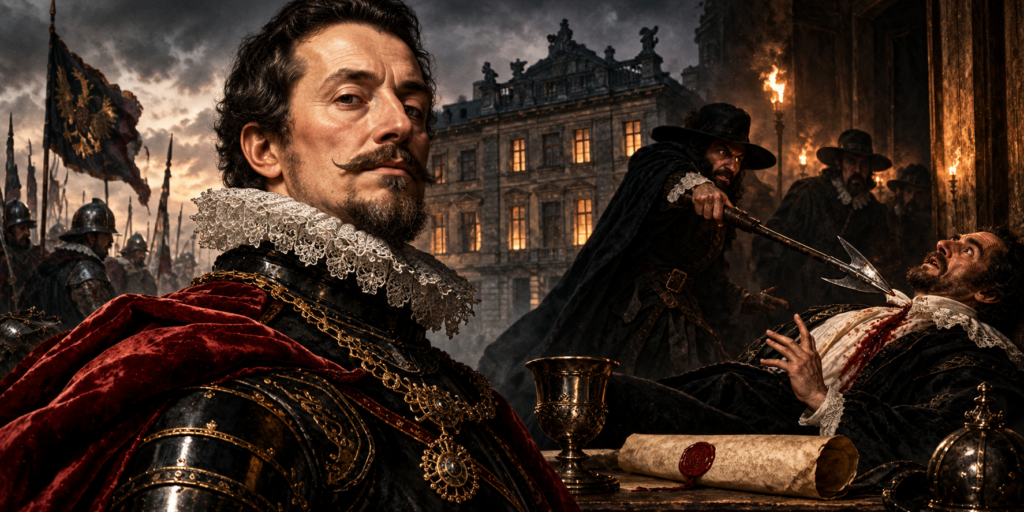
Albrecht von Wallenstein: The Emperor’s Most Powerful General and the Bloody Betrayal at Eger
The Ruthless Rise of a Bohemian Nobleman, the Private Army That Terrified Europe, and the Imperial Conspiracy That Ended with a Murder in the Night
Albrecht Wenzel Eusebius von Wallenstein (24 September 1583–25 February 1634), also known as Albrecht von Waldstein, was a Bohemian nobleman, imperial generalissimo, Duke of Friedland, and Duke of Mecklenburg who became one of the most powerful military commanders of the Thirty Years’ War. Born into a relatively modest Protestant noble family in the Kingdom of Bohemia, he converted to Catholicism, accumulated enormous wealth through marriage and confiscated estates, and built an extraordinary military establishment in the service of Holy Roman Emperor Ferdinand II. At the height of his influence, Wallenstein commanded vast armies, controlled extensive territories, and exercised a degree of military and political independence that alarmed even the emperor he served. His increasingly secretive diplomacy, controversial military decisions, and deteriorating relationship with the imperial court led to accusations of treason in 1634. After Ferdinand secretly authorized his removal and declared him a traitor, Wallenstein was assassinated on 25 February 1634 at Eger, now Cheb in the Czech Republic, by officers acting in support of the imperial cause. Although he was never a monarch, his immense military power and territorial authority made him one of the most formidable political figures of seventeenth-century Europe. His murder remains one of the most notorious acts of political betrayal during the Thirty Years’ War, and the question of whether he genuinely intended to betray Ferdinand II continues to divide historical interpretation.
The Night the Emperor’s Greatest General Was Murdered
On the night of 25 February 1634, Albrecht von Wallenstein was staying in a house in the Bohemian town of Eger, close to the frontier with Saxony. He was fifty years old, suffering from chronic illness, and increasingly isolated from the army and emperor whose fortunes he had helped shape. Only a few years earlier, he had commanded forces so enormous that his name inspired fear from the Baltic coast to the heart of Germany. Now he was surrounded by officers whose loyalty was uncertain, while rumors of treason and secret negotiations followed him wherever he went.
Wallenstein had once seemed almost untouchable. He had raised armies for Emperor Ferdinand II, defeated Protestant enemies, accumulated princely titles, and transformed himself from a comparatively obscure Bohemian nobleman into one of the richest men in the Holy Roman Empire. His soldiers depended upon his financial system, his officers owed him their advancement, and his enemies regarded him as a commander whose ambitions threatened the balance of power. Yet the extraordinary independence that had made him indispensable to the emperor had also made him dangerous.
The conspiracy against him was already unfolding inside Eger. Several officers who appeared to remain loyal to Wallenstein had secretly committed themselves to the imperial cause, believing that their commander had become a traitor. They had arranged to eliminate his closest supporters before moving against Wallenstein himself. Their plan relied upon deception, surprise, and the knowledge that the general was too isolated to summon an army to his defense.
That evening, four of Wallenstein’s senior associates were invited to a banquet at Eger Castle. Among them were Christian von Ilow, Adam Erdmann Trčka von Lípa, Wilhelm Kinsky, and Heinrich Niemann. The gathering appeared to offer an opportunity for hospitality and discussion among officers, but it was a carefully prepared trap. Once the guests were inside, armed men attacked and killed them.
Wallenstein was not present at the banquet. He remained in his lodgings at the house of the town’s burgomaster, unaware that the men closest to him had been murdered. The conspirators understood that eliminating his supporters would leave him without immediate protection. Their next objective was the general himself.
Later that night, a party led by the Irish-born officer Walter Devereux entered the house where Wallenstein was staying. Accounts of the final confrontation differ in their details, but they agree that Devereux killed the general with a partisan, a polearm capable of inflicting a devastating wound. Wallenstein was reportedly in his nightclothes when the assassins reached him, and he offered no effective resistance. The man who had commanded armies numbering tens of thousands was killed in a room where he had no soldiers to defend him.
The murder was not a spontaneous act of personal revenge. It followed the emperor’s decision to remove Wallenstein from command and the secret orders issued against him as his loyalty came under suspicion. Ferdinand II had authorized his apprehension or elimination under the terms of the imperial action against him, although the precise relationship between the court’s instructions and the immediate decisions of the officers at Eger remains important. The conspirators believed they were serving the emperor by destroying a commander whom the imperial government had condemned.
The contrast between Wallenstein’s former power and his final helplessness was extraordinary. He had once negotiated with princes, dictated military strategy, and governed territories with a magnificence approaching that of a sovereign ruler. Yet he died without a trial, without an opportunity to defend himself publicly, and without the army that had made him formidable. His death was the culmination of a political struggle in which suspicion, ambition, and imperial authority had become inseparable.
The assassination shocked Europe, but it also raised a question that historians have never entirely resolved. Had Wallenstein truly intended to betray Ferdinand II and transfer his loyalty to the emperor’s enemies, or had his political maneuvering been interpreted as treason by rivals determined to destroy him? The surviving evidence supports serious doubts about his conduct, but it does not provide a simple answer. To understand how the emperor’s most powerful general became a condemned man, it is necessary to examine the remarkable career that brought him to the brink of sovereignty.
A Bohemian Nobleman Born Into Religious Division
Albrecht von Wallenstein was born on 24 September 1583 at Heřmanice in the Kingdom of Bohemia, then part of the Habsburg lands within the Holy Roman Empire. His family belonged to the Bohemian nobility, but it did not possess the wealth or political influence of the great aristocratic houses. His parents were Protestant, reflecting the religious diversity that characterized Bohemia during the late sixteenth century. The region was already becoming a place where religious allegiance and political authority were deeply entangled.
The Protestant Reformation had transformed central Europe during the preceding decades. Lutheranism, Calvinism, and other reform movements had gained supporters among nobles, townspeople, and rulers, while the Catholic Habsburg dynasty sought to preserve its authority and religious influence. Bohemia was particularly complicated because its religious traditions included older reform movements associated with Jan Hus. The resulting mixture of confessions created a political environment in which religious identity could affect careers, property, and loyalty.
Wallenstein’s childhood was marked by family losses. His mother died when he was young, and his father followed several years later. The orphaned boy was placed under the care of relatives and guardians who oversaw his upbringing and education. These early experiences did not determine his later personality, but they meant that he grew up without the stable household that might have been expected for a noble heir.
His education took him beyond Bohemia. He studied at institutions associated with Protestant learning and traveled through parts of Europe, encountering different political and religious environments. Accounts of his student years include stories of quarrels and unruly behavior, although some details derive from later biographical traditions. What is clear is that he acquired an education and international experience useful to a nobleman seeking advancement.
Wallenstein eventually converted to Catholicism, probably around the turn of the seventeenth century. The reasons for his conversion have been debated, and it would be simplistic to attribute the decision entirely to ambition or entirely to religious conviction. Catholicism offered substantial advantages within the Habsburg political system, particularly for a nobleman seeking military and administrative advancement. His conversion helped open doors that might otherwise have remained closed.
The young nobleman also developed an interest in astrology, a pursuit that would remain associated with him throughout his life. Astrology was widely practiced among educated Europeans, including rulers and scholars, and it was not necessarily regarded as incompatible with serious political or military activity. Wallenstein consulted astrologers and paid attention to predictions concerning his future. The famous astronomer Johannes Kepler prepared a horoscope for him, although later stories about Wallenstein’s reliance upon the stars sometimes exaggerate the role astrology played in his decisions.
His early career unfolded within the Habsburg military system. Service in the imperial armies offered opportunities for advancement, particularly during conflicts involving the Ottoman Empire and internal disputes within the Habsburg lands. Wallenstein gained experience in military organization and developed connections with influential patrons. These relationships would become essential to his later rise.
By the time the Thirty Years’ War began, Wallenstein had already demonstrated considerable ambition and practical ability. He understood that wealth, landownership, and military service could reinforce one another. His conversion had aligned him with the ruling dynasty, while his financial instincts helped him identify opportunities for expansion. The combination would eventually transform him into one of the most powerful men in Europe.
Marriage, Money, and the Foundations of a Fortune
Wallenstein’s rise depended upon more than military talent. He possessed an unusual ability to accumulate and manage wealth, and his marriages played an important role in establishing his financial position. In 1609, he married Lucretia Nekšová of Landek, a wealthy Moravian widow whose estates substantially increased his resources. The marriage gave him access to property and income that would support his future ambitions.
Lucretia died in 1614, leaving Wallenstein with considerable wealth. Her death was a personal loss, but the inheritance strengthened his economic independence. Landownership provided income, social status, and opportunities for further investment. Wallenstein used these advantages to expand his position within the Habsburg political world.
His financial activities were sophisticated and sometimes controversial. He understood the importance of credit, military contracts, and the acquisition of land at favorable prices. The instability of central Europe created opportunities for men who possessed money and political connections. Wallenstein was exceptionally skilled at exploiting those circumstances.
In 1623, he married Isabella Katharina von Harrach, daughter of Karl von Harrach, an influential imperial adviser. The marriage connected Wallenstein with one of the important families at Ferdinand II’s court. It strengthened his political position and helped secure access to the emperor’s inner circle. The relationship was therefore both dynastic and strategic.
Wallenstein’s household became increasingly magnificent as his wealth expanded. He invested in residences, estates, and the ceremonial display expected of a great nobleman. His palace in Prague, later known as the Wallenstein Palace, reflected his extraordinary resources and political aspirations. Its scale and decoration rivaled those of princely residences.
Yet his fortune was not built solely through marriage. The upheavals following the Bohemian revolt created opportunities for the acquisition of confiscated estates. Wallenstein participated in the financial and political processes through which rebel property was transferred to loyal supporters of the Habsburg dynasty. These transactions became central to his transformation from wealthy nobleman into territorial magnate.
The accumulation of land also gave him political influence. Estates provided revenues, tenants, agricultural production, and administrative authority. They could support military recruitment and supply operations. Wallenstein increasingly understood that territorial power and military power could be made to reinforce one another.
His rise therefore reflected the opportunities and moral ambiguities of wartime society. The destruction of one family’s political position could become another family’s fortune. Wallenstein benefited from a system in which loyalty to the victorious ruler opened access to confiscated property. The wealth that later made him indispensable to Ferdinand II was partly built upon the defeat and dispossession of the emperor’s enemies.
The Bohemian Revolt and the Defeat That Made Wallenstein Rich
The Thirty Years’ War began in 1618 with a political and religious crisis in Bohemia. Protestant nobles feared that the Catholic Habsburg dynasty intended to restrict their religious privileges and strengthen royal authority. Tensions erupted when representatives of the Bohemian estates threw imperial officials from a window of Prague Castle. The incident became known as the Defenestration of Prague and helped trigger a rebellion against Habsburg rule.
The rebels rejected Ferdinand’s authority and eventually offered the Bohemian crown to Frederick V of the Palatinate, a Protestant prince. The decision transformed a regional dispute into a major European conflict. Catholic and Protestant powers became involved, while the Habsburg dynasty sought to restore control over Bohemia. The struggle would eventually spread across much of central Europe.
Wallenstein remained loyal to the Habsburg cause. His position was particularly significant because he came from a Protestant family and had connections within the Bohemian nobility. His Catholic conversion and military career had aligned him with Ferdinand’s interests. During the crisis, he chose the side that would ultimately prevail.
The decisive battle came at White Mountain near Prague on 8 November 1620. Imperial and Catholic League forces defeated the Bohemian rebels, bringing the immediate revolt to an end. The victory allowed Ferdinand II to impose severe political and religious changes upon Bohemia. It also created enormous opportunities for loyal nobles.
The aftermath was brutal. Leading rebels were executed, estates were confiscated, and Protestant political influence was systematically reduced. The executions in Prague in June 1621 became a powerful symbol of Habsburg retribution. Families that had dominated Bohemian society for generations lost property and status.
Wallenstein benefited from this transformation. He acquired extensive confiscated lands, often through transactions involving the imperial financial system. His participation in the consortium responsible for the debasement of coinage during the early 1620s has also attracted considerable historical attention. The financial operations were controversial and contributed to economic disruption, although the precise responsibility of individual participants requires careful assessment.
The scale of Wallenstein’s acquisitions was extraordinary. He assembled a territorial complex in northeastern Bohemia that became the foundation of the Duchy of Friedland. The emperor eventually granted him ducal status, elevating him far above the position into which he had been born. His wealth and authority now approached those of established princes.
The transformation of Bohemia was therefore inseparable from Wallenstein’s personal rise. The defeat of the Protestant estates destroyed one political order and created another dominated by Catholic nobles loyal to the Habsburgs. Wallenstein became one of the greatest beneficiaries of that process. His fortune was built in a world where military victory could determine the ownership of entire regions.
The events also established the pattern that would define his career. He supported the emperor, received extraordinary rewards, and used those rewards to increase his independent power. The arrangement benefited both men while their interests remained aligned. Yet the greater Wallenstein became, the more difficult it would be for Ferdinand to control him.
The Duke of Friedland: A State Within the Empire
The Duchy of Friedland became the center of Wallenstein’s territorial power. Located in northeastern Bohemia, it consisted of estates acquired through purchase, confiscation, and imperial favor. Wallenstein developed the territory with unusual administrative energy, seeking to increase production, revenues, and military usefulness. His methods reflected a desire to create a highly organized economic foundation for his ambitions.
He encouraged agricultural production, improved estate management, and supported industries capable of supplying armies. The demands of warfare created markets for food, clothing, weapons, horses, and other necessities. Wallenstein recognized that controlling production could reduce dependence upon outside suppliers. His territories became closely connected with his military system.
The duchy also possessed a substantial administrative apparatus. Officials supervised revenues, legal affairs, agricultural operations, and the movement of supplies. Wallenstein exercised authority over the territory with a degree of independence that impressed and alarmed contemporaries. His government resembled that of a powerful territorial prince rather than an ordinary noble landlord.
His residence at Jičín became an important center of administration and court life. Wallenstein invested in architectural projects intended to display his status and provide the infrastructure necessary for government. The transformation of the town reflected his ambition to create a princely capital. His building projects were expressions of political authority as well as personal magnificence.
The Prague palace offered another demonstration of his wealth. Its grand halls, gardens, and elaborate decoration presented Wallenstein as a figure whose status approached that of the highest aristocracy. Such displays were not merely vanity. In seventeenth-century politics, architecture and ceremony helped communicate legitimacy, rank, and power.
The duchy’s prosperity depended partly upon the wider military economy. Wallenstein’s armies required enormous quantities of supplies, and his estates could profit from providing them. This arrangement strengthened his financial position but also tied the territory to the continuation of war. Peace might reduce some of the opportunities upon which his system depended.
His authority also created resentment. Other nobles viewed his rapid rise with suspicion, while subjects faced the burdens of taxation, administration, and military demands. The concentration of wealth in his hands reflected the inequalities produced by the war. Wallenstein’s success was impressive, but it was not universally admired.
The Duchy of Friedland became a symbol of his extraordinary position within the empire. He was formally a subject of the emperor, yet he controlled territory, wealth, and administrative resources on a scale that made him difficult to treat as an ordinary servant. His later military commands would magnify that independence. The seeds of his conflict with Ferdinand II were already present in the structure of his power.
The General Who Offered to Raise an Army for the Emperor
By the mid-1620s, the Thirty Years’ War had expanded far beyond its original Bohemian origins. Protestant rulers and foreign powers were becoming increasingly involved, while the Habsburg monarchy faced growing military commitments. Ferdinand II needed armies capable of operating across the vast territories of the Holy Roman Empire. Maintaining such forces was enormously expensive.
Wallenstein offered a solution. He proposed raising and maintaining a substantial army in imperial service, using his financial resources, organizational ability, and network of military contractors. The arrangement promised Ferdinand access to military strength without requiring the emperor to finance every expense directly from his own treasury. It also gave Wallenstein extraordinary influence over recruitment, supply, and command.
The system depended upon contributions extracted from territories occupied or protected by the army. Soldiers required food, lodging, equipment, and pay, and these costs were imposed upon communities across the empire. Wallenstein’s administrative organization made it possible to sustain large forces, but the burden upon civilians could be devastating. His military success was inseparable from a system of compulsory contributions.
The army expanded rapidly. Contemporary figures vary, and claims about its maximum size must be treated cautiously, but Wallenstein commanded forces numbering many tens of thousands. His ability to assemble and sustain such an army made him indispensable to the emperor. It also gave him a personal power base that few other commanders could rival.
His officers depended upon his patronage. Commissions, promotions, and opportunities for profit were often connected with Wallenstein’s authority. The resulting relationships created a military hierarchy in which loyalty to the commander could become almost as important as loyalty to the emperor. This tension would eventually prove fatal.
Wallenstein’s military system was not entirely unique, but its scale was extraordinary. Other commanders relied upon contractors, contributions, and mercenary recruitment, yet few possessed his combination of territorial wealth and organizational ability. He became one of the most effective military entrepreneurs of the war. His success demonstrated how the demands of prolonged conflict could elevate private individuals to positions of immense power.
The emperor benefited from the arrangement during periods of military success. Wallenstein’s forces helped extend Habsburg influence and confront Protestant opponents. Yet the system also created a dangerous dependency. Ferdinand needed Wallenstein’s army, but the army’s existence strengthened Wallenstein’s independence.
The relationship was therefore built upon mutual advantage and growing distrust. Wallenstein could provide military power that the emperor could not easily replace. Ferdinand could grant titles, authority, and legitimacy that Wallenstein needed to sustain his position. Their partnership would dominate imperial military policy until the balance between them became impossible to maintain.
Victory, Ambition, and the Road to the Baltic
Wallenstein’s rise as a military commander coincided with major imperial successes during the 1620s. His forces operated alongside those of the Catholic League, whose most famous commander was Johann Tserclaes, Count of Tilly. The two military systems were not always harmonious, and their leaders possessed different political interests. Nevertheless, their campaigns helped strengthen the Habsburg position.
In 1626, Wallenstein defeated Ernst von Mansfeld’s forces at the Battle of Dessau Bridge. The victory enhanced his reputation and demonstrated the effectiveness of his army. Mansfeld had been one of the prominent Protestant commanders of the war, and his defeat weakened opposition to imperial authority. Wallenstein emerged as an increasingly important figure in the conflict.
The war then moved toward northern Germany. King Christian IV of Denmark had intervened in support of Protestant interests, but imperial and Catholic League forces achieved major successes against him. Wallenstein’s campaigns extended Habsburg influence toward the Baltic coast. The victories created opportunities for territorial expansion and political reward.
Ferdinand II granted Wallenstein the Duchy of Mecklenburg after its rulers were displaced for opposing the emperor. The title elevated him further into the ranks of imperial princes. It also gave him access to territory near the Baltic Sea, where commercial and strategic interests were increasingly important. Wallenstein’s ambitions appeared to be expanding beyond the boundaries of his Bohemian possessions.
The Baltic region offered possibilities for naval development and control of trade routes. Wallenstein received authority connected with imperial maritime ambitions, although the practical achievements of these plans remained limited. The emperor’s government hoped to challenge hostile powers and strengthen its position in northern Europe. Wallenstein’s military presence became central to those aspirations.
The siege of Stralsund in 1628 demonstrated the limits of imperial expansion. The city resisted Wallenstein’s forces and received support from Denmark and Sweden. Despite prolonged efforts, the siege failed to secure the town. The defeat was significant because it showed that even Wallenstein’s resources could not guarantee success.
His northern campaigns nevertheless made him one of the most feared commanders in Europe. Protestant rulers regarded his army as a threat to their independence, while Catholic princes worried about the concentration of power in his hands. His military authority increasingly overshadowed the ordinary structures of imperial government. The emperor’s servant was becoming a political force in his own right.
The expansion also intensified resentment within the empire. Princes complained about military contributions, occupation, and the behavior of soldiers. Wallenstein’s methods imposed enormous burdens upon territories that were not always enemies of the emperor. The political costs of his military system were becoming increasingly difficult for Ferdinand to ignore.
The Army That Fed on Germany
The Thirty Years’ War was not simply a succession of battles between professional armies. It was also a prolonged catastrophe for civilian populations, whose communities were repeatedly subjected to military occupation, taxation, plundering, and disease. Wallenstein’s armies participated in this system on an enormous scale. Their logistical organization was impressive, but the resources required to sustain them came from the territories through which they marched.
The contribution system imposed financial and material demands upon towns, villages, and estates. Communities were required to provide money, food, lodging, and supplies for soldiers. Failure to comply could result in coercion, confiscation, or violence. The distinction between organized taxation and military extortion was often difficult for civilians to recognize.
Wallenstein sought to regulate his forces and maintain discipline, but controlling large armies was a constant challenge. Soldiers who lacked pay or supplies could resort to plundering. Officers might exploit their positions for personal profit, while local inhabitants suffered the consequences. The army’s survival depended upon extracting resources from a population already weakened by war.
The burdens were especially severe in regions repeatedly crossed by opposing forces. Crops were destroyed, livestock seized, and trade disrupted. Disease spread through military camps and civilian settlements. The cumulative effects contributed to the demographic and economic devastation associated with the Thirty Years’ War.
Wallenstein’s reputation among civilians was therefore deeply ambiguous. His supporters admired his ability to maintain a powerful army, while many inhabitants feared the demands imposed by his soldiers. The same administrative system that made him effective as a commander could devastate the communities required to support it. His military achievements cannot be separated from those human costs.
The problem was not unique to Wallenstein. Armies throughout the conflict relied upon contributions, requisitions, and plunder. The scale of the war made it difficult for rulers to finance military operations through ordinary revenues. Commanders developed systems that shifted the burden onto occupied territories. Wallenstein was particularly successful at organizing this process.
His ability to sustain large forces gave him enormous political leverage. The emperor depended upon his military resources, while the princes of the empire feared the consequences of his presence. Wallenstein could influence negotiations simply by moving his army into a region. Military logistics became an instrument of political power.
The system also created enemies. Princes who resented imperial centralization saw Wallenstein as the embodiment of military tyranny. His growing independence alarmed officials at court. The army that made him indispensable also made him a threat to the political order he was supposed to defend.
The Emperor Dismisses His Most Powerful Servant
By 1630, opposition to Wallenstein had become intense. Catholic princes, including Maximilian I of Bavaria, feared his influence and resented the burdens imposed by his army. Imperial advisers worried about his independence and the political consequences of his military policies. The emperor faced pressure to reduce the power of the commander who had helped secure his victories.
The issue became particularly important during the electoral meeting at Regensburg in 1630. Ferdinand II hoped to advance dynastic objectives, including the election of his son as King of the Romans. The electors possessed leverage because their cooperation was essential. Opposition to Wallenstein became part of the negotiations.
Ferdinand eventually agreed to dismiss Wallenstein from command. The decision represented a remarkable reversal for a general who had seemed indispensable. His army was reduced and reorganized, while other commanders assumed greater responsibility. Wallenstein withdrew from active command to his estates.
The dismissal did not destroy his wealth or titles. He remained one of the richest men in the empire and continued governing his territories. Yet the loss of military command removed the principal instrument of his political influence. His relationship with the emperor had entered a new phase.
Wallenstein’s reaction was outwardly restrained compared with what might have been expected from a commander of his power. He did not immediately raise a rebellion or march against the imperial court. Instead, he withdrew and continued managing his possessions. His conduct demonstrated that he was capable of accepting a political setback when circumstances required it.
The dismissal nevertheless exposed the fragility of his position. His authority depended upon imperial favor, and Ferdinand could remove him when political pressure became overwhelming. Wallenstein possessed enormous resources, but he was not a sovereign ruler. The emperor remained the source of his military legitimacy.
The decision also revealed the competing interests within the Catholic camp. Ferdinand needed military strength, but the princes feared the concentration of that strength in one commander. Wallenstein’s army had helped defeat Protestant enemies while simultaneously alarming Catholic allies. The imperial coalition was far less unified than its victories suggested.
The timing of the dismissal would soon prove disastrous for the emperor. A new and formidable enemy was entering the war, and the imperial armies would suffer severe defeats. The man who had been removed because he was too powerful would soon be recalled because his power was desperately needed.
Gustavus Adolphus and the Swedish Storm
In 1630, King Gustavus Adolphus of Sweden entered the Thirty Years’ War with an army that would transform the military balance in Germany. The Swedish king presented his intervention partly as a defense of Protestant interests, but strategic and political objectives were also central. Sweden sought to prevent Habsburg domination of the Baltic region and strengthen its position in northern Europe. The intervention created a major new threat to Ferdinand II.
The Swedish army possessed experienced commanders, disciplined troops, and effective military organization. Gustavus Adolphus developed tactics that emphasized mobility, coordinated firepower, and flexible battlefield formations. His forces achieved important victories and attracted support from German Protestant rulers. The imperial position deteriorated rapidly.
The Battle of Breitenfeld in September 1631 was a devastating defeat for the imperial and Catholic League forces under Tilly. The Swedish victory shattered the assumption that the Habsburg armies were militarily invincible. Protestant territories gained confidence, while Ferdinand faced the possibility of losing much of his influence in Germany. The strategic crisis was severe.
Tilly was wounded during the campaign of 1632 and died shortly afterward. The emperor now lacked a commander capable of confronting the Swedish king on equal terms. Wallenstein’s earlier dismissal appeared increasingly costly. Ferdinand turned once again to the man whose power had previously alarmed him.
Wallenstein negotiated his return from a position of considerable strength. He understood that the emperor needed his military abilities and financial system. The resulting arrangements granted him extraordinary authority over recruitment, command, and strategic operations. His restoration demonstrated the depth of imperial dependence upon him.
The renewed command allowed Wallenstein to rebuild a substantial army. He recruited officers, assembled forces, and resumed operations against the emperor’s enemies. His return was greeted with relief by some imperial supporters and anxiety by others. The same concerns that had caused his dismissal had not disappeared.
The confrontation with Sweden became the central military challenge of his second command. Gustavus Adolphus was an aggressive and capable opponent, while Wallenstein preferred strategic maneuvering and the careful management of resources. Their campaigns reflected different approaches to warfare. The resulting struggle would culminate in one of the most famous battles of the Thirty Years’ War.
The Swedish intervention transformed Wallenstein’s political position. He was again indispensable, but his authority had become even more exceptional. Ferdinand had restored a commander whose independence he had previously feared. The arrangement could succeed only while both men believed their interests remained aligned.
Lützen: The Battle That Killed a King but Failed to End the War
The Battle of Lützen, fought on 16 November 1632, became one of the defining confrontations of the Thirty Years’ War. Wallenstein commanded imperial forces against the Swedish army led by Gustavus Adolphus. The battle took place amid difficult conditions, including fog and smoke that complicated visibility. Both armies suffered heavily.
The Swedish king personally participated in the fighting and was killed during the battle. His death shocked Protestant Europe and transformed him into a symbol of the struggle against Habsburg power. Yet the Swedish army continued fighting and ultimately held the field. The outcome was therefore complicated: the Swedes achieved a tactical success, but they lost their most important leader.
Wallenstein’s forces withdrew after the battle. The loss of Gustavus Adolphus did not produce an immediate imperial victory, and the war continued. The Swedish military system remained capable of sustained operations under other commanders. The battle demonstrated that even the death of a major ruler could fail to determine the outcome of a prolonged conflict.
For Wallenstein, Lützen was both a military and political turning point. He had confronted the most celebrated Protestant commander of the war and survived the encounter. Yet the imperial army had not achieved a decisive victory. The emperor’s government continued expecting results from the general whose authority had been restored at such high cost.
The death of Gustavus Adolphus also changed the diplomatic environment. Without the Swedish king’s personal leadership, negotiations and alliances became more fluid. Wallenstein increasingly explored possibilities for a political settlement. His interest in diplomacy would later become central to accusations of treason.
The battle also reinforced the destructive nature of the war. Thousands of soldiers were killed or wounded, while surrounding communities suffered from military operations. The struggle continued despite the loss of one of its most important commanders. The conflict had developed institutional and political momentum beyond the lives of individual leaders.
Wallenstein’s reputation remained formidable, but his relationship with the imperial court was becoming more complicated. Some advisers questioned his strategic decisions and suspected that he was pursuing objectives different from those of Ferdinand. His reluctance to engage in certain battles encouraged criticism. The seeds of the final conspiracy were beginning to grow.
Lützen demonstrated both the power and limitations of military leadership. Wallenstein could command armies and influence campaigns, but he could not easily impose peace or guarantee victory. The emperor wanted military success, while the general increasingly considered diplomatic alternatives. Their priorities were beginning to diverge.
The General Who Wanted to Negotiate Peace
After Lützen, Wallenstein became increasingly involved in diplomatic contacts with various powers. The Thirty Years’ War had devastated much of central Europe, and the possibility of a negotiated settlement attracted growing attention. Wallenstein understood that military victory alone might not resolve the conflict. His willingness to explore negotiations reflected both strategic calculation and personal ambition.
He maintained contacts with representatives of Saxony, Sweden, and other political interests. Some of these discussions were conducted without the full knowledge or approval of the imperial court. The secrecy surrounding them later became a major source of suspicion. Ferdinand’s advisers feared that Wallenstein might be negotiating independently of the emperor’s authority.
The general’s motives remain disputed. He may have believed that peace required direct communication with the emperor’s enemies and that his military position gave him the ability to negotiate effectively. He may also have sought to increase his own political influence by presenting himself as the indispensable mediator. The surviving evidence does not support a single uncomplicated explanation.
Wallenstein’s relationship with Saxony was particularly important. Elector John George I had been a significant Protestant ruler whose position shifted during the war. Negotiations involving Saxony offered possibilities for reducing the conflict. Yet they also created opportunities for accusations that Wallenstein was cooperating with the emperor’s enemies.
The general’s military conduct intensified suspicion. He sometimes avoided decisive engagements and pursued strategies that frustrated imperial expectations. His critics interpreted these decisions as evidence of disloyalty or deliberate obstruction. His defenders could argue that he was attempting to preserve his army and create favorable conditions for peace.
The problem was that Wallenstein possessed extraordinary freedom of action. His command arrangements gave him considerable authority over military operations, while his personal network extended across the empire. He could negotiate from a position of strength that few other imperial servants enjoyed. Such independence was difficult for Ferdinand’s government to tolerate indefinitely.
The emperor’s advisers increasingly feared that Wallenstein might attempt to establish a political settlement that served his own interests rather than those of the Habsburg dynasty. Rumors circulated that he sought a crown or intended to transfer his army to another power. These claims were politically explosive, but their evidentiary foundations varied. Some reflected genuine concerns about his conduct, while others were amplified by rivals.
The question of peace therefore became entangled with the question of loyalty. Wallenstein may have regarded himself as a statesman capable of ending a destructive war. His enemies increasingly portrayed him as a commander preparing to betray his sovereign. The difference between independent diplomacy and treason became dangerously uncertain.
The Pilsen Reverses: When Loyalty Became a Test
In early 1634, Wallenstein’s position deteriorated rapidly. He was increasingly isolated from the imperial court, and several senior officers were being encouraged to distance themselves from him. Rumors of his dismissal and possible arrest circulated through the army. The general responded by attempting to secure declarations of loyalty from his commanders.
At Pilsen, now Plzeň, Wallenstein gathered officers and sought assurances that they would remain faithful to him. The resulting declarations became known as the Pilsen Reverses. Their wording and political implications were central to the controversy. Critics interpreted them as an attempt to bind the army personally to Wallenstein rather than to the emperor.
The declarations were especially dangerous because military loyalty was a fundamental issue within the Holy Roman Empire. Soldiers might possess personal attachments to commanders, but their ultimate service was supposed to support legitimate political authority. A general who demanded unconditional loyalty could appear to be creating an independent military power. Wallenstein’s actions therefore intensified fears that he intended to rebel.
His supporters argued that the declarations were intended to preserve discipline and protect him against hostile court factions. The army was already divided by rumors, and Wallenstein needed to know which officers could be trusted. From this perspective, the loyalty pledges were defensive measures rather than preparations for treason. The surviving evidence allows room for debate.
The imperial court, however, increasingly regarded the situation as intolerable. Ferdinand’s advisers believed that Wallenstein was acting beyond the limits of his authority. His diplomatic contacts, military decisions, and attempts to secure personal loyalty appeared to form a dangerous pattern. The emperor began taking steps to remove him.
The crisis also exposed divisions within Wallenstein’s own command. Some officers remained personally loyal to him, while others feared the consequences of opposing Ferdinand. The promise of imperial favor and the threat of punishment encouraged defections. Wallenstein’s apparent control over his army was weaker than he believed.
The Pilsen declarations became a decisive piece of evidence in the accusations against him. They suggested that the general was attempting to place his personal authority above that of the emperor. Whether he intended to use the army against Ferdinand remains uncertain. What mattered politically was that the court had come to believe the danger was real.
The general’s position was now collapsing. He had built his power through military loyalty, but that loyalty was being tested by imperial authority. Officers who owed him their careers faced a choice between their commander and their sovereign. The decision would determine who survived the coming purge.
Ferdinand II Decides His General Must Be Removed
By January 1634, Emperor Ferdinand II had lost confidence in Wallenstein. Reports from the army and court advisers suggested that the general was pursuing unauthorized negotiations and attempting to secure personal control over imperial forces. The emperor feared that Wallenstein might transfer his allegiance or use his army to impose political demands. The situation had become a crisis of sovereign authority.
Ferdinand issued secret orders removing Wallenstein from command and authorizing action against him and his closest associates. The instructions were communicated to selected officers whose loyalty to the emperor was considered reliable. The secrecy was essential because Wallenstein still possessed substantial influence within the army. An open confrontation might provoke resistance.
The emperor’s decision was shaped by both evidence and political fear. Wallenstein’s conduct had given his enemies grounds for suspicion, but the court also contained rivals who resented his extraordinary power. Their reports and interpretations influenced Ferdinand’s judgment. The resulting decision reflected a combination of genuine security concerns and factional politics.
The imperial government sought to separate Wallenstein from his army. Officers were encouraged to abandon him and accept new commands. His authority depended upon the willingness of soldiers and commanders to follow his orders. Once that loyalty weakened, his position became increasingly precarious.
Ferdinand’s actions also carried a profound legal and moral problem. Wallenstein had not been publicly tried or convicted before the decisive measures were taken against him. The emperor acted through secret orders and military authority rather than an open judicial process. The distinction would later become central to debates about the legitimacy of the assassination.
The court’s supporters argued that the danger of treason justified extraordinary action. A commander who controlled a vast army could threaten the state before formal proceedings were possible. Delay might allow him to join the emperor’s enemies or provoke civil war within the imperial forces. From this perspective, secrecy and speed were necessary.
Critics could interpret the same events as a politically motivated elimination of an inconvenient servant. Wallenstein had become too powerful, too independent, and too difficult to control. His removal served the interests of rivals who wished to redistribute military authority and influence. The emperor’s decision therefore cannot be understood without considering the political struggle surrounding it.
The result was a secret campaign to destroy Wallenstein’s position before he could organize resistance. His officers were approached, his authority undermined, and his closest supporters identified as targets. The general who had once commanded the emperor’s armies was now being hunted by men acting in the emperor’s name. The final stage of the conspiracy was approaching.
The Flight to Eger
As the crisis intensified, Wallenstein left Pilsen and moved westward toward Eger. His health was poor, and his political position had become increasingly uncertain. He was accompanied by a reduced circle of loyal supporters, including officers who remained committed to him despite the imperial accusations. The journey reflected both his isolation and his continuing hope of finding support.
Eger occupied a strategically important position near the border with Saxony. Its location offered possibilities for communication with forces outside immediate imperial control. Wallenstein may have hoped to establish contact with allies or negotiate from a safer position. His precise intentions remain disputed, particularly because his movements occurred amid rapidly changing circumstances.
The general’s departure also demonstrated the collapse of his military authority. He no longer commanded the full army that had once made him indispensable. Many officers had abandoned him or accepted the emperor’s orders. His remaining followers could not guarantee his safety.
Among the officers at Eger were men who had secretly aligned themselves with the imperial cause. John Gordon, Walter Leslie, and Walter Butler became central figures in the conspiracy. They understood that Wallenstein’s arrival created an opportunity to eliminate him before he could escape or gather support. Their loyalty to the emperor had become more important than their previous association with the general.
The conspirators faced a difficult problem. Wallenstein still possessed supporters who might resist an attempt to arrest or kill him. A direct confrontation could produce fighting within the town. The officers therefore decided to eliminate his closest associates first. The plan relied upon deception and the isolation of the general from those most likely to defend him.
The decision to act at Eger was shaped by the local military situation. The conspirators controlled enough armed men to carry out the operation. They also possessed access to the castle and knowledge of Wallenstein’s movements. These advantages made a coordinated attack possible.
Wallenstein appears to have underestimated the danger. He had reason to fear imperial action, but he may not have realized that officers near him were preparing murder. His declining health and political isolation further limited his ability to respond. The general who had once managed vast military operations was now vulnerable to a small group of conspirators.
The final hours of his life unfolded within this atmosphere of uncertainty. His supporters remained close, but their loyalty could not protect him from deception. The conspirators prepared a banquet that would become the first stage of the killing. By the time Wallenstein understood the danger, it would be too late.
The Banquet of Blood at Eger Castle
On the evening of 25 February 1634, several of Wallenstein’s closest associates were invited to a gathering at Eger Castle. The invitation came from officers who appeared to be maintaining ordinary relations with the general’s circle. The guests included Christian von Ilow, Adam Erdmann Trčka von Lípa, Wilhelm Kinsky, and Heinrich Niemann. They were among the men whose loyalty made them dangerous to the conspirators.
The banquet was a trap. The conspirators had arranged for armed soldiers to enter and kill the guests once they were gathered. The plan depended upon the victims being separated from Wallenstein and deprived of immediate military support. Hospitality became the instrument of betrayal.
The precise sequence of the killings varies among historical accounts. Some describe a signal given during the meal, followed by the sudden entrance of armed men. Others emphasize the confusion and violence as the victims attempted to defend themselves. The essential fact is that Wallenstein’s principal supporters were murdered inside the castle.
The attack was swift and brutal. The victims had little opportunity to organize resistance against the armed men who entered the room. Their deaths eliminated the officers most likely to oppose the assassination of Wallenstein. The conspirators had removed the general’s immediate protective circle.
The murders also demonstrated the ruthlessness of the imperial purge. The victims were not ordinary soldiers caught in battle but senior figures invited into a setting of apparent hospitality. Their killing was intended to prevent resistance and secure the success of the operation. The methods reflected the conspirators’ belief that the political danger justified extraordinary violence.
The banquet became one of the most notorious episodes of the Thirty Years’ War. It combined the familiar rituals of aristocratic hospitality with sudden murder. The contrast made the event particularly memorable to later chroniclers and historians. It also reinforced the image of Wallenstein’s downfall as a betrayal carried out by men who had once served him.
The deaths left Wallenstein dangerously exposed. He remained in his lodgings, separated from the officers who might have defended him. The conspirators now controlled the immediate situation. Their final objective was to kill the general before news of the banquet murders could reach him.
The massacre at Eger Castle was therefore not a separate incident but an essential part of the assassination. It destroyed Wallenstein’s remaining command structure and prevented an organized response. The conspirators had turned the general’s own military environment against him. The final act would take place in the house where he was staying.
The Murder in the Night
After the killings at Eger Castle, the conspirators moved against Wallenstein himself. He was staying in the house of the burgomaster, a residence that offered temporary lodging but little protection against a determined armed party. The general was reportedly preparing for bed or already in his nightclothes when the assassins arrived. His physical condition and isolation made resistance unlikely.
Walter Devereux, an Irish-born officer serving in the imperial military environment, led the party that entered the house. He carried a partisan, a polearm with a broad blade capable of delivering a fatal thrust. The weapon was well suited to close combat against an unarmored opponent. Devereux’s role became central to later accounts of the assassination.
The conspirators forced their way into Wallenstein’s quarters. The precise details of the confrontation differ among sources, including whether any words were exchanged before the fatal blow. Some later narratives present dramatic scenes of accusation or defiance, but such dialogue cannot be accepted without reliable contemporary support. The essential sequence is clear: the assassins reached Wallenstein and killed him.
Devereux struck the general with his weapon, inflicting a fatal wound. Wallenstein offered no effective resistance and died in his lodgings. The killing ended the life of a commander whose military authority had once extended across much of Germany. His death required no battlefield victory, only the betrayal of officers who had gained access to him.
The violence was striking in its simplicity. Wallenstein had survived campaigns, sieges, political crises, and the dangers of commanding enormous armies. Yet he was killed by a small group of men inside a private residence. The contrast between his former power and his final vulnerability became central to his historical reputation.
The assassination also revealed the limits of personal loyalty in a military system built upon patronage. Wallenstein had rewarded officers and depended upon their service, but imperial authority could redirect their allegiance. The men who killed him believed they were acting for the emperor. His personal network collapsed when the sovereign withdrew legitimacy from his command.
The murder was followed by efforts to secure control of the town and prevent resistance. The conspirators had eliminated both the general and his closest supporters. The immediate danger of a Wallenstein-led rebellion appeared to have ended. The imperial court could now announce that the suspected traitor had been removed.
Yet the killing did not resolve the question of guilt. Wallenstein had died without a public trial, and the evidence against him remained subject to interpretation. His enemies had achieved their objective before he could defend himself. The assassination therefore became both a political success for the imperial court and a lasting historical controversy.
The Emperor’s Orders and the Question of Responsibility
Ferdinand II’s responsibility for Wallenstein’s death is central to understanding the assassination. The emperor had secretly removed the general from command and authorized action against him after concluding that his loyalty was compromised. The orders created the framework within which the conspirators acted. They believed that eliminating Wallenstein served the imperial cause.
The precise wording and interpretation of the imperial instructions have been debated. Some documents emphasized arrest and the removal of dangerous officers, while others permitted more drastic action if necessary. The conspirators at Eger chose to kill Wallenstein and his closest associates rather than attempt a public arrest. Their decision was consistent with the emperor’s determination to neutralize the perceived threat.
Ferdinand did not personally enter the room at Eger or direct the physical attack. The immediate planning and execution were carried out by officers who controlled the local military situation. Yet the emperor’s secret action against Wallenstein made the assassination politically possible. The distinction between direct operational command and sovereign authorization is important but does not remove imperial responsibility.
The court later rewarded participants in the conspiracy. Titles, estates, and financial benefits were distributed among those who had helped eliminate Wallenstein. These rewards demonstrated official approval of the outcome. They also created incentives for officers to present their actions as loyal service rather than personal ambition.
The rewards were particularly significant because Wallenstein’s enormous possessions became available for redistribution. His downfall benefited powerful individuals who had opposed him or participated in his removal. The confiscation of his estates transformed the assassination into a major transfer of wealth. Political loyalty and material advantage were closely connected.
The emperor’s supporters argued that Wallenstein had become a dangerous traitor whose continued command threatened the Habsburg monarchy. From this perspective, the killing prevented a potentially catastrophic military rebellion. The absence of a public trial could be justified by the urgency of the danger. Such arguments reflected the political assumptions of a monarchy fighting for survival during a devastating war.
Critics questioned whether the evidence justified the extreme measures taken. Wallenstein had engaged in suspicious negotiations and sought personal loyalty from officers, but the precise nature of his intentions remained uncertain. His enemies had strong political reasons to interpret his conduct as treason. The assassination prevented a full public examination of the accusations.
The result was a political killing authorized within the imperial system but carried out through conspiracy and deception. Wallenstein was neither an ordinary criminal convicted by a court nor a soldier killed in open battle. He was a powerful commander eliminated by men acting under the authority of the ruler he had served. The circumstances make his death one of the most striking examples of political assassination during the Thirty Years’ War.
Was Wallenstein Really a Traitor?
The question of Wallenstein’s loyalty has remained controversial for centuries. His enemies accused him of negotiating with the emperor’s opponents, seeking personal sovereignty, and preparing to use his army against Ferdinand II. His defenders argued that he was attempting to negotiate peace and protect his position against hostile court factions. The surviving evidence supports serious suspicion but does not establish every accusation with certainty.
Wallenstein unquestionably conducted diplomatic contacts that alarmed the imperial government. He communicated with representatives of Saxony, Sweden, and other powers involved in the war. Some discussions occurred without clear authorization from Ferdinand. These actions created legitimate concerns about the limits of his military authority.
His attempts to secure personal loyalty from officers were also politically dangerous. The Pilsen declarations could be interpreted as efforts to bind the army to Wallenstein rather than the emperor. In a monarchy dependent upon military obedience, such conduct threatened the foundations of sovereign authority. Even if Wallenstein intended only to defend himself, his methods increased suspicion.
Yet the claim that he had a fully developed plan to seize the Bohemian crown or establish an independent kingdom is more difficult to prove. Rumors of royal ambition circulated, but their sources were often politically interested. Wallenstein possessed the wealth and status to make such ambitions conceivable. Possibility, however, is not proof.
His interest in peace negotiations may have reflected a genuine recognition that the war could not be ended through military victory alone. By the early 1630s, the conflict had become increasingly complex, involving dynastic, religious, and territorial interests across Europe. Wallenstein may have believed that his military position gave him the leverage necessary to negotiate. His independence made that strategy dangerous.
The emperor’s court had reasons to distrust him beyond the specific accusations. Wallenstein had become extraordinarily powerful and difficult to control. His military system placed enormous resources under his personal direction, while his political contacts extended beyond imperial supervision. Removing him could restore authority to the court and satisfy powerful rivals.
The evidence therefore allows several interpretations. Wallenstein may have been preparing a genuine betrayal, exploring alternatives without a final commitment, or attempting to force the emperor toward peace through independent diplomacy. His conduct was sufficiently ambiguous to encourage suspicion. The assassination prevented historians from observing what he would actually have done.
The most responsible conclusion is that Wallenstein’s loyalty had become deeply compromised in the eyes of the imperial government, but the full extent of his intentions remains uncertain. He was not an innocent figure whose actions gave no cause for concern, nor can every accusation made by his enemies be accepted as fact. His death occurred before the political crisis could be resolved through open negotiation or trial. The uncertainty is inseparable from the tragedy of his downfall.
The Fortune Divided Among the Murderers
Wallenstein’s death created an enormous opportunity for the redistribution of wealth. His estates, titles, and financial interests represented one of the greatest private fortunes in the Holy Roman Empire. The imperial government moved to confiscate his possessions and reward those who had remained loyal to Ferdinand II. The process transformed political victory into material gain.
The participants in the conspiracy received substantial rewards. Walter Butler, Walter Leslie, John Gordon, and others associated with the operation benefited from imperial favor. The distribution of estates and honors reinforced the official interpretation that they had performed a service to the emperor. Their actions were not treated as ordinary murder within the political framework of the court.
The confiscations also weakened Wallenstein’s family and supporters. His extraordinary territorial complex was broken apart, and the political structure he had built around Friedland lost its central figure. The redistribution reduced the possibility that his heirs or associates could recreate his independent power. The emperor’s government regained control over resources that had become concentrated in one man’s hands.
The financial consequences were substantial. Estates that had supported Wallenstein’s army and court passed to new owners. The economic system he had developed could no longer function in the same way. His death therefore destroyed not only a military command but also a territorial and financial network.
The rewards also complicate the moral interpretation of the conspiracy. The officers who killed Wallenstein may have sincerely believed that he was a traitor, but they also stood to benefit from his removal. Political conviction and material self-interest were not mutually exclusive. The possibility of reward formed part of the environment in which the assassination occurred.
Ferdinand’s decision to reward the conspirators helped establish the official narrative of Wallenstein’s guilt. Those who eliminated him were presented as loyal servants who had protected the monarchy. The redistribution of property reinforced that interpretation by giving tangible benefits to the victors. The dead general had no opportunity to challenge the account.
The destruction of Wallenstein’s fortune also illustrates the instability of wealth acquired through political favor. He had risen through imperial patronage and the confiscation of rebel estates. His own downfall subjected his possessions to a similar process. The system that had enriched him ultimately consumed his legacy.
The irony was severe. Wallenstein had built his power by serving the emperor and benefiting from the defeat of those declared disloyal. When he himself was accused of treason, the same mechanisms of confiscation and reward were turned against him. His wealth could not protect him once imperial legitimacy was withdrawn. The fortune that had made him almost sovereign became the prize of the men who destroyed him.
The Army Without Its Master
Wallenstein’s assassination created an immediate challenge for the imperial military establishment. His army had been organized through personal networks, financial arrangements, and a command structure closely associated with his authority. Removing him risked disrupting operations at a time when the war remained intense. Ferdinand needed to ensure that the army continued serving the Habsburg cause.
The imperial government moved to reorganize command and secure the loyalty of officers. Those who had supported Wallenstein were removed, punished, or pressured to demonstrate obedience. Other commanders received new responsibilities. The transition was intended to prevent the army from becoming a source of rebellion.
The emperor’s son, Ferdinand, King of Hungary and future Ferdinand III, assumed an increasingly important military role. Experienced commanders supported the reorganization, and the imperial forces continued operations against their enemies. The army did not collapse after Wallenstein’s death. This outcome demonstrated that his personal authority, although immense, was not indispensable to the survival of the imperial military system.
Later in 1634, imperial and allied forces achieved a major victory at the Battle of Nördlingen. The defeat of the Swedish-led army significantly altered the military balance in Germany. It strengthened the Habsburg position and encouraged negotiations with several German Protestant rulers. The victory occurred only months after Wallenstein’s assassination.
The success at Nördlingen complicated later assessments of his military legacy. His supporters could argue that he had possessed exceptional strategic abilities, while his critics pointed to imperial victories achieved without him. The battle demonstrated that the emperor could continue the war under different leadership. It did not prove that Wallenstein’s earlier policies had been entirely mistaken.
The reorganization also reduced the danger of a commander exercising excessive independence. Ferdinand’s government sought to prevent another military leader from accumulating authority comparable to Wallenstein’s. The experience had exposed the risks of relying upon a single general whose financial and political resources were nearly sovereign. The court had learned a harsh lesson about military dependency.
Yet the war continued for another fourteen years. Wallenstein’s death did not bring peace, and the suffering of central Europe persisted. France entered the conflict more openly, while Sweden and other powers remained involved. The assassination removed a major figure without resolving the structural causes of the war.
The army’s survival therefore reflected both the strength of imperial institutions and the limits of personal power. Wallenstein had been extraordinarily influential, but the political and military system was larger than any individual commander. His death changed leadership and redistributed authority. It did not end the conflict that had made his rise possible.
A Man Who Lived Like a Prince but Died Without a Crown
Wallenstein’s career was remarkable because he approached the power of a sovereign ruler without possessing a hereditary crown. His titles, estates, and military authority placed him among the most influential figures in the Holy Roman Empire. He governed territories, maintained a magnificent court, and negotiated with foreign powers. Yet his position remained dependent upon imperial legitimacy.
The distinction between princely status and sovereignty was central to his downfall. As Duke of Friedland and Mecklenburg, Wallenstein possessed substantial territorial authority, but he was still formally subordinate to Ferdinand II. His military command was granted by the emperor and could be withdrawn. His wealth did not free him from the political hierarchy of the empire.
Wallenstein’s ambitions appear to have pushed against those limits. He sought broad freedom in military operations and diplomacy, and he cultivated personal loyalty among officers. His court and estates reflected a desire for exceptional status. These qualities made him formidable but also politically vulnerable.
The emperor faced a similar contradiction. Ferdinand needed Wallenstein’s resources and abilities, particularly during periods of military crisis. Yet allowing one commander to accumulate such power threatened the authority of the monarchy. The relationship could remain stable only while their interests aligned. Once suspicion emerged, the imbalance became dangerous.
The assassination at Eger demonstrated the ultimate authority of the sovereign within the imperial political system. Wallenstein’s army, titles, and fortune could not protect him after Ferdinand withdrew confidence. Officers who had served him transferred their loyalty to the emperor. The general’s power collapsed because its legal foundation had been removed.
Yet the methods used against him also revealed the weakness of formal authority. Ferdinand did not simply summon Wallenstein to court and conduct a public trial. The government relied upon secrecy, military conspiracy, and assassination. The decision suggested that the emperor feared the consequences of confronting his general openly.
Wallenstein therefore occupied an ambiguous position between servant and rival. He had never been a king, but his power resembled that of a ruler in important respects. His death was not regicide in the strict sense, yet it belonged to the same world of political violence in which rulers and near-sovereign figures were eliminated to resolve struggles over authority. His inclusion among assassinated political rulers reflects the extraordinary nature of his position.
The tragedy of his career lies in the instability of power built upon personal military command. Wallenstein could raise armies, acquire territories, and influence European diplomacy, but he could not create a secure political legitimacy independent of the emperor. His ambitions exceeded the protections available to him. When the relationship with Ferdinand collapsed, his apparent sovereignty proved illusory.
The Man Behind the Legend
Wallenstein’s death quickly became the subject of competing interpretations. Imperial supporters portrayed him as a traitor whose removal had saved the monarchy. His admirers emphasized his military genius, political independence, and possible desire for peace. The uncertainty surrounding his intentions encouraged dramatic retellings.
His reputation was further shaped by literature. Friedrich Schiller’s dramatic trilogy about Wallenstein, written in the late eighteenth century, transformed the general into one of the great tragic figures of European theater. The plays explored ambition, loyalty, betrayal, and the conflict between personal power and political duty. Their influence helped establish Wallenstein as a symbol of the dangerous independence of military commanders.
Literary portrayals should not be confused with documentary history. Dramatic works necessarily simplify motives and invent dialogue to explore moral and political themes. The historical Wallenstein was more complicated than a tragic hero or villain. His career combined administrative ability, financial ambition, military talent, and political maneuvering.
His interest in astrology became another important element of the legend. Later writers sometimes portrayed him as a man who allowed horoscopes to determine his decisions. The surviving evidence confirms that he consulted astrologers, but it does not justify reducing his career to superstition. Astrology formed part of the intellectual culture of his age and coexisted with practical military calculation.
His physical health also attracted attention. Wallenstein suffered from chronic illness, and some historians have discussed possible diagnoses based upon surviving descriptions. Such retrospective medical interpretations remain uncertain because the evidence is incomplete. His declining health in 1634 is relevant to his vulnerability, but it cannot explain every political decision he made.
The general’s financial achievements have received increasing historical attention. He was not merely a battlefield commander but an organizer of resources on an extraordinary scale. His ability to finance armies and develop territorial administration made him a pioneer of forms of military entrepreneurship associated with the early modern state. These achievements were inseparable from the coercive economy of the war.
His political ambitions remain the most contested aspect of his legacy. He may have sought a negotiated peace, personal sovereignty, or simply the preservation of his extraordinary position. The evidence suggests that he explored possibilities beyond the emperor’s immediate instructions. It does not reveal a single final plan that can be accepted without qualification.
Wallenstein therefore remains fascinating because his life resists simple moral judgment. He served the emperor and became indispensable, yet his independence threatened the authority he was supposed to defend. He accumulated wealth through the dispossession of others, then lost his own fortune through confiscation. He commanded armies capable of devastating entire regions, yet died helplessly in a private room.
The Assassination That Revealed the Dark Heart of Imperial Power
The murder at Eger was not an isolated act of violence committed by a few ambitious officers. It emerged from the political structure of the Holy Roman Empire during a period of extraordinary crisis. The emperor depended upon military commanders whose resources and authority could exceed those of ordinary princes. That dependency created opportunities for men such as Wallenstein to accumulate immense power.
The system also generated fear. A commander who controlled an army might become capable of imposing demands upon the sovereign who had appointed him. Personal loyalty among officers could conflict with legal obedience to the emperor. The danger was particularly acute during a war that required enormous forces and constant financial improvisation.
Wallenstein’s rise exposed these tensions. He provided Ferdinand II with military strength that the emperor could not easily obtain elsewhere. In return, he received titles, territories, and extraordinary command authority. The arrangement was mutually beneficial but politically unstable. Each success increased both his value and the danger he represented.
His downfall demonstrated how quickly imperial favor could become lethal hostility. The same court that had rewarded him with princely status eventually condemned him as a traitor. Officers who had benefited from his patronage helped organize his death. His estates were confiscated and redistributed among the victors.
The assassination also reveals the relationship between law and violence in early modern politics. Ferdinand’s government acted through secret orders rather than a public judicial process. The conspirators used deception and murder to carry out what they regarded as legitimate imperial policy. The result blurred the boundary between state punishment and political assassination.
The killings at Eger Castle made the betrayal especially brutal. Wallenstein’s closest supporters were invited to a banquet and murdered before they could defend him. The general was then killed in his lodgings, separated from those who might have protected him. The operation was designed to prevent resistance rather than establish guilt.
The aftermath reinforced the political nature of the crime. The conspirators received rewards, while Wallenstein’s possessions were divided. The imperial government presented the killings as necessary acts of loyalty. The dead general’s reputation became part of the struggle to justify what had happened.
The murder therefore stands as a warning about the dangers of concentrated military power and the insecurity of those who wield it without independent legitimacy. Wallenstein had become almost sovereign, but he remained vulnerable to the ruler whose authority had created his position. His assassination exposed the violent mechanisms through which that authority could be reasserted. The emperor’s greatest general died because the emperor no longer believed he could be trusted.
The General Who Became Too Powerful to Live
Albrecht von Wallenstein began life as a comparatively modest Bohemian nobleman and rose to become one of the most powerful figures in seventeenth-century Europe. Through military service, financial skill, marriage, and the acquisition of confiscated estates, he accumulated wealth and influence on an extraordinary scale. His territories became the foundation of a princely state, while his armies transformed the military balance of the Thirty Years’ War. He was not a monarch, but his authority approached that of a sovereign ruler in ways that alarmed both allies and enemies.
His rise depended upon the favor of Emperor Ferdinand II. The emperor needed armies capable of confronting Protestant opponents and foreign powers, and Wallenstein possessed the resources and organizational ability to provide them. In return, he received titles, estates, and extraordinary command authority. The arrangement made him indispensable while gradually creating a political problem that neither man could easily resolve.
Wallenstein’s military successes strengthened the Habsburg position, but his methods imposed enormous burdens upon the territories required to support his armies. His contribution system helped sustain forces numbering many tens of thousands, while civilians suffered from taxation, requisitions, and the violence of prolonged warfare. His growing independence also provoked resentment among imperial princes and court officials. By 1630, the pressure had become sufficient to force his dismissal.
The Swedish intervention brought him back to power. Ferdinand needed his abilities after the disasters suffered by imperial forces, and Wallenstein returned with extraordinary authority. Yet his second command intensified the tensions that had caused his earlier removal. His diplomatic contacts, controversial military decisions, and attempts to secure personal loyalty among officers created growing suspicion.
By early 1634, the emperor had concluded that his general could no longer be trusted. Secret orders removed Wallenstein from command and authorized action against him. His officers were encouraged to abandon him, and his authority began collapsing. The man who had once commanded vast armies found himself traveling toward Eger with only a reduced circle of supporters.
The conspiracy reached its climax on 25 February 1634. Wallenstein’s closest associates were invited to a banquet at Eger Castle and murdered by armed men acting in support of the imperial cause. Later that night, Walter Devereux and his companions entered the general’s lodgings and killed him with a partisan. Wallenstein died without a public trial, leaving the question of his ultimate intentions unresolved.
The emperor’s government rewarded the conspirators and confiscated the general’s enormous possessions. His military command was reorganized, and the imperial armies continued fighting. The assassination removed a dangerous political figure but did not end the Thirty Years’ War. The conflict continued for another fourteen years, bringing further devastation to central Europe.
The historical judgment remains complicated. Wallenstein had engaged in unauthorized diplomacy and sought personal loyalty from officers, actions that gave Ferdinand genuine reasons for concern. Yet the evidence does not conclusively establish every accusation of treason made against him. His enemies benefited from his removal, and the assassination prevented a full public examination of his conduct.
The final hours of Albrecht von Wallenstein reveal the extraordinary fragility of power built upon military command and imperial favor. He had accumulated wealth beyond the dreams of most princes, governed territories with remarkable independence, and raised armies that could determine the fate of kingdoms. Yet when the emperor withdrew his confidence, the officers who had once served him became the instruments of his destruction. His closest supporters were butchered at a banquet, and he was killed in his lodgings by men who believed that murder had become a duty of loyalty. The general who had helped shape the Thirty Years’ War died without the protection of the military machine he had created. His fortune was divided, his reputation condemned, and his ambitions buried beneath accusations that historians still debate. Wallenstein had spent his life transforming imperial service into personal power, but the system that elevated him ultimately destroyed him. He was never a king, yet his assassination carried the weight of a fallen ruler, exposing a world in which loyalty could become treason overnight and the most powerful man in an empire could be murdered before he had the chance to defend himself.