
Philip II of Macedon: The King Murdered at His Daughter’s Wedding and the Conspiracy That Changed History
Philip II of Macedon (382–336 BCE) | King of Macedon, 359–336 BCE
The King Who Walked Into His Own Assassination
The king of Macedon had never been more powerful than he was on the morning someone murdered him. Philip II had spent more than two decades transforming a vulnerable northern kingdom into the dominant military power of Greece, crushing enemies, manipulating alliances, and preparing an invasion of the Persian Empire. His armies had defeated some of the most formidable opponents in the Greek world, and his political ambitions had carried him further than most of his predecessors could have imagined. Now, in 336 BCE, he had gathered his family, generals, aristocrats, and distinguished guests at the ancient royal capital of Aegae for a celebration intended to display the magnificence of his dynasty.
The occasion was the marriage of his daughter Cleopatra to Alexander I of Epirus, a king who also happened to be the brother of Philip’s estranged wife, Olympias. The wedding promised to strengthen an important alliance and demonstrate that the Macedonian royal family remained united despite years of bitter domestic conflict. Foreign dignitaries had arrived, religious sacrifices were being performed, and the festivities included elaborate processions and theatrical performances. Everything about the occasion was designed to proclaim that Philip stood at the summit of his power.
The celebration also contained an extraordinary display of royal ambition. According to the historian Diodorus Siculus, Philip arranged for images of the twelve Olympian gods to be carried in procession, accompanied by a thirteenth image representing the king himself. Whether this display was intended to suggest divine status, exceptional royal honor, or something between the two remains debated. To spectators, however, the symbolism could hardly have been missed: Philip was presenting himself alongside the gods at the very moment his earthly power appeared almost unlimited.
As the procession approached the theater, Philip made a decision that would cost him his life. He allowed his companions to proceed ahead of him while his bodyguards remained at a distance, apparently wishing to demonstrate confidence and approachability before the assembled guests. For a ruler accustomed to commanding armies and surviving dangerous campaigns, the gesture may have seemed perfectly reasonable. It also created the opportunity an assassin had been waiting for.
The killer was Pausanias of Orestis, a member of Philip’s own royal bodyguard. He had once enjoyed the king’s favor, but a bitter personal grievance had transformed him into an enemy. Beneath his clothing, he concealed a dagger, and outside the city he had arranged horses for his escape. His preparations suggest that the murder was no sudden outburst of anger.
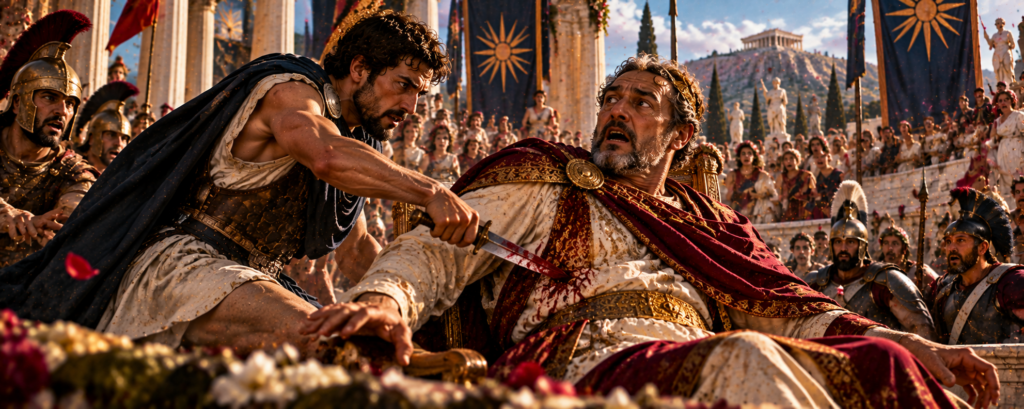
When Philip approached the theater, Pausanias rushed toward him and drove the blade into his body. The attack was devastating, and the king collapsed before his guards could save him. Pausanias immediately fled toward the waiting horses, but his escape failed when he stumbled and fell. Pursuing bodyguards caught him and killed him before he could be questioned.
Within moments, the most powerful ruler in Greece was dead, his assassin had been silenced, and the Macedonian throne stood at the center of a potentially catastrophic succession crisis. Philip’s twenty-year-old son Alexander would soon become king and embark upon conquests that transformed the ancient world. Yet the circumstances surrounding his father’s murder would never be satisfactorily resolved. Pausanias had wielded the dagger, but whether he acted alone remains one of antiquity’s most enduring political mysteries.
Macedonia Before Philip: A Kingdom Surrounded by Enemies
The kingdom Philip inherited was nothing like the formidable power he left behind. Macedonia occupied a strategically important position north of the principal Greek city-states, but its political institutions differed considerably from those of Athens, Sparta, and Thebes. Its kings depended heavily upon the loyalty of aristocratic families, regional nobles, military companions, and powerful local interests. Succession disputes could become violent, and rival claimants frequently sought support from foreign powers.
Macedonia’s geographical position created constant dangers. Illyrian groups threatened its western territories, Paeonian communities exerted pressure from the north, and Thracian rulers competed for influence along its eastern frontiers. Greek cities also intervened in Macedonian politics whenever doing so served their interests. A weak king could quickly find himself surrounded by enemies and undermined by rivals within his own household.
Philip was born around 382 BCE into the Argead dynasty, the royal family that claimed descent from the legendary hero Heracles. His father, Amyntas III, struggled to preserve Macedonian independence amid repeated political and military crises. Philip grew up in a world where kingship offered prestige but little security. Royal blood could place a man on the throne, yet it could also make him a target for assassination.
During his youth, Philip spent time as a hostage in Thebes, then emerging as one of the strongest military powers in Greece. This experience would later acquire enormous significance because Theban commanders had developed innovative military methods that challenged Spartan supremacy. Philip observed a sophisticated political and military environment very different from the unstable kingdom of his birth. Although the exact extent of his education there cannot be established, his exposure to Theban military organization almost certainly influenced his later reforms.
Thebes had recently demonstrated its power through the achievements of Epaminondas and Pelopidas. At Leuctra in 371 BCE, Theban forces had shattered the reputation of Spartan invincibility. Their success depended partly upon tactical innovation, disciplined troops, and effective coordination. Philip would eventually apply comparable principles on a much larger scale.
His opportunity came after another Macedonian catastrophe. In 359 BCE, King Perdiccas III, Philip’s brother, was killed during a disastrous campaign against the Illyrians. Thousands of Macedonian soldiers reportedly died with him, leaving the kingdom dangerously weakened. Philip emerged as the dominant figure in the resulting crisis, initially associated with the interests of his young nephew before establishing himself as king.
He inherited a country threatened by invasion, internal rivalry, and possible disintegration. Few observers could have predicted that this precarious ruler would eventually dominate Greece. Philip’s survival required immediate political intelligence and military effectiveness. He would prove exceptionally capable at both.
The Ruthless Architect of Macedonian Power
Philip understood that Macedonia could not survive through courage alone. Its army needed better organization, its aristocracy needed stronger incentives for loyalty, and its enemies needed to be confronted through a combination of force and diplomacy. He therefore embarked upon reforms that transformed Macedonian warfare. His achievements would provide the military foundation later used by Alexander the Great.
The Macedonian infantry became famous for its long pikes, known as sarissas. These weapons allowed tightly organized formations to present formidable barriers against opposing troops. The exact development of the system occurred over time, but Philip is widely credited with making the Macedonian phalanx a central instrument of his army. He combined disciplined infantry with powerful cavalry, specialized troops, and increasingly sophisticated siege techniques.
His cavalry was particularly important. Macedonian aristocrats had long possessed traditions of mounted warfare, and Philip turned their military role into an essential part of royal power. The Companion cavalry provided a striking force capable of exploiting weaknesses created by the infantry. Successful warfare also rewarded nobles with wealth, prestige, and opportunities for advancement.
Philip’s political methods were equally effective. He negotiated alliances, arranged marriages, bribed influential opponents, exploited rivalries, and changed diplomatic positions when circumstances demanded it. Ancient writers frequently accused him of using gold as readily as weapons. Whether every accusation was fair, his ability to manipulate political divisions became legendary.
He also recognized the importance of financial resources. Control of valuable territories and revenues, including mining districts, helped support military expansion. Armies required regular payment, equipment, and supplies, and Philip increasingly possessed the means to provide them. His military machine became more formidable as his territorial power expanded.
His successes came at a human cost. Campaigns brought casualties, destruction, displacement, and the subordination of communities that resisted Macedonian expansion. Philip could be generous to useful allies while dealing harshly with opponents. His reputation combined political brilliance with a willingness to employ coercion whenever it served his ambitions.
This combination made him both admired and feared. Supporters saw a ruler who had rescued Macedonia from near collapse. Enemies saw an ambitious monarch steadily destroying the independence of Greek cities. Both interpretations contained substantial truth.
By the time Philip approached his final years, the kingdom he had inherited was almost unrecognizable. Macedonia possessed one of the most effective armies in the Mediterranean world. Its king had become the central figure in Greek diplomacy. His greatest ambitions, however, still lay ahead.
Olympias: The Queen Who Would Become a Suspect
Among the most consequential figures in Philip’s personal life was Olympias, a princess from Epirus whom he married in the 350s BCE. She belonged to the Molossian royal dynasty and brought valuable political connections to the marriage. Their union produced Alexander, born in 356 BCE, and a daughter named Cleopatra. Both children would become deeply entangled in the circumstances surrounding Philip’s assassination.
Olympias later acquired a formidable reputation for ambition, religious devotion, and fierce determination to protect her son’s position. Ancient authors frequently portrayed her through sensational stories involving serpents, ecstatic religious practices, and violent passions. Some of these accounts reflect genuine aspects of religious culture, while others were shaped by hostile attitudes toward powerful royal women. They cannot all be accepted as straightforward descriptions of her character.
Her relationship with Philip was complicated by the nature of Macedonian kingship. Royal marriages served diplomatic and dynastic purposes, and Philip married several women during his reign. These unions created alliances but also produced competing family interests. Every new wife potentially introduced relatives seeking influence and children who might become future claimants.
Olympias therefore occupied a position that was prestigious but insecure. She was the mother of Philip’s most prominent son, yet Macedonian succession did not operate through an inflexible rule of primogeniture. Royal birth mattered, but military support, political alliances, and the acceptance of influential nobles were also crucial. Alexander’s future could not be guaranteed simply because he was Philip’s son.
As Philip’s ambitions expanded, tensions within the royal household became increasingly dangerous. His marriages connected him to powerful families whose interests did not always align. Olympias had reason to watch these developments closely. Her son’s inheritance depended partly upon Philip’s continued favor.
Later ancient writers accused Olympias of involvement in her husband’s murder. Some claimed she encouraged Pausanias, while others attributed extraordinary acts of celebration to her after the assassination. These allegations are historically important, but they are not proof of guilt. They emerged within a tradition already inclined to portray Olympias as ruthless and politically dangerous.
Understanding her position is essential because she possessed a possible motive without being demonstrably responsible. Philip’s death removed a husband whose latest marriage threatened her influence. It also placed her son upon the throne. Those consequences made suspicion almost inevitable.
Alexander: The Son Raised to Conquer
Alexander grew up in the shadow of a father whose achievements seemed almost impossible to surpass. Philip had rescued Macedonia, expanded its territory, defeated enemies, and built an army capable of challenging the greatest powers of the age. Alexander received an elite education and military training suited to a future ruler. His famous association with Aristotle reflected the intellectual ambitions of the Macedonian court.
The young prince demonstrated exceptional ability early in life. During Philip’s absence, he was entrusted with responsibilities that allowed him to gain political experience. He also participated in military campaigns and acquired a reputation for courage. By his late teens, Alexander was already an important figure within the royal family and army.
His relationship with Philip was nevertheless complicated. A powerful king and an ambitious heir could easily become rivals, particularly when the father continued producing potential successors. Alexander admired military achievement and expected to inherit a kingdom worthy of his abilities. Yet he also lived under the authority of a ruler whose decisions could threaten his future.
Ancient stories emphasize moments of competition between father and son. Some anecdotes may have been embellished to foreshadow Alexander’s later greatness. Nevertheless, the political tension was real enough to become dangerous during Philip’s final years. The king’s latest marriage would bring it into the open.
Alexander also had strong supporters among the Macedonian elite. His military experience, royal birth, and personal charisma made him an attractive successor. Yet other nobles might prefer a different heir if such a candidate offered greater influence. Succession was therefore not simply a private family matter.
The possibility of conflict became especially serious when Philip married a young Macedonian noblewoman named Cleopatra, commonly distinguished from his daughter by the name Cleopatra Eurydice. Her family connections brought a powerful military commander, Attalus, into closer association with the royal household. The marriage created a new political faction around the king.
For Alexander and Olympias, the implications were alarming. A child born from Philip’s new marriage could become a rival claimant. The issue was not merely the nationality of Alexander’s mother, since Macedonian royal marriages regularly involved foreign dynasties. It concerned the possibility that influential Macedonian nobles might rally behind a new heir.
The crisis erupted publicly at a wedding banquet.
Cleopatra Eurydice and the Marriage That Nearly Destroyed the Dynasty
Philip’s marriage to Cleopatra Eurydice, usually dated to 337 BCE, was one of the most consequential decisions of his reign. Cleopatra belonged to the Macedonian aristocracy and was connected to Attalus, an influential commander. Her marriage strengthened Philip’s ties to an important domestic faction. It also threatened to destabilize the succession.
At the wedding celebration, according to Plutarch, Attalus made a provocative remark while drinking. He called upon those present to pray that the marriage would produce a legitimate successor to the Macedonian throne. The wording implied that Alexander’s claim was somehow deficient. Given Alexander’s position as Philip’s recognized son and an experienced military leader, the insult was explosive.
Alexander reacted furiously. Plutarch describes him throwing a drinking vessel at Attalus and challenging the implication that he was illegitimate. Philip attempted to intervene, but the king was reportedly so intoxicated that he stumbled while moving toward his son. Alexander then mocked the contrast between Philip’s grand ambitions and his inability to cross the room.
The exact dialogue survives through later literary tradition and should not be treated as a verbatim record. Nevertheless, the episode reflects a genuine political rupture within the royal household. Attalus’s apparent support for a future child of Cleopatra Eurydice threatened Alexander’s position. Philip’s reaction demonstrated that he was not prepared to tolerate public defiance from his son.
Alexander left the court, and Olympias returned to Epirus. The prince spent time away from Macedonia before a reconciliation was arranged. The crisis exposed the fragility of the royal family at precisely the moment Philip was preparing his greatest military undertaking. A kingdom powerful enough to dominate Greece remained vulnerable to conflict over succession.
Cleopatra Eurydice herself is difficult to reconstruct as an individual. Ancient accounts largely portray her through the ambitions of her relatives and the hostility of Olympias and Alexander. There is little reliable evidence concerning her personal political intentions. Her marriage made her dangerous to others regardless of what she actually wanted.
Attalus, however, was clearly a major political figure. Philip entrusted him with an important role in the advance expedition against Persia. This appointment demonstrated that the king continued to value his services despite the tensions surrounding the marriage. It also meant that Attalus would be away from Macedonia when Philip was assassinated.
The marriage had created enemies, sharpened rivalries, and introduced uncertainty into the succession. It would later provide investigators and historians with a possible explanation for a conspiracy against Philip. Yet the immediate grievance that drove Pausanias toward murder involved Attalus in a very different way.
Pausanias of Orestis: The Bodyguard Who Turned Against His King
Pausanias came from Orestis, a region of Upper Macedonia, and served among Philip’s royal bodyguards. This was a prestigious position that placed him close to the king. Members of the bodyguard belonged to the elite military environment surrounding the monarch and could acquire considerable influence. Their proximity also made them uniquely capable of harming the person they were sworn to protect.
The surviving accounts suggest that Pausanias had once enjoyed Philip’s personal affection. Diodorus describes him as attractive and favored by the king, placing their relationship within the conventions of elite male intimacy in ancient Macedonia. Such relationships must be understood within their historical context rather than automatically interpreted through modern categories. What matters for the assassination is that Pausanias had enjoyed privileged access before a serious grievance developed.
According to Diodorus, another young man also named Pausanias became an object of Philip’s affection. The older Pausanias insulted his rival, accusing him of sexual submission and humiliating him publicly. The younger man was deeply offended. He later died while protecting Philip during a military engagement against an Illyrian opponent.
Diodorus presents the younger Pausanias’s death as a deliberate act of self-sacrifice prompted by shame. That interpretation cannot be independently verified, and the account may have been shaped by later storytelling. Nevertheless, the narrative explains why Attalus became involved. The younger man had been associated with Attalus, who reportedly regarded his treatment as an intolerable insult.
Attalus then arranged revenge against the surviving Pausanias. According to Diodorus, he invited him to a drinking gathering, made him severely intoxicated, and handed him over to attendants who sexually assaulted him. The account describes a calculated act of degradation intended to destroy Pausanias’s honor. Other ancient sources confirm that an outrage involving Attalus lay behind the assassination, although the precise details vary.
The sexual violence described in this tradition is central to understanding the grievance. Pausanias was not simply offended by a careless remark. He had allegedly suffered a brutal assault arranged by a powerful courtier. In the honor-conscious environment of the Macedonian aristocracy, the attack carried devastating social consequences.
Pausanias sought justice from Philip. As king, Philip possessed the authority to punish Attalus or provide some form of redress. The complaint placed him in a difficult political position because Attalus was both influential and connected to the royal family through Cleopatra Eurydice. Philip’s response would determine whether Pausanias continued to trust his sovereign.
The king did not deliver the punishment Pausanias wanted.
The Humiliation Philip Refused to Avenge
Philip’s handling of Pausanias’s complaint became the immediate grievance identified by the strongest ancient evidence. Aristotle, who was closely connected to the Macedonian royal court, briefly refers to the assassination in his Politics. He states that Pausanias killed Philip because the king allowed him to be insulted or mistreated by Attalus and his associates. This near-contemporary testimony is especially important because it confirms that the personal grievance was not merely an invention of much later historians.
Diodorus provides a fuller explanation. According to his account, Philip was angered by the abuse Pausanias had suffered but refused to punish Attalus because he needed the commander’s services. Attalus had become an important military figure and was connected to Philip through his recent marriage. The king therefore attempted to compensate Pausanias without destroying his relationship with Attalus.
Philip reportedly gave Pausanias gifts and promoted him within the royal bodyguard. Such rewards might have satisfied someone seeking material compensation or professional advancement. They did not address the underlying demand for punishment. Pausanias wanted the man responsible for his humiliation held accountable.
The king’s decision reveals a dangerous conflict between political convenience and personal justice. Philip had spent his career balancing competing aristocratic interests, and Attalus was too valuable to discard lightly. Yet refusing to punish a powerful courtier for abusing a royal servant sent a troubling message. Loyalty to the king did not necessarily guarantee protection against influential rivals.
Pausanias’s resentment deepened. Diodorus explains that he eventually directed his anger not only toward Attalus but toward Philip himself. The king had possessed the authority to provide justice and had chosen not to use it. Pausanias therefore came to regard Philip as responsible for the continuation of his dishonor.
This explanation is psychologically plausible and supported by Aristotle’s brief reference. It also fits the political structure of the Macedonian court, where personal honor and royal favor were closely connected. A bodyguard whose status depended upon proximity to the king could feel especially betrayed when that king refused to protect him. The grievance was intimate, but its consequences would be political.
There are nevertheless uncertainties. Diodorus’s chronology of the earlier incidents has raised questions about how much time elapsed before the assassination. The detailed story may contain embellishments, and the precise sequence cannot be reconstructed beyond doubt. The central connection between Pausanias’s grievance, Attalus, and Philip’s refusal to provide satisfactory redress remains the most secure explanation.
Whether that grievance fully explains the murder is another question. Pausanias had access to the king, a motive for revenge, and the determination to act. Yet his preparations for escape and the extraordinary political consequences of the killing have encouraged suspicion that other people may have been involved.
The Persian War Philip Never Lived to Fight
While the royal household descended into rivalry, Philip was preparing the most ambitious campaign of his reign. Having established Macedonian supremacy over much of Greece, he planned an invasion of the Persian Empire. Persia possessed enormous wealth, extensive territories, and a long history of involvement in Greek affairs. A successful campaign promised military glory and resources on a scale far beyond anything Macedonia had previously controlled.
Philip had already created a political framework for the expedition. Following his victory over the Greek coalition at Chaeronea in 338 BCE, he organized a league of Greek states commonly known as the League of Corinth. The arrangement acknowledged his leadership and provided a basis for coordinated military action. Sparta remained outside the settlement, but Philip had achieved an extraordinary degree of influence over the Greek mainland.
The planned invasion was presented partly as a campaign of vengeance for earlier Persian attacks upon Greece. Such rhetoric could unite Greek communities around a common enemy while placing Philip at the head of the enterprise. It also offered an outlet for military ambitions that might otherwise destabilize his new political order. Conquest abroad could reward Macedonian nobles and reinforce loyalty at home.
In 336 BCE, Philip dispatched an advance force into Asia Minor under Parmenion and Attalus. The expedition established a Macedonian presence across the Hellespont and began operations against Persian interests. Philip intended to follow with the main army. His preparations were already moving from diplomacy into war.
Attalus’s appointment was significant for the assassination mystery. He was one of the men Pausanias most deeply resented, yet Philip had entrusted him with a prestigious military command. From Pausanias’s perspective, the decision may have confirmed that the king would never punish the man responsible for his humiliation. From Philip’s perspective, Attalus remained too useful to abandon.
The invasion also created an urgent succession problem. Philip would be leaving Macedonia for a dangerous campaign, potentially for an extended period. The stability of the royal household therefore mattered enormously. Conflict between Alexander and Cleopatra Eurydice’s faction could threaten the kingdom while the king was abroad.
Philip’s final diplomatic arrangements attempted to strengthen his position. The marriage of his daughter Cleopatra to Alexander I of Epirus helped secure the relationship between Macedonia and Epirus. Because the groom was Olympias’s brother, the wedding also offered an opportunity to repair tensions involving the queen’s family. The celebration at Aegae was therefore politically important as well as personally significant.
Philip intended the festivities to demonstrate that his dynasty was united and his authority secure. Instead, the occasion exposed the vulnerability of a political system centered upon one man. The Persian invasion was ready to begin, but its architect would never lead it.
Aegae: The Wedding That Gathered Every Possible Suspect
Aegae, the ancient royal capital of Macedonia, provided an appropriate setting for the wedding celebrations. Although Pella had become an important administrative center, Aegae retained deep dynastic and ceremonial significance. Macedonian kings were associated with its royal traditions, and the site contained important religious and political spaces. A magnificent celebration there could connect Philip’s achievements with the history of his dynasty.
The marriage itself was politically delicate. The bride, Cleopatra, was Philip’s daughter by Olympias and therefore Alexander’s sister. The groom, Alexander I of Epirus, was Olympias’s brother. The union reinforced a relationship that had been strained by Philip’s recent marriage to Cleopatra Eurydice and the resulting conflict with Alexander.
The similarity of names has caused considerable confusion in later retellings. The bride Cleopatra was Philip’s daughter, while Cleopatra Eurydice was his younger wife. Alexander I of Epirus was the groom, while Alexander the Great was Philip’s son and the bride’s brother. Keeping these individuals separate is essential to understanding the political tensions surrounding the event.
Philip invited important guests from across the Greek world. The celebration included religious sacrifices, feasting, and performances intended to display royal generosity and prestige. Foreign dignitaries could witness the wealth and confidence of the Macedonian court. The festivities also served as a public demonstration of Philip’s leadership over Greece.
According to Diodorus, the king arranged an elaborate procession featuring statues of the twelve Olympian gods. A thirteenth statue represented Philip himself. The display suggested an extraordinary elevation of royal prestige. Whether it amounted to a claim of divinity remains debated, but it certainly advertised the king’s exceptional status.
The theatrical performances provided the setting for the assassination. Spectators gathered at the theater as the procession approached. Philip’s companions entered ahead of him, while the royal guards remained sufficiently distant to leave him exposed. The king apparently wanted to appear confident rather than surrounded by armed protection.
The decision was understandable as political theater. A ruler who had conquered enemies and united powerful states could demonstrate his supremacy by appearing unafraid. Yet the gesture depended upon the loyalty of the people closest to him. One of those people had already prepared a weapon.
Pausanias knew the ceremonial arrangements and possessed access to the king. His position within the bodyguard made him familiar with the security procedures. The festival provided crowds, confusion, and a predictable opportunity. The assassin had chosen a moment when Philip’s desire to display power would temporarily weaken his defenses.
The Thirteenth God and the Fatal Display of Confidence
Philip’s inclusion of his own image among the twelve Olympian gods became one of the most memorable details surrounding his death. Ancient Greek kings and aristocrats regularly used religious ceremonies to display prestige, but placing a living ruler alongside divine figures carried unusual implications. The image may have represented exceptional honors rather than a literal claim that Philip was a god. Nevertheless, the symbolism contributed to later interpretations of his assassination as punishment for arrogance.
Diodorus emphasizes the magnificence of the ceremony and Philip’s extraordinary confidence. The king had reached a position of power that few European rulers of his era could rival. His military victories and political alliances had made him the dominant figure in Greece. The procession publicly celebrated that achievement.
Later readers naturally noticed the irony. A man whose image appeared among the gods was about to be killed by one of his own servants. The contrast between apparent invulnerability and sudden death was almost too perfect for ancient moralizing historians to ignore. It became a powerful illustration of the instability of human fortune.
Yet the religious display should not be treated as the cause of the assassination. Pausanias’s grievance concerned personal abuse and Philip’s refusal to punish Attalus. There is no reliable evidence that he killed the king because of the thirteenth statue. The symbolism became meaningful primarily through the circumstances of Philip’s death.
The more immediate danger lay in Philip’s decision to separate himself from his guards. Diodorus explains that the king wished to appear approachable and confident before the assembled Greeks. His bodyguards therefore stood apart while he entered the theater. The gesture created a brief opening that an informed assassin could exploit.
Pausanias was uniquely positioned to recognize that opportunity. He knew the king’s movements and the responsibilities of the bodyguard. He also knew that a public celebration could make it difficult for guards to react instantly. The assassin did not need to defeat the Macedonian army. He needed only a few unprotected moments.
Philip’s death therefore resulted from a collision between ceremonial ambition and personal betrayal. The king wanted to demonstrate that his power was secure enough to dispense with visible protection. Pausanias intended to prove otherwise. The assassin’s dagger transformed royal theater into political catastrophe.
The Dagger at the Theater
Diodorus provides the fullest surviving narrative of the assassination itself. Pausanias approached the theater carrying a concealed Celtic-style dagger, a weapon suitable for a sudden close-range attack. He had arranged horses near the city gates, indicating that he intended to escape after killing the king. The preparations demonstrate planning rather than an impulsive confrontation.
As Philip entered the theater, his companions had moved ahead and his bodyguards were standing apart. Pausanias rushed toward him and struck. Diodorus describes the blade being driven into the king’s side or ribs with fatal force. Philip collapsed and died before the surrounding men could save him.
The surviving sources do not provide a reliable sequence of multiple blows, and there is no need to invent one. The essential event is stark enough. A member of the royal bodyguard stabbed the king during a public celebration. The ruler who had survived years of warfare was killed at close range by someone entrusted with protecting him.
The crowd’s immediate reaction cannot be reconstructed in detail. A sudden attack upon the king in the middle of a ceremonial gathering would almost certainly have caused confusion and alarm. Guards rushed toward Philip while others pursued the assassin. The celebrations that had begun with religious ceremony and dynastic pride were abruptly transformed by violence.
Pausanias fled toward the horses prepared for his escape. Diodorus names Leonnatus, Perdiccas, and another bodyguard named Attalus among those who pursued him. This Attalus should not be confused with the powerful commander implicated in Pausanias’s earlier humiliation. The commander was serving with the Macedonian advance force in Asia.
The assassin nearly reached safety. According to Diodorus, he became entangled in a vine or root, stumbled, and fell. His pursuers overtook him before he could mount a horse. They killed him with their weapons.
The detail of the fall became another memorable feature of the story. A murder carefully prepared in advance failed at the final stage because of an apparently trivial obstacle. The man who had successfully killed the most powerful king in Greece could not escape a few pursuing guards. His death also eliminated the most important potential witness to the conspiracy.
Pausanias never provided a surviving explanation of his actions. The king was dead, the assassin was dead, and the political future of Macedonia depended upon what happened next. Every accusation concerning a wider plot would have to be examined without testimony from the man who carried out the murder.
Why Was Pausanias Killed So Quickly?
The death of Pausanias has encouraged suspicion for centuries. If he had been captured alive, Macedonian authorities might have questioned him about his motives and possible accomplices. Instead, pursuing bodyguards killed him during the attempted escape. His silence became permanent.
Some later interpretations suggest that his pursuers may have wanted to prevent him from revealing a wider conspiracy. This possibility is intriguing because several of the men involved in the pursuit later became prominent supporters of Alexander. Perdiccas and Leonnatus would play important roles in the campaigns that followed. Their presence has therefore attracted attention from historians examining Alexander’s possible involvement.
Yet the evidence does not establish that Pausanias was deliberately silenced. He had just murdered the king and was attempting to escape. Armed guards pursuing a fleeing assassin could easily kill him without any hidden political motive. The circumstances were violent and chaotic, and immediate retaliation would have been unsurprising.
The prepared horses nevertheless raise questions. Pausanias clearly intended to flee rather than die beside his victim. Whether he arranged the escape entirely alone is unknown. The presence of multiple horses in Diodorus’s account has sometimes been interpreted as suggesting accomplices, but the detail is not conclusive.
A lone assassin could prepare more than one horse for practical reasons. Alternatively, others may have helped him without knowing his full intentions. It is also possible that the narrative preserves evidence of a wider conspiracy. The sources do not allow these possibilities to be distinguished with certainty.
The speed of Pausanias’s death therefore creates an evidentiary problem rather than proving a cover-up. The most important witness was unavailable, and later investigators could not question him. Suspicions naturally focused upon people who benefited from Philip’s death. Those suspicions would become politically explosive.
For Alexander, the assassination created both an opportunity and a danger. He stood to inherit a powerful kingdom, but his father’s death could also unleash rival claims and accusations. If he hesitated, opponents might seize control. His response would be immediate and ruthless.
Olympias: The Queen Accused of Arranging the Murder
Olympias became one of the principal suspects in ancient accounts of Philip’s assassination. Her marriage had deteriorated, her position had been threatened by Cleopatra Eurydice, and her son Alexander’s succession was potentially insecure. Philip’s death removed the man whose decisions had created those dangers. The political motive was obvious enough to attract suspicion.
Plutarch reports that much of the blame was placed upon Olympias because she was believed to have encouraged Pausanias to seek revenge. He also records that Alexander was not entirely free from suspicion. These statements demonstrate that allegations circulated in antiquity. They do not establish that either mother or son actually organized the murder.
Justin, summarizing an earlier historical tradition, provides an even more sensational account. He alleges that Olympias arranged horses for Pausanias’s escape and later honored the dead assassin with extraordinary ceremonies. According to this tradition, she placed a golden crown upon his corpse and arranged commemorative honors. The story presents her as almost openly celebrating responsibility for her husband’s death.
Such details require considerable caution. Justin wrote centuries after the assassination, and his account survives through the complicated transmission of earlier histories. The narrative also reflects a broader tradition hostile to Olympias, whose later political career involved genuine violence. Her reputation made her an attractive figure upon whom to place responsibility for a notorious murder.
The allegations are not impossible. Olympias possessed political intelligence, family connections, and a powerful interest in Alexander’s succession. She may have known people capable of approaching Pausanias. Her estrangement from Philip provided a plausible emotional and political motive.
Yet motive is not evidence of participation. The ancient accounts do not preserve a reliable document, confession, or contemporary testimony proving that she directed the assassination. The story of the golden crown is particularly vulnerable to embellishment because it portrays her guilt in an almost theatrical manner. It may reflect later hostility rather than an accurately remembered event.
Olympias’s conduct after Philip’s death further complicated her reputation. Ancient sources associate her with the destruction of Cleopatra Eurydice and her child or children. The precise circumstances and chronology are disputed, but the elimination of rival dynastic interests is a significant part of the succession story. Such actions demonstrate her willingness to protect Alexander’s position through violence.
They do not, however, prove that she arranged Philip’s murder beforehand. A person can exploit an assassination without having caused it. Olympias may have recognized the opportunity created by her husband’s death and acted ruthlessly afterward. Whether she helped create that opportunity remains unresolved.
Did Alexander Know His Father Would Be Killed?
The possibility of Alexander’s involvement is even more consequential because his accession changed the course of world history. Philip’s death placed the Macedonian throne within reach of a young man whose military abilities were already recognized. Alexander had recently quarreled with his father over the succession. His mother’s position had been threatened, and the new royal marriage introduced possible rivals.
These circumstances provide a potential motive. Alexander could have feared that Philip intended to favor a child born to Cleopatra Eurydice. The powerful Attalus faction might have supported such an heir. Removing Philip before the birth or political establishment of a rival could secure Alexander’s position.
Yet the argument contains serious weaknesses. Alexander was already the most prominent and experienced candidate for succession. He had military achievements, elite supporters, and a recognized place within the royal family. Philip’s planned Persian campaign might have provided him with further opportunities for glory and command. Murdering his father would also create enormous risks.
If a conspiracy were discovered, Alexander could lose everything. Macedonian nobles loyal to Philip might reject him, and rival claimants could exploit the resulting chaos. The army’s loyalty could not be assumed automatically. A successful assassination was therefore not necessarily the safest path to power.
Plutarch preserves a story suggesting that Alexander once made a provocative remark to Pausanias involving a tragic verse about vengeance. The anecdote has sometimes been interpreted as evidence that Alexander encouraged the assassin. Yet its meaning is uncertain, and it may have been shaped by later suspicion. A literary allusion is not proof of a murder plot.
Alexander’s immediate conduct after the assassination is also ambiguous. He moved quickly to secure the throne and eliminate potential rivals. Such decisiveness could be interpreted as preparation by a conspirator who knew what was coming. It could equally be the necessary response of an heir facing a dangerous succession crisis.
The central problem is that Alexander benefited enormously from Philip’s death without necessarily having caused it. His subsequent conquests made the assassination appear almost providential in retrospect. Historians must resist reasoning backward from the outcome. The fact that Alexander became one of history’s most famous conquerors does not establish that he arranged his father’s murder.
No surviving evidence proves Alexander’s complicity. The possibility remains a subject of historical debate, but it should not be presented as an established fact. The murder mystery endures precisely because plausible motives exist without decisive proof.
Attalus: The Powerful General at the Center of the Scandal
Attalus occupies a remarkable position in the assassination story because he was central to Pausanias’s grievance while also becoming a victim of the political upheaval that followed. As an influential Macedonian commander and relative of Cleopatra Eurydice, he possessed substantial connections at court. Philip valued his military abilities enough to entrust him with an important role in the Persian expedition. His influence helped explain why the king refused to punish him.
The assault upon Pausanias, as described by Diodorus, was an act of calculated humiliation. Attalus allegedly used a drinking gathering to incapacitate the young bodyguard and arrange his sexual abuse by attendants. The purpose was revenge for insults directed against another man connected to Attalus. The incident demonstrated how powerful aristocrats could exploit their position within the royal court.
Philip’s failure to punish Attalus turned the commander’s misconduct into a crisis of royal authority. Pausanias believed that the king had denied him justice. The grievance eventually became lethal. Attalus therefore contributed indirectly to the circumstances of Philip’s death even if he did not intend that result.
At the moment of the assassination, Attalus was away in Asia with Parmenion. His absence complicates any suggestion that he personally orchestrated the attack. He had little obvious reason to murder a king whose favor had elevated him and whose marriage connected him to the royal family. Philip’s death placed Attalus in immediate danger because Alexander had never forgiven the insult at Cleopatra Eurydice’s wedding.
Alexander’s accession transformed that danger into a death sentence. Attalus was soon killed on orders associated with the new regime. Ancient sources report allegations that he had engaged in hostile communications or threatened Alexander’s position. The reliability of those accusations remains uncertain.
His execution removed a powerful supporter of Cleopatra Eurydice’s faction. It also eliminated the man whose treatment of Pausanias had provided the most widely accepted motive for the assassination. Whether Alexander acted from fear of rebellion, personal hatred, political calculation, or a combination of these motives cannot be determined with certainty. The result was unmistakable.
Attalus had helped create a succession crisis through his conduct at court and his provocative remarks about legitimate heirs. He had also contributed to Pausanias’s resentment through an alleged act of sexual violence. After Philip’s death, he became one of the first major casualties of the new political order. The courtier whose influence had protected him under Philip could not survive Alexander’s accession.
The Other Suspects and the Lyncestian Conspiracy
The assassination produced accusations extending beyond Olympias, Alexander, and Attalus. Members of the aristocratic family associated with Lyncestis were implicated in a conspiracy against Philip. Two brothers, Arrhabaeus and Heromenes, were executed, while a third, Alexander of Lyncestis, survived. Their involvement remains difficult to assess because the evidence is fragmentary and politically charged.
The Lyncestian family belonged to a region with a history of complicated relations with the Macedonian monarchy. Regional aristocrats could possess substantial local influence and sometimes resisted central royal authority. Such families were both valuable allies and potential threats. Their position made them natural suspects during a succession crisis.
Ancient sources associate the brothers with Pausanias’s plot, but the precise evidence used against them is not preserved. Their executions may reflect genuine involvement in a wider conspiracy. They may also have been convenient victims of political consolidation. The distinction cannot be established with confidence.
Alexander of Lyncestis survived partly because he recognized the new king’s authority promptly. His later career would nevertheless be overshadowed by renewed suspicion. During Alexander the Great’s campaigns, he was accused of involvement in another plot and eventually executed. His fate illustrates the persistent dangers facing aristocrats whose loyalty remained uncertain.
The possibility of Persian involvement has also attracted attention. Philip was preparing to invade the Persian Empire, giving Persian authorities a clear strategic interest in preventing the campaign. Removing the Macedonian king might disrupt the invasion and weaken the coalition he had assembled. Assassination was not beyond the political methods used in ancient interstate rivalry.
Yet there is no reliable evidence proving that Persian agents organized Philip’s murder. The timing is suggestive but insufficient. Pausanias possessed a well-attested personal grievance, and the immediate circumstances do not require foreign direction. A conspiracy involving Persia remains speculative.
Other Macedonian nobles may have feared Philip’s increasing concentration of power or disagreed with his plans. His marriages, military reforms, and political centralization affected powerful families in different ways. Some benefited enormously, while others may have resented his authority. The court contained many possible motives for hostility.
The difficulty is that a political environment full of potential enemies does not identify the actual conspirators. Philip’s murder created opportunities for numerous factions, but opportunity is not proof. The surviving evidence establishes Pausanias as the killer and leaves the existence of a broader conspiracy unresolved.
The Young King Moves Before His Enemies Can
Alexander’s accession after Philip’s death was rapid but not effortless. At approximately twenty years old, he inherited an army, a kingdom, and a network of alliances that depended heavily upon his father’s personal authority. Rival claimants and hostile nobles could have challenged him. Greek states might also seize the opportunity to escape Macedonian domination.
The new king therefore needed immediate support from the army and influential commanders. His previous military service helped establish his credibility. Important figures within the Macedonian elite accepted his leadership. Their support allowed him to move against potential rivals before opposition could organize.
The succession involved executions and political eliminations. Members of the Lyncestian family were killed, and other potential claimants faced danger. Attalus was eliminated while serving in Asia. These actions reduced the possibility that alternative factions could rally around competing heirs.
Cleopatra Eurydice and her children or child also became victims of the succession struggle. Ancient accounts differ concerning the exact circumstances, but Olympias is commonly associated with their deaths. Some traditions describe the killing of Cleopatra’s young daughter and the forced suicide of the mother. Reports concerning an additional son are disputed, and the family relationships should not be simplified beyond the evidence.
The violence demonstrates how dangerous royal succession could be in Macedonia. A child did not need to possess political ambition to become a threat. Birth alone could provide a faction with a possible claimant. Eliminating rival bloodlines was a brutal method of securing power.
Alexander also moved to preserve Macedonian authority beyond the kingdom. Greek communities that had submitted to Philip might interpret his death as an opportunity for independence. The new king needed to demonstrate that his father’s military system remained effective. He acted decisively to reassert control.
The speed of these measures later encouraged suspicion that Alexander had prepared for the assassination. Yet a capable successor could also respond rapidly to an unexpected crisis. Macedonian political culture rewarded decisiveness, and hesitation could be fatal. His actions reveal determination to secure power, not necessarily prior knowledge of the murder.
Within a short period, Alexander had established himself as Philip’s successor. The kingdom survived the assassination. The larger question was whether the young king could preserve and extend the achievements of his father.
The Kingdom Philip Left Behind
Philip’s death did not destroy the military system he had built. Macedonia possessed disciplined infantry, powerful cavalry, experienced commanders, and substantial resources. The army had been shaped through years of campaigns and reforms. Alexander inherited an instrument of conquest that few rulers could have created from nothing.
The political settlement in Greece also remained largely intact, although it required renewed enforcement. Philip’s victory at Chaeronea had demonstrated Macedonian military superiority over a coalition including Athens and Thebes. The League of Corinth provided a framework for collective action under Macedonian leadership. Alexander could present himself as the continuation of an established order rather than the founder of an entirely new one.
The Persian expedition was already underway in preliminary form. Macedonian forces had crossed into Asia, and the strategic objective had been defined. Philip had laid much of the diplomatic and military groundwork. Alexander would transform the campaign into something far larger than its original conception.
This inheritance complicates the popular tendency to view Philip merely as the father of Alexander the Great. Without Philip’s reforms, alliances, territorial expansion, and military organization, Alexander’s extraordinary conquests would have been far less likely. The son’s achievements were built upon the father’s foundations. Philip deserves recognition as one of the most consequential rulers of ancient Macedonia in his own right.
His assassination also changed the direction of the planned invasion. Philip was an experienced ruler with established diplomatic habits and a long record of political calculation. Alexander possessed a different temperament and would pursue conquest with astonishing speed and ambition. Whether Philip would have attempted to conquer the entire Persian Empire is uncertain.
It is possible that Philip envisioned a more limited campaign focused upon western Asia Minor and strategic objectives. It is equally possible that success would have encouraged greater expansion. The surviving evidence does not allow historians to reconstruct a complete alternative history. His death prevented those ambitions from being tested.
Alexander’s accession therefore created both continuity and transformation. The army remained Macedonian, the Persian war remained the objective, and many experienced commanders continued serving. Yet the ruler directing them was a young man whose ambitions would soon exceed anything previously achieved by a Greek or Macedonian king. The assassination opened a path that would lead from Macedonia to Egypt, Mesopotamia, Persia, and India.
The world that emerged from Alexander’s conquests would bear the imprint of both father and son. Philip created the means, and Alexander used them on an unprecedented scale. Pausanias’s dagger determined which of them would lead the great invasion.
The Funeral of a Murdered King
Philip’s death demanded a royal funeral appropriate to the ruler who had transformed Macedonia. The ancient capital of Aegae possessed deep associations with the Argead dynasty and its burial traditions. Royal funerals were political as well as religious occasions, allowing successors to honor the dead and display continuity. For Alexander, the ceremonies also offered an opportunity to establish his legitimacy.
The precise details of Philip’s funeral are not fully preserved in surviving literary sources. Later archaeological discoveries at Vergina, the site identified with ancient Aegae, revealed spectacular royal tombs containing rich grave goods, weapons, and evidence of elaborate funerary practices. One particularly famous tomb has often been identified as Philip II’s burial, although the attribution has been debated. Archaeological interpretations should not be presented as settled where scholarly disagreement remains.
The discoveries nevertheless demonstrate the wealth and ceremonial sophistication of the Macedonian monarchy. Gold objects, decorated weapons, and elaborate burial arrangements reflect a dynasty that had acquired extraordinary resources. Such material evidence helps explain the magnificence of the court Philip displayed at his final celebration. His kingship combined military power with increasingly elaborate royal symbolism.
The assassination also transformed the meaning of his funeral. Philip had intended to celebrate a marriage and prepare for war. Instead, his family and commanders had to confront the death of the king who held their political system together. Mourning and succession politics became inseparable.
Pausanias’s corpse acquired its own controversial place in later tradition. Justin claims that Olympias honored the assassin after his death and arranged commemorative ceremonies. These stories contributed to accusations that she had participated in the conspiracy. Their reliability remains uncertain, particularly given the hostility surrounding her reputation.
The contrast between Philip’s royal honors and the alleged treatment of Pausanias became part of the assassination’s mythology. The king received the ceremonies due to a monarch, while the assassin was remembered through accusations, punishment, and rumors of secret supporters. The public meaning of their deaths depended upon the political order that survived. Alexander controlled that order.
Philip’s funeral marked the end of one of the most remarkable reigns in Greek history. It also marked the beginning of a new era whose consequences would extend far beyond Macedonia. The dead king had prepared an invasion of Persia. His son would carry it out.
The Assassination That Changed the Ancient World
Philip’s murder belongs among history’s most consequential political assassinations because it occurred at a moment of extraordinary transition. Macedonia had become the dominant power in Greece, and its king was preparing a major campaign against Persia. The succession was politically sensitive, but the army remained formidable. A single act of violence abruptly changed who would command it.
The assassination also demonstrates the dangers of personal monarchy. Philip’s government depended heavily upon his authority, relationships, and ability to balance competing aristocratic interests. His marriages created alliances but also produced rival factions. His refusal to punish Attalus protected a useful commander while alienating a bodyguard who possessed direct access to him.
Pausanias exploited precisely that access. He did not need to organize a rebellion or defeat Macedonian soldiers. He needed to approach the king during a public ceremony and strike before the guards could intervene. The structure of royal security placed enormous trust in a small number of men.
The personal grievance behind the murder makes the event especially disturbing. According to the strongest ancient tradition, Pausanias had suffered sexual violence arranged by Attalus and believed Philip had denied him justice. The king’s political calculations transformed an abuse of power into a fatal grievance. An act of personal humiliation became a crisis for an entire kingdom.
Yet the possibility of wider conspiracy prevents the case from being reduced to revenge alone. Olympias had a motive, Alexander stood to benefit, rival nobles possessed ambitions, and Persia had strategic reasons to welcome Philip’s death. Ancient authors preserved accusations against several possible participants. None can be established conclusively as the organizer of the murder.
The immediate killing of Pausanias ensured that the central witness could never explain himself. His prepared escape suggests planning, but planning does not necessarily imply accomplices. The subsequent elimination of political rivals further obscured the evidence. People who might have known more were soon dead, discredited, or dependent upon the new king.
The assassination therefore remains a mystery with a known killer and an uncertain wider context. Its historical importance does not depend upon solving every question. Philip died, Alexander inherited, and the Persian campaign continued under a different ruler. Those facts alone make the event a turning point.
What remains fascinating is how small the immediate act was compared with its consequences. A concealed dagger, a brief opening in royal security, and a fleeing assassin were enough to alter the leadership of the most powerful military state in Greece. The resulting chain of events would reshape the eastern Mediterranean and much of western Asia.
Was Philip’s Murder an Inside Job?
The phrase “inside job” is tempting because Pausanias belonged to Philip’s bodyguard and possessed privileged access to the king. In that limited sense, the assassination was unquestionably committed by an insider. The killer was not a foreign soldier who penetrated the palace or an unknown enemy emerging from a hostile crowd. He was a member of the king’s own protective circle.
The more difficult question is whether other insiders directed or assisted him. The ancient evidence allows suspicion but not certainty. The prepared horses, political tensions, and rapid death of the assassin create possibilities that cannot be dismissed entirely. Yet none provides conclusive proof of a coordinated conspiracy.
Aristotle’s testimony is particularly important because it supports the personal grievance explanation without requiring a wider plot. He identifies the offense involving Attalus and the king’s failure to provide redress as the cause of the assassination. This explanation is consistent with the more elaborate account preserved by Diodorus. It offers a plausible motive rooted in documented court tensions.
The accusations against Olympias and Alexander emerged within a politically charged environment. Both had reasons to fear the consequences of Philip’s latest marriage, and both benefited from his death. Yet accusations against powerful successors are common after royal assassinations. Political enemies may exploit suspicion even when evidence is weak.
The murder also occurred during a highly public celebration, which complicates theories requiring elaborate coordination. Pausanias had a predictable opportunity because Philip chose to enter the theater with his guards at a distance. The assassin did not necessarily need assistance from a powerful faction. His position already gave him the knowledge required to act.
The strongest conclusion is therefore limited. Pausanias killed Philip, and his grievance against Attalus and the king is supported by early evidence. A wider conspiracy is possible, but its participants cannot be identified with confidence. Claims that Alexander, Olympias, or Persian agents definitely ordered the murder exceed what the surviving sources establish.
The uncertainty is not a weakness to be concealed. It is the central historical problem. The assassination changed the ancient world, yet the people closest to the event left no surviving account capable of settling the question. The most dramatic theories remain theories.
Philip’s murder reminds us that history can preserve consequences far more clearly than causes. We know what happened to the Macedonian kingdom afterward. We know who struck the fatal blow. We do not know whether Pausanias carried out his revenge entirely alone.
The Father Overshadowed by the Son
Philip II is often remembered primarily because he was the father of Alexander the Great. That description is accurate but deeply inadequate. Philip was a remarkable ruler whose achievements transformed the political and military balance of Greece. His reign created the conditions that made Alexander’s conquests possible.
He inherited a kingdom threatened by enemies and internal collapse. Through military reform, diplomacy, marriage alliances, and relentless campaigning, he turned Macedonia into the strongest power in the Greek world. He defeated major opponents and imposed a new political order upon much of Greece. His planned invasion of Persia demonstrated the scale of his ambitions.
His methods were frequently ruthless. He manipulated rival factions, used coercion, and subordinated communities that resisted Macedonian expansion. His marriages created political alliances but also endangered the stability of his household. The same qualities that made him successful could produce resentment and hostility.
His treatment of Pausanias reveals a particularly damaging failure. If the ancient account is substantially accurate, Philip protected an influential commander despite a serious accusation of sexual violence. He attempted to compensate the victim through rewards rather than punish the perpetrator. That decision placed political convenience above justice.
The consequences were catastrophic. Pausanias redirected his anger toward the king and eventually murdered him. Philip’s ability to manage armies and states could not resolve a grievance within his own court. The ruler who had defeated enemies across Greece failed to recognize the danger posed by a humiliated bodyguard.
His death also exposed the fragility of royal succession. Alexander moved rapidly to secure power, and rival claimants or potential opponents were eliminated. The violence surrounding the transition demonstrated that Philip’s political achievements had not produced a peaceful method of transferring authority. The kingdom survived because the new ruler possessed both ability and ruthless determination.
Philip’s legacy therefore contains extraordinary success and fatal vulnerability. He built an army capable of conquering an empire but died before leading it. He dominated Greek politics but could not prevent his household from becoming a center of suspicion. He prepared a future that another man would inherit.
That man would become one of history’s most famous conquerors. Philip’s own story would increasingly disappear behind his son’s achievements. Yet the assassination at Aegae remains the moment when the father’s unfinished ambitions became the son’s destiny.
The Dagger That Gave Alexander an Empire
Philip II of Macedon died at the height of his power, surrounded by the symbols of everything he had achieved. His kingdom was secure, his army was formidable, and his authority extended across much of Greece. The Persian expedition was already beginning, and the royal wedding at Aegae was intended to display dynastic unity before the next great campaign. The celebration should have marked the beginning of his most ambitious undertaking.
Instead, it became the scene of his murder. Pausanias, a trusted member of the royal bodyguard, approached the king and drove a concealed dagger into his body. Philip collapsed before his guards could protect him. The assassin fled but was killed before he could escape.
The immediate motive appears to have been a deeply personal grievance. Pausanias had allegedly suffered a brutal sexual assault arranged by Attalus, and Philip had refused to punish the powerful commander. The king attempted to resolve the dispute through compensation and promotion. Pausanias regarded that response as a betrayal.
Yet the murder occurred within a royal household already divided by dangerous political rivalries. Philip’s marriage to Cleopatra Eurydice had threatened Alexander’s position and alienated Olympias. Attalus had become a powerful figure associated with a possible alternative line of succession. The king’s death removed those tensions by placing Alexander in a position to seize the throne.
That outcome created suspicions that have never disappeared. Ancient writers accused Olympias of encouraging Pausanias and suggested that Alexander may have known more than he admitted. Others have considered the possibility of aristocratic or Persian involvement. The evidence remains insufficient to establish a wider conspiracy.
Pausanias’s death ensured that the central witness could never be questioned. His prepared horses suggest that he intended to survive, but his escape failed almost immediately. The men who killed him may simply have been performing their duty. They may also have destroyed the only person capable of revealing additional participants, although that possibility remains unproven.
Alexander inherited the kingdom and moved swiftly to eliminate rivals. Attalus was killed, members of the Lyncestian family were executed, and Cleopatra Eurydice’s family became victims of the succession struggle. The new king secured the throne through a combination of military support and political violence. The Macedonian state survived the crisis, but the transition was stained with blood.
Within a few years, Alexander would conquer territories that Philip had only begun preparing to invade. The Macedonian army crossed into Asia, defeated Persian forces, and advanced through an empire whose wealth and power had once seemed almost limitless. Egypt, Mesopotamia, Persia, and lands farther east would fall under Alexander’s command. The world would remember the son as Alexander the Great.
Yet every stage of those conquests rested upon foundations Philip had built. The army, the officers, the political alliances, and the strategic opportunity were largely his creations. He had transformed Macedonia from a threatened kingdom into a power capable of challenging Persia. His assassination did not erase those achievements; it transferred them to another ruler.
The tragedy of Philip’s death lies partly in the contrast between his extraordinary political intelligence and his fatal misjudgment of a personal grievance. He could negotiate with hostile states, manipulate powerful aristocrats, and command armies in battle. Yet he apparently failed to understand how deeply Pausanias resented the injustice he believed he had suffered. The king who knew how to use fear and ambition could not recognize the danger of wounded honor within his own bodyguard.
His final public appearance captured that contradiction. Philip entered the theater as a ruler confident enough to leave his guards at a distance. He wanted the assembled Greeks to witness his greatness without the barrier of armed protection. The gesture projected security, but it depended upon trust. Pausanias shattered that trust in a matter of seconds.
The assassination also demonstrates how difficult it can be to distinguish personal revenge from political conspiracy. Pausanias had a compelling individual motive, but others possessed reasons to welcome Philip’s death. The circumstances created opportunities for ambition, suspicion, and accusation. The surviving sources allow several interpretations without proving any hidden mastermind.
Perhaps Pausanias acted alone, driven by humiliation and rage against a king who refused him justice. Perhaps someone recognized his resentment and encouraged him to turn it into murder. Perhaps the royal family’s bitter rivalries created a conspiracy whose full membership disappeared with the assassin’s death. History cannot deliver a verdict that the evidence does not support.
What is certain is that the consequences were enormous. Philip’s death placed a twenty-year-old prince upon the throne of the strongest military kingdom in Greece. Alexander inherited his father’s army and ambitions, then carried them farther than anyone could have anticipated. The assassination did not merely end a reign; it changed the identity of the man who would lead the coming conquest.
Philip had intended the wedding at Aegae to celebrate his dynasty and proclaim the future he was building. Instead, the festival exposed the violence concealed beneath Macedonian royal magnificence. The king’s image had appeared among the gods, but his body proved as vulnerable as that of any ordinary man. His carefully constructed political order survived only because another ambitious ruler was ready to claim it.
More than two thousand years later, the mystery remains. The assassin’s name is known, his grievance is preserved, and the moment of the attack can be reconstructed with unusual clarity. Yet the question of whether he acted entirely alone continues to resist a definitive answer. The murder stands at the intersection of personal betrayal, dynastic ambition, and world-changing political opportunity.
Philip II had conquered enemies, humbled Greek cities, built a formidable army, and prepared to challenge the greatest empire of his age. He had survived the dangers of war only to fall before a dagger wielded by one of the men entrusted with his protection. His son would inherit the military machine he created and become the conqueror history remembers. Philip built the kingdom that made Alexander the Great possible, but on a morning intended to celebrate his own triumph, a bodyguard’s blade ensured that the greatest victories of his dynasty would belong to someone else.