
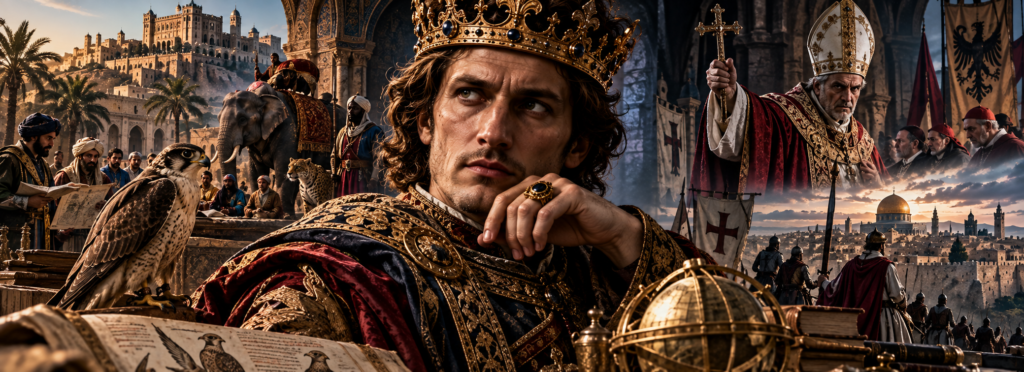
Frederick II: The Wonder of the World, the Emperor of Heretics, and the Man the Papacy Called a Beast
Holy Roman Emperor, 1220–1250 | King of Sicily, 1198–1250 | King of Germany and Jerusalem | Stupor Mundi | Excommunication, the Sixth Crusade, Scientific Curiosity, Religious War, and the Scandalous Court of the “Wonder of the World”
The Emperor Who Was Too Strange for His Own Age
Frederick II did not look like the sort of ruler medieval Europe knew how to understand. He was a Christian emperor who surrounded himself with Muslims, an excommunicated crusader who recovered Jerusalem without a great battle, a monarch fascinated by falcons and anatomy who also wrote an unusually sophisticated treatise on birds, and a ruler whose Sicilian court brought together Latin, Greek, Arabic, Jewish, and Norman intellectual traditions. His enemies accused him of heresy, blasphemy, sexual depravity, cruelty, deception, and almost every other vice a Christian emperor could possess. Pope Gregory IX reached for the language of the Apocalypse when denouncing him, presenting Frederick as a monstrous beast rising from the sea and threatening Christian civilization itself.
To admirers, however, Frederick was Stupor Mundi, the “Wonder of the World.” His intellectual curiosity was extraordinary by the standards of medieval kingship, and even hostile chroniclers conceded that he possessed unusual abilities. He spoke or understood several languages, encouraged scholarship, took an intense interest in the natural world, cultivated Muslim intellectual contacts, legislated on medicine and public order, and treated falconry almost as a scientific discipline. At the same time, he could be ruthlessly authoritarian, politically vindictive, and willing to imprison enemies—including his own son—for years. The brilliance and brutality belonged to the same ruler, which is one reason Frederick has remained so difficult to categorize.
His reputation becomes darker when we encounter the experiments attributed to him. The Franciscan chronicler Salimbene de Adam claimed Frederick deprived infants of speech and affection to discover humanity’s original language, had men killed and dissected after eating to compare their digestion, and sealed a condemned man inside a container to investigate whether the soul could be observed leaving the body. These stories have been repeated for centuries as proof that Frederick was a medieval mad scientist experimenting on human beings with terrifying indifference. The problem is that Salimbene was intensely hostile to Frederick, wrote within a culture saturated with anti-imperial propaganda, and cannot be treated as an impartial laboratory witness. The experiments belong to Frederick’s historical reputation, but they must remain allegations rather than unquestioned facts.
That distinction matters throughout Frederick’s life. He was neither the enlightened modern rationalist sometimes imagined by romantic admirers nor the satanic monster described by his most determined enemies. He was unmistakably medieval, deeply authoritarian, intensely conscious of sacred monarchy, interested in astrology as well as observation, capable of intellectual tolerance while practicing severe political repression, and fascinated by Islamic civilization without ceasing to be a Christian emperor. What made him appear almost mad to some contemporaries was not that he had lost contact with reality, but that he repeatedly refused to behave according to the categories by which they expected an emperor to live.
There is no persuasive evidence that Frederick II suffered from psychosis, mania, or another severe mental disorder. His place among the Mad Monarchs rests instead upon his extraordinary reputation for dangerous unconventionality, his relentless conflict with the papacy, the disturbing experiments attributed to him, and a court culture that enemies could portray as almost alien to Christian kingship. Frederick’s story is therefore not about madness consuming a ruler. It is about what happens when an exceptionally intelligent, immensely powerful, ruthlessly curious man behaves so differently from the expectations of his age that his opponents begin describing him as something almost inhuman.
A Child Born Into an Impossible Inheritance
Frederick was born at Jesi in central Italy on 26 December 1194, the son of Emperor Henry VI and Constance of Sicily. His birth united two formidable inheritances. Through his father he belonged to the Hohenstaufen dynasty and inherited claims connected to the Holy Roman Empire, while through his mother he became heir to the Norman Kingdom of Sicily, one of the wealthiest and most culturally complex realms in medieval Europe. From the beginning, his existence threatened to unite Germany and southern Italy under a single dynasty, creating exactly the geopolitical encirclement that generations of popes feared.
His childhood was anything but secure. Henry VI died in 1197, and Constance died the following year, leaving Frederick an orphan before his fourth birthday. He became King of Sicily as a child, while competing factions struggled for influence around him and the wider Hohenstaufen position in Germany collapsed into a disputed succession. Pope Innocent III became one of the young king’s guardians, although papal protection did not transform Frederick’s childhood into a peaceful royal upbringing.
Palermo, where Frederick grew up, was unlike most Christian capitals of western Europe. Sicily had been ruled by Muslims before its Norman conquest, and Muslim communities remained important under Christian government. Greek Christians, Latin Christians, Jews, Arabic speakers, Norman aristocrats, Italian merchants, and administrators shaped by several political traditions existed within the kingdom. Frederick therefore matured in an environment where cultural and religious boundaries were more complicated than they appeared from northern Europe.
Later legend exaggerated this childhood into the story of an almost feral prince wandering Palermo’s streets and educating himself among Muslims, merchants, beggars, and adventurers. The reality was not so romantic, but his Sicilian upbringing unquestionably mattered. Frederick’s later willingness to employ Muslim soldiers, communicate with Muslim rulers, engage Arabic intellectual traditions, and cultivate an unusually cosmopolitan court had deep roots in the kingdom that formed him.
The boy who emerged from Palermo would eventually claim authority over Germany, Italy, Sicily, and Jerusalem. He would also inherit the ancient struggle between emperors and popes over who possessed the greater authority within Christian society. By the time Frederick was an adult, his extraordinary collection of crowns had made that confrontation almost unavoidable.
Sicily: The Kingdom That Made Frederick Different
Sicily was Frederick’s political laboratory and the realm in which his vision of monarchy reached its most concentrated form. The Norman kings before him had already developed a centralized administration capable of governing an unusually diverse population, and Frederick expanded that tradition. He did not invent Sicilian multiculturalism, but he inherited a state where Christian rulers had long employed administrative practices influenced by Byzantine and Islamic predecessors.
This background helps explain why Frederick’s court could appear scandalously foreign to northern European observers. Arabic was not an exotic curiosity imported into an otherwise culturally uniform kingdom. It belonged to a Sicilian world in which Muslim communities had existed for centuries, and Frederick encountered Islamic culture as part of the political reality of his own inheritance.
His relationship with Sicily’s Muslims was nevertheless far more complicated than the flattering image of a tolerant multicultural emperor suggests. Muslim communities rebelled against royal authority, particularly in western Sicily, and Frederick responded with military force. Large numbers were eventually transferred to Lucera in mainland southern Italy, where a substantial Muslim settlement developed under direct royal control.
Lucera became one of Frederick’s most unusual political creations. Its Muslim population received a degree of religious and communal autonomy, while Muslim archers and soldiers became valuable components of imperial military power. Their dependence upon Frederick could make them personally reliable in ways that Christian magnates with independent lands and papal loyalties were not.
The arrangement was pragmatic rather than an expression of modern religious equality. Frederick had violently subdued Muslim resistance before transforming some of the defeated population into a community tied closely to his monarchy. Yet once established, Lucera gave him access to soldiers whose religious identity made papal excommunication considerably less intimidating to them.
To hostile churchmen, the sight of a Christian emperor guarded by armed Muslims could appear almost deliberately provocative. Frederick had taken a population considered religiously outside Christian society and turned it into one of the supports of imperial power. His enemies would eventually use that relationship as evidence that the emperor’s sympathies lay dangerously close to Islam.
The Young King Who Reached for an Empire
Frederick’s path from Sicilian king to emperor was shaped by the larger Hohenstaufen struggle in Germany. After the death of his father, rival candidates fought over the German crown, most notably Frederick’s uncle Philip of Swabia and the Welf claimant Otto IV. Papal policy shifted as circumstances changed, because the papacy feared any emperor capable of dominating both northern Italy and Sicily.
By 1212, Frederick entered the German contest with papal support against Otto. His position initially looked precarious, but alliances and political defections gradually strengthened him. He was crowned King of Germany and eventually emerged victorious, while Otto’s power collapsed after defeat at the Battle of Bouvines in 1214.
Frederick’s relationship with the papacy already contained the seeds of future disaster. Popes had supported him partly because he appeared useful against Otto, yet the revival of Hohenstaufen power recreated the old fear of an emperor controlling territories both north and south of the Papal States. Frederick could make promises concerning the separation of Sicily from the empire, but political realities repeatedly drew his territories and ambitions together.
In 1220, Pope Honorius III crowned Frederick Holy Roman Emperor in Rome. The ceremony placed him at the pinnacle of secular Christian authority, but it also intensified expectations that he would fulfill his repeatedly postponed promise to go on crusade. Frederick had taken the cross years earlier, and every delay made his sincerity easier to question.
The crusading vow would eventually become the instrument through which Pope Gregory IX excommunicated him. What followed was one of the strangest crusades in medieval history: an excommunicated emperor sailing east against papal orders, negotiating with a Muslim sultan, recovering Jerusalem without a major battle, and placing a crown upon his own head while church authorities refused to celebrate his triumph.
It was exactly the kind of achievement only Frederick II seemed capable of turning into a scandal.
The Court That Looked Too Much Like the Islamic World
Frederick’s court has often been described as resembling an Islamic caliph’s court more than that of a conventional Christian emperor. The comparison contains exaggeration, but there was enough unusual cultural borrowing to disturb observers. Muslim servants, soldiers, intellectuals, entertainers, and officials appeared within Frederick’s broader political world, while Arabic learning commanded his genuine interest.
Accounts of an imperial “harem” require more caution. Frederick unquestionably had mistresses and illegitimate children, and contemporary descriptions refer to women and eunuchs within his household in ways that invited comparisons with Islamic royal courts. Hostile writers could use such arrangements to portray the emperor as sexually decadent and culturally un-Christian.
The presence of eunuchs was particularly striking to western Christian observers. Eunuchs had long histories within Byzantine and Islamic courts but were much less normal within the aristocratic households of Latin western Europe. Their presence around Frederick reinforced the impression that his Sicilian monarchy followed customs belonging to civilizations many churchmen regarded as religious rivals.
Frederick did not seem particularly troubled by the discomfort. His court reflected the Mediterranean world he actually ruled rather than the cultural expectations of German bishops. Arabic-speaking scholars could offer knowledge he valued, Muslim soldiers could provide military service, and eastern court customs could communicate magnificence and imperial universality.
The result was politically dangerous precisely because symbolism mattered. An emperor did not merely govern; he represented an ideal of Christian order. Frederick’s willingness to blur cultural boundaries allowed papal propagandists to ask whether the emperor who surrounded himself with Muslims remained a trustworthy defender of Christianity at all.
The Emperor’s Menagerie
Frederick’s fascination with animals became one of the most visible features of his court. His menagerie included exotic creatures rarely seen in western Europe, and animals accompanied imperial displays in ways that astonished spectators. Elephants, camels, leopards or cheetahs, exotic birds, and other animals became associated with the emperor’s spectacular public image.
One elephant became especially famous during Frederick’s northern Italian campaigns. To a medieval audience, an elephant was not simply an unusual animal but something almost legendary, known from scripture, classical texts, travelers’ accounts, and distant wars. Displaying one transformed an imperial procession into a demonstration that Frederick’s reach extended far beyond ordinary European horizons.
Later stories expanded the menagerie until Frederick seems to have traveled permanently with a fantastic moving zoo. Some descriptions undoubtedly became embellished, but the underlying fascination is genuine. Frederick collected, observed, exchanged, and displayed unusual animals, while his court’s international connections made such acquisitions possible.
The animals were not merely decorative. They expressed imperial magnificence and Frederick’s claim to universal authority, while also satisfying his genuine curiosity about nature. The same ruler who used exotic beasts as political theater could spend extraordinary amounts of attention studying the flight, anatomy, habits, and training of birds of prey.
His obsession with falconry would eventually produce something much more significant than court entertainment. It produced one of the most remarkable scientific works written by a medieval ruler.
The Emperor Who Studied Falcons
Frederick’s De Arte Venandi cum Avibus, or The Art of Hunting with Birds, reveals an intellectual side of the emperor that even his enemies could not easily dismiss. Falconry was an aristocratic pursuit throughout medieval Europe and the Islamic world, but Frederick approached it with unusual intensity. He did not merely want to hunt successfully; he wanted to understand birds.
The work examines anatomy, behavior, migration, environment, training, and practical observation. Frederick drew upon existing authorities, including material transmitted through Arabic scholarship, but he was willing to challenge inherited claims when his own observations contradicted them. That willingness to test authority against experience has helped create his later reputation as a ruler somehow ahead of his century.
It would be misleading to turn him into a modern experimental scientist born six hundred years too early. Frederick remained a medieval thinker, and his intellectual world included assumptions very different from modern scientific methodology. Nevertheless, his insistence upon careful observation was unusual enough to deserve attention.
Falconry also demonstrates how easily Frederick’s admirable curiosity could acquire darker associations. A ruler willing to examine nature so intensely seemed, to later storytellers, exactly the kind of man who might experiment upon human beings as well. The alleged atrocities recorded by Salimbene therefore attached themselves to a real characteristic: Frederick genuinely possessed an unusually powerful desire to know how things worked.
The historical question is not whether Frederick was curious. He unquestionably was. The question is whether that curiosity actually led him to commit the grotesque human experiments later attributed to him.
That is much harder to answer.
The Babies Raised Without Language
The most famous alleged experiment concerns infants supposedly raised without spoken language. According to Salimbene de Adam, Frederick wanted to discover what language children would naturally speak if no one taught them one. Hebrew, Greek, Latin, Arabic, or the language of their parents were among the possibilities supposedly considered.
Nurses were ordered to feed, bathe, and care physically for the infants while refraining from speaking to them or engaging them with the normal gestures and affection given to children. According to Salimbene, the experiment produced no answer because the children died. He interpreted their deaths as proof that infants could not live without the affection, gestures, expressions, and human interaction normally surrounding them.
It is a chilling story, and it has frequently been presented as an established early experiment in developmental psychology. That is much too confident. Salimbene was born in 1221, was a Franciscan friar, became fiercely hostile to Frederick, and wrote about an emperor who had already become the subject of enormous religious and political propaganda.
The story also belongs to a much older tradition of rulers supposedly conducting experiments to discover humanity’s original language. Herodotus told a similar story about the Egyptian pharaoh Psamtik, and comparable tales later attached themselves to other rulers. That literary tradition does not prove Salimbene invented his account, but it gives historians an additional reason for caution.
The responsible conclusion is therefore uncomfortable but clear. Salimbene really did accuse Frederick of the experiment, and the accusation is important evidence for the emperor’s reputation. It is not sufficient evidence to state without qualification that Frederick definitely conducted it.
For an Infamous History account, the distinction actually makes the story more revealing. Frederick became so strongly associated with dangerous intellectual curiosity that contemporaries could imagine him sacrificing children simply to answer a question.
The Men Killed for Their Digestion
Another story attributed to Salimbene is even more grotesque. Frederick supposedly wanted to know whether digestion worked better during sleep or physical exercise, so two men were given the same meal. One was then sent to sleep while the other was made to exercise, traditionally through hunting.
According to the story, Frederick later ordered both men killed and their bodies opened so that their stomachs could be examined. The purpose was supposedly to determine which man had digested his meal more effectively. It is the kind of experiment that sounds horrifyingly rational: a clear question, controlled conditions, comparison, observation, and complete indifference to the lives destroyed in obtaining the answer.
That quality has made the story central to the image of Frederick as a medieval mad scientist. Yet once again, the evidence depends upon hostile chronicling rather than surviving administrative records or corroborating testimony from an imperial medical program. It cannot responsibly be narrated as though Frederick left behind laboratory notes documenting the murders.
What the tale does reveal is the kind of cruelty people found believable about him. Frederick’s genuine interest in medicine, anatomy, animals, and observation made the allegation plausible to people who already regarded his curiosity as transgressive. A conventional warrior king might be accused of slaughtering prisoners in rage; Frederick could be accused of slaughtering them to answer a physiological question.
The difference captures his reputation perfectly. Even his alleged atrocities were intellectualized.
The emperor’s supposed madness was not mindless violence. It was knowledge pursued without moral restraint.
The Prisoner, the Barrel, and the Escaping Soul
A third famous experiment supposedly involved a condemned prisoner sealed inside a container or cask. Frederick allegedly wanted to determine whether the human soul could be physically observed leaving the body at death. The prisoner was therefore enclosed so completely that any visible escape of the soul might supposedly be detected.
Again, the account is preserved within the hostile tradition surrounding Frederick and should not be treated as established fact. There is no secure basis for presenting it as a documented imperial experiment witnessed and verified by neutral observers. It belongs with the other stories through which Salimbene portrayed Frederick’s curiosity as morally monstrous.
The allegation is particularly interesting because it sits at the intersection of Frederick’s religious reputation and his scientific curiosity. A ruler asking whether the soul could be observed materially might appear to question Christian doctrine itself. To hostile churchmen, intellectual investigation could easily shade into unbelief.
Frederick was repeatedly accused of religious skepticism, and enemies attributed statements to him suggesting contempt for central Christian beliefs. Some reports claimed he regarded Moses, Jesus, and Muhammad as deceivers or impostors who had manipulated humanity. Such accusations circulated within polemical warfare and cannot simply be accepted as authentic expressions of Frederick’s beliefs.
The barrel story therefore fits an existing propaganda portrait. Frederick was presented as a man who would not accept sacred mysteries on faith and instead demanded physical proof, even if obtaining that proof required another person’s death.
Whether he actually conducted such an experiment remains doubtful.
That people believed he might have done so tells us something extraordinary about the emperor Europe thought it knew.
Salimbene: Witness, Gossip, and Enemy
Salimbene de Adam is indispensable to Frederick’s dark legend, but he must be handled carefully. The Franciscan chronicler did not write as a detached modern historian. He lived within the political and religious struggles of thirteenth-century Italy and regarded Frederick with intense hostility.
Yet Salimbene’s portrait is not one-dimensional. He could acknowledge Frederick’s intelligence, linguistic ability, charm, musical interests, ingenuity, and impressive qualities even while condemning his morality and religion. That complexity makes his testimony more interesting than simple propaganda, but it does not automatically make every anecdote factual.
Salimbene attributed a series of cruel curiosities to Frederick, including the infant experiment and other tests upon human beings. He also repeated stories and judgments belonging to a culture in which moral character was frequently demonstrated through memorable anecdotes rather than documentary proof. Some may preserve genuine events, while others may contain exaggeration, rumor, literary borrowing, or hostile invention.
The safest historical approach is therefore neither to discard Salimbene nor to believe him unquestioningly. His chronicle tells us what a highly informed and deeply hostile contemporary or near-contemporary believed, heard, or wanted readers to believe about Frederick. That alone is enormously valuable.
Frederick’s reputation had become so extreme that allegations which would sound absurd about another monarch seemed plausible when attached to him. His intellectual curiosity, religious controversies, unusual court, Muslim connections, and authoritarian government had created a persona larger than the historical man.
The emperor had become a legend while he was still close enough to living memory for the legend to hurt.
The Constitutions of Melfi
In 1231—not 1331, as the date is sometimes mistakenly repeated—Frederick promulgated the Constitutions of Melfi, also known as the Liber Augustalis, for the Kingdom of Sicily. The legal code represented one of the most ambitious attempts by a medieval monarch to systematize royal government and law. It strengthened centralized authority, regulated officials, restricted private aristocratic power, and asserted the crown’s role as the source of justice.
Some provisions can appear strikingly rational to modern readers. The code restricted or rejected forms of ordeal and placed greater emphasis upon legal procedures and evidence. Frederick’s legislation mocked the logic behind certain ordeals, questioning why natural physical processes should be interpreted as miraculous revelations of guilt or innocence.
Trial by combat was also restricted, though claims that Frederick simply abolished every form of judicial duel throughout his territories need qualification. Medieval legal practice was complicated, and exceptions remained. Nevertheless, the direction of Frederick’s legal thought challenged customs that linked divine judgment with physical ordeal.
His government also regulated medicine. Physicians required training and examination, and distinctions were drawn between medical and pharmaceutical practice. Public health, urban order, and environmental regulation appeared within a broader governmental system that assumed the state possessed substantial responsibility for controlling social life.
Modern admirers sometimes portray these laws as proof Frederick was essentially a secular liberal centuries ahead of his age. That is misleading. The same legal system was intensely authoritarian and designed to strengthen royal control. Frederick’s rationalization of government did not aim at modern individual liberty; it aimed at making monarchy more effective.
What frightened nobles was not that Frederick had become modern.
It was that he wanted the state to reach further into their world.
Law, Order, and Imperial Obsession
Frederick’s concern with regulation extended into matters that can seem surprisingly mundane. Medieval governments were not indifferent to sanitation, markets, pollution, or public order, so Frederick did not invent public hygiene. Yet the detailed administrative character of his Sicilian monarchy reinforced his reputation as a ruler who wanted almost everything categorized and controlled.
Rules addressed the disposal of waste, the contamination of water, commercial practices, professional standards, and the conduct of officials. Such legislation belonged to a larger effort to make the Kingdom of Sicily governable through royal law rather than through an uncontrolled patchwork of aristocratic privilege.
This could look like enlightened administration from one perspective and suffocating despotism from another. Nobles accustomed to jurisdictional privileges saw royal officials intruding into areas of traditional authority. Frederick’s monarchy sought to subordinate competing powers rather than coexist comfortably with them.
The emperor’s intellectual curiosity and his political authoritarianism therefore reinforced each other. He liked systems. Whether studying birds or organizing courts, Frederick displayed an appetite for classification, procedure, observation, and control.
That does not make him obsessive in a clinical sense. It does help explain why stories of extreme perfectionism attached themselves so easily to him. A ruler famous for demanding order could readily become the subject of anecdotes in which a minor error provoked terrifying punishment.
One such story involved nothing more than the spelling of his name.
The Notary’s Thumb
Salimbene claimed that Frederick ordered a notary’s thumb cut off because the man had misspelled the emperor’s name. The anecdote has survived because it compresses Frederick’s reputation for intelligence, pride, and disproportionate cruelty into one unforgettable image.
If true, the punishment would have been grotesquely severe. A professional scribe’s hand was essential to his livelihood, so mutilating a thumb for a spelling error would transform a trivial mistake into permanent bodily punishment. The act would suggest a ruler whose demand for precision had become vicious.
Yet this story comes from the same hostile chronicling environment as many of Frederick’s supposed experiments. It should therefore be presented as an allegation rather than a securely documented administrative sentence. Medieval chroniclers loved stories in which rulers’ characters were revealed through dramatic punishments, and such anecdotes could acquire symbolic meaning regardless of literal accuracy.
The story’s endurance tells us how Frederick’s enemies interpreted his authoritarian personality. He was imagined as a ruler for whom error became defiance and imperfection became an insult to imperial order. Whether or not a notary actually lost his thumb, the anecdote fit the emperor’s public image.
Similar caution applies to stories that Frederick executed attendants over failures involving prized falcons or punished objects that irritated him. Some may contain kernels of truth, while others belong to the folklore surrounding a ruler whose temper and power made almost any punishment imaginable.
Frederick certainly possessed the authority to be cruel.
That does not mean every cruelty attributed to him actually occurred.
Falconry, Perfection, and the Limits of Legend
Frederick’s love of falconry was genuine and intense. Falcons were valuable animals requiring highly skilled care, and imperial falconers occupied positions of considerable responsibility. It is therefore plausible that negligence resulting in the loss of a prized bird could provoke severe punishment.
The more sensational claim that Frederick executed a falconer simply because a favorite bird died should nevertheless be treated cautiously unless tied to strong contemporary evidence. Like the notary’s thumb, the anecdote works almost too perfectly as a character story. Frederick’s passion becomes obsession, and obsession becomes lethal tyranny.
This is a recurring problem with famous rulers. Once a personality becomes established in historical memory, stories migrate toward it. Cruel anecdotes accumulate around cruel kings, sexual stories around promiscuous kings, and bizarre experiments around intellectually curious kings.
Frederick attracted all three kinds. He was politically ruthless, sexually unconventional by clerical standards, and unusually curious about the natural world. He therefore became an almost ideal magnet for stories combining cruelty, sexuality, science, and blasphemy.
The task of responsible history is not to drain the drama from those stories. It is to preserve the drama while keeping the boundary between evidence and legend visible.
Frederick needs no invented atrocities to remain extraordinary.
His documented life was already strange enough.
The Crusade He Kept Postponing
Frederick’s relationship with the crusading movement became one of the central controversies of his reign. He had repeatedly promised to travel to the Holy Land, but political obligations and delays postponed his departure. By the time Gregory IX became pope in 1227, patience had nearly disappeared.
Frederick finally embarked, but illness struck the expedition, forcing him to turn back. Gregory regarded the retreat as another broken promise and excommunicated him in September 1227. Frederick insisted that illness had genuinely prevented the crusade, while the pope treated his failure as part of a broader pattern of evasion.
The emperor now faced a bizarre problem. He remained bound by his crusading commitment, but he was excommunicated. When he sailed again in 1228, he did so without reconciliation with the pope.
A Christian emperor therefore went on crusade while officially excluded from communion with the Church. Clergy and military orders in the East faced the awkward question of how closely they could cooperate with an excommunicated ruler. Papal hostility followed Frederick across the Mediterranean.
Most rulers would have found such circumstances disastrous.
Frederick proceeded to accomplish through diplomacy what previous crusading armies had failed to achieve through enormous bloodshed.
The Excommunicated Crusader
Frederick arrived in the eastern Mediterranean with significant disadvantages. His military force was not large enough to guarantee conquest, and his excommunication weakened his authority among crusaders. Yet he possessed something many crusading leaders lacked: familiarity with diplomacy across religious boundaries and the ability to negotiate with Muslim rulers without treating negotiation itself as dishonorable.
Sultan al-Kamil of Egypt had his own political problems within the Ayyubid world. Frederick understood that the Muslim ruler might prefer an agreement with the emperor to an expensive military confrontation. Negotiations therefore became the heart of the Sixth Crusade.
Frederick and al-Kamil reached an agreement in 1229. Jerusalem, Bethlehem, and other territories came under Christian control under carefully negotiated terms, while Muslim religious rights at sacred sites were protected. The arrangement was imperfect and controversial, but Frederick had recovered Christian access to Jerusalem without the enormous massacre that had accompanied the First Crusade’s conquest in 1099.
To modern eyes, the achievement can appear astonishingly sensible. To many contemporaries, however, it was deeply uncomfortable. Crusade ideology celebrated holy warfare, sacrifice, and the liberation of sacred territory under ecclesiastical blessing. Frederick had arrived excommunicated, negotiated with a Muslim sultan, and produced a settlement while still locked in conflict with the pope.
The emperor had succeeded in exactly the wrong way.
That may have irritated his enemies almost as much as failure would have done.
The Crown of Jerusalem
Frederick possessed a claim to the Kingdom of Jerusalem through his marriage to Isabella II, also known as Yolande of Brienne. Their marriage was politically strategic, but Isabella died in 1228 after giving birth to their son Conrad. Frederick then asserted authority connected to his young son’s inheritance.
In March 1229, Frederick participated in a coronation-like ceremony at the Church of the Holy Sepulchre in Jerusalem. The popular image of the excommunicated emperor defiantly crowning himself has become one of the great scenes of his life. The precise ceremonial details are more complicated than the legend, and it is safer to describe him as taking the crown in a ceremony without the normal ecclesiastical coronation rather than imagining a theatrical rejection of Christianity.
The symbolism remained extraordinary. A ruler under papal excommunication stood in Christianity’s holiest city after obtaining it through negotiation with a Muslim ruler. Clerical authorities could hardly celebrate him enthusiastically without undermining the papal campaign against him.
Frederick’s behavior again seemed to collapse categories medieval political culture preferred to keep separate. Was he a crusader or an enemy of the Church? Was negotiation with al-Kamil brilliant diplomacy or suspicious intimacy with Islam? Was his recovery of Jerusalem a Christian triumph or an imperial publicity stunt?
Frederick seemed comfortable inhabiting all of these contradictions.
His enemies were not.
A Christian Emperor Who Spoke to Muslims
Frederick’s relationship with al-Kamil became central to later portrayals of him as an almost modern religious skeptic. The two courts exchanged intellectual questions, diplomatic messages, and gifts, and Frederick’s interest in Arabic scholarship was genuine. He was capable of treating Muslim elites as intellectual and political counterparts rather than simply enemies of the faith.
This did not make him a modern advocate of religious pluralism. Frederick fought Muslims when political interests required it, forcibly relocated Muslim communities in Sicily, and used religion as an instrument of monarchy. His tolerance was selective and pragmatic.
Yet his comfort with Islamic culture was unusual enough to fuel suspicion. Christian polemicists could portray his Muslim soldiers, Arabic interests, eastern court customs, and diplomacy with al-Kamil as evidence that he secretly preferred Islam or lacked genuine Christian belief.
The accusations became more explosive because Frederick himself did little to cultivate the image of a conventionally obedient Christian monarch. He fought popes, challenged ecclesiastical privileges, and responded to papal propaganda with propaganda of his own. His political behavior made allegations of religious deviance easier to believe.
In reality, Frederick’s religious beliefs remain difficult to reconstruct. He used Christian language and imperial theology, founded and supported religious institutions, participated in crusading ideology, and clearly understood himself within a Christian political universe. At the same time, he possessed a degree of intellectual openness that alarmed churchmen already predisposed to distrust him.
The result was one of the most destructive propaganda wars of the Middle Ages.
The Beast Rising From the Sea
Frederick’s relationship with Pope Gregory IX eventually collapsed into open hostility again. In 1239 Gregory excommunicated him during a renewed struggle involving northern Italy and the Lombard cities. This second great period of excommunication proved even more vicious than the first.
Papal rhetoric became apocalyptic. Gregory used imagery from the Book of Revelation to describe Frederick as a beast rising from the sea, full of blasphemy and threatening the faithful. Such language did not amount neatly to a formal psychiatric judgment, nor is it accurate to reduce the entire controversy to the pope simply issuing an official declaration that Frederick was “the Antichrist.” The propaganda was more complex and more politically calculated than that.
Nevertheless, Antichrist imagery circulated around the conflict. Frederick’s enemies could depict him as a persecutor of the Church, while imperial propagandists retaliated by portraying the papacy as corrupt, tyrannical, and itself dangerously close to apocalyptic evil. Both sides weaponized Christian eschatology.
The language mattered because medieval politics existed inside a religious understanding of history. Calling an emperor a beast from Revelation was not equivalent to a modern political insult. It placed him within a cosmic struggle between divine order and evil.
Frederick had therefore moved beyond being merely an inconvenient ruler.
His enemies were presenting him as a threat to Christendom itself.
How Many Times Was Frederick Excommunicated?
Frederick is frequently described as having been excommunicated four times, although the number varies depending upon whether renewed or reiterated sentences are counted separately. The major episodes are clearer than the headline number. Gregory IX excommunicated him in 1227 over the failed crusading departure, and the conflict continued while Frederick went east before reconciliation in 1230. Gregory excommunicated him again in 1239 during the renewed imperial-papal war, while subsequent papal actions continued and intensified the condemnation.
Under Innocent IV, the struggle reached another level. At the Council of Lyon in 1245, the pope declared Frederick deposed, presenting an extraordinary challenge to imperial legitimacy. Frederick rejected the sentence and continued ruling and fighting.
The repeated condemnations contributed enormously to his sinister reputation. Excommunication was supposed to isolate a ruler spiritually and politically, yet Frederick repeatedly continued governing. His Muslim soldiers were particularly useful because papal spiritual sanctions had little meaning for them.
Every failed attempt to destroy him could make him appear more dangerous. If an excommunicated emperor still commanded armies, administered kingdoms, negotiated with foreign rulers, and defeated Christian enemies, papal propagandists needed increasingly powerful explanations for his persistence.
Frederick became not merely disobedient but monstrous.
His ability to survive condemnation helped create the legend that condemnation was meant to destroy.
The Son Who Rebelled
Frederick’s family life contained its own political catastrophe. His son Henry, commonly called Henry VII in German royal numbering, had been crowned King of the Romans and entrusted with authority in Germany. The arrangement was intended to preserve Hohenstaufen control while Frederick concentrated on Italy and Sicily.
Father and son increasingly disagreed over German policy. Henry attempted to build his own political position and eventually aligned himself with forces opposed to his father’s wishes. In 1235, Frederick moved north to confront the crisis.
The rebellion collapsed, and Henry submitted. Later storytelling emphasized the almost surreal spectacle surrounding Frederick’s arrival, sometimes linking his exotic entourage and animals with the psychological collapse of opposition. Whatever effect the imperial display had, political isolation rather than zoological intimidation explains Henry’s defeat more securely.
Frederick showed little mercy afterward. His son was stripped of authority and imprisoned, moving between places of confinement in southern Italy. The imprisonment lasted for years.
For a ruler fascinated by law, order, and obedience, rebellion by his own son was an intolerable challenge. Frederick chose dynastic security over paternal reconciliation.
The decision would end tragically.
The Death of Henry VII
In 1242, while being transferred between places of confinement, Henry died after falling or plunging from his horse in a mountainous area. The circumstances led to the enduring suspicion that he deliberately rode over a precipice and killed himself rather than continue enduring captivity.
Suicide is possible, but absolute certainty is impossible. Medieval accounts and later retellings differ, and an accidental fall cannot be entirely excluded. The image of a broken prince deliberately throwing himself to his death after years of imprisonment nevertheless became one of the darkest episodes associated with Frederick’s family.
If Henry did kill himself, Frederick’s treatment of his son acquires an especially grim dimension. The emperor had not ordered an immediate execution, but prolonged imprisonment could itself become a devastating punishment. A man who had once been prepared to inherit an empire was reduced to a captive moved between fortresses under his father’s authority.
Frederick reportedly showed grief after Henry’s death, which complicates the image of a completely unfeeling tyrant. Medieval rulers could love family members and still punish them with extraordinary severity when dynastic rebellion occurred. Political survival often overrode private affection.
The episode also demonstrates why Frederick does not need dubious psychological labels to appear frightening. His severity was political rather than psychotic. He could decide that an imprisoned son was safer than a reconciled one and live with that decision for years.
The emperor’s rationality could be colder than madness.
Frederick’s Women and the Myth of the Harem
Frederick married several times and fathered numerous legitimate and illegitimate children. His relationships became part of the scandal surrounding his court, particularly because clerical opponents were eager to depict him as sexually uncontrolled. Later writers often describe an imperial harem populated by concubines and guarded by eunuchs.
There is evidence for women maintained within Frederick’s household and for eastern-influenced court arrangements, but the word “harem” can create misleading images imported from later Ottoman stereotypes. Frederick’s household was culturally unusual, and his sexual life was certainly not limited to his lawful marriages, but reconstructing its private organization requires caution.
One of the most important women in his life was Bianca Lancia, with whom Frederick had a long relationship and who was the mother of several of his children, including Manfred. Later tradition claimed Frederick married Bianca near the end of her life, although the status of any such marriage remains disputed.
Frederick’s sexual reputation blended easily with accusations of religious deviance. A Christian emperor surrounded by Muslim soldiers, eunuchs, exotic animals, mistresses, scholars, astrologers, and Arabic-speaking courtiers could be portrayed as ruling a palace of oriental decadence. The image was politically irresistible.
Reality was less theatrical but still unusual. Frederick’s court genuinely did combine cultural influences in ways that distinguished it from many northern European courts. The propaganda worked because it exaggerated something people could actually see.
He was different.
His enemies simply transformed difference into depravity.
Astrology and the Rational Emperor
The popular image of Frederick as a hard-headed rationalist contains another contradiction. He was deeply interested in astrology, a field that medieval intellectuals did not necessarily separate from serious study of nature. Learned astrologers could hold respected positions at court, and celestial influences were widely believed to affect human affairs.
Michael Scot, the Scottish scholar associated with Frederick’s court, became famous for work involving astrology, philosophy, translation, and natural knowledge. Later legends transformed Scot into an almost magical figure and connected Frederick with prophecies about his own death.
One famous tradition claimed Frederick had been warned that he would die sub flore, “under the flower.” Later storytelling connected this prophecy with his supposed avoidance of Florence, whose name evoked the flower, and with his eventual death at Castel Fiorentino. The coincidence was too perfect for medieval and later writers to resist.
The details should not be treated as securely documented proof that Frederick spent his life terrified of Florence. Prophetic death stories commonly accumulated around famous rulers, and retrospective coincidence could make legends appear inevitable. Nevertheless, Frederick’s genuine interest in astrology makes the tradition plausible enough to have endured.
This is another reason describing him as a modern rationalist is inadequate. Frederick could question ordeals, insist upon observation, study birds carefully, converse with Muslim scholars, and still inhabit a universe in which the stars carried meaning.
He was not ahead of the Middle Ages because he had escaped them.
He was extraordinary because he explored so many possibilities within them.
Fish, Rings, and the Emperor’s Curiosity
Stories also credit Frederick with experiments intended to determine how long fish lived, including marking or tagging fish so they could supposedly be identified later. Such anecdotes fit his genuine interest in animals and observation, but specific claims about meticulous multi-decade tracking programs should be approached cautiously.
Frederick unquestionably possessed the temperament that made such stories believable. His falconry treatise demonstrates patient observation over time, and his court engaged intellectual questions involving zoology, medicine, mathematics, philosophy, and the natural world. He enjoyed asking questions.
That habit distinguished him from rulers whose intellectual patronage remained primarily ceremonial. Frederick appears to have participated personally in scholarly inquiry, sometimes sending questions to learned men and expecting substantive answers. His interests were not confined to theology or law.
Yet curiosity at a medieval court always existed beside spectacle. Exotic animals could be objects of study and symbols of power simultaneously. An elephant might inspire natural inquiry while also announcing that the emperor commanded connections reaching across continents.
Frederick’s genius, if the word is appropriate, lay partly in refusing to separate these functions. Knowledge strengthened magnificence, magnificence strengthened authority, and authority gave him access to knowledge unavailable to ordinary people.
The darker stories ask what happened when the same authority was applied to human beings.
That question remains unresolved because the most horrifying answers come from enemies whose testimony cannot simply be trusted.
The University of Naples and the Controlled Mind
In 1224, Frederick founded the University of Naples, one of the earliest universities established directly by a ruler. The institution was intended in part to train administrators and professionals for the Kingdom of Sicily. Its creation therefore combined intellectual ambition with political centralization.
Students could be educated within Frederick’s realm rather than traveling to institutions such as Bologna, where intellectual communities might exist beyond direct royal control. The university would help supply the trained legal and administrative personnel required by an increasingly sophisticated monarchy.
This again reveals the dual nature of Frederick’s intellectual patronage. He genuinely valued learning, but he also understood knowledge as an instrument of government. Education could strengthen the state.
His court supported poetry as well. The Sicilian School became important in the development of Italian vernacular literature, with poets experimenting in forms that would influence later Italian literary traditions. Frederick himself was associated with poetry and music as well as science and law.
The emperor who appears in hostile chronicles as a demonic tyrant therefore presided over one of medieval Europe’s most remarkable cultural environments. The contradiction is only apparent if intellectual achievement is assumed to require political gentleness.
History offers no such guarantee.
Brilliant rulers can also be authoritarian rulers, and Frederick II may be one of the clearest medieval examples.
The War Against the Lombard Cities
Frederick’s imperial ambitions brought him into repeated conflict with the cities of northern Italy. The Lombard League represented a formidable obstacle to direct imperial domination, and papal policy increasingly aligned with resistance to Hohenstaufen expansion.
Frederick achieved a major victory at Cortenuova in 1237. The triumph encouraged him to press his advantage, but his demands proved too severe for a durable settlement. Milan and other opponents continued resisting.
Here again Frederick’s stubbornness became politically costly. He could achieve impressive victories and then demand enough from defeated enemies to ensure that resistance continued. His conception of imperial authority left limited room for autonomous political communities unwilling to acknowledge his supremacy.
The papacy watched these developments with alarm. If Frederick dominated northern Italy while retaining Sicily in the south, the Papal States would be caught between his territories. The conflict therefore involved not only abstract arguments about church and empire but geography and survival.
Gregory IX’s renewed excommunication in 1239 emerged from this environment. Papal propaganda painted Frederick as a religious monster, while Frederick presented the pope as a political enemy disguising territorial ambition behind spiritual authority.
Both descriptions contained elements of truth and propaganda.
Neither side was fighting only about theology.
The Ships Carrying Churchmen
The struggle became particularly bitter when Gregory IX attempted to summon a church council against Frederick. Prelates traveling toward Rome by sea became entangled in the military conflict, and imperial forces intercepted a Genoese fleet carrying numerous churchmen in 1241 at the Battle of Giglio.
The capture of ecclesiastical dignitaries was a spectacular escalation. Frederick could justify military action against enemies aiding the papacy, but to his opponents the seizure of bishops and cardinals confirmed that the emperor had become a persecutor of the Church.
Gregory died later that year before the confrontation reached the conclusion he intended. Frederick had once again outlasted a pope who had dedicated enormous energy to destroying his political position.
The pattern resembled his earlier conflict with Gregory’s predecessors and would continue under Innocent IV. Frederick could survive condemnation, but survival did not produce reconciliation. Each victory merely postponed the next phase.
His political life increasingly resembled permanent warfare. The empire, the papacy, the Lombard cities, Sicily, Germany, and Frederick’s own family became connected within a struggle no single victory could settle.
The emperor’s reputation darkened accordingly.
A ruler permanently at war with the institutional Church could eventually be made to look like an enemy of Christianity itself.
Innocent IV and the Attempt to Depose an Emperor
Pope Innocent IV initially pursued negotiation but eventually became another determined enemy. In 1244 he escaped from Italy and reached Lyon, placing himself beyond Frederick’s immediate military reach. There, in 1245, a council became the setting for one of the most extraordinary papal attacks on an emperor in medieval history.
Innocent declared Frederick deposed. The accusations included perjury, violation of peace, sacrilege, and suspicion of heresy. The pope sought to release Frederick’s subjects from obedience and encourage the election of an alternative ruler.
Frederick rejected the sentence. From his perspective, the pope had exceeded legitimate spiritual authority and was attempting to destroy an emperor for political reasons. His supporters argued that papal power did not include an unrestricted right to dispose of imperial crowns.
The result was renewed civil and ideological warfare. Rival kings appeared in Germany, papal supporters fought Hohenstaufen forces in Italy, and the conflict became increasingly brutal. Frederick’s opponents were no longer simply resisting particular policies; they were being encouraged to imagine a Europe without him.
Yet Frederick continued ruling.
Once again, ecclesiastical condemnation failed to make the emperor vanish.
Pier delle Vigne and the Poison of Suspicion
One of the most tragic episodes of Frederick’s final years involved Pier delle Vigne, his trusted chancellor and one of the most important figures within the imperial administration. Pier had risen through Frederick’s service and became closely associated with the sophisticated rhetoric and legal culture of the emperor’s court.
In 1249, Pier suddenly fell from favor. The precise reasons remain uncertain. Accusations of corruption, betrayal, or involvement in plots circulated, while later tradition connected the affair with an alleged attempt to poison Frederick.
Pier was arrested and blinded. He died soon afterward, traditionally by suicide, although details surrounding his death remain uncertain. Dante later immortalized him in the Inferno, transforming the disgraced minister into one of medieval literature’s most memorable tragic figures.
The fall of Pier has often been interpreted as evidence that Frederick became increasingly paranoid during his final years. That is possible, particularly in an environment filled with genuine conspiracies and political defections, but retrospective psychiatric language again risks oversimplification.
Frederick had real enemies trying to overthrow or kill him. Papal policy encouraged rebellion, rival claimants challenged his authority, and assassination was hardly unknown in medieval politics. Suspicion was therefore not inherently delusional.
The tragedy was that a ruler surrounded by genuine treachery could become unable to distinguish actual betrayal from imagined betrayal.
Pier delle Vigne may have paid the price.
The Emperor and the Poison Plot
Stories of attempted assassination intensified during Frederick’s final years. One famous episode involved an alleged plot to poison him, with various accounts implicating people within his household or political network. As with many stories surrounding Frederick, the evidence is complicated by propaganda and later embellishment.
The important point is that assassination was plausible enough to shape imperial behavior. Frederick’s wars had created enemies among nobles, cities, ecclesiastics, and rival political factions. The possibility that someone might attempt to murder him was not irrational.
Yet prolonged exposure to real threats can produce a political atmosphere in which almost anyone becomes suspect. The emperor’s court grew increasingly dangerous as loyalty became difficult to distinguish from opportunism. Men who had risen through Frederick’s favor could fall catastrophically.
This pattern has encouraged descriptions of the aging Frederick as paranoid. Such language should remain descriptive rather than diagnostic. We do not possess evidence of irrational persecutory delusions detached from actual circumstances.
What we possess is evidence of a ruler who had spent decades under excommunication, military attack, rebellion, propaganda, and threats of deposition.
Frederick had created enemies throughout Europe.
By the end, he had reason to wonder which of them had reached his own chambers.
The Myth of the Bell
Among the lesser anecdotes attached to Frederick are stories of his anger toward objects or customs that offended his sense of order. One tale claims that a church bell irritated him so badly that he ordered it removed, smashed, or melted. Such stories contribute to the portrait of an emperor whose intolerance of annoyance crossed into absurd tyranny.
As with the severed thumb and executed falconer, this kind of anecdote should not be allowed to carry more evidentiary weight than it deserves. Medieval rulers attracted moral tales in which their virtues and vices were exaggerated through memorable incidents. Bells also carried political significance because they summoned communities, marked ecclesiastical authority, and could symbolize urban independence.
An order concerning a bell could therefore have political circumstances later stripped away in retelling. What survives as a tantrum may originally have involved jurisdiction, rebellion, or punishment of a community. Without reliable context, certainty is impossible.
The broader image remains revealing. Frederick was remembered as a ruler who demanded control not merely over armies and nobles but over the soundscape of his world. Everything had to fit within the order he imposed.
That image may tell us more about how subjects experienced centralized monarchy than about Frederick’s mental state.
To people accustomed to negotiated privileges, an emperor determined to regulate everything could look irrationally controlling.
From Frederick’s perspective, control was what government was for.
Was Frederick an Atheist?
Few accusations against Frederick were more explosive than the suggestion that he did not genuinely believe Christianity. Enemies associated him with blasphemous statements, religious skepticism, and suspicious admiration for Islam. One notorious accusation connected him with the idea that Moses, Jesus, and Muhammad had deceived the world.
The authenticity of such statements is highly doubtful. Heresy accusations were powerful political weapons, and Frederick’s conflicts with the papacy created obvious incentives to portray him as an unbeliever. His Muslim connections made the accusations easier to sell.
Frederick nevertheless seems to have possessed an unusually questioning intellect. He was interested in theological and philosophical problems, sought answers from Muslim thinkers, and did not always display the kind of public piety expected from a ruler fighting for Christian legitimacy. That made him vulnerable to charges of skepticism.
Yet he continued to operate within Christian kingship. He invoked divine authority, participated in crusading ideology, endowed religious institutions, and understood his imperial office in sacred terms. None of this proves private orthodoxy, but neither does the evidence justify confidently labeling him an atheist.
The more interesting reality is that Frederick frightened people because they could not easily determine where his intellectual curiosity ended. A ruler willing to question received wisdom about nature might also, his enemies feared, question received truths about God.
In a medieval emperor, curiosity itself could become suspicious.
“Stupor Mundi”
The title Stupor Mundi, usually rendered “Wonder of the World,” captures the astonishment Frederick inspired. The phrase did not mean that everyone admired him. Wonder could contain fear as easily as praise.
Frederick’s range was genuinely remarkable. He was emperor, legislator, military commander, diplomat, falconer, patron of poets, founder of a university, participant in scientific inquiry, and ruler of culturally diverse territories stretching across the central Mediterranean and into Germany. He communicated across linguistic and religious boundaries with unusual ease.
He also presided over executions, imprisonments, forced relocations, wars, and harsh political punishments. His centralized Sicilian government could be efficient while remaining authoritarian. His intellectual brilliance did not soften his determination to destroy rebellion.
This mixture makes Frederick especially vulnerable to romantic mythology. Admirers can turn him into a tolerant Renaissance prince born centuries early, while enemies can turn him into a satanic despot experimenting on babies and mocking Christianity.
Neither portrait is sufficient.
The wonder of Frederick lies partly in his refusal to fit comfortably into either one.
The Emperor Who Negotiated With the Enemy
Frederick’s diplomacy with al-Kamil deserves particular attention because it reveals how differently he could approach problems other rulers treated as matters of sacred violence. The Sixth Crusade had every potential to become another bloody military expedition. Frederick instead recognized that political circumstances made negotiation possible.
This was not pacifism. Frederick was perfectly willing to use military force elsewhere, and his career contains no general rejection of war. His diplomacy in the Holy Land was strategic.
Yet strategy produced an extraordinary result. Jerusalem returned to Christian control through treaty rather than massacre, at least temporarily. Frederick accomplished one of the central stated goals of crusading while under excommunication.
The papacy’s difficulty was obvious. Celebrating the achievement strengthened an emperor it was condemning. Attacking it too aggressively risked appearing to oppose the recovery of Jerusalem.
Frederick had once again placed his enemies in an impossible position by succeeding outside the rules they expected him to follow.
That may have been one of his greatest talents.
He did not merely defy institutions.
He sometimes made their categories stop working.
Tolerance and Its Limits
Frederick is often praised for religious tolerance, particularly toward Muslims and Jews. There is some truth behind this reputation, but it must be kept within medieval context. He employed Muslims, engaged Muslim scholars, protected useful communities, and demonstrated a level of cultural flexibility unusual enough to attract attention.
At the same time, he was not a modern secular pluralist. His laws contained discriminatory provisions affecting religious minorities, and his treatment of rebellious Sicilian Muslims involved warfare and forced relocation. Tolerance often depended upon obedience to the state.
This apparent contradiction disappears once Frederick’s priorities are understood. He was less interested in enforcing cultural uniformity than in enforcing political submission. A Muslim soldier loyal to Frederick could be more valuable than a Christian noble loyal to the pope.
That pragmatism could look like tolerance because it allowed communities to preserve practices other rulers might have suppressed. It could also become brutal the moment those communities resisted royal authority.
Frederick’s state did not ask everyone to be the same.
It demanded that everyone recognize who ruled them.
For the emperor, political loyalty frequently mattered more than cultural familiarity.
A Court Between Worlds
Palermo and Frederick’s wider southern Italian court existed at a crossroads of civilizations. Latin Christian, Greek, Jewish, and Islamic intellectual traditions intersected there, while the emperor’s diplomatic network connected him with courts throughout the Mediterranean.
Translation mattered enormously. Works preserved or developed in Arabic could enter Latin intellectual culture through scholars moving between languages. Philosophy, medicine, mathematics, astronomy, astrology, and zoology circulated across boundaries political propaganda portrayed as absolute.
Frederick was unusually receptive to this environment. His intellectual questions were not confined by the assumption that useful knowledge had to come from Christian authors. That attitude could produce remarkable scholarship while simultaneously exposing him to accusations of religious contamination.
The court’s literary culture was equally significant. Poetry written in the Sicilian vernacular contributed to developments that would eventually shape Italian literature. Frederick’s political court therefore became a cultural workshop.
None of this means Palermo was a utopia of enlightened coexistence. Hierarchy, coercion, slavery, religious inequality, and royal violence remained part of the system. The court’s brilliance existed beside the harsher realities of medieval monarchy.
Frederick’s world was sophisticated without being humane by modern standards.
That combination is essential to understanding him.
Did Frederick Go Mad?
There is no convincing evidence that Frederick II experienced a psychotic disorder or the kind of severe episodic mental illness documented in certain other monarchs. He did not suffer known periods in which he lost his identity, failed to recognize those around him, experienced obvious hallucinations, or became incapable of government.
His decisions, however controversial, generally reveal sustained political calculation. Even his most unconventional actions served recognizable purposes. Muslim troops gave him loyal military manpower, centralized law strengthened Sicily, negotiation recovered Jerusalem, and the suppression of rebellious family members protected dynastic authority.
His intellectual eccentricities also do not constitute mental illness. Fascination with animals, languages, medicine, astrology, philosophy, and anatomy may have made him unusual, but unusual curiosity is not insanity. Nor does cultural openness toward Islam demonstrate psychological instability.
The darker allegations require separate treatment. If Frederick truly conducted lethal experiments on infants and prisoners, those acts would demonstrate extraordinary cruelty and moral detachment. They still would not automatically establish psychosis.
But because the experiments themselves are poorly corroborated and depend heavily upon hostile testimony, they cannot carry the burden of diagnosing the emperor.
Frederick was eccentric.
He could be ruthless.
He was not demonstrably mad.
The Real Madness Was Political
If Frederick possessed a self-destructive trait, it may have been his unwillingness to accept limits upon imperial authority. His struggle with the papacy consumed decades, destabilized Italy, encouraged rebellion in Germany, and eventually threatened the survival of the Hohenstaufen dynasty.
Yet the popes were equally unwilling to accept a political order in which Frederick dominated both Sicily and northern Italy. The conflict was structural as much as personal. Even a less provocative emperor might have collided with a papacy terrified of Hohenstaufen encirclement.
Frederick’s personality intensified the struggle. He was intelligent enough to defend his claims brilliantly, powerful enough to make those claims dangerous, and stubborn enough to continue fighting after compromise might have preserved more of his dynasty’s future.
His opponents responded in kind. Excommunication became political warfare, heresy accusations became propaganda, and eventually crusading language itself was directed against the Hohenstaufen.
The emperor who had negotiated Jerusalem back into Christian hands could now be treated as an enemy against whom Christians might legitimately wage holy war.
Medieval politics rarely produced a stranger reversal.
Frederick had gone from crusader to target of crusading rhetoric without changing the essential conviction that his authority came from God.
The Final Years
Frederick’s final years were increasingly difficult. Papal opposition remained fierce, rebellion threatened parts of his political system, and trusted servants fell under suspicion. The defeat of imperial forces at Parma in 1248 was particularly damaging and destroyed the imperial camp known as Vittoria.
The name itself carried Frederick’s characteristic confidence. He had established a settlement called “Victory” while besieging Parma, as though triumph had already been decided. When the Parmesans attacked and destroyed it, the symbolism was humiliating.
Yet Frederick again refused to collapse. He continued campaigning, reorganizing, and defending his position. The Hohenstaufen system remained formidable despite accumulating setbacks.
The fall of Pier delle Vigne in 1249 darkened the atmosphere further. Whether Frederick had become increasingly suspicious or was responding to genuine corruption and conspiracy, the emperor’s inner circle no longer looked secure. The ruler who had spent his life constructing systems of loyalty was discovering how fragile loyalty could become under relentless pressure.
His health also deteriorated.
The Wonder of the World was approaching an ending no pope had managed to impose upon him.
The Prophecy of the Flower
Frederick died on 13 December 1250 at Castel Fiorentino in Apulia. Later legend immediately found meaning in the location. A prophecy had supposedly warned him that he would die sub flore, “under the flower,” encouraging him to avoid Florence.
Castel Fiorentino seemed to fulfill the prediction through its name. The emperor who had supposedly avoided Florence had died at a place bearing the fatal linguistic echo. Medieval chroniclers and later storytellers could hardly resist the irony.
The story is compelling, but it belongs to the legendary atmosphere surrounding Frederick’s death rather than secure medical history. His final illness is commonly associated with severe intestinal disease, often described as dysentery or a similar condition. There is no need to invoke supernatural prophecy.
Yet the legend suits Frederick because his entire life occupied the border between rational inquiry and medieval wonder. He questioned nature but consulted astrologers. He challenged superstition in law while inhabiting a world fascinated by prophecy.
Even his death refused to become ordinary.
A ruler surrounded by legends in life naturally acquired another legend as he died.
The Hohenstaufen Disaster After Frederick
Frederick’s death did not end the papal struggle with his dynasty. His son Conrad IV inherited claims but survived his father by only a few years. Frederick’s illegitimate son Manfred later seized control in Sicily and continued Hohenstaufen resistance.
The papacy remained determined to destroy the dynasty’s power in southern Italy. Charles of Anjou was eventually brought into the conflict, defeating and killing Manfred at Benevento in 1266. The Hohenstaufen cause then passed to the young Conradin, Frederick’s grandson.
Conradin invaded Italy in an attempt to reclaim his inheritance but was defeated at Tagliacozzo in 1268. Captured and condemned, the sixteen-year-old was publicly executed in Naples. With his death, the legitimate male Hohenstaufen line effectively ended.
The destruction gives Frederick’s career a grim retrospective quality. He spent decades fighting to preserve and expand imperial power, yet the political enemies created during those struggles continued attacking his family after his death. The dynasty that had once seemed capable of dominating central Europe and Italy was broken within a generation.
Frederick had been powerful enough to survive popes.
His descendants were not.
The Wonder of the World left behind an inheritance almost as dangerous as his enemies had always feared.
Monster, Genius, or Both?
Frederick II has repeatedly been forced into extremes. One tradition celebrates him as a proto-modern genius, religious skeptic, scientific thinker, multicultural ruler, and rational lawgiver who anticipated the Renaissance. Another presents him as a cruel despot, sexual libertine, blasphemer, persecutor, and experimenter willing to sacrifice human beings to satisfy intellectual curiosity.
The historical Frederick cannot be contained by either portrait. His intellectual achievements were real, but he did not cease to be a medieval emperor. His cultural openness was real, but it existed beside coercion and hierarchy. His legislation could be rationalizing while also strengthening authoritarian royal power.
His cruelty was real in political contexts, even when particular sensational stories remain doubtful. He imprisoned his rebellious son for years, crushed resistance, fought devastating wars, and punished enemies harshly. There is no need to rely upon babies deprived of affection or prisoners dissected after dinner to establish that Frederick could be ruthless.
At the same time, his enemies had enormous incentives to blacken his reputation. Papal propaganda was not written to provide neutral biography. A ruler described through apocalyptic imagery while the Church was attempting to depose him cannot be judged by hostile accusations alone.
Frederick’s historical fascination lies in the tension between these realities.
He was brilliant enough to inspire wonder and dangerous enough to inspire nightmares.
Frederick II Among the Mad Monarchs
Frederick’s place among the Mad Monarchs is unusual because almost everything that made him seem mad to contemporaries can be understood without mental illness. His court looked strange because Sicily genuinely stood at a cultural crossroads. His Muslim soldiers existed because they were politically useful and personally dependent upon him.
His diplomacy with al-Kamil looked suspicious because crusading culture expected religious warfare, yet negotiation was the most practical route to Jerusalem. His legal reforms looked intrusive because he wanted a centralized monarchy capable of overruling traditional privilege. His scientific interests looked dangerous because he asked questions rulers were not expected to ask.
Even the darker side of his reign does not require psychiatric explanation. Political cruelty, authoritarianism, vindictiveness, sexual misconduct, and ruthless punishment are human behaviors, not diagnoses. A ruler can be terrifyingly rational.
The alleged experiments remain the most disturbing exception, but their uncertain evidentiary foundation makes them dangerous material upon which to build psychological conclusions. Salimbene’s stories should be told because they became central to Frederick’s legend, but they should be labeled for what they are: hostile medieval allegations whose literal truth cannot be established.
Frederick was called monstrous because he violated expectations.
He was called wonderful for precisely the same reason.
That duality may be the key to understanding him.
The Emperor Who Refused Every Category
Frederick was a Christian monarch comfortable with Muslims, a crusader at war with the pope, a lawgiver fascinated by astrology, an intellectual who could be brutally authoritarian, and a ruler who valued observation while inspiring some of the wildest legends of medieval Europe. Every attempt to place him neatly into one category seems to produce an immediate contradiction.
He was not tolerant in a modern democratic sense, yet his court could be remarkably cosmopolitan. He was not a modern scientist, yet his study of birds displayed genuine empirical discipline. He was not an atheist philosopher-king, yet his willingness to engage ideas across religious boundaries unsettled orthodox critics.
Nor was he simply a mad tyrant. His government functioned too deliberately, his diplomacy was too sophisticated, and his political objectives were too consistent for that label to explain much. Even his most dramatic reversals generally followed recognizable strategic calculations.
Frederick’s real peculiarity was his breadth. Most rulers became famous for warfare, legislation, religion, diplomacy, or cultural patronage. Frederick became entangled in all of them.
That made him difficult to understand even while he was alive.
It has not become much easier eight centuries later.
The Wonder and the Beast
Two images followed Frederick II through history. One was Stupor Mundi, the Wonder of the World: brilliant, curious, multilingual, cosmopolitan, intellectually restless, and unlike almost any emperor who came before him. The other was the apocalyptic beast of papal propaganda: blasphemer, persecutor, friend of Muslims, enemy of the Church, and possible herald of Antichrist.
Neither image was entirely Frederick.
Both were created from parts of him.
His enemies did not invent his Muslim soldiers, his conflict with the papacy, his unusual court, or his refusal to submit quietly to excommunication. Admirers did not invent his intellectual curiosity, his falconry scholarship, his legal ambitions, his diplomacy, or the cultural brilliance associated with his Sicilian world.
Propaganda worked by arranging genuine features into frightening patterns.
A Christian emperor surrounded by Muslim archers became an enemy of Christianity. A ruler interested in anatomy and nature became a killer conducting experiments on human bodies. A man who negotiated with a sultan became secretly Islamic. A monarch who questioned conventional practices became an unbeliever.
Frederick’s life demonstrates how easily eccentricity becomes monstrosity when politics requires a monster.
The Darker Truth
The temptation is to rescue Frederick completely from his enemies and transform him into a misunderstood genius persecuted for being centuries ahead of everyone around him. That interpretation is just as misleading as the demonic caricature.
Frederick could be brutal. His treatment of rebels, political prisoners, and his own son demonstrates that intellectual sophistication did not prevent cruelty. His centralized monarchy was designed to increase his control, not liberate his subjects.
His religious flexibility also had limits. Muslim communities could flourish under his protection when they were useful and obedient, but rebellion brought military repression and displacement. Frederick’s pragmatism was often tolerant because tolerance served him.
His curiosity may have possessed moral limits very different from ours, although the most sensational experiments remain uncertain. Even without them, he was a ruler comfortable exercising enormous power over other people’s lives.
That is the darker truth behind Frederick’s brilliance.
He was not frightening because genius transformed him into madness.
He was frightening because intelligence, curiosity, authoritarian power, and ruthless political calculation could coexist perfectly well inside the same man.
The Emperor Who Made Europe Wonder
Frederick II died at fifty-five after spending much of his life surrounded by arguments about what he truly was. Popes had treated him as a danger to Christendom. Muslim rulers negotiated with him as an unusually knowledgeable Christian sovereign. Scholars gathered around his court, soldiers fought under his banners, poets wrote within his cultural orbit, and enemies spread stories in which his curiosity became almost diabolical.
He recovered Jerusalem while excommunicated and managed to make that triumph controversial. He wrote about falcons while armies fought over his empire. He surrounded himself with cultural influences that scandalized churchmen and then insisted that his imperial authority was itself part of God’s order.
The contradictions did not disappear at his death. They grew.
Later generations turned him into whatever they needed him to be: enlightened monarch, tyrant, skeptic, scientist, Antichrist, rationalist, despot, multicultural visionary, or mad experimenter. The real Frederick remained somewhere inside that forest of competing legends.
The most responsible conclusion is also the most interesting. Frederick II was almost certainly not mentally ill in any way historians can responsibly diagnose from the surviving evidence. His supposed madness was the madness of violated expectations, amplified by one of the fiercest propaganda wars of the medieval world.
He asked questions that made people uncomfortable. He employed people Christian rulers were not expected to trust. He negotiated when crusaders were expected to fight, challenged popes when emperors were expected to obey ecclesiastical judgment, and built a court whose cultural vocabulary reached far beyond Latin Christendom.
His enemies answered by turning difference into darkness.
Yet Frederick himself supplied enough darkness that propaganda never had to work entirely from nothing. His political punishments were severe, his conception of monarchy was authoritarian, his family relationships could become merciless, and his determination to impose his will helped sustain wars that consumed much of his reign. The line separating visionary government from oppressive control could become extremely thin under an emperor who believed so strongly in his own authority.
That is why the alleged experiments remain so powerful even when their historicity is doubtful. The stories of the silent infants, the dissected diners, and the dying prisoner in the sealed vessel feel like grotesque extensions of something genuinely present in Frederick’s personality: an almost relentless desire to know, classify, test, understand, and control. Salimbene transformed that quality into horror, whether by reporting actual events, repeating hostile rumors, embellishing them, or combining all three.
The emperor’s genuine study of falcons shows what his curiosity could produce when directed toward nature. The Constitutions of Melfi show what his desire for order could produce when directed toward government. His relationship with Lucera shows what his pragmatism could produce when applied to religious difference, while the imprisonment of his son shows what happened when the same determination confronted dynastic rebellion.
Frederick II therefore does not fit comfortably among monarchs whose “madness” involved clear episodes of mental incapacity. He belongs among the rulers whose contemporaries used ideas of abnormality, monstrosity, heresy, or dangerous eccentricity to explain behavior that violated political and religious expectations.
He did not wander through his palaces believing himself made of glass. He did not lose the ability to recognize his family. He did not disappear into prolonged periods of obvious psychosis or surrender government because his mind had collapsed.
Frederick remained terrifyingly engaged with the world around him.
He watched it.
He questioned it.
He attempted to organize it.
And when it resisted him, he fought it.
That struggle carried him from Palermo to Germany, from Jerusalem to northern Italy, through excommunications, crusades, rebellions, dynastic disasters, papal condemnations, and wars that outlived some of the popes who declared him an enemy of Christian order. He survived long enough to see trusted servants fall, his son die in captivity, his enemies multiply, and his dynasty become locked in a conflict it would ultimately lose.
Yet when Frederick himself died in 1250, no enemy had succeeded in reducing him to the simple monster described by papal propaganda. The emperor remained powerful enough that his death transformed European politics. The Hohenstaufen system would collapse afterward, but Frederick’s reputation escaped destruction.
Eight centuries later, the same contradiction remains.
Was Frederick II a monster whose intelligence made his cruelty more dangerous, or a genius whose enemies transformed unconventional brilliance into evidence of depravity? Was his court a scandalous rejection of Christian Europe or a sophisticated Mediterranean culture that later generations struggled to understand? Were the horrifying experiments genuine acts committed by an emperor without moral restraint, or hostile stories attached to a ruler already famous for asking unsettling questions?
The evidence refuses to give us one easy Frederick.
Perhaps that is appropriate.
The ruler called the Wonder of the World should not become simple merely because the world that feared him has disappeared. His life is most compelling when the contradictions remain intact: Christian and cosmopolitan, curious and authoritarian, pragmatic and theatrical, brilliant and brutal, celebrated as a marvel and denounced in the language of apocalypse.
Frederick II was not a mad emperor in any clinical sense the evidence can sustain. He was something far more difficult for his contemporaries to explain—a ruler whose intelligence, ambition, curiosity, cultural openness, and appetite for control repeatedly carried him outside the boundaries of what a medieval Christian emperor was expected to be.
His enemies looked at that strange combination and saw the beast rising from the sea.
His admirers looked at the same man and saw Stupor Mundi, the Wonder of the World.
More than seven centuries after his death, Frederick II remains suspended between them: neither demon nor enlightened saint, neither madman nor harmless eccentric, but one of the most extraordinary, unsettling, intellectually restless, and dangerous rulers the medieval world ever produced.