
Abel of Denmark: The Brother Accused of Regicide and the King’s Bloody Death in Friesland
The Danish King Who Inherited His Murdered Brother’s Crown, Ruled Beneath the Shadow of Fratricide, and Met a Violent End at the Hands of the People He Tried to Subdue
The King Who Could Not Escape His Brother’s Blood
In the summer of 1252, a Danish king marched into the marshlands of Friesland, determined to impose his authority upon communities that had little interest in submitting to him. Abel of Denmark had worn the crown for barely two years, and already his reign was overshadowed by one of the most notorious accusations in Scandinavian royal history. His elder brother, King Eric IV, had been murdered in 1250 after falling into the hands of men associated with Abel’s political circle, and his body had reportedly been thrown into the waters of the Schlei. Abel had denied responsibility, sworn to his innocence, and secured the crown, but the suspicion that he had benefited from his brother’s murder followed him into every corner of his brief kingship. Now, far from the royal halls of Denmark, he was about to discover that a crown acquired amid bloodshed offered little protection against an enemy determined to resist.
The campaign was intended to compel obedience and enforce royal claims over the North Frisian communities along the western coast of Schleswig. These were difficult lands to conquer, a region of tidal waters, islands, marshes, and settlements whose inhabitants had long defended their privileges against outside interference. Abel possessed the title of king, the military resources of the Danish monarchy, and the confidence that armed force could accomplish what political demands had failed to achieve. Yet the campaign ended not with a triumphant submission but with his own death, traditionally dated to 29 June 1252, in fighting near Husum.
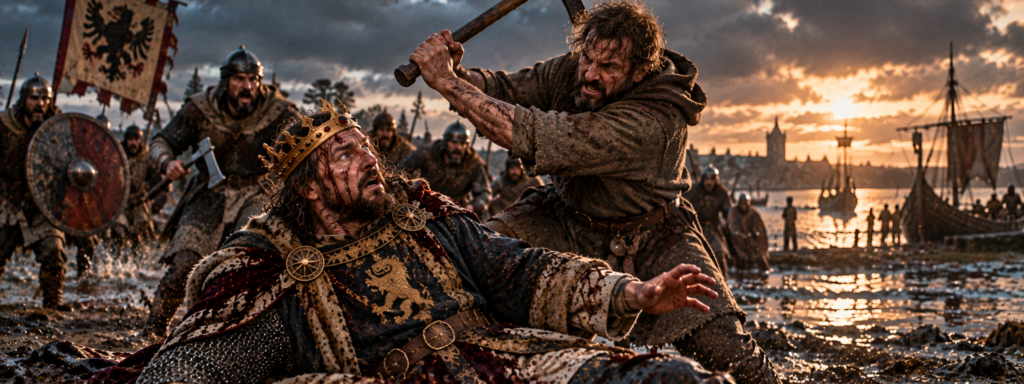
Later accounts attached a particularly humiliating detail to the king’s final moments. Rather than falling to a noble warrior in a celebrated duel, Abel was said to have been killed by a Frisian wheelwright, a craftsman whose ordinary occupation made the story especially memorable. Some traditions preserve the wheelwright’s name as Henner, while other retellings provide different details or leave the killer unidentified. The precise circumstances of the fatal blow are not securely established, and the wheelwright story belongs to a historical tradition that must be distinguished from the more certain fact that Abel died violently during the campaign.
For those who believed Abel had arranged his brother’s murder, the manner of his death seemed almost too fitting. A king suspected of obtaining the throne through betrayal had survived only two years before being killed by the people he sought to overpower. Medieval chroniclers and later storytellers could easily interpret the event as divine punishment, an act of justice delivered not by another king or an imperial army but by a comparatively humble opponent. Yet beneath that dramatic interpretation lay a much more complicated story of dynastic ambition, territorial rivalry, taxation, military violence, and the fragile authority of medieval Danish kingship.
Abel’s death did not simply close the story of one controversial monarch. It helped determine the succession of the Danish crown, intensified the separation between the royal line and the dukes of Schleswig, and left his descendants struggling for the inheritance that their father had briefly possessed. His younger brother Christopher succeeded him, while Abel’s sons remained associated with the duchy that had been central to the family’s earlier conflicts. The resulting rivalry would outlive every participant in the original struggle.
To understand why Abel died in Friesland, it is necessary to return to the royal family into which he was born, the powerful father whose political arrangements created competing centers of authority, and the elder brother whose murder made Abel one of Denmark’s most controversial kings. His life was not simply a short reign ending in battle. It was the story of a prince who spent years fighting for power, obtained the greatest prize available to him, and discovered that possessing a kingdom was very different from controlling it.
Abel of Denmark: The King Behind the Accusation
Abel of Denmark was born around 1218, a son of King Valdemar II of Denmark and his second wife, Berengaria of Portugal. He belonged to a royal dynasty that had exercised considerable power around the Baltic Sea, although Denmark’s territorial ambitions had suffered serious reverses before Abel reached adulthood. As a younger son, he was not initially the principal heir to the crown, but he received the strategically important Duchy of Schleswig, a position that gave him substantial political and military influence. He married Matilda of Holstein, strengthening his connections with influential German aristocratic families whose interests frequently intersected with Danish politics. His relationship with his elder brother Eric IV deteriorated into repeated conflict over Schleswig and royal authority, turning the southern part of the kingdom into a battleground. After Eric was murdered on 10 August 1250, Abel succeeded him as king, although accusations that he had arranged the assassination followed him throughout his reign. Abel denied responsibility and sought to establish his innocence through formal oaths, but his reputation remained inseparable from the circumstances of his accession. On 29 June 1252, while campaigning against rebellious North Frisians in the region of Husum, Abel was killed, leaving the Danish crown to pass to his younger brother Christopher I rather than securely to his own sons.
Abel’s historical reputation presents an immediate difficulty. He is remembered primarily as the brother accused of regicide, yet his political career began long before Eric’s murder and involved questions that cannot be reduced to personal hatred. His position as Duke of Schleswig placed him at the center of a long-running struggle over the relationship between the Danish monarchy and its southern territories. His marriage connected him with powerful neighboring interests, and his military activities reflected the complicated political geography of the region.
The accusation of fratricide nevertheless transformed the way later generations understood his life. Every action he took after 1250 could be interpreted through the suspicion that he had arranged his brother’s death. His accession appeared to reward the murder, while his own violent end seemed to complete a story of crime and punishment. Such interpretations are historically important because they shaped his reputation, but they cannot replace careful examination of the surviving evidence.
Abel was a ruler whose ambitions were entirely recognizable within the politics of thirteenth-century Europe. Younger royal sons often received territories that gave them wealth, status, and the ability to cultivate supporters. Those territories could become the foundation of loyalty to the crown, but they could also provide the resources necessary to challenge it. In Abel’s case, the second possibility became a defining feature of his career.
His death in Friesland also deserves to be understood on its own terms. The campaign was not merely the final scene of a morality tale about a suspected murderer. It emerged from longstanding tensions between rulers and the coastal communities whose obligations and privileges were contested. Abel entered that conflict as a king attempting to enforce authority, and he died because the people resisting him were prepared to fight.
The House of Valdemar: A Dynasty Built on Conquest
Abel’s father, Valdemar II, known as Valdemar the Victorious, became king of Denmark in 1202. His reign was associated with ambitious military expansion, diplomatic influence, and efforts to strengthen Danish power around the Baltic Sea. At its height, the monarchy exercised influence over territories far beyond the borders of the Danish kingdom. These achievements gave Valdemar a formidable reputation, but they also created enemies whose resistance would reshape the future of his dynasty.
One of the most celebrated episodes of Valdemar’s reign was the Danish campaign in northern Estonia in 1219. The conquest became an important part of Danish medieval history and later national memory. The familiar legend connecting the Danish flag with a miraculous event during the campaign developed through later tradition and should not be confused with a securely documented contemporary occurrence. Nevertheless, the expedition demonstrated the scale of Valdemar’s ambitions.
The king’s position changed dramatically in 1223 when he and his eldest son, Valdemar the Young, were captured by Count Henry of Schwerin. Their imprisonment exposed the vulnerability of Denmark’s political position and gave neighboring powers an opportunity to challenge Danish influence. Valdemar eventually secured his release through difficult negotiations and concessions. The episode seriously weakened the monarchy’s standing in northern Germany.
Valdemar attempted to recover his lost influence, but his forces suffered a major defeat at the Battle of Bornhöved in 1227. The battle marked the effective collapse of Denmark’s earlier dominance over substantial areas south of the Baltic. Although Valdemar remained king, the territorial ambitions that had characterized the earlier part of his reign were sharply curtailed. His sons would inherit a kingdom still struggling with the consequences.
The defeat also increased the importance of Denmark’s remaining southern territories. Schleswig occupied a vital position between the kingdom and the German political world, and control of the duchy carried military and economic significance. A royal family member governing Schleswig could serve as an important defender of Danish interests. Yet the same arrangement could create a powerful rival to the reigning king.
Valdemar’s family circumstances complicated the succession. His first wife, Dagmar of Bohemia, had given birth to Valdemar the Young, who was crowned as co-king but died in 1231. His second wife, Berengaria of Portugal, was the mother of Eric, Abel, Christopher, and their sisters. The death of the eldest son altered the succession and increased the importance of Berengaria’s children.
Eric became the principal heir and was crowned as co-king in 1232. Abel received authority in Schleswig, while Christopher remained another significant member of the royal family. These arrangements were intended to provide positions appropriate to royal sons and preserve dynastic strength. Instead, they created competing interests that would become increasingly difficult to reconcile.
When Valdemar II died in 1241, his sons inherited the consequences of his political decisions. Eric became king, Abel remained Duke of Schleswig, and Christopher retained his own ambitions. The monarchy faced external pressures, territorial disputes, and powerful aristocratic interests. The father who had once united the dynasty through personal authority was gone, and the brothers soon began fighting over what remained.
Berengaria’s Sons and the Seeds of Fratricide
Berengaria of Portugal married Valdemar II in 1214, bringing connections with the royal families of the Iberian Peninsula into the Danish court. She died in 1221, when her sons were still children. Her early death meant that she did not witness the political rivalry that later consumed the family. The surviving evidence offers limited insight into the private relationships among her children, but their subsequent careers reveal the extraordinary tensions created by their positions.
Eric, Abel, and Christopher were brothers by both parents, a fact that made their later conflict especially striking. Each possessed royal ancestry and expectations of status, but only one could occupy the Danish throne at a time. The eldest surviving son enjoyed the strongest claim, while younger brothers could seek power through territorial authority, alliances, or political competition. Their shared inheritance therefore created opportunities for cooperation and conflict.
Abel’s position was particularly dangerous to the unity of the monarchy. As Duke of Schleswig, he governed a territory whose strategic importance gave him influence beyond that of an ordinary nobleman. His authority rested upon local resources, aristocratic connections, and relationships with neighboring German princes. He could challenge royal decisions without immediately losing the means to resist.
Christopher’s presence added another dimension. Although he did not possess the same territorial position as Abel, he remained a member of the ruling dynasty and a potential participant in succession disputes. His interests did not always coincide with those of his elder brothers. The monarchy therefore contained several ambitious princes whose relationships depended upon political circumstances.
The problem was not unique to Denmark. Medieval European rulers frequently granted territories to younger sons in an effort to preserve family influence and provide suitable livelihoods. Such grants could produce loyal supporters, but they could also establish independent power bases. When disputes arose, royal brothers might possess the resources necessary to fight one another.
The Danish succession was especially vulnerable because royal authority depended heavily upon recognition, political alliances, and the ability to enforce obedience. Hereditary claims mattered, but they did not automatically eliminate competing ambitions. A prince with substantial supporters could challenge a king even when his legal position was weaker. The struggle among Valdemar’s sons developed within this environment.
The death of their father removed the figure who had possessed sufficient prestige to contain many disagreements. Eric expected recognition as king, while Abel defended his authority in Schleswig. Their competing claims gradually hardened into hostility. By the late 1240s, the brothers were engaged in open warfare.
The eventual murder of Eric would become the most terrible expression of the family’s collapse. Abel’s accession after the killing made the rivalry appear to have ended in fratricide, although his personal responsibility remains disputed. His own death two years later completed a sequence in which two brothers died violently and the third inherited the crown. The family that had once represented Denmark’s royal strength became a symbol of dynastic instability.
Schleswig: The Duchy That Made Abel Dangerous
Schleswig occupied a strategically important position between Denmark and the German lands. Its towns, waterways, agricultural territories, and trade routes connected the Danish kingdom with the political world to the south. Control of the duchy provided access to revenues, military resources, and influential neighboring families. For a younger royal son, it offered a degree of independence that could rival the authority of the crown.
Abel became Duke of Schleswig during his father’s reign and developed strong interests in the territory. His marriage to Matilda of Holstein connected him with the counts of Holstein, whose political ambitions frequently intersected with Danish affairs. These relationships strengthened Abel’s position and provided potential support in disputes with his brother. They also made Schleswig a center of political competition between Danish and German interests.
The duchy had long occupied an ambiguous position within Danish royal politics. Its ruler might acknowledge the king’s superior authority while defending local privileges and jurisdiction. Such arrangements depended upon personal relationships and political compromise. When those relationships deteriorated, disputes could become military conflicts.
Eric’s accession in 1241 intensified the problem. As king, he expected to exercise authority over the kingdom and its territories, including Schleswig. Abel possessed established rights and supporters that he was unwilling to surrender. Their disagreement therefore involved the fundamental question of how much independence a royal duke could exercise.
The conflict was not merely a personal quarrel over prestige. Schleswig’s strategic location made control of the territory essential to Denmark’s security and political influence. A duke acting independently could undermine royal authority and create opportunities for neighboring powers. A king attempting to impose direct control could threaten the interests of the duke and his supporters.
Abel’s position gave him the ability to resist. He could mobilize armed followers, negotiate with influential neighbors, and defend strongholds within the duchy. Eric possessed the superior formal title but could not simply command his brother into obedience. The struggle therefore became a contest between competing political networks.
The geography of Schleswig also shaped the conflict. The Schlei inlet provided access to the town of Schleswig and the surrounding region, while routes toward the North Sea connected the duchy with Frisian communities. These areas would later become associated with the two violent deaths that defined Abel’s career. Eric was murdered near the Schlei in 1250, and Abel died during a campaign in the western coastal region in 1252.
Schleswig was therefore the central territory of Abel’s political life. It gave him the means to challenge his brother, helped shape the circumstances of Eric’s murder, and remained important to his descendants after his death. The duchy was not simply a possession he governed. It was the foundation of his ambitions and the source of the conflicts that eventually destroyed his family.
Matilda of Holstein: The Marriage That Strengthened a Rival
Abel married Matilda of Holstein, a daughter of Count Adolf IV of Holstein. The marriage connected him with one of the most influential aristocratic families in the region south of Denmark. Such unions were political arrangements as well as personal relationships, linking territories and creating obligations among powerful families. For Abel, the connection was particularly valuable because his authority in Schleswig depended upon relationships across the Danish-German frontier.
The counts of Holstein had long been involved in conflicts and negotiations with Danish rulers. Their interests were shaped by territorial competition, trade, and the changing balance of power in northern Germany. A marriage alliance with Abel offered opportunities to influence Schleswig and maintain connections with the Danish royal family. It also complicated the relationship between Abel and his brother Eric.
Matilda’s family background therefore placed her within a politically sensitive marriage. As duchess, she belonged to a household whose ambitions increasingly conflicted with those of the Danish crown. The surviving sources do not provide enough evidence to reconstruct her private opinions about the brothers’ rivalry. It would be misleading to portray her as secretly directing political schemes without documentation.
The marriage produced children whose future claims would become important after Abel’s death. His sons included Valdemar and Eric, who were associated with the continuing ducal line in Schleswig. Their interests would later conflict with those of Christopher I and his descendants. The marriage therefore helped establish a branch of the royal family with enduring territorial ambitions.
The importance of Matilda’s connections became especially clear during the succession struggles. Abel’s descendants possessed links with both Danish royal ancestry and German aristocratic networks. These relationships could provide support when the crown attempted to impose authority over Schleswig. The duchy’s political independence therefore survived Abel’s short reign.
Matilda’s position also demonstrates the limited visibility of royal women in many medieval political narratives. Their marriages could shape alliances and succession, yet chroniclers often concentrated upon the actions of kings and dukes. The absence of detailed personal accounts should not be mistaken for a lack of political significance. Her marriage was central to the relationships that supported Abel’s authority.
After Abel’s death, the interests of his children remained tied to Schleswig. Matilda’s family connections continued to matter within the political world inherited by the next generation. The struggle between the ducal line and the Danish monarchy did not disappear with the king’s death. It became part of the longer history of Schleswig’s contested status.
Abel’s marriage was therefore an important element of his political career. It strengthened his position as duke, connected him with influential neighbors, and helped establish the descendants who would continue his territorial claims. The alliance also contributed to the complexity of the conflict with Eric. What began as a dynastic marriage became part of the political structure that sustained a royal rivalry.
Brothers at War: The Conflict with Eric Ploughpenny
Eric IV became king in 1241 following the death of Valdemar II. His reign began under difficult circumstances, with the monarchy facing territorial challenges, aristocratic interests, and the need to maintain authority over powerful regional rulers. Abel remained Duke of Schleswig and possessed the resources necessary to resist royal demands. The relationship between the brothers soon became increasingly hostile.
The conflict centered upon the extent of royal authority in Schleswig. Eric sought to assert the supremacy of the crown, while Abel defended his position within the duchy. Their disagreements involved political jurisdiction, military influence, and territorial control. The surviving sources do not preserve every negotiation, but the escalation into warfare demonstrates the seriousness of the dispute.
Armed conflict between the brothers damaged the southern territories. Military campaigns disrupted communities, required supplies, and forced nobles to choose sides. The struggle also weakened the monarchy by diverting resources toward internal warfare. Denmark’s enemies could benefit from the divisions.
Abel’s connections with Holstein and other neighboring interests strengthened his ability to resist. Eric could mobilize royal forces, but his formal authority did not guarantee victory. The conflict therefore continued through periods of fighting and attempted reconciliation. Each confrontation increased distrust.
The brothers reached agreements intended to restore peace, but the underlying rivalry remained unresolved. A temporary settlement could reduce immediate violence without settling competing claims. Both men retained supporters and political ambitions. The possibility of renewed conflict remained.
Eric’s reputation as Ploughpenny reflected the fiscal pressures of his reign. His nickname is traditionally associated with taxation connected to agricultural holdings or ploughs. Warfare required substantial revenue, and the king’s financial demands could provoke resistance. The relationship between taxation and political opposition added another source of tension.
Abel’s resistance could be presented by his supporters as a defense of ducal rights. Eric’s supporters could portray it as rebellion against legitimate royal authority. The competing interpretations reflected the political interests of the factions involved. Neither side possessed a monopoly on the language of legitimacy.
By 1250, the conflict had reached a dangerous stage. The brothers had fought for years, and their relationship was marked by deep suspicion. Eric entered the region of Schleswig during the continuing struggle. His presence there would end in murder.
The Murder of Eric IV: The Crime That Made Abel King
On 10 August 1250, King Eric IV was murdered near Schleswig after falling into the hands of men associated with Abel’s political circle. The killing occurred during the final stage of the brothers’ long conflict. Later accounts describe the king being removed from custody and killed near the Schlei. His body was reportedly thrown into the inlet, an act that became one of the most notorious details of Danish medieval history.
The precise circumstances remain uncertain. Medieval narratives differ in their descriptions of the killing, including the treatment of the body and the identities of those directly involved. Some traditions describe beheading, while others emphasize the violent murder and disposal of the remains. The broad event is well established, but the details cannot be reconstructed with modern forensic certainty.
The political implications were immediate. Eric was dead, and Abel was the principal beneficiary of his removal. The duke who had fought against the king for years now stood in a position to inherit the crown. The circumstances made suspicion almost unavoidable.
Abel denied responsibility for the murder. He sought to establish his innocence through formal oaths and the support of influential men. Such procedures reflected medieval political and legal practices, in which sworn declarations could play an important role in establishing legitimacy. They did not, however, eliminate the doubts surrounding the assassination.
The accusation against Abel was serious because of the combination of motive, opportunity, and benefit. He had been engaged in prolonged conflict with Eric, possessed authority in the region where the murder occurred, and became king afterward. These circumstances strongly implicated his political circle. Yet they do not provide definitive proof that Abel personally issued an order to kill his brother.
Later chroniclers often treated Abel as guilty. Their accounts were shaped by moral judgments and by the political interests of competing dynastic lines. The descendants of Abel and Christopher would later struggle over Schleswig, giving the murder continuing political significance. Historical narratives could therefore be used to strengthen or weaken claims to legitimacy.
The reported disposal of Eric’s body in the Schlei intensified the horror of the story. A king’s remains were normally associated with burial, mourning, and public recognition of legitimate authority. Throwing the body into the water could be interpreted as an attempt to conceal the crime or dishonor the victim. The image became central to the memory of the assassination.
Eric’s murder transformed Abel’s career. The duke who had challenged his brother became king, but his accession was inseparable from an accusation of fratricide. The crown gave him authority, yet it could not erase the circumstances of its acquisition. His brief reign would unfold beneath that shadow.
The Oath of Innocence and the Crown of Suspicion
Abel’s accession required more than simply occupying the place left vacant by Eric’s death. He needed recognition from the political community whose support sustained Danish kingship. The accusation that he had arranged his brother’s murder threatened his legitimacy. Establishing his innocence therefore became an essential part of his claim.
Medieval legal and political culture placed considerable importance upon sworn oaths. A powerful man accused of wrongdoing might seek to clear himself through formal declarations supported by others of suitable standing. Such procedures did not function like modern criminal trials, but they carried recognized authority. Abel’s efforts to deny responsibility belonged to this world.
The use of oaths did not necessarily settle public opinion. Political opponents could continue to suspect a ruler even after formal procedures accepted his declarations. The circumstances of Eric’s death were especially difficult to dismiss because Abel had been his principal rival. The accusation therefore remained politically dangerous.
The surviving sources do not provide a definitive record establishing the exact chain of command behind the murder. It is possible that Abel ordered the killing, but the evidence does not prove that conclusion beyond dispute. It is also possible that men within his political circle acted without an explicit command. Both interpretations remain subject to uncertainty.
The distinction matters because historical responsibility can take different forms. A ruler might personally plan a murder, knowingly permit it, encourage followers through his political conduct, or benefit from an act he did not authorize. The surviving evidence does not allow Abel’s precise role to be established with certainty. His political responsibility for the environment surrounding the crime is easier to discuss than a specific order.
Nevertheless, the accusation shaped his kingship from the beginning. A monarch suspected of fratricide could be portrayed as morally unworthy of the crown. His opponents possessed a powerful argument against his legitimacy. His supporters had strong reasons to defend him.
The controversy also affected the later reputation of his descendants. Abel’s sons retained claims and interests connected with Schleswig, while Christopher’s line inherited the Danish crown after Abel’s death. The murder could be invoked in disputes between these branches. Its political usefulness helped preserve the accusation.
Abel became king, but he never escaped the circumstances of his accession. His formal recognition gave him the authority to govern. It did not remove the suspicion that his crown had been purchased with his brother’s blood. When he died violently in 1252, that suspicion would shape the interpretation of his fate.
A Kingdom Inherited Through Bloodshed
Abel’s reign began in 1250, following Eric’s murder and the formal recognition of his succession. He inherited a kingdom already weakened by internal conflict and the consequences of earlier territorial losses. The monarchy faced powerful nobles, competing regional interests, and difficult relationships with neighboring rulers. Abel’s position as king did not eliminate the problems that had defined his brother’s reign.
The new king possessed experience in military and territorial politics. His years as Duke of Schleswig had taught him how to cultivate supporters and defend regional authority. Yet governing the entire kingdom required a different balance of interests. He now had to assert the supremacy of the crown over men who might resist royal demands.
His accession also altered his relationship with Schleswig. The duchy had been the foundation of his political independence, but as king he was responsible for the broader interests of Denmark. His family retained strong connections with the territory. The relationship between ducal and royal authority remained complicated.
Abel’s reign was too short to produce a comprehensive transformation of Danish government. The surviving evidence provides a limited picture of his policies and achievements. Much of his historical reputation is dominated by the circumstances of his accession and death. Nevertheless, his government faced the ordinary demands of medieval kingship, including the enforcement of authority and the collection of revenue.
The western coastal territories presented particular difficulties. North Frisian communities possessed traditions of local privilege and resistance to outside demands. Their relationship with Danish rulers involved questions of taxation, jurisdiction, and military obligations. These disputes would become central to Abel’s final campaign.
The king’s need to assert authority was understandable within the political framework of the period. A ruler who failed to enforce recognized claims risked appearing weak. Yet the use of military force could provoke resistance and create new enemies. Abel’s final campaign demonstrated the danger of relying upon coercion in territories with strong local traditions.
His reign therefore unfolded under two kinds of pressure. The accusation of fratricide threatened his moral legitimacy, while territorial disputes challenged his practical authority. He needed to demonstrate that he could govern a kingdom whose political divisions had already destroyed his brother. The campaign against the Frisians became one attempt to establish that authority.
The result was catastrophic. Abel entered the western coastal region as king of Denmark, commanding forces intended to enforce his claims. He encountered resistance from communities unwilling to submit. The campaign ended with his death, leaving the crown vacant once again.
The Frisians: A People Who Resisted Kings
The Frisians occupied coastal regions along the North Sea, including territories that are now part of the Netherlands and Germany. In the medieval period, Frisian communities developed distinctive traditions of local autonomy, legal privilege, and resistance to external domination. Their political organization varied across regions and periods, and they should not be treated as a single unified state. Nevertheless, the idea of Frisian freedom became an important element of regional identity.
North Friesland formed part of the western coastal world connected with Schleswig. Its landscape included islands, marshes, tidal flats, and settlements whose inhabitants depended upon agriculture, livestock, fishing, and maritime activity. The environment created both opportunities and difficulties. Communities had to manage the constant threat of flooding while maintaining connections across waterways and coastal routes.
The geography also complicated military campaigns. Armies accustomed to conventional movement could encounter difficult terrain, narrow routes, and unfamiliar tidal conditions. Local inhabitants possessed knowledge of the landscape that could provide advantages during resistance. A ruler attempting to impose authority therefore faced challenges beyond the strength of opposing forces.
Frisian communities had long negotiated or resisted the demands of neighboring rulers. Their obligations could involve taxation, military service, or recognition of superior political authority. Disputes arose when external powers attempted to enforce claims that local communities considered excessive or illegitimate. Such conflicts were part of the broader history of the North Sea coast.
The term Frisian freedom became associated with traditions of resistance to feudal domination. Its precise meaning and political application varied over time, and later interpretations sometimes idealized the independence of medieval communities. Nevertheless, the concept reflects the importance of local privilege and collective identity. These traditions helped shape the political environment encountered by Abel.
The North Frisians were not simply a collection of powerless peasants waiting to be conquered. Their communities possessed economic resources, local leadership, and the capacity for organized resistance. Their knowledge of the coastal landscape could make military intervention difficult. Abel’s royal title did not guarantee their obedience.
The conflict also involved the relationship between the Danish monarchy and the Duchy of Schleswig. The western coastal territories were connected with the political world that Abel had governed as duke. Claims to authority could therefore overlap with local privileges and customary obligations. The precise grievances of the 1252 campaign are not fully preserved in the surviving sources.
The Frisians’ resistance should be understood within this context. They were defending interests that they regarded as important, while Abel sought to enforce royal authority. The confrontation was therefore political and economic as well as military. It became fatal when the king attempted to impose his demands through force.
Taxes, Tribute, and the Price of Royal Authority
Taxation was one of the most common causes of conflict between medieval rulers and their subjects. Kings required revenue to maintain households, support military campaigns, and reward political followers. Local communities, however, often defended customary limits upon what they were expected to provide. Disputes could become violent when rulers attempted to impose new or contested demands.
Abel’s final campaign is commonly associated with efforts to enforce royal authority and extract obligations from the North Frisians. Later accounts emphasize resistance to taxation or tribute. The precise legal basis of the demands and the details of negotiations are not fully documented. It is therefore safer to describe the campaign as an attempt to compel submission and enforce contested obligations rather than to invent a specific tax decree.
The political significance of such demands was substantial. A community that refused payment could be interpreted by the crown as rejecting legitimate authority. A ruler who accepted resistance without response might encourage other subjects to challenge his claims. Military intervention could therefore appear necessary from the royal perspective.
For the communities involved, the same demands could represent an attack upon established privileges. Local inhabitants might regard external taxation as excessive or inconsistent with their customary rights. Their resistance could be motivated by economic hardship, political independence, or both. The surviving evidence does not permit every grievance to be reconstructed.
The conflict also reflected the financial pressures of medieval government. Abel had inherited a kingdom weakened by years of warfare, and royal authority required resources. His brief reign left little time to establish stable relationships with contested territories. The temptation to enforce claims through military action was therefore significant.
Yet military coercion carried serious risks. An army entering a hostile region required supplies and secure routes. Local resistance could exploit unfamiliar terrain and attack vulnerable forces. The western coastal landscape made these dangers particularly important.
The campaign against the Frisians therefore emerged from a familiar medieval problem. A king sought to enforce obligations that local communities resisted. Both sides possessed reasons to regard their position as legitimate. The dispute escalated because neither was willing to surrender.
Abel’s death transformed the conflict into a dramatic example of the limits of royal power. A king who had obtained the crown amid accusations of murder attempted to compel obedience from resistant subjects. Instead, he was killed during the campaign. The event demonstrated that the authority of a monarch could be challenged even by communities far removed from the royal court.
The Road to Husum: Abel’s Final Campaign
In 1252, Abel led a military expedition into the North Frisian region associated with the western coast of Schleswig. The campaign was intended to enforce royal authority over communities resisting Danish demands. Its precise movements are not preserved in a complete contemporary military record. The broad outcome, however, is clear: the expedition ended with the king’s death.
The region around Husum was part of a landscape shaped by marshes, waterways, and coastal settlements. Medieval conditions differed from those of the modern coastline, which has been altered by centuries of flooding, land reclamation, and environmental change. Armies operating in such territory faced difficulties that could favor local defenders. The terrain therefore formed an important part of the campaign’s context.
Abel entered the region as a king accustomed to military conflict. His earlier struggles with Eric had involved armed resistance, territorial campaigns, and negotiations backed by force. He possessed experience in the political use of warfare. Yet experience did not eliminate the dangers of an expedition into hostile territory.
The North Frisians were unwilling to accept the demands being imposed upon them. Resistance developed into armed confrontation, although the precise sequence of engagements remains uncertain. Later accounts emphasize the king’s personal involvement and the violence of his death. The campaign became memorable primarily because of its outcome.
The traditional date of Abel’s death is 29 June 1252. The location is generally associated with the Husum region, although the exact site and circumstances are not securely established. Some accounts place the fatal encounter near the western coastal settlements of Schleswig. The evidence supports the broad regional setting more strongly than a precise reconstruction of the battlefield.
The king’s death appears to have occurred during fighting against the Frisians. Whether he was killed in the main engagement, during a pursuit, or in another phase of the conflict cannot be established with certainty from the surviving accounts. The distinction matters because later storytelling sometimes transforms an uncertain military event into a highly detailed scene. Historical accuracy requires restraint.
Abel’s death ended the expedition as a royal undertaking. The loss of a reigning monarch during a campaign created immediate political consequences. His followers faced the problem of returning without the king, while the Danish succession became uncertain. The Frisians had achieved a result far greater than the rejection of a particular demand.
The campaign therefore stands as a striking reversal of power. Abel entered Friesland intending to enforce obedience. He died in the territory of the people he had sought to subdue. The king’s authority ended where local resistance proved stronger than his ability to impose it.
The Wheelwright Who Killed a King
The most famous detail of Abel’s death is the tradition that he was killed by a Frisian wheelwright. A wheelwright was a craftsman who made or repaired wooden wheels, an occupation far removed from the aristocratic world of kings and knights. The contrast between the royal victim and the humble killer gave the story enduring dramatic force. It suggested that even a powerful monarch could fall to an ordinary man defending his community.
Some later accounts identify the wheelwright as Henner, although the details vary across traditions. The name and occupation belong to a narrative that developed around the king’s death and should not be treated as securely verified contemporary evidence. The surviving record establishes that Abel was killed during the Frisian campaign. It does not provide a definitive modern identification of the individual who delivered the fatal blow.
The wheelwright story nevertheless reveals how the event was remembered. A king who had fought his brother for power and inherited the crown amid accusations of murder was said to have been struck down by a common craftsman. The social contrast made the death appear especially humiliating. It also allowed later storytellers to present the event as a triumph of ordinary resistance over royal ambition.
Medieval warfare did not always follow the aristocratic ideals celebrated in chronicles and romances. Kings and nobles could be killed by men of comparatively low status, particularly during chaotic fighting. The battlefield did not guarantee that a ruler would encounter an opponent of equal rank. A weapon delivered by an ordinary combatant could be just as fatal as one wielded by a knight.
The occupation of wheelwright also carried symbolic possibilities for later interpretation. A craftsman associated with the practical needs of everyday life became the alleged destroyer of a king. The story could be understood as a reversal of the social hierarchy. A monarch accustomed to commanding others was defeated by someone who possessed no royal title.
Yet the symbolic power of the narrative should not obscure the uncertainty surrounding it. There is no secure basis for reconstructing the wheelwright’s thoughts, words, or personal motives. The exact weapon used in the fatal encounter is also uncertain in the surviving traditions. A detailed scene of confrontation would therefore be imaginative rather than historical.
The broader fact remains extraordinary without embellishment. Abel, king of Denmark, was killed during a campaign against North Frisian resistance. His death occurred only two years after the murder of his brother Eric. The political and moral implications were immediately striking.
The wheelwright tradition endured because it gave the story a memorable human figure. Instead of an anonymous battlefield death, later generations could imagine a king falling before an ordinary craftsman. The tale became part of the historical memory of Abel’s reign. Its dramatic appeal, however, must be balanced against the limits of the evidence.
The Death of Abel: What Can Be Known
Abel’s death on 29 June 1252 is one of the central facts of his short reign. He was killed during a campaign against North Frisian resistance in the western part of Schleswig. The expedition had been connected with attempts to enforce royal authority and contested obligations. His death ended a kingship that had lasted less than two years.
The precise circumstances remain less certain. Medieval sources and later traditions provide varying accounts of the fighting and the individual responsible. The wheelwright story is the best-known version, but its details cannot be verified with complete confidence. It should therefore be presented as tradition rather than established fact.
The distinction between battle death and assassination also requires care. Abel was killed during armed conflict, not in a securely documented private murder plot comparable to the killing of his brother Eric. His death can be included within a broad category of deliberately slain rulers, but it is more accurately described as a violent death during a campaign than as a proven assassination. The identity and intention of the individual who struck the fatal blow remain uncertain.
The campaign itself reflected a struggle over authority. Abel sought to compel submission from communities that resisted Danish demands. The Frisians defended their interests through armed opposition. The king’s death occurred within that political and military confrontation.
The surviving sources do not preserve a reliable account of Abel’s final words. They do not establish a detailed sequence of wounds or a complete description of the battlefield. Later narratives may contain dramatic elements shaped by moral interpretation. Such details should not be repeated as certain unless supported by strong evidence.
What is certain is that Abel’s death created an immediate succession problem. His sons possessed dynastic claims, but the crown did not pass securely to them. Instead, his younger brother Christopher became king. The transfer of power demonstrated the continuing instability of the Danish monarchy.
The brevity of Abel’s reign also shaped his reputation. He had become king after Eric’s murder and died violently before establishing a durable political settlement. The sequence invited interpretations of divine punishment. Yet the historical explanation lies in the military and political circumstances of the Frisian campaign.
Abel’s death was therefore both a military event and a dynastic turning point. It ended the life of a controversial king and altered the succession of Denmark. The uncertainty surrounding the fatal blow does not diminish its importance. The consequences were clear even when the final moments remain partly hidden.
Divine Punishment or Political Misfortune?
For medieval observers who believed Abel had arranged Eric’s murder, his death in Friesland could appear to be an act of divine justice. A king accused of fratricide had obtained the crown and enjoyed it for only two years. He then died violently while attempting to impose his authority upon resistant subjects. The sequence offered a powerful moral narrative.
Christian historical writing frequently interpreted political events through the language of providence. The downfall of a ruler accused of wrongdoing could be presented as evidence that divine justice remained active in human affairs. Such interpretations provided moral meaning to events that otherwise appeared chaotic. Abel’s death was particularly suitable for this kind of explanation.
The contrast between the brothers strengthened the narrative. Eric had been murdered in circumstances associated with Abel’s political circle, and his body had reportedly been thrown into the Schlei. Abel became king afterward, despite the accusation that he had benefited from the killing. His own violent death could therefore be portrayed as punishment for a crime that human institutions had failed to avenge.
The wheelwright tradition added another layer. A king suspected of murdering his brother was said to have been killed by a humble craftsman rather than a powerful noble. The social reversal made the story appear especially fitting. It suggested that divine justice could operate through the actions of ordinary people.
Yet historical analysis cannot establish supernatural causation. Abel died during a military campaign in a region where local communities resisted his demands. His death can be understood through the risks of warfare, the difficulties of the terrain, and the strength of local opposition. The moral interpretation reveals how later generations understood the event, not why it occurred in a demonstrable historical sense.
The accusation against Abel also remains unresolved. His political circumstances strongly implicated him in Eric’s murder, but the surviving evidence does not prove a direct order beyond dispute. A narrative of divine punishment therefore rests upon an assumption of guilt that cannot be established with absolute certainty. The distinction matters even when the suspicion is compelling.
The interpretation of Abel’s death as punishment nevertheless became part of his reputation. His brief reign seemed to confirm the idea that a crown acquired through wrongdoing could not bring lasting security. The story circulated as a warning about ambition, betrayal, and the instability of power. It gave moral shape to a violent political sequence.
The historical reality was more complicated. Abel’s death emerged from a conflict over royal authority in North Friesland, while Eric’s murder had occurred within a dynastic struggle over Schleswig. The two events were connected through Abel’s life and reputation but were not necessarily part of a single deliberate pattern of revenge. Their association became powerful because later generations sought meaning in the extraordinary sequence.
The Body of the King and the End of a Reign
The death of a medieval king created immediate practical and political problems. His followers had to respond to the loss of their commander, while the royal household faced the task of arranging succession and burial. The treatment of the body carried religious and dynastic significance. A king’s remains represented more than the death of an individual because they were connected with the continuity of legitimate authority.
Abel was buried at Schleswig Cathedral, the ecclesiastical center of the territory that had been central to his political career. His association with Schleswig remained strong even after he became king. The burial reflected the importance of the duchy within his life and dynasty. It also placed his remains within a Christian institution despite the controversy surrounding his reputation.
Later traditions attached further stories to Abel’s burial and the treatment of his remains. Some accounts describe disturbances or unusual circumstances associated with his grave, reflecting the belief that his death had been punishment for fratricide. Such stories belong to the development of his posthumous reputation. They should not be confused with securely established contemporary events.
The contrast with Eric’s burial was striking. Eric’s body had reportedly been thrown into the Schlei after his murder and later received royal burial. Abel died during a military campaign and was buried in the duchy that had formed the foundation of his power. The brothers’ deaths and burials became intertwined within Danish historical memory.
The political consequences of Abel’s death were immediate. He left sons whose claims could not be ignored, but the Danish crown passed to Christopher I. The succession demonstrated that Abel had not established a secure hereditary position for his own branch. His brief reign therefore failed to create the lasting dynastic advantage he might have hoped to obtain.
The burial of a king could not settle the disputes he left behind. Abel’s descendants retained interests in Schleswig, and the relationship between the duchy and the Danish crown remained contested. The political problems that had defined his career survived his death. The kingdom continued to face divisions within the royal family.
Abel’s grave therefore marked the end of his personal ambitions but not the end of their consequences. He had fought for power, obtained the crown, and died before securing his family’s position. His sons inherited claims and controversies rather than an uncontested kingdom. The shadow of Eric’s murder continued to follow the ducal line.
The king who had entered Friesland to enforce authority returned to history as a symbol of its limits. His body was buried, his reign ended, and another brother took the crown. Yet the accusations and territorial disputes remained. Death had removed Abel from the struggle without resolving the conflict that had shaped his life.
Christopher I: The Third Brother Takes the Crown
After Abel’s death in 1252, the Danish crown passed to Christopher I, the youngest surviving son of Valdemar II and Berengaria of Portugal. His accession completed an extraordinary sequence in which three brothers occupied the center of Danish royal politics. Eric had been murdered, Abel had become king and died violently, and Christopher now inherited the monarchy. The family had endured years of conflict without establishing a stable succession.
Christopher’s accession was not simply a matter of replacing a dead king. Abel had sons whose hereditary interests remained significant, particularly in Schleswig. The transfer of the crown to Christopher therefore created a division between the royal line and the descendants of Abel. That division would shape Danish politics for generations.
The surviving political circumstances suggest that Abel’s sons were unable to secure the crown immediately after their father’s death. Christopher possessed his own supporters and a recognized claim as a son of Valdemar II. His accession reflected the political importance of recognition and effective power. Hereditary descent alone did not guarantee succession.
The controversy surrounding Abel’s accession may also have affected perceptions of his descendants. If Abel was believed to have obtained the crown through his brother’s murder, his line could face moral and political objections. Yet the surviving evidence does not permit every decision surrounding Christopher’s accession to be explained through the accusation of fratricide. Other factors, including political support and the age of Abel’s sons, were also important.
Christopher inherited a kingdom still facing serious challenges. Powerful nobles, ecclesiastical leaders, and regional interests could resist royal authority. Schleswig remained a source of tension because Abel’s descendants retained claims there. The monarchy therefore continued to struggle with the same structural problems that had divided the brothers.
Christopher’s reign would also involve conflict with the Church and powerful political opponents. His government faced disputes over royal authority and ecclesiastical privilege. These struggles demonstrated that the problems of Danish kingship extended beyond the personalities of Eric and Abel. The monarchy operated within a political system where authority was continually negotiated and contested.
The succession of 1252 therefore did not represent a final victory for one branch of the family. Christopher obtained the crown, but the ducal descendants of Abel remained politically significant. The relationship between the two lines continued to generate conflict. The murder of Eric and the death of Abel became part of the background to later disputes.
Christopher’s accession marked the beginning of another chapter in Denmark’s dynastic history. The youngest brother inherited a crown already stained by accusations of murder and years of civil conflict. He faced the task of restoring authority while competing family interests remained unresolved. The deaths of Eric and Abel had changed the succession without healing the kingdom.
Abel’s Sons and the Crown They Never Inherited
Abel left sons whose political futures were shaped by his sudden death. His descendants belonged to the Danish royal family and possessed claims associated with both their father’s kingship and his authority in Schleswig. Yet the crown passed to Christopher I rather than securely to Abel’s line. The resulting division became a major feature of Danish political history.
Valdemar, one of Abel’s sons, became associated with the succession to the Duchy of Schleswig. His position reflected the continuing importance of the territory as a dynastic inheritance. The duchy remained a source of wealth, authority, and political identity. It also provided a base from which Abel’s descendants could defend their interests.
Another son, Eric, continued the ducal line after Valdemar. The descendants of Abel became known through their connection with Schleswig and maintained political relationships with neighboring German powers. Their interests frequently conflicted with those of the Danish crown. The struggle therefore continued beyond the generation of the three brothers.
The division between royal and ducal authority had serious consequences. The kings of Denmark sought to maintain influence over Schleswig, while the dukes defended their territorial position. The relationship was complicated by hereditary claims, feudal obligations, and political alliances. Disputes could become military conflicts.
Abel’s marriage to Matilda of Holstein contributed to the strength of his descendants’ political connections. The ducal line possessed relationships with influential German aristocratic families. These connections could provide support against the Danish monarchy. The political geography of Schleswig therefore remained central to the conflict.
The accusation of fratricide continued to shape Abel’s reputation, but his descendants were not merely passive inheritors of a scandal. They pursued their own political interests within a changing regional environment. Their claims rested upon territorial authority and dynastic descent. The memory of Abel’s accession formed only one part of a larger political struggle.
The failure of Abel’s sons to inherit the crown also reveals the limits of his achievement. He had fought his elder brother for years and became king after Eric’s murder. Yet his reign lasted too briefly to establish an uncontested succession for his children. The crown passed to another branch of the family.
Abel’s death therefore transformed his apparent victory into a more complicated legacy. His descendants retained Schleswig but lost the immediate opportunity to continue his kingship. The resulting rivalry would influence Denmark for generations. The king’s ambitions survived in the form of territorial claims rather than a secure royal dynasty.
The Long Struggle for Schleswig
The political importance of Schleswig did not end with Abel’s death. The duchy remained a contested territory whose rulers possessed connections with both Denmark and the German political world. Its strategic position made it valuable to kings, dukes, and neighboring princes. The conflict between royal and ducal authority therefore continued through later generations.
Abel’s descendants maintained a ducal line associated with Schleswig. Their territorial interests could conflict with the ambitions of the Danish monarchy. The relationship involved questions of hereditary right, political allegiance, and jurisdiction. These disputes reflected the same structural tensions that had divided Eric and Abel.
The duchy’s geography contributed to its importance. It occupied a position between the Danish kingdom and the German lands, with access to important routes of trade and military movement. Control of Schleswig could influence the balance of power across the region. The territory therefore remained a major concern for successive rulers.
The political relationships of the ducal line also extended beyond Denmark. Connections with Holstein and other German princes provided opportunities for alliances and support. Such relationships could strengthen the duchy’s independence. They also complicated attempts by Danish kings to impose direct authority.
The conflict should not be understood as a single uninterrupted war beginning with Abel. Political circumstances changed over time, and later disputes involved new rulers, alliances, and territorial claims. Nevertheless, the division between the royal line and the descendants of Abel contributed to a longer history of tension. The legacy of the thirteenth-century succession remained significant.
The accusation surrounding Eric’s murder also continued to influence dynastic memory. Abel’s reputation as a suspected fratricide could be used to question the moral legitimacy of his line. His descendants, however, possessed territorial claims that could not simply be dismissed through historical accusation. Political power depended upon more than reputation.
The long struggle over Schleswig demonstrates how family conflict could become embedded within territorial institutions. A dispute between brothers over authority developed into competing hereditary lines. The consequences survived the individuals who had created the original conflict. The murder of Eric and the death of Abel therefore became part of a much larger political history.
Abel’s life illustrates the dangers of granting substantial territorial authority to royal relatives without establishing stable relationships between their interests and those of the crown. His duchy gave him the means to challenge Eric, and his descendants continued to defend their position after his death. The political structure that enabled the rivalry remained. The king’s violent end did not resolve the problem.
Was Abel a Murderer, a Usurper, or a Victim of Circumstance?
Abel’s historical reputation has been dominated by the accusation that he arranged the murder of his brother Eric. The circumstances provide strong reasons for suspicion. Abel had fought against Eric for years, possessed authority in the region where the killing occurred, and became king afterward. The combination of motive, opportunity, and benefit made the accusation difficult to dismiss.
Yet the surviving evidence does not establish every detail of the crime. Abel denied responsibility and sought to clear himself through formal procedures recognized in medieval political society. Later chroniclers frequently treated him as guilty, but their accounts were shaped by moral and dynastic interests. A responsible historical judgment must distinguish plausible suspicion from definitive proof.
The term usurper also requires care. Abel succeeded Eric after the murder and obtained recognition as king. His accession was politically controversial, but it was not simply an occupation of the throne without any dynastic claim. As a son of Valdemar II, he belonged to the ruling family and possessed a recognized position within the succession. The controversy centered upon the circumstances that made his accession possible.
His conflict with Eric was also more complicated than a private desire for the crown. The brothers disputed authority over Schleswig, a territory with significant political and economic importance. Abel defended his ducal position, while Eric sought to assert royal supremacy. Their rivalry reflected structural tensions within the monarchy.
None of this eliminates the seriousness of the accusation. If Abel ordered Eric’s murder, the act represented a deliberate betrayal of both family and kingship. Even if he did not issue a direct command, his political conflict with Eric created the environment in which the killing occurred. His accession ensured that he benefited from the result.
His own death in Friesland presents a different historical question. Abel was killed during a military campaign against communities resisting royal demands. The surviving evidence does not establish that his death was a planned assassination. It is more accurately understood as a violent battlefield or campaign death.
The moral interpretation of his fate nevertheless became powerful. A king suspected of murdering his brother died only two years later, reportedly at the hands of a humble wheelwright. The contrast encouraged the belief that justice had been delivered. Such interpretations shaped his reputation without proving divine intervention.
Abel remains a controversial figure because his life resists simple classification. He was an ambitious duke, a brother involved in destructive civil conflict, a king whose accession followed murder, and a ruler killed while attempting to enforce authority. His guilt in Eric’s assassination remains debated, while the consequences of his political actions are clear. His story illustrates how ambition and structural conflict could combine to destroy a royal family.
Abel Among the Violently Slain Kings of Scandinavia
The death of Abel belongs to a broader history of violent royal succession in medieval Scandinavia. Denmark, Norway, and Sweden experienced repeated conflicts among royal claimants, powerful nobles, and regional factions. Kings could be murdered, executed, or killed in battle when their authority was challenged. The instability reflected the difficulty of establishing uncontested succession and maintaining political unity.
Denmark had already witnessed notorious royal killings before Abel’s reign. Canute IV was killed in Odense in 1086 during a rebellion against his government. Canute V was murdered during the Bloodfeast of Roskilde in 1157, an event associated with the treachery of a rival claimant. These episodes demonstrated the vulnerability of kings whose authority faced organized opposition.
Norway experienced prolonged civil wars in which rival royal claimants fought for control of the kingdom. Harald Gille was murdered in 1136, while Eystein II was killed during the conflicts among his brothers in 1157. The deaths reflected the destructive consequences of competing dynastic claims. Royal ancestry could provide legitimacy while simultaneously creating dangerous rivals.
Sweden also experienced violent succession struggles during the twelfth century. Sverker the Elder was murdered in 1156, Eric IX was killed in 1160, and Karl Sverkersson was assassinated in 1167. These events formed part of prolonged rivalry among competing dynastic groups. The monarchy remained vulnerable to political violence.
Abel’s case is distinctive because he was both the beneficiary of a suspected regicide and the victim of a violent death during his own reign. His brother Eric had been murdered in circumstances associated with Abel’s political circle. Abel then became king and died during a campaign against the Frisians. The sequence created an unusually powerful narrative of ambition and reversal.
His death also differed from the assassination of Eric. Eric was murdered after falling into the hands of men associated with a political rival, while Abel died during armed conflict. The distinction is important when classifying royal deaths. Both were deliberately slain rulers, but the available evidence supports different descriptions of the circumstances.
The wider Scandinavian pattern reveals the fragility of medieval kingship. Royal authority depended upon political support, military resources, and the ability to manage competing claims. A king who lost those foundations could become vulnerable to violence. The crown offered prestige but not guaranteed security.
Abel’s short reign therefore belongs within a history of political instability rather than an isolated morality tale. His life was shaped by the same forces that destroyed other Scandinavian rulers. Dynastic rivalry, territorial disputes, and resistance to royal authority created conditions in which violence became a means of political change. His death demonstrated that even a king who had survived years of family conflict could fall before local resistance.
The Historical Sources and the Problem of Legend
The surviving evidence concerning Abel’s reign is limited by the nature of medieval historical writing. Chronicles, annals, and later narrative traditions preserve important information but do not provide a complete record of political decisions or military events. Their authors often wrote within religious or dynastic frameworks that shaped interpretation. The historian must therefore distinguish documented events from moral judgments and later embellishments.
The broad chronology is secure. Abel was Duke of Schleswig, fought against his brother Eric, became king after Eric’s murder in 1250, and died during a campaign against the Frisians in 1252. These facts provide the essential framework of his career. They are sufficient to establish the extraordinary violence surrounding his rise and fall.
The accusation that Abel arranged Eric’s murder is more difficult to evaluate. His political circumstances strongly implicated him, and later tradition treated him as responsible. Yet the surviving evidence does not establish a definitive direct order. His denial and formal efforts to clear himself remain part of the historical record.
The wheelwright story presents another problem. It is widely repeated in accounts of Abel’s death, but the precise identity of the killer and the circumstances of the fatal blow are not securely established. Later narratives may preserve genuine local memory while also incorporating dramatic elements. The occupation of the alleged killer should therefore be identified as tradition.
The location of the final campaign is broadly associated with North Friesland and the Husum region. The exact battlefield and movements of the army are less certain. The medieval coastline differed from the modern landscape, complicating attempts to identify precise locations. A detailed reconstruction of the king’s final movements would therefore exceed the evidence.
The interpretation of Abel’s death as divine punishment also belongs to the history of memory rather than demonstrable causation. Medieval writers often connected political misfortune with moral wrongdoing. The sequence of Eric’s murder, Abel’s accession, and Abel’s violent death encouraged such interpretations. They reveal the values of the writers but cannot establish supernatural intervention.
The political consequences are more securely documented. Abel’s death opened the way for Christopher I, while his descendants retained claims associated with Schleswig. The division between the royal and ducal lines became a lasting feature of Danish politics. The assassination of Eric and the death of Abel therefore had consequences that extended beyond the uncertain details of either event.
The most compelling historical account preserves the drama without inventing certainty. Abel’s life was marked by civil conflict, a controversial accession, and a violent death during a campaign. His reputation became inseparable from the accusation of fratricide. The unresolved details remain part of the story rather than gaps to be filled with imagined scenes.
The King Who Won Everything and Lost It Almost Immediately
Abel spent much of his political career defending his authority in Schleswig against the demands of his elder brother. His position as duke gave him influence, resources, and connections with powerful neighboring families. Yet the conflict with Eric consumed years and damaged the kingdom. The rivalry eventually ended with Eric’s murder and Abel’s accession to the throne.
The crown represented the highest political prize available to him. As king, Abel possessed the formal authority that he had previously resisted when exercised by his brother. He could now demand obedience from territories and communities across Denmark. Yet the responsibilities of kingship exposed him to challenges that ducal independence had not eliminated.
His reign began beneath the shadow of suspicion. The accusation that he had arranged Eric’s murder threatened his moral legitimacy and shaped later interpretations of his actions. Formal recognition did not erase the controversy. The crown therefore carried a burden as well as power.
The campaign against the Frisians demonstrated the limits of his authority. Abel sought to compel submission from communities resisting royal demands. He entered a difficult coastal region where local knowledge and determination could offset royal military strength. The expedition ended with his death.
The contrast between his ambitions and his fate is striking. He had survived years of conflict with a powerful brother and obtained the Danish crown. Yet he died only two years later during a campaign against people who refused to recognize his demands. His kingship was too brief to establish a secure succession for his sons.
The crown passed to Christopher, while Abel’s descendants retained Schleswig. The family rivalry therefore continued in another form. The political structures that had enabled Abel’s challenge to Eric survived his death. His apparent victory had not resolved the underlying conflict.
The wheelwright tradition gave his death an enduring symbolic force. A king suspected of obtaining power through fratricide was said to have been killed by an ordinary craftsman. The story appealed to medieval ideas of justice and the reversal of worldly power. Its historical details remain uncertain, but its influence upon Abel’s reputation is unmistakable.
Abel’s life therefore illustrates the difference between acquiring power and securing it. He obtained the crown after years of conflict but failed to establish a lasting kingship. His death left his descendants with contested claims rather than an uncontested inheritance. The political ambitions that had shaped his life survived as problems for future generations.
The Crown, the Wheelwright, and the Blood That Would Not Wash Away
Abel of Denmark was born into a dynasty whose power had once extended across much of the Baltic world. His father, Valdemar II, had pursued ambitious expansion before military defeat and political reverses weakened the kingdom. Abel inherited the Duchy of Schleswig, a territory whose strategic importance gave him substantial independence. That independence eventually brought him into conflict with his elder brother Eric IV, turning a family rivalry into a struggle over the authority of the Danish crown.
The brothers’ conflict consumed much of the 1240s and damaged the kingdom they were supposed to defend. Eric sought to assert royal supremacy, while Abel resisted from his position in Schleswig. Their rivalry became increasingly bitter, and attempts at reconciliation failed to produce lasting peace. In August 1250, Eric was murdered after falling into the hands of men associated with Abel’s political circle, and his body was reportedly thrown into the Schlei.
Abel became king after the murder, but his accession was immediately controversial. He denied responsibility and sought to establish his innocence through formal oaths. The surviving evidence does not prove beyond dispute that he personally ordered the killing, although the political circumstances strongly implicated him. His reputation nevertheless became inseparable from the accusation of fratricide.
The crown did not bring the stability that Abel might have expected. His reign lasted less than two years, and the monarchy continued to face resistance from powerful regional interests. In 1252, he led a campaign against North Frisian communities that resisted Danish demands. The expedition ended with his death near Husum, traditionally dated to 29 June.
Later tradition claimed that Abel was killed by a Frisian wheelwright, a detail that transformed his death into a powerful story of royal humiliation. The precise identity of the killer and the circumstances of the fatal blow remain uncertain. What is established is that Abel died violently during the campaign, far from the security of his royal court. The event demonstrated the limits of military power in a region where local communities were prepared to resist.
His death immediately altered the Danish succession. The crown passed to Christopher I, while Abel’s sons retained claims and interests associated with Schleswig. The resulting division between the royal and ducal lines contributed to further political conflict. Abel’s brief kingship had failed to secure an uncontested future for his descendants.
For medieval writers, the sequence of events offered an irresistible moral interpretation. A prince accused of murdering his brother had obtained the crown and then died violently after only two years. His death could be presented as divine punishment, particularly when later tradition attributed the fatal blow to a humble craftsman. Yet the historical explanation lies in the political and military circumstances of his campaign, while the accusation against him remains a matter of evidence and interpretation.
Abel’s story is ultimately one of the most unsettling examples of the fragility of medieval royal power. He possessed noble ancestry, a strategically important duchy, influential allies, and eventually the crown of Denmark itself, yet none of these advantages could protect him from the consequences of political conflict. His brother Eric died in circumstances that left Abel permanently suspected of fratricide, and Abel’s own reign ended in violence before he could establish a lasting dynasty. The wheelwright who supposedly struck him down became a memorable symbol of the reversal of royal fortune, even though the details of the tradition cannot be established with certainty. His descendants continued to struggle over Schleswig, proving that the political divisions surrounding the brothers had not been buried with either king. The crown passed from Eric to Abel and then to Christopher, but each succession revealed how unstable the monarchy had become. Abel had spent years fighting for authority and had finally obtained the highest title in Denmark, only to lose his life while attempting to enforce that authority upon people who refused to submit. In the end, the most haunting feature of his reign was not simply that he died violently, but that the king who had inherited his murdered brother’s crown discovered how quickly power could turn into vulnerability, leaving behind a dynasty still haunted by the bloodshed that had brought him to the throne.