
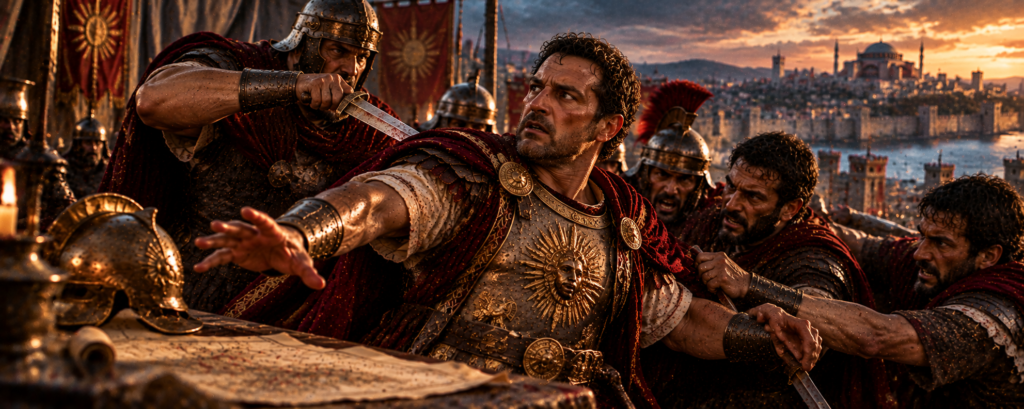
Aurelian: The Emperor Who Saved Rome and Was Murdered by the Men He Trusted
Lucius Domitius Aurelianus (c. 214–275 CE) | Roman Emperor, 270–275 CE | Assassinated Near Byzantium, September or October 275 CE
The Emperor Who Conquered an Empire but Could Not Survive a Lie
In the autumn of 275 CE, the most successful Roman emperor in decades was preparing for another war when a conspiracy began forming among the men responsible for protecting him. Aurelian had spent five extraordinary years dragging the Roman Empire back from the edge of destruction. He had defeated invading armies, crushed rebellious rulers, conquered the powerful kingdom of Palmyra, and restored provinces that had spent years beyond Rome’s control. His victories had earned him the magnificent title Restitutor Orbis, the Restorer of the World, yet all that military glory was about to prove useless against a frightened group of officers and a document that may never have contained a single genuine imperial order.
The emperor was traveling through Thrace, near Byzantium, on his way toward a planned campaign against the Sasanian Persian Empire. His army was gathering for another expedition, and the officers accompanying him had every reason to expect that their commander would demand the same discipline and obedience that had characterized his previous campaigns. Aurelian was not a ruler known for overlooking misconduct. He had acquired a reputation for severe punishment, relentless military discipline, and a willingness to act decisively against anyone he believed had betrayed his authority.
According to the most famous ancient account, the disaster began with a member of Aurelian’s own administrative household. The man, identified in several sources as Eros or Mnestheus, had apparently committed an offense that made him fear the emperor’s punishment. Rather than wait to discover his fate, he allegedly prepared a forged document naming several senior officers as men whom Aurelian intended to execute. He then showed the list to its supposed victims, convincing them that their lives were in immediate danger.
The officers believed the warning, or at least accepted it as sufficient reason to act. Their emperor had punished men harshly before, and the possibility of an impending purge may have seemed entirely credible. Faced with what they thought was a choice between obedience and execution, they chose murder. Aurelian was attacked near Caenophrurium, a station in Thrace not far from Byzantium, and killed by members of his own military entourage.
The ancient sources do not agree upon every detail of the conspiracy. The secretary’s identity, the exact nature of his alleged offense, and the individual roles of the assassins remain uncertain. The forged execution list is a story preserved by later writers rather than an independently surviving document, and it should not be treated as unquestionably established fact. Nevertheless, the accounts consistently connect Aurelian’s death with a conspiracy among his own officers, apparently encouraged by fears of imperial punishment.
The irony was almost unbearable. Aurelian had defeated enemies who commanded armies, cities, and entire provinces, but he was destroyed by men who feared what he might do to them. He had reunited an empire shattered by rebellion, yet his own military household became the setting for another act of political murder. The emperor who had restored Rome’s authority over millions of people could not preserve his authority over the soldiers standing closest to him.
His assassination ended one of the most remarkable reigns in Roman history. In less than five years, Aurelian had accomplished what many contemporaries might have considered impossible, restoring imperial unity after decades of military disaster and political fragmentation. His death also exposed the terrible weakness that continued to threaten Rome despite those achievements. An emperor could save the empire from its enemies and still be murdered by the men entrusted with defending him.
A Soldier Born Into an Empire Already Beginning to Fracture
Aurelian was probably born in 214 or 215 CE, although the precise date and location remain uncertain. Ancient traditions associate his origins with the Danubian or Balkan provinces, particularly areas around Sirmium or Serdica. His family appears to have been of relatively modest standing, and later accounts describe his father as connected to an estate belonging to a senator named Aurelius. The details are difficult to verify, but there is little reason to believe Aurelian began life among Rome’s most powerful aristocratic families.
His background mattered because the Roman military offered opportunities that were not always available through traditional political careers. A capable provincial soldier could rise through the ranks, acquire command responsibilities, and eventually enter the highest circles of imperial government. During the third century, military experience became increasingly valuable as emperors struggled to defend multiple frontiers. Men from the Danubian provinces would play an especially important role in Rome’s eventual recovery.
Aurelian grew up during the final decades of the Severan dynasty, when the empire still possessed enormous wealth and impressive institutions. Roman roads connected distant provinces, armies guarded established frontiers, and cities across the Mediterranean continued to function as centers of trade and administration. Yet political violence had already become a recurring feature of imperial succession. Emperors could be assassinated, replaced by military rivals, or destroyed through struggles within their own families.
The murder of Alexander Severus in 235 marked the beginning of a particularly unstable period. Soldiers killed the young emperor and his mother, Julia Mamaea, during a campaign near the German frontier. They then elevated Maximinus Thrax, a military commander whose authority depended heavily upon the army. His accession demonstrated how decisively soldiers could intervene in imperial politics.
The following decades brought repeated coups, invasions, and civil wars. Maximinus was murdered by his troops in 238, while several rival emperors rose and fell during the same year. Philip the Arab was overthrown by Decius in 249, and Decius himself died fighting the Goths in 251. The imperial throne had become an extraordinarily dangerous prize.
Aurelian’s military career developed within this violent environment. He learned his profession during years when armies were repeatedly called upon to defend threatened provinces and decide political disputes. His later achievements suggest extensive military experience, although the surviving accounts of his early service contain legendary embellishments. By the time he emerged as a major commander, Rome desperately needed men capable of winning battles.
The Making of a Relentless Commander
Ancient writers portrayed Aurelian as an exceptionally disciplined soldier who demanded the same standards from everyone under his command. The Historia Augusta, a notoriously unreliable collection of imperial biographies, preserves stories of his extraordinary strength, courage, and severity. Some of these anecdotes are clearly exaggerated or shaped by literary conventions. Nevertheless, his later military record supports the broader conclusion that he was a formidable commander.
Aurelian rose during a period when military competence could determine the survival of entire provinces. Frontier commanders needed to organize supplies, maintain discipline, respond quickly to invasions, and inspire confidence among soldiers who had witnessed repeated disasters. Failure could lead not only to defeat but also to mutiny or assassination. The profession required both battlefield skill and political judgment.
His reputation for harsh discipline became one of the defining features of his historical image. Later writers described him as a man who punished misconduct severely and tolerated little disobedience. Such accounts may contain exaggeration, but they are consistent with the severity associated with his government. Aurelian appears to have believed that military order was essential to restoring Roman strength.
The danger was that discipline could easily become fear. Soldiers might respect a commander who punished corruption and cowardice, but they could also resent or dread him. Officers who believed their careers or lives were threatened might become dangerous opponents. The qualities that made Aurelian effective in war would eventually contribute to the circumstances surrounding his murder.
His rise also reflected a broader transformation of Roman leadership. Traditional senatorial ancestry remained prestigious, but the empire increasingly depended upon professional soldiers who understood frontier warfare. Aurelian belonged to this emerging military elite. His career would eventually carry him from provincial service to the imperial throne.
Gallienus and the Army That Produced a New Generation of Emperors
Aurelian’s career became particularly important during the reign of Gallienus, who ruled from 253 to 268. Gallienus inherited an empire facing invasions, rebellions, and the catastrophic capture of his father Valerian by the Persians in 260. The central government lost effective control over substantial western and eastern territories. Rome appeared to be approaching permanent fragmentation.
Gallienus responded partly by strengthening mobile military forces and relying upon experienced professional commanders. Cavalry became increasingly important for responding to threats across the empire. Officers from military backgrounds acquired responsibilities that had previously been associated with senatorial rank. These developments helped create the environment in which Aurelian advanced.
The precise details of Aurelian’s service under Gallienus are uncertain. Later accounts associate him with important cavalry commands and with the circle of officers who became prominent during the emperor’s final years. He clearly emerged from the military leadership that would dominate Roman politics after Gallienus’s death. His reputation rested upon professional military achievement rather than an inherited claim to imperial power.
Gallienus was assassinated near Milan in 268 while campaigning against the rebel commander Aureolus. Ancient sources disagree about the conspirators, and some traditions implicate men who later became emperors, including Claudius and possibly Aurelian. Aurelian’s personal involvement cannot be established securely. It would therefore be misleading to present him as a proven participant in the murder.
The assassination nevertheless changed the political world in which Aurelian operated. Claudius II became emperor and continued the struggle against Gothic and other invading forces. Aurelian served within the military leadership of the new government. His abilities made him increasingly important at a time when Rome’s survival depended upon successful commanders.
Claudius achieved significant victories, particularly against Gothic forces, and earned the title Gothicus. His reign was cut short in 270 when he died during an epidemic. The succession immediately became contested. Aurelian was now positioned to make the transition from military commander to emperor.
The Throne Won During Another Succession Crisis
When Claudius II died, his brother Quintillus claimed the imperial throne. The precise chronology of his brief reign remains uncertain, with ancient accounts offering different estimates. His authority appears to have been recognized in some regions, but he lacked the broad military support necessary to secure the empire. Aurelian emerged as a rival candidate backed by powerful troops.
The army proclaimed Aurelian emperor in 270, probably at Sirmium or within the wider Danubian military region. His claim rested upon his military reputation and the support of soldiers who believed he could defend the empire. Quintillus was unable to overcome the challenge. He died after a short reign, although the circumstances remain disputed.
Some accounts suggest Quintillus was murdered by his troops, while others describe suicide. The evidence does not allow a definitive conclusion. What matters is that his death removed the immediate obstacle to Aurelian’s accession. Another imperial succession had been settled through military power rather than peaceful constitutional agreement.
Aurelian inherited a throne surrounded by danger. The empire remained divided, foreign enemies threatened its frontiers, and rival commanders could still claim imperial authority. His military reputation was impressive, but he had not yet demonstrated that he could govern the entire Roman world. The challenges facing him were immense.
His accession also carried an uncomfortable lesson. Aurelian had benefited from the same unstable military politics that had destroyed numerous predecessors. Soldiers could proclaim an emperor when they admired his abilities, but their loyalty was not guaranteed forever. He would eventually discover that the army’s power to create rulers included the power to murder them.
Rome’s Enemies Were Already Inside the Empire
Aurelian’s first priority was military survival. Germanic and other groups had crossed Roman frontiers and threatened provinces that had once enjoyed relative security. The Danube remained vulnerable, while northern Italy faced the possibility of invasion. The empire’s enemies understood that repeated civil wars had weakened Roman defenses.
Aurelian confronted groups identified in ancient sources as Vandals, Juthungi, Alamanni, and Goths. These names describe complex coalitions rather than perfectly unified nations, and the precise composition of individual invading forces is not always clear. Their campaigns nevertheless posed serious threats. Roman armies needed to respond quickly before raiders could devastate additional territory.
The new emperor pursued aggressive military operations intended to restore confidence. He confronted invading forces along the Danube and in northern Italy, sometimes negotiating and sometimes fighting. His campaigns demonstrated the energy that would characterize his reign. He was determined to prevent Rome’s enemies from exploiting the empire’s internal weakness.
Yet success did not come without setbacks. In 271, Roman forces suffered a serious reverse against invading Juthungi or related groups near Placentia, modern Piacenza. The defeat created alarm because enemy forces had penetrated deep into Italy. The possibility that Rome itself might be threatened became increasingly difficult to dismiss.
Aurelian recovered and eventually defeated the invaders, but the episode exposed the vulnerability of the imperial heartland. Italy had once been protected by the empire’s distant frontiers. Now foreign armies could reach regions that had not expected such dangers. The emperor understood that military victory alone might not provide sufficient protection.
His response would permanently change the physical appearance of Rome. He ordered the construction of a massive defensive circuit around the capital. The walls would stand for centuries as a reminder that even the center of the Roman world could no longer assume its safety.
The Walls That Revealed Rome’s Fear
The Aurelian Walls were among the most visible achievements of the emperor’s reign. Their construction began around 271, following the alarming incursions into Italy. The project enclosed a vast area of Rome within a defensive circuit extending approximately nineteen kilometers. Towers, gates, and fortified sections transformed the city’s appearance.
The decision carried enormous symbolic significance. Rome had long presented itself as the capital of a world-spanning empire protected by distant legions. Building new defensive walls acknowledged that the city itself might face attack. The project was therefore both practical and psychologically unsettling. It revealed how dramatically the empire’s strategic circumstances had changed.
The walls were constructed with considerable urgency. Existing buildings and structures were incorporated into the defensive circuit where possible. The project required extensive labor, materials, and administrative coordination. It demonstrated that Aurelian could mobilize substantial resources despite the empire’s ongoing crises.
The walls also reflected his determination to confront unpleasant realities. Rather than rely upon the prestige of Rome’s past, he accepted that the capital needed physical protection. The decision may have seemed humiliating to those who remembered an era when Rome’s enemies were kept far beyond Italy. Yet it was a realistic response to changing military conditions.
Large portions of the Aurelian Walls survive today, making them one of the most enduring monuments of his reign. Their continued existence contrasts sharply with the brevity of his life. The emperor who ordered their construction would be murdered only a few years later. His defensive achievement outlived the political system that failed to protect him.
The Brutal Business of Restoring Discipline
Aurelian’s military campaigns were accompanied by a reputation for uncompromising discipline. Ancient writers describe severe punishments for soldiers who committed theft, disobeyed orders, or abused civilians. Some stories portray him as almost obsessively concerned with military conduct. The details require caution, particularly when preserved in the unreliable Historia Augusta.
Nevertheless, his government appears to have treated discipline as a central requirement of imperial recovery. Roman armies had repeatedly mutinied, murdered emperors, and supported rival claimants. Aurelian understood that an army incapable of obeying its commander could not reliably defend the empire. Restoring authority required more than winning battles.
His severity may also have been intended to protect civilians from military misconduct. Armies moving through Roman territory could impose enormous burdens upon local communities. Theft, violence, and unauthorized requisitions could undermine support for the government. Punishing such behavior served both military and political purposes.
Yet harsh discipline created its own dangers. Officers who feared punishment might conceal mistakes or attempt to shift blame. Soldiers could become resentful if they believed penalties were excessive. A commander who inspired obedience through fear risked encouraging desperate resistance when subordinates believed their lives were threatened.
This tension would become central to the story of Aurelian’s assassination. The alleged forged execution list succeeded because the officers apparently believed that the emperor might genuinely order their deaths. Whether their fear was justified in that particular case is another matter. His reputation made the deception plausible.
Aurelian’s greatest strength was his ability to impose order upon a chaotic military world. His greatest vulnerability was that the men subjected to that order might eventually turn against him. The qualities that helped restore the empire also created the atmosphere in which his murder became possible.
The Province He Chose to Abandon
Aurelian’s military realism was demonstrated by his decision to withdraw Roman administration and major forces from Dacia north of the Danube. The province had been conquered under Trajan in the early second century and had long represented Roman expansion beyond the river. By Aurelian’s reign, its position had become increasingly difficult to defend. Maintaining the province required resources that the empire could scarcely afford.
The withdrawal was a significant political decision because Roman emperors were expected to preserve territory rather than surrender it. Abandoning a province could appear to acknowledge defeat. Aurelian nevertheless recognized that holding Dacia might weaken defenses elsewhere. Concentrating forces south of the Danube offered a more sustainable military position.
The process was complex, and ancient accounts simplify the movement of populations. Roman administration and substantial military forces were withdrawn, while some inhabitants undoubtedly remained in the region. The idea that every Romanized resident was evacuated is not supported by the evidence. The withdrawal was primarily a strategic reorganization.
Aurelian established a new province bearing the name Dacia south of the Danube. This preserved the prestigious provincial designation while acknowledging the new defensive reality. The arrangement allowed imperial propaganda to soften the appearance of territorial loss. It also demonstrated the emperor’s willingness to adapt rather than defend an untenable position indefinitely.
The decision reveals an important distinction between Aurelian’s reputation and his actual strategy. He was an aggressive commander, but he was not incapable of compromise. He could recognize when withdrawal served the empire better than continued warfare. His goal was not simply to preserve every frontier established by earlier emperors.
This pragmatism would also appear in his treatment of defeated rulers. Although Aurelian could be ruthless, he sometimes chose mercy when it served political stability. His reign was marked by a complicated combination of severity and calculation. Reducing him to a bloodthirsty soldier ignores the strategic intelligence behind many of his decisions.
The Queen Who Challenged Rome From the Desert
While Aurelian secured the western and Danubian frontiers, a powerful rival government controlled much of the eastern empire. Its center was Palmyra, a wealthy city in the Syrian desert whose rulers had gained extraordinary authority during Rome’s earlier military disasters. The most famous figure associated with this regime was Queen Zenobia. Her ambition and political skill made her one of Aurelian’s most formidable opponents.
Palmyra’s rise had begun under Odaenathus, who organized resistance against the Persians after Emperor Valerian’s capture. His military successes helped preserve Roman interests in the east, but they also created a powerful regional government. When Odaenathus was murdered in 267, authority passed increasingly into the hands of Zenobia. She governed in the name of her young son Vaballathus.
Zenobia expanded Palmyrene influence across substantial eastern territories. Her forces gained control over Egypt, an especially important province because of its agricultural wealth and strategic position. Palmyrene authority also extended through Syria and parts of Asia Minor. The regime developed the institutions and military resources necessary to challenge Rome.
The relationship between Palmyra and the central empire was initially ambiguous. Zenobia’s government continued to employ Roman political language and titles while exercising increasing independence. The arrangement eventually became incompatible with Aurelian’s determination to restore imperial unity. A confrontation became inevitable.
Zenobia was a dangerous opponent because she possessed more than a rebellious army. She controlled wealthy cities, important trade routes, and experienced military forces. Her government could draw upon regional loyalties and established administrative structures. Defeating her required a major campaign rather than a simple punitive expedition.
Aurelian understood the importance of the eastern provinces. Without them, Rome’s claim to universal imperial authority was severely weakened. The recovery of Egypt and Syria would also restore valuable resources to the central government. His campaign against Palmyra became one of the defining achievements of his reign.
The March Against Zenobia
In 272, Aurelian advanced eastward to confront the Palmyrene regime. His campaign required careful planning because he was moving through territories where local communities might support Zenobia or fear Roman retaliation. The emperor needed to secure routes, supplies, and political cooperation while advancing toward the enemy’s principal forces. His reputation for severity could encourage surrender, but it could also provoke desperate resistance.
Ancient accounts describe the capture or submission of several cities during the campaign. One famous tradition concerns Tyana, where Aurelian allegedly spared the inhabitants after considering the consequences of destruction. The Historia Augusta embellishes the episode with a supernatural appearance by the philosopher Apollonius of Tyana. That apparition belongs to literary legend rather than verifiable history.
The broader claim that Aurelian sometimes preferred clemency is more plausible. Destroying every city that resisted would have undermined his effort to restore a functioning empire. He needed tax-paying communities, reliable supply routes, and local elites willing to cooperate. Mercy could therefore serve military and political objectives.
The campaign culminated in major confrontations with Palmyrene forces. Zenobia’s army included powerful cavalry, particularly heavily armored horsemen capable of delivering devastating charges. Aurelian needed to neutralize that advantage without allowing his troops to be overwhelmed. His tactical response demonstrated the skill that had brought him to prominence.
The first major victory came near Immae, close to Antioch. Aurelian’s cavalry reportedly drew the Palmyrene horsemen into a prolonged pursuit before turning against their exhausted opponents. The maneuver exploited the enemy’s strengths and transformed them into weaknesses. The Roman victory opened the way for further advances.
Zenobia’s forces withdrew, but the campaign was not over. Aurelian continued pursuing them toward Emesa, where another major battle would determine the future of Palmyrene resistance. The emperor had begun restoring the east through military force. The next victory would bring him closer to the city that had challenged Roman authority.
The Battles That Broke Palmyra’s Power
The Battle of Immae demonstrated Aurelian’s ability to adapt his tactics to the enemy. Palmyrene heavy cavalry could be formidable in a direct charge, but their equipment and horses imposed limitations during prolonged pursuit. Roman forces reportedly exploited those limitations through controlled withdrawal and counterattack. The resulting victory weakened Zenobia’s military position.
The next major confrontation occurred near Emesa. The battle was difficult, and ancient accounts describe intense fighting involving cavalry and infantry. Aurelian’s forces eventually prevailed, forcing the Palmyrene army to retreat. The defeat deprived Zenobia of much of her ability to resist in open battle.
Aurelian then advanced toward Palmyra itself. The desert city possessed formidable defenses and had benefited from wealth accumulated through trade. Its position complicated Roman supply arrangements, but the emperor maintained pressure. The campaign required both military persistence and political negotiation.
Zenobia attempted to escape, reportedly seeking refuge or assistance farther east. Ancient accounts describe her capture near the Euphrates, although the precise circumstances differ. Her capture effectively ended the immediate struggle for control of the Palmyrene regime. Aurelian had defeated one of the most powerful rivals to Roman authority.
The victory was extraordinary because Palmyra had controlled substantial territories that the central empire had been unable to govern effectively for years. Aurelian restored Roman authority over Syria and Egypt, bringing valuable resources back under imperial control. His success strengthened both his military reputation and his political legitimacy. The eastern empire was once again largely united with Rome.
Yet the conquest did not end the danger. Palmyra would rebel again, forcing Aurelian to return and impose a far harsher settlement. The second confrontation would reveal the ruthless side of the emperor’s restoration.
The Fall of Palmyra and the Price of Rebellion
After Zenobia’s defeat, Aurelian initially appears to have sought a settlement that preserved the city of Palmyra. The emperor had reasons to avoid destroying a wealthy commercial center whose prosperity could benefit the restored empire. Roman authority was reestablished, and the principal leadership of the rebellion was removed. The arrangement might have allowed the city to recover.
Instead, another uprising occurred in 273. The precise leadership and circumstances are described differently in ancient sources, but the renewed rebellion challenged Roman control after Aurelian had already departed. The emperor responded rapidly. He returned to Palmyra and imposed severe punishment.
Ancient writers describe the city as devastated, although the extent of destruction should not be exaggerated into complete physical annihilation. Palmyra continued to exist afterward, but its political and commercial importance was badly damaged. The rebellion ended any realistic prospect of restoring its previous independent power. Aurelian had demonstrated that renewed resistance would be met with overwhelming force.
The treatment of Zenobia remains a subject of historical uncertainty. Later traditions describe her being displayed in Aurelian’s triumph and subsequently allowed to live in comfortable retirement near Rome. Other accounts suggest different outcomes, including death before reaching Italy. The evidence does not permit complete certainty about her final years.
Aurelian’s handling of Palmyra reveals the complexity of his character. He could offer mercy when surrender served his interests, but he could also impose devastating punishment when he believed his authority had been challenged again. His actions were driven by a determination to prevent renewed fragmentation. The result was effective politically but often brutal for those caught in the conflict.
The conquest also strengthened his image as the emperor capable of restoring the Roman world. He had defeated a powerful eastern regime and recovered provinces that seemed almost permanently lost. The empire’s eastern territories were once again under central authority. Only the western breakaway government remained to be subdued.
The Gallic Empire and Rome’s Other Emperor
While Aurelian campaigned in the east, the western provinces remained under a separate imperial government commonly called the Gallic Empire. The breakaway regime had emerged in 260 under Postumus, following the murder of Gallienus’s son Saloninus at Cologne. It controlled substantial territories, including Gaul and Britain, and exercised influence in parts of Spain at different times. Its rulers presented themselves as Roman emperors rather than foreign kings.
Postumus had established a functioning government with its own coinage, administration, and military forces. His authority depended partly upon defending the Rhine frontier against Germanic threats. For local communities, the breakaway regime could offer practical protection when the central government was occupied elsewhere. Its existence therefore reflected both political ambition and the empire’s inability to defend every region.
After Postumus’s death in 269, the Gallic Empire experienced its own succession crises. Several rulers followed before Tetricus I emerged as emperor. His government faced internal tensions and military pressures. By the time Aurelian turned westward, the breakaway regime was less stable than it had been under Postumus.
Aurelian could not consider the restoration complete while major western provinces remained outside his control. He had defeated Zenobia and recovered the east, but the empire was still politically divided. Reuniting Gaul and Britain would restore the appearance and much of the reality of Roman territorial unity. It would also eliminate another rival imperial court.
The campaign against Tetricus culminated in a confrontation traditionally associated with the region near Châlons in Gaul. Ancient accounts describe a Roman victory and the collapse of the Gallic regime. Some later sources claim that Tetricus secretly negotiated with Aurelian before the battle, but the details remain uncertain. The story may reflect attempts to explain his subsequent survival.
What is clear is that Aurelian defeated the breakaway government and restored central imperial authority over its territories. Tetricus and his son were taken into Aurelian’s power. Their treatment would demonstrate another aspect of the emperor’s political calculation. The man who had crushed Palmyra would choose not to execute every defeated rival.
The Emperor Who Spared His Rival
Tetricus I had ruled as a rival Roman emperor, claiming authority over territories that Aurelian intended to recover. His defeat could easily have ended in execution. Roman history contained numerous examples of unsuccessful claimants being murdered, publicly humiliated, or killed after capture. Aurelian had every reason to regard him as a dangerous political opponent.
Instead, the surviving tradition indicates that Tetricus was spared. He and his son reportedly appeared in Aurelian’s triumph, but they were not executed. Later accounts describe Tetricus receiving a comfortable position within the restored imperial system. The precise details of his subsequent career remain uncertain, but his survival is widely accepted.
The decision was politically intelligent. Executing every defeated rival could encourage future opponents to resist until death. Sparing Tetricus demonstrated that surrender might offer a path to survival. Aurelian could present himself as a restorer of unity rather than merely a destroyer of enemies.
The contrast with his reputation for severity is striking. Aurelian was capable of harsh punishment, yet he also understood the value of mercy. His treatment of Tetricus suggests that he could distinguish between enemies who continued resisting and those whose submission might strengthen imperial authority. Political calculation shaped his decisions.
The recovery of the Gallic provinces completed the central achievement of his reign. The empire that had been divided into competing political centers was once again substantially reunited. Aurelian had restored authority over territories lost during the worst years of the crisis. His victories transformed his historical reputation.
The emperor now possessed a claim to greatness that few contemporaries could dispute. He had defeated foreign invaders, recovered the east, and reunited the west. The title Restitutor Orbis was not merely empty propaganda. It reflected an extraordinary sequence of military and political successes.
The Triumph of the Restorer of the World
In 274, Aurelian celebrated a magnificent triumph in Rome. Ancient accounts describe an elaborate procession displaying the wealth, captives, and symbols of his victories. The event was intended to demonstrate that the empire had recovered from years of humiliation. Rome could once again celebrate a ruler who had defeated its enemies and restored its authority.
The procession reportedly included representatives of the defeated Palmyrene and Gallic regimes. Zenobia and Tetricus became symbols of the territories brought back under Roman control. The precise details of their appearance, including descriptions of extravagant chains and costumes, may have been embellished by later writers. The broader purpose of the triumph is unmistakable.
Aurelian presented himself as the man who had reunited the Roman world. The title Restitutor Orbis expressed the central message of his government. The empire had been fragmented, threatened, and humiliated, but its unity had been restored through military victory. The emperor stood at the center of that achievement.
The triumph also served a domestic political purpose. Aurelian needed the support of Rome’s population and governing elite. Public celebration allowed him to display the benefits of his campaigns and reinforce his legitimacy. It transformed distant military victories into visible evidence of imperial success.
For ordinary spectators, the procession must have offered a dramatic contrast with the disasters of previous years. Rome had endured invasions, political instability, and fear for its own safety. Now captured rulers and foreign spoils were displayed before the population. The spectacle proclaimed that Roman power had returned.
Yet the triumph also concealed continuing problems. The empire remained financially strained, military discipline required constant enforcement, and the frontiers were not permanently secure. Aurelian had restored unity, but preserving it would demand further work. His greatest political challenge was shifting from conquest to consolidation.
The Emperor Who Tried to Repair Rome’s Money
Aurelian’s restoration extended beyond military conquest. The empire’s monetary system had suffered severe deterioration during the third-century crisis. Coins that had once contained substantial silver had been progressively debased, undermining confidence and complicating economic transactions. Inflation, regional disruption, and military expenditure placed additional pressure upon the economy.
Aurelian attempted to reform the coinage and restore greater consistency. His government introduced changes associated with the radiate coinage, including issues marked with symbols that have been interpreted in relation to metal content or monetary standards. The precise technical meaning of some marks remains debated. Nevertheless, the reform represented a serious attempt to address monetary disorder.
The emperor also confronted problems within the imperial mint at Rome. Ancient sources describe a violent uprising associated with Felicissimus, an official connected to the mint or financial administration. The chronology and precise causes of the revolt remain disputed. It may have involved corruption, resistance to reform, or broader political tensions.
Later accounts describe severe fighting and substantial casualties, although the reported numbers are likely exaggerated. The revolt was suppressed, and Aurelian imposed harsh measures against those involved. The episode reinforced his reputation for uncompromising punishment. It also demonstrated that restoring financial order could provoke violent resistance.
The monetary reforms did not solve every economic problem. The empire’s difficulties were too extensive for a single adjustment to coinage. Military expenditure remained enormous, and decades of instability had disrupted trade and production. Aurelian nevertheless recognized that imperial recovery required more than battlefield victories.
His efforts reveal the breadth of his ambitions. He wanted to restore military security, political unity, and administrative order. The empire he had reunited needed functioning institutions if it was to remain stable. His assassination would prevent him from completing much of that work.
Sol Invictus and the Emperor’s Vision of Unity
Aurelian also sought to strengthen imperial unity through religion. He promoted the cult of Sol Invictus, the Unconquered Sun, and established an important temple dedicated to the deity in Rome. The cult drew upon traditions already present within the Roman religious world. Its prominence under Aurelian reflected his interest in a divine symbol capable of expressing universal imperial authority.
The sun offered a powerful image for an emperor who had restored the Roman world. Its light extended across the empire, and its daily return suggested permanence and renewal. Imperial coinage associated Aurelian with Sol and presented the deity as a source of protection and victory. The imagery reinforced the message that his government had restored order.
The promotion of Sol Invictus did not amount to the creation of a fully exclusive monotheistic religion. Roman religious life remained diverse, and traditional cults continued to function. Aurelian’s policy was better understood as an elevation of a particular divine patron within the existing religious system. It offered a unifying symbol without necessarily requiring the abolition of other forms of worship.
The temple of Sol became an important monument of his reign. Its establishment reflected the wealth and resources made available through imperial victories. The emperor’s religious program complemented his military achievements. He presented himself as the ruler favored by a powerful divine protector.
The relationship between Aurelian’s solar cult and later religious developments has sometimes been exaggerated. It is tempting to draw direct lines from his policies to later imperial Christianity, but the historical connections are complex. His religious program belonged primarily to the political and cultural circumstances of the third century. It should be understood on its own terms.
Nevertheless, the promotion of Sol Invictus demonstrates that Aurelian was thinking beyond immediate military survival. He wanted the restored empire to possess symbols of unity and permanence. His victories had reunited the provinces, but he also sought to reinforce the ideological foundations of imperial authority. The project was ambitious, and his death left its longer-term development uncertain.
The Emperor Whose Severity Became His Reputation
Aurelian’s achievements made him one of the most formidable rulers of the third century, but his personality remained a source of controversy. Ancient writers repeatedly emphasized his harshness. He was portrayed as a man who demanded obedience, punished misconduct, and inspired fear among subordinates. The image became central to explanations of his assassination.
Some traditions associated him with the expression manu ad ferrum, suggesting a readiness to resort to the sword. The precise historical authenticity of such characterizations is uncertain, particularly when preserved in later literary sources. They nevertheless reflect the reputation that attached to him. Aurelian was remembered as a commander whose anger could have serious consequences.
His severity may have been partly necessary. The empire had suffered repeated military mutinies and political rebellions. Soldiers had murdered emperors, supported usurpers, and abandoned commanders when circumstances changed. Aurelian needed to restore discipline if he hoped to preserve the unity he had achieved.
Yet severity could undermine the loyalty it was intended to secure. Officers who feared punishment might become suspicious of the emperor’s intentions. Minor mistakes could appear potentially fatal. A ruler who inspired obedience through fear risked encouraging desperate conspiracies.
This contradiction lay at the heart of Aurelian’s political position. He needed his officers to obey without hesitation, but he also needed them to trust that obedience would not lead to arbitrary punishment. His reputation made that balance difficult. The men around him might respect his achievements while fearing his authority.
The assassination tradition suggests that this fear became decisive. A forged list of intended executions was apparently believable because Aurelian was known for punishing misconduct severely. Whether the emperor actually intended to execute anyone on the list is unknown. The conspirators acted upon what they believed he might do.
The Persian War That Was Never Fought
By 275, Aurelian had restored much of the empire’s territorial unity and turned his attention toward the Sasanian Persian Empire. Persia had inflicted one of Rome’s greatest humiliations by capturing Emperor Valerian in 260. The eastern frontier remained strategically important, and the memory of that disaster continued to shadow Roman prestige. Aurelian intended to confront the power that had once held a Roman emperor captive.
The political situation in Persia had changed since the reign of Shapur I. The great Persian king had died, and his successors faced their own challenges. Aurelian may have regarded the moment as an opportunity to strengthen Rome’s eastern position. The precise objectives of his planned campaign remain uncertain.
Preparations required substantial military organization. Troops needed to assemble, supplies had to be secured, and routes through the eastern provinces had to be coordinated. Aurelian’s previous campaigns demonstrated his ability to conduct large operations across considerable distances. His army had reason to expect another demanding expedition.
The emperor’s presence near Byzantium reflected the strategic importance of the route toward Asia Minor and the eastern frontier. He was moving through a region that connected the Balkan provinces with the eastern empire. The journey placed him among officers and administrative personnel responsible for supporting the campaign. It also created the circumstances in which the assassination conspiracy developed.
The planned war carried enormous symbolic significance. Aurelian had defeated the enemies who fragmented the empire, and Persia represented another major challenge to Roman prestige. A successful campaign might have completed the image of an emperor who restored Roman power in every direction. His death prevented that possibility from being tested.
The Persian expedition therefore became one of history’s great unrealized military plans. Aurelian never reached the battlefield where he intended to confront the Sasanians. He was killed before the campaign could begin. The emperor who had survived so many wars was destroyed while preparing for another.
The Secretary Who Allegedly Forged a Death Sentence
The most famous explanation for Aurelian’s assassination centers upon a secretary or administrative official identified in ancient sources as Eros or Mnestheus. The accounts differ in their details, and the names may reflect variations within the historical tradition. The man was supposedly responsible for an offense that placed him in danger of imperial punishment. Fearing the consequences, he devised a plan to save himself.
According to the story, the secretary prepared a document that appeared to contain the emperor’s orders for the execution of several senior officers. The list named men whose positions placed them close to Aurelian’s military command. It was designed to convince them that they were about to be killed. The document’s authority depended upon the secretary’s access to imperial correspondence.
The scheme exploited a fundamental weakness of government. Emperors relied upon secretaries and officials to prepare documents, transmit orders, and communicate decisions. A trusted administrator could therefore possess considerable influence over the information received by military commanders. If that access was abused, forged instructions might appear genuine.
The secretary allegedly showed the document to the officers whose names appeared upon it. They were told, or led to believe, that Aurelian intended to execute them. The emperor’s reputation for severity made the warning credible. The men apparently concluded that waiting for confirmation might cost them their lives.
The story is preserved in later literary sources and cannot be independently verified through a surviving document. We do not possess the alleged list, and the precise offense committed by the secretary remains uncertain. It is possible that the narrative simplifies a more complicated conspiracy involving political ambition or genuine dissatisfaction. Nevertheless, it provides a plausible explanation for why officers close to a successful emperor might suddenly turn against him.
The secretary’s alleged deception transformed private fear into collective action. A single man who believed himself endangered persuaded powerful officers that they shared his danger. Their combined fear created the conditions for murder. If the tradition is substantially accurate, Aurelian’s death began not with a military defeat but with a forged piece of administrative paperwork.
The Officers Who Believed They Were Already Condemned
The officers who allegedly received the forged execution list faced a terrifying dilemma. Aurelian was known for severe discipline, and the document appeared to confirm that their lives were in immediate danger. They could confront the emperor and risk provoking the punishment they feared. They could attempt to escape, but flight might be interpreted as proof of guilt.
The alternative was conspiracy. By acting together, the officers could remove the man they believed intended to kill them. Their military positions gave them access to weapons, soldiers, and the emperor’s movements. They possessed the practical means to organize an assassination.
The surviving sources do not provide a reliable account of every meeting or conversation among the conspirators. We cannot reconstruct the exact moment when they agreed to murder Aurelian. The tradition nevertheless suggests that fear was the immediate motive. The officers acted because they believed their own survival depended upon the emperor’s death.
This explanation distinguishes Aurelian’s assassination from many other Roman coups. The conspirators were not necessarily attempting to place a particular rival upon the throne. They may have been motivated primarily by the belief that they were about to be executed. The murder could therefore have emerged from panic rather than a fully developed political program.
Yet the distinction should not be exaggerated. Officers who feared punishment might also possess grievances or ambitions that made rebellion attractive. The forged list could have provided an excuse for men already dissatisfied with the emperor. The surviving evidence does not allow historians to separate every motive.
What is clear is that Aurelian’s authority failed at the moment when his officers ceased to trust him. His victories had demonstrated extraordinary military competence, but they could not overcome the fear created by the alleged document. The emperor’s reputation became a weapon in the hands of his enemies. His own severity helped make the lie believable.
Caenophrurium: The Place Where the Restorer of the World Fell
Aurelian was murdered near Caenophrurium, a location in Thrace associated with the route between Heraclea Perinthus and Byzantium. The exact modern identification is uncertain, but the ancient tradition places the assassination in the region west of Byzantium. The emperor was traveling with his military entourage while preparing for the eastern campaign. His death occurred away from Rome, in the world of soldiers and officers that had defined his career.
The surviving accounts do not agree upon every detail of the attack. Some describe a conspiracy among officers who struck the emperor after being deceived by the forged list. Others provide less elaborate explanations. The identity of the individual who delivered the fatal blow cannot be established with certainty.
There is no reliable evidence for a dramatic final speech in which Aurelian confronted his assassins. Nor can historians reconstruct a prolonged struggle or heroic last stand. Such scenes might be compelling, but they would be inventions. The documented event is sufficiently powerful without embellishment.
Aurelian was killed by men associated with his own military command. He had not been defeated by the Persians, captured by Zenobia, or overthrown by the Gallic Empire. His death came from within the organization that had enabled his victories. The army that restored Rome’s unity became the setting for another imperial assassination.
The murder ended a reign of approximately five years. In that short period, Aurelian had accomplished more than many emperors achieved over decades. He had recovered lost provinces, defeated powerful rivals, strengthened frontier defenses, and attempted significant administrative reforms. His death interrupted a government that appeared capable of further achievements.
The circumstances were especially bitter because the conspiracy may have rested upon a false accusation. If the forged-list tradition is accurate, the officers killed an emperor who had not actually ordered their executions. They acted upon fear rather than verified knowledge. The Restorer of the World was destroyed by a lie that his own reputation made credible.
The Emperor Who Was Murdered by His Own Reputation
Aurelian’s assassination raises a disturbing question about the relationship between fear and authority. His harsh discipline had helped restore order to armies accustomed to mutiny and rebellion. He had punished misconduct and demanded obedience from men whose actions could determine the fate of provinces. His reputation was therefore a central instrument of government.
Yet fear could become dangerous when subordinates believed punishment was inevitable. An officer who trusted the emperor might seek clarification about an alarming document. An officer who expected execution might conclude that asking questions was too dangerous. The forged list allegedly succeeded because the conspirators believed Aurelian capable of carrying out its threats.
The tragedy lies in the difference between actual intention and perceived intention. The ancient tradition suggests that Aurelian had not ordered the executions. The secretary’s deception created a false impression of imperial policy. The officers responded to the impression rather than the reality.
This distinction makes the assassination particularly unsettling. Aurelian did not need to issue a death sentence for his men to believe one existed. His reputation supplied the missing authority. The fear generated by earlier punishments made the forged document plausible.
The emperor had therefore become vulnerable to the very image that helped him govern. His severity encouraged obedience while also creating the possibility of desperate resistance. The conspirators may have believed that killing him was their only chance of survival. In attempting to escape an imagined execution, they committed a real assassination.
The story is a powerful example of how political authority can be undermined by distrust. Aurelian commanded armies and possessed the formal powers of the Roman state. Yet he could not prevent a small group of officers from believing a false warning. Once trust collapsed, military power turned against its own commander.
The Murderers Discover the Truth
Ancient accounts suggest that the conspirators eventually discovered they had been deceived. The secretary’s forged list was exposed, revealing that Aurelian had not actually ordered the executions. The realization reportedly produced remorse among the officers. They had murdered their emperor to prevent punishments that may never have been intended.
The details of this discovery remain uncertain. Later writers may have emphasized the conspirators’ regret to heighten the moral lesson of the story. The narrative presents the assassination as a tragic error caused by fear and deception. Its structure is almost too perfect, which is one reason historians must approach it cautiously.
Nevertheless, the tradition reveals how Aurelian’s death was remembered. He was portrayed not simply as a tyrant removed by justified rebellion but as a successful emperor destroyed through a misunderstanding. The murderers’ alleged remorse reinforced the idea that his death was a disaster for Rome. The conspiracy became an example of the dangers of acting upon unverified accusations.
Some accounts indicate that the secretary responsible for the deception was punished. The precise circumstances and timing are uncertain. The surviving evidence does not allow a detailed reconstruction of his fate. What matters is that the assassination did not produce the stable political outcome its participants may have expected.
Aurelian’s death created a succession crisis rather than an immediate transfer of power to a clearly designated successor. The army and Senate needed to determine who would rule next. The emperor’s extraordinary achievements had not produced a secure mechanism for succession. His murder exposed that weakness once again.
The alleged discovery of the forgery therefore came too late to repair the damage. Aurelian was dead, the Persian campaign was interrupted, and the empire had lost its most successful ruler in years. No confession or punishment could reverse the assassination. The consequences extended far beyond the frightened officers who had acted.
Severina: The Empress Left Behind
Aurelian’s wife was Ulpia Severina, who held the title Augusta during his reign. Her background remains uncertain, although her name suggests connections with established Roman naming traditions. She appeared prominently on imperial coinage and was associated with traditional virtues and divine protection. Her public image helped present Aurelian’s government as a legitimate imperial household.
The couple’s private relationship is poorly documented. Ancient sources do not preserve a detailed account of their marriage, domestic life, or personal correspondence. There is no reliable basis for inventing romantic scandals or dramatic conversations between them. Severina’s historical presence is largely preserved through official imagery.
Her position became especially interesting after Aurelian’s assassination. Coinage issued in her name has led some historians to suggest that she may have exercised a degree of authority during the succession interval. The evidence is debated, and it does not establish that she formally ruled the empire as an independent empress. Nevertheless, her continued prominence suggests that the imperial household retained political significance after Aurelian’s death.
The possibility of an interregnum associated with Severina has attracted considerable attention. Some older reconstructions imagined a lengthy period during which the Senate and army struggled to choose a successor. Modern scholarship has questioned the chronology and extent of that interval. The surviving evidence does not permit a definitive account of Severina’s political role.
Her fate after the accession of Tacitus remains obscure. We do not know whether she continued living in Rome, retired from public life, or died soon afterward. The sources provide no secure narrative of her final years. Like many imperial women, she disappears from history when the political regime associated with her husband ends.
Severina nevertheless remains an important figure in Aurelian’s story. Her coinage preserves the image of an imperial household that had helped symbolize Rome’s restoration. His assassination destroyed the government that had elevated her. The empress survived in the historical record primarily through objects that outlasted the dynasty they represented.
The Strange Succession After the Murder
Aurelian’s assassination did not immediately produce a universally recognized successor. Ancient sources describe uncertainty among the army and Senate, with both institutions apparently involved in determining who should rule. The length and precise nature of the succession interval remain debated. Some accounts exaggerate the delay, while numismatic and chronological evidence complicates the traditional narrative.
Eventually, Marcus Claudius Tacitus became emperor in 275. He was an older senator whose accession has sometimes been interpreted as a temporary restoration of senatorial influence. The precise circumstances of his selection remain uncertain. What is clear is that he inherited a government deprived of the commander who had restored imperial unity.
Tacitus faced military challenges almost immediately. Gothic and other forces continued threatening Roman territory, and the empire still required active defense. His reign lasted only a short time before his death in 276. Ancient sources disagree about whether he died from illness or violence.
His brother Florianus then claimed the throne, but another military commander, Probus, emerged as a rival. Florianus’s reign ended after only a few months, apparently through military betrayal or assassination. Probus became emperor and continued the struggle to stabilize the empire. The cycle of military succession remained dangerously familiar.
Aurelian’s death therefore demonstrated that restoring territorial unity did not automatically solve the problem of imperial succession. The empire could recover its provinces and still lack a reliable method of transferring power. Soldiers continued to elevate commanders and abandon rulers when circumstances changed. Political stability remained fragile.
The emperor who had restored the Roman world left behind a state that still depended heavily upon military personalities. His achievements were real, but they had not eliminated the structural weaknesses that produced repeated coups. The assassination at Caenophrurium revealed how much work remained unfinished.
Was Aurelian Too Ruthless for His Own Good?
Aurelian’s reputation for severity has often been used to explain his murder. The forged execution list was believable because the emperor was known for punishing misconduct harshly. Officers who feared him might be more willing to accept alarming accusations. His style of government therefore appears directly connected to the circumstances of his death.
Yet it would be simplistic to conclude that Aurelian deserved assassination because he was severe. The empire he inherited had suffered decades of military rebellion and political instability. Restoring discipline was essential to defending the provinces and maintaining authority. A ruler who tolerated constant disobedience might have been overthrown even more quickly.
The problem was not discipline itself but the relationship between discipline and trust. Soldiers needed to believe that punishments were predictable and justified. Officers needed confidence that loyalty would protect them from arbitrary accusations. A government based entirely upon fear could become unstable when subordinates believed their lives were threatened.
Aurelian’s record also complicates the image of an indiscriminately cruel ruler. He spared Tetricus after defeating the Gallic Empire and appears to have offered mercy during parts of the Palmyrene campaign. His decisions could be pragmatic rather than purely vindictive. He was capable of distinguishing between situations requiring punishment and those where clemency served the state.
The assassination tradition therefore reveals a tragic imbalance. Aurelian’s severity had become more memorable to some officers than his capacity for mercy. When confronted with the alleged execution list, they apparently assumed the worst. Their fear overwhelmed any expectation of fair treatment.
His death was not an inevitable consequence of harsh leadership, but his reputation made the conspiracy possible. The emperor had restored order through discipline, yet he could not guarantee that his officers trusted him. The distinction between obedience and loyalty became fatal.
The Emperor Who Saved Rome but Could Not Save Himself
Aurelian’s achievements were extraordinary because they occurred during one of the most dangerous periods in Roman history. He inherited an empire fragmented by rebellion, threatened by foreign enemies, and weakened by decades of military instability. Within five years, he restored central authority over most of the territories lost during the crisis. His victories changed the political future of the Roman world.
The conquest of Palmyra recovered the eastern provinces and defeated a powerful regional regime. The destruction of the Gallic Empire restored western territories that had operated independently for years. His campaigns against Germanic and Gothic groups strengthened frontier security. The Aurelian Walls provided Rome with defenses that would remain important for centuries.
His reforms extended beyond warfare. He attempted to improve the monetary system, confronted corruption, reorganized difficult frontier positions, and promoted religious symbols of imperial unity. These policies reveal a ruler concerned with the practical foundations of government. He was not simply a general who happened to occupy the throne.
Yet his reign remained vulnerable because the imperial system depended upon the loyalty of armed men. Aurelian could defeat foreign enemies, but he could not eliminate the possibility of conspiracy within his own command. His officers possessed the means to kill him if they believed their survival required it. The assassination demonstrated the limits of personal military greatness.
The irony is especially sharp because Aurelian’s murder appears to have been unnecessary even from the conspirators’ perspective. If the forged-list tradition is accurate, the emperor had not ordered their executions. They killed him to prevent a danger that existed primarily in their own minds. Fear transformed deception into political catastrophe.
His death therefore belongs among the most tragic assassinations of Roman imperial history. A ruler who had restored the empire was destroyed by the very military culture he had struggled to discipline. His achievements survived, but his life ended before he could consolidate them fully. Rome lost the man who had given it a chance to recover.
The Empire That Outlived Its Restorer
Aurelian’s assassination did not undo all his achievements. The Gallic and Palmyrene regimes did not immediately reemerge as independent empires. Rome retained much of the territorial unity he had restored. His successors inherited a stronger strategic position than he had possessed at the beginning of his reign.
The Aurelian Walls continued protecting Rome for centuries. His monetary reforms influenced later attempts to stabilize imperial finance. His military victories restored confidence and demonstrated that the empire could recover from seemingly irreversible fragmentation. These accomplishments gave later rulers a foundation upon which to build.
Nevertheless, the Crisis of the Third Century continued after his death. Tacitus, Florianus, Probus, Carus, and other rulers faced military threats and succession problems. Several were killed through violence or died under uncertain circumstances. The empire remained vulnerable to the ambitions of commanders and the instability of military politics.
A more systematic attempt to address these problems would emerge under Diocletian, who became emperor in 284. His reforms transformed imperial administration, military organization, and the structure of government. The Tetrarchy attempted to reduce the dangers associated with concentrating authority in one ruler. Even that system would eventually experience civil wars.
Aurelian’s reign therefore occupies a crucial place in the history of Roman recovery. He did not end the crisis permanently, but he prevented the empire’s fragmentation from becoming irreversible. His military achievements restored the possibility of political unity. Without them, later reforms might have faced a far more divided Roman world.
His assassination remains a reminder that institutional recovery and personal security were not the same thing. Aurelian strengthened the empire while remaining vulnerable to the officers around him. The state survived his murder because his achievements had altered its strategic position. The man himself received no such protection.
The Assassination as an Act of Military Regicide
Aurelian’s death was a clear case of imperial assassination carried out through conspiracy within the military command. He was a reigning emperor deliberately killed by men associated with his own army. The murder was not a battlefield casualty or an execution following lawful judgment. It was a violent removal of the sovereign.
The circumstances distinguish it from many other Roman assassinations. Julius Caesar was murdered by senators who claimed to defend the Republic. Caligula was killed by members of the Praetorian Guard amid hostility toward his rule. Domitian was assassinated through a palace conspiracy involving members of his household.
Aurelian’s murder emerged from the military environment of an active campaign. The conspirators were officers who allegedly believed their emperor intended to execute them. Their motive, according to the traditional account, was self-preservation rather than a clearly articulated political program. The assassination therefore resembled a desperate preemptive strike.
Yet the political consequences were unavoidable. Killing the emperor created a vacancy at the center of government. The army and Senate were forced to determine who would rule next. The murder interrupted military preparations and destabilized a government that had recently restored imperial unity.
The alleged role of the secretary adds another distinctive element. The conspiracy may have depended upon forged administrative authority rather than a genuine imperial order. A document presented as evidence of impending executions transformed frightened officers into assassins. The machinery of government was turned against the ruler who controlled it.
The episode therefore illustrates the vulnerability of military monarchy to deception and distrust. An emperor could command armies and issue laws, but he depended upon officials to communicate information accurately. When those officials abused their positions, they could manipulate the fears of powerful men. Aurelian’s death was the ultimate consequence of that failure.
The Restorer of the World Destroyed by a Forged List
Aurelian’s reign began when the Roman Empire appeared to be approaching permanent fragmentation. Foreign enemies crossed its frontiers, rival emperors controlled vast territories, and the central government struggled to maintain authority. The disasters of previous decades had shattered confidence in Rome’s ability to defend itself. Many rulers had attempted to restore stability, but few had survived long enough to achieve lasting success.
Aurelian accomplished what seemed almost impossible. He defeated invading armies, recovered the eastern provinces from Palmyra, and brought the Gallic Empire back under Roman control. He strengthened Rome’s defenses, attempted monetary reform, and promoted symbols of imperial unity. In less than five years, he transformed the strategic position of the Roman world.
His achievements earned him the title Restorer of the World. The designation reflected genuine military and political accomplishments rather than mere ceremonial flattery. He had reunited territories that had operated independently for years and restored the authority of the central government. The empire he left behind was stronger than the one he inherited.
Yet Aurelian’s success depended upon the army, and the army remained a dangerous instrument of political power. His officers possessed the weapons, authority, and access necessary to defend him. They also possessed the means to destroy him. The same military system that made his victories possible created the conditions for his assassination.
The ancient tradition presents his death as the result of an extraordinary deception. A secretary who feared punishment allegedly forged a list of officers whom the emperor intended to execute. The men named in the document believed their lives were threatened and decided to act before Aurelian could act against them. Their fear transformed a false accusation into a real murder.
The story is not beyond historical doubt. The surviving accounts were written after the events and contain differences that prevent complete certainty. The forged document itself has not survived, and the precise roles of the conspirators remain unclear. Nevertheless, the tradition captures a central truth about Aurelian’s reign: his reputation for severity made fear a powerful force within his own command.
That fear ultimately destroyed him. The officers did not need to defeat his armies or challenge his authority in open battle. They needed only to believe that their emperor intended to kill them. Once they accepted that belief, the man who had restored the empire became an obstacle to their survival.
The assassination was particularly tragic because Aurelian had not exhausted his ambitions. He was preparing for a campaign against Persia, the power that had once captured Emperor Valerian and humiliated Rome. His victories in the east and west suggested that he might have achieved further military success. His death ended those plans before they could be tested.
The consequences extended beyond one interrupted campaign. Aurelian’s murder created another succession crisis and demonstrated that Rome had not solved the problem of military loyalty. The empire could recover its territories while remaining unable to guarantee a peaceful transfer of power. Political stability continued to depend upon the uncertain calculations of armed men.
His achievements nevertheless endured. The provinces he recovered remained largely within the restored empire, and the walls he ordered around Rome continued standing long after his death. His military successes helped make the later recovery of imperial authority possible. The Restorer of the World left behind a legacy that his assassins could not erase.
The final irony is that Aurelian was destroyed by the reputation that had helped make him successful. His severity had restored discipline to armies accustomed to disorder, but it also made a forged execution list believable. His officers feared punishment so intensely that they murdered the emperor to prevent it. The man who had imposed order upon a shattered empire could not prevent fear from producing chaos within his own command.
Aurelian had defeated Zenobia, overcome Tetricus, driven back invading armies, and restored Roman authority across territories that had seemed permanently lost. He had survived the dangers of military command and the violence of imperial succession long enough to accomplish one of the greatest restorations in Roman history. Yet near Byzantium, on the road to another campaign, his life ended because men standing close enough to protect him became convinced that they needed to kill him first.
His assassination leaves behind a warning more unsettling than any battlefield defeat. Power can command obedience without inspiring trust, and fear can make even the strongest ruler vulnerable to deception. Aurelian possessed armies, provinces, victories, and the authority of the Roman state, but none of those things could protect him once his own officers believed a lie. The emperor who restored the Roman world was murdered by the men he trusted to defend it, and the conqueror who had survived every enemy beyond his borders fell to a conspiracy born within his own ranks.