
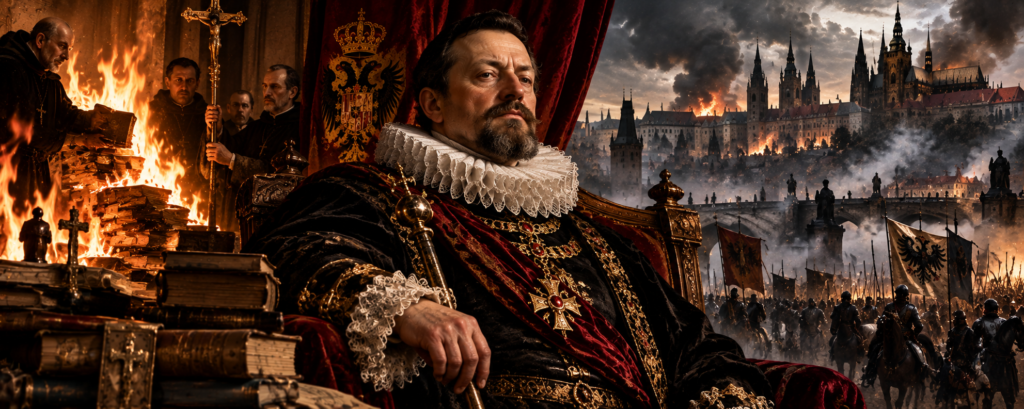
Ferdinand II: The Emperor of Holy War, the Broken Kingdoms, and the Faith That Set Europe Ablaze
Holy Roman Emperor, 1619–1637 | Jesuit Education, the Counter-Reformation, the Defenestration of Prague, White Mountain, Religious Persecution, Confiscated Kingdoms, the Edict of Restitution, Wallenstein’s Murder, Swedish Invasion, and the Thirty Years’ War
The Emperor Who Would Rather Lose a Kingdom Than Compromise His Faith
When Ferdinand II inherited the imperial crown in 1619, the Holy Roman Empire was already sliding toward catastrophe. Bohemia was in rebellion, Protestant and Catholic princes were arming themselves, the Habsburg dynasty was struggling to maintain its authority, and the religious settlement that had kept an uneasy peace for decades was cracking apart. Ferdinand did not create every one of these tensions, nor did he single-handedly cause the Thirty Years’ War, which had begun with the Bohemian revolt the previous year. What he brought to the crisis, however, was a conviction so deep and inflexible that compromise could appear to him not merely politically undesirable but spiritually wrong.
Ferdinand was not insane in any recognizable clinical sense. There is no convincing evidence that he suffered the psychotic episodes associated with Charles VI of France, the incapacitating mental illness of Maria I of Portugal, or the severe psychological disturbances that afflicted his cousin and predecessor Rudolf II. Indeed, people who encountered Ferdinand personally often found him surprisingly pleasant, approachable, conscientious, and even cheerful. He enjoyed hunting and music, loved his family, maintained successful marriages, worked diligently, and could behave with warmth toward people around him.
That relatively ordinary private personality makes the consequences of his reign more unsettling rather than less. Ferdinand did not need to be delusional to help turn a political and religious crisis into one of the most destructive conflicts Europe had yet experienced. He believed with extraordinary sincerity that Catholic truth possessed claims higher than political convenience, and he repeatedly interpreted his responsibilities through the duties of a Christian prince. When military victories appeared to confirm that God favored his cause, his willingness to push Catholic restoration farther became stronger.
Later generations have sometimes described this as a kind of ideological madness: not insanity of the mind, but the terrifying certainty of a ruler convinced that eternal truth justified enormous temporal suffering. Ferdinand’s enemies accused him of preferring a devastated Catholic realm to a prosperous Protestant one, and variations of the famous claim that he would rather rule a desert than tolerate heresy became attached to his reputation. The exact wording of such sayings is difficult to establish and should not be treated as a verbatim declaration without qualification. Yet the sentiment survived because Ferdinand’s policies often made it seem horrifyingly plausible.
A Childhood Built Around Catholic Certainty
Ferdinand was born in Graz on 9 July 1578, the son of Archduke Charles II of Inner Austria and Maria Anna of Bavaria. His father ruled Styria, Carinthia, Carniola, and associated Habsburg territories collectively known as Inner Austria, lands in which Protestantism had made substantial advances among nobles, townspeople, and other subjects. His mother came from the intensely Catholic Bavarian Wittelsbach dynasty and exercised a profound influence over the religious atmosphere surrounding her children. Ferdinand therefore grew up not in a world where Catholicism was simply one aspect of royal identity, but in a household where defending the faith formed part of the fundamental purpose of dynasty and government.
Later biographical traditions emphasize the extraordinary religious discipline of Ferdinand’s childhood. Accounts describe the Habsburg children being introduced to Mass at an exceptionally young age, surrounded by Catholic instruction, and deliberately protected from Protestant influence. Stories that the children were taught to say the names of Jesus and Mary among their earliest words, or that Latin was privileged over ordinary German instruction, illustrate the reputation of the household even when such picturesque details should be treated cautiously. What is beyond serious dispute is that Ferdinand’s upbringing was intensely confessional and that his mother regarded Protestant influence as spiritually dangerous.
The young archduke was educated by Jesuits and in 1590 was sent to Ingolstadt, one of the major centers of Catholic learning in the German-speaking world. He studied there during formative adolescent years, absorbing an understanding of rulership in which political authority carried religious obligations. Ferdinand did not emerge from Ingolstadt as a mindless instrument of the Society of Jesus, as hostile Protestant propaganda would later imply, but Jesuit spirituality became permanently woven into his religious life. He retained Jesuit confessors, supported the order generously, and remained deeply receptive to Catholic arguments about the responsibilities of princes.
This education helped produce a ruler whose political thinking cannot be understood by separating religion from government. Modern observers often instinctively distinguish private faith from public policy, but Ferdinand inhabited a world in which such a division could appear artificial. If Catholicism was true and a prince had been entrusted with the souls of his subjects, tolerating what he believed to be religious error could itself become a failure of government. That conviction would eventually collide with an empire in which millions of subjects had no intention of surrendering their Protestant faith.
The Vow of a Catholic Prince
After completing his education and assuming personal control of Inner Austria in the 1590s, Ferdinand traveled to Italy and visited important Catholic religious sites. Tradition associates a particularly important vow with his pilgrimage to Loreto, where he supposedly resolved that he would sacrifice his lands, and even his life, rather than abandon the Catholic faith. The precise wording attributed to him varies in later accounts, but the broader commitment is consistent with his subsequent actions. Ferdinand returned to his territories determined to reverse the Protestant gains tolerated by earlier Habsburg policy.
He had inherited a difficult situation because Protestantism was deeply entrenched among sections of the nobility and urban population. A cautious ruler might have preserved existing arrangements to avoid rebellion, especially while the Habsburg monarchy remained threatened by the Ottoman Empire. Ferdinand instead concluded that religious division itself weakened legitimate authority. Catholic restoration and political consolidation therefore became mutually reinforcing objectives.
Beginning in the late 1590s, Protestant pastors and teachers were expelled from parts of Inner Austria, Protestant institutions were closed or transferred, and Catholic religious structures were strengthened. Subjects faced growing pressure to conform to Catholic worship or leave territories where Ferdinand possessed sufficient authority to enforce his policy. Protestant books were confiscated and publicly destroyed in some places, creating deliberately theatrical demonstrations that the religious order of the territory had changed. The message was unmistakable: the archduke who had been educated among the Jesuits intended to govern as a Catholic prince rather than preserve the compromises of the previous generation.
The striking feature was that the policy largely succeeded without producing the catastrophic revolt many advisers had feared. That success mattered enormously to Ferdinand’s later development because it seemed to confirm both his political judgment and his religious convictions. He had been warned that coercive Catholic restoration might destroy his lands, yet his authority survived and Protestant institutions were dramatically weakened. The experience taught him a dangerous lesson: firmness in matters of faith could appear reckless to worldly advisers and still be vindicated by events.
When Success Becomes a Dangerous Teacher
Ferdinand’s experience in Inner Austria helps explain why he later behaved as he did in Bohemia and the wider empire. His religious policy was not merely theoretical doctrine absorbed from Jesuit teachers; it was something he believed he had tested successfully. Opposition had looked formidable, advisers had warned of disaster, and yet persistence had brought results. To a ruler already convinced that Providence governed human affairs, success could easily appear as confirmation that God rewarded steadfastness.
This did not make Ferdinand incapable of calculation. He could negotiate, delay measures, accept temporary political realities, and work through advisers rather than simply issuing religious commands regardless of circumstances. The caricature of a helpless fanatic controlled entirely by confessors underestimates both his intelligence and his capacity for government. His limitation was subtler: he possessed a framework within which compromise had definite moral boundaries, and those boundaries were considerably narrower than the fractured empire required.
Ferdinand’s religiosity was also deeply personal rather than merely political theater. He attended Mass frequently, devoted considerable time to prayer and religious reading, undertook pilgrimages, supported Catholic institutions, and maintained a disciplined devotional routine throughout his life. Court observers could find his piety excessive, but there is little reason to doubt its sincerity. He was not cynically using religion to conceal naked ambition.
That sincerity is crucial to understanding the destruction that followed. Cynical politicians can sometimes abandon ideological programs when the costs become intolerable, because their beliefs were instruments rather than absolutes. Ferdinand could modify tactics, but abandoning the underlying objective of Catholic restoration risked becoming a betrayal of his conception of Christian rulership. The very quality his supporters admired as steadfastness could therefore appear to his enemies as terrifying inflexibility.
A Crown Waiting to Explode
The succession crisis within the Austrian Habsburg dynasty eventually brought Ferdinand toward far greater power. Emperor Matthias had no surviving legitimate children, and the dynasty needed an acceptable successor. Ferdinand’s Catholic reputation alarmed Protestant subjects, particularly in Bohemia, where religious rights had become entangled with the political privileges of the estates. Nevertheless, Ferdinand was accepted as King of Bohemia in 1617 and became King of Hungary the following year.
Bohemia was particularly dangerous because Emperor Rudolf II had issued the Letter of Majesty in 1609, granting significant religious protections to Protestant estates. Disputes subsequently developed over the interpretation and implementation of those rights, especially concerning Protestant churches built on lands controlled by Catholic ecclesiastical authorities. The issue involved much more than theology. Bohemian nobles feared that a strengthened Catholic monarchy would eventually destroy both their religious liberties and their political autonomy.
On 23 May 1618, a group of Protestant nobles entered Prague Castle and confronted royal officials whom they blamed for violating religious rights. The confrontation ended with two governors, Jaroslav Bořita of Martinice and Vilém Slavata of Chlum, along with their secretary Philip Fabricius, being thrown from a high window. All three survived, producing competing explanations that immediately reflected the confessional divide. Catholic accounts emphasized providential rescue, while Protestant mockery attributed the survival to less miraculous circumstances.
The Defenestration of Prague became the dramatic opening of the Bohemian Revolt and the event traditionally used to mark the beginning of the Thirty Years’ War. Yet no one standing inside Prague Castle that day could have known that the confrontation would expand into a conflict lasting until 1648. The war developed through successive interventions, shifting alliances, dynastic rivalries, confessional disputes, and international calculations. Ferdinand would become one of its central figures, but the catastrophe was never the product of one man’s will alone.
The King Bohemia Rejected
The Bohemian rebels eventually declared Ferdinand deposed and offered their crown to Frederick V, Elector Palatine, a Calvinist prince and leading Protestant figure. Ferdinand’s position appeared precarious because Emperor Matthias died in March 1619, leaving him struggling simultaneously for the imperial succession and the recovery of a kingdom rejecting his authority. Despite the rebellion, Ferdinand was elected Holy Roman Emperor in Frankfurt in August 1619. He had acquired the highest secular title in Catholic Europe at almost the exact moment one of his most important kingdoms was attempting to escape him.
Frederick V accepted the Bohemian crown and became remembered derisively as the “Winter King,” because his rule in Prague lasted little more than a year. Ferdinand secured assistance from Catholic allies, most importantly the Catholic League led by his Bavarian cousin Maximilian I. Spanish Habsburg forces and other supporters also helped shift the balance against the rebels. The struggle for Bohemia was therefore international almost from the beginning.
On 8 November 1620, the opposing forces met near Prague at the Battle of White Mountain. The battle was relatively brief compared with the enormous historical consequences that followed it. Frederick’s army collapsed, and the Bohemian revolt suffered a devastating defeat. Frederick fled, while Ferdinand recovered control of the kingdom that had attempted to depose him.
For Ferdinand, White Mountain was more than a military victory. It appeared to demonstrate that Providence had once again vindicated firmness in the defense of Catholic monarchy. The lesson he had learned in Inner Austria seemed to repeat itself on a far larger stage. Resistance had appeared dangerous, yet determination had triumphed, and the temptation to interpret victory as divine approval was immense.
The Scaffold in Prague
Ferdinand’s victory was followed by punishment designed to ensure that rebellion could not easily revive. On 21 June 1621, twenty-seven leaders associated with the Bohemian uprising were executed in Prague’s Old Town Square. The condemned included nobles, burghers, and political figures, and the executions became one of the defining symbols of Habsburg vengeance after White Mountain. Heads and other remains of some executed rebels were publicly displayed as warnings, giving the restoration of imperial authority an unmistakably brutal face.
The number of executions should be kept in perspective because Ferdinand did not order the indiscriminate slaughter of every captured rebel. Nevertheless, the political purge extended far beyond the twenty-seven men killed in the square. Estates belonging to rebels and political opponents were confiscated on an enormous scale, transforming patterns of land ownership throughout Bohemia. Families that had dominated political life could lose fortunes accumulated over generations.
Confiscated properties passed into the hands of loyal Catholic nobles, imperial supporters, military entrepreneurs, and foreign families who benefited from the reconstruction of Bohemian society after the rebellion. Albrecht von Wallenstein would become one of the most spectacular beneficiaries of this upheaval, assembling enormous territorial wealth. Ferdinand’s generosity toward loyal followers strengthened a new political elite but also deprived the crown of resources it desperately needed. His habit of rewarding supporters lavishly became a recurring financial weakness.
The transformation of Bohemia was therefore religious, political, and economic at the same time. The revolt had challenged Ferdinand’s kingship, and he responded by restructuring the kingdom so thoroughly that the old political order could not simply reassemble itself. White Mountain did not merely restore a king. It opened the way for a social revolution from above.
Conversion, Exile, and the Remaking of Bohemia
The religious consequences were equally profound. Protestant clergy were expelled, Catholic institutions were strengthened, and pressure for conversion intensified. Protestant nobles eventually faced stark choices concerning conformity and exile, while restrictions expanded through the 1620s. The Revised Land Ordinance of 1627 further strengthened hereditary Habsburg authority in Bohemia and entrenched Catholicism as the privileged confession.
Popular accounts sometimes claim that Ferdinand expelled hundreds of thousands of Protestants from Bohemia immediately after White Mountain. The reality unfolded over years and is difficult to reduce to one reliable number. Tens of thousands certainly left Bohemia and neighboring Habsburg territories for religious and political reasons, while others converted outwardly or genuinely returned to Catholicism. The enormous population losses later associated with the Thirty Years’ War also resulted from warfare, disease, famine, economic disruption, and displacement, making simple demographic claims about religious expulsion misleading.
The exile nevertheless transformed Bohemian cultural life. Protestant nobles, scholars, clergy, craftsmen, and townspeople carried their traditions elsewhere, while Catholic religious orders expanded their presence within the kingdom. The famous educator and theologian John Amos Comenius became one of the most prominent exiles, spending much of his remaining life away from his homeland. For such refugees, Ferdinand’s Catholic restoration was not an abstract confessional policy but the force that severed families from property, communities, and familiar landscapes.
Ferdinand could view these measures very differently. If Protestantism represented religious error and rebellion had demonstrated the political dangers of confessional division, Catholic uniformity could appear to promise both salvation and stability. The problem was that this logic allowed suffering to become evidence that the policy was working rather than evidence that it should stop. Every exile meant one fewer Protestant subject resisting the confessional order Ferdinand wanted to build.
The Pleasant Man Behind the Repression
One of the strangest things about Ferdinand is the contrast between his political reputation and descriptions of his private personality. He was not generally remembered as a sadistic man who delighted personally in suffering. Contemporary descriptions often emphasize his friendliness, good humor, accessibility, devotion to family, enjoyment of hunting, and enthusiasm for music. His court could be relatively modest compared with the theatrical extravagance of some European monarchies.
He married Maria Anna of Bavaria in 1600, and the marriage appears to have been affectionate. After her death in 1616, he married Eleonora Gonzaga of Mantua in 1622, another relationship generally regarded as successful. Ferdinand’s domestic life lacked many of the sexual scandals, violent marriages, and spectacular personal cruelties associated with other rulers in the Mad Monarchs category. He could be conventional, disciplined, and emotionally attached to those closest to him.
Music offered another side of the emperor. Ferdinand supported court musicians and participated in the development of the Italianate musical culture that would become important at the Habsburg court. Religious devotion and musical patronage existed comfortably together, and his court was not simply a grim monastery populated by priests and soldiers. He could appreciate beauty while pursuing policies that devastated communities.
That contradiction makes him historically disturbing. Cruel systems do not always require personally cruel men, and persecution does not always originate in sadistic pleasure. Ferdinand could treat an individual graciously while supporting policies that forced thousands of other individuals to choose between faith and homeland. Personal affability and ideological severity occupied the same man without appearing contradictory to him.
The Emperor and His Confessors
Ferdinand’s Jesuit confessors have long occupied a controversial place in interpretations of his reign. Protestant polemicists depicted the emperor as almost a puppet whose priests manipulated him into religious extremism. His later confessor Wilhelm Lamormaini became particularly influential and was accused by critics of exercising excessive power over imperial policy. The image of a weak emperor waiting for a Jesuit to tell him what God wanted became a powerful piece of anti-Habsburg propaganda.
There is no question that Ferdinand valued clerical advice deeply. His confessors possessed access to his conscience, and questions of morality inevitably overlapped with political decisions in a ruler who regarded government as a religious responsibility. Lamormaini could advocate strongly for Catholic interests, and Ferdinand listened to him. Yet the emperor also consulted secular ministers, lawyers, diplomats, generals, relatives, and territorial advisers.
Describing Ferdinand as incapable of acting until a confessor interpreted divine signs for him goes too far. He was conscientious and sometimes slow, and his belief in Providence encouraged him to examine political events through a religious framework. Defeat could become a divine trial, while victory could appear to confirm righteousness. Nevertheless, he was not simply immobilized whenever priests were absent from the room.
The more significant problem was that Ferdinand’s spiritual advisers often reinforced assumptions he already held. He did not need Jesuits to manufacture his Catholicism because it had shaped him since childhood. Their influence mattered because they spoke within a worldview he already trusted. The emperor and his confessors therefore reinforced one another rather than forming a simple relationship between manipulator and victim.
A War That Refused to End
After White Mountain, Ferdinand might have hoped the rebellion was essentially finished. Instead, the conflict widened. Frederick V’s defeat did not eliminate the political and confessional networks supporting resistance to Habsburg power. Fighting spread through the Palatinate and other parts of Germany, while foreign rulers watched the expanding strength of the emperor with increasing concern.
The Thirty Years’ War is traditionally divided into phases associated with Bohemian, Danish, Swedish, and Franco-Swedish interventions, but these labels can obscure how interconnected the conflict became. Religion remained crucial, yet dynastic and geopolitical calculations increasingly crossed confessional boundaries. Catholic France would eventually fight against the Catholic Habsburgs because French leaders feared encirclement and Habsburg dominance more than they desired confessional solidarity. Protestant princes could negotiate with Catholic rulers when political interests demanded it.
Ferdinand’s central mistake was not simply believing strongly in Catholicism. Many contemporaries possessed equally intense religious convictions without pursuing identical policies. His problem was his repeated willingness to interpret military success as an opportunity to extend imperial and Catholic claims farther. Each victory seemed to create the possibility of settling questions that had previously required compromise.
The empire, however, was not a state Ferdinand could simply reorganize by decree. German princes possessed extensive constitutional rights, territorial interests, and deep suspicion of any emperor who appeared to be transforming temporary military superiority into permanent political dominance. Catholic princes could fear Habsburg centralization almost as much as Protestants feared Catholic restoration. Ferdinand would discover that victory could make him more frightening to potential enemies than defeat ever had.
Wallenstein: The Emperor’s Dangerous Creation
No relationship better illustrates Ferdinand’s wartime predicament than his alliance with Albrecht von Wallenstein. Born into a relatively modest Bohemian noble family, Wallenstein converted to Catholicism and rose spectacularly during the upheavals following the Bohemian revolt. He acquired confiscated estates, developed enormous economic resources, and became one of the richest and most powerful nobles in Central Europe. His ambition, organizational talent, and ability to raise armies made him indispensable to an emperor perpetually short of money.
Wallenstein offered Ferdinand something revolutionary in scale: a vast army that could sustain itself substantially through contributions imposed upon territories where it operated. The arrangement reduced the immediate need for the imperial treasury to finance every soldier directly, but it transferred the burden onto civilians. Towns and villages were compelled to provide money, food, quarters, horses, and supplies. Friendly territory could suffer almost as brutally as enemy territory when an enormous army descended upon it.
By the middle 1620s, Wallenstein had become the emperor’s generalissimo and Duke of Friedland. His victories helped defeat the Danish intervention led by King Christian IV and carried imperial power toward the Baltic. Ferdinand’s military position appeared stronger than it had at any earlier point in the war. Wallenstein, meanwhile, became so powerful that princes across the empire wondered whether the emperor had created a military monster he could no longer control.
The relationship was built upon mutual need rather than trust. Ferdinand needed Wallenstein’s army, while Wallenstein needed imperial legitimacy for his extraordinary accumulation of authority. Both benefited enormously from the arrangement, and both had reasons to fear the other. Their eventual rupture would become one of the darkest episodes of Ferdinand’s reign.
The Edict of Restitution: Victory Turns Into Overreach
In March 1629, Ferdinand issued the Edict of Restitution, perhaps the clearest example of how military success encouraged him to pursue a maximalist religious settlement. The decree sought to restore Catholic ecclesiastical properties that had come under Protestant control in violation, as Ferdinand and his supporters interpreted it, of the Peace of Augsburg. It potentially affected bishoprics, monasteries, foundations, and enormous amounts of property across the empire. For Protestant rulers, it threatened to overturn generations of established possession.
The Edict was not simply Ferdinand waking one morning with a fantasy of omnipotence. Catholic grievances over secularized church property had existed for decades, and legal arguments could be made that Protestant princes had stretched the terms of the 1555 settlement. Yet issuing such a sweeping measure while imperial armies dominated much of Germany transformed a legal claim into something resembling a program imposed by military victory. Protestants had every reason to wonder how far Ferdinand intended to go.
Even Catholic princes became nervous. If the emperor could use wartime power to redefine property arrangements across the empire, the constitutional balance between emperor and princes might be shifting in dangerous ways. Maximilian of Bavaria, despite being Ferdinand’s crucial Catholic ally, had his own interests and no desire to become subordinate to an overwhelmingly powerful Habsburg emperor. Confessional solidarity therefore began colliding with princely autonomy.
The Edict became one of Ferdinand’s greatest political overreaches. It frightened enemies who already distrusted him, complicated relations with allies, and made compromise more difficult at precisely the moment foreign intervention threatened to transform the war again. It did not single-handedly cause Sweden or France to enter the conflict, since both powers had broader strategic reasons for opposing Habsburg power. Nevertheless, it strengthened the impression that Ferdinand intended to use victory to remake the religious and political order of the empire.
The Emperor Who Gave Away His Victories
Ferdinand’s financial habits created another paradox. Personally, he was not notorious for the extravagant luxury associated with rulers who bankrupted themselves on palaces, jewels, mistresses, or endless festivals. Yet his government suffered chronic financial weakness, and Ferdinand could be astonishingly generous with confiscated property and rewards. Lands taken from defeated rebels became political currency used to compensate supporters and bind military allies to the dynasty.
This redistribution helped create a loyal Catholic aristocracy in Bohemia and other Habsburg lands. Men who owed their fortunes to the post-White Mountain settlement had powerful incentives to support the dynasty that had enriched them. From that perspective, Ferdinand was not simply throwing wealth away irrationally. Confiscated land purchased loyalty when the imperial treasury lacked enough cash to reward everyone directly.
The cost was enormous. Once estates were granted away, the crown surrendered potential revenue that might otherwise have strengthened its own finances. Military expenses continued growing, soldiers went unpaid, lenders demanded repayment, and war devastated the tax base from which future resources would have to come. Ferdinand repeatedly needed extraordinary military entrepreneurs precisely because his government lacked the money to maintain forces conventionally.
His generosity was therefore simultaneously politically useful and financially damaging. Calling it mere madness obscures the patronage system underlying early modern monarchy, but calling it sound finance would be equally misleading. Ferdinand built loyalty by distributing wealth he could scarcely afford to lose. The emperor who dreamed of strengthening Habsburg power repeatedly weakened the financial foundation necessary to exercise it.
Prudishness, Piety, and the Problem of the Naked Body
Ferdinand acquired a reputation for intense personal modesty and sexual prudishness. Later accounts have even claimed that he ordered nude or erotically suggestive Renaissance artworks from the Habsburg collections destroyed because their imagery offended his religious sensibilities. Some versions specifically describe paintings being burned, an arresting image of Counter-Reformation morality literally consuming Renaissance art. Such claims appear in biographical traditions, but the precise scale, objects involved, and circumstances are not sufficiently secure to treat every dramatic version as established fact.
His general moral conservatism is much easier to document. Ferdinand regarded Catholic discipline as extending beyond doctrinal belief into behavior, worship, family life, and public morality. The Catholic Reformation itself emphasized religious education, sacramental practice, clerical discipline, and the reform of conduct. An emperor shaped by this environment would naturally regard art through moral as well as aesthetic categories.
This aspect of Ferdinand sharply distinguishes him from Rudolf II. Rudolf had gathered an extraordinary collection filled with sensual, mythological, enigmatic, and sometimes erotic imagery, while Ferdinand represented a far more disciplined Counter-Reformation sensibility. The transition between their worlds symbolized a broader change in Habsburg culture. The mysterious, eclectic Prague of Rudolf was giving way to a monarchy increasingly defined by confessional Catholic identity.
Yet Ferdinand was not hostile to art itself. He supported music enthusiastically and participated in a court culture that remained sophisticated and artistically productive. His problem was not beauty but beauty he believed violated Christian morality. As with so much else in his life, aesthetic judgment passed through the filter of faith.
When Gustavus Adolphus Came South
Ferdinand’s apparent triumph did not last. In 1630, King Gustavus Adolphus of Sweden landed in northern Germany with an army that would transform the military situation. Sweden had strategic interests around the Baltic, feared expanding Habsburg influence, and presented its intervention partly as the defense of Protestant liberties. Ferdinand now confronted an enemy far more formidable than the defeated Bohemian rebels or Danish forces he had previously overcome.
At almost the same moment, Ferdinand dismissed Wallenstein under pressure from German princes who feared the general’s power and the enormous burdens imposed by his army. The dismissal appeared manageable while imperial fortunes remained strong. Then the Swedish advance exposed how badly Ferdinand still needed the man he had removed. The emperor’s relationship with his generalissimo entered its second and far more dangerous phase.
The catastrophe at Breitenfeld in September 1631 shattered the aura of Catholic-imperial invincibility. Gustavus Adolphus and his allies inflicted a crushing defeat on forces of the Catholic League under Count Tilly. Protestant territories that had feared Ferdinand suddenly saw the possibility of military salvation. The emperor who had seemed capable of dictating Germany’s religious settlement now faced the prospect of losing everything.
Ferdinand recalled Wallenstein. The decision was humiliating but necessary, and Wallenstein understood his value. He returned under conditions granting him extraordinary authority, rebuilding an imperial army while maintaining a degree of independence that intensified suspicion at court. Ferdinand had restored the very man he had previously considered too powerful because only that man seemed capable of saving him.
Wallenstein and the King Who Died at Lützen
Wallenstein confronted the Swedish threat with characteristic caution and strategic calculation. In November 1632, his forces fought Gustavus Adolphus at the Battle of Lützen. The battle was bloody and confused, and although the Swedish army held the field, Gustavus himself was killed. His death removed one of the most charismatic military leaders of the war but did not end Swedish intervention.
Wallenstein’s conduct after Lützen increasingly troubled Ferdinand and other imperial leaders. The general pursued negotiations with various powers, explored possible peace arrangements, and maintained contacts that could be interpreted as either pragmatic diplomacy or dangerous independent politics. His enormous army remained personally associated with him, creating the terrifying possibility that military loyalty might belong more to the commander than the emperor. Rumors multiplied that Wallenstein intended to betray Ferdinand, seize a crown, or construct an independent settlement.
Some accusations against Wallenstein were exaggerated, and historians continue debating exactly how far his plans extended. He was unquestionably conducting political negotiations beyond what Ferdinand considered acceptable, but proving a fully developed treasonous conspiracy is more difficult. The emperor, however, did not have the luxury of waiting for perfect historical evidence. If Wallenstein really intended betrayal, hesitation could destroy the dynasty.
Ferdinand therefore confronted a problem almost designed to produce paranoia. He depended upon a man powerful enough to save the monarchy and therefore powerful enough to threaten it. Wallenstein’s independence made him indispensable when armies were needed and intolerable when political obedience was required. The relationship could survive only while both men believed they needed each other more than they feared each other.
The Secret Death Sentence
By early 1634, Ferdinand had decided that Wallenstein could no longer be trusted. The emperor issued orders stripping him of command and accusing him of conspiracy, while loyal officers were encouraged to separate themselves from the generalissimo. Wallenstein attempted to gather support but discovered that the loyalty surrounding a powerful commander could disappear rapidly once imperial authority turned decisively against him. He fled toward Eger, apparently hoping to secure his position or continue negotiations.
On the night of 25 February 1634, Wallenstein’s closest associates were murdered during a banquet at Eger. Later that night, armed men entered the house where Wallenstein was staying. The Irish officer Walter Devereux confronted the unarmed general and killed him with a partisan or halberd-like weapon. One of the most powerful men in Europe died without a formal trial.
Ferdinand did not personally wield the weapon, and the precise chain of authorization surrounding the killing has generated extensive historical debate. What is clear is that imperial actions had marked Wallenstein as a traitor and created the political conditions in which his elimination became acceptable to officers seeking to prove loyalty. Ferdinand subsequently rewarded participants in the suppression of Wallenstein and accepted the result. Whatever legal distinctions might be drawn, the emperor cannot be separated from the destruction of the general he had twice entrusted with enormous military power.
The episode reveals Ferdinand at his darkest. His fear of Wallenstein was not necessarily irrational because the general really had accumulated extraordinary power and really was negotiating independently. Yet the solution bypassed any meaningful public judicial process and ended in assassination. The emperor who believed intensely in moral order had sanctioned a political environment in which a dangerous servant could simply be removed by violence.
Providence and the Politics of Certainty
Ferdinand’s tendency to interpret events through divine Providence profoundly influenced his resilience. When circumstances appeared hopeless, he could believe that suffering represented a test rather than proof that his policies were mistaken. This gave him remarkable psychological endurance. Political crises that might have broken a less certain ruler instead reinforced his determination to wait for divine assistance.
His supporters admired this steadfastness. Ferdinand survived the Bohemian revolt, threats to his succession, Danish intervention, Swedish victories, internal princely opposition, financial crisis, and the terrifying dependence upon Wallenstein. Again and again, situations that looked disastrous eventually changed. A ruler who believed God would not abandon a righteous cause could interpret survival itself as confirmation of divine favor.
The danger was that such a worldview could make policy correction difficult. If defeat represented a divine trial rather than evidence of strategic error, then compromise risked appearing as failure of faith. Ferdinand was capable of compromise when circumstances forced it, but his instinct was often to preserve principles and wait for conditions to improve. Religious conviction provided emotional strength while narrowing the range of politically acceptable retreat.
This is where descriptions of Ferdinand as ideologically “mad” become understandable even though they remain medically inappropriate. He did not hallucinate divine commands or demonstrate psychotic detachment from reality. Instead, he possessed a coherent religious worldview shared in broad form by many contemporaries and pursued it with unusual consistency. The destructiveness came not from incoherence but from the frightening coherence of a belief system applied to an empire that could not survive complete confessional uniformity without resistance.
The Peace of Prague
The death of Wallenstein did not destroy the imperial war effort. In September 1634, imperial and Spanish forces won a major victory over the Swedes at Nördlingen. Once again Ferdinand seemed to have escaped disaster, and once again military success created an opportunity for political settlement. This time, however, the result moved toward compromise rather than another maximalist religious decree.
The Peace of Prague in 1635 brought Ferdinand to an agreement with many Protestant German princes, most importantly Saxony. The settlement suspended or modified some of the most explosive consequences associated with the Edict of Restitution and attempted to create greater unity within the empire against foreign forces. It demonstrated that Ferdinand could compromise when political reality made compromise unavoidable. The supposedly immovable religious fanatic was capable of retreat when survival demanded it.
Yet the peace failed to end the larger war. France, under Cardinal Richelieu, intervened openly against the Habsburgs despite being a Catholic monarchy. The conflict had now evolved beyond anything that could be explained simply as Catholics fighting Protestants. French strategy focused upon weakening Habsburg power, while Sweden remained active and other states pursued their own interests.
For Ferdinand, the transformation must have been deeply revealing. The war he understood in strongly confessional terms had become a struggle in which Catholic France could ally against the Catholic emperor. The political world refused to fit neatly into the religious categories that had shaped his youth. By the final years of his life, the conflict had become something even his deepest Catholic certainty could not simplify.
The War Beyond the Emperor’s Control
The Thirty Years’ War produced devastation unevenly rather than destroying every region of Germany equally. Armies lived from the territories through which they marched, requisitioning food, money, livestock, shelter, and supplies. Soldiers who went unpaid frequently became predators, while civilians fled advancing armies only to encounter famine or epidemic disease. Villages could be burned, crops destroyed, trade disrupted, and entire local economies pushed toward collapse.
Modern estimates of total mortality vary enormously because surviving demographic evidence is incomplete. Figures reaching several million deaths across the affected regions are plausible, with some estimates approaching or exceeding eight million when warfare, famine, disease, and associated demographic collapse are combined. Direct battlefield deaths represented only part of the catastrophe. Typhus, plague, hunger, displacement, and the destruction of agricultural systems killed far more people than swords and muskets alone.
It would be historically false to place every one of those deaths personally at Ferdinand’s feet. The war continued for eleven years after his death, and numerous rulers repeatedly chose escalation for their own religious, territorial, dynastic, or strategic reasons. Sweden, France, Spain, Denmark, Bavaria, Saxony, the Palatinate, Transylvania, imperial princes, and countless commanders all shaped the conflict. The Thirty Years’ War was a system of destruction larger than any single ruler.
Ferdinand nevertheless bears substantial responsibility for decisions that hardened the conflict during crucial stages. His treatment of Bohemia, aggressive Catholic restoration, willingness to exploit military victories for confessional objectives, and Edict of Restitution made reconciliation more difficult and frightened rulers who feared both religious coercion and imperial centralization. He did not invent the fire, but he repeatedly chose policies that fed it. By the time he recognized the necessity of broader compromise, the war had become an international catastrophe.
The Myth of the Emperor Who Wanted a Desert
The famous image of Ferdinand declaring that he preferred a desert to a country filled with heretics captures his reputation so perfectly that it is frequently repeated as though taken directly from an unquestionable transcript. Similar formulations circulated in early modern confessional polemic and became attached to rulers committed to religious uniformity. The exact words attributed to Ferdinand should therefore be treated cautiously. Historical truth does not require placing a convenient sentence in his mouth.
His actual policies make the legend understandable. In Inner Austria, Protestants faced expulsion or conformity, and after White Mountain the same principle reshaped Bohemia on a much larger scale. Protestant institutions disappeared, clergy were expelled, estates were confiscated, and religious exile became a defining experience for many families. Ferdinand repeatedly demonstrated that he considered confessional unity worth considerable social and economic disruption.
Yet he did not literally seek depopulation. He wanted subjects to convert, not vanish, because rulers needed taxpayers, farmers, artisans, merchants, and soldiers. Exile was a tool for eliminating religious resistance when conversion failed, not an objective valued for its own sake. The image of the emperor happily surveying an empty Catholic wasteland belongs to polemic rather than responsible history.
The more unsettling reality is that Ferdinand could recognize the economic cost of religious coercion and still consider it acceptable. Material prosperity occupied a lower position than confessional truth within his hierarchy of obligations. To people forced from their homes, that distinction offered little comfort. A ruler did not need to desire a desert to create one in particular communities.
Was Ferdinand II a Puppet of the Jesuits?
Protestant propaganda often portrayed Ferdinand as “Jesuit-ridden,” implying that members of the Society of Jesus effectively governed through him. The accusation was powerful because his education, confessors, and patronage made the connection obvious. Jesuits did possess unusual influence at his court, particularly on matters touching religion and conscience. Ferdinand valued them precisely because he trusted their theological judgment.
Nevertheless, reducing his reign to clerical manipulation excuses Ferdinand for decisions that were fundamentally his own. He had embraced aggressive Catholic restoration before becoming emperor and had already implemented it successfully in Inner Austria. His religious convictions were not whispered into existence by Wilhelm Lamormaini decades later. The advisers reinforced the emperor because the emperor had deliberately chosen advisers who shared his worldview.
Secular ministers also mattered enormously. Hans Ulrich von Eggenberg, Gundaker of Liechtenstein, Cardinal Dietrichstein, Maximilian von Trauttmansdorff, and numerous other political actors influenced Habsburg decision-making at different points. Ferdinand listened to legal and political arguments, negotiated with princes, and could reject clerical recommendations when other considerations became overwhelming. His government was not a confessional puppet theater.
The relationship nevertheless demonstrates the dangers of intellectual enclosure. Rulers naturally surround themselves with people they trust, and Ferdinand trusted those who shared his deepest assumptions about Catholic monarchy. Advice therefore often began from the premise that Catholic restoration was desirable and debated how or when it should be achieved. The possibility that enforced confessional uniformity itself might be the problem had little room to survive within such a system.
The Strange Frugality of a Generous Emperor
Ferdinand’s personal habits also resist the stereotype of a power-mad tyrant. He was not famous for building an endless series of fantastical palaces or maintaining a court designed solely to display his wealth. His tastes could be relatively restrained, and his deepest pleasures appear to have included religion, hunting, music, and family life. The man directing a vast war did not necessarily live like a decadent conqueror.
At the same time, his generosity could become financially reckless. Ferdinand distributed honors, offices, estates, and rewards on a scale his resources struggled to sustain. Patronage was indispensable to early modern government, especially when loyalty had to be purchased from nobles and military commanders capable of raising troops. Yet repeated grants diminished the resources available directly to the crown.
This weakness became particularly serious because war devoured money at a rate traditional dynastic finances could barely comprehend. Armies grew larger, campaigns lasted longer, fortifications required maintenance, artillery demanded expensive supply systems, and soldiers expected wages even when governments could not provide them. The resulting military economy encouraged rulers to shift costs onto occupied territories. Wallenstein’s system was one response to a fundamental fiscal problem Ferdinand never solved.
The emperor’s financial difficulties were therefore not evidence of mental instability. They reveal a monarchy attempting to fight wars beyond the capacity of its conventional institutions while simultaneously rewarding the people whose loyalty made survival possible. Ferdinand could be personally modest and institutionally extravagant at the same time. The contradiction belonged as much to seventeenth-century monarchy as to the emperor himself.
The Emperor at Prayer While Germany Burned
There is an irresistible image of Ferdinand kneeling in prayer while armies devastated Germany. It can become unfair if treated as though he ignored every military report and simply waited for miracles. Ferdinand worked, consulted advisers, made appointments, negotiated alliances, reviewed political questions, and understood that armies required ordinary material support. His piety existed alongside government rather than replacing it completely.
Yet prayer occupied an extraordinary place in his daily life. He attended Mass regularly, sometimes more than once in a day, devoted substantial time to devotional exercises, and interpreted political responsibilities through his relationship with God. During crises he could turn intensely toward religion, seeking spiritual reassurance that endurance would eventually be rewarded. Providence was not metaphorical decoration in his worldview but a force operating within history.
That belief helped him withstand moments when his political situation seemed impossible. During the Bohemian revolt, during Swedish victories, and during internal crises, Ferdinand could believe that apparent disaster did not mean final defeat. His faith provided psychological resilience that should not be dismissed merely as superstition. It also made surrendering core religious objectives emotionally and morally difficult.
The disturbing contrast remains. While Ferdinand prayed for divine assistance, civilians prayed that whichever army approached would pass without taking their food, burning their homes, spreading disease, or killing their families. Both emperor and peasant could believe passionately in God while inhabiting radically different realities created by the same war. The Thirty Years’ War was filled with sincere Christians slaughtering, starving, and dispossessing other sincere Christians.
Ferdinand and the Madness of Certainty
Ferdinand belongs in a Mad Monarchs category for reasons fundamentally different from Rudolf II. Rudolf’s reign was shaped by recurrent psychological illness, profound melancholy, withdrawal, suspicion, and periods of serious incapacity. Ferdinand appears to have remained psychologically functional throughout his reign. He worked, maintained relationships, pursued coherent policies, enjoyed recreation, and adapted tactically when circumstances forced him to do so.
What makes Ferdinand seem “mad” is the extremity of his certainty. He believed that Catholic restoration was a legitimate duty of Christian monarchy and remained willing to impose extraordinary costs in pursuit of it. Because the belief was coherent, culturally intelligible, and shared by many contemporaries, calling it clinical madness would be both inaccurate and unfair. Ideological rigidity can be destructive without being psychiatric illness.
This distinction matters because explaining destructive rulers as insane can become strangely comforting. Madness suggests abnormality, as though ordinary human beings operating through recognizable beliefs could never produce such devastation. Ferdinand demonstrates the opposite. He could be rational within his assumptions, personally affable, emotionally attached to his family, appreciative of music, diligent in work, and simultaneously responsible for policies that destroyed lives on a vast scale.
The frightening lesson is that rationality does not guarantee moderation. A ruler can reason carefully from premises that leave little room for other people to exist as they choose. Ferdinand’s Catholicism did not make him uniquely evil, and Protestant rulers of the period could be equally intolerant when controlling their own territories. What made his case historically explosive was the enormous political arena in which he attempted to apply his convictions.
The Last Years of an Emperor Who Never Saw Peace
By the mid-1630s, Ferdinand was aging and increasingly concerned with securing the succession. His son, the future Ferdinand III, had already emerged as an important figure and participated in military affairs, including the imperial victory at Nördlingen. The elder emperor wanted to ensure that the dynasty would survive him and that his son would succeed to the imperial dignity. The political world he would leave behind, however, remained deeply unstable.
The Peace of Prague demonstrated that Ferdinand had learned something from the failures of maximalism. He accepted a settlement with Protestant princes that would have been difficult to imagine at the height of his confidence in 1629. Yet foreign intervention prevented the agreement from becoming a general peace. France entered the conflict openly, Sweden continued fighting, and the war moved into another destructive phase.
Ferdinand died in Vienna on 15 February 1637 at the age of fifty-eight. He had been Holy Roman Emperor for nearly eighteen years, and not one of those years had been free from the conflict that had begun in Bohemia. He died believing in the Catholic faith with the same sincerity that had shaped his childhood. He also died without seeing the final settlement of the war his policies had helped prolong.
His son Ferdinand III inherited the imperial title and a conflict that would continue for another eleven years. Only in 1648 would the Peace of Westphalia finally bring the Thirty Years’ War to an end. By then, Ferdinand II had been dead long enough that a new generation of statesmen was confronting a Europe permanently changed by the catastrophe. The universal Catholic restoration he had once appeared close to achieving had become impossible.
What Ferdinand Actually Accomplished
If Ferdinand’s objective was to eliminate Protestantism from the Holy Roman Empire, he failed. Lutheranism and Calvinism survived, Protestant princes retained their territories, and the final peace recognized a confessional order more plural than the emperor would have preferred. Sweden emerged as a major power in northern Germany, France strengthened its position against the Habsburgs, and imperial authority remained constitutionally constrained. The empire Ferdinand had hoped to strengthen did not become a centralized Catholic monarchy.
Within the hereditary Habsburg lands, however, his legacy was far more durable. Bohemia and the Austrian territories underwent profound Catholic transformation, while Habsburg dynastic authority became stronger in important respects. The aristocratic landscape of Bohemia changed after confiscations and exile, producing a new elite closely connected to the dynasty and Catholic Church. Ferdinand therefore failed at universal confessional victory while succeeding dramatically within the core lands his descendants would continue to rule.
The distinction helps explain why evaluations of him vary so sharply. From the perspective of Catholic Habsburg state-building, he consolidated a monarchy that survived for centuries. From the perspective of Protestant exiles and defeated Bohemian estates, he destroyed religious liberties, political traditions, and family fortunes. From the perspective of imperial constitutional history, his ambitions helped provoke resistance that ultimately limited what emperors could achieve.
Ferdinand’s life cannot therefore be reduced to failure. He was enormously consequential precisely because some of his policies succeeded. The Catholic character of the Habsburg monarchy in Central Europe owed much to the transformations undertaken during his reign. His victory was simply narrower, harsher, and more expensive than the universal triumph he once seemed to imagine.
A Good-Natured Man in a Terrible Age
There is something profoundly uncomfortable about returning to descriptions of Ferdinand as friendly and good-natured after examining the consequences of his reign. Historians often prefer their destructive rulers to look monstrous because the moral landscape becomes easier to understand. Ferdinand refuses that convenience. He could laugh, enjoy music, love his family, hunt enthusiastically, speak pleasantly to courtiers, and demonstrate sincere concern for his religious obligations.
None of those qualities prevented persecution. Indeed, his sincere belief that Catholic restoration benefited his subjects could make coercion easier to justify. A ruler who hates his victims may eventually tire of vengeance, but a ruler convinced that coercion serves their eternal salvation possesses a far more durable justification. Conversion could be represented not as oppression but as rescue from error.
The same paradox shaped Ferdinand’s treatment of political enemies. Confiscations rewarded loyalty, executions punished rebellion, and Catholic restoration supposedly restored proper religious order. Each action could be fitted into a coherent system of law, dynasty, faith, and providence. The emperor did not need to experience himself as cruel.
This is one reason his story belongs comfortably within the darker corners of history. Evil outcomes are not always produced by people consciously choosing evil as they understand it. They can emerge from certainty, duty, obedience, institutional logic, fear, and the conviction that suffering today will create righteousness tomorrow. Ferdinand’s reign offers a disturbing demonstration of how easily virtue in one moral framework can become persecution in another person’s life.
Wallenstein’s Ghost
Of all the figures surrounding Ferdinand, Wallenstein remains the one who most dramatically complicates his reputation. The general was hardly an innocent victim. He accumulated staggering wealth, imposed crushing contributions on civilian populations, pursued personal ambitions, negotiated independently, and commanded an army whose loyalty presented a genuine political danger. Ferdinand’s fear was grounded in reality even if rumors exaggerated the scale of the conspiracy.
Yet Wallenstein’s killing revealed the limits of Ferdinand’s legal and moral scruples when dynastic survival seemed threatened. The emperor who spent hours concerned with Christian duty accepted a process ending with an unarmed man murdered in his lodging. No public trial established the full extent of Wallenstein’s supposed treason. Political necessity replaced judicial clarity.
Ferdinand subsequently sought to present the general’s fall as justified by betrayal. The confiscation of Wallenstein’s enormous estates and the distribution of rewards among loyal officers further tied political interests to the official narrative of treason. Those who benefited from his destruction had little incentive to question whether every allegation had been true. Wallenstein’s enemies inherited both vindication and property.
The episode encapsulates the moral contradictions of Ferdinand’s reign. He believed deeply in legitimate authority but could sanction extraordinary violence to protect it, believed in Christian morality but pursued confessional coercion, and valued law while allowing necessity to overtake procedure when the stakes seemed high enough. His certainty did not eliminate contradiction. It simply gave him a framework within which contradiction could be justified.
The Empire Ferdinand Could Not Purify
By the end of Ferdinand’s life, the dream of imposing a comprehensive Catholic restoration upon the Holy Roman Empire had collided with the political structure of the empire itself. The German princes were not provincial governors waiting for instructions from Vienna. They possessed their own armies, institutions, territories, confessional commitments, foreign relationships, and constitutional claims. Any emperor attempting to reshape the empire without their cooperation risked creating the coalition that would defeat him.
Ferdinand repeatedly underestimated how religious policy interacted with fears of imperial power. A Lutheran prince might resist him because of theology, while a Catholic prince might resist because of constitutional autonomy. France could support Protestant enemies because geopolitical rivalry outweighed confessional solidarity. Sweden could defend Protestant interests while simultaneously pursuing territorial and strategic advantages.
The Edict of Restitution exposed this problem more clearly than almost anything else. Ferdinand viewed it partly as the enforcement of legitimate Catholic claims under the empire’s religious constitution. His opponents saw an emperor backed by victorious armies attempting to overturn decades of possession. The same decree could therefore look like justice from Vienna and revolutionary imperial expansion from a Protestant court.
No amount of personal conviction could resolve that contradiction. Ferdinand’s empire was plural because its political structure and religious history had made it plural. Trying to restore uniformity through military success created more enemies than imperial power could permanently suppress. The emperor discovered that victory on battlefields could not erase the Reformation.
The Emperor Who Mistook Victory for Providence
Ferdinand’s greatest weakness may have been his tendency to learn too much from success. His Counter-Reformation program in Inner Austria succeeded despite warnings that it would provoke disaster. White Mountain crushed the Bohemian rebellion after Ferdinand’s position had appeared dangerously weak. Danish intervention was defeated, imperial armies advanced across Germany, and by the late 1620s the emperor seemed almost unstoppable.
Each success reinforced a worldview in which steadfastness appeared rewarded. Advisers counseling moderation could look timid when previous predictions of catastrophe had proven wrong. Religious confidence and military success became mutually reinforcing. Ferdinand’s willingness to issue the Edict of Restitution makes far more sense when understood against this background of repeated apparent vindication.
Then the pattern broke. Gustavus Adolphus entered Germany, Breitenfeld shattered imperial confidence, Wallenstein became indispensable again, and Ferdinand’s enemies multiplied. The emperor discovered that a policy could succeed repeatedly and still eventually encounter conditions under which it became disastrous. Providence was far more difficult to read than victory had made it appear.
The lesson arrived slowly and at immense cost. By the Peace of Prague, Ferdinand had become more willing to suspend or soften claims that had once seemed nonnegotiable. The transformation did not make him religiously indifferent, but it demonstrated that even his convictions had limits when confronted with political survival. Unfortunately for Central Europe, that recognition came after more than a decade of escalating war.
Was Ferdinand II Really a “Mad Monarch”?
Ferdinand II should not be described as clinically mad. No surviving evidence justifies diagnosing him with psychosis, mania, schizophrenia, or another severe psychiatric disorder. His religious beliefs, however extreme they may appear to modern readers, belonged to recognizable currents within Counter-Reformation Catholicism. His devotion was intense, but intensity of belief is not itself mental illness.
His inclusion among Mad Monarchs makes sense only if the category is understood more broadly as examining rulers whose behavior was perceived as irrational, fanatical, destructive, obsessive, or politically catastrophic. Ferdinand’s defining extremity was ideological rather than psychiatric. He pursued religious uniformity with a determination that repeatedly outweighed economic, demographic, and diplomatic costs. His critics could reasonably regard such behavior as madness in the ordinary political sense even when no physician would have diagnosed it as such.
Some of the more bizarre claims attached to him require caution. Stories about his childhood being programmed down to his first spoken words, his destruction of nude masterpieces, or his inability to make decisions until Jesuits interpreted divine signs may preserve kernels of truth while becoming exaggerated in repetition. His upbringing was intensely Catholic, his prudishness was real, his devotional routine was demanding, and his confessors were influential. Those facts do not require the most theatrical versions of the stories to be accepted uncritically.
The documented history is already dramatic enough. Ferdinand imposed aggressive Catholic restoration in Inner Austria, crushed the Bohemian revolt, oversaw executions and massive confiscations, transformed the religious order of Bohemia, issued the Edict of Restitution, relied upon Wallenstein and then destroyed him, and spent his entire imperial reign inside a war that became one of Europe’s greatest catastrophes. Nothing needs to be invented to make his reign dark.
The Faith That Survived the Kingdoms It Broke
Ferdinand II died before the Thirty Years’ War revealed its final verdict. He never saw the Peace of Westphalia acknowledge a political and religious reality far removed from the comprehensive Catholic restoration he had once pursued. He never saw how permanently the war would scar the historical memory of Germany and Central Europe. He left those consequences to his son and to millions of subjects who had no choice but to survive them.
His defenders could point to genuine achievements. The Habsburg monarchy survived the Bohemian revolt, strengthened hereditary authority in important territories, and created a more firmly Catholic political core. The dynasty that seemed endangered in 1619 remained one of Europe’s great powers. Ferdinand had not been defeated in the simple sense his enemies once hoped.
Yet the cost makes triumph difficult to celebrate. Bohemian political society had been violently transformed, Protestant communities uprooted, fortunes confiscated, and entire regions subjected to armies that survived by extracting resources from civilians. The wider war continued consuming lives long after the emperor’s original objectives had become entangled with conflicts he could no longer control. Victory and devastation became impossible to separate.
Ferdinand’s personal character deepens the contradiction. He was not remembered as a drunken sadist, a deranged recluse, or a ruler delighted by torture. He could be disciplined, affectionate, musically cultivated, hardworking, and personally pleasant. The man himself could seem almost ordinary while the consequences of his certainty became extraordinary.
That may be the darkest element of his story. Ferdinand does not allow us to dismiss historical catastrophe as the product of obvious monsters. He shows how a conscientious ruler can become dangerous when conscience permits too little doubt, how sincere faith can coexist with coercion, and how a belief in moral duty can make compromise appear sinful precisely when compromise is desperately needed.
His childhood had taught him that religion was not one concern among many. It was the framework through which every other concern acquired meaning. His education reinforced the duties of a Catholic prince, his early victories convinced him that determination worked, and his success in Inner Austria suggested that confessional division could be eliminated without destroying government. When he inherited larger kingdoms, he carried those lessons with him.
Bohemia taught him another lesson, but at first it seemed to be the same one. The rebels rejected him, chose another king, and appeared capable of destroying Habsburg authority. White Mountain then crushed them with astonishing speed. Ferdinand could look upon the victory and conclude once again that firmness had been rewarded.
The scaffolds in Prague followed. Confiscations remade the aristocracy, Protestant clergy disappeared, exiles carried their faith across borders, and Catholic institutions reclaimed the kingdom. Ferdinand saw restoration where his victims saw dispossession. Both perceptions became part of the historical reality he created.
Then his victories expanded beyond Bohemia. Danish intervention failed, Wallenstein’s armies marched across Germany, and imperial power reached heights that seemed to place a comprehensive settlement within Ferdinand’s grasp. The Edict of Restitution emerged from that moment of confidence. What the emperor regarded as the recovery of legitimate Catholic property appeared to his enemies as proof that military victory would be used to dismantle their entire religious and political world.
Fear produced resistance, and resistance invited intervention. Gustavus Adolphus entered the war, imperial armies suffered disaster, and Ferdinand was forced to summon Wallenstein again. The emperor who had seemed capable of dictating Germany’s future discovered how rapidly supremacy could evaporate. Military fortune had never been the same thing as divine certainty, no matter how tempting it had been to confuse them.
Wallenstein then became Ferdinand’s most dangerous contradiction made flesh. The emperor needed an extraordinarily powerful commander because ordinary imperial institutions could not support the military struggle he had helped create. Yet the more powerful Wallenstein became, the more threatening he appeared to imperial authority. Ferdinand created the instrument of his survival and then became afraid of what he had created.
The general’s death in 1634 remains one of the bleakest moments of the reign. Wallenstein was no innocent servant, and there were serious reasons to distrust his independent negotiations and ambitions. Even so, his elimination without a normal public trial exposed the ruthless logic of a government that believed extraordinary danger justified extraordinary measures. Ferdinand’s world of moral certainty had produced another morally ambiguous act.
By 1635, the Peace of Prague revealed an emperor capable of accepting compromises that would once have seemed unthinkable. This fact matters because it prevents Ferdinand from becoming a cartoon fanatic incapable of learning anything. He could adapt. The tragedy was that adaptation came after the conflict had expanded beyond the empire and become entangled with the strategic ambitions of Sweden, France, Spain, and other powers.
The war continued after his death because it no longer belonged to him. What had begun with a revolt in Prague had become a European struggle whose participants possessed objectives Ferdinand neither created nor controlled. France fought the Habsburgs despite Catholicism, Sweden pursued both Protestant and strategic interests, and German princes maneuvered between survival, religion, autonomy, and ambition. The emperor’s holy struggle had become international power politics.
This does not absolve him. Ferdinand helped create conditions in which moderation repeatedly lost ground to escalation. He used victory to pursue ambitious confessional settlements, treated rebellion as an opportunity to restructure entire societies, and underestimated how aggressively other powers would respond to expanding Habsburg strength. His intentions were only one part of the catastrophe, but they were an important part.
Nor does calling him a fanatic fully explain him. Ferdinand was capable of calculation, affection, pleasure, compromise, fear, patience, and ordinary human warmth. His religious convictions did not consume every aspect of his personality. They became dangerous because they governed the areas where he possessed the greatest power.
This is the distinction that makes Ferdinand II so compelling within the history of infamous rulers. Rudolf II retreated into Prague Castle as psychological illness increasingly damaged his capacity to govern. Ferdinand marched in almost the opposite direction, remaining functional while imposing his certainty outward upon the territories he ruled. One emperor struggled to control himself; the other struggled to control the beliefs of millions.
Ferdinand’s reign therefore raises a more unsettling question than whether a monarch was mad. It asks what happens when a ruler is perfectly capable of reasoning but begins from convictions that make another person’s freedom look like rebellion against God. It asks how much suffering can be justified once political authority becomes responsible for eternal salvation. It asks whether absolute certainty can become as dangerous as delusion even when the person holding it remains psychologically sane.
The answers were written across Central Europe. They appeared in abandoned farms, confiscated estates, emptied Protestant churches, Catholic processions, refugee communities, ruined towns, military contribution lists, plague pits, battlefields, and the memories of families that survived. No single ruler created all of that destruction, but Ferdinand’s decisions repeatedly shaped the road leading toward it.
He died believing he had defended the true faith. His enemies remembered him as the ruler who tried to extinguish theirs. His dynasty remembered a monarch who strengthened Habsburg Catholic identity, while Bohemian exiles remembered the king who had transformed victory into dispossession. The same man could become defender, persecutor, reformer, tyrant, father, patron, and fanatic depending upon which door of his empire one stood behind.
Perhaps Ferdinand’s greatest historical warning lies precisely there. He was not a raving lunatic issuing commands from a world of hallucinations, and he was not a grotesque monster incapable of affection or pleasure. He was a disciplined, devout, often personable man who believed deeply that he understood the moral order of the world. That certainty gave him strength when weaker rulers might have collapsed, but it also allowed him to continue when doubt might have saved lives.
For Ferdinand, faith was the anchor that held firm while Europe convulsed around him. For many of his subjects, the same anchor became a chain. He spent his reign trying to restore religious unity to a world that had already become irreversibly divided, and every apparent victory tempted him to believe complete restoration remained possible. By the time reality forced greater compromise, armies had been marching for years and an entire generation had learned to live inside war.
Ferdinand II never witnessed the peace that finally ended the catastrophe. He died in 1637 with eleven more years of killing still ahead, leaving his son to confront the limits of the imperial dream. The settlement of 1648 would not produce the confessional empire Ferdinand had once imagined. Europe survived by acknowledging, however imperfectly, a degree of political and religious plurality that his earlier policies had attempted to reverse.
The emperor had sought unity and helped deepen division. He had sought stronger authority and helped provoke resistance to imperial power. He had sought the restoration of sacred order and became inseparable from a war remembered for chaos, starvation, disease, and death. Those contradictions are more powerful than any legend of insanity because they emerged from a man who, by all available evidence, knew what he was doing.
Ferdinand II was not mad in the clinical sense. His darker legacy came from something history has often found just as destructive: a ruler convinced that his cause was righteous, strengthened by early success, surrounded by advisers who largely shared his assumptions, and entrusted with enough power to make his certainty everyone else’s problem. His reign reminds us that the most dangerous monarch is not always the one who loses contact with reality. Sometimes it is the one who sees reality clearly enough, yet remains absolutely certain that it must be remade in the image of his faith.