
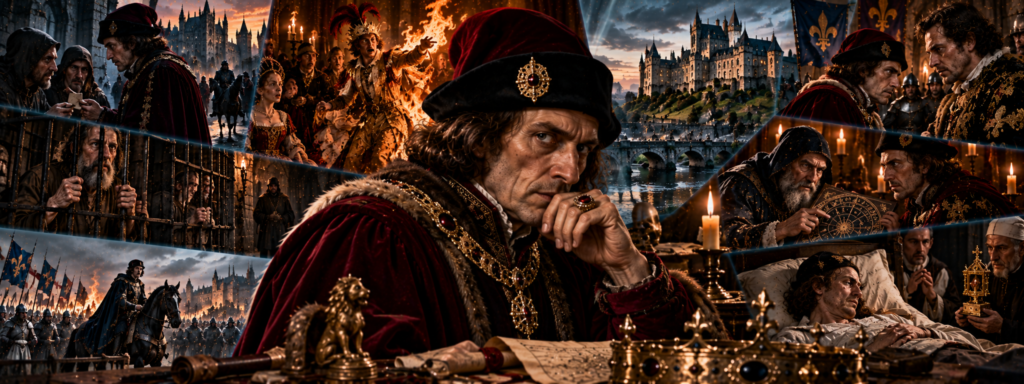
Louis XI of France: The Universal Spider, His Iron Cages, and the King Who Trusted No One
King of France, 1461–1483
He dressed like an ordinary traveler, surrounded himself with informants, imprisoned powerful enemies, and spent his final years behind the defenses of an increasingly secluded royal residence. King Louis XI of France was one of the most intriguing and feared monarchs of the fifteenth century, a ruler whose extraordinary political instincts earned him the enduring nickname the Universal Spider. While other kings displayed their authority through magnificent ceremonies and battlefield glory, Louis preferred secret negotiations, carefully placed agents, intercepted correspondence, and the quiet destruction of dangerous alliances. His enemies accused him of cruelty, deception, and almost unnatural suspicion. Stories circulated about prisoners confined in iron cages, astrologers manipulating his fears, and physicians exploiting his desperate determination to remain alive. Yet behind the sinister reputation stood a ruler who survived rebellions, outmaneuvered powerful rivals, and transformed the balance of power within France. Louis XI was not a clinically mad monarch. His story is more unsettling than that: it concerns a king whose distrust often had genuine political foundations, whose religious devotion coexisted with ruthless statecraft, and whose methods blurred the boundaries between necessary caution, calculated intimidation, and obsession.
The King Behind the Fortress Walls
During the final years of Louis XI’s reign, access to the French monarch became increasingly restricted. At his residence of Plessis-lès-Tours, near Tours, visitors encountered an atmosphere shaped by security precautions, carefully controlled audiences, and the king’s growing concern about his health. The ruler who had once traveled energetically throughout his kingdom now spent much of his time within a comparatively confined environment, directing affairs through messengers, correspondence, and trusted servants.
Louis had good reasons to understand the dangers surrounding medieval kingship. His father had faced rebellion and foreign invasion, powerful princes had repeatedly challenged royal authority, and Louis himself had survived conspiracies, political humiliation, and the threat of captivity. The kingdom he governed was not a peaceful nation-state with a secure monopoly on military power. Great territorial lords maintained armed forces, foreign rulers cultivated French allies, and personal loyalties could change with remarkable speed.
Nevertheless, Louis’s precautions attracted attention even in a world accustomed to fortified residences and guarded monarchs. Accounts describe barriers, defensive works, and restrictions intended to protect the king from unwanted visitors. Some later narratives embellish these arrangements into an almost theatrical landscape of lethal traps, hidden observers, and servants terrified to approach their master. The underlying security measures were real, but many of the most colorful details come from hostile or retrospective accounts and cannot all be verified.
The image of Louis hiding behind walls became inseparable from his reputation. He had spent much of his life building political networks that reached beyond France’s borders, yet he ended his reign increasingly concerned about the vulnerability of his own body. He could negotiate with princes, threaten enemies, reward informants, and command armies, but he could not compel his health to return.
That contradiction lies at the center of his story. Louis devoted his reign to reducing uncertainty in politics, gathering information before his rivals could act, and preventing threats from developing beyond his control. During his final illness, he confronted something his agents could not reliably predict and his wealth could not purchase: the approaching end of his life.
A Prince Raised in Rebellion and Distrust
Louis was born on July 3, 1423, at Bourges, the son of Charles VII of France and Marie of Anjou. His childhood unfolded during the final decades of the Hundred Years’ War, when the French monarchy was struggling to recover from the disastrous reign of his grandfather, Charles VI. England and its allies had controlled substantial French territories, and the legitimacy of Charles VII had been challenged by the Treaty of Troyes.
The political world surrounding Louis was therefore defined by uncertainty. Royal authority depended upon military success, regional loyalties, financial resources, and the cooperation of powerful aristocratic families. The young prince grew up watching his father restore the monarchy through diplomacy, administration, and the gradual recovery of territory.
Charles VII’s achievements were substantial. His reign witnessed the campaigns associated with Joan of Arc, the reconciliation with Burgundy through the Treaty of Arras in 1435, and the military developments that eventually expelled the English from most of their continental possessions. By 1453, the French monarchy had recovered much of the territory lost during the earlier phases of the war.
Yet the relationship between Charles and his eldest son became deeply troubled. Louis demonstrated political ambition at an early age and resisted remaining subordinate to his father’s authority. He cultivated relationships among nobles dissatisfied with royal government, creating concerns about his loyalty.
In 1440, Louis participated in the Praguerie, a rebellion involving prominent nobles who opposed Charles VII’s policies and the expansion of royal authority. The uprising failed, and the young dauphin was eventually reconciled with his father. The episode nevertheless revealed a willingness to challenge the crown long before Louis inherited it.
The rebellion also provided an important lesson. Louis discovered that aristocratic alliances could be dangerous, unstable, and difficult to manage. Powerful nobles might cooperate when their interests coincided, but their loyalties could dissolve when circumstances changed.
In 1446, Louis was sent to govern the Dauphiné, where he exercised considerable independence. He developed administrative experience, cultivated supporters, and pursued policies that sometimes conflicted with his father’s wishes. His conduct demonstrated both political ability and an unwillingness to accept restrictions imposed from Paris.
The conflict intensified after Louis married Charlotte of Savoy in 1451 without obtaining his father’s approval. The marriage strengthened his connections with the House of Savoy but angered Charles VII, who had preferred a different diplomatic arrangement.
By 1456, Louis’s position had become increasingly precarious. Rather than submit to his father’s demands, he fled to the territories of Philip the Good, Duke of Burgundy. There he remained under Burgundian protection until Charles VII died in 1461.
His years in Burgundy were politically formative. Louis observed the wealth, magnificence, and ambitions of one of Europe’s most powerful princely courts. He also learned how vulnerable the French monarchy might become if Burgundy’s resources were directed against it.
When Louis finally inherited the throne, he brought with him years of resentment, political experience, and firsthand knowledge of aristocratic opposition. His later suspicion did not emerge in a vacuum. He had spent much of his adult life participating in precisely the kind of factional maneuvering that he would eventually seek to suppress.
The Unlikely Monarch: A King Who Rejected Royal Splendor
Louis XI became king on July 22, 1461, following the death of Charles VII. His accession marked the beginning of a reign that would differ sharply in style from the magnificent aristocratic courts of his contemporaries. Although Louis understood the importance of ceremony, he developed a reputation for personal simplicity that surprised observers accustomed to the elaborate presentation of royal power.
The king often preferred comparatively plain clothing, particularly practical garments suitable for travel. His hats became famous, especially those decorated with religious images or devotional objects. Later writers emphasized the contrast between his modest appearance and the grandeur of rulers such as Charles the Bold of Burgundy.
This contrast was not merely a matter of taste. Clothing communicated rank, wealth, and political authority in fifteenth-century Europe. A monarch who appeared in relatively unpretentious garments could unsettle expectations and distinguish himself from nobles who invested heavily in visible magnificence.
Nevertheless, descriptions of Louis dressing permanently like a beggar should be treated cautiously. He remained a king with access to valuable clothing, ceremonial objects, and expensive possessions. Royal accounts demonstrate that his household could spend substantially when circumstances required it.
His personal simplicity therefore coexisted with the material demands of monarchy. Louis did not abolish ceremony or reject wealth. Instead, he frequently appeared less interested in spectacular display than in the political advantages that money could secure.
Contemporaries and later historians also emphasized his willingness to converse with people outside the highest aristocracy. He employed officials of varied backgrounds and valued individuals whose administrative or diplomatic abilities could serve the crown. Such appointments sometimes offended nobles who regarded prestigious offices as their natural inheritance.
The famous stories of Louis unexpectedly visiting ordinary households, eating humble meals, or avoiding elaborate civic receptions reflect this reputation for informality. Some may preserve genuine incidents, but others belong to a tradition of anecdotes intended to contrast his unconventional behavior with aristocratic expectations.
The king’s mobility was particularly important. During much of his reign, he traveled frequently, moving between residences and political centers while maintaining contact with officials through correspondence. This was not evidence of a neurological inability to remain still. Medieval rulers commonly traveled, and Louis’s movements served identifiable administrative, diplomatic, and military purposes.
His approach to kingship was unconventional in presentation but highly practical in intent. Louis understood that a ruler could command attention without constantly displaying magnificence. Sometimes the ability to arrive unexpectedly, speak privately, and learn what others believed was more valuable than an elaborate procession.
The Universal Spider: The Web of Information That Covered Europe
Louis XI’s most enduring nickname is the Universal Spider, a description associated particularly with later interpretations of his diplomatic methods. The image suggests a ruler sitting at the center of an immense web, waiting for distant movements to reveal opportunities or threats.
The nickname captures something important about his political conduct, but it should not be mistaken for evidence of a modern intelligence organization. Louis did not possess a centralized secret service resembling those of contemporary states. He relied upon ambassadors, merchants, clerics, couriers, household servants, informants, and personal contacts who supplied information through overlapping networks.
Correspondence was essential to this system. Louis’s surviving letters reveal a ruler intensely engaged with appointments, negotiations, financial arrangements, military developments, and personal relationships. He frequently issued detailed instructions and expected his representatives to report developments promptly.
His agents operated in a political environment where information could be as valuable as military strength. Knowing that a rival prince was negotiating with England, preparing an alliance, or experiencing financial difficulties might allow Louis to intervene before the situation became dangerous.
Money played a major role in his diplomacy. Louis offered pensions, gifts, offices, and financial incentives to individuals whose cooperation could weaken opposing coalitions. Such practices were familiar in medieval politics, but he employed them with particular persistence.
He also cultivated relationships across social and political boundaries. Officials who possessed useful expertise could become influential regardless of whether they belonged to the most prestigious aristocratic families. This contributed to his reputation for surrounding himself with men whom hostile nobles considered socially inferior.
The effectiveness of these methods depended upon patience. Louis could postpone confrontation, negotiate with one opponent while isolating another, and exploit divisions within hostile alliances. He was capable of military action, but he often preferred arrangements that reduced the need for expensive campaigns.
The spider metaphor also reflects the hostility of his enemies. A ruler who negotiated secretly and rewarded defectors could appear treacherous to princes who celebrated open declarations of loyalty and aristocratic honor. Louis’s methods threatened their independence precisely because they operated through personal relationships and financial obligations rather than battlefield confrontation alone.
His suspicion was therefore inseparable from the realities of government. He knew that alliances could change, promises could be broken, and powerful nobles might use foreign support against the crown. The danger was genuine, even if some of his precautions appeared excessive.
The web he constructed was not simply a symptom of fear. It was a political instrument that allowed a relatively vulnerable monarchy to challenge opponents possessing substantial territorial resources.
The League of the Public Weal: When France’s Nobles Turned Against Their King
Louis’s determination to strengthen royal authority quickly provoked opposition. In 1465, a coalition of powerful nobles formed the League of the Public Weal, claiming to oppose abuses in royal government and defend the interests of the kingdom. Among its leading figures was Charles, Count of Charolais, the future Charles the Bold of Burgundy.
The league brought together princes whose individual grievances differed. Some opposed Louis’s administrative policies, others feared the reduction of aristocratic influence, and several sought territorial or political concessions. Their cooperation demonstrated how quickly powerful nobles could unite when they perceived a common threat.
The conflict culminated in the Battle of Montlhéry in July 1465. The engagement was confused and inconclusive, with both sides experiencing difficulties. Louis survived the immediate military danger but faced continuing pressure from the coalition.
Negotiations produced settlements, including the Treaty of Conflans, that required significant concessions. The king surrendered or promised territories and privileges to secure the temporary dissolution of the alliance. To observers, the outcome might have appeared a serious defeat for royal authority.
Louis, however, did not regard every concession as permanent. During the following years, he worked to recover advantages lost in the settlement and undermine the relationships that had sustained the league. His approach reflected an understanding that aristocratic coalitions were often easier to dismantle politically than defeat in a single battle.
The rebellion reinforced his distrust of the great nobility. Men who claimed to defend the public welfare had used military force to secure their own interests, while foreign connections threatened to complicate the conflict. Louis had experienced the danger of princely opposition directly.
Yet the episode also reveals the limits of portraying him as an all-powerful manipulator. He could misjudge situations, suffer military setbacks, and accept humiliating terms when circumstances demanded it. His later successes emerged partly from his willingness to recover from mistakes rather than insist upon immediate victory.
The League of the Public Weal established a pattern that would dominate much of the reign. Louis confronted powerful opponents, sometimes retreated under pressure, and then sought to weaken them through diplomacy, financial incentives, and carefully timed intervention.
His most formidable opponent would be the Duke of Burgundy.
Charles the Bold: The Rival Who Refused to Be Trapped
Few relationships defined Louis XI’s reign more completely than his rivalry with Charles the Bold. Charles inherited the Burgundian dominions in 1467 and pursued an ambitious program intended to strengthen his territories and elevate his dynasty’s status. His possessions extended across a politically fragmented collection of lands that included Burgundy and important territories in the Low Countries.
The two rulers represented contrasting approaches to power. Charles cultivated the elaborate ceremonies and aristocratic ideals associated with the Burgundian court. Louis preferred negotiation, financial inducements, and the exploitation of rivalries among his opponents. These differences were genuine, although later writers exaggerated them into a simple confrontation between an impulsive warrior and a calculating spider.
Charles possessed formidable military resources and substantial revenues from wealthy commercial territories. He also maintained connections with other princes who resented Louis’s policies. For the French king, Burgundy represented a danger that could not safely be ignored.
Their rivalry involved territorial disputes, competing alliances, and conflicting ambitions. Louis sought to limit Burgundian influence within France, while Charles resisted efforts to subordinate his political independence to the crown. Both rulers understood that the outcome could reshape the balance of power in western Europe.
The conflict became particularly dangerous in 1468, when Louis traveled to meet Charles at Péronne. The encounter would produce one of the most humiliating episodes of the French king’s life.
The Trap at Péronne: When the Spider Became the Prisoner
Louis arrived at Péronne in October 1468 hoping to negotiate directly with Charles the Bold. He believed that a personal meeting might resolve outstanding disputes and prevent further military confrontation. The decision was characteristic of his willingness to take diplomatic risks, but it also exposed him to danger.
While the negotiations were underway, news arrived of a revolt in Liège, a city that had long resisted Burgundian authority. Louis had previously maintained contacts with opponents of Burgundy, and Charles suspected that the French king had encouraged the uprising. The timing made Louis’s position extremely vulnerable.
Charles reacted angrily and effectively placed Louis under constraint. The king found himself unable to leave freely while his powerful rival considered how to respond. The circumstances were especially humiliating because Louis had entered Burgundian territory voluntarily, trusting that diplomatic negotiations would protect him.
The king eventually accepted the Treaty of Péronne, making concessions that favored Burgundy. He was also compelled to accompany Charles during the campaign against Liège. The spectacle of the French monarch participating in the suppression of a city associated with opposition to Burgundy was politically embarrassing.
The city suffered severe punishment after its capture. Contemporary accounts describe destruction, executions, and the harsh treatment of inhabitants. Louis’s presence became an enduring symbol of the dangers associated with his diplomatic miscalculation.
Péronne demonstrated that Louis’s reputation for cunning did not make him immune to serious errors. He had underestimated the risk of entering his rival’s power and overestimated his ability to manage events through personal negotiation.
Yet he survived the confrontation. Once free of Burgundian control, Louis gradually worked to undermine the settlement and recover political advantages. The humiliation strengthened his determination to avoid placing himself in a similarly vulnerable position.
The episode also helps explain his later security precautions. Louis had personally experienced the danger of being trapped by a rival prince. His suspicion was not simply an abstract personality trait; it had been reinforced by a confrontation that might have ended far worse.
The Iron Cages: The Darkest Symbol of Louis’s Reign
Among the most notorious features of Louis XI’s reputation are the iron cages associated with his political prisons. Popular accounts describe narrow enclosures in which prisoners could neither stand comfortably nor move freely, sometimes remaining confined for years. The image became one of the most powerful symbols of royal cruelty in later histories.
The fortress of Loches is particularly associated with these stories. Its imposing medieval structures served defensive and administrative purposes, but the site also became an important state prison. Louis continued and expanded practices already developing under his predecessors, using imprisonment to restrain individuals considered politically dangerous.
The historical evidence requires several distinctions. Confinement in heavily reinforced wooden or iron-bound cages was not merely an invention of modern fiction. Surviving descriptions and records support the existence of unusually restrictive prison structures. However, popular accounts often exaggerate their dimensions, duration of use, or association with particular prisoners.
The expression the king’s little girls, or les fillettes du roi, is especially revealing. Contrary to frequent retellings, the term referred to heavy iron restraints or shackles rather than being the standard name for the cages themselves. These restraints were designed to make movement and escape extremely difficult.
The distinction matters because it demonstrates how separate forms of punishment became merged in popular memory. Heavy shackles, fortified cells, wooden cages reinforced with iron, and underground prison chambers were gradually transformed into a single image of an elaborate royal torture system.
One of the best-known prisoners was Cardinal Jean Balue, a churchman who had risen rapidly through Louis’s patronage. Balue became an important royal adviser and received significant ecclesiastical offices. His relationship with the king deteriorated after allegations that he had communicated sensitive information to Burgundy.
Balue was arrested in 1469 and remained imprisoned until 1480. His long detention is historically established, but the familiar claim that he spent all eleven years inside a cramped iron cage is disputed. Some later narratives place him in such confinement, while other evidence does not substantiate the precise circumstances.
The controversy surrounding Balue illustrates the difficulty of separating documented royal severity from stories that accumulated afterward. Louis was certainly capable of holding politically sensitive prisoners for years without an ordinary public trial. Yet the dramatic image of a cardinal continuously suspended or folded inside a tiny cage cannot be accepted without qualification.
The king’s imprisonment policies reflected an approach to political security that prioritized preventing renewed opposition. A powerful prisoner could remain dangerous even after losing an office or territory. Captivity removed such individuals from political networks while avoiding some of the consequences associated with execution.
This did not make the punishment humane. Prolonged confinement, heavy restraints, uncertainty, and isolation could inflict severe suffering. The king’s willingness to employ such measures contributed substantially to his reputation for cruelty.
The iron cages endure in historical memory because they express a central feature of Louis’s government. He preferred enemies who were unable to act, communicate, or organize opposition. When diplomacy failed, physical confinement offered another means of control.
Cardinal Balue: The Favorite Who Became a Prisoner
Jean Balue’s career demonstrates the dangers of proximity to Louis XI. Born into comparatively modest circumstances, Balue advanced through ecclesiastical and political service until he became one of the king’s important advisers. Louis valued capable officials, but his favor could expose them to intense resentment from established aristocratic and clerical interests.
Balue received valuable benefices and eventually became a cardinal in 1467. His advancement reflected the king’s influence over church appointments and the political importance of ecclesiastical offices. In a period when bishops and cardinals frequently participated in diplomacy, religious status did not place a man outside secular politics.
The accusations against Balue concerned communications with Louis’s enemies, particularly Burgundy. Whether every allegation was justified is difficult to establish from the surviving evidence, but the king regarded the matter as a serious betrayal. Balue’s arrest in 1469 abruptly ended his influence.
His imprisonment raised complications because of his ecclesiastical rank. A cardinal possessed privileges that made ordinary secular prosecution controversial. Negotiations involving the papacy failed to secure his immediate release, leaving him in royal custody for more than a decade.
The length of his imprisonment reveals the severity of Louis’s response to suspected disloyalty. The king was unwilling to restore a former adviser whom he considered dangerous, even when the prisoner occupied a prominent position within the Church.
Balue was eventually released in 1480 through papal intervention. He subsequently resumed an ecclesiastical career, demonstrating that his detention had not permanently destroyed his standing within the Church.
His story is often told as a morality tale in which a man supposedly responsible for inventing cruel cages becomes imprisoned inside his own creation. That poetic reversal is memorable, but the details are not securely established. It is safer to recognize the documented betrayal accusations and prolonged captivity without presenting the legendary punishment as certain.
The episode nevertheless reveals the atmosphere surrounding royal service. Louis rewarded useful officials generously, but his confidence could disappear when he suspected divided loyalties. Advancement and danger were closely connected in a court where access to information carried enormous political value.
The King’s Justice: Punishment, Confiscation, and Fear
Louis XI inherited a legal system in which royal justice was expanding but remained intertwined with local privileges, aristocratic jurisdictions, and customary procedures. The monarchy sought to extend its authority through courts, administrative officers, and the enforcement of royal decisions. These developments continued trends established under earlier Valois kings.
The king employed legal proceedings and confiscations against political opponents. Charges of treason could justify the seizure of lands and property, while imprisonment prevented powerful individuals from organizing resistance. Such methods could strengthen the crown financially and politically.
Yet Louis did not possess unlimited authority to imprison or execute anyone without consequences. Great nobles maintained connections that could provoke rebellion, while legal traditions and ecclesiastical privileges complicated royal action. The king often had to balance severity against the risk of creating new enemies.
One of the most notorious figures associated with his government was Tristan L’Hermite, a royal officer whose name became linked in later literature with harsh punishment and secret executions. Tristan had served Charles VII and continued under Louis XI, carrying out important duties connected with royal justice and security.
Later novels and popular histories transformed him into an almost supernatural executioner who obeyed every sinister command. This image reflects literary tradition as much as documented biography. His actual responsibilities belonged to the coercive machinery of monarchy, but individual atrocities attributed to him require verification.
Louis’s treatment of suspected enemies could be severe, especially when he believed their activities threatened the security of the crown. Nevertheless, his government also depended upon pardons, negotiations, and the restoration of former opponents to favor. He sometimes found reconciliation more useful than permanent punishment.
The contrast was central to his political method. An enemy might be imprisoned or deprived of property, but another could receive money, office, or protection in exchange for cooperation. Louis adjusted his response according to circumstances rather than following a uniform policy of exterminating rivals.
His reputation for cruelty emerged partly because his actions challenged aristocratic expectations. Powerful nobles who considered themselves entitled to negotiate with the crown as near-equals increasingly confronted a monarch determined to treat rebellion as an offense against royal authority.
The resulting fear was politically useful, but it carried costs. Harsh punishments could generate resentment, while secretive procedures encouraged rumors about atrocities beyond those actually documented. Louis’s enemies had every incentive to portray him as a ruler whose authority rested upon terror.
His legacy in royal justice therefore combines genuine coercion, institutional development, and a powerful tradition of hostile storytelling.
The Death of Charles the Bold: The Spider’s Greatest Opportunity
Louis XI’s long struggle with Burgundy reached its decisive turning point in January 1477. Charles the Bold had pursued an increasingly ambitious territorial policy, seeking to connect his scattered possessions and strengthen his position among Europe’s ruling dynasties. His campaigns brought him into conflict with the Swiss Confederacy, the Duke of Lorraine, and other opponents.
The Burgundian duke suffered serious defeats at Grandson and Morat in 1476. These disasters damaged his military reputation and weakened his ability to maintain an army capable of intimidating his enemies. Nevertheless, Charles continued pursuing his objectives rather than abandoning the campaign.
On January 5, 1477, he was killed at the Battle of Nancy while fighting forces associated with René II, Duke of Lorraine, and his Swiss allies. His death created an immediate succession crisis because his principal heir was his daughter, Mary of Burgundy.
For Louis, the disappearance of his formidable rival represented an extraordinary opportunity. He moved to assert French royal claims over the duchy of Burgundy and other territories, arguing that certain lands should revert to the crown following the duke’s death.
Mary resisted these claims. Her marriage to Maximilian of Austria in August 1477 connected the Burgundian inheritance to the Habsburg dynasty, creating a new and enduring challenge for French diplomacy. The struggle therefore did not end with Charles’s death.
Louis nevertheless secured important gains, including the duchy of Burgundy and Picardy, although control over parts of the Burgundian inheritance remained contested. His territorial successes strengthened the French monarchy and reduced the danger previously posed by a powerful Burgundian prince operating within the kingdom.
The episode is frequently presented as the ultimate triumph of the Universal Spider. Louis had survived years of confrontation, humiliation, and diplomatic struggle, only to see his principal rival destroyed in a battle he did not personally fight. Yet attributing Charles’s death to an elaborate plan directed entirely by Louis would exaggerate the French king’s control over events.
The Swiss, Lorraine, and other regional powers pursued their own interests. Charles’s military decisions and the circumstances of his campaigns were crucial to his downfall. Louis benefited from developments he had encouraged or exploited, but he did not command every participant in the conflict.
His achievement lay partly in recognizing the opportunity and acting quickly. Where another monarch might have pursued immediate glory on the battlefield, Louis concentrated on securing territories, legal claims, and diplomatic advantages.
The result transformed the political geography of France. Burgundy’s defeat did not eliminate all foreign threats, but it substantially altered the relationship between the crown and its most formidable internal rival.
Buying Peace With England: The Treaty of Picquigny
Louis’s approach to England demonstrated the same preference for financial diplomacy over unnecessary warfare. In 1475, Edward IV of England crossed the Channel with an army, intending to pursue English claims in France. The invasion threatened to revive a conflict that had consumed generations of royal resources.
Louis faced the possibility of confronting English forces while still managing Burgundian hostility. Rather than seek a decisive battle, he opened negotiations with Edward. The resulting Treaty of Picquigny, agreed in August 1475, provided for English withdrawal in exchange for substantial financial payments and diplomatic arrangements.
The settlement included an immediate payment of 75,000 gold crowns and an annual pension of 50,000 crowns to Edward IV, alongside other provisions. A proposed marriage between the English heir and Louis’s daughter Elizabeth formed part of the diplomatic framework, although it was never realized.
To critics who valued battlefield victory, paying a foreign king to depart might appear humiliating. Louis regarded the expenditure differently. A military campaign could consume enormous resources, devastate territory, and produce an uncertain outcome. Financial concessions might secure peace at a more predictable cost.
The agreement also weakened the possibility of coordinated action between England and Burgundy. By reaching a separate understanding with Edward, Louis reduced the danger of confronting two powerful opponents simultaneously.
Later writers sometimes describe Picquigny as an example of Louis defeating England without fighting a battle. The phrase captures his diplomatic approach but oversimplifies the circumstances. Edward possessed his own reasons to negotiate, including the practical challenges of maintaining an army overseas.
The treaty did not permanently end Anglo-French rivalry. It did, however, contribute to a period of relative stability and allowed Louis to concentrate resources on other political objectives.
His conduct at Picquigny reveals why his contemporaries found him difficult to categorize. He could be ruthless toward imprisoned enemies yet generous with money when generosity served his interests. He did not consistently seek glory through warfare, and he was willing to accept arrangements that aristocratic observers considered undignified.
For Louis, preserving political advantage mattered more than satisfying expectations of heroic kingship.
The Saints in His Hat: Devotion, Fear, and Superstition
Louis XI’s religious practices became another source of fascination and criticism. He demonstrated considerable devotion to saints, relics, pilgrimages, religious foundations, and charitable institutions. His correspondence and expenditure reveal repeated efforts to secure spiritual protection and support religious causes.
The king was particularly devoted to the Virgin Mary and maintained important associations with shrines such as Notre-Dame de Cléry. He also supported religious institutions and made donations connected with personal and dynastic concerns.
His hats, sometimes decorated with devotional images, became an enduring feature of his reputation. Later writers portrayed him as a monarch who carried a collection of saints upon his head while planning political betrayals. The contrast between outward piety and ruthless diplomacy offered an irresistible opportunity for satire.
Yet devotional objects were not inherently unusual in fifteenth-century Europe. Rulers, nobles, soldiers, and ordinary believers sought protection through saints, relics, prayers, and pilgrimages. Religious practice permeated daily life, and the boundary between what modern observers call faith and superstition was understood differently.
Louis’s devotion could nevertheless become unusually intense, particularly during periods of illness. He sought religious assistance from distant shrines and attached importance to objects associated with miraculous healing. His actions suggest profound concern about divine favor and personal salvation.
The famous story that Louis prayed to saints for forgiveness before committing political crimes should be approached cautiously. It reflects the enduring image of a king who attempted to reconcile cruelty with religious devotion, but individual conversations and intentions cannot be verified merely because later anecdotes repeat them.
Louis also consulted astrologers and individuals who claimed specialized knowledge about future events. Astrology was practiced within learned and courtly environments, sometimes alongside medicine and astronomy. Consulting astrologers did not automatically indicate mental illness.
One popular anecdote concerns an astrologer who supposedly avoided execution by predicting that he would die shortly before the king. According to the story, Louis became so frightened by the implication for his own survival that he protected the man thereafter.
The tale appears in varying forms and belongs to a broader tradition of clever predictions defeating tyrannical rulers. It should be treated as an anecdote rather than a securely documented event from Louis’s reign.
His religious behavior is more revealing when considered through established actions: donations, pilgrimages, correspondence, patronage, and the pursuit of sacred assistance during illness. These activities demonstrate a ruler deeply engaged with the religious assumptions of his age, sometimes in ways that appeared excessive even to contemporaries.
The darker irony remains. Louis sought divine protection while employing imprisonment, intimidation, and calculated political deception. His faith and statecraft were not separate compartments of his life; they coexisted within the same medieval understanding of royal responsibility, sin, and salvation.
The King’s Doctor: Jacques Coitier and the Price of Staying Alive
During Louis’s final years, his physician Jacques Coitier acquired extraordinary influence. Coitier served a monarch increasingly concerned about his health, and the relationship became famous because of the doctor’s alleged ability to exploit the king’s fear of death.
Louis suffered serious medical episodes during the early 1480s, commonly described as strokes or stroke-like attacks. Reports indicate periods of impaired speech and physical weakness, followed by partial recovery. The precise medical nature of these events cannot be established with certainty from the surviving descriptions.
Coitier occupied a privileged position because he possessed access to the king’s body and private circumstances. In an age when medicine offered limited treatments for severe neurological illness, royal physicians could exercise considerable influence through their knowledge, confidence, and proximity to the patient.
The memoirist Philippe de Commynes, an important witness to Louis’s political world, described the king’s desperate efforts to preserve his life. Later accounts portray Coitier as demanding extravagant rewards and exploiting the monarch’s belief that dismissing him would hasten death.
A famous story claims that the physician threatened Louis by declaring that the king would die within days if deprived of his services. The anecdote illustrates Coitier’s reputation for manipulating royal anxiety, although the exact exchange should not be treated as a verified quotation.
The physician received significant financial benefits and privileges. His position became an example of how access to an ailing ruler could translate into wealth and political influence.
Louis’s dependence upon medical attendants has often been characterized as hypochondria. That description is misleading if it implies that his concerns were imaginary. He experienced serious physical illness, and his fear of death was grounded in genuine deterioration.
His willingness to pay substantial sums for medical assistance is therefore understandable, even when individual treatments offered little realistic hope. Medieval physicians lacked modern knowledge of cardiovascular disease and neurological injury, while royal patients could afford remedies and consultations unavailable to most people.
The relationship with Coitier also reveals a reversal in Louis’s usual political position. Throughout his reign, the king had rewarded and manipulated individuals whose cooperation he required. During his final illness, a physician with access to his health possessed leverage over the monarch himself.
The Universal Spider, accustomed to drawing others into his network of obligations, had become dependent upon a man who understood one of his deepest fears.
The Condemned Prisoner and the Medical Experiment
Another disturbing episode associated with Louis XI concerns a condemned prisoner who was permitted to undergo a dangerous surgical procedure. The story is frequently described as an early medical experiment in which royal authorities offered a prisoner the possibility of survival or pardon in exchange for submitting to an operation.
The historically attested episode involved a prisoner suffering from a serious condition described in medieval medical language as a mal de pierre, generally associated with urinary stones. Accounts of the case concern an operation performed by surgeons who were attempting to treat or study the condition.
Later retellings sometimes describe the procedure as a vivisection ordered purely to satisfy Louis’s curiosity. That characterization is misleading. The episode involved invasive surgery upon a living person, but it should not automatically be equated with deliberate anatomical dissection or an operation performed solely for entertainment.
The circumstances raise serious ethical questions. A condemned prisoner could not negotiate freely with royal authorities, particularly when the possibility of avoiding execution depended upon accepting a dangerous procedure. Consent obtained under such conditions differs fundamentally from voluntary participation.
The story has also been embellished with claims that Louis personally watched the surgery or pursued it to discover a cure for his own gallstones. These details are not securely established. The operation should be examined within the broader history of medieval surgery rather than presented as proof of the king’s supposed psychiatric instability.
Surgical treatment for urinary stones existed in medieval Europe, although it was dangerous and could cause severe bleeding, infection, or death. The involvement of a condemned prisoner demonstrates the unequal distribution of medical risk and the coercive power available to royal authorities.
The episode fits Louis’s wider reputation for using the resources of government in unconventional ways. Yet it does not establish that he suffered from a pathological fascination with human experimentation. The surviving evidence supports a more limited conclusion: royal authority became involved in a dangerous medical procedure whose circumstances would be deeply troubling by modern ethical standards.
Plessis-lès-Tours: The Fortress of a Dying King
As Louis’s health deteriorated, Plessis-lès-Tours became increasingly central to his life. The residence offered relative privacy and security while remaining connected to the administrative networks through which he governed. Its location near Tours allowed the king to maintain contact with officials and messengers without constantly undertaking exhausting journeys.
Accounts describe substantial defensive precautions. Guards controlled approaches to the residence, and barriers limited unauthorized entry. Some later narratives refer to caltrops, iron spikes, and other obstacles intended to injure intruders or prevent mounted attacks.
These descriptions reflect genuine concern with security, but the more theatrical details require scrutiny. The claim that Louis created a secret lethal perimeter known as the King’s Meadow is not established with the same confidence as the broader evidence for guarded access and defensive arrangements.
Stories about concealed listening passages, elaborate spyholes, and unusual alarm bells similarly belong to a mixture of architectural tradition, hostile commentary, and later romanticized history. Medieval residences could contain private passages and controlled entrances, but that does not prove Louis constructed an elaborate system for personally overhearing every conversation.
The king’s withdrawal also should not be described as total isolation from government. He continued directing affairs through correspondence and trusted officials. His surviving letters demonstrate that he remained concerned with political developments even as his physical abilities declined.
His wife, Charlotte of Savoy, and their children occupied important positions within the dynastic household, although the royal family’s domestic arrangements were often geographically dispersed. The assertion that Louis entirely rejected his family during his final years exaggerates the available evidence.
He was particularly concerned about the succession of his surviving son Charles, the future Charles VIII. The prince was young and relatively inexperienced, and Louis sought to arrange political conditions that would protect the dynasty after his death.
The king’s final residence therefore combined two purposes. It provided a controlled environment for a seriously ill man, and it functioned as a center from which the monarchy continued conducting business.
The unsettling atmosphere described by later writers was not wholly imaginary. A ruler who had spent decades confronting conspiracies was now physically vulnerable, dependent upon attendants, and surrounded by security precautions. Yet the residence remained a political headquarters rather than merely a prison of his own making.
The Final Bargain With Death: Relics, Prayers, and Saint Francis of Paola
Louis’s determination to survive became especially apparent in his pursuit of religious assistance. As his condition worsened, he sought the intervention of holy figures and sacred objects believed capable of bringing healing or divine favor.
Among the most notable episodes was his effort to bring Francis of Paola, the Italian hermit and founder of the Minims, to France. Francis possessed a reputation for extraordinary holiness, and Louis hoped that his presence might provide spiritual comfort or miraculous assistance.
The king’s request required diplomatic intervention, including papal involvement, before Francis traveled to the French court. The hermit’s arrival became one of the defining stories of Louis’s final illness.
Later narratives portray the king pleading for a miracle while Francis emphasized spiritual preparation and acceptance of death. The exact conversations cannot be reconstructed, but the encounter reflects a genuine contrast between royal expectations and the religious understanding of mortality.
Louis also sought relics associated with revered saints and holy institutions. Such efforts were consistent with medieval beliefs concerning sacred intercession. For a seriously ill ruler, spiritual assistance could appear as important as medical treatment.
His behavior has often been described as frantic superstition. There is evidence of intense anxiety about death, but the interpretation should not ignore the religious environment in which he lived. Medieval rulers routinely made donations, requested prayers, and sought the assistance of saints during illness.
What distinguished Louis was partly the scale of the resources he could mobilize. He could summon physicians, request relics from distant institutions, and involve foreign religious authorities in his search for assistance.
The king who had once influenced political events across Europe now used similar networks in an effort to preserve his life. His correspondence and diplomatic connections could bring holy men and sacred objects to his residence, but they could not guarantee recovery.
The episode provides a more revealing portrait of Louis than the legendary astrologer’s clever prediction. His fear was genuine, his illness was serious, and his response combined the resources of monarchy with the religious expectations of his age.
The Death of Louis XI and the Kingdom He Left Behind
Louis XI died on August 30, 1483, at Plessis-lès-Tours, aged sixty. His death ended a reign of twenty-two years during which the French monarchy had confronted powerful aristocratic coalitions, foreign intervention, territorial disputes, and repeated challenges to royal authority.
He was buried at Notre-Dame de Cléry, reflecting his longstanding devotion to the shrine. His burial arrangements differed from the traditional association of French kings with Saint-Denis, illustrating the importance of his personal religious attachments.
His son succeeded as Charles VIII, still a minor. Government during the early years of the new reign was dominated by Louis’s daughter Anne of France and her husband Pierre de Beaujeu, who helped preserve the monarchy’s authority during the transition.
Louis had strengthened the crown’s territorial position, particularly through the acquisition of Burgundian lands following the death of Charles the Bold. He also benefited from the extinction or reversion of other important princely lines, including developments involving Anjou and Provence near the end of his reign.
These gains contributed to the expansion of royal resources and authority. Nevertheless, France was not yet a fully centralized modern nation-state. Powerful regional privileges, local institutions, and aristocratic interests remained important, while the monarchy continued negotiating with territorial and corporate bodies.
His administrative legacy was similarly complex. Louis used officials, correspondence, financial incentives, and diplomatic networks to strengthen the crown. He also employed imprisonment, confiscation, intimidation, and severe punishment against perceived enemies.
His reputation for suspicion cannot be separated from the political environment he inherited. France had only recently emerged from the Hundred Years’ War, and powerful princes still possessed the capacity to challenge the monarchy through military force. Louis had personally participated in rebellion and experienced the dangers of factional politics before becoming king.
Yet understanding the origins of his distrust does not require excusing every action. His imprisonment of opponents could be prolonged and harsh, and his willingness to manipulate relationships created resentment among contemporaries.
The reign therefore resists simple classification. Louis was neither a harmless eccentric nor the omnipotent villain of later romantic literature. He was a ruler whose methods could be effective, coercive, inventive, and deeply unsettling.
Was Louis XI Mad? Suspicion, Strategy, and the Limits of Retrospective Diagnosis
Louis XI’s reputation for madness rests primarily upon descriptions of extreme suspicion, unusual personal habits, intense religious devotion, and fear of death. These characteristics differ fundamentally from the severe recurring psychiatric disturbances documented during the reign of his grandfather Charles VI.
There is no convincing evidence that Louis experienced comparable episodes of psychosis, profound identity disturbance, or sustained incapacity caused by mental illness. His political correspondence and decisions reveal considerable continuity of purpose, even when his methods were controversial.
Claims that he suffered from a neurological condition producing compulsive movement or hyperactivity are speculative. His frequent travels served practical political purposes and were consistent with the itinerant traditions of medieval monarchy.
His plain clothing does not establish psychological abnormality. It reflected personal preference and could serve political purposes by distinguishing him from more ostentatious aristocratic rivals.
His consultation of astrologers and devotion to relics must be understood within fifteenth-century religious culture. Such practices could be intense or unusual in degree without constituting evidence of delusional belief.
His suspicion also had identifiable political foundations. He had experienced rebellion, exile, betrayal, and confinement, while powerful rivals maintained genuine military and diplomatic resources. The existence of real threats complicates any attempt to interpret his caution as pathological paranoia.
His final fear of death likewise occurred in the context of serious physical illness. Desperation, dependence upon physicians, and the pursuit of religious assistance were understandable responses to deteriorating health, even when particular decisions appeared excessive.
The most disturbing aspects of his reign concern political conduct rather than psychiatric symptoms. Prolonged imprisonment, coercive punishment, manipulation of alliances, and the exploitation of vulnerable opponents were choices made within the structures of medieval government.
Louis XI therefore belongs in the history of reputedly mad monarchs because his behavior challenged contemporary expectations and inspired an unusually dark historical reputation. He does not belong there because the evidence establishes clinical insanity.
The distinction matters. Calling a ruler mad can turn deliberate political actions into symptoms, obscuring responsibility and reducing complicated historical circumstances to a simplistic psychological explanation.
The Universal Spider’s Last Web: A King Who Could Control Almost Everything Except His Fate
Louis XI inherited a kingdom still recovering from generations of warfare and political fragmentation. During his reign, he confronted powerful princes, survived humiliating reversals, negotiated with foreign monarchs, and strengthened the territorial authority of the French crown. His methods often differed from the ideals celebrated by the aristocracy, but they reflected a consistent concern with security and political advantage.
His rivalry with Charles the Bold demonstrated the importance of patience and diplomacy in an age that continued to glorify military courage. His negotiations with Edward IV showed that financial concessions could sometimes achieve objectives more efficiently than warfare. His treatment of prisoners revealed the darker consequences of a government determined to prevent opposition through coercion.
The king’s personal habits made him an irresistible subject for chroniclers. His plain clothing, religious objects, guarded residences, unusual conversations, and reliance upon informants contrasted sharply with conventional images of royal magnificence. These details contributed to a reputation that later writers expanded through stories of hidden passages, sinister cages, frightened astrologers, and cruel experiments.
Some of those stories preserve genuine aspects of his reign. Others distort the evidence or transform isolated incidents into elaborate legends. The historical Louis emerges most clearly when the documented events are separated from the anecdotes that accumulated around his name.
His final years exposed the limitations of his political methods. Louis could reward loyalty, punish betrayal, purchase alliances, and direct officials across considerable distances. He could not secure certainty about his own survival. His dependence upon physicians and religious intercession revealed the vulnerability concealed beneath decades of calculated authority.
Louis XI was not a clinically mad king, but he became one of the most unsettling figures in French royal history because his methods made suspicion an essential instrument of government. He understood that power could be exercised through information as effectively as through armies, and that an enemy deprived of allies might be defeated without a decisive battle. He also demonstrated how easily the pursuit of security could justify imprisonment, intimidation, and the erosion of trust. His political achievements strengthened the French monarchy, but they did not erase the suffering of those who fell under royal suspicion. The image of the Universal Spider remains memorable because it captures both the reach and the limitations of his authority. He spent his reign constructing networks that allowed him to influence events far beyond his immediate presence, yet his final years unfolded within the guarded confines of a residence where doctors, servants, and religious figures attended a failing body. The king who had devoted his life to anticipating danger could not negotiate with mortality, imprison it, or purchase its withdrawal. His legacy is therefore not simply the story of a clever monarch who outmaneuvered his enemies. It is the darker history of a ruler who sought security through control, accumulated extraordinary political power, and discovered that the greatest uncertainty of all remained beyond his command.