
Pius II: The Pope Who Renounced His Scandalous Past and Tried to Save Christendom
Pius II — 1458–1464
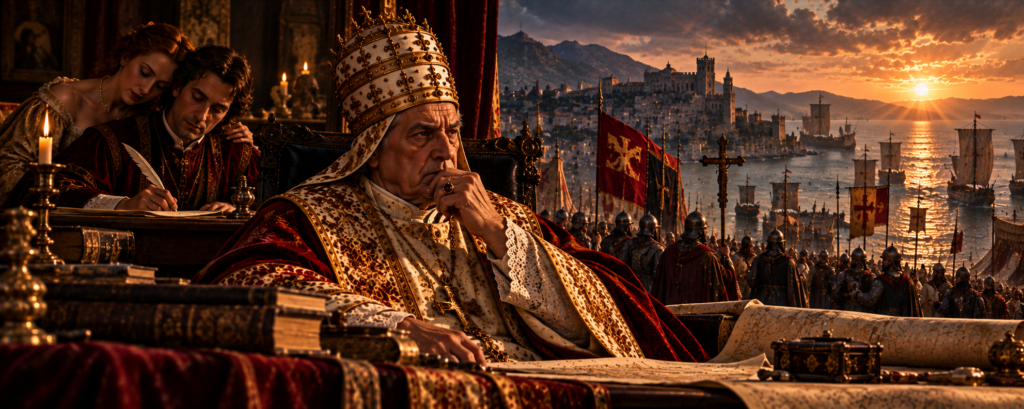
In August 1464, an elderly and gravely ill pope waited in the Italian port of Ancona for an army that never truly materialized. Across the Adriatic Sea lay the Ottoman territories he had spent years urging Christian rulers to attack, and somewhere beyond them stood Constantinople, the magnificent Byzantine capital that had fallen to Sultan Mehmed II eleven years earlier. Pope Pius II had traveled to Ancona despite failing health, determined to lead a crusade in person if Europe’s princes would not act without him. Instead, he found himself confronting the collapse of his grandest ambition, watching preparations falter while the expedition he had sacrificed so much to organize remained little more than a collection of promises, scattered volunteers, and insufficient ships.
The scene was extraordinary enough on its own, but the identity of the dying pope made it almost unbelievable. Before becoming Pius II, Enea Silvio Piccolomini had been a poet, diplomat, political opportunist, passionate defender of church councils against papal authority, and author of one of the most popular erotic romances of the fifteenth century. He had fathered illegitimate children, written frankly about love and sexual desire, and moved through the courts of Europe with the confidence of a man who understood both human weakness and political ambition. His early life seemed better suited to the pages of a Renaissance romance than to the biography of a pope.
Yet the man who eventually occupied the throne of Saint Peter became one of the most determined defenders of papal supremacy in his generation. He condemned appeals from papal judgments to future church councils, repudiated positions he had once championed, and demanded that Europe’s rulers unite beneath the banner of a new crusade. The former writer of romantic adventures now warned Christian princes against worldly pleasures and political selfishness. The former supporter of an antipope had become an uncompromising advocate of the authority of Rome.
Was this an extraordinary religious conversion, a remarkable act of political reinvention, or something more complicated? His contemporaries asked similar questions, particularly those who remembered the opinions he had expressed before receiving holy orders. Critics accused him of abandoning principles whenever his circumstances changed, while admirers saw a brilliant humanist who had matured into a deeply committed churchman. Both interpretations contain elements of truth, but neither fully captures the contradictions of his life.
Pius II does not belong among the Wicked Popes in quite the same way as the most notoriously corrupt, violent, or sexually scandalous occupants of the papal throne. His darker history lies in the tension between the man he had been and the authority he later demanded, between his genuine intellectual gifts and his willingness to suppress positions he once defended, and between his passionate desire to save Christian Europe and the political realities that made his crusading ambitions so dangerous and difficult to achieve. His story is not primarily one of spectacular wickedness. It is the story of a man who spent much of his life changing sides, reinventing himself, and finally dying in pursuit of a cause that almost nobody else was prepared to follow.
A Noble Family Without a Fortune
Enea Silvio Piccolomini was born on October 18, 1405, in Corsignano, a small Tuscan settlement near Siena. His family belonged to the Sienese nobility, but noble ancestry did not necessarily mean wealth, security, or political influence. The Piccolomini had experienced financial difficulties and political setbacks, leaving Enea to grow up in circumstances considerably more modest than those enjoyed by the great aristocratic families of Italy. His parents, Silvio Piccolomini and Vittoria Forteguerri, could offer him an honorable name but not the kind of fortune that guaranteed advancement.
The world into which he was born was politically fragmented and intensely competitive. Italian cities fought over territory, noble families struggled for influence, and powerful rulers attempted to extend their authority across the peninsula. The papacy itself remained entangled in the consequences of the Western Schism, while churchmen increasingly debated whether a pope should possess unrestricted authority over the wider Church. For an ambitious young man without substantial wealth, education offered one of the most promising routes into this complicated world.
Enea displayed intellectual ability early in life and eventually studied at the University of Siena. He pursued law, but his interests extended far beyond legal texts and ecclesiastical administration. Classical literature fascinated him, particularly the writings of ancient Roman poets, historians, and orators. The revival of classical learning that characterized Renaissance humanism offered him a language through which ambition, politics, love, morality, and human behavior could be explored with unusual sophistication.
He was especially attracted to the possibilities of writing. Poetry and elegant Latin prose could win admiration, secure employment, and bring an otherwise obscure scholar to the attention of powerful patrons. Enea understood that literary talent could become a form of political currency. Long before he became pope, he was learning how words could open doors that birth and money had left closed.
The Young Humanist Who Loved the World
The young Piccolomini was not drawn immediately toward the disciplined life of a priest. His interests were literary, political, social, and frequently romantic. He admired classical authors who wrote openly about love and desire, and he belonged to a humanist culture that often celebrated wit, elegance, and worldly experience. His surviving writings reveal a man who could discuss human passions with remarkable frankness.
This did not make him unique among Renaissance scholars. Humanism brought renewed attention to ancient literature, including works that medieval moralists sometimes regarded with suspicion. Educated men studied Ovid, Virgil, Cicero, and other classical authors not simply as historical curiosities but as models of style and intellectual achievement. The result was a culture in which Christian learning and classical sensuality could exist in uneasy proximity.
Enea embraced that tension rather than avoiding it. He wrote poetry, cultivated friendships, and developed an interest in romantic relationships that would later become a source of embarrassment to his papal identity. His early correspondence sometimes treated love and sexual experience with a candor that seemed startling when viewed through the expectations attached to a pope. These writings would eventually become ammunition for critics who questioned the sincerity of his transformation.
Yet it would be misleading to imagine him as a man interested only in pleasure. He was intensely ambitious, intellectually disciplined, and capable of sustained work. His literary interests formed part of a larger determination to escape obscurity. The young humanist wanted a place among the powerful men who shaped European affairs.
The Council of Basel Opens a Dangerous Door
In 1431, Enea entered the service of Cardinal Domenico Capranica and traveled toward the Council of Basel. The gathering would become one of the most important experiences of his life. It had been summoned during a period when many churchmen believed that general councils could provide the reforms that individual popes had failed to achieve. The memory of the Western Schism remained powerful, and the constitutional relationship between pope and council was far from settled.
The Council of Constance had helped end the Schism in 1417, but it also encouraged arguments that the wider Church, represented through a general council, possessed authority that could supersede the pope under certain circumstances. Supporters of this position became known as conciliarists. They believed that collective ecclesiastical authority offered protection against papal abuses and institutional paralysis. Their opponents warned that such arguments threatened the unity and authority of the papacy itself.
Enea became increasingly involved in the council’s affairs. He served important churchmen as a secretary, developed connections with influential participants, and gradually emerged as a capable writer and diplomat. His command of Latin and his ability to formulate persuasive arguments made him useful within a gathering where political influence often depended upon speeches, documents, and legal reasoning. The council offered him an international stage.
He also became a committed supporter of the conciliar movement. This position was not a minor youthful opinion expressed casually in private correspondence. He wrote and worked on behalf of the council during its increasingly bitter confrontation with Pope Eugenius IV. The future defender of papal supremacy was beginning his public career by challenging the authority of the pope.
The War Between Pope and Council
Relations between Eugenius IV and the Council of Basel deteriorated into a struggle over the government of the Church. The pope attempted to control or dissolve the gathering, while conciliar leaders insisted that their authority could not simply be extinguished by papal command. Each side claimed to defend the proper order of Christianity. Beneath the theological arguments lay competing visions of how power should operate.
Enea supported the council during its increasingly radical phase. He helped articulate positions that placed collective ecclesiastical authority above the personal decisions of the pope. His arguments were sophisticated and politically useful. They also placed him in direct opposition to the institution he would later govern.
The conflict eventually produced another papal claimant. In 1439, the remaining conciliar faction elected Amadeus VIII, the former duke of Savoy, who took the name Felix V. The election revived the danger of competing papal obediences only two decades after the Western Schism had supposedly ended. Enea became associated with Felix’s administration and served as one of his secretaries.
Later Catholic history would classify Felix V as an antipope. Enea’s participation in his cause therefore became one of the most embarrassing episodes of his earlier career. The man who would eventually insist upon obedience to the Roman pontiff had once worked for a rival claimant created through opposition to that authority. His future transformation would require more than a change of employer.
A Diplomat Who Learned to Change Sides
Enea’s involvement with Basel brought him into contact with rulers, diplomats, and ecclesiastical representatives from across Europe. He traveled widely and developed a sophisticated understanding of the political interests shaping the conflict. His work required tact, persuasion, and the ability to adjust arguments to different audiences. These experiences helped transform a talented scholar into an accomplished diplomat.
He also began recognizing the practical weaknesses of the conciliar movement. Basel’s authority depended upon the willingness of rulers and churchmen to support it, and that support was increasingly uncertain. The council’s confrontation with Eugenius IV had created divisions that threatened to undermine its original reforming ambitions. What had begun as a movement for unity risked producing another prolonged schism.
By the early 1440s, Enea’s political loyalties were changing. He moved away from Basel and entered the service of Frederick III, the Habsburg ruler who would later become Holy Roman Emperor. The transition placed him within a powerful imperial court and opened new opportunities for advancement. It also marked the beginning of his gradual reconciliation with the Roman papacy.
Critics later interpreted the change as evidence of opportunism. Supporters argued that experience had convinced him that conciliar resistance was damaging the Church. The surviving record supports the reality of his changing position but cannot establish a single simple motive. Political calculation, intellectual reconsideration, religious development, and personal ambition may all have contributed.
Poet Laureate at the Imperial Court
In 1442, Frederick III honored Enea with the title of poet laureate. The distinction recognized his literary accomplishments and strengthened his position within the imperial court. For a man who had begun life without substantial wealth or political influence, the honor represented a remarkable achievement. His command of language had become a passport into the highest circles of European government.
Enea served as an imperial secretary and participated in diplomatic affairs. He observed the tensions between German princes, imperial authority, and the papacy. His correspondence reveals an intelligent and frequently critical observer of European politics. He understood how rulers used religious questions to advance territorial and dynastic interests.
The imperial court also provided an environment in which his literary interests continued to flourish. He wrote historical and geographical works, political commentary, poetry, and fiction. His writing ranged from serious reflections on government to accounts of romantic entanglements. He was not yet the austere defender of ecclesiastical discipline who would later occupy the papal throne.
This period became central to his later reputation because it produced the work most frequently used to illustrate his worldly past. In the 1440s, Enea wrote a Latin romance that would become extraordinarily popular. Its subject was not papal authority, crusading, or the reform of the Church. It was forbidden love.
The Tale of Two Lovers
Enea’s Historia de duobus amantibus, commonly translated as The Tale of Two Lovers, was written in 1444. Set in Siena, the story concerns a passionate relationship between a married woman named Lucretia and a man named Euryalus. The narrative explores attraction, secrecy, longing, deception, and the consequences of illicit desire. It became one of the most widely circulated works of Latin prose fiction during the Renaissance.
The story was not simply an innocent celebration of courtly affection. It treated sexual desire with a frankness that later readers found surprising in a work written by a future pope. Enea drew upon classical literary models, especially traditions associated with Ovid and ancient love poetry. His characters inhabited a world in which passion could overwhelm prudence and social obligation.
The work’s popularity reflected its literary skill as well as its provocative subject. Readers admired its elegant Latin, emotional intensity, and vivid portrayal of romantic intrigue. The story circulated widely in manuscript and later in print. Long after Enea became pope, his earlier fiction continued reaching audiences.
Its existence created an obvious problem for his later reputation. A pope who condemned worldly attachments had once written a celebrated account of adulterous passion. His defenders could argue that the work belonged to an earlier stage of life, while critics could accuse him of hypocrisy. The tension between the novelist and the pontiff would become one of the defining contradictions of his biography.
The Women and Children of Enea Silvio
Enea’s worldly reputation was not based entirely upon fiction. Before entering the priesthood, he had sexual relationships and fathered two children outside marriage. One child was born during his travels in Scotland, while another was born later in the German-speaking lands. The children did not survive to adulthood, and the surviving evidence does not provide a complete account of their mothers or family circumstances.
The existence of these children is historically significant because Enea himself acknowledged aspects of his earlier sexual life. His later reputation did not depend solely upon hostile accusations invented by enemies. He had lived in a manner that differed considerably from the expectations eventually attached to his papal office. His own writings make that distinction difficult to ignore.
It is equally important to recognize the chronology. Enea fathered these children before receiving priestly ordination, rather than secretly maintaining a household of illegitimate children while serving as pope. Medieval clerical expectations were complicated, but the distinction between his earlier secular life and later ecclesiastical career matters. Treating every episode as though it occurred during his pontificate would distort the historical record.
His experiences nevertheless complicated the image he later cultivated. The pope who urged moral discipline knew from personal experience the attractions and consequences of romantic relationships. His understanding of human desire was not merely theoretical. That familiarity may help explain the psychological depth of his early writing, although it does not allow us to reconstruct his private feelings with certainty.
The Slow Road Toward the Priesthood
Enea’s movement toward an ecclesiastical career was gradual rather than instantaneous. He spent years serving political and religious figures without fully embracing the priestly vocation. His literary interests and personal relationships remained important during this period. The eventual decision to enter holy orders therefore marked a substantial change in his public identity.
During the mid-1440s, he reconciled himself with the Roman papacy and moved away from the conciliar positions he had previously defended. He received priestly ordination in 1446, when he was already in his forties. The following year, Pope Nicholas V appointed him bishop of Trieste. In 1449, he became bishop of Siena.
These appointments demonstrated how successfully he had rebuilt his position within the Church. A former supporter of the Council of Basel and Felix V was now receiving important offices from the recognized papacy. His diplomatic abilities remained valuable, and his connections with Frederick III strengthened his influence. The transition was remarkable even by the flexible standards of Renaissance politics.
Whether this represented a sudden spiritual conversion is difficult to establish. Enea certainly adopted a more serious ecclesiastical identity and increasingly defended papal authority. Yet his political career continued, and his ambition did not disappear. The transformation was genuine in its consequences, even if the mixture of motives behind it remains uncertain.
The Man Who Helped Reconcile an Emperor and a Pope
Enea became an important intermediary between Frederick III and the Roman papacy. His diplomatic work helped improve relations during a period when the Church was attempting to overcome the remaining consequences of the conciliar crisis. He understood the arguments of both sides because he had worked within competing political and ecclesiastical environments. That experience made him unusually effective.
He helped negotiate arrangements that strengthened the relationship between the imperial court and Pope Eugenius IV. His participation in the diplomatic settlement culminating in the Vienna Concordat of 1448 further established his reputation. The agreement regulated aspects of ecclesiastical appointments and relations between the papacy and the German lands. It also helped consolidate the position of the Roman papacy after the upheavals surrounding Basel.
The irony was striking. A man who had once defended conciliar authority was now helping restore the very papal influence he had challenged. His knowledge of the conciliar movement made him a particularly valuable advocate for its opponents. He understood the language, arguments, and political weaknesses of his former associates.
This pattern would continue throughout his life. Enea frequently used experience gained on one side of a dispute to strengthen his position on the other. Admirers considered this evidence of intellectual development and diplomatic maturity. Critics saw a man whose principles changed whenever advancement required it.
Cardinal Piccolomini
In December 1456, Pope Callixtus III created Enea Silvio Piccolomini a cardinal. The appointment brought him into the College of Cardinals, the institution responsible for electing the pope. He had now traveled an extraordinary distance from the young scholar who attended the Council of Basel. His career had passed through humanist circles, imperial service, conciliar politics, and episcopal government.
The cardinalate also placed him among men whose ambitions and alliances would determine the future of the Church. Italian families competed for influence, while European monarchies sought to shape papal policy. The Ottoman conquest of Constantinople in 1453 had created a new urgency surrounding crusading plans. The College of Cardinals therefore operated at the center of both religious and geopolitical conflict.
Enea’s reputation combined intellectual brilliance with considerable political experience. He was a skilled speaker, an accomplished writer, and a diplomat familiar with the courts of Europe. His earlier controversies had not disappeared, but they no longer prevented advancement. The Church had found uses for the talents of a man who had once opposed its central authority.
Callixtus III died in August 1458. The cardinals assembled to elect his successor amid the political tensions created by the previous pontificate. Enea was not the most obvious candidate at the beginning of the process. Yet his experience, connections, and ability to appeal across factions made him increasingly attractive.
The Conclave That Changed Everything
The conclave of August 1458 took place against a background of rivalry between Italian and French interests. Powerful candidates attracted support, but their strength also provoked resistance. Cardinal Guillaume d’Estouteville emerged as an important contender, while other cardinals sought alternatives. Enea Silvio Piccolomini gradually became a compromise candidate capable of gathering broader support.
His election was not inevitable. He faced opposition from men who remembered his controversial past or questioned his suitability. His health was also imperfect, and he was already in his early fifties, an age that could be considered advanced in the political and medical circumstances of the period. Nevertheless, his diplomatic reputation and persuasive abilities helped him secure the necessary votes.
On August 19, 1458, he was elected pope. He chose the name Pius II, a choice associated with the classical figure of Aeneas and the language of filial devotion celebrated in Virgil’s Aeneid. The name suited a Renaissance humanist whose intellectual identity had been shaped by classical literature. It also signaled a new chapter in his life.
The transformation was astonishing. The former secretary of an antipope had become the recognized pope. The author of an erotic romance now occupied the highest office of the western Church. The man who had once argued against papal supremacy was about to defend it with extraordinary determination.
The Past That Followed Him Into the Vatican
Pius II could not erase the writings and relationships of his earlier life. His literary works had circulated widely, and many educated Europeans remembered his association with the Council of Basel. The new pope therefore inherited a reputation that did not fit neatly with the dignity of his office. His enemies had material available whenever they wished to question his consistency.
The most damaging issue was not necessarily his sexual history. Although his illegitimate children and romantic writings attracted attention, medieval and Renaissance observers were familiar with the moral shortcomings of powerful churchmen. The deeper constitutional problem concerned his earlier support for conciliarism. He had once defended principles that could limit or challenge the authority he now possessed.
Pius responded by openly repudiating positions associated with his earlier career. He urged readers to distinguish the writings of Enea Silvio from the teachings of Pius II. The distinction was rhetorically effective because it presented his transformation as a movement from youthful error toward mature understanding. It also invited the obvious accusation that his principles had changed when his office changed.
His supporters regarded the repudiation as an honest correction. Human beings could learn from experience, and a man who had witnessed the destructive consequences of conciliar conflict might reasonably reconsider his earlier views. His critics remained unconvinced. To them, the former conciliarist had become an absolutist precisely when absolutism benefited him.
Yesterday’s Rebel, Today’s Defender of Authority
The Council of Basel had shaped Enea’s political education, but it also became the intellectual enemy of his papacy. As Pius II, he increasingly emphasized the authority of the Roman pontiff over attempts to challenge papal judgments through future councils. He regarded such appeals as dangerous instruments through which dissatisfied rulers and churchmen could undermine ecclesiastical government. The experience of the Western Schism and Basel provided a powerful historical argument for his position.
Yet the change remained deeply ironic. Earlier in life, Enea had worked for a council that challenged a reigning pope and eventually supported the election of Felix V. He had defended the idea that extraordinary ecclesiastical circumstances justified collective action against papal authority. Now he feared that the same principle could become a permanent weapon against the papacy. His own career illustrated both sides of the controversy.
This was more than a personal embarrassment. The relationship between councils and popes remained one of the most important constitutional questions facing the late medieval Church. Supporters of conciliarism believed that unchecked papal power could produce corruption and institutional paralysis. Defenders of papal supremacy warned that allowing councils to override popes could create endless competing authorities.
Pius chose the second position decisively. He did not merely express a preference for strong papal leadership. He used formal papal authority to condemn a procedure that had once been central to his own political world. The reversal became one of the defining acts of his pontificate.
The Bull That Condemned His Former Cause
On January 18, 1460, Pius II issued the bull Execrabilis. The document condemned the practice of appealing from a papal judgment to a future general council. Such appeals had become a means through which individuals and rulers attempted to resist decisions they disliked. Pius regarded the practice as a direct threat to ecclesiastical order.
The bull did not simply erase the existence or importance of church councils. Its central target was the use of an appeal to a future council as a mechanism for suspending or challenging papal authority. Pius argued that such a procedure encouraged disobedience and weakened the government of the Church. The condemnation carried serious ecclesiastical consequences.
For anyone familiar with his earlier career, the contradiction was impossible to miss. Enea Silvio Piccolomini had once supported the conciliar movement against Eugenius IV. Pope Pius II now condemned one of the principal instruments through which opponents of papal decisions sought relief. His critics could hardly have asked for a more convenient example of apparent inconsistency.
Yet the historical judgment requires care. Changing an opinion after years of political experience is not automatically hypocrisy. Pius had witnessed the destructive consequences of the Basel conflict and may genuinely have concluded that conciliar resistance threatened Christian unity. The uncomfortable fact is that his new conviction also strengthened the office he now held.
A Pope Who Wanted Europe to Obey
Pius II inherited a Church whose spiritual authority remained immense but whose ability to command European rulers was limited. Kings and princes frequently placed dynastic interests above papal requests. Territorial disputes, rival alliances, and financial pressures complicated efforts to coordinate international action. The pope could issue exhortations, but he could not simply compel Europe’s armies to march.
This limitation frustrated him throughout his pontificate. He believed the Ottoman conquest of Constantinople represented a danger requiring a united Christian response. Yet the rulers whose cooperation he needed were often more concerned with conflicts closer to home. The contrast between papal ambition and political reality became increasingly painful.
Pius approached the problem with the confidence of an experienced diplomat. He had spent decades negotiating with rulers and understood the language of European politics. He believed persuasion, public ceremony, moral pressure, and carefully constructed alliances might produce results. His eloquence became one of his principal weapons.
Nevertheless, speeches could not overcome every political obstacle. The same rulers who praised the ideal of crusading often refused to provide the necessary troops or money. Pius would spend much of his papacy discovering how little practical obedience the spiritual head of western Christianity could command. His final journey to Ancona would expose that weakness in its most humiliating form.
The Shadow of Constantinople
The fall of Constantinople in 1453 haunted the imagination of Pius II. The city had been the capital of the Byzantine Empire and one of the great centers of Christian civilization. Its conquest by Mehmed II transformed the balance of power in the eastern Mediterranean. For many western Christians, the event appeared to signal the beginning of a wider catastrophe.
Pius interpreted the Ottoman advance through a combination of religious conviction, historical learning, and political anxiety. He understood the symbolic importance of Constantinople and feared further Ottoman expansion into Europe. His writings frequently presented the struggle as a defining challenge for Christian rulers. The issue became increasingly central to his understanding of the papal office.
His predecessor Callixtus III had pursued a crusade with considerable determination. The Christian victory at Belgrade in 1456 had demonstrated that Ottoman armies could be resisted, but it had not produced the broader campaign the papacy desired. Pius inherited both the hope created by Belgrade and the disappointment caused by Europe’s lack of unity. He believed the opportunity had not entirely disappeared.
His ambitions were sweeping. He wanted Christian princes to set aside rivalries, contribute forces, and participate in a major campaign against Ottoman power. The objective was not simply defensive diplomacy. It was a religious war intended to reverse or contain Ottoman expansion.
The Congress of Mantua
In 1459, Pius summoned a congress at Mantua to organize a crusade. The gathering was intended to bring together representatives of Europe’s rulers and transform expressions of concern into concrete military commitments. It offered the pope an opportunity to use the diplomatic skills he had developed throughout his earlier career. The setting also provided a stage for his eloquence.
Pius delivered powerful appeals urging Christian rulers to recognize the danger posed by Ottoman expansion. He framed the issue as a collective responsibility transcending local political interests. The fall of Constantinople served as a warning of what could happen when Christian powers failed to cooperate. His arguments were designed to shame hesitation and inspire action.
The response was disappointing. Important rulers were absent or represented by envoys whose authority to make binding commitments was limited. Diplomatic discussions became entangled in disputes over territory, taxation, military leadership, and political precedence. The congress produced declarations and plans, but not the unified army Pius desired.
The failure exposed a fundamental weakness in his crusading vision. The pope imagined Christendom as a community capable of acting together under religious leadership. European rulers operated within a system of competing states and dynastic interests. The gap between those realities would haunt the remainder of his pontificate.
France, Burgundy, and the Problem of Rival Ambitions
The French monarchy presented one of the most difficult obstacles to Pius’s plans. France possessed enormous military resources, but its rulers were deeply involved in their own political priorities. Relations with the papacy were complicated by longstanding disputes over ecclesiastical appointments and the rights of the French crown. The pope needed French cooperation but could not assume it.
Louis XI, who became king of France in 1461, pursued policies shaped by the interests of his kingdom. The Pragmatic Sanction of Bourges, adopted under Charles VII in 1438, had restricted aspects of papal influence over the French Church. Louis’s decision to revoke it in 1462 appeared to offer Pius an important diplomatic victory. Yet the relationship remained complicated by disagreements over Naples and other political questions.
Pius supported Ferrante of Naples against Angevin claims favored by France. This decision protected what he regarded as important Italian and papal interests, but it also damaged prospects for French participation in the crusade. The contradiction was painfully familiar. The pope demanded that rulers set aside political rivalries while remaining deeply involved in Italian dynastic disputes himself.
Burgundy, the Holy Roman Empire, Venice, and other powers presented additional complications. Each possessed its own strategic calculations and financial limitations. Some feared Ottoman expansion, while others saw opportunities for trade or diplomatic accommodation. Pius could appeal to shared religious identity, but he could not erase competing interests.
Naples and the Pope’s Political Reality
The Kingdom of Naples became a major concern during Pius’s pontificate. After the death of Alfonso V of Aragon in 1458, the succession of his son Ferrante faced challenges from the Angevin claimant John of Calabria. The conflict threatened the political balance of southern Italy. It also forced the papacy to choose between rival interests.
Pius supported Ferrante, calculating that his position offered the best prospect for stability and papal influence. The decision drew him into a difficult political struggle involving military campaigns, shifting alliances, and rival diplomatic pressures. The pope who wished to unite Europe against the Ottomans was simultaneously helping determine the outcome of an Italian dynastic war. His crusading ideal could not be separated from the political realities of the peninsula.
The conflict consumed attention and resources. It also damaged relations with France, whose rulers had interests in the Angevin claim. Pius believed his policy served the wider stability of Italy, but his opponents could reasonably accuse him of placing regional politics above international religious unity. The same tension had troubled earlier crusading popes.
This was not evidence that Pius secretly cared nothing about the Ottoman threat. His commitment to crusading was sustained and genuine. The problem was that he could not escape the ordinary responsibilities and calculations of papal government. His ideal of united Christendom repeatedly collided with the political world he had spent his life learning to navigate.
The Pope Who Remembered His Family
Pius II did not practice nepotism on the spectacular scale associated with Callixtus III or later Renaissance popes, but family patronage remained part of his government. He promoted relatives and trusted associates, strengthening the position of the Piccolomini family within ecclesiastical and political circles. Such appointments reflected the ordinary expectations of Renaissance patronage. They also exposed the tension between public office and private loyalty.
His nephew Francesco Todeschini-Piccolomini received the cardinalate in 1460. The young cardinal would eventually become Pope Pius III in 1503, although his pontificate lasted less than a month. The appointment therefore had consequences extending well beyond Pius II’s own lifetime. It helped establish another branch of family influence within the highest levels of the Church.
Pius also favored Jacopo Ammannati, a humanist churchman whom he brought into the Piccolomini family through adoption and promoted to the cardinalate in 1461. Ammannati became an important associate and later contributed to the preservation of Pius’s memory. His advancement reflected both personal confidence and the pope’s appreciation of intellectual talent. Family connection and genuine ability were not always mutually exclusive.
Nevertheless, the pattern remained familiar. A pope could use ecclesiastical office to reward people personally connected to him. The practice was accepted within much of Renaissance political culture, but it could also undermine the ideal of impartial spiritual government. Pius was more restrained than some successors, yet he did not entirely escape the habits of the institution he governed.
The Transformation of Corsignano
One of Pius’s most enduring achievements was the transformation of his birthplace. Corsignano had been a modest Tuscan settlement when Enea Silvio was born there in 1405. As pope, he decided to reshape it into a model of Renaissance urban design. The result was Pienza, a town renamed in his honor.
Pius commissioned the architect Bernardo Rossellino to redesign important parts of the settlement. A new cathedral, papal palace, and civic buildings were arranged around a carefully planned square. The project reflected humanist ideals of proportion, harmony, and architectural order. It became one of the most celebrated examples of Renaissance urban planning.
The transformation was also intensely personal. Pius was using the resources and prestige of the papacy to glorify the place of his birth and preserve the memory of his family. The project combined cultural achievement with self-commemoration. Its beauty does not eliminate the political implications of its funding and symbolism.
Pienza reveals another contradiction in his personality. The pope who demanded sacrifice for a crusade also invested in an ambitious architectural project associated with his own name. Yet he was not simply indulging in meaningless luxury. The town embodied his intellectual ideals and left a lasting cultural legacy.
The Pope Who Loved Ancient Rome
Pius remained a humanist throughout his pontificate. His classical education shaped his understanding of history, geography, architecture, and political authority. He admired the remains of ancient Rome and recognized their cultural significance. This interest distinguished him from churchmen who regarded classical antiquity primarily as a pagan inheritance.
In 1462, he issued measures intended to protect ancient monuments from destruction. Roman ruins had long been quarried for building materials, and the practice threatened structures that Renaissance scholars increasingly valued. Pius sought to restrict further damage. His policy reflected a growing appreciation of antiquity as a historical inheritance worth preserving.
The decision was particularly interesting because it came from a pope who otherwise defended traditional ecclesiastical authority with considerable determination. His religious conservatism did not extinguish his intellectual curiosity. He could oppose conciliarism while celebrating pagan Roman literature and architecture. The Renaissance humanist remained visible beneath the papal robes.
His cultural interests also extended to geography and historical writing. He described landscapes, cities, political events, and the customs of different peoples with unusual attention. His writings provide valuable insight into the world of fifteenth-century Europe. They also reveal how carefully he cultivated his own intellectual reputation.
The Pope Who Wrote His Own History
Pius II left behind an extraordinary autobiographical work known as the Commentaries. Written in Latin, it records events from his life and pontificate with remarkable detail. The work is unusual because a reigning pope was narrating his own career in a literary form associated with classical historical writing. It offers historians a rare opportunity to examine how a Renaissance pontiff wished to be remembered.
The Commentaries contain vivid descriptions of people, places, ceremonies, political negotiations, and personal experiences. Pius possessed a sharp eye for character and an impressive ability to turn events into engaging narrative. His writing can be witty, observant, self-aware, and occasionally unflattering toward others. It is one of the major literary achievements associated with the Renaissance papacy.
Yet the work must be read critically. Pius was not a detached historian describing events without personal interest. He was a political actor explaining decisions, defending policies, and shaping his own legacy. His account could emphasize successes, minimize mistakes, and portray opponents in ways favorable to his position.
This makes the Commentaries especially fascinating. The former novelist had become the author of his own papal reputation. He understood better than most rulers how narrative could influence memory. Even while struggling to organize a crusade, he was helping determine how future generations would interpret his life.
The Dangerous Power of a Beautiful Story
Pius’s literary skill complicates the historian’s task. His descriptions are often so vivid that readers may forget they are encountering a carefully constructed perspective. He could transform a diplomatic negotiation into a dramatic encounter and present his own decisions as reasonable responses to difficult circumstances. His talent made his version of events particularly persuasive. That is precisely why it requires scrutiny.
The problem is not that Pius simply invented his life. Much of what he recorded can be compared with independent evidence, and his writings preserve information that might otherwise have disappeared. The danger lies in accepting his interpretation as the final judgment. A ruler’s autobiography is never free from the desire to justify the ruler.
His treatment of political opponents illustrates this tension. Men who resisted his crusading plans could appear selfish or cowardly, while his own policies were presented as necessary for the defense of Christendom. Such interpretations reflected genuine conviction, but they also served his reputation. His literary voice was inseparable from his political interests.
The same caution applies to his account of personal transformation. Pius wished to be remembered as a man who had abandoned youthful errors and embraced the responsibilities of the papacy. That may accurately describe important aspects of his development. It also provided a convenient explanation for the contradictions between Enea Silvio and Pius II.
The Letter to Mehmed II
One of the most remarkable writings associated with Pius II was a lengthy letter addressed to Sultan Mehmed II. In it, the pope presented arguments for Christianity and imagined the possibility of the Ottoman ruler’s conversion. The letter has fascinated historians because it appears to offer an alternative to military confrontation. Rather than simply demanding war, Pius explored the idea of persuading the sultan through religious and political argument.
The document should not be interpreted as evidence that Pius abandoned his crusading ambitions. It was composed within the same intellectual and political environment that produced his calls for war. Conversion would have represented a dramatic triumph for Christianity and papal authority. The letter’s religious reasoning was therefore closely connected to the larger struggle over the future of Constantinople and the eastern Mediterranean.
There is also an important question concerning its intended audience and transmission. Scholars have debated whether the letter was actually sent to Mehmed or was primarily a literary and political composition. Its existence is secure, but the circumstances of its delivery are not established with the certainty sometimes implied in popular accounts. It should not be described as a documented diplomatic exchange between pope and sultan.
The work nevertheless reveals Pius’s intellectual ambition. He believed that words could shape political reality, even when addressed to one of the most formidable rulers of his age. The former humanist and diplomat remained convinced of the power of argument. His crusading vision therefore included both military coercion and the imagined possibility of religious conversion.
Christianity, Islam, and the Language of Fear
Pius’s writings about the Ottoman Empire reflected the religious assumptions and political fears of fifteenth-century western Europe. He viewed Ottoman expansion as a grave threat to Christian territories and institutions. His appeals frequently portrayed the conflict in sweeping religious terms. Such language was intended to inspire solidarity among rulers who otherwise disagreed about almost everything.
The rhetoric could also encourage hostility toward Muslims as a religious community. Crusading ideology presented warfare as a sacred obligation and could blur distinctions between military threats, political rivalries, and religious identity. Pius’s intellectual sophistication did not free him from these assumptions. His writings belonged to a world in which religious conflict was often understood through uncompromising categories.
A modern account should therefore avoid romanticizing his crusade as a simple struggle between civilization and barbarism. The Ottoman Empire was a sophisticated political and military power with its own institutions, ambitions, and religious traditions. Christian rulers also pursued conquest, taxation, dynastic advantage, and territorial expansion. The conflict was more complicated than the language of crusading propaganda allowed.
Pius’s determination remains historically important, but it should be understood within its own context. He genuinely feared Ottoman expansion and believed the papacy had a duty to respond. He also advocated a religious war whose consequences would have included violence and coercion. These realities belong together in any balanced assessment of his pontificate.
The Problem of Bohemia
Pius also confronted religious tensions within Bohemia, where the legacy of Jan Hus and the Hussite movement remained powerful. The Hussite conflicts had challenged ecclesiastical authority earlier in the fifteenth century and produced arrangements that did not fit comfortably within Roman expectations. Bohemian religious life remained divided between different traditions and political interests. The papacy regarded the situation with deep concern.
King George of Poděbrady attempted to govern a kingdom whose religious circumstances required compromise. His position was complicated by his association with the Utraquist tradition, which defended communion under both kinds for the laity. Agreements connected with the Council of Basel had previously offered a framework for accommodation. Pius increasingly rejected the legitimacy of those concessions.
In 1462, he declared the Basel Compactata invalid. The decision intensified tensions between the papacy and the Bohemian crown. Pius believed he was defending ecclesiastical unity and proper religious authority. His opponents regarded the move as an attack upon arrangements that had helped preserve peace.
The dispute reveals the limits of his willingness to compromise. The former supporter of Basel now rejected an important part of its religious settlement. The pope who had spent years negotiating between competing powers became increasingly uncompromising when papal authority was at stake. His transformation carried consequences for communities far beyond Rome.
A Former Conciliarist Against the Hussite Legacy
The Bohemian controversy made Pius’s earlier career especially relevant. The Council of Basel had played a significant role in negotiating with the Hussites, and Enea Silvio had once worked within that conciliar environment. As pope, he approached the legacy of those negotiations from a different constitutional position. The authority of Rome now took precedence over compromises associated with the council.
This reversal cannot be explained solely through personal ambition. Pius genuinely believed that ecclesiastical unity required a strong papacy capable of resisting fragmentation. He had seen the dangers created by competing authorities and feared that local religious arrangements could weaken the wider Church. His position therefore possessed an internal logic.
Nevertheless, the consequences were serious. Religious communities that had developed practices under earlier agreements now faced renewed pressure. Political tensions intensified, and the prospect of conflict increased. The pursuit of uniformity could undermine the fragile peace that previous compromises had achieved.
Pius’s policy demonstrates why his pontificate cannot be described simply as an inspiring tale of personal redemption. His commitment to papal authority had coercive implications. He was prepared to reject arrangements that others considered legitimate and necessary. The former rebel had become a ruler determined to limit rebellion.
The Contradictions of Religious Reform
Pius II often spoke about the need for Christian rulers and churchmen to fulfill their responsibilities. He criticized political selfishness and urged the powerful to place religious obligations above personal interests. His crusading appeals depended upon the assumption that Christendom possessed shared duties. Yet his own government remained embedded in the patronage networks and political rivalries of Renaissance Italy.
He promoted relatives and trusted associates. He intervened in the Neapolitan succession and pursued policies that damaged relations with France. He invested in the transformation of his birthplace while seeking resources for military action. These choices did not necessarily contradict every religious principle he defended, but they complicated his moral authority.
The problem was particularly visible when he accused rulers of placing dynastic interests above the crusade. A French king could respond that the pope himself had chosen sides in the struggle over Naples. Italian states could question whether their own security should be sacrificed for a campaign whose leadership and financing remained uncertain. The pope’s position as a territorial ruler weakened his ability to appear completely above politics.
Pius understood this world better than almost anyone. His decades of diplomatic experience had taught him that rulers rarely acted from religious conviction alone. Yet he continued hoping that eloquence and moral pressure might overcome those realities. His crusading failure was therefore not caused by ignorance but by the limits of the political system he knew so well.
The Pope and the Renaissance
Pius occupies an unusual place within the Renaissance papacy because he combined literary brilliance with strong ecclesiastical conservatism. He was one of the most accomplished writers ever to become pope. His works reveal extensive knowledge of classical literature, geography, history, and contemporary politics. Yet his pontificate was dominated by the pursuit of religious and political objectives associated with older crusading ideals.
This combination was not necessarily contradictory to his contemporaries. Renaissance humanism did not require rejection of Christianity or papal authority. Many humanists served church institutions and used classical learning to defend religious positions. Pius belonged to that tradition.
His career nevertheless challenges simplistic divisions between medieval and Renaissance culture. The author of an erotic romance became an advocate of papal supremacy. The admirer of classical antiquity organized a crusade. The sophisticated diplomat embraced a religious project that depended upon overcoming the very political rivalries he understood so well.
He was neither simply a medieval pope trapped in the wrong century nor a modern intellectual disguised in ecclesiastical clothing. He was a fifteenth-century humanist whose religious and political commitments changed substantially over time. The complexity of that transformation makes him difficult to classify. It also makes him unusually revealing.
The Aging Pope’s Frustration
As the years passed, Pius became increasingly frustrated by the failure of European rulers to support his crusading plans. The Congress of Mantua had not produced the military coalition he desired. Diplomatic negotiations continued, but commitments remained uncertain. The Ottoman Empire retained the initiative in important regions.
The pope’s health was also deteriorating. He suffered from painful physical ailments, including gout, and his mobility became increasingly limited. These difficulties did not extinguish his determination. Instead, they made his persistence appear more extraordinary.
Pius began considering an increasingly dramatic solution. If kings and princes would not lead the crusade, perhaps the pope himself could provide the example they lacked. His personal participation might shame reluctant rulers into action. It might also transform a faltering diplomatic project into a movement sustained by religious enthusiasm.
The idea carried enormous risks. A pope traveling toward a military expedition while seriously ill could die before the campaign began. The available forces might prove insufficient, leaving the Church exposed to humiliation. Yet Pius increasingly believed that remaining in Rome would accomplish nothing.
The Decision to Lead the Crusade Himself
By 1463, Pius had committed himself to a final effort to organize a crusade. He sought cooperation from Venice, whose maritime resources were essential for any major campaign across the Adriatic. Venetian leaders had their own reasons to resist Ottoman expansion, particularly where their commercial and territorial interests were threatened. Their participation offered the possibility of turning papal ambition into a practical military undertaking.
The pope called upon Christian rulers and volunteers to join the expedition. Plans were made for assembling forces at Ancona, a port on Italy’s Adriatic coast. The location would allow troops and ships to gather before crossing toward Ottoman-held territories. The campaign depended upon coordination that remained uncertain.
Pius’s personal decision to participate was extraordinary. Popes had frequently sponsored crusades, appointed legates, and raised money for military campaigns. A reigning pope physically accompanying an expedition was another matter. His presence would carry enormous symbolic weight.
Yet symbolism could not replace ships, supplies, soldiers, and coherent leadership. The expedition required resources that had not been secured fully. Pius understood the difficulties but hoped that his example would create momentum. His final gamble rested upon the belief that personal sacrifice could accomplish what diplomacy had failed to achieve.
The Journey to Ancona
In June 1464, Pius left Rome for Ancona. He was already seriously ill, and the journey placed additional strain upon his weakened body. The pope traveled with the expectation that crusading forces would assemble at the port. His determination was remarkable, but the circumstances were increasingly discouraging.
Volunteers arrived in varying numbers and conditions. Some lacked adequate equipment, supplies, or money. Others were motivated by religious enthusiasm but had little military experience. The expedition did not resemble the disciplined international army imagined in papal appeals.
The expected Venetian fleet was delayed. Political and logistical problems complicated preparations, while the pope’s health continued to decline. The contrast between his grand vision and the reality at Ancona became painfully obvious. Europe had produced enthusiasm, promises, and scattered contingents, but not the coordinated force necessary for a major campaign.
Pius nevertheless remained committed. He had traveled too far, physically and politically, to abandon the project easily. His presence at Ancona became a final demonstration of personal resolve. It also exposed the isolation of a pope whose greatest ambition depended upon cooperation he could not command.
The Fleet That Came Too Late
The Venetian fleet eventually approached Ancona, but the timing was disastrous. Pius was dying, and the expedition had already been weakened by delays and inadequate preparations. The arrival of ships could not solve the deeper problems of organization and leadership. The crusade was collapsing before it began.
On August 15, 1464, Pius II died at Ancona. He was fifty-eight years old and had reigned for almost six years. His death brought an immediate end to the project he had pursued with such determination. The expedition dispersed without achieving its intended military objectives.
The scene became one of the most memorable endings to a Renaissance papacy. A former poet and diplomat had traveled to the Adriatic in the hope of leading a religious war. He died before the army could depart. The grand crusade existed more fully in speeches, documents, and aspirations than on the battlefield.
His death also transformed the meaning of his career. Supporters could present him as a pope who sacrificed his remaining strength for the defense of Christendom. Critics could point to the failure of a project that consumed years of attention without producing the intended result. Both interpretations reflected genuine aspects of the story.
A Crusade That Never Sailed
The failure at Ancona was not simply the result of Pius’s illness. It reflected the political fragmentation of Europe and the difficulty of organizing a major international military campaign. Kings and princes faced competing priorities, while Italian states calculated their own strategic interests. Religious enthusiasm could not eliminate financial and logistical obstacles.
Pius had attempted to overcome those barriers through diplomacy, public appeals, and personal example. His efforts demonstrated persistence but also revealed the limitations of papal authority. He could summon a congress and issue calls for crusading. He could not guarantee that Europe’s rulers would provide the forces necessary for success.
The episode therefore represents both courage and miscalculation. Traveling to Ancona while gravely ill required determination. Proceeding without secure military preparations also exposed the expedition to failure. The pope’s personal commitment could not compensate for the absence of an effective coalition.
His final campaign became a symbol of the fading possibilities of medieval crusading leadership. The papacy still possessed enormous religious influence, but Europe’s political landscape had changed. Rulers increasingly pursued interests that could not easily be subordinated to a universal Christian military project. Pius died confronting that reality.
The Reputation He Tried to Leave Behind
Pius understood the importance of historical memory. His Commentaries demonstrate that he was intensely aware of how rulers could shape the narratives surrounding their lives. He had spent decades writing about politics, history, and human behavior. As pope, he continued presenting his actions within a larger story of duty and responsibility.
His final crusading effort offered a powerful conclusion to that narrative. The former lover and novelist had become a pope willing to risk his life for a religious cause. The former conciliarist had become a defender of papal authority. The ambitious diplomat had ended his career attempting to unite rulers who refused to cooperate.
Yet historical memory cannot be reduced to the story a ruler wishes to tell. Pius’s transformation was real in its public consequences, but the contradictions remained. His earlier writings continued circulating, his family received patronage, and his policies toward councils and Bohemia reflected a determination to defend authority. His crusading ambition did not erase those facts.
The result is a legacy unusually resistant to simple judgment. Pius was intellectually brilliant, politically experienced, religiously committed, and capable of substantial inconsistency. His life contains evidence of personal development alongside decisions that benefited his position. Both deserve attention.
Was His Conversion Genuine?
The question of Pius’s sincerity has fascinated historians for centuries. His transformation from worldly humanist to pope appears dramatic, particularly when his earlier writings are placed beside his later pronouncements. The temptation is to choose between two explanations. Either he experienced a genuine religious conversion or he cynically adopted whatever beliefs advanced his career.
The evidence does not require such a stark choice. Human motivations are rarely singular, and political ambition can coexist with sincere religious conviction. Enea may have genuinely reconsidered conciliarism after witnessing the failures of Basel. He may also have recognized that reconciliation with Rome offered greater opportunities than continued loyalty to a declining movement.
His later commitment to crusading appears particularly difficult to explain through personal advancement alone. The expedition to Ancona placed his health and reputation at risk without offering obvious personal benefit. His determination suggests that the cause possessed deep significance for him. That does not make every decision wise or morally admirable, but it argues against reducing his entire pontificate to calculated self-interest.
The most convincing interpretation recognizes a complicated process of change. Enea Silvio did not become Pius II in a single moment. His religious, intellectual, and political commitments evolved across decades. The result was a pope whose convictions were real even when they contradicted his earlier life.
The Hypocrisy Question
Pius’s reversal on conciliarism remains the strongest basis for accusing him of hypocrisy. He had once defended the authority of councils against a pope. As pope, he condemned appeals to future councils and strengthened the authority of his own office. The political convenience of the change is undeniable.
Yet inconsistency and hypocrisy are not identical. A person may sincerely abandon an earlier belief after gaining experience or encountering new evidence. Pius had witnessed the Council of Basel’s prolonged confrontation with Rome and the emergence of Felix V. He could plausibly conclude that conciliar resistance had become a source of division rather than reform.
The difficulty is that his new position also protected his own authority. As pope, he possessed a direct institutional interest in preventing challenges from councils. His arguments therefore cannot be separated entirely from his circumstances. Even a sincere conviction can serve personal power.
This ambiguity is central to his place in the darker history of the papacy. Pius demonstrates how easily intellectual development and political advantage can become intertwined. His change of position may have reflected genuine belief, but it also strengthened the institution he now controlled. The historical record cannot neatly separate the two.
The Scandal of the Former Lover
Pius’s sexual history presents a different kind of contradiction. Before entering the priesthood, he had relationships and fathered children. He wrote a celebrated romance exploring adultery and sexual desire. Later, as pope, he represented an institution that demanded clerical discipline and upheld strict moral expectations.
The contrast is striking, but chronology matters. His children were born before his priestly ordination. His erotic fiction belonged to the period when he was a secular humanist rather than a reigning pope. These facts distinguish him from popes accused of maintaining openly scandalous households during their pontificates.
His past nevertheless challenged the image of papal holiness. Readers who encountered The Tale of Two Lovers could hardly forget that its author had later become the head of the Church. The work revealed a familiarity with desire and romantic deception that seemed difficult to reconcile with the moral authority of the papacy. Its popularity ensured that the contradiction remained visible.
Pius’s response was to acknowledge the distance between his earlier and later identities. He did not successfully erase the writings, nor could he prevent their circulation. Instead, he presented his youthful life as something he had moved beyond. The resulting story of repentance became part of his public identity.
A Pope Who Understood Human Weakness
One of the most interesting aspects of Pius’s career is that his earlier experiences gave him an unusually broad understanding of human behavior. He had known ambition, romantic attachment, political disappointment, and the attractions of worldly success. He had worked for rival ecclesiastical authorities and observed the weaknesses of powerful rulers. His knowledge of human motives was not confined to theological speculation.
This experience helped make him an effective writer and diplomat. He understood how fear, pride, desire, loyalty, and self-interest shaped decisions. His Commentaries contain sharp observations about political personalities and the difficulties of government. He could describe human contradictions with unusual sophistication.
Yet understanding weakness does not necessarily produce tolerance. As pope, Pius could be uncompromising when he believed ecclesiastical authority was threatened. His policies toward conciliar appeals and the Bohemian religious settlement demonstrated a willingness to impose firm boundaries. Personal experience did not always translate into institutional flexibility.
That contradiction makes him especially human. A man may understand temptation while still demanding discipline from others. He may remember his own errors while believing that his present office requires a different standard. Pius’s career illustrates how difficult it can be to reconcile personal history with public authority.
Why Pius II Is an Unusual Wicked Pope
Pius II lacks many of the characteristics associated with the most notorious figures in papal history. He did not become famous for ordering massacres, selling the papacy, maintaining an openly scandalous papal household, or constructing a vast territorial empire for illegitimate children. His reputation rests more upon intellectual brilliance, political transformation, and crusading determination. Treating him as a conventional monster would therefore be misleading.
His inclusion among the Wicked Popes makes sense only if the category also explores contradiction, institutional power, and the darker implications of papal authority. His reversal on conciliarism raises questions about consistency and political self-interest. His policies toward Bohemia demonstrate the coercive potential of religious uniformity. His crusading ambitions reveal a willingness to organize large-scale religious warfare.
These issues deserve examination, but they do not place him on the same moral footing as every other controversial pope. The historical evidence does not support inventing scandals simply to make his story more sensational. His early sexual life was colorful, but it occurred before his priestly career. His later religious commitment appears substantial, even when its consequences invite criticism.
Pius is therefore best understood as a borderline figure within the category. He is fascinating not because he embodied extraordinary personal wickedness, but because his life exposes the contradictions of Renaissance Christianity. The man who wrote about forbidden love became a defender of ecclesiastical discipline. The man who challenged a pope became a pope determined to prevent others from challenging him.
The Humanist Who Became a Crusader
The transformation from Enea Silvio to Pius II captures a larger tension within fifteenth-century Europe. Renaissance humanism encouraged the study of classical literature, individual experience, and worldly achievement. The papacy continued claiming authority rooted in medieval religious traditions and the universal responsibilities of Christian government. Pius inhabited both worlds.
He never entirely abandoned his humanist identity. His literary works, historical interests, architectural patronage, and admiration for classical antiquity remained important. Yet he increasingly devoted his political energy to crusading and the defense of papal authority. His pontificate therefore combined intellectual sophistication with religious militancy.
The combination may seem strange to modern readers, but it was not necessarily contradictory in his own time. Humanists could defend Christianity through classical rhetoric and historical argument. They could celebrate ancient literature while supporting religious warfare. Pius believed that eloquence and learning could serve the highest purposes of the Church.
His failure lay partly in overestimating what those qualities could accomplish. He could persuade audiences and produce magnificent speeches. He could not force Europe’s rulers to abandon their rivalries. His literary brilliance was powerless against the practical obstacles that defeated his crusade.
The Price of an Impossible Dream
Pius’s crusading ambition consumed much of his pontificate. He summoned rulers, negotiated alliances, issued appeals, and sought financial support. His determination gave coherence to his policies, but it also diverted attention from other pressing problems. Critics could reasonably question whether the pursuit of a vast military expedition was the best use of papal resources.
The project also exposed tensions between religious ideals and political realities. Pius demanded unity while intervening in Italian dynastic conflicts. He condemned selfish rulers while promoting relatives and defending papal territorial interests. These contradictions weakened his ability to present himself as a completely impartial leader of Christendom.
Yet his final decision to travel to Ancona complicates any accusation that the crusade was merely a political performance. He was seriously ill and had little to gain personally from the expedition. His journey placed him in danger and ended with his death. Whatever his earlier motives, the cause had become deeply important to him.
The tragedy is that sincerity did not make the project feasible. The ships, soldiers, money, and political cooperation necessary for success were not adequately secured. Pius’s personal sacrifice could not create an army. His final days exposed the difference between conviction and power.
The Pope Who Could Not Escape His Past
Throughout his pontificate, Pius remained connected to the earlier Enea Silvio. His literary achievements brought prestige, but his romantic writings created embarrassment. His diplomatic experience made him effective, but his changing political loyalties invited suspicion. His knowledge of conciliarism strengthened his arguments against it, but also made his reversal appear self-serving.
He attempted to reconcile these contradictions through the language of personal development. The errors of youth could be abandoned, and experience could produce wisdom. The man who had once supported Basel could argue that he had learned the dangers of weakening papal authority. The former lover could present his later ecclesiastical discipline as evidence of maturity.
Such explanations are plausible but not complete. His ambition did not disappear when he became pope. His family continued benefiting from his position, and his political calculations remained sophisticated. The transformation changed his priorities without eliminating the worldly skills that had brought him to power.
Perhaps that is why his biography remains compelling. Pius did not simply exchange one identity for another. He carried the experiences of his earlier life into the papacy, even while publicly repudiating parts of them. The result was a ruler whose contradictions were visible to anyone familiar with his career.
Conclusion: The Pope Who Died Waiting for an Army
On August 15, 1464, Pius II died at Ancona while waiting for the crusade he had spent years trying to organize. The fleet and forces necessary for a major campaign had not assembled in a form capable of achieving his ambitions. The Ottoman Empire remained powerful, Constantinople remained under Ottoman rule, and Europe’s rulers continued pursuing their competing interests. The pope’s final journey had ended not in military triumph but in the collapse of an extraordinary dream.
The scene offers a fitting conclusion to a life defined by ambition, transformation, and contradiction. Enea Silvio Piccolomini had begun as a young humanist from a financially diminished noble family. He became a poet, diplomat, novelist, and supporter of a council that challenged papal authority. He fathered children, wrote about forbidden love, and moved through the courts of Europe with an appetite for experience and advancement.
Then his career changed direction. He abandoned the declining conciliar movement, reconciled with Rome, entered the priesthood, and rose through the ecclesiastical hierarchy. His diplomatic abilities helped secure his advancement, while his literary reputation gave him unusual prestige. In 1458, he became pope.
As Pius II, he embraced positions that stood in striking contrast to his earlier life. He condemned appeals to future councils, defended papal supremacy, and pursued religious uniformity in places where compromise had previously been attempted. He promoted relatives and intervened in Italian politics while demanding that Europe’s rulers place Christian unity above dynastic interests. His government was shaped by convictions that were sincere but not free from contradiction.
His crusading obsession became the defining project of his pontificate. The fall of Constantinople had convinced him that western Christianity faced a grave challenge. He believed that the pope possessed a duty to organize resistance. His efforts were persistent, eloquent, and ultimately unsuccessful.
The failure was not simply his own. Europe’s political divisions made a unified campaign extraordinarily difficult. Kings and princes were reluctant to surrender resources or strategic independence. Italian states calculated their interests carefully, while the papacy lacked the military power necessary to compel cooperation.
Pius nevertheless continued. He summoned the Congress of Mantua, negotiated with rulers, and sought alliances. When those efforts failed to produce the army he desired, he decided to participate personally. The journey to Ancona became the final act of his life.
It would be easy to portray him as a tragic hero who died for a noble cause. Such an interpretation captures his determination but risks romanticizing a project of religious warfare. His crusading ambitions involved coercion and the prospect of extensive violence. The moral consequences of the campaign he envisioned deserve scrutiny alongside his personal courage.
It would be equally easy to dismiss him as a hypocrite. He had once defended conciliar authority and later condemned it. He had written erotic fiction before becoming a pope who demanded moral discipline. He had criticized political selfishness while pursuing the interests of the papacy and his family.
Yet the evidence does not justify reducing his life to calculated deception. People can change their beliefs, and experience can transform political convictions. Pius’s commitment to the crusade appears to have been genuine. His final journey is difficult to explain as a mere attempt to secure personal advantage.
His contradictions therefore reveal something more complicated than simple wickedness. He was a brilliant writer who understood the weaknesses of human nature but could be uncompromising in government. He was an experienced diplomat who pursued an international project that diplomacy could not achieve. He was a former rebel who became an energetic defender of the authority he had once challenged.
His literary legacy remains extraordinary. The Tale of Two Lovers preserves the voice of a young humanist fascinated by passion and desire. The Commentaries reveal the mature politician and pope attempting to shape his own place in history. Together, the works allow readers to encounter different stages of a life that rarely followed a straight path.
His architectural legacy also survives in Pienza, the town he transformed from his birthplace into a Renaissance ideal. Its carefully arranged buildings reflect his admiration for classical proportion and humanist design. The project demonstrates that his cultural ambitions continued after he became pope. His religious conservatism never entirely displaced his intellectual curiosity.
For Wicked Popes, Pius II is therefore an unusual and optional inclusion. He does not possess the record of spectacular corruption associated with some Renaissance successors. His earlier sexual life should not be misrepresented as misconduct committed during his pontificate. His religious and political policies deserve criticism where appropriate, but they should not be distorted into invented crimes.
His real significance lies in the extraordinary distance between the man he had been and the pope he became. Enea Silvio understood the attractions of worldly life because he had participated in them. Pius II defended the authority of the Church because he had come to believe that institutional unity required it. The tension between those identities never disappeared.
In the end, he died far from the comfortable surroundings of the papal court, waiting for an expedition that could not fulfill his ambitions. The former novelist had become a crusader, the former conciliarist an advocate of papal supremacy, and the former lover a pope whose final years were dominated by religious duty. His life had been filled with reinvention, but his final commitment was pursued with unmistakable determination.
The tragedy of Pius II is not that he secretly remained the scandalous young man he had once been. It is that his transformation produced convictions powerful enough to consume his final years, yet insufficient to overcome the political world he understood so well. He had spent decades mastering diplomacy, rhetoric, and the ambitions of rulers. At Ancona, he discovered that even a pope who knew Europe’s princes intimately could not make them march together.
He died before the crusade began, leaving behind an unfinished campaign, an extraordinary body of writing, and a reputation that still resists simple judgment. The man who had once celebrated earthly love ended his life pursuing a religious vision that demanded sacrifice from an entire continent. Whether that transformation represents redemption, inconsistency, or the complicated development of a remarkable human being remains open to interpretation.
What cannot be denied is the strange power of his story. Few popes traveled such a distance between their youthful beliefs and their final convictions. Few left behind such revealing evidence of the different people they had been. And few ended their lives in circumstances that so completely exposed the limits of the authority they had fought to defend.
Pius II did not leave the world as a conventional wicked pope, surrounded by the ruins of scandalous excess. He died as a determined and disappointed crusader, still attempting to make Europe obey a vision that had become increasingly impossible. His life reminds us that the darkest contradictions of history do not always belong to obvious villains. Sometimes they belong to gifted, sincere, ambitious people whose changing convictions lead them toward consequences they never fully understand.
The young Enea Silvio had once written about the irresistible power of desire. The old Pius II spent his final years trying to overcome the desires of kings, princes, and rival states. He understood the passions of individuals better than most men of his age, yet he could not persuade the rulers of Europe to surrender their competing ambitions. That final irony gives his story its lasting force.
At Ancona, the pope waited for an army that would not come. His health failed, his plans collapsed, and the crusade died with him. The man who had reinvented himself so many times could not reinvent the political realities of Europe. He had reached the highest office in western Christianity, but even that authority could not command the world he wished to change.