
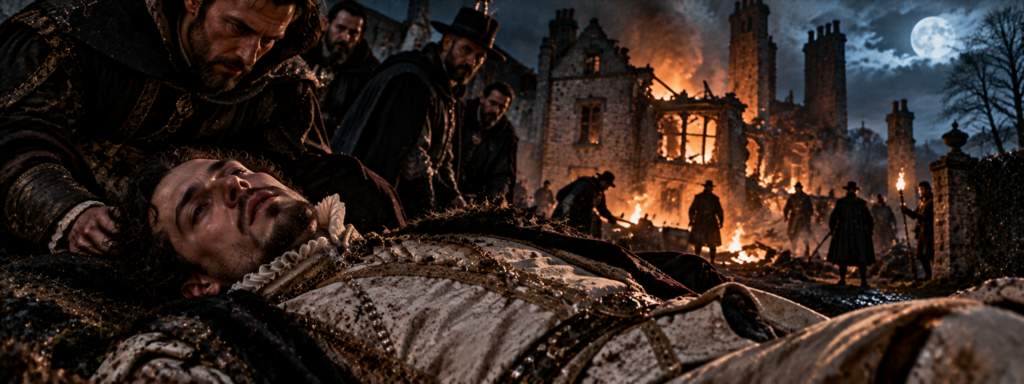
Lord Darnley: The Murdered King Consort and the Explosion That Destroyed Mary, Queen of Scots
Henry Stuart, Lord Darnley (1545–1567) | Husband of Mary, Queen of Scots | King Consort of Scotland, 1565–1567 | Father of James VI of Scotland and James I of England | Implicated in the murder of David Rizzio | Killed at Kirk o’ Field, Edinburgh, during the night of February 9–10, 1567 | His body was discovered outside a house destroyed by gunpowder, raising enduring questions about strangulation, conspiracy, and the involvement of his wife’s closest associates
The Explosion That Was Supposed to Kill a King
In the early hours of February 10, 1567, a tremendous explosion shattered the darkness over Edinburgh. A house at Kirk o’ Field, where Henry Stuart, Lord Darnley, was recovering from a serious illness, had been destroyed by gunpowder. The blast was powerful enough to demolish much of the building, scattering debris across the surrounding property and alarming residents. Anyone who knew that the husband of Mary, Queen of Scots, had been sleeping inside could reasonably have assumed that he had been killed beneath the wreckage.
But when searchers examined the grounds, they discovered something far more disturbing than the remains of a man crushed by an explosion. Darnley’s body was lying outside the ruined house, in an orchard or garden area near the property. Beside him lay the body of his servant, William Taylor, who had apparently died during the same mysterious sequence of events. Neither man displayed the obvious injuries that would ordinarily be expected from such a devastating blast.
Darnley was only twenty-one years old. He had been married to the Scottish queen for less than two years, had fathered the infant heir to the throne, and had spent much of his marriage alienating almost everyone who might have protected him. His relationship with Mary had deteriorated into mutual distrust, while powerful nobles resented his arrogance, ambition, and involvement in the murder of the queen’s secretary. By the time his body was discovered, Scotland’s royal court was already filled with men who had reasons to wish him gone.
The circumstances of his death immediately suggested that the explosion had not been the entire story. Some contemporary observers believed that Darnley and Taylor had escaped the building before it exploded, only to be intercepted and strangled or smothered outside. Others proposed that they had been killed before the explosion and their bodies moved to the garden. The surviving evidence does not establish the precise sequence, but it leaves little doubt that Darnley was the intended victim of a carefully planned murder.
The identity of those responsible became one of the most explosive political questions of the sixteenth century. Suspicion quickly focused on James Hepburn, Earl of Bothwell, a powerful nobleman closely associated with Mary. Even more dangerously, rumors spread that the queen herself had known about the conspiracy or participated in planning her husband’s death. Whether those accusations were justified remains fiercely debated, but the political consequences were immediate and catastrophic.
Within three months, Mary married Bothwell, the man widely suspected of arranging Darnley’s murder. Within four months, she had been confronted by rebellious nobles and separated from her new husband. Within five months, she was a prisoner at Lochleven Castle, forced to abdicate in favor of her infant son. The murder at Kirk o’ Field had not merely ended one man’s life; it had helped destroy a reigning queen.
Darnley’s death became notorious because the physical evidence appeared to contradict the obvious explanation. A building had been blown apart, yet the intended victim lay outside it without clear blast injuries. A queen’s husband had been murdered, yet the principal suspect was acquitted and soon became her next husband. The surviving documents contain accusations, confessions, political propaganda, and disputed letters, but no single account resolves every mystery.
To understand why so many people wanted Darnley dead, it is necessary to examine the extraordinary ambitions that brought him to Scotland, the marriage that briefly made him one of Europe’s most important royal figures, and the violent betrayal that transformed him from a promising prince into a dangerous liability.
A Young Nobleman With Royal Blood and Dangerous Ambitions
Henry Stuart was born on December 7, 1545, at Temple Newsam in Yorkshire. His father was Matthew Stewart, Earl of Lennox, a Scottish nobleman who had spent years navigating the dangerous politics of the Scottish and English courts. His mother was Lady Margaret Douglas, the daughter of Margaret Tudor and Archibald Douglas, Earl of Angus. Through his mother, Henry was a great-grandson of Henry VII of England and possessed a significant hereditary connection to the Tudor dynasty.
His ancestry made him politically valuable long before he reached adulthood. Margaret Tudor had been the elder sister of Henry VIII, and her descendants possessed claims that could become important if the direct Tudor line failed. Darnley therefore belonged to a family whose ambitions extended beyond the Scottish aristocracy. His parents understood that his bloodline might eventually place him near the center of the English succession.
Margaret Douglas was particularly conscious of her son’s dynastic prospects. She had experienced the uncertainty of Tudor politics firsthand and understood the importance of royal favor, marriage, and legitimacy. Her own position at the English court had been complicated by disputes over marriage and succession. She wanted her son to achieve the status that his ancestry appeared to promise.
Darnley grew into a tall, handsome young man whose appearance impressed several contemporaries. He received the education expected of an aristocratic heir, including instruction in languages, music, dancing, and courtly accomplishments. These qualities would later help attract Mary, Queen of Scots, who had been raised in the sophisticated French court. Yet physical elegance and noble ancestry were poor preparation for the ruthless political environment he would enter.
His father, Lennox, possessed his own interests in Scotland. The family’s position had been weakened by earlier political conflicts, and a successful marriage between Henry and Mary could restore Lennox’s influence dramatically. Such a union would connect the Lennox family directly to the Scottish crown. It would also unite two descendants of Margaret Tudor, strengthening the hereditary claim of any children they produced.
The prospect was irresistible to an ambitious family. Henry was not merely being prepared for an advantageous aristocratic marriage. He was being positioned for a possible role in the succession of two kingdoms. The danger was that he might begin to believe his royal ancestry entitled him to authority regardless of the political realities surrounding him.
Mary Stuart and the Marriage That Alarmed Elizabeth I
Mary, Queen of Scots, returned to Scotland in 1561 after spending most of her childhood and adolescence in France. She had already been Queen Consort of France through her marriage to Francis II, but his death in December 1560 left her widowed at eighteen. Her return placed her at the head of a kingdom transformed by Protestant reform and divided by competing noble interests. Finding a suitable second husband quickly became one of the most important questions facing her government.
The choice was politically dangerous because Mary’s marriage could alter the balance of power throughout Britain. She possessed a hereditary claim to the English throne through Margaret Tudor, and many Catholics considered that claim stronger than Elizabeth I’s. A husband with military resources or powerful foreign connections might make Mary a more immediate threat to England. Elizabeth therefore watched the negotiations surrounding her cousin’s remarriage with intense concern.
Darnley offered an unusual combination of advantages. He was a Catholic aristocrat with close connections to the English royal family, and he shared Mary’s descent from Margaret Tudor. Their children would inherit claims through both parents, creating a potentially formidable dynastic position. A marriage between them could strengthen the Stuart claim to England without requiring Mary to marry a foreign prince.
Darnley traveled to Scotland in 1565 and soon attracted Mary’s attention. Contemporary descriptions emphasize his height, appearance, and accomplishments in dancing and other courtly activities. Mary appears to have been strongly impressed by him, although later accounts sometimes exaggerate the romance into a story of overwhelming passion. Their attraction developed alongside calculations about religion, succession, and political advantage.
Elizabeth opposed the proposed marriage. Darnley was an English subject, and his union with Mary threatened to create a rival dynastic combination outside Elizabeth’s control. The English queen also had reasons to resent the possibility that two people with claims to her succession might marry without her approval. Her objections did not prevent the match.
Mary and Darnley married at Holyrood Palace on July 29, 1565. The ceremony brought together two people whose royal ancestry appeared to promise extraordinary political possibilities. Darnley received the title of king in Scotland, although the exact limits of his authority would soon become a source of conflict. The marriage that initially appeared to strengthen Mary’s position would instead expose her government to an unprecedented crisis.
A King Who Wanted More Than a Crown
Darnley quickly discovered that being called king was not the same as possessing independent royal authority. Mary was the reigning sovereign, and her hereditary right to govern did not automatically transfer to her husband. Darnley wanted a more substantial share of power, particularly the crown matrimonial. Such a grant could have strengthened his position and potentially allowed him to retain authority beyond Mary’s lifetime.
Mary was unwilling to surrender that degree of control. She had inherited the Scottish crown as an infant and had governed in her own right since returning from France. Granting her husband independent authority would have created a dangerous rival within the monarchy. Her refusal frustrated Darnley and contributed to the rapid deterioration of their relationship.
Contemporary observers increasingly described Darnley as arrogant, immature, and difficult to manage. Some accounts accuse him of excessive drinking, sexual misconduct, and insulting behavior toward powerful nobles. These descriptions came from politically interested witnesses and should not all be accepted without qualification. Nevertheless, the breadth of hostility surrounding him suggests that he was alienating influential people at an alarming rate.
His conduct also complicated Mary’s relationships with the Scottish aristocracy. Several Protestant nobles opposed the marriage because they feared that a Catholic royal couple might threaten the religious settlement. Mary’s half-brother James Stewart, Earl of Moray, became involved in resistance to the marriage. The resulting rebellion, known as the Chaseabout Raid, was suppressed, but it demonstrated the political divisions created by Darnley’s arrival.
For a brief period, the marriage seemed to have strengthened Mary’s authority. She defeated the opposition and maintained control of the kingdom, while Darnley’s royal ancestry enhanced the dynastic prospects of their future children. Yet the apparent victory concealed a growing struggle inside the royal household. Darnley wanted power that Mary would not give him, and ambitious nobles were ready to exploit his resentment.
The king consort had become a political problem almost as soon as he acquired his title. He possessed enough status to threaten Mary’s authority but lacked the experience and support required to govern independently. His ambitions made him useful to conspirators who wanted to weaken the queen. The first major consequence would be the murder of David Rizzio.
David Rizzio: The Secretary Who Became a Target
David Rizzio was an Italian musician and secretary who had gained an influential position within Mary’s household. His responsibilities included correspondence and access to the queen, making him an important figure in the daily operation of the court. He was not a great nobleman, and his rise created resentment among aristocrats who believed that political influence should remain in their hands. His foreign origins and Catholic associations made him an especially convenient target.
Darnley became increasingly hostile toward Rizzio. Rumors circulated that the secretary enjoyed an improper relationship with Mary, although convincing evidence of a sexual affair is lacking. Such allegations were useful because they transformed a dispute over access and political influence into a question of royal honor. Darnley’s jealousy could therefore be exploited by nobles who wanted Rizzio removed.
Several Protestant lords recognized an opportunity to form an alliance with the discontented king consort. Darnley wanted greater authority, while the nobles wanted to weaken Mary’s government and recover their political positions. The resulting conspiracy combined personal resentment with calculated political ambition. Rizzio became the immediate victim of a struggle involving much more than jealousy.
The conspirators also hoped to pressure Mary over the crown matrimonial and other political concessions. Darnley’s participation gave them access to the royal apartments and the appearance of support from the queen’s husband. Their plans were especially dangerous because Mary was pregnant. Violence within her household threatened not only her safety but also the unborn heir to the throne.
The murder was planned for March 1566. Armed conspirators would enter the queen’s private apartments and seize Rizzio in her presence. The decision to attack during a private meal was intended to demonstrate that Mary’s personal household offered no protection against their demands. It would become one of the most shocking episodes of her reign.
Blood at Holyrood: The Murder Darnley Helped Arrange
On the evening of March 9, 1566, Mary was dining in her private apartments at Holyrood Palace. Rizzio was among those present, and the queen was approximately six months pregnant. Darnley entered the room as part of a conspiracy involving armed nobles. The gathering was transformed into a scene of terror when the conspirators attempted to seize the secretary.
Rizzio sought protection near Mary, but the attackers dragged him away. He was stabbed repeatedly, with contemporary accounts describing dozens of wounds. The precise number varies in later retellings, but the violence of the killing is beyond dispute. His body was left as evidence of the conspirators’ determination to eliminate him.
Mary was held under guard during the crisis. Her own account, dictated to Elizabeth I after her escape, described the murder of a trusted servant in her presence and the danger she believed she had faced. The letter is especially valuable because it records how Mary presented the event shortly afterward. It also demonstrates that she regarded the attack as a direct assault upon her royal authority.
Darnley’s involvement destroyed much of the trust remaining in the marriage. He had participated in a conspiracy that endangered his pregnant wife and undermined her government. Whatever his motives, the attack revealed that he was willing to cooperate with her political enemies. His behavior made him appear not merely unreliable but potentially dangerous.
Mary nevertheless managed to turn the situation to her advantage. She persuaded Darnley to abandon his fellow conspirators and escape with her from Holyrood. The couple reached Dunbar, where Mary gathered supporters and prepared to recover control. Darnley’s betrayal of the conspirators left him increasingly isolated.
The nobles who had relied upon him now regarded him as untrustworthy, while Mary had powerful reasons to resent his conduct. Darnley had helped arrange a murder and then abandoned the men who carried it out. His attempt to gain authority through conspiracy had instead destroyed his credibility. The consequences would follow him into the final year of his life.
The Birth of James and the Illusion of Reconciliation
On June 19, 1566, Mary gave birth to a son at Edinburgh Castle. The child was named James and would eventually become James VI of Scotland and James I of England. His birth secured the immediate succession and strengthened the dynastic position of both parents. For Darnley, it was the greatest political achievement of his short life.
James inherited claims through both Mary and Darnley. His descent from Margaret Tudor through two separate family lines made him an important potential successor to Elizabeth I. The birth therefore had implications far beyond Scotland. The infant prince represented the possibility of a future union of the Scottish and English crowns.
Yet the arrival of an heir did not repair the marriage. Darnley remained dissatisfied with his political position, and Mary continued to rely upon advisers whom he disliked. Their relationship was further complicated by the resentment of nobles who had participated in the Rizzio conspiracy. The royal household remained deeply divided.
Darnley’s political isolation became increasingly apparent. Some nobles regarded him as responsible for the instability surrounding the queen, while others feared that his ambition would provoke further conflict. He had acquired enemies across religious and factional divisions. His royal status protected him from ordinary retaliation, but it also made his removal a matter of national politics.
Mary faced an equally difficult situation. She could not easily divorce Darnley without creating questions about the legitimacy of their son. Nor could she comfortably continue living with a husband who had participated in violence against her household. The marriage had become a trap for both parties, although Mary retained far greater political authority.
By the autumn of 1566, discussions about ending the marriage were circulating among influential nobles. The surviving evidence does not establish that everyone involved favored murder. Some may have contemplated divorce or separation, while others appear to have considered more drastic solutions. The distinction would become crucial after Darnley was found dead.
Craigmillar Castle and the Dangerous Question of Divorce
In late 1566, Mary spent time at Craigmillar Castle near Edinburgh. The queen was recovering from illness and the strains of the preceding months, while political tensions continued to surround her marriage. Several important nobles gathered in her orbit during this period. Later accounts connected their discussions with plans to remove Darnley.
The so-called Craigmillar Bond has become one of the most disputed elements of the murder investigation. Some later testimony suggested that leading nobles discussed a scheme to free Mary from her marriage, possibly through a formal agreement. The precise wording and existence of any surviving original bond remain uncertain. Historians must therefore distinguish between documented conversations and later claims made after the murder.
Mary appears to have been willing to consider a lawful separation. She was concerned, however, about the implications for her son’s legitimacy and her own reputation. The marriage had produced an heir whose rights needed protection. Any arrangement that cast doubt upon James’s birth could create another succession crisis.
Bothwell was among the powerful figures associated with the political discussions of this period. He had become increasingly important to Mary’s government and was regarded as one of her most energetic supporters. His military experience and willingness to confront opponents made him valuable. Those same qualities would later make him a principal suspect in Darnley’s murder.
The crucial uncertainty concerns whether discussions about divorce developed into an agreement to kill Darnley. Some later witnesses claimed that violent intentions were concealed behind language about resolving the queen’s marital difficulties. Others had obvious reasons to shift responsibility away from themselves or toward political enemies. No surviving document conclusively establishes Mary’s participation in a murder agreement at Craigmillar.
What is clear is that Darnley’s removal had become a subject of serious political discussion. His enemies were no longer confined to one faction or religious group. The king consort had become an obstacle to the ambitions of several powerful men. Within weeks, the problem would be resolved through violence.
The Illness That Brought Darnley Back to Edinburgh
Darnley became seriously ill around the beginning of 1567 while staying in Glasgow. The illness has traditionally been identified as smallpox, although some historians have considered other possibilities, including syphilis. The surviving descriptions are insufficient to establish a modern medical diagnosis. His condition was serious enough to affect his movements and require a period of recovery.
Mary traveled to Glasgow and persuaded him to return toward Edinburgh. The circumstances of their meeting became central to later accusations because opponents claimed that she had deliberately lured him into a trap. Her defenders argued that she was attempting reconciliation or fulfilling her responsibilities toward an ill husband. The available evidence supports neither interpretation with complete certainty.
Darnley agreed to return, but he did not immediately resume residence at Holyrood Palace. Instead, arrangements were made for him to stay at Kirk o’ Field, a property in Edinburgh associated with the former collegiate church of St. Mary in the Fields. The lodging was outside the main royal palace complex and offered accommodation during his recovery. Its relative isolation would later make it attractive to conspirators.
The building was not the enormous villa sometimes imagined in popular retellings. It was a substantial urban lodging within a larger group of structures and grounds, including gardens and nearby buildings. The surviving plans and descriptions provide valuable evidence about its layout, although not every architectural detail is certain. Its position made it possible for people to approach the property without passing through the heavily guarded spaces of Holyrood.
Mary visited Darnley during his stay. Their conversations were later interpreted through the accusations contained in the Casket Letters, documents allegedly written by Mary to Bothwell. Those texts suggest that Darnley wanted reassurance about their relationship and that Mary was managing his expectations. Their authenticity and integrity remain disputed, making them dangerous evidence upon which to build a definitive account.
By early February, Darnley was recovering and apparently expected his situation to improve. He remained surrounded by servants and possessed the status of the queen’s husband, but he was politically vulnerable. Powerful men were moving against him, and the location of his lodging had become known. The final arrangements for his murder were approaching completion.
James Hepburn, Earl of Bothwell: The Man at the Center of the Conspiracy
James Hepburn, fourth Earl of Bothwell, was one of the most formidable and controversial figures in Mary’s government. He came from a powerful Scottish noble family and possessed experience in military affairs and political conflict. His loyalty to Mary during earlier crises had helped him gain influence. By 1567, he occupied a position that made him both useful to the queen and threatening to his rivals.
Bothwell’s reputation was complicated by his turbulent career. He had experienced imprisonment, exile, political hostility, and repeated confrontations with other nobles. He was energetic and ambitious, but his conduct did not inspire universal trust. His willingness to employ force made him a plausible participant in a conspiracy against Darnley.
Several men associated with Bothwell later became implicated in the murder. Among them were members of his household and retainers who could assist with transporting gunpowder, entering the property, or coordinating movements. The precise division of responsibility remains uncertain because much of the evidence came from confessions obtained after arrests. Some statements were made under conditions that raise serious questions about reliability.
The conspiracy required planning and resources. Gunpowder had to be obtained, transported, and placed where it could destroy the lodging. The perpetrators needed to know when Darnley would be present and how to approach the property without attracting immediate suspicion. The operation was therefore more complex than a spontaneous act of revenge.
Bothwell had the influence and connections necessary to organize such an undertaking. That does not establish that he personally carried out every action described in later accounts. It does, however, help explain why suspicion focused on him so quickly. His political position, access to the queen, and association with men implicated in the plot made him an obvious suspect.
The question of Mary’s knowledge remains separate. A close relationship between the queen and Bothwell did not automatically prove that she approved his actions. Nevertheless, the circumstances created a serious appearance of impropriety. After Darnley’s death, that appearance would become politically devastating.
The Final Evening at Kirk o’ Field
On February 9, 1567, Mary visited Darnley at Kirk o’ Field. The surviving accounts indicate that she spent time with him before leaving to attend a wedding celebration connected with members of her household. Her departure has been scrutinized for centuries because it placed her away from the building shortly before the explosion. Yet attendance at the celebration was not, by itself, evidence of advance knowledge.
Darnley remained at the lodging with servants, including William Taylor. The household apparently expected an ordinary night following the queen’s visit. There is no reliable surviving account of Darnley expressing certainty that he was about to be murdered. Later dramatic narratives sometimes invent warnings, ominous conversations, or desperate suspicions that cannot be documented.
Meanwhile, conspirators were preparing the gunpowder. Testimony and later reconstructions describe powder being transported to the property and placed beneath or near Darnley’s sleeping quarters. The exact quantity is uncertain, although the destruction demonstrates that a substantial explosive charge was used. The operation required coordination among several participants.
Bothwell’s movements during the evening became a major subject of investigation. Accounts connect him with the wedding festivities and with the men involved in the conspiracy. Some witnesses described changes of clothing or attempts to establish an alibi. These details must be assessed cautiously because the testimony was produced amid intense political conflict.
The final hours of Darnley’s life remain largely inaccessible. We do not know exactly when he went to bed, whether he became aware of intruders, or whether he attempted to escape before the explosion. The discovery of his body outside the building suggests that the events did not unfold as the conspirators may originally have intended. Yet the surviving evidence cannot establish every movement.
Sometime during the early hours of February 10, the gunpowder detonated. The explosion destroyed the lodging and awakened people across the surrounding area. The sound announced that something extraordinary had occurred. Within hours, Scotland would learn that the queen’s husband was dead.
The Ruins and the Bodies in the Garden
The destruction at Kirk o’ Field was extensive. The house where Darnley had been staying was reduced to wreckage, and the surrounding area became the scene of an urgent search. The scale of the explosion made it clear that the building had been deliberately targeted. This was not an ordinary household accident.
Yet Darnley’s body was not found beneath the collapsed structure. He and William Taylor were discovered outside, in a nearby garden or orchard area. Their clothing was incomplete, suggesting that they had been preparing for sleep or had left their quarters in haste. The absence of obvious blast injuries made their deaths particularly suspicious.
A contemporary drawing of the scene, prepared for English officials, became one of the most important surviving records of the murder. It depicts the ruined property, the positions of the bodies, and other details associated with the investigation. The drawing is not a modern forensic survey, and its purpose included communicating the political significance of the crime. Nevertheless, it provides valuable evidence about how the scene was understood shortly after the event.
The bodies appeared to have been separated from the principal destruction. This raised the possibility that Darnley and Taylor had escaped the building before the explosion. If so, they may have encountered attackers waiting outside. Another possibility is that they were killed before the detonation and placed where they would later be discovered.
Contemporary reports frequently suggested strangulation or smothering. The lack of obvious wounds was consistent with that interpretation, but it did not prove a particular method of killing. There was no modern autopsy, and the surviving descriptions do not provide enough anatomical detail to establish a definitive cause of death. The precise mechanism remains uncertain.
The discovery created a murder mystery unlike an ordinary political assassination. The explosion was clearly intended to destroy the lodging, but the intended victim appeared to have died outside it. The conspirators may have planned more than one method of killing, or the events may have unfolded unexpectedly. The physical evidence preserved the mystery rather than resolving it.
Was Darnley Strangled Before the Explosion?
The most familiar reconstruction holds that Darnley awoke or was warned before the gunpowder detonated. According to this theory, he and Taylor fled the house in their nightclothes, perhaps attempting to escape through the garden. Attackers then intercepted them and killed them by strangulation or smothering. The explosion followed, destroying the building but failing to conceal the bodies.
This explanation accounts for several important details. The men were found outside the ruins, their clothing was incomplete, and their bodies reportedly lacked the injuries expected from the blast. It also explains why conspirators might have needed to kill them directly if they escaped the intended explosion. Yet the sequence remains a reconstruction rather than an eyewitness account.
Another possibility is that Darnley and Taylor were murdered before the explosion. Their bodies could then have been moved outside while the gunpowder was prepared or detonated. Such an arrangement might have been intended to confuse investigators or create the appearance of an attempted escape. The surviving evidence does not establish that this occurred.
Some accounts suggest that Darnley may have been suffocated rather than strangled. The distinction is difficult to evaluate because the medical observations available from 1567 were limited. A lack of visible injuries does not identify the exact means of death. It is therefore misleading to describe strangulation as a proven forensic conclusion.
The possibility of a direct killing also raises questions about the conspirators’ original intentions. If the gunpowder was sufficient to destroy the building, why would attackers risk confronting Darnley outside? Perhaps he escaped unexpectedly, forcing them to improvise. Alternatively, the explosion may have been intended to conceal an earlier murder.
No surviving evidence allows these questions to be answered with certainty. The most defensible conclusion is that Darnley and Taylor were murdered in connection with the planned destruction of Kirk o’ Field. The explosion was part of the conspiracy, but it may not have been the immediate cause of their deaths. The precise sequence remains one of the enduring mysteries of the case.
The Servant Who Died Beside His Master
William Taylor is often overshadowed by the royal victim whose death transformed Scottish politics. Yet his body was discovered alongside Darnley’s, making him an important part of the crime. Taylor was a servant attending the king consort during his stay at Kirk o’ Field. He had no independent claim to political power and was not the principal target of the conspiracy.
His death suggests that the perpetrators were unwilling to leave a witness alive. If Taylor escaped the building with Darnley, he may have seen the attackers or attempted to protect his master. If both men were killed before the explosion, Taylor may have been eliminated because of his proximity to Darnley. These possibilities remain speculative, but they illustrate the danger faced by servants caught in royal conspiracies.
The surviving drawing of the murder scene includes Taylor’s body and references to his burial. His presence in the record is therefore more than a minor detail. It confirms that the crime involved at least two deaths and that investigators recognized the importance of their locations. The killing was not confined to the destruction of a single royal figure.
Taylor’s death also complicates the theory of a spontaneous confrontation. Two men were found dead outside the building, apparently without obvious injuries from the explosion. Their deaths suggest deliberate violence beyond the detonation itself. Whether the same attackers killed both men cannot be established with certainty.
The contrast between the victims is revealing. Darnley’s murder became a matter of international diplomacy and dynastic politics, while Taylor’s death received comparatively little attention. Yet both men were killed during the same operation. The servant’s fate reminds us that political assassinations often destroy people whose lives are barely recorded.
Taylor had entered the royal household to serve a powerful man, not to become part of a conspiracy that would alter the history of Scotland. His final hours are as obscure as Darnley’s, and the surviving evidence does not preserve his thoughts or actions. He remains one of the least remembered victims of the Kirk o’ Field murder. His presence beside Darnley is nevertheless central to understanding the crime.
The Investigation That Scotland Could Not Trust
The murder demanded an investigation, but the political circumstances made impartial justice difficult. Darnley had numerous enemies among the Scottish nobility, and several powerful men possessed the influence necessary to interfere with proceedings. Mary herself was vulnerable to suspicion because of her troubled marriage. The government therefore faced the task of investigating a crime that implicated people close to the center of power.
Public accusations quickly focused on Bothwell. Placards and rumors circulated in Edinburgh, naming individuals believed to have participated in the conspiracy. Some accusations also implicated Mary, although the evidence against her was far less direct. The atmosphere became increasingly hostile as political opponents used the murder to attack one another.
Darnley’s father, the Earl of Lennox, demanded justice for his son. He pressed for the investigation of Bothwell and other suspects, arguing that the murder could not be allowed to go unpunished. Lennox’s demands were understandable, but they also reflected his own political interests. The death of his son had destroyed the family’s immediate position at the Scottish court.
Bothwell was brought to trial in April 1567. The proceedings were widely criticized because of the circumstances surrounding the hearing and the limited opportunity available to his accusers. Lennox did not appear in person, and the court acquitted Bothwell. The verdict did not persuade many contemporaries that he was innocent.
The acquittal instead intensified suspicion. A powerful nobleman accused of murdering the queen’s husband had escaped punishment and remained close to the royal court. The outcome suggested that political influence could determine the administration of justice. It also placed Mary in an increasingly difficult position.
Elizabeth I of England expressed concern about the damage to Mary’s reputation. She urged the Scottish queen to pursue the murderers and protect her honor from the accusations spreading across Europe. The correspondence reveals that the scandal was already becoming an international problem. Darnley’s death had created a crisis of legitimacy that the trial failed to resolve.
The Confessions and the Men Who Helped Carry Out the Plot
Several men associated with the conspiracy were eventually arrested and questioned. Their statements became important evidence for later historians attempting to reconstruct the murder. Some implicated Bothwell and described preparations involving gunpowder, movement around the property, and participation in the operation. Yet the circumstances under which these confessions were obtained require careful consideration.
One of the best-known figures was William Powrie, a servant associated with Bothwell’s household. Other men, including George Dalgleish and John Hepburn, were also connected with the investigation. Their testimony contributed to the picture of a coordinated conspiracy involving several participants. The surviving accounts, however, do not always agree on every detail.
Confessions produced in sixteenth-century criminal proceedings cannot be treated as equivalent to modern forensic evidence. Prisoners faced severe punishment, and some statements may have been influenced by coercion, fear, or attempts to shift responsibility. Political authorities also had reasons to emphasize particular suspects. The documents are valuable, but they must be read critically.
The testimony nevertheless supports the conclusion that the explosion was deliberately organized. Gunpowder was transported and placed, participants coordinated their movements, and efforts were made to avoid detection. The crime required preparation rather than sudden anger. Darnley’s death was the result of conspiracy.
The degree of Bothwell’s personal involvement remains a subject of historical interpretation, but the evidence connecting his associates to the operation is substantial. His acquittal did not eliminate those connections. Later events would make his position even more suspicious. The man accused of arranging Darnley’s murder was about to marry Darnley’s widow.
The confessions also reveal the limitations of the investigation. They provide fragments of the conspiracy but do not establish every participant’s knowledge or intentions. They cannot conclusively determine whether Mary authorized the murder. The case therefore remains a mixture of strong evidence against particular conspirators and unresolved questions about the highest levels of political responsibility.
Mary and Bothwell: The Marriage That Made Everything Worse
In April 1567, Bothwell’s political influence continued to grow despite the accusations surrounding him. Several nobles signed or were associated with an agreement supporting his proposed marriage to Mary. The document commonly known as the Ainslie Tavern Bond has become an important part of the controversy. Its circumstances and the sincerity of the support it represented remain disputed.
Bothwell was still married to Jean Gordon, making the proposed union even more complicated. Arrangements were made to dissolve that marriage, clearing the way for him to marry the queen. The speed of events was extraordinary. Scotland had barely begun to recover from Darnley’s murder before the principal suspect was positioning himself as the next royal husband.
In April, Bothwell intercepted Mary during a journey and took her to Dunbar Castle. The episode has been described as an abduction, but historians disagree about whether Mary consented to the journey or the subsequent marriage. Contemporary accounts included allegations of sexual coercion, while other writers portrayed the event as a political arrangement. The evidence does not permit a confident reconstruction of Mary’s private experience.
On May 15, 1567, Mary married Bothwell at Holyrood Palace. The ceremony occurred barely three months after Darnley’s murder. To many observers, the marriage appeared to confirm the rumors that Mary had been involved with Bothwell before her husband’s death. The political damage was immediate and severe.
The marriage did not prove that Mary had participated in the murder. A woman could marry a suspect without having helped arrange the crime, particularly if coercion or political pressure influenced her decision. Nevertheless, the timing was disastrous. Mary’s enemies could now present the union as evidence of guilt.
Elizabeth I reacted with alarm and disapproval. Her correspondence emphasized the damage done to Mary’s honor by marrying a man publicly accused of murdering her former husband. The criticism reflected both personal concern and political calculation. Mary had given her opponents a powerful weapon.
The Casket Letters and the Accusation Against a Queen
The most controversial evidence used to implicate Mary in Darnley’s murder became known as the Casket Letters. Her opponents claimed that a collection of letters and poems had been discovered in a silver casket associated with Bothwell. The documents were allegedly written by Mary and suggested an intimate relationship with Bothwell before Darnley’s death. Some passages were interpreted as evidence that she knew about the murder conspiracy.
The letters became central to the political struggle following Mary’s deposition. Her enemies presented them as proof that she had betrayed her husband and participated in planning his death. Her defenders argued that the documents were forged, altered, or assembled from genuine and fabricated material. The controversy has never been conclusively resolved.
The original documents have not survived in a form that permits modern examination. Historians must rely upon copies, translations, summaries, and references produced during politically charged proceedings. Some texts may preserve authentic correspondence, while others may have been manipulated. Their uncertain transmission makes definitive conclusions hazardous.
The longest letter is particularly important because it appears to describe Mary’s conversations with Darnley during his illness. It includes language suggesting that she was managing his expectations and reporting details to Bothwell. If entirely genuine, it could support the argument that she was involved in a deception. Yet the authenticity and integrity of the document remain disputed.
The political usefulness of the letters cannot be ignored. Mary’s enemies needed to justify removing a reigning queen and transferring authority to her infant son. Demonstrating that she had participated in her husband’s murder would provide a powerful argument for deposition. The documents therefore served a political purpose regardless of their original composition.
Mary denied responsibility for Darnley’s murder. Her defenders continued to challenge the letters, while her opponents treated them as evidence of guilt. The debate remains central to historical assessments of her reign. It also illustrates how difficult it can be to separate criminal evidence from political propaganda.
The Rebellion That Destroyed Mary’s Throne
Mary’s marriage to Bothwell triggered a rebellion among Scottish nobles who claimed to act in defense of the kingdom and the infant Prince James. Some had previously supported Bothwell or participated in the political arrangements surrounding him. Their sudden opposition reflected changing alliances as well as genuine hostility to the marriage. The murder scandal had become a struggle for control of the monarchy.
In June 1567, the opposing forces confronted Mary and Bothwell near Carberry Hill. The encounter developed into a prolonged standoff rather than a decisive pitched battle. Negotiations and uncertainty shaped the outcome, while Mary’s support weakened. Bothwell eventually left the field, and Mary surrendered to the opposing nobles.
Mary was taken into custody and subjected to public humiliation. The nobles presented themselves as defenders of justice for Darnley’s murder and protectors of the infant heir. Their actions also allowed them to seize political authority. The queen who had once defeated rebellion now found herself powerless.
She was imprisoned at Lochleven Castle, where her captors controlled her movements and correspondence. The conditions were restrictive, and she suffered a miscarriage during her confinement. The political consequences of her marriage to Bothwell had become irreversible. Her enemies were determined to remove her from government.
On July 24, 1567, Mary was forced to abdicate in favor of her son. James became James VI of Scotland, although he was still an infant. A regency government assumed authority in his name. The murder of Darnley had helped bring down the queen who had inherited Scotland’s crown at six days old.
The sequence was extraordinary in its speed. Darnley was murdered in February, Mary married Bothwell in May, and she lost her throne in July. Within five months, Scotland’s royal government had been transformed. The political consequences of the assassination were greater than the conspirators may originally have anticipated.
Bothwell’s Escape and Miserable End
Bothwell escaped from the immediate crisis surrounding Mary’s surrender. He attempted to preserve his position but found his political support collapsing. The man who had briefly become the queen’s husband and one of the most powerful figures in Scotland was now a fugitive. His enemies sought to capture him, and his prospects of returning to power diminished rapidly.
He eventually traveled north and became involved in attempts to escape through the islands and across the sea. His movements brought him into contact with Norwegian and Danish authorities. He was detained and ultimately imprisoned in Denmark. The circumstances of his detention reflected both his personal history and the international complications surrounding his position.
Bothwell never returned to Scotland. He spent years in captivity, with later accounts describing increasingly harsh conditions. His reputation as the suspected murderer of Darnley followed him. The political career that had reached its height through marriage to Mary ended in isolation.
He died in Denmark in 1578. The exact circumstances of his final illness and mental condition have been described differently in later sources. Stories of madness and extreme suffering should be treated cautiously where they depend upon uncertain testimony. What is clear is that he died far from the Scottish court whose politics he had helped destabilize.
Bothwell’s fate did not resolve the question of Mary’s involvement in Darnley’s murder. His death removed one of the principal figures who might have provided further testimony. The surviving evidence remained fragmented and politically compromised. The mystery continued without its most notorious suspect.
The contrast between Bothwell’s ambitions and his end is striking. He had risen from powerful nobleman to royal husband within months of Darnley’s death. Yet the marriage that appeared to promise extraordinary influence instead destroyed his political future. He died a prisoner, remembered primarily for a murder he had been acquitted of committing.
The Queen Who Fled Into a Longer Prison
Mary escaped from Lochleven Castle in May 1568 and attempted to recover her authority. Supporters rallied around her, arguing that her abdication had been forced and was therefore invalid. Her opponents defended the regency government established in the name of James VI. Scotland moved toward another civil conflict.
On May 13, Mary’s forces were defeated at Langside, near Glasgow. The battle destroyed her immediate prospects of regaining the throne. She fled south and eventually crossed into England, hoping that Elizabeth I would assist her restoration. Instead, she entered a captivity that would last almost nineteen years.
Elizabeth faced a difficult problem because Mary was both a foreign sovereign and a claimant to the English succession. Restoring her to Scotland might destabilize the neighboring kingdom, while allowing her freedom in England could encourage Catholic rebellion. Elizabeth therefore ordered her detention while investigating the accusations surrounding Darnley’s murder. The inquiry failed to produce a definitive resolution.
The Casket Letters were presented during proceedings involving representatives of Mary and the Scottish regency government. Their authenticity and interpretation became central to the debate. Elizabeth avoided issuing a final judgment that would either condemn another queen or require her restoration. Mary remained imprisoned.
Over the following years, her hereditary claim continued to attract conspirators who opposed Elizabeth’s Protestant government. The Ridolfi, Throckmorton, and Babington plots demonstrated the danger that Mary’s existence represented to the English monarchy. Her own involvement varied between the conspiracies and remains disputed in important respects. Nevertheless, the government increasingly regarded her as an unacceptable security threat.
In 1586, Mary was tried and convicted of involvement in the Babington Plot, which included plans to assassinate Elizabeth. She denied authorizing the English queen’s murder and challenged the court’s jurisdiction over a foreign sovereign. The commissioners found her guilty, and Elizabeth eventually signed the death warrant. The consequences of Darnley’s murder had followed Mary all the way to the English scaffold.
The Execution of Mary, Queen of Scots
On February 8, 1587, exactly twenty years after Darnley’s murder, Mary was executed at Fotheringhay Castle. The coincidence of the date is striking, although it should not be interpreted as proof that the execution was deliberately scheduled as an anniversary of his death. Mary had spent nearly nineteen years in English captivity. She was forty-four years old.
The execution was carried out by beheading before English officials. Contemporary accounts describe a badly performed killing in which the executioner failed to sever her head with the first blow. The spectacle became one of the most infamous royal executions of the sixteenth century. Mary’s composure and Catholic devotions helped transform her into a martyr in the eyes of supporters.
Her death did not settle the accusations surrounding Darnley’s murder. Some writers continued to portray her as a guilty conspirator who had arranged her husband’s death and later plotted against Elizabeth. Others regarded her as a victim of political manipulation and religious persecution. The evidence remained disputed, and the competing narratives survived for centuries.
Mary’s son James VI had been an infant when Darnley was killed and his mother was forced to abdicate. He grew up under regents and eventually established his own authority in Scotland. In 1603, after Elizabeth I died without children, he inherited the English crown as James I. The dynastic claim that had made his parents politically important was finally realized.
The union of the crowns created an extraordinary historical reversal. Darnley had married Mary partly because their combined ancestry strengthened the claim of their descendants to England. His murder destroyed their marriage and helped bring down Mary’s reign. Yet their son eventually inherited the kingdom that had imprisoned and executed his mother.
Darnley never lived to see the fulfillment of his family’s ambitions. He died at twenty-one, before his son was eight months old. His personal political career had been disastrous, but his bloodline became central to the future of Britain. The man whose body was found in an Edinburgh garden became the father of a king who ruled both Scotland and England.
The Murder That Historians Still Cannot Completely Solve
The murder at Kirk o’ Field remains one of the most extensively discussed crimes in Scottish royal history. Its central facts are clear: Darnley was killed during the night of February 9–10, 1567, while staying at a lodging destroyed by gunpowder. His body and that of William Taylor were found outside the ruined building. The circumstances strongly indicate a deliberate conspiracy.
The identity of the principal conspirators is less uncertain than the precise sequence of the killing. Evidence connects Bothwell and members of his circle with the preparations and execution of the plot. His acquittal did not remove the suspicions surrounding him, and later testimony strengthened the case against his associates. Nevertheless, the surviving records do not provide a complete, uncontested account of every participant’s actions.
The immediate cause of Darnley’s death remains particularly difficult to establish. Strangulation or smothering has long been the leading explanation because the bodies were found outside the building without obvious blast injuries. Yet no modern forensic examination was possible, and the contemporary observations are incomplete. It is therefore more accurate to describe suffocation as a probable or plausible reconstruction than as a scientifically proven conclusion.
Mary’s involvement is even more controversial. Her troubled marriage gave her reasons to desire separation from Darnley, and her subsequent marriage to Bothwell made her appear deeply suspicious. The Casket Letters were used to implicate her, but their authenticity and integrity remain disputed. No surviving evidence establishes beyond reasonable historical doubt that she personally ordered the murder.
The political circumstances also complicate the question of motive. Darnley had enemies among nobles who opposed him for reasons unrelated to Mary’s personal feelings. His participation in Rizzio’s murder had alienated former allies, while his ambitions threatened powerful interests. Several men could benefit from his removal. The existence of multiple motives makes it dangerous to assign responsibility solely according to who gained the most afterward.
The murder is therefore best understood as a well-supported conspiracy surrounded by unresolved questions. The explosion was deliberate, and Darnley was the intended victim. Bothwell’s circle was deeply implicated, while Mary’s knowledge remains contested. The case offers strong evidence of political assassination without providing certainty about every detail.
A King Consort Who Helped Create His Own Enemies
Darnley’s murder cannot be understood without examining his conduct during the brief period when he occupied the Scottish royal court. He arrived as a handsome young aristocrat with impressive ancestry and the possibility of becoming a powerful royal husband. His marriage to Mary gave him extraordinary status. Yet he quickly alienated the people whose cooperation he needed.
His demand for greater authority placed him in conflict with Mary. His association with the Rizzio conspiracy demonstrated a willingness to use violence and intimidation to advance his interests. His subsequent abandonment of the conspirators made him appear unreliable even to those who had supported him. By 1567, he had accumulated enemies across several political factions.
These actions do not justify his murder. Darnley was a difficult and ambitious young man, but his political failures did not make him deserving of assassination. His death was the result of deliberate violence organized by people who chose to eliminate him rather than resolve their conflicts through lawful means. The distinction is essential to any responsible historical assessment.
Darnley’s youth also matters. He was only nineteen when he married Mary and twenty-one when he died. His behavior reflected the dangerous combination of immense privilege, political ambition, and limited experience. Older and more powerful nobles were able to exploit his resentment for their own purposes. He was both an instigator of violence and, ultimately, its victim.
His relationship with Mary remains difficult to reconstruct in personal terms. The surviving correspondence and contemporary reports reveal attraction, conflict, resentment, and attempts at reconciliation. They do not provide complete access to either spouse’s private thoughts. Later romantic narratives often simplify the marriage into a story of passion followed by hatred, but the political realities were far more complicated.
Darnley’s greatest tragedy may have been his inability to distinguish royal status from secure authority. He possessed the title of king but lacked the independent power he desired. His attempts to obtain more influence helped destroy the alliances that might have protected him. By the time the gunpowder was placed beneath Kirk o’ Field, his crown had become little more than a dangerous ornament.
The Assassination That Changed Scotland’s Future
The murder of Darnley had consequences far beyond the death of one royal consort. It triggered a crisis that destroyed Mary’s government, elevated her infant son, and reshaped the Scottish political landscape. The resulting struggle involved religion, aristocratic ambition, foreign diplomacy, and competing claims of legitimacy. Few political killings have produced such rapid consequences.
Mary’s marriage to Bothwell transformed suspicion into open rebellion. Nobles who opposed the union claimed that they were defending justice and protecting the young prince. Their victory at Carberry Hill led to Mary’s imprisonment and forced abdication. The monarchy passed to James VI while he was still an infant.
The regency government that followed faced its own conflicts and divisions. Mary’s supporters continued to challenge the legitimacy of her deposition, while her opponents defended the new political settlement. Scotland endured years of factional struggle. Darnley’s murder had helped create a crisis that could not be resolved simply by removing the queen.
The assassination also affected relations with England. Elizabeth I became involved in the controversy surrounding Mary’s deposition and later held her cousin prisoner. The accusations about Darnley’s death followed Mary into English captivity, where they complicated efforts to restore her authority. Her presence in England eventually became a focus for Catholic conspiracies. The consequences extended across the border.
Darnley’s son ultimately inherited both crowns, but that outcome was not inevitable in 1567. The infant James survived political upheaval and grew into a ruler capable of navigating the competing interests of Scotland and England. His accession to the English throne in 1603 fulfilled the dynastic ambitions that had helped bring his parents together. The murder that destroyed their marriage did not destroy their bloodline.
The Kirk o’ Field conspiracy therefore occupies a central place in the history of royal assassination. It eliminated a politically troublesome king consort, destabilized a reigning queen, and helped create the conditions for a new royal succession. Its effects continued long after the immediate conspirators had died. The explosion in Edinburgh became a turning point in the history of the Stuart dynasty.
The King Who Escaped the Explosion but Not His Enemies
Henry Stuart, Lord Darnley, was born with a bloodline that seemed to promise extraordinary political opportunities. Through his mother, he descended from Henry VII of England, while his father belonged to one of Scotland’s most important noble families. His marriage to Mary, Queen of Scots, united two branches of the Tudor-descended Stuart dynasty. Their future children would possess claims that could transform the political map of Britain.
For a brief moment, Darnley’s prospects appeared dazzling. He was young, handsome, and married to a reigning queen whose hereditary claim to England made her one of Europe’s most important political figures. He received the title of king and became the father of a legitimate heir. Yet the status he gained did not satisfy his ambitions.
Darnley wanted authority that Mary was unwilling to surrender. His resentment led him into alliances with nobles who sought to weaken the queen’s government. The murder of David Rizzio demonstrated how far those alliances could go. By participating in violence against Mary’s household, Darnley helped destroy the trust upon which his marriage depended.
His subsequent betrayal of the Rizzio conspirators left him isolated. Mary had reasons to resent him, while former allies regarded him as unreliable. Powerful nobles increasingly discussed ways to remove him from the queen’s life. The young king consort had become an obstacle to the ambitions of people who possessed the means to destroy him.
The illness that brought Darnley to Kirk o’ Field placed him in a vulnerable position. He was recovering away from the main royal palace, surrounded by a relatively small household. His enemies knew where he was staying and could plan an attack upon the building. The arrangements that were supposed to provide a quiet place for recovery instead became the setting for his murder.
During the night of February 9–10, 1567, gunpowder destroyed the lodging. The explosion was intended to eliminate Darnley, but his body was discovered outside the ruins. William Taylor lay dead nearby, and neither man displayed obvious injuries from the blast. The physical evidence immediately raised questions about how they had died.
Strangulation or smothering remains a leading explanation. Darnley and Taylor may have escaped the building before the explosion and encountered attackers waiting outside. Alternatively, they may have been killed before the gunpowder detonated. The surviving evidence does not establish the precise sequence, but it confirms that the explosion was part of a deliberate murder conspiracy.
Bothwell and his associates became the principal suspects. Their connections with the preparations and subsequent events made them central to the investigation. Bothwell was acquitted at a controversial trial, but the verdict did little to remove suspicion. His marriage to Mary only three months after Darnley’s death transformed the scandal into a political catastrophe.
Mary’s role remains one of the most disputed questions in Scottish history. Her unhappy marriage and subsequent conduct created grounds for suspicion, while the Casket Letters were used to accuse her of complicity. Yet those documents are contested, and the surviving evidence does not conclusively establish that she ordered her husband’s murder. The distinction between political suspicion and proven responsibility must be preserved.
The consequences of the killing were immediate. Mary married Bothwell, faced rebellion, and was forced to abdicate in favor of her infant son. She eventually fled to England, where she spent nearly nineteen years in captivity. In 1587, exactly twenty years after Darnley’s death, she was executed at Fotheringhay Castle.
Bothwell’s own career ended in disgrace. He fled Scotland, was detained abroad, and died in Danish captivity in 1578. The man who had briefly become the queen’s husband after Darnley’s murder never returned to the political world he had helped destabilize. His fate offered little satisfaction to those who wanted a definitive explanation of the crime.
Darnley’s son James eventually inherited the English crown after Elizabeth I’s death in 1603. The dynastic ambitions that had brought his parents together were fulfilled through the next generation. The child whose father had been murdered before his first birthday became the first Stuart king of England. His accession transformed the political relationship between Scotland and England.
The murder at Kirk o’ Field therefore changed the course of British history. It helped destroy Mary’s reign, contributed to decades of political controversy, and shaped the circumstances under which James VI grew to adulthood. Its effects reached beyond Scotland into the religious and dynastic struggles of Elizabethan England. The assassination was both a personal crime and a major political turning point.
Darnley’s own character remains difficult to admire. He was ambitious, arrogant, and implicated in the brutal murder of Rizzio. His behavior alienated allies and contributed to the collapse of his marriage. Yet those failings do not diminish the fact that he was deliberately murdered by conspirators who regarded his death as politically useful.
The circumstances of his killing remain uniquely disturbing. A powerful explosion destroyed the building in which he was supposed to be sleeping, but his body lay outside the wreckage. The absence of obvious blast injuries suggested that the killers had used another method to ensure his death. The crime appeared designed to conceal itself behind destruction, yet the physical evidence exposed the possibility of a second act of violence.
For centuries, historians have attempted to reconstruct those final moments. Some have imagined Darnley fleeing into the garden as the conspirators prepared the gunpowder. Others have suggested that he was murdered before the explosion and that the building was destroyed to disguise the crime. Neither version can be accepted as certain.
The unanswered questions have helped preserve the murder’s fascination. Who gave the final order, and who physically killed Darnley and Taylor? Did Mary know what was being planned, or was she manipulated by men pursuing their own ambitions? Was the explosion intended as the sole method of assassination, or had the conspirators always planned to kill Darnley directly?
The surviving evidence provides partial answers but not a complete reconstruction. Bothwell’s circle was deeply implicated, and the explosion was unquestionably deliberate. The precise cause of Darnley’s death and the extent of Mary’s knowledge remain uncertain. The mystery survives because the documents cannot resolve every contradiction.
What is certain is that Darnley’s death destroyed far more than the man himself. His murder helped bring down a queen, elevate an infant king, and transform the political future of Scotland. It also created accusations that followed Mary for the rest of her life. The violence at Kirk o’ Field became inseparable from the tragedy of the Stuart monarchy.
Darnley had sought power through marriage, royal ancestry, and political intrigue. He had helped arrange one murder in the hope of strengthening his position, only to become the victim of another conspiracy less than a year later. His enemies may have intended the gunpowder to erase the evidence of their crime. Instead, the ruined house and the bodies outside it created one of history’s most enduring royal murder mysteries.
On that February morning in 1567, the king consort of Scotland lay dead in an Edinburgh garden while the remains of his lodging smoldered nearby. The explosion had failed to provide the simple explanation his killers may have expected. Within months, the queen who had married him would lose her throne, and the man accused of arranging his death would become a fugitive. Darnley had spent his short life reaching for a crown, but in the end, the crown could neither protect him from his enemies nor conceal the terrible circumstances of his murder.