
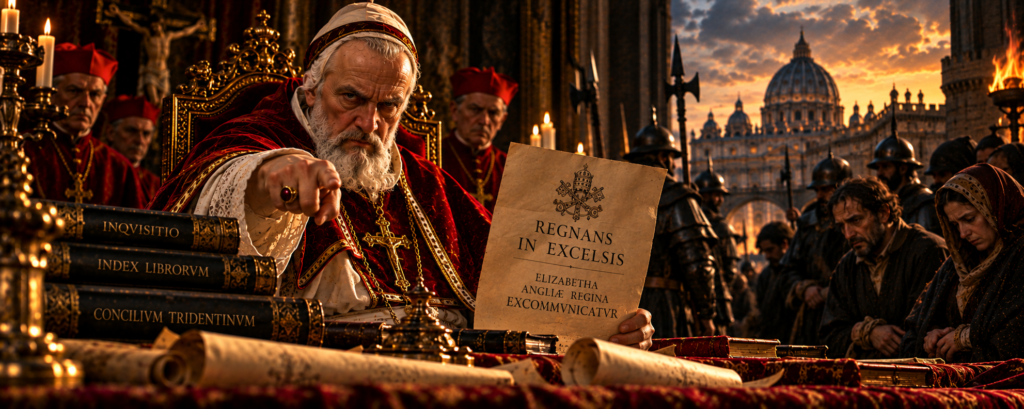
Pius V: The Saintly Inquisitor Who Ruled the Church With an Iron Fist
Pope Pius V (1504–1572) | Reigned 1566–1572
The Pope Who Declared a Queen Unfit to Rule
On February 25, 1570, Pope Pius V issued a declaration that would help transform the religious divisions of England into a struggle involving treason, political allegiance, and the threat of rebellion. The document, known as Regnans in Excelsis, condemned Queen Elizabeth I as a heretic, pronounced her excommunicated, and declared that she had forfeited her claim to the English throne. It went further by releasing her subjects from their obligations of loyalty and obedience. From Rome, the pope had attempted to sever the bond between a reigning monarch and her people.
Elizabeth was not a Catholic ruler who had merely offended the pope through an unfortunate political decision. She governed a kingdom that had rejected papal jurisdiction and established a Protestant religious settlement, although many of her subjects continued practicing Catholicism privately. Pius regarded her authority as illegitimate because she had defied the Roman Church. His declaration therefore challenged not only her religious position but the foundations of her government.
The consequences were potentially devastating for English Catholics. Men and women who wished to remain loyal to their religion without betraying their country now faced an increasingly dangerous conflict between spiritual and political authority. The queen’s government could point to the papal declaration as evidence that Catholic allegiance threatened the security of the state. Suspicion intensified, and the political position of English Catholics became more precarious.
Pius did not intend to protect Elizabeth’s Catholic subjects by encouraging them to compromise with Protestant rule. He believed that religious truth carried obligations that could override loyalty to a monarch. His declaration reflected a conviction that rulers who rejected Catholic authority could lose their legitimate claim to obedience. It was an extraordinary assertion of papal power at a moment when much of Europe was already being torn apart by religious conflict.
Yet the man responsible for this confrontation was not a corrupt Renaissance prince living amid extravagant banquets, mistresses, and the enrichment of an enormous family. Pius V was personally austere, deeply religious, and remarkably disciplined. He wore the simple white habit of his Dominican order beneath the dignity of the papal office, devoted considerable time to prayer, and sought to eliminate abuses within the Church. His private life offered little of the scandalous material associated with Alexander VI, Julius III, or the more notorious Renaissance pontiffs.
That contrast makes his story especially unsettling. Pius V did not persecute religious opponents because he had abandoned the principles of his faith. He pursued them because he believed those principles demanded uncompromising enforcement. His government strengthened the Roman Inquisition, imposed severe restrictions upon Jewish communities, pursued suspected heretics, and attempted to make religious conformity a defining obligation of political society.
He also became one of the most celebrated popes of the Catholic Counter-Reformation. His administration implemented major reforms from the Council of Trent, standardized important aspects of Catholic worship, and helped organize the Holy League that defeated an Ottoman fleet at the Battle of Lepanto in 1571. Catholics later venerated him as a saint, and he was canonized in 1712. His reputation for holiness became inseparable from his place in Catholic history.
Pius V therefore presents a difficult historical paradox. The same pope who became a model of personal piety also used religious authority to justify persecution and coercion. The same ruler who sought to eliminate corruption from the Church imposed policies that deprived entire communities of freedom and security. His pontificate demonstrates that personal virtue, as understood by a ruler and his supporters, does not necessarily produce humane government.
Antonio Ghislieri: The Boy Who Became an Inquisitor
The future Pius V was born Antonio Ghislieri on January 17, 1504, in Bosco, a village in the Duchy of Milan, now known as Bosco Marengo. His family was not part of the great aristocratic dynasties that had supplied so many Renaissance popes. Accounts of his childhood emphasize modest circumstances and a religious upbringing. Unlike the Medici and Farnese pontiffs, his career would not be built primarily upon inherited political wealth.
Northern Italy during his childhood was a region of almost constant political uncertainty. French and Habsburg armies competed for control of Milan and surrounding territories, while local rulers struggled to preserve their independence. The Italian Wars brought devastation, shifting alliances, and foreign intervention. Religious institutions remained deeply entangled with these conflicts.
Antonio’s early life took a different direction from that of many ambitious young men seeking careers in the Church. He entered the Dominican order as a teenager, taking the religious name Michele. The Dominicans emphasized preaching, theological education, and the defense of Catholic doctrine. Their institutional history was also closely connected with medieval inquisitorial activity.
The young friar embraced the order’s demanding religious discipline. He studied philosophy and theology, developed a reputation for seriousness, and devoted himself to prayer and intellectual work. His commitment to austerity distinguished him from clerics who treated ecclesiastical office as a source of comfort and status. Those who admired him regarded his strictness as evidence of unusual religious integrity.
Yet the Dominican environment also encouraged a particular understanding of religious responsibility. The defense of orthodox doctrine was considered essential to the salvation of souls and the preservation of Christian society. Heresy was not viewed merely as a private intellectual mistake. It was understood as a spiritual danger capable of spreading through communities and undermining religious authority.
These assumptions would shape Ghislieri’s entire career. He came to believe that the Church had a duty to identify and suppress religious error. His personal commitment to poverty and discipline developed alongside an equally strong commitment to doctrinal enforcement. The two qualities were not contradictory within his religious worldview.
As he advanced through the Dominican order, his reputation for severity became increasingly important. He was regarded as dependable, incorruptible, and unwilling to compromise on matters of faith. Those characteristics attracted the attention of church authorities confronting the spread of Protestantism. The future pope was moving toward a career in which religious certainty would become an instrument of judicial power.
The Dominican Friar Who Hunted Heresy
Ghislieri’s rise coincided with the Catholic Church’s growing determination to confront Protestantism. Martin Luther’s challenge had spread far beyond Germany, while reform movements associated with Huldrych Zwingli, John Calvin, and other leaders were reshaping European religious life. Catholic authorities feared that Protestant ideas might gain influence within Italy itself. The need to investigate suspected heresy became a major concern of the Roman government.
Ghislieri developed experience in inquisitorial administration before reaching the highest ranks of the Church. His reputation for theological rigor and personal discipline made him attractive to officials who wanted reliable defenders of orthodoxy. He served in positions connected with the investigation of religious dissent. His work brought him into contact with the legal machinery through which Catholic authorities examined accusations of heresy.
The Inquisition was not a single institution operating identically throughout Europe. Different inquisitorial systems existed under varying political and ecclesiastical authorities, including the Spanish Inquisition and the Roman Inquisition. Procedures, jurisdictions, and punishments differed according to place and period. Ghislieri’s career developed primarily within the Roman system that had been strengthened during the sixteenth century.
The Roman Inquisition investigated suspected departures from Catholic doctrine. Its officials could summon witnesses, examine writings, question accused individuals, and impose penalties through formal proceedings. Imprisonment and other punishments were available, while serious cases could result in the condemned being handed to secular authorities for execution. The system was designed to enforce religious conformity rather than protect freedom of conscience.
Ghislieri regarded this work as a religious duty. He believed that tolerating heresy endangered both individuals and the wider Christian community. From his perspective, the correction or punishment of religious error could be understood as an act of spiritual responsibility. Such reasoning made coercion appear compatible with religious devotion.
His strictness sometimes brought him into conflict with political authorities and other churchmen. Local rulers could resent inquisitorial interference, especially when investigations affected influential individuals or threatened economic interests. Ghislieri was not inclined to abandon a prosecution merely because powerful people objected. His reputation for inflexibility became one of his defining characteristics.
Supporters admired his refusal to be intimidated. Critics considered him excessively harsh and unwilling to recognize the complexities of religious disagreement. Both assessments reflected genuine features of his temperament. His career was built upon the conviction that truth required firm enforcement, even when enforcement created hostility.
The significance of this background cannot be overstated. Pius V did not become an inquisitorial pope after unexpectedly discovering the machinery of religious repression. He had spent much of his adult life working within it. When he eventually reached the papal throne, he brought decades of experience and a deeply established commitment to its mission.
Paul IV Finds a Man After His Own Heart
Ghislieri’s career advanced significantly under Pope Paul IV, one of the most uncompromising pontiffs of the Counter-Reformation. Paul had helped establish the centralized Roman Inquisition before becoming pope and regarded it as essential to defending Catholic doctrine. He distrusted theological compromise and believed that religious reform required strict enforcement. Ghislieri shared much of that outlook.
In 1556, Paul IV appointed Ghislieri bishop of Sutri and Nepi. The appointment placed him within the episcopal hierarchy while allowing him to continue his involvement in religious administration. His reputation for discipline and orthodoxy made him valuable to the pope. He was not simply another politically connected churchman receiving an honorary office.
The following year, Paul elevated him to the College of Cardinals. Ghislieri became Cardinal Michele Ghislieri, commonly associated with his Dominican identity and his inquisitorial responsibilities. His promotion reflected the pope’s confidence in his judgment. It also brought him into the highest ranks of a Church increasingly divided over the methods of Catholic reform.
Ghislieri subsequently received important responsibilities within the Roman Inquisition. His experience made him one of the institution’s most influential figures. He was closely associated with the effort to identify and suppress religious ideas considered incompatible with Catholic teaching. The appointment strengthened his connection to the most severe aspects of Paul IV’s government.
Paul IV’s pontificate also witnessed the creation of the Roman Ghetto and the persecution of Jewish communities. His bull Cum nimis absurdum imposed compulsory segregation and economic restrictions upon Jews in the Papal States. At Ancona, inquisitorial proceedings against people accused of returning to Judaism after baptism resulted in executions. These events established a precedent for the policies Ghislieri would later pursue as pope.
The relationship between the two men was rooted in shared religious convictions. Both believed that Catholic reform required discipline, orthodoxy, and resistance to compromise. Both regarded the Inquisition as an essential institution. Their approaches differed in some political and administrative respects, but their understanding of religious authority was closely aligned.
When Paul IV died in 1559, Rome erupted in hostility toward his government. Crowds attacked his statue and the headquarters of the Inquisition, revealing the resentment associated with his severity. Ghislieri’s reputation as an inquisitor did not disappear with his patron’s death. He remained a prominent representative of the hardline reform movement within the Church.
The next pope, Pius IV, adopted a more diplomatic approach. His government moderated some of Paul IV’s harshest policies and completed the Council of Trent. Ghislieri continued serving the Church but was not always comfortable with the new pontiff’s flexibility. The contrast between the two approaches would become important when the papal throne fell vacant again.
The Election That Brought the Inquisition to the Papal Throne
Pius IV died on December 9, 1565, leaving behind a Church that had undergone significant institutional reform. The Council of Trent had finally concluded in 1563, establishing doctrines and disciplinary measures intended to strengthen Catholicism. Yet the implementation of those reforms remained incomplete. The next pope would determine how aggressively the new standards would be enforced.
The conclave opened amid familiar political pressures. European monarchs sought influence over the election, while cardinals disagreed over the direction of Catholic reform. Some preferred a diplomatic pope capable of managing relations with Catholic rulers. Others wanted a more austere leader who would impose strict discipline upon the Church.
Charles Borromeo, the influential nephew of Pius IV, played an important role in the election. Borromeo had become one of the leading advocates of Tridentine reform and valued personal holiness in ecclesiastical leadership. He supported the candidacy of Michele Ghislieri, whose austere reputation appealed to reform-minded cardinals. The choice reflected a determination to place the papacy in the hands of a man known for religious seriousness.
On January 7, 1566, Ghislieri was elected pope. He took the name Pius V, succeeding the more moderate Pius IV. The election represented a decisive shift in temperament. Rome was about to be governed by a man whose identity had been shaped by Dominican discipline and inquisitorial enforcement.
The new pope was sixty-one years old and had spent decades defending Catholic orthodoxy. He possessed little interest in the luxurious habits associated with earlier Renaissance courts. His personal life was marked by simplicity, prayer, and strict religious observance. Many Catholics welcomed his election as evidence that the Church was finally abandoning the corruption of the Renaissance papacy.
Yet his austerity came with a formidable capacity for severity. He believed that moral reform required the punishment of wrongdoing and the suppression of religious error. His understanding of pastoral responsibility allowed little room for tolerance toward those who rejected Catholic doctrine. The qualities that made him admirable to supporters would make him frightening to opponents.
Pius V did not intend to govern as a ceremonial figure. He was determined to implement the Council of Trent, strengthen religious discipline, and defend Catholicism against Protestant and Ottoman challenges. His pontificate would be active, demanding, and uncompromising. The consequences would reach far beyond Rome.
A Pope Who Refused to Live Like a Renaissance Prince
One of the most striking features of Pius V’s pontificate was his personal austerity. He continued wearing the white Dominican habit associated with his religious order, maintaining a visible connection to the life he had chosen as a young friar. His habits contrasted sharply with the extravagant courts of earlier Renaissance popes. He preferred simplicity and religious discipline to elaborate displays of personal luxury.
His daily routine emphasized prayer and religious observance. He attended to spiritual responsibilities with a seriousness that impressed supporters. Accounts of his life describe a pope who resisted unnecessary comfort and sought to preserve the habits of a religious community. His personal conduct became an important part of his reputation for holiness.
Pius also opposed forms of corruption that had long damaged the Church. He sought to enforce clerical discipline, discourage the sale of ecclesiastical favors, and improve the administration of religious institutions. His government placed greater emphasis upon the responsibilities of bishops and priests. The reforms reflected the principles established by the Council of Trent.
He was particularly hostile toward the luxurious behavior of clergy. Churchmen who neglected their duties or treated office as a source of personal enrichment could expect criticism. Pius believed that the Church’s authority depended partly upon the moral example of its leaders. He wanted clergy to live in a manner consistent with their religious obligations.
His attitude toward nepotism also differed from that of many predecessors. He did not establish a vast family dynasty comparable to the Borgias, Farnese, or Carafa. Although relatives were not entirely absent from his government, family advancement was not the defining purpose of his pontificate. His personal reputation remained largely free from the financial scandals associated with earlier popes.
These qualities explain why Pius V became a revered figure within Catholic tradition. He appeared to embody the disciplined religious leadership demanded by reformers. His lifestyle offered a powerful contrast to the corruption that had contributed to criticism of the papacy. He was a pope whose personal conduct could inspire genuine admiration.
Yet austerity did not necessarily produce compassion. Pius could deny himself luxury while demanding harsh restrictions upon others. His religious convictions made him willing to use the power of the state against people whose beliefs he condemned. The contradiction between personal holiness and coercive government would become the central problem of his reign.
Rome Under the Rule of a Moral Enforcer
Pius V moved quickly to impose stricter moral discipline upon Rome. He regarded the city as the spiritual center of Catholic Christianity and believed that its public life should reflect that status. Practices he considered sinful or scandalous became targets of regulation. His government attempted to reshape the behavior of ordinary residents as well as clergy.
Prostitution attracted particular attention. Rome had long contained a substantial population of women involved in commercial sex, and earlier papal governments had alternated between regulation, taxation, and attempts at suppression. Pius regarded prostitution as a moral danger that should not be tolerated. His efforts to restrict or remove prostitutes created practical difficulties and resistance.
The problem was complicated by poverty and the limited economic opportunities available to women. Many women involved in prostitution depended upon it for survival, while others were controlled or exploited by intermediaries. Policies designed primarily around punishment could worsen their vulnerability. Pius’s determination to eliminate public immorality did not necessarily address the conditions that sustained it.
The pope also pursued measures against blasphemy, public disorder, and sexual misconduct. His government expected residents to conform more closely to Catholic moral standards. Religious observance became an important measure of acceptable public behavior. The boundaries between spiritual discipline and civil regulation narrowed.
Pius’s campaign reflected a broader Counter-Reformation effort to create more disciplined Catholic societies. Similar concerns influenced bishops and rulers elsewhere in Europe. Religious authorities believed that public morality affected the spiritual health of the community. Enforcement therefore appeared to them as a legitimate responsibility of government.
Yet the consequences could be oppressive. Ordinary people faced increased scrutiny over behavior that earlier authorities might have tolerated or regulated less aggressively. Moral offenses could carry serious legal penalties. The pope’s vision of a purified Rome depended upon the ability to compel obedience.
The city that had once celebrated Renaissance magnificence was becoming a model of Counter-Reformation discipline. Artistic and religious traditions continued, but the atmosphere of government had changed. Pius wanted Rome to demonstrate the seriousness of Catholic reform. For those who fell outside his standards, that seriousness could be frightening.
The Inquisition Returns to the Center of Power
The Roman Inquisition occupied a central place in Pius V’s understanding of Catholic government. He had spent much of his career within its administration and trusted its methods. His election brought a former inquisitor to the highest office in the Church. The institution consequently enjoyed strong papal support.
Pius believed that religious error could spread through books, preaching, private discussion, and personal relationships. He regarded the investigation of suspected heresy as necessary to protect Catholic society. The Inquisition offered procedures through which accusations could be examined and penalties imposed. Its authority extended into matters that modern societies generally regard as questions of individual conscience.
Investigations could involve testimony from witnesses, examination of writings, and interrogation of suspects. Accused individuals might be imprisoned while proceedings continued. The institution possessed legal rules and did not condemn every person investigated. Nevertheless, the threat of prosecution created powerful incentives for silence and conformity.
The pope’s personal involvement gave inquisitorial officials considerable confidence. They knew that their work aligned closely with his priorities. Pius was unlikely to regard doctrinal compromise as a virtue when serious accusations of heresy arose. His government therefore encouraged strict enforcement.
The consequences extended beyond openly Protestant communities. Catholic intellectuals whose theological positions appeared ambiguous could also attract scrutiny. Religious discussion became increasingly constrained by the need to remain within officially accepted boundaries. The possibility of investigation affected scholarship and pastoral activity.
Pius’s supporters considered this vigilance essential. They believed that Protestantism had spread partly because earlier church leaders failed to respond decisively. In their view, strict enforcement prevented spiritual danger and preserved religious unity. The Inquisition could therefore be understood as an instrument of protection.
Those subjected to its authority experienced a different reality. Religious dissent could lead to imprisonment, loss of livelihood, public humiliation, or more severe punishment. The institution’s coercive powers made freedom of belief conditional upon official approval. Pius’s government strengthened a system in which religious conformity was enforced through law.
The Case of Pietro Carnesecchi
One of the most notorious inquisitorial prosecutions during Pius V’s pontificate involved Pietro Carnesecchi, a Florentine humanist and former papal official. Carnesecchi had moved within influential intellectual and religious circles during the early decades of the Reformation. He became associated with reform-minded Catholics whose theological discussions attracted suspicion. His career placed him at the intersection of Renaissance humanism and the increasingly rigid boundaries of Counter-Reformation orthodoxy.
Carnesecchi had previously faced accusations concerning his religious beliefs. His associations included figures connected with spiritual reform movements that emphasized justification by faith and personal religious renewal. Such ideas could overlap with Protestant theology, even when their supporters continued identifying as Catholic. The distinction became increasingly dangerous as the Church hardened its doctrinal boundaries.
Under Pius IV, Carnesecchi had received a measure of protection and relief from earlier accusations. The election of Pius V transformed his position. The new pope was far less willing to tolerate theological ambiguity. Carnesecchi’s past associations became the basis for renewed prosecution.
In 1566, he was arrested and brought before the Roman Inquisition. The proceedings examined his beliefs, writings, and connections with suspected religious dissenters. Investigators sought to establish whether he had embraced doctrines condemned by the Church. His intellectual and social prominence did not protect him.
The trial culminated in his condemnation for heresy. On October 1, 1567, Carnesecchi was executed in Rome, where he was beheaded and his body burned. His death became one of the most prominent examples of the severity associated with Pius V’s religious policies. It demonstrated that the pope was prepared to authorize the ultimate punishment against an educated and influential man accused of religious error.
Carnesecchi’s execution also revealed the narrowing space available for Catholic reformers who had explored ideas outside the boundaries later established by Trent. Earlier decades had permitted a wider range of theological discussion within certain circles. By the 1560s, those conversations could become evidence in a heresy trial. The Church’s determination to define orthodoxy had made intellectual experimentation dangerous.
The case remains significant because it was not merely a conflict between Rome and an openly Protestant ruler. It involved a man whose religious development had taken place within the complex world of Italian Catholic reform. His prosecution exposed the difficulty of separating sincere spiritual inquiry from condemned doctrine. Under Pius V, that distinction could determine whether a person lived or died.
The Church’s War Against Dangerous Books
Pius V inherited a system of religious censorship that had been developed and revised under earlier popes. Paul IV’s Index of Forbidden Books had imposed sweeping restrictions, while Pius IV approved a more systematic version in 1564. The purpose remained the same: to prevent the circulation of writings considered dangerous to Catholic doctrine. Pius V strongly supported that objective.
The printing press had transformed the spread of religious ideas. Protestant reformers used printed books, pamphlets, and translations to reach audiences across Europe. Catholic authorities understood that controlling preaching alone was no longer sufficient. Written arguments could circulate far beyond the immediate supervision of bishops.
Pius regarded censorship as a necessary defense against heresy. The Church sought to identify prohibited works and restrict their publication, distribution, and possession. Printers and booksellers could face investigation if they circulated condemned material. Scholars had to consider the possibility that controversial writings might attract official attention.
The restrictions affected theological scholarship in particular. Authors who explored disputed questions risked being associated with Protestant ideas. The boundaries of acceptable discussion were increasingly defined by the Council of Trent and subsequent papal decisions. Intellectual independence was subordinated to doctrinal conformity.
Yet censorship was not always applied uniformly. Local authorities, political circumstances, and institutional resources influenced enforcement. Some prohibited works continued circulating despite official restrictions. The system was powerful but not omnipotent.
Pius’s commitment to censorship reflected his broader understanding of religious government. He believed that the Church had a responsibility to protect believers from dangerous ideas. That conviction made the restriction of reading appear legitimate. The possibility that individuals might possess a right to investigate religious claims independently had little place in his worldview.
The long-term consequences extended beyond his lifetime. Catholic censorship remained an important institution for centuries, shaping the publication and reception of religious and intellectual works. Pius V did not create the system, but his government reinforced its authority. The defense of orthodoxy remained closely connected with the control of information.
The Jews of Rome: A Community Already Behind Walls
When Pius V became pope, Jewish life in the Papal States had already been transformed by the policies of Paul IV. The bull Cum nimis absurdum, issued in 1555, had imposed compulsory segregation, distinctive clothing, and severe economic restrictions. In Rome, Jews were confined to the ghetto established near the Tiber. Their freedom of residence and occupation had been sharply curtailed.
Pius IV had moderated some aspects of his predecessor’s treatment of Jewish communities. His government offered limited relief from certain restrictions and adopted a less confrontational approach. These concessions did not abolish the ghetto or establish religious equality. Nevertheless, they represented a temporary easing of the harshest policies.
Pius V reversed that direction. He shared Paul IV’s conviction that Jewish communities should occupy a restricted position within Christian society. His government renewed severe regulations and pursued additional measures intended to limit Jewish economic activity. The brief period of relative relief came to an end.
The restrictions were rooted in longstanding Christian anti-Jewish prejudice. Church authorities had historically imposed limitations upon Jewish residence, property ownership, and public religious life. Such policies were justified through theological arguments that treated Judaism as a subordinate religious tradition. Pius accepted these assumptions and sought to enforce them more rigorously.
For Jewish families, the consequences were immediate and practical. Economic restrictions threatened livelihoods, while compulsory segregation limited opportunities for social and commercial activity. The requirement to wear identifying clothing reinforced exclusion in public. Religious identity became the basis for systematic legal inequality.
The Roman Ghetto remained a crowded and restricted environment. Its residents preserved communal institutions, religious traditions, and family networks despite the limitations imposed upon them. Their survival reflected resilience under coercive conditions. It did not mean that the restrictions were accepted willingly.
Pius’s policies would soon go beyond confinement. In 1569, he issued a decree that forced Jewish communities to leave most of the Papal States altogether. The measure became one of the most consequential acts of religious persecution during his reign. It demonstrated that the pope’s determination to enforce religious uniformity could extend to the displacement of entire populations.
The Bull That Expelled Jewish Families From Their Homes
On February 26, 1569, Pius V issued the bull Hebraeorum gens. The decree ordered Jews to leave most territories under papal rule, with important exceptions for Rome and Ancona in Italy and certain papal possessions in southern France. It marked a severe escalation of the discriminatory policies already imposed upon Jewish communities. Families who had lived in particular towns for generations were forced to confront the possibility of permanent displacement.
The bull justified its measures through hostile accusations against Jews as a religious group. Such accusations reflected the prejudices of the period rather than reliable evidence of collective wrongdoing. The decree treated Jewish identity itself as a basis for exclusion. It did not require proof that every person affected had committed a crime.
The consequences were devastating for communities scattered across the Papal States. Families had to abandon homes, businesses, and established relationships. Property arrangements became complicated by the pressure to leave within the prescribed period. Economic and emotional losses accompanied the forced movement.
Towns that had contained Jewish communities for generations lost residents whose families had contributed to local commerce and culture. Synagogues, schools, and communal institutions were disrupted or abandoned. Religious traditions that had developed within particular communities faced the challenge of relocation. The decree transformed the social landscape of central Italy.
Some expelled families moved to Rome or Ancona, where Jewish residence remained permitted under severe restrictions. Others sought refuge in territories governed by rulers willing to tolerate Jewish communities. The movement placed additional pressure upon receiving towns and existing Jewish populations. Displacement created new hardships even where refuge was available.
The exceptions granted to Rome and Ancona reveal the practical calculations underlying the policy. Both cities possessed economic interests that made the complete removal of Jewish residents undesirable. Ancona’s commercial connections with the eastern Mediterranean were particularly important. The pope’s government was willing to tolerate Jewish presence where economic considerations made expulsion inconvenient.
That contradiction undermines any attempt to portray the decree as a simple matter of unavoidable religious principle. The government imposed sweeping exclusion while preserving exceptions that served its interests. Religious prejudice and economic calculation operated together. The result was a policy that devastated vulnerable communities while accommodating the needs of papal commerce.
What Expulsion Meant for Ordinary Families
The expulsion of 1569 was not merely a legal measure affecting an abstract population. It reached into households, disrupted marriages and family networks, and forced people to make decisions under severe pressure. A merchant might lose customers and property accumulated over decades. A family might be separated from relatives unable to travel or unwilling to abandon their homes.
The practical difficulties were immense. Moving required money, transportation, and knowledge of places where settlement might be permitted. Families had to consider whether they could preserve religious practices in their new surroundings. They also faced uncertainty about whether future rulers might impose similar restrictions.
Economic losses were particularly damaging. Property sold under pressure rarely commanded the same value as property sold freely. Businesses dependent upon local relationships could not easily be recreated elsewhere. The decree therefore threatened both immediate survival and long-term financial security.
The destruction of established communities also affected religious life. Synagogues were more than places of worship; they were centers of education, charity, and communal organization. Their disappearance could weaken networks that supported the poor and vulnerable. Relocation required rebuilding institutions under uncertain conditions.
Some Jewish communities found refuge in territories outside papal control. Italian rulers differed in their policies, and commercial interests sometimes encouraged tolerance. Yet refuge was rarely equivalent to unrestricted freedom. Jewish residents could remain subject to special taxes, residential limitations, and political insecurity.
The expulsion also altered the demographic history of the Papal States. Jewish life became increasingly concentrated in the places where residence remained permitted. Rome and Ancona acquired greater importance as centers of Jewish settlement. Communities elsewhere suffered interruption or disappearance.
Pius V’s responsibility for this displacement is direct. The bull was issued under his authority and reflected his religious priorities. Its consequences cannot be dismissed as unfortunate accidents of a broader historical process. He chose to impose a policy that deprived thousands of people of the right to remain in their communities.
A Pope Who Believed Religious Difference Was Dangerous
Pius V’s treatment of Jewish communities reflected a broader conviction that religious difference threatened Christian society. He did not approach Judaism as a legitimate alternative faith deserving equal protection. His government treated Jews as a population whose presence required restriction and supervision. The resulting policies were discriminatory by design.
The same understanding shaped his treatment of Protestantism. Religious disagreement was not regarded as a private matter between an individual and God. It was understood as a threat to the spiritual and political order. Authorities therefore claimed the right to intervene.
This worldview was widespread in sixteenth-century Europe. Catholic and Protestant governments alike frequently imposed religious conformity within their territories. Rulers believed that religious division could produce political instability and civil conflict. The experience of the Reformation appeared to confirm those fears.
Yet the prevalence of coercion does not make every policy inevitable or morally equivalent. Different rulers adopted different approaches, and periods of limited toleration existed even within deeply divided societies. Pius V consistently favored strict enforcement. His choices intensified persecution where alternative policies were possible.
His government also demonstrated that religious persecution could be economically selective. Jewish communities were expelled from many towns while remaining permitted in commercially important centers. Such exceptions reveal the interaction between ideological conviction and practical government. The pope’s religious certainty did not prevent political calculation.
The result was a system that treated freedom of conscience as subordinate to the demands of religious authority. Individuals could not simply choose their beliefs without risking legal consequences. Communities could lose the right to reside in places where their ancestors had lived for generations. Pius regarded such measures as legitimate expressions of Christian government.
For those subjected to them, the consequences were coercion, displacement, and insecurity. The gap between the pope’s intentions and the experiences of his victims is essential to understanding his reign. His sincerity does not erase the suffering produced by his policies. The historical record demands attention to both.
The Council of Trent Becomes a Program of Government
Pius V inherited one of the most important achievements of the Catholic Reformation. The Council of Trent had concluded in 1563 under Pius IV, establishing doctrinal definitions and disciplinary reforms intended to strengthen the Church. Yet the decrees required implementation across a vast and politically divided Catholic world. Pius approached that task with determination.
The council had addressed clerical education, episcopal responsibilities, the sacraments, and numerous questions of church discipline. Its decisions sought to correct abuses that had damaged Catholic credibility. Better-trained priests and more responsible bishops were considered essential to renewal. The reforms also clarified Catholic teaching in opposition to Protestant doctrines.
Pius regarded the council’s decrees as obligations rather than suggestions. He encouraged bishops to reside in their dioceses and fulfill pastoral responsibilities. He supported improved clerical discipline and the establishment of seminaries. His government sought to make reform visible throughout Catholic institutions.
His personal example strengthened these efforts. A pope who lived austerely could demand greater seriousness from clergy without appearing hypocritical in matters of personal luxury. His reputation for incorruptibility gave moral authority to disciplinary measures. Many Catholic reformers admired his determination.
Yet implementation also reinforced centralization. Rome increasingly supervised the interpretation and application of Tridentine decrees. Bishops were expected to conform to standards established through papal authority. The Church became more institutionally disciplined and more clearly defined.
The reforms were not merely instruments of repression. Better clerical education improved pastoral care, while clearer administrative standards addressed genuine problems. The establishment of seminaries helped create a more professionally trained priesthood. These achievements had lasting consequences.
Nevertheless, Pius’s understanding of reform remained inseparable from enforcement. He believed that institutional renewal required obedience to doctrine and discipline. The same government that promoted education also supported censorship and inquisitorial prosecution. Catholic reform under Pius V therefore combined constructive renewal with coercive religious uniformity.
The Roman Catechism and the Education of Priests
One of the important publications of Pius V’s pontificate was the Roman Catechism, issued in 1566. The work had been prepared through efforts initiated under earlier popes and associated with the Council of Trent. Its purpose was to provide parish priests with a systematic explanation of Catholic doctrine. The publication became an important instrument of Counter-Reformation education.
The need for such a work was substantial. Clergy in different regions possessed uneven levels of theological training. Some priests lacked the education necessary to explain complex doctrines clearly. Protestant reformers had criticized these weaknesses and developed their own educational materials. Catholic leaders recognized the importance of responding.
The Roman Catechism offered guidance concerning the Creed, sacraments, commandments, and prayer. It was intended primarily for clergy rather than as a simple children’s manual. Its explanations helped establish a common framework for preaching and religious instruction. The work contributed to greater consistency within Catholic pastoral practice.
Pius supported its publication because he regarded education as essential to religious reform. He wanted priests capable of defending Catholic teaching and guiding their congregations. The catechism offered a practical means of achieving that objective. It also reinforced the doctrinal boundaries established by Trent.
The work’s influence extended far beyond his pontificate. It remained an important reference for Catholic clergy over subsequent centuries. Its publication represented a constructive aspect of the Counter-Reformation. Better instruction could address ignorance without relying exclusively upon punishment.
Yet the catechism also formed part of a wider effort to establish religious uniformity. It presented Catholic doctrine as authoritative and excluded interpretations condemned by the Church. Its educational purpose therefore operated within a system that restricted theological disagreement. The distinction between instruction and enforcement remained closely connected.
Pius’s achievement in this area deserves recognition. The publication contributed to a more educated clergy and a more systematic approach to religious teaching. It also demonstrates why his pontificate cannot be reduced to persecution alone. His government strengthened Catholic institutions through both education and coercion.
The Mass That Became Associated With His Name
Pius V also played a major role in standardizing Catholic worship. The Council of Trent had called for revisions to important liturgical books, and the pope supervised their publication. In 1568, he issued a revised Roman Breviary. Two years later, he promulgated a revised Roman Missal.
The Roman Missal of 1570 became especially influential. It established a standardized form of the Roman Rite for much of the Latin Church. The reform sought to eliminate inconsistencies and ensure greater uniformity in the celebration of Mass. It reflected the Counter-Reformation emphasis on discipline and doctrinal clarity.
The changes did not create an entirely new liturgy. They revised and standardized traditions that had developed over centuries. The missal preserved many longstanding elements of Roman worship. Its significance lay in the authority with which a particular form was promulgated.
Pius allowed certain older liturgical traditions to continue. Rites with sufficiently ancient established usage, generally at least two hundred years, were exempted from compulsory adoption of the new missal. This exception preserved important local and religious-order traditions. The reform was therefore extensive but not absolutely universal.
The standardized Roman Mass became closely associated with Pius V. Later generations often referred to it as the Tridentine Mass, reflecting its connection with the Council of Trent. Its influence extended across Catholic Europe and into missionary territories. It became one of the most enduring features of post-Tridentine Catholicism.
The reform also reinforced papal authority over worship. Liturgical practice became more closely regulated through centrally approved books. Local variation was reduced, and the Roman model gained greater prominence. The Church’s religious identity became increasingly uniform.
For many Catholics, these changes strengthened spiritual life and created a shared form of worship. For historians, they also reveal the growing centralization of Catholic institutions. Pius V’s liturgical reforms were among his most lasting achievements. They demonstrate how his determination to enforce uniformity could produce developments celebrated by later generations.
The Queen Who Refused to Obey Rome
Elizabeth I had ruled England since 1558, when she succeeded her Catholic half-sister Mary I. Her accession reversed the religious direction of the previous reign. The Elizabethan settlement restored royal supremacy over the English Church and established Protestant worship. The papacy no longer possessed recognized jurisdiction within the kingdom.
Pius V regarded Elizabeth’s government as a profound challenge to Catholic authority. She was the daughter of Henry VIII and Anne Boleyn, whose marriage had been central to England’s earlier break with Rome. Catholic opponents questioned the legitimacy of that marriage and, consequently, Elizabeth’s claim to the throne. The pope’s religious objections were therefore intertwined with dynastic politics.
Elizabeth’s government faced a complicated domestic situation. Many English subjects accepted the Protestant settlement, while others remained Catholic. Some Catholics attended official services outwardly while maintaining traditional beliefs privately. Others refused conformity and faced financial or legal penalties.
The queen initially sought political stability rather than immediate mass persecution of every Catholic subject. Her government nevertheless imposed religious obligations and treated open resistance as a potential threat. The relationship between religion and political loyalty was increasingly difficult to separate. Foreign Catholic powers complicated the situation by supporting rival claims and religious opposition.
Pius believed that Elizabeth’s rejection of papal authority made her position illegitimate. He also regarded her government as responsible for the suppression of Catholic worship. The possibility of restoring England to Catholicism remained an important objective. Yet the pope possessed limited practical means of achieving it.
The situation became more dangerous after the Northern Rebellion of 1569. Catholic nobles in northern England attempted to challenge Elizabeth’s government and restore Catholic influence. The rebellion failed, and its leaders faced severe consequences. The episode intensified fears of Catholic conspiracy.
Pius’s response would go far beyond ordinary diplomatic condemnation. He intended to declare Elizabeth excommunicated and release her subjects from obedience. The decision would transform the religious conflict into an explicit challenge to royal legitimacy. It would also place English Catholics in an increasingly perilous position.
Regnans in Excelsis: The Bull That Challenged a Throne
On February 25, 1570, Pius V issued the bull Regnans in Excelsis. The document condemned Elizabeth I for her religious policies and declared her excommunicated. It also asserted that she had forfeited her claim to rule. Her subjects were released from their obligations of allegiance.
The declaration represented one of the most dramatic assertions of papal political authority during the Reformation. Pius claimed that the spiritual jurisdiction of the Church could affect the legitimacy of a secular monarch. The bull therefore challenged the principle that Elizabeth’s authority rested upon the laws and institutions of England. It attempted to place papal judgment above the political settlement of the kingdom.
The pope’s action reflected longstanding medieval claims concerning the relationship between spiritual and temporal power. Earlier popes had attempted to discipline monarchs through excommunication and political sanctions. Yet the sixteenth century presented a different political environment. Protestant rulers rejected the very authority upon which such measures depended.
Elizabeth was not likely to surrender her throne because the pope declared her illegitimate. Her government possessed the military and administrative means to enforce its authority. The bull therefore had little immediate prospect of removing her. Its more direct effect was to intensify the political danger surrounding Catholic allegiance.
The timing also complicated matters. The Northern Rebellion had already failed, and the declaration came after the principal uprising had been suppressed. It could not provide effective support to the defeated rebels. Instead, it supplied Elizabeth’s government with a powerful argument that papal authority encouraged disobedience.
The bull was not simply a theological statement. By releasing subjects from allegiance, it entered the realm of political rebellion. It raised the possibility that Catholics might regard resistance to Elizabeth as a religious obligation. Even those who rejected violence could be suspected of harboring divided loyalties.
Pius considered the declaration justified by Elizabeth’s rejection of Catholic authority. He believed that religious truth could determine political legitimacy. Yet the consequences for ordinary English Catholics were deeply troubling. A papal decision made in Rome increased the risks faced by people living under a government the pope could not control.
English Catholics Caught Between Church and Crown
The bull created a dangerous dilemma for English Catholics. Many wished to remain faithful to their religion while continuing to live peacefully under Elizabeth’s government. Their position had already been difficult because official worship was Protestant. The papal declaration made the conflict between religious and political allegiance more explicit.
The queen’s government could interpret loyalty to Rome as evidence of potential disloyalty to England. Catholics who refused official religious services faced growing suspicion. Priests associated with foreign seminaries or missionary efforts could be viewed as agents of hostile powers. The boundary between religious practice and political conspiracy became increasingly contested.
The effects developed over time rather than appearing all at once. The bull did not immediately produce every later law against Catholics, and the English government’s policies were shaped by numerous political events. Nevertheless, it became an important part of the justification for harsher measures. The threat of foreign intervention and domestic rebellion made Catholic allegiance appear increasingly dangerous to Elizabeth’s advisers.
Some English Catholics rejected the idea that papal excommunication required them to overthrow the queen. They sought ways to reconcile religious fidelity with civil obedience. Others supported efforts to replace Elizabeth with a Catholic ruler. The community was not politically uniform.
The papal declaration made these distinctions harder for the government to recognize. Officials could suspect even peaceful Catholics of secretly accepting the pope’s claim that Elizabeth lacked legitimate authority. The result was a climate in which religious identity itself became politically suspect. The consequences would become more severe during later decades.
Pius’s decision also exposed the limitations of governing through absolute religious principle. He believed that Elizabeth should be condemned because she rejected Catholic authority. Yet he had little ability to protect the Catholics who would bear the consequences of his condemnation. The spiritual certainty of the declaration did not guarantee political wisdom.
The bull remains one of the strongest examples of the coercive assumptions underlying his pontificate. Pius did not merely criticize a monarch’s religious policies. He attempted to dissolve the political obligations of her subjects. His action helped transform a religious dispute into a conflict involving sovereignty, treason, and national security.
Mary, Queen of Scots, and the Hope of a Catholic Restoration
The question of Elizabeth’s legitimacy was closely connected with the position of Mary, Queen of Scots. Mary was a Catholic monarch with a claim to the English throne through her Tudor ancestry. Her supporters regarded her as a possible alternative to Elizabeth. The prospect of a Catholic ruler replacing Elizabeth attracted interest among Catholic powers.
Mary’s own political situation was deeply troubled. Her reign in Scotland had been marked by religious conflict, factional rivalry, and scandal surrounding her marriages. In 1567, she was forced to abdicate in favor of her infant son, James VI. She escaped to England in 1568, where Elizabeth placed her under supervision.
Mary’s presence created a continuing political danger for Elizabeth. Catholic opponents of the English queen could regard the Scottish monarch as a legitimate alternative. Foreign powers might also use her claim as a justification for intervention. The problem became increasingly serious as religious divisions deepened.
Pius V viewed the possibility of Catholic restoration in England with interest. The papacy hoped that Protestant rule might eventually be reversed. Mary represented one potential focus for those ambitions. Yet the pope’s practical influence over English politics remained limited.
The Northern Rebellion and subsequent conspiracies demonstrated the dangers associated with rival claims. Elizabeth’s government regarded threats to her throne as matters of national security. Mary became increasingly entangled in the fears and calculations of English officials. Her captivity would continue long after Pius’s death.
It would be inaccurate to portray Pius as the sole architect of every later plot involving Mary. The political conflicts surrounding her involved numerous individuals and governments with different objectives. Nevertheless, his declaration against Elizabeth contributed to an atmosphere in which replacing the queen could be presented as a religious cause. The papacy’s position intensified the connection between Catholic identity and dynastic opposition.
The consequences would become especially tragic for Mary herself. She was eventually executed in 1587 after being implicated in a plot against Elizabeth. Pius had died fifteen years earlier and bore no direct responsibility for that final decision. His pontificate nevertheless formed part of the wider history that made the rivalry between the two queens so dangerous.
France: A Kingdom Divided by Religion
Pius V also confronted the growing violence of the French Wars of Religion. France had become divided between Catholics and Protestants, commonly known as Huguenots. Religious allegiance overlapped with aristocratic rivalry and struggles for political influence. The result was a series of conflicts that devastated communities and threatened the monarchy.
The pope strongly supported the Catholic cause. He regarded Protestantism as heresy and believed that Catholic rulers had a duty to resist its expansion. His government encouraged efforts to defend Catholic interests. He was deeply suspicious of political settlements that granted concessions to Protestant communities.
Catherine de’ Medici, acting as a central figure in the French monarchy, pursued a more complicated policy. She attempted at various moments to negotiate between rival factions and preserve royal authority. Her willingness to consider limited toleration alarmed hardline Catholics. Pius shared their concern that compromise might strengthen Protestantism.
The conflict intensified during the late 1560s. Catholic and Huguenot forces fought campaigns marked by brutality and religious hatred. Towns and villages suffered from military operations, while political assassinations and reprisals deepened mistrust. The violence demonstrated how thoroughly religious division had become entangled with civil war.
Pius’s support for Catholic military efforts reflected his understanding of religious duty. He believed that defending orthodoxy could justify armed intervention. His position was consistent with the coercive policies he pursued within the Papal States. Religious error was not something he believed rulers should simply tolerate.
Yet military victories did not produce lasting peace. The French monarchy repeatedly sought settlements because prolonged warfare threatened the kingdom’s stability. The Peace of Saint-Germain in 1570 granted important concessions to Huguenots. Pius strongly disliked the settlement.
His reaction revealed the limits of his political flexibility. He regarded concessions to Protestants as dangerous even when French rulers considered them necessary to end fighting. His commitment to religious uniformity made compromise difficult. The result was a papacy that supported Catholic interests but often struggled to accommodate the realities of a divided Europe.
The Catholic World Faces the Ottoman Empire
While religious conflict divided Western Europe, the Ottoman Empire remained a formidable power in the eastern Mediterranean. Ottoman forces controlled extensive territories in southeastern Europe, North Africa, and the eastern Mediterranean. Their naval strength threatened Christian-held islands and commercial routes. Catholic rulers regarded Ottoman expansion as both a political and religious danger.
Pius V became increasingly concerned about the situation. He believed that Catholic powers should cooperate against Ottoman military pressure. Yet the states he hoped to unite possessed competing interests. Spain, Venice, and other powers often disagreed over strategy and territorial priorities.
Venice depended heavily upon Mediterranean commerce and maintained complicated diplomatic relations with the Ottomans. Spain faced Ottoman and North African threats while also managing conflicts elsewhere in Europe. The Papal States possessed limited military resources but considerable diplomatic influence. Building a coalition required overcoming mutual suspicion.
The crisis intensified when Ottoman forces attacked Cyprus, a Venetian possession. The campaign began in 1570 and placed enormous pressure upon Venice. The island’s strategic position made its fate important to the balance of power in the eastern Mediterranean. Its defense became a major concern for Christian governments.
Pius regarded the Ottoman campaign as an opportunity to unite Catholic powers. He used papal diplomacy to encourage cooperation between Venice and Spain. His determination was strengthened by religious conviction. He believed that a common military effort could defend Christian territories and demonstrate Catholic unity.
The negotiations were difficult. Spain and Venice disagreed over military priorities and the distribution of costs. Each feared that the other might pursue separate interests. Pius worked to overcome these obstacles.
His efforts eventually produced the Holy League of 1571. The coalition included the Papal States, Spain, Venice, and other Catholic participants. Its purpose was to confront Ottoman naval power. The alliance became one of the most celebrated achievements of Pius’s pontificate.
The Holy League: An Alliance Built Against the Odds
The formation of the Holy League required considerable diplomatic persistence. Spain and Venice had reasons to cooperate, but their interests were not identical. Venice wanted to protect its eastern Mediterranean possessions and commercial position. Spain was concerned with broader Ottoman threats and the security of its own territories.
Pius V served as an important mediator. His authority as pope gave him influence over Catholic rulers, although it did not allow him simply to command their cooperation. He appealed to religious solidarity while addressing practical political concerns. The alliance emerged from negotiation rather than automatic obedience.
The agreement was concluded in May 1571. The coalition assembled a major fleet intended to challenge Ottoman naval power. Its forces included ships and personnel from several Catholic states. The diversity of the alliance created logistical and command difficulties.
Don John of Austria, the illegitimate half-brother of Philip II of Spain, was chosen to command the allied fleet. He was young but possessed considerable military experience and prestige. His appointment helped provide a recognized leader acceptable to the principal participants. The fleet gathered for a campaign that would become one of the most famous naval confrontations of the century.
The Ottoman fleet was commanded by Müezzinzade Ali Pasha. Ottoman naval power had expanded significantly during the sixteenth century. Its forces included experienced sailors, soldiers, and commanders. The confrontation would involve large numbers of ships and combatants.
Pius remained in Rome while the fleets prepared for battle. His role was diplomatic and spiritual rather than tactical. He encouraged prayer and religious observance in support of the campaign. His government presented the conflict as a defense of Christianity against Ottoman expansion.
The alliance’s formation was a genuine political achievement. Catholic powers that had often competed with one another agreed to cooperate against a common opponent. Pius’s persistence helped make that cooperation possible. The resulting battle would transform his reputation.
Lepanto: Blood on the Water
On October 7, 1571, the fleets of the Holy League and the Ottoman Empire met near the entrance to the Gulf of Patras, off western Greece. The engagement became known as the Battle of Lepanto. It was one of the largest galley battles in Mediterranean history. Thousands of sailors and soldiers fought in a confrontation that would become legendary.
The battle was extraordinarily violent. Warships closed with one another, exchanging artillery fire before soldiers boarded enemy vessels. Fighting often resembled land combat conducted upon crowded wooden platforms. The confined spaces made casualties severe.
The Holy League eventually achieved a decisive tactical victory. The Ottoman fleet suffered heavy losses in ships and personnel. Many Christian captives serving as galley slaves were liberated during or after the battle. The victory was celebrated throughout Catholic Europe.
The scale of the destruction was enormous, although precise casualty figures vary among historical accounts. Thousands of men died, and many more were wounded or captured. The sea became a battlefield filled with wreckage and human suffering. The victory was costly even for the winning side.
Pius V received news of the battle in Rome and celebrated it as a providential triumph. Catholic tradition later associated him with a vision or supernatural awareness of the victory before official confirmation arrived. Such stories became important elements of his devotional reputation. They should be understood as religious traditions rather than independently established historical facts.
The pope encouraged thanksgiving and connected the victory with devotion to the Virgin Mary and the Rosary. The commemoration contributed to the development of the feast associated with Our Lady of Victory, later connected with Our Lady of the Rosary. Lepanto became a powerful symbol of Catholic unity and divine favor. Its religious significance extended far beyond its immediate military consequences.
The battle was a major achievement for the Holy League, but it did not permanently destroy Ottoman naval power. The Ottoman Empire rebuilt much of its fleet and remained a formidable Mediterranean force. Venice eventually made peace with the Ottomans and surrendered Cyprus. The strategic consequences were therefore more complicated than the triumphal celebrations suggested.
Nevertheless, Lepanto transformed Pius V’s historical reputation. The pope who had spent years enforcing religious discipline became associated with one of Catholic Europe’s most celebrated military victories. His supporters regarded the event as confirmation of his spiritual leadership. The darker aspects of his domestic policies became less prominent within devotional accounts of his reign.
The Victory That Became a Religious Legend
Lepanto quickly acquired a significance extending beyond military history. Catholic writers presented the victory as evidence that prayer and religious unity could overcome a powerful enemy. Pius V’s devotion to the Rosary became closely associated with the outcome. The battle entered Catholic memory as a triumph of faith.
The pope’s supporters emphasized his role in organizing the Holy League. His diplomacy had helped overcome rivalries between Spain and Venice. His encouragement of prayer reinforced the religious identity of the coalition. These contributions were real and substantial.
Yet later accounts sometimes exaggerated the military consequences. The Ottoman Empire did not collapse after Lepanto, nor did the battle end its influence in the Mediterranean. Ottoman forces continued operating throughout the region. The victory was decisive within the engagement itself but not the final resolution of the wider conflict.
The religious celebration also obscured the human cost. Thousands of men died in a battle shaped by imperial rivalry as well as religious difference. Christian and Muslim combatants alike experienced the violence of naval warfare. The suffering of ordinary sailors and soldiers was often overshadowed by the triumphal language of rulers and churchmen.
Pius’s reputation benefited enormously from the victory. His image as a holy pope defending Christianity became more firmly established. The event helped distinguish his pontificate from those of earlier reforming popes. He appeared to have united Catholic powers at a moment when religious division threatened Europe.
The contrast with his domestic policies remained striking. The same pope celebrated for defending Christian Europe had expelled Jewish communities from much of his own territory. His government pursued suspected heretics and restricted religious freedom. The language of spiritual victory existed alongside the reality of persecution.
Lepanto therefore illustrates the complexity of his legacy. It was a genuine military achievement made possible partly through papal diplomacy. It also became a symbol that encouraged later generations to emphasize his holiness while paying less attention to those who suffered under his authority. Historical understanding requires both perspectives.
The Condemnation of Michael Baius
Pius V’s concern for doctrinal purity also extended to theological controversies within Catholicism. One important case involved Michael Baius, a theologian at the University of Louvain. Baius developed ideas concerning grace, original sin, and human nature that attracted considerable debate. His positions were controversial because some appeared to challenge established Catholic teaching.
In 1567, Pius issued the bull Ex omnibus afflictionibus, condemning seventy-nine propositions associated with Baius’s theology. The condemnation did not necessarily mean that every proposition was presented exactly as Baius intended. The controversy involved complex questions of interpretation and theological context. Nevertheless, the papal decision established boundaries that Catholic theologians were expected to respect.
The case demonstrated that Pius’s vigilance extended beyond openly Protestant movements. Catholic scholars could also face condemnation if their ideas appeared inconsistent with official doctrine. The pope regarded theological precision as essential to preserving religious unity. Ambiguity was something to be corrected rather than tolerated indefinitely.
Baius’s situation differed from that of individuals executed for heresy. He remained within the Catholic Church and continued his theological career. The controversy involved formal doctrinal condemnation rather than capital punishment. This distinction is important because not every theological dispute under Pius ended in imprisonment or death.
Nevertheless, the case reveals the intellectual environment of the Counter-Reformation. The Church was increasingly defining acceptable theological positions through authoritative judgments. Scholars had to navigate boundaries established by papal and conciliar decisions. The space for controversial speculation became more restricted.
Pius’s approach reflected his conviction that doctrinal error could spread even among educated Catholics. He believed that clear condemnation protected the faithful from confusion. His supporters regarded such decisions as necessary safeguards. Critics could see them as examples of excessive centralization.
The Baius controversy therefore belongs within the wider story of his pontificate. It shows how the defense of orthodoxy shaped not only criminal prosecutions but also academic theology. Pius sought to establish a Church united by clearly defined beliefs. The cost was a reduced tolerance for disagreement within Catholic intellectual life.
The Pope Who Tried to Reform Everything
Pius V’s determination to impose discipline extended into numerous aspects of Catholic government. He supported the implementation of Tridentine reforms, improved clerical education, and promoted more consistent religious observance. His administration sought to reduce abuses that had damaged the Church’s reputation. These efforts reflected genuine concern for institutional renewal.
He also pursued measures intended to strengthen episcopal responsibility. Bishops were expected to reside in their dioceses and supervise clergy more effectively. The Council of Trent had emphasized these obligations, but implementation required sustained pressure. Pius regarded neglect of pastoral duties as a serious problem.
His government encouraged the establishment and development of seminaries. Better education was considered essential to producing priests capable of teaching Catholic doctrine and guiding congregations. The reform addressed weaknesses that Protestant critics had repeatedly identified. Its long-term influence was substantial.
Pius also supported religious orders committed to reform. Communities that emphasized discipline, education, and pastoral service played important roles in the Counter-Reformation. The Jesuits, approved under Paul III, continued expanding their influence during his pontificate. Their educational and missionary activities contributed to Catholic renewal.
The pope’s personal example reinforced his reforming program. He lived austerely and expected others to do the same. His reputation for integrity made it difficult to dismiss his criticisms as hypocrisy. He appeared genuinely committed to the standards he imposed.
Yet his government also demonstrated the danger of treating reform as a project of compulsory uniformity. Religious discipline could become surveillance, and doctrinal clarity could become censorship. The suppression of heresy could lead to imprisonment and execution. The expulsion of Jewish communities revealed the consequences of extending religious exclusion into civil government.
Pius therefore represents both the achievements and the darker tendencies of the Counter-Reformation. His reforms strengthened Catholic institutions and improved important aspects of clerical life. His coercive policies inflicted suffering upon those who did not conform. The two sides of his pontificate cannot be separated without distorting the historical record.
The Final Illness of the Dominican Pope
By 1572, Pius V’s health was deteriorating. He had spent six years governing the Church with extraordinary intensity, combining administrative reform, diplomatic activity, and religious enforcement. His austere habits had not spared him from illness. The demands of office increasingly exceeded his physical strength.
The pope suffered from a painful medical condition commonly described in historical accounts as involving bladder stones. His illness became severe during the final months of his life. Despite his declining health, he remained committed to religious observance. Accounts of his final days emphasize prayer and spiritual preparation.
His death came on May 1, 1572, at the age of sixty-eight. His pontificate had lasted a little more than six years. During that period, he had helped implement the Council of Trent, standardized major liturgical books, strengthened the Inquisition, expelled Jewish communities from much of the Papal States, and challenged Elizabeth I’s authority. He had also helped organize the Holy League that won at Lepanto.
The range of his actions was remarkable. Few popes combined such intense personal austerity with such extensive religious and political intervention. His government left enduring marks upon Catholic worship, ecclesiastical administration, and relations between Church and state. Its consequences were both constructive and destructive.
Pius was succeeded by Gregory XIII, who continued important aspects of Catholic reform. The Church remained committed to the implementation of Trent and the defense of Catholic doctrine. Religious conflict across Europe continued intensifying. The death of Pius did not end the forces that had shaped his pontificate.
His reputation for holiness grew after his death. Supporters remembered his prayerfulness, discipline, and commitment to reform. Lepanto became an especially powerful symbol of his spiritual leadership. His harsh policies toward religious minorities and dissenters received less emphasis within devotional accounts.
The process eventually led to his canonization in 1712 under Pope Clement XI. Pius V became Saint Pius V within the Catholic Church. His sainthood reflected the Church’s judgment concerning his personal holiness and religious life. It did not erase the historical consequences of his government.
The Saint and the Inquisitor
The canonization of Pius V creates one of the most striking contrasts in papal history. Within Catholic tradition, he is remembered as a model of holiness, discipline, and devotion. His personal austerity distinguished him from the corruption associated with earlier Renaissance popes. His achievements in Catholic reform remain substantial.
Yet historians must also examine the experiences of those subjected to his authority. Jewish families expelled from their communities in 1569 encountered a government that denied them the right to remain in their homes. Suspected heretics faced investigation and punishment through institutions the pope strongly supported. English Catholics confronted increased political danger after his declaration against Elizabeth I.
These experiences do not disappear because the pope’s personal conduct was austere. A ruler can live simply while exercising power harshly. Religious sincerity can coexist with policies that cause suffering. Pius V demonstrates the importance of distinguishing personal devotion from the moral consequences of government.
His supporters understood his actions through the religious assumptions of the sixteenth century. They believed that Catholic truth required protection and that rulers possessed responsibilities toward the spiritual welfare of their subjects. Heresy was regarded as a danger to society rather than merely an individual belief. Within that framework, coercive measures could appear justified.
Modern historical analysis must recognize those assumptions without adopting them uncritically. Understanding why Pius pursued persecution does not require accepting persecution as legitimate. His policies were choices made within a particular political and religious environment. Other rulers and churchmen sometimes chose different approaches.
The pope’s canonization therefore belongs to the history of Catholic devotion, while his coercive policies belong to the history of religious government. Both are essential to understanding him. Neither should be used to erase the other. His life resists a simple division between holiness and wrongdoing.
Pius V was not a hypocrite in the ordinary sense. He appears to have believed deeply in the religious principles that shaped his actions. The unsettling question is what happens when a ruler’s sincere convictions permit little space for the rights or beliefs of others. His pontificate provides a powerful historical example.
Was Pius V a Wicked Pope?
Pius V differs fundamentally from many of the pontiffs commonly associated with scandal. He was not notorious for personal sexual misconduct, extravagant luxury, or the enrichment of an enormous family dynasty. His commitment to prayer and austerity was genuine. His efforts to reform the Church addressed real institutional problems.
His achievements also deserve serious recognition. The publication of the Roman Catechism, the revised Breviary, and the Roman Missal contributed to Catholic religious life for centuries. His support for Tridentine reform strengthened clerical education and discipline. His diplomacy helped create the Holy League that achieved victory at Lepanto.
Yet these accomplishments do not excuse the coercive policies of his government. He strengthened inquisitorial enforcement and presided over the execution of Pietro Carnesecchi for heresy. He imposed severe restrictions upon Jewish communities and ordered their expulsion from most papal territories. He attempted to undermine Elizabeth I’s political legitimacy through excommunication and the release of her subjects from allegiance.
These actions are not merely hostile rumors or sensational legends. They are documented features of his pontificate. Their consequences can be examined through surviving decrees, legal proceedings, and historical accounts. The evidence is sufficient without inventing accusations concerning his private life.
His religious convictions help explain his behavior but do not remove responsibility for it. He believed that defending Catholic truth justified coercion against dissenters. His government treated religious difference as a threat to political and spiritual order. The resulting policies inflicted suffering upon people whose beliefs he condemned.
Pius V therefore belongs among the Wicked Popes primarily because of his use of religious authority to enforce conformity. His personal austerity makes the case more complicated, not less significant. He demonstrates that a pope could be morally disciplined in private life while governing through severe and discriminatory policies. The contrast is central to understanding the darker history of the Counter-Reformation.
His pontificate also reveals a broader historical danger. When religious certainty becomes inseparable from political power, disagreement can be transformed into criminality. Communities may lose freedom because their beliefs differ from those of the ruler. The machinery of government can become an instrument for enforcing spiritual obedience.
Pius V’s legacy is therefore both impressive and troubling. He strengthened Catholic institutions while narrowing the space available for religious difference. He helped shape the Church’s future while imposing suffering upon those outside its accepted boundaries. His story challenges the assumption that personal holiness necessarily produces just government.
The Pope Who Believed He Was Saving Souls
Pius V entered the papacy determined to purify the Catholic Church and defend it against the religious divisions of the Reformation. He lived austerely, rejected much of the luxury associated with Renaissance pontiffs, and devoted himself to prayer and reform. His government strengthened clerical education, standardized Catholic worship, and helped implement the Council of Trent. These achievements were substantial, and their influence extended far beyond his six-year reign.
Yet the same conviction that inspired his reforms also justified persecution. The Roman Inquisition enjoyed his strong support, suspected heretics faced severe punishment, and Jewish communities were expelled from much of the Papal States. His declaration against Elizabeth I attempted to transform religious condemnation into political disobedience, placing English Catholics in an increasingly dangerous position. The pope’s determination to defend Catholic truth repeatedly came at the expense of those who did not share his beliefs.
The victory at Lepanto transformed Pius into a celebrated figure of Catholic history, while his later canonization confirmed his place within the Church’s devotional tradition. Those developments reflect the admiration inspired by his personal discipline and religious leadership. They do not eliminate the suffering caused by his policies or the coercive assumptions underlying his government. Historical judgment must account for the experiences of the persecuted as well as the achievements celebrated by supporters.
Pius V is therefore one of the most unsettling figures in the history of the papacy. He did not need personal decadence or obvious corruption to become a harsh ruler, because his understanding of religious duty already permitted extraordinary coercion. His life demonstrates that sincere conviction can inspire genuine reform while also encouraging intolerance and injustice. The man remembered as a saint by his Church was also an inquisitor who believed that religious truth could justify imprisonment, expulsion, and death.