
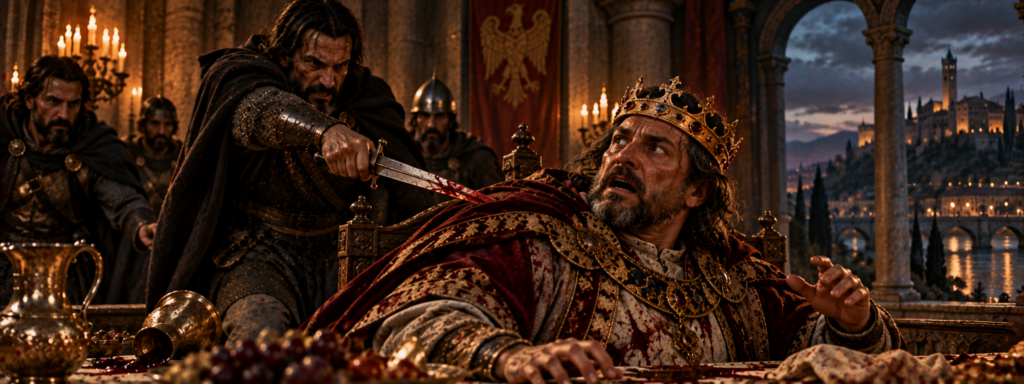
Berengar I of Italy: The Emperor Betrayed by His Own Men and Murdered at Verona
The Bloody Struggle for Italy’s Crown, the Betrayals That Destroyed an Empire, and the Conspiracy That Ended a Forty-Year Fight for Power
Berengar I of Italy (c. 845–7 April 924), also known as Berengar of Friuli, was King of Italy from 888, although his authority was repeatedly challenged, and emperor from 915 until his assassination in 924. A grandson of Emperor Louis the Pious through his mother, Gisela, Berengar belonged to the Carolingian royal family and inherited the powerful March of Friuli before becoming one of the principal contenders for the Italian throne following the collapse of Carolingian imperial unity. His long and turbulent career was marked by civil wars, rival kings, devastating Magyar invasions, shifting aristocratic alliances, and repeated attempts to preserve a crown that powerful Italian nobles seemed determined to take from him. Crowned emperor in Rome by Pope John X in 915, he eventually lost the support of important factions of the Italian nobility, who invited Rudolf II of Upper Burgundy to challenge his rule. After suffering a major defeat at the Battle of Fiorenzuola in 923, Berengar withdrew to Verona, where he was assassinated on 7 April 924 by conspirators associated with his own political and military circle, ending the reign of one of early medieval Italy’s most embattled rulers.
The Emperor Who Could No Longer Trust His Own Men
By the spring of 924, Berengar I had spent nearly four decades fighting for the Italian crown. He had survived civil wars, humiliating defeats, betrayals by powerful nobles, and the arrival of invading armies that devastated the countryside he claimed to govern. He had watched rival kings rise against him, endured the loss of cities and territories, and repeatedly recovered from disasters that might have destroyed a less determined ruler. Yet after all those years of struggle, the danger that finally killed him did not come from a foreign army marching across the Alps.
It came from men who knew him.
Verona, the fortified northern Italian city that had long served as one of Berengar’s most important political strongholds, should have offered a measure of security. Its walls had witnessed the passage of armies, the negotiations of ambitious nobles, and the desperate maneuvers of rulers struggling to control the fragmented kingdom of Italy. Berengar had relied upon the city during some of the darkest periods of his reign. In 924, however, the same political world that had sustained him became the setting for his destruction.
The emperor was no longer the formidable contender who had seized the opportunity presented by the collapse of Carolingian power in 888. His military fortunes had deteriorated badly, and his enemies had rallied behind Rudolf II of Upper Burgundy. The disastrous Battle of Fiorenzuola in 923 had shattered his hopes of maintaining undisputed authority over Italy. Although he retained the imperial title, his practical control was increasingly confined to the territories and followers who remained loyal to him.
Even those loyalties were uncertain.
Among the most dangerous figures in Berengar’s final days was a man named Flambert, whose role in the assassination is preserved in the historical tradition surrounding the emperor’s death. The surviving accounts differ in their details, and the precise sequence of the conspiracy cannot be reconstructed with complete confidence. Nevertheless, the central fact is clear: Berengar was killed at Verona on 7 April 924 through an act of betrayal involving men within his own political and military environment.
The murder was the final expression of a political system in which kings depended upon nobles who could change their allegiance whenever ambition, resentment, or opportunity demanded it. Berengar had spent much of his reign attempting to manage precisely those relationships. He had rewarded supporters, negotiated with rivals, fought rebellious magnates, and tried to preserve the loyalty of powerful families whose private interests frequently outweighed their obligations to the crown. In the end, the emperor discovered that decades of political experience could not protect him from betrayal at close quarters.
His death also marked the end of an era. Berengar was the last emperor crowned in the West before the imperial coronation of Otto I in 962, nearly four decades later. The title that had once symbolized the political unity of Charlemagne’s vast empire had become entangled in the ambitions of rival Italian rulers and powerful aristocratic factions. Berengar’s murder exposed just how far the old imperial order had fallen.
The tragedy of his life was not simply that he lost his throne. He had already endured defeat, humiliation, and the collapse of political alliances on numerous occasions. What made his final downfall especially bitter was that he had spent almost forty years refusing to surrender his claim to Italy, only to be destroyed when his own supporters turned against him. The man who had survived the collapse of an empire was ultimately killed within the walls of a city he had trusted.
To understand how Berengar reached that fatal moment, it is necessary to return to the disintegration of the Carolingian world. His story begins not with the assassination at Verona, but with the inheritance of a dynasty whose immense power had become its greatest weakness. By the time Berengar sought the Italian crown, the empire of Charlemagne was already breaking apart.
Born into the Ruins of Charlemagne’s Empire
Berengar was born around 845 into one of the most influential aristocratic families in the Carolingian world. His father, Eberhard, was margrave of Friuli, a strategically important territory in northeastern Italy that guarded approaches toward the eastern Alpine frontier. His mother, Gisela, was a daughter of Emperor Louis the Pious and a granddaughter of Charlemagne. Through her, Berengar possessed a direct connection to the dynasty that had dominated much of western and central Europe for generations.
That ancestry mattered enormously. In the ninth century, royal legitimacy was closely connected to dynastic descent, military reputation, and the ability to secure the support of powerful aristocratic families. Berengar’s Carolingian blood gave him a claim to prestige that many ambitious nobles could not match. His father’s position in Friuli provided the territorial and military resources necessary to transform that prestige into political influence.
The empire into which Berengar was born had already begun to fragment. Charlemagne had been crowned emperor in Rome on Christmas Day in 800, creating a powerful political order that linked Frankish kingship with the revived western imperial title. His son Louis the Pious inherited the empire in 814, but disputes among Louis’s sons weakened the unity of the realm. Civil wars and contested successions gradually transformed the empire into a collection of competing kingdoms.
The Treaty of Verdun in 843 divided the Carolingian Empire among Louis the Pious’s surviving sons. The agreement did not immediately destroy the idea of imperial unity, but it established political divisions that would become increasingly difficult to overcome. Italy occupied a particularly important position because possession of the kingdom could provide access to Rome and the imperial coronation. The peninsula therefore attracted rulers whose ambitions extended far beyond its borders.
Berengar grew up in a world where the language of imperial unity survived even as political authority became fragmented. Kings and emperors claimed legitimacy through dynastic inheritance, but their actual power depended upon the cooperation of regional aristocrats. Counts, margraves, and bishops controlled important resources and could influence the outcome of succession disputes. A ruler who lost their support might discover that royal ancestry alone was insufficient.
Friuli was an especially valuable base of power. Its position near the eastern Alps gave its rulers responsibility for defending important routes and managing relations with neighboring peoples. The march also possessed military resources that could be mobilized during political struggles within Italy. Berengar’s inheritance therefore placed him among the most important regional magnates in the kingdom.
His upbringing and family connections prepared him for a life of political competition. He belonged to the Carolingian aristocratic world and possessed a strong territorial foundation. Yet those advantages also drew him into the conflicts that followed the decline of central authority. When the opportunity to claim the Italian throne finally emerged, Berengar was ready to seize it.
The March of Friuli: A Fortress of Power
The March of Friuli was more than a family possession. It was a frontier territory whose military importance gave its rulers considerable influence within the Italian kingdom. Located in northeastern Italy, it guarded approaches through the eastern Alps and connected the peninsula with the wider political world of central Europe. Control of Friuli provided access to armed followers, landed wealth, and strategic routes.
Berengar inherited this position after the death of his elder brother Unruoch III, generally placed in the 870s. His authority as margrave gave him a substantial independent power base. In a period when kings increasingly depended upon regional nobles, such resources were essential. A claimant to the throne without a strong territorial foundation could struggle to command an army or reward supporters.
Friuli also exposed Berengar to the military pressures facing northern Italy. The region had long been important in the defense of the kingdom against threats from beyond the Alps and the eastern frontier. Its rulers needed to maintain relationships with local aristocrats and organize military forces. Berengar’s experience in this environment would later influence his approach to kingship.
The political structure of the Carolingian world encouraged the growth of regional authority. Kings granted offices and lands to powerful families in exchange for service, but those families often developed their own hereditary interests. As central government weakened, the distinction between royal appointment and personal possession became increasingly blurred. Men such as Berengar could use the offices inherited from their families to pursue ambitions far beyond their original responsibilities.
His family connections also extended into other important aristocratic networks. Marriage alliances and kinship relationships linked the leading families of Italy, Burgundy, and the Frankish kingdoms. These connections could provide support during political crises, but they could also create competing claims and obligations. The same networks that strengthened Berengar’s position would later contribute to the complicated rivalries of his reign.
By the late 880s, Berengar possessed the resources and ancestry necessary to become a serious contender for the Italian crown. The kingdom’s political situation was becoming increasingly unstable, and the imperial succession remained uncertain. The death of the reigning emperor would create an opportunity that ambitious nobles could not ignore. Berengar was about to enter a struggle that would consume the remainder of his life.
The Death of Charles the Fat and the Collapse of Imperial Unity
The immediate opportunity came with the downfall of Emperor Charles III, commonly known as Charles the Fat. Charles had briefly reunited much of the former Carolingian Empire under his authority during the 880s. His position appeared to offer the possibility of restoring the political unity associated with Charlemagne. Yet his government was weakened by military failures, aristocratic dissatisfaction, and disputes over succession.
Charles faced severe criticism for his handling of Viking attacks and other military threats. Powerful nobles increasingly questioned his ability to defend the territories under his rule. His lack of a legitimate male heir complicated the succession. By 887, his political authority was collapsing.
At an assembly in eastern Francia, Charles was deposed by nobles who supported Arnulf of Carinthia, an illegitimate Carolingian descendant with substantial military backing. Charles died in January 888, leaving behind a fragmented political world. The brief reunification of the empire had ended. Several regional rulers now competed to establish independent kingdoms.
Italy became one of the principal arenas of this struggle. Its possession offered both territorial power and the possibility of imperial coronation in Rome. The kingdom contained wealthy cities, influential bishops, and aristocratic families whose support could determine the outcome of a succession. Yet no single candidate possessed uncontested authority.
Berengar moved quickly. His Carolingian ancestry and position in Friuli made him a plausible claimant, and he secured recognition as king of Italy in 888. The coronation is commonly associated with Pavia, the traditional royal center of the Lombard and Carolingian kingdoms. His elevation marked the beginning of a reign that would be repeatedly challenged.
The crown, however, did not bring peace. Another powerful noble, Guy III of Spoleto, possessed ambitions of his own. Guy had connections to the Carolingian political world and commanded substantial resources in central Italy. His supporters regarded him as a legitimate candidate for kingship.
The rivalry between Berengar and Guy would become one of the defining conflicts of the early years of Berengar’s reign. Both men possessed aristocratic backing, military forces, and claims to political legitimacy. Neither was willing to accept permanent subordination to the other. The kingdom that Berengar hoped to govern was about to descend into civil war.
Two Kings, One Crown: The Rivalry with Guy of Spoleto
Guy of Spoleto was one of the most formidable opponents Berengar encountered. As a member of a powerful aristocratic family established in central Italy, he possessed military resources and influential supporters. He had previously pursued political ambitions beyond Italy, including an unsuccessful attempt to secure the kingship of West Francia. His return to Italian politics placed him directly in competition with Berengar.
The struggle between the two men developed rapidly after 888. Berengar initially possessed important support in northern Italy, but Guy commanded forces capable of challenging him. Their rivalry reflected the fragmentation of royal authority after the collapse of Carolingian unity. Regional nobles increasingly determined which claimant could exercise power.
In 889, Guy defeated Berengar near the Trebbia River. The victory significantly weakened Berengar’s position and allowed Guy to establish himself as king. Berengar did not abandon his claim, but his effective authority became more restricted. The defeat demonstrated that dynastic ancestry and territorial resources could not guarantee military success.
Guy’s ambitions extended to the imperial title. In 891, Pope Stephen V crowned him emperor in Rome, giving him the prestigious dignity that Berengar would later pursue. The coronation strengthened Guy’s claim to leadership within Italy. It also intensified the rivalry between the competing royal factions.
Guy attempted to secure the succession for his son Lambert. In 892, Lambert received an imperial coronation during his father’s lifetime, an extraordinary effort to establish dynastic continuity. The arrangement threatened to exclude Berengar permanently from the highest political offices in Italy. Yet the stability of the Spoletan dynasty remained uncertain.
Berengar continued to maintain support in parts of northern Italy, particularly around his traditional power base. His persistence became one of the defining characteristics of his political career. Defeat did not persuade him to abandon the crown. Instead, he waited for opportunities to recover his position.
The conflict also exposed the weakness of the Italian monarchy. Rival rulers could claim the same title, receive support from different aristocratic factions, and exercise authority over separate territories. The crown had become an object of competition rather than a universally accepted institution. Berengar would spend much of his life attempting to overcome that fragmentation.
Arnulf of Carinthia Enters the Italian Struggle
The rivalry between Berengar and Guy of Spoleto drew the attention of Arnulf of Carinthia, the powerful ruler of East Francia. Arnulf possessed Carolingian ancestry and substantial military resources, making him an important figure in the politics of central Europe. Italian nobles dissatisfied with the existing situation could seek his intervention. His ambitions also extended toward the imperial title.
Berengar initially looked to Arnulf as a possible ally against Guy. The relationship reflected the complicated diplomacy of the period, when rival claimants could seek outside support to strengthen their position. Inviting a powerful foreign ruler into Italian politics, however, carried obvious risks. An ally might become a competitor for the crown.
Arnulf launched military expeditions into Italy during the 890s. His campaigns challenged the authority of the Spoletan rulers and altered the balance of power. The death of Guy in 894 created further instability, leaving Lambert to defend the family’s claims. Arnulf continued pursuing his own ambitions.
In 896, Arnulf entered Rome and received the imperial crown from Pope Formosus. The coronation represented a major triumph for the East Frankish ruler. It also demonstrated how the imperial title had become entangled in competing claims among rulers whose political authority remained geographically divided. The prestige of Rome could elevate a claimant, but it did not guarantee lasting control over Italy.
Arnulf’s campaign was interrupted by serious illness, traditionally described as a stroke or paralysis. He withdrew from Italy, leaving the political situation unresolved. His departure allowed surviving Italian factions to resume their struggles. The kingdom remained divided among competing loyalties.
For Berengar, Arnulf’s intervention was both an opportunity and a danger. It weakened some of his rivals but also demonstrated that powerful rulers beyond the Alps could claim authority in Italy. Berengar needed to preserve his own position while navigating the ambitions of men who possessed greater military resources. His survival depended upon flexibility as much as force.
The death of Lambert in 898 and Arnulf in 899 transformed the political landscape once again. Two major rivals disappeared within a short period, creating an opening for Berengar to consolidate his claim. After years of struggle, the crown seemed closer to becoming securely his. Yet a new and devastating threat was approaching from the east.
The Magyar Invasions: Terror from the Eastern Frontier
The arrival of the Magyars, the people who would establish the medieval kingdom of Hungary, transformed the military situation in central Europe during the late ninth and early tenth centuries. Their mounted forces conducted raids across extensive territories, exploiting the weaknesses of fragmented political systems. Their mobility and military tactics posed serious challenges to rulers whose armies were organized around different forms of warfare. Northern Italy became one of the regions exposed to their attacks.
In 899, a major Magyar force invaded Italy. Berengar attempted to confront the invaders and defend his kingdom. The resulting campaign culminated in a disastrous defeat near the Brenta River on 24 September 899. The battle became one of the most humiliating military reverses of his reign.
The circumstances of the defeat reveal the difficulties faced by armies confronting highly mobile mounted opponents. The Magyars used speed, maneuver, and tactical deception to exploit their enemies’ weaknesses. Berengar’s forces suffered heavy losses. The defeat opened the way for further devastation across parts of northern Italy.
The battle damaged Berengar’s reputation as a defender of the kingdom. Kingship carried an expectation of military protection, particularly against invaders who threatened the wealth and security of local communities. A ruler who failed to prevent destruction could lose the confidence of nobles and bishops. Berengar’s political enemies would exploit such failures.
The Magyar threat did not disappear after the battle. Raiding expeditions continued to affect Italy and neighboring regions during the following decades. The invaders could move rapidly, attack vulnerable communities, and withdraw before large armies could respond. Their campaigns placed enormous pressure upon local defensive systems.
Berengar’s responses included military resistance, negotiation, and efforts to manage the threat through payments or political arrangements. Such measures were not unusual in early medieval warfare, but they could be interpreted as weakness by hostile observers. A ruler who paid raiders to withdraw might protect his territories temporarily while damaging his prestige. The distinction between practical survival and dishonorable submission was often politically contested.
The Magyar invasions became one of the central problems of Berengar’s reign. They devastated communities, weakened royal authority, and encouraged powerful nobles to seek greater independence. The king’s inability to guarantee security contributed to the instability that repeatedly threatened his crown. The disaster at the Brenta remained a reminder that his military resources were limited.
The Battle of the Brenta: A Humiliation That Haunted His Reign
The defeat at the Brenta in 899 deserves particular attention because of its political consequences. Berengar had attempted to defend northern Italy against a major Magyar incursion, but the campaign ended in catastrophe. The invaders inflicted heavy losses and demonstrated the vulnerability of the kingdom’s military organization. The defeat damaged the king’s prestige at a moment when he was attempting to consolidate authority after years of civil war.
The surviving accounts of the battle contain details shaped by the literary traditions of medieval chroniclers. They emphasize the speed and effectiveness of the Magyar forces and the failure of Berengar’s army to respond successfully. The exact number of casualties cannot be established with confidence. Medieval reports of enormous losses should be treated cautiously, particularly when they serve to dramatize a ruler’s humiliation.
The military consequences were nevertheless serious. The defeat allowed Magyar forces to raid widely, threatening communities that had already suffered from political instability. Local aristocrats and bishops faced the immediate problem of protecting their territories. Their confidence in royal leadership could weaken when the king failed to provide effective defense.
Berengar’s position became especially difficult because his legitimacy depended partly upon his ability to maintain order. He had fought rival kings for the crown and claimed authority over Italy, but the Magyar invasion exposed the limits of that authority. His enemies could argue that another ruler might provide stronger protection. The battle therefore contributed to the political conditions that encouraged further challenges.
The disaster also reflected wider changes in European warfare. The Magyars possessed military advantages that many western armies initially struggled to counter. Their mounted archers and rapid movements allowed them to exploit terrain and surprise opponents. The challenge required changes in defensive organization and military strategy.
Berengar did not disappear from politics after the defeat. His persistence allowed him to recover from the humiliation and continue exercising royal authority. Yet the battle remained part of the larger pattern of his reign: military setbacks followed by political recovery, only for new threats to emerge. The crown survived, but its foundations remained unstable.
The Brenta defeat also helps explain why Berengar’s later relationship with Magyar forces became politically controversial. A ruler who had suffered a devastating defeat might seek accommodation to prevent further destruction. Such arrangements could provide temporary security but create resentment among nobles who regarded the invaders as enemies. The problem would become increasingly important during his final years.
Louis the Blind: Another Rival for the Italian Crown
Berengar’s difficulties did not end with the Magyar invasions. In 900, a new challenger entered Italian politics: Louis of Provence, commonly known as Louis the Blind. Louis possessed Carolingian ancestry and ruled in the kingdom of Provence, giving him a plausible claim to the Italian throne. Italian nobles dissatisfied with Berengar invited him to intervene.
Louis entered Italy and secured recognition as king. In 901, Pope Benedict IV crowned him emperor in Rome, giving him the highest title in the western political world. The coronation represented another major challenge to Berengar’s authority. Once again, a rival had obtained the imperial dignity that Berengar desired.
The struggle between the two rulers continued over several years. Berengar retained important support in northern Italy and refused to abandon his claim. Louis attempted to consolidate his position, but his authority depended upon the cooperation of Italian aristocrats whose loyalties were uncertain. The kingdom remained divided.
In 902, Berengar forced Louis to withdraw from Italy. The settlement reportedly involved an undertaking that Louis would not return. Yet the rivalry was not finished. Louis returned in 905, apparently encouraged by supporters who believed he could recover the throne.
Berengar responded decisively. He captured Louis at Verona and ordered him blinded, a punishment that destroyed his ability to exercise effective royal power. The act was brutal but politically calculated. By blinding his rival rather than killing him, Berengar removed a dangerous claimant while avoiding the consequences of outright execution.
Louis survived and continued to rule in Provence under the assistance of others, but his Italian ambitions were effectively ended. The episode demonstrated Berengar’s determination to preserve his crown. It also revealed the ruthless methods that could accompany early medieval succession struggles. Royal rivals were not always killed; they could be permanently incapacitated.
The blinding of Louis strengthened Berengar’s position, but it did not create lasting stability. Italian nobles continued to pursue their own interests, and the Magyar threat remained serious. The king had eliminated another rival, yet the political system that produced such challenges remained unchanged. His reign would continue to be defined by conflict.
Verona: The City of Victory, Captivity, and Death
Verona occupied a central place in Berengar’s political career. Located in northern Italy near important routes through the Alps, the city possessed strategic and administrative significance. Its fortifications made it a valuable stronghold during periods of military uncertainty. Berengar relied upon it repeatedly as he struggled to preserve his authority.
The city had already witnessed one of his most ruthless political victories. In 905, Berengar captured Louis the Blind at Verona and ordered him deprived of his sight. The punishment eliminated a rival whose imperial coronation had threatened Berengar’s claim. Verona became associated with the king’s ability to survive and retaliate against enemies.
The city’s importance extended beyond individual episodes. Northern Italy was the principal arena of Berengar’s struggles, and control of fortified centers could determine the outcome of campaigns. Verona provided access to important routes and offered protection during periods of political instability. Its possession strengthened Berengar’s ability to resist rivals.
Yet the same concentration of political and military activity made the city dangerous. A royal stronghold was also a place where ambitious nobles, commanders, and courtiers gathered. Personal relationships and rivalries developed within its walls. A ruler depended upon the loyalty of men who possessed access to his household and military resources.
By 924, Verona had become the setting for Berengar’s final political crisis. His defeat at Fiorenzuola had weakened his authority, and rival factions were gaining strength. The city offered refuge but could not guarantee security. The emperor’s enemies were no longer confined to armies outside its walls.
The contrast between 905 and 924 is striking. In the earlier year, Berengar had used Verona to destroy a rival claimant. Nineteen years later, the city became the place where his own enemies destroyed him. The stronghold that had once symbolized his survival became the setting for his assassination.
Verona therefore provides a powerful thread connecting the beginning and end of Berengar’s most ruthless political struggles. It was a city of royal authority, military power, and calculated violence. Its walls had protected him during years of conflict. They could not protect him from betrayal.
A Crown Won Through Ruthlessness
Berengar’s treatment of Louis the Blind reveals the severity of the political world in which he operated. Blinding was a form of punishment used in various medieval societies to incapacitate political rivals without necessarily killing them. It could remove a claimant from effective power while avoiding some of the religious and political consequences associated with execution. The practice was especially associated with Byzantine political culture but was not confined to the eastern empire.
The punishment inflicted upon Louis was therefore both cruel and strategic. Berengar had already forced him to withdraw from Italy, but the rival returned and threatened his authority again. Blinding eliminated the possibility of another effective campaign. It also sent a warning to other claimants.
Such violence did not necessarily strengthen royal legitimacy. A ruler who punished rivals harshly might deter opposition, but he could also create resentment among powerful families. Aristocrats who feared similar treatment might seek protection through alliances with competing rulers. The methods used to preserve a crown could therefore contribute to the instability surrounding it.
Berengar’s reign repeatedly exposed this contradiction. He needed to demonstrate strength in order to command loyalty, but his authority depended upon nobles whose cooperation could not be guaranteed. Military victories and harsh punishments could eliminate immediate threats without resolving deeper political divisions. Each recovery was followed by new challenges.
The blinding of Louis also illustrates the personal nature of early medieval politics. Rival kings were not abstract representatives of competing states; they belonged to interconnected aristocratic families and dynastic networks. Their struggles involved claims of ancestry, marriage alliances, and personal loyalty. A political defeat could become a lifelong physical punishment.
Berengar survived the rivalry with Louis and continued ruling Italy, but the episode contributed to his reputation as a determined and sometimes ruthless monarch. His willingness to use severe measures demonstrated that he would not easily surrender the crown. Yet the final years of his reign would reveal the limits of such determination. A king could blind a rival and still be unable to prevent his own assassination.
The Road to the Imperial Crown
For much of his reign, Berengar possessed the title of king but not the imperial dignity that had been claimed by several of his rivals. Guy of Spoleto, Lambert, Arnulf of Carinthia, and Louis the Blind had all received imperial coronations during the years of political conflict. Their claims demonstrated the prestige associated with the title. Berengar’s own ambitions remained unfulfilled for decades.
The imperial crown carried enormous symbolic importance. It linked its holder to the legacy of Charlemagne and the Roman imperial tradition. Coronation in Rome by the pope provided religious and political legitimacy that could strengthen a ruler’s standing among aristocrats and neighboring kingdoms. Yet the title did not automatically confer effective control over the territories once governed by Charlemagne.
Berengar’s opportunity emerged through his relationship with Pope John X and the political struggles of early tenth-century Italy. The papacy faced its own difficulties, including rival aristocratic factions and threats to security around Rome. Cooperation with a powerful northern ruler could provide military assistance and political protection. Berengar possessed the resources necessary to play that role.
In 915, Berengar received the imperial crown from Pope John X in Rome. The coronation represented the culmination of decades of ambition. After years of rivalry, military defeat, and political recovery, he had finally obtained the title that had eluded him. The ceremony elevated his prestige and appeared to confirm his position as the leading ruler in Italy.
The coronation was connected with wider efforts to address military threats in the peninsula. In 915, a coalition of Italian and Byzantine forces defeated Muslim forces associated with the stronghold on the Garigliano River. The campaign helped eliminate a longstanding threat to central Italy. Berengar’s role in the political arrangements surrounding the victory strengthened his relationship with the papacy.
Yet the imperial title did not solve the problems that had plagued his reign. Powerful nobles continued to pursue their own interests, and the kingdom remained politically fragmented. The Magyars continued to threaten northern Italy. Berengar had gained the highest dignity available in the western political world, but his practical authority remained vulnerable.
The coronation therefore marked both a triumph and a warning. Berengar had achieved the ambition that had driven much of his political career. Yet the title could not guarantee military success or aristocratic loyalty. Within a decade, the emperor would be defeated, isolated, and murdered.
Pope John X and the Politics of Imperial Coronation
Pope John X occupied the papal throne from 914 to 928, a period marked by intense political competition among Roman aristocratic families and regional rulers. His position required him to navigate the ambitions of powerful nobles while protecting the interests of the papacy. Military threats from Muslim forces in southern and central Italy added urgency to those concerns. Cooperation with Berengar offered an opportunity to strengthen papal security.
The imperial coronation of 915 reflected the close relationship between political power and religious authority. The pope could confer a title of enormous prestige, while the emperor could provide military assistance and protection. The arrangement drew upon traditions established under Charlemagne and his successors. Yet the practical balance between pope and emperor depended upon the circumstances of the moment.
John X had reasons to support Berengar. The king had survived numerous rivals and possessed substantial influence in northern Italy. His military resources could contribute to efforts against the Muslim stronghold at the Garigliano. A successful campaign would strengthen both papal security and the emperor’s reputation.
The victory at the Garigliano in 915 was achieved by a coalition rather than by Berengar alone. Italian rulers, papal forces, and Byzantine interests participated in the broader campaign. The destruction of the Muslim base reduced a serious threat to central Italy. The success helped create a political atmosphere favorable to Berengar’s imperial coronation.
The ceremony in Rome was therefore more than a personal reward. It reflected an alliance between the papacy and a ruler whose authority could support wider political objectives. The imperial title enhanced Berengar’s standing among competing Italian nobles. It also linked his kingship to the religious prestige of Rome.
Yet papal support could not guarantee lasting political stability. The pope’s influence was strongest in certain regions, while northern Italian nobles possessed their own military resources. Berengar still needed to maintain their loyalty. The imperial coronation strengthened his legitimacy without eliminating the rivalries that threatened his crown.
The relationship between Berengar and John X illustrates the complicated politics of early medieval Italy. Kings, emperors, popes, and aristocratic families pursued overlapping interests. Alliances could produce military victories and prestigious ceremonies, but they remained vulnerable to changing circumstances. Berengar’s imperial title would survive until his death, even as his effective political power collapsed.
The Emperor’s Family and the Fragile Politics of Marriage
Berengar’s political career was shaped not only by warfare but also by family relationships and marriage alliances. His wife, Bertila, belonged to an important aristocratic family and became queen alongside him. Their marriage connected Berengar to networks of influence within Italy. Such relationships were essential in a political world where kinship could strengthen claims to land, office, and royal authority.
Bertila appears in the surviving record as a significant figure within the royal household. She was associated with Berengar’s political position and participated in the ceremonial and institutional life of the monarchy. Her death, usually dated to 915, has sometimes been connected in later accounts with accusations of misconduct or poisoning. The evidence surrounding those allegations is uncertain and should not be treated as proof of a sensational court scandal.
Berengar later married Anna, whose background and role are less securely documented. The marriage reflected the continuing importance of dynastic relationships even during the emperor’s final years. Royal unions could create alliances, strengthen legitimacy, and influence succession. Yet they could not guarantee political stability when powerful nobles refused to accept the ruler’s authority.
Berengar’s daughter Gisela married Adalbert I of Ivrea, connecting the royal family to another influential Italian aristocratic house. Their descendants would play important roles in the politics of the kingdom. The relationship demonstrates how marriage alliances could extend a ruler’s influence beyond his immediate territories. It also illustrates the long-term consequences of dynastic connections.
His daughter Bertha became associated with the religious and aristocratic world of northern Italy. Such family relationships helped preserve the influence of royal lineages even when individual rulers lost political power. Monasteries and ecclesiastical institutions could serve as important centers of family memory and patronage. The boundaries between religious and political life were often closely intertwined.
Yet Berengar’s family connections did not produce an uncontested successor capable of preserving his imperial authority. The absence of a secure succession contributed to the instability of the kingdom. Powerful nobles could seek alternative rulers whose claims better served their interests. Dynastic prestige remained important, but it could not overcome the political fragmentation of Italy.
The emperor’s family therefore reveals another dimension of his struggle. Berengar belonged to the Carolingian world and used marriage alliances to strengthen his position, but the institutions that had once supported dynastic succession were weakening. His personal authority became increasingly important. When that authority collapsed, the imperial title could not be preserved through a straightforward hereditary transition.
The Magyars Return: An Emperor Under Siege
The Magyar threat continued during Berengar’s later reign, placing renewed pressure upon northern Italy. The defeat at the Brenta in 899 had demonstrated the vulnerability of the kingdom’s military defenses. Subsequent raids threatened communities and exposed the limits of royal authority. The emperor faced the difficult task of protecting his territories while managing powerful nobles whose loyalty was uncertain.
The Magyars’ military methods made them formidable opponents. Their mounted forces could move rapidly across large distances, attack vulnerable settlements, and withdraw before slower armies could respond. Their campaigns were not always attempts at permanent conquest. Raiding, tribute, and political negotiation could form part of their strategy.
Berengar’s response included efforts to negotiate and manage the invaders. Such arrangements could reduce immediate destruction, but they also created political risks. Nobles who suffered from raids might resent payments or agreements that appeared to reward the attackers. A ruler could be accused of weakness even when negotiation offered the most practical means of protecting his territories.
The political consequences became particularly serious during the final years of Berengar’s reign. His enemies accused him of relying upon Magyar forces or failing to defend Italy effectively. Such accusations could damage his legitimacy among nobles who expected military protection. The distinction between necessary diplomacy and collaboration with invaders became a weapon in aristocratic rivalry.
The Magyar threat also exposed the fragmentation of military authority. Regional nobles increasingly controlled their own defensive resources, while royal armies depended upon their cooperation. A king who could not compel unified action struggled to respond effectively to mobile raiders. The resulting insecurity encouraged further political independence among local magnates.
Berengar’s imperial title did little to resolve these difficulties. The prestige of the coronation in 915 could not prevent Magyar incursions or guarantee the loyalty of aristocratic families. His authority remained dependent upon military success and political negotiation. Both became increasingly difficult as opposition to his rule intensified.
The emperor’s final crisis would emerge from this atmosphere of insecurity. Powerful Italian nobles began seeking another ruler who might offer stronger leadership or better protect their interests. Their choice would be Rudolf II of Upper Burgundy. The invitation to a foreign king would bring Berengar’s long struggle for Italy toward its violent conclusion.
The Italian Nobles Turn Against Their Emperor
By the early 920s, Berengar’s relationship with important Italian nobles had deteriorated badly. His long reign had been marked by repeated conflicts, and many aristocratic families had developed interests that were difficult to reconcile with strong royal authority. Military failures and the continuing Magyar threat provided opportunities for criticism. The emperor’s opponents began searching for an alternative ruler.
Among the leading figures in the opposition were powerful northern Italian magnates whose territories and military resources gave them considerable influence. Adalbert I of Ivrea and other aristocratic leaders participated in the shifting alliances that undermined Berengar’s position. Their motivations were complex, involving personal ambition, regional interests, and dissatisfaction with the emperor’s government. The surviving sources do not support reducing the entire opposition to a single grievance.
The nobles’ decision to seek a foreign ruler reflected a recurring pattern in Italian politics. Earlier factions had invited Louis of Provence and other claimants to intervene against Berengar. Such invitations could transform domestic political disputes into international conflicts. A ruler from beyond the Alps might provide military strength while relying upon local nobles for support.
Rudolf II of Upper Burgundy became the principal candidate. He ruled a kingdom north of the Alps and possessed the resources necessary to challenge Berengar. His position also connected him to important aristocratic networks. Italian nobles who opposed the emperor regarded him as a plausible alternative.
The invitation to Rudolf represented a serious threat because it combined external military power with internal opposition. Berengar had survived foreign invasions and rival kings before, but his authority was now weakened by decades of conflict. Powerful nobles were prepared to abandon him. The crown he had fought to preserve was once again contested.
The emperor attempted to resist the challenge. His remaining supporters gathered forces, and the struggle developed into another civil war. The conflict would culminate in a major battle in 923. Its outcome would destroy Berengar’s hopes of restoring undisputed authority.
The betrayal by Italian nobles was particularly bitter because Berengar’s reign had depended upon their cooperation. He had spent decades negotiating with aristocratic families, granting favors, and fighting rivals who sought their support. Yet those relationships remained unstable. The men whose loyalty sustained the monarchy could also invite a new king to replace him.
Rudolf II of Burgundy: The Rival Who Would Break Berengar
Rudolf II of Upper Burgundy was an ambitious ruler whose kingdom occupied important territories north of the Alps. His position gave him access to military resources and political connections that could be used in Italian affairs. When dissatisfied Italian nobles invited him to challenge Berengar, he recognized an opportunity to expand his authority. The Italian crown remained a prestigious prize despite the instability surrounding it.
Rudolf entered Italy and secured support among influential aristocratic factions. His claim rested not only upon military strength but also upon the willingness of Italian nobles to recognize him. In a fragmented political system, such recognition could be decisive. A king without aristocratic backing might possess a title but little practical authority.
Berengar refused to surrender. His long career had been defined by persistence in the face of defeat, and he had survived earlier challenges from Guy of Spoleto, Arnulf of Carinthia, and Louis the Blind. He still possessed supporters and military resources. The struggle with Rudolf therefore developed into a contest for control of the kingdom.
The conflict exposed the divisions within Italy. Some nobles supported Rudolf, while others remained loyal to Berengar. Regional interests influenced allegiance, and the balance of power shifted as armies moved across the peninsula. The monarchy had become a prize contested by rival coalitions.
Rudolf’s challenge was particularly dangerous because Berengar’s military reputation had been weakened by the Magyar invasions. The emperor’s enemies could present the Burgundian ruler as a stronger defender of Italy. Whether Rudolf could actually provide greater security remained uncertain. His political appeal depended partly upon dissatisfaction with Berengar.
The decisive confrontation came in 923 near Fiorenzuola, close to Piacenza. The battle would become one of the most important military disasters of Berengar’s reign. It would also determine the political circumstances that led to his assassination. After decades of struggle, the emperor was about to suffer a defeat from which he would not recover.
The Battle of Fiorenzuola: The Defeat That Destroyed an Emperor
The Battle of Fiorenzuola took place on 17 July 923, during the struggle between Berengar and Rudolf II of Upper Burgundy. The armies met near Piacenza in northern Italy, a region that had witnessed repeated conflicts during Berengar’s long reign. Both sides understood that the battle could determine control of the kingdom. The confrontation was therefore politically decisive.
The surviving accounts describe a hard-fought engagement that ended in a major defeat for Berengar. His forces suffered heavy losses, and the emperor’s military position was severely weakened. The battle destroyed much of his ability to challenge Rudolf openly. His authority contracted as supporters reconsidered their allegiance.
The precise tactical details are difficult to reconstruct. Medieval chroniclers often emphasized dramatic reversals and the role of individual leaders, but their accounts do not provide the information necessary for a complete battlefield reconstruction. The scale of casualties is also uncertain. What is clear is that Berengar suffered a disastrous defeat.
The consequences were immediate. Rudolf’s position strengthened, and Berengar’s claim to effective kingship became increasingly difficult to sustain. The emperor retained his title, but his practical authority was reduced. He withdrew toward the territories where he still possessed support.
Verona became particularly important during this final phase. The city had served as a stronghold throughout Berengar’s career and offered a place of refuge after military defeat. Yet the emperor’s position was now dangerously isolated. His enemies controlled important territories, and the loyalty of his remaining followers was uncertain.
The battle also intensified the political divisions that had plagued Italy for decades. Nobles who had supported Berengar might now seek accommodation with Rudolf. Others could remain loyal out of personal obligation or fear of losing their positions. The emperor’s defeat created opportunities for betrayal.
Fiorenzuola was therefore more than a military disaster. It shattered the political foundation of Berengar’s authority and made his assassination possible. A ruler who had survived repeated challenges was now weakened, isolated, and dependent upon a shrinking circle of supporters. Within nine months, he would be dead.
The Burning of Pavia and the Shadow of the Magyars
The year 924 brought another catastrophe to northern Italy. Magyar forces attacked Pavia, one of the kingdom’s most important cities and a traditional center of royal authority. The raid resulted in severe destruction, including a devastating fire. The event became one of the most notorious episodes of the Magyar incursions into Italy.
Pavia possessed immense political and symbolic importance. It had served as the capital of the Lombard kingdom and remained closely associated with Italian kingship under the Carolingians and their successors. Its churches, administrative institutions, and aristocratic households represented centuries of political history. The destruction of the city therefore carried consequences beyond immediate material losses.
Medieval accounts describe the attack in dramatic terms, emphasizing fire, death, and devastation. The exact scale of the destruction is difficult to establish, and casualty figures preserved in later narratives should be treated cautiously. Nevertheless, the raid was a major disaster. It demonstrated the continuing vulnerability of northern Italy.
Berengar’s relationship with Magyar forces had long been controversial. His enemies accused him of tolerating or exploiting their raids, and later historical traditions sometimes connected him with the devastation of Pavia. Such claims require caution because political opponents had strong reasons to portray him as responsible for the suffering of the kingdom. The surviving evidence does not justify treating every accusation as established fact.
The destruction of Pavia nevertheless damaged the political environment in which Berengar struggled to survive. The emperor had already suffered a major defeat at Fiorenzuola, and his authority was increasingly confined. A devastating raid against one of Italy’s most important cities reinforced the impression that royal government had failed to provide security. His enemies could use the disaster to justify their opposition.
The attack also revealed the wider tragedy of the period. Italy’s political fragmentation made coordinated defense difficult, while rival rulers competed for authority over territories exposed to invasion. Communities suffered from the consequences of both internal conflict and external raids. The crown remained a symbol of prestige, but its ability to protect the population was limited.
For Berengar, the disaster at Pavia came during the final months of his life. His political position was already precarious, and the raid further weakened confidence in his leadership. The emperor who had spent decades fighting for Italy’s crown was now associated with a kingdom devastated by war. The conditions for his final betrayal were complete.
Verona in 924: The Last Refuge of a Defeated Emperor
After the defeat at Fiorenzuola, Berengar’s political position deteriorated rapidly. Rudolf II possessed substantial support, and the emperor’s authority was increasingly restricted. Verona remained one of the principal centers where Berengar could still exercise influence. The city offered fortifications, loyal followers, and the familiarity of a place that had served him throughout his career.
Yet the security of Verona was deceptive. A fortified city could resist an invading army, but it could not eliminate the dangers created by political conspiracy. Berengar depended upon men whose loyalties had been tested by years of conflict. Some remained committed to him, while others may have calculated that his reign was effectively finished.
The emperor’s age also shaped his position. Born around 845, he was approaching eighty when he died, although the uncertainty surrounding his birth date prevents an exact calculation. He had spent much of his adult life engaged in political and military struggles. The repeated demands of kingship had consumed decades.
His enemies had reasons to regard him as an obstacle. Even after military defeat, Berengar retained the imperial title and could continue attracting supporters. His survival complicated the consolidation of Rudolf’s authority. Removing him would eliminate a rival whose persistence had repeatedly disrupted Italian politics.
The conspiracy that developed at Verona emerged from this atmosphere of uncertainty. The surviving sources identify men associated with Berengar’s own circle as participants in his murder. Their motives may have included political ambition, resentment, and the desire to secure favor with the victorious faction. The precise balance of those motives cannot be established with confidence.
The emperor’s vulnerability lay in his dependence upon personal loyalty. He could command fortifications and retain the symbols of kingship, but he could not guarantee the faithfulness of every man who approached him. His long career had taught him the dangers of aristocratic betrayal. Yet the final conspiracy succeeded where so many earlier challenges had failed.
Verona was about to become the place where Berengar’s struggle ended. The city that had witnessed the blinding of Louis the Blind would now witness the murder of the man who ordered it. The political violence that had sustained Berengar’s reign returned against him. His final enemies were already close.
The Conspiracy of Flambert
The assassination of Berengar is traditionally associated with a figure named Flambert, whose role appears in the surviving historical accounts of the emperor’s death. The precise nature of his position and the details of his relationship with Berengar are not uniformly preserved. He is generally presented as a man connected to the emperor’s political or military environment. His participation illustrates the danger posed by enemies within a ruler’s own following.
The conspiracy developed during a period when Berengar’s authority had been severely weakened. His defeat at Fiorenzuola had reduced his military power, while Rudolf II’s supporters were gaining influence. Men who had once depended upon Berengar might now see greater opportunities elsewhere. The emperor’s continued survival could become an obstacle to their ambitions.
The surviving narratives differ in their descriptions of the final events. Some traditions emphasize the involvement of Flambert and the betrayal of the emperor’s trust, while others preserve only the broader fact of assassination at Verona. The evidence does not support an elaborate reconstruction of secret meetings or precise conversations among the conspirators. The political context, however, makes the motive for removing Berengar understandable.
A defeated ruler could remain dangerous even after losing a major battle. Berengar had repeatedly recovered from political disasters and might attempt another campaign if circumstances changed. His imperial title also preserved a claim to prestige that Rudolf could not simply ignore. Killing him would eliminate a persistent rival.
The conspirators may also have sought to protect their own positions. Aristocrats and military followers who changed allegiance during a succession struggle often needed to demonstrate loyalty to the victorious faction. Participation in the removal of a defeated ruler could secure political advantage. Such calculations were common in the unstable world of early medieval kingship.
Yet the assassination should not be reduced to a single motive without evidence. Personal resentment, political ambition, and the changing balance of power may all have contributed. The surviving sources establish the betrayal but do not reveal every private intention. What matters is that men within Berengar’s own environment turned against him.
The conspiracy succeeded because the emperor’s political isolation had become severe. His enemies no longer needed to defeat him in a major battle. They needed only to reach him at close quarters. The crown that had survived decades of war could not protect its wearer from assassination.
April 7, 924: The Murder of Berengar I
Berengar I was assassinated at Verona on 7 April 924. The date is widely accepted in the historical chronology of his reign, and the location is firmly associated with his final downfall. His death ended a career that had begun with the struggle for the Italian crown in 888 and culminated in imperial coronation in 915. Nearly four decades of political conflict came to an abrupt and violent conclusion.
The surviving accounts agree that the emperor was killed through betrayal rather than in open battle. The precise circumstances of the attack are less certain, and later retellings have sometimes added dramatic details that cannot be securely verified. The historical record does not justify inventing a detailed scene involving specific rooms, weapons, or conversations. The essential fact is that Berengar was murdered by conspirators connected to his own political world.
The assassination was the final consequence of his military defeat and political isolation. After Fiorenzuola, he lacked the resources necessary to challenge Rudolf II effectively. His remaining supporters were divided, and his enemies had strong incentives to remove him permanently. The conspiracy succeeded at the moment when his authority was weakest.
Berengar’s death also reflected the instability of early medieval kingship. Royal titles carried enormous prestige, but rulers depended upon aristocratic loyalty and military support. A king who lost those foundations could become vulnerable to deposition, captivity, or assassination. Berengar had survived repeated challenges because he retained enough support to recover.
In 924, that support was no longer sufficient. The emperor’s enemies reached him within Verona, the city that had long served as one of his strongest bases. His death removed the last major obstacle to the consolidation of Rudolf’s claim. The crown passed into another phase of political competition.
The murder was particularly striking because Berengar had endured so many earlier disasters. He had survived defeats by Guy of Spoleto, the intervention of Arnulf of Carinthia, the challenge of Louis the Blind, and the devastation caused by Magyar raids. He had recovered from humiliation and achieved the imperial title after decades of struggle. Yet he could not survive betrayal at close quarters.
His assassination therefore stands as one of the most dramatic examples of political regicide in early medieval Italy. It was the deliberate killing of a reigning emperor by men connected to his own political environment. The act ended a long and turbulent reign. It also exposed the fragility of an imperial title that no longer guaranteed effective power.
The Emperor’s Death and the Silence of the Crown
Berengar’s murder left Italy without a western emperor. Although Rudolf II continued to pursue the Italian kingship, he did not receive an imperial coronation comparable to Berengar’s. The title that had been contested by successive rulers since the collapse of Carolingian unity fell into abeyance. The political circumstances necessary for another imperial coronation would not emerge for decades.
The absence of an emperor reflected the fragmentation of western political authority. Italy remained divided among powerful aristocratic families, regional rulers, and competing royal claimants. The papacy faced its own political struggles, while the kingdoms north of the Alps developed separate interests. The old ideal of a unified Carolingian empire survived in memory and political language, but its institutions had weakened.
Rudolf’s position in Italy was not secure. His supporters had invited him to replace Berengar, but aristocratic loyalty remained unstable. The same nobles who had abandoned Berengar could later turn against Rudolf. The kingdom continued to experience contested successions and shifting alliances.
Within a few years, Hugh of Provence emerged as another major claimant. He became king of Italy in 926, beginning a new phase of political competition. The struggle for the crown therefore continued after Berengar’s death. His assassination removed one ruler without resolving the underlying instability.
The imperial title remained vacant in the West until Otto I was crowned emperor in Rome in 962. Otto’s coronation established the foundations of the political institution later known as the Holy Roman Empire. The title connected his authority to the traditions of Charlemagne and the earlier Carolingian emperors. Berengar’s death in 924 therefore marked the beginning of a significant interruption in western imperial coronations.
The contrast between Berengar and Otto is revealing. Berengar had struggled to maintain authority within a fragmented Italian kingdom, while Otto possessed a stronger political and military foundation north of the Alps. The imperial title alone could not create stability. It required resources, institutions, and loyal supporters capable of sustaining the ruler’s authority.
Berengar’s assassination demonstrated what happened when those foundations collapsed. He retained the prestige of imperial coronation but lacked the military power necessary to defend his position. His enemies could remove him through conspiracy. The crown survived as an idea, but the emperor himself did not.
The End of the Carolingian Imperial Dream
Berengar’s death marked the end of a particular phase in the history of the Carolingian imperial tradition. He was a descendant of Charlemagne through his mother and had pursued the imperial title as part of the political inheritance of that dynasty. His coronation in 915 represented an attempt to preserve the connection between Italian kingship and western imperial authority. Yet his reign revealed how far the political world had changed since Charlemagne’s time.
The empire of Charlemagne had depended upon military conquest, dynastic legitimacy, and a network of royal officials and aristocratic supporters. Its rulers claimed authority over vast territories extending across much of western and central Europe. By the late ninth century, that unity had broken apart. Regional kingdoms and powerful noble families increasingly pursued independent interests.
Berengar’s career was shaped by the consequences of this fragmentation. He possessed Carolingian ancestry but could not command universal loyalty. Rival rulers with similar dynastic claims challenged him repeatedly. The Italian crown became the object of competition among regional aristocrats and foreign kings.
His imperial coronation did not restore the old political order. The title carried prestige, but it did not provide the institutions or resources necessary to govern a reunited empire. Berengar remained dependent upon the support of Italian nobles whose loyalty was uncertain. His military defeats exposed the weakness of that arrangement.
The assassination at Verona therefore symbolized the collapse of an imperial ideal. A ruler who claimed the inheritance of Charlemagne was killed by men within his own political environment. The crown that had once represented vast authority could not guarantee safety in a single fortified city. The distance between imperial prestige and practical power had become enormous.
The later coronation of Otto I would revive the western imperial title under different political circumstances. Otto’s authority rested upon the resources of the East Frankish kingdom and his military success in Italy. The institution that emerged would develop its own traditions and conflicts. Berengar belonged to the earlier, fragmented world from which that later empire arose.
His death did not erase the memory of Charlemagne or the idea of western empire. It demonstrated that those traditions could not survive through titles alone. Political authority required more than ancestry and coronation. Berengar’s life was a prolonged struggle to secure the power that his imperial dignity seemed to promise.
Was Berengar a Failure or a Survivor?
Berengar’s historical reputation has often been shaped by his repeated defeats and the instability of his reign. He lost battles, faced rival kings, and struggled to defend Italy against Magyar invasions. His authority was repeatedly challenged by nobles who invited foreign rulers to replace him. His assassination appears, at first glance, to confirm the failure of his political career.
Yet such a judgment overlooks his extraordinary persistence. Berengar first claimed the Italian crown in 888 and remained a central figure in the kingdom’s politics until his death in 924. During those decades, he survived the ambitions of Guy of Spoleto, the intervention of Arnulf of Carinthia, the challenge of Louis the Blind, and the rise of Rudolf II. Few rulers could have endured so many crises while retaining a claim to kingship.
His political resilience was remarkable. Defeat did not necessarily end his career, and he repeatedly recovered from situations that appeared hopeless. His territorial base in Friuli and northern Italy provided resources that helped sustain him. His Carolingian ancestry also strengthened his legitimacy among supporters who valued dynastic continuity.
His military record was far less impressive. The defeat at the Brenta in 899 exposed the weakness of his forces against the Magyars, while the disaster at Fiorenzuola in 923 destroyed his final hopes of maintaining effective authority. His inability to provide consistent security damaged his reputation. Powerful nobles increasingly sought alternatives.
His political methods also contributed to instability. The blinding of Louis the Blind demonstrated his willingness to use severe punishment against rivals. His shifting alliances and negotiations with powerful aristocrats reflected the demands of survival but could also create resentment. The same flexibility that preserved his reign may have weakened trust.
Berengar’s achievements should nevertheless be recognized. He maintained a royal claim through decades of fragmentation and eventually obtained the imperial crown in 915. His career connected the final stages of Carolingian political authority with the emerging world of regional kingdoms and aristocratic power. His reign provides valuable insight into the transformation of early medieval Europe.
The most balanced assessment is that Berengar was both a survivor and a ruler whose ambitions exceeded his ability to establish lasting stability. He possessed determination, political skill, and dynastic prestige, but he could not overcome the structural weaknesses of the Italian kingdom. His assassination was not simply the result of personal failure. It emerged from a political system in which even persistent rulers depended upon uncertain loyalties.
The Historical Sources and the Problem of Betrayal
The surviving evidence for Berengar’s reign comes from a range of early medieval chronicles, royal documents, and later historical traditions. Among the most important narrative sources is Liudprand of Cremona, whose Antapodosis provides a vivid account of Italian politics during the tenth century. Liudprand wrote after many of the events he described and possessed strong political opinions. His work is valuable but must be read with attention to its literary style and personal judgments.
The Gesta Berengarii Imperatoris, a Latin poem celebrating Berengar’s achievements, offers another perspective. Its author presents the ruler in favorable terms and emphasizes his legitimacy and accomplishments. The poem is particularly useful for understanding how Berengar’s supporters wished to portray him. Yet its celebratory purpose means that it cannot be treated as a neutral record.
Other chronicles preserve information about the political conflicts, Magyar invasions, and the final years of Berengar’s reign. Their accounts sometimes differ in chronology or detail. Such differences are common in early medieval history, where writers possessed limited access to information and often relied upon earlier narratives. The historian must compare the evidence rather than assume that every dramatic detail is equally reliable.
The assassination at Verona is securely established, but the precise circumstances remain less certain. The traditional association with Flambert provides an important element of the story, yet the surviving sources do not permit a complete reconstruction of the conspiracy. The location and date are clearer than the private motives of every participant. It would be misleading to invent conversations, secret meetings, or a detailed murder scene unsupported by the evidence.
The same caution applies to accusations involving Berengar’s relationship with Magyar forces. His enemies had strong reasons to portray him as responsible for the kingdom’s suffering. Some later accounts connect him with destructive raids in ways that may reflect political hostility. The evidence must be evaluated carefully before assigning direct responsibility.
Berengar’s reputation has also been influenced by the dramatic nature of his career. A ruler who repeatedly lost and recovered the crown provides material for stories of ambition, betrayal, and revenge. Medieval chroniclers often shaped such events into moral narratives about the consequences of pride or disloyalty. Those interpretations reveal contemporary attitudes but do not always establish historical motives.
A responsible account must therefore distinguish between documented events and later embellishments. Berengar was king of Italy, became emperor in 915, suffered defeat at Fiorenzuola in 923, and was assassinated at Verona on 7 April 924. His reign was marked by repeated conflicts and unstable aristocratic alliances. The precise details of his final betrayal remain partly obscured by the limitations of the surviving record.
The Assassination as Political Regicide
Berengar’s murder belongs firmly within the history of regicide because it involved the deliberate killing of a reigning monarch and emperor. His enemies did not simply defeat him in battle or force him into exile. They eliminated him through conspiracy at a moment when his military position had collapsed. The act removed a persistent claimant whose survival complicated the political future of Italy.
The assassination was political rather than an ordinary private murder. Berengar’s imperial title and royal claim gave him significance beyond his immediate circle. Even after defeat, he remained a potential rallying point for supporters. Killing him helped clear the way for rival political arrangements.
The involvement of men connected to his own environment made the act particularly dangerous. A ruler could prepare defenses against an invading army, but protection against betrayal required reliable personal loyalty. Berengar had spent decades navigating aristocratic rivalries and shifting alliances. His final enemies exploited the weakness of those relationships.
The murder also reflected the fragmentation of political authority in Italy. Powerful nobles possessed military resources and could influence the selection or removal of kings. Their support was essential to royal government, but it could be withdrawn when circumstances changed. Berengar’s assassination demonstrated the extreme consequences of that instability.
The act did not produce lasting peace. Rudolf II’s position remained contested, and new claimants emerged after Berengar’s death. The Italian crown continued to be fought over by rival aristocratic factions and rulers from beyond the Alps. Removing the emperor did not resolve the structural problems that had plagued his reign.
Berengar’s death therefore illustrates a recurring pattern in medieval political violence. Assassination could eliminate a ruler without creating a stable government. The conspirators achieved their immediate objective, but the kingdom remained divided. The crown passed into another phase of conflict.
The significance of the murder lies partly in this failure. Berengar had spent decades fighting to preserve royal authority, yet his death did not restore unity or security. It merely removed one contender from a political system that continued producing rivals. The assassination ended a life but not the struggle for Italy.
The Emperor Who Survived Everything Except Betrayal
Berengar I entered the struggle for Italy’s crown at a moment when the Carolingian Empire was breaking apart. His ancestry connected him directly to Charlemagne, while his inheritance in Friuli provided the military and political resources necessary to pursue kingship. The collapse of Charles the Fat’s authority in 887 created an opportunity that Berengar seized in 888. Yet the crown he claimed would remain contested for almost the entirety of his life.
His reign became a succession of wars, defeats, recoveries, and betrayals. Guy of Spoleto challenged him, Arnulf of Carinthia intervened, and Louis the Blind briefly secured the imperial title. Berengar repeatedly lost ground but refused to abandon his claim. His determination allowed him to survive political disasters that might have destroyed other rulers.
The Magyar invasions exposed the weakness of his military position. The defeat at the Brenta in 899 devastated his army and damaged his reputation as a defender of Italy. Subsequent raids threatened communities and encouraged aristocratic dissatisfaction. The king struggled to provide security while preserving his authority over nobles whose loyalty was uncertain.
His response to political rivals could be ruthless. In 905, he captured Louis the Blind at Verona and ordered him blinded, eliminating a claimant who had repeatedly challenged his position. The punishment demonstrated Berengar’s determination to preserve the crown. It also revealed the brutal methods through which early medieval rulers attempted to secure power.
After decades of struggle, Berengar achieved his greatest ambition. In 915, Pope John X crowned him emperor in Rome, granting him the prestigious title associated with Charlemagne and the western imperial tradition. The ceremony appeared to confirm his position as the leading ruler in Italy. Yet the imperial crown could not resolve the political divisions that had shaped his reign.
Powerful nobles continued to pursue their own interests. Military failures and the continuing Magyar threat weakened confidence in the emperor’s leadership. His enemies invited Rudolf II of Upper Burgundy to challenge him. The struggle culminated in the disastrous Battle of Fiorenzuola in 923.
The defeat destroyed Berengar’s hopes of maintaining undisputed authority. His forces suffered heavy losses, and his political position deteriorated rapidly. Rudolf gained support, while the emperor withdrew toward the territories where he still possessed loyal followers. Verona became one of his final strongholds.
The city carried memories of earlier victories and acts of political violence. Berengar had used Verona to capture and blind Louis the Blind in 905, demonstrating his ability to eliminate a rival. Nearly two decades later, the same city became the setting for his own destruction. The contrast reveals the instability of power in a world where fortunes could change dramatically.
The conspiracy against Berengar emerged from his political isolation. Men connected to his own environment turned against him, and the surviving tradition associates the assassination with Flambert. The precise details of the plot remain uncertain, but its outcome is clear. On 7 April 924, Berengar was murdered at Verona.
His death ended a reign that had lasted, in contested form, for nearly four decades. The emperor who had survived repeated military defeats and rival claims was killed through betrayal at close quarters. His imperial title offered no protection against men who possessed access to him. The crown that had consumed his life could not save it.
The assassination also marked the end of a phase in western imperial history. Berengar was the last emperor crowned in the West before Otto I received the title in 962. The imperial dignity that had once symbolized Charlemagne’s vast political authority fell into abeyance. Italy remained divided among competing rulers and aristocratic factions.
Berengar’s historical reputation is complicated. His military failures were serious, and his inability to establish lasting stability contributed to the fragmentation of the kingdom. Yet his persistence was extraordinary. Few rulers endured so many challenges while retaining a claim to power for so long.
His career demonstrates the limits of dynastic legitimacy. Berengar possessed Carolingian ancestry and eventually received the imperial crown, but neither guaranteed obedience. Powerful nobles could invite rival kings, change allegiance, and undermine royal authority. The monarchy depended upon personal loyalty that could disappear without warning.
His assassination was the final consequence of that instability. Berengar had spent decades negotiating with aristocrats, rewarding supporters, and fighting enemies who sought to remove him. He had survived because enough men remained loyal to sustain his claim. In 924, that loyalty finally failed.
The tragedy of Berengar’s life lies in the distance between his ambitions and the political world he inhabited. He sought the crown of Italy and the imperial dignity associated with Charlemagne, but he ruled a kingdom fractured by rivalries and exposed to invasion. His victories were temporary, his alliances uncertain, and his authority repeatedly challenged. Even his greatest triumph, the imperial coronation of 915, could not secure lasting power.
The emperor’s murder did not bring stability to Italy. Rudolf II’s position remained contested, and new claimants soon emerged. The political struggles that had consumed Berengar’s life continued after his death. His assassination removed one ruler without resolving the conflicts that had destroyed his authority.
Berengar therefore stands as one of the most revealing figures of the early medieval struggle for kingship. His life illustrates the collapse of Carolingian unity, the rise of powerful regional aristocracies, and the dangerous dependence of rulers upon military loyalty. His death demonstrates how easily royal authority could be destroyed when those relationships failed. The emperor who had fought for nearly forty years to preserve his crown was ultimately killed by men within his own political world.
Berengar survived the collapse of an empire, the ambitions of rival kings, the devastation of invading armies, and decades of civil war. He gained the imperial crown that so many of his enemies had coveted, but in the end, the walls of Verona could not protect him from the men who betrayed him. His reign ended not with the triumph of a conquering army, but with the final, intimate violence of political treachery.