
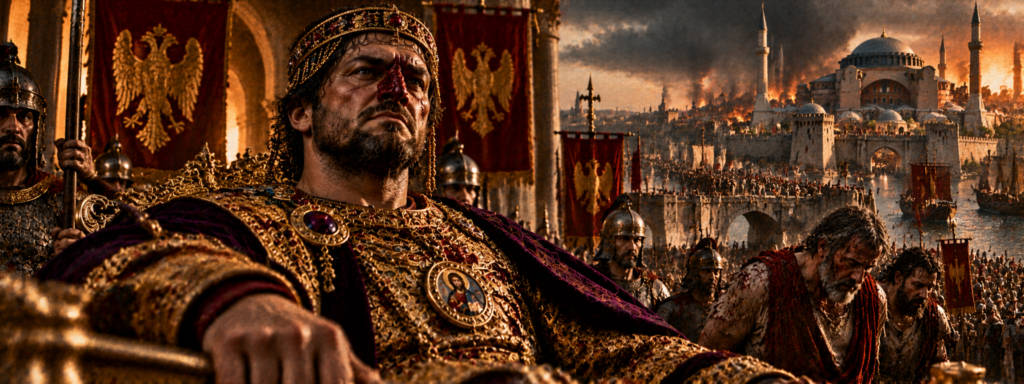
Justinian II: The Slit-Nosed Emperor Who Returned for Revenge
They cut off his nose, stripped him of his crown, and sent him into exile, believing they had permanently removed him from the Byzantine throne. But Justinian II was not prepared to disappear quietly into history. Ten years after his downfall, the mutilated emperor returned to Constantinople with foreign military support, reclaimed the imperial palace, and unleashed a campaign of vengeance against the men who had replaced him. His enemies were humiliated, tortured, and executed, while his increasingly violent rule spread fear through the empire. Known to history as Rhinotmetos, or “Slit-Nose,” Justinian II became one of Byzantium’s most notorious rulers—a man whose extraordinary determination restored his throne but whose relentless pursuit of enemies ultimately destroyed his dynasty.
The Emperor Who Refused to Stay Dead
In the summer of AD 705, an extraordinary political drama unfolded beneath the towering walls of Constantinople. A former emperor, mutilated and exiled a decade earlier, had returned with an army determined to reclaim the throne. The man outside the capital was Justinian II, once the legitimate ruler of the Eastern Roman Empire and now a dangerous challenger whose very survival defied the political expectations of his age. His enemies had deliberately disfigured him to prevent precisely this possibility, yet he had crossed foreign territories, negotiated with powerful rulers, and assembled enough military support to threaten the government that had replaced him.
The Byzantine Empire was no stranger to violent changes of power. Emperors had been assassinated, deposed, imprisoned, and forced into monasteries, while ambitious generals frequently discovered that military success could provide a path to the throne. Yet Justinian’s return was remarkable even by those standards. He had been removed from power in AD 695, subjected to facial mutilation, and banished to Cherson, a distant imperial outpost on the Crimean Peninsula. His enemies expected the disfigurement to make him politically unacceptable, preserving his life while destroying his ability to rule.
They had underestimated him.
For years, Justinian lived beyond the imperial capital, surrounded by uncertain allies and exposed to the shifting loyalties of frontier politics. His attempts to recover the throne eventually brought him into contact with the Khazars, a powerful steppe polity north of the Black Sea, and later the Bulgars under Khan Tervel. These alliances were not sentimental acts of friendship. They were calculated political arrangements involving military assistance, diplomatic advantage, and the possibility of substantial rewards.
When Justinian finally returned to Constantinople, he did not merely seek recognition as a former ruler unjustly displaced. He intended to recover the full authority of the imperial office and punish those who had taken it from him. His restoration would demonstrate that even deliberate mutilation could not necessarily end an emperor’s ambitions.
The consequences were brutal. His immediate predecessors, Leontios and Tiberios III, were captured and executed, while other opponents faced punishment, dismissal, or death. Later Byzantine chroniclers portrayed the restored emperor as consumed by vengeance, increasingly willing to use military force against communities suspected of disloyalty. Some of their most sensational stories require caution, but the broader pattern of violent political retaliation is well established.
Justinian’s second reign lasted only six years. In AD 711, another rebellion overthrew him, and this time his enemies ensured that he would never return. He was killed, his young son was murdered, and the dynasty established by his great-great-grandfather Heraclius came to an end.
His life remains one of the most dramatic stories in Byzantine imperial history. It is also a warning about the difficulty of separating personal vengeance from political survival in a system where losing the throne could mean mutilation, exile, or death.
Born Into the Purple: The Last Heir of a Powerful Dynasty
Justinian II was born around AD 668 or 669, the son of Emperor Constantine IV and his wife Anastasia. He belonged to the Heraclian dynasty, which had ruled the empire since Heraclius seized power in AD 610. By Justinian’s birth, the dynasty had survived enormous territorial losses, repeated wars, religious controversies, and internal political struggles. The empire he would inherit was still a formidable state, but it was considerably smaller and more militarized than the Roman Empire of earlier centuries.
The seventh century had transformed the eastern Mediterranean. Arab-Muslim armies had conquered Syria, Palestine, and Egypt, depriving Constantinople of some of its wealthiest provinces. The Sasanian Persian Empire, once Rome’s great eastern rival, had collapsed, while the expanding caliphate became Byzantium’s principal external opponent. Imperial resources were increasingly concentrated in Anatolia, the Balkans, and the remaining Mediterranean territories.
Constantinople nevertheless remained one of the most impressive cities in the world. Its immense defensive walls, imperial palaces, churches, harbors, and ceremonial institutions preserved the prestige of Roman government. The emperor ruled through an elaborate administration supported by military commanders, provincial officials, and religious authorities. The city’s political culture combined Christian imperial ideology with the traditions of Roman law and monarchy.
Justinian was named after Justinian I, the celebrated sixth-century emperor associated with the reconquest of western territories, major legal reforms, and the construction of Hagia Sophia. The name carried enormous imperial significance. It evoked an earlier period of Roman ambition and suggested continuity with a ruler whose achievements had become central to Byzantine political memory.
His father, Constantine IV, had successfully resisted major Arab attacks against Constantinople during the late seventh century. The details and chronology of those campaigns remain debated, but Constantine’s government achieved important defensive successes and negotiated arrangements that improved the empire’s position. He also convened the Sixth Ecumenical Council in AD 680–681, which condemned Monothelitism and sought to resolve a long-running theological controversy.
These achievements gave Justinian a substantial inheritance. He would receive a functioning imperial government, an experienced military establishment, and a dynasty that had maintained power through decades of danger. Yet the state remained vulnerable to external threats, while its survival depended on cooperation among military commanders, provincial elites, and the imperial court.
Justinian was elevated as co-emperor in AD 681, strengthening his claim to succession. When Constantine IV died in September AD 685, Justinian became sole emperor while still approximately sixteen or seventeen years old. The young ruler inherited an empire whose recent survival had depended on cautious diplomacy and military resilience.
He would soon demonstrate ambitions that exceeded the political restraint associated with his father’s later reign.
A Teenage Emperor With Enormous Ambitions
Justinian’s accession placed extraordinary power in the hands of a young man raised within the imperial court. His position was secure in dynastic terms, but he faced the challenge of governing a state surrounded by formidable enemies. The caliphate remained a major threat in the east, while Slavic communities and the recently established Bulgar polity complicated Byzantine authority in the Balkans. The empire also depended on regional commanders whose loyalty could become uncertain when military or financial demands increased.
The surviving sources suggest that Justinian possessed considerable energy and determination. His government pursued military campaigns, negotiated diplomatic agreements, reorganized populations, and undertook major building projects. These activities do not fit the image of an emperor incapable of governing. They reveal a ruler prepared to use the resources of the state aggressively, even when his policies generated resistance.
His youth may have contributed to the perception that his government was unusually forceful, but the evidence does not permit confident conclusions about his temperament. Byzantine chroniclers frequently explained political failure through moral judgments about rulers, emphasizing arrogance, cruelty, or impiety. Such descriptions can preserve genuine grievances while also reflecting the hostility of later political and religious traditions.
Justinian’s early reign began with an opportunity created by instability within the caliphate. Civil conflict among Muslim rulers temporarily weakened pressure on Byzantine territories, allowing Constantinople to negotiate from a stronger position. The emperor took advantage of these circumstances through diplomacy and military activity, seeking to strengthen imperial control over contested regions.
His ambitions also extended into the Balkans. Slavic groups had settled across substantial territories during the preceding century, sometimes operating beyond direct imperial administration. Justinian sought to restore authority over strategically important routes and communities, particularly around Thessalonica. His campaigns demonstrated that the Byzantine army retained offensive capabilities despite earlier territorial losses.
Yet military success could produce political problems. Campaigns required money, troops, transportation, and administrative support, while efforts to reorganize populations could disrupt established communities. The emperor’s willingness to impose sweeping measures increased the demands placed on provincial society.
The first years of Justinian’s reign therefore combined genuine achievement with the emergence of tensions that would eventually threaten his throne.
War, Diplomacy, and the Dangerous Peace With the Caliphate
One of Justinian’s earliest priorities was managing relations with the Umayyad Caliphate. The two empires had fought for decades over territory, tribute, and strategic advantage. Their rivalry shaped the political geography of the eastern Mediterranean, while both governments periodically negotiated agreements when circumstances made continued warfare undesirable. Justinian inherited a situation in which internal conflict within the caliphate offered Constantinople diplomatic opportunities.
In the late 680s, the Byzantine government concluded an agreement with Caliph Abd al-Malik. Ancient accounts describe arrangements involving payments, territorial administration, and the distribution of revenue from regions such as Cyprus, Armenia, and Iberia in the Caucasus. The precise terms are debated because the surviving narratives differ and some details are difficult to reconcile. Nevertheless, the agreement represented a significant diplomatic achievement for Justinian’s government.
The emperor used the temporary reduction in eastern pressure to pursue other priorities. He sought to strengthen Byzantine authority in the Balkans and reorganize military resources. Such policies reflected the strategic flexibility required of a state defending several frontiers simultaneously. Peace with one rival could provide the opportunity to confront another.
Relations with the caliphate eventually deteriorated. Disputes over treaty obligations, payments, and the form of coinage used in transactions contributed to renewed tension. Later accounts sometimes connect the breakdown directly to disagreements involving religious imagery on Byzantine coins and the caliphate’s developing monetary reforms. The precise causal relationship remains uncertain, and it would be misleading to reduce the renewed conflict to a single dispute over coins.
By AD 692, the two powers were again at war. Byzantine forces suffered a major defeat at the Battle of Sebastopolis, an event that seriously damaged Justinian’s military position. The battle also became associated with accusations of betrayal involving troops recruited from resettled Slavic populations. These accusations would have devastating consequences for people who had been moved into imperial territory under the emperor’s own policies.
The failure demonstrated the risks of Justinian’s ambitious approach. A diplomatic opportunity had allowed him to strengthen the empire temporarily, but renewed war exposed weaknesses in military organization and loyalty. The emperor responded harshly to the defeat, reinforcing the reputation for severe punishment that would later dominate accounts of his reign.
The Slavic Campaigns and the Forced Movement of Peoples
Justinian’s Balkan campaigns were among the most significant military operations of his first reign. During the late seventh century, substantial areas of the peninsula contained Slavic communities whose relationships with Constantinople varied considerably. Some groups paid tribute or cooperated with imperial officials, while others operated independently or resisted Byzantine authority. Restoring control over routes connecting Constantinople with Thessalonica was an important strategic objective.
In AD 688 or 689, Justinian led a campaign into the Balkans and reached Thessalonica. The operation demonstrated the ability of Byzantine forces to penetrate regions where imperial authority had weakened. It also allowed the government to capture or negotiate the submission of substantial numbers of Slavs. Byzantine accounts present the campaign as a restoration of imperial power, although the extent of lasting territorial control is uncertain.
Following these operations, Justinian transferred large numbers of Slavs to Anatolia. Population transfers were a familiar instrument of Byzantine policy, intended to strengthen military recruitment, develop agricultural regions, and reduce potential resistance in strategically sensitive areas. The emperor’s government sought to integrate resettled communities into the imperial military system. Such measures could benefit the state, but they also uprooted families and disrupted existing social relationships.
Some resettled Slavs were organized into military units, reportedly providing a substantial contingent for the campaign against the caliphate. At Sebastopolis in AD 692, a significant number of these troops defected or changed sides, according to Byzantine accounts. The reasons remain uncertain, and later narratives may simplify complex military circumstances by presenting the event as straightforward betrayal. The defeat nevertheless became a major humiliation for Justinian.
The emperor reportedly retaliated against Slavic communities associated with the defectors. Theophanes the Confessor, writing in the early ninth century, describes severe punishment and mass killing, although the numbers and details are difficult to verify. His account reflects a hostile tradition that portrayed Justinian as exceptionally cruel. Even allowing for exaggeration, the episode suggests that the government responded to military failure through collective punishment.
The incident damaged Justinian’s standing. Soldiers and provincial communities could reasonably fear that failure or suspected disloyalty would bring consequences extending beyond those directly responsible. Military discipline was essential to imperial survival, but indiscriminate punishment risked undermining the loyalty it was intended to enforce.
The emperor’s policies had been designed to strengthen the empire. Instead, the defeat and its aftermath contributed to the resentment that would eventually threaten his rule.
Taxes, Imperial Projects, and the Officials Who Inspired Hatred
Military campaigns were not Justinian’s only source of controversy. His government also undertook construction projects and imposed financial demands that later chroniclers associated with widespread resentment. Constantinople’s imperial buildings required maintenance and expansion, while the court depended on substantial revenue to support administration, ceremonies, and military expenditure. These obligations placed pressure on the population, particularly when combined with the costs of war.
Two officials became especially notorious in the surviving accounts: Stephen, a powerful administrator associated with financial enforcement, and Theodotos, a former monk who held important fiscal responsibilities. Later Byzantine writers portrayed them as instruments of imperial oppression, accusing them of harsh treatment, extortion, and abuses against prominent individuals. The details require caution because the accounts were written within traditions hostile to Justinian’s government. Nevertheless, their prominence suggests that resentment toward fiscal administration became politically significant.
Theophanes describes Stephen using violence and humiliation against people who resisted official demands. He also preserves allegations involving members of the imperial household, including Justinian’s mother Anastasia. Some stories are particularly dramatic and may have been embellished to illustrate the arrogance of imperial officials. Their historical value lies partly in showing how later generations remembered the government as oppressive.
Justinian also sponsored major construction projects in Constantinople, including work associated with the imperial palace and ceremonial spaces. Such projects reflected the traditional expectation that emperors should display magnificence and maintain the physical setting of imperial authority. Yet construction could require labor, resources, and the displacement of existing structures. When public resentment was already growing, imperial building could become another symbol of arbitrary power.
The emperor’s government also faced criticism over taxation and confiscation. Byzantine fiscal administration was complex, and not every unpopular measure can be attributed directly to Justinian’s personal decisions. Officials possessed considerable discretion, while local disputes could produce accusations of abuse. Nevertheless, the ruler bore political responsibility for the conduct of the administration operating under his authority.
By the middle of the 690s, several sources of resentment had converged. Military defeat had damaged imperial prestige, population transfers had disrupted communities, and fiscal demands had angered influential groups. Justinian remained emperor, but the foundations of his authority were becoming unstable.
The crisis would erupt in Constantinople itself.
The Rebellion of 695: Constantinople Turns Against Its Emperor
In AD 695, Justinian’s first reign ended in a sudden political uprising. The rebellion developed amid resentment toward his government and the influence of military and aristocratic opponents. Its central figure was Leontios, an experienced commander who had previously fallen from imperial favor. His career and imprisonment reflected the dangers faced by powerful officers in a court where military failure or political suspicion could lead to punishment.
Leontios was released from confinement and given military responsibilities shortly before the rebellion. The precise circumstances remain debated, but he soon became the focus of opposition to Justinian. Supporters mobilized in Constantinople, where popular unrest and hostility toward imperial officials created favorable conditions for a coup. The city’s population could become a decisive political force when soldiers, religious leaders, and urban factions acted together.
The uprising rapidly overwhelmed the emperor’s position. Justinian was seized, while some of his most hated officials suffered violent punishment. Theophanes describes Stephen and Theodotos being killed amid public anger, although individual details of the violence may reflect later embellishment. The events demonstrated that resentment had extended beyond isolated aristocratic conspiracies into the streets of the capital.
Leontios was proclaimed emperor, ending Justinian’s first period of rule. The deposition was especially humiliating because Justinian belonged to an established dynasty and had inherited the throne legitimately. His enemies needed to prevent him from becoming the center of a restoration movement. Killing him would have eliminated the immediate threat, but Byzantine political practice offered another method intended to make a former ruler permanently unsuitable for office.
They mutilated him.
Justinian’s nose was cut off, an act that gave him the enduring nickname Rhinotmetos. Some accounts also suggest additional facial mutilation, although the precise injuries remain uncertain. The central fact is that his disfigurement was intended to mark him publicly as a man no longer fit to occupy the imperial throne.
The mutilated former emperor was then exiled to Cherson, a distant Byzantine possession on the Crimean Peninsula. The location placed him far from Constantinople and the political networks that might support his return. His enemies believed that distance, humiliation, and physical disfigurement would end his ambitions.
Instead, the exile became the beginning of one of Byzantium’s most extraordinary political comebacks.
Rhinotmetos: Why They Cut Off His Nose
Facial mutilation carried profound political meaning in Byzantine society. Imperial ideology associated the emperor with dignity, bodily integrity, and divine favor, making visible disfigurement a potential obstacle to legitimate rule. Removing a rival’s nose could therefore serve as an alternative to execution, preserving his life while attempting to prevent his return to power. The practice was brutal, but it reflected the political logic of a system in which deposed rulers remained dangerous as long as supporters could rally around them.
Justinian’s mutilation was intended to transform him from emperor into a permanently disqualified exile. The injury would have been visible in ordinary interaction and could not easily be concealed. It also exposed him to public humiliation, reminding observers that his enemies had exercised power over his body. The nickname Rhinotmetos preserved that humiliation in historical memory.
Yet the assumption that physical disfigurement made a person incapable of ruling was not an absolute constitutional rule. Byzantine succession depended heavily on political recognition, military support, dynastic legitimacy, and control of Constantinople. Religious and ceremonial expectations mattered, but they could be challenged when a claimant possessed sufficient power. Justinian would eventually demonstrate that the supposed barrier could be overcome.
The psychological consequences of his mutilation cannot be reconstructed with certainty. Later writers often presented his second reign as a campaign of revenge driven by the humiliation he suffered. Such an interpretation is understandable, but it remains an interpretation rather than direct evidence of his private thoughts. The political circumstances alone gave him strong reasons to punish opponents who might attempt another deposition.
His injury also became central to the way later generations portrayed him. The nickname reduced a complicated ruler to a physical mark associated with defeat and vengeance. It encouraged the idea that his restored reign was defined by the desire to reverse humiliation through cruelty. While that reputation reflects genuine political violence, it can also obscure the diplomatic and military calculations that made his return possible.
For the moment, Justinian remained an exile far from the imperial capital. His enemies controlled Constantinople, and his dynasty appeared to have lost the throne. But the political world beyond the empire’s borders offered opportunities that his opponents had failed to eliminate.
Exile in Cherson: A Deposed Emperor Among Uncertain Allies
Cherson occupied a strategic position on the Crimean Peninsula, connecting Byzantine interests with the Black Sea and the peoples of the northern steppe. The city maintained commercial and diplomatic relationships across a region where imperial authority depended on negotiation as much as direct military control. For Justinian, exile there meant separation from the capital but not complete isolation from political networks. The surrounding world contained rulers who might find advantage in supporting a displaced emperor.
The years following his deposition were dangerous. Leontios ruled Constantinople, but his government faced serious military problems, including the loss of Carthage to Arab forces in AD 698. The defeat undermined his authority and contributed to another rebellion. A naval commander, Apsimar, seized power under the imperial name Tiberios III, demonstrating that the political instability which had destroyed Justinian continued after his removal.
The successive changes of government created opportunities for a former emperor with a recognized dynastic claim. Justinian could argue that both Leontios and Tiberios were usurpers who had displaced the legitimate ruler. His mutilation complicated his position, but it did not erase his ancestry or the memory of his first reign. Supporters might still regard him as a plausible alternative if he could obtain military backing.
His presence in Cherson eventually became a source of concern to local authorities. Byzantine chronicles describe fears that Justinian intended to recover the throne and suggest that officials considered handing him over to the reigning emperor. The exact sequence is uncertain because the sources differ in detail. Nevertheless, Justinian appears to have concluded that remaining in Cherson was increasingly dangerous.
He escaped from the region and sought protection among the Khazars. The Khazar Khaganate controlled extensive territories north of the Black Sea and maintained important diplomatic relationships with Byzantium. Its rulers could influence events around Crimea and the Caucasus, making them valuable allies for an imperial claimant. Justinian’s flight transformed his situation from isolated exile to participation in the politics of a powerful neighboring state.
The former emperor had lost his throne, but he had not lost his ability to negotiate.
The Khazar Princess and the Plot to Kill an Exile
Justinian’s relationship with the Khazars became one of the most remarkable episodes of his exile. The Khazar ruler, commonly identified in Byzantine sources as the khagan, initially offered him protection. Justinian strengthened the relationship through marriage to a Khazar princess whose original name is often given as Tzitzak or a related form. Upon entering the Byzantine imperial world, she took the name Theodora, linking her symbolically to earlier imperial traditions.
The marriage was politically important. It connected Justinian to a powerful ruler whose territories could provide refuge, resources, and diplomatic leverage. For the Khazars, supporting a former Byzantine emperor offered opportunities to influence relations with Constantinople. Such marriages were instruments of international politics, not merely private family arrangements.
The alliance soon became dangerous. Byzantine sources report that Emperor Tiberios III sought Justinian’s death and persuaded or pressured the Khazar ruler to cooperate. The khagan allegedly agreed to arrangements that would place Justinian in the hands of men prepared to kill him. The exact diplomatic circumstances remain uncertain, but the tradition consistently portrays Justinian as facing a serious threat while under Khazar protection.
Theodora reportedly warned her husband of the danger. In the surviving narratives, her intervention allowed Justinian to escape before the planned assassination could occur. Some accounts describe him killing or neutralizing individuals involved in the plot, but the precise details are difficult to verify. The central historical significance is that his Khazar refuge had become unsafe.
Justinian fled again, this time seeking support from the Bulgars. His marriage to Theodora nevertheless endured as part of his restored imperial identity. She would later join him in Constantinople and be recognized as empress, while their son Tiberios became central to the dynasty’s final tragedy.
The episode reveals the precarious position of a deposed ruler. Foreign protection could preserve his life, but alliances depended on changing political calculations. A former emperor could become valuable as a bargaining asset, yet that same value made him vulnerable to betrayal. Justinian survived by moving between competing powers and exploiting opportunities that his enemies could not fully control.
His next alliance would finally provide the military force necessary to reclaim Constantinople.
Tervel of Bulgaria: The Alliance That Changed Everything
Justinian turned to Tervel, ruler of the Bulgars, seeking assistance in recovering the Byzantine throne. The Bulgar polity had established itself south of the Danube during the late seventh century, becoming a significant regional power. Relations with Constantinople alternated between conflict, negotiation, and diplomatic accommodation. Supporting Justinian offered Tervel an opportunity to gain wealth, prestige, and influence over Byzantine affairs.
The negotiations produced an agreement under which Tervel would provide military assistance. Byzantine sources describe promises of substantial rewards, including treasure, honors, and territorial concessions. The precise terms remain debated, but the alliance was clearly advantageous enough for Tervel to commit forces to the campaign. Justinian had transformed himself from an isolated exile into the leader of a foreign-supported restoration attempt.
In AD 705, Justinian and his allies advanced toward Constantinople. The appearance of Bulgar forces outside the imperial capital created a serious challenge for Tiberios III, who had ruled since AD 698. Constantinople possessed formidable defenses, and an assault against its walls was dangerous even for a large army. Justinian therefore needed more than military strength; he needed a way to penetrate the city and secure support from within.
The sources describe the restoration as involving a daring entry into Constantinople through an opening or conduit associated with the city’s defenses. The exact route and circumstances vary among accounts, and some details may have been dramatized. Nevertheless, Justinian succeeded in entering the capital with a small group of followers, creating confusion and encouraging supporters to rally to him. His presence inside the city undermined Tiberios’s authority.
The reigning emperor fled, and Justinian recovered the throne. The restoration was extraordinary because the man deliberately mutilated to prevent his return had regained imperial power through foreign military assistance and political daring. His success challenged assumptions about bodily integrity and imperial legitimacy. It also demonstrated how unstable Byzantine succession could become when external rulers intervened in domestic struggles.
Justinian rewarded Tervel for his assistance. The Bulgar ruler received substantial gifts and the prestigious title of Caesar, an extraordinary honor for a foreign sovereign. The alliance temporarily strengthened relations between the two powers, although later conflicts would show that cooperation remained fragile.
The restored emperor had achieved what many contemporaries must have considered impossible. He had returned to the palace from which he had been expelled ten years earlier.
Now he would confront the men who had ruled in his absence.
The Return of the Slit-Nosed Emperor
Justinian’s restoration in AD 705 marked the beginning of his second reign. The imperial court once again belonged to the Heraclian dynasty, and the emperor who had been mutilated and exiled now possessed the authority to punish his enemies. His return was celebrated by supporters as the recovery of legitimate rule. For those who had participated in his deposition, however, the restoration created an immediate danger.
The most prominent targets were Leontios and Tiberios III. Both had occupied the throne after Justinian’s first deposition, and both represented rival claims to imperial legitimacy. Allowing them to survive could provide future rebels with alternative candidates. Their removal therefore served a political purpose, although the methods used also became central to Justinian’s reputation for vengeance.
Byzantine chronicles describe the former emperors being publicly humiliated before their execution. One famous account places them beneath Justinian’s feet during a ceremonial spectacle, symbolizing their complete subordination to the restored ruler. The scene is associated with a biblical verse concerning victory over enemies, reinforcing the religious and political symbolism of imperial triumph. The precise staging may have been shaped by later literary conventions, but the execution of both men is historically secure.
The public nature of the punishment mattered. Byzantine emperors relied on ceremonies to communicate authority, and the humiliation of defeated rivals could transform political victory into a visible demonstration of legitimacy. Justinian’s enemies had once disfigured him to announce his exclusion from power. Now he used the imperial court to display their defeat.
The patriarch Kallinikos, who had held office during the earlier political upheaval, also suffered punishment. Later sources report that he was blinded and exiled, illustrating the extent to which religious leaders could become entangled in imperial politics. The punishment reinforced the message that association with Justinian’s enemies could carry severe consequences.
The restoration therefore began with a combination of political consolidation and violent retaliation. Some actions were intended to eliminate rival claimants, while others communicated the emperor’s determination to punish those who had supported his removal. The distinction between security and vengeance became increasingly difficult to maintain.
Justinian had recovered the throne, but the methods used to secure it helped create the fear that would eventually destroy him.
Public Humiliation, Executions, and Imperial Revenge
The executions of Leontios and Tiberios III became the most famous examples of Justinian’s restored severity. Both men had ruled Constantinople, commanded officials, and exercised the ceremonial authority of the imperial office. Their public humiliation demonstrated how quickly political status could be reversed. Men once addressed as emperors could become condemned prisoners when another claimant gained control of the capital.
Later Byzantine historians expanded the picture of Justinian’s revenge, describing punishments directed against officials, aristocrats, and communities suspected of opposition. Theophanes and Nikephoros preserve traditions of harsh reprisals, although their accounts differ in emphasis and detail. Some stories may reflect genuine acts of repression, while others were shaped by the later reputation of a ruler remembered as exceptionally vindictive. The most dramatic allegations should not be treated as automatically reliable.
The restored emperor faced genuine political dangers. He had returned with foreign assistance, and many officials had served governments established after his deposition. Some may have feared punishment even if they had not actively participated in the original rebellion. Justinian therefore confronted a court in which personal loyalties were uncertain and rival networks remained influential.
Punishment could temporarily eliminate opponents, but it also encouraged fear among those who survived. Officials who believed that association with a previous regime made them vulnerable had little incentive to trust the emperor. Military commanders might worry that failure would be interpreted as betrayal. Provincial communities could become hostile if imperial investigations threatened collective punishment.
The sources portray Justinian as increasingly severe, but they do not provide a complete administrative record of his actions. It would be misleading to claim that every opponent was tortured or executed. The available evidence supports a pattern of violent political retaliation, particularly against prominent rivals, without establishing the full scale of the alleged purges.
The political consequences were nevertheless serious. A ruler restored through military force needed to rebuild trust across the empire, but harsh reprisals could undermine the cooperation required for stable government. Justinian’s second reign became increasingly associated with coercion, making future rebellion more likely rather than less.
The Empress Theodora and the Son Who Would Inherit the Danger
Justinian’s marriage to the Khazar princess Theodora became an important part of his restored dynasty. Their relationship had developed during his exile, when foreign alliances were essential to his survival. After his return to Constantinople, Theodora joined him and received recognition as empress. Her presence symbolized both the extraordinary circumstances of Justinian’s restoration and the diplomatic connections that had made it possible.
Their son, Tiberios, became the intended heir to the throne. The child’s elevation to imperial status helped reinforce the continuity of the Heraclian dynasty. Justinian had survived deposition and mutilation, but the future of his family depended on establishing a secure succession. His son’s position therefore carried enormous political significance.
Theodora’s individual role in government is difficult to reconstruct. Byzantine sources preserve relatively little reliable information about her political activities after the restoration. Her marriage was clearly important diplomatically, but claims about her private influence or personal views would be speculative. The surviving evidence does not support a detailed psychological portrait of the empress.
The young Tiberios, however, became central to the dynasty’s final crisis. As Justinian’s son and designated successor, he represented the possibility that the Heraclian family might continue ruling after his father’s death. For opponents seeking to end the dynasty, the child could become a dangerous symbol around whom loyalists might rally. His status made him politically important long before he could exercise authority himself.
The family history also reveals the human consequences of Byzantine succession struggles. Justinian had survived mutilation because his enemies chose not to kill him, but his eventual return demonstrated the risks of leaving a dynastic claimant alive. The lesson would not be forgotten by those who overthrew him in AD 711. When the final rebellion succeeded, its leaders would take measures intended to prevent another restoration.
The fate of Tiberios would become one of the darkest episodes in the story.
Religion, Imperial Authority, and the Quinisext Council
Justinian’s reign was not defined exclusively by warfare and revenge. His government also participated in important religious developments, particularly the council held in Constantinople in AD 691–692. Commonly known as the Quinisext Council or Council in Trullo, the assembly addressed disciplinary and canonical questions that had not been fully resolved by earlier ecumenical councils. Its decisions became influential in the eastern Christian tradition.
The council issued numerous canons regulating clerical conduct, religious observance, marriage, and aspects of church administration. It also reflected differences between eastern and western Christian practices, contributing to tensions with the papacy. Some provisions challenged customs accepted in Rome, particularly concerning clerical marriage and fasting. These disagreements complicated relations between Constantinople and the western church.
Pope Sergius I refused to accept certain canons, creating a confrontation with the imperial government. Byzantine accounts describe an attempt to compel papal compliance, including measures directed against the pope. The episode demonstrated the emperor’s willingness to assert authority in religious matters, although the political circumstances were more complicated than a simple struggle between church and state. Local support for the papacy limited the effectiveness of imperial pressure.
The council also illustrates Justinian’s broader conception of imperial authority. Byzantine emperors regarded religious unity and ecclesiastical order as important responsibilities of government. Convening councils and enforcing religious legislation were established aspects of imperial rule. Justinian’s involvement therefore belonged to a long tradition rather than representing an unusual personal obsession.
His religious policies complicate the image of a ruler concerned only with vengeance. The council’s canons had lasting significance, while his government continued administrative and ceremonial practices associated with earlier emperors. Justinian was capable of pursuing institutional objectives even when his political conduct generated hostility.
Nevertheless, the relationship between religious authority and imperial coercion could become dangerous. Attempts to enforce conformity through political pressure risked provoking resistance from religious communities and their leaders. Justinian’s government repeatedly encountered the limits of imperial power when institutions or populations refused to cooperate.
The Second Reign: A Throne Restored but Never Secure
Justinian’s second reign began with the triumph of restoration, but the political circumstances remained unstable. He had regained Constantinople through foreign assistance, executed his principal rivals, and reestablished the Heraclian dynasty. Yet many officials had served previous governments, and the empire continued facing military threats along its frontiers. The restoration did not erase the grievances that had contributed to his first deposition.
Relations with the Bulgars eventually deteriorated despite Tervel’s earlier assistance. Byzantine sources describe renewed conflict, including a campaign in which Justinian suffered a setback near Anchialos, usually dated to AD 708. The episode demonstrated the fragility of alliances formed through immediate political advantage. Tervel had helped restore Justinian, but the interests of the two rulers did not remain permanently aligned.
The empire also faced continuing pressure from the Umayyad Caliphate. Arab forces conducted campaigns against Byzantine territories, placing demands on military resources and frontier administration. Justinian’s government had to manage these threats while maintaining internal security. The combination of external warfare and domestic suspicion increased the difficulty of stable rule.
The restored emperor’s reputation for harshness became a political liability. Commanders and provincial officials could fear that military failure would bring punishment, while communities associated with opposition might expect retaliation. Such fears could encourage preemptive rebellion when imperial authority appeared vulnerable. The government needed loyalty, but its methods risked producing resistance.
Later chroniclers describe Justinian’s conduct becoming increasingly severe during these years. Their narratives emphasize vengeance and cruelty, but the chronology and details are sometimes uncertain. The sources were written after the dynasty’s destruction and may reflect efforts to explain its fall through the moral character of the ruler. Even so, the repeated association of his government with violent punishment suggests that repression played an important role in its instability.
The crisis would eventually center on Cherson, the very city where Justinian had spent his exile.
Cherson: The City That Remembered His Exile
Cherson held a unique place in Justinian’s personal and political history. It had been the site of his exile after the deposition of AD 695, and its inhabitants had witnessed the years when he lived as a mutilated former emperor. Some local officials had reportedly considered surrendering him to his enemies, while others became involved in the complicated circumstances surrounding his escape. The city therefore possessed associations with the humiliation and danger he had experienced before his restoration.
During his second reign, Justinian’s government launched military operations against Cherson. Byzantine chronicles portray these expeditions as punitive campaigns motivated by the emperor’s desire for revenge. The accounts describe severe violence, executions, and the removal of inhabitants, although their details and scale remain difficult to verify. The broader fact that imperial forces intervened militarily in the region is well established.
The political circumstances were complicated by Cherson’s frontier position. The city maintained relationships with the Khazars and operated within a region where Byzantine authority was not always direct or secure. Local leaders could seek protection from neighboring powers when relations with Constantinople deteriorated. Justinian’s attempts to impose control therefore risked provoking resistance supported by external interests.
Theophanes describes particularly brutal treatment of inhabitants and officials, including allegations of drowning and other punishments. These stories have strongly influenced Justinian’s reputation as a vengeful ruler. Yet the source’s hostile perspective and the dramatic character of some episodes require caution. The precise number of victims and the circumstances of individual executions cannot be established confidently.
What is clear is that the campaigns failed to secure lasting loyalty. Instead, Cherson became a center of rebellion against Justinian’s government. Imperial commanders and local leaders eventually supported an alternative claimant, turning the emperor’s punitive intervention into a direct threat to his throne. The attempt to impose authority through force had produced the opposite result.
The irony was profound. Cherson had once been the place where Justinian’s enemies sent him to disappear. Now it became the center of the movement that would end his reign permanently.
The Rebellion of Philippikos Bardanes
The final rebellion against Justinian emerged from the political and military turmoil surrounding Cherson. A commander and aristocrat named Bardanes became the focus of opposition, eventually taking the imperial name Philippikos. His rise reflected the ability of provincial forces to create alternative emperors when the central government lost their loyalty. The movement also benefited from the complicated relationships among Byzantine officials, local communities, and Khazar interests.
The surviving accounts describe shifting allegiances among commanders sent to deal with Cherson. Some forces that were supposed to enforce Justinian’s authority instead supported the rebellion. The precise sequence is difficult to reconstruct because the chronicles contain inconsistencies and hostile interpretations. Nevertheless, the rebellion developed into a serious military threat capable of challenging Constantinople itself.
Philippikos gained support among opponents of Justinian’s government and eventually advanced toward the capital. The emperor’s position deteriorated rapidly as military and political loyalty shifted away from him. The pattern resembled his first deposition in AD 695, when resentment within the empire had allowed a rival commander to seize power. This time, however, Justinian could not rely on the opportunity of a long exile and eventual restoration.
The rebellion also exposed the limits of his foreign alliances. The Khazars had previously sheltered him, while the Bulgars had helped restore his throne. Yet these relationships could not guarantee his survival when imperial forces and officials turned against him. The emperor who had mastered the politics of exile now faced a coalition he could not overcome.
By AD 711, Philippikos’s supporters had gained sufficient strength to threaten Constantinople. Justinian attempted to respond, but his authority was collapsing. The capital eventually accepted the new ruler, leaving the emperor isolated and vulnerable. The final stage of his reign unfolded with the speed characteristic of Byzantine coups.
The man who had once returned from exile to punish his enemies was about to experience the same political reversal again.
The Death of Justinian II
Justinian II was killed in AD 711 during the rebellion that brought Philippikos Bardanes to power. The exact circumstances of his death differ among the surviving sources, but the central event is secure. He was captured and executed after losing the support necessary to defend his throne. His second reign ended after approximately six years, bringing his total time as emperor to about sixteen years across two separate periods.
The killing was politically decisive because Justinian had already demonstrated the danger of leaving a deposed emperor alive. His restoration in AD 705 had shown that exile and mutilation were insufficient to eliminate a determined claimant with dynastic legitimacy and foreign allies. The rebels of AD 711 therefore had strong reasons to prevent another return. Execution removed the possibility that Justinian himself could organize a future restoration.
The violence did not end with his death. His young son Tiberios, the designated heir, was also killed. Byzantine accounts describe the child seeking sanctuary in a church before being taken and executed, although the precise details vary. The murder eliminated the most immediate continuation of the Heraclian dynasty.
The child’s death became one of the most disturbing aspects of the final rebellion. Tiberios had not governed independently or commanded the policies that made his father unpopular. His political importance came from his ancestry and imperial title. In a system where dynastic claims could inspire future rebellions, even a child could be regarded as a threat.
The killing of father and son ended the Heraclian dynasty’s direct rule. The family that had governed Byzantium since AD 610 disappeared from the imperial throne after more than a century. Its history had included military victories, territorial losses, religious controversies, and repeated succession struggles. Justinian’s death brought that long political chapter to a violent conclusion.
The emperor who had survived mutilation, exile, and assassination plots could not survive the final collapse of his authority. His enemies ensured that the extraordinary comeback of AD 705 would never be repeated.
Was Justinian II Really Mad?
Justinian II is sometimes included among rulers described as mad, unstable, or pathologically cruel. Such labels reflect his reputation for vengeance, severe punishment, and violent political retaliation. Yet the surviving evidence does not permit a reliable clinical diagnosis. Byzantine chroniclers were not recording psychiatric assessments, and their descriptions were shaped by political hostility, religious concerns, and moral expectations about imperial behavior.
The emperor’s conduct can be examined without assigning him a modern medical condition. He ordered or authorized harsh punishments, executed prominent rivals, and pursued military campaigns against communities suspected of disloyalty. His restoration was followed by violent reprisals, while his later policies contributed to renewed rebellion. These actions provide substantial grounds for discussing authoritarian government and political brutality.
The interpretation that he was driven entirely by revenge is more difficult to establish. His mutilation and exile undoubtedly created a political context in which former enemies remained dangerous. Eliminating rival emperors served the practical purpose of preventing future claims to the throne. Punishment could therefore combine personal hostility with calculations about security, legitimacy, and deterrence.
Ancient writers often explained tyranny through recognizable moral patterns. A ruler who ignored advice, punished opponents, or suffered military defeat could be portrayed as arrogant, impious, or irrational. Such descriptions made historical narratives more compelling while reinforcing lessons about the dangers of excessive power. Justinian’s extraordinary life provided abundant material for this kind of storytelling.
His achievements also complicate the caricature. During his first reign, he conducted military campaigns, negotiated with the caliphate, reorganized populations, and convened an important church council. During his exile, he negotiated alliances with the Khazars and Bulgars, survived political threats, and organized a successful restoration. These actions demonstrate sustained political calculation and determination, even when their consequences were destructive.
The historical question is therefore not whether Justinian was clinically mad. It is how a ruler capable of strategic planning and extraordinary resilience became associated with such severe repression that his government repeatedly provoked rebellion. His story illustrates the danger of political power exercised through fear, especially when personal survival and the elimination of rivals become inseparable.
The Byzantine Empire After Justinian’s Death
The death of Justinian II did not restore immediate stability to the Byzantine Empire. Philippikos Bardanes became emperor, but his government faced political and religious opposition. His policies included renewed controversy over the theological decisions of earlier councils, contributing to tensions within the church. His reign lasted only until AD 713, when he was overthrown and blinded.
The following years witnessed further changes of power. Anastasius II succeeded Philippikos but was deposed in AD 715, while Theodosios III ruled briefly before surrendering the throne to Leo III in AD 717. These rapid successions reflected continuing instability within the military and political establishment. The empire remained vulnerable to external threats while its rulers struggled to secure lasting authority.
The Umayyad Caliphate continued applying pressure, culminating in the major siege of Constantinople in AD 717–718. Leo III successfully defended the capital, helping stabilize the empire after years of political turmoil. His reign began a new dynasty and introduced further religious controversies, particularly concerning the use of sacred images. The political world that followed Justinian’s death remained deeply affected by the problems of military succession and imperial legitimacy.
Justinian’s career had demonstrated both the resilience and vulnerability of Byzantine institutions. The empire could survive the deposition of emperors, the intervention of foreign powers, and repeated civil wars. Its administrative and military structures remained capable of producing new rulers and organizing resistance. Yet these same institutions could become instruments of political violence when competing factions struggled for control.
The end of the Heraclian dynasty marked an important transition. A family that had guided the empire through the Arab conquests and the transformation of the seventh century disappeared from power. The rulers who followed inherited a state still capable of survival but increasingly dependent on military leadership and political adaptation.
Justinian’s death therefore belonged to a larger history of imperial transformation. His personal downfall was dramatic, but the forces surrounding it continued shaping Byzantine politics long afterward.
The Emperor Who Defied the Rules of Power
Justinian II’s restoration remains one of the most extraordinary episodes in Byzantine history. His enemies had removed his nose because they believed visible mutilation would make him permanently unacceptable as emperor. The punishment was intended to preserve his life while destroying his political future. Yet Justinian survived exile, secured foreign alliances, and recovered Constantinople through military and diplomatic determination.
His success revealed that imperial legitimacy was more flexible than the political assumptions surrounding mutilation suggested. Dynastic ancestry, military support, foreign alliances, and control of the capital could outweigh the stigma of physical disfigurement. The emperor’s body mattered symbolically, but political power ultimately depended on the institutions and forces willing to recognize him. Justinian demonstrated that a ruler could overcome a punishment designed to make restoration impossible.
The achievement was remarkable, but it did not produce lasting security. His second reign began with executions and public humiliation of defeated rivals, while later campaigns against suspected opponents intensified resistance. The government increasingly depended on coercion, and the emperor’s enemies gained opportunities to organize rebellion. His determination to preserve authority could not overcome the political consequences of widespread hostility.
The story also reveals the brutality of Byzantine succession. Deposition could bring mutilation, exile, imprisonment, or death, while even imperial children could become targets because of their dynastic claims. Justinian had survived the first overthrow because his enemies chose mutilation rather than execution. When he fell again, his opponents acted differently, killing both him and his son to prevent another restoration.
The nickname Rhinotmetos became a lasting reminder of his extraordinary career. It commemorated the injury intended to end his political life, but it also marked the failure of that punishment. The slit-nosed emperor returned, reclaimed his throne, and ruled again. His eventual death demonstrated that the political system which had allowed his comeback remained capable of destroying him.
The Dark Legacy of Justinian II: Revenge, Terror, and the End of a Dynasty
Justinian II inherited the Byzantine throne as a teenager, belonging to a dynasty that had survived some of the greatest crises in Roman history. His early reign demonstrated ambition and energy through military campaigns, diplomacy, population transfers, and religious legislation. Yet these policies also generated resentment, particularly when military defeat and financial demands exposed the costs of imperial authority. By AD 695, opposition had become strong enough to overthrow him in Constantinople.
His mutilation and exile were intended to end his political career permanently. The removal of his nose marked him as a defeated ruler supposedly unfit to govern, while banishment to Cherson separated him from the institutions that sustained imperial power. Yet Justinian refused to accept political extinction. Through alliances with the Khazars and Bulgars, he assembled the support necessary to return to Constantinople in AD 705.
The restoration became the defining achievement of his life. Few emperors had returned from such humiliating circumstances to reclaim the throne, and his success challenged assumptions about legitimacy and physical disfigurement. Nevertheless, the second reign became associated with violent retaliation against former enemies. The executions of Leontios and Tiberios III demonstrated that Justinian intended to eliminate rival claims and publicly reverse the humiliation he had suffered.
His later campaigns against Cherson contributed to another rebellion, while military and political loyalty increasingly shifted away from his government. In AD 711, Philippikos Bardanes gained the support necessary to overthrow him. Justinian was killed, and his young son Tiberios was executed, bringing the Heraclian dynasty to an end. The emperor who had once survived mutilation and exile was denied the opportunity for another return.
His reputation for cruelty rests partly on reliable political events and partly on hostile chronicles written after his downfall. The executions of prominent rivals, the punitive campaigns, and the final rebellion are central to understanding his reign. More sensational stories of torture and indiscriminate slaughter require caution because their details cannot always be independently verified. His conduct can be examined critically without treating every hostile anecdote as fact or assigning him an unsupported psychiatric diagnosis.
The larger tragedy of Justinian’s reign lies in the relationship between political survival and coercion. His first deposition demonstrated the vulnerability of an emperor whose policies alienated powerful groups. His restoration showed that determination, diplomacy, and military support could overcome extraordinary obstacles. Yet the harsh methods associated with his second reign contributed to the conditions that made another overthrow possible.
Justinian II entered exile as a mutilated emperor whose enemies believed they had erased his future. Ten years later, he returned to Constantinople and proved that even the deliberate destruction of his appearance could not necessarily destroy his claim to power. But reclaiming the throne was not the same as securing it. His restored government became associated with punishment and fear, while the enemies he sought to suppress eventually gathered enough strength to destroy him. The final rebellion ended not only his life but also the life of his young heir, ensuring that the dynasty would not rise again. Justinian’s story remains unforgettable because it combines extraordinary resilience with the destructive consequences of imperial vengeance. He overcame the humiliation intended to end his reign, only to discover that the power he recovered could not protect him from the violence through which Byzantine emperors so often rose and fell.