
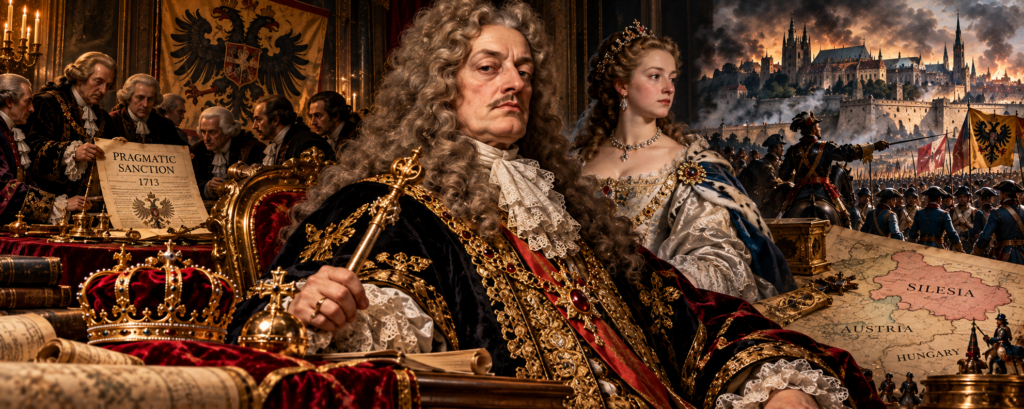
Charles VI: The Emperor Who Tried to Outwit Extinction
Holy Roman Emperor, 1711–1740 | The Lost Spanish Crown, Habsburg Succession Panic, the Pragmatic Sanction, Disinherited Nieces, Obsessive Court Ritual, Dynastic Anxiety, Diplomatic Bargains, Military Decline, the Mushroom Supper, and the Inheritance That Set Europe on Fire
An Empire Built on a Daughter’s Future
For nearly three decades, Emperor Charles VI devoted an extraordinary amount of political energy to preventing a catastrophe that would occur only after he was dead. He negotiated treaties, surrendered advantages, courted enemies, pressured provincial estates, reshuffled alliances, and repeatedly returned European diplomacy to the same haunting question: what would happen to the Habsburg monarchy if he died without a son? The answer terrified him because Charles had already watched one great Habsburg inheritance become the prize in a European war. He had personally fought for the Spanish throne after the death of the childless Charles II of Spain, and he knew exactly what could happen when a dynasty ran out of men.
Charles was not mentally ill, and there is no serious evidence that he suffered anything resembling the devastating psychotic episodes of Charles VI of France, the medieval king with whom he is sometimes confused. The Holy Roman Emperor did not believe himself to be made of glass, forget his own identity, or attack attendants during delusional episodes. His peculiarities belonged to a very different world: rigid ceremonial, extreme attachment to dynastic tradition, ponderous decision-making, a deeply conservative political imagination, and an almost consuming concern with the succession. If there was a “madness” to his reign, it lay in the lengths to which an intelligent and rational ruler was willing to go in pursuit of one objective while other foundations of Habsburg power deteriorated around him.
The centerpiece of that struggle was the Pragmatic Sanction of 1713. It is often described simply as the decree that allowed Charles’s daughter Maria Theresa to inherit, but its original purpose was broader and in some ways more revealing. Charles was still childless when it was promulgated, and he continued desperately hoping for sons. What the decree attempted to establish above all was that the scattered Habsburg possessions were to remain indivisible and inseparable, passing together according to a common succession order rather than being carved apart when the male line failed.
Charles then spent the remaining twenty-seven years of his reign trying to make that arrangement unassailable. One European government after another offered recognition, usually after extracting concessions from Vienna. Provincial estates accepted it, foreign courts promised to respect it, and the emperor accumulated enough diplomatic assurances to persuade himself that the future had been secured. When he died in October 1740, however, much of that elaborate structure began collapsing almost immediately.
The daughter for whom Charles had spent so many years collecting signatures inherited a monarchy desperately short of money, burdened by recent military defeats, and equipped with an army badly in need of reform. Frederick II of Prussia invaded wealthy Silesia before Charles had been dead two months. Bavaria challenged Maria Theresa’s inheritance, France supported her enemies, and Europe descended into the War of the Austrian Succession. The emperor who had spent much of his adult life trying to prevent a succession war had helped create a legal framework for his daughter’s inheritance, but he had failed to provide the power necessary to make everyone respect it.
There is a brutal irony in that failure. Charles VI had correctly identified the greatest danger facing his dynasty, pursued a solution with astonishing persistence, and still watched his strategy fail from beyond the grave. He had tried to bind the future with treaties and legal formulas, but Europe answered with armies. His story is not the tale of a madman losing his grip on reality; it is the darker story of a ruler becoming so preoccupied with controlling tomorrow that he left tomorrow dangerously unprepared for the moment it actually arrived.
The Second Son Who Was Supposed to Become King of Spain
Charles was born in Vienna on 1 October 1685, the younger surviving son of Emperor Leopold I and his third wife, Eleonore Magdalene of Neuburg. His elder brother Joseph stood ahead of him in the Austrian succession, which initially left Charles available for another dynastic purpose. The Habsburg family did not regard younger sons as political leftovers. They were pieces on a European chessboard, capable of inheriting kingdoms, marrying heiresses, commanding armies, or preserving branches of the dynasty that might otherwise disappear.
The greatest opportunity imaginable appeared in Spain. King Charles II, the last male representative of the Spanish Habsburg line, was physically frail, childless, and clearly unlikely to produce an heir. His death threatened to release an enormous collection of territories that included Spain itself, possessions in Italy and the Low Countries, and a vast overseas empire. Both the Austrian Habsburgs and Bourbon France possessed dynastic claims, and every major European government understood that allowing either house to absorb the entire inheritance could transform the continental balance of power.
Before Charles II died, Leopold I and his sons had already considered how Habsburg claims might be organized. In 1703, during the developing struggle for the Spanish inheritance, Joseph and Charles entered into a family succession arrangement that became crucial later. Under that agreement, if both brothers eventually lacked male heirs, Joseph’s daughters were initially placed ahead of Charles’s future daughters in the succession to the Austrian Habsburg lands. Charles would later overturn that priority, creating one of the more uncomfortable contradictions behind his celebrated defense of hereditary legitimacy.
When Charles II died in 1700, his final will named Philip of Anjou, a grandson of Louis XIV, as heir to the Spanish monarchy. Philip became Philip V of Spain, but the Austrian Habsburgs refused to surrender their competing claim. The younger Archduke Charles was put forward as the Habsburg candidate and styled himself Charles III of Spain. Europe plunged into the War of the Spanish Succession, and the young Austrian prince found himself fighting for a crown that would shape his imagination for the rest of his life.
Charles went to the Iberian Peninsula and spent years attempting to establish himself as Spain’s legitimate monarch. He entered Madrid more than once but could not hold it securely, while different regions of Spain divided in their loyalties. Catalonia became particularly associated with the Habsburg cause, and Barcelona served as Charles’s principal base. Those years left him with a deep emotional and political attachment to Spanish traditions that survived long after his chances of ruling Spain had disappeared.
The Crown That Slipped Away
The strange turning point in Charles’s Spanish adventure came not through defeat in Spain but through a death in Vienna. His elder brother Joseph I died of smallpox in April 1711 at only thirty-two, leaving daughters but no surviving son. Charles suddenly inherited the Austrian Habsburg lands and became the dynasty’s candidate for the imperial crown. The younger brother who had been fighting to become King of Spain was now positioned to become Holy Roman Emperor as well.
This created precisely the kind of European super-monarchy that many of Charles’s allies had gone to war to prevent. Britain and the Dutch Republic had opposed Philip V partly because they feared the possibility of France and Spain becoming too closely united under Bourbon power. They were hardly eager to replace that danger with a recreation of something resembling the enormous Habsburg empire of Charles V, combining Austria, imperial influence, Spain, Italy, the Low Countries, and overseas possessions under one ruler. Charles’s unexpected inheritance therefore changed the diplomatic logic of the war.
He was elected Holy Roman Emperor as Charles VI in 1711. By then, however, his former allies were becoming increasingly willing to negotiate with France. The settlements of Utrecht, Rastatt, and Baden ended the major conflict through a complicated redistribution of territories. Philip V remained King of Spain but renounced rights intended to prevent the French and Spanish crowns from being united, while Charles received important former Spanish possessions in Europe, including the Austrian Netherlands and territories in Italy.
Charles never entirely reconciled himself emotionally to losing Spain. He continued to use Spanish royal titles and surrounded himself with people and traditions connected to his years as the Habsburg claimant. Vienna under Charles became, in some respects, the home of a displaced Spanish court that had never fully accepted defeat. The lost kingdom became part of his political identity, not merely an unsuccessful youthful adventure.
That experience also taught Charles a lesson he would never forget. The extinction of a ruling line could turn inheritance into warfare, and legal claims meant little unless other powers found it convenient to respect them. He had spent years fighting because Charles II of Spain died without an undisputed successor. Once Charles VI himself became the head of the Austrian Habsburg dynasty, the possibility that the same catastrophe might happen again moved from historical memory to personal nightmare.
The Emperor of Ceremony
Charles was not an easy man to know. Contemporary descriptions and later scholarship portray him as reserved, shy, painstaking, stubborn, intensely conscious of rank, and unusually attached to ceremonial detail. He lacked the social ease and energetic personality attributed to his elder brother Joseph I. Where Joseph had appeared comparatively open and reform-minded, Charles increasingly represented an older and more formal vision of Habsburg monarchy.
His years connected with Spain reinforced this temperament. Spanish Habsburg court culture had long been famous for severe etiquette, elaborate distinctions of rank, carefully regulated access to the monarch, and a style of royal majesty built upon distance. Charles admired these traditions and preserved Spanish influences after returning to Central Europe. The result was a Viennese court in which ceremony did not merely decorate power; ceremony became one of the languages through which power was understood.
The emperor’s person occupied the center of a carefully ordered universe. Who could approach him, how deeply a courtier bowed, where an ambassador stood, which doorway someone entered through, and who possessed the right to remain covered in the imperial presence could carry political meaning. To modern eyes, such disputes can look absurdly trivial, but early modern diplomacy treated precedence as a visible statement about sovereignty. A ceremonial concession could be interpreted as recognition that one ruler or state stood beneath another.
Stories about Charles becoming enraged as a teenager because an envoy remained covered in his presence belong to this larger culture of status and should not automatically be interpreted as evidence of a childish tantrum or psychological instability. Arguments over hats, chairs, doorways, titles, and seating arrangements repeatedly caused genuine diplomatic disputes throughout early modern Europe. Charles was unusually comfortable within that world because rigid ceremonial suited both his political beliefs and his reserved personality. It created a barrier between the vulnerable private man and the almost sacred public figure of the emperor.
Nevertheless, Charles’s devotion to ceremonial could become burdensome. The Viennese court was famous for conservatism, precedent, and elaborate procedure, and observers could mock the intensity with which Austrians defended questions of etiquette. Lady Mary Wortley Montagu, visiting Vienna during Charles’s reign, famously observed that Austrians seemed capable of extraordinary passion when questions of ceremony were involved. The remark was witty exaggeration, but it captured something real about a court where hierarchy could become almost an obsession.
The Pragmatic Sanction Before Maria Theresa
One of the most persistent misconceptions about Charles VI is that he created the Pragmatic Sanction after realizing he had only daughters. The chronology tells a more complicated story. Charles issued the measure in April 1713, years before Maria Theresa was born and while he still expected that marriage would provide him with sons. The original crisis was therefore not simply female succession; it was the fear that the Habsburg monarchy might fragment if succession rules differed among its many territories.
The Habsburg monarchy was not a single centralized kingdom in the modern sense. It was a composite collection of lands including Austria, Bohemia, Hungary, and other territories, each possessing its own traditions, estates, privileges, legal structures, and historical identity. The same ruler stood at the top of these lands, but the rules governing inheritance were not necessarily identical everywhere. A disputed succession could therefore threaten not only the dynasty but the political unity of the entire collection.
The Pragmatic Sanction declared that the Habsburg hereditary lands were to remain indivisible and inseparable. It established a succession order designed to keep those territories together even if the male line failed. Male heirs still possessed priority, and Charles continued hoping intensely for a son. Female succession was the emergency mechanism, not his preferred outcome.
There was also a deeply personal dynastic maneuver buried within the arrangement. The earlier family agreement made during the Spanish succession struggle had favored the daughters of Joseph I if both brothers ultimately lacked male heirs. Charles altered that order so that his own future daughters would take precedence over his nieces. He was therefore simultaneously defending hereditary legitimacy and rewriting a previous family understanding to favor his own direct line.
Joseph’s daughters, Maria Josepha and Maria Amalia, would later marry powerful German princes. Maria Josepha married the future Augustus III of Saxony and Poland, while Maria Amalia married Charles Albert of Bavaria. Their husbands could consequently point to Habsburg blood and earlier succession arrangements when challenging Maria Theresa after Charles VI’s death. The emperor’s attempt to simplify the future had therefore created resentments that would return at precisely the worst possible moment.
The Desperate Search for a Son
Charles married Elisabeth Christine of Brunswick-Wolfenbüttel, who had converted from Lutheranism to Catholicism before the marriage. Their relationship carried the usual political burden placed upon royal marriages: producing heirs was not merely a private hope but a matter of state security. For Charles, whose entire political world had been shaped by the extinction of the Spanish Habsburg male line, the pressure was extraordinary. A son could resolve almost every succession problem that diplomacy struggled to contain.
For years the imperial couple remained childless, intensifying anxiety at court. Then, in 1716, Elisabeth Christine gave birth to a boy, Archduke Leopold Johann. The arrival of a male heir appeared to rescue the dynasty from the nightmare Charles feared. Celebrations followed, and the succession seemed secure at last.
The relief was devastatingly brief. Leopold Johann died in infancy, before reaching his first birthday. For Charles, the loss was both personal tragedy and political disaster because the death returned the dynasty to exactly the uncertainty from which the child’s birth had seemed to save it. Elisabeth Christine became pregnant again, but the next child was a daughter.
That daughter, born in 1717, was Maria Theresa. Another daughter, Maria Anna, followed in 1718, while Maria Amalia was born later and died in childhood. No second son arrived, despite years of hope. With every passing year, the theoretical female succession provisions of the Pragmatic Sanction became increasingly likely to determine the actual future of the monarchy.
The imperial couple’s inability to produce another male heir became surrounded by the anxieties, medical interventions, prayers, dietary advice, and fertility theories typical of dynastic courts. Later stories sometimes sensationalize these efforts, and it is difficult to separate reliable evidence from retrospective gossip. What is certain is that Elisabeth Christine bore a crushing reproductive burden because the political future of Habsburg Europe had been placed upon her ability to produce a surviving boy.
Maria Theresa: The Daughter Who Was Not Trained to Rule Enough
Charles loved Maria Theresa, but his approach to her future contained one of the greatest contradictions of his reign. He spent decades forcing Europe to acknowledge her right to inherit if no son appeared, yet he did not educate her as thoroughly in government as the circumstances might suggest. She received the upbringing of a high-ranking archduchess and future dynastic bride, including religion, languages, music, courtly accomplishments, and the cultural expectations of her station. What she did not receive was sustained preparation to master the finances, military structures, administrative weaknesses, and diplomatic machinery of the enormous inheritance Charles was so determined to preserve for her.
Part of the explanation was that Charles never fully surrendered hope for a male heir. A son would have displaced Maria Theresa in the succession immediately, and the emperor remained psychologically and politically attached to the traditional male Habsburg future. Preparing his daughter openly as the inevitable ruler might have felt like admitting that the son he desired would never come. The result was an odd state of suspended expectation in which Europe was asked to recognize Maria Theresa’s rights while Charles continued behaving as though the succession problem might still solve itself in the traditional way.
Maria Theresa nevertheless possessed intelligence, confidence, religious conviction, and formidable determination. Her marriage became another critical element of Charles’s planning. She eventually married Francis Stephen of Lorraine, a match that Charles supported despite complicated international negotiations surrounding Lorraine itself. The marriage would become personally successful as well as dynastically transformative, producing the House of Habsburg-Lorraine.
Yet when Maria Theresa inherited in 1740, she had to learn the brutal realities of government under conditions of immediate crisis. The diplomatic guarantees her father had accumulated began proving unreliable, while military weakness invited attack. She would later become one of the most consequential rulers in Habsburg history, but much of that achievement emerged from reforms forced upon her by the deficiencies of the system she inherited. Charles had spent decades securing her legal title while failing to ensure that the machinery behind the title was equally formidable.
Twenty-Seven Years of Collecting Promises
Once it became increasingly clear that Charles might never have another son, recognition of the Pragmatic Sanction became the central diplomatic project of his reign. Domestic recognition came first. The estates of the various Habsburg territories had to acknowledge the succession arrangement and the principle that the lands should remain united. Securing internal acceptance was generally more manageable than persuading foreign powers to respect the arrangement.
The international campaign was much more expensive. European diplomacy operated through bargaining, and no major power had much reason to give Charles something valuable for nothing. Recognition of the Pragmatic Sanction became a commodity that could be exchanged for commercial privileges, territorial concessions, alliance commitments, or changes in imperial policy. Charles repeatedly found himself paying political prices to purchase promises about what other governments would do after his death.
Britain’s recognition, for example, became entangled with the fate of the Ostend Company, a Habsburg-backed trading enterprise based in the Austrian Netherlands that competed with British and Dutch commercial interests. Charles eventually sacrificed the company as part of the diplomatic process surrounding recognition. The decision illustrates the central weakness in his strategy: he could trade away present advantages in exchange for future assurances whose enforcement would depend upon circumstances he could not control. A signature on a treaty was only as strong as the interests supporting it when the treaty was finally tested.
Other powers offered recognition under their own conditions. Charles spent years maneuvering among Britain, France, Spain, Russia, Prussia, the Dutch Republic, and the German princes. Alliances shifted repeatedly, and recognition that seemed secure under one diplomatic arrangement could become far less meaningful when international circumstances changed. The emperor’s pursuit became an enormous exercise in attempting to freeze a fluid political system.
Prince Eugene of Savoy, the great commander and statesman who had served the Habsburgs for decades, is traditionally associated with a much harsher view of the problem. The essence of the argument attributed to him was that a strong army and a full treasury would protect Maria Theresa better than parchment guarantees. Whether every famous formulation attached to Eugene is authentic matters less than the strategic truth behind it. In 1740, Europe demonstrated exactly how little diplomatic promises could mean when military opportunity pointed in another direction.
The Emperor Who Tried to Make Europe Promise the Future
Charles’s succession diplomacy can appear obsessive because it consumed so much of his reign. Yet his fear was not imaginary. He had lived through the War of the Spanish Succession, had personally claimed a disputed throne, and knew that the death of a childless ruler could destabilize half a continent. His concern that the Austrian Habsburg lands might be divided or seized was therefore one of the most rational fears any ruler of his generation could possess.
The problem lay in the degree to which securing recognition became a substitute for strengthening the state that would need to defend the succession. Charles sometimes made concessions that weakened Habsburg influence in order to obtain diplomatic guarantees. The monarchy’s finances remained precarious, administration remained uneven, and the army that had achieved spectacular victories under Prince Eugene deteriorated during the later years of the reign. By 1740, the emperor had accumulated promises but lacked the military deterrent necessary to make violating those promises prohibitively dangerous.
His behavior reveals a particular kind of political tunnel vision. Every concession could be justified because recognition of the Pragmatic Sanction appeared to solve the ultimate problem. Every treaty could be celebrated because another government had acknowledged Maria Theresa’s future rights. The accumulation of legal recognition created an illusion of security even as the underlying balance of power shifted.
This was not delusion in the psychiatric sense. Charles understood diplomacy, knew foreign courts pursued their own interests, and was capable of changing alliances. Yet he seems to have placed excessive confidence in the architecture he had constructed, perhaps because acknowledging its fragility would have meant confronting the possibility that twenty-seven years of effort had not solved the problem at all.
The most painful verdict came immediately after his death. Several powers that had recognized the Pragmatic Sanction found reasons to challenge, reinterpret, or ignore it when opportunity arose. Charles had spent almost an entire reign asking Europe to promise not to behave as Europe usually behaved. When the moment arrived, dynastic ambition and strategic advantage proved stronger than diplomatic memory.
The Disinherited Nieces
The succession struggle contained a family betrayal that complicates Charles’s image as the principled guardian of legitimate inheritance. Joseph I had died leaving two daughters, Maria Josepha and Maria Amalia. Under the earlier family succession arrangement, their position had been stronger than the one Charles later allowed them. The Pragmatic Sanction placed Charles’s own daughters ahead of his nieces.
This was not an irrational act. A reigning monarch naturally preferred his own descendants to those of his deceased brother, and keeping the inheritance within Charles’s direct line could appear politically desirable. Yet the reversal created precisely the kind of competing dynastic grievance that succession law was supposed to eliminate. Charles wanted Europe to regard his new arrangement as definitive even though he himself had modified an earlier one.
The marriages of the nieces magnified the danger. Maria Josepha married the Saxon electoral prince who became Augustus III of Poland, while Maria Amalia married Charles Albert of Bavaria. Both women therefore carried Habsburg claims into ambitious neighboring dynasties. Renunciations and legal arrangements could be demanded, but political claims had a remarkable ability to reappear when circumstances made them useful.
Charles Albert of Bavaria would become one of Maria Theresa’s most dangerous opponents after Charles VI died. He challenged the Habsburg succession, invaded Habsburg territories with allies, and was eventually elected Holy Roman Emperor as Charles VII. For the first time in centuries, the imperial title passed to a non-Habsburg male ruler. The succession settlement designed to secure Habsburg continuity thus helped produce a moment in which the Habsburgs temporarily lost the imperial crown itself.
Charles could not have eliminated every future claim through perfect drafting. European inheritance politics simply did not work that cleanly. Yet the dispute demonstrates the limits of his legalistic approach. Blood relationships could not be erased by declaring them politically inconvenient, and a niece who had once possessed a stronger claim did not cease to be a Habsburg because an uncle rewrote the order of succession.
The Ghost of Spain in Vienna
Charles’s lost Spanish kingship remained emotionally present throughout his imperial reign. He continued to cultivate Spanish traditions, retained advisers and courtiers connected with his Spanish experience, and maintained ceremonial forms that recalled the older Spanish Habsburg monarchy. The court at Vienna became a place where a vanished political possibility survived through ritual. Charles had lost Spain, but he could preserve something of the Spanish Habsburg world around himself.
This attachment suited his naturally formal temperament. Spanish ceremonial emphasized distance, hierarchy, restraint, and the almost sacred elevation of the monarch. Access to Charles was structured through layers of rank and protocol, making the emperor physically and symbolically remote. For a reserved ruler, ceremonial provided a system in which spontaneity was unnecessary because precedent told everyone how to behave.
Critics could interpret this as empty pomp. Charles was indeed capable of devoting extraordinary attention to questions of precedence and ceremonial correctness while the monarchy faced serious financial and administrative problems. Yet dismissing the rituals as meaningless overlooks their political purpose. Courts were governments as well as households, and ceremonial order determined access, patronage, status, and influence.
Still, Charles’s attachment to the past became increasingly conspicuous as Europe changed around him. Britain and the Dutch Republic were developing powerful financial and commercial systems, Prussia was strengthening its army and administration, and Russia had emerged as a major European power. Charles remained a grand Baroque emperor whose political imagination was deeply rooted in dynastic legitimacy and inherited hierarchy. The contrast between magnificent representation and structural weakness would become painfully visible after his death.
Pomp, Piety, and the Baroque Emperor
Charles VI belonged to the last great generation of Habsburg Baroque monarchy. His reign transformed Vienna architecturally and ceremonially, producing monuments intended to express imperial authority, Catholic devotion, and dynastic permanence. The Karlskirche, commissioned after the plague epidemic of 1713, became one of the most spectacular architectural statements of the period. Imperial building, religious symbolism, and political representation blended together into a visual language of Habsburg power.
Music occupied an important place at court, continuing traditions cultivated by Charles’s father Leopold I. Charles himself was musically educated and deeply interested in court culture. Opera, religious music, festivals, processions, hunts, and dynastic celebrations surrounded the imperial household with carefully constructed magnificence. The court represented the monarchy as stable, ordered, ancient, and divinely sanctioned.
That image concealed serious vulnerabilities. The Habsburg monarchy remained a collection of territories rather than a fully integrated centralized state, and its revenues did not always match its ambitions. Military commitments stretched from Italy and the Rhine to Hungary and the Ottoman frontier. Charles could appear as one of Europe’s grandest monarchs while his ministers struggled with debts and inadequate resources.
This contradiction is essential to understanding his reputation for excessive pomp. Ceremony was not proof that Charles had lost touch with reality, but it could become a refuge in a world where reality was increasingly difficult to control. At court, every rank could be defined, every bow regulated, every procession ordered, and every participant placed precisely where tradition demanded. Beyond the palace walls, Europe stubbornly refused to arrange itself with the same obedience.
Prince Eugene and the Decline of a Partnership
Charles inherited one of the greatest military commanders in Europe: Prince Eugene of Savoy. Eugene had served Leopold I and Joseph I with spectacular success against both France and the Ottoman Empire. Under Charles, he remained enormously influential, helping secure further Habsburg victories and playing a major role in imperial government. The relationship between emperor and commander, however, was not always easy.
Charles gradually moved away from some of the personnel and policies associated with his brother Joseph. His conservative instincts and attachment to different advisers created friction within the government. Eugene remained a towering figure, but advancing age and court politics reduced his influence during the later part of the reign. His death in 1736 removed a statesman whose experience could not easily be replaced.
The decline of military effectiveness became painfully apparent during Charles’s final years. Earlier victories had expanded Habsburg influence dramatically, particularly after renewed war against the Ottomans beginning in 1716. Eugene’s victories at Petrovaradin and Belgrade helped produce the Treaty of Passarowitz in 1718, bringing the monarchy substantial territorial gains. For a time, Charles appeared to preside over Habsburg power at its greatest extent.
Much of that success later unraveled. A new war against the Ottomans beginning in 1737 went disastrously, exposing weaknesses in leadership, logistics, coordination, and finance. The Treaty of Belgrade in 1739 forced the Habsburgs to surrender most of the territories south of the Danube and Sava that had been gained two decades earlier. Charles entered the final year of his life having watched a significant portion of his eastern achievements disappear.
The timing could hardly have been worse. The emperor had spent years securing recognition of his daughter’s succession, but the monarchy that Maria Theresa was about to inherit had just suffered humiliating military reverses. The army’s reputation had declined, the treasury was strained, and enemies were watching closely. The legal fortress Charles had built around the succession was standing atop increasingly unstable foundations.
The Cost of Buying Recognition
Diplomatic recognition was expensive because Charles repeatedly had to give other powers reasons to cooperate. The Ostend Company provides perhaps the clearest example. Established in the Austrian Netherlands, the company participated in lucrative overseas trade and threatened the commercial interests of Britain and the Dutch Republic. It represented exactly the kind of economic development that might have strengthened the Habsburg monarchy’s financial position.
Foreign opposition was fierce. British and Dutch governments had no desire to encourage a new competitor backed by imperial authority. Charles needed their diplomatic cooperation on the Pragmatic Sanction, placing his commercial interests and dynastic priorities in direct conflict. The company’s activities were first suspended and ultimately sacrificed as part of the broader diplomatic bargaining.
From Charles’s perspective, the decision could be defended logically. A trading company, however profitable, was less important than preventing the monarchy from being divided after his death. Yet the episode demonstrates how his succession policy could consume resources that might otherwise have strengthened the state. He repeatedly paid in the present for promises concerning the future.
Those bargains also encouraged a dangerous assumption that recognition itself constituted security. Foreign governments did not sign because they had suddenly become emotionally committed to Maria Theresa. They signed because the diplomatic circumstances of the moment made recognition useful. When circumstances changed, the value of their promises changed with them.
Charles was therefore trying to accomplish something almost impossible: persuade rival states to bind their future interests to a settlement designed primarily for Habsburg benefit. He achieved astonishing diplomatic success on paper. The tragedy was that paper could not march to Silesia when Frederick II crossed the frontier.
The Daughter and the Duke of Lorraine
Maria Theresa’s marriage became another element in Charles’s elaborate attempt to control the future. The chosen husband was Francis Stephen, Duke of Lorraine, who had spent time at the Viennese court and developed a close relationship with the imperial family. Maria Theresa became deeply attached to him, and unlike many dynastic marriages, theirs would contain genuine affection. Yet even this personal relationship became entangled in European diplomacy.
France objected to the prospect of Lorraine remaining closely tied to the Habsburg dynasty because the duchy occupied a strategically sensitive position near the French frontier. During the diplomatic rearrangements associated with the War of the Polish Succession, Francis Stephen was pressured to surrender Lorraine. He eventually received Tuscany in compensation after the extinction of the Medici ruling line. Maria Theresa’s marriage could proceed, but another ancestral territory had been traded within the enormous bargaining system surrounding European dynasties.
Charles accepted the arrangement reluctantly because the succession remained his overriding concern. Francis Stephen provided Maria Theresa with a husband acceptable enough to help continue the dynasty, while the broader diplomatic settlement contributed to recognition of the Pragmatic Sanction by important powers. Again, the emperor exchanged something concrete for assurances about the future. Again, those assurances would prove conditional.
The marriage took place in 1736. Charles now had a daughter whose succession had been legally recognized across much of Europe and a son-in-law capable of fathering the next generation. The male Habsburg line might be approaching extinction, but a new Habsburg-Lorraine dynasty could emerge through Maria Theresa. Biologically, the future looked more secure than it had for years.
Politically, however, danger remained. Maria Theresa’s right to inherit Habsburg territories did not automatically make her eligible to be Holy Roman Emperor because the imperial office was elective and effectively restricted to men. Charles therefore had to think not only about preserving the hereditary monarchy but also about maintaining Habsburg influence over the imperial crown. The succession problem contained layers that no single decree could entirely solve.
The Emperor Who Could Not Let Spain Go
Charles’s continued use of Spanish titles and symbols reveals how deeply the failed Spanish succession remained embedded in his identity. He had been proclaimed and treated by supporters as King Charles III, had maintained a court in Barcelona, and had genuinely expected to rule Spain. Losing that crown was not comparable to losing a minor diplomatic dispute. It meant losing the political destiny around which his early adulthood had been constructed.
The experience may help explain his later fixation on succession without requiring any psychiatric speculation. Charles had seen a dynasty disappear because there was no uncontested heir. He had watched European powers negotiate partitions of another monarch’s possessions and had personally fought in the resulting war. He knew that dynastic extinction was not an abstract genealogical inconvenience but an invitation for foreign armies to determine who owned what.
When he looked at Maria Theresa, therefore, he was not simply looking at a beloved daughter. He was looking at the potential answer to a historical catastrophe he had already experienced once. If her rights were questioned, Vienna could become what Madrid and Barcelona had been during his youth: prizes in an international succession struggle. The nightmare was perfectly rational.
Where Charles went wrong was not in recognizing the danger but in believing that legal recognition could neutralize it. His entire political education should perhaps have taught the opposite lesson. Charles II of Spain had left a will naming Philip of Anjou, yet that document had not prevented war. Charles VI nevertheless spent decades creating another legal and diplomatic structure whose success ultimately depended upon whether powerful states chose to honor it.
No, He Was Not Charles VI of France
The numerical coincidence between Emperor Charles VI and King Charles VI of France has generated endless confusion, particularly in popular historical summaries. The French Charles VI lived from 1368 to 1422, nearly three centuries before the Habsburg emperor. He suffered recurrent episodes of severe mental disturbance that genuinely impaired his ability to rule. The difference between the two men could hardly be greater.
The French king’s first famous breakdown occurred in 1392 during a military expedition. In a state of extreme agitation, he attacked members of his own party and killed several men before being restrained. His condition later recurred in episodes during which he could fail to recognize people around him, lose awareness of his identity, and behave in ways that terrified the court. His illness became a major political problem because factions competed for power whenever the king became incapable of governing.
The famous “glass delusion” is also associated with the French king. Later accounts describe Charles VI believing that his body could shatter like glass and taking precautions to prevent himself from being touched or broken. The story belongs to a broader medieval and early modern phenomenon in which people were reported to believe themselves made of glass. Whatever precise modern diagnosis might be proposed, the French king unquestionably suffered severe episodes of mental illness.
The notorious Bal des Ardents, or “Dance of the Burning Men,” also belonged to the French court, not to the eighteenth-century emperor. In 1393, Charles VI and several noblemen participated in a masquerade wearing highly flammable costumes representing wild men. A torch ignited the costumes, four participants died, and Charles survived when his young aunt, the Duchess of Berry, covered him with her skirts. The catastrophe became one of the most grotesque episodes associated with his troubled reign, but it has absolutely nothing to do with Habsburg Emperor Charles VI.
The distinction matters because transferring these stories to the emperor transforms an obsessive but rational dynastic politician into a psychotic monarch he never was. Charles VI of Austria did not believe he was glass, run naked through palace corridors, or murder attendants during delusional frenzies. His peculiarities were ceremonial, political, dynastic, and temperamental. They are fascinating precisely because they operated within an otherwise functional mind.
A Man Who Could Control a Procession Better Than a Continent
Charles’s ceremonial world offers one of the most revealing metaphors for his reign. Within the Hofburg, precedence could be recorded, rehearsed, and enforced. Courtiers knew where they belonged, ambassadors could be corrected, costumes could be prescribed, and ancient precedents could be consulted whenever uncertainty arose. The emperor inhabited a world where disorder could theoretically be conquered through sufficiently careful rules.
His succession policy followed a surprisingly similar logic. The Pragmatic Sanction attempted to arrange the future through legal order, establishing who would inherit and insisting that the territories remain together. Domestic estates were brought into agreement, foreign governments were persuaded to recognize the arrangement, and marriage diplomacy was organized around preserving the system. Charles was, in effect, attempting to create a ceremonial order for European power.
Europe was not the Hofburg. Prussia did not remain in its assigned place because Charles had obtained recognition from Frederick William I. Bavaria did not abandon its dynastic ambitions because Maria Theresa’s priority had been written into Habsburg law. France did not permanently sacrifice strategic opportunity because an earlier diplomatic bargain said it should.
This gap between ceremonial control and geopolitical reality helps explain why Charles can appear strangely archaic. He was not stupid, and he understood power politics well enough to spend decades practicing them. Yet his political imagination remained deeply attached to legitimacy, precedent, dynasty, and formal recognition. The eighteenth century was about to demonstrate that disciplined armies, efficient taxation, credit, administrative reform, and opportunistic statecraft could be even more decisive.
The Emperor’s Final Military Humiliation
The disastrous Austro-Turkish War of 1737–1739 exposed the weakness Charles had failed to correct. The Habsburg monarchy entered the conflict as an ally of Russia but performed badly. Command failures, disease, supply problems, strategic confusion, and Ottoman resistance produced a succession of reverses. The contrast with Prince Eugene’s earlier victories was humiliating.
The Treaty of Belgrade in 1739 surrendered Belgrade and most Habsburg gains south of the Danube and Sava. Territories won under the Treaty of Passarowitz two decades earlier disappeared. Charles had once presided over an expanding monarchy whose armies seemed capable of driving Ottoman power steadily backward. He now watched the frontier contract again.
The defeat had implications far beyond the Balkans. European governments observed Habsburg weakness at precisely the moment when everyone knew Charles’s death would produce a vulnerable female succession. A powerful army might have discouraged opportunistic challenges. A visibly weakened one encouraged them.
Charles had succeeded in convincing many states to recognize the Pragmatic Sanction, but recognition had been obtained during earlier diplomatic circumstances. By 1740, the calculations had changed. The emperor’s health was failing, his male line was ending, and his military reputation had suffered. The inheritance increasingly looked less like a settled legal question and more like an opportunity.
The Mushroom Supper
Charles VI’s death has acquired one of the strangest culinary legends in royal history. In October 1740, after a hunting excursion near the Hungarian frontier, the emperor became seriously ill after eating mushrooms. He returned toward Vienna as his condition worsened and died on 20 October at the age of fifty-five. The association between his final illness and mushrooms was widely repeated and became immortalized by Voltaire’s famous observation that a dish of mushrooms had changed the destiny of Europe.
Later writers have often transformed the episode into a dramatic story in which Charles recklessly gorged himself on a huge plate of poisonous death cap mushrooms despite warnings. That version goes beyond what can safely be established. Mushrooms were connected with his fatal illness in contemporary and near-contemporary accounts, and poisoning by a toxic species has been proposed, but identifying the exact mushroom as Amanita phalloides with certainty is impossible. Nor should colorful claims about deliberate gluttony or ignored medical warnings be presented as documented fact without stronger evidence.
Whatever the exact medical cause, the political consequences were immediate. Charles had no surviving son. Maria Theresa, twenty-three years old and pregnant, inherited the Habsburg hereditary lands under the settlement her father had spent almost three decades constructing. The great test of the Pragmatic Sanction had arrived.
Charles had imagined this moment for most of his reign. He had negotiated for it, legislated for it, traded for it, and worried over it. He had attempted to remove every legal excuse that another ruler might use to challenge his daughter. He could not remove ambition.
Frederick of Prussia Smells Weakness
Among the rulers watching Vienna was the young Frederick II of Prussia, who had inherited his own throne only months before Charles died. Prussia possessed one of Europe’s most disciplined armies, built and maintained with relentless attention by Frederick’s father. Frederick saw an opportunity in Silesia, a wealthy Habsburg province to which Prussia could assemble old dynastic claims. The legal merits mattered less than the strategic circumstances.
In December 1740, Prussian troops crossed into Silesia. Maria Theresa had barely begun ruling. The invasion revealed the fatal weakness in Charles’s succession strategy with almost theatrical clarity. One of the powers that had recognized the Pragmatic Sanction was willing to exploit Habsburg vulnerability when the rewards seemed worth the risk.
Other challenges followed. Bavaria advanced claims through the family relationships Charles had attempted to subordinate. France supported anti-Habsburg forces. Saxony became involved, and the succession crisis expanded into a European war. The young Maria Theresa found herself fighting not simply to preserve her father’s arrangements but to prevent the monarchy from being dismembered.
Charles’s nightmare had come true almost exactly as he had feared. The bitter twist was that his efforts had not been useless. Domestic acceptance of the Pragmatic Sanction helped Maria Theresa take possession of the Habsburg lands with a legal foundation that mattered enormously. What failed was the expectation that foreign recognition would remove the need to defend that foundation militarily.
Maria Theresa Inherits the Storm
Maria Theresa’s first years as ruler became a brutal education in statecraft. She inherited no peaceful transition secured by universal respect for her father’s diplomatic achievement. Instead, she faced invasion, competing claims, unreliable allies, financial weakness, and the possibility that the Habsburg monarchy might break apart. The young woman whom Charles had not fully trained for government was suddenly required to become a wartime sovereign.
She proved far more formidable than many opponents expected. Maria Theresa rallied support within her territories, cultivated Hungarian loyalty, reorganized aspects of government, sought financial resources, and refused to surrender the essential integrity of her inheritance. She lost most of Silesia to Prussia, a wound that would shape Habsburg policy for decades, but she preserved the core monarchy.
Her experience also delivered a harsh judgment on Charles’s priorities. The Habsburg state required administrative reform, more reliable taxation, stronger military institutions, and better coordination among its territories. Maria Theresa and her advisers would spend years attempting to create those things. The reforms were driven partly by the discovery that treaties alone could not protect the monarchy.
Charles had given his daughter something enormously valuable: a legal principle that the Habsburg lands belonged together. Yet he had not given her enough of the practical strength necessary to enforce it. Maria Theresa’s greatness would emerge partly from correcting that imbalance.
The daughter therefore became both the fulfillment and the repudiation of her father’s political life. She inherited because of the system Charles had constructed, but she survived because she learned that the system was insufficient. The Pragmatic Sanction provided the claim; armies, money, administration, diplomacy, and personal determination preserved the inheritance.
Was the Pragmatic Sanction an Obsession?
Calling Charles’s pursuit of the Pragmatic Sanction obsessive is reasonable if the word is used politically rather than clinically. It dominated his foreign policy for decades and influenced alliances, commercial decisions, marriage negotiations, and relations with other European powers. Few rulers have spent such a large portion of a reign preparing for what would happen immediately after their own death. The succession became the central problem through which Charles increasingly viewed European politics.
Yet it is important not to turn persistence into psychiatric diagnosis. Charles’s fear had an obvious historical basis, and his solution was not absurd. Without a recognized succession law, the heterogeneous Habsburg lands might genuinely have faced fragmentation. The Pragmatic Sanction ultimately became a foundational constitutional principle of the Habsburg monarchy and remained important long after Charles’s death.
The failure lay less in the decree itself than in Charles’s disproportionate confidence in diplomatic recognition. He treated international guarantees as though accumulating enough of them could permanently settle a question that remained dependent upon power. The lesson of the Spanish succession should have warned him that inheritance law and international politics were different things. Instead, he tried to force them into alignment.
There is something almost tragic in his persistence because Charles was not pursuing a foolish objective. He was attempting to preserve the political unity his descendants would in fact continue to rule for generations. His mistake was believing that the future could be secured through recognition without simultaneously ensuring that the monarchy was strong enough to punish anyone who withdrew that recognition.
The Madness of Trying to Control What Comes After You
Every hereditary monarch lives with succession, but Charles VI seems to have felt its pressure more intensely than most. He had been the younger brother who unexpectedly inherited, the pretender who lost Spain, the emperor whose only son died in infancy, and the last male Habsburg of his direct line. His life repeatedly taught him that death could rearrange kingdoms overnight. It is hardly surprising that he became preoccupied with what his own death would unleash.
The psychological dimension is compelling even without inventing a diagnosis. Charles could control his court through etiquette, regulate his territories through decrees, and negotiate with living rulers through diplomacy. Death would remove him from the board entirely. The Pragmatic Sanction was his attempt to continue exercising imperial authority after he was gone.
That desire is common among rulers, but Charles pursued it with exceptional determination. He wanted his lands to remain united, his daughter to inherit, rival family claims to remain subordinate, foreign governments to honor their signatures, and the Habsburg political structure to continue according to a plan he had designed. The ambition was almost architectural: build the succession strongly enough and it would survive without its builder.
History answered with characteristic cruelty. Charles could command courtiers to bow, but he could not command unborn political circumstances. He could negotiate promises from kings, but he could not force their successors to value those promises more than territory. He could write the future into law, but he could not prevent a Prussian army from crossing the Silesian frontier.
The Last Male Habsburg Emperor
Charles VI occupies a peculiar place in Habsburg history because his death ended the male line of the dynasty that had ruled enormous portions of Europe for centuries. Maria Theresa continued the Habsburg inheritance, and her marriage to Francis Stephen created the House of Habsburg-Lorraine. In political and cultural memory, the dynasty continued almost seamlessly. Genealogically, however, Charles represented an ending.
He knew that possibility for much of his reign. The absence of a surviving son was not merely a personal disappointment but the extinction of a male dynastic line whose history had become inseparable from the Holy Roman Empire. Habsburg rulers had worn the imperial crown with remarkable consistency since the fifteenth century. Charles therefore faced not simply the future of Austria but the apparent ending of a historical identity.
The irony was that the Habsburg monarchy proved more durable than the male Habsburg line. Maria Theresa preserved the core inheritance, and her descendants continued ruling until the twentieth century. The dynasty survived by transforming itself, precisely the kind of adaptation Charles’s rigid political personality did not always embrace easily. His daughter became the bridge between the old Habsburg world and a new one.
Charles’s most important achievement was therefore not preventing change but creating enough legal continuity for change to occur without destroying the monarchy. The Pragmatic Sanction failed as a guarantee of peace but succeeded as a constitutional principle. His obsession was simultaneously inadequate and indispensable.
The Baroque Prison of Etiquette
Charles’s ceremonialism deserves a final reconsideration because it is easy to mock. A ruler who worried about bows and precedence while his treasury struggled can look absurd. Yet ceremonial offered Charles something politics rarely provided: certainty. It turned relationships into rules and uncertainty into choreography.
At the Viennese court, precedent mattered because precedent could answer questions. A properly organized audience had a correct form, and an experienced master of ceremonies could discover it by examining earlier examples. The same mentality appears in Charles’s dynastic politics, where old claims, family agreements, renunciations, titles, and legal formulas carried enormous weight. He was a ruler deeply attracted to systems in which the past could tell the present what ought to happen.
The problem was that European statecraft was becoming increasingly unforgiving toward governments that confused what ought to happen with what could be enforced. Frederick II of Prussia represented almost the opposite political temperament. Young, ambitious, militarily prepared, and willing to exploit opportunity, Frederick cared far less about Charles’s carefully accumulated recognition than about whether Austria could stop him. The encounter between those political cultures took place after Charles was dead, but its result exposed the limitations of his worldview.
This does not make ceremonial meaningless or Charles foolish. It makes him a transitional figure, one of the last great Baroque emperors standing at the edge of a harsher age of state competition. His magnificent court looked backward toward Habsburg universal monarchy even as Prussia and other powers were developing tools that would challenge Austrian dominance. Charles perfected the rituals of inherited greatness while his rivals prepared to test how much power remained behind them.
The Mushroom That Changed Europe
The image of Charles eating his final mushroom meal has survived because it compresses an enormous historical transition into one strangely ordinary moment. An emperor who had spent decades worrying about death sat down to eat, became ill, and within days the political structure he had built was subjected to the test he feared most. Whether the mushrooms were genuinely poisonous or simply associated with an illness that had another cause cannot now be established with certainty. The dramatic symbolism, however, is difficult to resist.
Voltaire’s observation that a dish of mushrooms changed the destiny of Europe became famous because the consequences were so disproportionate to the apparent cause. Charles’s death released claims and ambitions that diplomacy had merely restrained. Prussia moved into Silesia, Bavaria challenged the Habsburg succession, France intervened, and Maria Theresa fought for survival. One man’s death transformed treaties into questions and questions into armies.
Yet the mushrooms did not truly cause the crisis. Charles would have died eventually, and the structural weaknesses of his succession settlement would still have existed. The meal merely determined the moment at which the test began.
The real cause of the catastrophe lay in the political world Charles inhabited. Dynastic inheritance controlled vast territories, rival powers regarded weakness as opportunity, and legal claims could be enforced only when supported by sufficient power. The emperor had spent twenty-seven years trying to escape that reality. His death revealed that he never had.
A Sane Emperor With an Impossible Obsession
There is no need to invent mental illness to make Charles VI compelling enough for the Mad Monarchs category. His story is already extraordinary. He was a defeated claimant to one of the greatest empires on earth who became Holy Roman Emperor because his brother unexpectedly died. He then spent almost three decades preparing for his own dynasty’s extinction while clinging to the ceremonial world of an older Habsburg age.
His eccentricities were real but should remain in proportion. He was unusually formal, conservative, detail-oriented, and attached to Spanish ceremonial. He could be ponderous and indecisive, and his court could become consumed by precedence. None of those characteristics constitutes evidence of psychosis.
Likewise, the mushroom story should remain a fascinating uncertainty rather than become a tale of suicidal gluttony. Charles did fall fatally ill after eating mushrooms according to well-established tradition, and poisoning is possible. We cannot responsibly reconstruct the plate, species, quantity, warnings, and medical circumstances with the confidence of someone who witnessed the meal. Historical storytelling becomes stronger, not weaker, when the uncertain edges remain visible.
The same principle applies to his supposed “madness.” Charles was not the French glass king. He did not inhabit a private reality invisible to everyone else. His tragedy came from understanding reality well enough to recognize the danger and then choosing a solution that could never completely master it.
The Emperor Who Secured Everything Except Security
Charles VI spent twenty-seven years gathering recognition for the Pragmatic Sanction, and in one sense his persistence was remarkably successful. He persuaded the Habsburg lands to accept the principle of indivisibility. He persuaded major European powers to recognize Maria Theresa’s eventual rights. He arranged a marriage capable of carrying the dynasty into another generation and established a constitutional framework that would remain significant until the Habsburg monarchy itself disappeared in 1918.
Yet almost everything he feared happened anyway. His male line ended. Foreign powers challenged his daughter. Bavaria asserted competing claims, Prussia seized Silesia, France supported Habsburg enemies, and Europe descended into another succession war. The imperial crown itself temporarily passed outside the Habsburg family.
The contradiction is devastating because Charles’s policy was not meaningless. Without the Pragmatic Sanction, Maria Theresa’s position might have been even more vulnerable, and the Habsburg lands might have fragmented more easily. His work provided a legal center around which supporters of the monarchy could rally. It simply could not provide the military and financial strength necessary to defend that center.
Charles therefore achieved the strange distinction of solving the constitutional problem while failing to solve the political one. He established who should inherit but could not guarantee that everyone would allow her to do so. He created order on paper and left disorder waiting beyond it.
The Daughter Who Proved Him Both Right and Wrong
Maria Theresa ultimately vindicated her father’s central conviction that the Habsburg lands could remain united under a woman. She did not merely survive the succession crisis; she became one of the most important Habsburg rulers of the eighteenth century. Her reign transformed administration, taxation, education, military organization, and the relationship between Vienna and the monarchy’s territories. The supposedly vulnerable daughter became the architect of a stronger state.
Yet her success also exposed Charles’s failures. Maria Theresa’s reforms were driven by the realization that the monarchy she inherited had been dangerously unprepared for modern great-power competition. The loss of Silesia to Prussia became a lasting humiliation and strategic wound. She spent much of her reign strengthening institutions her father had neglected while pursuing diplomatic recognition.
In that sense, Charles gave Maria Theresa both her throne and her crisis. The Pragmatic Sanction established the principle upon which she inherited, while his failure to reinforce the monarchy adequately left her fighting to make that principle real. She became great partly because the inheritance he left forced greatness upon her.
Charles could not have known how formidable his daughter would become. Perhaps if he had understood it earlier, he might have spent less time hoping for the son who never came and more time preparing Maria Theresa directly for government. His inability to make that psychological transition may be one of the saddest aspects of his succession obsession.
The Madness of the Male Heir
Behind the entire crisis stood one of hereditary monarchy’s oldest fixations: the son. Charles possessed a healthy, intelligent daughter capable of ruling, yet the absence of a boy turned the future of the monarchy into an existential emergency. The political system had been constructed around male succession so thoroughly that a daughter’s existence did not eliminate uncertainty. It merely created a legal problem that required decades of negotiation.
Charles was not personally responsible for creating this system, and the Pragmatic Sanction was actually an attempt to overcome part of it. Yet he remained emotionally invested in the traditional solution. A surviving son would have made almost everything easier, and he continued hoping for one while Maria Theresa grew toward adulthood. Female succession remained the contingency plan long after it had become the most likely reality.
This tension helps explain why Charles’s policy can seem both progressive and profoundly conservative. He established a woman’s right to inherit an enormous collection of territories, but he did so to preserve the existing dynastic order rather than to challenge assumptions about women and political authority. Maria Theresa was permitted to inherit because preserving Habsburg continuity mattered more than excluding women.
History rewarded the contingency rather than the preference. The son Charles wanted died as an infant. The daughter who remained preserved the monarchy, produced a large dynasty, and became far more famous than her father. The future Charles spent decades trying to control arrived in the form he had never truly preferred.
The Last Baroque Emperor
Charles VI died at the end of an era. He represented a conception of monarchy built around sacred dynasty, inherited rights, elaborate ceremonial, Catholic majesty, and the belief that political order could be anchored in ancient legitimacy. His buildings, court rituals, titles, and diplomatic language projected continuity with centuries of Habsburg greatness. He looked backward even while attempting to legislate the future.
The Europe emerging around him was no less dynastic, but it was becoming increasingly dominated by states capable of mobilizing resources efficiently. Prussia’s disciplined army, Britain’s financial power, Russia’s expansion, and the increasingly sophisticated diplomatic balance among the great powers created pressures that ceremonial legitimacy alone could not answer. Charles’s monarchy possessed enormous resources, but its institutions did not always mobilize them effectively.
His reign therefore contains a strange mixture of grandeur and fragility. Vienna became a magnificent imperial capital while state finances remained troubled. Habsburg territories expanded and then contracted. International recognition of the succession became more impressive even as the army became less capable of deterring opportunistic enemies.
Charles did not see the contradiction clearly enough before his death. Maria Theresa would be forced to confront it almost immediately. The world her father tried to preserve would survive, but only by changing.
The Emperor Who Could Not Command the Future
Charles VI’s life began in the shadow of another man’s succession crisis and ended by creating one of his own. As a young prince, he crossed Europe to fight for the Spanish crown after Charles II died without children. He learned that royal deaths could redraw maps, break alliances, and send armies across continents. The experience marked him permanently.
As emperor, he attempted to ensure that his own death would produce a different result. The Pragmatic Sanction would keep the Habsburg lands together. Domestic estates would accept it, foreign governments would recognize it, his daughter would inherit, and the dynasty would continue through her descendants. Nothing would be left ambiguous.
It was an extraordinary attempt to impose order upon mortality. Charles could not choose whether he had a surviving son, could not choose how long he lived, and could not know what Europe would look like when he died. What he could do was legislate, negotiate, bargain, and collect promises, so that is what he did with relentless determination.
The effort was deeply human. It was also doomed to be incomplete. No ruler, however powerful, can make future governments permanently obedient to present agreements when their interests change.
The Emperor Who Tried to Outwit Extinction
Charles VI deserves a place among the Mad Monarchs not because he was insane but because his reign demonstrates how obsession can grow inside an otherwise rational political mind. He identified a genuine threat, constructed a rational response, and then allowed that response to dominate so much of his diplomacy that it became almost impossible to separate the man from the succession problem. His fear of dynastic extinction became the organizing principle of his reign.
He was not the glass king of France, and confusing the two men destroys what is most fascinating about the Habsburg emperor. Charles VI of France suffered terrifying episodes of mental illness that stripped him periodically of identity, recognition, and control. Charles VI of the Holy Roman Empire remained capable of governing, negotiating, planning, composing policy, maintaining relationships, and pursuing long-term objectives. His peculiarities belonged to politics and personality rather than psychosis.
That distinction makes his failure more haunting. Charles was not detached from reality when he feared a succession war; he predicted one with remarkable accuracy. He was not irrational when he believed Maria Theresa needed legal recognition; she desperately needed it. He was not foolish to believe that the Habsburg lands must remain indivisible if the dynasty were to survive as a great power.
He simply mistook one kind of security for another. Recognition was not deterrence, legitimacy was not military strength, and diplomatic signatures were not soldiers. He spent decades making sure Europe knew who should inherit his monarchy while giving insufficient attention to whether his monarchy could force Europe to accept the answer.
When Charles died in October 1740, the Baroque machinery of his court would have performed death with the same solemn precision with which it performed life. Titles, mourning, funeral ritual, precedence, and dynastic symbolism could all be arranged according to tradition. The emperor who loved order could therefore be carried into death surrounded by the ceremonial certainty he had valued so highly.
Beyond the ceremony, however, nothing was certain. Frederick of Prussia was calculating. Bavaria remembered its claims. France saw opportunity. Maria Theresa stood at the center of a political structure her father had spent a lifetime attempting to protect, but she possessed neither the money nor the military security he should have wanted for her as urgently as foreign signatures.
The emperor had succeeded in writing his daughter’s name into the future. He had not succeeded in making the future obey.
That is the darkest irony of Charles VI. He spent his life haunted by the memory of a succession war, sacrificed advantages to prevent another one, altered family inheritance to secure his own descendants, negotiated across Europe for recognition, and made the survival of the Habsburg monarchy the great project of his reign. Then he died, perhaps after an ordinary meal containing the wrong mushrooms, and within weeks the structure he had spent twenty-seven years building began to crack.
Yet it did not collapse completely. Maria Theresa survived. The Habsburg lands remained largely united, the dynasty continued as Habsburg-Lorraine, and the constitutional principle Charles had established endured for generations. The Pragmatic Sanction was therefore neither the ridiculous failure its critics could claim nor the impregnable safeguard Charles wanted it to be.
It was something far more human: an imperfect defense against a future no one could fully control. Charles had built it because he had already watched one dynasty disappear and an entire continent go to war over the remains. He understood extinction better than most monarchs ever would.
Perhaps that was what trapped him. Every treaty became another brick in the wall, every recognition another reassurance, every concession a price worth paying if it kept the nightmare away. The wall eventually proved too weak to prevent war, but strong enough to give Maria Theresa something around which to rebuild.
Charles VI did not lose his mind. He spent his reign trying not to lose his dynasty.
In the end, the dynasty survived him, but not because he had successfully commanded the future. It survived because the daughter he had spent so long protecting on paper proved capable of defending herself when the paper failed. The emperor’s great obsession therefore ended with a final, almost cruel reversal: Charles VI devoted twenty-seven years to securing Maria Theresa’s inheritance, but when the decisive moment came, Maria Theresa had to secure it for herself.