
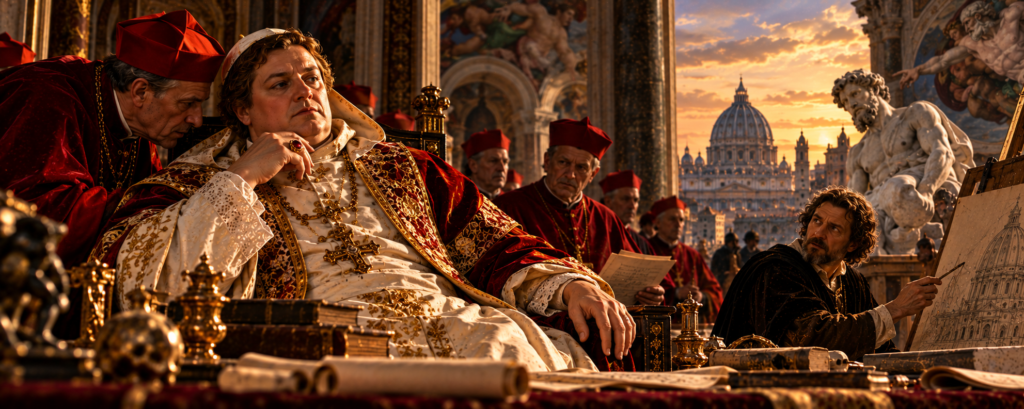
Leo X: The Medici Pope Whose Golden Age Ended in Rebellion
Leo X — 1513–1521
The Pope Who Celebrated While Christendom Began to Fracture
In the autumn of 1517, Rome was enjoying one of the most extravagant periods in its history. Artists decorated magnificent palaces, cardinals competed to display their wealth, and the papal court entertained itself with elaborate banquets, theatrical performances, music, and ceremonies. At the center of this glittering world sat Pope Leo X, a member of the powerful Medici family whose love of Renaissance culture was matched by his appetite for luxury and political influence. He had inherited the throne of Saint Peter from the formidable Julius II, but where his predecessor had become famous for wearing armor and leading military campaigns, Leo preferred the pleasures of a sophisticated court.
Hundreds of miles away, however, an obscure Augustinian friar was preparing to challenge a practice that helped finance the magnificent world Leo inhabited. Martin Luther was deeply troubled by the preaching of indulgences, particularly the campaign associated with the Dominican friar Johann Tetzel in German territories. Luther believed that the promises surrounding these indulgences encouraged Christians to misunderstand repentance, forgiveness, and the relationship between money and salvation. On October 31, 1517, he sent his famous Ninety-Five Theses to Archbishop Albert of Brandenburg, setting in motion a controversy that would eventually tear western Christianity apart.
The contrast was almost theatrical. In Rome, the pope presided over a court celebrated for its refinement, artistic achievement, and spectacular expenditure. In Germany, a university theologian was questioning whether the Church had allowed its financial interests to corrupt the spiritual lives of ordinary believers. Neither man could have fully anticipated the consequences of the confrontation that was beginning, but their disagreement would transform European history.
Leo X did not invent indulgences, nor did he single-handedly create the corruption, theological disagreements, or political resentments that made the Protestant Reformation possible. Many of those problems had developed over generations, and reformers had been criticizing ecclesiastical wealth and abuses long before his election. Nevertheless, Leo’s pontificate brought several dangerous forces together at precisely the wrong moment: an expensive papal government, a financially ambitious church hierarchy, growing resentment of Rome, and a new printing culture capable of spreading controversy with unprecedented speed.
The pope’s response to Luther would become one of the defining failures of his reign. He initially approached the dispute through established ecclesiastical procedures, but the controversy developed faster than the papal government could contain it. As Luther’s criticism expanded from indulgence preaching to fundamental questions about papal authority, Leo increasingly relied upon condemnation and the threat of excommunication. By the time the pope died in December 1521, the religious unity of western Europe had been shaken in ways that could no longer be reversed.
Yet the story of Leo X is considerably darker and more complicated than that of a pleasure-loving pope who failed to recognize a theological revolution. His pontificate involved dynastic ambition, political manipulation, an expensive war for the Duchy of Urbino, accusations of assassination within the College of Cardinals, executions, financial desperation, and the expansion of a papal bureaucracy that increasingly treated ecclesiastical offices as sources of revenue. He was a generous patron of artists and scholars, but he could also be ruthless when his family’s interests were threatened. His reign became a striking example of how Renaissance magnificence could conceal institutional weaknesses that were growing more dangerous with every passing year.
To understand how the Medici pope became entangled in one of Christianity’s greatest crises, it is necessary to return to Florence, where Giovanni de’ Medici was born into a family that had already learned how to turn money into political power.
Born Into the House of Medici
Giovanni de’ Medici was born in Florence on December 11, 1475, the second son of Lorenzo de’ Medici and Clarice Orsini. His father, remembered as Lorenzo the Magnificent, dominated Florentine politics while presiding over one of the most celebrated cultural environments of the Italian Renaissance. The Medici were bankers, patrons, political operators, and masters of a system in which formal republican institutions coexisted with the enormous influence of one family. Giovanni grew up surrounded by wealth, intellectual achievement, and the understanding that power was something to be cultivated through personal relationships as much as official titles.
The Florence of his childhood was dazzling, but it was also dangerous. Lorenzo’s position depended upon alliances, financial resources, public prestige, and the ability to survive conspiracies among rival families. In 1478, when Giovanni was still a small child, the Pazzi conspiracy erupted in violence during Mass inside Florence Cathedral. Lorenzo survived the attack, but his brother Giuliano was murdered, demonstrating that even the most powerful family in Florence could be threatened by enemies willing to shed blood in a sacred place.
The conspiracy had involved political interests connected to Pope Sixtus IV and his relatives, although the precise extent of the pope’s knowledge of the planned assassination remains disputed. Its aftermath brought Florence into a bitter confrontation with the papacy and its allies. Lorenzo emerged from the crisis with his authority strengthened, but the experience exposed the brutality beneath Renaissance political culture. Giovanni was raised in a household that understood both the magnificence and the dangers of power.
His education reflected the ambitions of his family. Lorenzo surrounded his children with distinguished scholars and humanists, ensuring that Giovanni received instruction in classical literature, philosophy, languages, and the intellectual traditions of the Renaissance. He was not raised in an isolated religious environment devoted exclusively to theology. His education prepared him to move confidently among princes, diplomats, poets, and churchmen.
The Medici intended Giovanni for an ecclesiastical career from an early age. Such a decision was hardly unusual among wealthy Italian families, which regarded high church office as a means of securing influence and prestige. A son placed within the Church could protect family interests, obtain valuable connections, and eventually become a powerful figure in his own right. For Giovanni, however, the scale of his advancement would be extraordinary.
A Cardinal Before He Was a Man
Giovanni’s ecclesiastical career began while he was still a child. Through Lorenzo’s influence and negotiations with Pope Innocent VIII, he was named a cardinal in 1489, although his public assumption of the dignity was delayed until 1492. He was only thirteen when the appointment was made. The elevation demonstrated the extraordinary influence of the Medici and the willingness of the Renaissance papacy to distribute prestigious offices through political patronage.
The appointment was not evidence that Giovanni had demonstrated exceptional spiritual leadership. He was a boy whose family possessed the wealth and influence necessary to secure one of the Church’s highest honors. The cardinalate brought prestige and opportunities that would normally have required decades of ecclesiastical service. It also placed him within a political institution whose governing elite frequently behaved like a collection of competing aristocratic dynasties.
Lorenzo’s ambitions for his son were substantial, but he did not live to see their ultimate fulfillment. He died in April 1492, leaving the Medici family facing an uncertain future. Giovanni formally entered the College of Cardinals shortly afterward, beginning a career that would eventually lead him to the papacy. His position was impressive, but the political foundations of his family’s power were already becoming unstable.
The death of Lorenzo removed the man whose diplomatic skill had helped maintain Florence’s political balance. Giovanni’s elder brother Piero inherited the family’s leading position but lacked his father’s ability to manage a dangerous political environment. Within a few years, foreign invasion and domestic opposition would destroy the Medici regime. Giovanni would discover that an illustrious name did not guarantee security.
His extraordinary promotion nevertheless shaped his understanding of the Church. From adolescence, he had experienced ecclesiastical office as an extension of dynastic influence and aristocratic privilege. He entered the hierarchy not through a long pastoral career but through family connections. That background would profoundly influence his conduct when he eventually became pope.
The Fall of the Medici and the Years of Exile
In 1494, King Charles VIII of France invaded Italy, triggering a series of wars that would transform the peninsula. Florence became caught in the crisis, and Piero de’ Medici’s handling of the French advance provoked widespread anger. His concessions to Charles were regarded as humiliating, and opposition to Medici rule intensified. The family was driven from Florence, ending the political dominance it had exercised under Lorenzo.
Giovanni was forced into exile along with other members of his family. The experience was a dramatic reversal for someone raised amid the privileges of Florence’s ruling household. He had been educated to expect influence and prestige, yet his family’s political position had collapsed. The years that followed taught him the importance of patience, diplomacy, and powerful allies.
Florence entered a period of republican government in which the Dominican preacher Girolamo Savonarola briefly exercised enormous moral and political influence. Savonarola condemned luxury, corruption, and the moral failings of Italian society, including abuses associated with the Church. His preaching represented a very different vision of Christian life from the cultured aristocratic environment Giovanni had known. The preacher’s eventual execution in 1498 demonstrated how violently religious reform and political conflict could become intertwined.
Giovanni spent much of his exile traveling and cultivating connections within the European political world. His position as a cardinal provided access to courts and ecclesiastical networks even while his family’s fortunes remained uncertain. He learned to navigate the rivalries among Italian rulers and foreign monarchs. These experiences strengthened the political instincts that would later characterize his pontificate.
The Medici remained determined to recover Florence. Their restoration depended upon the shifting alliances of the Italian Wars and the willingness of powerful rulers to support their return. Giovanni’s ecclesiastical influence became an increasingly valuable asset in that struggle. The Church would eventually provide the means by which the family regained its political position.
The Return to Florence
The opportunity for Medici restoration emerged during the pontificate of Julius II. The Warrior Pope was engaged in a bitter struggle against French influence in Italy and sought allies capable of strengthening his position. The political situation in Florence became entangled with the wider conflict. Giovanni de’ Medici benefited from the pope’s support and from the military pressure exerted by anti-French forces.
In 1512, the Medici were restored to power in Florence after the defeat of the Florentine republic’s military position. The restoration was accompanied by violence, including the sack of Prato by Spanish troops allied with the anti-French coalition. The suffering inflicted upon Prato became one of the darkest episodes associated with the family’s return. Giovanni did not personally direct every act committed during the campaign, but his political restoration was made possible by the military intervention that produced the catastrophe.
The return of the Medici revealed the dependence of Italian politics upon foreign armies. Florence had been unable to preserve its independence against the shifting military alliances of larger powers. The Medici regained their position not simply through popular support but through the pressure of armed intervention. Giovanni emerged from the crisis with his family’s fortunes restored.
His role within the Church also became more prominent. He was now a senior cardinal with extensive political experience, powerful family connections, and influence in Florence. The death of Julius II in February 1513 created an extraordinary opportunity. Giovanni was well positioned to become a leading candidate for the papacy.
The election that followed would transform the Medici family’s influence from a regional political force into something far greater. Giovanni was about to inherit an office that combined spiritual leadership with substantial territorial power. His family would gain access to the resources and prestige of the papal monarchy. The consequences would reach far beyond Florence.
The Election of Leo X
Giovanni de’ Medici was elected pope on March 11, 1513, at the age of thirty-seven. He chose the name Leo X and was crowned later that month. His election brought one of the most famous families of Renaissance Italy to the summit of the Catholic hierarchy. For the Medici, it represented an extraordinary triumph after years of exile and political uncertainty.
Leo inherited a papacy strengthened by the military campaigns of Julius II. The Papal States had recovered important territories, and Rome had become a center of artistic achievement. Yet the government also faced financial obligations, diplomatic dangers, and unresolved institutional problems. The new pope possessed a different temperament from his predecessor, but he inherited many of the same political challenges.
Contemporaries quickly recognized the contrast between the two men. Julius had been forceful, impatient, and closely associated with warfare. Leo was more inclined toward diplomacy, ceremony, scholarship, music, and the pleasures of court life. He was not incapable of political ruthlessness, but he preferred a style of government that emphasized negotiation and cultivated magnificence.
His accession inspired optimism among artists, scholars, and courtiers. Many expected the new pope to preside over a golden age of Renaissance culture. Leo had been educated among the finest humanists of Florence and possessed a genuine appreciation for literature and art. Rome appeared ready to become even more splendid.
The celebration, however, concealed a fundamental problem. The magnificence of the papal court depended upon enormous financial resources, and Leo was not inclined toward restraint. His family also possessed political ambitions that would draw the papacy into costly conflicts. The new pontificate began with promises of cultural glory, but its financial foundations were far less secure than the festivities suggested.
A Renaissance Court of Almost Unbelievable Luxury
Leo X transformed the papal court into a center of elaborate entertainment and artistic patronage. Banquets, musical performances, theatrical productions, hunting excursions, and ceremonial displays became prominent features of his reign. The pope enjoyed the company of scholars, poets, musicians, and witty courtiers. His household reflected the sophisticated culture of the Medici rather than the austere image traditionally associated with religious leadership.
His love of pleasure became one of the defining characteristics of his reputation. Contemporary accounts describe an atmosphere in which entertainment and display occupied an important place in court life. Some stories were embellished by later writers eager to portray the pope as a symbol of Renaissance decadence. Nevertheless, his extravagant spending and enthusiasm for secular culture are firmly established.
Leo’s interests were not confined to superficial amusement. He appreciated classical literature, supported humanist scholarship, and encouraged artistic production. His court attracted men whose work contributed to the intellectual life of Renaissance Europe. The problem was not that he valued culture, but that the scale of his patronage existed alongside increasingly severe financial pressures.
The papal household itself was expensive to maintain. Cardinals and courtiers expected honors, gifts, offices, and opportunities for advancement. Ceremonial magnificence reinforced the pope’s prestige, but it also encouraged competition in expenditure. A ruler who wished to appear generous could find himself surrounded by people whose loyalty depended upon continued rewards.
Leo’s generosity therefore possessed a dangerous political dimension. Giving money and favors helped secure influence, but it also created expectations that were difficult to satisfy. The papal court became a place where magnificence and dependency reinforced one another. Behind the splendid ceremonies, the government was increasingly searching for ways to obtain more money.
The Medici Pope and the Art of Magnificence
Leo inherited the artistic projects begun under Julius II, including the rebuilding of Saint Peter’s Basilica and the decoration of the Vatican apartments. He continued supporting Raphael, whose extraordinary talent had already transformed the visual culture of the papal court. The artist received important commissions and became increasingly involved in architectural and administrative responsibilities. Leo’s patronage helped sustain the remarkable artistic environment of early sixteenth-century Rome.
Raphael became particularly important after the death of Donato Bramante in 1514. He assumed a leading role in the architectural work associated with Saint Peter’s and continued developing major artistic projects. Leo also supported Raphael’s work on the celebrated tapestry designs for the Sistine Chapel. These designs depicted scenes from the lives of Saints Peter and Paul and were intended to complement the chapel’s existing decoration.
The tapestries were woven in Brussels, reflecting the international reach of Renaissance artistic production. Their creation required substantial financial investment and the coordination of skilled craftsmen across Europe. The resulting works were among the most magnificent textiles of their age. They also demonstrated the pope’s willingness to spend heavily on objects intended to glorify the Church.
Leo’s patronage extended beyond painting and architecture. He supported musicians, scholars, printers, and humanists, contributing to Rome’s reputation as a center of learning. His court celebrated classical antiquity while presenting the papacy as the natural heir to Rome’s imperial and Christian traditions. The combination was intellectually ambitious and politically useful.
Yet the artistic achievements created an uncomfortable contrast with the financial methods used to sustain the papal government. The rebuilding of Saint Peter’s required enormous resources, and the court’s wider expenditures added to the burden. Money flowed into artistic projects while officials searched for new revenues. The connection between magnificence and ecclesiastical fundraising would become one of the most consequential issues of Leo’s reign.
Saint Peter’s Basilica and the Cost of Immortality
The rebuilding of Saint Peter’s Basilica had begun under Julius II in 1506. The project was intended to replace the ancient church associated with Constantine and the burial place of Saint Peter. Its scale was unprecedented, and its completion would require generations of architects, artists, and craftsmen. Leo inherited both the ambition and the financial obligations of the undertaking.
The new basilica was more than a place of worship. It represented the universal claims of the papacy and the desire to create a monument worthy of Christian Rome. Its architecture drew upon classical traditions while expressing the grandeur of Renaissance religious culture. For Leo, continuing the project was both a spiritual responsibility and a demonstration of papal prestige.
The costs were immense. Construction required stone, skilled labor, transportation, architectural planning, and constant financial support. The papacy possessed substantial income, but its resources were already committed to government, diplomacy, warfare, and court expenditure. Saint Peter’s became one of several major demands upon an increasingly strained treasury.
Fundraising for the basilica was therefore a central concern. Julius II had authorized indulgences connected with the rebuilding, and Leo continued the practice. Such arrangements belonged to a long-established tradition in which the Church encouraged financial contributions toward religious projects. Yet the system became especially controversial when indulgence preaching was connected to complex financial agreements involving powerful churchmen and bankers.
The tragedy was that a project intended to glorify the Church became associated with one of the greatest crises in its history. The basilica itself was not the sole cause of the Reformation, and Luther’s objections ultimately extended far beyond construction fundraising. Nevertheless, the money needed for Saint Peter’s helped create the circumstances in which a local theological dispute became an international confrontation. The magnificent building rising in Rome became linked to resentment spreading through German territories.
The Papal Treasury Begins to Empty
Leo’s financial problems developed rapidly. He inherited resources accumulated under Julius II, but his spending soon placed severe pressure upon the papal treasury. Court expenses, political patronage, artistic projects, and military commitments consumed enormous sums. His generosity and reluctance to impose consistent restraint made the situation increasingly difficult.
The papacy possessed many traditional sources of revenue. These included income from the Papal States, ecclesiastical fees, taxes, benefices, and payments associated with appointments. Yet the government also faced growing demands from creditors and political allies. The result was a constant search for additional income.
One increasingly important method involved the creation and sale of offices. Buyers could obtain positions within the papal administration in exchange for substantial payments. Such arrangements were not invented by Leo, but their expansion under his government attracted criticism. Offices that carried administrative or financial responsibilities could become instruments for raising immediate revenue.
The practice created long-term problems. Selling offices brought money into the treasury quickly, but it also generated obligations and encouraged officeholders to recover their investments. Administrative positions became entangled with private financial interests. Critics regarded the system as evidence that the Church was increasingly treating government as a marketplace.
Leo also relied upon loans and other financial arrangements. Banking houses and wealthy individuals played important roles in supporting the papal government. The pope’s dependence upon credit reflected the broader financial sophistication of Renaissance Europe. It also exposed the vulnerability of a government whose ambitions exceeded its reliable income.
By the later years of his pontificate, financial strain had become a defining problem. The pope’s court remained magnificent, but the treasury was burdened by debt and continuing expenditure. His government increasingly resembled an aristocratic state struggling to finance ambitions larger than its resources. The crisis would become especially severe after the disastrous war for Urbino.
The Family Comes First
Leo’s devotion to the Medici family shaped much of his political conduct. He wanted to preserve their position in Florence and strengthen their influence across central Italy. His relatives occupied important positions within the Church and the political world. The papacy became a powerful instrument for advancing dynastic interests.
His cousin Giulio de’ Medici was particularly important. Giulio became a cardinal in 1513 and gradually emerged as one of Leo’s most trusted advisers. He possessed considerable administrative ability and played an increasingly prominent role in diplomacy and papal government. His influence demonstrated how closely the management of the Church could become connected to family loyalty.
Giulio would eventually become Pope Clement VII, extending Medici influence over the papacy beyond Leo’s lifetime. His later pontificate would face its own catastrophic challenges, including the Sack of Rome in 1527. Under Leo, however, Giulio was primarily an instrument of dynastic consolidation. His advancement strengthened the family’s control over ecclesiastical decision-making.
Leo also sought opportunities for his brother Giuliano and his nephew Lorenzo. Marriage alliances, territorial ambitions, and political appointments were all considered as means of strengthening the family. These plans brought the papacy into negotiations with foreign rulers and Italian princes. The interests of the Church and those of the Medici became increasingly difficult to distinguish.
The pope’s conduct was not unusual by Renaissance standards. Earlier pontiffs had advanced nephews, children, and relatives through ecclesiastical and secular offices. Yet Leo’s family ambitions were especially consequential because they helped produce expensive military adventures. The most damaging of these would center upon the Duchy of Urbino.
The War for Urbino: A Family Ambition Paid for by the Church
The Duchy of Urbino was ruled by Francesco Maria della Rovere, a nephew of Julius II. His family had benefited from the previous pope’s patronage, just as the Medici now benefited from Leo’s position. The duchy occupied a strategically important location in central Italy and possessed considerable political value. Leo increasingly regarded it as a potential possession for his own family.
The pope’s relationship with Francesco Maria deteriorated amid disputes over loyalty and military obligations. Leo eventually moved to deprive the duke of his territory. In 1516, papal forces invaded Urbino, and the duchy was granted to Lorenzo de’ Medici, the pope’s nephew. The campaign represented a clear example of papal military power being used to advance dynastic interests.
Francesco Maria did not accept his dispossession. He attempted to recover his territory, and the resulting conflict became expensive and prolonged. Military operations required large sums, while the instability threatened the surrounding region. Leo’s government was forced to devote resources to a struggle that offered limited benefit to the Church as an institution.
The war became one of the greatest financial disasters of the pontificate. Contemporary and later calculations placed its cost at an enormous level, with some estimates exceeding eight hundred thousand ducats. Exact accounting remains difficult, but there is little doubt that the campaign placed extraordinary pressure upon papal finances. It also intensified criticism of Leo’s willingness to sacrifice ecclesiastical resources for family advancement.
The human consequences were equally significant. Soldiers fought over cities and fortresses, local populations endured occupation and disruption, and political uncertainty spread through central Italy. The conflict was not a theological struggle or a campaign against an external enemy of Christianity. It was a dynastic war conducted through the machinery of the papal state.
Leo ultimately secured Urbino for Lorenzo, but the victory was temporary. Lorenzo died in 1519, and the Medici hold over the duchy did not endure. Francesco Maria would eventually recover his position after Leo’s death. The campaign left behind debt, resentment, and a powerful example of the dangers of papal nepotism.
A Pope Surrounded by Enemies
The war for Urbino intensified opposition to Leo within the Italian political world. Powerful families resented the expansion of Medici influence, while some cardinals feared that the pope’s relatives were monopolizing offices and opportunities. The political atmosphere became increasingly tense. Leo’s pleasant public image concealed a government surrounded by rivalries.
Siena was another source of conflict. The Petrucci family had dominated the city, but its internal divisions created opportunities for Medici intervention. Leo supported political changes that weakened one branch of the family and strengthened another more favorable to his interests. The resulting disputes drew him into a dangerous confrontation with Cardinal Alfonso Petrucci.
Alfonso had initially supported Leo’s election and expected political rewards. He became increasingly resentful when papal policies undermined his family’s position in Siena. His hostility developed amid wider opposition to Medici influence within the College of Cardinals. The pope began to suspect that some of his own senior churchmen were conspiring against him.
The situation was particularly dangerous because cardinals possessed substantial political resources. They maintained households, cultivated foreign alliances, and exercised influence over important territories. A dissatisfied cardinal could become a focal point for opposition to the pope. Leo’s government therefore treated signs of conspiracy with increasing seriousness.
In 1517, the conflict erupted into one of the darkest scandals of his pontificate. Allegations emerged that Alfonso Petrucci and other cardinals had plotted to murder the pope. The investigation would involve arrests, interrogations, torture, executions, and enormous financial penalties. It would also raise questions about whether Leo used a genuine threat to eliminate political enemies.
The Cardinal Who Allegedly Planned to Poison the Pope
The alleged conspiracy against Leo X centered upon Cardinal Alfonso Petrucci and his associates. Investigators claimed that the cardinal had considered arranging the pope’s death through a physician who might gain access to him. The proposed method reportedly involved poison administered during medical treatment. Such an accusation was particularly alarming because Leo suffered from health problems that required medical attention.
The investigation implicated Battista da Vercelli, a physician associated with the alleged plan. It also involved members of Petrucci’s household and several other cardinals. Statements obtained during interrogations were used to construct the case against the accused. Some of the evidence, however, emerged under torture, making its reliability difficult to assess.
Modern historians have treated the conspiracy with considerable caution. Political hostility toward Leo was real, and some opponents may have discussed or contemplated his removal. Yet the precise nature of the alleged assassination plot remains disputed. The possibility that investigators exaggerated the conspiracy to justify a broader political purge cannot be dismissed.
The pope’s response was severe. Petrucci was arrested after negotiations that had offered him assurances concerning his safety. The proceedings culminated in his condemnation and death in prison in July 1517. The circumstances of his execution and the broader handling of the case became subjects of controversy.
Other accused cardinals escaped execution but faced enormous financial penalties and the loss of influence. Cardinal Raffaele Riario, a wealthy and prominent member of the College, was among those punished. His property and position became entangled with the political consequences of the investigation. The affair strengthened the influence of the Medici faction within the papal government.
The scandal demonstrated that Leo’s court was not merely a world of music and entertainment. Beneath its polished surface lay the same ruthless political culture that had shaped the careers of earlier Renaissance popes. The man celebrated for his generosity could preside over severe punishment when his authority was threatened. His response to the alleged conspiracy revealed a harder side of his character.
Torture, Confessions, and the Politics of Fear
The use of torture during the investigation raises particularly troubling questions. Statements obtained under physical coercion cannot be treated as reliable evidence without independent corroboration. People subjected to torture may confess to crimes they did not commit or implicate others in the hope of ending their suffering. The procedures used in the Petrucci affair therefore complicate any confident reconstruction of the alleged plot.
The investigation also served an obvious political purpose. Leo’s opponents within the College of Cardinals were weakened, while his trusted relatives and allies gained influence. The affair created an atmosphere in which resistance to the pope could be associated with treason. Even cardinals who had not participated in any conspiracy had reason to fear the consequences of political opposition.
Financial penalties imposed upon accused churchmen also benefited the papal government. The amounts involved were substantial, and confiscated property could be redirected toward the pope’s supporters. It would be too simplistic to claim that Leo invented the entire conspiracy solely to raise money. Nevertheless, the financial consequences of the investigation were significant.
The case illustrates how judicial proceedings could become instruments of political consolidation. The pope possessed spiritual authority, territorial sovereignty, and influence over the institutions responsible for investigating crimes. Those powers could reinforce one another when a political enemy was accused. The boundary between justice and the preservation of power became dangerously uncertain.
Leo emerged from the affair with his position strengthened, but the methods damaged his reputation. A pope who had been celebrated as a cultured patron of learning had demonstrated a willingness to use coercion against members of his own governing elite. The episode belongs among the most serious controversies of his reign. It also foreshadowed the increasingly authoritarian measures he would employ against religious opposition.
Thirty-One New Cardinals
In July 1517, Leo X created thirty-one new cardinals in a single consistory. The appointment was extraordinary in scale and dramatically altered the composition of the College of Cardinals. It followed the conspiracy crisis and helped strengthen the pope’s political position. Many of the new cardinals were connected to his supporters or represented interests he wished to cultivate.
The creation also had financial implications. Some appointments involved payments or arrangements that brought substantial resources into the papal treasury. The sale or financial negotiation of ecclesiastical dignities was a controversial feature of Renaissance church government. Critics regarded such practices as evidence that sacred offices were being treated as commodities.
Not every new cardinal was unworthy of office. The group included capable and distinguished churchmen whose careers cannot be reduced to financial transactions. Nevertheless, the scale of the appointments and their political context made the event deeply significant. Leo had effectively reshaped the institution responsible for electing future popes.
The consistory also demonstrated how the papacy could respond to internal opposition by changing the balance of power within its own governing elite. The College of Cardinals was not simply a spiritual advisory body. It was a political institution whose members represented families, territories, and foreign interests. Increasing the number of loyal cardinals strengthened the pope’s ability to govern.
The episode reveals the connection between political security and financial necessity. Leo needed dependable supporters, but he also needed money. The creation of offices and dignities could address both problems simultaneously. Such methods offered immediate advantages while deepening the impression that the Church’s government was becoming increasingly commercialized.
The Indulgence Campaign That Changed History
The indulgence controversy associated with Leo X developed from a complicated financial arrangement involving Archbishop Albert of Brandenburg. Albert already held important ecclesiastical positions when he sought the archbishopric of Mainz. The accumulation of major church offices required papal dispensations and substantial payments. Albert needed access to large sums of money to secure the arrangements.
The banking house of Fugger became involved in financing the payments. A plan was developed through which indulgence preaching in designated territories would generate revenue. Part of the proceeds would support the rebuilding of Saint Peter’s Basilica, while another portion would help repay Albert’s financial obligations. Leo approved the arrangement, which linked ecclesiastical privilege, banking credit, and religious fundraising.
The system was sophisticated but spiritually dangerous. Ordinary Christians encountered indulgence preaching as a religious appeal connected to sin, repentance, and the consequences of wrongdoing. Behind the campaign stood financial agreements involving a powerful archbishop, bankers, and the papal treasury. The gap between the spiritual message and the financial machinery created fertile ground for criticism.
Indulgences themselves were not simply documents that purchased forgiveness for sins. In Catholic theology, an indulgence concerned the remission of temporal punishment associated with sins whose guilt had already been forgiven. The doctrine presupposed repentance and the Church’s authority to administer spiritual benefits. Yet preaching practices could encourage misunderstandings, particularly when financial contributions were emphasized.
The problem was intensified by the difficulty ordinary believers faced in distinguishing complex theology from simplified promises. A preacher seeking donations might emphasize the benefits of an indulgence more dramatically than its theological qualifications. Listeners could come away believing that money offered a direct means of securing spiritual relief. Such impressions were precisely what Luther found intolerable.
Leo did not personally travel through Germany preaching indulgences. He authorized and supported the arrangements that made the campaign possible. Albert and his agents played important roles in its administration, while Johann Tetzel became its most famous public representative. Responsibility was therefore distributed among several figures, but the pope remained central because the campaign operated under papal authority.
Johann Tetzel and the Marketplace of Salvation
Johann Tetzel was a Dominican friar experienced in preaching indulgences. By 1517, he had already participated in similar campaigns and understood how to present religious appeals to large audiences. His preaching became closely associated with the indulgence authorized in connection with Albert of Brandenburg and Saint Peter’s Basilica. The campaign brought him into territories near Wittenberg, where Martin Luther was teaching theology.
Tetzel became famous for a saying about money entering a collection chest and a soul leaving purgatory. Versions of the rhyme circulated widely, but historians must be cautious about treating every later quotation as a precise record of his words. The slogan became a powerful symbol of the controversy because it suggested a direct exchange between payment and spiritual benefit. Whether every preacher used such language or not, the perception of commercialization was real.
The indulgence campaign was not permitted in every German territory. Frederick the Wise, Elector of Saxony, did not authorize Tetzel’s preaching within his lands, partly because of his own interests and established religious practices. Nevertheless, people could travel to neighboring territories where the indulgence was available. Reports of the campaign reached Wittenberg and contributed to Luther’s growing concern.
Luther was particularly troubled by the possibility that believers were being encouraged to trust in indulgence documents rather than genuine repentance. He feared that exaggerated promises undermined pastoral responsibility and created false spiritual security. His objections were initially directed toward the theology and preaching of indulgences, not toward a fully developed rejection of the Catholic Church. The controversy would become much broader only as the dispute escalated.
Tetzel later became one of the most notorious figures in Protestant accounts of the Reformation. His name was often used to represent the abuses Luther opposed. Yet reducing the entire controversy to one preacher obscures the financial and institutional arrangements behind the campaign. Tetzel was an important participant, but he did not create the system that placed him before the public.
The deeper problem was that religious authority had become entangled with financial necessity. The pope needed money for Saint Peter’s and other commitments, Albert needed to repay debts, and indulgence preaching offered a means of obtaining funds. The arrangement was legal within the ecclesiastical system that approved it. Its moral and theological implications, however, were becoming increasingly difficult to defend.
Martin Luther Enters the Story
Martin Luther was born in 1483 and entered the Augustinian religious order after a period of intense personal religious concern. He became a priest, scholar, and professor of biblical theology at the University of Wittenberg. His intellectual development was shaped by questions about sin, grace, repentance, and the relationship between humanity and God. By 1517, he had become increasingly dissatisfied with the way indulgences were being presented.
On October 31, 1517, Luther sent his Ninety-Five Theses to Archbishop Albert of Brandenburg. The theses challenged aspects of indulgence preaching and raised questions about the authority and proper use of indulgences. The familiar story of Luther dramatically nailing the document to the church door at Wittenberg has become an enduring symbol of the Reformation. Whether the posting occurred exactly as later tradition describes remains debated, but the circulation of the theses is beyond doubt.
The document was written in Latin and initially belonged to the world of academic theological debate. Luther was inviting discussion of issues he believed required clarification and reform. He did not begin with a comprehensive program for creating a separate church. His immediate concern was the spiritual harm he believed indulgence preaching could cause.
The response was far greater than he expected. Copies of the theses circulated rapidly, aided by the printing press and growing public resentment of ecclesiastical abuses. The controversy spread beyond university theologians into wider political and religious society. What began as a dispute over indulgences became a public challenge to the authority of Rome.
Leo’s government initially approached Luther through familiar mechanisms of ecclesiastical discipline. The papacy had confronted controversial theologians before, and officials possessed procedures for investigating suspected errors. Yet the new controversy was spreading through a communications environment that made traditional containment increasingly difficult. Printed arguments could reach audiences far beyond the jurisdiction of any single bishop.
The pope had inherited a Church accustomed to resolving disputes through hierarchy and authority. Luther’s supporters increasingly questioned whether that authority could be trusted. The confrontation was therefore becoming more than a disagreement about indulgences. It was developing into a struggle over who possessed the right to define Christian truth.
Why Leo Underestimated the Crisis
Leo X has often been portrayed as a pope too distracted by pleasure to recognize the importance of Luther’s challenge. The image contains an element of truth because the papal court was heavily occupied with political and financial concerns. Yet it is misleading to suggest that Leo simply ignored the controversy for years. His government investigated Luther, employed theologians, and attempted to secure his submission.
The difficulty was that Rome initially understood the dispute within an established framework. A university theologian had advanced controversial propositions, and church authorities expected that he could be corrected through examination, pressure, or condemnation. Similar disputes had occurred before without producing a permanent division of western Christianity. Leo had little reason in 1517 to anticipate the full scale of the coming Reformation.
Political circumstances also complicated the response. Luther lived within the Holy Roman Empire, where territorial rulers possessed substantial authority. Frederick the Wise protected the interests of his university and resisted attempts to remove Luther without appropriate procedures. The papacy therefore had to consider the political consequences of its actions.
The imperial election of 1519 added further complications. European monarchs competed for influence, and the pope sought to preserve the political independence of the Church. Religious discipline could not be separated entirely from diplomacy. Leo’s government had to consider how its treatment of Luther might affect relationships with powerful German princes.
The controversy also developed intellectually. Luther’s arguments moved beyond the original question of indulgences toward the authority of Scripture, the nature of the Church, and the role of the pope. Each new dispute made compromise more difficult. By the time Rome fully recognized the challenge, it had become embedded in a much wider movement.
Leo’s failure was therefore not simply ignorance. It involved institutional rigidity, political distraction, and an inability to appreciate how rapidly the controversy was changing. The papacy continued relying upon methods that had previously contained theological dissent. Those methods proved inadequate against a movement supported by print, scholarship, and territorial politics.
The Meeting at Augsburg
In October 1518, Luther appeared before Cardinal Thomas Cajetan at Augsburg. Cajetan was a distinguished theologian and papal representative who had been instructed to address the controversy. The meeting offered an opportunity for clarification but quickly exposed the depth of disagreement. Luther was unwilling to retract positions he believed were supported by Scripture.
Cajetan insisted upon the authority of the Church and the need for Luther to submit. Luther sought theological justification for the demands being made of him. Their exchanges demonstrated that the controversy was no longer limited to questionable preaching practices. It concerned the foundations of ecclesiastical authority.
The meeting ended without reconciliation. Luther departed Augsburg and continued defending his position. His supporters increasingly portrayed him as a courageous theologian resisting an unjust ecclesiastical system. His opponents regarded him as a dangerous figure whose refusal to submit threatened Christian unity.
Leo’s government remained determined to secure obedience, but political circumstances limited its immediate options. Frederick the Wise continued protecting Luther from straightforward removal to Rome. The controversy remained unresolved while public interest continued growing. Every delay gave Luther further opportunities to explain and expand his arguments.
The failure at Augsburg was an important turning point. It demonstrated that the dispute could not be settled through a simple demand for retraction. Luther had begun questioning the authority upon which that demand depended. The conflict was moving toward a confrontation that neither side could easily escape.
Leipzig and the Question of Papal Authority
The Leipzig Debate of 1519 further transformed the controversy. Luther engaged in public theological disputation with Johann Eck, a formidable defender of established Catholic positions. Their arguments moved beyond indulgences to questions about councils, papal authority, and the historical foundations of church government. The debate exposed the increasingly radical implications of Luther’s position.
Eck pressed Luther on his relationship to earlier condemned teachings, particularly those associated with Jan Hus. Luther acknowledged that some propositions condemned in the past might have been consistent with Christian truth. This was an extraordinary admission within the ecclesiastical framework of the period. It suggested that church councils could err.
The implications were enormous. If councils and popes could be mistaken, then their authority could no longer function as the final answer to theological disagreement. Luther increasingly emphasized Scripture as the decisive standard. The dispute was becoming a challenge to the structure of western ecclesiastical authority.
Leo’s government now faced a theologian whose position could not be contained by correcting abuses in indulgence preaching. Luther was questioning the legitimacy of the system that had authorized the indulgences. The controversy had moved from financial scandal into fundamental ecclesiology. A compromise that might have been possible in 1517 was becoming increasingly unlikely.
The debate also strengthened Luther’s public reputation. His arguments circulated widely, and supporters interpreted his resistance as evidence of courage. Opponents saw a dangerous assault upon Christian unity. The conflict became a defining issue in the religious and political life of the Holy Roman Empire.
The Bull That Threatened Luther With Excommunication
On June 15, 1520, Leo X issued the bull Exsurge Domine, condemning forty-one propositions associated with Luther’s teachings. The document demanded that Luther retract the condemned positions within a specified period. It also ordered action against writings judged dangerous. The papacy had moved decisively from investigation toward formal condemnation.
The bull represented the culmination of several years of unsuccessful attempts to resolve the controversy. Leo and his advisers regarded Luther’s continued resistance as a threat to the Church’s doctrinal authority. The document was intended to establish clear boundaries and compel submission. Instead, it intensified the confrontation.
Luther refused to retract. In December 1520, he publicly burned a copy of the papal bull along with other ecclesiastical legal texts. The act was a dramatic rejection of papal authority. It demonstrated that the dispute had reached a point where reconciliation was becoming extraordinarily difficult.
The burning of the bull also possessed enormous symbolic power. A university theologian was openly rejecting the authority of the pope before an audience of supporters. The gesture transformed theological disagreement into public defiance. It made Luther’s separation from Rome increasingly visible.
Leo’s government responded through the established machinery of ecclesiastical discipline. The pope could condemn teachings and impose spiritual penalties, but he could not simply erase the movement that had formed around Luther. The printing press continued spreading arguments, and political authorities remained divided. The papacy’s formal power was substantial, but its practical control was limited.
The Excommunication of Martin Luther
On January 3, 1521, Leo X issued Decet Romanum Pontificem, formally excommunicating Martin Luther. The decision marked a decisive break between the reformer and the papal government. Luther was now officially excluded from communion with the Church under the terms of the papal sentence. The conflict had moved beyond academic dispute into institutional separation.
The excommunication did not end the controversy. Luther’s supporters continued defending him, and the movement expanded through German territories. His writings attracted readers who shared his theological concerns or resented Roman influence. Political rulers increasingly recognized that the dispute had implications for their own authority.
The Diet of Worms later in 1521 brought Luther before Emperor Charles V and representatives of the imperial estates. Luther refused to retract his writings unless convinced by Scripture and reasoned argument. The proceedings made him one of the most famous religious figures in Europe. The imperial condemnation that followed did not eliminate his influence.
Leo had hoped that ecclesiastical discipline would preserve unity. Instead, the controversy continued developing beyond the reach of papal authority. The Church possessed centuries of institutional experience, but it faced a movement that combined theological conviction with new forms of communication and political support. The old methods of suppression were no longer sufficient.
The pope did not live to witness the full consequences of the Reformation. He died before Protestant churches had developed into the major institutions they would later become. Nevertheless, his pontificate became inseparable from the beginning of the rupture. His decisions helped determine the form that the confrontation would take.
The Fifth Lateran Council and the Reform That Was Not Enough
Leo X inherited the Fifth Lateran Council from Julius II. The council had opened in 1512 partly in response to a rival assembly supported by opponents of the previous pope. Under Leo, it continued addressing questions of ecclesiastical authority, discipline, and reform. Its proceedings demonstrated that concerns about the Church’s condition existed before Luther’s challenge.
The council issued decrees concerning preaching, education, religious orders, and other institutional matters. It also addressed the regulation of printing, reflecting growing awareness of the power of published material. Some measures sought to correct abuses and strengthen ecclesiastical discipline. Yet the council did not produce a comprehensive transformation of the Church’s financial and administrative culture.
The assembly concluded in March 1517, only months before Luther’s Ninety-Five Theses circulated. The timing became one of the great ironies of religious history. A council intended partly to address reform had ended just as a far more disruptive reform movement was beginning. The institutional measures adopted in Rome proved insufficient to prevent the coming crisis.
Leo’s government had opportunities to address financial abuses and the resentment they generated. Yet the papacy remained deeply dependent upon revenue from ecclesiastical offices, fees, and other established practices. Reform threatened interests that supported the government itself. The difficulty of changing those structures was enormous.
The council therefore illustrates the limits of reform within a system unwilling or unable to transform its financial foundations. Leo was not indifferent to every question of ecclesiastical discipline. He supported certain reforms and administrative measures. Nevertheless, the most explosive problems remained unresolved when the council closed.
A Church That Had Forgotten How Angry People Were
Resentment toward Rome had been developing across Europe long before Leo became pope. Critics complained about ecclesiastical taxation, the accumulation of benefices, absentee clergy, and the influence of wealthy churchmen. German territories were particularly sensitive to the flow of money toward the papal court. These grievances created an environment in which Luther’s criticism could attract widespread attention.
The papacy’s financial system depended upon relationships that many ordinary believers did not understand. Payments associated with offices, dispensations, and ecclesiastical privileges could appear remote from the spiritual responsibilities of the Church. Wealthy families possessed opportunities unavailable to most Christians. The contrast between religious ideals and institutional practice was increasingly visible.
Humanist scholars had also criticized abuses within the Church. Erasmus of Rotterdam, among others, called attention to the need for moral and spiritual renewal. Such criticism did not necessarily imply rejection of Catholic doctrine or papal authority. It reflected a broader desire for a Christianity less burdened by corruption and empty ceremony.
Leo’s court represented many of the features critics found troubling. Its magnificence was celebrated by artists and scholars, but its expense required constant financial support. Its offices were connected to political patronage, and its leading figures often came from powerful families. The papacy appeared to some observers as an aristocratic government rather than a model of spiritual simplicity.
The Reformation succeeded in part because Luther’s arguments entered this existing atmosphere of dissatisfaction. His theology offered answers to questions that extended beyond the immediate indulgence controversy. Political rulers found opportunities to challenge Roman influence, while ordinary believers encountered new interpretations of Christian teaching. Leo’s government struggled to respond to the combined force of these developments.
The Printing Press and the Collapse of Control
The printing press transformed the controversy surrounding Luther. Earlier reform movements had depended heavily upon handwritten texts, preaching, and personal networks. By the early sixteenth century, printed pamphlets could circulate rapidly across political boundaries. Luther’s arguments reached audiences far beyond Wittenberg.
The papacy understood the importance of printing but struggled to control its effects. Ecclesiastical authorities attempted to regulate publications and suppress writings judged dangerous. Yet the decentralized nature of printing made enforcement difficult. Printers could operate in territories where local rulers were unwilling to cooperate with Rome.
Luther proved especially effective at communicating with a broad audience. His writings increasingly appeared in German as well as Latin, allowing readers outside universities to engage with his arguments. The controversy became part of popular religious culture. Images, pamphlets, and sermons helped transform theological disagreement into a public movement.
Leo’s government was accustomed to exercising authority through established institutions. Bishops, universities, courts, and councils formed part of the traditional system of religious control. The printing press created a different environment in which arguments could spread before officials had time to respond. Condemnation sometimes increased interest rather than suppressing it.
The result was a crisis of communication as well as theology. The pope could issue decrees, but he could not guarantee that they would persuade readers. Luther could challenge Rome before an audience that was increasingly capable of comparing competing claims. The Reformation unfolded within this transformed public sphere.
The Politics of France, Spain, and the Empire
Leo’s pontificate was dominated by the continuing Italian Wars. France, Spain, and the Holy Roman Empire competed for influence over the peninsula, while Italian states attempted to preserve their independence. The papacy possessed substantial territories but lacked the military strength to dominate the larger powers. Leo therefore relied heavily upon diplomacy and shifting alliances.
In 1515, King Francis I of France invaded northern Italy and achieved a major victory at the Battle of Marignano. The outcome strengthened French influence and forced Leo to reconsider his position. The pope met Francis at Bologna later that year, beginning a period of negotiation. Their relationship produced important agreements concerning ecclesiastical affairs.
The Concordat of Bologna, concluded in 1516, reshaped relations between the French monarchy and the papacy. It gave the king substantial influence over appointments to major ecclesiastical offices in France while preserving important papal rights. The agreement reflected the political realities of the age. Church government was deeply entangled with royal authority.
Leo also had to consider the growing power of Charles of Habsburg, who became emperor as Charles V in 1519. The rivalry between Francis and Charles would dominate European politics for decades. The pope attempted to preserve room for maneuver between the competing monarchs. His choices were influenced by the security of the Papal States and the interests of the Medici.
These political concerns complicated his response to Luther. The Holy Roman Empire was not a unified state that could simply enforce papal demands without negotiation. Its princes possessed significant authority, and the emperor had to balance religious questions against political realities. Leo’s ability to suppress the reformer depended partly upon rulers whose priorities did not always match his own.
The pope’s diplomacy therefore unfolded within a world of competing dangers. He feared foreign domination of Italy, sought protection for his family’s territories, and faced a religious controversy spreading through the empire. Each problem demanded resources and attention. The combined pressure exposed the limitations of his government.
The Final Political Gamble
In the final years of his pontificate, Leo increasingly aligned himself with Charles V against France. The decision reflected the shifting balance of power in Italy and the pope’s desire to protect papal interests. Military operations in 1521 produced important successes for the anti-French coalition. Leo appeared to be approaching another political triumph.
The recovery of Milan from French control was especially significant. The city was one of the principal prizes of the Italian Wars, and its possession affected the balance of power across northern Italy. Leo’s alliance with imperial forces helped weaken French influence. The result offered a measure of satisfaction after years of difficult diplomacy.
Yet the campaign also continued the pattern of expensive political involvement. The papacy remained committed to military objectives while its finances were under severe strain. Leo’s government had not escaped the problems created by the war for Urbino. It was still relying upon complex financial arrangements and political alliances.
The pope’s health was also becoming increasingly uncertain. He had suffered from medical problems for years, and the demands of government added to the strain. His physical condition became a matter of concern among courtiers and diplomats. The possibility of his death raised questions about the future of Medici influence.
Leo would not live to enjoy his final political successes for long. His death came suddenly in December 1521. The circumstances immediately encouraged rumors, but the surviving evidence does not justify treating sensational allegations as established fact. His pontificate ended amid the same atmosphere of political uncertainty that had characterized much of his reign.
The Sudden Death of Leo X
Leo X died on December 1, 1521, at the age of forty-five. His death followed a short illness and surprised many contemporaries. Because he had recently celebrated political successes, the timing encouraged speculation. Rumors circulated that he might have been poisoned.
Such allegations were common when powerful Renaissance figures died unexpectedly. Political enemies, disappointed courtiers, and rival factions often suspected deliberate murder. The possibility of poisoning could become an explanation for almost any sudden death. In Leo’s case, however, the available evidence does not establish that he was assassinated.
His death created an immediate political crisis. The Medici had enjoyed extraordinary influence during his pontificate, but the papal throne was once again vacant. Cardinals began calculating the consequences of the succession. Foreign monarchs also had interests in the outcome.
The financial condition of the papacy was particularly troubling. Leo had spent enormous sums during his reign and left substantial debts. Contemporary estimates varied, but the scale of the financial burden was widely recognized. The magnificent court had consumed resources that his successor would struggle to replace.
Leo was buried in Rome, and his reputation quickly became the subject of competing interpretations. Admirers remembered his generosity, artistic patronage, and cultured government. Critics emphasized extravagance, nepotism, financial abuse, and his handling of Luther. The contrast reflected the contradictions that had defined his pontificate.
The Pope Who Left His Successor a Financial Nightmare
The election of Adrian VI in January 1522 brought a striking contrast to the Medici pontificate. Adrian was a Dutch-born theologian and former tutor to Charles V, known for a more austere temperament. He inherited a papal government burdened by debt and institutional problems. The transition exposed the scale of Leo’s financial legacy.
Adrian attempted to address abuses and restore greater discipline to the Church. His efforts encountered resistance from a court accustomed to Renaissance magnificence and patronage. Many officials had benefited from the financial and political practices that Leo had encouraged. Reform threatened established interests.
The new pope also faced the continuing spread of Lutheran ideas. Excommunication had not eliminated the movement, and religious controversy was becoming increasingly difficult to contain. Adrian recognized the seriousness of the crisis and acknowledged the existence of abuses within the Church. Yet his pontificate was brief, and his reforming ambitions achieved limited results.
The contrast between Leo and Adrian became a powerful symbol in later historical writing. Leo represented the splendor and extravagance of Renaissance Rome, while Adrian appeared as a serious reformer confronting the consequences. The comparison can be exaggerated, because both men operated within complex political circumstances. Nevertheless, it reveals how dramatically the papacy’s priorities appeared to change after Leo’s death.
The financial difficulties inherited by Adrian were not solely the result of personal luxury. Warfare, diplomacy, administration, and major building projects all contributed to the burden. Yet Leo’s spending habits and dynastic ambitions made the problem considerably worse. His government had repeatedly chosen immediate magnificence and political advantage over long-term financial stability.
The Legend of Leo X
Leo X became the subject of numerous stories intended to illustrate his supposed irreligion or love of pleasure. One of the most notorious is the claim that he privately described Christianity as a profitable fable. The remark has often been repeated in polemical literature as evidence that the pope did not believe in the religion he governed. Its authenticity, however, is not established by reliable contemporary evidence.
The saying became associated with anti-papal writing after Leo’s lifetime. It reflects the hostility of critics who regarded Renaissance popes as cynical rulers exploiting religious belief. Such accusations were politically and religiously useful, especially during the conflicts of the Reformation. They cannot simply be accepted as genuine quotations.
Leo’s documented behavior provides a more complicated picture. He participated in religious ceremonies, supported ecclesiastical institutions, and took action against teachings he regarded as dangerous. His cultural interests and luxurious lifestyle do not prove that he lacked religious belief. Renaissance churchmen could combine genuine faith with conduct that later observers considered morally contradictory.
Other anecdotes about his extravagance also require caution. Contemporary observers certainly described costly entertainments and generous patronage, but later writers sometimes exaggerated the details. The pope’s reputation became a convenient symbol of everything critics disliked about the Renaissance Church. His historical character was more complex than the caricature.
The distinction matters because Leo’s real failures were substantial enough without invented quotations. His financial policies, dynastic warfare, and handling of the Reformation are well documented. They provide serious grounds for criticism. Unsupported stories merely obscure the more revealing historical record.
Was Leo X Personally Corrupt?
Leo’s reputation for corruption rests primarily upon financial and political conduct rather than proven personal depravity. He spent heavily, advanced relatives, supported the sale of offices, and allowed the papal government to become deeply entangled with aristocratic interests. These practices were not unique to his pontificate. Nevertheless, their scale and consequences were significant.
His generosity toward artists and scholars was genuine. He contributed to some of the greatest cultural achievements of the Renaissance and helped make Rome a center of intellectual life. Such patronage was not inherently corrupt. The moral difficulty arose when the pursuit of magnificence depended upon financial practices that damaged the Church’s credibility.
His involvement in the war for Urbino presents a particularly serious problem. The campaign was designed largely to advance Medici interests and consumed enormous resources. It brought violence and instability to central Italy. The benefits to the Church as a spiritual institution were difficult to justify.
The Petrucci conspiracy affair raises different concerns. The existence of political hostility toward Leo is beyond doubt, but the precise extent of the alleged assassination plot remains disputed. The use of torture and severe punishment complicates the official account. The affair strengthened Medici control while damaging the appearance of justice.
His response to Luther must also be judged within its historical circumstances. Leo was not uniquely responsible for the abuses that Luther criticized, and the theological dispute developed in ways no pope could have easily predicted. Yet his government failed to recognize the depth of the crisis early enough to respond effectively. Its reliance upon condemnation helped turn a reform controversy into a permanent institutional rupture.
Leo was therefore neither an innocent patron unfairly blamed for the Reformation nor a simple villain who deliberately destroyed Christian unity. He was a Renaissance ruler whose priorities reflected the political culture of his age. His failures became catastrophic because they occurred at a moment when that culture was being challenged by forces it could no longer control.
The Medici Dynasty After Leo
Leo’s death did not end Medici influence within the Church. His cousin Giulio de’ Medici remained one of the most powerful figures in the College of Cardinals. After the brief pontificate of Adrian VI, Giulio was elected pope in 1523 and took the name Clement VII. The family therefore regained the papal throne within two years.
Clement inherited many of the political problems that had troubled Leo. The rivalry between France and the Habsburg monarchy continued, while the Reformation spread through northern Europe. The papacy remained financially vulnerable and diplomatically exposed. The consequences would become devastating during the Sack of Rome in 1527.
The Medici also continued seeking to secure their position in Florence. Family members occupied important offices, and dynastic alliances remained central to their political strategy. The papacy provided opportunities for influence that extended beyond religious government. Leo’s pontificate had strengthened the family’s connection to the highest levels of European politics.
Yet the family’s success also demonstrated the limitations of Renaissance papal power. The Medici could obtain offices, command armies, and commission magnificent art, but they could not control the religious transformation unfolding across Europe. The Reformation developed through forces that exceeded the ambitions of any single dynasty. The political methods that had secured their rise proved inadequate to preserve religious unity.
Leo’s legacy therefore extended in two directions. He helped consolidate Medici influence and contributed to the artistic magnificence of Rome. At the same time, his reign became associated with the beginning of a crisis that would permanently alter the western Church. His successors inherited both achievements and consequences.
The Reformation Was Bigger Than Leo X
It is tempting to imagine that the Protestant Reformation could have been prevented if Leo had spent less money or responded differently to Luther. The idea offers a simple explanation for an enormously complicated historical transformation. Yet the conditions that made the Reformation possible had developed over centuries. Ecclesiastical abuses, theological disagreements, political resentments, and demands for reform were deeply rooted.
Earlier reformers had challenged aspects of church government and doctrine. John Wycliffe and Jan Hus had raised questions that continued influencing later religious debates. Humanist scholars criticized clerical ignorance and moral corruption. European rulers increasingly resisted interference from Rome.
The printing press accelerated the spread of new ideas, while universities provided environments for theological debate. Political fragmentation within the Holy Roman Empire made centralized enforcement difficult. Luther’s personal intellectual development also played an essential role. His theology cannot be reduced to anger over a fundraising campaign.
Leo nevertheless occupied a uniquely important position. He was pope when the controversy began, and his government authorized the indulgence arrangement that helped provoke Luther’s protest. His response contributed to the escalation of the dispute. His pontificate became the point at which long-standing tensions erupted into open confrontation.
The distinction between immediate responsibility and deeper historical causation is essential. Leo did not create every problem facing the Church. He inherited many of them and failed to address others effectively. His choices mattered because they occurred at a moment when the consequences of failure were unusually great.
The Reformation was not inevitable in every detail, but it cannot be explained by the personality of one pope. It emerged from the interaction of religion, politics, economics, technology, and intellectual change. Leo’s reign was one of its most important turning points. His failures became part of a transformation far larger than his own ambitions.
The Golden Age That Concealed a Crisis
The artistic achievements of Leo’s pontificate remain extraordinary. Raphael’s work helped define the High Renaissance, while the rebuilding of Saint Peter’s continued transforming Rome. Humanist scholarship flourished, and the papal court attracted some of Europe’s most talented artists and intellectuals. Leo’s patronage contributed to a cultural environment of remarkable creativity.
Yet the magnificence was sustained by a government increasingly burdened by financial demands. The papacy sold offices, borrowed money, and relied upon fundraising arrangements that exposed it to criticism. Its leading figures often came from powerful families whose political ambitions shaped ecclesiastical decisions. The distinction between spiritual government and aristocratic patronage became increasingly difficult to maintain.
The indulgence controversy revealed the danger of that arrangement. A financial system that appeared normal within the papal administration could look profoundly troubling to believers concerned about repentance and salvation. The Church’s leaders understood indulgences through established theological categories. Many ordinary Christians encountered them through the language of contributions, benefits, and promises.
Luther’s challenge exposed the distance between those perspectives. His arguments resonated because they addressed anxieties that extended beyond the immediate campaign. The controversy became a vehicle for broader criticism of ecclesiastical authority. Leo’s government struggled to recognize how deeply those concerns had taken root.
The resulting crisis did not erase the artistic achievements of the Renaissance papacy. It placed them within a more troubling historical context. The same institution capable of producing extraordinary beauty was also capable of policies that undermined its spiritual credibility. Leo’s pontificate brought that contradiction into unusually sharp focus.
Why Leo X Belongs Among the Wicked Popes
Leo X was not a pope whose reputation rests upon spectacular personal violence or lurid sexual scandal. His historical significance lies in the combination of extravagance, nepotism, financial exploitation, political ruthlessness, and institutional failure. He presided over a court that celebrated Renaissance culture while the Church faced mounting criticism. His decisions helped turn a theological dispute into a confrontation with lasting consequences.
His dynastic ambitions were especially damaging. The war for Urbino consumed enormous resources and brought suffering to central Italy. His support for Medici interests repeatedly blurred the boundary between papal responsibility and family advancement. The Church’s political power became an instrument of aristocratic ambition.
The Petrucci affair revealed the darker machinery of his government. The alleged assassination conspiracy involved genuine political hostility, but the evidence remains disputed in important respects. Torture, executions, and enormous financial penalties accompanied the proceedings. The result strengthened the pope’s position while raising serious questions about justice and political manipulation.
His financial policies also deserve criticism. The expansion of revenue-generating offices and the reliance upon complex fundraising arrangements encouraged the perception that ecclesiastical authority was being commercialized. The indulgence campaign associated with Albert of Brandenburg and Johann Tetzel became the immediate setting for Luther’s protest. Leo’s approval of the arrangement connected the papacy directly to the controversy.
Yet historical judgment must remain proportionate. Leo did not invent indulgences, and Catholic theology did not simply teach that forgiveness could be purchased. He did not single-handedly create the Reformation or deliberately seek the division of western Christianity. His failures were those of a ruler operating within a deeply flawed institutional system.
What makes his pontificate so compelling is the scale of the consequences. Many Renaissance popes had spent lavishly, advanced relatives, and pursued territorial ambitions. Leo did these things at the moment when criticism of the Church acquired unprecedented power. His reign became the point at which the contradictions of Renaissance papal government could no longer remain safely contained within Rome.
The Pope Who Could Not Buy Back Christendom
Leo X entered the papacy as the brilliant son of Lorenzo the Magnificent, raised among scholars and artists and accustomed to the privileges of one of Europe’s most influential families. He inherited a Rome already transformed by the ambitions of Julius II and continued its rise as a center of Renaissance culture. His court celebrated beauty, learning, and magnificence on an extraordinary scale. For those who benefited from his generosity, his reign could appear to be a golden age.
Yet the splendor concealed serious weaknesses. The papal treasury struggled beneath the weight of court expenditure, military campaigns, and ambitious building projects. Ecclesiastical offices became increasingly entangled with financial transactions, while family interests influenced political decisions. The Church’s government appeared wealthy and powerful, but its spiritual authority was becoming vulnerable to criticism.
The indulgence controversy exposed that vulnerability with devastating clarity. The financial arrangement involving Albert of Brandenburg, the Fugger bankers, and the rebuilding of Saint Peter’s brought the machinery of papal fundraising into direct conflict with the religious concerns of Martin Luther. What began as a dispute over indulgence preaching developed into a challenge to the foundations of papal authority. Leo’s government responded through investigation, condemnation, and excommunication, but the movement continued spreading.
The tragedy of his pontificate lies partly in the distance between what Leo believed he was preserving and what his actions helped bring about. He sought to defend the authority and magnificence of the Church, yet his financial policies contributed to the grievances that made reform necessary. He attempted to silence Luther through established ecclesiastical procedures, but the controversy expanded beyond the reach of those methods. By the time he died, the religious unity of western Europe had been shaken in ways that would permanently alter its history.
Leo’s personal legacy was equally contradictory. He supported extraordinary artists and scholars, but he also pursued a costly dynastic war and presided over severe punishment during the Petrucci conspiracy affair. He cultivated an image of generosity and refinement while allowing the papal government to become deeply burdened by debt. His cultural achievements were genuine, but they did not excuse the political and financial consequences of his rule.
The most enduring irony is that Saint Peter’s Basilica, one of the greatest symbols of Catholic Christianity, became connected to the controversy that helped ignite the Protestant Reformation. Leo did not begin the project, and the building itself was not responsible for the theological divisions that followed. Nevertheless, the effort to finance its construction helped expose the dangerous relationship between spiritual authority and money. A monument intended to proclaim the unity and magnificence of the Church became associated with the beginning of its most consequential western division.
Leo X died before the full scale of the Reformation became apparent. He never witnessed the establishment of the major Protestant churches or the religious wars that would later devastate parts of Europe. He left behind magnificent art, an indebted papal government, and a religious controversy that his successors could not easily resolve. The world he had known was beginning to disappear.
His story is therefore not simply that of a pope who loved luxury too much. It is the story of a ruler who inherited an institution accustomed to wealth and authority at the very moment when growing numbers of Christians were beginning to question both. Leo possessed the resources to commission masterpieces, reward powerful allies, and maintain one of Europe’s most magnificent courts. What he could not purchase was the unquestioning obedience upon which that world had depended.
The Medici pope helped create a Renaissance Rome whose beauty continues to astonish the world. Yet while artists painted the walls of the Vatican and builders raised the foundations of a new Saint Peter’s, the religious foundations of western Christendom were beginning to fracture. Leo X remains one of history’s most consequential popes because his reign brought those two realities together. He presided over a golden age of art while standing at the threshold of a religious revolution that would change Europe forever.