
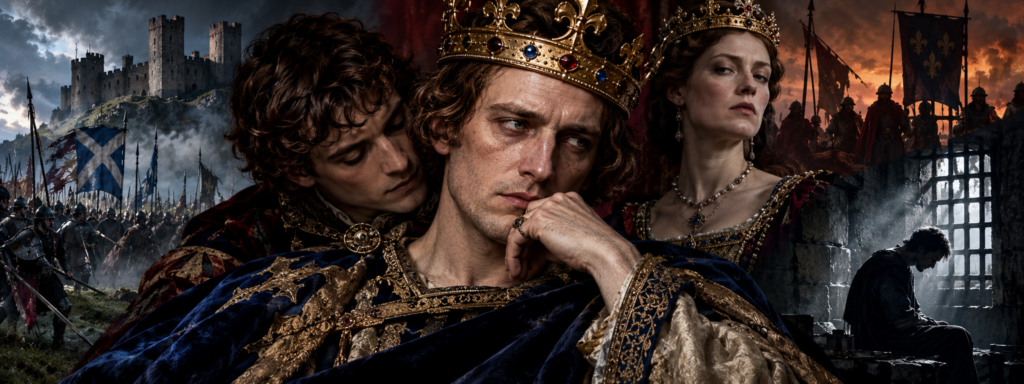
Edward II: England’s Unkingly King, His Dangerous Favorites, and the Brutal Fall of a Dynasty
He was the son of one of England’s most formidable warrior kings, yet he preferred the company of ordinary laborers to the ceremonial grandeur of his father’s court. He showered his male favorites with wealth and influence, alienated powerful nobles, suffered a devastating defeat against Scotland, and watched his kingdom descend into rebellion. His closest companions became the targets of violent political revenge, while his own wife eventually joined forces with an exiled enemy to overthrow him. In January 1327, Edward II became the first English king since the Norman Conquest to be formally removed from the throne. Months later, he reportedly died in captivity at Berkeley Castle, leaving behind one of medieval England’s most disturbing royal mysteries.
The King Who Was Never Supposed to Fall
In September 1327, a former king of England was being held behind the walls of Berkeley Castle in Gloucestershire. Edward II, once the anointed ruler of England and lord of Ireland, had been stripped of his crown, separated from his family, and placed under the control of men whose loyalty belonged to the government that had replaced him. His fourteen-year-old son now occupied the throne as Edward III, while his estranged wife, Isabella of France, and her political ally Roger Mortimer exercised extraordinary influence over the kingdom. The former king’s existence presented an uncomfortable problem: as long as Edward lived, opponents of the new regime could attempt to restore him.
On September 21, according to the official account, Edward died in captivity. The circumstances were suspicious enough to generate questions almost immediately, although surviving evidence does not establish precisely how he died. Later chronicles supplied increasingly horrifying explanations, including the notorious story that he was murdered with a heated metal instrument inserted into his body. That gruesome detail became one of the most famous tales of medieval royal murder, but it is not securely supported by contemporary evidence and should not be accepted as established fact.
What can be said with confidence is that Edward’s death occurred less than eight months after his deposition, during a period when his former supporters were already attempting to challenge the new government. His removal had been extraordinary, and his continued survival was politically dangerous. The circumstances surrounding his reported death would trouble historians for centuries, especially as later evidence and traditions raised the possibility that he might have survived beyond 1327. Most historians accept that Edward died at Berkeley, but the precise circumstances remain disputed.
His downfall was remarkable because Edward had inherited considerable advantages. His father, Edward I, had strengthened royal government, conquered Wales, and spent much of his later reign fighting to impose English authority over Scotland. The younger Edward inherited an established monarchy, experienced officials, substantial resources, and a dynasty whose claims to kingship were firmly recognized. Yet within twenty years, his reign had become associated with political favoritism, military defeat, rebellion, confiscations, executions, and the collapse of royal authority.
Edward’s contemporaries frequently portrayed him as unsuitable for kingship. Some criticized his preference for physical labor and ordinary company, while others condemned his dependence on favored companions. His relationship with Piers Gaveston became the subject of extraordinary hostility, and his later association with Hugh Despenser the Younger helped provoke a political crisis that destroyed his reign. These criticisms reveal much about medieval expectations of monarchy, but they do not establish that Edward suffered from a mental illness.
The central problem was not that Edward lacked intelligence or possessed interests outside the accepted behavior of aristocratic society. It was that he repeatedly failed to manage the competing demands of personal loyalty, royal authority, aristocratic cooperation, and military leadership. His affection for particular individuals became inseparable from the distribution of wealth and political power. Those excluded from his favor increasingly believed that the king was allowing private relationships to override the responsibilities of government.
To understand why Edward’s reign ended so violently, it is necessary to return to the court of his formidable father, where the future king grew up beneath expectations he would struggle to satisfy.
Born Beneath the Shadow of Edward Longshanks
Edward II was born on April 25, 1284, at Caernarfon Castle in northwestern Wales. His father, Edward I, had recently completed major military campaigns against the Welsh princes and was consolidating English control over the region. The castle itself became one of the most imposing symbols of that conquest, part of an ambitious network of fortifications intended to secure royal authority. Edward’s birth there later acquired symbolic significance, although familiar stories about his father presenting the infant to the Welsh as a prince who spoke no English belong to later tradition rather than reliable contemporary evidence.
His mother was Eleanor of Castile, Edward I’s first wife, who had borne numerous children during their marriage. Many died young, a familiar tragedy among medieval royal families despite their wealth and access to care. By the time Edward was born, several older brothers had already died, making him the surviving male heir. His future therefore carried enormous dynastic importance.
Edward I was a commanding figure whose reign emphasized military leadership, legal authority, and the defense of royal rights. He was physically imposing, politically determined, and capable of extraordinary severity toward those who resisted him. His conquest of Wales and campaigns in Scotland demonstrated his willingness to devote enormous resources to warfare. For his son, such a father represented both an inheritance and a demanding example of what a medieval king was expected to become.
The younger Edward received the education appropriate to a royal heir. He learned the skills of aristocratic society, participated in court life, and acquired experience in government and military affairs. He was not wholly indifferent to warfare, despite later portrayals of him as incapable of performing martial duties. Nevertheless, his personal interests and social preferences differed noticeably from the conventional image of a warrior prince.
Edward’s mother died in 1290, when he was six years old. His father later married Margaret of France, producing additional children and strengthening diplomatic connections with the French monarchy. The young prince grew up within a household shaped by military campaigns, political marriages, and the constant demands of royal government. His childhood was privileged, but it was also defined by the expectation that he would eventually continue his father’s work.
In 1301, Edward was formally created Prince of Wales. The title had previously been associated with the native Welsh rulers whom his father had defeated, and its adoption by the English heir reinforced the monarchy’s claims over the conquered principality. Edward’s position appeared secure, yet the responsibilities attached to it were substantial. He would inherit unresolved conflict in Scotland, strained relations with powerful nobles, and a kingdom whose resources had been heavily committed to warfare.
One of the most consequential relationships of his life had already begun to develop. A young Gascon nobleman named Piers Gaveston entered the prince’s household, eventually becoming Edward’s closest companion. Their association would provoke political conflict even before Edward inherited the throne.
Piers Gaveston: The Favorite Who Changed Everything
Piers Gaveston came from a Gascon family connected to the service of the English crown. His father had supported Edward I, and Piers entered the household of the future Edward II during the prince’s youth. Gaveston possessed aristocratic accomplishments, including skill in arms and the manners expected of a courtly nobleman. He was not an obscure servant suddenly elevated from poverty, as some popular accounts imply.
The relationship between Edward and Gaveston became exceptionally close. Contemporary chroniclers described the king’s attachment in language that conveyed unusual affection, and some suggested that Edward loved Gaveston more intensely than was considered appropriate. Historians continue to debate whether their relationship was sexual, romantic, or an especially intimate form of aristocratic companionship. The surviving evidence supports profound personal attachment but does not establish the precise nature of their private relationship.
For medieval nobles, the central political issue was not necessarily Edward’s affection for another man. Kings were expected to maintain friendships, reward loyal companions, and surround themselves with trusted advisers. The danger emerged when one individual appeared to monopolize access to royal favor and receive rewards that others considered excessive. Gaveston’s growing influence threatened established expectations about how power should be distributed.
Edward I apparently became concerned about the relationship. In 1307, shortly before his death, he ordered Gaveston into exile. The precise reasons for the decision remain debated, although concerns about the prince’s behavior and the distribution of royal patronage probably contributed. The order demonstrated that even the formidable Edward I recognized the political dangers surrounding his son’s favorite.
When Edward I died on July 7, 1307, his son immediately inherited the throne. One of the new king’s earliest decisions was to recall Gaveston from exile. The action signaled that Edward intended to govern according to his own preferences rather than continue every policy of his father. It also announced that Gaveston would occupy an exceptionally privileged position.
Edward soon granted Gaveston the earldom of Cornwall, a title carrying substantial lands and revenues. The elevation was extraordinary because Cornwall had strong associations with the royal family and was not ordinarily bestowed upon a relatively minor nobleman. Gaveston also married Margaret de Clare, Edward’s niece, strengthening his connections to the highest aristocracy. These rewards transformed him into one of the kingdom’s most prominent figures.
The king’s affection had now become a political issue of the first importance. Powerful earls saw Gaveston receiving influence and privileges they believed should have been distributed more broadly. His advancement challenged the established hierarchy of the court. Edward’s refusal to recognize the danger would turn resentment into organized opposition.
The Coronation That Revealed a Dangerous Obsession
Edward II married Isabella of France in January 1308, shortly before his coronation. Isabella was the daughter of Philip IV of France, and the marriage was intended to strengthen relations between two powerful monarchies. She was approximately twelve years old at the time, an age that reflected the dynastic marriage practices of medieval royalty. Her arrival in England should have marked the beginning of a prestigious royal partnership.
Instead, the early months of the marriage became overshadowed by Gaveston’s prominence. Edward entrusted his favorite with important responsibilities and displayed extraordinary confidence in him. Gaveston’s participation in royal ceremonies and access to the king attracted hostile attention. Chroniclers later emphasized these details as evidence that Edward neglected the dignity of kingship.
The coronation took place at Westminster Abbey on February 25, 1308. Gaveston received a conspicuous ceremonial role, carrying the crown of Saint Edward during the proceedings. Some accounts suggest that his clothing and display appeared more splendid than those of important nobles, although the details are filtered through hostile reporting. What mattered politically was the impression that the king’s favorite enjoyed exceptional standing.
Isabella’s personal feelings during these events cannot be reconstructed with certainty. Later storytelling often presents her as immediately humiliated by her husband’s attachment to Gaveston, but the surviving evidence does not support a simple account of jealousy from the beginning of the marriage. She would eventually cooperate with Edward and bear him children. Her later hostility developed within a much broader political crisis.
The aristocracy, however, had already begun organizing against Gaveston. Nobles resented his access to royal patronage and the possibility that he could influence important decisions. Chroniclers accused him of arrogance and described him assigning insulting nicknames to powerful earls. The precise wording and attribution of these insults vary, but the stories reflect his reputation for provoking influential men.
Edward responded to criticism by defending Gaveston. His loyalty may have been personally understandable, but it carried increasing political costs. The king appeared unwilling to distinguish between affection for a companion and the responsibilities of distributing royal authority. Every attempt to protect Gaveston reinforced the belief that the favorite stood above ordinary political restraint.
The resulting conflict would dominate the opening years of Edward’s reign. What began as resentment over court patronage became a struggle over whether the king could govern without regard to the counsel of his leading nobles.
A King Who Preferred Ditches to Tournaments
Edward II’s personal interests attracted almost as much criticism as his favorites. Medieval chroniclers described him enjoying activities that seemed inappropriate for a ruler of his status. He reportedly took pleasure in digging ditches, working with tools, building or maintaining structures, and participating in forms of physical labor normally associated with ordinary workers. Such interests were unusual enough to become part of his enduring reputation.
One famous description comes from the Vita Edwardi Secundi, an important contemporary account of his reign. The author criticized Edward’s preference for occupations considered unsuitable for kings, contrasting his interests with the martial accomplishments expected of a monarch. The criticism reveals the values of the writer as much as the personality of Edward himself. Physical labor was not inherently irrational, but it violated aristocratic expectations about royal dignity.
Edward also appears to have enjoyed rowing, swimming, and spending time with people outside the highest ranks of society. Accounts describe his willingness to associate with craftsmen and ordinary laborers. These activities did not necessarily mean that he abandoned government whenever he engaged in them. Nevertheless, they provided ammunition for critics who already questioned his suitability for kingship.
The contrast with Edward I was particularly damaging. His father had cultivated the image of a formidable warrior and commanding ruler. The younger Edward’s willingness to engage in manual tasks appeared strange to observers who expected kings to demonstrate their status through warfare, hunting, ceremonial display, and aristocratic company. His behavior challenged the social boundaries that helped sustain medieval monarchy.
Later writers sometimes treated these preferences as evidence of foolishness or instability. Such conclusions reflect the assumptions of their age rather than any reliable indication of mental illness. Enjoying practical work, physical exercise, or the company of ordinary people does not establish psychological disorder. Indeed, Edward’s interests may suggest curiosity and personal independence from the conventions of his court.
The political problem arose because these unconventional habits became associated with other failures. Had Edward enjoyed military success and maintained aristocratic loyalty, his hobbies might have attracted less hostile attention. Instead, they were interpreted alongside favoritism, rebellion, and defeat. Activities that might otherwise have seemed eccentric became evidence in a broader argument that he was unsuitable to rule.
Edward’s reputation as an unkingly monarch therefore emerged from a clash between personality and political expectation. His subjects did not require every king to resemble his father, but they expected him to fulfill recognizable duties. As his reign deteriorated, even harmless preferences became symbols of a monarchy that appeared to have lost its direction.
The Ordinances of 1311: When the Nobles Tried to Control Their King
Opposition to Gaveston intensified during the first years of Edward’s reign. Powerful nobles demanded his removal, arguing that his influence threatened the proper administration of the kingdom. Edward attempted various compromises, including appointing Gaveston to positions outside England. These measures repeatedly failed because the king remained determined to restore his favorite.
Gaveston was sent to Ireland in 1308 as the king’s lieutenant, an appointment that allowed Edward to comply formally with demands for his removal while preserving his status. Gaveston demonstrated some administrative and military ability there, complicating the image of him as merely an incompetent court favorite. Nevertheless, his return to England renewed political tensions. His enemies regarded the arrangement as an evasion of their demands.
In 1310, Edward agreed to the appointment of a committee of twenty-one Lords Ordainers. Their task was to examine the condition of the kingdom and propose reforms. The resulting Ordinances of 1311 sought to restrict aspects of royal government, regulate finances, and limit the king’s freedom to appoint officials or conduct certain policies without appropriate counsel. They also demanded Gaveston’s removal.
The Ordinances represented a serious challenge to Edward’s authority. Medieval kings were expected to consult powerful nobles, but the proposed restrictions went beyond ordinary advice. They attempted to institutionalize aristocratic oversight of royal government. Edward regarded such limitations as an intrusion upon the rights of the crown.
The conflict became increasingly personal. Edward’s opponents believed Gaveston’s removal was essential to reform, while Edward treated attacks on his favorite as attacks upon himself. Neither side found a lasting compromise. Gaveston was repeatedly exiled and recalled, turning his presence into a test of political power.
By 1312, the struggle had reached a dangerous point. The king’s enemies were prepared to use force, and Gaveston’s position had become increasingly vulnerable. His aristocratic marriage and royal favor could no longer protect him. The dispute that had dominated Edward’s early reign was about to end in blood.
The Murder of Piers Gaveston: A Favorite Dies, a King Remembers
In 1312, several powerful earls moved against Gaveston. Their opposition included Thomas, Earl of Lancaster, one of the wealthiest and most influential nobles in England. Lancaster was Edward’s cousin and possessed extensive estates, giving him the resources to challenge royal authority. His involvement transformed the campaign against Gaveston into a major aristocratic confrontation.
Gaveston eventually surrendered at Scarborough Castle under terms negotiated with Aymer de Valence, Earl of Pembroke. Pembroke intended to escort him south, but the arrangements collapsed when Guy de Beauchamp, Earl of Warwick, seized Gaveston. The prisoner was taken to Warwick Castle, where his enemies determined his fate. The seizure violated the expectations of safe custody and deeply damaged trust among the nobles involved.
On June 19, 1312, Gaveston was executed near Warwick. His captors treated him as an outlaw or traitor, although the legal justification for the killing was highly questionable. He was beheaded after being taken to Blacklow Hill. The execution removed Edward’s closest companion but created a new crisis.
Edward was devastated by Gaveston’s death, according to contemporary accounts. His grief became intertwined with anger toward the earls responsible. He regarded the killing as an assault upon royal authority as well as a personal loss. The execution therefore failed to resolve the political conflict and instead intensified hostility between the king and his opponents.
Lancaster emerged as a central figure in the opposition, while Edward sought opportunities to recover authority. Negotiations eventually produced a temporary settlement, but the underlying grievances remained. The king’s relationship with the aristocracy had been severely damaged. Gaveston’s death became a lasting source of resentment.
The episode also demonstrates why reducing Edward’s reign to a story of personal obsession is inadequate. Gaveston’s influence mattered because access to the king affected offices, lands, revenues, and political decisions. His enemies were defending their own interests as well as expressing concerns about government. The conflict was therefore both deeply personal and fundamentally political.
Edward had lost the companion whose presence had dominated the opening years of his reign. He had not, however, learned to avoid the dangers of concentrating favor upon a small circle of trusted individuals.
Bannockburn: The Battle That Shattered a King’s Reputation
While Edward struggled with domestic opposition, Scotland remained a major military challenge. His father had spent years attempting to establish English dominance over the kingdom, but resistance continued under Robert Bruce. Bruce’s position strengthened during Edward II’s early reign as English authority weakened in several Scottish regions. By 1314, the conflict had reached a critical point.
Stirling Castle, one of Scotland’s most strategically important fortresses, was under siege by Bruce’s forces. Its English commander had agreed to surrender if relief did not arrive by a specified date. Edward assembled a substantial army and marched north to relieve the castle. The campaign offered an opportunity to restore military prestige and demonstrate effective kingship.
The English army was larger than the Scottish force, although precise numbers remain uncertain. Edward possessed cavalry, infantry, and experienced commanders. Robert Bruce, however, selected ground that reduced the advantages of English mounted troops. The Scottish army relied heavily on disciplined formations of spearmen known as schiltrons.
The Battle of Bannockburn took place on June 23–24, 1314. The fighting developed across difficult terrain near Stirling, where English forces struggled to deploy effectively. Scottish resistance disrupted English attacks, while congestion and confusion undermined the larger army’s organization. The battle ended in a decisive Scottish victory.
Edward escaped from the battlefield, but many English soldiers and nobles were killed or captured. The defeat was humiliating because it destroyed the immediate objective of relieving Stirling and strengthened Bruce’s position. It also exposed weaknesses in English military leadership and coordination. The king’s reputation suffered severely.
Bannockburn did not immediately establish complete Scottish independence, nor did it end the war. English and Scottish forces continued fighting for years. Nevertheless, the battle became a defining moment in Edward’s reign. It demonstrated that the military achievements associated with Edward I could not simply be inherited by his son.
The consequences extended into English politics. Aristocratic critics questioned Edward’s leadership, while Lancaster and other opponents gained opportunities to challenge his authority. Military defeat intensified financial pressure and weakened confidence in the crown. The king’s inability to secure a decisive victory became part of the argument that he was unsuitable to govern.
For Edward, Bannockburn was more than a lost battle. It was a public failure in one of the principal duties expected of a medieval monarch: defending the kingdom and maintaining military honor. His personal preferences and political relationships now seemed even more objectionable to those who believed he had failed as a warrior king.
Hunger, Disorder, and a Kingdom Losing Confidence
Edward’s reign was further destabilized by the Great Famine of 1315–1317. Heavy rainfall, poor harvests, and disruptions to agricultural production created severe food shortages across much of northern Europe. England experienced widespread hardship, with rising prices, hunger, and increased mortality. The crisis affected ordinary households far more directly than the disputes surrounding royal favorites.
The famine was not caused by Edward’s personal behavior. Climatic and agricultural conditions were the principal drivers, and rulers across northern Europe faced similar difficulties. Nevertheless, medieval political culture often associated natural disasters with failures of government or divine displeasure. A king already criticized for military defeat and political disorder was especially vulnerable to such interpretations.
The shortage of food complicated military campaigns and strained royal finances. Soldiers required provisions, horses needed fodder, and communities struggled to meet demands for taxation or supplies. The government could not easily overcome these structural problems. Edward’s administration therefore operated under severe pressures beyond the control of any individual ruler.
The famine also exposed the limits of royal authority. Kings could issue orders, regulate certain markets, and attempt to secure supplies, but they could not restore failed harvests. The suffering of the population intensified the general atmosphere of instability. Local disputes, crime, and economic hardship became part of the wider experience of Edward’s reign.
Political conflict continued alongside these disasters. Lancaster and other nobles challenged royal policy, while Edward sought to recover authority. Neither faction possessed a simple solution to the kingdom’s difficulties. The result was a government increasingly consumed by internal rivalry while external and economic pressures persisted.
The combination of military defeat, famine, and political division proved deeply damaging. Edward’s reign began with the expectation that he would continue his father’s achievements. Instead, England experienced a prolonged period of uncertainty. The king’s opponents interpreted these failures as evidence that the monarchy required reform or stronger aristocratic supervision.
Yet the most destructive phase of Edward’s reign still lay ahead. The death of Gaveston had removed one controversial favorite, but another relationship would eventually provoke an even greater crisis.
Hugh Despenser: The Favorite Who Helped Destroy the Crown
Hugh Despenser the Younger emerged as one of Edward’s most influential companions during the later years of his reign. His family already possessed significant aristocratic connections, and his father, Hugh Despenser the Elder, had a long history of royal service. The younger Despenser’s marriage to Eleanor de Clare, a niece of Edward II and one of the heirs to the vast Gloucester inheritance, gave him access to substantial territorial interests. His rise therefore combined personal royal favor with the opportunities created by aristocratic inheritance.
Despenser became royal chamberlain in 1318, a position that placed him close to the king and gave him influence over access to the royal household. His relationship with Edward grew increasingly important. As with Gaveston, historians debate the precise personal nature of their attachment. The evidence establishes exceptional intimacy and political dependence, but claims about their private sexual relationship remain uncertain.
Despenser’s ambition was particularly dangerous in the Welsh Marches, where powerful families competed for land and jurisdiction. He sought to expand his holdings and influence, sometimes through aggressive legal and political methods. His acquisition of Gower and disputes involving the de Braose inheritance helped provoke hostility among Marcher lords. His opponents believed that he was using royal power to advance private interests at their expense.
The younger Despenser’s father also benefited from royal favor. Together, the two men became associated with a political faction that increasingly dominated Edward’s government. Their influence threatened nobles who feared confiscation, prosecution, or exclusion from royal patronage. The concentration of power around the Despensers created resentment across several aristocratic networks.
In 1321, opposition erupted into armed conflict. Marcher lords attacked Despenser lands and demanded the favorites’ removal. The rebels presented their actions as resistance to oppressive influence over the king. Edward initially faced sufficient pressure to agree to the Despensers’ exile.
The settlement did not last. Edward soon maneuvered to restore his favorites and recover political control. His subsequent military campaign transformed the conflict into a struggle over the authority of the crown itself. The king was no longer merely defending a companion; he was confronting a coalition that challenged his right to govern.
The Despensers’ return marked the beginning of the most coercive period of Edward’s reign. Their enemies would face imprisonment, confiscation, exile, and execution. The political struggle that had once centered on court favoritism became a confrontation with devastating consequences for the aristocracy.
The Despenser War and the Execution of Thomas of Lancaster
The conflict of 1321–1322 is commonly known as the Despenser War. It began with attacks upon Despenser interests and developed into a broader rebellion against Edward’s government. The king initially appeared vulnerable, but he proved capable of organizing an effective military response. His eventual success demonstrated that he was not invariably incompetent in warfare.
Edward moved against rebel positions and secured important strategic advantages. His forces advanced through the Welsh Marches and into northern England, where Lancaster’s supporters attempted to resist. The rebels suffered from divisions and difficulties coordinating their operations. Edward exploited these weaknesses with increasing determination.
The decisive confrontation occurred at Boroughbridge in Yorkshire on March 16, 1322. Royal forces under Sir Andrew Harclay defeated the rebels attempting to cross the River Ure. Lancaster was captured and brought before the king’s government. His defeat ended the immediate rebellion and gave Edward an opportunity to punish his principal opponents.
Thomas of Lancaster was executed at Pontefract on March 22, 1322. The proceedings were politically charged, and his execution represented a dramatic reversal for one of the kingdom’s most powerful nobles. Lancaster had participated in the killing of Gaveston a decade earlier, making the confrontation deeply personal as well as political. His death removed a leading opponent but intensified the bitterness surrounding Edward’s rule.
Other rebels were executed, imprisoned, or deprived of property. The king’s government pursued confiscations and financial penalties against those associated with resistance. Some families lost extensive estates, while others faced prolonged uncertainty over their inheritance. The consequences reached far beyond the principal leaders of the rebellion.
Edward’s victory temporarily strengthened royal authority. The Ordinances of 1311 were largely overturned through the Statute of York in 1322, which reaffirmed the king’s legislative role while recognizing the place of parliamentary consent in certain matters. The crown regained powers that aristocratic opponents had attempted to restrict. Yet the restoration of authority did not produce lasting reconciliation.
The king had defeated his enemies militarily, but the methods used afterward deepened resentment. The Despensers benefited from the political settlement and continued expanding their influence. Their opponents increasingly viewed the government as an instrument of personal revenge.
Edward’s reign had entered the period later historians would describe as the Despenser tyranny.
The Despenser Tyranny: Fear Behind the Royal Throne
Between 1322 and 1326, Edward II and the Despensers exercised unusually concentrated political power. The defeat of Lancaster removed an important aristocratic rival, while confiscations weakened other opponents. Hugh Despenser the Younger became increasingly influential in the administration of royal patronage and the management of political relationships. His father also occupied a prominent position within the government.
The term “Despenser tyranny” reflects the hostile reputation of this period. It describes a government associated with aggressive land acquisition, financial exploitation, and punitive treatment of political enemies. Although the phrase carries an evaluative judgment, the underlying evidence demonstrates extensive use of royal authority to benefit the ruling faction. The distinction matters because not every government action was necessarily unlawful, even when its political consequences were deeply destabilizing.
The Despensers accumulated lands and influence through inheritance disputes, forfeitures, and royal grants. Their expansion threatened neighboring aristocratic families, particularly in the Welsh Marches. Those who resisted risked becoming targets of legal proceedings or political retaliation. The king’s support made it difficult for opponents to challenge their position through ordinary channels.
Edward himself was not merely a passive figure controlled by his favorites. The surviving records indicate that he participated actively in government and supported many of the policies associated with the Despenser regime. His interests aligned with those of his companions, particularly in recovering royal authority after rebellion. Describing him as entirely manipulated would underestimate his responsibility.
The government also maintained administrative activity and pursued policies beyond the interests of the Despensers. Royal justice continued, officials performed their duties, and the monarchy remained capable of collecting revenue and conducting diplomacy. The kingdom had not ceased functioning. Nevertheless, the political atmosphere was increasingly hostile.
One particularly important consequence was the alienation of Queen Isabella. Her relationship with Edward had survived earlier crises, but the rise of Despenser created new tensions over influence, resources, and security. The queen’s household and financial position became entangled in the conflict. Her growing estrangement would eventually provide the opposition with a powerful figure around whom to organize.
The Despensers appeared secure after 1322, but their dominance rested heavily on the king’s personal protection. Their enemies had not disappeared; many were imprisoned, exiled, or waiting for an opportunity to return. The government had won a civil conflict without resolving the political grievances that produced it.
When that opportunity arrived, the collapse would be extraordinarily rapid.
Isabella of France: From Royal Bride to Dangerous Enemy
Isabella of France entered England in 1308 as a young bride whose marriage was intended to strengthen relations between the English and French crowns. Over the following years, she became an established member of Edward’s court and the mother of his children. Their eldest son, the future Edward III, was born in 1312, followed by John of Eltham and two daughters, Eleanor and Joan. The marriage therefore fulfilled its principal dynastic purpose.
For much of Edward’s reign, Isabella performed the political and ceremonial responsibilities expected of a queen. She participated in diplomacy, maintained a household, and occasionally acted as an intermediary during disputes. The familiar image of a permanently neglected wife plotting revenge from the beginning of the marriage is misleading. Her opposition developed gradually and was closely connected to the political circumstances of the 1320s.
The rise of Hugh Despenser the Younger intensified tensions. Isabella’s access to resources and influence became increasingly restricted, particularly during periods of conflict with France. Her lands and revenues were affected by royal policies, while the Despensers’ position made reconciliation difficult. The queen eventually became convinced that her security and political standing were threatened.
In 1325, Isabella traveled to France to negotiate with her brother, Charles IV, over disputes involving Edward’s continental possessions. The mission offered a diplomatic solution to a conflict that had become increasingly dangerous. Edward remained in England, while Isabella used her position as a French princess and English queen to conduct negotiations. Her presence at the French court gave her opportunities unavailable at home.
The young Prince Edward subsequently traveled to France to perform homage for the family’s French territories. His arrival placed the heir to the English throne within Isabella’s immediate influence. The arrangement was politically significant because the prince could now become the center of an alternative government. Isabella refused to return to England while Despenser remained in power.
Her decision transformed a diplomatic mission into an open challenge to her husband. She had not yet overthrown Edward, but she possessed something his enemies desperately needed: a legitimate royal figure capable of attracting support. Her son represented dynastic continuity, while Isabella could present her opposition as an effort to protect him and restore proper government.
The queen’s alliance with Roger Mortimer would turn that political opportunity into an invasion.
Roger Mortimer: The Exiled Rebel Who Became the Queen’s Ally
Roger Mortimer, Lord of Wigmore, belonged to a powerful Marcher family whose interests had been threatened during the Despenser conflict. He participated in opposition to Edward’s government and was captured following the rebellion of 1321–1322. Unlike Lancaster, Mortimer escaped execution, but he was imprisoned in the Tower of London. His prospects appeared bleak.
In 1323, Mortimer escaped from the Tower and fled to France. The escape became one of the most remarkable episodes of the period, although later accounts embellished the details. He joined the community of exiles who opposed Edward and the Despensers. Their position was difficult because they lacked the resources needed to challenge the king directly.
Mortimer eventually became closely associated with Isabella. Their political partnership was decisive in organizing opposition to Edward. Later chroniclers and historical traditions portrayed them as lovers, and many historians consider a sexual relationship plausible. However, the surviving contemporary evidence does not establish precisely when such a relationship began or the nature of their private intimacy.
Their alliance combined complementary advantages. Isabella possessed royal status, diplomatic connections, and access to her son, the heir to the throne. Mortimer brought military experience, aristocratic networks, and personal grievances against the Despenser regime. Together, they could present their cause as a campaign to rescue the kingdom from oppressive government.
The political situation in France complicated their preparations. Charles IV was not willing to provide unlimited support for an invasion of England, and Isabella eventually sought assistance elsewhere. She negotiated with William I, Count of Hainaut, whose family possessed important connections in the Low Countries. A marriage agreement between Prince Edward and Philippa of Hainaut helped secure support.
The resulting invasion force was not enormous. Its strength lay partly in the expectation that dissatisfied English nobles would join once Isabella landed. Years of confiscations, executions, and resentment had created conditions in which the government’s apparent strength concealed deep vulnerability. The queen and Mortimer intended to exploit that weakness.
In September 1326, they sailed for England. Edward’s reign was approaching its final crisis.
The Invasion of 1326: When England Abandoned Its King
Isabella and Mortimer landed in Suffolk on September 24, 1326, with a relatively small force. Their arrival presented Edward with a serious challenge, but the king still possessed resources and loyal officials. The government attempted to organize resistance and called upon supporters to defend the crown. Yet the response was far weaker than Edward needed.
Powerful nobles began joining the invaders. Among them was Henry, Earl of Lancaster, brother of the executed Thomas of Lancaster. His participation connected the rebellion to grievances dating from the Despenser War. Other aristocrats recognized that the political balance was shifting and chose to abandon the king.
Edward’s position deteriorated rapidly. The government’s authority depended on cooperation from local officials, landholders, and military commanders. As support collapsed, royal orders became increasingly difficult to enforce. The king discovered that the coercive methods used to suppress opposition had not produced durable loyalty.
Edward and Hugh Despenser the Younger fled westward, attempting to preserve their position. Their movements took them through Wales, where they hoped to find supporters and opportunities for escape. The strategy failed as the invading coalition gained control of important territories. The king’s remaining allies were isolated.
Hugh Despenser the Elder was captured at Bristol. He was executed in October 1326, demonstrating the determination of the new regime to destroy the ruling faction. The elder Despenser had enjoyed extraordinary influence under Edward, but his position collapsed once royal protection disappeared. His death foreshadowed the fate awaiting his son.
Edward and the younger Despenser were captured in November. Their arrest effectively ended the king’s ability to govern independently. The coalition led by Isabella and Mortimer now controlled the principal instruments of power. Edward remained king in name, but his political authority had disappeared.
The speed of the collapse was extraordinary. A government that had defeated major rebellion only four years earlier disintegrated when confronted by a comparatively small invading force supported by domestic opponents. The outcome revealed how extensively Edward had alienated the political community on which his rule depended.
His favorites had been unable to save him. One was already dead, and the other faced a public execution intended to demonstrate the complete destruction of the old regime.
The Execution of Hugh Despenser: A Favorite Meets a Terrifying End
Hugh Despenser the Younger was brought before his enemies at Hereford in November 1326. His association with Edward’s government made him the principal symbol of the political system Isabella and Mortimer claimed to have overthrown. The accusations against him included treason, corruption, and abuses committed through royal favor. The proceedings were intended not merely to punish an individual but to condemn the entire Despenser regime.
On November 24, Despenser was subjected to a particularly brutal execution. Contemporary accounts describe hanging, disembowelment, and dismemberment, punishments associated with the most serious forms of treason. The precise sequence of the mutilations varies among sources, but the execution was deliberately public and degrading. It demonstrated the extreme violence that could accompany political revenge in medieval England.
Despenser’s death was also deeply symbolic. He had accumulated extraordinary wealth and influence through his relationship with the king, yet those advantages disappeared once Edward lost power. The same aristocratic society that had endured his dominance now participated in his destruction. His execution served as a warning about the dangers of royal favoritism and the instability of political fortune.
Edward’s reaction is difficult to reconstruct. He had already been captured and deprived of effective authority. The death of his closest companion removed another connection to the government he had built. Contemporary sources do not provide reliable access to his private emotions, although the political consequences were unmistakable.
The execution also exposed the severity of the new regime. Isabella and Mortimer presented themselves as liberators from oppression, yet their victory involved harsh punishment and the elimination of political enemies. Medieval rebellions frequently justified extraordinary violence as necessary to restore lawful government. The distinction between justice and revenge could become difficult to maintain.
With the Despensers destroyed, the central question became Edward’s own future. He remained the anointed king of England, a status that carried profound religious and political significance. Removing him required more than imprisonment. His opponents needed a formal justification for transferring the crown to his son.
The resulting deposition would establish a precedent with consequences extending far beyond Edward’s lifetime.
The Deposition of Edward II: A King Stripped of His Crown
In January 1327, representatives of the political community assembled to address Edward’s position. The king was held in custody, while Isabella and Mortimer exercised effective control over the government. His continued reign appeared incompatible with the new political order. Yet the removal of an anointed monarch raised difficult questions about legitimacy and authority.
Edward’s opponents presented accusations concerning his government. They criticized his dependence on unsuitable advisers, failure to maintain justice, loss of territory, and inability to fulfill the duties of kingship. These charges reflected genuine grievances but were also framed to justify an extraordinary political act. The deposition was therefore both a judgment upon his reign and a means of legitimizing the transfer of power.
A delegation visited Edward at Kenilworth Castle, where he was informed that he could no longer continue as king. The surviving accounts describe a deeply humiliating confrontation. Edward was pressured to accept the succession of his son rather than risk the crown passing outside his direct line. The extent to which he freely consented is doubtful given his captivity and the circumstances surrounding the decision.
On January 25, 1327, the accession of Edward III was formally dated, and the young king was crowned at Westminster Abbey on February 1. He was fourteen years old. The new reign preserved the Plantagenet dynasty while removing the ruler whose government had become unacceptable to his opponents. Isabella and Mortimer remained the dominant political figures during the early years of the minority.
Edward II’s deposition was historically significant. English kings had previously been forced from power, but the formal procedures surrounding his removal gave the event a distinctive constitutional character. His opponents argued that kingship carried responsibilities that could be violated. The deposition therefore raised fundamental questions about the relationship between royal authority and political consent.
Nevertheless, the process was not a peaceful constitutional transition in the modern sense. Edward had been captured by force, deprived of political independence, and pressured to surrender his position. The new government controlled the circumstances in which the decision was made. The language of lawful deposition existed alongside the reality of military victory.
Edward’s removal did not resolve every danger. He remained alive, and his supporters could attempt to restore him. His continued existence threatened the stability of Isabella and Mortimer’s government.
The former king was transferred into captivity, where the final mystery of his life would unfold.
Berkeley Castle: The Mysterious Death of a Deposed King
After his deposition, Edward II was held under guard at several locations before being placed at Berkeley Castle. His custodians were responsible for preventing escape and limiting contact with potential supporters. The former king’s status was extraordinary because he had lost political authority but remained a member of the royal dynasty. His treatment therefore carried both practical and symbolic importance.
The new government faced repeated concerns about attempts to rescue Edward. Supporters of the former king remained active, and the possibility of restoration could not be dismissed. Any successful rescue would threaten the legitimacy of Edward III’s accession and the position of Isabella and Mortimer. The captive king’s survival thus created a continuing political problem.
On September 21, 1327, Edward reportedly died at Berkeley Castle. The official announcement attributed his death to circumstances that did not openly establish murder. Nevertheless, suspicion developed because of the political advantages his death offered the ruling regime. Later chroniclers increasingly portrayed the event as an assassination.
The most notorious version claimed that Edward was murdered by the insertion of a heated metal instrument into his body, supposedly intended to kill him without leaving obvious external wounds. The story is deeply embedded in popular accounts of his reign, but it appears in sources whose reliability is contested and cannot be verified. Historians have long questioned its plausibility and the chronology of its development. It should be treated as a sensational allegation rather than a documented description of his death.
Other accounts suggest that Edward may have been suffocated or killed through less elaborate means. These explanations are also uncertain. The surviving evidence does not permit a definitive reconstruction of the events inside Berkeley Castle. The political circumstances make suspicion understandable, but suspicion is not equivalent to proof of a particular method.
An additional controversy concerns whether Edward died in 1327 at all. The so-called Fieschi Letter, written years later, presents an account in which Edward escaped captivity and lived abroad. Some historians have examined this possibility seriously, while others regard the letter as unreliable or based on mistaken information. The traditional account of his death at Berkeley remains the prevailing interpretation, but the alternative has contributed to continuing debate.
Edward’s reported body was buried at Gloucester Abbey, now Gloucester Cathedral, in December 1327. His tomb later became an important site of royal memory and religious attention. The elaborate monument commissioned during Edward III’s reign helped preserve his identity within the Plantagenet dynasty. It also provided a striking contrast to the humiliation of his final months.
The king who had once ruled England was now remembered through a tomb, disputed chronicles, and stories of an exceptionally cruel death. His political enemies had succeeded in removing him, but the uncertainty surrounding his fate ensured that his downfall would remain one of medieval history’s most enduring mysteries.
Isabella and Mortimer: The Victors Who Became the Next Targets
Edward II’s deposition did not produce a stable government free from the problems associated with his reign. Isabella and Mortimer exercised considerable authority during the early years of Edward III’s kingship. Their position depended on controlling access to the young monarch and maintaining support among powerful nobles. The arrangement quickly generated resentment.
Mortimer accumulated titles, lands, and influence, becoming increasingly prominent within the government. His advancement reminded critics of the favoritism that had contributed to Edward II’s downfall. Although the circumstances differed, the concentration of power around a dominant political figure created familiar tensions. Nobles who had supported the deposition began questioning the new regime.
The execution of Edmund, Earl of Kent, in 1330 intensified opposition. Kent, a younger half-brother of Edward II, became involved in a conspiracy based partly on the belief that the former king remained alive. His arrest and execution demonstrated the insecurity of Isabella and Mortimer’s government. The episode also complicated the historical debate surrounding Edward II’s death because it revealed that rumors of his survival circulated within the royal family.
Edward III eventually moved against Mortimer. In October 1330, the young king organized a coup at Nottingham Castle with the assistance of trusted supporters. Mortimer was arrested, while Isabella was removed from her position of political dominance. The operation marked Edward III’s assumption of effective personal rule.
Mortimer was executed at Tyburn in November 1330. His fall resembled the fate of earlier royal favorites whose power had depended on privileged access to the monarch. The man who helped overthrow Edward II had himself become the target of accusations concerning excessive influence and political misconduct. His execution completed another violent reversal within the Plantagenet court.
Isabella survived the coup and lived for many years afterward, dying in 1358. She retained an honorable position as the king’s mother, although her political authority was sharply reduced. Her later life complicates the popular image of her as merely a ruthless conspirator. She had been a queen, diplomat, mother, political opponent, and participant in one of the most dramatic depositions in English history.
The events of 1330 demonstrated that Edward II’s removal had not eliminated the structural problems surrounding royal favoritism and aristocratic competition. The new regime had reproduced some of the tensions it claimed to oppose. Political authority remained closely connected to personal relationships, patronage, and control over the king.
Edward II was gone, but the struggles that destroyed him continued shaping the kingdom.
Was Edward II Really Mad?
Edward II’s inclusion among supposedly mad or unfit monarchs requires careful historical interpretation. His contemporaries criticized his behavior, personal relationships, military failures, and apparent disregard for the expectations of kingship. Some chroniclers described him as foolish or unsuitable for royal authority, while others emphasized his unconventional interests and dependence on favorites. These judgments reflected political and social expectations rather than reliable evidence of psychiatric illness.
There is no secure historical basis for diagnosing Edward with a mental disorder. The surviving records do not establish that he experienced delusions, psychosis, or another identifiable psychiatric condition. His enjoyment of manual labor and ordinary company was unusual for a medieval monarch, but unusual interests do not constitute madness. Likewise, his intimate relationships with male favorites cannot legitimately be treated as evidence of mental instability.
The political consequences of those relationships were nevertheless substantial. Edward repeatedly granted extraordinary influence to individuals whose advancement provoked aristocratic resentment. Gaveston’s elevation contributed to the crisis that ended in his execution, while Despenser’s dominance helped provoke rebellion and deposition. The issue was not affection itself but the distribution of power and the king’s unwillingness to manage competing interests.
Edward’s military failures also contributed to his reputation. Bannockburn was a devastating defeat, and his inability to secure lasting success in Scotland weakened confidence in his leadership. Yet he later demonstrated military competence during the Despenser War. His record therefore does not support a simple portrayal of total incapacity.
The king’s political behavior was often inconsistent and damaging. He resisted aristocratic restrictions, defended controversial favorites, and participated in harsh reprisals against opponents. These decisions alienated powerful families and weakened the political foundations of his rule. His downfall emerged from the interaction of personal relationships, military pressures, aristocratic rivalries, and the exercise of royal authority.
The label of madness is particularly misleading when applied to his unconventional hobbies. Medieval chroniclers viewed kingship as a role defined by hierarchy, ceremony, warfare, and aristocratic conduct. Edward’s preference for practical work challenged those expectations. His behavior became a symbol of unfitness because it did not conform to the social image of monarchy, not because it demonstrated a clinical condition.
His sexuality has also been used unfairly in some historical portrayals. The possibility that Edward had romantic or sexual relationships with men has attracted extensive scholarly debate, but such relationships would not constitute evidence of psychological disorder. The historical questions concern the nature of the available evidence and the political consequences of favoritism. Conflating sexuality with incompetence or madness obscures rather than explains his reign.
Edward II therefore belongs in a history of notorious monarchs because of his contested reputation, political failures, and extraordinary deposition. His reign reveals how a ruler could become vulnerable when personal attachments collided with the expectations of powerful subjects. It also demonstrates the danger of interpreting political failure through unsupported psychological labels.
The historical Edward was more complicated than either the helpless victim of manipulative favorites or the foolish king of hostile chronicles. He exercised power, made consequential decisions, and sometimes demonstrated determination and administrative ability. His failures were real, but they belonged to the political world in which he governed.
The Legacy of Edward II: A Crown Lost Through Favoritism and Betrayal
Edward II’s reign ended in humiliation, but its significance extended beyond the fate of one monarch. His deposition raised questions about the responsibilities of kingship and the circumstances under which a ruler might be removed. The political arguments used against him influenced later discussions of royal authority, even though the events of 1327 were shaped by military force and factional interests. His downfall became an important precedent in English constitutional history.
The destruction of Gaveston and the Despensers illustrated the dangers of concentrating political influence around royal favorites. Both relationships provoked aristocratic hostility because personal access to the king translated into wealth, office, and authority. Edward repeatedly treated attacks on his companions as attacks upon his own position. His inability to separate private loyalty from public government contributed directly to his political isolation.
His reign also exposed the importance of military reputation. Bannockburn damaged his authority because medieval kings were expected to lead armies and defend inherited territories. The defeat strengthened Robert Bruce’s position and demonstrated the limits of English power in Scotland. Edward’s inability to reverse that outcome became part of the broader case against his government.
The political violence of his later years left lasting scars. Lancaster’s execution, the confiscation of rebel estates, the rise of Despenser power, and the invasion led by Isabella and Mortimer all reflected a kingdom divided by competing claims to legitimate authority. The deposition did not immediately restore stability, and the new regime soon developed its own problems. Edward III’s coup in 1330 revealed how quickly political alliances could reverse.
Edward’s personal reputation remained controversial. Some chroniclers portrayed him as weak, foolish, and dominated by favorites, while later writers emphasized the tragedy of his imprisonment and reported murder. His unconventional interests attracted ridicule, and his relationships became the subject of speculation. Modern historical scholarship has increasingly questioned the assumptions underlying these portrayals.
The mystery of his death remains particularly powerful. The traditional account places his death at Berkeley Castle in September 1327, but the precise circumstances cannot be established. The gruesome story of murder with a heated instrument belongs to a later tradition whose evidentiary foundations are uncertain. Claims that he survived captivity also remain disputed.
His tomb at Gloucester Cathedral provides a tangible reminder of the man behind the political controversies. Edward III eventually developed a formidable reputation of his own, particularly through military campaigns in France. The contrast between father and son influenced later historical interpretations, encouraging the view that Edward II had failed to fulfill the responsibilities inherited from Edward I. Yet such comparisons can obscure the complex circumstances in which each king governed.
Edward II was neither simply a harmless eccentric nor a monarch whose failures can be explained by madness. He was a ruler whose personal attachments became inseparable from political power, whose military defeats weakened his authority, and whose harsh treatment of opponents contributed to rebellion. His reign demonstrates how the expectations of medieval kingship could become destructive when a monarch could not maintain the confidence of those who helped sustain his rule.
The final irony is that Edward’s enemies justified his removal partly by condemning the influence of royal favorites, yet the government that replaced him soon became dominated by another powerful individual. Mortimer’s rise and fall revealed that the problem extended beyond Edward’s personality. Medieval monarchy depended upon personal relationships, and those relationships could become sources of instability when political authority lacked effective restraints.
Edward II inherited a crown strengthened by conquest and royal ambition, but he lost it amid favoritism, rebellion, and betrayal. His closest companions were executed, his wife helped overthrow him, and his teenage son replaced him on the throne. The stories surrounding his death transformed his final months into one of England’s darkest royal mysteries. Yet the most revealing aspect of his reign is not the sensational legend of Berkeley Castle or the speculation surrounding his private life. It is the spectacle of a king who possessed the authority of an anointed monarch but could not preserve the loyalty necessary to exercise it. Edward II’s tragedy was that the crown could protect neither his favorites nor himself once the political world around him turned against him.