
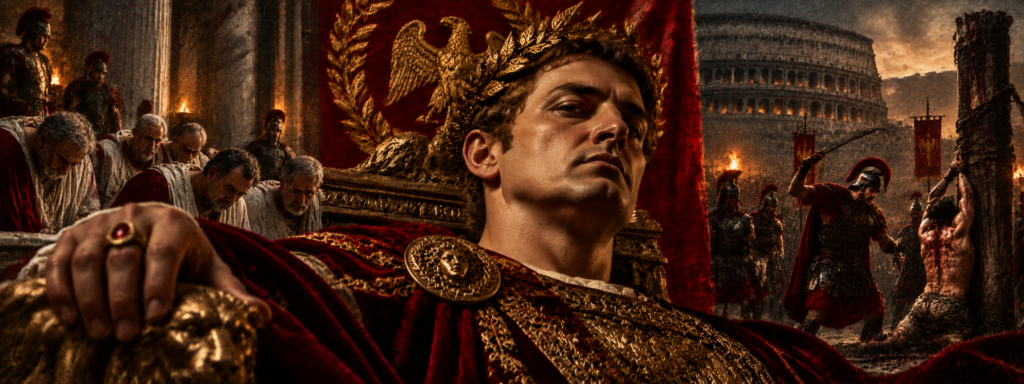
Domitian: Rome’s Feared Emperor and the Reign of Suspicion, Blood, and Betrayal
He inherited an empire still recovering from civil war, rebuilt much of Rome, strengthened its defenses, and ruled with an authority that few senators dared challenge. Yet Emperor Domitian would become one of the most hated figures in Roman aristocratic history, accused of humiliating the Senate, persecuting his enemies, and surrounding himself with an atmosphere of suspicion and fear. Ancient writers portrayed him as a ruthless autocrat who expected divine honors and treated powerful men as potential conspirators. After fifteen years on the throne, Domitian was murdered inside his own palace by members of the imperial household. His death brought celebrations, the destruction of his images, and a reputation for tyranny that would overshadow his achievements for nearly two thousand years.
On September 18, AD 96, Emperor Domitian was attacked inside the imperial palace on Rome’s Palatine Hill. The ruler who had spent fifteen years exercising extraordinary control over the Roman Empire found himself confronted by a conspiracy that had reached into the very household responsible for his personal security. According to the ancient historian Suetonius, a palace official named Stephanus approached the emperor under the pretense of delivering information about a plot against his life. Concealing a weapon beneath the bandages wrapped around his arm, Stephanus allegedly struck when Domitian lowered his guard. A violent struggle followed, and other conspirators joined the attack until the emperor lay dead.
The assassination was an extraordinary reversal for a ruler whose reputation had become inseparable from suspicion and the punishment of suspected enemies. Ancient writers described Domitian as increasingly fearful of conspiracies, particularly during the final years of his reign, when prominent senators and officials faced accusations of treason. Men who had served the empire could find themselves accused of disloyalty, while the emperor’s personal relationships and political judgments became matters of intense concern within the aristocracy. Yet the very measures intended to secure his position failed to prevent a conspiracy from developing among those closest to him.
Domitian’s death also exposed the bitterness that had accumulated during his government. The Senate condemned his memory, and imperial images and inscriptions were subjected to destruction or alteration. Writers associated with the succeeding political order portrayed his reign as an era of fear, servility, executions, and arbitrary power. Pliny the Younger celebrated the contrast between Domitian and his successor, while Tacitus described the atmosphere of repression that had affected Rome’s political and intellectual life. Suetonius preserved disturbing stories about the emperor’s private habits, cruelty, and increasingly isolated existence.
These accounts created one of the most enduring portraits of tyranny in Roman history. Domitian became the emperor who supposedly demanded to be addressed as “Master and God,” delighted in terrifying senators, and treated even harmless criticism as a threat to his authority. His reputation was so thoroughly damaged that later generations often remembered him primarily as a paranoid despot, placing him alongside Caligula, Nero, and Commodus in popular accounts of Rome’s most notorious rulers.
Yet the historical Domitian was more complicated than the monster described by his enemies. He was an experienced administrator who maintained financial stability, strengthened frontier defenses, supported public construction, and exercised unusually close supervision over provincial government. His military record contained both achievements and setbacks, while his relationship with the army appears to have remained substantially stronger than his relationship with the Senate. The empire he left behind was not a state collapsing under the weight of incompetence, even though his personal rule had become politically intolerable to influential members of the ruling class.
Understanding Domitian therefore requires separating the evidence of genuine repression from the exaggerations of hostile writers. The executions and treason proceedings associated with his reign cannot simply be dismissed as propaganda, but neither can every sensational allegation be accepted without examination. His supposed enjoyment of torture, his alleged obsession with being worshipped as a god, and the extent of his personal paranoia must all be considered within the political and literary circumstances in which these stories were preserved.
Domitian’s reign was ultimately a struggle over the meaning of imperial authority. He believed the emperor should govern decisively, supervise the machinery of state, and command the obedience of institutions that had once exercised greater independence. Many senators regarded his conduct as an assault on their dignity and traditional privileges, even while benefiting from the stability that imperial government provided. As the relationship deteriorated, political opposition became increasingly dangerous, and the emperor’s efforts to protect himself contributed to the hostility that eventually destroyed him.
His story began within a family that had risen from relative obscurity to seize control of the Roman world during one of the most violent years in imperial history.
Born Into the Flavian Dynasty: The Emperor Who Was Never Supposed to Rule
Titus Flavius Domitianus was born in Rome on October 24, AD 51, during the reign of Emperor Claudius. His father, Vespasian, belonged to a family that had achieved prominence through military and administrative service rather than through ancient aristocratic ancestry. His mother, Flavia Domitilla, came from a background that later writers sometimes treated with aristocratic condescension, reflecting the importance Roman elites attached to distinguished family origins. Domitian was the youngest son in the household, with an older brother, Titus, who would eventually become both a celebrated military commander and emperor.
The family’s fortunes rose through Vespasian’s successful career. He had served in Britain during the Roman conquest under Claudius and later held important provincial responsibilities. By the time Domitian was growing up, his father had established himself as a capable commander whose experience made him valuable to successive emperors. The family’s position was respectable and increasingly influential, but there was little reason during Domitian’s childhood to assume that he would someday rule the empire.
His early years unfolded against the increasingly unstable final period of the Julio-Claudian dynasty. Nero became emperor in AD 54, and his reign eventually produced political conspiracies, military unrest, and a collapse of confidence among influential Roman groups. Vespasian’s military career continued, and in AD 67 Nero appointed him to command the campaign against the Jewish revolt in Judaea. Titus accompanied his father and became deeply involved in the military operations, while the younger Domitian remained in Rome.
This separation shaped Domitian’s early political position. His father and brother gained experience commanding armies and dealing with provincial crises, while Domitian remained distant from the military achievements that would later establish the family’s claim to imperial power. Ancient accounts suggest that he did not receive the same level of attention or preparation as Titus, although the extent of any deliberate neglect is uncertain. What is clear is that Titus possessed an established military reputation by the time the family approached the throne, whereas Domitian’s public career was still largely undeveloped.
The distinction would remain important throughout Domitian’s life. He belonged to the ruling family after Vespasian’s accession, but his older brother was the expected successor. Domitian received honors and opportunities, yet he remained secondary within a dynasty whose public identity emphasized the military achievements of Vespasian and Titus. When he eventually became emperor, his relationship with that inheritance would influence both his ambitions and the way ancient writers interpreted his conduct.
The Year of Four Emperors: Rome Drowns in Civil War
The death of Nero in June AD 68 plunged the Roman Empire into a succession crisis. Without an accepted heir, military commanders and provincial armies began supporting competing claimants, exposing the extent to which imperial authority depended on the loyalty of soldiers. Galba briefly occupied the throne before being murdered in January AD 69, and Otho succeeded him only to confront the forces supporting Vitellius. The resulting civil wars devastated parts of Italy and demonstrated that Rome’s political future could be decided by armies marching against one another.
Vespasian eventually emerged as another contender. Supported by forces in the eastern provinces, he gained important allies and established a coalition capable of challenging Vitellius. His supporters advanced toward Italy while Vespasian remained in the east, allowing military commanders acting in his name to conduct much of the campaign. Domitian, still in Rome, suddenly found himself connected to a family whose claim to imperial power placed its members in immediate danger.
The struggle reached a particularly violent stage in December AD 69. Vespasian’s brother, Flavius Sabinus, became involved in a confrontation with forces loyal to Vitellius, and fighting erupted around the Capitoline Hill. The Temple of Jupiter Optimus Maximus was destroyed by fire during the conflict, a catastrophe with enormous religious and political significance. Sabinus was captured and killed, while Domitian escaped the violence.
Ancient accounts describe Domitian surviving by concealing his identity, with Suetonius reporting that he disguised himself as a worshipper of Isis. The precise details of his escape are difficult to verify, but the broader danger was real. At approximately eighteen years old, Domitian had witnessed the destruction of one of Rome’s most sacred buildings and the killing of a close relative during a struggle for imperial power. The experience demonstrated that political defeat could mean immediate death, even for members of prominent families.
Vespasian’s forces eventually defeated Vitellius, who was killed in December AD 69. Domitian emerged from hiding and was publicly recognized as a member of the victorious dynasty, receiving honors associated with his father’s new position. For a brief period, he exercised influence in Rome before Vespasian returned from the east, although ancient writers accused him of making appointments and exercising authority beyond what was appropriate. Those allegations may reflect genuine youthful ambition, but they also fit the later literary portrayal of Domitian as impatient for power.
The Year of Four Emperors left a lasting political lesson. The imperial throne was not protected by ancient tradition or sacred ceremony alone; it depended on military strength, political alliances, and the ability to survive conspiracy. Domitian had seen a ruling emperor murdered, a sacred temple destroyed, and his own family placed in mortal danger. Whether these experiences directly shaped his later suspicions cannot be established, but they formed part of the violent political environment in which he entered public life.
Living in the Shadow of Vespasian and Titus
Vespasian’s reign brought a measure of stability after the civil wars. The new emperor worked to restore imperial finances, rebuild damaged institutions, and establish the legitimacy of the Flavian dynasty. His government emphasized practical administration and military achievement, while public construction projects helped demonstrate that Rome had emerged from the chaos of AD 69. Among the most important undertakings was the amphitheater later known as the Colosseum, begun under Vespasian and completed under Titus.
Domitian occupied an awkward position within this new imperial household. As the emperor’s younger son, he received honors and participated in public ceremonies, but Titus remained the dynasty’s principal heir. Titus had commanded the Roman forces that captured Jerusalem in AD 70, and his military success gave him a reputation that Domitian could not easily match. The older brother also held substantial political responsibilities during Vespasian’s reign, reinforcing his position as the expected successor.
Ancient writers portray Domitian as resentful of his limited authority, claiming that he sought military commands and greater political influence. Suetonius suggests that his ambitions sometimes created tension within the family, although the account was written after Domitian’s death and reflects the hostile traditions surrounding his reputation. The surviving evidence supports the conclusion that Domitian possessed fewer opportunities for independent military achievement than Titus, but it does not establish the full extent of his private feelings toward his brother.
Domitian’s marriage to Domitia Longina also became politically significant. She was the daughter of the celebrated general Gnaeus Domitius Corbulo, who had commanded Roman forces in the east under Nero before being ordered to commit suicide. By marrying into Corbulo’s family, Domitian strengthened his connections with an influential military lineage. The marriage also linked him to a household whose history demonstrated the dangers faced by successful commanders under suspicious emperors.
The couple had children, including a son who died young, leaving Domitian without a surviving male heir. Their relationship later became the subject of scandalous accusations, particularly concerning alleged adultery and political intrigue. Ancient writers described periods of separation and reconciliation, but their accounts contain elements that cannot be independently confirmed. Domitia nevertheless remained an important figure within the imperial household, and her eventual role in the events surrounding Domitian’s assassination has been debated by historians.
When Vespasian died in AD 79, Titus succeeded him as expected. Domitian remained the emperor’s younger brother, honored but excluded from the supreme authority he would eventually inherit. The situation changed unexpectedly only two years later, when Titus died after a short reign. Domitian, now approximately twenty-nine years old, suddenly became the central figure in the Flavian dynasty.
The Sudden Death of Titus and Domitian’s Rise to Power
Titus died on September 13, AD 81, after reigning for slightly more than two years. His death followed an illness, and ancient sources offer different explanations for its nature and circumstances. Suetonius preserved rumors suggesting that Domitian had behaved suspiciously during his brother’s final illness, while later traditions sometimes implied that he had contributed to Titus’s death. There is no reliable evidence establishing that Domitian murdered or deliberately neglected his brother, and such accusations must be treated as hostile speculation rather than documented fact.
The succession itself proceeded rapidly. Domitian secured the support of the Praetorian Guard and was recognized as emperor, preserving the Flavian dynasty’s control of the throne. His accession was politically significant because he lacked the military reputation that had supported his father and brother. He therefore needed to establish authority through administration, ceremonial presentation, military patronage, and the institutions of imperial government.
Domitian’s early reign demonstrated that he was not content to remain a passive figure surrounded by advisers. He involved himself closely in government, supervised officials, and exercised personal control over important administrative decisions. Ancient writers who disliked his later autocratic behavior often interpreted this involvement as evidence of an excessive desire for domination. Yet close imperial supervision could also improve administrative consistency and reduce abuses by provincial governors or financial officials.
His approach differed from the public image associated with Titus, whom later writers praised for generosity and accessibility. Domitian cultivated a more formal and commanding style of rule, emphasizing the authority of the imperial office rather than the appearance of equality between emperor and aristocracy. The distinction became increasingly important because Roman political culture preserved republican traditions even though real power had long been concentrated in the emperor.
The Senate continued to hold prestigious offices, debate public matters, and participate in government, but its independence was limited by imperial authority. Domitian appears to have been less willing than some predecessors to preserve the appearance that senators remained his political equals. This approach offended aristocratic expectations and contributed to the hostility that would dominate accounts of his reign.
The Emperor Who Demanded Obedience
Domitian’s relationship with the Senate became one of the defining conflicts of his government. Roman emperors had possessed extraordinary authority since Augustus, but the political system continued to preserve republican language and ceremonial traditions. Senators expected to be treated as distinguished participants in public life, even when they understood that the emperor exercised ultimate control. A ruler who openly emphasized his superiority could therefore provoke resentment without necessarily introducing powers that were entirely new.
Domitian adopted a more openly authoritarian style than many senators considered acceptable. He held the censorship for life from AD 85, giving him an enduring role in supervising public morals and senatorial membership. The office allowed him to influence the composition and standing of the aristocracy, reinforcing his authority over men who traditionally regarded themselves as guardians of Roman political dignity. His close involvement in appointments and administration further reduced the space in which senators could exercise independent influence.
Ancient writers accused Domitian of humiliating the Senate and treating its members as servants rather than partners. Some of these complaints reflected genuine fear of punishment, particularly during the later treason proceedings. Others expressed resentment at the loss of aristocratic privilege under an emperor who did not consistently flatter senatorial expectations. Distinguishing between these motives is essential because hostility toward autocracy did not always imply opposition to the imperial system itself.
Domitian’s administrative record complicates the portrait of an irrational despot. He maintained careful oversight of provincial officials and appears to have taken corruption and financial administration seriously. His government also supported public construction, religious restoration, and military expenditure. These activities required organization and sustained attention, suggesting that his reign cannot be understood solely through stories of personal cruelty.
Nevertheless, efficient administration did not prevent political repression. An emperor could supervise finances competently while treating perceived opponents harshly, and Domitian’s reign demonstrates how those qualities could coexist. His increasing conflict with the Senate created an atmosphere in which accusations of disloyalty became politically dangerous. The resulting fear would become central to the hostile accounts written after his death.
“Master and God”: The Dangerous Language of Imperial Power
One of the most famous accusations against Domitian concerns the title dominus et deus, meaning “master and god.” Suetonius reports that an imperial communication used the formulation “our master and god commands,” and he claims that Domitian encouraged or expected such language. The story became an enduring symbol of imperial arrogance, suggesting that the emperor no longer regarded himself as the first citizen of Rome but as a ruler entitled to unquestioning obedience and divine honors.
The historical situation was more complicated than the familiar quotation suggests. Roman emperors had long received divine honors in certain contexts, particularly in provincial communities where ruler worship formed part of established political and religious traditions. The distinction between honoring an emperor’s divine associations and treating him as a living god was not always clear or consistent across the empire. Domitian’s use of religious imagery therefore belonged to a broader imperial tradition, even if his presentation of authority offended Roman aristocratic expectations.
The evidence does not establish that every subject was legally required to address Domitian as “Master and God.” Suetonius’s account reflects a hostile interpretation of the emperor’s court culture, and modern historians debate how widely the phrase was used or officially encouraged. What is clear is that Domitian cultivated an elevated imperial image and placed considerable emphasis on the dignity of his office. His religious patronage, ceremonial presentation, and relationship with the Senate reinforced the impression of a ruler who expected deference.
The controversy mattered because Roman senators regarded the language of mastery as particularly offensive. In republican political tradition, a dominus was a master in relation to slaves, making the title uncomfortable when applied to free Roman citizens. An emperor who accepted such language could be portrayed as reducing distinguished senators to the status of dependents. The accusation therefore carried political significance beyond the question of personal vanity.
Domitian’s association with the goddess Minerva also became an important feature of his public identity. He honored her through religious imagery, coinage, and ceremonial activities, presenting the goddess as a divine patron of his government. This devotion was not inherently unusual, since emperors frequently emphasized relationships with particular deities. Yet hostile writers incorporated his religious presentation into a broader portrait of arrogance, suggesting that he had become dangerously absorbed in the magnificence of his own authority.
Building a Monument to Imperial Power
Domitian’s reign witnessed substantial construction and restoration throughout Rome. The city had suffered repeated disasters during the preceding decades, including the destruction associated with the civil wars and a major fire during Titus’s reign. Rebuilding offered an opportunity to restore public life while demonstrating the resources and authority of the Flavian dynasty. Domitian embraced that opportunity through an ambitious program of temples, public buildings, and imperial residences.
One of the most impressive projects associated with his reign was the vast palace complex on the Palatine Hill, traditionally called the Domus Flavia and Domus Augustana. The complex provided ceremonial spaces, reception halls, residential areas, and facilities appropriate to the growing administrative demands of imperial government. Its architecture emphasized the separation between the emperor and ordinary visitors, reinforcing the dignity and controlled accessibility of the imperial household. Later writers sometimes interpreted this grandeur as evidence of excessive luxury, although monumental palaces also served practical and ceremonial functions.
Domitian also supported the restoration of the Temple of Jupiter Optimus Maximus on the Capitoline Hill, which had suffered destruction during the turmoil of AD 69 and again in the fire of AD 80. The temple occupied an exceptional place in Roman religious life, making its reconstruction an important act of public devotion and political symbolism. By restoring sacred buildings, Domitian presented himself as a guardian of Rome’s religious traditions and the continuity of imperial authority.
His building program included the Stadium of Domitian, whose outline survives in the shape of modern Piazza Navona, and the Odeon used for musical performances. These projects reflected his interest in public spectacles and cultural competitions, particularly those associated with Greek traditions. He also established the Capitoline Games, a recurring festival involving athletic, musical, and literary contests. Such events helped connect imperial patronage with public entertainment and cultural prestige.
The scale of construction demonstrated that Domitian’s government possessed substantial administrative capacity. His reign was not simply an era of arbitrary violence or neglect, despite the impression created by hostile literary accounts. Rome’s physical landscape was transformed through projects that continued influencing the city long after his death. Yet the same monumental architecture that celebrated imperial power also reflected the growing distance between the emperor and the aristocracy, a separation that would become increasingly dangerous.
The Army, the Frontiers, and the Price of Military Glory
Domitian understood that military loyalty was essential to imperial survival. His father had won the throne through the support of provincial armies, while the civil wars of AD 69 demonstrated how quickly soldiers could determine the fate of competing rulers. As emperor, Domitian therefore devoted considerable attention to military affairs, frontier defense, and the financial interests of the army. His relationship with soldiers would remain one of the stronger foundations of his authority.
Early in his reign, Domitian campaigned against the Chatti, a Germanic people whose territory lay beyond the Rhine frontier. The campaign became associated with imperial victory celebrations and the adoption of the title Germanicus. Ancient writers sometimes questioned the scale of his achievements, suggesting that the victories had been exaggerated for political purposes. Nevertheless, the campaign formed part of a broader effort to strengthen Roman positions along the frontier and demonstrate imperial military leadership.
Domitian’s government also continued the development of defensive infrastructure in the Rhine and Danube regions. Fortifications, roads, and military installations helped consolidate Roman control and improve communication between frontier forces. These measures contributed to the longer-term organization of the imperial border system, even though they did not eliminate the threat of invasion or rebellion. The emphasis on frontier defense reflected a practical understanding that military security required more than occasional campaigns.
The most serious challenges emerged along the Danube, particularly in conflicts involving the Dacians under King Decebalus. Roman forces suffered setbacks, including the destruction of a force commanded by the Praetorian prefect Cornelius Fuscus. These defeats damaged imperial prestige and required further military intervention. Domitian eventually reached an arrangement with Decebalus that involved payments and technical assistance, a settlement later critics portrayed as humiliating.
The agreement was politically controversial because it appeared to reward an enemy who had inflicted serious losses on Roman forces. Yet diplomacy involving subsidies and negotiated settlements was a familiar feature of Roman frontier policy, and the arrangement provided a period of relative stability. Domitian’s successor Trajan would later renew the struggle against Dacia, eventually conquering the kingdom. The contrast allowed later writers to celebrate Trajan’s military achievements while criticizing Domitian’s settlement, although the two rulers faced different strategic circumstances.
Domitian’s military record therefore contained both genuine achievements and serious reversals. He strengthened frontier administration and maintained army loyalty, but he also confronted defeats that damaged his reputation among aristocratic critics. His decision to increase military pay placed additional demands on imperial finances while reinforcing the importance of soldiers to his political position. The army remained a crucial source of support, but its loyalty could not protect him from enemies within the palace.
Saturninus: The Rebellion That Changed Everything
In January AD 89, Lucius Antonius Saturninus, governor of Upper Germany, launched a rebellion against Domitian. The revolt represented one of the most serious direct challenges to the emperor’s authority during his reign. Saturninus commanded important military forces and attempted to use his provincial position to establish an alternative claim to power. His uprising demonstrated that even a ruler with substantial army support could face dangerous opposition from senior commanders.
The rebellion was short-lived. Forces loyal to Domitian defeated Saturninus before the revolt could develop into a wider civil war, and the rebel governor was killed. Ancient accounts describe the rapid suppression of the uprising, although details concerning its organization and the motives of its participants remain uncertain. The failure prevented a prolonged military conflict, but it also revealed vulnerabilities within the imperial system.
The aftermath became particularly significant. Domitian responded by investigating suspected supporters and taking measures intended to prevent future military conspiracies. Ancient writers associated the period following Saturninus’s revolt with an intensification of suspicion and repression. The emperor’s concerns were not entirely imaginary, since a provincial commander had genuinely attempted to overthrow him. Nevertheless, the response contributed to an atmosphere in which accusations of disloyalty could become increasingly dangerous.
The revolt also highlighted the importance of communication and military organization. Saturninus had hoped to gain support from forces beyond his immediate command, but the uprising collapsed before broader coordination could occur. Domitian’s government subsequently took steps to reduce opportunities for military rebellion, including measures affecting the concentration of troops. These actions reflected practical security concerns, although they also reinforced the emperor’s determination to control potential rivals.
The relationship between Saturninus’s revolt and Domitian’s later political behavior remains debated. Ancient writers often presented the rebellion as a turning point after which the emperor became increasingly suspicious and cruel. Such a narrative offers a convenient explanation for the treason proceedings that followed, but it may simplify a more gradual deterioration in relations between Domitian and the aristocracy. What is certain is that the revolt provided a powerful reminder that imperial authority could be challenged by men entrusted with substantial military commands.
The Senate Under Suspicion
Domitian’s later reign became associated with treason accusations, prosecutions, exile, and executions involving prominent members of the Roman aristocracy. Ancient writers described a political atmosphere in which senators feared informers and struggled to determine which expressions of loyalty might be considered insufficient. The emperor’s relationship with the Senate had never been entirely comfortable, but the tensions became more dangerous as suspicions of conspiracy intensified. Political disagreement could now carry consequences extending far beyond humiliation or loss of office.
Roman treason law, commonly associated with the concept of maiestas, had long provided a mechanism for prosecuting offenses against the authority of the state and emperor. Under earlier rulers, such accusations had sometimes been used against political opponents, creating a tradition that aristocratic writers regarded with particular anxiety. Domitian’s government employed prosecutions that later sources presented as instruments of repression. The precise number of victims is uncertain, but the surviving evidence confirms that prominent individuals suffered execution, exile, or confiscation.
Among those associated with opposition to Domitian were members of philosophical circles that emphasized moral independence and traditional Roman virtues. The so-called Stoic opposition included figures whose public conduct or family connections attracted imperial suspicion. Some were executed or exiled, while others became celebrated in later literature as examples of courage under tyranny. The relationship between philosophical beliefs and political opposition was complex, however, and not every victim can be understood as part of a coordinated movement.
Domitian’s treatment of senators created an atmosphere in which fear and resentment reinforced one another. The emperor could interpret aristocratic criticism as evidence of disloyalty, while senators could regard imperial investigations as proof that their traditional dignity was under attack. Informers benefited from this environment because accusations could advance personal interests or eliminate rivals. The resulting distrust made political cooperation increasingly difficult.
The ancient sources sometimes describe Domitian as deriving pleasure from the suffering of senators, but this claim concerns his private motives and cannot be independently established. What can be documented is that his government employed coercive measures against members of the elite and that these actions contributed substantially to his hostile reputation. The distinction matters because political repression does not require proof that the ruler personally enjoyed cruelty. Domitian’s responsibility for the political environment of his reign can be examined without accepting every psychological judgment offered by his enemies.
The Terrifying Banquet of Black
One of the most memorable stories about Domitian’s alleged cruelty appears in Cassius Dio’s account of a banquet designed to terrify distinguished guests. According to Dio, the emperor invited senators and other prominent individuals to a dinner where the surroundings were decorated in black, creating an atmosphere associated with death and mourning. The guests allegedly found objects resembling funerary monuments marked with their names, while attendants dressed in dark clothing contributed to the threatening spectacle. Dio presents the event as an elaborate exercise in psychological intimidation.
The story continues with the guests fearing that they were about to be executed. Domitian supposedly spoke of death and related subjects while the participants remained uncertain of their fate. Eventually, they were allowed to leave, and gifts connected with the banquet were delivered afterward. The episode became a striking illustration of the emperor’s alleged pleasure in making powerful men fear for their lives.
Yet the account was written by Cassius Dio more than a century after Domitian’s death, and there is no independent confirmation that the banquet occurred exactly as described. Its theatrical structure resembles a moral anecdote intended to reveal the character of a tyrant. The use of black decorations, funerary symbolism, and terrified senators creates a memorable scene, but its literary effectiveness should not be mistaken for historical certainty. The story may preserve a genuine court entertainment that later writers interpreted as threatening, or it may be substantially embellished.
What makes the anecdote historically revealing is the atmosphere it attempts to convey. Domitian’s critics believed, or wished readers to believe, that senators lived under a ruler capable of turning ordinary social occasions into demonstrations of absolute power. Whether the banquet occurred precisely as described is less certain than the existence of political hostility that made such stories plausible to later audiences. The narrative reflects the fear associated with imperial authority when the ruler’s intentions were regarded as unpredictable.
The banquet also illustrates how Domitian’s reputation developed after his death. Later writers selected episodes that emphasized cruelty, arrogance, and the humiliation of aristocrats, reinforcing a coherent portrait of tyranny. Such stories became influential because they transformed political grievances into vivid scenes that readers could easily remember. The result was a historical image in which the emperor’s supposed personality overshadowed the administrative and military realities of his government.
Domitia Longina: Marriage, Scandal, and the Imperial Household
Domitian’s marriage to Domitia Longina became another subject of hostile ancient commentary. Domitia was the daughter of Gnaeus Domitius Corbulo, the distinguished general whose forced suicide under Nero had demonstrated the dangers of imperial suspicion. Her family connections gave the marriage political importance, linking Domitian to a respected military lineage. As empress, she occupied a prominent position within the imperial household and participated in the ceremonial presentation of the dynasty.
Ancient writers describe tensions within the marriage, including allegations that Domitia had an affair with the actor Paris. Suetonius reports that Domitian temporarily separated from his wife and later reconciled with her, while other sources preserve more sensational claims about the emperor’s jealousy. The precise circumstances remain uncertain because the surviving narratives were written within a tradition hostile to Domitian. Allegations of adultery were common weapons in Roman political literature, and their presence does not establish every detail as fact.
The death of the couple’s young son created an important dynastic problem. Domitian had no surviving male heir, making the future succession increasingly uncertain. Roman emperors could adopt successors or designate relatives, but the absence of an obvious heir created opportunities for competing claims. Domitian eventually promoted younger members of the Flavian family, including the sons of his cousin Flavius Clemens, as potential successors.
The imperial household was therefore not simply a private domestic environment. Marriage, children, adoption, and family alliances had direct political consequences because they influenced the future distribution of power. Domitia’s position gave her access to the emperor and the court, while the absence of a surviving son increased the importance of other relatives. These circumstances would become particularly significant during the final years of the reign.
Domitia’s possible involvement in the assassination conspiracy remains debated. Some ancient traditions connect her with the plot, but the evidence is insufficient to establish that she actively participated. Her continued survival and later public recognition complicate any simple portrayal of her as either a loyal wife or a conspirator. Like many women associated with unpopular emperors, she became part of a historical narrative shaped by rumors, political interests, and retrospective attempts to explain the ruler’s death.
Flavius Clemens and the Shadow of Treason
During the final years of Domitian’s reign, members of his own extended family became targets of suspicion. One of the most important cases involved Titus Flavius Clemens, a cousin of the emperor who served as consul in AD 95. Clemens had close dynastic connections and was the father of boys whom Domitian had promoted as potential successors. His position within the family made his downfall particularly significant because it suggested that even close relatives were not necessarily safe from imperial punishment.
Ancient sources report that Clemens was executed and that his wife, Flavia Domitilla, suffered exile or other punishment. The precise charges remain difficult to reconstruct. Cassius Dio associated the case with accusations of “atheism,” a term that could refer to rejection of traditional religious practices and was sometimes applied to people connected with Jewish customs. Later Christian traditions identified members of the family with Christianity, but the relationship between those traditions and the original prosecutions remains disputed.
The case has often been interpreted as evidence of religious persecution under Domitian. Some Christian writers later portrayed the emperor as a persecutor, but the extent and nature of any systematic campaign against Christians during his reign are uncertain. There is no secure evidence of an empire-wide persecution comparable to later, more clearly documented episodes. The punishment of Clemens and Domitilla may have involved religious accusations, political suspicion, or a combination of factors.
What is clear is that the execution of a prominent relative intensified the impression that Domitian’s government had become dangerous even for members of the ruling family. The absence of a secure successor made dynastic politics particularly sensitive, and the promotion or removal of potential heirs could carry enormous consequences. If the emperor suspected relatives of disloyalty, the resulting conflict threatened the stability of the Flavian dynasty itself.
The downfall of Clemens also contributed to the atmosphere surrounding Domitian’s assassination the following year. Ancient accounts suggest that members of the court feared becoming targets of further punishment, although the exact relationship between individual prosecutions and the conspiracy remains uncertain. The emperor’s efforts to secure his authority had created enemies among people with access to the palace. That combination would prove fatal.
The Emperor Behind Closed Doors
Ancient writers portrayed Domitian as increasingly isolated during the final years of his reign. Suetonius describes unusual private habits and suggests that the emperor spent time alone engaging in activities that later readers interpreted as signs of eccentricity. One famous anecdote claims that Domitian amused himself by catching flies and piercing them with a sharp instrument. The story is memorable, but it cannot be independently verified and may have been preserved because it symbolized the cruelty and isolation attributed to him.
The emperor’s personal security was undoubtedly a serious concern. He had experienced the civil wars of AD 69, witnessed the rebellion of Saturninus, and governed during a period when treason accusations affected prominent aristocrats. His palace was a center of political power where servants, guards, officials, and relatives possessed varying degrees of access. The possibility of assassination was not imaginary, even if ancient writers exaggerated the extent of his fears.
Suetonius reports that Domitian took precautions against attack, including architectural arrangements intended to make it more difficult for someone to approach him unexpectedly. Such stories fit the image of a ruler who believed danger could emerge from his immediate surroundings. Yet they also reflect a practical reality of Roman imperial government, where assassinations had repeatedly occurred through conspiracies involving guards or household officials. Security measures therefore cannot by themselves establish pathological paranoia.
The distinction between political suspicion and mental illness is particularly important. Ancient writers described Domitian as fearful, secretive, and cruel, but their accounts do not provide reliable clinical evidence of a psychiatric disorder. A ruler who had survived civil war and rebellion might have genuine reasons to fear conspiracies, even if his responses became oppressive or counterproductive. Retrospective diagnoses based on hostile literary portraits would go beyond what the evidence supports.
Domitian’s isolation also had political consequences. When an emperor restricted access and relied heavily on selected officials, resentment could grow among those excluded from influence. The concentration of power within the palace made personal relationships increasingly important, while the absence of trust created opportunities for conspiracy. By the final year of his reign, the emperor’s authority remained substantial, but his security depended on a household whose loyalty was no longer assured.
September AD 96: The Conspiracy Inside the Palace
Domitian was assassinated on September 18, AD 96, after approximately fifteen years as emperor. The conspiracy involved members of the imperial household, although the full list of participants and the extent of their coordination remain uncertain. Ancient sources identify Stephanus, a steward associated with Flavia Domitilla, as a central figure in the attack. Other palace officials and attendants were reportedly involved, demonstrating that the plot had penetrated the emperor’s immediate surroundings.
Suetonius provides the most detailed surviving narrative of the assassination. According to his account, Stephanus concealed a dagger beneath bandages wrapped around his arm and approached Domitian under the pretense of delivering information about a conspiracy. The emperor allegedly accepted the document and began reading it, allowing Stephanus to strike. A struggle followed, during which Domitian attempted to defend himself before additional attackers joined the assault.
The precise sequence of events cannot be independently verified, and Suetonius’s dramatic details may reflect the conventions of assassination narratives. Nevertheless, the central facts are secure: Domitian was murdered in the palace, and the conspiracy involved individuals with access to his person. The attack succeeded despite the security precautions associated with his reign. The emperor who had survived military rebellion and political opposition was ultimately killed by people operating within the household that should have protected him.
The assassination also raised questions about the role of senior officials and the Praetorian Guard. Some ancient traditions suggest that influential figures knew of the conspiracy or accepted its outcome, but the extent of prior involvement remains debated. The rapid succession of Nerva, an elderly senator with political experience, indicates that arrangements for continuity were made or accepted quickly after Domitian’s death. Whether Nerva had advance knowledge of the plot cannot be established with confidence.
Domitian’s death ended the Flavian dynasty’s direct rule. Vespasian had secured the throne through civil war, Titus had inherited it through dynastic succession, and Domitian had maintained it for fifteen years through a combination of administrative control, military patronage, and increasingly coercive political authority. The dynasty’s final emperor did not fall in battle or die of illness. He was killed inside his own palace, exposing the limits of personal security in a political system where supreme power could generate enemies at the center of government.
Rome Celebrates the Death of a Tyrant
The reaction to Domitian’s assassination revealed deep divisions within Roman society. Ancient writers describe the Senate responding with satisfaction, while members of the Praetorian Guard reportedly reacted with anger and demanded punishment for those responsible. These contrasting responses reflected the different relationships Domitian had maintained with aristocratic institutions and the military. His government had offended many senators, but his attention to military pay and army interests helped preserve loyalty among soldiers.
The Senate condemned Domitian’s memory, initiating measures commonly associated with what modern historians call damnatio memoriae. His images were removed or destroyed in some contexts, inscriptions were altered, and public honors were withdrawn. The process was not necessarily uniform throughout the empire, and surviving portraits and monuments demonstrate that the destruction of his memory was incomplete. Nevertheless, the official condemnation represented a dramatic rejection of the emperor’s public identity.
The destruction of imperial images carried powerful symbolic meaning. Roman portraits and inscriptions were not merely decorations; they represented authority, legitimacy, and the presence of the ruler throughout the empire. Removing Domitian’s name or image allowed the new political order to distance itself from his government and present his reign as an interruption of proper imperial conduct. The measures also encouraged writers to emphasize the contrast between the condemned emperor and his successors.
Nerva became emperor after Domitian’s death, beginning a new phase of imperial succession. His reign was short, but his adoption of Trajan established a line of rulers later celebrated by Roman aristocratic writers. The favorable reputation of Nerva and Trajan was strengthened by comparison with Domitian, whose memory became a convenient symbol of everything the new government claimed to reject. The resulting literary tradition helped preserve the image of Domitian as a tyrant long after the immediate political circumstances had disappeared.
Yet the reaction was not universally hostile. The army’s anger suggests that Domitian retained support among soldiers, while his administrative achievements continued influencing imperial government. His assassination was therefore not simply the overthrow of a ruler hated by everyone. It was the violent conclusion of a reign in which political authority had become increasingly concentrated and relations with influential aristocrats had deteriorated beyond repair.
Tacitus, Suetonius, and the Men Who Destroyed His Reputation
Much of Domitian’s enduring reputation comes from writers who lived through his reign or wrote during the period following his assassination. Tacitus, Pliny the Younger, Suetonius, and Cassius Dio all contributed to the image of an emperor associated with fear, cruelty, and the humiliation of the Senate. Their works remain indispensable sources, but they must be understood within the political and literary environments that shaped them. None provides a completely neutral account of Domitian’s government.
Tacitus belonged to the senatorial aristocracy and experienced public life under Domitian. His writings describe the suppression of political independence and the moral compromises imposed by autocratic government. In the Agricola, he presented the career of his father-in-law, the general Agricola, against the background of imperial suspicion and the dangers faced by successful commanders. The work reflects genuine concerns about senatorial freedom, but it also participates in the literary construction of Domitian as a tyrant.
Pliny the Younger offered an especially hostile portrait in his Panegyricus, a speech praising Trajan. By contrasting the new emperor’s conduct with that of Domitian, Pliny emphasized the restoration of dignity, freedom, and cooperation between ruler and Senate. The comparison served a clear political purpose because praising Trajan involved condemning the practices associated with his predecessor. Domitian became a negative example through which the virtues of the new regime could be displayed.
Suetonius preserved numerous anecdotes about Domitian’s private habits, cruelty, religious pretensions, and assassination. His biography contains valuable information, but it also includes sensational stories whose reliability varies considerably. Cassius Dio, writing later, drew on earlier traditions and developed the image of a ruler who terrified aristocrats through elaborate displays of power. Together, these writers created a portrait that influenced historical memory for centuries.
Modern historians have therefore reconsidered Domitian’s reign by comparing literary accounts with inscriptions, coins, archaeological evidence, and administrative developments. This evidence reveals a ruler who maintained financial stability, supported construction, strengthened military defenses, and exercised close supervision over government. It does not erase the executions and political repression associated with his reign, but it complicates the claim that he was simply an irrational monster. The historical Domitian was capable of effective administration and coercive rule, and both aspects must be considered together.
Was Domitian Truly Paranoid?
Domitian is frequently described as paranoid, particularly in accounts of his final years. Ancient writers emphasized his suspicion of senators, fear of conspiracies, and reliance on security measures, presenting these characteristics as evidence of a ruler increasingly consumed by distrust. The assassination conspiracy and earlier rebellion of Saturninus demonstrate that threats to his position were not entirely imaginary. Yet the existence of genuine danger does not establish that every response was proportionate or politically wise.
The term paranoia can be used informally to describe excessive suspicion, but it also has clinical meanings that cannot responsibly be applied to Domitian on the basis of hostile ancient narratives. The surviving evidence does not provide systematic observations of his mental state, and the most detailed descriptions were written by authors who had strong reasons to condemn him. Claims that he suffered from a specific psychiatric disorder therefore remain speculative. His behavior is better examined through documented political decisions, the institutional pressures of imperial government, and the circumstances of his reign.
Domitian’s suspicion of powerful individuals contributed to serious repression. Treason prosecutions, executions, and exile affected members of the aristocracy, while the emperor’s strained relationship with the Senate created an atmosphere of fear. These actions can be criticized historically without assuming that they resulted from mental illness. Roman emperors often used coercion to manage political opposition, and Domitian’s government operated within a system that concentrated extraordinary authority in one individual.
The allegation that he personally enjoyed torture or execution is more difficult to establish. Ancient writers frequently attributed pleasure in cruelty to rulers they wished to portray as tyrants, using such claims to explain political violence through moral corruption. Domitian’s responsibility for executions and repressive policies is a matter of historical inquiry, but his private emotional reactions cannot be recovered with confidence. The distinction prevents sensational accusations from replacing evidence.
His final years nevertheless reveal a destructive pattern. Political suspicion encouraged coercion, coercion generated resentment, and resentment increased the possibility of conspiracy. The emperor’s attempts to protect his authority may therefore have contributed to the conditions that made his assassination possible. This interpretation does not require a psychiatric diagnosis; it follows from the political consequences of a government increasingly dependent on fear and personal control.
The Emperor Who Governed Effectively but Ruled Through Fear
Domitian’s reign presents a difficult historical contradiction. He was condemned by aristocratic writers as a tyrant, yet his government achieved administrative and military results that cannot be dismissed. He maintained substantial financial resources, supervised provincial officials, supported public construction, and strengthened important frontier systems. These achievements suggest a ruler who devoted considerable attention to the practical responsibilities of government.
His relationship with the army also demonstrated political awareness. By increasing military pay and maintaining close connections with soldiers, Domitian reinforced one of the principal foundations of imperial authority. His campaigns and frontier policies produced mixed results, but they formed part of a sustained effort to defend Roman territory. The empire did not disintegrate during his reign, and many institutions continued functioning effectively after his death.
At the same time, his treatment of the Senate created lasting hostility. Domitian’s unwillingness to preserve the appearance of aristocratic partnership offended men who regarded themselves as essential participants in Roman government. Treason proceedings and executions transformed resentment into fear, while the emperor’s control over appointments and political institutions reduced opportunities for independent influence. The resulting atmosphere made reconciliation increasingly difficult.
The contradiction illustrates a broader feature of Roman imperial politics. Administrative competence did not guarantee political legitimacy, particularly when influential groups believed their status and security were threatened. An emperor could manage finances carefully and maintain military defenses while alienating the aristocracy whose cooperation remained important to government. Domitian’s downfall demonstrated that effective administration could coexist with political isolation.
His assassination also revealed the limits of military loyalty. The army remained an important source of support, but soldiers stationed beyond the palace could not prevent a conspiracy organized by people with direct access to the emperor. The institutions that sustained imperial power were therefore vulnerable to personal relationships and household politics. Domitian’s government had concentrated authority around the emperor, but that concentration made his physical survival especially important.
The Dark Legacy of Domitian
Domitian ruled the Roman Empire from AD 81 until his assassination in AD 96, maintaining power longer than either his father Vespasian or his brother Titus. His reign witnessed substantial public construction, administrative supervision, frontier campaigns, and financial management. He strengthened the imperial office and exercised authority with a degree of directness that many senators found offensive. The empire remained functioning and militarily formidable, but the political atmosphere surrounding the emperor became increasingly hostile.
His conflict with the Senate shaped his historical reputation more than any other aspect of his government. Ancient writers described a ruler who humiliated aristocrats, encouraged accusations of treason, and treated suspected enemies with severity. Some of these criticisms reflected documented repression, while others relied on anecdotes and judgments that cannot be independently verified. The distinction is essential because the historical record contains both genuine evidence of political violence and literary exaggerations designed to portray Domitian as a monstrous tyrant.
The famous claim that he demanded to be addressed as “Master and God” became a symbol of imperial arrogance, although the extent of its official use remains uncertain. Stories of terrifying banquets, private cruelty, and obsessive suspicion further shaped his reputation, often presenting psychological interpretations as though they were established facts. Modern evidence complicates these accounts by revealing a ruler capable of sustained administrative attention and practical military policy. His government was neither the uninterrupted nightmare described by hostile writers nor a harmless administration unfairly condemned by its enemies.
Domitian’s assassination brought the Flavian dynasty to an end and allowed the Senate to condemn his memory. His images were attacked, his honors withdrawn, and his reign transformed into a negative example through which later emperors could demonstrate their supposed virtues. Yet the destruction of his public reputation could not erase the buildings, administrative practices, and military developments associated with his government. Rome continued to benefit from aspects of his rule even while its political elite celebrated his death.
The emperor’s final years reveal how fear could undermine the very authority it was intended to protect. Domitian had survived civil war, inherited the throne of a victorious dynasty, suppressed military rebellion, and maintained the loyalty of important sections of the army. Yet he became increasingly estranged from influential members of the aristocracy, and the circle of people he could trust appears to have narrowed. His efforts to control political danger did not prevent enemies from organizing within the palace itself.
The irony of his death was profound. Domitian had spent years exercising extraordinary authority over senators, officials, soldiers, and provincial communities, yet the conspiracy that killed him depended on access to his private household rather than on a great military uprising. The emperor who had demanded obedience from an empire was unable to secure the loyalty of everyone standing closest to him. His assassination demonstrated that absolute power could create an appearance of invulnerability while concealing profound personal and political weakness.
Nearly two thousand years later, Domitian remains one of Rome’s most controversial emperors. His reputation was shaped by writers who despised his government, but their hostility does not erase the repression that occurred during his reign. His administrative achievements deserve recognition as historical facts, just as his political violence and strained relationship with the Senate require serious examination. The most revealing portrait is therefore neither the efficient ruler stripped of all responsibility nor the theatrical monster of later legend, but an emperor whose determination to command obedience contributed to the isolation that made his downfall possible.
Domitian inherited an empire strengthened by his father and brother, and for fifteen years he governed it with formidable authority. He rebuilt Rome, supervised its administration, defended its frontiers, and demanded a level of obedience that transformed political disagreement into a dangerous undertaking. Yet the fear surrounding his government eventually reached the imperial household itself, where the conspiracy that ended his life took shape. His death exposed the terrible weakness concealed beneath the grandeur of absolute power: a ruler could command the Roman world, punish suspected enemies, and surround himself with guards, but he could not compel genuine loyalty from those who had come to fear him. In the end, Domitian’s empire survived, his dynasty disappeared, and the men who hated him helped determine how history would remember his name.