
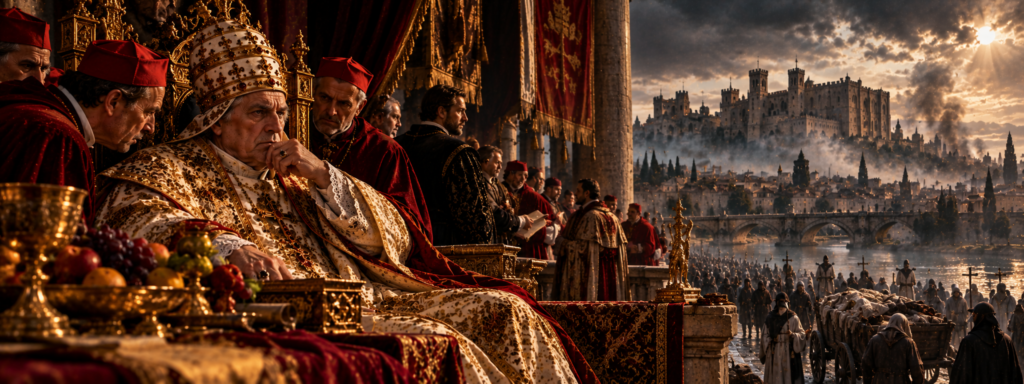
Clement VI: The Magnificent Pope Who Ruled Through the Black Death
Clement VI — 1342–1352
The palace at Avignon glittered while Europe died. Inside the papal court, musicians performed, artists worked beneath richly decorated ceilings, clerks carried documents through crowded chambers, ambassadors waited for audiences, and cardinals moved through a world increasingly famous for wealth and ceremony. Beyond those walls, beginning only a few years into Clement VI’s pontificate, the Black Death tore through cities and villages with a speed that made ordinary life seem suddenly fragile. Entire households vanished, cemeteries overflowed, frightened survivors searched desperately for explanations, and mobs began murdering Jewish communities accused of causing a catastrophe they had no power to create.
At the center of this strange and terrifying world sat Clement VI, one of the most magnificent, politically ambitious, generous, extravagant, and contradictory popes of the Middle Ages. He spent lavishly, promoted relatives, expanded the splendor of the Avignon papacy, intervened aggressively in European politics, and showed little interest in the austere style favored by his predecessor. Yet when plague panic produced massacres of Jews, Clement did something that complicates any attempt to portray him as a simple villain: he condemned the accusations, ordered Christians to stop attacking Jews, and pointed out that Jews themselves were dying from the same disease. In an age when frightened communities were burning innocent people alive, the famously luxurious pope could display more reason and humanity than many of the people condemning his wealth.
That contradiction makes Clement VI an unusually compelling figure for the Wicked Popes category. He was certainly worldly, unapologetically magnificent, heavily involved in dynastic patronage, and comfortable presiding over a papal court whose extravagance scandalized critics. His political methods could be ruthless, his conception of papal authority was enormous, and his generosity frequently blurred into nepotism. Yet he was not merely a corrupt churchman feasting while Europe suffered, and reducing him to that caricature would erase the very qualities that make his reign so fascinating.
Clement’s pontificate was a collision between splendor and catastrophe. He governed during war, rebellion, financial strain, political intrigue, earthquakes, religious tensions, and the greatest demographic disaster medieval Europe had experienced. He bought Avignon itself, fought an emperor, promoted his family, supported artists and scholars, dealt with the spectacular rise of Cola di Rienzo in Rome, proclaimed a shortened interval between jubilees, and watched plague transform the society around him. His reign asks an uncomfortable question that has followed wealthy religious institutions for centuries: how should spiritual authority look when it possesses enormous riches while ordinary people suffer?
Pierre Roger Before the Papal Crown
Clement VI was born Pierre Roger around 1291 in the Limousin region of France, into a family that was respectable and increasingly influential but hardly one of Europe’s great ruling dynasties. His path toward power came primarily through the Church, education, patronage, and his own considerable abilities. Pierre entered the Benedictine order and received an education that prepared him for the intellectual and political world of high ecclesiastical office. He became known not merely as an administrator but as an impressive preacher whose rhetorical talents helped distinguish him among ambitious clerics.
His rise was remarkably swift. Pierre became abbot of Fécamp, bishop of Arras, archbishop of Sens, and eventually archbishop of Rouen, placing him among the leading churchmen of France. He also served the French monarchy and moved comfortably through the political environment surrounding King Philip VI. By the time Pope Benedict XII made him a cardinal in 1338, Pierre Roger had accumulated the kind of experience that made him an obvious candidate for still greater office.
Benedict XII died in April 1342, and the cardinals elected Pierre Roger as his successor on May 7. He took the name Clement VI and was crowned later that month. The contrast between the new pope and his predecessor quickly became obvious, because Benedict had cultivated a comparatively restrained court and attempted to reform aspects of ecclesiastical administration. Clement had a dramatically different conception of what the papacy should look like.
Clement believed magnificence could serve authority. A pope claiming spiritual leadership over Latin Christendom should not, in his view, necessarily behave like an impoverished monk hiding behind bare walls. Ceremonial grandeur displayed the dignity of the office, patronage attracted talented people, generosity created loyalty, and an impressive court demonstrated the power of the institution Clement governed. The result was a papacy that dazzled admirers, horrified moralists, and gave later critics endless material with which to condemn him.
Avignon Becomes a Stage
The Avignon Papacy had begun before Clement VI, and it is misleading to imagine that he personally dragged the papacy away from Rome. Clement V had established the pattern of papal residence outside Rome decades earlier, while John XXII and Benedict XII had developed Avignon into an increasingly important center of ecclesiastical government. Political instability in Italy made residence at Rome difficult, and Avignon offered security, administrative convenience, and proximity to powerful western European networks. By Clement’s election, the city was already thoroughly associated with papal government.
Clement nevertheless gave Avignon a character distinctly his own. The papal palace expanded into an environment suitable for ceremony, diplomacy, administration, and spectacular hospitality. Artists were commissioned, interiors decorated, tapestries displayed, musicians supported, and elaborate banquets became part of a court culture designed to impress visitors. The pope’s residence was not simply a private home but a theater of authority in which architecture, clothing, ritual, art, and hospitality communicated power.
The magnificence was expensive, and Clement did not pretend otherwise. He inherited an extensive papal financial system capable of drawing revenue from ecclesiastical appointments, benefices, fees, taxation, and other sources spread across Christendom. Maintaining the curia required enormous administrative expenditure even before the costs of patronage and political intervention were considered. Under Clement, however, the distinction between necessary governmental expense and spectacular display became particularly difficult to ignore.
Critics could look at Avignon and see everything they feared had gone wrong with the medieval Church. Christ had preached among the poor, while his supposed representative entertained princes in richly furnished halls. Apostles had wandered with limited possessions, while cardinals accumulated benefices and households. The papacy could offer sophisticated explanations for why international government required money, but the contrast between Gospel poverty and courtly magnificence remained visually devastating.
The Pope Who Refused to Apologize for Splendor
Clement’s extravagance was not simply a matter of personal appetite. Medieval political culture expected powerful rulers to demonstrate generosity, and a leader who hoarded everything could appear weak, miserly, or incapable of rewarding service. Gifts created obligations, banquets created relationships, artistic patronage enhanced prestige, and magnificent ceremonies reinforced hierarchy. Clement understood these conventions exceptionally well and practiced them with enthusiasm.
He was also personally comfortable with luxury. Accounts of his court repeatedly emphasize sumptuous clothing, elaborate furnishings, entertainment, feasting, and a general atmosphere very different from the austerity associated with monastic reformers. Some hostile descriptions undoubtedly sharpened the contrast for moral effect, but the basic reputation for magnificence was well deserved. Clement did not govern as an ascetic accidentally surrounded by riches.
His generosity could be enormous. Money and offices flowed toward scholars, artists, churchmen, political allies, petitioners, and members of his extended family. This helped create a court remembered for cultural brilliance, but it also placed tremendous pressure on papal finances. The wealth Clement inherited from earlier administrations was consumed at a remarkable rate by his expansive style of government.
For a Wicked Popes profile, this is where temptation toward caricature becomes dangerous. Clement’s spending was excessive enough without inventing scenes of drunken debauchery or pretending every court expense represented stolen money. Medieval rulers operated through systems of patronage fundamentally different from modern bureaucratic states, and magnificence itself possessed political meaning. The scandal lies not in fictional orgies but in the extraordinary willingness of a spiritual monarchy to resemble the richest secular courts of Europe.
The Family Arrives
Where papal generosity becomes considerably more troubling is in Clement’s treatment of his relatives. Medieval popes routinely promoted family members because kinship provided networks of loyalty in a political environment where trust could be difficult to obtain. Clement embraced that practice enthusiastically. Members of the Roger family and connected families benefited enormously from his elevation.
Several relatives entered the College of Cardinals, while others received ecclesiastical offices, benefices, lands, influence, and opportunities that would have been unimaginable without a pope in the family. Clement was hardly the inventor of papal nepotism, and later Renaissance pontiffs would make family aggrandizement even more notorious. Nevertheless, his pontificate offers a clear example of spiritual office being used to construct and strengthen a dynasty.
The defense of such behavior was straightforward. A pope needed trustworthy men around him, and relatives could be expected to have strong incentives to protect the family’s most powerful member. Some papal relatives were also talented churchmen rather than useless parasites. Medieval society did not draw the same sharp boundary between family loyalty and public administration that modern governments theoretically attempt to maintain.
Yet the consequences were impossible to disguise. When relatives received cardinalates and lucrative positions, other candidates lost opportunities regardless of their merits. Ecclesiastical office carried money, status, and political power, making every appointment materially significant. Clement’s family therefore rose alongside the papacy itself, reinforcing the impression that the Church had become a ladder by which one fortunate dynasty could climb toward wealth.
A French Pope in a European Church
Clement’s close relationship with France created another source of suspicion. He had served the French crown before becoming pope, and his court remained culturally and politically intertwined with French interests. Critics of the Avignon Papacy increasingly portrayed the pontiffs as servants of France rather than universal leaders of Christianity. Clement’s policies sometimes strengthened that impression.
The reality was more complicated than the accusation. Clement pursued papal interests that did not always coincide perfectly with those of the French monarchy, and it would be inaccurate to reduce him to a puppet receiving instructions from Paris. The papacy possessed its own diplomatic objectives, territorial concerns, financial interests, and theories of universal authority. Clement was capable of supporting France while still understanding himself as an independent ruler.
The timing made neutrality particularly difficult. England and France were entering the long conflict later known as the Hundred Years’ War, and Clement repeatedly attempted to mediate between Christian rulers whose armies were devastating one another. The papacy had obvious reasons to seek peace, especially because warfare between Christian kingdoms interfered with hopes for crusading activity elsewhere. Yet a French pope residing near France could never easily persuade English observers that his sympathies were perfectly balanced.
Clement therefore occupied an awkward position in which almost any decision could be interpreted politically. Support for French interests confirmed English suspicions, while pressure on France could alienate important allies. His magnificent court depended upon diplomatic relationships that stretched across hostile kingdoms. The pope claiming universal spiritual fatherhood remained deeply embedded in the political rivalries of his age.
Louis of Bavaria and the Old War for Authority
Clement also inherited the papacy’s long confrontation with Louis IV of Bavaria, the Holy Roman Emperor who had fought bitterly with John XXII. Louis had been excommunicated and had once supported an antipope against John’s authority. By the time Clement became pope, years of conflict had hardened positions on both sides. Reconciliation was possible in theory but increasingly difficult in practice.
Clement maintained strong claims concerning papal authority and refused to simply erase the consequences of Louis’s previous resistance. Negotiations occurred, but the conditions demanded for reconciliation proved unacceptable to Louis and his supporters. The conflict therefore continued, mixing theology, constitutional argument, imperial politics, and the ambitions of rival German princes. Clement’s papacy remained deeply involved in determining who should possess legitimate imperial authority.
The pope eventually supported Charles of Luxembourg, the future Emperor Charles IV, as an alternative to Louis. Charles was elected king of the Romans in 1346 by electors opposed to Louis, earning hostile descriptions as a candidate dependent upon papal influence. The political situation remained contested until Louis unexpectedly died in 1347. His death removed the most formidable obstacle to Charles’s position without requiring a decisive military settlement.
Clement’s conduct in the conflict reveals how far his papal ideology extended beyond spiritual guidance. He believed the papacy possessed rights in relation to imperial legitimacy and was willing to use excommunication, diplomacy, political alliances, and electoral influence accordingly. This was not unusual within the long medieval struggle between popes and emperors, but it placed Clement firmly within the tradition of assertive papal monarchy. The luxurious court at Avignon was backed by an equally magnificent conception of papal power.
Rome Without Its Pope
While Clement governed from Avignon, Rome remained the city whose bishop he technically was. The physical absence of the pope created a strange political vacuum in which Roman aristocratic families, civic institutions, papal representatives, and popular movements competed for influence. Many Italians resented the papacy’s continued residence in France. Rome possessed immense symbolic prestige but often suffered political instability and economic decline.
Into this atmosphere stepped Cola di Rienzo, one of the most extraordinary political adventurers of the fourteenth century. Educated, eloquent, obsessed with the grandeur of ancient Rome, and gifted at theatrical political performance, Cola imagined a revival of Roman civic greatness. He denounced aristocratic violence and corruption while presenting himself as the champion of justice and the Roman people. His message resonated powerfully with citizens exhausted by factional disorder.
Clement initially viewed Cola with a degree of sympathy and gave him a position within the civic administration. When Cola seized power in 1347 and proclaimed an ambitious new political order, the pope did not immediately move to destroy him. The Roman tribune initially appeared capable of restoring order in a city where noble families had repeatedly undermined papal government. For a time, Clement could hope that this flamboyant reformer might accomplish what ordinary administrators had failed to achieve.
Cola’s ambitions soon expanded beyond what Clement was willing to tolerate. The tribune began imagining Rome as the center of a renewed political order capable of asserting authority throughout Italy and perhaps influencing the imperial succession itself. Ceremonies became increasingly grandiose, claims increasingly expansive, and relationships with both nobles and papal representatives deteriorated. Clement’s promising Roman reformer was becoming an independent political problem.
The Rise and Fall of Cola di Rienzo
Cola’s political style had much in common with Clement’s own understanding of magnificence, though the two men deployed spectacle toward very different ends. Both understood the emotional power of ceremony, symbols, impressive clothing, public declarations, and historical memory. Cola invoked ancient Rome, while Clement invoked papal monarchy. Their competing performances could coexist only while their political objectives remained compatible.
As Cola became more unpredictable and ambitious, Clement withdrew support. Papal opposition helped undermine the tribune’s legitimacy, while Roman aristocrats and other enemies gathered against him. By the end of 1347, Cola’s first extraordinary period of rule collapsed, and he fled Rome. The dream of civic resurrection had lasted only months.
The story did not end there. Cola later wandered through a strange sequence of experiences that included contact with radical religious currents and eventual imprisonment after seeking imperial support. He ultimately reached Avignon, where Clement’s successor would inherit the problem of what to do with him. Under Innocent VI, Cola returned to Rome in papal service before being killed during another uprising in 1354.
For Clement, the episode demonstrated the dangers created by ruling Rome from afar. The pope could issue commands and appoint representatives, but charismatic local leaders could exploit the absence of direct papal presence. Rome remained spiritually central yet politically distant. Avignon glittered, but every crisis in Italy reminded the papacy that magnificence in France could not entirely replace authority in its ancient city.
A Queen Accused of Murder
One of the darkest political scandals of Clement’s pontificate centered upon Joanna I, Queen of Naples. Joanna had inherited the Neapolitan throne while still young and was married to Andrew of Hungary, whose supporters expected him to exercise royal authority alongside her. The marriage was deeply troubled, while competing factions surrounded the couple. In September 1345, Andrew was murdered at Aversa, strangled and thrown from a window according to the most famous accounts of the killing.
Suspicion immediately fell upon people close to Joanna. Whether the queen herself ordered, knew about, or participated in the murder became one of the great controversies surrounding her reign. Her enemies treated her guilt as obvious, while modern historians have generally been more cautious because the surviving evidence does not establish her personal responsibility beyond dispute. The murder nevertheless triggered a political crisis with consequences extending directly into Clement’s papacy.
Andrew’s brother, King Louis I of Hungary, invaded southern Italy seeking vengeance and political control. Joanna fled her kingdom and eventually came to Provence, where she defended herself against accusations surrounding her husband’s death. Clement’s position was exceptionally delicate because the papacy possessed feudal claims concerning the Kingdom of Naples and therefore had a direct interest in its succession and stability. The case combined murder, dynastic warfare, legal jurisdiction, and papal diplomacy.
Joanna was ultimately not condemned as Andrew’s murderer, and Clement maintained relations with her. Critics later portrayed the outcome as evidence of corruption, especially because another major transaction soon connected the queen and the pope. That transaction involved the city in which Clement had built his magnificent court. In 1348, Avignon itself became papal property.
The Pope Buys Avignon
Avignon had previously belonged to Joanna as Countess of Provence rather than being the sovereign property of the pope. Clement negotiated its purchase in 1348 for a reported price of 80,000 florins. The acquisition gave the papacy direct ownership of the city that had become its administrative home. Symbolically and politically, the transaction was enormously important.
The timing created an irresistible scandal. Joanna had faced accusations concerning her husband’s murder, Clement had become involved in the political crisis surrounding her, and then the pope acquired Avignon from her. Later critics could easily arrange these events into a story of judicial favor purchased with a city. The narrative is dramatic, but chronology and coincidence do not by themselves prove a corrupt bargain.
There is no solid basis for stating as established fact that Clement cleared Joanna of murder in exchange for Avignon. The legal and political circumstances surrounding her case were more complicated, while the purchase had obvious practical value to the papacy independent of her personal troubles. Clement had every reason to secure control over the city in which the papal government had become deeply established. The transaction nevertheless looked suspicious enough to nourish hostile interpretations.
For a dark-history article, the distinction matters. Clement does not need to be falsely convicted of accepting an entire city as a bribe in order for the episode to remain fascinating. A queen under the shadow of murder sold the pope the city housing his luxurious court while Europe was entering one of the most catastrophic years in its history. The documented facts already possess enough atmosphere without transforming suspicion into certainty.
The Year Death Arrived
The Black Death had begun moving westward before the sale of Avignon was completed. By late 1347, plague had reached Mediterranean ports, carried along commercial routes connecting Europe with the Black Sea and eastern Mediterranean. In 1348 it spread with terrifying speed through southern France, Italy, Spain, and beyond. Communities that had never experienced mortality on such a scale suddenly found themselves surrounded by death.
Avignon was hit brutally. The papal city was crowded with clergy, diplomats, merchants, petitioners, servants, pilgrims, and residents, creating ideal conditions for contagious disease to move through the population. People fell ill rapidly, and many died within days. Ordinary burial practices struggled to cope with the volume of corpses.
Medieval observers had no knowledge of Yersinia pestis, bacterial transmission, or the ecological systems through which plague spread. Physicians worked within inherited medical frameworks involving humors, corrupted air, celestial influences, and environmental conditions. Religious explanations also flourished, with many Christians interpreting the catastrophe as divine punishment for human sin. When familiar explanations failed to stop the dying, terror created fertile ground for rumor.
Clement suddenly found himself governing from within the disaster. He did not flee permanently from Avignon, though physicians took precautions around him and his household. Famous accounts describe large fires being kept burning near the pope, partly reflecting contemporary ideas about purifying corrupted air. Whatever protective effect the measures may or may not have had, Clement survived while death continued around him.
A Pope Surrounded by Death
The atmosphere in Avignon must have been extraordinary. The magnificent palace that had symbolized papal confidence now stood within a city overwhelmed by mortality. Clerics died alongside laborers, wealthy households suffered alongside poor ones, and elaborate social distinctions offered little protection against infection. The pope’s gold could purchase physicians and isolation, but it could not restore certainty to the world beyond his chambers.
Clement responded through the religious and administrative tools available to him. He issued spiritual privileges connected with the dying and sought ways to address the enormous pastoral crisis created when priests themselves were dying too rapidly to minister normally. The scale of mortality forced ecclesiastical authorities to adapt because traditional procedures could not function under extraordinary conditions. A Church built around sacraments, confession, burial, and priestly ministry suddenly confronted death occurring faster than its clergy could manage.
The plague also exposed the limits of papal power. Clement could issue bulls across Europe, threaten rulers, appoint bishops, collect revenues, and intervene in imperial elections, but he could not command disease to stop. The contrast must have been stark even to contemporaries accustomed to believing in hierarchical order. One of Europe’s most powerful men sat at the center of a government that could regulate souls but could not explain why bodies were collapsing around it.
This helplessness helps explain why frightened populations searched for human enemies. Catastrophe without an identifiable cause is psychologically difficult to endure, while catastrophe caused by a supposed conspiracy offers someone to blame. Rumors began accusing Jews of poisoning wells and deliberately spreading disease. Those accusations were false, but fear does not require truth before it becomes violent.
The Poisoned-Well Lie
Anti-Jewish prejudice had deep roots in medieval Christian Europe long before the Black Death. Jewish communities faced discriminatory laws, religious hostility, periodic expulsions, forced conversions, economic restrictions, and outbreaks of mob violence. Christian teaching could simultaneously tolerate Jewish existence for theological reasons and subject Jews to degrading restrictions. The arrival of plague therefore encountered societies in which an identifiable religious minority was already vulnerable.
The accusation that Jews had poisoned wells spread across parts of Europe with devastating consequences. Confessions were sometimes extracted under torture, providing authorities with exactly the testimony their methods were designed to produce. Once a tortured prisoner confirmed the conspiracy, the confession could be used to justify further arrests and violence. Fear, torture, rumor, and prejudice reinforced one another.
The accusation made little sense when compared with the reality of the epidemic. Jewish communities were also dying from plague, and disease appeared in places where few or no Jews lived. Clement recognized these facts and explicitly used them against the conspiracy theory. His response stands as one of the most important aspects of his pontificate.
This does not transform Clement into a modern advocate of religious equality. He remained a fourteenth-century Christian pope whose theological understanding of Judaism contained assumptions and limitations unacceptable by modern standards. His policies toward non-Christians elsewhere could also be aggressive, and his broader worldview was thoroughly medieval. Yet during the specific crisis of plague persecution, he defended Jewish communities against accusations that were getting people murdered.
Clement VI Condemns the Massacres
Clement issued papal interventions in 1348 condemning attacks upon Jews and rejecting the claim that they were responsible for the plague. He observed that Jews themselves were suffering and dying, an obvious fact that should have undermined accusations of a coordinated Jewish plot. He also noted that the disease struck regions where Jews did not live. In the middle of mass panic, the pope used evidence and logic against a conspiracy theory.
He ordered churchmen to protect Jews and threatened spiritual penalties against those participating in persecution. Such commands could not magically stop violence across Europe, especially where local authorities either encouraged attacks or proved unwilling to confront mobs. Nevertheless, papal condemnation mattered because religious authority was frequently being invoked to justify hostility. Clement made clear that murdering Jews was not a legitimate Christian response to plague.
His actions become still more significant when placed beside the behavior of local communities. In some cities, Jews were arrested, tortured, expelled, burned, or massacred. Entire communities disappeared while property was confiscated and debts owed to Jewish lenders could conveniently vanish with the victims. Economic interest mixed easily with religious hatred and plague panic.
Clement’s intervention therefore deserves more than a passing sentence inserted to make his biography balanced. It directly challenges the simplest interpretation of him as a decadent churchman indifferent to suffering outside his palace. When terrified Christians sought vulnerable people to kill, Clement used his authority to oppose them. The pope famous for luxury behaved with greater restraint than many supposedly ordinary Christian communities.
The Limits of Papal Protection
Papal orders did not end the massacres. Violence against Jews spread through parts of Switzerland, the German lands, and other regions despite Clement’s condemnation. Local politics, economic motives, popular panic, and established antisemitism could prove stronger than distant commands from Avignon. Thousands of people suffered because rumor moved faster than protection.
Some authorities protected Jewish communities, while others participated in persecution or allowed it to proceed. In certain places, massacres occurred even before plague had fully arrived, demonstrating how fear of the disease could become almost as destructive as the disease itself. Property confiscation also gave rulers and towns material incentives that could align conveniently with accusations of conspiracy. Murder could be disguised as public defense while producing economic benefit.
Clement’s inability to stop the violence reveals the limits of medieval papal monarchy. Popes could make enormous claims about universal spiritual authority, but implementation depended upon bishops, princes, city governments, clergy, and local officials. A papal bull could condemn murder without providing soldiers capable of protecting every threatened neighborhood. The distance between legal authority and practical power could be enormous.
Yet failure to stop every massacre does not make the attempt meaningless. Clement placed the papacy formally against the plague libel and against indiscriminate violence toward Jews. He did so while the conspiracy theory was spreading rather than waiting for later generations to recognize its absurdity. In judging his pontificate, this act belongs beside the gold, banquets, nepotism, and political maneuvering rather than being buried beneath them.
The Pope and the Flagellants
The Black Death also produced dramatic religious movements among Christians. Groups of flagellants traveled from place to place publicly whipping themselves as acts of penance, believing extraordinary suffering might appease divine anger. Their processions could attract enormous crowds, especially among people desperate for some response to a catastrophe established institutions seemed unable to control. What began as penitential enthusiasm could become a challenge to ecclesiastical authority.
Some flagellant groups operated outside ordinary clerical supervision and developed claims or practices church leaders considered dangerous. Their gatherings could produce intense emotional excitement, apocalyptic expectations, and hostility toward outsiders. Flagellants were also associated in some regions with anti-Jewish violence, further increasing official concern. The movement therefore presented Clement with another crisis born from plague terror.
Clement eventually condemned unauthorized flagellant movements in 1349. His objections concerned both doctrinal disorder and the possibility that independent religious enthusiasm could escape ecclesiastical control. A pope whose government emphasized hierarchy was unlikely to welcome wandering groups claiming extraordinary spiritual authority outside normal church structures. The suppression demonstrates once again how Clement’s papacy combined pastoral concern with strong institutional control.
The contrast with his protection of Jews is revealing. Clement could be tolerant when he believed innocent minorities were being falsely blamed, yet intolerant when Christian movements challenged ecclesiastical order. His policies were not based upon a modern principle of universal religious liberty. They reflected a medieval conception of society in which the pope believed himself responsible for protecting certain groups while simultaneously regulating acceptable Christian belief and practice.
Death, Money, and the Church
The plague transformed ecclesiastical finances as well as religious life. Clergy died in enormous numbers, leaving benefices vacant and creating urgent demand for replacements. Property changed hands rapidly as families disappeared or inheritance patterns shifted. Institutions struggled to continue functioning in communities where the human structure supporting them had collapsed.
A centralized papal government inevitably became involved. Vacant offices, appointments, dispensations, petitions, and financial rights flowed through Avignon. Critics could interpret every payment as evidence that the Church profited from catastrophe, while administrators could argue that someone had to rebuild ecclesiastical government after mass mortality. Both perspectives contained elements of truth.
Clement’s reputation for spending made the financial dimension especially damaging. A pope already famous for luxury was particularly vulnerable to accusations of extracting wealth from a suffering Church. The administrative reality was more complicated than simple theft, but perception mattered. The sight of magnificence at Avignon could become morally offensive when news arrived from communities where priests and parishioners had died together.
The Black Death therefore sharpened an existing contradiction. Papal wealth could finance charity, administration, diplomacy, and religious institutions, but the same wealth could support banquets, relatives, artistic magnificence, and political projects. Money itself did not reveal which uses were righteous. Clement’s reign made the ambiguity impossible to ignore.
The Jubilee and a Flood of Pilgrims
Even after the worst initial waves of plague, Europe remained deeply traumatized. Clement nevertheless looked toward Rome and the tradition of the Jubilee, when pilgrims could receive extraordinary spiritual benefits by visiting the sacred city. The first great papal Jubilee had been proclaimed by Boniface VIII in 1300 with the expectation of a long interval before another. Clement shortened that interval and proclaimed a Jubilee for 1350.
The decision reflected theological reasoning as well as practical considerations. Clement connected the fifty-year interval with biblical jubilee traditions and opened the spiritual opportunity to a generation that otherwise would never have lived to see the next celebration. After the plague, when death had made spiritual anxiety almost universal, the promise of indulgence and pilgrimage carried enormous emotional power. People who had watched families disappear could seek reassurance in sacred travel.
Pilgrims poured toward Rome despite the dangers of travel and the continuing instability of the age. The city benefited economically from the influx, while the papacy remained physically absent in Avignon. This created another striking contradiction: Rome became the center of an enormous papally authorized religious celebration while the pope himself remained hundreds of miles away. Clement could magnify Rome’s sacred importance without returning to live there.
The Jubilee also demonstrated the enduring strength of papal spiritual authority after the plague. Disease had revealed the pope’s inability to control nature, but it had not destroyed belief in the Church’s power over penance, indulgence, and salvation. Clement understood this spiritual economy as deeply as he understood financial administration. The same pope associated with material magnificence could mobilize millions through promises concerning the invisible world.
Patron of Art in an Age of Graves
Clement’s court was one of the important cultural centers of fourteenth-century Europe. He patronized painters, musicians, scholars, and intellectuals, helping transform Avignon into something more than a bureaucratic headquarters. Italian artistic influence entered the papal palace, and court culture flourished around a ruler who appreciated beauty. Clement’s willingness to spend money therefore produced cultural achievements as well as scandal.
Artistic patronage was inseparable from politics. Decorated chambers impressed ambassadors, liturgical magnificence enhanced religious ceremony, and intellectual patronage strengthened the prestige of the papacy. Beauty communicated legitimacy in a world where most people experienced political authority visually and ceremonially. Clement understood that a magnificent institution could inspire awe before anyone heard its legal arguments.
The cultural brilliance of Avignon attracted both admiration and criticism. Petrarch, who spent significant time in the Avignon environment, became one of its most famous critics and described the papal city in language saturated with disgust toward corruption, ambition, and luxury. His writings helped shape the later image of Avignon as a kind of Babylonian captivity. Yet Petrarch himself depended upon the networks of patronage and ecclesiastical benefices associated with the world he criticized, making the relationship more complicated than simple outsider condemnation.
Clement’s court thus became both cultural achievement and moral symbol. To admirers, it demonstrated what enlightened patronage could create. To critics, every painted wall and jeweled vessel represented money that might have served humbler purposes. The argument has never entirely disappeared from discussions of wealthy religious institutions.
The Pope and Petrarch
Francesco Petrarch offers one of the most vivid windows into the intellectual atmosphere surrounding Avignon. The poet admired classical antiquity and increasingly dreamed of cultural renewal centered upon Rome rather than the papal court in southern France. He despised what he saw as the corruption of Avignon and attacked the environment with language that helped permanently stain its reputation. Clement therefore ruled under the gaze of one of the most talented literary critics of the age.
Petrarch’s hostility must be used carefully as historical evidence. Brilliant writers are not automatically neutral observers, and satire often exaggerates precisely because exaggeration makes it memorable. Avignon was not literally the infernal caricature hostile literature sometimes created. Its officials were not uniformly corrupt, nor were its cardinals universally depraved.
Yet hostile testimony matters because reputation is itself historical. Clement’s magnificence created conditions in which accusations of worldliness seemed plausible even when particular stories were embellished. A papal court that cultivated splendor could hardly complain when moralists judged it by the standards of apostolic poverty. The visual language of wealth invited theological criticism.
Clement appears to have been far less embarrassed by magnificence than Petrarch wished him to be. He believed papal authority could coexist with cultivated luxury, artistic patronage, generosity, and court ceremony. His confidence makes him fascinating because he did not behave like a guilty hypocrite desperately concealing his wealth. He governed as though grandeur naturally belonged to the office.
Nepotism With a Long Shadow
Clement’s family patronage had consequences extending beyond his own lifetime. Relatives elevated during his reign remained influential within the Church, and the networks he strengthened helped shape later ecclesiastical politics. Among those connected to his family was Pierre Roger de Beaufort, who eventually became Pope Gregory XI, the pontiff who returned the papal court to Rome in 1377. Clement’s dynasty therefore became woven into the later history of the Avignon Papacy itself.
This illustrates why nepotism was so tempting to medieval and Renaissance popes. A pontiff could not establish a legitimate hereditary papal monarchy, because the office was elective, but he could place relatives in positions capable of influencing future elections and policies. Cardinal nephews could preserve family power after the pope’s death. Ecclesiastical patronage offered dynastic continuity inside an institution theoretically governed by spiritual vocation.
The practice also created obvious corruption risks. Cardinals helped elect popes, controlled enormous resources, and influenced diplomacy throughout Europe. Filling the College with relatives and clients could distort the supposedly universal character of the institution. Even talented relatives entered office beneath a shadow because everyone knew who had opened the door.
Clement’s nepotism therefore deserves criticism without requiring modern assumptions that every medieval family connection was automatically scandalous. He operated within a culture where kinship mattered enormously, but he exploited that culture on a remarkable scale. His family rose because he became pope. That fact alone ensured that accusations of worldly ambition would cling to his reign.
A Pope Who Gave Freely and Spent Recklessly
Clement’s reputation for generosity complicates the charge of simple greed. A miser accumulates wealth primarily for himself, whereas Clement allowed money to flow outward with extraordinary ease. He gave gifts, supported petitioners, rewarded servants, patronized culture, assisted institutions, and used wealth as a political instrument. His problem was less hoarding than magnificent expenditure.
That distinction does not absolve him. Money spent generously can still be extracted through systems that burden others, and gifts can purchase loyalty as effectively as bribes. A ruler who distributes resources to relatives and supporters may appear generous while simultaneously building a political machine. Clement understood the relationship between generosity and authority exceptionally well.
His spending eventually weakened the financial reserves accumulated under previous popes. The papacy remained capable of raising substantial revenue, but Clement’s court consumed resources at a formidable rate. Magnificence had become part of government, and reducing it would have meant changing the public character of the pontificate. Clement showed little interest in such retreat.
The moral picture is therefore stranger than that of a greedy pope clutching treasure. Clement gathered resources and then transformed them into art, patronage, ceremony, family advancement, diplomacy, administration, and political influence. The money did not merely sit in chests. It became power.
Crusading Dreams and Harsh Boundaries
Clement’s protection of Jews during the Black Death should not be mistaken for a general philosophy of religious pluralism. Like other medieval popes, he operated within a Christian worldview that placed the Church at the center of legitimate spiritual order. He supported crusading projects and maintained traditional distinctions between Christians and non-Christians. His tolerance had boundaries determined by theology rather than modern ideas of equal citizenship.
This is important because heroic portrayals can become as misleading as hostile ones. Clement opposed the massacre of Jews because the accusations were false, the killings violated established protections, and Christian authority had obligations toward communities living under its jurisdiction. He did not therefore conclude that Judaism and Christianity possessed equal theological standing. Medieval papal protection could coexist with discrimination.
His broader attitudes toward non-Christian peoples could be considerably more aggressive. Crusading remained a legitimate and desirable project within his political imagination, particularly in relation to territories associated with Christian claims or expansion. The same pope capable of protecting one religious minority could support coercive policies elsewhere. The apparent contradiction becomes understandable only when viewed through the categories of his own age.
Clement therefore resists moral simplification in both directions. He was neither a modern humanitarian mysteriously transported into the fourteenth century nor a mindless persecutor incapable of restraint. His response to Jews during the plague was genuinely significant precisely because it occurred within a society saturated with religious prejudice. He deserves credit for what he did without being transformed into something he was not.
Why Clement VI Belongs Among the Wicked Popes
At first glance, Clement may seem less obviously wicked than figures such as Benedict IX, Stephen VI, or John XII. There is no corpse placed on trial, no reliably documented sale of the papacy, and no need to rely upon stories of sexual depravity or personal murder. His scandals are largely institutional: extravagance, nepotism, political manipulation, immense expenditure, and a conception of papal monarchy comfortable with worldly power. That makes his darkness quieter but no less revealing.
His court embodied a fundamental contradiction within medieval Christianity. The religion venerated a founder who preached among ordinary people and warned repeatedly about wealth, yet its highest western institution could resemble a royal court. Clement did not create that contradiction, but he displayed it with exceptional magnificence. His papacy made spiritual monarchy look very much like secular monarchy.
Nepotism deepened the problem because it suggested that sacred authority could become family opportunity. Clement’s relatives entered positions of influence through a system controlled by their kinsman. Even where those relatives were competent, the pattern damaged confidence that ecclesiastical office was distributed primarily for spiritual reasons. The pope who claimed universal fatherhood behaved conspicuously as a member of a particular family.
His political interventions created similar tensions. Clement acted as judge, diplomat, territorial ruler, patron, financial administrator, and kingmaker while simultaneously claiming the spiritual leadership of Christianity. Every role could be defended individually. Together they created an institution almost impossible to distinguish from the great secular powers it regularly criticized.
Why Clement VI Does Not Belong Among the Monsters
Yet placing Clement among Wicked Popes requires an equally important qualification. He should not be treated as though lavish spending erased every admirable decision he made. During the Black Death, when conspiracy theories turned terrified populations against Jewish communities, Clement refused to validate the lie. He used papal authority against persecution rather than encouraging it.
That matters enormously because other choices were available. A pope seeking popularity could have remained silent while mobs found scapegoats. He might have accepted tortured confessions as evidence or allowed local authorities to define Jews as enemies of Christian society. Instead, Clement challenged the accusation and attempted to protect those being attacked.
His response also demonstrated intellectual clarity in a moment dominated by panic. Jews were dying too, and plague existed where Jewish communities did not. These facts did not explain the disease scientifically, but they demolished the claim that Jews were causing it through poisoned wells. Clement recognized the contradiction while many others preferred murder to reason.
A historically responsible Wicked Popes category should have room for precisely this kind of figure. Wickedness need not mean that every action of a pope was wicked or that every hostile accusation was true. Clement’s story becomes more compelling when his admirable actions remain beside his excesses. A man can preside over a scandalously luxurious court and still stand against a massacre.
The Black Death Changes Everything
Nothing during Clement’s reign could ultimately compete with the Black Death in historical significance. Political quarrels that seemed enormous in 1345 suddenly appeared almost trivial beside a catastrophe killing people across continents. The plague transformed labor, landholding, religious life, economic relationships, family structures, and attitudes toward death. Europe emerging from the epidemic was not the Europe that had entered it.
The Church suffered profoundly. Monasteries lost members, parish clergy died, religious communities struggled to replace educated personnel, and survivors questioned why divine providence had permitted such destruction. Some people responded with intensified devotion, while others became more skeptical of clergy who had proved no less vulnerable than anyone else. The catastrophe exposed both the emotional importance and the practical limitations of institutional religion.
Clement’s survival inevitably gave him a strange symbolic position. The pope lived while countless others died, protected by the resources of the richest religious institution in western Europe. It would be unfair to condemn him merely for surviving or for accepting medical precautions unavailable to the poor. Nevertheless, the image of a protected pontiff surrounded by fire and attendants while ordinary families died in crowded houses possesses an unavoidable moral power.
That image should not obscure what Clement did with his survival. He continued governing, responded to pastoral emergencies, condemned persecution, authorized measures intended to help Christians facing death, and attempted to preserve institutional order amid chaos. The luxurious pope did not simply lock his doors and wait for the poor to disappear. His response was imperfect, medieval, and constrained by limited knowledge, but it was still a response.
Magnificence in the Shadow of Mass Graves
The darkest irony of Clement’s pontificate lies in the coexistence of beauty and death. Artists continued decorating the papal environment while graveyards filled. Musicians performed while funeral rites multiplied. Gold and color accumulated inside a court surrounded by a continent increasingly dressed in mourning.
There is something almost disturbing about that contrast, but beauty during catastrophe is not necessarily cruelty. Patronage kept craftsmen employed, religious art could offer consolation, and ceremonial continuity could reassure people that social order had not entirely collapsed. Human beings have always continued creating art during war, plague, and disaster. Clement’s court can therefore be understood as both extravagant and culturally resilient.
The moral difficulty lies in proportion. How much magnificence was necessary to sustain authority, and when did magnificence become self-indulgence? How much family patronage represented practical trust, and when did trust become nepotism? How much papal revenue supported the Church, and how much supported the lifestyle of its elite?
Medieval critics asked versions of these questions even without modern democratic assumptions. Calls for apostolic poverty had existed for centuries, sometimes producing movements condemned as heretical precisely because they challenged wealthy ecclesiastical institutions. Clement inherited that long tension between the Church as spiritual community and the Church as political institution. His personality pushed the institutional side toward spectacular visibility.
The Purchase That Made Avignon Papal
The acquisition of Avignon in 1348 symbolized the transformation perfectly. What had begun as a place of papal residence became papal territory. Clement was no longer merely a guest governing from another ruler’s city. The papacy had purchased its home.
The transaction strengthened papal security and administrative independence. It also suggested that the Avignon arrangement was becoming more permanent at precisely the moment many Italians hoped the pope would return to Rome. Every investment in the city could be interpreted as another sign that the papacy had grown comfortable away from its ancient seat. Clement’s magnificent court increasingly seemed rooted in French soil.
Avignon would remain under papal control for centuries after the popes themselves returned to Rome. Clement’s purchase therefore had consequences far beyond his own reign. A transaction associated in popular memory with scandal became a durable territorial acquisition. The pope famous for spending money had bought something the papacy actually kept.
Yet even this achievement carried an ambiguous legacy. Securing Avignon made practical sense, but it strengthened the institutional world critics already considered dangerously comfortable. Clement solved one political problem while deepening another symbolic one. The papacy became safer in Avignon and perhaps more alienated from Rome.
The Final Years
The later years of Clement’s pontificate unfolded in a Europe still recovering from plague. Political disputes continued despite demographic catastrophe, because kings, nobles, cities, and churchmen did not stop competing merely because millions had died. Clement remained active in diplomacy and ecclesiastical administration. His court continued functioning as one of Europe’s great centers of political and cultural life.
His health eventually deteriorated, and he died at Avignon on December 6, 1352. He had ruled for slightly more than a decade, yet those ten years contained enough catastrophe and political drama for a much longer reign. The world of 1352 had been transformed almost beyond recognition from the world in which he had been elected in 1342. Few popes have governed across such a violent historical divide.
Clement was buried at the Benedictine abbey of La Chaise-Dieu, an institution with which he had longstanding connections and which he had richly favored. Even in death, the relationship between religious devotion and magnificent patronage remained visible. His tomb and memorial culture reflected the same confidence in splendor that had characterized his pontificate.
He left the papacy financially strained compared with the reserves available when he became pope, but culturally enriched and politically formidable. His relatives remained influential, Avignon belonged to the papacy, and the institution had survived the Black Death. His successor inherited both the strengths and the liabilities of Clement’s magnificent government.
The Case Against Clement VI
The strongest case against Clement does not depend upon sensational allegations. He promoted relatives on a scale that clearly served dynastic interests, spent enormous sums maintaining a magnificent court, and participated aggressively in the political struggles of his age. His conception of papal office comfortably incorporated wealth and temporal power. For critics seeking apostolic simplicity, Clement represented almost everything wrong with the medieval papal monarchy.
His extravagance also carried opportunity costs. Resources devoted to court display were resources unavailable for other purposes, even if medieval financial structures make simplistic comparisons difficult. Money spent on magnificence could still support artists and workers, but it also reinforced elite privilege. The pope’s generosity did not eliminate the inequalities surrounding his court.
Nepotism remains still harder to defend. Trust in relatives may have been understandable, but repeatedly advancing family members blurred the boundary between service to the Church and service to the Roger dynasty. Clement benefited people because they were connected to him by blood. That is precisely the kind of practice that made later reformers demand clearer separation between ecclesiastical office and family interest.
His political style likewise reflected enormous confidence in papal supremacy. Clement could be diplomatic, but he was not timid about asserting jurisdiction over rulers or influencing imperial politics. Spiritual sanctions and political objectives existed within the same papal arsenal. His Church was not merely a community of believers but a formidable international government.
The Case for Clement VI
The defense of Clement begins with competence. He was educated, articulate, politically experienced, and capable of governing through extraordinary circumstances. His patronage helped make Avignon a major cultural center. His generosity supported people and institutions rather than simply enriching himself.
His behavior during the Black Death strengthens the defense considerably. Clement did not possess modern medical knowledge, but he recognized that blaming Jews was irrational and dangerous. He publicly challenged the conspiracy theory and attempted to protect communities facing violence. That response deserves recognition without qualification or embarrassment.
He also continued administering the Church during an unprecedented crisis. The death of clergy required emergency responses, while frightened populations needed pastoral care. Clement used the mechanisms available to him rather than abandoning government. Whatever one thinks of the Avignon papacy, institutional continuity during catastrophe mattered.
Even his magnificence can be understood within medieval expectations of rulership. Kings, bishops, princes, and popes used display to communicate authority, and generosity was considered a virtue of great rulers. Clement took those expectations to extraordinary lengths, but he did not invent them. Judging him fairly requires understanding the political language he was speaking even when criticizing how loudly he spoke it.
The Pope of Contradictions
Clement VI seems almost designed to frustrate simple moral categories. He was extravagant but generous, nepotistic but capable, politically aggressive but diplomatically active, thoroughly medieval yet occasionally strikingly rational. He defended Jewish communities while maintaining a worldview that did not imagine religious equality. He loved magnificence while governing through the greatest mass-death event of his century.
Those contradictions are not flaws in the historical record that need to be resolved. They are the historical record. Human beings rarely behave with the ideological consistency later storytellers prefer. A pope capable of vanity in one situation could display courage in another.
Clement’s complexity also reveals the danger of categories such as Wicked Popes when they become too rigid. Some pontiffs fit easily because their documented conduct includes extraordinary violence, corruption, or abuse. Others belong because their reigns expose darker aspects of ecclesiastical power rather than because they were personally monstrous. Clement belongs overwhelmingly to the second group.
His pontificate illuminates wealth, privilege, family patronage, political power, and the tension between spiritual ideals and institutional magnificence. It also provides a rare example of papal authority being used against mass persecution at a moment when intervention genuinely mattered. Both realities deserve to remain visible. Removing either one produces a less interesting and less truthful Clement VI.
The Palace and the Pyre
Two images can represent Clement’s age. The first is the papal palace at Avignon, glowing with candlelight, filled with art, ceremony, music, fine clothing, political conversation, and the movement of wealth. The second is a Jewish community somewhere north or east of Avignon being accused of poisoning wells while frightened neighbors gather and authorities decide whether to protect them or surrender them to violence. Clement’s historical reputation exists between those images.
The palace represents the accusation against him. It reveals a papacy comfortable with wealth at a time when Christian preaching continued to celebrate humility and poverty. Clement’s family benefited from his position, his court consumed enormous resources, and magnificence became one of the defining characteristics of his reign. No responsible biography should disguise that extravagance.
The threatened Jewish community represents the complication. When people demanded scapegoats, Clement refused to sanctify their hatred. He pointed toward reality, condemned persecution, and attempted to use the machinery of the Church to stop murder. The same centralized authority criticized for collecting money and distributing offices could become a shield when local communities turned violently against minorities.
Neither image cancels the other. Protecting Jews during the plague does not erase nepotism, and nepotism does not erase the protection of Jews. History becomes dishonest when good deeds are treated as absolution or bad deeds as proof that goodness was impossible. Clement VI requires both to remain in the frame.
When Wickedness Is Not Monstrous
The word wicked naturally suggests deliberate cruelty, and Clement does not fit that expectation comfortably. His reign lacks the grotesque theatricality of the Cadaver Synod or the spectacular moral accusations surrounding John XII. His faults were more recognizable and perhaps more ordinary: love of luxury, family favoritism, political ambition, institutional arrogance, and willingness to spend resources on magnificence. These failings can seem almost mild beside murder and torture.
Yet institutional corruption rarely requires a monster. It can emerge when intelligent people normalize practices benefiting themselves and their networks because those practices are customary, useful, or politically convenient. Clement could sincerely believe magnificent papal government served the Church while simultaneously enjoying that magnificence. He could believe relatives were trustworthy while overlooking the unfair advantages they received.
This is why his story belongs in dark history. The most useful subjects are not always those whose villainy is obvious. Sometimes they reveal how questionable systems can flourish under competent, cultured, even generous rulers. Clement’s virtues did not prevent his court from becoming a symbol of ecclesiastical worldliness.
At the same time, his virtues mattered when circumstances demanded them. During plague persecution, administrative authority and moral restraint aligned in a way that saved lives where papal commands were obeyed. Clement’s willingness to contradict popular hysteria demonstrates that powerful institutions can also resist collective cruelty. His reign therefore becomes a study not merely in corruption but in the unpredictable moral uses of power.
A World Dying Outside the Gates
It is impossible to know exactly how Clement emotionally experienced the Black Death. Medieval documents reveal actions more reliably than private feelings, and later imagination should not manufacture scenes of the pope wandering alone through his palace tormented by the sound of funeral bells. What can be said is that death surrounded the government he led. People Clement knew, officials his administration required, clergy throughout Christendom, and countless ordinary Christians disappeared within a few years.
The catastrophe must have changed the practical atmosphere of the papal court even if magnificence continued. Every petition arriving from a devastated diocese represented communities whose normal structures had broken down. Vacancies multiplied because officeholders were dead rather than merely promoted elsewhere. Requests for spiritual assistance emerged from people who had watched familiar religious routines collapse.
Clement responded as a medieval pope rather than a modern public-health official. He could offer indulgences, permissions, ecclesiastical regulations, prayers, charitable assistance, and moral commands, but he could not organize antibiotics or understand bacterial transmission. Judging him for failing to possess knowledge unavailable to his century would be meaningless. Judging how he used the authority and knowledge he did possess is far more revealing.
On that measure, his response was mixed but often serious. He protected himself, continued governing, adapted ecclesiastical practice, and confronted anti-Jewish violence. He could not stop plague, and he could not stop every massacre. He nevertheless refused to make the catastrophe worse by endorsing a murderous lie.
The Price of Magnificence
Clement’s financial legacy became easier to criticize after his death because extravagance leaves numbers, buildings, beneficiaries, and debts behind. The papal administration had enormous revenue-generating capacity, but his style of government consumed wealth rapidly. Patronage networks created expectations that successors might struggle to satisfy. Magnificence, once established as normal, becomes difficult to reduce without appearing diminished.
This is one of the recurring dangers of court culture. A ruler may initially use spectacle to display strength, but eventually spectacle becomes necessary to avoid displaying weakness. Cardinals expect households appropriate to their rank, ambassadors expect ceremonies, relatives expect advancement, artists expect commissions, and political allies expect rewards. Luxury turns from choice into structure.
Clement participated enthusiastically in that process. He was not trapped reluctantly inside a magnificent system because he clearly enjoyed and encouraged it. Yet the system was larger than personal taste. Avignon had become a court society in which ecclesiastical government operated through the same languages of patronage and display used by secular monarchies.
The spiritual problem remained impossible to escape. Christianity possessed powerful traditions warning that wealth could corrupt the soul, while the papacy possessed powerful practical reasons for accumulating wealth. Clement’s reign did not solve that contradiction. It illuminated it with gold.
A Reputation Built in Gold and Plague
Clement VI has never possessed the kind of instantly infamous reputation attached to a handful of spectacularly scandalous popes. His name is more often encountered in histories of Avignon, the Black Death, papal finances, medieval art, or European politics. Yet those subjects converge into a remarkable portrait. Few pontificates offer such a dramatic contrast between privilege and catastrophe.
His wealth made him vulnerable to criticism, while his response to plague complicates the criticism. His family patronage appears self-serving, while his broader generosity prevents him from looking merely avaricious. His political ambitions reveal a powerful institutional monarch, while his cultural patronage reveals a sophisticated ruler capable of appreciating scholarship and art. Every accusation seems to encounter a qualification.
That does not mean historical judgment becomes impossible. Clement clearly participated in nepotism, clearly presided over an exceptionally lavish court, and clearly embraced a worldly style of papal monarchy. Those choices deserve scrutiny because they shaped the Church and benefited elites around him. Nuance should refine judgment rather than eliminate it.
The same principle applies to his admirable actions. His protection of Jews should not be minimized simply because modern readers expect medieval popes to be intolerant. Clement deserves recognition for opposing a deadly conspiracy theory when doing so mattered. Historical fairness works in both directions.
The Magnificent Pope in the Age of Death
Clement VI died in 1352 having ruled through one of the darkest decades in European history. He had entered office as a brilliant French churchman with a taste for magnificence and left behind a papacy permanently associated with the splendor of Avignon. Between those moments, plague had killed an enormous portion of Europe’s population, political conflicts had continued, Jewish communities had been massacred, Rome had experimented with revolution, and the pope had purchased the city from which he governed. His reign was crowded with contradictions because the world around him was crowded with catastrophe.
He deserves criticism for the court he created and the family system he strengthened. Clement understood perfectly well that ecclesiastical office brought wealth and influence, yet relatives benefited conspicuously from his power. He spent resources on a scale that astonished contemporaries and helped transform Avignon into a symbol of churchly luxury. The pope who represented a religion founded around a wandering preacher lived with the magnificence of a monarch.
Yet that is not the whole judgment, and pretending otherwise would turn history into propaganda. Clement’s response to anti-Jewish persecution during the Black Death stands among the most significant moral actions of his pontificate. He rejected false accusations when false accusations were killing people, and he used papal authority to demand protection for a vulnerable minority. He could not stop every massacre, but he refused to give the massacres religious legitimacy.
That decision matters precisely because Clement was no modern liberal hero. He lived inside a deeply hierarchical Christian worldview and accepted many assumptions modern readers would reject. His willingness to defend Jews therefore emerged not from twenty-first-century ideals but from principles available within his own medieval world. Other people facing the same choices chose violence.
Clement chose differently. The man surrounded by luxury could still recognize injustice outside his palace. The pope accused of worldliness could still use his office to restrain people who believed murder was an acceptable response to fear.
This does not absolve him of extravagance because moral accounting does not work by cancellation. Protecting innocent people does not make nepotism harmless, just as promoting relatives does not make the protection of innocent people meaningless. Clement’s life resists the comforting idea that good people consistently do good things and corrupt people consistently do evil ones. Human beings are rarely organized so neatly.
His papacy also demonstrates why institutional power cannot be judged solely by appearances. The magnificent machinery of Avignon could collect revenues and reward papal relatives, but that same machinery could send commands demanding that Jews be protected from mobs. Centralized authority could become oppressive or protective depending upon the purpose for which it was used. Clement’s reign contained both possibilities.
The Black Death exposed that contradiction with terrible clarity. The papacy possessed wealth, theology, legal authority, international networks, and centuries of accumulated prestige, yet none of those things could stop an invisible disease. Clement could command Christians but not bacteria. The most powerful spiritual monarch in western Europe remained helpless before the biological catastrophe unfolding around him.
Perhaps that helplessness makes the magnificence of Avignon appear even stranger. Gold could decorate a chamber but could not keep plague from a city. Fine tapestries could cover stone walls but could not cover the graves multiplying beyond them.
Relatives could be made cardinals but could not be made immortal. Political authority could determine an imperial election but could not determine who would survive the next week.
Yet people continued building, painting, praying, governing, arguing, eating, marrying, and creating music because catastrophe does not suspend human life completely. Clement’s court remained magnificent partly because medieval government depended upon continuity. The palace still needed clerks, servants, diplomats, guards, cooks, chaplains, artists, and administrators. Life persisted beside death.
This is why the image of Clement feasting while Europe died must be treated carefully. It contains a powerful symbolic truth about inequality, but it can become historically misleading if taken literally as proof of indifference. Clement’s government was responding to the catastrophe even while the court continued functioning. Splendor and responsibility existed simultaneously.
The same caution should govern stories about Queen Joanna and the purchase of Avignon. The coincidence of her political troubles and the sale of the city invited accusations that Clement had effectively accepted Avignon in exchange for favorable treatment. That interpretation is dramatically satisfying but not established fact. The real political relationship was complicated enough without inventing a transaction history cannot prove.
Clement’s genuine actions already provide abundant material for judgment. He bought Avignon, supported Charles IV against Louis of Bavaria, intervened in Roman politics, promoted relatives, spent magnificently, supported artists, expanded patronage, confronted flagellants, shortened the Jubilee interval, and governed during the Black Death. His pontificate does not need fictional crimes to become extraordinary.
The temptation to exaggerate Clement probably arises because he occupies the Wicked Popes category beside men associated with murder, sexual scandal, corpse trials, simony, and violent usurpation. His faults can appear comparatively tame. Luxury and nepotism lack the theatrical horror of strangled rivals or mutilated antipopes.
Yet corruption does not become harmless merely because it is elegant. Family advancement through sacred office raises serious questions about whose interests an institution serves. Lavish expenditure by religious elites raises serious questions when those elites preach spiritual detachment to everyone else.
Clement’s papacy embodied those questions on a spectacular scale. He did not hide wealth beneath an appearance of austerity. He made magnificence part of the visual language of papal government.
That confidence may be one reason his court became so culturally important. Clement attracted talent because he was willing to spend money on talent. Artists, scholars, musicians, diplomats, and clerics found opportunities in Avignon that austerity might never have provided.
Beauty came from the same patronage system that produced accusations of corruption. The painted palace and the promoted nephew belonged to the same political culture.
This is another reason moral judgment remains difficult. Money used for luxury can also create art that survives for centuries. Patronage used to strengthen a ruler’s prestige can also support intellectual work of genuine value.
Institutions rarely divide their expenditures neatly between pure selfishness and pure public benefit. Clement’s Avignon demonstrates how thoroughly the two can intertwine.
His generosity presents the same problem. Clement did not behave like a miser terrified of losing every coin. He distributed resources freely and sometimes extravagantly.
Generosity could alleviate need, reward merit, and encourage culture. It could also purchase loyalty and strengthen patronage networks.
A pope could therefore appear simultaneously generous and corrupt without either description being false. Clement’s willingness to give made him popular among beneficiaries and suspicious to reformers. The question was never simply whether money left his hands.
The question was why it left, where it went, and what relationships it created. Those questions remain relevant to powerful institutions long after Clement’s world disappeared.
His protection of Jews belongs in a different moral category because its purpose was unusually clear. People were being accused falsely and killed. Clement told Christians that the accusation was wrong and the killing must stop.
There is no need to romanticize his motives to recognize the importance of the decision. Whatever mixture of theology, law, reason, pastoral responsibility, and political order informed his actions, the result placed papal authority against persecution.
That stance becomes more impressive when contrasted with the failure of so many local authorities. Some officials yielded to popular pressure, while others discovered financial advantages in confiscated Jewish property or canceled debts. Fear and greed could reinforce one another with murderous efficiency.
Clement had access to the same prejudices circulating through medieval Christian society. He nevertheless rejected the central plague conspiracy and demanded restraint.
His reasoning was strikingly straightforward. Jews were dying too, and plague struck places without Jewish communities. These observations did not reveal the true cause of the disease, but they exposed the accusation as irrational.
In an age of uncertainty, recognizing that much was an achievement. Clement could admit ignorance rather than fill ignorance with a convenient enemy.
That distinction is perhaps the most important lesson of his plague response. Human beings confronted with catastrophe often prefer a false explanation to no explanation at all. A conspiracy gives suffering a villain, while uncertainty gives suffering nothing but fear.
Clement resisted that psychological temptation in one of the most dangerous contexts imaginable. Many others did not.
The flagellant controversy shows the limits of his tolerance. Clement was willing to defend Jews from false accusation, but he was far less willing to tolerate Christian movements operating beyond established ecclesiastical authority. Once flagellant groups appeared threatening to doctrinal or institutional order, papal condemnation followed.
From Clement’s perspective, these policies were perfectly compatible. Jews living under Christian protection should not be murdered for imaginary crimes, while Christians remained subject to the disciplinary authority of the Church. Modern readers may see inconsistency where Clement saw different legal categories.
Understanding that worldview helps explain him without requiring agreement with it. Medieval tolerance was not modern pluralism. Protection could exist within a hierarchy that remained discriminatory.
Clement’s response to Jews was therefore limited, but limited protection during a massacre still mattered. Historical praise need not require pretending that a fourteenth-century pope secretly possessed twenty-first-century values.
His politics were similarly medieval in ways modern readers can easily misunderstand. Clement believed papal authority had legitimate consequences for emperors, kings, and political communities. His intervention against Louis of Bavaria therefore did not appear to him as an inappropriate invasion of secular politics.
Spiritual and temporal authority overlapped throughout medieval political thought. The argument concerned where boundaries should be drawn, not whether religion and politics could be separated completely.
Clement drew those boundaries expansively. He inherited centuries of papal claims and showed little inclination to surrender them. His support for Charles IV demonstrated that Avignon remained capable of influencing imperial politics despite the papacy’s physical distance from Rome.
The luxurious court was therefore not merely decorative. It was the headquarters of an institution still claiming a voice in the political organization of Christian Europe.
This is where magnificence and power meet. Clement’s banquets, buildings, clothing, ceremonies, patronage, and art all communicated that the papacy remained formidable. A poor-looking court might have preached humility more convincingly but could also have appeared politically diminished.
Clement chose majesty over austerity. He accepted the moral risks that came with that choice.
His critics preserved those risks in his reputation. Avignon became shorthand for ecclesiastical corruption long after Clement died. Later reformers looked back upon the papal court there as evidence that the Church had become too entangled with money and politics.
Some of that reputation grew from polemic and nostalgia for Rome. Some of it grew from realities men such as Clement made impossible to ignore.
The grandeur he created therefore outlived him in two forms. It survived culturally through art, architecture, and patronage. It survived negatively through stories of luxury, nepotism, and papal worldliness.
Few rulers control which version posterity remembers. Clement provided abundant material for both.
His family also carried his influence beyond the grave. Relatives elevated under his patronage continued moving through the highest levels of ecclesiastical politics. The papal monarchy could not become formally hereditary, but nepotism allowed families to reproduce influence inside an elective system.
Clement understood that reality and used it. Whether he thought of his behavior as corruption is far less important than recognizing what the behavior accomplished.
It created advantage. Blood relationship to the pope became a pathway toward power.
That alone justifies including nepotism prominently in any assessment of his reign. Medieval custom explains the practice but does not neutralize its effects. Other churchmen without papal relatives competed in a system where family connections could determine careers.
Clement did not invent that inequality. He benefited his own family through it with remarkable enthusiasm.
The final judgment must therefore resist both condemnation and rehabilitation. Clement VI was not secretly innocent of every criticism simply because he protected Jews during the plague. Nor was he a decadent monster whose good actions should be ignored because they complicate a satisfying villain story.
He was a powerful ruler capable of behavior ranging from self-serving patronage to morally significant intervention. The range is what makes him human.
It also makes him more useful for Infamous History than a caricature would be. History becomes darker, not lighter, when we recognize that questionable institutions can be administered by intelligent and occasionally admirable people. Cruelty does not always arrive wearing an obvious villain’s face.
Neither does courage always arrive through saints. Sometimes the man issuing the order to stop a massacre is sitting in the richest palace in Christendom.
Clement’s Avignon therefore deserves to remain visually magnificent in our memory. The candles should burn against painted walls, gold should gleam from ceremonial objects, musicians should perform, cardinals should move through crowded chambers, and petitioners should wait beneath signs of extraordinary wealth. Removing the splendor would sanitize the contradiction.
Outside, however, the plague must remain equally visible. Funeral bells sound, carts carry bodies, houses close their shutters, clergy struggle to bury the dead, and frightened survivors search for reasons. Europe is collapsing while the papal court continues to function.
Then another image must be added. Somewhere, a Jewish family hears rumors that Christians believe their community poisoned the wells. They know plague has killed their neighbors too, but reason may not matter once a mob forms.
Into that terror comes a command from the same magnificent papal government critics accuse of corruption. The accusation is false, the violence is forbidden, and Christians are ordered to stop.
That command does not erase the palace. The palace does not erase the command. Together they form the real Clement VI.
He was the pope of gold and graves, nepotism and protection, political ambition and cultural brilliance. He could spend scandalously while acting responsibly during catastrophe. He could promote relatives while defending strangers.
He could embody the worldliness of the medieval Church while occasionally demonstrating why a powerful universal institution could matter. Those contradictions should not be resolved because their tension is the point.
Clement VI belongs among the Wicked Popes because his pontificate exposes the uncomfortable relationship between spiritual authority and worldly power. He presided over a court whose magnificence challenged Christian ideals of humility, rewarded family members through ecclesiastical patronage, and wielded papal authority deep inside European politics. His reign offers abundant evidence of how easily sacred institutions can acquire the habits of secular dynasties.
Yet he also warns against allowing a category to become a verdict before the evidence is heard. Clement was capable of reason when societies around him surrendered to hysteria. He was capable of protection when vulnerable people were being transformed into scapegoats.
The pope who could not stop the Black Death still tried to stop Christians from turning plague into murder. That fact deserves to stand beside every jewel, banquet, cardinal nephew, and political intrigue associated with his name.
When Clement died, the magnificent court continued, the plague eventually receded, and the papacy remained at Avignon. Europe rebuilt itself slowly around empty houses, altered economies, shattered families, and memories of communities that had disappeared. The pope who had governed through the catastrophe became another figure in the long history of an institution struggling to reconcile spiritual ideals with temporal power.
His reign never resolved that struggle. Perhaps no reign could. Clement merely made the contradiction impossible to miss.
That is why his story remains so compelling. The easiest Wicked Popes are the men whose atrocities permit uncomplicated condemnation, but Clement VI offers something more unsettling because he forces judgment to remain divided. He demonstrates that extravagance can coexist with generosity, corruption with culture, hierarchy with protection, and moral failure with moments of genuine moral clarity.
The palace at Avignon still stands in history as the perfect symbol. Its walls speak of wealth, authority, ambition, art, ceremony, and a papacy comfortable enough to build magnificently while critics demanded reform. Yet Clement’s response to the Black Death reminds us that power itself is not morally fixed.
The same hand that distributes privilege can sign an order of protection. The same institution that enriches relatives can confront a murderous lie.
History becomes dangerous when we decide one truth must erase the other. Clement VI deserves criticism without slander and credit without canonization. His flaws were real, his magnificence was extraordinary, his nepotism was consequential, and his response to anti-Jewish persecution was admirable.
That combination is not a problem to be solved. It is the reason his pontificate deserves to be remembered.
Clement VI was no simple monster sitting safely among treasures while Europe burned. He was something far more recognizably human: a gifted ruler who loved magnificence, used power to benefit his own circle, believed deeply in the grandeur of his office, and could still recognize injustice when terror made others blind to it. His reign reminds us that darkness in history rarely arrives without contradiction, and that even inside a palace glowing with gold, a decision could be made that stood between frightened people and the fire.