
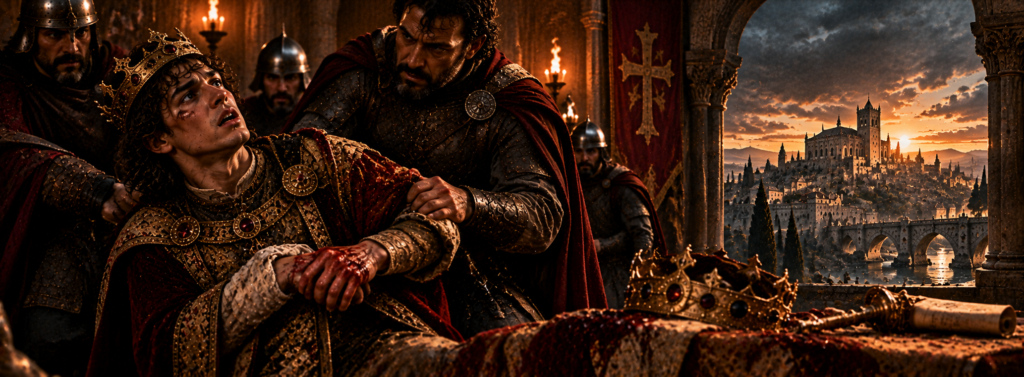
Liuva II: The Young Visigothic King Mutilated and Murdered for His Crown
Liuva II (c. 584–603) | King of the Visigoths, 601–603 | Son and successor of Reccared I | Grandson of Leovigild | Inherited the throne at approximately seventeen or eighteen years old | Ruled during the consolidation of Catholic Christianity in the Visigothic kingdom | Overthrown by the military commander Witteric | Had his right hand amputated and was killed in 603 | Last reigning representative of Leovigild’s immediate royal line.
The King Who Lost His Hand Before He Lost His Life
The young king had inherited one of the most powerful thrones in western Europe, but by the time his enemies finished with him, even his right hand had been taken away. Liuva II was barely out of adolescence when a conspiracy destroyed the royal dynasty his grandfather had strengthened and his father had transformed. His downfall was not the result of a foreign invasion or a catastrophic defeat on the battlefield. It came from within his own kingdom, orchestrated by a military commander who had been entrusted with defending Visigothic territory against the Eastern Roman Empire.
In 603, Witteric seized power from the young monarch and subjected him to a punishment intended to make his removal irreversible. According to Isidore of Seville, the usurper deposed Liuva, had his right hand cut off, and killed him. The mutilation was particularly significant because bodily integrity was closely associated with a ruler’s fitness to exercise authority. By depriving Liuva of his hand, his enemies were not merely inflicting physical suffering; they were destroying the possibility that he could return to the throne as an unimpaired king.
The surviving accounts are brief, leaving many of the most disturbing details unknown. We do not know exactly where Liuva was imprisoned after his deposition, whether the mutilation and killing occurred on the same day, or what method was used to end his life. Later narratives sometimes describe a separate execution following a period of captivity, but Isidore’s concise account does not securely establish that sequence. The essential facts remain sufficiently brutal without inventing a scaffold, an executioner, or a final confrontation between the young king and his betrayer.
Liuva’s death was remarkable because he had inherited a monarchy that appeared stronger than it had been for generations. His grandfather Leovigild had expanded royal authority, subdued rebellious territories, and strengthened the political foundations of the kingdom. His father Reccared had accomplished something even more consequential by abandoning Arian Christianity and embracing the Catholic faith of much of the Hispano-Roman population. Together, they had helped create a more unified Visigothic state, with Toledo emerging as its political center.
Yet their achievements had not eliminated the ambitions of powerful nobles and military commanders. Beneath the appearance of religious unity and royal stability, factions remained capable of challenging the monarchy. Witteric, who had previously been associated with an unsuccessful Arian conspiracy, emerged as the man who would exploit those divisions. When he finally moved against Liuva, the dynasty’s accomplishments could not protect its youngest representative.
The king’s murder exposed the terrible fragility of hereditary power in the Visigothic kingdom. Liuva possessed royal blood, an established succession, and the legacy of two influential predecessors. Witteric possessed military connections, political ambition, and enough support to overthrow him. In the struggle between those competing sources of authority, the young king lost everything.
A Dynasty That Had Fought to Control Hispania
Liuva II was born into a royal family that had spent decades transforming the Visigothic kingdom. His grandfather Leovigild became king in the sixth century, initially sharing authority with his brother Liuva I. When Liuva I died in 572, Leovigild became sole ruler and embarked upon an ambitious program of military expansion and political consolidation. His reign would become one of the most important periods in Visigothic history.
The kingdom Leovigild inherited was not a completely unified state. Powerful regional communities retained considerable autonomy, and some territories resisted royal authority. The Eastern Roman Empire controlled portions of southern and southeastern Hispania, while the Suevic kingdom remained independent in the northwest. Frankish rulers also threatened Visigothic interests north of the Pyrenees.
Leovigild responded through sustained military campaigning. He attacked rebellious regions, strengthened royal authority, and eventually conquered the Suevic kingdom in 585. His victories brought much of Hispania under Visigothic control, although the Eastern Roman possessions remained beyond his complete reach. The expansion increased the monarchy’s resources and helped establish a more centralized political order.
He also cultivated the outward appearance of royal majesty. Earlier Visigothic kings had exercised substantial authority, but Leovigild emphasized ceremonial distinctions between the monarch and his subjects. His government developed a more visibly elevated conception of kingship, influenced partly by Roman imperial traditions. The monarchy increasingly presented itself as an institution standing above ordinary aristocratic competition.
This transformation mattered for Liuva’s eventual inheritance. His grandfather was not merely another warrior who had obtained the crown through military success. Leovigild sought to establish a durable royal dynasty capable of passing authority from father to son. He associated his sons with kingship and attempted to secure the family’s political future.
Yet the dynasty’s greatest danger initially came from within the royal household itself. Leovigild’s son Hermenegild rebelled against him in a conflict that became entangled with religious division. The rebellion exposed the limits of dynastic loyalty and demonstrated how easily personal and political disagreements could escalate into civil war. Liuva would eventually inherit a family history in which even royal blood had failed to prevent violence.
Leovigild and the Rebellion of Hermenegild
The conflict between Leovigild and Hermenegild became one of the most notorious episodes in Visigothic history. Hermenegild had married Ingund, a Frankish princess who followed Catholic Christianity. His conversion from Arianism to Catholicism became associated with his rebellion against his father. Religious disagreement and political ambition became closely intertwined.
The surviving accounts offer different interpretations of the conflict. Catholic writers frequently portrayed Hermenegild as a defender of the true faith against an Arian ruler. Other evidence suggests that political grievances, regional interests, and foreign alliances also played important roles. The rebellion cannot be reduced to a simple dispute over theology.
Hermenegild established himself in southern Hispania and sought support from forces opposed to Leovigild. The struggle involved cities, armies, and diplomatic relationships extending beyond the Visigothic kingdom. Leovigild eventually defeated his rebellious son and took him into custody. Hermenegild was killed in 585, although the precise circumstances and responsibility for his death remain debated.
The episode left a lasting mark upon the dynasty. Leovigild had succeeded in preserving his authority, but the conflict demonstrated that even his own family could become a source of rebellion. His surviving son Reccared would inherit the throne after his death in 586. Reccared’s decisions would transform the religious character of the kingdom and reshape the political world into which Liuva was born.
For Liuva, Hermenegild was more than a distant figure in royal history. He was his father’s brother, and his rebellion represented an earlier struggle over the relationship between royal authority and religious allegiance. The dynasty had already experienced a conflict in which questions of faith became inseparable from political legitimacy. Those tensions would not disappear completely during Liuva’s lifetime.
The death of Hermenegild also revealed the harsh consequences of unsuccessful rebellion. A royal prince could lose his freedom and his life after challenging the reigning monarch. Two decades later, Liuva would suffer a similar fate at the hands of a usurper. The circumstances differed, but both episodes demonstrated the dangers of losing a struggle for power.
Reccared: The Father Who Changed a Kingdom
When Reccared succeeded Leovigild in 586, he inherited a kingdom strengthened by conquest but divided by religion. The Visigothic ruling elite had traditionally followed Arian Christianity, while much of the Hispano-Roman population adhered to Catholic Christianity. These divisions complicated relationships between the monarchy, the aristocracy, and the church. Reccared recognized that religious unity could become a powerful foundation for political stability.
In 587, he converted to Catholic Christianity, abandoning the Arian faith associated with earlier Visigothic kings. His decision was a major turning point in the history of the kingdom. It brought the monarchy into closer religious alignment with much of the population and created opportunities for cooperation with influential Catholic bishops. The conversion also challenged aristocrats and clergy who remained committed to Arianism.
Reccared’s religious policy culminated in the Third Council of Toledo in 589. The council publicly affirmed the king’s conversion and marked the official acceptance of Catholic Christianity by the Visigothic monarchy. Bishops and representatives of the ruling elite participated in the proceedings. The event became a defining moment in the development of a more unified religious and political identity.
The transformation was not entirely peaceful. Some Arian bishops and nobles resisted the change, and conspiracies emerged against the king. Reccared had to confront opposition from men who regarded the abandonment of Arianism as a betrayal of established traditions. His success demonstrated the strength of his position, but the resistance revealed divisions that would remain politically dangerous.
Liuva grew up in the aftermath of this transformation. His father had become associated with the establishment of Catholic royal authority, and the dynasty possessed considerable prestige among those who supported the new religious settlement. Yet some members of the aristocracy had reason to resent the family’s policies. The young prince would eventually inherit both the achievements and the enemies of his father.
Reccared’s reign lasted until 601, giving the kingdom a period of relative continuity after the military campaigns of Leovigild. He maintained the monarchy’s authority and helped strengthen relationships between the crown and Catholic institutions. His death, however, created a succession in which the throne passed to a very young ruler. The stability achieved during his reign would soon be tested.
The Young Prince Who Inherited Everything
Liuva II was born around 584, although the exact date is uncertain. He was the son of Reccared I, and his mother is sometimes identified as Baddo, a woman associated with the royal household. The surviving evidence does not establish every detail of his parentage with complete certainty. His status as Reccared’s son, however, provided the hereditary claim through which he succeeded to the throne.
Some modern accounts describe Liuva as an illegitimate son of Reccared. The surviving traditions concerning his mother and birth are not entirely straightforward, and the precise implications for his legitimacy remain debated. What matters politically is that he was recognized as the king’s successor in 601. His accession demonstrated that the dynasty could still transmit royal authority through hereditary descent.
He was approximately seventeen or eighteen years old when his father died. That age made him young by the standards of a kingdom governed through military leadership and aristocratic negotiation. He had inherited the crown before acquiring the decades of experience possessed by his grandfather and father. His position therefore depended heavily upon the willingness of established political figures to accept his authority.
The surviving sources reveal remarkably little about Liuva’s childhood. We do not know the details of his education, the officials who supervised his upbringing, or the military training he may have received. It is reasonable to suppose that a royal prince would have been exposed to court politics and the expectations of kingship. Nevertheless, no detailed account survives that would allow us to reconstruct his personal development.
His youth was not necessarily an insurmountable disadvantage. Hereditary succession could provide continuity, and powerful advisers might help a young ruler govern successfully. The prestige of Leovigild and Reccared also strengthened Liuva’s claim. Yet a youthful monarch could become vulnerable when ambitious nobles believed that his authority was easier to challenge than that of an experienced military king.
The problem was not simply that Liuva lacked years of experience. He inherited a political system in which royal authority remained dependent upon military support and aristocratic cooperation. His family’s achievements had strengthened the monarchy without eliminating the power of those groups. A determined conspirator could exploit that dependence.
Toledo and the Appearance of Royal Stability
By Liuva’s accession, Toledo had become increasingly important as the political center of the Visigothic kingdom. Its central location and association with royal government made it an appropriate seat for a monarchy seeking to govern much of Hispania. The city also possessed influential religious institutions that supported the growing relationship between Catholic bishops and the crown. Royal authority was becoming more closely connected to the political and ecclesiastical life of Toledo.
The court inherited by Liuva was shaped by the reforms of Leovigild and Reccared. The monarchy possessed ceremonial traditions, administrative officials, military commanders, and relationships with powerful regional elites. The king’s authority extended across a substantial territory, although it remained uneven in some regions. The Eastern Roman province in southern Hispania continued to represent a major challenge.
The presence of imperial territory was a reminder that the Visigothic kingdom remained vulnerable to foreign pressure. Justinian’s armies had established themselves in Hispania during the civil wars of the 550s. Later Visigothic rulers had attempted to recover territory, but the imperial presence survived. Liuva inherited an unresolved military problem that required capable commanders and sustained political cooperation.
The young king also inherited the religious settlement established by his father. Catholic bishops had become important partners of the monarchy, and the councils of Toledo provided a setting in which royal and ecclesiastical interests could intersect. This relationship offered legitimacy but also created expectations. A king who failed to maintain aristocratic or episcopal confidence could find himself politically isolated.
The surviving evidence does not show Liuva undertaking major reforms during his brief reign. His time on the throne was too short, and the historical record is too sparse, to support a detailed reconstruction of domestic policy. The absence of such information should not be mistaken for proof that he accomplished nothing. It reflects the limited evidence available for his government.
What can be said is that Liuva inherited a kingdom whose institutions appeared stronger than they had been earlier in the century. His grandfather had expanded royal control, and his father had transformed the religious foundation of the monarchy. The young king’s position therefore seemed to rest upon substantial achievements. Yet those achievements would prove insufficient when Witteric moved against him.
The Enemies Reccared Had Left Behind
Reccared’s conversion to Catholic Christianity had created opportunities for unity, but it also produced resentment among those who remained attached to Arianism. Some members of the Gothic aristocracy regarded the old faith as part of their political and cultural identity. Others may have feared that Catholic bishops would gain influence at the expense of established noble families. Religious opposition could therefore overlap with struggles over power.
The conspiracy associated with the Arian bishop Sunna of Mérida illustrates these tensions. In 589, Sunna became involved in opposition to Reccared’s religious settlement. The plot was exposed, and the bishop was eventually sent into exile. The episode demonstrated that resistance to the king’s conversion could become a direct political threat.
Witteric appears in the surviving tradition as one of the men associated with that conspiracy. His precise role remains uncertain, and the evidence does not provide a complete account of his punishment or subsequent rehabilitation. Nevertheless, the connection is significant because he later emerged as the commander who overthrew Liuva. A man linked to opposition against Reccared eventually destroyed Reccared’s son.
It would be misleading, however, to describe Witteric’s coup as a straightforward Arian restoration. The surviving evidence does not establish that he attempted to reverse the Catholic settlement after becoming king. Catholic institutions continued functioning during his reign, and the monarchy did not simply return to the religious policies of Leovigild. Political ambition may have mattered more than theological conviction.
The earlier conspiracy nevertheless suggests that Witteric belonged to networks capable of challenging the ruling dynasty. His survival and eventual military prominence demonstrate that opposition to Reccared did not permanently exclude every suspected participant from public life. Powerful men could recover influence as political circumstances changed. Liuva would eventually discover how dangerous such a figure could become.
The religious transformation of the kingdom therefore had an unintended consequence. It strengthened the monarchy’s relationship with Catholic institutions while creating enemies among some established elites. Reccared had possessed the authority to contain those enemies. His young successor would not enjoy the same security.
Witteric: The Commander Who Wanted a Crown
Witteric emerged as the central figure in Liuva’s downfall. He was a Visigothic noble and military commander whose career placed him among the men capable of influencing royal politics. His earlier association with the conspiracy against Reccared suggests that he had already participated in opposition to the ruling dynasty. By the early seventh century, he had acquired sufficient influence to become a serious threat to the throne.
The surviving evidence does not reveal every stage of his rise. We do not know the full extent of his family connections, the estates he controlled, or the personal relationships through which he gained military authority. His career nevertheless demonstrates that political survival was possible even after involvement in a failed conspiracy. Witteric remained within the world of powerful Gothic aristocrats.
Around 602, he was entrusted with military command against the Eastern Romans. The exact circumstances of the appointment are not fully preserved, but the responsibility was significant. The imperial presence in Hispania remained a major strategic concern, and the monarchy needed experienced commanders to defend its territories. Giving Witteric control of troops placed substantial military power in his hands.
That appointment became central to later explanations of the coup. Witteric allegedly used the forces available to him not to attack the Romans but to move against Liuva. The transformation of a royal military command into an instrument of rebellion illustrates the danger of entrusting ambitious nobles with independent armed power. The army intended to defend the kingdom could become a threat to the king himself.
The precise chronology of Witteric’s preparations remains uncertain. Some reconstructions describe him gathering supporters among officers and aristocrats before moving against the palace. Such a process is politically plausible, but the surviving sources do not provide a detailed record of secret meetings or promises. The coup’s success nevertheless implies that he possessed support beyond a handful of isolated conspirators.
Witteric’s ambition placed him in direct conflict with the hereditary succession established by Reccared. Liuva possessed the royal bloodline, while Witteric possessed military influence and the ability to organize opposition. The struggle would reveal which form of power proved decisive. In 603, the commander emerged victorious.
The Army That Was Supposed to Fight the Romans
The Eastern Roman Empire remained a persistent military threat to the Visigothic kingdom. Its territories in southern and southeastern Hispania had survived the reigns of several Visigothic kings. The imperial government could maintain coastal positions and use its Mediterranean connections to support troops stationed in the peninsula. Recovering those territories remained an important objective of Visigothic rulers.
Witteric’s military appointment therefore placed him in a position of considerable responsibility. A commander fighting the Romans needed access to soldiers, supplies, and relationships with influential officers. He could develop personal loyalty among men whose immediate experience of authority came through their general rather than the distant monarch. Such loyalty could become politically dangerous when the commander possessed ambitions of his own.
The surviving tradition describes Witteric turning his military power against Liuva. Instead of using his forces exclusively against the imperial enemy, he became the leader of a domestic coup. The episode demonstrates how military command could provide the resources necessary for usurpation. A king who appointed a powerful noble to defend the kingdom might inadvertently strengthen the man who would overthrow him.
The young monarch’s position was particularly vulnerable because he lacked a long personal military career. His grandfather had built his authority through repeated campaigns, while his father had governed for approximately fifteen years. Liuva had ruled for little more than a year when the conspiracy developed. He had not enjoyed sufficient time to establish the same relationships with commanders and soldiers.
Witteric could exploit that imbalance. His troops may have regarded him as their immediate leader, while aristocratic opponents of the dynasty could view him as a viable alternative. The surviving sources do not identify every faction that supported the coup. Nevertheless, the overthrow of a reigning king required more than personal ambition.
The military threat from the Romans also created an opportunity for deception. A commander operating under the authority of the crown could move troops and gather resources without immediately appearing to challenge the monarchy. Whether Witteric deliberately used that cover from the beginning cannot be established. The outcome, however, was unmistakable: the forces associated with royal defense became instruments of royal destruction.
The Coup of 603
In 603, Witteric moved against Liuva II and overthrew the young king. The surviving tradition associates the coup with the seizure of royal authority and the removal of the reigning monarch. Later reconstructions describe Witteric entering the royal palace with armed supporters, although the earliest narrative evidence does not preserve a detailed account of the operation. The essential result is certain: Liuva lost his throne to a military usurper.
The speed of the coup suggests that the young king’s support was insufficient to resist effectively. We do not possess a reliable account of a prolonged civil war between Liuva and Witteric. Nor is there evidence of a major battle in which the royal army was decisively defeated. The overthrow appears to have been accomplished through internal political and military action.
That distinction is important because it reveals the weakness of Liuva’s position. He was not a ruler whose kingdom had been conquered by foreign armies. He was a monarch whose own political environment allowed a powerful commander to seize control. His hereditary legitimacy could not compensate for the loss of practical military support.
Witteric’s success also demonstrated the persistence of aristocratic opposition to the dynasty of Leovigild. The royal family had governed for decades and achieved major political reforms, but its authority remained contestable. A faction of powerful men could still support a rival claimant. The monarchy had become stronger without becoming invulnerable.
Liuva’s youth may have contributed to his downfall, although the surviving sources do not establish it as the sole cause. A young ruler could struggle to command the loyalty of experienced nobles who had served his father. His dependence upon established officials might provide opportunities for manipulation. Yet the coup should not be reduced to a simple story of youthful incompetence.
The decisive factor was Witteric’s ability to organize sufficient support to remove the king. Liuva’s royal ancestry did not prevent the seizure of power. The political order created by Leovigild and Reccared collapsed at the moment when the dynasty’s young representative was deprived of effective authority. The coup ended his reign, but the violence against him was not yet finished.
The Right Hand of a King
The mutilation of Liuva II is the most disturbing feature of his downfall. Isidore of Seville records that Witteric removed the young king from power, had his right hand cut off, and killed him. The account is brief, but the choice of punishment carries enormous significance. The attack was directed not merely against Liuva’s life but against his ability to remain a legitimate claimant to royal authority.
In many late antique and early medieval societies, physical integrity was associated with fitness for public office and kingship. Mutilation could serve as a means of permanently disqualifying political rivals. Removing a hand or blinding a claimant made it more difficult for supporters to present that person as an acceptable ruler. The punishment therefore had a political purpose beyond inflicting pain.
The right hand possessed particular symbolic importance. It was associated with action, command, military ability, and the exercise of authority. A king’s ability to wield weapons and perform public acts could contribute to the image of royal competence. Removing the hand could therefore be understood as an attack upon the physical expression of kingship.
Yet the precise legal and ceremonial implications of Liuva’s mutilation should not be overstated. The surviving evidence does not establish a universally enforced Visigothic law declaring that every physically impaired person was automatically incapable of kingship. The political significance of mutilation is supported by broader historical patterns, but its exact application in Liuva’s case remains open to interpretation. Witteric’s objective was evidently to destroy his rival’s position, although the precise reasoning behind the punishment was not recorded.
The mutilation also represented an extraordinary humiliation. Liuva had been born into the ruling dynasty and had inherited the crown from his father. He was now subjected to a punishment associated with the destruction of political status. The contrast between his former authority and his treatment after deposition could hardly have been greater.
The surviving sources do not describe Liuva’s physical response or the conditions under which the punishment was carried out. We cannot reconstruct the room, identify the executioner, or describe the instruments used. Such details would make the scene more graphic, but they would also move beyond the available evidence. The historical fact of the mutilation is sufficiently severe without embellishment.
Why Mutilation Could Be More Useful Than Imprisonment
A deposed king remained dangerous as long as supporters believed he could return to power. Imprisonment could prevent immediate action, but it did not necessarily destroy a claimant’s legitimacy. Loyal nobles might attempt a rescue, while foreign rulers could offer military assistance. A living monarch could remain the center of opposition even after losing control of the government.
Mutilation offered a more permanent solution. By physically disabling a rival, a usurper could weaken the argument that the deposed ruler remained suitable for kingship. The punishment could also intimidate supporters who might otherwise attempt to restore him. It transformed political defeat into a visible and lasting condition.
The practice was not unique to the Visigoths. The Eastern Roman Empire would become particularly associated with the blinding and mutilation of deposed rulers and political rivals. Such punishments could remove claimants without necessarily killing them, although they were often accompanied by imprisonment or exile. Their purpose was to make political restoration more difficult.
In Liuva’s case, however, mutilation did not preserve his life. Isidore records that Witteric killed him after removing his right hand. The combination suggests that the usurper wanted not only to disqualify the young king but also to eliminate him completely. Whether the mutilation was intended as an initial alternative to execution or formed part of a single sequence of violence remains uncertain.
The punishment may also have served as a public demonstration of Witteric’s power. A usurper who could mutilate a reigning monarch showed that the old dynasty no longer possessed effective protection. Such an act could intimidate opponents and signal the final transfer of authority. Yet the sources do not establish whether Liuva’s mutilation was performed publicly.
The political logic remains grim. Liuva’s royal blood made him dangerous because it could support a future restoration. His youth meant that he might have remained a claimant for decades if allowed to live. Witteric’s actions removed both the immediate ruler and the possibility of a straightforward dynastic recovery. The monarchy passed into new hands through deliberate violence.
The Death of Liuva II
Liuva II was killed in 603 after being overthrown by Witteric. The most important early account, preserved by Isidore of Seville, links his deposition, the cutting off of his right hand, and his death. The historian’s wording does not provide a detailed chronology separating the mutilation from a later formal execution. Modern retellings sometimes describe the young king as being condemned and executed after a period of captivity, but that sequence should be treated cautiously.
The exact method of death remains unknown. We cannot establish whether Liuva was killed with a sword, died from injuries associated with the mutilation, or was executed through another procedure. The surviving evidence does not identify the men who physically carried out the killing. Witteric’s political responsibility is clear, but the mechanics of the murder are not.
The young king was approximately nineteen years old when he died. His reign had lasted less than two years, making it one of the briefest in the later history of the Visigothic monarchy. He had inherited the crown from a father whose religious reforms transformed the kingdom. His own opportunity to govern ended before he could establish a comparable political legacy.
The death also extinguished the immediate ruling line of Leovigild. Liuva was the grandson of a king who had spent years consolidating territory and strengthening royal authority. He was the son of the monarch who had established Catholic Christianity as the official faith of the Visigothic monarchy. His murder brought that dynastic succession to a violent conclusion.
The surviving sources do not preserve the reaction of Liuva’s relatives or supporters. We do not know whether attempts were made to avenge him or whether members of the royal household were imprisoned or exiled. The absence of such information makes it difficult to assess how much opposition Witteric faced immediately after the coup. His ability to retain the throne nevertheless suggests that the usurpation achieved sufficient political acceptance.
Liuva’s death became one more example of the violence that repeatedly interrupted Visigothic succession. His grandfather had attempted to establish a durable dynasty, and his father had strengthened the monarchy’s religious foundations. Yet neither achievement prevented the assassination of their young heir. The crown survived, but the family that had transformed it was destroyed.
Isidore of Seville and the Murdered King
Isidore of Seville is one of the most important sources for Liuva’s downfall. Writing during the seventh century, he preserved a history of the Goths that became central to later understanding of the Visigothic monarchy. His account of Liuva is unusually sympathetic, presenting the young ruler as an innocent victim of Witteric’s usurpation. The contrast between the two men is central to his interpretation.
Isidore describes Liuva as a young king whose reign was ended by a man who seized power unlawfully. His account emphasizes Witteric’s violence and the mutilation inflicted upon the deposed monarch. The language leaves little doubt about the historian’s moral judgment. Liuva appears as the wronged ruler, while Witteric appears as the ambitious aggressor.
That judgment is important because Isidore was not simply recording events without interpretation. As a Catholic bishop, he belonged to an intellectual tradition that connected political legitimacy with moral conduct and religious order. Reccared’s conversion had become a foundational moment in the kingdom’s Catholic identity. Liuva, as Reccared’s son, possessed a symbolic connection to that achievement.
Witteric’s earlier association with Arian opposition may have reinforced Isidore’s hostility. A man linked to resistance against Reccared’s religious settlement had overthrown and killed Reccared’s heir. The sequence could easily be interpreted as an attack upon the dynasty associated with Catholic unity. Yet the surviving evidence does not establish that Witteric attempted to restore Arianism after taking power.
Isidore’s account therefore needs to be read with both respect and caution. His testimony provides essential information about the coup and mutilation. His moral language also reveals how the events were understood within the later Catholic political culture of Hispania. The historian’s sympathy for Liuva should not be mistaken for a complete biography of the young king.
The most striking limitation is how little Isidore tells us about Liuva’s actual government. The young ruler is remembered primarily through his ancestry and death. His policies, personal relationships, and political decisions remain largely invisible. The assassination overshadowed the reign so completely that the victim’s life became secondary to the manner of his destruction.
Was Liuva Really Innocent?
Isidore’s portrayal of Liuva as innocent has strongly influenced later historical writing. The young king appears as a legitimate heir destroyed by a ruthless usurper. His youth and the brutality of his punishment make the interpretation emotionally compelling. Yet the surviving evidence does not provide enough information to assess every aspect of his government.
There is no substantial record of Liuva engaging in the kinds of abuses that later chroniclers associated with some Visigothic rulers. He is not remembered for systematic persecution, military atrocities, or scandalous personal conduct. His brief reign also provides little evidence of major political achievements. The absence of accusations does not prove exceptional virtue, but it does distinguish him from rulers whose reputations were dominated by alleged misconduct.
His hereditary claim was stronger than that of many earlier Visigothic kings. He was the recognized son and successor of Reccared, whose reign had been relatively stable. The dynasty possessed considerable prestige because of Leovigild’s military achievements and Reccared’s religious transformation. Witteric’s seizure of power therefore represented a direct challenge to an established succession.
Nevertheless, the coup’s success suggests that Liuva faced meaningful opposition. Some nobles may have resented the dynasty’s concentration of power, while others may have sought greater influence under a new ruler. Religious grievances could have contributed to the conflict. The surviving sources do not allow us to reconstruct the precise balance of these motives.
It is possible that Liuva’s youth made him vulnerable to manipulation or weakened his ability to manage powerful commanders. Yet there is no reliable evidence that he was personally incompetent or incapable of governing. His reign ended too quickly for such judgments to be established with confidence. The historian should resist the temptation to invent weaknesses merely to explain his defeat.
The most responsible conclusion is that Liuva was a young hereditary monarch overthrown by a politically successful usurper. The surviving evidence supports Isidore’s condemnation of the violence inflicted upon him. It does not provide a complete assessment of Liuva’s character or administration. His innocence in the narrative is primarily the innocence of a ruler whose murder was not justified by any clearly documented offense.
The Dynasty Witteric Destroyed
Liuva’s murder ended the immediate succession of the royal family associated with Leovigild and Reccared. The dynasty had governed during a period of major transformation, expanding royal territory and reshaping the kingdom’s religious identity. Its authority had appeared increasingly secure by the end of the sixth century. Yet the death of a single young king brought its direct rule to an end.
Leovigild had attempted to strengthen hereditary kingship by associating his sons with royal authority. His reign demonstrated that a powerful monarch could impose greater control over regional communities and rival rulers. Reccared then used religious policy to strengthen relationships between the crown and Catholic institutions. Together, they created a monarchy with greater territorial and ideological cohesion.
Liuva inherited those achievements without the personal authority that had produced them. His father had governed for approximately fifteen years, while his grandfather had spent even longer establishing military prestige. The young king had barely begun his reign when Witteric moved against him. The dynasty’s political capital proved insufficient to guarantee his survival.
The coup also demonstrated the limits of hereditary legitimacy. Liuva possessed a clear dynastic connection to two influential rulers, but Witteric obtained the crown through military and aristocratic support. The transfer of power was not a peaceful election or a recognized succession. It was a usurpation enforced through mutilation and killing.
The disappearance of the dynasty had consequences for the monarchy’s future. Later Visigothic kings would continue struggling with the relationship between hereditary claims and aristocratic selection. Some attempted to establish family succession, while others gained power through conspiracy or rebellion. The problem that destroyed Liuva remained unresolved.
His death therefore represents a turning point in the history of Visigothic kingship. The monarchy survived the coup, and the Catholic settlement established by Reccared continued. Yet the ruling family that had shaped those developments was removed from power. The kingdom retained much of the dynasty’s institutional legacy while abandoning its hereditary heir.
Witteric Becomes King
After Liuva’s death, Witteric occupied the Visigothic throne and ruled from 603 until 610. His accession demonstrated that the coup had achieved its immediate political objective. The usurper who had destroyed the young king now possessed the authority he had seized. Yet obtaining the crown did not guarantee that he would enjoy a secure reign.
Witteric faced the same strategic problems that had confronted his predecessors. The Eastern Roman Empire still controlled territory in southern and southeastern Hispania. Frankish politics remained important to Visigothic diplomacy, particularly in Septimania and the regions north of the Pyrenees. The monarchy also depended upon cooperation with powerful Gothic nobles and Catholic institutions.
His reign included military operations against the Eastern Romans. Isidore of Seville offers a dismissive assessment of his achievements, suggesting that Witteric gained little distinction despite repeated campaigns. The historian mentions the capture of enemy soldiers near Sagunto as one of the few notable successes. The account reflects both the limited evidence for the campaigns and Isidore’s hostility toward the king.
Witteric also pursued diplomatic relationships with the Frankish kingdoms. One of the most significant episodes involved his daughter Ermenberga and a proposed marriage to the Frankish king Theuderic II. The marriage was intended to strengthen political ties between the courts. Instead, the arrangement ended in humiliation and diplomatic conflict.
Ermenberga was sent to the Frankish court but was not accepted as the king’s wife. Frankish political intrigues, including the influence of Brunhild, contributed to the breakdown of the marriage arrangement. The young woman was eventually returned to her father without the expected union. The episode damaged Witteric’s prestige and contributed to hostility between the kingdoms.
The irony was considerable. Witteric had destroyed Liuva’s hereditary claim in order to become king, but his own attempts to strengthen dynastic influence through marriage failed. He possessed the crown without achieving the lasting security that royal families sought. His reign would eventually end through the same kind of violence that had brought him to power.
The Murderer Who Was Murdered
Witteric’s reign ended in 610 when he was assassinated. The surviving tradition describes his death as the result of a conspiracy, although the precise details and identities of the killers remain uncertain. Some accounts associate the murder with a banquet, recalling earlier Visigothic assassinations carried out during royal gatherings. The essential fact is that Witteric himself became the victim of political violence.
His death created a grim symmetry with Liuva’s murder. Witteric had seized power by overthrowing a young king and destroying his ability to return to the throne. Seven years later, his own reign ended at the hands of conspirators. The usurper who had relied upon violence to obtain the crown discovered that the same method could be used against him.
Isidore of Seville portrays Witteric’s end in strongly moral terms. The historian presents his death as a fitting consequence of his earlier crimes. Such interpretation reflects the Christian historical tradition in which violent rulers were often shown receiving punishment for their wrongdoing. The connection is morally powerful, although it should not be mistaken for evidence that the assassins acted specifically to avenge Liuva.
The identity of Witteric’s successor also demonstrates the instability of the monarchy. Gundemar became king after the assassination and ruled until 612. His accession continued the pattern in which political authority could pass following the violent removal of a predecessor. The Visigothic kingdom remained vulnerable to factional struggles despite the institutional achievements of earlier rulers.
Witteric’s murder did not restore Liuva’s dynasty. The young king had been killed, and no successful restoration followed. The family associated with Leovigild and Reccared remained absent from the throne. Political violence had eliminated both the legitimate heir and the usurper who destroyed him.
The sequence became one of the clearest examples of the dangers of Visigothic succession. A young hereditary king was mutilated and killed by a military commander. The commander became king but was later assassinated himself. The crown continued passing between powerful men, while the monarchy struggled to establish lasting security.
The Visigothic Problem of Royal Legitimacy
Liuva’s death reveals a central weakness of Visigothic kingship. The monarchy possessed hereditary traditions, but those traditions did not always determine who would rule. Powerful nobles and military commanders could challenge a reigning monarch when they believed that another candidate offered greater advantages. The absence of a consistently enforced succession system made political violence a recurring possibility.
Leovigild had attempted to strengthen dynastic succession through his sons. Reccared had inherited the throne and passed it to Liuva, demonstrating that hereditary transfer could succeed. Yet Witteric’s coup showed how quickly that arrangement could collapse. A powerful commander could still overthrow a recognized heir.
The monarchy’s dependence upon military support was particularly important. Kings needed commanders capable of defending territory and suppressing rebellion. Those commanders often possessed their own networks of loyalty and influence. A man entrusted with substantial military power could become a threat if his ambitions changed.
Witteric’s career illustrates that danger with unusual clarity. He was associated with an earlier conspiracy against Reccared, yet later acquired military responsibility under Liuva’s government. His command against the Eastern Romans placed troops and resources within his reach. He then used his position to overthrow the young king.
The coup also demonstrated that religious unity had not eliminated political rivalry. Reccared’s conversion had strengthened relationships between the monarchy and Catholic institutions, but powerful nobles retained independent interests. Some may have resented the dynasty’s authority or its religious policies. Others may simply have supported Witteric because they expected to benefit from his success.
Liuva’s hereditary legitimacy therefore proved insufficient without effective military and aristocratic support. His royal blood established a claim, but it did not guarantee obedience. The usurper’s success exposed the continuing gap between legal or dynastic authority and practical political power. That gap would remain a source of instability throughout Visigothic history.
The Politics of a Mutilated King
The decision to mutilate Liuva rather than simply imprison him reveals how seriously Witteric regarded the possibility of dynastic restoration. A deposed king could remain politically dangerous even after losing control of the palace. Supporters might attempt to rescue him, while foreign rulers could recognize his claim. His existence could provide a legitimate alternative to the usurper.
Removing Liuva’s right hand was a way of attacking that possibility. The punishment physically marked him as a defeated ruler and potentially undermined his fitness to resume kingship. It also demonstrated that Witteric possessed complete control over the young monarch’s body. The usurper could now impose consequences that Liuva’s royal ancestry had once seemed to make unimaginable.
The mutilation carried a message to the aristocracy. Men considering resistance could see that the former king had been rendered powerless. The punishment suggested that Witteric would not tolerate attempts to restore the old dynasty. It transformed the political victory into a visible act of domination.
Yet the subsequent killing raises questions about the original purpose of the mutilation. If Witteric intended merely to disqualify Liuva from kingship, why was the young man also killed? Perhaps the mutilation formed part of a broader sequence intended from the beginning to end in death. Alternatively, the usurper may have concluded that even a mutilated former king remained dangerous.
The surviving sources do not allow us to choose between these possibilities. They record the brutality without explaining every decision behind it. The uncertainty should not obscure the political significance of the act. Liuva was deprived of both his physical integrity and his life because he represented a rival claim to royal authority.
The punishment also reveals the personal cost of dynastic politics. Liuva was not an abstract symbol of hereditary legitimacy. He was a young man who had inherited the throne from his father and lost it before reaching adulthood in the fullest sense. His body became the means through which a political victory was made irreversible.
A Young King Without a Voice
One of the most striking features of Liuva’s story is the absence of his own perspective. The surviving sources tell us who his father was, when he became king, and how Witteric destroyed him. They provide almost nothing about his personality, beliefs, friendships, or ambitions. His life is visible mainly through the achievements of his family and the violence of his enemies.
We do not know whether Liuva anticipated the coup. He may have trusted Witteric as a commander responsible for defending the kingdom, or he may have recognized the danger too late. The surviving evidence does not reveal whether he attempted to negotiate, resist, or escape. Any detailed account of his final decisions would therefore be speculative.
His youth makes the silence especially unsettling. Liuva inherited the crown at approximately seventeen or eighteen, an age when many rulers were still acquiring political experience. He was expected to govern a kingdom shaped by decades of military campaigns and religious transformation. Powerful nobles who had served his father could possess far greater experience than he did.
The pressure upon such a ruler must have been considerable, although the sources do not describe his personal response. He inherited unresolved conflict with the Eastern Roman Empire and the political consequences of Reccared’s conversion. He also faced the challenge of maintaining loyalty among aristocrats whose ambitions had not disappeared. His reign ended before he could demonstrate how he intended to meet those responsibilities.
The historical record therefore preserves the consequences of his failure to survive without revealing the full nature of his government. He may have possessed considerable ability that never had time to develop. He may also have struggled with the demands of kingship. The evidence does not support confident judgments in either direction.
What remains is the image of a young hereditary monarch destroyed by an experienced political rival. His right hand was removed, and his life was taken. The dynasty that had placed him upon the throne disappeared from power. His silence became part of the tragedy of a reign remembered almost entirely through its violent ending.
Why Liuva II Belongs Among the Assassinated Rulers & Regicides
Liuva II belongs unquestionably within the Assassinated Rulers & Regicides category. He was a reigning Visigothic king overthrown by a military usurper and deliberately killed in 603. His death was not an accidental consequence of battle or a natural end to a short reign. It was an act of political violence intended to eliminate a legitimate claimant to the throne.
The mutilation of his right hand makes the case particularly distinctive. Witteric did not merely remove Liuva from office but subjected him to a punishment that attacked his physical ability to exercise royal authority. The act was closely connected to the political objective of preventing restoration. It transformed deposition into a permanent assault upon the former king’s status.
The killing also marked the destruction of an important royal dynasty. Liuva was the son of Reccared I and grandson of Leovigild, two rulers whose achievements had transformed the Visigothic kingdom. His accession represented a continuation of their hereditary line. His murder ended that succession and opened the throne to a powerful military commander.
The case illustrates the vulnerability of young rulers in political systems where military support could outweigh dynastic legitimacy. Liuva inherited the crown before acquiring the experience and personal relationships possessed by his predecessors. Witteric controlled sufficient military and aristocratic support to overthrow him. The young king’s ancestry could not protect him once those relationships turned against him.
The religious background adds another layer of intrigue. Witteric had previously been associated with opposition to Reccared’s Catholic settlement, while Liuva represented the dynasty responsible for that transformation. The coup may have involved lingering religious resentments, although it cannot securely be described as an attempt to restore Arianism. Political ambition and factional rivalry remain essential to the explanation.
Liuva’s death also belongs to the wider history of rulers mutilated to destroy their political legitimacy. The removal of his hand was not simply an act of cruelty detached from the struggle for power. It was part of the process through which Witteric eliminated a rival claimant. The assassination demonstrates how violently the boundaries of legitimate kingship could be contested.
The Hand That Could Never Hold a Crown Again
Liuva II inherited a kingdom that his grandfather had strengthened and his father had transformed. Leovigild had expanded Visigothic authority through military conquest, while Reccared had established Catholic Christianity as the monarchy’s official faith. Their achievements created the appearance of a more stable and unified state. When Liuva became king in 601, he inherited the prestige of a dynasty that had shaped the political future of Hispania.
Yet the young monarch also inherited unresolved divisions. Powerful nobles retained their own interests, military commanders possessed substantial influence, and the religious changes introduced by Reccared had not eliminated every source of resentment. The Eastern Roman Empire continued occupying territory in southern Hispania. The monarchy needed experienced leadership at a moment when its new ruler was barely out of adolescence.
Liuva’s hereditary claim was strong, but his personal authority remained untested. He had not spent decades commanding armies or negotiating with powerful aristocrats. His reign was too brief for him to establish a substantial independent political record. The dynasty’s achievements could support his position, but they could not guarantee the loyalty of every influential figure.
Witteric emerged as the man who exploited that vulnerability. His earlier association with opposition to Reccared’s religious settlement placed him among those who had reason to resent the ruling family. His later military appointment gave him access to the armed power necessary to challenge the throne. By 603, he possessed sufficient support to overthrow the young king.
The coup demonstrated the limits of hereditary monarchy in a political system where military influence remained decisive. Liuva was the recognized successor of Reccared, but Witteric controlled the resources necessary to remove him. The transfer of power did not occur through a peaceful succession or an accepted legal procedure. It was imposed through force.
The mutilation of Liuva’s right hand revealed the brutality underlying that transfer. Witteric sought to destroy the young king’s ability to return to power, attacking the physical integrity associated with royal authority. The punishment transformed a political defeat into a permanent bodily injury. It also demonstrated how completely the former monarch had fallen into the hands of his enemies.
The subsequent killing made the usurpation irreversible. Liuva was approximately nineteen years old when his life ended in 603. The surviving sources do not preserve the precise circumstances of his death, leaving the final act of violence largely hidden. What remains certain is that Witteric’s seizure of power culminated in the destruction of the young king.
The death was particularly consequential because Liuva represented the immediate continuation of Leovigild’s dynasty. His grandfather had attempted to strengthen hereditary kingship, while his father had passed the throne to him after a relatively stable reign. The murder ended that succession and demonstrated that dynastic legitimacy could still be overwhelmed by military conspiracy. The monarchy survived, but the family that had transformed it lost power.
Witteric’s own reign would eventually end through assassination. The usurper who destroyed Liuva ruled for approximately seven years before becoming the victim of political violence himself. His death created a grim symmetry, although the surviving evidence does not establish that his killers were avenging the young king. The crown had been obtained through murder and was eventually lost through murder.
The sequence exposed a fundamental problem within Visigothic kingship. Royal authority depended upon powerful men whose loyalty could change when political circumstances shifted. A king might inherit the throne legitimately but remain vulnerable to commanders who possessed military resources and aristocratic connections. Without secure mechanisms for resolving succession disputes, violence could become the means through which power changed hands.
Liuva’s story also reveals how little of a ruler’s life may survive when his reign ends abruptly. We know the achievements of his father and grandfather in considerable detail, but the young king’s own personality remains obscure. His policies, ambitions, and relationships disappeared from the record. His murder became the defining event of his historical existence.
That absence should not encourage the invention of a sentimental portrait. Liuva may have been intelligent, ambitious, cautious, or politically inexperienced, but the surviving sources do not allow those qualities to be established. His youth and violent death are sufficiently tragic without imagining private conversations or emotional scenes. The historian’s responsibility is to preserve the difference between documented events and possibilities.
The same caution applies to the final punishment. Isidore records the removal of Liuva’s right hand and his killing, but does not provide a detailed account of a separate execution ceremony. Later retellings sometimes describe imprisonment followed by formal condemnation and death. Such reconstructions may reflect plausible political procedures, but they exceed what the principal early account securely establishes.
The brutality of the event nevertheless remains unmistakable. A young king was overthrown, mutilated, and killed because another man wanted his crown. His royal ancestry offered no protection once the military and aristocratic balance turned against him. The punishment was designed to destroy both his political position and his ability to reclaim it.
Liuva’s death also marked the end of an era. The dynasty of Leovigild and Reccared had shaped the territorial and religious foundations of the Visigothic kingdom. Its final reigning representative disappeared through an act of calculated political violence. The institutions created by his predecessors survived, but their family no longer controlled the throne.
There is a terrible irony in the way the dynasty ended. Leovigild had strengthened royal authority through conquest and ceremonial power, while Reccared had sought unity through religious transformation. Both men had attempted to create a more durable monarchy. Yet their young heir was destroyed by the same aristocratic and military forces that earlier Visigothic kings had struggled to control.
The mutilation of Liuva’s hand became the most memorable symbol of that failure. It represented the destruction of a claimant who possessed hereditary legitimacy but lacked the power to defend it. The injury was intended to make restoration impossible, while the subsequent killing removed even the possibility of future resistance. The usurper did not merely take the crown; he eliminated the person whose existence challenged his possession of it.
Liuva II therefore stands among the most tragic victims of Visigothic political violence. He inherited a kingdom shaped by two influential rulers, occupied the throne for less than two years, and died before reaching twenty. His downfall exposed the fragility of hereditary succession and the ruthless ambitions of powerful commanders. The dynasty’s achievements could not save its youngest king.
In the end, Liuva’s story is not simply about a monarch who lost his throne. It is about the destruction of a royal family, the use of mutilation as a weapon of political exclusion, and the ease with which military power could overturn established legitimacy. Witteric took the crown, but his own assassination would eventually demonstrate that violence offered no lasting security. The young king’s right hand was cut away so that he could never rule again, and his life was taken so that he could never challenge the man who replaced him.
The Visigothic kingdom continued after Liuva’s death, carrying forward the political and religious institutions established by his predecessors. Its rulers would fight wars, confront rebellions, and struggle repeatedly with the problem of succession. Yet the fate of Reccared’s young son remained a stark reminder that even a powerful dynasty could disappear when armed men decided that hereditary legitimacy no longer mattered. Liuva II had inherited a crown that represented generations of royal ambition, but in 603, that inheritance ended in mutilation, murder, and the triumph of a usurper.