
John X: The Warrior Pope Who Lost Rome to Marozia
John X — 914–928
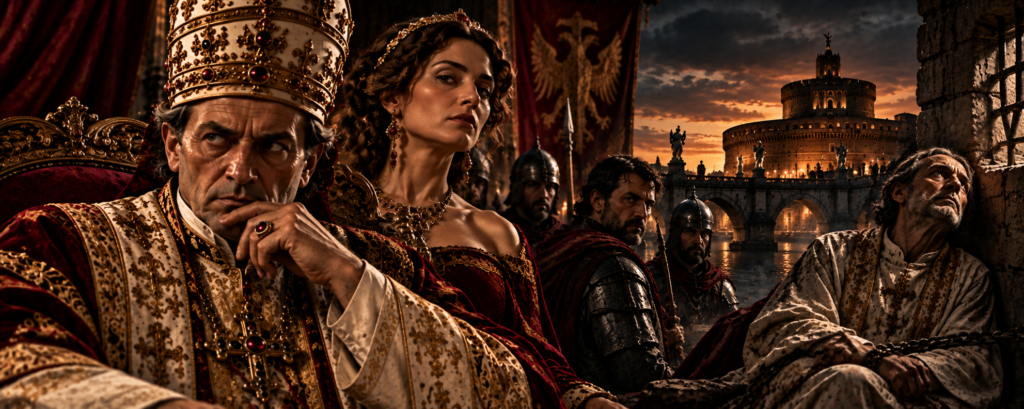
In the spring of 928, the men who ruled Rome came for the pope. John X had occupied the throne of Saint Peter for fourteen turbulent years, survived the shifting alliances of Italian kings and Roman aristocrats, helped assemble an army against Muslim strongholds in southern Italy, crowned an emperor, and attempted to turn the papacy into an independent political force. None of that protected him when the balance of power inside Rome finally turned against him. His enemies struck at the people closest to him, killed his brother before his eyes according to the hostile narrative tradition, seized the pope himself, and carried him away into imprisonment.
Behind the coup stood one of the most formidable women in medieval Roman politics: Marozia. She was the daughter of Theophylact and Theodora, members of the aristocratic dynasty that had helped bring John to the papal throne years earlier. By 928, however, the political alliance had shattered, and Marozia had built a formidable power base of her own alongside her husband, Guy of Tuscany. The family that had helped make John pope now helped destroy him.
John disappeared into captivity and never returned. Later tradition claimed that he was murdered in prison, possibly smothered beneath a pillow or otherwise suffocated on Marozia’s orders, while another contemporary tradition suggested that he died from the anguish and hardship of confinement. There is no secure evidence allowing us to reconstruct his final moments or confidently accuse Marozia of ordering his murder. What is certain is grim enough: a reigning pope was violently overthrown, imprisoned by his political enemies, and dead before he could regain his freedom.
Yet John X does not fit neatly among the Wicked Popes in the same way as Stephen VI, whose Cadaver Synod remains one of the most grotesque acts ever associated with the papacy, or John XII, whose later pontificate became infamous for allegations of sexual misconduct and violence. John was energetic, politically capable, militarily active, and by the standards of his age sometimes surprisingly effective. His pontificate included genuine achievements, most dramatically the coalition that destroyed the Muslim stronghold on the Garigliano River in 915. He was less the obvious villain of his story than one of the most revealing participants in a political system that could turn popes into kingmakers, war leaders, aristocratic clients, prisoners, and corpses.
That is precisely why John belongs in the story of the Wicked Popes. His reign exposes the world surrounding the papacy during the notorious Saeculum Obscurum, the so-called Dark Age of the tenth-century Roman Church. This was an era of family alliances, disputed elections, accusations of sexual influence, armed coups, assassinations, imprisonment, and aristocratic domination. John rose because he understood that world, prospered because he learned to maneuver within it, and ultimately fell because he attempted to become powerful enough to escape it.
His story begins not with Marozia, however, but with her mother. Long before John X became Marozia’s prisoner, hostile tradition claimed that he had been Theodora’s lover.
The Man from Tossignano
John was born at Tossignano in the Romagna, probably during the second half of the ninth century. Little reliable information survives about his childhood, family circumstances, or early education, which is hardly unusual for a churchman who lived more than eleven centuries ago. By the opening years of the tenth century, however, he had risen far enough within the Church to attract attention. His advancement would eventually bring him into the orbit of Ravenna, Rome, and the formidable aristocratic dynasty surrounding Theophylact and Theodora.
John became bishop of Bologna and subsequently archbishop of Ravenna around 905. Ravenna was no insignificant provincial appointment. The city possessed enormous ecclesiastical prestige, had once served as an imperial capital, and remained one of the most important archiepiscopal sees in Italy. A man holding its archbishopric occupied a position from which he could participate in politics extending far beyond the boundaries of his diocese.
His promotion also placed him within the complicated relationship between the Roman papacy and powerful Italian aristocrats. Rome itself had entered a period in which local noble families increasingly controlled the political environment surrounding papal elections. The collapse of strong Carolingian imperial authority had created a vacuum, and ambitious rulers competed for the Italian and imperial crowns while Roman aristocrats struggled to dominate the city. The bishop of Rome might claim spiritual authority extending across western Christendom while remaining dependent upon whichever political faction controlled the streets outside the Lateran.
Among the most powerful figures in this new order were Theophylact and his wife Theodora. Their family had risen dramatically during the pontificate of Sergius III and would eventually become so closely associated with papal politics that later historians treated them as symbols of the corruption of the entire age. John would owe much of his advancement to this political circle. Whether his relationship with Theodora was also sexual is a much more difficult question.
Theodora and the Scandal That Followed John
The most sensational version of John’s rise comes from Liutprand of Cremona, a brilliant but intensely partisan tenth-century writer with an unmistakable appetite for scandal. According to Liutprand, John became Theodora’s lover while serving at Ravenna. Theodora supposedly desired him so strongly that she engineered his elevation to the papacy partly so that he would be closer to her in Rome. It is the kind of story that has ensured John’s appearance in lurid histories of the medieval papacy ever since.
There are serious reasons for caution. Liutprand wrote decades after the events and displayed deep hostility toward the Roman aristocratic women he described. His portrayals of Theodora and her daughter Marozia repeatedly sexualized their political authority, presenting female power as something exercised through seduction, adultery, and manipulation. The allegation concerning John therefore fits suspiciously well within the author’s broader rhetorical agenda.
That does not prove the affair was impossible. Theodora was politically influential, John was clearly connected with her family’s interests, and sexual relationships involving clerics certainly existed despite ecclesiastical expectations. What cannot responsibly be done is to move from possibility to certainty simply because Liutprand told the story vividly. No private correspondence, independent contemporary testimony, or other decisive evidence establishes John and Theodora as lovers.
A more prosaic explanation for John’s rise is also readily available. He was already an experienced and prominent churchman, and he possessed political connections with the dominant Roman aristocratic family. Theophylact and Theodora had good reasons to support a pope they knew and trusted without requiring a secret affair to explain their choice. Political loyalty was valuable enough on its own.
The sexual allegation nevertheless became almost impossible to separate from John’s later reputation. The idea that Theodora used her influence to elevate her lover seemed to provide a perfect opening scene for the era later condemned as the “pornocracy.” Yet the word itself can mislead, turning complicated aristocratic politics into a morality tale about sexually predatory women and helpless churchmen. The reality of John’s papacy would prove considerably more complicated.
Rome After Sergius III
When Sergius III died in 911, the papacy had already become closely entwined with Theophylact’s family. Sergius had emerged from the bloody aftermath of the Cadaver Synod and had relied upon Roman aristocratic support to secure his position. His successors Anastasius III and Lando ruled only briefly, and neither succeeded in escaping the political structure that had developed around the papal office. By 914, the dominant Roman faction once again possessed enormous influence over the selection of a pope.
John was chosen in the spring of that year. His transfer from the archbishopric of Ravenna to Rome raised canonical questions because medieval church discipline generally discouraged bishops from abandoning one see for another. Ironically, that issue echoed the controversy surrounding Formosus, whose transfer from Porto to Rome had helped provide the legal pretext for the Cadaver Synod. Rome had nearly torn itself apart over such questions only a generation earlier.
Whatever objections existed, John became pope and proved far more energetic than anyone expecting a passive aristocratic puppet might have anticipated. His pontificate would last approximately fourteen years, unusually long by the chaotic standards of the period. He became deeply involved in Italian politics, international ecclesiastical affairs, military organization, and the struggle over imperial authority. The pope supposedly elevated because a Roman noblewoman wanted her lover nearby quickly demonstrated ambitions extending well beyond anyone’s bedroom.
The first great challenge facing him was also one of the most frightening. Muslim raiders had established a fortified base near the Garigliano River south of Rome, from which they could raid surrounding territories and threaten Christian communities. The problem had persisted for years and had proven resistant to fragmented local efforts. John decided to build a coalition large enough to destroy the stronghold.
The Threat from the Garigliano
Muslim forces had been active in southern and central Italy for decades by the time John became pope. Their presence cannot be reduced to a simple picture of one unified Islamic army invading Christian Italy, because the political landscape was considerably more complicated. Muslim raiding groups, fortified settlements, local rulers, Byzantine interests, Lombard principalities, and competing Christian powers interacted through warfare, temporary alliances, tribute, and shifting loyalties. The Garigliano stronghold nevertheless represented a serious military threat.
Its location was strategically dangerous. From the fortified settlement near the mouth of the river, raiders could strike into surrounding territories and disrupt communications between Rome and southern Italy. Religious houses and rural communities were particularly vulnerable. The papal territories themselves could not simply ignore an armed enclave capable of launching raids so close to Rome.
John recognized that no single local ruler was likely to eliminate the problem. Italy was fragmented among men who frequently regarded one another as greater threats than the Muslim forces they supposedly shared an interest in defeating. The pope therefore became a diplomat as much as a religious leader. His task was to persuade rivals to cooperate long enough to destroy a common enemy.
The coalition eventually included important southern Italian rulers and received Byzantine support. Landulf of Benevento and Capua, Guaimar of Salerno, Gregory of Naples, John of Gaeta, and other regional powers participated, while the Byzantine strategos Nicholas Picingli contributed forces from imperial possessions in southern Italy. Berengar of Friuli, king of Italy, was also drawn into John’s political calculations. The coalition was remarkable precisely because many of these powers had competing interests.
John did more than bless the campaign from a safe distance. Sources associate the pope personally with the military effort, presenting him as an active participant in the coalition that moved against the Garigliano stronghold. The image is striking: the bishop of Rome, remembered by later scandal writers as Theodora’s lover, was also helping lead an armed campaign. Whatever his private life may have been, John X was no politically ornamental pope.
The Battle of the Garigliano
The campaign culminated in 915. Coalition forces surrounded the Muslim position and subjected it to sustained pressure, while naval forces helped prevent escape or reinforcement by sea. The fighting appears to have continued over an extended period rather than taking the form of a single dramatic battlefield encounter. Eventually the defenders attempted to break out of the encirclement.
The stronghold was destroyed, and the surviving Muslim forces were defeated. The victory removed a major raiding base that had threatened central Italy for years. For John, the result represented an extraordinary political and military achievement. He had succeeded in persuading mutually suspicious rulers to cooperate under a cause associated closely with papal leadership.
Later crusading ideology should not simply be projected backward onto the campaign. John was operating in the political and military conditions of early tenth-century Italy rather than launching anything resembling the organized crusades of the eleventh and twelfth centuries. Even so, the victory demonstrated that the papacy could act as a coordinating force in warfare when circumstances demanded it. The bishop of Rome had become a coalition builder against an armed threat.
The success also strengthened John’s political reputation. A pope whose election had depended heavily upon Roman aristocrats now possessed an achievement independent of them. His authority reached beyond Rome, and rulers had responded to his diplomacy. That growing independence would become one of the defining tensions of his pontificate.
Crowning Berengar Emperor
John’s alliance with Berengar of Friuli formed another important element of his strategy. Berengar had struggled for years to establish himself as king of Italy amid competing aristocratic claims. Possession of the imperial title could strengthen his legitimacy enormously, while papal support could provide religious prestige that military victory alone could not supply. John, meanwhile, needed a powerful secular partner capable of supporting stability in Italy.
Berengar came to Rome in 915. John crowned him emperor in Saint Peter’s, reviving the relationship between papal coronation and western imperial legitimacy that had shaped Italian politics since Charlemagne. The ceremony represented a high point for both men. Berengar obtained the imperial dignity he had long sought, while John demonstrated his ability to determine who would receive one of the most prestigious crowns in western Europe.
The alliance was practical rather than sentimental. John needed protection against threats surrounding Rome, and Berengar needed papal recognition. Their interests overlapped enough to create cooperation, but Italian politics rarely allowed such arrangements to remain secure for long. Berengar continued facing opposition from powerful nobles unwilling to accept his dominance.
His eventual murder in 924 dramatically changed John’s position. The pope lost an important secular ally, while the political landscape of Italy once again became uncertain. John would attempt to replace the lost alliance by supporting another ruler. That decision helped place him on a collision course with Marozia.
The Pope Beyond Rome
John’s fourteen-year pontificate involved far more than Italian warfare. He maintained correspondence and diplomatic relationships extending into Germany, the Balkans, France, and the Byzantine world. Papal legates participated in ecclesiastical disputes, and John intervened in questions involving bishops and rulers far from Rome. The contrast between international prestige and domestic vulnerability remained one of the strange features of the tenth-century papacy.
In Germany, John sent representatives connected with the Synod of Hohenaltheim in 916. The papacy continued attempting to shape ecclesiastical order north of the Alps even while Rome itself remained politically unstable. John also supported missionary and ecclesiastical activity among Slavic peoples and maintained contact with churches in regions beyond Italy. The papal office had not ceased functioning simply because Roman aristocrats had become powerful.
He also supported monastic reform. The monastery of Cluny had been founded only a few years before John’s accession, and the movement associated with it would eventually become one of the most important forces for ecclesiastical reform in medieval Europe. John confirmed or supported privileges connected with the developing Cluniac tradition. The later reform movement would flourish in a Church very different from the aristocratically dominated Rome of John’s lifetime.
Not all of his decisions appear admirable from a modern or even contemporary ecclesiastical perspective. John became involved in the scandalous situation at Reims, where Hugh, a very young child belonging to the powerful family of Count Herbert II of Vermandois, was allowed to occupy the archiepiscopal see. Political considerations surrounding the imprisoned King Charles the Simple influenced the affair. John’s willingness to accommodate such arrangements demonstrates that his ecclesiastical policies could bend dramatically beneath political pressure.
That contradiction is important. John could promote monastic reform in one context while tolerating blatant aristocratic manipulation of a bishopric in another. He was neither a heroic reform pope trapped among villains nor merely a corrupt aristocratic creature. He was a tenth-century political churchman operating within systems where spiritual responsibility and dynastic calculation constantly collided.
The Fourth Marriage Crisis
John also inherited the final stages of the Byzantine controversy surrounding Emperor Leo VI’s fourth marriage. Byzantine church discipline strongly disapproved of repeated marriages, and Leo’s decision to marry Zoe Karbonopsina after three previous marriages had created a major conflict with Patriarch Nicholas Mystikos. The emperor desperately needed to secure the legitimacy of his son Constantine, while ecclesiastical leaders worried that allowing a fourth marriage would undermine church discipline. Rome became involved because papal judgment could provide support for the emperor’s position.
Sergius III had already taken a relatively permissive approach to the controversy, reflecting differences between Latin and Byzantine disciplinary traditions. Under John X, relations between Rome and Constantinople eventually moved toward reconciliation. The dispute was formally settled in the Byzantine Church through the Tome of Union in 920, which condemned fourth marriages as a general practice while resolving the immediate political crisis. John participated in the broader diplomatic environment surrounding that settlement.
The episode again reveals a pope exercising authority beyond the narrow politics of Rome. Constantinople possessed its own patriarch, emperor, court, theological traditions, and ecclesiastical machinery, yet the Roman pontiff remained a figure whose position mattered. John’s voice could be relevant in an imperial marriage controversy hundreds of miles from the Lateran. That international significance coexisted with his dependence upon Roman aristocrats capable of overthrowing him.
Such contradictions define his pontificate. John could help coordinate armies, crown emperors, communicate with distant rulers, and influence church disputes across Europe. Yet his fate would ultimately be determined not in Constantinople, Germany, or on the Garigliano, but by a family struggle inside Rome.
Theophylact’s Family Begins to Change
During the early years of John’s papacy, Theophylact and Theodora remained dominant figures in Roman politics. Their support had helped create the political environment in which he became pope, and John appears to have cooperated closely with them. Over time, however, the older generation disappeared from the scene. Their deaths created space for the next generation to compete for control.
Marozia emerged as the most formidable member of that generation. She was already connected to powerful Italian aristocratic networks through her marriage to Alberic I of Spoleto, an ambitious military and political figure. Alberic participated in Roman politics and at times exercised substantial authority in the city. His relationship with John appears to have deteriorated before his own violent end.
Marozia’s reputation would eventually eclipse that of almost every man around her. Later hostile writers portrayed her as sexually voracious, manipulative, and morally corrupt, while modern interpretations tend to emphasize her political intelligence and dynastic strategy. Neither image should be accepted without qualification. What is unmistakable is that she became one of the most powerful people in Rome.
Her power was not merely inherited from her parents. Marozia built alliances through marriage, family connections, property, titles, and control over armed supporters. She understood the same political system John did and proved equally willing to use it. The conflict that eventually destroyed him would therefore be a struggle between experienced political operators rather than a simple story of a wicked woman attacking an innocent pope.
Marozia Before the Coup
Marozia’s first husband, Alberic I, had been a major participant in Italian politics and the military struggles of the period. Their marriage connected the Theophylact family with the house of Spoleto and produced children who would later dominate Rome. Among them was Alberic II, who would eventually overthrow his own mother and rule the city for more than two decades. The family was creating a dynasty whose members would repeatedly shape the papacy.
Another of Marozia’s sons was John, the future Pope John XI. Later sources claimed that John XI was actually the illegitimate son of Pope Sergius III, with whom Marozia supposedly had an affair before her marriage or during its early years. The paternity remains disputed, and Alberic I may instead have been John’s father. What is certain is that Marozia later succeeded in placing this son on the papal throne.
By the 920s, Marozia had become powerful enough to pursue policies independently of John X. The pope, meanwhile, was developing his own political alliances and increasingly relying upon his brother Peter. Peter’s rise within Roman government appears to have alarmed Marozia’s faction because it threatened to create a competing family power structure around the pope. The conflict was no longer simply about ecclesiastical policy but about who would control Rome.
The death of Alberic I altered the balance further. Marozia subsequently married Guy, or Guido, margrave of Tuscany, another extremely powerful Italian nobleman. The marriage gave her access to additional military strength and transformed her from the widow of one major prince into the wife of another. John now faced an opponent whose family influence inside Rome was reinforced by Tuscan power outside it.
The Pope Builds His Own Dynasty
John’s brother Peter became increasingly important during the later years of the pontificate. Sources describe him holding significant authority in Rome, commonly identifying him as prefect or otherwise placing him near the center of secular government. His rise gave John something popes in this period desperately needed: a trusted political figure whose interests were directly tied to his own. It also made the papal government look increasingly like a rival family regime.
From Marozia’s perspective, Peter’s prominence was dangerous. Her own family had dominated Roman politics for years, and the papacy had originally been sustained by that aristocratic network. If John could use his brother to create an independent power base, the Theophylact dynasty risked losing the influence it had spent decades accumulating. Political cooperation gradually became competition.
Peter’s enemies eventually forced him out of Rome, but he did not remain defeated. He sought assistance from outside powers and returned with armed support. The exact sequence of these events is difficult to reconstruct from partisan sources, but the broad pattern is clear: Rome was becoming divided between John’s faction and the coalition gathering around Marozia and Guy.
The pope who had once depended upon the Roman aristocracy was now attempting to stand against one of its most powerful representatives. His earlier military and diplomatic successes may have encouraged him to believe that he possessed enough authority to survive the confrontation. He was about to discover that victories outside Rome did not guarantee control inside it.
After Berengar: Searching for Another King
Berengar’s murder in 924 deprived John of the emperor he had crowned and one of his most important political allies. Italy again became the object of competing royal ambitions, and John needed to determine which claimant could best protect papal interests. He eventually supported Hugh of Provence, who became king of Italy in 926. The alliance appeared to offer John a replacement for the support lost with Berengar.
Marozia had reasons to view the arrangement with suspicion. Hugh represented an external power capable of strengthening John against the Roman aristocracy. If the pope could combine his brother’s local authority with royal support from outside Rome, Marozia’s position might be seriously weakened. The struggle over the papacy was therefore merging with the larger contest over the Italian crown.
Marozia’s marriage to Guy of Tuscany gave her an answer. Guy was Hugh’s half-brother but also his political rival, and the complicated relationships among Italian aristocratic families ensured that kinship rarely prevented conflict. Marozia and Guy could oppose John’s alliance with Hugh while building a competing bloc of their own. Rome once again became a stage upon which wider Italian rivalries were fought.
By 927 and 928, the situation had become increasingly dangerous. John had his brother and external allies, while Marozia possessed her Roman network and the military resources associated with Guy. Neither side could easily retreat without surrendering political dominance. The conflict was moving toward violence.
The Road to the Coup
John’s mistake may have been believing that papal authority could overcome the local aristocratic machinery upon which his government had once depended. Fourteen years on the throne had given him prestige, diplomatic experience, and a record of military success. He had crowned an emperor and helped destroy the Garigliano stronghold. Yet Rome remained a city where armed noble families could determine whether a pope remained physically secure.
Marozia had advantages John could not easily neutralize. Her family’s connections penetrated Roman society, while her marriage to Guy provided additional military support. She also understood the political vulnerabilities surrounding the papal household. Attacking John directly required overcoming Peter first.
Hostilities intensified until open confrontation became unavoidable. Peter had apparently returned to Rome with outside assistance after previously being expelled, further inflaming the opposition. His return may have convinced Marozia’s faction that John intended to establish a durable rival regime. The struggle was no longer about influence around the papacy but control of the city itself.
In 928, Marozia and Guy acted. Their supporters moved against the Lateran and the pope’s faction. The confrontation ended with Peter dead and John in the hands of his enemies.
Blood at the Lateran
The most dramatic surviving account portrays Peter being killed in front of John. Armed men seized him and cut him down while the pope was forced to witness his brother’s destruction. The exact details come through sources whose hostility and dramatic style require caution, so we should not pretend to possess a reliable minute-by-minute account of the assault. The essential fact, however, is secure: Peter was killed during the political overthrow of John’s regime.
His death destroyed the pope’s most important local ally. John could no longer rely upon the family power structure he had attempted to construct around his brother. The killing also sent an unmistakable message to anyone considering resistance. Marozia and Guy were prepared to use violence to seize control.
John himself was captured rather than immediately killed. Removing him from office presented a delicate problem because a living pope possessed spiritual legitimacy even when stripped of political control. Simply allowing him to remain free would create the possibility of restoration, especially if Hugh or another external ruler intervened. Imprisonment provided the most practical solution.
The pope who had once helped lead armies now became a prisoner inside his own city. The man who had crowned Berengar emperor and negotiated with rulers across Europe could no longer determine where he slept or whether he would ever leave confinement. Marozia had won.
The Prison of Castel Sant’Angelo
Tradition places John’s captivity in the Castel Sant’Angelo, the enormous fortress built around the ancient Mausoleum of Hadrian. By the Middle Ages the structure had become one of Rome’s most formidable defensive positions, capable of serving as refuge, fortress, and prison. Its massive walls stood only a short distance from Saint Peter’s. For a deposed pope, it was an ominously appropriate cage.
John’s confinement effectively ended his pontificate even before his death. He could no longer govern freely, and Marozia’s faction controlled Rome. A new pope, Leo VI, would soon appear under the political order created by her victory. The machinery of papal succession moved forward while John was still alive or only recently dead.
The circumstances of his captivity remain frustratingly obscure. We do not know precisely how he was treated, how long he expected to survive, whether supporters attempted to rescue him, or what communication he maintained with allies outside Rome. Later narratives fill the silence with murder. Contemporary evidence leaves more room for uncertainty.
What can be imagined without invention is the scale of his reversal. John had spent fourteen years at the center of European religious politics and had personally participated in military campaigns. Now the walls of a Roman fortress separated him from the office he had once wielded so energetically. The papacy had not protected him from the political system that made him pope.
Was John X Murdered?
The most famous version of John’s death comes again from Liutprand of Cremona. According to the hostile tradition, John was suffocated in prison, commonly retold as smothering with a pillow. The accusation has frequently been attributed to Marozia, whose political interests clearly benefited from John’s permanent disappearance. A dead pope could not rally supporters or seek restoration.
Another important contemporary source, Flodoard of Reims, gives a different impression. His account suggests that John died in captivity through grief, anxiety, or the hardship of imprisonment rather than deliberate murder. The difference is significant because Flodoard wrote much closer to the events and lacked Liutprand’s particular obsession with portraying Roman aristocratic women as agents of sexual and political corruption. Neither source allows absolute certainty.
Natural death in prison would hardly make the episode benign. Medieval imprisonment could involve terrible conditions, inadequate food, illness, isolation, psychological stress, and deliberate neglect. A man who died from the consequences of confinement imposed by political enemies was still a victim of the coup that placed him there. Murder and natural death are not the only morally meaningful categories.
Marozia certainly had motive if she wanted John dead, but motive is not proof. His continued existence threatened her control, yet a long imprisonment might have neutralized him just as effectively. No surviving document records an order from Marozia commanding his execution. The most responsible conclusion is therefore that John died in captivity in 928 under suspicious circumstances, with murder possible but unproven.
That uncertainty should remain part of the story rather than being treated as a weakness. The darkness surrounding John’s final days reflects the nature of the political world that consumed him. A pope could disappear behind fortress walls, die there, and leave later generations arguing over whether his captors actively killed him or simply allowed imprisonment to finish the work.
Marozia Takes Rome
With John removed, Marozia emerged as the dominant political figure in Rome. Her victory was not merely personal revenge against a pope who had challenged her. It represented the triumph of the aristocratic dynasty over an attempt by the papacy to construct an independent political base. The woman later caricatured primarily as a seductress had defeated an experienced pope through alliances, military power, and calculated political action.
Leo VI succeeded John but reigned only briefly. Stephen VII followed and likewise operated within the political environment dominated by Marozia. In 931, she achieved an extraordinary dynastic triumph by securing the papacy for her son John XI. Whether John XI was the son of Sergius III or Alberic I remains disputed, but his maternal connection to Marozia is unquestioned.
Marozia’s control over Rome reached its height during these years. She held titles associated with senatorial and patrician authority and behaved effectively as the city’s ruler. The papacy existed within a political system in which her approval carried enormous weight. The office that John X had tried to strengthen was now more visibly subordinate to aristocratic power.
Yet Marozia’s own triumph would prove temporary. The political culture that destroyed John contained no guarantee that today’s victor would remain tomorrow’s ruler. Her downfall would come from within her own family.
The Son Who Overthrew His Mother
In 932, Marozia married Hugh of Provence, the same king of Italy whom John X had once supported. The marriage represented an astonishing reversal of earlier alliances and demonstrated how little permanent loyalty existed within the political world of tenth-century Italy. Marozia now sought to bind her Roman authority to royal power. If successful, the union might have transformed the balance of power throughout central Italy.
Her son Alberic II rebelled. Later tradition describes a personal humiliation by Hugh helping provoke the revolt, but the deeper cause was political opposition to the possibility of Rome falling under Hugh’s control. Alberic rallied the Romans, Hugh fled the city, and Marozia was captured. The woman who had imprisoned John X now became a prisoner herself.
Alberic II then ruled Rome for more than twenty years. His half-brother John XI remained pope but exercised limited secular authority under Alberic’s domination. The political lesson of John X’s downfall therefore survived Marozia. Roman aristocratic power remained stronger than the temporal independence of the papacy.
The cycle is almost brutally symmetrical. John had been raised through aristocratic influence and later tried to escape it, only to be imprisoned by Marozia. Marozia used that victory to dominate the papacy, only to be imprisoned by her own son. Alberic then controlled Rome and constrained another pope, continuing the same system under a different ruler.
Was John X Actually Wicked?
Placing John X among the Wicked Popes requires more nuance than placing Stephen VI there. We have no equivalent of the Cadaver Synod directly attributable to John, no secure record of him ordering grotesque executions, and no reliable evidence that he transformed the papal palace into the kind of scandalous court later associated with John XII. Some of the most memorable sexual accusations surrounding him come from a hostile source and may be false. His major military achievement arguably made central Italy safer.
He could also be politically ruthless and opportunistic. His willingness to maneuver among rival kings, support questionable ecclesiastical arrangements when politically convenient, elevate his brother within Roman government, and build a personal power base places him firmly within the aristocratic politics of his age. He was not standing above the system condemning its corruption. He was participating in it and attempting to master it.
That distinction matters. Wickedness in this category need not mean that every subject was personally monstrous. Some popes are important because their lives reveal periods when the institution itself became entangled in violence, nepotism, dynastic ambition, and political coercion. John X is one of the strongest examples.
His story also provides a necessary counterweight to simplistic portrayals of the Saeculum Obscurum. The papacy was not merely occupied by incompetent men selected by sexually manipulative women. John was capable, energetic, internationally active, and politically ambitious. The fact that such a man could still be overthrown and die in prison demonstrates how powerful the aristocratic system surrounding the papacy had become.
The Myth of the Pornocracy
The term “pornocracy” has often been applied to the period associated with Theodora and Marozia. It creates an unforgettable image of Rome ruled through the bedrooms of sexually corrupt aristocratic women who selected lovers as popes and manipulated the Church for personal gratification. The stories surrounding Sergius III and John X fit neatly into that narrative. They may also have helped create it.
The problem is that sexual scandal can obscure political reality. Theodora and Marozia possessed wealth, family networks, marriage alliances, titles, armed supporters, and access to the machinery of Roman government. They did not need sexual relationships with popes to explain their influence. Reducing their authority to seduction actually understates how powerful they were.
Liutprand’s hostility toward them should therefore be kept constantly in view. His writing is invaluable, vivid, and often based upon genuine information, but he had no interest in presenting these women sympathetically. Sexual accusation was one of his favorite weapons. Modern readers should resist becoming unwitting participants in a tenth-century propaganda campaign.
None of this requires sanitizing the period. Papal elections were manipulated, aristocratic families exercised enormous control, imprisoned opponents died under suspicious circumstances, and church offices could become tools of dynastic politics. The historical reality is dark without requiring every sexual allegation to be true.
John X demonstrates the difference perfectly. Whether he slept with Theodora is uncertain. That Theodora’s family helped shape his rise and that her daughter eventually engineered his downfall are much firmer historical realities.
A Warrior Pope in an Age of Intrigue
John’s participation in the Garigliano campaign complicates any attempt to portray him simply as an aristocratic puppet. He possessed enough diplomatic skill to coordinate rulers whose interests frequently conflicted, and he was willing to involve himself directly in military affairs. The victory of 915 remained one of the major successes of his pontificate. It also demonstrated what papal leadership could accomplish when Italian powers temporarily cooperated.
His imperial politics reveal similar ambition. Crowning Berengar strengthened an alliance capable of supporting papal interests, while John’s later relationship with Hugh of Provence represented another attempt to secure outside backing. These were rational strategies for a pope governing without a reliable emperor permanently protecting Rome. They were also dangerous because every external alliance threatened someone else’s interests.
John therefore spent much of his pontificate balancing competing centers of power. He needed Roman aristocrats without becoming their prisoner, Italian kings without surrendering papal independence, Byzantine cooperation without becoming subordinate to Constantinople, and local military allies without allowing them to dominate papal territory. The balancing act worked for more than a decade. Eventually it failed.
His tragedy lies partly in how close he came to succeeding. Fourteen years was a substantial pontificate in an era when some popes lasted only months. John had accumulated prestige and constructed a network extending far beyond Rome. Yet the local political foundation beneath him remained fragile enough to collapse once Marozia and Guy mobilized against his family.
Peter’s Death and the Price of Nepotism
John’s reliance upon his brother Peter deserves particular attention because it reveals the logic that repeatedly pushed medieval popes toward nepotism. A pope surrounded by potentially hostile aristocratic families needed people he could trust absolutely. Blood relatives offered a degree of loyalty that political allies might not. Giving relatives important offices could therefore appear less like simple greed and more like institutional self-defense.
The problem was that every relative promoted by a pope threatened existing elites. Peter’s rise meant that John’s family could potentially replace the Theophylact dynasty as the dominant secular power surrounding the papacy. What protected John from one danger created another. Marozia’s faction had powerful incentives to destroy Peter before his position became permanent.
Peter’s violent death demonstrated the limits of the strategy. Family loyalty could strengthen a pope only while that family possessed enough military and political power to survive. Once Peter’s enemies gained the advantage, his closeness to John made him a primary target. The pope’s attempt to secure himself through kinship instead exposed both brothers to destruction.
This pattern would recur repeatedly in papal history. Later popes elevated nephews, brothers, cousins, and sons of relatives because family networks could protect a ruler in a hostile political environment. The practice often became corrupt and exploitative, but its persistence also reflected a genuine structural weakness. John X’s fate shows why a pope might desperately want trusted relatives around him.
A Pope Who Tried to Rule
One of the most striking features of John X is that he seems to have taken the temporal responsibilities of the papacy seriously. He was not content merely to perform ceremonies while Roman nobles governed around him. He negotiated alliances, directed military policy, intervened in Italian kingship, promoted his own officials, and attempted to strengthen papal authority. Those efforts eventually brought him into direct conflict with the family that had once supported him.
The tragedy is therefore political rather than merely moral. John rose through a system of aristocratic influence and then attempted to become independent of it. His success at the Garigliano and his relationships with Berengar and Hugh provided him with resources beyond Rome. His brother Peter gave him a possible local counterweight to Marozia.
Marozia recognized the threat and acted before John’s position became unassailable. Her alliance with Guy of Tuscany gave her the force necessary to remove Peter and seize the pope. The coup of 928 was not random violence but the decisive conclusion of a struggle over who would rule Rome. John lost because his opponents possessed greater control of the political machinery closest to him.
His downfall reveals the fundamental weakness of the papacy during the Saeculum Obscurum. Spiritual prestige did not automatically translate into military security. A pope might command respect across Europe while remaining unable to prevent armed men from entering his own residence.
The Silence of the Prison
The final stage of John’s life is haunting precisely because so little can be known. Once imprisoned, the energetic pope largely disappears from the record. There are no surviving prison letters describing his fears, no reliable account of conversations with his captors, and no witness statement describing his death. History closes around him like the walls of the fortress itself.
Later imagination naturally filled that silence. The image of Marozia ordering an inconvenient pope smothered fits perfectly into her hostile reputation and the broader narrative of aristocratic corruption. It also provides a dramatically satisfying ending to a political struggle. Satisfaction, however, is not evidence.
Flodoard’s alternative account reminds us that imprisonment itself could kill. John was no longer a young man and had endured years of political and military strain. Sudden loss of power, harsh confinement, illness, and despair could have been enough to end his life without an executioner entering the cell. We cannot know which explanation is correct.
What we can say is that John entered captivity because Marozia’s faction overthrew him and never emerged alive. His political destruction and his death were therefore inseparable even if no murder occurred. The coup ended both his government and, shortly afterward, his life.
The Papacy After John
John’s removal did not liberate the papacy from aristocratic domination. It intensified it. Leo VI and Stephen VII followed under circumstances heavily shaped by Marozia’s political supremacy. Her son John XI then became pope, bringing the family connection to the throne of Saint Peter into even sharper focus.
When Alberic II overthrew Marozia, the papacy remained politically subordinate, only to a different member of the same dynasty. Alberic controlled Rome until 954 and ensured that his own son Octavian would eventually become pope. Octavian took the papal name John XII and would become one of the most notorious pontiffs of the entire Middle Ages. The aristocratic system surrounding John X therefore helped create the political environment inherited by another flagship Wicked Pope.
The continuity is striking. Sergius III had relied upon the Theophylact family. John X rose through the same aristocratic world and later died after challenging Marozia. John XI became pope through Marozia, while John XII reached the papacy through Alberic II. Family politics and papal succession had become almost impossible to separate.
This does not mean the papacy ceased to possess religious significance. Popes continued issuing privileges, communicating with bishops, supporting monasteries, and participating in disputes across Europe. The humiliation lay in the contrast between those universal claims and the local political reality. The man regarded as successor of Saint Peter could exercise spiritual influence hundreds of miles away while remaining subject to the will of Roman aristocrats outside his door.
John X and the Wicked Popes
John X belongs among the Wicked Popes primarily because his life exposes the political darkness of the institution around him. He was neither the most depraved nor the most cruel pope of the era, and describing him that way would distort the evidence. His pontificate instead offers something arguably more valuable for understanding the category: a view inside the machinery that made the tenth-century papacy so vulnerable to corruption and violence. He participated in that machinery, benefited from it, attempted to control it, and ultimately became one of its victims.
The allegations surrounding his relationship with Theodora belong in the story because they shaped his reputation and illuminate how later writers understood aristocratic influence. They should not be stated as proven fact. The same principle applies to his death. Marozia may have had him murdered, but the evidence does not allow us to close the case with certainty.
The documented political story requires no embellishment. John became pope with the support of the dominant Roman aristocracy, constructed alliances with Italian rulers, promoted his brother into a powerful position, and eventually clashed with Marozia’s faction. Her coalition overthrew him, killed Peter, imprisoned the pope, and replaced his regime. John died in captivity.
That sequence belongs naturally within Wicked Popes because the category is not merely a gallery of personally monstrous men. It is also the story of what happened when the papal throne became an object of dynastic ambition, political manipulation, military intervention, and aristocratic warfare. Few pontificates reveal that transformation more clearly than John’s.
The Woman Who Won and the Pope Who Lost
Popular history has often turned John and Marozia into characters from a decadent melodrama. He becomes her mother’s lover, while Marozia becomes the sexually manipulative daughter who eventually murders him. The story has everything a scandal writer could want: forbidden sex, corrupt clergy, powerful women, family rivalry, and death inside a fortress. Unfortunately, history is rarely obligated to preserve such perfect plots.
The actual political conflict is more compelling because the participants possessed real strategic goals. John wanted greater independence for the papacy and relied upon his brother and outside rulers to obtain it. Marozia wanted to preserve and expand her family’s control over Rome and allied herself through marriage with men capable of providing military strength. Their interests became incompatible.
Marozia won because she understood where John’s vulnerability lay. His international prestige could not save him once his local support collapsed. The pope’s allies beyond Rome were too distant to prevent the coup when it came. Control of the city mattered more in that moment than recognition from kings or bishops elsewhere.
Yet her victory also contained the seeds of her own destruction. By concentrating so much power in her hands, Marozia created enemies among the Roman aristocracy and even within her family. Four years after John’s downfall, she would experience her own coup and imprisonment. The fortress that had swallowed John would become associated with her own captivity as well.
Power Without Safety
John X’s career demonstrates a recurring paradox of medieval papal history. The pope could possess immense symbolic authority while enjoying remarkably little personal security. John could crown Berengar emperor, correspond with distant rulers, influence episcopal appointments, and help organize armies. None of those powers guaranteed that he could survive a feud with the strongest family in Rome.
The paradox helps explain why popes repeatedly sought secular protectors. Dependence upon kings and emperors could threaten papal independence, but the absence of a strong protector left the bishop of Rome vulnerable to local aristocrats. John tried both approaches, working first within the Theophylact system and later cultivating rulers capable of balancing it. Neither provided permanent security.
His attempt to rely upon Peter represented another solution and another failure. A trusted brother could protect papal interests more reliably than an ambitious noble family, but elevating Peter provoked the very aristocrats John hoped to contain. Every strategy created new enemies. The papacy was trapped within a political environment offering no easy route to independence.
Later reformers would struggle with versions of the same problem. The great papal reforms of the eleventh century would attempt to free church offices from secular control, but doing so required enormous political conflict. John X lived too early for that reforming system. His answer was personal political maneuvering, and it ended behind prison walls.
Remembering the Victory as Well as the Scandal
John’s downfall has sometimes overshadowed the achievement that once made him one of the most important political figures in Italy. The victory at the Garigliano was not imaginary propaganda created by later admirers. It represented the destruction of a fortified raiding base that had caused serious insecurity in central Italy. John played an important role in building the coalition responsible.
That success matters when assessing his character. A purely passive pope controlled by Theodora would have been unlikely to demonstrate such diplomatic and organizational ability. John could persuade rival rulers to cooperate, participate in military strategy, and use the prestige of the papacy toward a practical political objective. His reign therefore challenges the most simplistic image of the tenth-century papacy as uniformly incompetent.
His ecclesiastical activity tells a similar story. He engaged with Germany, Byzantium, Slavic churches, monastic institutions, and Italian dioceses. Some of his decisions were politically compromised, but the papal administration remained active. The Church did not simply stop functioning during the so-called Dark Age.
Recognizing those achievements makes his eventual destruction more dramatic. John did not fall because he was obviously incapable. He fell because political competence could not overcome the structural vulnerability of a pope ruling inside aristocratic Rome.
What We Can Actually Say About John X
The secure outline of John’s life is substantial. He came from Tossignano, rose through Bologna and Ravenna, and became pope in 914 with support from the dominant Roman aristocratic faction. He organized or helped organize the coalition against the Garigliano stronghold, crowned Berengar emperor, engaged actively in European ecclesiastical politics, and sought to strengthen the temporal position of the papacy. Those achievements are well grounded.
His relationship with Theophylact’s family is equally important. Their influence assisted his rise, while his later attempt to construct an independent power base contributed to conflict with Marozia. His brother Peter became a major figure in Roman government and was killed when Marozia and Guy moved against the pope. John was deposed and imprisoned in 928.
Beyond that point, certainty diminishes. The claim that Theodora had been John’s lover is a hostile allegation and is widely regarded with skepticism. The claim that Marozia ordered him smothered is possible but not securely established. Both stories should be included because they are historically influential, but neither should be disguised as proven fact.
This careful distinction does not make John’s story less dramatic. It makes the darkness more credible. Instead of relying upon sensational rumors, the narrative rests upon a documented world of coups, armed factions, family rivalries, political imprisonment, and a pope who died after being violently removed from office.
The Dark Age Was Not Dark Because of Women
The treatment of Theodora and Marozia deserves one final qualification. For centuries, writers used their influence as evidence that Rome had reached a uniquely shameful state because women supposedly controlled the papacy through sexuality. This interpretation says as much about later discomfort with powerful women as it does about tenth-century Rome. Male aristocrats manipulated papal elections before, during, and after their careers without generating an equivalent vocabulary of sexual degradation.
Theodora and Marozia were capable of ruthless politics, and Marozia unquestionably participated in the coup against John. There is no reason to sanitize their conduct. Yet their power should be analyzed through the same categories applied to powerful men: family networks, wealth, marriage diplomacy, patronage, military resources, territorial ambition, and control of political offices. Sexual allegations may belong within that story, but they cannot replace it.
John himself was not simply their victim. He accepted aristocratic support when it benefited him, participated in dynastic politics, and promoted his own brother when attempting to strengthen his position. The struggle became violent when competing networks sought control of the same political space. Everyone involved understood that papal authority carried enormous secular value.
The darkness of the Saeculum Obscurum therefore came not from women entering politics but from the weakness of institutions capable of restraining factional power. Popes could be made and unmade because control of Rome mattered more than orderly succession. John X’s fate illustrates that structural crisis with brutal clarity.
The Pope Behind the Fortress Walls
John’s final days remain beyond recovery. Perhaps he understood immediately that his capture meant death, or perhaps he expected Hugh of Provence or another ally to intervene. Perhaps his captors intended only permanent confinement before deciding he was too dangerous to leave alive. Perhaps no execution order was ever given and illness or despair ended his life.
Those possibilities cannot be resolved, and inventing a dramatic death scene would betray the very uncertainty that makes the episode historically compelling. We know that the pope who once rode or marched in connection with military campaigns could no longer leave his prison. We know that the political faction responsible for his confinement had every reason to prevent his restoration. We know that he died before freedom returned.
The contrast with the Garigliano is difficult to ignore. In 915, John had stood at the center of a coalition powerful enough to destroy a fortified enemy that had resisted Italian rulers for years. In 928, he could not defeat the coalition assembled against him inside Rome. Thirteen years separated triumph from captivity.
The papal throne had given him access to kings, armies, bishops, and emperors, but it had never given him complete control over the city in which that throne stood. His enemies understood the difference. They did not need to defeat the pope across Europe; they only needed to reach him in Rome.
John X: A Pope Consumed by the Age He Tried to Master
John X entered the papacy through the aristocratic politics of tenth-century Rome and spent much of his reign trying to become larger than the system that created him. He was energetic enough to organize alliances, ambitious enough to crown emperors, practical enough to negotiate with distant powers, and determined enough to build a political network of his own. For fourteen years, the strategy worked remarkably well. Then the family politics surrounding him became stronger than the authority he had accumulated.
His story should not be reduced to the allegation that he slept with Theodora. That accusation may be false, exaggerated, or impossible to verify, and repeating it as fact merely reproduces the hostility of later sources. The more important relationship was political: Theodora’s family helped create the conditions for John’s rise, and her daughter eventually created the conditions for his fall. That arc requires no sexual scandal to make it extraordinary.
Nor should his death be transformed automatically into a murder mystery with Marozia cast as a proven killer. She overthrew him, imprisoned him, and benefited from his disappearance, all of which naturally generated suspicion. Liutprand’s account of suffocation may preserve the truth, but another contemporary tradition points toward death from the hardships or anguish of captivity. More than a millennium later, the evidence cannot tell us which version describes his final moments.
The uncertainty does not absolve the political system responsible for his fate. John did not enter prison voluntarily, and he did not retire peacefully after deciding that fourteen years as pope were enough. Armed enemies destroyed his regime, killed his brother, seized his person, and prevented him from returning to power. Whether imprisonment killed him indirectly or an assassin completed the process directly, the coup ended his life as a free man.
John X therefore occupies an unusual place among the Wicked Popes. He is not primarily memorable because he committed an act of spectacular depravity. He is memorable because his pontificate reveals what the papacy had become when spiritual authority was forced to coexist with aristocratic government, dynastic marriage, military power, nepotism, and the threat of violent deposition.
He could be both pope and war leader, spiritual authority and political operator, patron of religious institutions and participant in questionable ecclesiastical compromises. He could depend upon one aristocratic family while attempting to create another network around his own brother. These contradictions were not incidental flaws in his career. They were the conditions under which a tenth-century pope had to survive.
For a time, John survived them better than most. He outlasted many immediate predecessors, won a significant military victory, crowned an emperor, and maintained papal involvement across Europe. His fourteen-year reign suggests a man who understood power exceptionally well. His downfall demonstrates that Marozia understood it too.
When her faction finally struck, papal prestige offered no sanctuary. Peter died, John was captured, and the pope vanished into imprisonment while his enemies took control of Rome. The institution continued almost immediately under another occupant, demonstrating the chilling ease with which a living pope could become politically disposable.
Marozia’s triumph would not last. She too would eventually be overthrown and imprisoned, while her son Alberic II established a new regime over Rome and reduced another pope’s secular independence. The individuals changed, but the system remained. Power moved through families more reliably than through papal succession.
That is the larger tragedy surrounding John X. The pope who tried to strengthen his office became evidence of its weakness. His military victories could protect Rome from enemies outside its walls, but they could not protect the papacy from the aristocratic struggle unfolding inside them.
The Garigliano had shown what John could accomplish when Italian rulers followed his leadership. The coup of 928 showed what could happen when Rome stopped following it. Between those two moments lies the full contradiction of his pontificate: a pope capable of helping defeat an army, yet unable to prevent his own capture by the family whose influence had once helped place him on the throne.
John X entered history under the shadow of Theodora and left it under the shadow of Marozia. Whether either woman’s relationship with him was as scandalous as hostile chroniclers later claimed is far less certain than generations of sensational histories have suggested. Their political significance, however, is beyond serious doubt.
In the end, John X may be one of the most revealing Wicked Popes precisely because he was not exceptionally wicked. He did not need to be a monster for his story to become dark. He only needed to be ambitious enough to rule in a city where ambition could make a pope powerful, and dangerous enough that the people who had once helped create him eventually decided he had to disappear.
By 928, the warrior pope who had helped break the Muslim stronghold on the Garigliano was behind walls he could not escape. Somewhere inside captivity, whether through illness, despair, neglect, or murder, his life ended while Marozia’s Rome moved on without him. The throne of Saint Peter survived, but the man who had occupied it for fourteen years did not.
That is the unsettling legacy of John X. His reign reminds us that the darkest periods of papal history were not always created by uniquely depraved popes. Sometimes the darkness came from a political world in which even an energetic and capable pope could rise through family power, struggle against it, and finally be swallowed by it.
John had helped drive an enemy from the Garigliano, crowned an emperor beneath the sacred vaults of Rome, negotiated across kingdoms, and tried to make the papacy a political force in its own right. None of those achievements mattered when armed rivals seized control of the city. In the end, the pope who had spent fourteen years mastering the dangerous politics of tenth-century Italy discovered the final rule of the age: in Rome, power belonged to whoever could still hold it when the doors were broken open.