
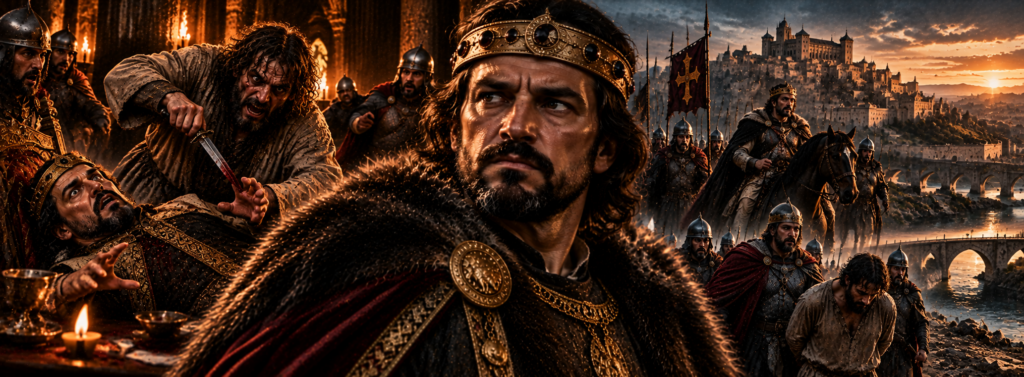
Theudis: The Visigothic King Murdered by a Man Pretending to Be Mad
Theudis (d. 548) | King of the Visigoths, 531–548 | Former Ostrogothic military commander and representative of Theodoric the Great | Rose to power through military influence, political alliances, and a wealthy marriage | Became king following the violent death of Amalaric | Defended Hispania against a major Frankish invasion | Attempted to challenge Byzantine expansion in North Africa | Promoted legal reforms and permitted Catholic church councils despite his Arian faith | Assassinated inside a royal palace by a man reportedly pretending to be insane | According to Isidore of Seville, begged his followers not to kill his murderer | Succeeded by Theudigisel, who would himself be assassinated.
The Madman Who Entered the Palace
The assassin did not arrive at the Visigothic royal palace announcing himself as an enemy of the king. According to the account preserved by Isidore of Seville, he had spent considerable time pretending to be insane, carefully cultivating the appearance of a man whose behavior could be dismissed as harmless madness. It was a strange and calculating disguise, one that depended upon convincing others that he was too irrational to pose a deliberate political threat. When the opportunity finally came, the supposed madman approached King Theudis and struck him with a weapon, inflicting a wound from which the ruler would not recover.
The attack took place in 548, ending the seventeen-year reign of a man who had once been among the most powerful military figures in the western Mediterranean. Theudis had survived the collapse of Ostrogothic influence in Hispania, the death of the Visigothic king he had helped govern, a dangerous succession crisis, and repeated attempts by foreign powers to invade his kingdom. He had commanded armies, accumulated enormous wealth, and built a political position strong enough to carry him from military service to the Visigothic throne. Yet all that power failed to protect him from a single man who apparently understood how to exploit the assumptions of those guarding the royal court.
What happened afterward is even more remarkable than the assassination itself. Isidore reports that, as Theudis lay bleeding, he pleaded with those around him not to kill his attacker. The dying king supposedly believed that he was receiving punishment appropriate to his own past actions, because he himself had once killed a superior while still a private man. Whether this extraordinary admission preserves a genuine confession, a distorted memory of political violence, or a moralizing story added to explain his death remains uncertain.
The image is difficult to forget. A king who had spent much of his life building power through military strength was suddenly helpless, surrounded by followers who could do nothing to save him. His murderer was apparently within reach, and the natural response of the royal household would have been immediate vengeance. Instead, the surviving tradition presents Theudis attempting to prevent another killing while acknowledging that his own past may have finally caught up with him.
There is one important detail that deserves caution from the beginning. The assassination is sometimes placed specifically in Toledo, a city increasingly associated with Visigothic kingship, but the principal early account does not securely identify the palace where the murder occurred. Other historical reconstructions have associated Theudis’s final days with Seville or Barcelona. The murder itself is well attested; its precise location is less certain than many popular retellings suggest.
The story of Theudis is therefore more than an account of a king murdered by an unusually deceptive assassin. It is the story of an ambitious military commander who learned to rule a kingdom without initially wearing its crown, a foreign-born aristocrat who became indispensable to the Visigoths, and a monarch whose death may have carried the shadow of an earlier crime. His final moments would be remembered not for a victorious battle or a grand political achievement, but for a dying request that the bloodshed stop with him.
A Kingdom Born from the Ruins of Rome
The world into which Theudis rose was one of collapsing imperial authority and rapidly changing political loyalties. During the fifth century, the Western Roman Empire had gradually lost control of its provinces to military leaders, rival emperors, and the kingdoms established by peoples once operating within its borders. The Visigoths had built a powerful state across southwestern Gaul and Hispania, while the Ostrogoths eventually established their own kingdom in Italy. These kingdoms inherited Roman cities, roads, laws, taxation systems, and populations, but their rulers depended heavily upon military strength and aristocratic alliances.
The Visigothic kingdom had reached the height of its Gallic power under Euric, who ruled from 466 to 484. His son Alaric II inherited a realm centered on Toulouse, stretching across Aquitaine and into much of the Iberian Peninsula. The kingdom appeared formidable, but its position was increasingly threatened by the expansion of the Franks under Clovis. When Clovis defeated Alaric II at the Battle of Vouillé in 507, the consequences transformed the political future of western Europe.
Alaric was killed, Toulouse fell, and the Visigoths lost most of their territories in Gaul. Their surviving power shifted toward Septimania and Hispania, where the dynasty struggled to preserve its authority. Alaric’s illegitimate son Gesalec became king during the emergency, although the legitimate younger son Amalaric possessed a rival claim. That succession dispute would provide the opportunity for the Ostrogothic king Theodoric the Great to intervene.
Theodoric was Amalaric’s maternal grandfather, and he had no intention of allowing his grandson’s inheritance to disappear. His Ostrogothic kingdom in Italy possessed formidable military resources, and his intervention prevented the Franks and Burgundians from completely destroying the remaining Visigothic territories. Gesalec was eventually displaced, and Theodoric exercised extensive authority over the Visigothic kingdom during Amalaric’s minority. The arrangement created a political connection between the two Gothic kingdoms that would shape Theudis’s entire career.
Theodoric needed reliable commanders to supervise territories far from his Italian court. He could not personally administer every city, negotiate with every noble, or lead every army across the western Mediterranean. His authority depended upon trusted representatives who could exercise power in his name. Theudis became one of those men, although his loyalty would eventually prove more complicated than his master might have wished.
The Sword-Bearer of Theodoric the Great
Theudis was an Ostrogoth rather than a member of the Visigothic royal dynasty. His early life is poorly documented, and the surviving sources do not provide a detailed account of his childhood, parents, or initial military training. What they do establish is his association with Theodoric the Great, whose service offered ambitious Gothic warriors opportunities for advancement. Theudis eventually became one of the men entrusted with managing Ostrogothic interests in Hispania.
Some accounts describe him as Theodoric’s sword-bearer, a title that suggests personal service within the ruler’s military household. Such a position should not be mistaken for a merely ceremonial occupation. In early medieval courts, proximity to the king could lead to military command, political influence, and responsibility for important territories. Men who served close to a monarch often became the very commanders upon whom royal power depended.
Theudis was sent to Hispania during the period when Theodoric exercised authority over the Visigothic kingdom on behalf of Amalaric. His task involved more than guarding a child prince. He was responsible for maintaining order in a kingdom recently devastated by war, where Gothic nobles, Roman landowners, local bishops, and foreign enemies all competed for influence. The position demanded military ability, political judgment, and access to substantial resources.
The surviving evidence suggests that Theudis proved extraordinarily effective at building his own power. He did not remain a simple subordinate carrying out orders from Ravenna. Instead, he established relationships within Hispania that gave him an increasingly independent political position. His authority eventually became so substantial that Theodoric had to tolerate a degree of autonomy he might otherwise have considered dangerous.
The irony is striking because Theodoric had intervened in Visigothic affairs to protect his grandson’s inheritance. In doing so, he placed enormous authority in the hands of an ambitious commander who would eventually become king himself. The man sent to preserve the dynasty ultimately outlived its immediate heir and occupied the throne. His rise demonstrates how easily a military protector could become a political rival in a kingdom where power depended upon the loyalty of armed men.
The Marriage That Made Him Powerful
One of the most revealing details about Theudis comes from the Byzantine historian Procopius. According to Procopius, Theudis married a wealthy woman from Hispania whose family possessed extensive property and considerable social standing. Her personal name has not survived in the principal account, but her wealth became a decisive factor in her husband’s rise. Through the marriage, Theudis acquired access to resources that transformed him from an important military official into something approaching an independent ruler.
Procopius reports that the wealth associated with the marriage enabled Theudis to maintain a private military following of approximately two thousand men. The figure should be treated as a reported estimate rather than a precisely verified muster roll, but its significance is unmistakable. A commander supported by thousands of personally loyal warriors possessed power beyond that normally expected of a provincial representative. He could negotiate with aristocrats, resist rivals, and make himself difficult to remove.
The marriage also reveals how Gothic military elites could integrate themselves into the wealthier structures of Hispano-Roman society. Theudis did not build his influence solely through battlefield victories. He acquired land, money, and connections through a woman whose family belonged to the established provincial elite. The combination of military authority and landed wealth gave him a political foundation that could survive changes at the royal court.
His wife deserves recognition as more than an unnamed source of money. Although the surviving sources tell us almost nothing about her personality or private life, her family’s resources helped make Theudis’s extraordinary career possible. Without that marriage, his ability to maintain a large independent following might have been considerably weaker. Her wealth became one of the instruments through which he accumulated power.
The arrangement also created a potential conflict with Theodoric the Great. A commander whose authority depended entirely upon royal appointment could be recalled, replaced, or deprived of resources. A commander with substantial personal wealth and thousands of loyal soldiers was much harder to control. Theudis had become indispensable in Hispania while acquiring the means to resist interference from Italy.
The Governor Who Became Almost Untouchable
Procopius presents Theudis as a man who exercised considerable independence while carefully maintaining the appearance of loyalty. He continued obeying Theodoric’s instructions and sending the required payments or tribute, thereby avoiding an open confrontation with his royal master. At the same time, his personal military resources made him powerful enough to resist removal. The arrangement was politically delicate, but both men had reasons to preserve it.
Theodoric faced threats beyond Hispania. The Franks remained dangerous, relations among the successor kingdoms were complicated, and maintaining control over distant territories required constant negotiation. Attempting to remove Theudis by force could have provoked instability or created an opening for Frankish expansion. The Ostrogothic king therefore tolerated a commander whose independence was becoming increasingly obvious.
Theudis understood the advantages of avoiding unnecessary rebellion. By continuing to acknowledge Theodoric’s authority, he retained the legitimacy of his official position while building a separate foundation of power. He did not need to declare himself king while Theodoric lived. The longer he remained in control of military resources and local alliances, the stronger his position became.
This was a form of political ambition that did not require dramatic proclamations. Theudis accumulated influence patiently, using his appointment, marriage, and military following to make himself essential to the functioning of the kingdom. His authority became embedded in the everyday structures of government. When the moment finally arrived for him to seek the crown, he would already possess much of the power normally associated with kingship.
The relationship also raises an uncomfortable question about the nature of loyalty. Theudis obeyed Theodoric while making himself increasingly independent of him. From one perspective, he was a capable official protecting a vulnerable kingdom. From another, he was an ambitious subordinate using royal authority to construct a personal power base.
Both interpretations contain elements supported by the surviving evidence. Theudis maintained the outward obligations of service, but he also positioned himself to survive without the master who had appointed him. His career demonstrates that political independence could develop gradually, long before a formal break occurred.
The Death of Theodoric and the Weakening of the Old Order
Theodoric the Great died in 526, removing the most powerful figure holding the Ostrogothic and Visigothic political systems together. His death created uncertainty across the western Mediterranean because the authority he had exercised depended heavily upon his personal prestige and military strength. The Ostrogothic kingdom passed into a new phase under his grandson Athalaric and the regency of his daughter Amalasuntha. The Visigothic kingdom, meanwhile, moved toward greater independence under Amalaric.
Amalaric had spent much of his childhood under his grandfather’s protection. Once Theodoric was gone, he could exercise royal authority more directly, although the political consequences of the long Ostrogothic protectorate remained. Theudis was still a powerful military figure with extensive connections in Hispania. The young king therefore inherited a kingdom in which one of the most influential men had already spent years governing under another monarch’s authority.
The relationship between Amalaric and Theudis is not documented well enough to reconstruct their private attitudes toward one another. It would be tempting to imagine the young king resenting the older commander or Theudis secretly plotting to replace his former charge. The sources do not provide sufficient evidence for such scenes. What can be established is that Theudis possessed the resources necessary to become a serious political contender if the throne became vacant.
That opportunity arrived only a few years later. Amalaric became involved in a disastrous conflict with the Franks, and his reign ended violently in 531. The circumstances surrounding his death are described differently in the surviving accounts, but the result was clear. The legitimate grandson of Theodoric the Great was dead, and the Visigothic kingdom needed another ruler.
Theudis was ready.
The Marriage That Helped Destroy Amalaric
Amalaric’s downfall was connected to another royal marriage, one intended to stabilize relations between rival kingdoms. He married Clotilde, a daughter of Clovis and sister of the Frankish king Childebert I. The union linked the Visigothic royal house to the family whose armies had destroyed much of its former territory in Gaul. Such marriages were common diplomatic tools, but they did not guarantee peace.
Religious differences complicated the relationship. Amalaric was an Arian Christian, while Clotilde adhered to Nicene Christianity. Gregory of Tours, writing from a strongly Nicene and Frankish perspective, describes the king mistreating his wife because of her religious beliefs. According to Gregory, Clotilde appealed to her brother for help, and Childebert responded with military intervention.
The details require caution because Gregory’s narrative is shaped by religious and dynastic loyalties. His portrayal of an Arian husband persecuting a Catholic princess served a clear moral purpose. That does not mean the marriage was peaceful or that the reported mistreatment was invented, but the surviving account cannot be treated as an impartial domestic investigation. Political ambition and territorial rivalry were also powerful reasons for Frankish intervention.
In 531, Childebert’s forces defeated Amalaric, and the Visigothic king was killed during the resulting crisis. The exact circumstances of his death are uncertain, with different traditions offering different details. Some accounts connect his killing to the aftermath of defeat at Barcelona. What matters for Theudis’s story is that the last immediate royal heir protected by Theodoric the Great had disappeared.
The kingdom now faced another succession crisis. Theudis had the military following, local wealth, political experience, and personal authority necessary to become king. He was not a direct hereditary successor to Amalaric, but Visigothic kingship had never depended exclusively upon strict hereditary descent. Powerful aristocrats and military leaders could become monarchs when dynastic continuity broke down.
In 531, Theudis took the throne.
From Commander to King
Theudis’s accession marked a remarkable transformation in his political position. He had arrived in Hispania as an Ostrogothic representative serving the interests of Theodoric the Great. He had built wealth and military influence while governing territory associated with the Visigothic royal house. Now he ruled that kingdom in his own name.
It is reasonable to describe his accession as a seizure of power in the broad political sense, but the surviving evidence does not establish that he personally murdered Amalaric or staged a precisely documented palace coup. The throne became vacant after Amalaric’s violent death, and Theudis emerged as the successful candidate. His previous authority undoubtedly helped him secure the crown. The exact negotiations or struggles surrounding his elevation are not fully preserved.
His rise demonstrates the flexibility and danger of early Visigothic succession. Royal blood mattered, but military command and aristocratic acceptance could matter just as much. A foreign-born Ostrogoth with sufficient support could become king of the Visigoths. The distinction between military governor and sovereign could disappear when the political circumstances changed.
Theudis had also survived the death of the man who originally appointed him. Theodoric the Great had once been powerful enough to tolerate Theudis’s growing independence because removing him seemed too dangerous. After Theodoric’s death, the commander remained influential while the old dynastic arrangement weakened. The balance of power had shifted in his favor.
There is a certain ruthlessness in the logic of his career, even without inventing crimes for which no evidence survives. Theudis accumulated wealth, maintained armed followers, obeyed powerful masters when necessary, and emerged as king when the succession opened. He had spent years making himself difficult to replace. In 531, that investment paid off.
Yet the crown brought dangers that military command alone had not. Theudis was now responsible for defending a kingdom exposed to Frankish aggression, maintaining order among competing aristocratic factions, and managing relations with an increasingly ambitious Eastern Roman Empire. He had reached the highest position available to him. The question was whether he could survive it.
The Visigothic Kingdom Under Theudis
The kingdom Theudis inherited was very different from the realm Alaric II had ruled before Vouillé. Most of the Visigothic territories in Gaul were gone, leaving Septimania as the principal surviving possession north of the Pyrenees. Hispania had become the center of political gravity, although royal control over the peninsula remained uneven. Local Roman aristocrats, bishops, military commanders, and regional powers continued exercising considerable influence.
Theudis needed to consolidate authority without provoking unnecessary resistance. His background may have helped him navigate the relationship between Gothic military elites and Hispano-Roman landowners. His own marriage had already tied him to wealthy provincial society, and his long administrative experience gave him familiarity with the kingdom’s political realities. He was not an inexperienced warrior suddenly handed a crown.
The exact location of his principal court is debated. Toledo became increasingly important during this period and would later emerge as the great royal center of the Visigothic kingdom, but it is misleading to assume that every major event in Theudis’s reign occurred there. Royal government remained mobile, and cities such as Barcelona and Seville also played important roles in Visigothic politics. The kingdom had not yet developed the fully established Toledo-centered monarchy familiar from later centuries.
Theudis ruled for approximately seventeen years, a substantial reign by the standards of a dynasty repeatedly shaken by violent succession. His government faced major military threats, but it also undertook legal and ecclesiastical measures that suggest an interest in maintaining stable institutions. He was not merely a commander who happened to occupy a throne. He exercised kingship in ways that extended beyond warfare.
Nevertheless, the military foundations of his authority remained essential. The Visigothic kingdom had survived the catastrophe of Vouillé because powerful armies prevented its complete destruction. Theudis understood that another major defeat could reopen the succession struggles he had benefited from. His reign would therefore be defined partly by the need to keep the Franks from repeating their earlier successes.
The Franks Return
The greatest immediate external threat to Theudis came from the Frankish kingdoms north of the Pyrenees. Clovis had died in 511, but his sons inherited both his territories and his appetite for expansion. The Frankish rulers frequently competed among themselves, yet they could also cooperate when attacking neighboring kingdoms. The Visigoths remained an attractive target because of their former territories in Gaul and their possessions in Hispania.
In 541, the Frankish kings Childebert I and Chlothar I launched a major invasion of the Iberian Peninsula. Their armies crossed the Pyrenees and advanced toward Zaragoza, an important city in northeastern Hispania. The campaign threatened the security of Theudis’s kingdom and raised the possibility that the Franks might establish a lasting foothold south of the mountains. For a ruler whose dynasty had been shattered by Frankish conquest only a generation earlier, the danger was unmistakable.
Gregory of Tours describes the Frankish forces besieging Zaragoza and eventually withdrawing after a religious episode involving the city’s inhabitants and the relics of Saint Vincent. His account emphasizes the miraculous power of Catholic devotion, a theme consistent with his wider historical writing. The religious story is important as evidence of how Gregory understood the event, but it should not be treated as a complete military explanation for the withdrawal. Strategic pressures and Visigothic resistance also shaped the campaign.
Theudis’s forces pursued the retreating Franks. A Gothic commander named Theudigisel played an important role in operations against them, particularly as they attempted to withdraw through the mountain routes. Later accounts describe the Franks suffering serious losses, although the precise numbers and circumstances are uncertain. The campaign nevertheless demonstrated that the Visigothic kingdom could still resist major Frankish aggression.
The outcome strengthened Theudis’s military reputation. Unlike the disastrous defeat of Alaric II at Vouillé, the invasion of 541 did not result in the permanent loss of the kingdom’s heartland. The Franks failed to establish lasting control over the territory they attacked. Theudis had survived one of the greatest external challenges of his reign.
Yet even this success contained a reminder of the dangers surrounding royal authority. Theudigisel, the commander associated with the defense against the Franks, would eventually succeed Theudis as king. Military achievement could elevate a subordinate into the same kind of political position Theudis himself had once occupied. The kingdom’s strongest defenders could also become its next rulers.
The Battle for Zaragoza
The Frankish invasion deserves particular attention because it reveals the continuing importance of religion in sixth-century warfare. Zaragoza was a major urban center with a Christian population whose religious institutions carried considerable local influence. Gregory of Tours presents the city’s resistance through the lens of sacred protection, describing public religious activity associated with Saint Vincent. His narrative portrays the Frankish attackers as responding to the city’s devotion.
Such accounts can be difficult for modern readers because they combine political history with religious interpretation. Gregory was not writing a detached military report. He believed divine intervention shaped the fortunes of kingdoms, and he presented events accordingly. His testimony is valuable, but its theological framework must be recognized.
The broader military situation was serious regardless of the miraculous elements in the story. A Frankish army had penetrated deep enough into Hispania to threaten one of the kingdom’s important cities. Theudis needed to prevent the invasion from becoming a permanent conquest. His commanders also had to control the routes through which the Franks could withdraw or receive reinforcements.
The eventual Frankish retreat preserved Visigothic authority in the region. Theudis could claim that his kingdom had survived an invasion by two powerful Frankish rulers. The victory or successful defense helped establish that the Visigoths were no longer simply the broken survivors of Vouillé. They remained capable of defending their territory.
The campaign also reinforced the political importance of commanders such as Theudigisel. A king could receive credit for military success while relying upon subordinates to conduct the fighting. Those subordinates acquired prestige of their own. In a monarchy where military support influenced succession, that prestige could become politically significant.
For Theudis, the Frankish invasion was a test he survived. The next challenge would come from a different direction, and its consequences would be considerably less favorable.
Justinian and the Return of Roman Ambition
While Theudis ruled in Hispania, the Eastern Roman Empire was attempting something extraordinary. Emperor Justinian I sought to recover territories that had once belonged to the unified Roman Empire. His generals launched major campaigns against the Vandal kingdom in North Africa and the Ostrogothic kingdom in Italy. The victories transformed the political balance of the Mediterranean.
In 533, the Roman general Belisarius invaded Vandal North Africa. The Vandal kingdom, which had dominated the region for nearly a century, collapsed with astonishing speed. Carthage returned to imperial control, and the Eastern Roman government established itself in territories that had once been ruled from Constantinople’s western rival. The success brought imperial military power much closer to Visigothic Hispania.
Theudis could not ignore these developments. The Eastern Roman Empire possessed enormous resources, experienced commanders, and ambitions that extended beyond North Africa. Its recovery of Carthage gave it control over strategic ports and naval routes connecting Africa with southern Hispania. The possibility of Roman intervention across the Strait of Gibraltar became increasingly real.
Theudis’s response appears to have included attempts to establish or defend Visigothic interests in the region around Ceuta, on the North African coast. The exact chronology and extent of Gothic control are debated, but the surviving tradition records a disastrous Visigothic expedition against the imperial position there. The campaign ended in defeat.
The failure was especially serious because it demonstrated that the Visigoths could not easily challenge Justinian’s forces outside their established territorial base. Theudis had successfully resisted the Franks in Hispania, but the imperial armies in North Africa presented a different military problem. Their naval strength and control of fortified positions made operations across the strait extremely difficult.
The campaign also foreshadowed future conflicts. Only a few years after Theudis’s death, Eastern Roman forces would establish themselves in parts of southern Hispania during another Visigothic succession struggle. Theudis did not live to witness that development, but his reign unfolded during the opening stages of a renewed Roman challenge to Gothic power.
The Disaster at Ceuta
Isidore of Seville preserves a striking account of the Visigothic defeat near Ceuta. According to his narrative, the Gothic forces refrained from fighting on a particular day because of religious observance, allowing the imperial defenders to attack and inflict devastating losses. The story has often been repeated as evidence of a military disaster caused by misplaced religious scruples. Its details, however, deserve careful treatment.
Isidore wrote decades after the events and shaped his history through moral and religious interpretation. His account may preserve a genuine memory of an army caught unprepared, but it does not provide enough information to reconstruct the entire operation. The precise circumstances of the attack, the size of the forces, and the extent of the casualties remain uncertain. Claims that every soldier was killed should therefore be treated as part of the chronicler’s account rather than an independently verified casualty figure.
The broader strategic result is clearer. The Visigoths failed to dislodge the imperial position in North Africa. Justinian’s government retained control of its newly recovered territories, while Theudis’s forces suffered a humiliating setback. The campaign demonstrated the limitations of Visigothic power beyond Hispania.
For Theudis, the defeat contrasted sharply with the successful resistance to the Franks. He had shown that his kingdom could defend itself against invasion from the north, but projecting military force across the Mediterranean was another matter. The Roman Empire had returned as a serious western military power. The Visigoths would have to adapt to that reality.
The disaster may also have damaged the prestige of Theudis’s government, although the surviving sources do not establish a direct connection between Ceuta and his later assassination. Military failures could encourage dissatisfaction among aristocrats and soldiers, but it would be irresponsible to identify the defeat as the assassin’s motive without evidence. The king survived the campaign and continued ruling for several more years.
His eventual death came not on a foreign battlefield but inside a royal palace.
An Arian King and His Catholic Subjects
Theudis ruled a kingdom divided by religious affiliation, but his reign complicates the familiar image of relentless conflict between Arian Gothic rulers and Catholic Roman subjects. The Gothic royal house followed Arian Christianity, while much of the Hispano-Roman population adhered to Nicene Christianity. These differences had political consequences because bishops were influential local leaders and religious identity could shape alliances. Yet Theudis appears to have permitted a degree of Catholic ecclesiastical activity that later writers considered noteworthy.
Isidore of Seville, himself a Catholic bishop, offers a relatively favorable judgment of Theudis in this respect. He records that the king allowed Catholic bishops to assemble and conduct church business. Such permission mattered because provincial councils were important institutions through which bishops addressed discipline, doctrine, and relations among local churches. Royal tolerance could help maintain peace between the Gothic monarchy and the Roman population.
Several church councils took place during Theudis’s reign, including gatherings at Barcelona in 540 and at Lérida and Valencia in 546. Their existence demonstrates that Catholic ecclesiastical life continued under an Arian ruler. Theudis did not convert the Visigothic monarchy to Catholicism, but he apparently recognized the practical value of allowing Catholic institutions to function. Religious coexistence was often a matter of political necessity as much as personal conviction.
This aspect of his government makes the account of his final request particularly interesting. Later tradition portrays Theudis asking that his murderer be spared, an act easily interpreted through Christian ideals of forgiveness. Yet Theudis was an Arian Christian, and Isidore’s praise of his tolerance does not erase the theological differences between them. The historian’s favorable treatment of certain actions should not be confused with approval of the king’s religious beliefs as a whole.
Theudis may have understood that a kingdom containing large Catholic populations could not be governed effectively through constant religious confrontation. Bishops possessed influence in cities and among local aristocracies, and their cooperation could strengthen royal authority. Allowing councils to meet was therefore politically sensible. It also suggests that Theudis’s reign involved more administrative sophistication than the violent circumstances of his death might initially imply.
The King Who Reformed the Law
Theudis’s government also produced an important legal measure in 546. The legislation concerned judicial procedures and the fees associated with legal administration, an area where corruption and excessive payments could create serious grievances. The surviving law demonstrates that the monarchy remained engaged with Roman legal traditions and the practical problems of government. Theudis was not simply ruling through personal military power.
The measure drew upon established Roman legal authorities and was connected to the legal framework inherited from the reign of Alaric II. This continuity is significant because it reveals how much of Roman administrative culture survived under Gothic kingship. Theudis’s kingdom contained populations accustomed to written law, legal professionals, and formal judicial procedures. A successful ruler needed to operate within those expectations.
Judicial fees might appear less dramatic than assassinations and battles, but they affected ordinary people directly. Excessive payments could make justice inaccessible, encourage bribery, and strengthen the influence of wealthy litigants. Regulation offered the monarchy a way to assert authority over officials while presenting itself as a guardian of lawful government. Such measures could reinforce legitimacy among subjects who had little personal attachment to Gothic dynastic politics.
The law also demonstrates that Theudis was capable of sustained government during a turbulent reign. His years on the throne were not an uninterrupted sequence of military emergencies. Administrative decisions, church councils, and efforts to regulate legal practice continued alongside wars and diplomatic struggles. The kingdom was developing institutions that would outlast individual monarchs.
This creates an important contrast with his death. Theudis had spent years exercising authority through armies, alliances, and legal administration. Yet the surviving historical tradition remembers his final moments more vividly than most of his reforms. A single act of violence overshadowed seventeen years of government.
A Throne Built on Military Power
Theudis’s success rested heavily upon the military relationships he had cultivated before becoming king. His wealthy marriage had allowed him to maintain a substantial personal following, while his official position under Theodoric gave him command experience and political prestige. By the time Amalaric died, he was already one of the most powerful men in the kingdom. His accession therefore represented the transformation of military influence into royal authority.
Such transformations were common in the post-Roman West, but they carried serious dangers. A king who gained power through military support depended upon maintaining the loyalty of commanders and aristocrats. If those men became dissatisfied, they could transfer their allegiance to another candidate. The same political flexibility that allowed Theudis to become king also made the throne vulnerable to future challengers.
Theudis had witnessed the consequences of unstable succession throughout his career. Gesalec had been displaced after losing military support and confronting the superior power of Theodoric the Great. Amalaric had died during a crisis involving Frankish invasion. Earlier Visigothic kings had been murdered by brothers, rivals, and political opponents. The crown offered immense authority but little guarantee of personal safety.
The king’s foreign origins added another layer of complexity. Theudis was an Ostrogoth ruling the Visigoths, a distinction that may have mattered to some aristocrats even though Gothic political identities were not rigidly separated in every context. His legitimacy depended less upon descent from the previous Visigothic dynasty than upon his ability to govern effectively. Military success, political stability, and elite cooperation were therefore essential.
For seventeen years, he maintained enough support to remain king. That longevity suggests a degree of political competence that should not be overlooked. Yet survival on the throne did not mean that every enemy had disappeared. Theudis’s assassination would reveal how vulnerable even an established monarch could remain.
The Assassin Who Pretended to Be Mad
The most extraordinary detail surrounding Theudis’s death is the method his assassin reportedly used to approach him. Isidore of Seville states that the attacker had long pretended to be insane, deliberately cultivating an appearance that would deceive the king. The disguise appears to have been sustained rather than improvised at the final moment. Its purpose, according to the account, was to make the assassin seem less threatening than he really was.
The story raises questions that the surviving sources cannot answer. We do not know the assassin’s name, his family, his precise political loyalties, or the personal grievance that may have motivated him. We cannot establish whether he acted alone or whether powerful enemies encouraged him. The existence of a carefully maintained disguise suggests planning, but planning does not automatically prove a wider conspiracy.
Pretended madness was a particularly unsettling strategy because it exploited assumptions about rationality and danger. A person whose behavior appeared disordered might be dismissed as incapable of calculated action. The assassin reportedly used that expectation against the royal household. The very behavior that should have attracted suspicion may have helped him avoid it.
The account does not tell us exactly how the man gained access to Theudis. It does not identify the guards who admitted him, describe the layout of the palace, or explain why the king permitted him to approach closely enough to strike. Any detailed reconstruction of corridors, chambers, conversations, or ceremonial audiences would therefore be invented. The historical evidence provides the deception and the attack, but not the complete scene.
What makes the story memorable is the reversal at its center. Theudis had spent much of his career calculating political risks and building a military power base. His assassin supposedly succeeded by convincing others that he was incapable of calculation. The king who had survived powerful foreign enemies was brought down by a man whose apparent irrationality concealed deliberate violence.
Murder Inside the Royal Palace
In 548, the assassin struck Theudis inside a royal palace. Isidore describes the king being wounded by the man who had pretended madness, and the injury proved fatal. The account presents a sudden attack that overwhelmed the ruler before his followers could prevent it. Theudis fell, and the reign that had begun after Amalaric’s death came to a violent end.
The exact palace remains uncertain. Toledo is frequently named in popular accounts because of its later importance as the Visigothic royal capital, but the early narrative does not securely establish Toledo as the assassination site. Seville and Barcelona also appear in later discussions of Theudis’s final residence or death. The safest conclusion is that he was murdered in a royal palace, without treating one disputed location as proven.
The identity of the attacker is equally obscure. Isidore’s description does not establish that he was a member of the royal guard, a servant, a disgruntled noble, or an agent of a particular political faction. Later interpretations have sometimes supplied such roles, but the evidence is insufficient to choose among them confidently. The man remains almost entirely defined by the deception he employed and the wound he inflicted.
The murder was especially shocking because Theudis was not a newly crowned ruler caught in the chaos of succession. He had governed for approximately seventeen years, defeated major external threats, and accumulated extensive political experience. His authority had endured longer than that of many predecessors. Yet the palace itself failed to provide security.
Royal residences were supposed to represent controlled spaces where access to the ruler could be regulated. The assassin’s success suggests that whatever precautions surrounded Theudis were inadequate against a determined attacker. The event demonstrates the limitations of personal protection in a political world where the monarch’s body remained the center of government. A single successful attack could end an entire reign.
The king was dying, but the story had one more remarkable episode to reveal.
The Dying King’s Unexpected Request
According to Isidore of Seville, Theudis did not spend his final moments demanding vengeance. Instead, the historian reports that the wounded king asked those around him not to kill his assassin. The request was extraordinary because retaliation against a royal murderer would have been an understandable response from the king’s followers. Theudis supposedly attempted to prevent that response even while suffering from the wound that would kill him.
Isidore provides an explanation that transforms the scene into something resembling a confession. Theudis reportedly believed he was receiving punishment deserved for an earlier killing. As a private man, he had allegedly murdered a superior or leader who was in a vulnerable state. His own assassination was therefore presented as a form of retribution.
The passage is fascinating but difficult to interpret. Isidore wrote decades after Theudis’s death and may have drawn upon traditions shaped by moral or religious concerns. The account could preserve a genuine statement made by the dying king, but it could also reflect an attempt to explain his murder through the idea that violence eventually returns upon the violent. The surviving evidence does not independently establish the earlier killing or identify the supposed victim.
That uncertainty matters enormously. If the story is accurate, Theudis died acknowledging a grave crime committed before he became king. If it is a moralizing tradition, the confession reveals more about how later writers understood royal violence than about Theudis’s actual past. Neither possibility should be presented as certain without qualification.
The request to spare the assassin is equally difficult to verify independently. Isidore reports it, but we do not possess a detailed contemporary account confirming what happened to the murderer afterward. We therefore cannot confidently state that the assassin escaped punishment or that the king’s followers obeyed the request. The story preserves the dying plea, not a complete record of its consequences.
Nevertheless, the episode remains one of the most haunting deathbed traditions attached to a Visigothic ruler. A king who had risen through military power supposedly recognized his own murder as punishment for violence committed years earlier. Whether confession, legend, or a mixture of both, the story gave Theudis’s death a moral meaning far beyond the immediate political consequences.
The Crime That May Have Followed Him
The alleged earlier murder introduces a disturbing possibility into Theudis’s biography. Before becoming king, he had served powerful rulers and exercised military authority under Theodoric the Great. If Isidore’s report preserves a genuine memory, Theudis may have committed an act of violence against someone who held authority over him. The exact identity of that person, however, is not established.
It would be irresponsible to identify the victim as Amalaric merely because Theudis succeeded him. The sources do not prove that Theudis personally murdered the previous Visigothic king. Amalaric’s death occurred amid Frankish military intervention, and the surviving accounts offer different descriptions of the circumstances. Theudis’s accession afterward does not establish responsibility for the killing.
Nor should the supposed confession be treated as proof that Theudis murdered Theodoric the Great or another prominent monarch. Theodoric died in 526, and there is no reliable evidence that Theudis killed him. The wording of Isidore’s account does not provide enough information to support such identifications. Assigning a famous victim to the alleged crime would create a dramatic but unsupported narrative.
The more responsible interpretation is that the story preserves an accusation or tradition concerning violence committed during Theudis’s earlier career. It may have referred to a military superior, political patron, or another person whose authority he had challenged. Without additional evidence, the circumstances remain unknown. The uncertainty is part of the historical story rather than a gap that should be filled through imagination.
The possibility of a genuine earlier crime nevertheless fits the violent political environment in which Theudis rose. Commanders competed for influence, rulers depended upon armed followers, and succession disputes frequently ended in murder. A man who spent decades navigating that world could have participated in violence that later generations remembered. But possibility must remain possibility.
The most compelling element is not the identity of the unknown victim. It is the idea that Theudis’s final words, as preserved by Isidore, connected his death to his own past. The man who had escaped so many dangers supposedly believed that one particular act had finally caught up with him.
Forgiveness, Fear, or Political Calculation?
Theudis’s reported request to spare his murderer can be interpreted in several ways. A religious reading emphasizes forgiveness and the rejection of vengeance. A moral reading emphasizes remorse for an earlier crime. A political reading asks whether the dying king wanted to prevent further bloodshed among his followers.
These interpretations are not necessarily mutually exclusive, but the evidence does not allow us to establish his private motives. Isidore’s account presents the request through the language of deserved punishment, suggesting that the king understood his death as retribution. That framing may reflect genuine belief, the historian’s moral interpretation, or both. It should not automatically be transformed into proof of a sudden spiritual conversion.
Theudis was an Arian Christian, and there is no secure evidence that he abandoned that faith before dying. His tolerance toward Catholic bishops during his reign does not demonstrate that he secretly accepted Nicene doctrine. Likewise, a plea for mercy toward an assassin does not necessarily mean he had become a pacifist or renounced every violent act of his career. Human behavior, especially in moments of extreme crisis, rarely fits such simple categories.
There may also have been practical reasons to discourage retaliation. The assassination of a king could trigger factional violence if supporters began killing suspected conspirators without evidence. A dying ruler might wish to prevent the court from descending into chaos. Yet this interpretation remains speculative because Isidore does not provide a detailed political explanation for the request.
The tradition is most powerful when allowed to remain ambiguous. Theudis may have been forgiving his killer, acknowledging guilt, accepting divine punishment, or attempting to restrain his followers. We cannot know which impulse mattered most. What survives is the striking image of a wounded monarch asking that the man responsible for his death not be killed.
In a dynasty notorious for violent succession, that request stands apart.
The Violence of Visigothic Kingship
Theudis’s assassination was not an isolated event in Visigothic history. The kingdom had experienced repeated royal murders, disputed successions, and violent transfers of power since its emergence as a major post-Roman state. Kings were expected to command armies and reward powerful followers, but those same followers could become enemies. Royal authority depended upon relationships that could collapse with extraordinary speed.
Theodoric II had become king after the murder of his brother Thorismund in 453. Theodoric II was himself killed in 466, with his brother Euric taking the throne afterward. Athaulf had been assassinated in 415, and his successor Sigeric was murdered after only a brief reign. These episodes established a grim pattern in which the royal household could become as dangerous as the battlefield.
Theudis had personally benefited from another violent succession. Amalaric died in 531, and the powerful Ostrogothic commander became king. The evidence does not establish that Theudis arranged Amalaric’s death, but his accession demonstrates how quickly a military leader could rise when a royal vacancy appeared. The same political system that rewarded him remained capable of destroying him.
His assassination also exposed the weakness of a monarchy without an unquestioned hereditary succession. Theudis had no securely documented arrangement that guaranteed a peaceful transfer of power to a designated heir. Once he died, influential commanders and nobles had to determine who would rule. That process could produce another violent struggle.
Theudis had spent seventeen years maintaining the authority he had accumulated before his accession. His murderer ended that authority in moments. The kingdom would continue, but the man who had held it together was gone.
The next reign would prove that the danger had not disappeared with him.
Theudigisel Takes the Throne
After Theudis’s death in 548, Theudigisel became king of the Visigoths. He had already achieved prominence as a military commander, particularly during the struggle against the Frankish invasion of 541. His elevation therefore followed a pattern familiar from Theudis’s own career: military prestige could provide the foundation for royal authority. The kingdom once again turned to a man whose reputation rested heavily upon armed power.
Theudigisel’s reign was short. He ruled for roughly a year and a half before being murdered in 549. Isidore of Seville reports that his behavior provoked powerful enemies, particularly through sexual misconduct involving women connected to influential men. The account reflects the chronicler’s moral judgments, but it also suggests that aristocratic hostility played a major role in the king’s downfall.
Theudigisel was killed during a banquet at Seville. The assassination reportedly involved conspirators who attacked him while he was attending a feast. The details differ from Theudis’s murder, but the political pattern was disturbingly familiar. Another king had been eliminated by violence before his reign could become secure.
The succession then passed to Agila I, whose own reign would be marked by rebellion and military defeat. The kingdom remained vulnerable to internal conflict, and rival factions continued using force to settle questions of power. Within a few years, the Eastern Roman Empire would become involved in another Visigothic struggle, establishing a lasting foothold in southern Hispania. Theudis’s death therefore preceded a period of renewed instability.
The sequence makes his seventeen-year reign appear relatively durable by comparison. He had survived long enough to confront major foreign invasions, issue legislation, and maintain royal authority across a complicated kingdom. His successor barely survived long enough to establish a political record. Yet neither man escaped assassination.
The Visigothic crown remained a dangerous prize.
The Shadow of the Byzantine Empire
Theudis’s death occurred during a period when the political future of the Mediterranean was being transformed by Justinian’s campaigns. The Eastern Roman Empire had already recovered North Africa from the Vandals and was fighting a prolonged war to conquer Ostrogothic Italy. These campaigns weakened the old balance among the Germanic successor kingdoms. They also created opportunities for imperial intervention in Hispania.
Theudis had attempted to resist Roman power near Ceuta, but the campaign failed. His successors would face an even more direct challenge when imperial forces entered southern Hispania during the conflict between Agila and Athanagild. The Eastern Roman government eventually established a province commonly known as Spania. Its presence would complicate Visigothic politics for decades.
The connection between these events is strategic rather than conspiratorial. There is no reliable evidence that Justinian ordered Theudis’s assassination or that the mysterious attacker was an imperial agent. The timing may invite speculation because the empire benefited from instability among its western rivals, but benefit does not establish responsibility. The sources provide no convincing basis for attributing the murder to Constantinople.
Nevertheless, the assassination weakened the continuity of Visigothic leadership at a dangerous moment. Theudis had accumulated extensive experience dealing with foreign powers and internal factions. His death removed a ruler who understood the political system created by Theodoric the Great. The succession that followed produced instability rather than a smooth transfer of authority.
This was one of the enduring consequences of royal assassination. A single killing could destroy years of accumulated political experience. The next ruler inherited the crown but not necessarily the relationships that had sustained his predecessor.
In a world of expanding empires and ambitious neighboring kings, that loss could be costly.
The Unanswered Question of the Assassin
The identity of Theudis’s murderer remains one of the most frustrating mysteries surrounding his death. The surviving account preserves the assassin’s extraordinary disguise but tells us little about the person beneath it. We do not know whether he belonged to the Gothic aristocracy, served in the palace, had military experience, or acted because of a private grievance. His name has not survived in the principal narrative.
The deception suggests deliberation. Pretending madness over an extended period would require patience and an understanding of how others might react. The attacker apparently relied upon his assumed condition to lower suspicion and create an opportunity to approach the king. Yet the sources do not reveal whether anyone helped him maintain the disguise.
A political conspiracy is possible, but it cannot be treated as established. Theudis had powerful enemies, and any ruler who accumulated authority through military command could provoke resentment among rival nobles. The defeat near Ceuta, the complexities of succession, and the competing interests of aristocratic factions all created potential sources of hostility. None of these circumstances identifies the assassin’s actual motive.
Personal revenge is another possibility. If Isidore’s account of an earlier killing preserves genuine information, the murder might have been connected to a feud or a desire to avenge someone Theudis had harmed. Such an interpretation would fit the king’s reported belief that he was receiving deserved punishment. Yet the evidence does not establish that the assassin was related to the earlier victim or even knew of the alleged crime.
The most responsible conclusion is that the murderer’s motive remains unknown. His method is described with unusual vividness, while his identity and purpose remain hidden. The imbalance makes the story compelling but also dangerous for historians tempted to construct a complete conspiracy from a fragmentary account. The unknown assassin should remain unknown rather than being transformed into a character whose motives have been invented.
What can be said is that he succeeded where armies and political rivals had repeatedly failed. He reached Theudis inside a royal residence and inflicted a fatal wound. His deception became the defining feature of a killing that ended one of the longer Visigothic reigns of the sixth century.
Was the Madness Entirely an Act?
The claim that the assassin pretended to be insane is central to the surviving story, but it also raises questions about how madness was understood in the sixth century. Isidore presents the behavior as deliberate deception rather than genuine mental illness. According to his account, the man adopted the appearance of madness to mislead the king. The distinction is important because the murder is portrayed as calculated rather than impulsive.
We should not attempt to diagnose the assassin retrospectively. The sources provide no clinical description of his behavior, and modern psychiatric categories cannot be applied responsibly to such a brief account. Nor can we establish exactly what actions convinced observers that he was insane. The story tells us how the deception was interpreted, not how it was performed in detail.
The use of apparent madness as a disguise also reveals something about social expectations. People who behaved irrationally could be dismissed, pitied, feared, or tolerated depending upon the circumstances. The assassin supposedly exploited one of those responses to gain access to a powerful man. His apparent weakness concealed his capacity for deliberate violence.
There is an unsettling reversal in that strategy. Theudis had risen through the disciplined exercise of military and political power, while his killer succeeded by appearing incapable of disciplined thought. The royal household apparently failed to recognize the danger until the attack occurred. The deception turned assumptions about harmlessness into a weapon.
The account may have acquired dramatic emphasis as it passed through later historical tradition. The image of a madman murdering a king was memorable, and chroniclers often selected details that carried moral or symbolic force. Nevertheless, the story is preserved by an important early historian and cannot simply be dismissed as a modern invention. It remains one of the most distinctive assassination accounts in Visigothic history.
A King Remembered for Mercy
Theudis’s reported final request has influenced how later generations interpret his character. A monarch who asks that his assassin be spared appears to possess an unusual degree of restraint, especially in a political culture where vengeance was common. The image can easily encourage a portrayal of Theudis as a pious ruler who accepted his fate without bitterness. Yet the surviving account is more complicated than a simple tale of saintly forgiveness.
Isidore does not present Theudis as innocent. The dying king supposedly acknowledged that he had once killed a superior and that his own death was deserved punishment. The request for mercy therefore emerges from a story about guilt and retribution. It is not merely an example of kindness; it is also a possible confession of serious wrongdoing.
This tension makes the episode more interesting. Theudis had accumulated wealth, commanded soldiers, and become king through the unstable politics of the post-Roman world. His career was shaped by ambition and the possession of force. At the end, the surviving tradition portrays him recognizing the destructive consequences of violence.
The account may reflect Christian moral storytelling rather than a verbatim record of his last words. Isidore wrote as a bishop and frequently interpreted political events through religious and ethical ideas. The notion that a violent man eventually receives punishment for his own actions would have carried obvious moral significance. That possibility should remain visible whenever the episode is retold.
Even with those cautions, the story has enduring power. It presents a ruler who could no longer command armies or protect his own body, yet who supposedly used his remaining authority to restrain others. His final political act, if the tradition is accurate, was not an order to kill but an order to refrain from killing. For a king whose career had been built upon military power, the contrast is extraordinary.
Theudis and the Problem of Royal Legitimacy
Theudis’s career illustrates the complicated nature of legitimacy in the Visigothic kingdom. He was not the direct hereditary heir of Alaric II or Amalaric, yet he became king after years of exercising effective authority in Hispania. His rise depended upon military command, personal wealth, aristocratic relationships, and the collapse of the previous succession. The crown followed power rather than the other way around.
That system could produce capable rulers. Theudis had substantial administrative experience before his accession, understood the kingdom’s political geography, and possessed the resources needed to command armies. His long reign suggests that he maintained enough support to govern effectively despite foreign threats. He was not simply a temporary usurper who vanished after a few months.
Yet the same system made royal authority vulnerable. If a commander could become king through military influence, another commander might eventually replace him. If aristocratic support could elevate a ruler, its withdrawal could destroy him. The absence of an unquestioned succession mechanism encouraged factions to seek power through violence.
Theudis had benefited from the death of Amalaric without being proven responsible for it. His successor Theudigisel benefited from Theudis’s murder without being proven responsible for that assassination either. The sequence illustrates how royal deaths created political opportunities even when the identities of those who arranged them remained unknown. Successors could gain enormously from violence without necessarily having committed it.
This distinction is essential for historical accuracy. The fact that Theudis became king after Amalaric’s death does not prove that he ordered the killing. Likewise, Theudigisel’s accession after Theudis’s assassination does not establish that he employed the mysterious attacker. Political advantage is evidence of motive only when supported by additional facts, and those facts are missing here.
The Visigothic monarchy was therefore both powerful and precarious. Kings could rule extensive territories, command armies, and issue laws, but their authority depended upon personal relationships that could unravel suddenly. Theudis’s murder exposed that vulnerability with brutal clarity.
Why Theudis Belongs Among the Assassinated Rulers & Regicides
Theudis belongs unquestionably among the assassinated rulers of history. He was a reigning king deliberately attacked inside a royal palace, and the wound inflicted by his assailant caused his death. The attack was not an accidental battlefield casualty or an execution following formal deposition. It was the intentional killing of a monarch while he still held power.
The case is especially distinctive because of the assassin’s reported method. Instead of approaching through an openly hostile army or a documented aristocratic conspiracy, the murderer supposedly relied upon a carefully maintained appearance of madness. His deception allowed him to reach a ruler who had survived far more obvious threats. The contrast between the king’s military power and the assassin’s apparent harmlessness gives the episode its unsettling character.
The reported final request adds another layer. According to Isidore, Theudis asked that the murderer not be killed because he believed his own death repaid an earlier act of violence. If genuine, the episode reveals an extraordinary moment of remorse or acceptance. If shaped by later moral interpretation, it reveals how contemporaries and near-contemporaries attempted to make sense of political murder.
The assassination also belongs to the larger pattern of violent Visigothic succession. Theudis had followed a king killed during a political crisis, and his own successor would soon be murdered at a banquet. The crown repeatedly passed through circumstances involving bloodshed. Theudis’s death therefore illustrates not only one man’s vulnerability but the instability of the monarchy itself.
His case also demonstrates why assassination cannot always be explained through a single known motive. The assassin’s identity is lost, the existence of a conspiracy remains unproven, and the precise location is disputed. Those uncertainties do not diminish the historical importance of the murder. They remind us that even famous royal deaths can survive only through fragments.
Theudis had spent decades mastering a dangerous political world. In the end, he was killed by someone whose name history did not preserve. The imbalance between the king’s power and the murderer’s anonymity is part of what makes the story so disturbing.
The King Who Asked for No Revenge
Theudis had spent much of his life learning how power worked in a world where the old Roman order had fractured into competing kingdoms. He entered Visigothic politics as an Ostrogothic commander serving Theodoric the Great, one of the most formidable rulers of the sixth century. His authority initially depended upon royal appointment, but he gradually built an independent foundation through marriage, wealth, military command, and local political relationships. By the time the Visigothic throne became vacant in 531, he had already acquired much of the influence necessary to claim it.
His rise was remarkable because he did not inherit the kingdom through a straightforward dynastic succession. He was not the legitimate son of Alaric II, the grandson of Theodoric the Great, or the designated heir of Amalaric. He was a military leader who had become powerful enough to rule. The crown eventually followed the authority he had spent years accumulating.
For approximately seventeen years, Theudis maintained that position. He confronted Frankish invasion, resisted attempts to extend foreign power into his territories, and governed a kingdom whose political center was shifting permanently toward Hispania. His administration issued legislation, permitted Catholic councils, and preserved important elements of Roman legal tradition. Whatever the violence of his accession’s political environment, his reign cannot be reduced to a simple story of military ambition.
Yet the world that elevated Theudis never became safe. The Visigothic monarchy had a long history of disputed successions, murdered kings, and powerful commanders whose loyalty could not be taken for granted. Theudis had witnessed the collapse of Gesalec’s kingship, the death of Amalaric, and the transformation of Ostrogothic influence after Theodoric the Great’s death. He understood better than most that royal authority could disappear with astonishing speed.
The assassin who killed him exploited a vulnerability that military strength could not easily overcome. According to Isidore, the man spent considerable time pretending to be insane, allowing others to underestimate his capacity for deliberate violence. The deception eventually brought him close enough to strike. A king who had survived foreign armies and political crises was fatally wounded inside a place where he should have been protected.
The surviving evidence does not reveal the attacker’s name or motive. We do not know whether he sought revenge, served a political faction, or acted for reasons that disappeared with him. We cannot identify a proven conspiracy or reconstruct the exact circumstances that allowed him into the king’s presence. History preserves the method and the result while leaving the person responsible almost entirely in darkness.
The uncertainty surrounding the location is equally important. Toledo is often associated with the assassination, but the early evidence does not securely establish that city as the scene. Other locations have been proposed, reflecting the incomplete nature of the surviving record. The murder itself remains certain even though its precise setting cannot be confidently reconstructed.
What happened after the wound was inflicted is the part of the story that gives Theudis’s death its unusual moral force. Isidore reports that the king asked his followers not to kill the assassin. The request would have been extraordinary in any royal court, but especially in a political environment where violence frequently answered violence. The dying monarch supposedly attempted to interrupt the cycle at the very moment when his followers might have felt most justified in continuing it.
Isidore’s explanation is even more unsettling. Theudis reportedly believed that his own murder was punishment for a killing he had committed before becoming king. The historian presents the dying ruler as recognizing that an earlier act of violence had returned upon him. Whether this preserves a genuine confession or a moralizing tradition cannot be determined.
The alleged earlier crime remains unidentified. There is no reliable basis for declaring that Theudis murdered Amalaric, Theodoric the Great, or another specific ruler. The temptation to connect the confession to a famous death is understandable because it would give the story a satisfying explanation. Yet historical accuracy requires accepting that the victim’s identity is unknown.
That uncertainty does not erase the emotional power of the tradition. Theudis had spent decades accumulating power through military service, political alliances, and personal wealth. At the end, he supposedly acknowledged that one violent act from his earlier life had never truly disappeared. The past, in his own reported understanding, had finally returned.
The request for mercy also complicates any simple judgment of his character. Theudis may have been ambitious, calculating, and willing to use force, but he also permitted Catholic institutions to function and pursued legal reforms during his reign. His reported final act suggests a capacity for restraint that contrasts sharply with the violent world in which he had risen. Human beings are rarely consistent enough to fit neatly into categories of villain or saint.
The story should not be transformed into an uncomplicated account of a pious king forgiving his enemies. Theudis was an Arian Christian, and the source’s moral framing does not establish his private spiritual experience. Nor do we know whether his followers obeyed the request or what ultimately happened to the assassin. The tradition preserves a plea, not a complete account of its consequences.
Nevertheless, the plea is what makes the assassination unforgettable. Many rulers have died demanding revenge, attempting to preserve their dynasties, or struggling to maintain control until the final moment. Theudis is remembered for supposedly asking that the man responsible for his death be spared. That reversal distinguishes his story from countless other royal murders.
His death did not bring an end to Visigothic political violence. Theudigisel succeeded him and was himself assassinated in 549, reportedly during a banquet at Seville. The kingdom then passed into another period of instability under Agila I, whose reign would be challenged by rebellion and foreign intervention. The cycle continued despite the dying king’s reported appeal for restraint.
This continuation makes the story darker rather than less meaningful. One monarch’s request for mercy could not transform the political system that had made assassination such a recurring feature of kingship. The underlying struggles over succession, military command, aristocratic influence, and royal legitimacy remained unresolved. Theudis’s death removed one ruler without removing the conditions that endangered his successors.
His reign also belongs to a larger historical transition. The Visigothic kingdom was moving away from its former center in Gaul and becoming increasingly rooted in Hispania. Theudis helped govern that transformation while the Eastern Roman Empire was reasserting its power across the Mediterranean. His decisions formed part of the political foundation upon which later Visigothic kings would build.
Yet the historical memory of a ruler does not always correspond to the scale of his achievements. Theudis issued laws, commanded armies, managed relations among competing religious communities, and survived seventeen years on a dangerous throne. Those accomplishments require careful explanation to modern readers. The story of his assassination, by contrast, can be remembered almost immediately.
A man pretended to be mad.
He gained access to the king.
He struck him.
The king reportedly asked that he be spared.
The sequence has the simplicity of a moral tale, but the historical reality surrounding it is far more complicated. The attacker remains unidentified, the location is disputed, and the supposed confession cannot be independently verified. Even the precise meaning of Theudis’s final request is uncertain. The details that survive are powerful precisely because so much else has disappeared.
Theudis’s story therefore illustrates both the attraction and the danger of historical assassination narratives. A dramatic death can dominate the memory of a reign, encouraging later generations to interpret an entire life through its final moments. The supposed madman becomes the central figure, while the decades of military command, political negotiation, and government recede into the background. Recovering the fuller story restores the complexity that the assassination alone cannot provide.
Theudis was not merely a victim. He was an ambitious commander who built extraordinary power under another king, a ruler who emerged from a succession crisis, and a monarch who governed during one of the most turbulent periods in the history of the western Mediterranean. His life involved wealth, military strength, religious accommodation, legal administration, and foreign war. His death involved deception, violence, and a remarkable tradition of mercy.
Perhaps the most haunting aspect of the story is the contrast between the authority he possessed and the helplessness of his final moments. Theudis had commanded thousands of warriors and ruled cities across Hispania. He had survived the political collapse of the dynasty he originally served and established himself as king. Yet when the assassin struck, none of those achievements could protect him.
The crown that had once represented the culmination of his ambition became powerless against a single determined attacker. The royal palace offered no sanctuary, and the military following that had helped make him king could not undo the wound. His followers could still avenge him, but they could not restore his life. According to the tradition preserved by Isidore, Theudis understood that distinction and asked them not to add another death to his own.
Whether his words were remembered accurately will probably never be known. The historian who preserved them wrote with moral and religious concerns that shaped his account, and the supposed earlier murder remains an unresolved mystery. Yet the image of the dying king asking for restraint has survived for nearly fifteen centuries. It remains attached to Theudis more firmly than the name of the man who killed him.
In the end, Theudis’s assassination reveals the terrible vulnerability hidden beneath royal power. A king could build armies, accumulate wealth, command obedience, and govern for decades, yet still depend upon the loyalty and vigilance of those allowed near him. His position made him powerful enough to shape the fate of a kingdom while simultaneously making him a target for enemies whose motives might never be known. Theudis survived the dangers of war and succession only to fall to an assassin who reportedly concealed his intentions behind the appearance of madness.
The final irony is that a man who had risen through the violent politics of his age was remembered for an appeal against vengeance. His successor would soon be murdered, and the Visigothic kingdom would continue its long struggle with unstable succession and political bloodshed. Theudis could not stop that history, and his reported request may not even have saved the life of his own assassin. But the tradition leaves behind a question more unsettling than the murder itself: whether a ruler who spent his life mastering the use of power could recognize, only when dying, that the violence which raised men to kingship was also capable of destroying them.
Theudis entered history as a soldier, became powerful through service, wealth, and ambition, and died as a king whose authority could no longer protect him. His murderer vanished into anonymity, while the story of the supposed madman endured. The king’s final request, whether confession or moral legend, remains suspended between remorse and forgiveness. In a dynasty where royal deaths so often produced demands for revenge, Theudis was remembered for asking that the killing end with him.