
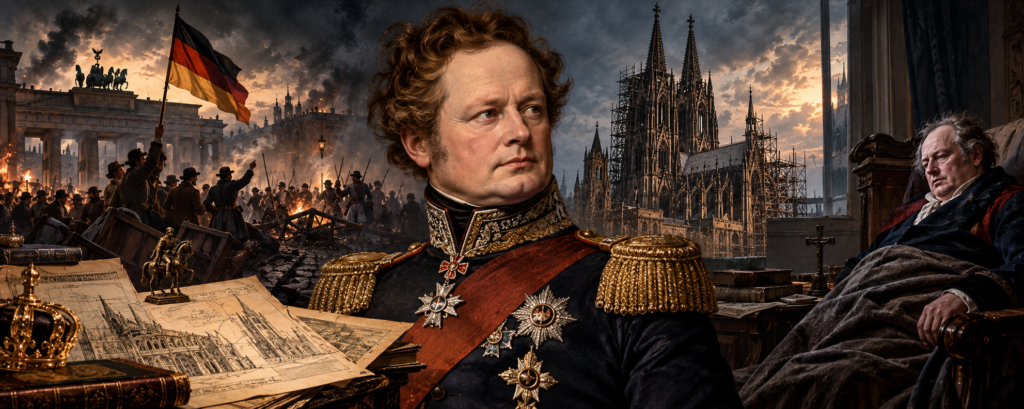
Frederick William IV of Prussia: The Romantic King, the Revolution, and the Mind Silenced by Strokes
King of Prussia, 1840–1861 | The “Romanticist on the Throne,” Medieval Dreams, the Berlin Revolution of 1848, the Rejected German Crown, Architectural Obsessions, Political Contradictions, Stroke, Aphasia, Incapacity, and the Regency That Ended His Rule
The King Who Slowly Lost His Words
By the final years of Frederick William IV’s reign, the man who had once been famous for torrents of words was struggling to produce them. This was a king who had loved conversation, speeches, elaborate political theories, architectural discussions, historical symbolism, religious speculation, and grand declarations about the sacred relationship between monarch and people. He had possessed a restless imagination and a gift for dramatic public performance, yet after a series of strokes beginning in 1857, language itself began slipping away from him. Speech became difficult, memory deteriorated, concentration failed, and the ruler who believed his crown came directly from God became increasingly incapable of exercising the authority he considered sacred.
To nineteenth-century observers, the transformation could easily look like madness. Frederick William had already spent decades acquiring a reputation for emotional volatility, impractical romanticism, political inconsistency, mystical religiosity, and an almost obsessive fascination with an idealized medieval past. He could speak warmly about reform and then recoil from its consequences, present himself as the loving father of his people and then permit troops to suppress resistance, or appear before revolutionary crowds wearing the colors of German nationalism while privately rejecting the political principles those colors increasingly represented. When neurological disease later destroyed portions of his cognitive and linguistic abilities, the decline seemed to confirm what enemies had long whispered: perhaps the strange king had finally lost his mind.
Modern understanding requires a much sharper distinction. Frederick William IV’s final incapacity was not simply a mysterious descent into “lunacy,” and it should not be confused with the eccentricities of his earlier personality. He suffered repeated strokes that produced serious neurological damage, including profound difficulties with speech and cognition. The exact underlying pathology cannot be established with the certainty possible in a modern clinical setting, and retrospective labels such as vascular dementia should therefore be used cautiously, but the broad pattern is unmistakably organic rather than merely psychological. His brain had been physically injured, and his ability to rule deteriorated with it.
That medical tragedy came at the end of one of the strangest reigns in nineteenth-century Prussia. Frederick William IV had spent much of his life dreaming about an organic Christian monarchy rooted in history, hierarchy, religion, traditional estates, and personal loyalty. Then the modern world arrived outside his palace windows in March 1848, armed with barricades, newspapers, constitutional demands, black-red-gold flags, and citizens who no longer wanted merely to be loved by their king. They wanted political rights. The collision between Frederick William’s romantic imagination and the realities of revolution would expose every contradiction in his character long before disease finally removed him from power.
The Romantic Prince
Frederick William was born in Berlin on 15 October 1795, the eldest son of the future Frederick William III and the celebrated Queen Louise of Prussia. His childhood began in a court still surrounded by memories of Frederick the Great, whose achievements had turned Prussia into a European power and whose reputation remained an almost suffocating standard for later Hohenzollerns. Yet the world of Frederick William’s youth would be shattered not by family conflict but by Napoleon. In 1806, Prussia’s supposedly formidable army collapsed catastrophically at Jena and Auerstedt, exposing how far the military system inherited from Frederick the Great had fallen behind the new realities of warfare.
The humiliation left a deep impression upon the Prussian royal family. The court fled, territory was lost, and the monarchy endured the degrading settlement imposed at Tilsit in 1807. Queen Louise became a patriotic symbol of Prussian suffering before her premature death in 1810, when Frederick William was only fourteen. The young prince therefore grew up surrounded by memories of national humiliation, romantic patriotism, religious feeling, dynastic duty, and the eventual wars of liberation against Napoleon. These experiences helped shape his conviction that monarchy was not merely an administrative system but something sacred, historical, emotional, and almost mystical.
Frederick William was intelligent, imaginative, artistically gifted, and unusually interested in architecture. He sketched buildings constantly, discussed designs with professional architects, and developed an ability to think spatially and aesthetically that went far beyond the casual architectural enthusiasm of many royal patrons. He was also highly verbal, capable of dazzling listeners with long, animated conversations in which ideas, jokes, historical references, religious convictions, and imaginative schemes tumbled over one another. Those who admired him could find him brilliant and charming, while those who had to translate his ideas into practical policy often found the same qualities exhausting.
His temperament was poorly suited to the Prussian ideal of the cold, methodical soldier-king. Frederick William was emotional, theatrical, sentimental, and capable of intense enthusiasm followed by hesitation or reversal. Later critics interpreted these qualities as evidence that something had always been psychologically wrong with him, but eccentricity is not mental illness. The more important problem was political: he possessed a vivid imagination but frequently struggled when reality refused to conform to the beautiful historical structures he imagined.
The Middle Ages Inside His Head
Frederick William became known as the “Romanticist on the Throne,” and the description captures something fundamental about him. He belonged intellectually to the world of German Romanticism, which had reacted against the rationalism of the Enlightenment and the upheavals of the French Revolution by rediscovering medieval art, Gothic architecture, Christian tradition, folklore, historical continuity, and organic ideas of society. To Frederick William, the Middle Ages were not simply an interesting period to be studied. They offered a political vocabulary through which he tried to understand what monarchy ought to be.
He imagined society as a historical organism composed of different orders, communities, provinces, professions, and estates bound together by inherited obligations. The king stood at the summit not because citizens had contracted to give him power but because monarchy had developed through history and existed beneath divine sanction. Nobles, townsmen, peasants, clergy, provinces, and corporate bodies could advise the sovereign, but they did not collectively create his authority. Frederick William could therefore favor consultation while rejecting the underlying principle of popular sovereignty.
This distinction explains why he could sound reformist while remaining fundamentally hostile to modern constitutional government. He did not necessarily oppose all representation. He opposed the idea that individuals, treated as politically equal citizens, could create a national legislature possessing authority independent of the crown. He preferred traditional estates and corporate bodies because they fitted his belief that society consisted of historically distinct communities rather than an undifferentiated mass of voters.
His political imagination consequently seemed to move backward at the very moment Prussia was moving forward economically and socially. Railways expanded, industrial cities grew, literacy increased, newspapers multiplied, a commercial middle class demanded influence, and workers began confronting the social consequences of industrialization. Frederick William looked upon this changing society and attempted to answer it with institutions inspired by an idealized pre-revolutionary past. His vision was not literally an attempt to restore serfdom or recreate medieval Prussia, but it was profoundly anti-modern in the political sense.
The Court of the Christian-German Romantics
Frederick William surrounded himself with conservatives, religious thinkers, aristocrats, artists, and intellectuals who shared at least portions of his worldview. This circle was not a secret occult cabal like the Rosicrucian environment associated with Frederick William II, but it could appear almost as detached from nineteenth-century political realities. Men around the king spoke of Christian monarchy, historical rights, organic society, inherited estates, and the sacred duties binding ruler and subjects together. The language was elevated, historical, and spiritually charged, which appealed deeply to Frederick William’s temperament.
The king’s court therefore possessed a peculiar intellectual quality. It was not unintelligent, and some of the people surrounding him were sophisticated scholars, administrators, artists, theologians, and jurists. The problem was that the court’s preferred political vocabulary could become self-reinforcing. Men who believed modern parliamentary liberalism represented an artificial disruption of historical society could persuade one another that older forms of representation remained viable alternatives.
Frederick William loved this kind of discussion because it transformed politics into a problem of history, theology, and symbolism. Practical questions could become debates about the nature of kingship itself. A constitution was not merely a mechanism for distributing authority; it was a statement about where sovereignty originated. If sovereignty came from God through the historical monarchy, then allowing a written constitution to stand above the king could seem almost sacrilegious.
This helps explain one of his most famous political images: his contempt for the notion that a written document should come between the monarch and his people. He spoke disparagingly of constitutional arrangements as pieces of paper or parchment that threatened the ancient relationship binding crown and country. The sentiment was not an incoherent outburst. It expressed a coherent but increasingly impractical philosophy of kingship in a Europe where constitutional politics was becoming impossible to ignore.
A King Who Promised Without Surrendering
Frederick William III died on 7 June 1840, and his eldest son succeeded him at the age of forty-four. The new reign initially generated considerable hope. Frederick William IV possessed more charisma than his reserved father, relaxed some restrictions, cultivated reconciliation, and seemed open to reforms that liberals had long desired. Political prisoners benefited from greater leniency, censorship initially eased in certain respects, and the king’s public style suggested that a warmer relationship between monarchy and society might be possible.
Yet almost immediately, the fundamental contradiction emerged. Frederick William wanted to be loved as a benevolent monarch without surrendering the divine basis of his authority. He could imagine granting rights from above, consulting representatives, encouraging civic participation, and speaking directly to his subjects. What he could not accept was the proposition that political authority originated with the people and could therefore be imposed upon the king from below.
This became particularly important because Prussia still lacked the national constitution that had been anticipated after the Napoleonic era. Frederick William’s father had created provincial estates but never fulfilled liberal hopes for a representative national assembly. The new king inherited those expectations and attempted to answer them through his own historical philosophy. Rather than establishing a modern parliament, he sought to combine the existing provincial estates into broader representative structures that would advise the crown without fundamentally limiting it.
The solution satisfied almost nobody. Conservatives feared that even limited representative institutions could become the opening wedge of constitutionalism, while liberals regarded the king’s medieval-inspired arrangements as inadequate substitutes for real political representation. Frederick William believed he was offering a historically authentic middle path. His opponents increasingly concluded that he was avoiding the question.
The United Diet: A Medieval Answer to a Modern Problem
In 1847, financial needs forced Frederick William to summon the United Diet, bringing together representatives from Prussia’s provincial estates. The king needed cooperation on matters involving state borrowing and infrastructure, particularly railway development. He hoped the assembly could provide consultation and consent in limited financial areas without becoming a permanent national parliament. In his mind, the arrangement preserved the historical estates while allowing the monarchy to address modern administrative needs.
The representatives had other ideas. Liberal members used the gathering to demand constitutional guarantees, regular parliamentary meetings, broader political rights, and a clearer limitation of royal authority. Frederick William responded with one of the most revealing statements of his reign, making clear that he would not permit a written constitutional arrangement to insert itself between God, king, and people. He considered his authority a sacred inheritance rather than a mandate derived from representatives.
The confrontation exposed the widening gulf between the king and politically active Prussians. Frederick William believed his opponents were trying to replace living historical relationships with abstract constitutional machinery. Liberals believed the king was dressing absolutism in medieval costume. Neither side misunderstood the other as much as later caricatures sometimes suggest; they genuinely disagreed about the source of legitimate authority.
The king’s failure was his belief that the disagreement could be resolved through eloquence and symbolism. He often seemed convinced that if subjects properly understood his intentions, affection for the monarchy would overcome political conflict. This paternalism left him dangerously unprepared for a revolutionary situation in which crowds would demand institutional guarantees rather than emotional reassurance. Less than a year after the United Diet, Berlin would show him how badly he had misjudged the mood.
Architecture as an Alternative Kingdom
Politics frustrated Frederick William because political reality resisted aesthetic harmony. Architecture offered something different. A building could be drawn, revised, arranged, ornamented, and eventually made to embody an ideal. The king’s architectural imagination therefore became one of the most consistent passions of his life, and his surviving sketches reveal genuine ability rather than merely royal doodling.
Working with architects such as Karl Friedrich Schinkel, Ludwig Persius, and Friedrich August Stüler, Frederick William helped shape buildings and landscapes across Berlin and Potsdam. His projects drew upon early Christian architecture, Italian Renaissance forms, Gothic revivalism, Norman influences, and picturesque landscape design. He was not simply obsessed with one version of the Middle Ages; his architectural imagination ranged broadly across historical styles. Potsdam in particular became a canvas upon which royal fantasy could be translated into stone, gardens, towers, churches, and villas.
His involvement could become extraordinarily detailed. Frederick William sketched ideas, altered designs, suggested forms, and sometimes approached architecture less like a patron than an amateur architect with professional resources at his disposal. This activity has occasionally been portrayed as pathological hyper-fixation, especially when contrasted with the political crises surrounding him. That judgment goes too far. He possessed a genuine artistic vocation, although the amount of royal attention devoted to architecture understandably frustrated people who wanted the king focused upon constitutional reform.
His projects also expressed his political imagination. Restoring ancestral castles and completing medieval churches allowed him to make history physically present. Where liberal politicians saw the future in constitutions and representative institutions, Frederick William often found political meaning in continuity with the past. Buildings could embody the hierarchical, Christian, historical order he wanted society itself to preserve.
Cologne Cathedral and the Sacred Past
No project captured Frederick William’s Romantic imagination more powerfully than Cologne Cathedral. Construction of the great Gothic cathedral had begun in the thirteenth century and remained unfinished for centuries. During the nineteenth-century Gothic revival, completing it became a powerful cultural project connected with religion, German history, Romantic nationalism, and artistic restoration. Frederick William enthusiastically supported the renewed construction, which formally resumed in 1842.
The project had an additional significance because the king was Protestant while Cologne was overwhelmingly Catholic. Frederick William sought reconciliation with Prussia’s Catholic subjects and helped resolve tensions inherited from the previous reign. Supporting the cathedral allowed him to present monarchy as the protector of a shared German Christian heritage transcending confessional divisions. It also perfectly matched his conviction that historical monuments could bind the present to an idealized past.
He participated personally in ceremonies connected with the building and treated the cathedral as far more than an architectural curiosity. Gothic architecture represented the kind of organic historical civilization he admired, a world in which religion, art, community, hierarchy, and political authority appeared intertwined. The unfinished cathedral could therefore become a metaphor for historical continuity: modern Germans completing a sacred work begun by medieval ancestors.
The irony is difficult to miss. Frederick William understood that a medieval cathedral could be completed using modern organization, technology, and money, yet he struggled to accept that political institutions might also have to evolve. He could combine past and present brilliantly in architecture while trying to preserve older principles of sovereignty against modern constitutional demands. Stone proved easier for him to reconcile with history than politics.
Hohenzollern Castle and the Dynasty in Stone
Frederick William’s fascination with dynastic history also inspired the reconstruction of Hohenzollern Castle, the ancestral seat of his family in southern Germany. The older fortress had fallen largely into ruin, but the king imagined its restoration as a monumental expression of Hohenzollern identity. The cornerstone of the new nineteenth-century castle was laid in 1852, and Friedrich August Stüler developed the design under strong royal influence. The result was not a literal reconstruction of one medieval phase but a Romantic interpretation of what an ancestral dynastic fortress ought to look like.
To Frederick William, this was not merely decorative nostalgia. Dynasties required memory, and memory required places. A restored ancestral castle could make the legitimacy of the Hohenzollerns appear ancient, visible, and almost geological. Towers, walls, chapels, and heraldic spaces transformed family history into architecture.
Critics could reasonably question whether such projects deserved royal attention during an age of rapid social change. Prussia faced industrial unrest, political demands, economic transformation, urban poverty, constitutional conflict, and the problem of German national unity. Frederick William nevertheless continued to devote enormous imaginative energy to architecture. The contrast reinforced his reputation as a monarch more comfortable designing idealized historical environments than navigating contemporary politics.
Calling this madness would be unfair. It was escapism only in the broadest sense, and many rulers have preferred cultural projects to political conflict. Yet Frederick William’s architecture reveals something central about him: when reality disappointed him, he repeatedly returned to historical imagination.
In stone, unlike politics, the past obeyed.
1848 Approaches
The European order began cracking in February 1848 when revolution erupted in Paris and King Louis-Philippe was overthrown. News traveled rapidly through newspapers, letters, travelers, and political networks. Revolt spread across the continent, reaching the German states, the Habsburg lands, and eventually Prussia. Demands varied from place to place, but constitutions, press freedom, representative government, national unity, and civil rights appeared repeatedly.
Frederick William initially tried to maneuver between concession and royal authority. He understood that Prussia could not remain untouched by the upheaval, yet he remained deeply suspicious of allowing revolutionary pressure to dictate political change. Demonstrations intensified in Berlin during March, and citizens gathered repeatedly to demand reforms. The king issued concessions while troops remained conspicuously present in the capital.
The tension was explosive because both sides feared the other. Berliners had watched events elsewhere and suspected the monarchy might use military force to crush reform. Officers and conservative courtiers feared that withdrawing troops would surrender the capital to revolution. Frederick William stood between these pressures, attempting to maintain royal authority while presenting himself as sympathetic to legitimate popular concerns.
His instinct for dramatic gestures would soon become both an asset and a liability. Frederick William believed intensely in the emotional bond between monarch and people. March 1848 forced him to test whether that bond actually existed.
The answer came through gunfire.
March 18, 1848: Morning — A City Waiting
By the morning of 18 March, Berlin was filled with political expectation. News had arrived that the king was prepared to make significant concessions, including steps involving press freedom and representative institutions. Crowds moved toward the royal palace, and many people initially came not to overthrow Frederick William but to celebrate what appeared to be a political breakthrough. The atmosphere combined relief, excitement, suspicion, and the dangerous energy of thousands of people gathered before armed troops.
Frederick William still hoped to control the situation through proclamation and personal authority. He had repeatedly shown confidence in his ability to speak directly to subjects and transform political confrontation into emotional reconciliation. That talent was real; even hostile observers acknowledged his capacity for dramatic self-presentation. Yet a crowd is not a royal audience, and Berlin in March 1848 was no longer willing simply to receive whatever the monarch chose to grant.
The presence of soldiers became increasingly provocative. Citizens demanded that the military withdraw, while commanders feared that doing so would leave the palace exposed. Shouts rose from the crowd, including demands that the soldiers be removed. The king ordered the square cleared rather than immediately removing the troops from the city.
What followed transformed a political demonstration into an urban battle.
March 18: Afternoon — The Shots
During the attempt to clear the palace square, shots were fired. The precise circumstances became the subject of immediate controversy, and contemporary evidence indicates that the initial discharges may have been accidental rather than a deliberate order to massacre the crowd. Such distinctions mattered little once people believed the military had opened fire upon citizens. Panic and fury spread through Berlin.
Barricades began appearing with extraordinary speed. Cobblestones were torn up, carts overturned, furniture dragged into streets, and neighborhoods transformed into defensive positions. Artisans, workers, students, and other citizens armed themselves with whatever weapons were available. The city’s narrow streets became a battlefield in which disciplined troops confronted opponents who possessed the advantage of barricades, windows, rooftops, and intimate knowledge of the urban terrain.
Frederick William found himself trapped inside the nightmare his political philosophy had insisted should not exist. These were his subjects, the people with whom he imagined a sacred paternal relationship. Now they were fighting his soldiers in the streets surrounding his palace. Every volley made reconciliation more difficult.
Reports reached the king throughout the afternoon and evening as the fighting intensified. His responses were emotional and uncertain, but sensational descriptions of alternating “manic” rage and hysterical sobbing should be treated cautiously unless supported by specific eyewitness testimony. What is well established is his indecision and distress. He did not possess the temperament of a commander who could calmly treat his capital as an enemy city.
March 18–19: Night — Berlin Behind the Barricades
The battle continued into the night. Fires burned, bells rang, gunfire echoed through streets, and barricades divided Berlin into pockets of combat. Prussian soldiers attempted to seize positions while civilians resisted from buildings and improvised fortifications. Casualties mounted on both sides, with civilians suffering heavily.
Inside the palace, Frederick William confronted contradictory advice. Hardliners wanted the military to restore order. Others warned that continuing the battle could produce a massacre, destroy the monarchy’s legitimacy, or drive the entire city into revolution. The king vacillated because either choice threatened something he valued: withdrawal humiliated royal authority, while continued fighting meant killing the very subjects he claimed to rule as a Christian father.
This was where Frederick William’s political romanticism became almost unbearable. His theory of monarchy depended upon an organic bond of affection and loyalty. The barricades demonstrated that society contained conflicts no amount of paternal symbolism could erase. Workers, artisans, liberals, soldiers, aristocrats, bureaucrats, and monarchists did not form one harmonious body simply because a king wished them to.
By the early hours of 19 March, Frederick William moved toward ending the fighting. Orders were issued for troops to withdraw from the city. The decision effectively conceded the streets to the revolutionaries and horrified conservative military figures, including the king’s brother Prince William, who had become associated in the public imagination with the possibility of violent repression.
The king had chosen reconciliation over a potentially greater bloodbath.
He had also suffered a humiliating political defeat.
March 19: The Dead Before the King
The morning after the fighting produced one of the most haunting scenes of Frederick William’s reign. The bodies of civilians killed during the battle were brought before the royal palace. The dead were displayed to the monarch whose troops had fought them only hours earlier, turning casualties into a devastating political accusation.
Frederick William appeared before the crowd and paid respect to the dead. Accounts of these scenes emphasize his emotional response, and there is no reason to doubt that he was genuinely shaken. His temperament was intensely sentimental, and the sight of subjects killed in a conflict involving his own soldiers struck directly at his conception of himself as a paternal Christian monarch.
Yet emotion could not undo what had happened. The dead of March became martyrs of the revolution, and their funerals transformed private grief into public political theater. The monarchy survived, but it had been forced to bow before the consequences of its own failed attempt to control the streets.
Prince William temporarily fled Berlin because of popular hostility, eventually earning the mocking association with the “grapeshot prince” image. Frederick William, by contrast, attempted to recast himself as the monarch who would lead reform rather than resist it. His extraordinary ability to move between ideological positions was about to produce one of the most theatrical political performances of the entire revolution.
March 21: The King Wears the Revolution’s Colors
On 21 March, Frederick William rode through Berlin displaying the black-red-gold colors associated with the German national movement. He issued proclamations presenting himself as a leader of German unity and appeared before crowds in a performance that astonished conservatives and encouraged liberals. Only days earlier, soldiers and citizens had been killing one another in the streets. Now the Prussian king seemed to place himself at the head of the national cause. Contemporary imagery celebrated the transformation, showing the monarch moving through his capital beneath revolutionary colors. German History in Documents and Images
The performance was not evidence of a manic episode. It was political improvisation under extreme pressure, shaped by Frederick William’s instinct for symbolism and his desire to recover the paternal relationship with his subjects. He understood that the monarchy could not immediately defeat the revolution by force, so he attempted to absorb its language. By identifying himself with German national aspirations, he hoped to transform revolutionary energy into loyalty to the crown.
The strategy temporarily worked. Frederick William possessed a remarkable talent for emotional self-presentation, and public anger after the March fighting focused heavily upon the military and Prince William rather than exclusively upon the king. The monarch could weep with his people, salute their dead, wear their colors, and promise reform while still privately rejecting much of the political philosophy underlying the revolution.
This was Frederick William at his most characteristic. He could inhabit a political role passionately in the moment without permanently accepting its implications. His critics interpreted this as dishonesty or instability, while admirers could interpret it as flexibility.
Both judgments contained truth.
March 22 and the Funeral of the Revolution
The funeral ceremonies for those killed in the March fighting deepened the revolution’s emotional power. The dead were carried through Berlin in a public procession, and Frederick William paid tribute to them. Revolutionary symbols, civic mourning, religious ceremony, and political demands became intertwined. The monarchy was forced to participate in the commemoration of people killed fighting royal troops. German History in Documents and Images
For Frederick William, the experience must have been particularly painful because it reversed his preferred political imagery. He wanted to be the father mourning with his people, but many Berliners saw a king acknowledging victims of state violence. He wanted reconciliation, while revolutionaries wanted institutional change. The same ceremony could therefore carry radically different meanings depending upon who watched it.
The days from 18 to 22 March have often encouraged retrospective speculation about Frederick William’s mental stability. His emotional displays, rapid concessions, dramatic national gestures, and subsequent reversals can appear chaotic. Yet there is no need to invoke mental illness to explain them. He was a monarch facing an unprecedented urban uprising, receiving contradictory advice, terrified of civil war, and attempting to preserve both his crown and his conception of kingship.
His behavior was inconsistent because his objectives were incompatible. He wanted constitutional concessions without popular sovereignty, German unity without revolutionary nationalism, royal authority without mass bloodshed, and affection from subjects who increasingly demanded rights rather than paternal love. No amount of eloquence could make all those goals coexist indefinitely.
Revolution in the Palace, Counterrevolution in the Wings
The months following March initially appeared to confirm revolutionary victory. A liberal ministry was appointed, elections took place, and a Prussian National Assembly met to develop constitutional arrangements. Press and political activity expanded dramatically. For a time, it seemed possible that Frederick William might become a constitutional monarch within a genuinely transformed Prussia.
The king never fully accepted the revolution’s underlying claim to sovereignty. His concessions had been extracted during crisis, and once the immediate danger passed, conservative forces recovered. The Prussian army remained loyal to the crown, rural areas were less revolutionary than Berlin, and divisions among liberals, democrats, workers, and moderate reformers weakened the revolutionary coalition.
Frederick William’s emotional language toward his “beloved Berliners” therefore coexisted with a growing determination to recover royal control. This apparent reversal was not as psychologically mysterious as contemporaries sometimes believed. He had yielded because he feared catastrophe, not because he had converted to democratic principles. Once the balance of power changed, his original convictions reasserted themselves.
By November 1848, the monarchy moved decisively against the revolutionary assembly. Troops under General Friedrich von Wrangel entered Berlin, and the National Assembly was first relocated and then dissolved. Martial law and conservative authority returned. The revolution that had forced the king to wear its colors in March was being systematically contained before the year ended. German History in Documents and Images
The Constitution He Never Wanted
Frederick William could not simply restore the world of 1847. The revolution had changed Prussia too deeply, and constitutional government had become unavoidable. In December 1848, the king imposed a constitution from above, and after further revisions Prussia received the constitutional settlement of 1850. The monarchy remained powerful, while representative institutions became permanent features of the state.
The electoral system was structured through the notorious three-class franchise, which weighted voting power according to taxation and therefore gave wealthy citizens vastly greater influence than poorer voters. The arrangement allowed Frederick William to concede constitutional forms while preserving strong royal authority and conservative social power. It was a compromise he could tolerate far more easily than a constitution derived directly from revolutionary sovereignty.
This outcome reveals why calling him simply politically irrational is inadequate. Frederick William eventually accepted constitutional machinery when he could shape it to preserve the crown. He was capable of adaptation, but only after attempting to reconcile the new system with his older convictions. His politics were therefore reactionary in principle but flexible in practice.
The contradiction would define the remainder of his active reign. Prussia was now a constitutional monarchy ruled by a king who had spent much of his life arguing that written constitutional arrangements violated the sacred relationship between monarch and people. History had forced him to inhabit the political world he had resisted.
The Crown From Frankfurt
While Prussia struggled with its own revolution, representatives from across the German states gathered in Frankfurt to confront the enormous question of German national unification. The Frankfurt Parliament attempted to create a constitutional German nation-state, debating borders, rights, political structures, and the relationship between Austria and Prussia. By early 1849, the assembly had produced a constitution and decided to offer the hereditary imperial crown to Frederick William IV.
The offer placed the king before one of the most extraordinary opportunities in German history. He could potentially become hereditary emperor of a unified German constitutional state, elevating Prussia to leadership over much of Germany. To later generations who knew that Prussia would eventually achieve German unification under his brother William I, rejecting the offer could look almost incomprehensible.
Frederick William refused.
The refusal was rooted directly in his conception of legitimate monarchy. The Frankfurt Parliament consisted of elected representatives, and Frederick William did not believe such a body possessed the authority to create an imperial crown and bestow it upon a Hohenzollern. A genuine German imperial title, in his view, required the consent of the German princes and could not simply be manufactured by a revolutionary or parliamentary assembly.
His private language concerning the offer was contemptuous. The famous phrase “crown from the gutter” captures his attitude, although the exact wording and transmission of particular quotations require care. In correspondence he used imagery portraying the proposed crown as contaminated by revolution, illegitimate sovereignty, and the upheavals of 1848. The issue was not that he disliked becoming more powerful.
He disliked the hands offering him the power.
Did Frederick William Delay German Unification?
It is tempting to say that Frederick William’s refusal single-handedly delayed German unification for decades, but that gives one man too much control over an enormously complicated political problem. Austria opposed a Prussian-led German empire that excluded or subordinated Habsburg interests. Many German princes resisted losing sovereignty. The Frankfurt Parliament lacked the military force necessary to impose its constitution upon unwilling governments. Revolutionary unity itself was already collapsing.
Even if Frederick William had accepted the imperial crown, war with Austria and resistance from other German states might have followed. Whether the Frankfurt constitution could have survived remains impossible to know. The king therefore rejected a remarkable opportunity, but not a guaranteed empire.
His refusal nevertheless exposed the limits of his imagination. Frederick William wanted German unity, but he wanted it created through legitimate princes and monarchical agreement rather than popular sovereignty. He could envision Prussian leadership without accepting the revolutionary mechanism that offered it to him.
This was not madness.
It was ideological consistency carried into a rapidly changing political world.
The irony would become enormous. His younger brother William, whose political instincts were in many respects more conventionally conservative, eventually became German Emperor in 1871 after wars engineered under Otto von Bismarck. The crown Frederick William would not accept from elected representatives would later come to his brother through princes, armies, diplomacy, and battlefield victories.
That was a method Frederick William could have understood.
The Erfurt Union and Another Failure
Frederick William did not abandon the idea of Prussian leadership in Germany after rejecting Frankfurt’s crown. His government supported the Erfurt Union project, an attempt to create a more conservative German federation under Prussian leadership. The plan represented a version of national organization that Frederick William could accept because it rested more heavily upon agreements among governments rather than revolutionary popular sovereignty.
Austria opposed the project and worked to restore its own influence within Germany. The confrontation eventually brought Prussia into a humiliating diplomatic retreat at Olmütz in 1850. Prussia abandoned the Union project and accepted the restoration of the German Confederation under conditions widely regarded by nationalists as a defeat.
The episode further damaged Frederick William’s reputation for consistency and leadership. He had rejected the Frankfurt crown because its source was illegitimate, then pursued a different path toward German leadership, only to retreat when confronted by Austria. Critics saw hesitation and weakness where the king saw the limits imposed by legitimate interstate politics.
Again, his behavior does not require psychiatric explanation. Prussia was not yet ready to risk a major war with Austria under unfavorable conditions, and Russia’s attitude strengthened Vienna’s position. The retreat was humiliating but strategically understandable.
Frederick William’s tragedy was that he wanted outcomes that increasingly required methods he disliked.
The Marriage Without an Heir
Frederick William married Elisabeth Ludovika of Bavaria in 1823. Their marriage appears to have been affectionate, but it produced no children. Elisabeth, raised Catholic, eventually converted to Protestantism after careful consideration, and she became a significant emotional presence in her husband’s life.
The absence of children meant that Frederick William’s younger brother William remained central to the succession. This would become enormously important when the king’s health collapsed. There was no adult son who could naturally step into a regency; the responsibility would fall upon the brother who had once fled revolutionary Berlin and who represented a more military, practical strand of Hohenzollern kingship.
The brothers differed markedly in temperament. Frederick William was imaginative, artistic, verbose, historical, emotional, and religiously romantic. William was more straightforwardly military and less fascinated by elaborate political theories. Their differences had been visible during the revolution, when William became associated with hard-line repression while Frederick William tried to reconcile the monarchy with the streets.
History would eventually reverse their reputations in unexpected ways. Frederick William, the eloquent romantic who dreamed of German unity under legitimate monarchy, would become incapable of speaking and governing. William, once forced to flee Berlin as a hated symbol of reaction, would return as regent, become king, and eventually receive the German imperial crown.
The First Signs of Neurological Catastrophe
By the 1850s, Frederick William’s health was becoming a matter of increasing concern. The decisive collapse came in 1857, when he suffered a series of strokes that damaged his neurological functioning. Contemporary terminology was imprecise, and later medical reconstructions have proposed cerebrovascular disease, including arteriosclerotic processes, as the underlying cause. What can be stated with much greater confidence is that repeated cerebral vascular events produced progressive neurological impairment.
Speech was particularly affected. Frederick William developed severe difficulties communicating, consistent with aphasia following cerebral injury. For a man whose personality had been so closely tied to speech, conversation, rhetorical performance, and verbal imagination, the loss was especially cruel. The king who had once overwhelmed listeners with words increasingly struggled to command language itself.
Cognitive impairment accompanied the speech problems. His ability to concentrate, remember, process complicated information, and conduct state business deteriorated. Accounts describing him simply as “mad” flatten a neurological catastrophe into a psychiatric label. The distinction matters because aphasia can make an intelligent person appear confused when the underlying problem is an inability to produce or understand language normally, while repeated strokes can simultaneously damage memory, judgment, and other cognitive functions.
His physical abilities also declined. Subsequent vascular events worsened his condition, and paralysis increasingly restricted his mobility. The decline was progressive rather than a single dramatic psychological break. The king was being dismantled neurologically, function by function.
Aphasia: When the King Could No Longer Command Words
Aphasia would have been particularly devastating within nineteenth-century monarchy because royal authority depended heavily upon communication. A king needed to understand reports, converse with ministers, make decisions, dictate responses, approve documents, and demonstrate that commands genuinely represented his will. Frederick William’s inability to communicate reliably therefore created a constitutional problem as well as a medical one.
The situation could also easily be misunderstood by observers unfamiliar with neurological disorders. A person with aphasia may struggle to find words, produce incorrect words, misunderstand complicated sentences, repeat fragments, or appear unable to answer questions that he may partly comprehend. To nineteenth-century witnesses, such behavior could be categorized loosely as mental derangement. Modern neurology allows a much more precise distinction between disorders of language and global insanity.
Frederick William’s case was complicated because the strokes did not affect language alone. Repeated vascular injury appears to have impaired broader cognitive functioning as well, making it increasingly difficult for him to perform the sustained intellectual work required of a sovereign. The combination of aphasia, memory problems, impaired concentration, physical weakness, and further neurological decline eventually made meaningful government impossible.
It is therefore reasonable to describe his final illness as involving stroke-related cognitive impairment and probably a vascular form of dementia, provided the diagnosis is presented as retrospective rather than certain. Historians do not possess the imaging, laboratory data, neurological examinations, or modern clinical records that would be required for absolute diagnostic precision. What they do possess is enough evidence to reject the idea that his late incapacity was simply an extension of lifelong eccentricity.
The Romantic king had not finally gone mad.
His brain had been injured.
The Constitutional Problem of an Incapable King
Frederick William’s illness created an extraordinary political dilemma. The Prussian monarchy still rested upon a powerful conception of personal kingship. The sovereign appointed ministers, exercised executive authority, commanded the military, participated in legislation, and embodied the continuity of the state. If the king could no longer reliably understand or communicate decisions, someone else had to exercise those powers.
Yet declaring a monarch incapable was politically delicate. Frederick William remained alive and remained king. His crown did not automatically disappear because illness had damaged his brain. Any transfer of authority therefore required a legal and dynastic mechanism that respected the monarchy while acknowledging the obvious reality that the sovereign could no longer govern.
Initially, temporary arrangements attempted to accommodate his condition. His brother William increasingly assumed responsibilities while hopes remained that Frederick William might recover enough to resume active government. Stroke victims can improve after an acute episode, and the full permanence of his incapacity may not have been immediately obvious.
Recovery proved insufficient. The king’s neurological impairment persisted, and additional episodes deepened the problem. By 1858, maintaining the fiction of effective personal rule had become untenable.
Prussia needed a regent.
William Takes the Government
In October 1858, Prince William formally assumed the regency. The transition marked the effective end of Frederick William IV’s political reign, although he remained king in title until his death. William would exercise sovereign authority on behalf of his incapacitated brother for the next several years.
The regency had enormous political consequences. William initially appointed a more moderate ministry, beginning the period sometimes called the New Era. Liberals hoped the change might produce greater constitutional cooperation after the increasingly conservative atmosphere of Frederick William’s later active years.
For Frederick William himself, the political transformation must have been profound even if his impaired cognition makes it impossible to know exactly how he experienced it. He had spent his life defending the sacred personal authority of kingship. Now that authority continued legally in his name while another man exercised it.
There is a grim symmetry in the situation. Frederick William had rejected the idea that sovereignty could be reduced to constitutional machinery because he believed monarchy depended upon a living relationship between king, God, history, and people. His illness demonstrated why states required institutions capable of functioning when the individual sovereign could not.
A monarchy built around the person of the king had encountered the most basic vulnerability of personal government.
The person could fail.
The King Removed From Politics
Frederick William’s final years were spent largely outside active political life. His condition restricted his public appearances and prevented meaningful participation in government. Elisabeth remained devoted to him, while William carried the responsibilities of the state.
The king suffered further neurological deterioration. Later strokes worsened paralysis and cognitive impairment, leaving him increasingly physically dependent. Claims that a specific 1859 stroke definitively paralyzed one precise side of his body should be handled cautiously because medical descriptions vary, but progressive paralysis and severe disability are well established.
This period contributed enormously to the historical image of the “mad king.” A once brilliant, talkative, eccentric monarch had disappeared from public politics and been replaced by a regent while rumors circulated about his mental condition. To people without a modern neurological vocabulary, the easiest explanation was that the king had lost his mind.
In a broad everyday sense, observers were seeing a loss of mental function. But the mechanism matters. Frederick William’s cognitive decline followed cerebrovascular injury rather than a documented primary psychiatric illness.
He was not suffering because Romanticism had finally consumed him.
He was suffering because portions of his brain no longer functioned properly.
The Strange Relationship Between Eccentricity and Disease
Frederick William’s earlier personality made later misunderstanding almost inevitable. If a famously practical and emotionally restrained monarch had suddenly developed aphasia after a stroke, observers might have recognized a clear before-and-after distinction. Frederick William already possessed a reputation for dramatic emotion, inconsistent politics, religious mysticism, architectural preoccupation, and impractical historical fantasies.
When neurological disease arrived, people could connect the two periods into a single narrative. The eccentric young prince had become the eccentric king, the eccentric king had behaved erratically during revolution, and the erratic ruler had eventually descended into incapacity. It was an appealing story because it turned an untidy life into a simple trajectory toward madness.
The medical evidence points toward a different interpretation. His pre-1857 behavior is better understood through personality, ideology, temperament, political circumstances, and Romantic intellectual culture. His post-1857 deterioration belongs to the history of neurological disease.
That does not mean his earlier behavior was always rational or wise. Frederick William could be indecisive, emotionally excessive, unrealistic, contradictory, and maddening to advisers. Political irrationality, however, is not equivalent to psychiatric illness.
The distinction is essential for a Mad Monarchs category that aims to separate documented illness from reputation. Frederick William IV is a perfect example of how genuine neurological impairment can become mixed with decades of hostile political commentary until “madness” seems to explain everything.
It does not.
Emotional Volatility Without a Diagnosis
Frederick William’s emotional nature was genuine. He was capable of tears, intense enthusiasm, sentimentality, religious emotion, theatrical gestures, and sudden shifts in tone. During crises, these qualities could appear especially unstable when compared with the rigid military demeanor expected of Prussian kings.
The events of March 1848 provide the most dramatic example. Frederick William moved rapidly from concession to confrontation, from military resistance to troop withdrawal, and from a bloody battle with Berliners to public identification with German national colors. Within days, he was mourning revolutionary dead and presenting himself as a leader of the national movement.
Such behavior can look manic when compressed into a narrative, but political crisis can force rapid reversals without requiring bipolar disorder or another psychiatric diagnosis. The king was responding to a changing balance of power hour by hour. His emotional temperament influenced how dramatically he expressed those responses, but the decisions themselves had political logic.
It is also worth remembering that theatrical public emotion was not necessarily regarded in the same way during the nineteenth century as it might be today. Romantic culture valued sentiment, religious feeling, and emotional authenticity. Frederick William was unusually expressive for a Prussian monarch, but tears alone are not pathology.
His real problem was that emotion sometimes substituted for policy. He repeatedly seemed to believe that symbolic reconciliation could solve structural conflict.
Berlin’s barricades proved otherwise.
The King as Artist
Frederick William’s artistic ability deserves serious consideration because it formed one of the most consistent parts of his personality. His architectural sketches were not merely random distractions but expressions of a mind genuinely interested in proportion, historical style, landscape, symbolism, and spatial composition. Professional architects sometimes developed ideas that originated with the king.
Potsdam benefited enormously from this interest. Churches, villas, landscape projects, palace alterations, and picturesque architectural ensembles created during his era helped shape the cultural landscape that survives today. His collaboration with architects and landscape designers left a legacy far more successful than many of his political experiments.
The contrast between artistic and political ability is striking. Architecture allowed Frederick William to create harmonious relationships between past and present. He could borrow historical forms without literally recreating historical society. Gothic, Renaissance, early Christian, and Italianate influences could be transformed into something distinctly nineteenth-century.
In politics, he struggled to make the same imaginative leap. He wanted the spirit of an older monarchical order without fully accepting the institutional changes required by industrial society. His political structures therefore often felt less creative than his buildings.
The architect in him understood adaptation.
The king in him feared it.
Religion, Kingship, and the Sacred Crown
Frederick William’s resistance to constitutional sovereignty cannot be understood without his religious beliefs. He genuinely regarded monarchy as a divine vocation. The crown was not simply a prestigious office inherited by accident of birth; it carried sacred responsibilities and existed within a providential historical order.
This conviction helps explain why the Frankfurt imperial crown repelled him. Accepting a crown from elected representatives would imply that the representatives possessed the authority to create and confer sovereignty. Frederick William believed that assumption inverted the proper order of political legitimacy.
His position was therefore more coherent than the famous “crown from the gutter” story sometimes suggests. He was not refusing power because he was too eccentric to understand what was being offered. He was refusing the political principle embedded within the offer.
The tragedy was that this principle increasingly shaped the century in which he lived. Constitutionalism, nationalism, representative institutions, public opinion, newspapers, mass politics, and industrial society were transforming Europe. Frederick William could delay those forces but could not make them disappear.
His brother would eventually solve the German national question through a combination of monarchy, conservative statecraft, military power, and limited constitutionalism.
Frederick William had imagined something similar in spirit.
He simply could not build it.
The Brother Who Inherited the Future
William’s assumption of the regency in 1858 represented more than a family arrangement. It transferred practical authority from one type of Hohenzollern ruler to another. Frederick William belonged to the generation shaped by Romanticism, the Napoleonic catastrophe, historical revival, and dreams of Christian monarchy. William would become associated with Bismarck, army reform, Realpolitik, and the wars of German unification.
The contrast should not be exaggerated because William himself was deeply conservative and hardly a modern democrat. Yet he was more comfortable with the military and administrative mechanisms through which Prussia would eventually dominate Germany. Where Frederick William surrounded political questions with historical and theological symbolism, William was generally more direct.
The irony became complete in 1871. The imperial title Frederick William had refused in 1849 eventually came to William after Prussia defeated Denmark, Austria, and France. The German princes participated in offering the imperial dignity, allowing the new empire to emerge through a monarchical process much closer to Frederick William’s ideas of legitimacy.
The brother who had once fled revolutionary Berlin became German Emperor.
The brother who had dreamed of German unity died before seeing it.
History had accepted part of Frederick William’s vision while rejecting the path he had taken toward it.
The Final Stroke
Frederick William remained king in name throughout the regency, but there would be no meaningful political recovery. His neurological condition continued to deteriorate, and further strokes deepened his disability. By the end of his life, the contrast with the brilliant, verbose prince of earlier decades was devastating.
On 2 January 1861, Frederick William IV died at Sanssouci at the age of sixty-five. His brother immediately succeeded him as King William I of Prussia. The regency was over because the crown had finally passed legally to the man who had already been governing.
Frederick William was buried at the Church of Peace in Potsdam, a building closely connected with his own artistic and religious vision. It was an appropriate resting place for the Romantic king. Architecture had been one of the few realms in which his imagination consistently produced lasting harmony.
His death also removed the final constitutional ambiguity surrounding the Prussian monarchy. William no longer governed for an incapacitated brother. He governed in his own right.
Within a decade, he would become emperor.
Was Frederick William IV Mad?
The simplest answer is no, at least not in the sense implied by the traditional label of an inherently insane monarch. There is no compelling evidence that Frederick William spent his adult life suffering from a severe psychotic disorder. His eccentricities were substantial, but they can be understood through his temperament, religious beliefs, Romantic intellectual environment, artistic personality, and political ideology.
His late-life cognitive collapse is a different matter. Repeated strokes beginning in 1857 produced severe neurological impairment affecting speech, cognition, memory, concentration, and eventually physical function. A retrospective diagnosis involving cerebrovascular disease and vascular cognitive impairment is plausible, although precise modern diagnostic certainty is impossible.
This distinction transforms the story. Frederick William’s later incapacity was not the inevitable culmination of his medieval fantasies or emotional personality. It was a medical catastrophe that happened to a man who had already acquired a reputation for eccentricity.
The two stories became fused because nineteenth-century observers possessed limited neurological understanding and because political enemies had spent years describing the king as unstable. Once he could no longer speak coherently or govern effectively, “madness” offered a simple explanation.
Modern history can do better.
We can recognize the eccentric monarch and the neurological patient without pretending they were the same thing.
The Romanticist on the Throne
Frederick William IV remains one of the most difficult Prussian kings to summarize because he was neither a simple reactionary nor a frustrated liberal. He loosened some restrictions when he became king, encouraged culture, supported infrastructure, reconciled with Catholic interests, and possessed a genuine affection for his subjects. Yet he remained deeply committed to divine-right monarchy and resisted the principle that political sovereignty could originate from elected citizens.
He was not merely nostalgic for medieval costumes and castles. His Romanticism formed a political worldview. Society, in his imagination, should grow historically rather than be mechanically constructed through abstract constitutional formulas. Different social groups should possess distinct roles, while the king unified them within a Christian moral order.
There was intelligence in this worldview, but also profound blindness. Industrializing Prussia contained interests and conflicts that could not be dissolved through paternal symbolism. Workers did not stop being poor because the king loved them. Liberals did not stop wanting constitutional rights because the king spoke beautifully about historical loyalty.
Frederick William repeatedly mistook emotional connection for political consent.
That mistake reached its most violent expression in March 1848.
The Barricades He Could Never Forget
The Berlin Revolution revealed the limits of Frederick William’s entire conception of kingship. He believed monarch and people were bound by something deeper than constitutional paragraphs. Then his soldiers and his people spent a night killing one another behind barricades.
His reaction was not simply cowardice, hysteria, or madness. He confronted an impossible choice between military repression and political humiliation. Continuing the battle risked turning Berlin into a slaughterhouse and perhaps destroying the monarchy. Withdrawing the army preserved the possibility of reconciliation but made the crown appear defeated.
Frederick William chose withdrawal and then attempted to reclaim political initiative through symbolism. He mourned the dead, adopted national colors, spoke of German unity, and presented himself as the people’s king. These gestures were theatrical, but they were not meaningless.
They helped save his throne.
Months later, when revolutionary momentum weakened, the monarchy regained control and dismantled much of what had been forced upon it. Frederick William’s behavior therefore looks less like random oscillation when viewed across the entire year. He yielded when weak and recovered authority when strong.
The emotional intensity was uniquely his.
The strategy was ancient.
The Crown He Would Not Touch
Few decisions damaged Frederick William’s historical reputation more than his refusal of the Frankfurt imperial crown. Later generations knew that Germany would eventually unify under Prussian leadership, making the offer of 1849 look like history placing destiny directly into his hands. His refusal therefore became evidence of blindness, cowardice, ideological obsession, or madness.
Yet Frederick William understood perfectly well that accepting the crown meant accepting the authority of the body offering it. The Frankfurt Parliament claimed to speak for the German nation. Frederick William believed sovereignty belonged to legitimate monarchs.
Accepting the crown would therefore have required him to endorse a political principle he considered revolutionary.
Whether this was wise is another question.
It was consistent.
The decision did not single-handedly prevent German unification, because Austria, the German princes, international politics, military realities, and the weakness of the Frankfurt Parliament all mattered. But Frederick William did reject an extraordinary opportunity because legitimacy mattered to him more than the immediate expansion of his power.
That makes the episode more fascinating than simple insanity.
A king refused an empire because he disliked where the crown had been.
The Silence at the End
The final years of Frederick William’s life possess a cruelty that no political caricature can fully capture. The man who had depended upon language lost language. The man who loved elaborate intellectual arguments lost the concentration required to sustain them. The artist who had filled pages with architectural visions increasingly lost control over his own body.
His political enemies had mocked his speeches, contradictions, emotions, and endless ideas. Disease removed them one by one.
The regency beginning in 1858 was therefore not simply the political replacement of an incompetent ruler. It was the institutional recognition of a neurological tragedy. Frederick William remained alive, remained king, and remained the symbolic sovereign of Prussia while being increasingly unable to perform the acts that made sovereignty meaningful.
For a monarch who had insisted so passionately upon personal kingship, there could hardly have been a more devastating fate.
He had rejected the idea that government could be reduced to impersonal mechanisms.
In the end, impersonal mechanisms had to govern because the king could not.
The Madness That Wasn’t
Frederick William IV belongs among the Mad Monarchs because his life demonstrates how easily personality, politics, propaganda, and genuine brain disease can become tangled together. His enemies could point to his tears, architectural obsessions, medieval political fantasies, religious convictions, reversals during 1848, and refusal of the imperial crown as evidence that something had always been wrong with him. Then came the strokes, aphasia, cognitive deterioration, paralysis, and regency, apparently providing the final confirmation.
But that interpretation collapses fundamentally different phenomena into one convenient label.
His Romanticism was not dementia.
His emotionality was not aphasia.
His political indecision was not paralysis.
His belief in divine-right monarchy was not proof of psychosis.
His strokes were real neurological injuries.
The distinction matters because historical figures deserve the same caution we would expect when interpreting illness today. A person can be eccentric without being insane, emotionally volatile without being psychotic, politically unrealistic without being mentally ill, and neurologically impaired without having suffered a lifelong psychiatric disorder.
Frederick William was all the more fascinating because those categories collided within one life.
A Kingdom Moving Beyond Him
Prussia continued changing while Frederick William faded from political life. Industry expanded, railways connected cities, the middle classes became more politically assertive, and the army remained central to the state. The constitutional settlement produced after 1848 survived despite its limitations.
The future increasingly belonged to men who thought differently from Frederick William. William I, Otto von Bismarck, Helmuth von Moltke, and Albrecht von Roon would eventually combine monarchy, bureaucracy, military reform, nationalism, and power politics into a system capable of achieving German unification. They did not abolish the Hohenzollern monarchy’s conservative traditions.
They modernized the methods through which those traditions defended themselves.
Frederick William’s medieval imagination could not have accomplished this. He wanted Germany to emerge organically from legitimate princes and historical institutions, but he lacked the political ruthlessness and practical focus required to force the issue.
Bismarck would later demonstrate what Frederick William had not understood.
Romantic nationalism could inspire people.
Armies and diplomacy could decide borders.
The King Trapped Between Two Worlds
Frederick William IV began his reign convinced that history could be reconciled with the present if only people understood the sacred meaning of monarchy. He imagined a Christian Prussia in which king and subjects remained connected through inherited loyalties older and deeper than written constitutions. He wanted representation without popular sovereignty, national unity without revolution, reform without surrendering divine right, and modern prosperity without allowing modern politics to redefine the crown. It was an elegant vision when expressed in speeches, drawings, churches, castles, and historical symbolism, but nineteenth-century Europe was becoming too complicated to fit inside it.
The Revolution of 1848 exposed the weakness of that dream with terrifying speed. On 18 March, Berliners gathered outside his palace amid expectations of reform; within hours, gunfire had turned the capital into a battlefield. Through the night, barricades rose while soldiers and civilians killed one another in streets belonging to the same supposedly harmonious kingdom. By morning, Frederick William faced the dead bodies of subjects whose loyalty his political philosophy had treated almost as a natural condition. The paternal monarchy had collided with the reality of class, ideology, political rights, military power, and urban revolution.
His response displayed everything that made him both fascinating and infuriating. He recoiled from the bloodshed, withdrew troops, mourned the dead, adopted revolutionary colors, spoke of German unity, and temporarily presented himself as though he might ride at the head of the movement that had just defeated his soldiers. These gestures were dramatic and emotionally charged, but they were not meaningless eruptions of madness. They were the improvisations of a monarch attempting to save his throne without surrendering his understanding of what that throne meant.
Once the revolutionary tide weakened, Frederick William moved back toward his old convictions. The monarchy dissolved the revolutionary assembly, restored order through military power, and imposed a constitution that preserved substantial royal authority. When the Frankfurt Parliament offered him the imperial crown in 1849, he refused because he rejected the sovereignty of the representatives offering it. The decision has often been remembered as an astonishing act of political blindness, but it was entirely consistent with the ideas he had defended for decades.
Frederick William wanted a German crown.
He simply would not accept a crown created by revolution.
That distinction shaped his failure.
His architectural world tells a different story. In buildings, Frederick William achieved what eluded him in politics: he could take the past and reshape it for the present. Cologne Cathedral rose again under nineteenth-century hands. Hohenzollern Castle became a Romantic monument to dynastic memory. Potsdam acquired churches, villas, towers, gardens, and palaces reflecting the king’s astonishing architectural imagination.
These projects were not symptoms of madness. They were evidence of genuine creative ability.
Yet they also reveal the refuge history offered him. Stone could be controlled in ways society could not. An architect could revise a drawing until every part belonged within a harmonious whole. A king could not redraw millions of subjects so easily.
Then, in 1857, the story changed completely.
The eccentric king became a sick man.
Strokes damaged Frederick William’s brain, attacking precisely the faculties upon which his intensely verbal personality had depended. Speech faltered through aphasia. Memory and concentration deteriorated. Physical disability increased. The king who had once talked endlessly about architecture, theology, monarchy, Germany, history, and art could no longer reliably communicate the royal will.
There is something profoundly unsettling about that transformation because it exposes the fragility hidden inside personal monarchy. Frederick William had spent much of his life insisting that the king could not be reduced to a constitutional function. The sovereign was a living link between God, dynasty, history, and people. Yet when the living sovereign’s brain was damaged, Prussia still needed orders, signatures, ministers, budgets, laws, diplomacy, and military decisions.
The state could not suffer a stroke simply because the king had.
William’s regency in 1858 therefore represented more than a family succession arrangement. It was an admission that government had to exist independently of the monarch’s physical ability to govern. Frederick William remained king, but kingship moved around him.
The brother who had fled Berlin during the revolution now exercised royal authority.
Frederick William lived on.
His reign, in every meaningful political sense, did not.
When he died on 2 January 1861, William I inherited the crown formally and began the reign that would eventually lead to the German Empire. Ten years later, in the Hall of Mirrors at Versailles, William would be proclaimed German Emperor. The title Frederick William had refused from the Frankfurt Parliament had returned through war, diplomacy, and the consent of German princes rather than revolutionary representatives.
It was, in a grim historical sense, much closer to the kind of imperial legitimacy Frederick William had wanted.
He simply did not live to see it.
Frederick William IV therefore belongs in the darker galleries of monarchical history for reasons far more complicated than the old accusation of madness. He was eccentric, emotional, impractical, imaginative, contradictory, deeply religious, artistically gifted, and politically trapped between a world he revered and a world he could not stop from arriving. His behavior before 1857 sometimes baffled contemporaries, but there is no need to diagnose it as insanity.
His final incapacity was different.
That was disease.
The king’s brain suffered repeated vascular injuries, and his speech, cognition, memory, concentration, and physical independence deteriorated until another man had to govern in his place. Nineteenth-century language blurred those symptoms into “madness” because medicine had not yet developed the neurological precision available today. Political enemies then blended the illness with his earlier eccentricities, producing the image of a strange king whose mind had supposedly been unstable all along.
The evidence tells a more tragic story.
Frederick William did not spend his life slowly going mad.
He spent his life dreaming.
He dreamed of a Christian monarchy rooted in history. He dreamed of a Germany united without revolution. He dreamed in Gothic cathedrals, ancestral castles, Italianate churches, sacred kingship, medieval estates, and paternal bonds between ruler and people. Some of those dreams produced beautiful buildings. Others produced political paralysis.
Then disease took away the mind that had created them.
By the end, the king who had once resisted the modern world could no longer meaningfully resist anything. The revolutionary crowds were gone, the barricades had been dismantled, the Frankfurt Parliament had vanished, and the constitutional battles of 1848 had moved into history. Frederick William remained within his palaces while Prussia quietly transferred power to his brother and prepared, without knowing it, for an entirely different age.
His tragedy was not that he was mad.
It was that he spent much of his reign trying to make the nineteenth century resemble the world he believed should exist, only to discover that history could not be designed like one of his castles.
And when he finally lost the ability to speak, history moved on without asking him at all.