
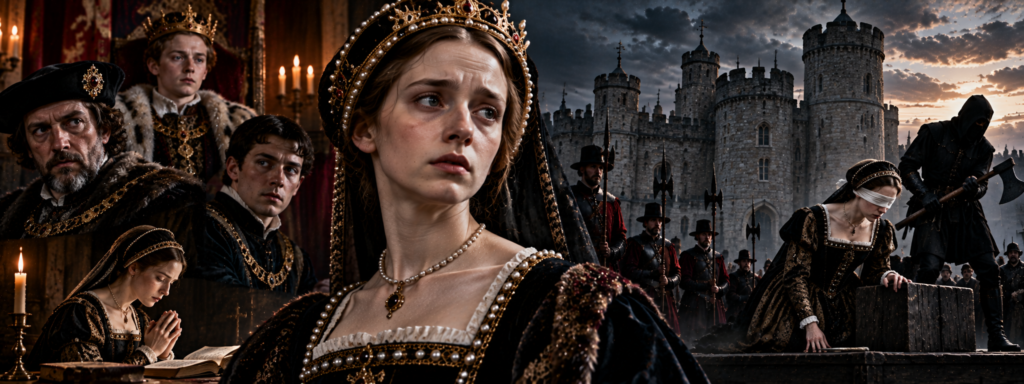
Lady Jane Grey: The Nine Days’ Queen Betrayed, Imprisoned, and Beheaded for Treason
Lady Jane Grey (c. 1537–1554) | Proclaimed Queen of England and Ireland, July 10–19, 1553 | Deposed in favor of Mary I, convicted of high treason, and beheaded at the Tower of London on February 12, 1554
The Girl Who Lost Her Head for Wearing a Crown
On the morning of February 12, 1554, a teenage girl prepared to die inside the Tower of London. Her name was Lady Jane Grey, and only seven months earlier she had been proclaimed Queen of England. For nine extraordinary days, the machinery of royal government had operated in her name, powerful nobles had sworn allegiance to her, and proclamations had declared her the rightful successor to Edward VI. Now she was a condemned prisoner, awaiting execution for the very act of accepting the crown that others had placed upon her head.
Jane was approximately sixteen years old when she approached the scaffold on Tower Green. Her husband, Lord Guildford Dudley, had already been taken to Tower Hill for execution, and the two young people were to die separately. According to contemporary accounts, Jane saw his body being carried back toward the Tower after his beheading. Whether every detail of that terrible morning has survived accurately is open to question, but the essential facts are beyond dispute: husband and wife were executed on the same day, and Jane’s brief claim to sovereignty ended beneath an executioner’s axe.
The circumstances were particularly cruel because Jane had not spent her childhood plotting to seize England’s throne. She was an exceptionally educated young noblewoman whose royal ancestry placed her dangerously close to the succession. Her Protestant faith made her attractive to powerful men determined to prevent the Catholic Mary Tudor from inheriting the crown. When the young Edward VI began dying in 1553, those men saw in Jane a solution to a political and religious crisis that threatened everything they had built.
The scheme failed almost immediately. Mary gathered support, the Privy Council abandoned Jane, and the young queen was deposed before she had even experienced the ordinary ceremonies of monarchy. She was imprisoned in the Tower, where she remained while Mary established her government. For several months, Jane’s survival suggested that the new queen might choose mercy over vengeance.
Then came Wyatt’s Rebellion in early 1554. Protestant and anti-Spanish opposition to Mary’s proposed marriage to Philip of Spain erupted into armed resistance, and Jane’s father became implicated in the wider uprising. Jane herself was not shown to have organized the rebellion, but her existence provided potential rebels with an alternative claimant to the throne. The girl who had once been useful to one political faction became intolerably dangerous to another.
Her execution was therefore not simply the punishment of a defeated usurper. It was the deliberate elimination of a dynastic rival whose survival had become a threat to the security of the reigning monarch. Mary had initially resisted killing her cousin, but the political circumstances changed. Jane’s fate was sealed by a rebellion in which she had no demonstrated active role.
The tragedy has inspired centuries of paintings, plays, novels, and historical arguments. Some portray Jane as a helpless victim manipulated by ruthless relatives, while others emphasize that she possessed strong religious convictions and demonstrated political judgment during her brief reign. Both perspectives contain elements of truth. Jane was young and heavily influenced by powerful adults, but she was neither unintelligent nor entirely without agency.
Even her title remains controversial. Was Lady Jane Grey truly a queen, or merely an unsuccessful claimant whose supporters briefly controlled the government? She was proclaimed sovereign and exercised certain royal functions, but Mary I possessed the stronger hereditary claim under Henry VIII’s statutory succession settlement and ultimately secured recognition. The answer depends partly upon whether kingship is defined by lawful inheritance, public proclamation, possession of governmental authority, or later historical recognition.
Whatever title historians assign her, Jane’s death remains one of Tudor England’s most disturbing acts of political elimination. She was condemned for treason against the woman who replaced her, although her claim had been advanced under the authority of the previous king. She was executed not when her nine days ended, but months later, when another rebellion persuaded Mary’s government that leaving her alive was too dangerous.
Jane Grey’s story is not merely about a girl who became queen and lost her crown. It is about a dynasty haunted by questions of legitimacy, a religious revolution that divided families, ambitious men who gambled with the lives of their children, and a monarchy prepared to sacrifice a teenager to protect its future.
A Dangerous Royal Bloodline
Lady Jane Grey was born around 1537, probably at Bradgate in Leicestershire, into one of the most politically significant families in Tudor England. Her father was Henry Grey, later Duke of Suffolk, and her mother was Lady Frances Brandon. Through Frances, Jane was a great-granddaughter of Henry VII and a grandniece of Henry VIII. That ancestry would eventually make her both valuable and vulnerable.
Jane’s maternal grandmother was Mary Tudor, the younger sister of Henry VIII. Mary had married Charles Brandon, Duke of Suffolk, after briefly becoming Queen of France through her first marriage to Louis XII. Their daughter Frances inherited a place within the extended Tudor family. Jane therefore belonged to the royal bloodline without being a direct descendant of Henry VIII.
This distinction became crucial because Henry VIII had three surviving children who stood ahead of Jane in the succession: Edward, Mary, and Elizabeth. Edward was the legitimate son of Henry’s third wife, Jane Seymour. Mary was the daughter of Catherine of Aragon, while Elizabeth was the daughter of Anne Boleyn. Both daughters had experienced periods of illegitimacy under their father’s shifting marriage policies, but Henry’s final succession arrangements restored them to the line of inheritance.
Under the Third Succession Act of 1543–1544 and Henry VIII’s subsequent will, the crown was to pass first to Edward and his descendants, then to Mary and her descendants, then to Elizabeth and her descendants. After them came the descendants of Henry’s younger sister Mary Tudor, including the Grey family. The descendants of Henry’s elder sister Margaret Tudor, whose line included the Scottish royal family, were excluded from his designated succession.
Jane therefore possessed a genuine hereditary connection to the English throne. Her claim was not invented from nothing by the Duke of Northumberland. Yet it was subordinate to the claims of Mary and Elizabeth under the succession settlement established during Henry VIII’s reign. To make Jane queen in 1553, that settlement had to be challenged or bypassed.
Her position also meant that marriage could transform her political importance. A husband from an ambitious noble family might gain extraordinary influence if Jane ever inherited the crown. Her children could potentially become future monarchs. In Tudor politics, the marriage of a royal cousin was never merely a private family arrangement.
Jane grew up in a world where ancestry could determine privilege, imprisonment, or death. Her great-uncle Henry VIII had executed two wives and numerous nobles, including people with close connections to the royal family. The Tudor monarchy was intensely sensitive to competing claims. Royal blood offered opportunity, but it could also become a fatal liability.
The Childhood of a Tudor Scholar
Jane received an education remarkable even by the standards of elite Tudor households. She studied Latin, Greek, French, and other languages, and she developed a strong interest in classical literature and Protestant theology. Her intellectual abilities impressed scholars who encountered her. The surviving evidence reveals a serious, disciplined young woman whose religious convictions were deeply connected to her education.
Her tutors included John Aylmer, who later became Bishop of London under Elizabeth I. Jane also corresponded with leading Protestant scholars, including Heinrich Bullinger of Zurich. Such connections placed her within an international network of religious reformers. Her education was not simply preparation for courtly conversation; it shaped the convictions for which she would eventually become famous.
The scholar Roger Ascham later recorded a visit during which he found Jane reading Plato while members of her family were hunting. According to his account, she explained that she preferred learning because her parents treated her harshly when she failed to satisfy their expectations. The story has become central to popular portrayals of Jane as an abused child. However, Ascham wrote it retrospectively, and historians should be cautious about treating every detail as an objective record of family life.
There is nevertheless evidence that Jane experienced pressure within an ambitious aristocratic household. Her parents expected obedience and understood the political importance of her position. A daughter with royal ancestry was a valuable dynastic asset. Her personal preferences could not easily compete with the family’s ambitions.
Jane also spent time in the household of Katherine Parr, Henry VIII’s sixth wife and widow. Katherine was a committed supporter of religious reform and female education. Her household provided Jane with exposure to influential Protestant thinkers and a sophisticated courtly environment. It also placed her near one of the most disturbing scandals of the late Tudor court.
After Henry VIII’s death in 1547, Katherine married Thomas Seymour, the ambitious brother of Edward VI’s uncle, Edward Seymour, Duke of Somerset. Thomas developed an inappropriate and troubling relationship with the young Princess Elizabeth, who was living in Katherine’s household. His behavior created scandal and contributed to tensions within the family. Jane’s own position in the household exposed her to the dangerous intersection of royal marriage, ambition, and sexual politics.
Katherine Parr died in September 1548 after giving birth to a daughter. Jane was present within the household during this period and participated in the funeral ceremonies. Thomas Seymour subsequently became involved in political intrigues that led to his arrest and execution in 1549. His downfall provided another lesson in the hazards of proximity to the throne.
By her early teens, Jane had witnessed the instability surrounding the Tudor royal family. Powerful men rose and fell, marriages created political alliances, and religious differences shaped access to power. Her education made her intellectually sophisticated, but it could not protect her from the political calculations being made around her.
England After Henry VIII
Henry VIII died in January 1547, leaving the crown to his nine-year-old son Edward VI. The new king inherited a kingdom transformed by his father’s break with Rome but still deeply divided over religion. Henry had rejected papal supremacy while preserving many traditional Catholic doctrines and practices. Under Edward, the government moved much further toward Protestantism.
Edward Seymour, Duke of Somerset, initially dominated the regency government as Lord Protector. His administration introduced religious reforms, but military failures, economic difficulties, and political opposition weakened his position. In 1549, he was overthrown by rivals within the ruling council. John Dudley, Earl of Warwick and later Duke of Northumberland, emerged as the dominant political figure.
Northumberland’s rise would eventually determine Jane’s fate. He was an experienced soldier and administrator who helped stabilize the government after Somerset’s downfall. He also supported the increasingly Protestant direction of Edward’s reign. His political survival became closely connected with the continuation of religious reform.
Edward VI himself was not simply a passive child controlled by ministers. As he grew older, he developed strong Protestant convictions and took an increasingly active interest in government. He regarded Catholic worship as religiously corrupt and believed that restoring it would endanger the kingdom. His faith would become central to the succession crisis.
Mary Tudor represented the greatest threat to the Protestant settlement. She remained firmly Catholic and refused to abandon the traditional Mass. Her religious position brought her into conflict with Edward’s government. Yet she also possessed a powerful hereditary claim and considerable support among subjects who respected Henry VIII’s succession arrangements.
Elizabeth, by contrast, was Protestant, although her religious outlook was more politically adaptable than Edward’s. Nevertheless, Edward’s succession plan eventually excluded her alongside Mary. This reflected legal arguments concerning the legitimacy of both sisters as well as the king’s desire for a Protestant succession. The decision would create a constitutional crisis.
By 1553, England was governed by a Protestant king whose Catholic half-sister stood next in line to inherit. Northumberland and other reformers feared that Mary’s accession would reverse the religious changes they had spent years establishing. The solution they developed would place Jane Grey at the center of a struggle she had not created.
John Dudley: The Duke Behind the Crown
John Dudley, Duke of Northumberland, has often been portrayed as the villain of Jane Grey’s story. In popular accounts, he appears as a calculating politician who manipulated a dying king and forced his own daughter-in-law onto the throne. His role was unquestionably central, but the historical picture is more complicated. Northumberland was not the only person responsible for the succession scheme, and Edward VI’s own convictions were significant.
Northumberland had risen through military service and political skill. He helped remove Somerset from power and eventually became the leading figure in Edward’s government. His administration restored a measure of financial stability and pursued policies intended to strengthen royal authority. He was ambitious, but he was also an experienced statesman confronting genuine political problems.
The succession threatened everything he had achieved. Mary was unlikely to retain a government dominated by men who had enforced Protestant religious reforms against her wishes. Northumberland’s position, wealth, and perhaps personal safety could be endangered by her accession. A Protestant alternative offered obvious advantages.
Jane Grey was attractive because she combined royal ancestry with Protestant commitment. She was closely related to the Tudor dynasty and could be presented as a legitimate successor if Edward’s sisters were excluded. Her religious convictions were well known. She was also young enough to be politically influenced by experienced councillors.
The marriage arranged between Jane and Northumberland’s son Guildford Dudley intensified suspicions. If Jane became queen, Guildford would become the husband of the sovereign, potentially giving the Dudley family extraordinary influence. Northumberland’s enemies later portrayed the entire succession plan as an attempt to establish a Dudley dynasty. The timing certainly made the arrangement politically advantageous.
Yet Edward’s surviving writings demonstrate that the succession project cannot be explained solely as Northumberland’s invention. The king developed a plan for the crown’s inheritance and revised it as his illness worsened. His religious convictions and concerns about female succession influenced the original scheme. Northumberland helped turn the plan into a practical political operation.
Responsibility therefore belongs to several people. Edward initiated and approved the exclusion of his sisters, Northumberland organized the political machinery, and leading councillors and legal officials participated under varying degrees of pressure. Jane herself was the intended beneficiary. Whether she wanted the crown is a separate question.
The Dying King’s Devise
Edward VI became seriously ill in early 1553. His condition deteriorated over the following months, and by the summer it was clear that he might not survive. The precise nature of his illness remains uncertain, although tuberculosis or a serious pulmonary infection has often been suggested. His approaching death created an immediate succession emergency.
Edward drafted a document known as My Devise for the Succession. The original plan favored male descendants of the Grey line rather than Jane herself. This reflected his preference for a male Protestant successor. The difficulty was that no suitable male heir existed who could inherit immediately.
As Edward’s death approached, the plan was altered to name Jane directly. The change was decisive. It transformed a speculative succession arrangement into an immediate attempt to place a teenage noblewoman on the throne. The king’s sisters Mary and Elizabeth were excluded.
Edward argued that their legitimacy was questionable because both had previously been declared illegitimate during Henry VIII’s marriage disputes. He also objected to Mary’s Catholicism. The religious argument was particularly important because Edward believed England’s Protestant settlement would be endangered under her rule. The devise therefore combined dynastic reasoning with confessional politics.
The legal problem was enormous. Henry VIII’s succession arrangements had received parliamentary authority, and Edward could not simply assume that his personal instructions possessed equivalent force. Lawyers and councillors faced pressure to support the new settlement. Some expressed serious reservations about its legality.
The document was eventually endorsed by leading political figures, but their signatures did not guarantee popular acceptance. Many councillors may have feared the consequences of resisting the dying king and Northumberland. Others sincerely supported a Protestant succession. The apparent unity of the government concealed deep uncertainty.
Edward died on July 6, 1553, aged fifteen. His death was initially concealed while Northumberland and the council attempted to secure the succession. Mary, however, was already beyond their immediate control. The race for the crown had begun.
A Marriage That Became a Death Sentence
Jane married Guildford Dudley on May 25, 1553, at Durham House in London. The wedding formed part of a wider series of aristocratic marriages arranged around the same time. Guildford was a younger son of Northumberland, and the union connected the Grey and Dudley families. Within weeks, the marriage acquired an importance neither spouse could escape.
The relationship between Jane and Guildford is difficult to reconstruct. Later accounts sometimes portray the marriage as entirely forced and loveless, while others suggest that the young couple developed affection. The surviving evidence does not justify certainty about their private feelings. Both were teenagers whose marriage served powerful dynastic interests.
Jane’s parents had reasons to support the match. Northumberland controlled the government, and an alliance with his family offered enormous political advantages. If Jane inherited the crown, the Greys and Dudleys would stand at the center of royal power. The marriage therefore became inseparable from the succession scheme.
Guildford’s position would soon produce tension. As Jane’s husband, he could expect high status, but whether he should become king in his own right was another matter. Jane reportedly resisted attempts to grant him the royal title automatically. The distinction reveals that she understood the difference between a queen regnant and a queen consort’s male equivalent.
This disagreement is important because it complicates the image of Jane as a completely passive puppet. She could be pressured into accepting the crown while still asserting authority over particular decisions. Her refusal to make Guildford king without proper legal authorization suggests political awareness. It also indicates that the Dudley family’s expectations did not always align with hers.
The marriage ultimately provided little protection. When Mary’s supporters prevailed, Guildford was imprisoned alongside Jane. Their relationship, whatever its private character, had become a political liability. Both would be condemned for their roles in the failed succession.
By February 1554, the marriage that had promised proximity to royal power would end in two executions. The Dudley name, once associated with Northumberland’s control of government, had become a mark of treason. Jane and Guildford would die on the same morning, separated by the walls and execution grounds of the Tower.
The Crown Nobody Could Safely Refuse
On July 9, 1553, Jane was informed that Edward VI had named her his successor. Accounts of her reaction describe shock, reluctance, and emotional distress. Some suggest that she initially refused the crown before yielding to pressure. These reports are valuable but must be treated cautiously because later narratives had reasons to emphasize her innocence.
Jane’s position was genuinely dangerous. Refusing the succession plan might expose her family to the anger of Northumberland and the government. Accepting it meant challenging Mary Tudor, whose claim rested upon Henry VIII’s established succession settlement. Either choice carried enormous risks.
On July 10, Jane was brought to the Tower of London and publicly proclaimed queen. The Tower was not merely a prison. It was also a royal residence and an important ceremonial location where monarchs traditionally stayed before coronation. Jane entered it as a sovereign claimant rather than as a convicted prisoner.
The proclamation described her as the rightful queen and rejected Mary’s claim. Official documents were issued in Jane’s name. The council acted as her government. For a brief period, the administrative machinery of England recognized her authority.
Yet the public response was muted. Jane did not receive the overwhelming enthusiasm that her supporters needed. London remained uncertain, and many subjects waited to see which claimant would prevail. The succession crisis was not settled by proclamation.
Jane’s government attempted to organize resistance against Mary. Northumberland prepared to lead troops into East Anglia, where Mary was gathering supporters. The council remained in London, supposedly directing affairs in Jane’s name. The arrangement soon exposed the weakness of the entire scheme.
Jane had entered the Tower as queen, but her authority depended upon men whose loyalty was uncertain. She possessed royal ancestry and official proclamations, but not an established military following of her own. Mary, meanwhile, was building precisely the support Jane lacked.
The crown had been placed upon Jane’s head politically, even though she was never formally crowned. Within days, it would be taken away. The Tower that welcomed her as a sovereign would become her prison.
Nine Days of Royal Power
The phrase “Nine Days’ Queen” usually refers to the period from Jane’s proclamation on July 10 to Mary’s recognition in London on July 19, 1553. Some historians use slightly different calculations depending upon whether Edward’s death or Jane’s proclamation marks the beginning of her claim. The familiar title is therefore a convenient historical shorthand rather than an entirely uncontested constitutional measurement. It nevertheless captures the extraordinary brevity of her position.
Jane’s government issued letters and orders in her name. These documents demonstrate that her claim was more than a private fantasy or an unsuccessful declaration by an isolated noble family. The machinery of state briefly operated under her authority. Councillors addressed her as queen, and officials were instructed to support her succession.
One surviving letter, dated July 10, directed the Marquess of Northampton to defend Jane’s title against Mary. Its language reveals how aggressively the new government sought to establish legitimacy. Mary was described as possessing a false claim because of the earlier judgments concerning her birth. The document shows that Jane’s regime was actively attempting to govern and mobilize support.
The question of Guildford’s title also emerged during these days. Jane reportedly resisted pressure to proclaim him king. She understood that marriage to a reigning queen did not automatically confer sovereignty. Her stance suggests that she intended to preserve the authority attached to her own claim.
Yet her practical power remained limited. Northumberland and the council controlled military planning, and the government depended upon their cooperation. Jane had little opportunity to build an independent political network. Her youth and sudden elevation made her especially vulnerable to the collapse of elite support.
The most serious weakness was the absence of a convincing explanation for excluding Mary. Many subjects accepted that Henry VIII’s daughter possessed the rightful claim under the succession settlement. Religious differences mattered, but hereditary legitimacy mattered too. Jane’s Protestantism could not automatically overcome the political weight of Mary’s birth.
As news spread, support for Mary increased. The balance of power shifted rapidly. Jane’s government began to disintegrate before she could establish herself securely.
Mary Tudor Refuses to Disappear
Mary Tudor was thirty-seven years old when Edward VI died. She had spent much of her life enduring political humiliation, religious pressure, and uncertainty about her status. Henry VIII’s annulment of his marriage to Catherine of Aragon had stripped Mary of her position as legitimate princess. She had been forced to submit outwardly to her father’s religious supremacy while privately maintaining Catholic convictions.
These experiences made Mary politically resilient. She understood the danger posed by Edward’s Protestant government and recognized that Northumberland might attempt to prevent her accession. When the succession crisis began, she moved to secure herself among supporters in East Anglia. Her decision prevented Northumberland from controlling her person.
Mary proclaimed herself queen and called upon loyal subjects to defend her hereditary right. Her supporters included committed Catholics, but her appeal extended beyond religion. Many Protestants also believed that she was the lawful successor. The issue was not simply Catholicism against Protestantism.
Support gathered around Mary with surprising speed. Nobles, gentlemen, and ordinary subjects joined her cause. Her claim possessed a clarity that Jane’s supporters struggled to match. She was Henry VIII’s daughter, named in the established succession settlement, and willing to fight for her inheritance.
Northumberland marched eastward with troops to confront the growing threat. His departure from London weakened his control over the Privy Council. Councillors who had previously endorsed Jane’s succession began reconsidering their positions. Political survival encouraged rapid changes of allegiance.
Mary’s strength increased while Northumberland’s position deteriorated. The government that had confidently proclaimed Jane queen was now divided and uncertain. Jane herself remained inside the Tower, dependent upon men who were preparing to abandon her.
The decisive betrayal came from the council. On July 19, leading councillors publicly recognized Mary as queen. Jane’s reign ended not through a battle but through the collapse of the political coalition that had created it.
The Council Turns Against Jane
The Privy Council’s decision to abandon Jane was swift and devastating. Men who had signed documents supporting her claim now proclaimed Mary the rightful sovereign. The change demonstrated how fragile Jane’s authority had always been. Her government depended upon loyalty that evaporated when Mary’s victory became likely.
Northumberland’s military expedition collapsed as support for Mary spread. He eventually acknowledged Mary and was arrested. His attempt to secure the succession had failed almost completely. The political architect of Jane’s elevation became one of its earliest casualties.
Jane was informed that she was no longer queen. Accounts describe her receiving the news with resignation, although exact words attributed to her should be treated cautiously. She had occupied the position for only days. The crown that others had insisted she accept had become the evidence against her.
She remained in the Tower, but her status changed completely. The royal residence became a place of confinement. Her husband and members of the Dudley family were also imprisoned. The men who had promised political glory now faced prosecution.
Mary entered London triumphantly in August 1553. Her accession was celebrated by crowds, and the new government moved to restore royal authority under her name. The speed of her success demonstrated the strength of her hereditary claim and the weakness of Northumberland’s coalition. Jane’s supporters had badly misjudged the political nation.
Northumberland was executed on August 22, 1553. Before his death, he publicly returned to Catholicism, an act that shocked some Protestants and encouraged accusations of opportunism. His conversion did not save him. The man who had attempted to prevent a Catholic succession died under the authority of the Catholic queen.
Jane survived. For the moment, Mary appeared willing to distinguish the teenage claimant from the powerful men who had placed her on the throne. That distinction offered hope, but it would not survive the next political crisis.
Was Jane Grey Really Queen?
Jane’s status remains one of the most interesting constitutional questions in Tudor history. She was proclaimed queen by the Privy Council, official documents were issued in her name, and the government briefly operated under her authority. These are substantial facts. She was not merely a woman who privately claimed royal descent.
Yet Mary’s legal position was stronger under Henry VIII’s succession settlement. Parliament had authorized the succession arrangements that placed Mary ahead of Jane. Edward VI’s devise attempted to override that settlement without obtaining equivalent parliamentary approval. The legality of his intervention was therefore highly questionable.
Jane was never crowned. She never secured broad national recognition. Her government collapsed before it could establish lasting authority. Mary subsequently became the universally recognized sovereign of England.
Modern historians consequently differ in how they classify Jane. Some include her among English monarchs because she was proclaimed queen and exercised governmental authority. Others describe her as a disputed claimant or de facto ruler rather than a legitimate reigning monarch. Both approaches reflect different definitions of sovereignty.
The distinction matters particularly when considering her execution as regicide. If Jane is counted as a reigning queen, her death was the execution of a former sovereign. If she is treated as an unsuccessful claimant, it was the execution of a royal pretender convicted of treason. Either interpretation places her death within the broader history of dynastic elimination.
Jane’s case also reveals the danger of assuming that monarchy operated through an uncontested set of rules. Tudor succession law had been repeatedly altered by Henry VIII’s marriages and parliamentary settlements. Edward’s final devise created another competing source of authority. The political community had to decide which claim to recognize.
Mary’s victory settled the immediate question through successful possession of the throne and broad political support. Later history generally recognized Mary as Edward’s rightful successor. Jane’s nine days remained an extraordinary interruption. Her execution ensured that the rival claim could not be revived through her person.
A Prisoner Who Might Have Lived
Mary initially showed reluctance to execute Jane. The new queen understood that her cousin had been young and subject to powerful family pressure. Jane’s participation in the succession scheme was serious, but she had not personally organized the military campaign against Mary. Mercy remained politically possible.
Jane and Guildford were tried for high treason in November 1553. Jane was accused of unlawfully assuming the royal title and exercising authority against Mary. Guildford and other members of the Dudley family faced related charges. Conviction was effectively inevitable under the new regime.
Jane pleaded guilty and received a death sentence. Yet the sentence was not immediately carried out. This delay is essential to understanding her fate. Mary had the legal power to execute Jane months before February 1554 but chose not to do so.
The queen’s reluctance may have reflected personal sympathy, political calculation, or both. Executing a teenage cousin who had been used by powerful men could appear unnecessarily cruel. Mary had already secured the throne and eliminated Northumberland. Jane no longer seemed an immediate threat.
Jane remained imprisoned in the Tower. Her conditions were not necessarily those of an ordinary criminal dungeon, and high-status prisoners could receive certain comforts and attendants. Nevertheless, her freedom was gone, her husband was imprisoned, and her future depended entirely upon Mary’s decisions. She lived under a sentence that could be enforced at any time.
The months of uncertainty must have been psychologically difficult, although Jane’s surviving writings emphasize religious conviction rather than detailed personal despair. She devoted herself to prayer and theological reflection. Her Protestant faith remained firm. It would become one of the defining features of her final days.
Had political circumstances remained stable, Jane might have survived for years. She could conceivably have been kept under permanent confinement or eventually released under strict conditions. The fact that Mary delayed execution demonstrates that death was not initially considered unavoidable. Another rebellion changed everything.
Philip of Spain and the Marriage That Terrified England
Mary’s decision to marry Philip of Spain provoked intense opposition. Philip was the son of Emperor Charles V and heir to the Spanish monarchy. The marriage promised England a powerful Catholic alliance. It also raised fears that England would become subordinate to foreign interests.
Opposition came from several directions. Protestants feared that Philip would strengthen Mary’s campaign to restore Catholicism. Political conservatives worried about foreign influence and the possibility of England being drawn into Habsburg wars. Others resented the prospect of a Spanish prince occupying a central position in English government.
Mary regarded the marriage differently. She wanted a Catholic husband of appropriate royal rank and hoped to secure the succession through children. At thirty-seven, she understood the urgency of producing an heir. A Catholic dynasty would help preserve the religious restoration she intended.
The marriage negotiations therefore became a national political crisis. Rumors spread about Spanish domination, foreign soldiers, and the destruction of English liberties. Some claims were exaggerated, but the underlying anxieties were genuine. The proposed marriage united people who otherwise disagreed about religion and government.
Conspirators began planning rebellion. Their objectives varied, but opposition to the Spanish marriage was central. Some hoped to replace Mary with Elizabeth, while others saw Jane or her family as potential alternatives. The political landscape was unstable enough that multiple dynastic possibilities circulated.
Jane remained in the Tower while these plans developed. There is no reliable evidence that she directed the conspirators or participated actively in organizing the rebellion. Yet her existence mattered because she had already been proclaimed queen once. A successful uprising could potentially use her claim again.
Mary’s government increasingly viewed that possibility as intolerable. A living Jane was a political symbol around whom discontent might gather. The same royal blood that had elevated her in July 1553 now threatened to destroy her.
Wyatt’s Rebellion: The Uprising That Sealed Jane’s Fate
In January 1554, rebellion broke out against Mary’s government. Sir Thomas Wyatt led the most significant rising in Kent, while other planned uprisings failed or collapsed. The rebellion was closely connected to opposition to Mary’s proposed marriage to Philip of Spain. It also reflected wider religious and political anxieties.
Jane’s father, Henry Grey, Duke of Suffolk, became involved in the conspiracy. His participation was disastrous for his daughter. Even if Jane herself had remained entirely inactive, her father’s rebellion demonstrated that members of her family were still willing to challenge Mary’s government. Her claim could no longer be dismissed as a harmless memory.
Wyatt gathered armed supporters and advanced toward London. The rebellion posed a serious threat, particularly because Mary’s government faced uncertainty over the loyalty of some troops and political figures. Mary responded with determination. She addressed Londoners at the Guildhall and appealed for their support.
The queen’s public appearance helped strengthen resistance to the rebels. Wyatt’s forces eventually reached London but failed to secure the city. The uprising collapsed in early February. Wyatt was captured and later executed.
The rebellion transformed Jane’s position. Mary had previously shown willingness to spare her cousin despite the treason conviction. Now the government faced evidence that opposition factions could organize armed resistance while alternative royal claimants remained alive. Jane became a security problem rather than merely a defeated teenager.
The involvement of her father made the situation particularly painful. Henry Grey’s actions helped create the conditions that destroyed any remaining hope of mercy. He would himself be executed later in February. Jane paid first.
Historians generally regard Wyatt’s Rebellion as the immediate political trigger for Jane’s execution. It is important, however, not to claim that Jane personally joined the uprising. Her death was justified by the earlier treason conviction and made politically urgent by the new rebellion. The distinction is central to understanding the tragedy.
Mary I and the Decision to Kill
Mary I has often been portrayed as a merciless persecutor because of the Protestant burnings that occurred later in her reign. Jane Grey’s execution has become part of that reputation. Yet the chronology reveals a more complicated decision. Mary did not order Jane’s death immediately after seizing the throne.
For months, the queen allowed her cousin to live despite a conviction for high treason. This suggests genuine reluctance or at least a belief that execution was not politically necessary. Jane’s youth and limited responsibility for Northumberland’s scheme probably mattered. Mary had personal reasons to understand the cruelty of Tudor dynastic politics.
The rebellion of 1554 changed the calculation. Jane’s father had joined an uprising, and the government feared further attempts to replace Mary. Jane remained a Protestant claimant whose name had already been used to challenge the succession. Sparing her now appeared to carry greater risks.
Mary also faced pressure from councillors and supporters who wanted the rival claim eliminated. The precise balance between her personal wishes and ministerial advice cannot be reconstructed with complete certainty. Nevertheless, the final decision rested with the queen’s government. Jane’s execution was not an unavoidable consequence of law alone.
The political logic was harsh but familiar in Tudor England. A claimant with royal blood could become dangerous even without personal ambition. Rebellions required symbols of legitimacy, and a living alternative heir could provide one. Eliminating the claimant removed that possibility.
Mary’s decision also reveals the limits of personal mercy within dynastic government. A ruler might pity a prisoner while believing that the prisoner’s survival threatened the crown. Jane’s innocence of the latest rebellion did not remove her political usefulness to others. That usefulness became fatal.
The execution was scheduled for February 12, 1554. Jane and Guildford were to die on the same day. The monarchy that had once recognized Jane as queen now prepared to destroy both members of the young marriage.
The Last Attempt to Save Her Soul
Before Jane’s execution, Mary arranged for John Feckenham, a Catholic cleric, to speak with her. Feckenham had become an important figure in the restored Catholic religious establishment. His conversations with Jane were intended to persuade her to abandon Protestant beliefs. If she converted, the act would have carried enormous symbolic value.
Jane refused to surrender her convictions. Accounts of their theological discussions portray her as knowledgeable, articulate, and determined. The exchanges concerned fundamental disputes over the Eucharist, salvation, church authority, and religious practice. Jane defended the Protestant positions she had studied throughout her youth.
The surviving accounts were transmitted through religiously partisan traditions, and their precise wording should be treated cautiously. Protestant writers had strong reasons to portray Jane as an exemplary defender of the Reformation. Catholic observers had different priorities. Nevertheless, Jane’s steadfast Protestantism is well supported by her surviving writings.
Feckenham apparently treated her with courtesy despite their disagreements. Jane’s refusal to convert did not prevent her from acknowledging his personal kindness. The episode offers a glimpse of human sympathy across a bitter religious divide. It also emphasizes that Jane’s convictions were not merely borrowed from Northumberland.
The execution was briefly delayed, apparently to allow further religious discussion. The postponement did not produce a conversion or a pardon. Jane remained committed to her faith. The government remained committed to carrying out the sentence.
Her final religious writings reveal a young woman preparing herself for death through prayer and scripture. She drew upon biblical passages emphasizing endurance, divine mercy, and the temporary nature of earthly suffering. These were not abstract exercises. They were the words of someone who knew the executioner was approaching.
Jane’s faith gave her a language through which to confront the destruction of her life. It also made her an ideal figure for later Protestant martyrology. The girl who had been used to preserve a Protestant succession would now die refusing to abandon Protestant belief.
Guildford Dudley Goes to the Scaffold
On February 12, Guildford Dudley was taken from the Tower to the public execution site on Tower Hill. He was approximately eighteen or nineteen years old, although his exact birth date is uncertain. Like Jane, he had become entangled in the succession crisis through family ambition and royal marriage. His father Northumberland had already been executed.
Guildford’s position had been politically compromised from the beginning. His marriage to Jane connected him to the proposed Protestant succession, and his family’s role in advancing her claim made him vulnerable after Mary’s victory. He was convicted of treason alongside Jane. The failed attempt to make him a royal consort had become a death sentence.
The surviving accounts provide less detail about Guildford’s final thoughts than about Jane’s. Later narratives often reduce him to a secondary figure in her tragedy. Yet he too was a young person whose marriage had been arranged within a dangerous political strategy. His execution formed part of the destruction of the Dudley family’s ambitions.
Guildford was beheaded on Tower Hill. His body was then carried back toward the Tower. According to a contemporary account, Jane saw the remains being brought past her place of confinement. The sight must have been dreadful, although historians should avoid inventing her private thoughts.
Jane was scheduled to die shortly afterward. The executions were deliberately separated, with Guildford killed publicly outside the Tower and Jane within its walls. High-ranking women were often executed in more restricted settings. Jane’s death would take place on Tower Green.
The order of executions ensured that Jane faced her own death knowing her husband had already been killed. Whether the government intended this sequence to increase her suffering cannot be established. The effect was nevertheless cruel. A marriage made for political advantage ended in two severed heads.
Guildford’s death also removed the possibility that the Dudley family might revive Jane’s claim through him. The government was eliminating both the claimant and her immediate marital connection. The political threat was being extinguished at its source.
The Walk to Tower Green
Jane approached the scaffold carrying a prayer book. Contemporary descriptions emphasize her composure and religious devotion. She was dressed simply rather than in the magnificent clothing associated with royal ceremony. The contrast with her brief appearance as queen was stark.
Tower Green was enclosed within the Tower complex. Unlike the public executions on Tower Hill, executions inside the fortress were generally reserved for prisoners of particularly high status. Anne Boleyn and Catherine Howard had also been executed within the Tower. Jane now joined the grim history of women destroyed by Tudor dynastic politics.
The scaffold was prepared with a block and axe. Officials and witnesses attended. Jane was expected to make a final statement acknowledging the justice of the sentence or expressing repentance. Such speeches were important parts of early modern execution rituals.
Jane reportedly admitted that she had acted unlawfully in accepting the crown but distinguished that political offense from any deliberate intention to harm Mary. The precise wording varies among surviving accounts. She did not deliver a lengthy attack upon the queen. Instead, she emphasized her Christian faith and prepared for death.
Her conduct impressed witnesses. Accounts describe her praying and reciting scripture. The young woman who had spent years studying theology now relied upon it in the final minutes of her life. Her learning had become a form of spiritual preparation.
Then came the most famous and disturbing moment of the execution. After being blindfolded, Jane reportedly struggled to locate the block. Unable to find it, she became distressed and asked for help. Someone guided her into position.
The episode has become inseparable from her memory. It reveals the vulnerability beneath the composed martyr narrative. Whatever courage Jane possessed, she was still a teenager trying to place her head upon a block she could no longer see.
The Execution of Lady Jane Grey
The surviving contemporary narrative describes Jane kneeling before the block after her final prayers. She had removed or adjusted clothing that might interfere with the execution. Her eyes were covered. The executioner stood ready.
When Jane could not immediately find the block, the scene became painfully human. The moment has often been reproduced in paintings and dramatic retellings. It should not be embellished with invented dialogue or prolonged theatrical action. The contemporary account is sufficiently disturbing without additions.
Once positioned, Jane commended her soul to God. The executioner struck with the axe. Lady Jane Grey was beheaded on February 12, 1554.
She had been approximately sixteen years old. Her proclaimed reign had lasted nine days. Her imprisonment had lasted nearly seven months. Her life ended because a political claim advanced in her name remained dangerous after its defeat.
Jane’s body was buried within the Chapel Royal of St Peter ad Vincula in the Tower of London. Guildford was also buried there. The chapel became the resting place of several prominent victims of Tudor executions. Its associations with royal bloodshed would deepen over the centuries.
The government had eliminated the immediate dynastic threat posed by Jane. Yet her death would prove far more difficult to control than her life. Protestant writers soon transformed her into a martyr. Later generations would remember her as one of the most tragic figures in English royal history.
Mary had secured her throne. Jane had lost her head. The struggle over what her death meant was only beginning.
The Father Who Helped Destroy His Daughter
Henry Grey, Duke of Suffolk, occupies a particularly uncomfortable position in Jane’s story. He was her father, a nobleman with royal connections, and one of the figures involved in advancing her claim to the throne. His political decisions helped place her in danger. His later participation in rebellion helped ensure that danger became fatal.
Suffolk had supported the succession scheme of 1553, although Northumberland was its most prominent organizer. When Mary’s claim prevailed, Suffolk was initially spared the fate of Northumberland. His survival suggested that reconciliation remained possible. Jane’s continued imprisonment, however, meant that the family’s political position remained precarious.
The decision to join the rebellion of 1554 was disastrous. Suffolk apparently hoped to oppose Mary’s Spanish marriage and the direction of her government. His involvement made it difficult for Mary to believe that Jane’s family had abandoned political resistance. The possibility of using Jane as an alternative sovereign became more threatening.
Suffolk’s actions did not prove that Jane herself was involved. Nevertheless, Tudor governments often treated family connections as politically significant. A royal claimant could become dangerous through the actions of relatives. Jane suffered the consequences of her father’s choices.
Suffolk was captured after the rebellion failed. He was executed on February 23, 1554, eleven days after Jane. His death completed another stage in the destruction of the Grey family’s political ambitions. The father survived long enough to know that his daughter had been executed.
It is tempting to describe Suffolk as solely responsible for Jane’s death, but that would oversimplify the events. Edward VI’s succession devise, Northumberland’s ambitions, Mary’s accession, religious divisions, and Wyatt’s Rebellion all contributed. Suffolk was one important participant in a much larger crisis. His final rebellion nevertheless played a decisive role in removing the possibility of mercy.
Jane’s tragedy therefore contains a devastating family dimension. The people expected to protect her had repeatedly placed her within dangerous political schemes. Her royal ancestry made her valuable to them. Their ambitions helped make that ancestry fatal.
A Protestant Martyr Is Created
Jane’s death quickly acquired religious significance among English Protestants. She had refused to abandon her faith despite the threat of execution. Her theological writings and reported conversations with Feckenham provided material for accounts of her courage. The image of a learned teenage girl dying for Protestant truth became extraordinarily powerful.
John Foxe’s Acts and Monuments, commonly known as Foxe’s Book of Martyrs, helped establish Jane’s reputation. Foxe presented Protestant suffering under Mary as evidence of religious persecution and spiritual steadfastness. Jane’s story fitted this narrative perfectly. Her youth, education, royal blood, and execution made her an especially compelling martyr.
Yet Jane was not executed solely because she was Protestant. Her formal conviction concerned high treason arising from the succession crisis. Mary had initially spared her despite knowing her religious beliefs. Wyatt’s Rebellion made the political danger of her survival more urgent. Reducing the execution to religious persecution alone obscures this chronology.
Religion nevertheless remained inseparable from the politics of her death. Jane had been chosen as Edward’s successor largely because she was Protestant. Mary represented the restoration of Catholicism. Jane’s refusal to convert before execution strengthened the religious interpretation of her fate. Political treason and confessional identity overlapped.
Foxe’s portrayal also shaped later Protestant memory of Mary I. The queen became increasingly associated with religious repression, eventually acquiring the notorious epithet “Bloody Mary.” Jane’s execution contributed to that reputation, although the major Marian burnings began after her death. The martyr narrative connected separate episodes into a broader story of Catholic tyranny.
Jane’s own writings demonstrate that she was more than a convenient symbol. She possessed genuine theological knowledge and strong convictions. Her final letters and prayers reveal a serious religious identity. Later writers may have idealized her, but they did not invent her faith.
The girl who had been politically defeated became spiritually victorious in Protestant memory. Her enemies had controlled her body and execution. They could not control how later generations interpreted her death.
The Letters From the Tower
Jane’s surviving writings provide one of the most direct ways to encounter her personality. Unlike later paintings or dramatized accounts, these texts preserve something of her own religious language. They reveal a young woman confronting imprisonment and death through scripture. Their importance extends beyond the political controversy surrounding her title.
One of the most moving surviving objects associated with Jane is a small prayer book containing farewell messages written in her hand. She used its margins to address people connected with her imprisonment. The book provides tangible evidence of her final preparations. It also reveals how intensely she relied upon religious texts.
Jane wrote to Sir John Brydges, the Lieutenant of the Tower, offering spiritual counsel. Her message emphasized the importance of preparing for death and seeking eternal life. The tone is striking because she was addressing a man who held authority over her confinement. Rather than merely begging for mercy, she offered religious instruction.
She also left a message for her father. The circumstances make the gesture especially poignant because Henry Grey’s involvement in rebellion had helped destroy her chance of survival. Jane’s words reflected religious concerns rather than a detailed political accusation. The surviving message should not be forced into a modern narrative of forgiveness or condemnation beyond what it actually says.
Other letters attributed to Jane circulated after her death, including communications intended to strengthen Protestant believers. Their authenticity and transmission require individual examination because later religious writers had strong incentives to preserve or adapt her words. Nevertheless, the surviving body of material confirms her intellectual seriousness. She was capable of sustained theological argument.
These writings complicate the familiar image of Jane as merely a helpless child. She was vulnerable politically, but she possessed a developed religious identity. She could express convictions, offer counsel, and defend theological positions. Her youth did not make her intellectually passive.
The letters also expose the limitations of the historical record. We hear Jane most clearly when she writes about faith, not when she describes her private feelings about her marriage, parents, or crown. The surviving Jane is therefore partly shaped by what she chose to record and what later generations preserved. Her inner life remains only partially accessible.
The Painting That Changed How the World Sees Jane
For many people, Lady Jane Grey is inseparable from Paul Delaroche’s famous painting The Execution of Lady Jane Grey, completed in 1833. The painting depicts a blindfolded young woman in white, reaching helplessly toward the execution block while attendants and an executioner surround her. It is one of the most emotionally powerful images of royal execution ever created. It is also a nineteenth-century interpretation rather than an eyewitness record.
Delaroche painted Jane nearly three centuries after her death. His work reflects Romantic interests in innocence, suffering, and historical tragedy. The pale clothing, dramatic lighting, and theatrical arrangement emphasize vulnerability. Jane appears almost impossibly delicate against the brutal machinery of execution.
The painting is not a reliable reconstruction of Tower Green. Its architectural setting and staging reflect artistic choices rather than precise historical evidence. The work also draws heavily upon the famous account of Jane struggling to find the block. Delaroche transformed that moment into the emotional center of the composition.
The image has profoundly influenced popular memory. Many people imagine Jane’s execution through Delaroche’s painting without realizing how much artistic interpretation it contains. The white dress in particular has become iconic. Yet contemporary descriptions do not justify treating every visual detail as fact.
The painting also encourages a particular interpretation of Jane’s personality. She appears passive, innocent, and almost childlike. Her political awareness, religious determination, and intellectual strength disappear behind the visual drama of helplessness. The result is moving but incomplete.
Jane was certainly young and vulnerable, but she was also a serious scholar who defended her beliefs under extraordinary pressure. She reportedly resisted granting Guildford the royal title automatically. She understood enough about politics and religion to challenge powerful men. The historical Jane was more complicated than the figure Delaroche painted.
The painting remains a masterpiece of historical imagination. Its danger lies in being mistaken for history itself. Jane’s real execution was terrible enough without allowing artistic beauty to replace documentary uncertainty.
Was Jane an Innocent Victim?
The question of Jane’s responsibility has divided historians and biographers. One interpretation presents her as an innocent girl manipulated by Northumberland and her parents. Another emphasizes that she accepted the crown, issued orders, and participated in a government challenging Mary’s lawful succession. Both interpretations require qualification.
Jane did not create Edward VI’s succession devise. She was not the principal architect of the political campaign against Mary. Her marriage to Guildford served dynastic interests arranged by powerful adults. Her age and circumstances made resistance difficult.
Yet Jane did accept the position of queen. Documents were issued in her name, and she did not immediately abandon the claim once proclaimed. She reportedly exercised judgment over Guildford’s proposed title. These facts suggest some agency, even within severe constraints.
Her Protestant convictions were also genuine. Jane was not simply chosen because she happened to be related to Henry VIII. Her religious identity made her politically useful, and she shared the belief that Catholic restoration threatened true religion. She may therefore have regarded the succession plan as a religious duty as well as a dynastic obligation.
The legal charge of treason was based upon her acceptance of royal authority against Mary. From Mary’s government’s perspective, this was a serious offense. Yet Jane had acted under the instructions of the dying king and the council that claimed to represent lawful government. Her position was therefore far more complicated than that of an ordinary rebel.
Her execution becomes especially troubling because Mary had already demonstrated that mercy was possible. Jane remained alive for months after conviction. She was killed only when a new rebellion made her politically dangerous again. The final decision concerned future security as much as punishment for past conduct.
Jane was neither a wholly passive puppet nor a ruthless usurper. She was a young woman with convictions and some political judgment who became trapped inside a succession struggle controlled largely by others. Her responsibility was real but limited. The punishment was absolute.
Mary and Jane: Two Women Trapped by the Tudor Crown
Mary I and Jane Grey are often presented as opposites. Mary appears as the Catholic queen who ordered the execution, while Jane appears as the Protestant girl who died for her faith. Their religious differences were profound, but their lives also contained striking similarities. Both were women whose political identities had been shaped by the ambitions of powerful men.
Mary had experienced the destruction of her mother’s marriage and the humiliation of being declared illegitimate. She had been pressured to accept religious changes she opposed. Her position within the royal family had repeatedly been threatened. By 1553, she understood that survival required determination.
Jane also experienced the dangers of dynastic politics. Her ancestry made her useful to relatives and councillors. Her marriage was arranged within a larger political strategy. She was expected to accept a crown whose legality was contested. Her personal future depended upon decisions made by others.
Both women possessed strong religious convictions. Mary remained Catholic despite intense pressure under her father and brother. Jane remained Protestant despite imprisonment and impending execution. Neither can be adequately described as religiously indifferent or merely obedient to advisers.
Their conflict was therefore tragic partly because each represented a different understanding of legitimate authority. Mary believed she possessed the crown by hereditary right and Henry VIII’s succession settlement. Jane’s supporters claimed Edward VI had lawfully designated a Protestant successor. The dispute could not be resolved simply by acknowledging that both women were sincere.
Mary’s victory gave her the power to decide Jane’s fate. Initially, she chose restraint. After Wyatt’s Rebellion, she accepted execution. The decision secured her government but permanently damaged her reputation among Protestants.
Jane’s death illustrates how monarchy could turn women into enemies even when neither had personally created the conditions of conflict. Their royal blood placed them within competing succession claims. Their faith intensified the division. One survived as queen, while the other became a martyr.
Why Jane Had to Die
From a modern perspective, executing a sixteen-year-old girl who had already been deposed and imprisoned appears extraordinarily harsh. Yet Tudor governments viewed rival claimants through a political logic shaped by rebellion, dynastic warfare, and foreign intervention. A person with royal blood could become the center of opposition without actively seeking power. Jane’s continued existence therefore posed a potential threat.
Her claim had already been tested. Powerful councillors had proclaimed her queen, and official documents had circulated under her name. The episode demonstrated that political factions could use her ancestry to challenge Mary. Imprisonment did not erase that possibility.
Wyatt’s Rebellion made the danger immediate. Jane’s father participated in the uprising, and the government feared that further conspiracies might develop. Even if rebels preferred Elizabeth or another claimant, Jane remained a possible alternative. Her name carried political significance.
Mary’s proposed Spanish marriage increased the stakes. Opponents feared foreign influence and Catholic restoration. A Protestant claimant with Tudor blood could attract support from people who disliked the marriage. Jane’s religious identity therefore reinforced her dynastic danger.
Execution eliminated the possibility of using Jane personally in another succession attempt. It also sent a warning to nobles contemplating rebellion. The government demonstrated that royal ancestry would not protect those associated with treason. The message was unmistakable.
Yet the policy carried a cost. Killing Jane created a martyr whose memory could be used against Mary for generations. The execution solved an immediate political problem while producing a long-term propaganda disaster. Jane became more powerful symbolically after death than she had ever been during her nine days.
This is one of the recurring ironies of regicide and dynastic execution. Governments kill rivals to remove threats, but the dead can become symbols of injustice. Jane’s body could be buried. Her story could not.
A Queen Without a Coronation
Jane’s lack of coronation has contributed to disputes over her status. English coronations were powerful ceremonies that publicly confirmed royal authority through religious ritual. They did not necessarily create the legal right to the crown, but they reinforced legitimacy. Jane never reached that stage.
Her supporters intended to establish her government, but events moved too quickly. Within nine days, the council abandoned her. The absence of coronation became one more sign of the claim’s failure. Mary, by contrast, was crowned at Westminster Abbey in October 1553.
Yet coronation alone does not determine whether someone was monarch. English kings and queens traditionally succeeded immediately upon the predecessor’s death, before coronation. Edward VI himself became king in January 1547 but was crowned later. The constitutional question therefore cannot be settled simply by noting that Jane was never crowned.
Jane’s case turns instead upon competing claims of lawful succession and effective possession of power. She was proclaimed queen and exercised governmental authority, but Mary possessed the stronger claim under Henry VIII’s statutory settlement. The council’s recognition of Mary ended Jane’s practical rule. Later governments treated Mary’s accession as legitimate.
The phrase “Nine Days’ Queen” preserves both sides of the ambiguity. It recognizes that Jane briefly occupied the position of sovereign while emphasizing how quickly that position vanished. It also gives her a distinct place in popular history. Few rulers are remembered primarily through the brevity of their reign.
For the category of assassinated rulers and regicides, Jane should therefore be described carefully. She was a disputed or de facto queen who was formally tried and executed for treason after deposition. Her death was not assassination in the ordinary sense. It was a state execution that removed a former sovereign claimant.
The distinction does not diminish the significance of her killing. It clarifies why her case is unusual. Jane died because she had briefly occupied the throne and remained capable of being used to challenge its new holder.
The Tudor Family’s Long History of Blood
Jane’s execution did not occur in isolation. The Tudor dynasty had repeatedly used imprisonment, attainder, and execution to eliminate political threats. Henry VIII’s reign had been particularly bloody among the aristocracy and royal family. His ministers, relatives, and wives had learned that proximity to the throne could become fatal.
Anne Boleyn was executed in 1536 after charges widely regarded by modern historians as politically motivated and unreliable. Catherine Howard followed in 1542 after accusations of sexual misconduct. Margaret Pole, Countess of Salisbury, was executed in 1541 because of her family’s political significance and the government’s suspicions. Thomas More and John Fisher had also died for resisting Henry’s religious supremacy.
These executions established a grim precedent. The monarchy could redefine loyalty through religious and political demands. Those who resisted might be condemned as traitors. Even noble birth offered limited protection.
Jane’s case was distinctive because she had actually been proclaimed queen. Yet the machinery used against her was familiar. She was accused of treason, convicted, imprisoned, and executed under royal authority. The state transformed a political rival into a criminal.
Mary’s government did not invent this system. It inherited legal and political practices developed under earlier Tudor monarchs. The difference was that Jane’s execution became inseparable from the struggle between Catholicism and Protestantism. Religious propaganda magnified its significance.
The Tudor family would continue facing succession anxiety. Elizabeth I later confronted plots involving Mary, Queen of Scots, whose execution in 1587 became another defining act of royal elimination. Like Jane, Mary Stuart possessed royal blood and could be used as a focus for opposition. Her survival eventually came to be regarded as too dangerous.
Jane Grey’s death therefore belongs within a broader Tudor pattern. Rival claimants were dangerous not merely because of what they did, but because of what others might do in their names. The monarchy’s obsession with succession repeatedly turned royal blood into a death sentence.
The Sisters Jane Left Behind
Jane had two younger sisters, Katherine and Mary Grey. Both possessed royal ancestry through their mother and therefore remained politically significant after Jane’s death. Their lives demonstrate that the danger attached to the Grey bloodline did not disappear with the execution. The surviving sisters continued to attract royal suspicion.
Katherine Grey became especially important during Elizabeth I’s reign because she stood relatively close to the succession under some interpretations of Henry VIII’s arrangements. Her secret marriage to Edward Seymour, Earl of Hertford, created a serious political problem. Elizabeth regarded unauthorized marriages among potential heirs as threats to dynastic stability. Katherine and her husband were imprisoned.
Katherine gave birth to children whose legitimacy became contested. Her marriage had been conducted secretly, and difficulties proving its validity complicated the children’s succession rights. Elizabeth refused to accept the union as politically harmless. Katherine died in captivity in 1568.
Mary Grey also married without royal permission. Her husband, Thomas Keyes, was a gentleman of the royal household, and the marriage displeased Elizabeth. Mary suffered restrictions and confinement as a consequence. Her experience demonstrated that even a comparatively distant claimant could not freely arrange her personal life.
The sisters’ stories reveal the lasting consequences of Jane’s brief reign. The Grey family remained associated with alternative claims to the crown. Their marriages were treated as matters of state security. Personal happiness could be sacrificed to prevent future succession disputes.
Jane’s execution had removed the most immediate threat, but it had not removed the dynasty’s anxieties. Tudor monarchy continued to fear rival bloodlines. The crown remained powerful enough to imprison those who possessed it only as a distant possibility.
The Grey sisters survived Jane, but neither enjoyed an ordinary aristocratic life free from political interference. Their family history remained overshadowed by the events of 1553 and 1554. Jane’s nine days continued to haunt the living.
The Legacy of the Nine Days’ Queen
Jane Grey became one of the most recognizable figures in Tudor history despite the extraordinary brevity of her political career. Her story combines royal ambition, religious conflict, family betrayal, imprisonment, and execution. The contrast between her youth and the severity of her punishment has made her especially compelling. Few historical figures possess such a dramatic reputation after exercising so little independent power.
Protestant writers remembered her as a martyr. Later historians examined the constitutional dispute surrounding her claim. Artists transformed her final moments into images of innocence and suffering. Novelists and dramatists imagined the private emotions that surviving documents cannot fully reveal.
These interpretations have sometimes obscured the historical Jane. She was not merely a beautiful victim in a white dress. She was an intellectually accomplished Protestant who understood theological controversy and displayed political judgment. She was also a young woman whose choices were constrained by family ambition and the decisions of a dying king.
Her execution raises difficult questions about responsibility. Northumberland helped engineer the succession scheme, but Edward VI himself played a central role. Jane accepted the crown, but her acceptance occurred under extraordinary pressure. Mary ordered her execution, but only after a rebellion transformed the political danger of leaving her alive.
No single villain explains the tragedy. The events emerged from a succession system repeatedly altered by Henry VIII, a religious settlement threatened by Catholic restoration, and a political elite willing to gamble with dynastic legitimacy. Jane stood at the intersection of those forces. She possessed the ancestry necessary to become queen but not the independent power necessary to remain one.
Her story also demonstrates the difference between political authority and historical memory. Jane’s government lasted nine days and accomplished little. Her death, however, influenced Protestant identity and popular perceptions of Tudor monarchy for centuries. The execution created a reputation far larger than the reign.
The girl who briefly occupied the throne became a permanent figure in England’s historical imagination. Her crown disappeared almost immediately. Her tragedy endured.
The Crown That Became a Death Sentence
Lady Jane Grey entered the Tower of London in July 1553 as a proclaimed queen. She returned to the status of prisoner before the month ended. Seven months later, she walked to a scaffold inside the same fortress and was beheaded. The building that had briefly represented royal authority became the place where that authority was used to destroy her.
Her life was shaped by a bloodline she had not chosen. As a great-granddaughter of Henry VII, she belonged to the extended Tudor dynasty and possessed a potential claim to the throne. That ancestry made her valuable to ambitious relatives and politicians. It also made her dangerous to any monarch whose legitimacy could be challenged through her.
Jane’s education gave her intellectual distinction but little protection. She studied classical languages, read theology, and corresponded with Protestant scholars. Her learning impressed contemporaries and provided the foundation for her religious convictions. Yet none of those accomplishments could shield her from the political consequences of her family’s ambitions.
Edward VI’s approaching death transformed her position. The young king feared that Mary would reverse the Protestant Reformation and sought to prevent her accession. Northumberland helped turn that determination into a political scheme. Jane became the chosen alternative because she possessed both royal blood and the desired religion.
The marriage to Guildford Dudley strengthened the alliance between the Grey and Dudley families. It also ensured that Jane’s personal life became inseparable from Northumberland’s political survival. Within weeks, she was informed that she had inherited the crown. Her future was no longer her own.
For nine days, Jane occupied an extraordinary position. She was proclaimed queen, addressed as sovereign, and represented in official documents. Yet her government lacked the broad support necessary to survive. Mary gathered followers, the council changed allegiance, and Jane’s claim collapsed.
The speed of the reversal remains astonishing. Men who had supported her succession abandoned her almost immediately when Mary’s victory became likely. Northumberland was arrested and executed. Jane remained in the Tower, no longer a queen but a convicted political danger.
Mary initially chose not to kill her. That decision is one of the most important facts in the story because it demonstrates that Jane’s execution was not inevitable from the moment she lost the throne. Mercy remained possible. The new queen had already secured power and could have allowed her cousin to remain imprisoned.
Wyatt’s Rebellion destroyed that possibility. Opposition to Mary’s Spanish marriage erupted into armed resistance, and Jane’s father joined the conspiracy. Jane herself was not shown to have organized the uprising. Nevertheless, her existence offered potential rebels an alternative sovereign.
The political calculation became brutally simple. As long as Jane lived, opponents of Mary could attempt to place her on the throne again. Her imprisonment reduced the immediate danger but did not eliminate it. Execution offered a permanent solution.
Mary’s government therefore carried out the sentence imposed months earlier. Guildford Dudley was beheaded on Tower Hill, and Jane followed on Tower Green. Their marriage, arranged to strengthen political ambition, ended with both spouses dead. The families that had gambled upon the succession lost far more than power.
Jane’s final moments have become legendary. The prayer book, the blindfold, the difficulty finding the block, and the executioner’s axe form one of the most haunting scenes in English royal history. Yet the tragedy should not be reduced to a painting or a few famous gestures. Jane’s death was the final consequence of a constitutional and religious crisis that had been developing for years.
She was not executed because she had personally led an army against Mary. She was not killed because she had organized Wyatt’s Rebellion. She was executed because she had once been proclaimed queen and could be used again by those who wished to overthrow the reigning monarch. Her potential political usefulness became more dangerous than anything she was known to have done.
That distinction is what makes her case particularly disturbing. Jane’s royal blood transformed her into a threat independent of her intentions. Her survival could inspire rebellion even if she remained unwilling to participate. The government therefore punished not merely past conduct but the possibility of future political use.
Her story also exposes the instability beneath Tudor monarchy. The crown was supposed to pass according to lawful succession, yet Henry VIII had repeatedly altered the status of his children. Edward VI attempted to change the succession again. Mary defended her hereditary claim against a rival government. Legitimacy depended upon law, ancestry, religion, political recognition, and ultimately power.
Jane stood where those competing principles collided. She could claim descent from Henry VII, but Mary stood ahead of her under the established succession settlement. She possessed official recognition for nine days, but Mary possessed wider support. She represented Protestant continuity, but Mary represented the senior hereditary line. No interpretation could remove the danger of their competing claims.
The controversy over whether Jane was truly queen therefore remains more than a technical historical argument. It reflects the uncertainty of the political world that destroyed her. If she was a queen, her execution was the killing of a former sovereign. If she was a failed claimant, her death was the elimination of a dynastic rival. In either case, the crown determined her fate.
Jane’s religious convictions gave her a final form of independence. She could not control the succession, her marriage, her imprisonment, or the execution order. She could, however, refuse to abandon the Protestant beliefs she had studied and embraced. Her final writings reveal a young woman using faith to confront the destruction of her life.
That determination helped transform her into a martyr. Protestant writers celebrated her courage and condemned Mary’s government. Artists later emphasized her innocence and vulnerability. Generations remembered the blindfolded girl reaching for the block. The historical Jane gradually became inseparable from the symbolic Jane.
Yet the real woman deserves to remain visible beneath the legend. She was intelligent, educated, religiously committed, politically constrained, and capable of independent judgment. She was not a flawless saint untouched by the succession struggle, nor was she the ambitious architect of a coup. She was a young Tudor noblewoman whose family connections placed her in a position from which escape became almost impossible.
Mary survived the crisis and ruled until 1558. Jane’s execution removed one rival but did not end religious conflict or succession anxiety. Elizabeth eventually inherited the throne and faced conspiracies involving other royal claimants. The Tudor monarchy continued to discover that dynastic blood could be both a source of legitimacy and a permanent political danger.
Jane’s sisters experienced that danger in their own lives. Their marriages became matters of state, and their descendants remained entangled in succession disputes. The execution of one Grey daughter did not eliminate the government’s fear of the family. It merely demonstrated how far the monarchy was willing to go.
There is a final cruelty in the way Jane’s reign is remembered. Nine days have become the defining measurement of her life. The phrase “Nine Days’ Queen” is memorable precisely because it compresses an extraordinary tragedy into a handful of words. Yet Jane lived for approximately sixteen years, studied extensively, developed convictions, formed relationships, and endured months of imprisonment before her death.
Her life was much larger than those nine days. Her historical reputation, however, was created by them. Without the succession crisis, she might have become a distinguished Protestant noblewoman remembered chiefly through her learning and correspondence. Instead, she became one of England’s most famous executed royal figures.
The men who promoted her claim hoped to preserve their political and religious world. Edward VI wanted to prevent Catholic restoration, Northumberland sought to maintain a Protestant government and protect his family’s position, and the Greys stood to gain extraordinary influence. Their scheme collapsed because they underestimated Mary’s support and overestimated the loyalty of the political elite. Jane became the person who paid the ultimate price.
The tragedy was not that she failed to become a powerful queen. It was that becoming queen, even briefly, made it impossible for her to return safely to private life. Once her name had appeared in royal proclamations, it could never again be politically innocent. The crown had changed the meaning of her existence.
On February 12, 1554, the executioner ended that existence. The axe removed a young woman whose claim had already been defeated and whose political power had vanished months earlier. Her death did not resolve the theological disputes dividing England or remove the monarchy’s anxieties about succession. It merely ensured that Lady Jane Grey herself could never again be used in the struggle.
That is why her story belongs among the darkest episodes of Tudor regicide and dynastic execution. Jane’s status as a reigning monarch remains debated, but the political reason for her death is unmistakable. She was killed because she had once been placed upon the throne and because powerful people feared she might be placed there again.
The Tower of London had witnessed many royal tragedies before Jane arrived, and it would witness others afterward. Its walls had confined queens, princes, nobles, and ministers whose political fortunes collapsed. Yet few stories capture the cruelty of dynastic politics as sharply as that of a teenage girl who entered the fortress as a proclaimed sovereign and left it only through death.
Jane Grey wore the crown for nine days, spent months awaiting an uncertain fate, and died before reaching adulthood. Her enemies succeeded in removing her from the succession struggle, but they could not prevent her from becoming one of its most enduring symbols. The monarchy survived, Mary retained her throne, and England continued through decades of religious conflict.
Lady Jane Grey did not.
The crown that had promised her extraordinary power became the reason she was condemned. The royal blood that elevated her made mercy politically dangerous. In the end, the girl remembered as the Nine Days’ Queen discovered the most terrible truth of Tudor monarchy: a crown could be taken away in a moment, but the danger of having worn it could follow its former holder all the way to the executioner’s block.