
Canute IV of Denmark: The King Murdered at the Altar and the Bloody Rebellion That Made Him a Saint
The Ruthless Ambitions of a Viking King, the Failed Invasion of England, and the Violent Uprising That Ended with Royal Blood Spilled Inside a Church
On 10 July 1086, a Danish king sought refuge inside a church in Odense while an angry rebellion closed around him. Canute IV, a monarch who had dreamed of conquering England and restoring the military glory of his ancestors, was now struggling to survive an uprising within his own kingdom. The men pursuing him were not foreign invaders or warriors serving a rival king across the sea. They were Danes, furious over royal demands, punitive taxation, military obligations, and the increasingly uncompromising authority of a ruler they had come to regard as oppressive. Before the day was over, the king would be dead, his sanctuary violated, and the church that should have offered protection transformed into the scene of one of medieval Scandinavia’s most notorious royal murders.
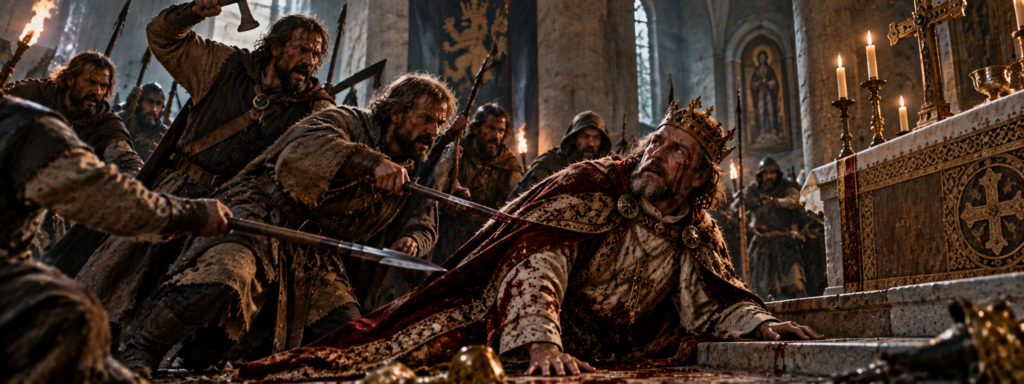
The killing was particularly shocking because of where it happened. Canute had taken shelter in St. Alban’s Church, a religious sanctuary where violence against a Christian king carried an additional weight of sacrilege. According to medieval accounts, the rebels surrounded the building, forced their way into the confrontation, and attacked the king and his companions. Later traditions describe Canute praying near the altar when he received the fatal wound, while other defenders were killed around him. The precise details of his final moments differ between surviving accounts, but the central event is beyond dispute: the king of Denmark was murdered during a rebellion by men who rejected his authority.
For his enemies, Canute’s death was the violent conclusion to years of growing resentment. His attempts to strengthen the monarchy, increase royal revenues, enforce military obligations, and expand the influence of the Church had placed extraordinary pressure upon Danish society. The collapse of his planned invasion of England in 1085 intensified those tensions, particularly when men who had assembled for the campaign were punished for abandoning an expedition that never departed. To those who rebelled, killing the king may have appeared to be the only way to end a government that had become intolerable.
Yet the victory of the rebels would prove strangely incomplete. Within a generation, the murdered monarch was being honored as a martyr, and in 1101 he received papal recognition as a saint. The ruler whose policies had provoked a deadly uprising became Saint Canute, Denmark’s first canonized king and one of the most important figures in the kingdom’s medieval religious history. His death was transformed from an act of political rebellion into a sacred crime, and the men who killed him became remembered as persecutors of a holy monarch.
The historical reality is considerably more complicated than either interpretation suggests. Canute was not simply an innocent victim of lawless peasants, nor was he merely a tyrant whose murder can be explained by excessive taxation. He was an ambitious eleventh-century ruler attempting to transform Danish kingship at a time when royal authority remained dependent upon powerful aristocrats, regional assemblies, and traditions of negotiated obligation. His assassination reveals what could happen when a king demanded more power than his subjects were prepared to surrender, and when political resistance crossed the threshold from rebellion into regicide.
Canute IV: The King Who Died in a Church and Became Denmark’s Patron Saint
Canute IV, also known as Knud IV or Canute the Holy, was born around 1042 and ruled Denmark from 1080 until his assassination on 10 July 1086. He was a son of King Sweyn II Estridsen, whose large family produced several competing claimants to the Danish throne. Canute emerged from a political world shaped by Viking traditions, dynastic rivalries, expanding Christian institutions, and continuing Danish ambitions across the North Sea. After succeeding his brother Harald III, he pursued a forceful program of royal consolidation, supported the Church, and attempted to organize a major expedition against England, then ruled by William the Conqueror. The planned invasion collapsed in 1085, and the punishments imposed upon men who had failed to remain with the fleet helped provoke widespread resentment. In 1086, rebellion spread through Denmark, forcing Canute to retreat to Odense on the island of Funen. There, he and several supporters were killed inside St. Alban’s Church, an event that later became central to his reputation as a Christian martyr. His cult developed rapidly, and Pope Paschal II recognized him as a saint in 1101, transforming a controversial murdered monarch into one of Denmark’s most enduring religious figures.
Canute’s story belongs to a particularly turbulent period in Scandinavian history. The great Viking expeditions of earlier generations had helped establish Danish power in England, Norway, and the Baltic world, but the political landscape was changing. Christianity had become firmly established among Scandinavian rulers, and kings increasingly relied upon ecclesiastical institutions to strengthen their authority. Traditional aristocratic privileges and regional assemblies nevertheless remained powerful constraints upon royal government.
The conflict that destroyed Canute arose from this collision between old political expectations and new ambitions. He sought to govern more assertively than many of his subjects were willing to tolerate. His efforts to command military service and enforce financial penalties made the crown more demanding, while his support for the Church altered the relationship between religious institutions and secular power. His death exposed the limits of royal authority in a society where powerful men could still organize resistance against their sovereign.
His later sainthood created a second, equally important historical story. The surviving narratives were influenced by the religious devotion that developed after his death, and some portray him as a righteous ruler persecuted by wicked subjects. These accounts preserve valuable information, but they also reflect the desire to explain his murder as martyrdom. Understanding Canute requires examining both the king who provoked rebellion and the saint who emerged from the bloodshed.
Born Into the House of Sweyn Estridsen
Canute was born into a dynasty that had inherited both the prestige and the problems of Denmark’s Viking past. His father, Sweyn II Estridsen, ruled Denmark from 1047 until 1076 and worked to consolidate a kingdom that had experienced decades of dynastic conflict. Sweyn’s legitimacy was connected to his mother Estrid, a sister of Cnut the Great, whose empire had once included England, Denmark, and Norway. The family therefore possessed an important connection to the most powerful Scandinavian monarchy of the early eleventh century.
That inheritance was both an opportunity and a burden. The memory of Cnut the Great offered later Danish rulers a model of extraordinary royal achievement. Yet the North Sea empire had not survived intact, and its former territories were now governed by different political powers. Danish kings could invoke their ancestors’ glory without possessing the resources necessary to recreate it.
Sweyn II had numerous children, several of whom became kings of Denmark. Medieval accounts differ concerning their mothers and the precise relationships among them, and the surviving genealogical traditions are not always consistent. The large number of royal sons nevertheless created a complicated succession problem. Denmark did not operate under an automatic system in which the eldest surviving son invariably inherited the crown.
Royal succession depended heavily upon political recognition. Powerful aristocrats and assemblies could influence which claimant became king, and competing members of the dynasty needed supporters willing to defend their claims. A prince’s personal abilities, military reputation, and political alliances could therefore matter as much as birth order. Canute grew up in a family where the possibility of kingship was real but far from guaranteed.
The political environment encouraged rivalry among royal brothers. Each possessed connections to the ruling dynasty, and several could plausibly claim the throne. Their ambitions were shaped by the need to win support among influential Danish families. A prince who failed to secure recognition might remain a powerful aristocrat, seek opportunities abroad, or become involved in conflict with the reigning king.
Canute’s early career was influenced by these conditions. He belonged to a generation that still valued military leadership and the possibility of overseas conquest. The Danish monarchy had not abandoned its interest in England, and the events surrounding the Norman Conquest created opportunities for Scandinavian intervention. Canute would eventually make those ambitions central to his reign.
His upbringing also took place during the consolidation of Christianity in Denmark. The kingdom had possessed Christian rulers for generations, but ecclesiastical organization continued to develop. Bishops, monasteries, and churches increasingly became important institutions within Danish political life. Canute would later embrace their support as part of his program of royal authority.
The young prince therefore inherited several competing traditions. He belonged to a dynasty celebrated for Viking conquest, but he lived in a kingdom becoming more closely integrated into Christian Europe. He could claim royal prestige, but his succession depended upon political support. These tensions would shape both his rise and his violent downfall.
Denmark After the Viking Age
By the middle of the eleventh century, Denmark was no longer simply the maritime power associated with the great Viking invasions. Its rulers governed an increasingly Christian kingdom with established regional communities, influential landowners, and political traditions that limited royal authority. The monarchy could command armies and collect revenues, but its practical power depended upon cooperation. A king who attempted to rule without that cooperation risked provoking serious resistance.
Regional assemblies, commonly known as things, played an important role in political and legal life. They provided settings in which disputes could be addressed, laws recognized, and rulers acknowledged. Their precise authority varied across regions and periods. Nevertheless, they reflected a political culture in which royal decisions were not automatically accepted simply because a king issued them.
The aristocracy possessed substantial resources. Wealthy landowners controlled estates, maintained followers, and exercised influence within local communities. Their support could determine whether a king’s commands were enforced. They also possessed the capacity to organize opposition when royal policies threatened their interests.
Military obligations were particularly sensitive. Scandinavian rulers traditionally relied upon maritime forces assembled through networks of regional obligation and aristocratic leadership. Such arrangements could provide substantial military strength, but they also required coordination and political consent. Maintaining a large fleet for an extended period placed burdens upon communities expected to supply ships, men, and provisions.
The expansion of Christianity introduced additional pressures and opportunities. Churches required land, resources, and legal protection, while bishops sought to strengthen ecclesiastical authority. Kings could support these institutions in exchange for religious legitimacy and administrative assistance. Yet the transfer of wealth or privileges to the Church could provoke resentment among those who believed their traditional rights were being diminished.
Denmark’s international position added another layer of complexity. The kingdom remained connected to Norway, Sweden, England, and the wider Baltic world through trade, dynastic marriage, and military rivalry. Danish rulers could still imagine themselves as major players in North Sea politics. The memory of earlier conquests encouraged ambitions that exceeded the kingdom’s immediate resources.
Canute would inherit this political landscape in 1080. He possessed a royal pedigree and a determination to strengthen his authority, but the kingdom was not prepared to accept unlimited royal demands. His reign would test the balance between monarchy, aristocracy, and regional society. The consequences would be fatal.
The Shadow of Cnut the Great
The name Canute carried enormous historical significance in eleventh-century Denmark. Cnut the Great had ruled England, Denmark, and Norway during the first half of the century, creating a powerful political dominion across the North Sea. His achievements remained a source of dynastic prestige. For later Danish rulers, the memory of his empire offered both inspiration and a tempting political objective.
Cnut the Great had secured England through conquest and political consolidation. His reign demonstrated that a Scandinavian king could command the resources of a wealthy English kingdom while maintaining authority in Denmark. The economic advantages were considerable, particularly because England possessed established systems of taxation and royal administration. Control of England could transform the resources available to a Danish monarch.
The empire, however, proved difficult to maintain after his death in 1035. Rival claimants struggled for power, and the political union eventually disintegrated. England returned to rulers from the native royal line before the Norman Conquest of 1066. Denmark remained an independent kingdom, but its direct control over England had ended.
The Norman Conquest created a new political situation. William, duke of Normandy, defeated Harold Godwinson at Hastings and became king of England. His authority was challenged by rebellions and resistance during the early years of his reign. Danish intervention therefore remained a possibility.
Sweyn II had already attempted to exploit English unrest. In 1069, Danish forces became involved in the rebellion against William’s rule, operating in northern England and cooperating with English opponents of the Normans. The campaign demonstrated that Danish military intervention remained possible. It also showed how difficult it would be to translate raids and temporary alliances into lasting conquest.
Canute inherited this tradition of ambition. England represented wealth, prestige, and the possibility of restoring a great dynastic achievement. A successful invasion would elevate him far beyond the position of an ordinary Scandinavian king. It could also provide resources useful for strengthening his authority at home.
Yet the political circumstances had changed since the age of Cnut the Great. William the Conqueror possessed a formidable military organization and had spent years consolidating his rule. An invasion would require enormous preparation, reliable alliances, and sustained logistical support. Canute’s dream of English conquest would ultimately expose the weaknesses of his own government.
A Prince Passed Over for the Throne
When Sweyn II died in 1076, the succession did not pass automatically to Canute. Instead, his brother Harald III, commonly known as Harald Hen, became king. The circumstances of Harald’s selection illustrate the importance of political recognition within Danish kingship. Canute possessed a royal claim, but he did not command enough support to secure the crown.
Harald’s reign is generally remembered as comparatively restrained. Later traditions associate him with legal reforms and a willingness to respect established political arrangements. The details of his policies are not always clear, and comparisons with Canute were shaped by subsequent historical interpretations. Nevertheless, Harald’s kingship appears to have followed a less confrontational approach.
Canute’s ambitions did not disappear during his brother’s reign. He remained a member of the royal family with potential supporters and military experience. Some later accounts suggest tension between the brothers. The precise extent of their rivalry is uncertain, but the succession problem remained unresolved.
The contrast between the brothers became important to later narratives. Harald was remembered as a ruler associated with moderation, while Canute acquired a reputation for forceful government. Such comparisons can exaggerate differences because medieval writers often organized history around moral contrasts. Yet the political consequences of Canute’s reign suggest that his approach to authority was indeed more demanding.
Harald died in 1080, opening the succession once again. Canute now secured recognition as king. His accession marked the beginning of a reign that would last only six years. Within that short period, he would attempt to strengthen royal government, prepare a major invasion of England, and provoke a rebellion powerful enough to destroy him.
The circumstances of his accession also shaped his political position. He had experienced the frustration of being passed over for the throne. He understood that royal authority depended upon the support of influential men. Once crowned, he appears to have sought a stronger monarchy less vulnerable to aristocratic pressure.
That ambition would become the central conflict of his reign. Canute did not inherit a kingdom in which royal commands could be enforced without negotiation. He attempted to expand the practical authority of the crown within a political system that still depended upon consent. His efforts would eventually bring him into direct confrontation with the people whose support had made him king.
The New King and His Determination to Strengthen the Crown
Canute’s accession in 1080 introduced a more assertive style of government. He sought to strengthen royal authority, increase the resources available to the monarchy, and enforce obligations that earlier rulers may have handled more cautiously. His policies reflected wider developments in European kingship, where rulers were increasingly interested in legal authority, revenue, and administrative control. In Denmark, however, these ambitions encountered established traditions of aristocratic independence.
One important aspect of his government involved royal rights and financial obligations. Medieval rulers depended upon a variety of revenues, including income from estates, fines, dues, and other customary claims. Expanding or enforcing these rights could increase the resources available to the crown. It could also create resentment among people who believed the king was demanding more than custom allowed.
Canute’s policies appear to have placed particular pressure upon wealthy landowners and communities expected to provide military service. The exact structure of his fiscal measures is difficult to reconstruct from the surviving sources. Later accounts emphasize oppressive taxation and severe enforcement, but they were written from different political and religious perspectives. The broad pattern of growing resentment is nevertheless clear.
His relationship with the aristocracy became increasingly strained. Powerful families were accustomed to exercising considerable influence over regional affairs. A king who attempted to impose stronger controls could threaten their economic interests and political prestige. Opposition to Canute therefore involved more than simple unwillingness to pay taxes.
Royal justice was another area of potential conflict. Fines and punishments could serve as instruments of government, but they could also be experienced as arbitrary exactions. A ruler who enforced penalties harshly risked turning legal disputes into political grievances. Canute’s later treatment of men associated with the failed invasion fleet would demonstrate the danger.
His support for the Church formed part of the same effort to strengthen kingship. Ecclesiastical institutions could provide ideological legitimacy and administrative assistance. Religious authority could reinforce royal claims to obedience. Yet cooperation between crown and Church could also concentrate power in ways that alarmed established elites.
Canute’s reign therefore became a test of political limits. He sought to govern as a powerful Christian monarch whose commands carried substantial authority. His subjects, particularly influential aristocrats and regional communities, retained expectations about consultation and customary rights. The conflict between these visions would eventually become irreconcilable.
A King Who Gave the Church Power and Land
Canute’s relationship with the Church was one of the defining features of his reign. He supported ecclesiastical institutions and contributed to the development of a more firmly organized Christian kingdom. His religious patronage became central to the later portrayal of him as a saint. It also had political implications that could generate resistance.
One of the most important surviving documents associated with his reign is a donation charter issued in 1085 for the church at Lund. The charter records substantial gifts and privileges, demonstrating the king’s willingness to support ecclesiastical institutions with material resources. Such donations helped strengthen the Church’s position within Danish society. They also reflected the relationship between royal authority and religious patronage.
Lund was becoming an increasingly important ecclesiastical center. The growth of its institutions contributed to the development of a more organized Danish Church. Royal support could provide land and income necessary for religious communities to function. In return, ecclesiastical institutions could reinforce the legitimacy of Christian kingship.
The transfer of resources to the Church was not politically neutral. Land and income granted to religious institutions were resources that could no longer be controlled in the same way by other interests. Aristocrats might resent the expansion of ecclesiastical privileges, particularly when royal patronage altered existing arrangements. The relationship between Church reform and royal centralization could therefore intensify political tensions.
Canute’s support for religious institutions also reflected the wider reform movements affecting western Christianity during the eleventh century. Church leaders sought stronger ecclesiastical organization and greater protection for religious property. Kings who supported these goals could present themselves as defenders of Christian order. Their authority might acquire a sacred dimension.
The later cult of Saint Canute emphasized his generosity toward the Church and his commitment to religious reform. Such accounts portrayed his enemies as hostile to Christian justice and ecclesiastical freedom. That interpretation became influential after his death. It should nevertheless be distinguished from the broader political grievances that contributed to the rebellion.
Canute’s religious policies were therefore both sincere acts of patronage and instruments of royal government. The two purposes were not necessarily contradictory in medieval political thought. A Christian king could regard the strengthening of the Church as part of his duty to govern. His subjects, however, might experience the same policies as an expansion of royal and ecclesiastical demands.
The connection between Canute and the Church would become decisive after his murder. The religious institutions he had supported helped preserve his memory and promote his sanctity. His death inside a church gave that memory extraordinary symbolic power. The policies that had contributed to political opposition also helped create the foundation of his posthumous reputation.
Marriage, Dynasty, and the Politics of Royal Legitimacy
Canute married Adela of Flanders, a daughter of Count Robert I of Flanders. The marriage connected the Danish monarchy with one of the most influential aristocratic families in northwestern Europe. Flanders possessed important political and economic connections with England and the wider continental world. The alliance therefore strengthened Canute’s international position.
The marriage also reflected the growing integration of Scandinavian royalty into European dynastic politics. Danish kings increasingly sought relationships with powerful Christian families beyond Scandinavia. Such unions could provide diplomatic support, prestige, and potential military connections. Canute’s ambitions extended well beyond the boundaries of his own kingdom.
Adela’s family connections were particularly relevant to the political situation in England. The counts of Flanders had longstanding relationships with English and Norman affairs. Their position could make them useful partners in a campaign against William the Conqueror. The marriage did not guarantee military assistance, but it formed part of a wider network of political possibilities.
Canute and Adela had children, including Charles, who later became count of Flanders and was himself murdered in 1127. Charles would eventually be venerated as Blessed Charles the Good, creating a striking family history of violent political deaths followed by religious devotion. The connection demonstrates how closely aristocratic politics and sanctity could become intertwined in medieval Europe. Both father and son would acquire reputations shaped by assassination and martyrdom.
Adela’s position became precarious during the rebellion of 1086. The king’s collapse threatened not only his own life but the security of his immediate family. After Canute’s death, she returned to Flanders with their young son Charles. Her departure marked the end of her position as queen within Denmark.
The surviving evidence offers limited access to Adela’s private thoughts and experiences. Later accounts concentrate primarily upon Canute’s martyrdom and the political consequences of his death. The personal cost of the rebellion for his wife and children is therefore difficult to reconstruct. Yet the destruction of the royal household was an important consequence of the uprising.
The marriage also reveals the scale of Canute’s ambitions. He was not content to rule Denmark as an isolated Scandinavian kingdom. He sought alliances that connected him with continental power and the struggle over England. His foreign policy and domestic government were closely related. The resources required for international ambition would become a major source of conflict at home.
The Dream of Conquering England
Canute’s most ambitious political project was the planned invasion of England in 1085. The campaign represented an attempt to challenge William the Conqueror and revive Danish influence across the North Sea. England had once formed part of the dominion of Cnut the Great, and the memory of that achievement remained powerful. A successful conquest would have transformed Canute’s position among European rulers.
The political circumstances appeared to offer an opportunity. William faced challenges within his territories, and the Anglo-Norman kingdom remained connected to wider conflicts involving France and Flanders. Danish intervention might exploit these tensions. Canute sought to assemble a substantial fleet capable of carrying an invasion force across the North Sea.
The expedition required extensive preparation. Ships had to be assembled, warriors summoned, and supplies organized. A major maritime campaign depended upon the cooperation of communities and aristocrats expected to contribute men and resources. The burden could be considerable, particularly if the fleet remained assembled for an extended period.
The planned invasion also involved diplomatic considerations. Canute’s connections with Flanders and other opponents of William could potentially support the campaign. The precise arrangements and expectations of the participants remain uncertain. Nevertheless, the invasion was sufficiently serious that William took the threat into account.
The Anglo-Saxon Chronicle records concern in England over the prospect of a Danish invasion. William responded by preparing defensive forces, including the use of troops from the continent. The English kingdom therefore treated the threat as significant. Canute’s expedition was not merely a fantasy preserved in later Danish tradition.
The problem was that the invasion never took place. The fleet assembled, but the campaign was delayed and eventually abandoned. The reasons remain debated, involving political circumstances, military difficulties, and the king’s own decisions. The delay created growing frustration among the men expected to remain ready for service.
A large fleet could not wait indefinitely without consequences. Warriors needed provisions, ships required maintenance, and agricultural communities could suffer when men were absent from their ordinary responsibilities. The longer the expedition remained inactive, the more resentment could develop. Canute’s determination to enforce discipline would turn that resentment into open hostility.
The failure of the invasion was therefore more than a missed military opportunity. It became the event that exposed the weaknesses of Canute’s relationship with his subjects. His ambition required cooperation on a scale he could not sustain. When the campaign collapsed, the political consequences were devastating.
The Fleet That Waited and the Men Who Went Home
The planned invasion fleet gathered in 1085, traditionally associated with the Limfjord region of northern Jutland. The expedition was intended to carry Danish forces against England. The size of the fleet reported in later sources varies, and medieval numerical claims should be treated cautiously. What is clear is that a substantial military mobilization took place.
The assembled men expected action. Maritime expeditions were costly undertakings, and maintaining readiness required time and resources. Farmers and landowners could not remain indefinitely separated from their estates without economic consequences. The longer the fleet waited, the greater the pressure upon those responsible for supplying it.
Canute did not launch the invasion as planned. Later accounts provide different explanations for the delay, including political developments and the king’s concerns about other threats. Some narratives associate the postponement with difficulties involving his brother Olaf, who later became king. The precise causes remain uncertain.
The waiting warriors eventually began to disperse. Some returned to their homes without receiving the king’s permission. From their perspective, the expedition had failed to proceed and the burdens of continued service had become unreasonable. From the king’s perspective, their departure represented disobedience to a royal military summons.
This difference in interpretation became explosive. Canute believed that military obligations had to be enforced if the monarchy was to conduct major campaigns. His subjects expected obligations to operate within established customs and practical limits. The abandoned invasion brought those competing expectations into direct conflict.
The king responded by imposing financial penalties upon men who had left the fleet. The surviving accounts emphasize fines and royal demands associated with the failed mobilization. The exact legal basis and scale of the penalties are not fully recoverable. Their political effect, however, was unmistakable.
Men who had already suffered the costs of assembling for a campaign now faced punishment for returning home. The demands were experienced as particularly harsh because the invasion had never taken place. Resentment spread among communities that had supplied warriors and ships. The king’s effort to enforce discipline undermined the loyalty necessary for future military service.
The failure of the fleet therefore became the immediate catalyst for rebellion. Canute’s ambitions had required extraordinary mobilization, but his subjects refused to bear unlimited burdens. The punishments imposed after the expedition collapsed transformed frustration into organized resistance. Within months, the king would be fleeing from the anger he had helped create.
The Taxation That Turned Subjects Into Enemies
The rebellion against Canute is often summarized as a reaction to heavy taxation. That explanation captures an important element of the conflict but does not fully describe its causes. The financial penalties associated with the failed invasion were especially significant, yet they formed part of wider tensions over royal authority. The king’s attempts to enforce obligations challenged expectations about the limits of monarchy.
Medieval taxation differed considerably from modern systems of regular national revenue collection. Kings relied upon a mixture of customary dues, fines, estate income, military obligations, and other claims. The distinction between a tax and a penalty was not always clear to those required to pay. A demand that appeared lawful to royal officials could be regarded as an abuse by local communities.
Canute’s government sought to enforce royal rights more aggressively. Such measures could increase the resources available to the crown and strengthen its ability to act independently. They could also reduce the freedom of powerful aristocrats and impose additional burdens upon ordinary landholders. Opposition therefore crossed social boundaries.
The failed invasion intensified these grievances because it involved military obligations as well as financial punishment. Men had been summoned to serve in a campaign that never departed. Their absence from home could disrupt agricultural work and local economic activity. The subsequent fines appeared to punish them for a failure that they did not necessarily regard as their own responsibility.
Aristocratic leaders had reasons to oppose the king as well. They could resent royal interference with customary rights and fear the expansion of central authority. Their influence within regional communities allowed them to organize resistance. A rebellion supported by powerful landowners was far more dangerous than scattered refusal to pay.
The religious dimension added further complexity. Canute’s support for the Church and the transfer of resources to ecclesiastical institutions could be interpreted as legitimate Christian patronage. Opponents might nevertheless resent the economic and political consequences. Royal and ecclesiastical demands could appear to reinforce one another.
The sources do not permit a precise reconstruction of every tax or penalty imposed during Canute’s reign. Later accounts were shaped by the desire either to defend the murdered king or explain the grievances of his opponents. The safest conclusion is that financial exactions, military obligations, and resistance to stronger royal government combined to produce the uprising. The rebellion cannot be reduced to a single unpopular tax.
What made the situation especially dangerous was the loss of political trust. Subjects who believed the king had exceeded customary limits were less willing to accept further demands. Aristocrats who feared punishment could decide that resistance was safer than submission. Canute’s determination to enforce authority created the conditions in which that authority could collapse.
The Rebellion Begins in Jutland
In 1086, opposition to Canute erupted into open rebellion. The uprising began in Jutland, where resentment over the failed invasion and royal demands had become particularly intense. The king’s authority depended upon local support that was rapidly disappearing. What had begun as anger over obligations and penalties became a direct challenge to his right to govern.
The rebels were not a single uniform social group. They included men from communities burdened by royal demands, together with influential leaders capable of organizing armed resistance. Later accounts often describe the uprising as a revolt of peasants, but aristocratic involvement was also important. The coalition reflected widespread dissatisfaction with the king’s policies.
The rebellion spread with alarming speed. Canute could no longer rely upon the obedience of communities that had previously supplied his military forces. Men who had been summoned for an invasion against England were now prepared to confront their own monarch. The reversal demonstrated how quickly military obligations could become a source of political danger.
Canute attempted to respond, but his position deteriorated. The available sources provide different details concerning his movements and the extent of his remaining support. The general pattern is clear: he was forced to retreat before an increasingly determined opposition. His authority in Jutland had effectively collapsed.
The king moved toward Funen, seeking safety and perhaps hoping to gather loyal forces. The island offered temporary refuge, but it did not place him beyond the reach of the rebellion. The rebels pursued him across the kingdom. Their determination suggests that the conflict had moved beyond negotiation over fines.
The political situation was now extremely dangerous for Canute. A king who had lost the cooperation of powerful regional communities could not easily restore order through command alone. His remaining supporters were insufficient to guarantee his safety. The uprising threatened not merely his policies but his life.
The rebellion also exposed the fragility of Danish kingship. Canute had attempted to strengthen the monarchy through more forceful government, yet his efforts had produced resistance that the crown could not contain. The institutions necessary to enforce his authority were not strong enough to overcome widespread opposition. The king who had dreamed of conquering England was losing control of Denmark.
As the rebels advanced, Canute retreated toward Odense. The city would become the setting for the final confrontation. His enemies were no longer content simply to refuse payment or military service. They were pursuing the monarch himself.
The Flight to Odense
Odense, on the island of Funen, became the final refuge of Canute IV. The settlement possessed religious institutions that offered the possibility of sanctuary. In medieval Christian society, churches were regarded as sacred spaces where violence carried particular moral and religious consequences. Canute’s decision to seek protection within a church reflected the seriousness of his predicament.
The king was accompanied by a small group of loyal supporters. Among them was his brother Benedict, who would also die during the confrontation. The surviving accounts differ concerning the number and identities of those present. Their resistance nevertheless became an important element of the later martyrdom narrative.
Canute’s retreat marked a devastating reversal of fortune. Only a short time earlier, he had commanded preparations for a major invasion of England. He had sought to mobilize a fleet capable of challenging one of Europe’s most powerful monarchs. Now he was fleeing from rebels within his own kingdom.
The political meaning of his flight was unmistakable. A king who could not travel safely through his own territory had lost much of the practical authority associated with kingship. His commands no longer guaranteed obedience, and his military resources were inadequate to protect him. The rebellion had become a crisis of sovereignty.
The church at Odense offered a different kind of protection. Christian sanctuary rested upon religious authority rather than military strength. Even men who opposed a ruler might hesitate to attack him within a sacred building. The prohibition against violence in churches was widely recognized, although it was not always respected.
Canute’s enemies did not abandon their pursuit. Their anger had reached a point where the sanctity of the building would not prevent confrontation. The king’s presence inside the church created a terrible possibility: a political rebellion might become an act of sacrilege. The consequences for his memory would be profound.
Later accounts emphasize Canute’s religious conduct during these final hours. They portray him praying and preparing for death rather than attempting to escape. Such details are important to the saintly tradition but cannot all be verified independently. The historical certainty is that he sought refuge in the church and was killed there.
The setting would become inseparable from his reputation. Had Canute died in open battle, his death might have been remembered differently. Murder inside a church allowed later generations to interpret his fate as martyrdom. The place of his death transformed the political meaning of the crime.
St. Alban’s Church: The Sanctuary That Could Not Save a King
The church where Canute died was dedicated to St. Alban, an early Christian martyr whose cult had spread beyond England. The dedication was particularly appropriate to the religious connections between Denmark and the wider North Sea world. St. Alban’s Church in Odense became the setting for the violent end of Canute’s reign. Its association with the king’s death would eventually give the site extraordinary historical significance.
The building should not be confused with the later monumental church structures associated with Saint Canute in Odense. The medieval religious landscape changed substantially after his death. The original setting belonged to the ecclesiastical world of eleventh-century Denmark. Later construction and commemoration transformed the location.
Canute entered the church with loyal companions while the rebels approached. The surviving narratives describe the king seeking refuge within the sacred building. His enemies surrounded the area and prepared to attack. The confrontation placed religious sanctuary directly against political fury.
The rebels had reasons to believe that allowing Canute to escape would be dangerous. A surviving king might gather loyal forces, seek foreign assistance, or punish those who had participated in the uprising. The possibility of reconciliation had diminished as the rebellion spread. The confrontation at Odense therefore carried the logic of a struggle in which both sides feared the consequences of defeat.
The presence of Canute’s brother Benedict and other defenders made the situation more violent. The king was not entirely alone or defenseless. His companions attempted to protect him, and the later accounts describe fighting around the church. The precise sequence of the confrontation remains uncertain.
The religious character of the location became central to the later interpretation. Violence against a king inside a church violated expectations concerning both royal authority and sacred space. For supporters of Canute, the attack demonstrated the wickedness of the rebels. For the rebels themselves, the urgency of eliminating the king may have outweighed the fear of sacrilege.
The surviving narratives emphasize the contrast between the king’s prayer and the violence of his enemies. This contrast served the purposes of hagiography, presenting Canute as a holy victim. It does not mean that the basic event was invented. The murder occurred, but the precise gestures and dramatic details of the final scene were shaped by later religious storytelling.
The church at Odense became a place where political history and sacred memory were permanently joined. The king had entered seeking protection from his subjects. Instead, he died within the sanctuary. His enemies won the immediate confrontation, but the religious meaning of the location would eventually turn their victory into a lasting condemnation.
The Murder of Canute IV
On 10 July 1086, the rebellion reached its violent climax at St. Alban’s Church in Odense. Canute and his remaining supporters were confronted by the rebels who had pursued him across Denmark. The king’s position was desperate, and the sanctuary offered no effective protection. The confrontation ended with his death and the killing of several loyal companions.
The medieval accounts describe a violent attack upon the church and its defenders. Some traditions emphasize missiles thrown or fired into the building, while others describe close fighting around the entrance and interior. The exact sequence differs between sources. These variations make it impossible to reconstruct every movement with certainty.
Canute’s brother Benedict was among those killed. His presence beside the king became an important part of the later narrative of loyalty and martyrdom. The deaths of the defenders demonstrated the determination of the rebels to eliminate resistance. The confrontation was not a symbolic protest but an armed assault.
The most famous tradition describes Canute receiving a fatal spear wound while praying near the altar. Other accounts differ in the details of the weapon and the circumstances of the attack. The image of the king dying in prayer became central to his cult. It should be understood as a medieval narrative tradition rather than an independently verified eyewitness description.
The broader facts remain clear. Canute was killed by Danish rebels inside a church, and his death ended his reign. The uprising had progressed from resistance to royal demands into the deliberate destruction of the monarch. It was an unmistakable act of regicide.
The killing was politically significant because Canute had not been defeated by a foreign army. His own subjects had organized the resistance that destroyed him. The grievances involved taxation, military obligations, royal authority, and aristocratic independence. His death revealed how deeply those conflicts had divided the kingdom.
The religious significance was equally profound. A Christian king had been murdered in a sacred building, and the circumstances offered powerful material for a martyrdom narrative. The Church could interpret the killing as an attack upon a ruler who had supported ecclesiastical reform. His opponents could be remembered not merely as rebels but as enemies of sacred order.
Canute’s final moments became the defining image of his life. The ambitious monarch who had sought to conquer England was remembered instead as a king dying near an altar. The political failures of his reign were gradually overshadowed by the violence of his death. The transformation began with the bloodshed at Odense.
The Brother Who Died Beside Him
Benedict, one of Canute’s brothers, became an important figure in the traditions surrounding the king’s murder. He remained with Canute during the final confrontation and was killed in the violence at Odense. His death demonstrated that the rebels were prepared to attack members of the royal family as well as the king himself. The event added a dynastic dimension to the regicide.
The surviving accounts describe Benedict attempting to defend his brother. Some later narratives portray him fighting bravely against overwhelming numbers. The precise details of his actions cannot be independently verified. His presence nevertheless became a symbol of loyalty in the face of rebellion.
The killing of Benedict also illustrates the danger faced by royal supporters during a successful uprising. Men closely associated with a defeated monarch could be regarded as threats to the new political order. Their survival might provide a rallying point for resistance. The rebels therefore had reasons to eliminate those defending Canute.
The later cult of Saint Canute incorporated Benedict’s death into the broader story of martyrdom. His loyalty reinforced the portrayal of the king as a righteous victim surrounded by faithful companions. The narrative emphasized sacrifice and religious devotion. The political circumstances of the rebellion became less prominent.
Benedict’s death also affected the royal family. Canute belonged to a dynasty with numerous potential claimants, but the killing of two brothers during the same confrontation demonstrated the violence of the succession crisis. The monarchy could not rely upon dynastic prestige alone to protect its members. Political authority remained vulnerable to armed resistance.
The memory of Benedict survived largely through his association with Canute. His independent political career is less well documented than that of his brother. Yet his death became inseparable from the events of 10 July 1086. The church at Odense witnessed not only the murder of a king but the destruction of part of his immediate circle.
The presence of loyal defenders also complicates the popular image of Canute as a completely passive victim. The confrontation involved armed men and violent resistance. Later religious accounts emphasized the king’s prayerful conduct, but the broader event was a political struggle ending in bloodshed. Both dimensions belong to the history of the assassination.
The Rebels Had Killed Their King—But What Had They Won?
The death of Canute removed the immediate source of the rebellion’s grievances. The monarch who had imposed unpopular demands and punished the men associated with the failed invasion was gone. His enemies no longer faced the prospect of his restoration through force. The uprising had achieved its most dramatic objective.
Yet regicide created its own political dangers. Killing a king did not automatically establish a stable government. Denmark still required a recognized ruler, and the royal dynasty contained several potential claimants. Powerful aristocrats and regional communities needed to negotiate a new political settlement.
Canute was succeeded by his brother Olaf I, commonly known as Olaf Hunger. His reign began in the aftermath of the rebellion and continued until 1095. The succession preserved the dynasty while ending Canute’s personal rule. It also demonstrated that the rebels had not necessarily intended to abolish monarchy itself.
The new king inherited a kingdom deeply affected by political conflict. The rebellion had exposed tensions between royal authority and aristocratic expectations. The legitimacy of the monarchy required rebuilding after the killing of a reigning sovereign. Olaf faced the challenge of governing communities that had recently demonstrated their willingness to resist royal demands.
The years following Canute’s death were remembered as a period of hardship, particularly famine. Later sources associated these disasters with divine punishment for the murder of the king. Such interpretations became important to the development of his cult. They should not be confused with proof that the famine was caused by supernatural judgment.
The political consequences of the uprising were therefore complicated. The rebels eliminated Canute, but the monarchy survived under another member of his family. His death did not permanently resolve the tensions surrounding royal authority. Instead, it created a new struggle over how his reign and murder should be remembered.
The Church’s interpretation would eventually become dominant. Canute’s support for ecclesiastical institutions made him an attractive figure for religious commemoration. His death inside a church strengthened the claim that he had suffered martyrdom. The political victory of the rebels gradually became a moral defeat in the historical narrative.
The men who killed Canute had sought to end his rule. They succeeded in that immediate objective. Yet their actions helped create the conditions in which the murdered king would acquire a new and more enduring authority. The transformation would become one of the most remarkable consequences of the rebellion.
Olaf Hunger and the Years of Famine
Canute’s brother Olaf I succeeded him in 1086 and ruled Denmark until 1095. His reign became associated with severe famine and hardship, giving rise to the epithet Olaf Hunger. The precise causes and geographical extent of the crises are difficult to reconstruct. Medieval sources nevertheless preserve a strong memory of suffering during these years.
The famine became central to the religious interpretation of Canute’s death. Later writers presented the disasters as divine punishment for the murder of a holy king. The implication was that Denmark had committed a grave sin by rebelling against its rightful ruler. Natural hardship was transformed into evidence of supernatural judgment.
Such interpretations were common in medieval historical writing. Chroniclers frequently connected political violence with famine, disease, or other disasters. These connections reflected religious beliefs about divine justice. They do not establish a causal relationship that can be verified through modern historical methods.
Olaf’s own reputation suffered because of the association. His reign became remembered through the hardship that followed his brother’s death. The contrast between the murdered saint and the suffering kingdom strengthened the developing cult. Canute’s opponents appeared to have brought disaster upon Denmark.
The political reality was more complicated. Agricultural crises could arise from weather, harvest failure, disease, and broader economic conditions. The surviving evidence does not permit a precise explanation of every famine associated with Olaf’s reign. Nor does it justify treating the hardship as a direct consequence of the rebellion.
The religious interpretation nevertheless had important consequences. It encouraged communities to reconsider Canute’s death and the moral legitimacy of the uprising. The king who had been condemned for oppressive government could now be remembered as a victim whose murder had offended divine order. His reputation began to change.
The contrast between Canute and Olaf also influenced later historical narratives. Canute’s reign could be portrayed as a period of righteous reform, while the years following his death became associated with punishment. Such moral structures simplified the complex political circumstances of the rebellion. They helped establish the foundation for Canute’s eventual canonization.
The years after 1086 therefore mattered greatly to the king’s posthumous reputation. His death did not immediately erase the grievances that had caused the uprising. Yet hardship, religious interpretation, and political change created conditions favorable to his cult. The murdered monarch was beginning to emerge as a saint.
The First Miracles and the Birth of a Martyr
The cult of Canute developed in the years following his assassination. Reports of miracles became associated with his remains and the site of his death. These accounts were important to the process through which he came to be recognized as a saint. They also helped reinterpret the rebellion as an act of religious persecution.
The surviving miracle traditions describe divine favor shown through the murdered king. Healings and other extraordinary events were attributed to his intercession. Such reports reflected medieval religious beliefs about the power of saints. Their historical significance lies in the devotion they inspired rather than in independently verifiable supernatural evidence.
Canute’s burial and the treatment of his remains became central to the cult. The religious community at Odense preserved his memory and promoted devotion to him. The location of his death provided a powerful focus for pilgrimage and commemoration. The church that had witnessed his murder became associated with sanctity.
The circumstances of the killing made the martyrdom narrative especially compelling. Canute had died inside a church while seeking refuge from rebels. Later accounts emphasized his prayerful conduct and the sacrilegious nature of the attack. The setting allowed his death to be interpreted as an assault upon Christian kingship.
His support for ecclesiastical institutions during his reign reinforced that interpretation. The king had granted resources and privileges to the Church. Religious writers could portray his enemies as men who rejected both royal justice and Christian reform. The political grievances of the rebels became secondary to the claim that Canute had died defending sacred order.
The development of the cult also served political purposes. A royal saint could strengthen the legitimacy of the dynasty and provide a symbol of Christian monarchy. Later rulers could associate themselves with Canute’s sanctity. His memory became a resource for both Church and crown.
The transformation was gradual rather than instantaneous. The surviving evidence does not support the assumption that every Dane immediately regarded Canute as holy. His reputation developed through religious promotion, changing political circumstances, and the circulation of miracle stories. The cult gained strength as the memory of the rebellion was reinterpreted.
Within fifteen years of his death, Canute would receive papal recognition as a saint. The speed of that transformation is remarkable. A king murdered by his own subjects in 1086 became an officially recognized holy ruler in 1101. The religious meaning of his death had overtaken the political grievances that caused it.
The Canonization of Saint Canute
In 1101, Pope Paschal II recognized Canute as a saint. The canonization marked a major moment in Danish religious history. Canute became the first Danish king to receive formal papal recognition of sanctity. His cult acquired an authority that extended beyond local devotion.
The recognition reflected the growing importance of papal involvement in the formal acknowledgment of saints. During the eleventh and twelfth centuries, the Church increasingly developed procedures for evaluating claims of holiness. Canute’s case belonged to this period of transition. His canonization demonstrated the international significance of his cult.
The political implications were substantial. Denmark now possessed a royal saint whose memory could strengthen the monarchy’s religious legitimacy. Later rulers could present themselves as heirs to a holy predecessor. The Church could invoke his example in support of ecclesiastical rights and Christian government.
The canonization also changed how the rebellion was remembered. The killing of Canute became not merely an act of regicide but the martyrdom of a recognized saint. His opponents were increasingly portrayed as enemies of sacred authority. The political circumstances that had led to the uprising were overshadowed by the religious interpretation.
The king’s feast day was celebrated on 10 July, the anniversary of his death. Annual commemoration helped preserve his memory within Danish religious life. Churches and communities honored him as a holy ruler. His reputation spread beyond the immediate region of Odense.
The cult also strengthened the importance of the church associated with his remains. Odense became a major center of devotion. The memory of the murder shaped the religious identity of the city. The site of political violence became a place of pilgrimage.
Canute’s canonization did not resolve every historical question about his reign. It established his religious status within the Church, but it did not provide independent evidence concerning every accusation made against his government. His policies remained politically controversial in historical interpretation. The saintly narrative reflected one powerful understanding of his life and death.
The contrast between the two reputations is central to his story. Canute the king had faced rebellion because many subjects regarded his demands as intolerable. Saint Canute became a model of Christian kingship whose murder was condemned as sacrilege. The same life could be understood through dramatically different moral frameworks.
The Church at Odense and the Memory of Royal Blood
Odense became inseparable from the memory of Canute’s assassination. The city was transformed from the site of a violent political confrontation into a center of religious devotion. The church associated with his death and burial acquired increasing importance. His cult shaped the development of the city’s ecclesiastical identity.
The later St. Canute’s Cathedral became the principal monument associated with the saint. Its medieval development reflected the growing significance of the cult and the resources devoted to his commemoration. The cathedral visible today belongs to later architectural phases rather than the original building in which Canute was killed. The distinction matters when reconstructing the events of 1086.
The saint’s remains became an important focus of devotion. Relics played a central role in medieval Christianity, providing tangible connections between worshippers and holy figures. The preservation and veneration of Canute’s body reinforced the belief that his death had sacred significance. Pilgrims could honor the murdered king at a place directly connected with his fate.
The cathedral also became a symbol of royal legitimacy. A king who had died during rebellion was now commemorated within a major religious institution. His memory could be invoked in support of the monarchy and the Church. The political conflict that destroyed him became part of a narrative emphasizing sacred kingship.
The location retained an unsettling historical irony. Canute had entered a church because he needed protection from his own subjects. The sanctuary failed to save him, but his death made the site religiously important. The violence that violated the church’s sanctity ultimately strengthened its association with holiness.
The development of Odense also demonstrates the power of historical memory to reshape physical spaces. Buildings were constructed, altered, and dedicated in response to the saint’s growing reputation. Religious ceremonies preserved the anniversary of his death. The city became a landscape of commemoration.
For later generations, the assassination was no longer simply a political event from the distant past. It was a sacred story connected with a place they could visit. The king’s remains and the cathedral provided a continuing focus for devotion. The memory of 1086 remained embedded in Danish religious culture.
Yet the original conflict should not be forgotten beneath the monuments. Canute died because his government had provoked serious resistance. The church became the scene of regicide because the political relationship between king and subjects had collapsed. The sacred landscape preserved the memory of the victim while often obscuring the grievances of those who killed him.
Was Canute a Tyrant or a Martyr?
The question of Canute’s character has divided interpretations of his reign for centuries. Some accounts emphasize his harsh government, financial demands, and willingness to punish disobedience. Others celebrate his religious devotion, support for the Church, and death within a sanctuary. Both traditions reflect important aspects of his historical reputation.
The charge of tyranny requires careful consideration. Canute attempted to strengthen royal authority in a kingdom where political power remained distributed among aristocrats and regional communities. His policies generated substantial resistance, particularly after the failed invasion of England. The rebellion demonstrates that many subjects regarded his demands as unacceptable.
Yet political opposition does not automatically prove that every royal policy was unjustified. Medieval rulers faced genuine challenges in maintaining military discipline, collecting revenues, and enforcing legal obligations. Canute’s efforts to strengthen government may have been intended to create a more effective monarchy. The difficulty lay in the methods he used and the degree of consent he possessed.
The martyrdom narrative also requires historical context. Canute was killed inside a church, and his support for ecclesiastical institutions contributed to his later recognition as a saint. Religious writers interpreted his death as persecution of a righteous Christian ruler. Their accounts were shaped by devotional purposes and cannot be treated as neutral political histories.
The rebels’ motives were not exclusively religious. Their grievances involved taxation, military service, royal punishment, and aristocratic independence. The uprising was a political revolt against a king whose authority had become deeply contested. It cannot be reduced to an attack upon Christianity.
At the same time, the religious interpretation was historically influential. Canute’s canonization shaped Danish political and ecclesiastical identity for centuries. His cult encouraged later rulers to associate royal authority with Christian sanctity. The memory of his death became more important than many of the specific disputes of his reign.
A historically responsible assessment must therefore distinguish between the political causes of the rebellion and the religious meaning later attached to the murder. Canute was an ambitious ruler whose policies contributed to his downfall. He was also a king killed in a sacred building whose death became the foundation of a major saintly cult. These identities are not mutually exclusive.
The complexity makes his story more revealing than a simple tale of good and evil. The same policies that strengthened the Church could provoke resentment among powerful subjects. The same king who sought to enforce military obligations could lose the loyalty of his army. The same rebellion that ended an unpopular reign could produce a saint whose memory strengthened the monarchy.
Regicide in a Christian Kingdom
Canute’s murder was one of the most dramatic acts of regicide in medieval Scandinavian history. It occurred during a period when kingship was becoming increasingly associated with Christian legitimacy. The killing of a monarch was therefore not merely a political act. It could be interpreted as an assault upon an office believed to possess sacred responsibilities.
The location intensified the significance. Canute died inside a church, a space associated with religious protection and divine authority. The attack violated expectations concerning sanctuary. Later writers emphasized this sacrilege as evidence of the rebels’ moral corruption.
Yet the rebellion also demonstrates that Christian kingship did not eliminate political resistance. Powerful subjects continued to believe that rulers could exceed legitimate authority. Regional communities retained expectations about customary obligations. A king who ignored those expectations could face armed opposition even within a Christian kingdom.
The murder therefore exposed competing understandings of legitimacy. Canute believed that royal authority entitled him to enforce military service and financial penalties. His opponents believed that his demands had become intolerable. The confrontation at Odense represented the violent failure of any political mechanism capable of reconciling those positions.
The survival of the dynasty after his death is also significant. The rebels did not establish a permanently different form of government. Canute’s brother Olaf succeeded him, preserving royal rule. The uprising was directed against a particular monarch and his policies rather than necessarily against kingship itself.
The later cult of Saint Canute strengthened the sacred interpretation of monarchy. His death became a warning against rebellion and violence toward a Christian ruler. The Church could present his murder as evidence of the consequences of rejecting legitimate authority. His memory therefore influenced the political meaning of regicide.
The historical circumstances remain more complicated than the saintly interpretation. Canute’s death resulted from a conflict involving real grievances and competing political interests. The rebels were not simply abstract enemies of kingship. They were participants in a struggle over the practical limits of royal power.
His case belongs within the history of assassinated rulers because the king was deliberately killed during a political uprising. Unlike a monarch slain in ordinary battle, Canute was pursued into sanctuary and murdered there. The location and circumstances distinguish his death from many other medieval royal killings. It remains one of the clearest examples of regicide arising from a domestic rebellion.
The Legacy of a Failed Conquest
Canute’s planned invasion of England never reached its intended destination, but its consequences shaped the final year of his reign. The campaign represented an attempt to revive Danish power across the North Sea. Its failure exposed the limitations of the kingdom’s military and political resources. The resulting conflict helped destroy the king who had organized it.
The invasion also marked the persistence of Scandinavian ambitions after the Norman Conquest. Denmark had not forgotten its earlier control over England. The possibility of intervention remained real enough to concern William the Conqueror. Canute’s preparations demonstrated that the political connections of the Viking Age had not disappeared.
Yet the expedition also revealed how difficult large-scale conquest had become. William possessed a consolidated military organization and extensive resources. A Danish invasion required cooperation among regional communities whose willingness to serve could not be taken for granted. The logistical demands of the campaign placed extraordinary pressure upon Canute’s government.
The king’s response to the fleet’s dispersal proved politically disastrous. By imposing penalties upon men who had abandoned the expedition, he attempted to defend royal authority. Instead, he intensified resentment among those already burdened by the failed mobilization. The effort to enforce discipline contributed directly to rebellion.
The collapse of the invasion therefore became a turning point in Danish history. It demonstrated the limits of overseas ambition when domestic political support was insufficient. A king could possess dynastic prestige and military aspirations without commanding the resources necessary to fulfill them. Canute’s failure exposed that contradiction.
The episode also illustrates the relationship between foreign policy and domestic government. Military campaigns required taxation, supplies, and obligations that affected ordinary communities. When the expected rewards failed to materialize, resentment could become politically dangerous. Canute’s attempt to conquer England destabilized his authority in Denmark.
His death ended the immediate project. Denmark would continue to play an important role in Scandinavian politics, but Canute’s planned conquest did not produce a renewed North Sea empire. The memory of Cnut the Great remained powerful, yet the political circumstances of the late eleventh century were different. Canute IV’s ambitions belonged partly to a world that was disappearing.
The irony is striking. Canute hoped to become a great conqueror remembered for restoring Danish power abroad. Instead, he became famous for being murdered at home. His failed invasion created the grievances that led to his death, while his death produced the saintly reputation that ultimately overshadowed his military ambitions.
A Dynasty Marked by Murder and Sanctity
Canute’s family history contains another remarkable episode of political violence. His son Charles, raised in Flanders after the assassination, eventually became count of Flanders. Charles acquired a reputation for religious devotion and concern for justice. In 1127, he was murdered inside a church in Bruges during a conflict involving powerful local interests.
The parallels between father and son are extraordinary. Both belonged to influential ruling families, both became involved in conflicts over authority, and both were killed within sacred buildings. Their deaths were followed by religious devotion. Charles became known as Charles the Good and was later beatified.
The circumstances of the two murders were not identical. Canute died during a widespread rebellion against his government, while Charles was killed in a conspiracy connected with disputes among powerful families in Flanders. Their political contexts differed substantially. Nevertheless, the repeated association of the dynasty with violent death and sanctity became a striking feature of its history.
Adela of Flanders connected these two stories. She had married Canute and survived the collapse of his reign. After his murder, she returned to her homeland with their son. Charles’s later career unfolded within the political world of Flanders rather than Denmark.
The family history demonstrates the dangers faced by medieval rulers who attempted to enforce authority against powerful interests. Kings and counts could possess considerable prestige while remaining vulnerable to organized resistance. Religious institutions offered legitimacy but could not always provide physical protection. Churches themselves sometimes became the scenes of political murder.
The later religious reputations of Canute and Charles also reveal how sanctity could develop around violent deaths. Their murders were interpreted as acts of persecution against righteous rulers. The political disputes that preceded the killings were incorporated into narratives of martyrdom. Their memories became part of the religious culture of medieval Europe.
For Canute’s dynasty, the transformation carried lasting significance. A king who had been killed by his subjects became a saint, and his son later acquired a similar reputation. The family was remembered not only for political ambition but for suffering violent deaths within sacred spaces. The pattern gave its history an unusually dark religious dimension.
The story also reinforces the importance of separating documented events from later interpretation. The murders of Canute and Charles are historical facts. Their recognition as holy figures reflects the religious judgments of later communities and ecclesiastical authorities. Understanding both dimensions is essential to appreciating the extraordinary legacy of the family.
The King Who Became More Powerful in Death
Canute’s reign lasted only six years, and its immediate political outcome was disastrous. His planned invasion of England failed, his domestic policies provoked widespread rebellion, and he was murdered by his own subjects. Judged solely by his ability to maintain political authority, his reign ended in complete collapse. Yet his posthumous influence became far greater than his immediate achievements.
His canonization transformed him into a model of Christian kingship. The Church celebrated his patronage and interpreted his death as martyrdom. His cult provided religious legitimacy to the Danish monarchy. The king who had failed to secure obedience during his lifetime became a symbol of sacred royal authority.
The transformation also altered the memory of the rebellion. The grievances that had motivated the uprising became less prominent in devotional accounts. Canute’s enemies were increasingly portrayed as wicked men who had murdered a holy ruler. The political conflict was recast as a moral and religious drama.
This reinterpretation served important institutional purposes. The Church could invoke Canute’s memory in support of ecclesiastical rights and royal patronage. Later monarchs could associate themselves with a canonized predecessor. His sanctity provided a powerful connection between religious devotion and political legitimacy.
The historical Canute, however, remained a more complicated figure. His efforts to strengthen government were not necessarily illegitimate, but they generated opposition because they challenged established expectations. His ambitions abroad placed heavy burdens upon his subjects. His refusal to compromise contributed to the collapse of his authority.
The saintly narrative did not erase these political realities, although it often overshadowed them. Modern historical analysis must consider the grievances of the rebels as well as the religious interpretation of the murder. The uprising was not simply an inexplicable act of wickedness. It arose from conflicts over power, resources, and obligation.
Canute’s enduring significance lies partly in this tension. He was a king whose policies helped provoke his own destruction, yet his death became the foundation of a major religious cult. The rebellion that ended his reign strengthened the sacred image of monarchy. His murder transformed political failure into posthumous authority.
The story demonstrates how historical memory can reverse the apparent outcome of violence. The rebels killed Canute because they rejected his government. Later generations honored him as a saint and condemned the act of regicide. The king lost his life and throne, but his memory became one of the most powerful symbols of medieval Danish Christianity.
The King Whose Subjects Killed Him at the Altar
Canute IV of Denmark entered the throne in 1080 determined to strengthen royal authority and restore the military prestige of his dynasty. He belonged to a family whose ancestors had ruled across the North Sea, and he inherited a kingdom still shaped by the traditions of Viking warfare and aristocratic independence. His ambitions were considerable, extending from domestic reform to the planned conquest of England. Yet the political system he sought to command was not prepared to accept unlimited royal demands.
His efforts to enforce military obligations, increase royal revenues, and strengthen ecclesiastical institutions created growing resentment. The planned invasion of England in 1085 exposed the limits of his authority when the assembled fleet failed to depart and warriors began returning home. Canute responded with financial penalties that intensified hostility among communities already burdened by the campaign. What began as resistance to royal demands became a rebellion against the king himself.
The uprising of 1086 destroyed his government with extraordinary speed. Canute fled from Jutland toward Funen, pursued by men who no longer recognized his authority. He sought refuge in St. Alban’s Church at Odense, hoping that the sacred building might offer protection. Instead, the rebels attacked, killing the king and several loyal companions, including his brother Benedict.
The murder was a decisive act of regicide. Canute was not killed by a foreign invader or a rival monarch seeking conquest. He was murdered by his own subjects during a political uprising rooted in disputes over taxation, military obligations, and royal authority. The circumstances revealed the extraordinary danger faced by a medieval king who lost the cooperation of powerful regional communities.
Yet the rebels’ victory proved less permanent than they imagined. The years following Canute’s death were remembered for hardship, and religious writers interpreted those disasters as punishment for the murder of a holy ruler. Reports of miracles strengthened devotion to the fallen king, and his support for the Church provided a foundation for the development of his cult. In 1101, Pope Paschal II recognized him as a saint.
The transformation changed the meaning of his life and death. Canute the controversial monarch became Saint Canute, a symbol of Christian kingship and ecclesiastical legitimacy. The political grievances that had caused the rebellion were increasingly overshadowed by the image of a righteous king murdered in a sacred place. His enemies had destroyed his government, but they could not prevent his memory from becoming central to Danish religious history.
The historical Canute remains more complex than either the image of a tyrant or the portrait of a flawless martyr. He was an ambitious ruler attempting to strengthen monarchy in a society where aristocratic privileges and regional traditions remained powerful. His policies produced genuine resistance, and his response to the failed invasion intensified the crisis. His murder was both the violent conclusion of those political conflicts and the beginning of a religious legacy that would endure for centuries.
On 10 July 1086, Canute entered St. Alban’s Church as a king who had lost control of his kingdom, pursued by subjects who believed his demands had become intolerable. The sanctuary offered no escape from the anger that had followed him across Denmark, and the men who attacked him were determined to end his rule even if doing so meant spilling royal blood within a sacred building. When the violence ended, the monarch who had dreamed of conquering England lay dead, his brother and defenders had fallen beside him, and the rebels possessed the victory they had sought. Yet the murder created a legacy far beyond the intentions of those who carried it out, because the Church transformed the fallen ruler into a martyr whose sanctity would outlive the political grievances of his enemies. The king who had demanded obedience through fines, military service, and royal authority became a saint whose memory inspired devotion and strengthened the very institution of monarchy that his murder had seemed to challenge. His story remains a warning about the dangers of power exercised without sufficient political consent, but it is also a remarkable example of how violence can transform the reputation of its victim. Canute IV failed to conquer England, failed to preserve his throne, and failed to escape the rebellion that destroyed him, yet his death achieved something no military expedition could have guaranteed. The men who killed him ended his reign, but the blood they spilled inside the church at Odense helped create Saint Canute, a figure whose name would survive long after the anger, ambitions, and grievances of his killers had faded into history.