
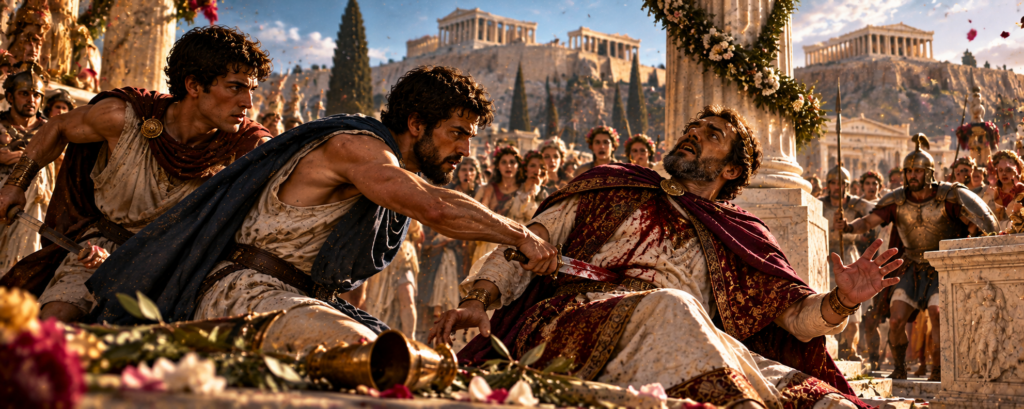
Hipparchus of Athens: Murder at the Panathenaia and the Birth of the Tyrannicides
Hipparchus of Athens (d. 514 BCE) | Assassinated during the Panathenaic Festival
Murder in the Middle of a Festival
Athens was dressed for celebration when the killers moved through the crowd. It was 514 BCE, during the Great Panathenaia, the magnificent festival held in honor of Athena, patron goddess of the city. Citizens gathered for sacrifices, athletic contests, ceremonies, music, and the great procession that wound through Athens toward the sacred heights of the Acropolis. Somewhere amid that spectacle, two men named Harmodius and Aristogeiton were carrying concealed weapons and waiting for an opportunity to strike at the family that ruled the city.
Their target was not originally supposed to be Hipparchus alone. According to the fullest surviving ancient account, the conspirators intended to attack both Hipparchus and his elder brother Hippias, the dominant figure within Athens’s ruling Peisistratid regime. The plan depended upon surprise, timing, and the confusion of a major public festival. If everything worked, the ruling family might be decapitated before its supporters could react. Instead, the conspiracy began unraveling before the first blow was struck.
Harmodius and Aristogeiton saw one of their fellow conspirators speaking familiarly with Hippias. They panicked, apparently fearing that their plan had been betrayed. Rather than wait to discover whether their suspicions were justified, they abandoned the larger assassination scheme and went searching for Hipparchus. They found him near the Leokoreion, a sanctuary or monument in the Agora associated with the daughters of Leos.
There, surrounded by a city celebrating its most important civic festival, they attacked him.
Hipparchus was stabbed to death. Harmodius was killed almost immediately by members of the tyrants’ guard, while Aristogeiton was captured and later executed after interrogation. Hippias survived, and the tyranny they had hoped to destroy remained standing. By almost every immediate measure, the conspiracy had failed.
Yet the story did not end beside Hipparchus’s bleeding body. Over the following generations, Athens transformed Harmodius and Aristogeiton into the Tyrannicides, heroic liberators whose daggers supposedly helped deliver the city from oppression. Statues of the two men stood prominently in the Agora, songs celebrated their names, and their descendants received public honors. Their assassination of Hipparchus became one of antiquity’s most famous political murders.
There was only one serious problem with the legend.
Hipparchus was not actually the principal tyrant of Athens when he was killed, his brother Hippias remained in power for several more years, and the murder itself appears to have originated not primarily in an abstract passion for democracy but in an intensely personal dispute involving desire, rejection, insult, and revenge. The celebrated liberation of Athens began as something much more human and much darker. Behind one of history’s classic stories of tyrannicide lies a tale of sexual rivalry, wounded pride, public humiliation, political violence, torture, propaganda, and a city that later rewrote the meaning of a murder to suit the story it wanted to tell about itself.
Athens Before Democracy
To understand why Hipparchus could be murdered as a tyrant before Athens had become the democracy later generations celebrated, it is necessary to enter a political world very different from the Athens of Pericles. Sixth-century BCE Athens was not yet the confident democratic power that would defeat Persian armies, build the Parthenon, produce the tragedies of Aeschylus and Sophocles, and dominate the Aegean through an empire. It was a society divided by aristocratic competition, economic tensions, regional rivalries, and recurring struggles over political authority. The institutions that would later define classical Athens were still developing.
Earlier in the century, the lawgiver Solon had attempted to address some of the city’s most serious social and political problems. His reforms included measures concerning debt, citizenship, political participation, and the legal system. They did not create democracy in the later classical sense, nor did they permanently resolve Athens’s factional struggles. Powerful aristocratic families continued competing for influence, while political factions developed around regional and social interests.
Into this unstable environment stepped Peisistratus, father of Hippias and Hipparchus. Peisistratus belonged to the Athenian elite and possessed both political ambition and remarkable persistence. Ancient accounts describe him as a charismatic figure capable of manipulating popular opinion and exploiting divisions among his rivals. He would seize power, lose it, return, be expelled again, and eventually establish himself securely as tyrant.
The Greek word tyrannos did not initially carry every implication contained in the modern English word “tyrant.” It referred fundamentally to a ruler who held power outside the conventional hereditary or constitutional framework, often through personal force, political maneuvering, or military support. Some Greek tyrants were remembered as brutal oppressors, while others sponsored public works, religion, trade, and culture. The institution could nevertheless become dangerous because power depended heavily upon the ruler and his network rather than stable constitutional restraints.
Peisistratus first seized control of Athens in the mid-sixth century BCE. Herodotus preserves colorful stories about his methods, including an extraordinary episode in which Peisistratus supposedly returned to Athens accompanied by a tall woman dressed as the goddess Athena, allowing heralds to proclaim that the goddess herself was restoring him. Whether every detail of this story should be accepted literally has long been debated. Its survival nevertheless reflects the reputation Peisistratus acquired for theatrical and ingenious political manipulation.
His final return to power, traditionally dated to around 546 BCE, proved more durable. Peisistratus defeated his opponents and established a regime that would remain in his family for decades. Yet he did not simply abolish every existing Athenian institution. Archons continued to serve, laws remained important, and aristocratic families retained social influence, although ultimate power rested with the tyrant and his supporters.
Later Athenian hostility toward tyranny sometimes obscured the achievements associated with Peisistratus’s government. Ancient tradition credited his era with religious, cultural, and economic developments, including increased importance for festivals and public building. Athens grew in wealth and prestige. The regime was authoritarian, but it was not remembered as an uninterrupted reign of terror.
This relative stability mattered enormously for the reputation of Peisistratus’s sons. When Peisistratus died around 528/527 BCE, his family inherited not merely personal wealth but an established political system. Hippias and Hipparchus stepped into a regime that had already survived aristocratic hostility and exile. They were heirs to a tyranny that had learned how to present itself as part of ordinary Athenian life.
The brothers would not inherit equal authority, however. That distinction later became essential because Athenian popular memory would blur it. Hipparchus became the famous victim of the Tyrannicides, but the man who actually stood at the head of the government was Hippias.
The Sons of Peisistratus
Ancient sources do not agree perfectly about every aspect of the Peisistratid family, but Hippias was clearly the elder and politically dominant son after Peisistratus’s death. Thucydides, writing in the fifth century BCE, explicitly challenged the popular belief that Hipparchus had been the ruling tyrant when he was assassinated. He insisted that Hippias held supreme power. This correction is particularly important because it demonstrates that the heroic version of the assassination had already become deeply embedded in Athenian memory.
Hipparchus nevertheless occupied an important position within the regime. He was not an irrelevant younger brother accidentally caught in a political dispute. As a member of the ruling family, he enjoyed status, influence, and access unavailable to ordinary citizens. Ancient tradition particularly associated him with cultural patronage and intellectual life.
Hipparchus reportedly invited poets and thinkers to Athens, including figures such as Anacreon of Teos and Simonides of Ceos. The Peisistratid court appears to have participated in the broader archaic Greek pattern in which powerful rulers enhanced their prestige through association with artists and intellectuals. Poetry was not merely entertainment in this world. It could shape reputation, celebrate elite patrons, preserve memory, and connect political authority with cultural sophistication.
A later dialogue attributed to Plato, the Hipparchus, presents an idealized portrait of Hipparchus as a lover of wisdom who encouraged moral instruction through inscriptions and brought poets to Athens. The historical reliability of every claim in that dialogue is uncertain, and it was written long after Hipparchus’s death. Nevertheless, it preserves a tradition in which the murdered Peisistratid was remembered as culturally ambitious rather than merely violent. That image sits uneasily beside his later role as the doomed tyrant in Athens’s liberation mythology.
The regime itself appears to have remained relatively moderate during the years immediately following Peisistratus’s death. Aristotle’s Athenian Constitution later claimed that the Peisistratids initially governed in a manner that was mild and generally respectful of existing laws. The family collected revenues and controlled the political system, but the darkest phase of the tyranny was associated particularly with the period after Hipparchus’s assassination. This chronology would become one of the murder’s most bitter ironies.
Hippias and Hipparchus therefore lived in a dangerous but sophisticated political environment. They belonged to a family that had seized control of Athens by force and maneuvering, yet their rule had become familiar enough that many citizens apparently continued ordinary life beneath it. Their government patronized religion and culture while remaining fundamentally dependent upon dynastic authority. Opposition existed, but Athens had not yet reached the point of permanent rebellion.
The crisis that changed everything did not begin with a democratic manifesto.
It began with desire.
Harmodius and Aristogeiton
Harmodius and Aristogeiton belonged to a relationship that ancient Greek sources describe within the social conventions of elite male courtship. Harmodius was the younger man, while Aristogeiton was his older lover. Such relationships existed within particular cultural expectations in archaic and classical Greece and cannot simply be mapped onto modern categories without distortion. What matters for the assassination is that the bond between the two men was understood by ancient authors as emotionally and socially significant.
According to Thucydides, Hipparchus became attracted to Harmodius and attempted to pursue him. Harmodius rejected the advance and informed Aristogeiton. The older lover became frightened and jealous, fearing that a member of the ruling family possessed enough power to take Harmodius by force. The political inequality surrounding the romantic rivalry made the situation far more dangerous than an ordinary dispute over affection.
Thucydides portrays Hipparchus as initially avoiding outright violence after the rejection. Instead, he supposedly chose another method of retaliation. Harmodius had a sister, and Hipparchus arranged for her to be invited to participate as a basket-bearer in the Panathenaic procession, an honorable ceremonial role generally associated with respectable young women. She was then publicly dismissed on the claim that she was unworthy of the honor.
The precise details of this insult depend upon ancient accounts written generations after the event, and caution is necessary. Yet both Thucydides and Aristotle’s Athenian Constitution preserve versions of a personal conflict involving Hipparchus, Harmodius, and an insult connected to Harmodius’s family. The convergence makes the basic story difficult to dismiss as a completely later invention. What cannot be recovered with certainty are every private motive and conversation surrounding the feud.
In an honor-conscious society, insulting Harmodius’s sister was not a trivial act. It humiliated the family publicly and demonstrated the power imbalance between them and the Peisistratids. Harmodius and Aristogeiton could interpret the insult as evidence that Hipparchus was willing to use his political status to punish rejection. Personal anger and political resentment now became impossible to separate.
This distinction is crucial to understanding the assassination. Harmodius and Aristogeiton were later celebrated as men who deliberately sacrificed themselves to free Athens from tyranny. The ancient evidence instead suggests that their immediate motive arose from a private grievance that became political because their antagonist belonged to the ruling family. Their hatred of tyranny may have been real, but it was not necessarily what started the conspiracy.
That does not make their act politically meaningless. In a tyranny, personal abuse by members of the ruling family is inherently political because victims cannot easily seek redress against those who control the state. A romantic rivalry becomes a political crisis when one participant possesses coercive authority unavailable to the others. Hipparchus’s status transformed an insult into something potentially more threatening.
The murder plot grew from this volatile mixture. Love, jealousy, humiliation, fear, resentment, and opposition to dynastic rule converged. By the time the Great Panathenaia approached in 514 BCE, Harmodius and Aristogeiton were no longer simply offended citizens. They were conspirators preparing to kill members of Athens’s ruling family.
A Plot Hidden Beneath the Panathenaia
The Great Panathenaia provided both opportunity and danger. The festival brought large numbers of Athenians together for one of the city’s most important religious celebrations. Processions, sacrifices, competitions, and public ceremonies created crowds in which conspirators could move without immediately attracting attention. The gathering also placed members of the ruling family in predictable public settings.
Ancient accounts suggest that Harmodius and Aristogeiton recruited additional conspirators. Their plan was therefore more ambitious than a spontaneous revenge attack upon Hipparchus. They apparently hoped to strike at the ruling regime during the festival, when circumstances might allow them to approach Hippias and his associates. The assassination of both brothers could potentially create enough confusion for broader resistance to emerge.
Weapons presented a problem. Thucydides explains that the conspirators expected citizens participating in the procession to carry arms, allowing them to conceal their intentions among others similarly equipped. Scholars have debated aspects of the festival’s procedures and the precise details of the conspiracy. The important point is that the assassins intended to use the ceremonial environment to disguise their preparations.
The plot depended upon secrecy. A tyranny might appear stable while remaining deeply suspicious of conspiracy, and betrayal could mean torture and death. Harmodius and Aristogeiton therefore needed confidence that their associates would not reveal the plan. The more conspirators they recruited, the greater the possibility that someone might lose nerve or inform the government.
On the day of the festival, they approached the area where Hippias was organizing the procession. Then they saw something that terrified them. One of the men involved in the conspiracy appeared to be speaking familiarly with Hippias. Because Hippias was reportedly approachable and conversed with many citizens, the exchange may have been entirely innocent.
Harmodius and Aristogeiton did not know that.
They concluded that their plan had probably been exposed. If Hippias knew of the conspiracy, arrest could come at any moment. The carefully prepared assassination plot suddenly seemed doomed. The conspirators faced the possibility of capture before they had struck a single blow.
Fear transformed the plan. Instead of attempting the original attack against Hippias, Harmodius and Aristogeiton decided to act against the man whose conduct had personally enraged them. They went looking for Hipparchus. The political conspiracy collapsed back into the private grievance from which it had grown.
This moment is one of the most revealing in the entire story. If their overriding objective had been a disciplined revolutionary strategy to liberate Athens, they might have prioritized Hippias, the actual ruler. Instead, believing the larger conspiracy compromised, they sought Hipparchus. Their decision does not prove that political motives were absent, but it strongly suggests that personal vengeance remained central.
Somewhere in the festival crowd, Hipparchus remained unaware that the failed seduction and humiliation of Harmodius’s family had finally returned to him in the form of armed men.
Blood at the Leokoreion
Hipparchus was reportedly near the Leokoreion when Harmodius and Aristogeiton found him. The exact appearance of the area in 514 BCE cannot be reconstructed in every detail, but it lay within the civic heart of Athens. The killers approached in the middle of a public religious festival rather than in a secluded alley or private residence. Their attack would therefore unfold before a city already gathered in extraordinary numbers.
They struck Hipparchus and killed him.
Ancient sources do not provide a reliable blow-by-blow description, and embellishing the scene with invented cries or final words would turn history into fiction. What survives is enough. Hipparchus, son of Peisistratus and brother of Athens’s ruler, was stabbed to death by Harmodius and Aristogeiton during the Panathenaic festivities.
The response was immediate. Harmodius was killed at the scene or very shortly afterward by members of the tyrants’ guard. He did not survive to see what political consequences his attack produced. Aristogeiton initially escaped the immediate slaughter but was soon captured.
The original conspiracy had therefore ended catastrophically. Hippias remained alive and in command. Hipparchus was dead, but the man who actually controlled the government had survived. One assassin was dead and the other a prisoner.
The festival that celebrated civic unity had become the setting for political murder. Religious ceremony and bloodshed collided in a way that would have been especially shocking in an ancient Greek context, where festivals carried profound communal and sacred significance. The assassination also revealed the vulnerability of the ruling family. If Hipparchus could be stabbed in public during one of Athens’s greatest celebrations, Hippias had reason to wonder who else might be waiting.
That fear mattered more than the immediate political success of the killers. Harmodius and Aristogeiton failed to overthrow the tyranny, but they changed the ruler who survived them. Hippias would never again govern with the same confidence. The murder of his brother transformed the political atmosphere of Athens.
The irony is severe. Later generations remembered the assassination as the beginning of liberation. In the short term, it produced the opposite result. The surviving tyrant became more suspicious, more defensive, and according to ancient tradition, significantly harsher.
Hipparchus’s death therefore did not free Athens.
It frightened its ruler.
Aristogeiton Under Interrogation
The fate of Aristogeiton after his capture became another part of the assassination’s legend. Ancient sources agree that he was interrogated and ultimately killed, but later traditions embellished the circumstances with dramatic stories of courage, deception, and defiance. Separating plausible historical fact from heroic legend is particularly difficult because Athenians had powerful reasons to glorify the Tyrannicides. Stories emphasizing Aristogeiton’s resistance could transform a failed conspirator into a martyr.
Thucydides provides a relatively restrained account of the aftermath. Hippias, now terrified by the possibility of a wider conspiracy, sought to identify others involved. Aristogeiton was subjected to interrogation, and the authorities attempted to discover the names of additional conspirators. The precise methods used are not described in enough detail to reconstruct the process confidently, although later tradition associates his treatment with torture.
Aristotle’s Athenian Constitution preserves a more elaborate story. According to this tradition, Aristogeiton deliberately named friends of Hippias as conspirators, manipulating the tyrant into executing loyal supporters and thereby weakening his own regime. Once Aristogeiton believed he had caused enough damage, he supposedly mocked Hippias for killing innocent friends. It is a compelling tale of a condemned man turning interrogation into psychological revenge.
Other later stories became even more dramatic. Some traditions involved a woman named Leaina, supposedly connected with the conspirators, who endured torture without betraying them. A famous legend claimed that she bit off her own tongue rather than reveal information. The story became associated with a bronze lioness erected in her honor, since leaina means lioness in Greek.
These tales belong to the heroic mythology surrounding the assassination and should not be accepted uncritically. They emerged within a culture that celebrated Harmodius and Aristogeiton as founders of liberty. Martyrdom stories naturally accumulated around figures whose political significance expanded after death. The more Athens identified itself with opposition to tyranny, the more useful stories of fearless resistance became.
What is historically plausible is that Hippias reacted aggressively to the possibility of conspiracy. His brother had been murdered in public, and he had narrowly escaped being targeted himself. Interrogations, arrests, and executions would have seemed necessary to a ruler convinced that enemies were hidden around him. Fear became the logic of government.
Aristogeiton was eventually executed. Harmodius was already dead. The men later celebrated as liberators had therefore been eliminated without ending the tyranny.
Yet their deaths gave Athens something more powerful than living conspirators. They became martyrs whose motives could be simplified, purified, and transformed. Dead men cannot correct the stories later generations tell about them.
Hippias Becomes the Tyrant Athens Remembered
Before 514 BCE, the Peisistratid regime had apparently maintained a relatively moderate character. After Hipparchus’s murder, ancient sources describe Hippias as becoming increasingly harsh and suspicious. The assassination of his brother revealed how vulnerable the ruling family had become. The fear of another conspiracy now shaped his government.
Arrests and executions followed as Hippias attempted to identify opponents. Political enemies faced greater danger, and the atmosphere of the city darkened. The tyrant also strengthened his financial and diplomatic position, preparing for the possibility that he might eventually be forced from Athens. The regime that Harmodius and Aristogeiton had failed to destroy became more oppressive because of their attack.
This transformation helps explain why later Athenians could remember the assassination as a blow against tyranny even though it did not immediately overthrow Hippias. Hipparchus’s death became the dividing line between the relatively mild earlier phase of Peisistratid rule and the harsher final years. The murder exposed the regime’s insecurity and accelerated the spiral of repression that eventually weakened it. In that indirect sense, the Tyrannicides did contribute to the tyranny’s downfall.
They were not, however, the people who actually expelled Hippias.
That distinction became politically inconvenient for later Athenian memory. Democratic Athens preferred a story in which heroic citizens liberated themselves through courageous resistance. The reality involved aristocratic exiles, the powerful Alcmaeonid family, intervention by Sparta, religious influence from Delphi, and complicated elite politics. Liberation proved less romantically democratic than the statues of Harmodius and Aristogeiton suggested.
Hippias’s harsher government also encouraged enemies who had previously tolerated or accommodated Peisistratid rule. Tyranny depended upon networks of cooperation as much as fear. When rulers become suspicious enough to punish potential allies, those networks can collapse. The assassination therefore damaged Hippias psychologically and politically even though it failed strategically.
The surviving brother also faced a problem of succession and family security. Hipparchus had been an important member of the ruling dynasty, and his death reduced the family’s strength. Hippias could no longer assume that public ceremony protected him. Every gathering potentially concealed another assassin.
The political lesson was grim. Harmodius and Aristogeiton had hoped to destroy tyranny through murder. Instead, their violence produced a more frightened and repressive tyrant. Yet the resulting repression made the regime less stable and more hated.
Violence had failed in the immediate moment while helping create conditions for later political change. This ambiguity would disappear from the patriotic legend Athens eventually constructed. Heroic memory prefers clean victories to complicated chains of unintended consequences.
The Alcmaeonids and the Real Fall of the Peisistratids
Among the most important enemies of the Peisistratid regime were the Alcmaeonids, a powerful aristocratic family with a long and complicated role in Athenian politics. Members of the family had experienced exile and rivalry with the tyrants. They possessed wealth, prestige, and political ambition. Their contribution to the fall of Hippias was far more direct than the famous assassination itself.
The Alcmaeonids attempted to return to Athens and challenge the tyranny, but early efforts were unsuccessful. They eventually became associated with the rebuilding of the temple of Apollo at Delphi after an earlier structure had burned. Ancient tradition claimed that they constructed the temple magnificently, even exceeding contractual expectations by using Parian marble for parts of the façade. Their relationship with Delphi would become politically significant.
Herodotus tells a famous story in which the Alcmaeonids bribed the Pythian priestess at Delphi to tell Spartans consulting the oracle that they should liberate Athens from tyranny. Whether an actual bribe occurred has been debated since antiquity. The accusation may reflect hostile tradition against the Alcmaeonids, but Spartan intervention did eventually become decisive. What matters is that the overthrow of Hippias depended upon forces much larger than the assassination of Hipparchus.
Sparta first sent an expedition under Anchimolius, but the attempt failed. Hippias had assistance from Thessalian cavalry, and the Spartan force was defeated. The setback did not end Spartan involvement. King Cleomenes I subsequently led a stronger expedition against Athens.
The Spartans defeated the Thessalian cavalry and trapped the Peisistratid family on the Acropolis. The decisive moment reportedly came when Hippias’s children were captured while being secretly removed from the city. Their capture gave the Spartans and the exiled Athenians enormous leverage. Hippias agreed to leave Athens in exchange for the safety of his family.
In 510 BCE, four years after Hipparchus’s assassination, Hippias departed from Athens. The Peisistratid tyranny was finally over. Harmodius and Aristogeiton had been dead for years.
This chronology was emphasized by Thucydides because many Athenians of his own time apparently misunderstood or simplified the sequence. Hipparchus had been killed in 514 BCE, but Hippias continued ruling until 510 BCE. The regime fell because of a combination of internal opposition, aristocratic rivalry, and Spartan military intervention. The famous Tyrannicides were part of the story, not its victorious conclusion.
Yet political memory would elevate them above the Spartans and the Alcmaeonids. Athens eventually became a democracy that defined itself partly through hostility toward tyranny and suspicion of Spartan power. A liberation story centered upon two Athenian citizens was much more useful than one centered upon intervention by a foreign oligarchic state. History would be rearranged around civic identity.
From Tyranny to Democracy
The expulsion of Hippias did not instantly create the mature democracy of fifth-century Athens. Instead, it opened another struggle among aristocratic factions. Cleisthenes of the Alcmaeonid family competed with Isagoras for political dominance. Their rivalry eventually produced reforms that fundamentally reshaped Athenian political institutions.
Cleisthenes turned toward broader citizen support after struggling against his aristocratic rival. His reforms, traditionally dated to 508/507 BCE, reorganized citizens into new tribes and political units, weakened older regional power structures, and expanded participation in the governing system. The Council of Five Hundred became a central institution. These changes helped establish the foundations of what would become Athenian democracy.
Isagoras resisted and obtained support from the Spartan king Cleomenes. Spartan intervention again entered Athenian politics, but this time the result differed dramatically. Cleomenes attempted to expel Cleisthenes and hundreds of other families while restructuring the government around a narrower oligarchic group. Athenian resistance forced the Spartans and their allies to withdraw.
Cleisthenes returned, and the democratic reforms continued. Athens had moved from tyranny through foreign intervention and aristocratic struggle toward a new political system. The process was neither inevitable nor peaceful. Democracy emerged from conflict rather than from a single heroic assassination.
Yet Harmodius and Aristogeiton fit perfectly into the new political culture. They could be presented as ordinary citizens who had resisted tyrannical rulers before democracy itself existed. Their willingness to kill and die became evidence that Athenians possessed an instinctive love of freedom. The personal motives behind the assassination became increasingly inconvenient.
The democratic state therefore inherited a murder and transformed its meaning. Harmodius and Aristogeiton were no longer merely lovers avenging an insult. They became ancestors of political liberty. Their daggers acquired constitutional significance after the fact.
Hipparchus underwent the opposite transformation. His cultural patronage mattered less than his membership in the ruling dynasty. His attempt to pursue Harmodius and the humiliation of Harmodius’s sister became evidence of the arrogance of tyrannical power. The murdered man became a symbol of the regime that survived him.
The story therefore became morally clearer as it became historically less precise. Democracy needed heroes and villains. Harmodius and Aristogeiton became the heroes, Hipparchus the fallen tyrant, and the complicated political reality receded behind them.
The First Statues of Political Assassins
Athens did something remarkable with the memory of Harmodius and Aristogeiton. The city erected public statues honoring them, reportedly created by the sculptor Antenor. These monuments stood in the Agora, the political and commercial heart of Athens. Their placement transformed the assassins from controversial conspirators into official civic heroes.
Public statues were not casual honors in archaic and early classical Greece. Monumental representation carried enormous prestige and political meaning. By placing the Tyrannicides in a prominent civic space, Athens announced that their violence against tyranny belonged within the city’s official memory. The assassins had become embodiments of freedom.
The original statues acquired another layer of significance during the Persian Wars. When the Persian king Xerxes captured Athens in 480 BCE, the sculptures were taken away as spoils. Their removal turned them into symbols not only of opposition to domestic tyranny but also of resistance to foreign domination. The absence of the statues became part of their legend.
A replacement group was commissioned from the sculptors Kritios and Nesiotes and erected around 477/476 BCE. Roman copies and other evidence preserve the famous composition, showing Harmodius and Aristogeiton advancing together with weapons raised. Their bodies embody action, courage, and shared purpose. The complicated motives described by Thucydides disappear entirely within the visual language of heroic resistance.
Later traditions claimed that the original statues were eventually returned to Athens after Alexander the Great’s conquest of the Persian Empire, although ancient accounts differ regarding precisely who restored them. Whatever the details, the story itself demonstrates the extraordinary symbolic value attached to the monuments. The Tyrannicides had become part of the city’s political identity.
Their descendants reportedly received special privileges, including forms of public support and honor. Songs celebrated Harmodius and Aristogeiton at drinking parties. Their names entered the emotional vocabulary of Athenian freedom. Few political assassins in history have received such extensive official glorification.
The statues also reveal how societies teach history through images. An Athenian walking through the Agora did not encounter a monument explaining that Harmodius and Aristogeiton mistakenly believed their conspiracy had been betrayed and killed the wrong member of the ruling family. The sculpture communicated something simpler. Two heroic men had attacked tyranny.
That message became more powerful than chronology. Art transformed a failed assassination into a permanent victory. The Tyrannicides lost their lives in 514 BCE, but in bronze they would kill tyranny forever.
Drinking Songs and the Making of Heroes
The cult of the Tyrannicides extended beyond monuments into popular culture. Famous skolia, drinking songs performed at symposia, celebrated Harmodius and Aristogeiton as liberators of Athens. These songs associated them with freedom and imagined them enjoying heroic existence after death. Repetition turned political interpretation into communal memory.
One famous tradition imagined Harmodius dwelling among the blessed alongside heroes such as Achilles. Another celebrated the carrying of the sword concealed within myrtle branches. The imagery transformed assassination into an almost sacred act of liberation. Violence against the tyrant became beautiful, honorable, and worthy of song.
The songs mattered because memory is shaped not only by historians but by repetition at social gatherings. Generations of Athenians could hear the Tyrannicides praised long before reading any analytical account of the Peisistratid regime. Their heroism became part of cultural common sense. The murder was remembered emotionally before it was examined historically.
This helps explain Thucydides’s frustration with popular understanding. He was deeply interested in correcting errors produced by tradition, rumor, and careless assumptions. In his account of the Peisistratids, he emphasized that Hippias—not Hipparchus—was the ruling tyrant. The need to make this correction shows how successful the patriotic legend had become.
Thucydides also emphasized the personal origin of the conspiracy. His version does not deny that Harmodius and Aristogeiton hated tyranny, but it refuses to present them as purely ideological revolutionaries. Erotic rivalry, jealousy, fear, and family humiliation drove events toward violence. The historian was stripping civic mythology back toward human motives.
That did not necessarily make the Tyrannicides less courageous. They knowingly attacked members of a powerful ruling family and faced almost certain death if the conspiracy failed. Harmodius died in the attack, and Aristogeiton endured interrogation and execution. Whatever their motives, they took an extraordinary risk.
The problem lies in confusing courage with political effectiveness. Their attack did not immediately liberate Athens. Indeed, it contributed to a harsher phase of tyranny. The freedom celebrated in later drinking songs emerged only after four more years of repression and foreign military intervention.
The myth nevertheless survived because it answered a deeper civic need. Democratic Athens wanted to believe that freedom had been born from Athenian resistance rather than delivered by Spartan soldiers. Harmodius and Aristogeiton provided exactly that story. Their failure in life became success in memory.
Hipparchus: Tyrant, Patron, or Victim?
Hipparchus himself is difficult to recover from beneath the legend surrounding his death. Ancient sources portray him as a member of a ruling family with significant cultural interests. He patronized poets and appears to have participated actively in the intellectual life of Peisistratid Athens. At the same time, the story of Harmodius suggests that he could use his privileged position in ways that humiliated those who resisted him.
Calling Hipparchus simply a tyrant is therefore both understandable and potentially misleading. He belonged to the tyrannical regime and benefited from its power, but Hippias appears to have been the principal ruler. Hipparchus’s authority may have been substantial without making him the sovereign figure later popular memory imagined. Thucydides was explicit about this distinction.
The personal dispute also raises questions about abuse of power. If the story about Harmodius’s sister is substantially accurate, Hipparchus retaliated against rejection by publicly humiliating the young man’s family. Even without physical violence, the episode demonstrates how private desire could become coercive when backed by political privilege. Harmodius could not respond to Hipparchus as he might respond to an ordinary rival.
Yet assassination was not an inevitable or proportionate response to humiliation. Harmodius and Aristogeiton chose to transform a personal grievance into a lethal conspiracy against the ruling family. Their decision endangered not only themselves but their fellow conspirators and potentially the wider city. Political murder always creates consequences beyond the intended victim.
Hipparchus’s cultural patronage does not excuse abuse, just as his abuse does not erase his cultural role. Historical figures frequently resist the clean categories later societies assign them. He could support poetry and intellectual life while participating in an authoritarian dynasty. He could be both politically privileged and personally vulnerable enough to die suddenly in a public square.
His murder also demonstrates the danger inherent in dynastic government. When political authority rests upon a family, private conflicts involving family members become affairs of state. A rejected advance can become a conspiracy. A family insult can become an assassination.
The Peisistratid regime had blurred the boundary between household and government. Harmodius and Aristogeiton responded by attacking the household in order to attack the government. Hipparchus died because he occupied both worlds simultaneously.
The man disappeared behind the symbol almost immediately. Democratic memory needed a tyrant for the Tyrannicides to kill. Hipparchus became that tyrant, even though the actual ruler survived.
The Question of Sexuality and Ancient Evidence
Modern retellings sometimes become uncomfortable with the relationship between Harmodius and Aristogeiton or attempt to simplify it according to contemporary categories. Ancient sources, however, clearly treat their relationship as central to the story. Ignoring that element would remove the emotional engine of the conspiracy. Understanding it requires historical context rather than embarrassment or sensationalism.
Elite Greek male relationships could involve an older erastes and a younger eromenos, structured through conventions of courtship, mentorship, status, and desire. These practices varied across Greek communities and periods, and ancient attitudes were not identical to modern ideas about sexual orientation or romantic partnership. Harmodius and Aristogeiton must therefore be understood within their own cultural environment. Applying modern labels too rigidly risks replacing one simplification with another.
The rivalry with Hipparchus becomes especially significant within this context. Aristogeiton’s fear was not merely jealousy in an abstract romantic triangle. Hipparchus belonged to the ruling dynasty and possessed political power that could potentially overwhelm ordinary social boundaries. The possibility of coercion therefore hovered behind the conflict even if Thucydides does not describe Hipparchus actually using force against Harmodius.
Harmodius’s rejection also mattered socially. By refusing a powerful Peisistratid, he asserted personal choice against someone accustomed to privilege. Hipparchus’s alleged retaliation against Harmodius’s sister then transformed private rejection into public humiliation. The sequence gave Aristogeiton reason to fear that the conflict would continue escalating.
Later democratic memory partially preserved the lovers’ relationship rather than erasing it. Their devotion to one another became part of their heroism. The willingness to face death together could be celebrated as evidence of loyalty and courage. Personal love and political liberty became intertwined within the legend.
This makes the story unusually rich. The assassination cannot be reduced either to a democratic revolution or to a lovers’ quarrel. The two dimensions interacted because tyranny made private relationships political. The power imbalance surrounding Hipparchus converted erotic rivalry into a confrontation with the ruling family.
Thucydides’s account is valuable precisely because he refused to choose the simpler interpretation. He emphasized personal motives while situating them within the tyranny. Harmodius and Aristogeiton acted from passion, fear, and resentment, but the political structure made those emotions dangerous. Their conspiracy was simultaneously private and public.
The resulting murder became one of the earliest famous examples of tyrannicide precisely because later generations stripped away much of that ambiguity. Athens transformed emotionally complicated assassins into constitutional symbols. Historical investigation restores the messiness that civic mythology removed.
Tyrannicide: When Does Murder Become Liberation?
The assassination of Hipparchus raises a question that political thinkers have debated for more than two thousand years. If a ruler governs without legitimate restraint, does killing that ruler become morally different from ordinary murder? Ancient Greeks wrestled with this problem long before later philosophers developed formal theories of resistance. The Tyrannicides became one of the earliest celebrated answers.
Athenians later treated Harmodius and Aristogeiton as heroes because their victim belonged to a tyranny. The political identity of the target transformed the meaning of the act. Killing an ordinary citizen was homicide. Killing a tyrant could be interpreted as liberation.
Yet Hipparchus complicates this moral framework because he was not the principal ruler. If tyrannicide is justified as a means of ending tyranny, killing a secondary member of the ruling family while leaving the actual tyrant alive presents an obvious problem. The assassination did not achieve its supposed political purpose. It instead triggered harsher repression.
Motives complicate the story further. Harmodius and Aristogeiton were not detached philosophers deciding that constitutional liberty required the removal of an unlawful ruler. They were men caught in a personal feud involving sexual rivalry and humiliation. Their political opposition emerged through that conflict.
Does that make their act less political? Not necessarily. People rarely enter political violence with perfectly pure motives. Revolutionaries can simultaneously seek freedom, revenge, status, security, and personal satisfaction. The desire for justice often mixes with anger.
The Athenians solved the problem by simplifying the story. They treated the assassins’ willingness to strike at the Peisistratids as proof of their commitment to liberty. Later political consequences mattered more than the psychological complexity of the original event. Memory judged them by what Athens became rather than solely by why they acted.
This pattern would repeat throughout history. Assassins who fail can later become national heroes if the regimes they attacked eventually collapse. Personal motives can disappear beneath patriotic narratives. Murder becomes tyrannicide when later generations decide the victim represented illegitimate power.
Hipparchus therefore belongs naturally within the history of assassinated rulers even though his precise political status requires qualification. His death became more important than his office. The murder provided later Athens with a foundational story about resistance to tyranny.
Whether that story was true in the form Athenians told it is another matter entirely.
Hippias, Persia, and the Shadow of Marathon
The story of the Peisistratids did not end when Hippias left Athens in 510 BCE. Exile did not extinguish his desire to recover power. He eventually turned toward the Persian Empire, the great eastern power increasingly involved in Greek affairs. This decision would connect the fall of the Athenian tyranny with one of the most famous battles in ancient history.
Hippias sought Persian support for his restoration. From his perspective, this was politically understandable. He had lost his city through Spartan intervention and aristocratic opposition, and Persia possessed the military strength to reverse that defeat. From the perspective of democratic Athens, however, his alliance with Persia confirmed the danger associated with the former tyrant.
When the Persian expedition under Datis and Artaphernes arrived in Attica in 490 BCE, Hippias accompanied it. Herodotus describes the elderly exile guiding the Persian forces to Marathon. The former tyrant had returned to Athenian soil, not as ruler but alongside an invading army. His presence gave the conflict an additional political dimension.
The Athenians defeated the Persians at Marathon. The victory became one of the defining events of Athenian civic memory. Democracy had survived both internal tyranny and an external empire. Hippias, once ruler of Athens, disappeared from history soon afterward.
This later association with Persia further darkened the reputation of the Peisistratid regime. Harmodius and Aristogeiton could now be remembered not merely as enemies of tyrants but as opponents of a dynasty whose surviving ruler had collaborated with Persia. The political meaning of their assassination continued changing long after their deaths. Each new crisis reshaped the past.
The Persian Wars also strengthened Athens’s confidence in its democratic institutions. Citizens who had expelled tyranny and defeated Persia could imagine themselves as uniquely devoted to freedom. Public memory connected these achievements into a coherent civic narrative. The Tyrannicides became early chapters in a story culminating at Marathon and later Salamis.
Historical reality was more complicated. Sparta had helped expel Hippias, and aristocratic families had played decisive roles in the transition. The democracy itself had emerged only after further factional conflict. Yet collective memory rarely preserves every complication equally.
Hippias’s appearance with the Persians made the heroic interpretation of Hipparchus’s killers even more attractive. The Peisistratids could now be associated with both domestic tyranny and foreign invasion. Harmodius and Aristogeiton became, retrospectively, defenders of an Athens that did not yet exist when they drew their weapons.
Thucydides Versus the Legend
More than a century after Hipparchus’s assassination, Thucydides decided that the popular version of the story required correction. His account appears within his history of the Peloponnesian War, where he discusses the mutilation of the Herms and the panic surrounding suspected conspiracies in 415 BCE. Athenians feared that the vandalism might signal an oligarchic or tyrannical plot. Memories of the Peisistratid tyranny shaped their reaction.
Thucydides used the opportunity to explain that Athenians did not understand their own history as accurately as they imagined. He emphasized that Hippias had been the eldest son of Peisistratus and the actual ruler. Hipparchus was killed because of the personal dispute involving Harmodius and Aristogeiton. The tyranny itself continued afterward.
This intervention is remarkable because Thucydides was writing for an Athenian audience familiar with statues, songs, ceremonies, and stories celebrating the Tyrannicides. He was challenging not an obscure error but a cherished civic memory. His correction demonstrates the historian’s determination to distinguish popular tradition from evidence. It also shows how quickly political mythology can overpower chronological fact.
Thucydides did not deny that Harmodius and Aristogeiton conspired against the tyranny. Instead, he complicated their motives and corrected the political consequences of their action. Their personal grievance triggered the plot, and their assassination of Hipparchus did not end Hippias’s rule. This version is less satisfying as patriotic legend but far more revealing as human history.
Aristotle’s Athenian Constitution, composed later in the fourth century BCE, provides additional information while preserving some different traditions. It similarly identifies Hippias as the principal ruler and describes the personal conflict leading to the assassination. Differences between the accounts remind us that the event was already centuries old by the time surviving narratives were written. Absolute certainty about every detail is impossible.
Herodotus, writing closer to the period but still decades afterward, focuses more heavily upon the later expulsion of the Peisistratids and the role of the Alcmaeonids and Spartans. Taken together, the sources allow a reasonably coherent reconstruction while leaving significant uncertainties. The broad chronology is much more secure than the intimate details of motive.
Modern historians therefore face the same challenge Thucydides confronted. The famous version is simple, memorable, and emotionally satisfying. The evidence is complicated, fragmented, and occasionally contradictory. Responsible history must resist the temptation to choose drama over uncertainty.
Fortunately, the real story is more dramatic than the myth. Two lovers planned an assassination after a humiliating personal feud, panicked when they thought they had been betrayed, killed the wrong member of the ruling family, died in the aftermath, accidentally provoked harsher tyranny, and were later transformed into the official liberators of a democracy that did not yet exist. No invented legend can improve upon that.
The Assassination That Failed and Still Changed History
Judged purely by its immediate objective, the assassination was a disaster. Hipparchus died, but Hippias survived. Harmodius was killed, Aristogeiton captured, and the wider conspiracy collapsed. The ruling family retained control.
Worse still, the murder appears to have intensified the repression it was later celebrated for opposing. Hippias became suspicious and harsh. Political opponents faced greater danger. Athens endured another four years of tyranny.
Yet political actions can matter even when they fail according to their original design. Hipparchus’s death destabilized the Peisistratid regime and changed Hippias’s behavior. Increased repression alienated people who might otherwise have tolerated the government. The assassination therefore contributed indirectly to the conditions that eventually made the tyranny more vulnerable.
Its greatest impact, however, came through memory. Harmodius and Aristogeiton became symbols that democratic Athens could use to define itself. Their story taught citizens that tyranny deserved resistance and that individuals willing to confront unlawful power merited extraordinary honor. The historical accuracy of that lesson mattered less than its civic usefulness.
The assassination also provided a template for later discussions of political violence. Tyrannicide could be imagined as morally heroic when directed against illegitimate authority. Similar arguments would appear in Greek philosophy, Roman political culture, medieval debates over kingship, Renaissance republican thought, and modern revolutionary ideology. The line between assassin and liberator would remain contested.
Hipparchus himself became almost secondary to the political meaning of his death. He is remembered today primarily because Harmodius and Aristogeiton killed him. His cultural patronage, family role, and individual personality survive only in fragments. The victim disappeared behind the legend of his killers.
That is one of the strange consequences of assassination. The killer can become more famous than the person killed, particularly when later generations attach ideological meaning to the act. Hipparchus died in 514 BCE. The Tyrannicides were born afterward.
Their immortality depended upon Athens deciding what the murder meant.
Assassinated Ruler or Misidentified Tyrant?
Hipparchus occupies an unusual position within a category devoted to assassinated rulers and regicides. Ancient Athenians often remembered him as though he were the tyrant whose death liberated the city. Thucydides explicitly tells us that this was wrong. Hippias was the ruler.
Yet excluding Hipparchus from the history of assassinated political rulers would also miss the importance of his position. He belonged to the ruling Peisistratid family and exercised substantial influence within the regime. His assassination was intended as part of a wider attack upon that regime. The murder was unquestionably political even if the victim was not Athens’s supreme ruler.
The distinction actually makes the case more interesting. Many famous political assassinations involve mistaken assumptions about how power works. Killing one individual rarely destroys an entire political system. Institutions, families, armies, bureaucracies, and networks of loyalty can survive the death of a prominent figure.
Harmodius and Aristogeiton discovered this immediately. They killed Hipparchus and found that the tyranny remained. The surviving ruler responded with repression rather than surrender. Their daggers removed a man but not the system that empowered him.
Later Athenians effectively corrected this disappointing outcome through mythology. In public memory, killing Hipparchus became equivalent to killing tyranny itself. The four years separating his death from Hippias’s expulsion faded into the background. Symbolic truth replaced political chronology.
That transformation reveals how societies construct foundational stories. Events are selected, simplified, and rearranged until they express values the community wants to celebrate. Harmodius and Aristogeiton became democratic heroes because democracy needed ancestors. Hipparchus became the tyrant because heroes of tyrannicide require a tyrant to kill.
The historical Hipparchus remains harder to categorize. He was powerful but not supreme, privileged but vulnerable, cultured but capable of vindictiveness, a member of an authoritarian dynasty who became the victim of political murder. His death neither liberated Athens nor left it unchanged.
For Assassinated Rulers & Regicides, that ambiguity is precisely what makes him valuable. His story shows that political assassination is rarely as simple as the legends created afterward. Sometimes the wrong man dies, the regime survives, and history still decides to call the killers heroes.
The Tyrannicides After Twenty-Five Centuries
Harmodius and Aristogeiton continue to fascinate because they stand near the beginning of a political idea that never disappeared. The tyrannicide occupies an unstable moral position between murderer and liberator. Whether the act is condemned or celebrated often depends upon how later generations judge the regime being attacked. Political success can rewrite moral vocabulary.
Had Hippias remained securely in power and passed the tyranny peacefully to another generation, Harmodius and Aristogeiton might have been remembered simply as failed assassins driven by a personal feud. Because the Peisistratid regime collapsed four years later and Athens developed democracy, their attack could be incorporated into a triumphant narrative. Later events changed the meaning of earlier violence.
Their relationship also gave the story emotional power. They were not anonymous conspirators assembled by a political faction. They were two men bound by affection whose conflict with Hipparchus began through desire and humiliation. The personal stakes made their decision understandable in ways an abstract constitutional dispute might not have been.
At the same time, the later democratic interpretation should not be dismissed entirely as propaganda. Their willingness to attack members of the ruling family did challenge a regime that concentrated power outside the emerging constitutional order. Personal motives and political consequences can coexist. A man seeking revenge can also strike against tyranny.
What must be rejected is the neat version in which Harmodius and Aristogeiton deliberately killed the tyrant and instantly liberated Athens. That did not happen. They killed Hipparchus, while Hippias survived and continued ruling. Spartan military intervention ultimately forced him out.
The real history therefore carries a warning about heroic political memory. Communities often prefer stories in which freedom is won through courageous action by their own people. Dependence upon foreign intervention, aristocratic maneuvering, accidental consequences, and private jealousy make poor patriotic monuments. Bronze prefers certainty.
Thucydides understood this more than two thousand years ago. His correction of the Tyrannicide story remains one of antiquity’s clearest demonstrations that widely believed history can still be wrong. Citizens who prided themselves upon political sophistication had turned a complicated assassination into a civic fairy tale.
The irony is that exposing the fairy tale does not diminish the story. It makes it more recognizably human. Freedom, vengeance, love, fear, humiliation, courage, and political ambition all occupied the same bloody afternoon.
The Murder Athens Needed to Remember Differently
Hipparchus of Athens died because politics had become personal and personal resentment had become political. A member of the ruling Peisistratid family pursued Harmodius, was rejected, and according to the strongest surviving ancient tradition, retaliated by humiliating the young man’s family. Harmodius and Aristogeiton responded by entering a conspiracy against the ruling dynasty. What began with desire and insult grew into a plan for political murder.
The plan failed almost immediately. Believing themselves betrayed, the conspirators abandoned their intended attack upon Hippias and sought out Hipparchus instead. They killed him during Athens’s greatest civic festival, but they did not kill the tyranny. Harmodius died at the scene, Aristogeiton was captured and executed, and Hippias remained ruler.
The consequences were darker than the assassins could have intended. Hippias became more suspicious and repressive after his brother’s murder. Arrests, executions, and political fear marked the final years of Peisistratid rule. The supposed first blow for freedom initially made Athens less free.
Four years later, the tyranny finally collapsed, but not because the Tyrannicides rose from the dead to finish their work. Aristocratic exiles, Alcmaeonid political maneuvering, Spartan military intervention, and Hippias’s own growing vulnerability combined to force him from Athens. Democracy then emerged through another round of political struggle associated especially with Cleisthenes. The road from Hipparchus’s murder to democratic Athens was crooked, violent, and filled with actors later memory preferred to forget.
Athens nevertheless chose Harmodius and Aristogeiton as its heroes. Statues placed them in the Agora. Drinking songs praised their courage. Their descendants received honors, and their names became synonymous with resistance to tyranny.
The city had good reasons for preferring that story. A democracy wants to imagine that its freedom was won by citizens who refused to kneel before oppressive rulers. It is less satisfying to admit that the tyrant was expelled by Spartan soldiers after the supposed liberators had been dead for four years. National memory rarely rewards inconvenient chronology.
Hipparchus suffered the opposite transformation. The culturally ambitious Peisistratid who patronized poets became simply “the tyrant” murdered by freedom fighters. His brother’s superior political authority faded from popular memory. The private dispute surrounding his death became subordinate to the public meaning Athens eventually assigned it.
Thucydides tried to restore the complication. He reminded his readers that Hippias had been the ruler, that Hipparchus’s murder arose from a personal dispute, and that the tyranny continued afterward. More than two thousand years later, his warning remains relevant. History is not always what societies commemorate in statues.
The Tyrannicides deserve neither effortless glorification nor effortless dismissal. They acted courageously in the sense that they knowingly risked their lives against a powerful ruling family. They also acted from motives entangled with jealousy, humiliation, revenge, and fear. Their assassination failed strategically and produced terrible immediate consequences.
Yet failure did not make the event meaningless. Hipparchus’s murder shattered the sense of security surrounding the Peisistratid dynasty. Hippias’s reaction deepened hostility toward his government. The memory of the assassins later helped democratic Athens articulate an uncompromising hatred of tyranny.
That memory became larger than the men themselves. Harmodius and Aristogeiton entered bronze, poetry, political rhetoric, and civic identity. Hipparchus became the corpse beneath their legend.
There is something deeply revealing in the way Athens remembered that afternoon. The city did not celebrate the assassination because the historical facts neatly demonstrated that two patriots had overthrown a dictator. It celebrated the assassination because later Athenians needed the event to mean that citizens could strike back against unlawful power. The meaning was constructed after the blood had dried.
Hipparchus therefore belongs among history’s most important assassinated political figures not because his death changed Athens instantly, but because of what people later made of it. His killers failed to overthrow the government, failed to kill its actual ruler, and failed to survive their own conspiracy. They nevertheless became immortal as the men who killed tyranny.
That contradiction is the reason the story has endured for more than twenty-five centuries. On the day Hipparchus died, Athens witnessed a botched assassination born from a dangerous mixture of political resentment and personal revenge. In the generations that followed, democracy looked back at the bloodshed and saw something nobler reflected there.
The tyrant had not actually fallen when Hipparchus fell. Democracy had not suddenly been born beside his body, and Athens had not liberated itself with two daggers during the Panathenaia. Those were meanings created afterward, when memory began polishing the murder into myth. What happened in 514 BCE was messier, darker, and far more human: two men killed a powerful member of a ruling family, failed to end the tyranny, and became heroes because history eventually gave their failure a victory it never possessed on the day they struck.