
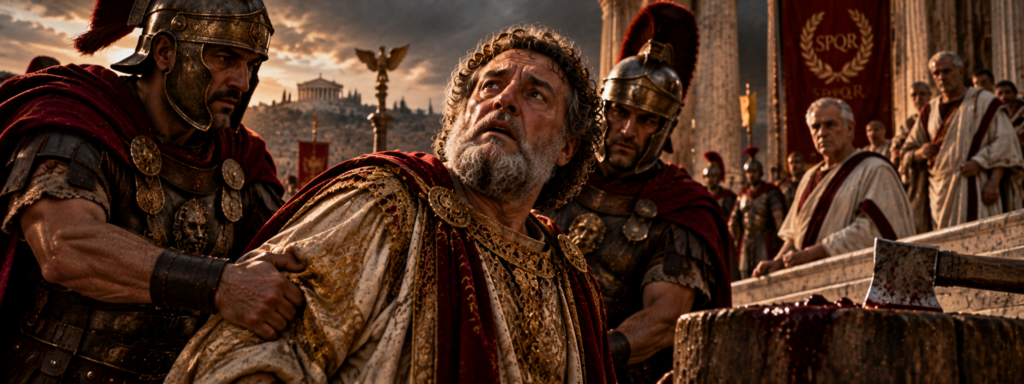
Didius Julianus: The Emperor Who Bought Rome and Paid for It With His Head
The Auction of the Roman Empire, the Betrayal of the Praetorian Guard, and the Bloody End of a Sixty-Six-Day Reign
Marcus Didius Severus Julianus (133 or 137–1 June 193 CE) was a Roman senator, former consul, provincial governor, and emperor whose brief reign became one of the most notorious episodes in imperial history. After the Praetorian Guard murdered Emperor Pertinax in March 193, Julianus secured the throne by promising the soldiers an enormous payment, an event remembered as the auction of the Roman Empire. His accession provoked widespread outrage, and three powerful provincial commanders challenged his authority. As Septimius Severus advanced toward Rome, the Senate abandoned Julianus, declared him an enemy, and ordered his execution. After ruling for just sixty-six days, the emperor was killed inside the imperial palace, becoming a symbol of the dangers of military corruption and the terrifying uncertainty of Roman imperial power.
The Emperor Who Discovered That Rome Was Not His to Keep
On the night of 1 June 193 CE, the imperial palace in Rome had become a place of abandonment. The servants who had once hurried to obey the emperor were disappearing, the soldiers who had promised to defend him were no longer reliable, and the senators who had reluctantly recognized his authority were preparing to destroy it. Somewhere beyond the city, an army commanded by Septimius Severus was advancing toward the capital, bringing with it the promise of a new emperor and the threat of violent punishment for anyone who resisted. Didius Julianus, who had purchased the throne only weeks earlier, was about to discover that the men who had sold him the empire had never possessed the loyalty necessary to guarantee his survival.
The circumstances were almost impossibly humiliating. Julianus had entered the imperial contest as a wealthy and distinguished senator, confident that his fortune and political connections could secure the greatest office in the Roman world. He had offered the Praetorian Guard more money than his rival, accepted their proclamation, and moved into the palace of the Caesars. For a brief moment, he possessed the titles, ceremonies, and outward authority of a Roman emperor, but the transaction that elevated him also poisoned his legitimacy. The population despised the spectacle, the Senate submitted under pressure, and the provincial armies refused to accept that Rome’s throne could be awarded to the highest bidder.
By the beginning of June, his position had become hopeless. The Praetorian Guard had proved unwilling to confront the advancing forces of Severus, and the Senate understood that continuing to support Julianus could invite disaster upon the capital. The emperor reportedly attempted negotiations, political compromises, and desperate appeals to the institutions that had recognized him. None of them could reverse the military reality that was approaching Rome.
Ancient historians preserve a final scene of extraordinary bitterness. As executioners entered the palace, Julianus was said to have protested that he had committed no crime deserving death and had killed no one. The precise wording of his final protest cannot be independently verified, but the tradition captures the bewilderment of a man who believed that purchasing imperial authority had made him its legitimate owner. His head was severed from his body, and the throne he had bought at such enormous cost passed to a commander who had secured it through military force.
The death of Didius Julianus was more than the punishment of an ambitious politician. It exposed a Roman political system in which emperors could be created by soldiers, condemned by senators, and murdered when their usefulness disappeared. His brief reign became one of the defining scandals of the Year of the Five Emperors, a period when the Roman Empire’s succession crisis erupted into open competition among military commanders. Yet behind the notorious auction was a more complicated story involving a successful aristocrat, a murdered reformer, an increasingly dangerous imperial guard, and a state whose institutions could no longer guarantee the survival of the ruler they recognized.
A Distinguished Roman With an Extraordinary Future
Long before his name became synonymous with the purchase of imperial power, Didius Julianus belonged to the established governing class of the Roman Empire. He was born in Mediolanum, the prosperous northern Italian city now known as Milan, into a family with substantial social standing. Ancient sources differ over the year of his birth, with 133 and 137 CE both appearing in modern reconstructions. The uncertainty is not unusual for figures whose early lives were recorded primarily because of their later political importance.
His family background provided connections that helped him enter the senatorial aristocracy. The Historia Augusta, a late and frequently unreliable collection of imperial biographies, preserves details about his ancestry and upbringing, including a reported connection with the household of Domitia Lucilla, the mother of Marcus Aurelius. Some of these claims may reflect genuine family traditions, but the source’s reputation requires caution. What can be established more securely is that Julianus entered public life with the advantages of wealth, education, and influential associations.
The Roman senatorial career was demanding, expensive, and highly competitive. Men who aspired to high office were expected to possess legal knowledge, administrative ability, social connections, and sufficient resources to sustain the costs of public life. Advancement could involve military service, provincial administration, and appointments requiring direct imperial confidence. Julianus successfully navigated this environment for decades.
His career included service in provincial and military posts, followed by advancement through the senior magistracies of the empire. He became consul in 175 CE, during the reign of Marcus Aurelius, a distinction that placed him among Rome’s most prominent aristocrats. The consulship no longer carried the independent power it had possessed during the Republic, but it remained a prestigious marker of senatorial achievement. A former consul could expect consideration for important provincial governorships and other senior responsibilities.
Julianus subsequently held governorships in several provinces, including Dalmatia and Germania Inferior. His career also brought him into contact with regions where Roman authority depended upon military organization and effective administration. These appointments indicate that he was regarded as sufficiently capable and trustworthy to manage important imperial responsibilities. Whatever later writers thought of his conduct in 193, he was not an obscure adventurer who appeared suddenly in Rome with a fortune and a reckless ambition.
His record also complicates the popular image of Julianus as nothing more than a corrupt purchaser of power. For much of his life, he had been a conventional and successful member of the imperial establishment. He understood the rituals of senatorial government, the expectations of provincial administration, and the importance of imperial favor. His eventual decision to seek the throne was disastrous, but it emerged from a career that had previously rewarded ambition and political calculation.
The empire in which Julianus rose was governed by rulers whose authority rested upon a combination of dynastic legitimacy, military support, and senatorial recognition. Under the Antonine emperors, these elements had generally remained sufficiently aligned to preserve political stability. Julianus belonged to the class that benefited from that arrangement. By the time he approached the throne, however, the relationships sustaining imperial authority had begun to fracture.
The World Marcus Aurelius Left Behind
Julianus’s political career developed during the reign of Marcus Aurelius, an emperor later celebrated for his philosophical writings and sense of public duty. Yet the period was far from peaceful. The Roman Empire confronted epidemics, frontier wars, economic pressures, and the enormous administrative burdens of governing territories stretching from Britain to the Middle East. Military loyalty remained essential, even under rulers remembered for restraint and moderation.
Marcus Aurelius died in 180 CE, leaving the throne to his son Commodus. The succession was legally secure because Commodus had already been elevated to the position of co-emperor. Nevertheless, the new ruler gradually developed a style of government that offended much of the senatorial elite. His enthusiasm for gladiatorial spectacle, extraordinary personal honors, and increasingly violent political purges became central features of his historical reputation.
Commodus’s relationship with the aristocracy deteriorated over the course of his reign. Prominent officials were executed, powerful favorites rose and fell, and senators faced an atmosphere of suspicion. The surviving accounts are strongly hostile to Commodus, and their sensational details require careful evaluation. Even allowing for exaggeration, his reign clearly produced serious conflict within the imperial government.
Julianus continued his public career during this increasingly unstable period. He was appointed to important positions and remained part of the senatorial establishment, although the surviving evidence does not permit a complete reconstruction of his political relationships. He eventually governed Africa, one of the empire’s most important provinces because of its agricultural production and wealth. The appointment reflected his seniority and standing.
Africa was not merely a prestigious assignment. Its cities, estates, and commercial networks contributed substantially to Rome’s economy, while grain supplies from North Africa helped sustain the imperial capital. A governor responsible for such a province operated within a system of considerable financial and political importance. Julianus therefore possessed experience that could plausibly support a claim to high office.
His governorship also brought him into the same administrative world as Pertinax, the man whose murder would create Julianus’s opportunity. Both men were experienced senators who had served the empire under earlier emperors. Their careers demonstrated that senior officials could accumulate substantial prestige without belonging to the ruling dynasty. In a succession crisis, such men could appear credible candidates for the throne.
The political situation changed dramatically on 31 December 192 CE. Commodus was assassinated in a palace conspiracy involving individuals close to his household, and the conspirators arranged for Pertinax to succeed him. The new emperor promised a return to discipline and more responsible administration. Yet the forces that had made Commodus’s murder possible remained deeply embedded within Roman politics.
For Julianus, the death of Commodus opened a world of dangerous possibilities. The emperor’s assassination had demonstrated that the throne could change hands through conspiracy rather than orderly succession. Pertinax possessed senatorial prestige, but his authority depended upon the cooperation of the Praetorian Guard. When that relationship collapsed, the empire would enter a crisis unlike anything Julianus had previously experienced.
Pertinax: The Emperor Who Tried to Restore Order
Publius Helvius Pertinax became emperor on 1 January 193 CE, immediately after the murder of Commodus. He was an experienced military commander and administrator whose career had carried him from comparatively modest origins to the highest levels of Roman government. His reputation for discipline made him attractive to senators who wanted to reverse the extravagance associated with Commodus. Yet the qualities that recommended him to the aristocracy also threatened those who had benefited from the previous regime.
Pertinax inherited serious financial difficulties. Commodus’s lavish expenditures and the demands of imperial government had placed pressure upon available resources. The new emperor attempted to restore fiscal discipline, reduce unnecessary spending, and impose greater order upon the administration. Such policies may have been necessary, but they immediately created enemies.
The Praetorian Guard was particularly sensitive to changes in imperial policy. Its soldiers expected financial rewards upon the accession of a new emperor, a practice that had become an important feature of Roman military politics. Pertinax had promised a donative, but the arrangements surrounding payment created dissatisfaction. His attempts to enforce discipline further aggravated relations with men accustomed to the privileges of service near the emperor.
The Guard’s position was uniquely dangerous because it combined military force with proximity to the imperial palace. Unlike frontier armies, Praetorian soldiers operated in and around Rome, where they could directly influence political events. Their commanders had participated in the conspiracy against Commodus, demonstrating the force’s importance in succession. The soldiers themselves understood that emperors depended upon their cooperation.
Pertinax’s reforms therefore encountered resistance from an institution capable of destroying him. Ancient sources describe growing dissatisfaction, conspiratorial activity, and disputes over military discipline. The exact sequence of events is not always clear, but the conflict between the emperor and the Guard intensified rapidly. Pertinax had inherited the throne without a civil war, yet he had not secured the unconditional loyalty of the men protecting it.
On 28 March 193 CE, a group of Praetorian soldiers entered the imperial palace. Pertinax reportedly attempted to confront them and restore order through personal authority. His intervention failed, and the soldiers killed him. The emperor had ruled for less than three months.
His murder shocked the Roman political establishment, but it also created an immediate question. The empire needed a new ruler, and the Praetorian Guard had demonstrated that it could eliminate an emperor who displeased it. Rather than allowing a conventional succession process to unfold, the soldiers effectively claimed the right to determine who would occupy the throne. The resulting spectacle would become one of the most infamous episodes in Roman history.
The Day the Roman Empire Went Up for Sale
The murder of Pertinax left Rome without a recognized emperor and placed the Praetorian Guard in a position of extraordinary influence. The soldiers controlled access to their fortified camp and possessed sufficient force to intimidate the political authorities in the capital. They also expected substantial financial rewards from whoever succeeded Pertinax. In this atmosphere, imperial power became entangled with a competition over money.
Ancient historians describe two principal candidates emerging in the struggle. Titus Flavius Sulpicianus, the father-in-law of Pertinax and an experienced senator, was already negotiating with the Praetorians. Didius Julianus, reportedly encouraged by associates, approached the camp and entered the competition. Both men possessed wealth and political standing, but the soldiers’ immediate concern was the payment they would receive.
The negotiations took place in circumstances that made the event appear like a public auction. Sulpicianus was reportedly inside the Praetorian camp, while Julianus negotiated from outside its walls. Offers were communicated to the soldiers, and the promised donatives increased as the candidates competed. The ancient accounts emphasize the humiliating spectacle of Rome’s supreme office being awarded through financial bargaining.
Cassius Dio, who was in Rome during the crisis, provides one of the most important surviving descriptions. He portrays the transaction with open disgust, emphasizing that the empire and its inhabitants were effectively offered for sale. His language reflects senatorial outrage, but the underlying event was extraordinary enough without literary embellishment. The Praetorians had turned their ability to proclaim an emperor into an opportunity for personal enrichment.
The amount promised by Julianus is generally given as 25,000 sesterces per soldier, equivalent to 6,250 denarii. Ancient sources differ in some details, and the exact financial arrangements cannot be reconstructed with complete certainty. Nevertheless, the promised sum was enormous when compared with ordinary military pay. The scale of the offer reveals how desperately Julianus wanted the throne and how aggressively the soldiers exploited the succession crisis.
The competition was not determined by money alone. The Praetorians reportedly feared that Sulpicianus might seek revenge for the murder of his son-in-law, Pertinax. Julianus could present himself as a candidate without that immediate personal grievance. His promises therefore combined financial inducement with political reassurance.
Julianus eventually secured the Guard’s support. The soldiers proclaimed him emperor and escorted him toward the imperial palace. The transaction gave him an armed force capable of imposing his authority upon Rome, but it also created a fatal weakness. His legitimacy rested upon the very soldiers whose corruption had horrified the population.
The image of the auction endured because it exposed the commercial logic underlying military patronage. Roman emperors had long rewarded soldiers with money, honors, and privileges. Julianus’s accession made that relationship unusually explicit, reducing the imperial succession to a contest of competing promises. The scandal was not that money had suddenly entered Roman politics, but that its influence had become impossible to disguise.
A Fortune Offered for a Crown
Julianus’s offer to the Praetorian Guard was a staggering financial commitment. Each soldier expected a payment large enough to represent many years of ordinary military earnings. The total cost depended upon the number of eligible Praetorians, which is not known with complete precision. Even conservative estimates indicate an enormous burden upon the imperial treasury or the emperor’s personal resources.
The promise also raised immediate questions about how the money would be obtained. Julianus was wealthy, but personal fortune and imperial finances were not interchangeable without political consequences. The treasury had already faced difficulties under Commodus and Pertinax. A massive donative threatened to deepen those pressures.
Ancient sources accuse Julianus of making promises he could not easily fulfill. Some accounts suggest that the available funds were insufficient to satisfy the soldiers as expected. The precise state of the treasury remains uncertain, but the problem was obvious. A ruler who purchased military support through extraordinary payments risked losing that support if the payments were delayed or reduced.
The soldiers’ expectations also extended beyond money. By proclaiming Julianus, they had demonstrated their ability to create an emperor. They could reasonably expect influence, privileges, and protection from punishment for Pertinax’s murder. The new ruler therefore entered office indebted to men whose conduct had already undermined imperial authority.
Julianus’s relationship with the Guard was fundamentally different from that of an emperor who had earned military loyalty through years of campaigning. He had not led the Praetorians in battle or developed longstanding personal relationships with their officers. His claim rested upon a transaction negotiated during a crisis. The soldiers had accepted his promises, but acceptance did not necessarily produce affection or commitment.
The enormous donative also made his accession vulnerable to criticism from provincial armies. Frontier soldiers endured demanding campaigns, harsh conditions, and long periods away from Rome. They could resent the spectacle of Praetorians receiving extraordinary rewards for murdering an emperor and selling his successor’s throne. The auction therefore threatened military cohesion beyond the capital.
Julianus had obtained the outward symbols of imperial power, but the price of his accession was political dependence. He needed the Praetorians to enforce his authority, yet their loyalty remained conditional. He needed the Senate to recognize his position, yet senators understood that his proclamation had been purchased. He needed the provincial armies to obey, yet their commanders possessed both military resources and alternative ambitions.
The throne had become a prize secured through financial competition rather than broad political agreement. Julianus may have believed that recognition would follow once he entered the palace. Instead, the circumstances of his accession became a permanent stain upon his authority. The fortune that purchased the crown could not purchase the legitimacy necessary to keep it.
The Night Julianus Entered the Palace
After securing the Praetorians’ support, Julianus was escorted into Rome under armed protection. The soldiers who had accepted his offer now became the visible foundation of his authority. Their presence was necessary because the population had little reason to welcome the new emperor. The murder of Pertinax remained fresh, and the spectacle of the auction had generated outrage.
Ancient accounts describe hostility among the crowds as Julianus moved toward the imperial palace. People reportedly shouted insults and condemned the transaction that had placed him on the throne. Some threw objects or attempted to obstruct the procession, although the precise details vary among the sources. The new emperor’s first journey through the capital therefore resembled an armed occupation more than a triumphal accession.
The hostility was politically significant. Roman emperors relied upon public ceremonies to display their legitimacy and relationship with the population. A ruler entering the capital under military protection while facing popular abuse began his reign with a serious symbolic disadvantage. Julianus could command obedience, but he could not compel genuine acceptance.
The Senate was summoned to recognize the new emperor. Its members faced a difficult choice because the Praetorian Guard had already proclaimed Julianus and controlled the immediate military situation. Open resistance could provoke violence, while recognition would associate the Senate with an accession many regarded as disgraceful. The senators chose the safer course.
Julianus received imperial titles and the formal acknowledgment necessary to exercise authority. His wife, Manlia Scantilla, and daughter, Didia Clara, were also elevated in status and received imperial honors. These measures attempted to establish the appearance of dynastic continuity. Yet the speed of the process could not conceal the instability of the new regime.
The imperial palace itself carried an atmosphere of recent violence. Commodus had been murdered there only three months earlier, and Pertinax had been killed by soldiers within its walls. Julianus entered a residence that had become associated with assassination and betrayal. The physical surroundings of imperial magnificence offered little reassurance about personal safety.
Ancient writers later portrayed his behavior in the palace as insensitive to the memory of Pertinax. Some accused him of enjoying luxurious meals and entertainments while the previous emperor’s death remained unavenged. Such stories may reflect hostile literary embellishment, particularly because Julianus’s reputation was already ruined by the auction. Nevertheless, they contributed to the image of a man more interested in possessing imperial privilege than understanding the crisis around him.
His accession was therefore successful only in the narrowest sense. He had obtained the throne, secured senatorial recognition, and entered the palace with armed protection. Yet the population resented him, the Senate feared him, and the provincial armies had not accepted his claim. The empire had a new emperor, but almost none of the political foundations necessary for a secure reign.
The Family Who Shared His Brief Imperial Glory
Julianus’s accession affected not only his own position but also the fortunes of his family. His wife, Manlia Scantilla, and daughter, Didia Clara, became members of the imperial household and received the title Augusta. Their elevation was intended to strengthen the appearance of legitimacy and establish a recognizable ruling family. In a political system where dynastic continuity carried enormous importance, such honors were more than ceremonial.
Manlia Scantilla remains a comparatively obscure figure. The surviving sources preserve little reliable information about her personal life, character, or political influence. Her prominence in 193 resulted primarily from her husband’s sudden elevation. Coins bearing her image provide material evidence of her imperial status.
Didia Clara likewise received public honors during the brief reign. She was married to Cornelius Repentinus, a senator whose career benefited from his relationship with the new emperor. Julianus’s family therefore became connected to the distribution of political office and prestige. Such appointments were common features of imperial government, but under the circumstances they could appear particularly opportunistic.
The family arrangements also reveal Julianus’s attempt to normalize his position. A ruler who had purchased the throne from soldiers needed to present himself as more than a temporary beneficiary of military corruption. Elevating his wife and daughter helped create the image of an established dynasty. The ceremonies suggested permanence even as the political situation deteriorated.
Yet the family’s fortunes depended entirely upon Julianus’s survival. Neither Manlia Scantilla nor Didia Clara possessed independent military support capable of protecting the regime. Their titles were granted by a government whose legitimacy was disputed. When the emperor fell, their status would disappear almost immediately.
The ancient sources do not provide enough evidence to reconstruct the private reactions of the two women. It would be tempting to imagine their excitement at entering the imperial household or their fear as the crisis intensified. Such emotions are plausible, but they are not documented. What can be established is that their extraordinary elevation lasted only a matter of weeks.
After Julianus’s death, their imperial honors were withdrawn. The family that had briefly occupied the highest social position in Rome returned to political obscurity. Unlike many relatives of condemned emperors, they were not necessarily subjected to the same immediate violence as Julianus himself. The surviving tradition indicates that his body was eventually released for burial through the efforts of his family.
Their experience illustrates the precariousness of imperial privilege. Titles, portraits, and ceremonies could transform a senator’s household into a ruling dynasty almost overnight. Yet those honors depended upon military and political support that could vanish just as quickly. Julianus’s family shared the glory of his accession but possessed little power to prevent his destruction.
The Senate That Recognized Him and Secretly Despised Him
The Roman Senate occupied an uncomfortable position during Julianus’s reign. Its members possessed enormous prestige, legal authority, and administrative experience, but they lacked the military force necessary to determine the succession independently. The Praetorian Guard had already proclaimed Julianus before the senators were asked to recognize him. Their formal approval therefore occurred under the shadow of armed coercion.
Cassius Dio’s account conveys the humiliation felt by senators who witnessed the proceedings. He regarded the auction as an outrageous degradation of imperial authority and described the Senate’s submission with bitterness. His perspective was not neutral, but it reflected a genuine constitutional problem. The institution that traditionally conferred legitimacy upon emperors had become subordinate to soldiers demanding payment.
Julianus attempted to cultivate senatorial support through the conventional language of imperial government. He presented himself as a legitimate ruler and sought recognition through established ceremonies. He also needed experienced administrators to manage the empire. His own background as a senator might have made cooperation easier under different circumstances.
Yet the circumstances of his accession could not be separated from his political identity. Senators who had respected Pertinax were now expected to honor the man who benefited from his murder. The new emperor’s dependence upon the Praetorians made him appear compromised from the beginning. Even those willing to cooperate had reason to doubt his durability.
The Senate’s hostility was also influenced by fear of the provincial armies. Powerful commanders controlled large military forces beyond Rome, and their reactions to the auction were uncertain. If one of them challenged Julianus successfully, senators associated too closely with the purchased emperor could face punishment. Political caution therefore encouraged private distance from the regime.
Julianus’s position became increasingly difficult as news of military opposition arrived. Senators could see that his authority was limited to the capital and the forces immediately available there. The emperor possessed titles but lacked the unquestioned obedience of the armies. His government appeared increasingly temporary.
The Senate’s eventual decision to condemn Julianus was therefore both a political reversal and an act of self-preservation. The same institution that had recognized him under Praetorian pressure would later abandon him as Severus approached. Its members could present the reversal as a rejection of illegitimate rule. Yet the timing also reflected the changing balance of military power.
The episode exposed the Senate’s weakness more clearly than its strength. It could confer honors upon a ruler selected by soldiers and withdraw them when another army approached. It could declare an emperor an enemy and authorize his death. What it could not reliably do was determine the succession without military backing.
Julianus’s relationship with the Senate therefore became a grim demonstration of Roman political reality. Formal legitimacy mattered, but it was insufficient without armed support. The senators recognized him when resistance seemed dangerous and condemned him when continued loyalty became more dangerous still. Their final judgment would provide the legal and political cover for his execution.
The Provincial Armies Refuse to Accept the Auction
While Julianus attempted to establish his authority in Rome, the provincial armies reacted with hostility. The empire’s military forces were distributed across frontier regions where commanders possessed substantial resources and personal influence. These soldiers had not participated in the Praetorian auction and had no reason to accept its outcome. Their allegiance became the decisive question of the new reign.
Three commanders emerged as major rivals. Septimius Severus governed Pannonia Superior and commanded forces along the Danube frontier. Pescennius Niger held authority in Syria and possessed influence among the eastern armies. Clodius Albinus governed Britain and commanded important forces in the western provinces.
Each represented a different potential center of imperial power. Severus possessed access to experienced Danubian legions, which could move toward Italy. Niger controlled forces in the wealthy and strategically important eastern provinces. Albinus commanded troops in Britain and enjoyed standing among western military circles.
The rivalry demonstrated that the Roman Empire could not be controlled merely by occupying the capital. Provincial armies had become powerful political institutions whose commanders could challenge the emperor. Their soldiers possessed the means to march across imperial territory and impose a new ruler. The Praetorian Guard’s control of Rome was therefore only one part of the military equation.
Julianus’s accession provided a convenient justification for rebellion. The provincial commanders could condemn the murder of Pertinax and the disgraceful auction while presenting themselves as defenders of legitimate imperial government. Their own ambitions undoubtedly influenced their decisions, but the scandal gave them a powerful political argument. They could claim to be rescuing the empire from corruption.
The speed with which opposition emerged revealed the weakness of Julianus’s position. He had not secured the loyalty of the frontier armies before accepting the throne. His proclamation depended upon soldiers whose military experience was limited compared with forces stationed along dangerous borders. The imbalance became increasingly apparent as rival commanders mobilized.
The empire now faced the possibility of civil war. Julianus could attempt to negotiate, prepare defenses, or seek support from the Senate and Praetorians. Yet he lacked the personal military reputation of his principal rivals. His wealth had secured the throne, but it could not immediately create an army capable of defending it.
The auction had therefore produced an emperor whose authority was geographically narrow and politically fragile. Rome recognized him because the Praetorians controlled the capital. The provincial armies rejected him because they possessed the strength to do so. The struggle for the empire was moving beyond financial promises toward open military confrontation.
Septimius Severus: The General Who Would Not Be Bought
Septimius Severus was born in Leptis Magna in Roman North Africa and had built a distinguished career within the imperial administration and army. By 193 CE, he commanded important forces along the Danube frontier. His position gave him access to experienced soldiers accustomed to difficult campaigns and military discipline. Unlike Julianus, he possessed a substantial army capable of enforcing his political ambitions.
Severus moved rapidly after learning of Pertinax’s murder and Julianus’s accession. His troops proclaimed him emperor, and he presented his cause as a response to the disgraceful events in Rome. The claim to avenge Pertinax provided moral and political justification for military intervention. It also allowed Severus to distinguish himself from a ruler associated with the Praetorian auction.
His military position was especially advantageous because the Danubian armies were relatively close to Italy. Severus could march toward Rome without first crossing the entire empire. His forces were experienced and loyal, and their commander understood the importance of speed. The rapid advance would prevent Julianus from organizing an effective defense.
Severus also pursued political arrangements intended to reduce the number of immediate enemies. He reached an understanding with Clodius Albinus, reportedly granting him the title Caesar and presenting him as a prospective partner or successor. The arrangement was temporary and would eventually collapse, but it helped secure Severus’s western flank. He could concentrate upon Rome without immediately confronting every rival.
The eastern challenge posed by Pescennius Niger remained significant. Niger enjoyed support in important provinces and would later resist Severus militarily. Yet the immediate struggle for the capital favored the commander who could reach Italy first. Severus recognized that possession of Rome and senatorial recognition would strengthen his claim.
His advance placed Julianus under increasing pressure. Cities and military units along the route had to decide whether to resist or accommodate the approaching army. Many had little incentive to fight for a ruler whose legitimacy was widely questioned. Severus’s reputation and military strength encouraged defections.
The contrast between the two claimants became increasingly stark. Julianus had purchased the support of the Praetorian Guard, while Severus commanded soldiers who had followed him through established military service. Julianus possessed the palace and imperial titles, while Severus possessed the force necessary to challenge them. The political struggle was becoming a test of whether purchased loyalty could withstand an advancing army.
For Julianus, the danger was immediate and personal. Severus was not merely issuing proclamations from a distant province. He was moving toward Rome with troops capable of overthrowing the government. Every mile of his advance reduced the emperor’s remaining time.
The March Toward Rome
Severus’s advance from the Danubian region toward Italy transformed the political crisis into an approaching military emergency. His troops moved with a speed that placed Julianus at a severe disadvantage. The emperor in Rome needed time to prepare defenses, organize supplies, and secure reliable forces. Severus intended to deny him that opportunity.
The route into Italy passed through regions where military and political loyalties could shift rapidly. Local authorities had to consider the consequences of resistance. A city that defended Julianus might face punishment if Severus prevailed, while a city that welcomed the challenger could hope for favorable treatment. Such calculations encouraged the collapse of support for the reigning emperor.
Julianus attempted to organize a defense using the Praetorian Guard and other available forces. Ancient sources describe preparations that included fortifications, military exercises, and efforts to strengthen the capital’s security. Some accounts emphasize the inadequacy of the troops and the absurdity of the defensive measures. These descriptions may be colored by hostility, but they reflect a genuine military imbalance.
The Praetorians were not necessarily incapable soldiers, but they were poorly positioned to confront a large, experienced field army under a determined commander. Their political influence in Rome did not guarantee effectiveness in a campaign against Danubian legions. The soldiers had accepted Julianus’s financial promises, yet they had little reason to risk destruction on his behalf. Their loyalty became increasingly uncertain as Severus approached.
Julianus also faced the problem of morale. A ruler whose accession had provoked public outrage could not rely upon enthusiastic civilian support. The Senate remained cautious, and the population had little reason to endure a siege for his survival. The emperor’s defensive preparations therefore lacked the political unity necessary for a determined resistance.
Ancient accounts describe various desperate measures, including attempts to train unusual military resources and reinforce the city’s defenses. Some of the more colorful details may have been exaggerated to ridicule Julianus. Nevertheless, the central problem is clear. He had entered office without the military infrastructure necessary to defend his claim against a major provincial commander.
Severus’s advance also created a psychological crisis within the palace. Every report of his progress increased the pressure upon officials, guards, and senators to reconsider their loyalties. The emperor’s authority depended upon the appearance that he could survive. As that appearance weakened, desertion became more attractive.
The march toward Rome was therefore a military operation and a political campaign simultaneously. Severus did not need to defeat Julianus in a major battle if the emperor’s supporters abandoned him before the armies met. The threat of force could accomplish what direct combat might otherwise require. By the time Severus approached the capital, Julianus’s regime was already disintegrating.
Desperate Defenses and an Emperor Without an Army
Julianus’s attempts to defend Rome became a favorite subject of ridicule among ancient historians. They portrayed him as a wealthy civilian struggling to organize military resistance against experienced legions. His orders reportedly included efforts to prepare the Praetorians for combat and strengthen the city’s defenses. The descriptions emphasize confusion, inexperience, and desperation.
Some accounts claim that the emperor ordered the use of elephants or other unusual measures to frighten the approaching enemy. Such details should be treated cautiously because hostile writers often included absurd episodes to humiliate defeated rulers. Even if some unusual preparations occurred, they do not establish that Julianus was incapable of rational military planning. They reveal the difficulty of defending Rome with limited forces and little time.
The central military problem was the quality and loyalty of the troops available to him. The Praetorian Guard had been powerful enough to murder Pertinax and impose Julianus upon the capital. Yet those actions required control of a confined political environment rather than success in a major field campaign. Confronting Severus’s experienced soldiers was an entirely different challenge.
Julianus attempted to strengthen his position through official orders and appeals to loyalty. He could issue commands as emperor, but their effectiveness depended upon obedience. Military officers had to decide whether to follow him into a potentially disastrous conflict. Many understood that Severus might soon control Rome.
The emperor’s financial promises also created a problem. Soldiers who had accepted a large donative might expect payment without being willing to risk their lives in battle. If the promised money was delayed or insufficient, resentment could increase. The relationship between Julianus and the Guard had been established through bargaining rather than long-term military loyalty.
The capital itself was not prepared for a prolonged civil war. Rome depended upon complex systems of food supply, administration, and public order. A serious siege could threaten the population and provoke unrest. Senators and officials had strong reasons to avoid exposing the city to destruction for the sake of a deeply unpopular ruler.
Julianus’s defensive measures therefore faced political limits as well as military ones. He could attempt to fortify positions, but he could not manufacture enthusiasm among the population. He could command soldiers, but he could not guarantee that they would fight. He could demand senatorial support, but he could not prevent senators from calculating the consequences of defeat.
The emperor’s isolation became more apparent with every passing day. His authority was still formally recognized, but the practical means of enforcing it were disappearing. The approaching army had not yet entered Rome, yet the threat of its arrival was enough to undermine the government. Julianus was discovering that imperial titles meant little when the institutions behind them refused to act.
The Betrayal of the Praetorian Guard
The Praetorian Guard had created Julianus’s reign, and its failure to defend him would help destroy it. The soldiers who had accepted his enormous financial promises now faced the prospect of confronting Septimius Severus and his experienced army. Their earlier confidence had rested upon control of the capital and the immediate succession crisis. That advantage disappeared when a powerful provincial commander challenged them.
Severus understood the Guard’s vulnerability and sought to neutralize it. He could offer assurances, threaten punishment, or encourage individual soldiers to abandon Julianus. The precise negotiations are not fully documented, but the political outcome is clear. The Praetorians did not mount an effective defense of the emperor they had proclaimed.
Their conduct exposed the difference between financial allegiance and military commitment. Julianus had promised them wealth, but he had not earned the loyalty that might persuade soldiers to fight a dangerous campaign. The Guard’s willingness to sell the throne did not imply willingness to die protecting the purchaser. Its members could seek survival by abandoning him.
The betrayal was particularly devastating because Julianus had few alternative forces. His authority in Rome depended heavily upon the Praetorians, whose armed presence had intimidated the Senate and population. Without them, he lacked the means to resist political opposition within the capital. The institution that had made him emperor could now render him defenseless.
The Guard also faced the consequences of its murder of Pertinax. Severus had publicly associated his cause with avenging the slain emperor. The Praetorians therefore had reason to fear punishment if they resisted unsuccessfully. Their attempts to negotiate or submit reflected a desire to avoid destruction.
After taking power, Severus would punish the existing Praetorian establishment by dismissing its soldiers and reorganizing the Guard with men loyal to him. The measure demonstrated that he understood the danger posed by a force capable of creating and killing emperors. He sought to replace its compromised personnel with soldiers whose allegiance depended upon his own military authority. The old Guard’s political power had become a threat that the new ruler intended to eliminate.
For Julianus, however, the consequences arrived before Severus entered the city. The soldiers who had demanded payment for their support were no longer prepared to guarantee his safety. His political position collapsed because the central bargain of his reign had failed. The throne had been sold, but the sellers refused to defend the transaction.
The episode remains one of the most revealing betrayals in Roman imperial history. Julianus had believed that wealth could secure the loyalty necessary to govern. The Praetorians had demonstrated that they could convert political violence into financial reward. When a stronger military force approached, both sides discovered the limits of their arrangement.
The Emperor’s Last Attempts to Save Himself
As Severus approached Rome, Julianus reportedly attempted several measures to preserve his life and authority. Ancient accounts describe negotiations, appeals to the Senate, and proposals intended to create a political compromise. His position had become increasingly desperate, but he had not yet accepted that his reign was finished. He continued to search for a solution that might prevent his removal.
One reported proposal involved sharing imperial power with Severus. Such an arrangement had precedents in Roman history, including the joint reigns of earlier emperors. Julianus may have hoped that offering recognition and partnership would satisfy the advancing commander. Yet Severus possessed the military advantage and had little reason to accept a compromise that preserved Julianus’s position.
The proposal also raised questions about legitimacy. Julianus had obtained the throne through a transaction that Severus publicly condemned. Accepting him as a colleague could undermine Severus’s claim to be avenging Pertinax and restoring order. The advancing general’s political narrative depended upon rejecting the purchased emperor. Compromise therefore offered limited benefits.
Julianus reportedly sought support from the Senate, hoping that the institution’s recognition might strengthen his bargaining position. Yet the senators understood that Severus’s army was approaching and that Julianus could no longer guarantee their safety. Their willingness to cooperate diminished as his military position deteriorated. The emperor’s formal authority became increasingly hollow.
Ancient writers also describe attempts to send envoys or negotiate directly with Severus. The details are uncertain, and some episodes may reflect literary efforts to portray Julianus as desperate and humiliated. Nevertheless, diplomatic efforts would have been a rational response to a deteriorating military situation. The emperor had little realistic prospect of defeating Severus in battle.
The approaching commander could afford to reject such offers. His army was advancing, Julianus’s supporters were wavering, and the Senate was preparing to change allegiance. Every day strengthened Severus’s position. The emperor in Rome possessed fewer resources with which to bargain.
Julianus’s attempts at negotiation reveal the tragic logic of his situation. He had purchased the throne because he believed imperial authority could be secured through financial promises and political recognition. When those foundations collapsed, he tried to preserve his position through further agreements. Yet the decisive factor was no longer money or ceremony but military force.
The emperor’s remaining options narrowed rapidly. He could flee, attempt resistance, or submit to the judgment of his enemies. None offered a reliable path to survival. The political system that had elevated him through an extraordinary bargain now provided no mechanism for protecting him from the consequences.
The Senate Turns Against Its Own Emperor
The final collapse of Julianus’s reign came when the Senate abandoned him and recognized the approaching power of Septimius Severus. The senators had previously acknowledged Julianus under the protection of the Praetorian Guard. Now that the Guard’s loyalty had failed and Severus’s army was nearing Rome, continued support became dangerous. The institution prepared to reverse its earlier decision.
Ancient sources describe a senatorial meeting in which Julianus was condemned and Severus recognized as emperor. The proceedings occurred while Julianus was still alive, making the reversal especially dramatic. The senators were not merely selecting a successor after an emperor’s death. They were withdrawing legitimacy from a reigning ruler and authorizing his destruction.
The decision reflected both political judgment and self-preservation. Julianus’s accession had been widely condemned, and many senators may have welcomed the opportunity to reject him. Yet the timing also corresponded to the arrival of overwhelming military pressure. The Senate’s action was inseparable from the knowledge that Severus was likely to prevail.
The formal condemnation of Julianus provided a political framework for his execution. By declaring him an enemy, the Senate could portray his removal as an act of public necessity rather than simple murder. The language of legality transformed a change in military power into an official judgment. Roman institutions retained the ability to legitimize violence even when they could not independently control it.
The reversal also exposed the precariousness of imperial authority. Julianus had received titles, honors, and formal recognition only weeks earlier. Those same honors could now be withdrawn by the institution that had granted them. The emperor’s legal position depended upon political circumstances that had changed beyond his control.
The Senate’s decision was particularly humiliating because Julianus belonged to its own aristocratic class. He had served as consul and provincial governor, participated in the highest levels of Roman administration, and possessed the social standing expected of an imperial candidate. Yet his colleagues abandoned him when his military support disappeared. His distinguished career offered no protection against political necessity.
The senators also understood the danger of allowing Rome to become a battlefield. If Julianus attempted a final defense, the capital might suffer violence and destruction. Recognizing Severus could allow the city to change rulers without a major confrontation. The execution of one emperor might appear preferable to the risks of urban warfare.
The decision therefore combined condemnation, calculation, and fear. Julianus had become a liability to the institution that had recognized him. Severus possessed the military strength to impose a new settlement. The Senate chose to accommodate the approaching victor and sacrifice the ruler who no longer had the means to defend himself.
The Palace Becomes a Death Chamber
By the evening of 1 June 193 CE, Julianus’s position had collapsed completely. The Senate had withdrawn its support, the Praetorian Guard was no longer prepared to defend him, and Severus’s advance had made resistance futile. The emperor remained inside the imperial palace, surrounded by the symbols of authority that had briefly transformed his life. Yet the titles and ceremonies that had accompanied his accession could no longer protect him.
Ancient accounts describe the palace as a place of abandonment during his final hours. Servants and attendants reportedly withdrew, leaving the emperor increasingly isolated. The details may have been shaped to emphasize the contrast between imperial magnificence and personal helplessness. Nevertheless, the political reality was unmistakable. Julianus had lost the support necessary to remain alive.
The palace had already witnessed the violent deaths of Commodus and Pertinax within the preceding six months. Its corridors and chambers were therefore associated with a succession of conspiracies and assassinations. Julianus had entered the residence as the beneficiary of one murder. He was now about to become another victim of the same political instability.
The execution was carried out by a soldier or military officer acting under the authority of the new political settlement. The surviving accounts do not provide a completely consistent reconstruction of the executioner’s identity or every movement within the palace. They agree, however, that Julianus was killed after the Senate abandoned him. His death occurred before Severus personally entered Rome.
The method is commonly described as beheading. The emperor was not granted a public trial in which he could meaningfully defend his conduct. His fate had already been determined by the collapse of his military and political support. The execution was the final act in a succession crisis decided by force.
Ancient writers preserve a tradition that Julianus protested his treatment as the executioners approached. He reportedly insisted that he had done nothing deserving death and had not killed anyone. The sentiment may reflect an authentic final appeal, but the exact words cannot be established. Ancient historians frequently shaped death scenes to reveal what they considered the moral character of their subjects.
The protest is striking because Julianus had not personally murdered Pertinax. He had benefited from the assassination and purchased the support of the soldiers responsible, but the surviving evidence does not establish that he had organized the killing. His claim to innocence therefore contained an element of literal truth. Yet his accession had been inseparable from the violence that made the auction possible.
The execution ended a reign of only sixty-six days. Julianus had purchased the throne in late March and lost it at the beginning of June. His death demonstrated that imperial authority could disappear with terrifying speed when military loyalty and senatorial recognition collapsed. The man who had briefly ruled the Roman world was killed inside the palace he had struggled so desperately to possess.
The Last Words of Didius Julianus
The final words attributed to Julianus are among the most memorable details of his assassination. Cassius Dio and other ancient writers preserve versions of his protest against the sentence imposed upon him. He reportedly asked what evil he had done and whom he had killed. The words have often been interpreted as an expression of bewilderment at the punishment he faced.
The historical reliability of such final speeches requires caution. Ancient authors frequently included dramatic statements at moments of death because they provided moral conclusions to political narratives. The exact wording could be reconstructed, embellished, or invented. A historian can report the tradition without treating it as a verbatim transcript.
Nevertheless, the alleged protest captures an important aspect of Julianus’s position. He had not seized power by personally leading an army against Pertinax. He had entered the succession crisis after the emperor was already dead and offered money to soldiers who controlled the capital. From his own perspective, he may have believed that he had acted within the brutal realities of Roman politics.
His opponents saw the matter differently. By purchasing the throne from the murderers of Pertinax, Julianus had rewarded political violence and encouraged the Praetorians’ corruption. His accession represented a public humiliation of the imperial office. The distinction between direct participation in murder and benefiting from its consequences offered little protection.
The final protest also reveals the absence of a stable legal framework for imperial succession. Julianus could claim that the Senate had recognized him and that he had exercised authority as emperor. Yet the same Senate now condemned him. His legitimacy had depended upon institutions that could reverse their decisions when military circumstances changed.
The question of personal guilt therefore became secondary to political necessity. Severus needed the throne cleared, and the Senate wanted to avoid conflict with the approaching army. Julianus’s continued existence could provide a focus for resistance or competing claims. His execution eliminated that possibility.
The alleged final words also invite comparison with the emperor’s earlier confidence. Only weeks before, he had believed that wealth could secure the greatest prize in Roman politics. He had entered the Praetorian competition voluntarily and accepted the consequences of victory. Now he faced death because the bargain had failed.
Whether he spoke the recorded words or not, Julianus’s final position was one of extraordinary helplessness. He possessed no army willing to fight for him, no Senate prepared to defend him, and no political arrangement capable of saving his life. His death was not the result of a formal judgment based upon established criminal procedure. It was the execution of a defeated ruler whose enemies had acquired the power to determine his fate.
What Happened to His Body?
After Julianus was executed, his body became part of the political aftermath of the regime’s collapse. Ancient sources indicate that his remains were eventually released for burial, reportedly through the efforts of his wife and daughter. The treatment was less spectacular than the public mutilations sometimes inflicted upon defeated rulers. Nevertheless, the circumstances reflected the complete destruction of his imperial position.
The body of a Roman emperor carried enormous symbolic significance. Imperial funerals could involve elaborate ceremonies, public mourning, and honors associated with deification. Such rituals reinforced the legitimacy of the ruling dynasty and the continuity of imperial authority. Julianus received none of the honors normally associated with a successful emperor.
His death instead marked the rejection of his claim to rule. The Senate had condemned him, and Severus was preparing to establish a new regime. Public celebration of Julianus would have been politically dangerous. His family therefore faced the task of securing burial without the protection of imperial status.
The surviving tradition associates his burial with a family tomb rather than a grand imperial monument. The exact details are not fully secure, but the contrast with his brief elevation is unmistakable. A man who had occupied the palace of the Caesars was returned to the private world of his family. His reign had ended without a dynasty, a military victory, or a lasting political achievement.
The treatment of his family also illustrates the selective nature of Roman political punishment. Julianus himself was executed because he represented a rival claim to imperial authority. His wife and daughter lost their honors, but their continued existence did not necessarily threaten Severus in the same way. Their survival was compatible with the removal of the regime.
The memory of Julianus, however, could not be separated from the auction. Ancient historians preserved the scandal as the defining event of his life. His administrative career, family relationships, and earlier achievements became secondary to the manner in which he obtained power. His death completed the moral narrative.
The body that had briefly embodied imperial authority was buried, but the political lesson remained. Rome’s throne could be purchased, recognized, and occupied without creating a secure right to rule. The emperor’s physical survival depended upon forces beyond ceremony and wealth. Julianus’s funeral marked the end of a reign that had never escaped the circumstances of its creation.
Severus Enters Rome and Punishes the Guard
Septimius Severus entered Rome after Julianus’s execution and assumed control of the imperial government. His arrival completed the transfer of power that had already been decided by the Senate and the collapse of Julianus’s support. The new emperor possessed the military force necessary to enforce his authority. He also understood that the Praetorian Guard had become a dangerous political institution.
Severus moved against the soldiers responsible for the murder of Pertinax and the auction of the throne. Ancient accounts describe his decision to disarm and dismiss the existing Praetorian personnel. The measure deprived them of the privileges they had exploited during the succession crisis. It also allowed Severus to reorganize the Guard with men drawn from forces loyal to him.
The punishment carried both practical and symbolic significance. The Praetorians had demonstrated that they could kill an emperor, demand money, and select a successor. Severus intended to prevent the same group from threatening his own position. By replacing its personnel, he sought to transform the Guard from an independent political actor into a force dependent upon his authority.
The new emperor also cultivated the memory of Pertinax. He presented himself as the avenger of the murdered ruler and used that association to legitimize his seizure of power. The contrast with Julianus was deliberate. Severus claimed to be correcting the corruption that had allowed the empire to be sold.
Yet Severus’s own accession was ultimately secured through military force. He had marched on Rome with an army, compelled political recognition, and benefited from the execution of his rival. His victory did not eliminate the military foundations of imperial authority. It demonstrated that a commander with sufficient troops could override the decisions of the capital.
The reorganization of the Praetorian Guard therefore solved one immediate problem while reinforcing a broader pattern. The emperor’s security depended upon soldiers personally loyal to him. Military service and political allegiance became increasingly intertwined. The new regime was built upon the same fundamental relationship between armed force and imperial power that had destroyed Julianus.
Severus also faced rival claimants elsewhere in the empire. Pescennius Niger remained a threat in the East, while the arrangement with Clodius Albinus would eventually collapse. The struggle for power continued beyond Rome. Julianus’s death had removed one competitor but had not ended the civil wars.
The new emperor’s victory therefore marked the beginning of a longer process of military consolidation. Severus would defeat his rivals and establish a dynasty that ruled for decades. His success contrasted sharply with Julianus’s brief and disastrous reign. Yet both men had risen during the same crisis, and both demonstrated that imperial authority depended upon the ability to command soldiers.
The Year of the Five Emperors
The events of 193 CE became known as the Year of the Five Emperors because several men claimed or occupied the imperial throne during the crisis. Pertinax began the year as emperor, having succeeded Commodus after the assassination of December 192. His murder in March opened the succession to Didius Julianus. The auction that followed transformed the crisis into a scandal of unprecedented visibility.
Julianus’s reign lasted until June, when the advance of Septimius Severus forced his removal. Severus then secured Rome and became the dominant claimant, but his authority was challenged by Pescennius Niger and Clodius Albinus. The five principal figures therefore represented different routes to imperial power. Some relied upon senatorial standing, others upon military command, and Julianus upon a financial bargain with the Praetorians.
The crisis revealed the weakness of the succession arrangements inherited from the Antonine dynasty. Commodus had been the biological son of Marcus Aurelius and possessed clear dynastic legitimacy. His assassination left no universally recognized heir. Pertinax was selected through palace conspiracy and senatorial approval, but his position depended upon military acceptance.
When Pertinax was murdered, the Praetorian Guard attempted to control the succession through financial competition. Its decision created Julianus but failed to secure the allegiance of the provincial armies. The commanders outside Rome then asserted their own claims. The empire’s political system offered no effective mechanism for resolving the dispute peacefully.
The resulting civil wars demonstrated the importance of military geography. Severus possessed armies close enough to Italy to move rapidly toward the capital. Niger controlled eastern forces, while Albinus commanded troops in the West. Their positions shaped the sequence of the conflict.
Severus defeated Niger in the eastern campaigns that followed his accession. He later confronted Albinus, culminating in the decisive Battle of Lugdunum in 197 CE. The struggle therefore continued for several years after Julianus’s execution. The Year of the Five Emperors was the opening phase of a broader civil war rather than a self-contained succession crisis.
The violence also affected the relationship between the emperor and the Senate. Senators could recognize rulers and confer honors, but their decisions were increasingly dependent upon military outcomes. The authority of provincial armies became impossible to ignore. The emperor who controlled the strongest forces could compel political acceptance.
Julianus’s brief reign occupied a central place in this transformation because it made the corruption of military succession so visible. The auction exposed the danger of allowing soldiers to determine imperial legitimacy through financial reward. His execution demonstrated that the arrangement could not survive opposition from larger armies. The crisis reshaped Roman politics by revealing that the throne belonged, in practice, to whoever could command sufficient force to hold it.
Was Julianus a Villain, a Fool, or a Scapegoat?
Didius Julianus has traditionally been portrayed as a greedy and foolish aristocrat who believed that the Roman Empire could be purchased like an estate. The auction of 193 provides powerful evidence for that interpretation. He willingly entered a competition in which soldiers demanded money in exchange for proclaiming an emperor. His decision was politically reckless and morally compromised.
Yet the familiar caricature can obscure the complexity of his career. Julianus had spent decades serving the empire in senior administrative positions. He had governed provinces, held the consulship, and accumulated the experience expected of a distinguished senator. His earlier achievements do not excuse the auction, but they demonstrate that he was not simply an incompetent outsider.
The political circumstances also help explain why he might have believed the throne was attainable. Pertinax had been murdered, the Praetorian Guard controlled the capital, and no universally accepted successor had emerged. Roman history offered numerous examples of emperors elevated through military support rather than orderly constitutional succession. Julianus’s error was not believing that soldiers could create an emperor, but believing that the soldiers available to him could secure the entire empire.
His financial offer was extraordinary, yet military donatives were an established feature of imperial politics. Emperors routinely rewarded soldiers upon accession and after military victories. The Praetorian auction made the transaction unusually blatant. Julianus participated in a system whose corrupting tendencies already existed.
The surviving accounts are also shaped by the perspective of his enemies. Cassius Dio despised the auction and regarded Julianus’s accession as a disgrace. Herodian emphasized the dramatic collapse of his authority. The Historia Augusta added details that require particular skepticism. These sources preserve essential facts, but their moral judgments should not be accepted without examination.
Julianus’s responsibility nevertheless remains substantial. He chose to compete for the throne through financial promises to soldiers who had just murdered an emperor. He accepted the benefits of their violence and attempted to establish his authority through their armed support. His actions rewarded a dangerous precedent and undermined the legitimacy of imperial government.
At the same time, his execution was not a straightforward act of justice. He was killed because Severus possessed the military advantage and the Senate had decided to recognize the approaching victor. His personal guilt was not established through an independent judicial process. The punishment served the political needs of the new regime.
Julianus was therefore both an ambitious participant in a corrupt transaction and a victim of the violent system that made the transaction possible. He attempted to exploit military power for personal advancement and discovered that it could abandon him without warning. His death does not absolve him of responsibility for his accession. It reveals the brutal consequences of a political order in which legitimacy could be purchased but survival depended upon force.
The Auction as a Symbol of Roman Corruption
The sale of the imperial throne became one of the most enduring symbols of political corruption in Roman history. Ancient writers used the episode to illustrate the degradation of public authority and the dangerous power of soldiers. The image of wealthy senators competing for the empire through financial offers was almost irresistibly scandalous. It appeared to reduce the government of millions of people to a private transaction.
Yet the auction was not an isolated departure from an otherwise pure political system. Roman emperors had long depended upon military rewards, patronage, and personal loyalty. The Praetorian Guard had influenced successions before 193 and would continue to do so afterward. Julianus’s accession exposed existing weaknesses rather than creating them.
The Roman imperial system lacked a universally binding succession law. Dynastic inheritance, adoption, senatorial recognition, and military proclamation could all contribute to legitimacy. When these elements aligned, transitions could appear orderly. When they conflicted, violence often determined the outcome.
The Praetorians exploited that uncertainty. By murdering Pertinax, they created a vacancy that they could attempt to fill on their own terms. Their demand for money transformed political authority into a commodity. The auction was therefore a symptom of institutional weakness as well as individual greed.
Julianus’s participation made the scandal possible, but the soldiers controlled the immediate process. They possessed the weapons, the fortified camp, and the ability to intimidate Rome’s political institutions. The candidates competed because the Guard appeared capable of delivering the throne. The transaction depended upon the belief that military force could create legitimacy.
The failure of the auction revealed the limits of that belief. The Praetorians controlled Rome but not the provincial armies. Their proclamation could not compel obedience from commanders with larger forces. Julianus therefore possessed a title whose practical authority extended only as far as his supporters could enforce it.
The episode also illustrates the relationship between wealth and political power. Julianus had accumulated enough resources to make an extraordinary offer, but wealth alone could not guarantee military loyalty. His fortune provided access to the throne without securing the means to defend it. The transaction was therefore both corrupt and strategically disastrous.
The enduring fascination with the auction reflects its brutal clarity. Roman politics often involved complicated alliances, dynastic claims, and military calculations. In 193, those complexities appeared to collapse into a simple contest of money. The emperor who won the bidding soon discovered that the highest offer was not the same as the strongest claim.
The Senate’s Convenient Morality
The Senate’s role in Julianus’s rise and fall deserves particular scrutiny. Its members condemned the auction as a disgrace, yet they formally recognized the emperor who emerged from it. They later declared him an enemy when Severus approached with an army. The institution’s changing position reflected the political pressures of the crisis.
Senators had limited freedom to resist the Praetorian Guard immediately after Pertinax’s murder. The soldiers controlled armed force in Rome and had demonstrated their willingness to kill an emperor. Refusing to recognize Julianus could have invited violence. The Senate’s initial submission was therefore understandable as an act of survival.
Yet the later condemnation was also shaped by political necessity. Severus possessed an army capable of entering Rome, and Julianus’s supporters were abandoning him. Recognizing the advancing commander offered a way to avoid destruction. The Senate’s moral rejection of Julianus coincided with the moment when rejecting him became politically advantageous.
This does not mean that every senator acted cynically. Many genuinely despised the auction and may have welcomed the opportunity to remove its beneficiary. Others may have feared civil war or hoped to preserve the capital. The surviving sources do not reveal the private motives of every participant.
The institution nevertheless demonstrated how flexible Roman legitimacy could become. Julianus was recognized as emperor because armed soldiers supported him. He was condemned as an enemy because another military force threatened to replace him. The Senate supplied the formal language that made both decisions appear constitutional.
The episode also exposed the weakness of aristocratic ideals when confronted with military power. Senators valued dignity, public service, and the traditional authority of their institution. Yet they could not prevent the Praetorians from selling the throne. Nor could they determine the succession independently once Severus advanced.
Julianus’s execution therefore served the interests of both the Senate and the incoming regime. The senators could distance themselves from the auction, while Severus could claim to restore legitimate government. The dead emperor became a convenient symbol of corruption. His removal allowed surviving institutions to present themselves as defenders of Roman dignity.
The moral narrative was powerful, but it concealed uncomfortable continuities. Severus also relied upon military force, and the Senate would recognize him because resistance was impractical. The difference was that he commanded an army strong enough to secure the throne. Julianus’s disgrace lay partly in the method of his accession and partly in his failure to defend it.
The Emperor Who Never Won a Battle
Julianus’s military weakness was central to his downfall. He had held provincial commands during his career, but he did not possess the battlefield reputation or personal army of Septimius Severus. His accession depended upon the Praetorian Guard, a force whose political influence exceeded its capacity to confront the major frontier armies. The imbalance made his position vulnerable from the beginning.
Roman emperors did not always need to be exceptional battlefield commanders. Many governed successfully through experienced generals and established military institutions. Yet a disputed succession placed extraordinary importance upon direct military loyalty. A ruler challenged by provincial commanders needed forces willing to fight for his survival.
Julianus lacked that foundation. His wealth had secured the Praetorians’ proclamation, but the soldiers’ commitment remained conditional. He had not developed the relationships with frontier legions that might have allowed him to resist Severus. His authority was concentrated in Rome, while his rivals controlled the military resources of entire regions.
The speed of Severus’s advance further exposed the weakness. Julianus had little time to recruit additional troops, organize defenses, or negotiate with provincial commanders. The approaching army created pressure upon every institution supporting him. Soldiers and senators alike began calculating how to survive the transition.
His attempts to prepare Rome for resistance were therefore unlikely to succeed. Fortifications and emergency military exercises could not compensate for the absence of a reliable field army. The capital’s population was hostile, and the Senate had no desire to endure a siege. The emperor’s position became militarily and politically indefensible.
The contrast with Severus also shaped the historical interpretation of the crisis. Severus appeared as a decisive commander advancing with disciplined troops. Julianus appeared as a wealthy senator attempting to defend a purchased throne. Ancient writers emphasized the difference to explain why the outcome was inevitable.
Yet the result was not predetermined from the moment of the auction. Political circumstances can change rapidly, and Julianus may have hoped to secure broader recognition before opposition organized. His failure resulted from the speed and strength of the provincial challenge. The emperor had misjudged the ability of the Praetorians to deliver lasting authority.
His death demonstrated that the Roman Empire could not be governed through ceremonial recognition alone. The emperor needed military support capable of resisting rivals. Julianus possessed the title but not the force. When the two were separated, the title became a liability rather than protection.
A Reign Too Short to Leave a Legacy
Didius Julianus ruled for only sixty-six days, a period too brief to establish a substantial administrative program or transform imperial institutions. His reign was dominated by the circumstances of his accession and the military challenge that followed. The surviving sources devote far more attention to the auction and his downfall than to ordinary government. His historical reputation therefore rests upon a narrow and exceptionally dramatic episode.
The brevity of the reign also limits what can be said about his intentions. Julianus may have hoped to govern as a conventional senator-emperor, relying upon experienced administrators and established institutions. His earlier career suggests familiarity with provincial government and imperial administration. Yet the crisis prevented any sustained attempt to demonstrate his capabilities.
His coins and official titles reveal efforts to present a legitimate imperial image. Like other emperors, he used public honors and dynastic associations to communicate authority. His wife and daughter received imperial status, suggesting an intention to establish continuity. Such measures were conventional, but they could not overcome the political scandal surrounding his accession.
The financial promises made to the Praetorians also constrained his government. A massive donative required resources and created expectations that could not easily be ignored. The emperor had to satisfy soldiers whose loyalty was already uncertain. His administration therefore began under extraordinary financial and political pressure.
The military challenge from Severus quickly displaced other concerns. Julianus had to prepare defenses, seek allies, and negotiate with political institutions. The ordinary responsibilities of imperial government became secondary to survival. His reign was consumed by the effort to preserve the throne.
The surviving evidence also reflects the interests of later historians. Writers were fascinated by the auction because it offered a vivid example of corruption and political humiliation. They had little incentive to preserve routine administrative decisions from a regime that lasted only weeks. The result is a historical portrait dominated by scandal.
Julianus’s earlier achievements therefore remain important for understanding the man behind the episode. He had served the empire for decades and reached the highest levels of senatorial office. His decision in March 193 was not the beginning of his political life but its disastrous culmination. The auction destroyed the reputation built through years of conventional service.
His legacy became inseparable from the manner of his death. He purchased the throne, failed to secure the armies, and was executed when a stronger claimant approached. The sequence was so dramatic that it overshadowed almost everything else about him. His reign survived in historical memory not as an administration but as a warning.
The Price of Imperial Ambition
The story of Didius Julianus raises uncomfortable questions about ambition in a political system where power could be obtained through violence, patronage, and military support. Julianus was not the first Roman to seek the throne through extraordinary means. Earlier emperors had risen through civil war, palace conspiracy, and the support of armed factions. His mistake was to pursue the same prize through a transaction that made the corruption unmistakable.
The Roman aristocracy encouraged ambition within established limits. Senators competed for offices, honors, governorships, and imperial favor. Julianus had spent his life succeeding within that environment. His decision to seek the throne may have appeared to him as the ultimate extension of a career devoted to advancement.
Yet imperial power differed fundamentally from ordinary senatorial office. A governorship could be obtained through appointment, and the consulship could be conferred through established procedures. The throne required a combination of legitimacy, military support, and political acceptance. Julianus secured one element through the Praetorian Guard but failed to obtain the others.
His wealth became both the instrument of his rise and the source of his humiliation. The enormous donative demonstrated that he possessed resources few individuals could rival. Yet the transaction also suggested that his claim rested upon money rather than merit, ancestry, or military achievement. The very act that elevated him undermined his authority.
The Praetorians were equally responsible for the scandal. They had murdered Pertinax and exploited the resulting vacancy for financial advantage. Their conduct revealed how dangerous an armed force could become when it placed private reward above institutional loyalty. Julianus’s participation rewarded that behavior, but he did not create the conditions that made it possible.
The Senate’s conduct added another layer of moral ambiguity. Its members recognized Julianus when the Praetorians controlled Rome and condemned him when Severus approached. Their decisions were understandable in the circumstances, but they demonstrated the weakness of formal legitimacy. The emperor’s survival depended upon the changing calculations of those around him.
Severus’s victory completed the lesson. He did not purchase the throne from the Praetorians; he marched toward Rome with an army capable of defeating them. His claim was strengthened by military success and political recognition. The distinction mattered enormously in practice, even though both routes depended upon armed force.
Julianus’s tragedy was therefore not simply that he paid too much for the throne. It was that he misunderstood what he was purchasing. The Praetorians could offer proclamation and temporary protection, but they could not guarantee the obedience of the empire. He bought the appearance of imperial authority without securing the power necessary to sustain it.
The Assassination That Was Also an Execution
Julianus’s death occupies an unusual place within the history of assassinated rulers and regicides. He was not murdered by a private conspirator acting secretly against a secure government. His execution followed a formal political reversal in which the Senate withdrew recognition and accepted the authority of an approaching rival. Yet the killing occurred inside the palace and eliminated a reigning emperor through deliberate violence.
The distinction between assassination and execution is important. An assassination generally involves the intentional killing of a prominent political figure, often through conspiracy or surprise. An execution is presented as punishment carried out under some form of authority. Julianus’s death combined elements of both because the Senate’s condemnation provided official justification for a killing driven by military necessity.
The Roman political system made such distinctions particularly unstable. Emperors possessed extraordinary authority, but their legitimacy could collapse when soldiers and senators abandoned them. A defeated ruler could be declared an enemy and killed without the protections normally associated with legal proceedings. The language of execution could therefore conceal the realities of political elimination.
Julianus had been emperor for more than two months when the Senate ordered his removal. His titles had been formally recognized, and his image appeared on imperial coinage. The decision to kill him was not simply the punishment of a private citizen. It was the destruction of a ruler whose authority had become politically inconvenient.
The execution also prevented him from becoming a rallying point for opposition. A living Julianus might have offered a focus for disaffected Praetorians or other groups unwilling to accept Severus. His death eliminated that possibility. The new regime could establish itself without an immediate rival in the capital.
The palace setting intensified the symbolism. Julianus was killed in the residence that embodied imperial authority, not on a distant battlefield. The same walls that had sheltered emperors now witnessed the destruction of another ruler. The imperial household had become a place where political power could be extinguished almost as quickly as it was acquired.
His death therefore belongs naturally within the broader history of regicide and the deliberate elimination of rulers. It demonstrates that Roman emperors could be killed not only by personal enemies but also by institutions acting under military pressure. The Senate’s order gave the violence an official form, but the underlying cause was the collapse of Julianus’s power. His execution was the final stage of a political overthrow.
The distinction does not diminish the brutality of the event. Julianus was abandoned, condemned, and killed because a stronger claimant was approaching Rome. His earlier accession had been corrupt and reckless, but his death was determined by political necessity rather than an impartial judgment. The episode reveals how easily legal authority could become an instrument of lethal succession.
The Emperor Rome Wanted to Forget
Didius Julianus left behind one of the most humiliating reputations in Roman imperial history. His name became associated with the auction of the empire, an episode that ancient writers treated as evidence of profound political corruption. His brief reign offered little opportunity for achievements that might complicate the narrative. The circumstances of his accession and execution became the defining facts of his life.
The hostility of the surviving sources ensured that his earlier career received comparatively little attention. His service as consul and provincial governor was overshadowed by the events of March 193. The distinguished senator became the man who bought the throne. His political identity was reduced to a scandal.
Yet the Roman Empire itself could not escape the implications of the episode. The auction demonstrated that the Praetorian Guard had acquired extraordinary power over imperial succession. The failure of Julianus showed that this power was limited by the strength of provincial armies. The resulting civil wars exposed the absence of a stable mechanism for selecting rulers.
The Senate also emerged from the crisis with its weakness revealed. It had recognized Julianus under military pressure and condemned him when another army approached. Its authority remained important for ceremony and legitimacy, but it could not independently determine the succession. The institution that claimed to embody Roman political tradition had become dependent upon armed force.
Severus eventually established a new dynasty, but his victory did not restore the earlier balance of power. The army remained central to imperial authority, and the relationship between soldiers and emperors continued to shape Roman politics. Julianus’s failure therefore anticipated broader developments in the empire’s political history. The throne would remain vulnerable to military competition.
The emperor’s personal fate also reveals the instability of wealth and status in the Roman world. Julianus possessed fortune, prestige, and decades of administrative experience. None protected him when his political support collapsed. His elevation to the throne made him more vulnerable rather than more secure.
The auction remained memorable because it stripped imperial power of its ceremonial dignity. The emperor was supposed to embody Roman authority, military command, and public order. In March 193, the office appeared as a prize awarded through financial bargaining. In June, its purchaser was killed when the bargain ceased to be useful.
Julianus became a warning about the dangers of ambition without sufficient power. His wealth opened the palace gates, but it could not keep them closed against his enemies. The Roman Empire had briefly belonged to him in name. In reality, it remained subject to the armies and institutions that could create or destroy emperors.
The Crown That Cost Him Everything
Didius Julianus began his political life as a successful member of Rome’s governing aristocracy. He held prestigious offices, governed important provinces, and accumulated the wealth and influence expected of a distinguished senator. Nothing in his earlier career made his violent death inevitable. Yet the succession crisis of 193 presented an opportunity that transformed ambition into catastrophe.
The murder of Pertinax created a vacancy that the Praetorian Guard attempted to exploit for financial reward. Julianus entered the competition and offered an enormous donative, securing the soldiers’ proclamation and the formal recognition of the Senate. For a brief moment, he possessed the throne of the Roman Empire. Yet the manner of his accession ensured that his authority would be questioned from the beginning.
The provincial armies refused to accept the auction as a legitimate settlement of imperial succession. Septimius Severus advanced toward Rome with experienced troops, while other commanders prepared their own claims. Julianus attempted to organize defenses and negotiate a compromise, but his support collapsed. The Praetorians abandoned him, the Senate withdrew recognition, and the emperor found himself isolated inside the palace.
His execution on 1 June 193 ended a reign of only sixty-six days. The Senate’s condemnation provided official authority for the killing, but the decisive cause was the approach of Severus’s army. Julianus was not defeated in a great battle or overthrown after years of tyranny. He was abandoned by the institutions that had elevated him and killed when his continued existence became politically inconvenient.
The aftermath demonstrated that his death was only one stage of a larger crisis. Severus secured Rome, punished the Praetorian Guard, and continued fighting rival claimants for imperial power. The Year of the Five Emperors exposed the fragility of succession and the growing importance of military force. Julianus’s auction became the most notorious symbol of that instability.
His reputation has often been reduced to greed and foolishness, but the historical lesson is more unsettling. Julianus participated in a corrupt transaction because the Roman political system made such a transaction possible. The Praetorians believed they could sell the throne, the Senate recognized the purchaser, and the provincial armies rejected the arrangement through force. His death revealed the absence of any institution capable of guaranteeing imperial legitimacy when armed factions disagreed.
The final irony is that Julianus may have believed he was acting within the accepted realities of Roman politics. Emperors had long rewarded soldiers, and military proclamation had repeatedly determined succession. He offered money, received recognition, and entered the palace as ruler. Only afterward did he discover that the bargain had purchased the title without the loyalty necessary to defend it.
Didius Julianus paid an extraordinary fortune to become the most powerful man in the Roman world, yet he could not persuade the soldiers who accepted his money to protect him when danger approached. The Senate that had recognized him abandoned him, the army he feared advanced toward Rome, and the palace he had struggled to enter became the place of his execution. His reign lasted sixty-six days, but its disgrace survived for centuries because it exposed a truth that Rome preferred to conceal beneath its ceremonies and imperial grandeur. The throne could be bought, but it could not be kept without the power to defend it, and Julianus discovered the difference only when the executioners came for his head.