
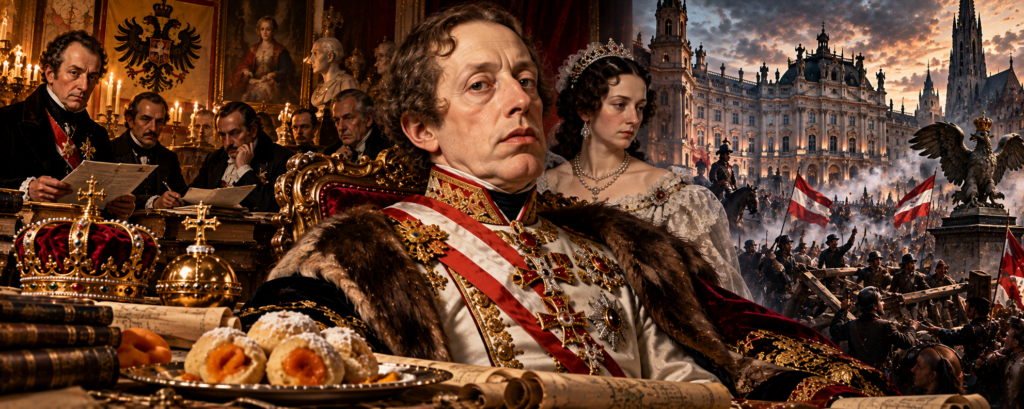
Ferdinand I of Austria: The Epileptic Emperor, the Puppet Throne, and the Revolution That Swept Him Aside
Emperor of Austria, 1835–1848 | Epilepsy, Habsburg Inbreeding, Neurological Disability, Metternich’s Shadow Government, an Unconsummated Marriage, Imperial Eccentricities, the Revolutions of 1848, Abdication, and the Gentle Emperor Who Outlived His Throne
The Emperor Behind the Curtain
When Ferdinand I inherited the Austrian Empire in 1835, Europe witnessed one of the strangest royal successions of the nineteenth century. The new emperor possessed an impressive collection of crowns and titles, could communicate in several languages, maintained intellectual interests, kept a coherent diary, and understood far more of the world around him than the cruelest caricatures later suggested. Yet he also suffered from serious neurological and physical problems, including epilepsy so severe that his seizures could repeatedly interrupt ordinary life. The man enthroned as ruler of one of Europe’s greatest powers was therefore simultaneously emperor and patient, sovereign and dependent, the ceremonial center of a vast monarchy whose most important decisions were frequently made by other men.
Ferdinand was not “mad” in the familiar historical sense of a ruler experiencing psychosis or profound delusion. There is no good evidence that he inhabited an imaginary world, lost all understanding of his identity, or suffered the spectacular breaks with reality associated with monarchs such as Charles VI of France. His difficulties were primarily neurological, physical, developmental, and intellectual, although nineteenth-century observers often bundled such distinctions together beneath humiliating labels such as “imbecile,” “idiot,” or “feeble-minded.” Modern readers should be far more cautious, particularly because Ferdinand’s surviving writings and demonstrated abilities make the crudest descriptions of him difficult to sustain.
Nevertheless, his limitations were serious enough to create an extraordinary political problem. The Habsburg principle of hereditary legitimacy demanded that the eldest son inherit, but the realities of governing an enormous multinational monarchy demanded sustained concentration, rapid decision-making, political judgment, and physical stamina. Ferdinand could wear the crown, sign documents, attend ceremonies, receive ministers, and perform many formal duties, but his government depended heavily upon a small circle of powerful advisers. Behind the throne stood Prince Klemens von Metternich, Count Franz Anton von Kolowrat-Liebsteinsky, Ferdinand’s uncle Archduke Louis, and the cumbersome machinery usually known as the State Conference.
For thirteen years this peculiar arrangement survived. Then came 1848, the year when revolutions erupted across Europe and the political system built around Ferdinand began collapsing with astonishing speed. Crowds filled Vienna, Metternich fled, Hungary rebelled, Prague rose, imperial authority faltered, and the emperor who had spent his reign protected from the harshest burdens of government suddenly found himself at the center of a continental political earthquake.
By December, Ferdinand was no longer emperor. His eighteen-year-old nephew Franz Joseph took the throne and would remain there for nearly sixty-eight years. Ferdinand, meanwhile, retired to Prague, where the supposedly incapable former emperor would live quietly for another twenty-six years, manage substantial private property, acquire a reputation for generosity, and become an oddly beloved relic of the vanished world that revolution had swept away.
Born Into the Habsburg Family Labyrinth
Ferdinand was born in Vienna on April 19, 1793, the eldest son of the future Emperor Francis II and Maria Theresa of Naples and Sicily. His parents were double first cousins, a striking example of the repeated intermarriage that had characterized European dynastic politics and was especially notorious among branches of the Habsburg family. Their family trees folded back upon themselves in ways that would appear extraordinary outside royal houses, where marriage was treated as an instrument of diplomacy and preservation of dynastic property. Ferdinand consequently inherited not merely a throne but the biological consequences of generations in which political calculations repeatedly overrode concerns about close kinship.
It is tempting, however, to turn Ferdinand into a simple morality tale about Habsburg inbreeding, and that goes further than the evidence allows. His parents’ close relationship unquestionably increased genetic risks, but assigning every one of Ferdinand’s medical conditions directly to dynastic consanguinity is more difficult than popular histories sometimes imply. He suffered from epilepsy, a pronounced speech impediment, physical weakness, and distinctive cranial and facial characteristics, while hydrocephalus has frequently been identified in descriptions of his condition. What can be said safely is that Ferdinand entered life with significant health problems in a dynasty where close-kin marriage had been practiced repeatedly.
The contrast between Ferdinand and the expectations placed upon him was brutal. An heir to the Habsburg monarchy was supposed to embody stability, military authority, Catholic legitimacy, and dynastic continuity. He would eventually be expected to rule lands stretching across Central and Eastern Europe, preside over competing nationalities, deal with foreign governments, appoint ministers, understand military affairs, and father another generation of heirs. Ferdinand’s childhood instead revolved heavily around illness, education adapted to his limitations, and uncertainty over what he would ever be capable of doing.
His difficulties were sufficiently obvious that his future as an active ruler could not be taken for granted. Yet Habsburg legitimacy was intensely conservative, and Francis was reluctant to displace his eldest son simply because Ferdinand failed to resemble the ideal prince. The dynasty that defended hereditary monarchy against revolution would have created a dangerous contradiction by casually ignoring hereditary succession within its own household. Ferdinand therefore remained heir, even while the people around him quietly constructed mechanisms that would compensate for his weaknesses.
That decision would eventually produce an emperor unlike almost any other in nineteenth-century Europe. Ferdinand would reign, but governing would become a collective operation carried out around him.
The Prince Who Learned Slowly
Ferdinand’s early education has often been presented as evidence either of severe intellectual disability or of hidden brilliance, but both extremes distort the more complicated picture. His development was delayed, and his speech difficulties could make him appear less capable than he actually was. His education proceeded carefully under tutors, including Baron Josef Kalasanz von Erberg and Countess Josephine von Attems, and Ferdinand eventually demonstrated genuine abilities. He developed interests in botany, agriculture, technical subjects, heraldry, music, and other fields that hardly fit the image of a man completely incapable of coherent thought.
He also acquired competence in several languages, an important achievement in a multilingual dynasty. Claims about precisely how fluently he spoke five or more languages vary in detail, but he was certainly not the intellectually empty figure suggested by later jokes. His diary remained coherent and legible, and accounts of his private life reveal someone capable of routine communication, memory, personal preferences, religious devotion, and practical interests. His limitations were substantial without being total.
Epilepsy presented a much more obvious obstacle. Reports that Ferdinand sometimes experienced extremely frequent seizures, even as many as twenty in a day during particularly severe periods, have circulated widely in biographical accounts. Such figures should not automatically be treated as an unchanging daily average across his life, but there is no doubt that his epilepsy could be severe. Repeated seizures would have imposed enormous physical exhaustion and made the uninterrupted schedule expected of a nineteenth-century sovereign exceptionally difficult.
His speech impediment compounded the problem because monarchy remained an intensely theatrical institution. A ruler had to receive ambassadors, speak with ministers, appear before crowds, preside at ceremonies, and project confidence. Ferdinand could perform ceremonial duties, but his physical appearance, speech, and occasional seizures exposed him to ridicule in a society far less sympathetic toward neurological disability than modern audiences should be. Political enemies and later commentators could easily transform disability into stupidity and stupidity into comedy.
The Ferdinand who emerges from better evidence is therefore more complicated than the caricature. He was neither a hidden political genius nor a mindless puppet incapable of understanding anything around him. He was a seriously disabled man placed in an office requiring abilities and stamina he did not consistently possess.
That distinction matters because the tragedy of his reign begins there. Ferdinand’s body and mind were not simply personal matters. In hereditary monarchy, they became matters of state.
A Throne He Was Never Supposed to Manage Alone
Francis understood his son’s limitations and made arrangements intended to preserve continuity after his own death. Rather than formally removing Ferdinand from the succession, he instructed him to rely upon trusted members of the dynasty and government. Archduke Louis, Ferdinand’s uncle, became particularly important, while Metternich remained the dominant figure in foreign policy and conservative statecraft. Count Kolowrat represented another powerful center within the governing structure.
The arrangement that developed after Ferdinand’s accession is often called a regency, although technically Ferdinand was not declared legally incapable and no straightforward formal regency replaced him. Instead, the State Conference acted as a collective mechanism through which major decisions were processed. This distinction may sound bureaucratic, but politically it was crucial. Ferdinand remained the sovereign, preserving dynastic legitimacy, while men considered more capable handled much of the actual burden of government.
Unfortunately, collective government did not necessarily mean efficient government. Metternich, Kolowrat, Archduke Louis, and other figures possessed different priorities and could obstruct one another. The system designed to compensate for Ferdinand’s limitations often produced inertia precisely when the Austrian Empire most needed adaptation. The emperor’s weakness became one element within a larger political culture increasingly unable to respond to the social, economic, national, and constitutional pressures transforming Europe.
Ferdinand’s reign consequently became associated with the final phase of the Vormärz, the period before the revolutions of March 1848. Censorship remained extensive, political participation narrow, and the government deeply suspicious of nationalism and liberal constitutionalism. Metternich’s name became synonymous with the conservative European order created after Napoleon’s defeat, but by the 1830s and 1840s that order was visibly aging. Industrialization, nationalism, liberalism, economic distress, and demands for constitutional reform were creating pressures that police surveillance could delay but not erase.
Ferdinand was poorly equipped to impose a new direction. Yet blaming him personally for every failure of the Austrian system would be unfair because many of the policies predated his reign and were designed by ministers who exercised far greater political influence. The emperor became the face of a system he had not created and could not effectively reform.
He sat at its center because birth had placed him there. Around him, Europe was changing faster than the men governing in his name were willing to admit.
The Assassination Attempt
Even before Ferdinand became emperor, the vulnerabilities surrounding him could become frighteningly real. In 1832, while still crown prince, he survived an assassination attempt at Baden near Vienna. A retired army captain named Franz Reindl attacked him with a pistol, but Ferdinand escaped serious injury. The episode was one of several reminders that the apparently placid Austrian world of the Biedermeier period concealed considerable social and political tension.
For a man already burdened by neurological illness and anxiety, such an attack could hardly have been trivial. Accounts suggest that Ferdinand was badly shaken psychologically even though he had not been physically wounded. His protected existence had never been entirely secure, and an assassin had suddenly penetrated the ceremonial barrier surrounding the heir to the empire. Royal status could provide guards, palaces, physicians, and servants, but it could not make vulnerability disappear.
The episode also exposes the strange position Ferdinand occupied. He was often portrayed as harmless, gentle, and detached from the harsher realities of power, yet he embodied a political system capable of inspiring lethal hatred. The assassin did not need Ferdinand personally to be cruel or competent. The crown itself was enough.
That contradiction would become even more pronounced after 1835. Ferdinand would acquire the image of a kindly sovereign while his government maintained censorship, policing, and conservative political control. He could personally dislike violence while ruling a state that depended upon coercion.
This gap between Ferdinand the man and Ferdinand the institution is essential to understanding his reign. The individual was often mild. The monarchy he represented was anything but powerless.
Maria Anna and the Marriage Without an Heir
Dynastic politics demanded that Ferdinand marry. In 1831 he wed Princess Maria Anna of Savoy, daughter of Victor Emmanuel I of Sardinia. She was twenty-seven, Ferdinand was thirty-seven, and the union was expected to provide the Habsburg dynasty with heirs despite obvious concerns about Ferdinand’s health. Contemporary court physicians were reportedly doubtful about his ability to consummate the marriage.
The wedding itself became one of the most uncomfortable episodes in Ferdinand’s biography. Accounts record that he suffered an epileptic seizure during the marriage ceremonies, an event that must have been terrifying and humiliating in a setting designed to display dynastic strength. Later reports claim that attempts at consummation triggered repeated seizures, sometimes specifically described as five successive attacks. The marriage remained childless and is generally believed never to have been consummated, although intimate details of royal marriages always require caution because much of what survives comes through physicians, courtiers, gossip, and later retellings.
Maria Anna nevertheless remained beside him. She developed a reputation for kindness, devotion, and charitable activity, and later accounts describe her role partly in terms of caregiving. Whatever private disappointments existed, the marriage became a stable companionship rather than a dynastic success. Ferdinand appears to have had no recognized children and no significant history of extramarital affairs.
For the Habsburg dynasty, the absence of an heir was manageable because Ferdinand had brothers and nephews. For Ferdinand personally, it removed one of the central expectations placed upon European monarchs. He would never produce a son to whom he could pass the empire.
The marriage also humanizes a man too often reduced to jokes. Epilepsy was not a colorful eccentricity. It intruded into Ferdinand’s most private moments, disrupted ceremonies, exhausted his body, complicated his marriage, and exposed him repeatedly to humiliation.
A seizure during a wedding might become an anecdote in a history book. For Ferdinand and Maria Anna, it was life.
Emperor at Last
Francis died on March 2, 1835, and Ferdinand inherited the Austrian throne. He also became king of Hungary and Bohemia under the appropriate regnal numbering used in those kingdoms, carrying the enormous collection of titles that accompanied Habsburg sovereignty. The succession itself demonstrated the dynasty’s commitment to hereditary legitimacy: Ferdinand’s disabilities were known, yet the crown passed to him as expected.
His coronations provided the public spectacle monarchy demanded. Ferdinand was crowned king of Bohemia in Prague in 1836, and his reign was marked by the elaborate ceremonies through which the Habsburg state attempted to transform dynastic inheritance into visible legitimacy. Crowns, robes, churches, processions, oaths, and court ritual presented an image of continuity. Behind that image, however, political power remained fragmented among the emperor’s advisers.
The public came to know Ferdinand by affectionate names such as Ferdinand the Good or the Benign. These labels reflected his reputation for personal gentleness rather than political effectiveness. He was not feared as a tyrant in his own personality, and anecdotes repeatedly depict him as good-natured, simple in his desires, religious, and relatively harmless. Even critics who considered him incapable could distinguish between incompetence and cruelty.
Yet the nickname carried an uncomfortable undertone. Calling a monarch “the Good” can become a way of saying that kindness was his most obvious qualification. Ferdinand’s reign needed decisiveness, political imagination, and the ability to arbitrate among powerful factions. Personal goodness could not substitute for those skills.
The emperor therefore became something close to a living symbol while other men governed around him. He signed papers, appeared at ceremonies, and embodied legitimacy. Metternich and the State Conference attempted to preserve the political order.
For a while, the machinery continued moving. But it was moving toward 1848.
The Emperor Who Counted Carriages
Among the stories told about Ferdinand is the claim that he would sit near a window during meetings and count passing carriages rather than follow complicated political discussions. In some versions, ministers debated affairs of state while the emperor quietly watched traffic, after which he signed whatever documents were placed before him. The anecdote has become part of the standard image of Ferdinand as a distracted child trapped inside imperial ceremony. Yet like many colorful stories attached to supposedly foolish monarchs, it should be approached cautiously.
It is entirely plausible that Ferdinand found prolonged council meetings exhausting or difficult, especially given his epilepsy and speech problems. It is also plausible that ministers accustomed to conducting government themselves reduced his role to approving decisions already made. What is much harder to establish is whether he literally spent meetings obsessively counting carriages in precisely the manner later stories describe. Such anecdotes are almost perfectly designed to communicate a political judgment, which makes them memorable but not necessarily reliable.
The broader truth requires no comic embellishment. Ferdinand did not dominate his ministers. He did not provide the forceful personal direction associated with monarchs such as Frederick the Great or Joseph II. Government operated through a complex group of advisers because his limitations made sustained independent rule difficult.
That does not mean he signed everything without comprehension. His surviving diary and other evidence demonstrate that he was capable of understanding events at some level. The mistake is assuming that political incapacity must equal total intellectual emptiness.
Ferdinand could be aware without being able to govern effectively. That is a much more believable and, in many ways, much sadder situation.
“I Am the Emperor, and I Want Dumplings”
No story about Ferdinand has become more famous than the imperial dumpling crisis. According to the familiar version, Ferdinand wanted apricot dumplings, or Marillenknödel, and was informed that fresh apricots were unavailable because they were out of season. The emperor supposedly responded with magnificent dynastic certainty: “I am the Emperor, and I want dumplings!” The line has survived because it compresses the absurdity of absolute monarchy into a single demand: a sovereign could command armies and issue laws, yet not command an apricot tree to bear fruit in winter.
The problem is that the story is not securely documented in the form usually repeated. Modern scholarship examining Ferdinand’s popular image has warned that many supposed quotations attributed to him are poorly authenticated and were used to ridicule him. Versions of the dumpling anecdote vary, including accounts in which a physician rather than the season prevented him from eating the desired food. A contemporary caricature tradition may have helped transform the episode into part of Ferdinand’s enduring folklore.
The quotation therefore belongs more safely to legend than to verified imperial dialogue. It may preserve a genuine episode, or it may be a comic story sharpened over time. Either way, its popularity reveals more about how Austrians remembered Ferdinand than about the precise contents of an imperial kitchen dispute.
People wanted Ferdinand to be the emperor who demanded impossible dumplings because the story made sense of his reign. He possessed immense theoretical authority while exercising surprisingly little practical control. The joke was not really about food.
It was about sovereignty itself.
Ferdinand could command that a document bear the imperial signature. He could not make the seasons obey him, and increasingly he could not make the empire obey him either.
The Eagle With Two Heads
Another famous story claims that Ferdinand encountered a real eagle after a hunt and expressed confusion because it had only one head. The Habsburg imperial symbol was the double-headed eagle, and the supposedly naive emperor is said to have assumed that actual eagles should resemble the heraldic creature displayed across imperial buildings, standards, seals, and uniforms. Like the dumpling story, the anecdote is irresistible precisely because it makes Ferdinand appear childlike.
There is little reason to treat it as securely established fact. Ferdinand had interests in botany and the natural world and was not so detached from ordinary reality that he could plausibly have reached adulthood believing all eagles possessed two heads. The story works far better as satire than biography. It converts his reputation for limited intelligence into an instantly understandable joke.
Such tales accumulated around Ferdinand because disability made him an easy target. Speech impediments, epilepsy, unusual appearance, and dependence upon advisers could all be transformed into stories proving that he was incapable of distinguishing symbols from reality. Nineteenth-century political humor was rarely gentle toward people with disabilities. Ferdinand became a particularly vulnerable subject because mocking him also allowed critics to mock the Habsburg state.
The two-headed eagle anecdote should therefore be retained only as part of Ferdinand’s legend. It tells us how he was caricatured, not what he genuinely believed. The difference is important for any serious account of his life.
Ferdinand was limited. He was not living inside a heraldic fantasy.
The Habsburg Face
Ferdinand’s appearance reinforced perceptions of incapacity. Portraits show the elongated Habsburg features inherited across generations, including the prominent lower jaw associated with the dynasty. His head appeared unusually large, and descriptions of hydrocephalus have long been attached to his medical history. Combined with his speech difficulties and neurological problems, these features could make public appearances uncomfortable.
The Habsburg jaw has become almost a visual shorthand for dynastic inbreeding. Modern genetic research on the Spanish Habsburgs has strengthened the association between consanguinity and pronounced mandibular prognathism within that branch of the family, although applying precise genetic conclusions to every Austrian Habsburg requires caution. Ferdinand belonged to a dynasty in which close-kin marriages were undeniably common. His own parents being double first cousins made the issue particularly striking.
Yet physical appearance also influenced how observers judged intelligence. A person with unusual facial features, impaired speech, and seizures could easily be assumed to possess less understanding than he actually did. Ferdinand’s political weakness then seemed to confirm the prejudice. Disability, appearance, and government became fused into a single caricature.
This is one reason modern assessments have become more nuanced. Ferdinand was clearly incapable of exercising the kind of vigorous personal monarchy his position theoretically demanded, but he was not devoid of intelligence. He could write, communicate, understand property, pursue interests, and function socially.
The Habsburg face became evidence in a trial that history had already decided against him. The real Ferdinand was trapped behind it.
Metternich’s Emperor
No figure loomed larger over Ferdinand’s reign than Prince Klemens von Metternich. By 1835 Metternich had already spent decades at the center of Austrian and European diplomacy. He had helped construct the post-Napoleonic settlement, participated in the Congress of Vienna, and become one of Europe’s most famous defenders of conservative order. Under Ferdinand, his influence remained immense.
Metternich believed revolution, nationalism, and radical liberalism threatened the stability of Europe. He favored careful diplomacy abroad and political restraint at home. Censorship and police surveillance formed part of the system associated with his name, although reducing the entire Austrian state to one man oversimplifies matters. Still, Ferdinand’s weakness made Metternich’s continued dominance easier.
The problem was that the Metternich system had been designed for the world after Napoleon, while Europe in the 1840s was becoming something else. Railways, newspapers, expanding literacy, urban growth, industrialization, economic change, nationalism, and new political ideas were reshaping society. The Habsburg monarchy contained Germans, Hungarians, Czechs, Italians, Croats, Slovaks, Romanians, Poles, Ruthenians, Slovenes, Serbs, and other peoples whose political demands increasingly collided.
Ferdinand was not capable of mastering those conflicts. Metternich tried to contain them. The State Conference often struggled merely to decide what should be done.
The emperor’s disabilities therefore mattered not because they created every problem but because they deprived the monarchy of a strong arbiter at precisely the moment when its governing structure was becoming increasingly rigid. Ferdinand did not cause the storm. He simply occupied the throne when the walls began to shake.
The Quiet Years Before the Explosion
For much of Ferdinand’s reign, Vienna did not look like the capital of an empire approaching revolution. The Biedermeier era cultivated domesticity, music, theater, comfortable interiors, and a public culture that could appear deliberately removed from dangerous politics. Beneath the surface, however, dissatisfaction accumulated. Students, intellectuals, professionals, workers, national activists, and sections of the middle classes increasingly wanted changes the government was reluctant to provide.
Economic pressures sharpened political resentment. Poor harvests and food shortages in the 1840s contributed to distress across Europe. Industrial change created instability, while population growth placed additional pressure upon urban centers. In the Habsburg lands, economic grievances became entangled with demands for constitutional government and national recognition.
Hungary presented one of the most dangerous challenges. Reformers such as Lajos Kossuth demanded greater political autonomy and modernization within the Kingdom of Hungary. Czech national consciousness was also strengthening, while Lombardy-Venetia remained deeply hostile to Austrian rule. The monarchy was not one country waiting for one revolution; it was a collection of societies carrying different grievances.
The imperial government responded cautiously and often inadequately. Ferdinand remained the ceremonial sovereign, but he could not provide the imaginative leadership needed to reconcile these competing pressures. The State Conference, already cumbersome, became a symbol of paralysis.
Then news arrived from France.
In February 1848, revolution overthrew King Louis Philippe. Europe caught fire.
Vienna, March 1848
On March 13, 1848, unrest erupted dramatically in Vienna. Students, workers, and political reformers filled the streets, demanding constitutional change, freedom of the press, and the dismissal of Metternich. Fighting broke out, troops confronted crowds, and the political system that had dominated Austria for decades suddenly appeared astonishingly fragile. Metternich, once one of the most powerful statesmen in Europe, resigned and fled.
A famous anecdote claims that Ferdinand, confronted with the news that his subjects were making a revolution, responded by asking whether they were allowed to do so. The Viennese version is often rendered roughly as “But are they permitted to do that?” Like the dumpling quotation, it is a perfect line and therefore deserves suspicion. It may reflect Ferdinand’s bewilderment, but its exact authenticity is doubtful.
Yet even if invented, the story captures the collision between Ferdinand’s sheltered monarchy and revolutionary politics. The Habsburg state had spent decades treating revolution as something that could be prohibited through censorship, policing, and international cooperation. Suddenly revolution was happening outside the palace. Whether Ferdinand literally asked if it was allowed almost did not matter; the political system around him had behaved for years as though history itself required official permission.
The emperor initially made concessions. Censorship was relaxed, constitutional promises were issued, and the government attempted to calm Vienna. Ferdinand’s personal reluctance to unleash indiscriminate violence has contributed to his later benign reputation, although decisions during the revolutionary year were made within an unstable court surrounded by competing advisers.
For the first time in his reign, Ferdinand stood at the center of events too large for the State Conference to quietly manage. Metternich was gone. The old political order had cracked open in a matter of days.
And the revolution was only beginning.
Hungary Breaks Away From the Old Order
The revolutionary crisis spread rapidly to Hungary. The Hungarian Diet demanded sweeping reforms, and Ferdinand sanctioned the famous April Laws, which transformed the kingdom politically. Serfdom was abolished, a responsible Hungarian ministry was established, and important elements of the old feudal order were dismantled. For a moment, constitutional transformation seemed possible within the Habsburg monarchy.
The arrangement soon began unraveling because the Hungarian revolution raised questions that no signature could easily solve. How much authority would remain with Vienna? Who controlled the army? How would the rights of Croats, Serbs, Romanians, Slovaks, and other non-Magyar peoples within the Kingdom of Hungary be protected? Could the Habsburg monarchy survive if one of its largest components became effectively autonomous?
Ferdinand was poorly positioned to answer such questions personally. Advisers, ministers, military commanders, and members of the dynasty increasingly determined policy. The emperor’s signatures appeared on documents whose political implications could be enormous, reinforcing the disturbing reality that sovereignty formally remained with a man unable to control the forces operating in his name.
The conflict escalated into war. Croatian Ban Josip Jelačić opposed the Hungarian government and remained aligned with the dynasty. Vienna gradually moved toward confrontation with Hungary, while the revolutionary government insisted upon rights it believed had already been legally recognized.
The Habsburg monarchy was beginning to fight itself. Ferdinand remained emperor of all sides.
That contradiction could not last indefinitely.
Flight From Vienna
The imperial family fled Vienna during the revolutionary turmoil, first seeking safety at Innsbruck. The departure exposed how thoroughly the balance of power had changed. The dynasty that had ruled from Vienna for generations was temporarily driven from its own capital by political instability. Ferdinand, whose reign had depended upon controlled ceremony, became a refugee from revolution.
Innsbruck offered security and a loyal reception, but events continued moving rapidly. The court eventually returned toward Vienna after conditions temporarily stabilized, only for renewed unrest to erupt. In October 1848, Vienna rose again after troops were ordered toward Hungary. War Minister Count Theodor Baillet von Latour was seized and murdered by a crowd, his body hanged from a lamppost in one of the revolution’s most gruesome episodes.
The imperial court fled once more, this time to Olmütz in Moravia, today Olomouc in the Czech Republic. Ferdinand’s monarchy was now being administered from exile while imperial troops prepared to retake the capital. Prince Alfred Windisch-Grätz became a central military figure in crushing the Viennese uprising. Artillery and soldiers did what constitutional improvisation had failed to do.
Vienna fell back under imperial control at the end of October. Executions followed, including that of Robert Blum, a German liberal deputy whose parliamentary immunity did not save him. The repression demonstrated that the Habsburg monarchy was recovering its capacity for violence even as Ferdinand’s personal authority became increasingly irrelevant.
A new generation of advisers concluded that restoring imperial power required a new emperor.
Ferdinand had become politically expendable.
The Court Decides the Emperor Must Go
The architect of the emerging post-revolutionary order was Prince Felix zu Schwarzenberg, an energetic conservative statesman who believed the monarchy needed centralized authority and a vigorous sovereign. Ferdinand, gentle and compromised by the concessions of 1848, did not fit the role. His younger brother Archduke Franz Karl stood next in the line of succession, but Franz Karl was hardly regarded as the dynamic figure needed to restore the monarchy. Attention therefore turned to Franz Karl’s eighteen-year-old son, Franz Joseph.
The plan was extraordinary. A reigning emperor who had not been formally declared insane or legally incapable would abdicate. His brother would renounce his rights. A teenager would inherit one of Europe’s largest empires while revolutions and wars were still raging.
Franz Joseph’s mother, Archduchess Sophie, strongly supported her son’s elevation and became an important force behind the transition. She had long understood the political weaknesses surrounding Ferdinand’s reign. Her son had been educated with the expectation that he might eventually rule, and the crisis of 1848 provided the opportunity far sooner than anyone might once have expected.
Ferdinand appears to have accepted abdication without the desperate resistance one might expect from a ruler being stripped of a crown. This does not mean he was incapable of understanding what was happening. His own diary records the transfer of power with clarity. He knew that his nephew was becoming emperor and that his own reign had ended.
The dynasty was sacrificing Ferdinand to save the throne.
It may have been the most consequential decision made during his reign, and fittingly, it was largely arranged by other people.
December 2, 1848
The abdication took place at Olmütz on December 2, 1848. Ferdinand relinquished the throne, Franz Karl renounced his succession rights, and eighteen-year-old Franz Joseph became Emperor of Austria. The young ruler knelt before his uncle and asked for his blessing. Ferdinand placed his hands upon Franz Joseph’s head and made the sign of the cross.
Ferdinand later described the event in his diary, providing unusually valuable evidence of his own awareness. His account is coherent, emotionally comprehensible, and specific. He understood that the “new emperor” had knelt before the old one, that he had blessed him, embraced him, and kissed him. Afterward, Ferdinand and Maria Anna attended Mass and prepared to leave.
This diary entry is particularly important because it undermines the crudest image of Ferdinand as a man who understood nothing. He might not have been capable of managing a revolutionary empire, but he comprehended the transfer of sovereignty occurring around him. His reaction also reveals something consistent with his personality: he did not turn abdication into a personal war.
There was no dramatic attempt to reclaim the crown. No rival court emerged proclaiming Ferdinand the legitimate sovereign. No faction fought to restore him. He stepped aside and allowed the dynasty to reinvent itself around a younger man.
For Franz Joseph, the moment began a reign lasting until 1916. For Ferdinand, it began something almost unheard of among deposed nineteenth-century monarchs.
Peace.
The Emperor Who Became Happier After Losing an Empire
Ferdinand withdrew primarily to Prague, where he lived at Prague Castle and other residences associated with his retirement. Stripped of the responsibilities for which he had never been well suited, he entered a surprisingly long and comparatively contented final phase of life. He would survive until 1875, outliving many of the politicians and revolutionaries who had defined his reign.
The contrast with his imperial years is striking. As emperor, Ferdinand had been surrounded by councils, ministers, ceremonies, crises, and constant scrutiny. In retirement, he could devote himself to private interests, religion, property, charity, and a quieter domestic existence with Maria Anna. The man judged incapable of governing an empire proved perfectly capable of maintaining a structured personal life.
He also possessed considerable private wealth and estates. Far from becoming helpless once removed from government, Ferdinand demonstrated practical competence in managing his economic affairs with assistance. His properties generated substantial income, and he reportedly showed interest in agricultural and financial matters. This does not prove that he could have governed Austria independently, but it further complicates the old caricature of complete intellectual incapacity.
Prague gradually grew accustomed to the former emperor. Ferdinand became a familiar and comparatively popular figure, remembered less as a failed sovereign than as an amiable elderly Habsburg. Stories describe him distributing money to the poor and sweets to children, although the most picturesque versions belong partly to the affectionate folklore that accumulated around his retirement.
The change in reputation is telling. On the throne, his limitations were a constitutional problem. Off the throne, the same simplicity could be interpreted as kindness.
Ferdinand had finally been given a role suited to the man he actually was rather than the monarch dynastic inheritance had demanded he become.
The Gentle Habsburg of Prague
Prague offered Ferdinand something Vienna rarely had: the possibility of being liked without needing to govern. He was no longer the weak center of a failing political system. He was the former emperor who appeared in public, gave generously, attended religious observances, and lived without threatening anyone’s political ambitions. His harmlessness, once considered disastrous, became charming.
Later popular memory softened him into Ferdinand the Good, and this affectionate image should be treated with some of the same caution as the mocking stories. People create sentimental legends just as easily as cruel ones. Ferdinand was neither a saint nor a helpless child wandering happily through Prague. He was a wealthy retired monarch living under exceptionally comfortable circumstances.
Nevertheless, there is little evidence that he resented Franz Joseph enough to create political trouble. He remained loyal to the dynasty and accepted his altered status. This was significant because deposed rulers frequently became centers of conspiracy whether they wanted to or not. Ferdinand’s peaceful retirement spared Franz Joseph a potentially dangerous legitimacy dispute.
Maria Anna remained with him throughout these years. Their childless marriage, which had begun beneath the shadow of illness and dynastic anxiety, ultimately became one of the most stable elements of Ferdinand’s life. She survived him by nearly nine years, dying in Prague in 1884.
There is something quietly moving about their final decades. The marriage had failed at the task dynasties cared about most—producing children—but endured long after the political reasons for creating it had disappeared. Ferdinand lost an empire and kept his wife.
For once, Habsburg history became gentler.
Did Ferdinand Really Suffer Twenty Seizures a Day?
The claim that Ferdinand experienced as many as twenty epileptic seizures per day is repeated in numerous biographies and reference works. It should be understood as a description of the possible severity of his condition rather than proof that every day of his adult life contained twenty major convulsions. Epilepsy encompasses different seizure types, and nineteenth-century descriptions rarely provide the neurological precision a modern physician would want. Nevertheless, Ferdinand’s epilepsy was unquestionably serious.
Repeated seizures could explain much about his physical limitations without requiring assumptions of profound intellectual disability. Frequent neurological episodes can produce exhaustion, confusion, injuries, disrupted concentration, and significant social consequences. Treatments available during Ferdinand’s lifetime were also extremely limited compared with modern antiepileptic medicine. He lived in an age when physicians could observe his condition but had few effective tools for controlling it.
The distinction between epilepsy and “madness” is especially important because Europeans had historically surrounded seizure disorders with superstition and stigma. Epileptic people could be treated as possessed, mentally defective, morally suspect, or inherently incapable regardless of their actual cognitive abilities. Ferdinand’s royal status protected him materially but could not protect his reputation from those prejudices.
Some observers therefore interpreted every difficulty through a single lens. His speech was unusual because he was “simple.” His seizures proved he was “simple.” His reliance on advisers proved he was “simple.” Comic anecdotes then supplied evidence for a verdict already reached.
Modern readers should resist that circular reasoning. Ferdinand’s epilepsy was disabling. It was not proof that he lacked a coherent mind.
Hydrocephalus and the Problem of Retrospective Diagnosis
Hydrocephalus is frequently listed among Ferdinand’s medical conditions, often described dramatically as “water on the brain.” His unusually large head and developmental difficulties have contributed to that diagnosis in historical accounts. Yet retrospective medicine always demands caution, especially when modern terminology is applied to people whose medical records are incomplete and whose physicians worked before modern neurology, imaging, and genetics.
Ferdinand certainly had significant neurological abnormalities. Whether every aspect of his condition can be reconstructed precisely almost two centuries later is another matter. Medical labels can create a false sense of certainty, particularly when they are used to explain personality, intelligence, and political behavior simultaneously. A diagnosis is not a biography.
The same caution applies to claims that inbreeding “caused” Ferdinand’s entire condition. His parents were extremely closely related, and generations of dynastic intermarriage unquestionably increased genetic risks. That makes consanguinity highly relevant. It does not permit historians to assign every symptom to a single identifiable inherited mechanism without evidence.
What can be said confidently is disturbing enough. European dynasties repeatedly arranged marriages among close relatives because political alliances, territory, and bloodline purity mattered more than biological diversity. Ferdinand emerged from one of those networks carrying serious medical burdens.
He then inherited an empire because the same dynastic ideology that helped produce the problem insisted that birth order determine political authority. Biology and politics had become trapped inside the same system.
That may be the darkest aspect of Ferdinand’s story.
Was He Intellectually Disabled?
This question sits at the center of almost every modern reassessment of Ferdinand. Contemporary and later descriptions often called him mentally deficient, but the language used was imprecise, insulting, and shaped by attitudes toward disability that modern medicine no longer accepts. Ferdinand clearly experienced developmental difficulties and appears to have had limitations in judgment and sustained political decision-making. Yet evidence of literacy, multilingual ability, diary writing, personal interests, financial understanding, and coherent social behavior makes extreme claims of total intellectual incapacity untenable.
Intelligence is also not a single quality. A person may possess excellent memory or linguistic ability while struggling with abstract political judgment, executive function, social pressure, or rapid decision-making. Ferdinand’s epilepsy could further complicate his functioning depending upon seizure frequency and recovery periods. Nineteenth-century observers had little interest in such distinctions.
His position made matters worse because he was compared not with ordinary expectations but with an almost impossible standard of sovereign competence. An emperor had to understand diplomacy, military affairs, finance, constitutional law, dynastic politics, administration, nationalism, and the personalities of dozens of ministers. A person capable of living independently could still be utterly overwhelmed by that office.
Ferdinand was overwhelmed. That does not require calling him an idiot.
Indeed, the political system around him may have reinforced dependence. Once ministers expected little from the emperor, they had little reason to cultivate his participation. Decisions were prepared elsewhere and brought to him, making him increasingly ceremonial.
A weak ruler can become weaker when everyone learns to govern without him.
The Strange Cruelty of the Ferdinand Jokes
The anecdotes surrounding Ferdinand deserve attention because they reveal how societies transform disability into entertainment. The dumplings, the two-headed eagle, the carriage counting, and the question about whether revolutionaries were “allowed” to revolt all follow the same structure. Ferdinand encounters an ordinary situation, misunderstands it in a childlike way, and exposes himself as absurd. The audience is invited to laugh.
Some of these stories may contain fragments of truth. Others are probably exaggerated or apocryphal. Their historical power does not depend upon authenticity because they became the version of Ferdinand people wanted to remember.
The jokes also served political purposes. Liberals could use them to ridicule hereditary monarchy: why should millions of people obey a man simply because he happened to be born first? Nationalists could mock the emperor as a symbol of an outdated multinational state. Supporters of stronger government could contrast Ferdinand’s weakness with the youthful decisiveness later associated with Franz Joseph.
The disabled monarch became evidence against the political system that had enthroned him. That criticism was not entirely unfair. Hereditary monarchy really had placed a severely impaired man at the head of a complicated empire simply because of birth.
But the target easily shifted from the institution to the individual. Instead of asking why a political system required Ferdinand to rule, people laughed at Ferdinand for being unable to fulfill the role.
He had not chosen his epilepsy. He had not designed the succession laws. He had not asked to be born first.
Yet he became the joke.
A Puppet, But Not an Empty One
Calling Ferdinand a puppet captures something real but also risks oversimplification. His ministers possessed enormous influence, and the State Conference handled much of the governing burden. Ferdinand rarely imposed an independent political program and could not consistently arbitrate among competing factions. In that sense, his sovereignty was substantially constrained by his dependence.
Yet puppets possess no awareness, and Ferdinand did. He understood his imperial identity, participated in ceremonies, followed events to varying degrees, signed measures, maintained a diary, and recognized the significance of his abdication. He was not simply an unconscious body onto which ministers attached a crown.
The more accurate image is perhaps that of a sovereign whose formal authority greatly exceeded his practical capacity. This mismatch created a vacuum. Metternich, Kolowrat, Archduke Louis, and eventually the revolutionary-era ministers filled it.
That arrangement worked while the political environment remained relatively stable. Once 1848 demanded rapid decisions, coherent strategy, and personal authority, its weaknesses became impossible to conceal. A committee could manage routine administration; it struggled to embody monarchy during revolution.
Franz Joseph’s accession therefore represented more than a change of individual. The dynasty wanted an emperor who could personally project power. At eighteen, Franz Joseph had little experience, but he possessed health, discipline, confidence, and the ability to become the visible center of the restored state.
Ferdinand had the stronger hereditary claim until he surrendered it. Franz Joseph had the qualities the monarchy now believed survival required.
Dynastic principle yielded to political necessity.
The Revolution That Freed Him
There is an extraordinary irony at the heart of Ferdinand’s abdication. The Revolutions of 1848 destroyed his reign, but they may also have liberated him from a position that had never suited him. He lost the Austrian throne, the Hungarian crown, the Bohemian crown, and the immense burden of representing one of Europe’s great powers. In exchange, he gained more than a quarter century of comparatively peaceful private life.
The people who arranged his abdication intended to save the monarchy, not Ferdinand. Yet the outcome appears to have benefited both. Franz Joseph acquired the authority necessary to rebuild Habsburg power, while Ferdinand escaped the relentless demands of a role that magnified every limitation he possessed. His retirement lacked the bitterness of many deposed monarchs because the throne may never have been the center of his identity in the first place.
This does not mean abdication was entirely voluntary in the modern sense. Powerful family members and ministers clearly concluded that he had to go, and the political pressure surrounding him was enormous. Ferdinand accepted a decision created within a court environment where his own preferences had never been the dominant force. His compliance was characteristic of a lifetime spent accommodating arrangements made by others.
Yet his diary does not read like the record of a man dragged screaming from power. He blessed Franz Joseph, attended Mass, and prepared to leave. The simplicity of the sequence is almost astonishing.
An emperor had just surrendered a dynasty’s crown.
Then he packed his bags.
Ferdinand and Franz Joseph
The contrast between Ferdinand and his successor could hardly have been greater. Ferdinand’s reign became associated with collective government, uncertainty, physical weakness, and revolutionary collapse. Franz Joseph cultivated discipline, duty, military bearing, personal routine, and an almost relentless commitment to the obligations of monarchy. Where Ferdinand had been protected from government, Franz Joseph immersed himself in paperwork.
Yet Franz Joseph’s reign would reveal that personal diligence could not solve every Habsburg problem either. Nationalism intensified, Austria lost influence in Italy and Germany, constitutional struggles continued, and the empire eventually transformed into Austria-Hungary. Franz Joseph’s extraordinary longevity gave an impression of stability, but beneath it the same multinational tensions that had erupted in 1848 continued evolving.
Ferdinand therefore should not be blamed for problems that outlived him by decades. His weakness exposed structural difficulties rather than creating them. Even a highly capable emperor would have struggled to reconcile the competing national, constitutional, social, and geopolitical pressures confronting the Habsburg monarchy.
The difference was that a stronger monarch might have managed the crisis more decisively. Ferdinand could not. His incapacity made an already difficult system even less responsive.
Franz Joseph spent much of his reign trying to embody what Ferdinand had failed to provide: continuity through personal duty. In the end, even that was not enough to save the dynasty.
The Habsburg problem was larger than either man.
Ferdinand the Good
Ferdinand’s popular nickname deserves a final examination. Ferdinand der Gütige, Ferdinand the Good or Benign, sounds almost patronizing when placed beside rulers remembered as Great, Terrible, Conqueror, or Lionheart. Yet perhaps it captures something genuinely important. Ferdinand did not leave behind a reputation for vindictiveness, personal cruelty, sexual predation, military bloodlust, or obsessive ambition.
His reign witnessed repression and violence, but he was not the driving personality behind those policies. During the revolutionary crisis, stories emphasizing his reluctance to fire upon his people contributed to his benign image, though specific quotations attributed to him remain difficult to verify. He was more comfortable with religion, domesticity, botany, routine, and private interests than with coercive political leadership.
That temperament would have been admirable in many lives. On an imperial throne in 1848, it became a weakness. Monarchies rarely reward rulers for being harmless when their states are collapsing.
Yet after abdication, harmlessness became a virtue again. Prague remembered the elderly Ferdinand with affection precisely because nobody feared that he wanted anything from them. He could walk, pray, give, observe, and grow old.
The crown had turned a gentle man into a political problem. Removing it allowed the gentleness to become visible.
The Emperor Who Outlived His Own Era
Ferdinand lived until June 29, 1875, dying in Prague at the age of eighty-two. His longevity was remarkable given the severe health difficulties of his youth and adulthood. The man whose medical condition had once raised doubts about whether he could fulfill basic dynastic expectations survived deep into the reign of the nephew who replaced him.
The Europe Ferdinand left in 1875 was almost unrecognizable compared with the one he had inherited in 1835. Metternich was dead. The old German Confederation had disappeared. Prussia had defeated Austria and created a German Empire without the Habsburgs. Italy had largely unified, stripping Austria of most of its Italian possessions. The Austrian Empire itself had become the Dual Monarchy of Austria-Hungary after the Compromise of 1867.
Railways now crossed territories Ferdinand had once traversed in carriages. Telegraphs accelerated communication. Industrialization transformed cities. Liberal constitutions and mass politics were reshaping the relationship between governments and populations. The conservative Europe constructed after Napoleon had receded into history.
Ferdinand had been born during the French Revolutionary Wars, ruled through the final age of Metternich, lost his throne during the revolutions of 1848, and lived long enough to see Bismarck’s German Empire established. Few lives bridged so many political worlds.
Yet Ferdinand himself remained largely outside the later dramas. His retirement transformed him from participant into survivor.
He had ceased trying to rule history. History simply moved past him.
Was Ferdinand I Really Mad?
Ferdinand belongs in the Mad Monarchs category, but only if the label is handled with unusual care. Unlike rulers whose reputations for madness grew primarily from cruelty, eccentricity, propaganda, or political hostility, Ferdinand genuinely suffered from serious neurological disability. Epilepsy profoundly affected his life, and developmental or cognitive limitations appear to have restricted his ability to govern independently. His physical difficulties were real rather than inventions of enemies.
But neurological disability is not synonymous with insanity. Epilepsy does not make a person psychotic, and Ferdinand’s ability to keep a coherent diary, learn languages, maintain interests, understand his abdication, and manage aspects of private life after retirement contradicts portrayals of complete mental incapacity. The historical vocabulary applied to him often tells us more about nineteenth-century prejudice than about his actual condition.
Hydrocephalus and intellectual impairment are frequently cited in his biographies, but precise retrospective diagnosis remains difficult. Claims that every difficulty resulted directly from Habsburg inbreeding likewise require qualification. His parents’ extremely close kinship is unquestionably relevant, yet historical genetics cannot reconstruct every causal pathway from a family tree alone.
Ferdinand was disabled. He was politically dependent. He was not capable of providing the energetic personal rule his empire required.
Those statements are strong enough without turning him into a grotesque caricature.
His tragedy was not that a madman somehow seized a throne. His tragedy was that a hereditary system placed a vulnerable man on a throne because admitting he was unsuited to it would have challenged the very principle upon which that throne rested.
The Cruel Logic of Hereditary Monarchy
Ferdinand’s reign exposes one of hereditary monarchy’s deepest contradictions. Dynastic government insisted that sovereignty passed through blood because blood supposedly guaranteed continuity. Yet biology does not guarantee political ability. A crown can be inherited with mathematical certainty; judgment, health, charisma, intelligence, and stamina cannot.
The Habsburgs had compounded that danger through generations of dynastic marriage. By repeatedly marrying within a restricted circle of royal families, they attempted to preserve political alliances and dynastic legitimacy. Ferdinand’s parents, double first cousins, represented an especially concentrated example of that system. Their son then inherited serious medical difficulties and, because he was their eldest surviving male heir, inherited an empire as well.
The political establishment responded by creating a government around him. Instead of questioning whether Ferdinand should rule, it separated ruling from governing. The emperor remained on the throne while advisers exercised the authority his position theoretically concentrated in his hands.
For thirteen years, that compromise preserved appearances. The monarchy could pretend hereditary principle remained intact, ministers could make decisions, and Ferdinand could fulfill ceremonial functions. The arrangement seemed stable because Europe itself seemed stable.
Then revolution arrived.
The system discovered that symbolism was not enough. In crisis, people wanted decisions, responsibility, and authority. Ferdinand possessed the title but could not consistently supply the leadership.
His abdication therefore became an admission the dynasty had resisted for decades. Birth alone was not enough.
The Man Behind the Jokes
The easiest Ferdinand to remember is the comic one. He demands dumplings in the wrong season, counts carriages while ministers govern, mistakes the imperial eagle for a real bird, and wonders whether revolutionaries possess permission to revolt. It is a memorable portrait because it turns a complicated reign into a collection of amusing scenes.
It is also unfair.
At least some of these anecdotes are weakly documented, embellished, or plainly shaped by political caricature. They flourished because Ferdinand’s disability made them believable to audiences already inclined to see him as ridiculous. Every story reinforced the next until folklore became biography.
The real Ferdinand is less amusing and more interesting. He was a man with severe epilepsy and other developmental and physical difficulties who nevertheless learned, wrote, maintained interests, understood personal relationships, participated in dynastic life, and survived into old age. He could not govern an empire effectively, but that is not the same thing as being incapable of thought.
His story also contains remarkably little personal malice. Many Mad Monarchs subjects fascinate because they were violent, paranoid, predatory, or cruel. Ferdinand fascinates because he was none of those things and still became a disastrous fit for absolute monarchy.
He did not destroy his reign through ambition.
He lost it because the throne demanded a man he could never become.
The Crown That Was Too Heavy
There is something especially dark about Ferdinand’s life because his greatest misfortune may have been privilege itself. Had he been born into an ordinary wealthy family, his epilepsy and developmental difficulties might still have made life challenging, particularly in the nineteenth century, but nobody would have expected him to manage the destinies of tens of millions of people. He could have pursued botany, lived quietly, managed property with assistance, enjoyed music and religion, and perhaps been remembered within his family as an eccentric but gentle relative.
Instead, he was born first.
That accident of birth transformed medical vulnerability into a European constitutional problem. Every seizure became potentially political. Every speech difficulty occurred beneath the gaze of ambassadors. Every limitation had to be hidden, compensated for, explained, or turned into a mechanism through which advisers exercised power.
Even his marriage became a matter of state. Ferdinand’s ability to consummate a relationship was not treated merely as intimate or medical because the future of a dynasty supposedly depended upon it. His body belonged partly to the monarchy from birth.
The same system that gave him palaces also denied him ordinary privacy. His seizures at marriage, his sexual difficulties, his speech, his appearance, and his cognitive limitations became historical evidence examined by generations of strangers.
There is cruelty hidden inside that kind of privilege.
Ferdinand had everything an emperor could possess except the freedom not to be emperor.
The Quiet After the Revolution
His retirement therefore feels almost like the resolution of a story that had gone wrong from the beginning. Once the crown passed to Franz Joseph, Ferdinand no longer had to pretend to be what hereditary politics required. He could live according to his actual capacities. The empire did not collapse because he stepped aside, and Ferdinand did not collapse because he lost it.
Instead, he lived another twenty-six years.
That fact alone challenges the image of a helpless wreck. Ferdinand adjusted to retirement, maintained routines, participated in religious and charitable life, dealt with property, and became embedded in Prague society. The emperor who supposedly could do nothing proved capable of doing many things once nobody expected him to govern Central Europe.
His life after 1848 also suggests that political failure should not be confused with personal failure. Ferdinand was a poor fit for imperial rule. He may have been perfectly capable of living a worthwhile life outside it.
Monarchy had reversed those priorities. It treated his ability to rule as the measure of the man because ruling was what birth demanded from him.
History need not make the same mistake.
The Emperor Who Blessed His Replacement
Perhaps the most revealing moment in Ferdinand’s life came not during a seizure, a coronation, or a revolutionary riot but during his abdication. Franz Joseph knelt before him. Ferdinand placed his hands upon the young man’s head and blessed him.
The scene contained everything the dynasty needed. Continuity replaced rupture. The old emperor appeared to transfer legitimacy willingly to the new one. The crown remained within the family, and Ferdinand’s brother stepped aside so that a vigorous young ruler could begin again.
Yet the scene also belonged to Ferdinand personally. He knew what was happening. His diary preserved the memory. He embraced the nephew who was taking the position he had occupied for thirteen years.
There was no grand revenge and no campaign to regain power. Ferdinand walked away.
For a man so often mocked as incapable of understanding the world, there was a certain dignity in that departure. Some rulers of far greater intelligence had destroyed kingdoms because they could not bear to surrender authority. Ferdinand relinquished an empire and survived.
He may even have been happier without it.
The Good Emperor and the Bad System
Ferdinand I is ultimately less a story about individual madness than about a political system’s inability to acknowledge human limitation. The Habsburg dynasty knew his health was poor. His father knew he would require extraordinary assistance. Ministers knew government would have to operate around him. Yet dynastic legitimacy demanded that the succession proceed.
The result was not immediate catastrophe. Austria survived his accession, and its bureaucracy continued functioning. Metternich remained influential, diplomacy continued, armies obeyed orders, taxes were collected, and provincial administrations carried on. A modern state is always larger than the individual at its summit.
But the arrangement encouraged stagnation. Nobody possessed both unquestioned legitimacy and decisive authority. Ferdinand could not dominate the system, while the men who could act lacked the sovereign position necessary to impose coherent reform. The State Conference became a mechanism for preserving an order increasingly detached from the pressures building beneath it.
The revolutions of 1848 finally exposed the contradiction. Ferdinand’s government could maintain routine but could not convincingly reinvent itself. When the old order broke, the dynasty did what it had avoided doing for years.
It replaced him.
The decision was ruthless but rational. Franz Joseph could provide what Ferdinand could not: a young, healthy, disciplined body around which imperial authority could be rebuilt.
The monarchy survived.
The emperor was discarded.
The Mad Monarch Who Wasn’t Mad
Ferdinand I deserves a place among the most unusual monarchs in European history, but not because he was a raving lunatic hidden behind palace doors. That image belongs to an older historical tradition that treated neurological illness, intellectual disability, physical deformity, and mental illness as interchangeable. Ferdinand’s real condition was more complicated and should be described with greater precision.
He had epilepsy, apparently severe. He had significant developmental and physical difficulties, a speech impediment, and limitations that made independent imperial government impractical. Hydrocephalus has long been associated with him, although retrospective medical certainty has limits. His parents’ close consanguinity makes the genetic background relevant without allowing every symptom to be explained confidently through inbreeding alone.
At the same time, he could read and write, maintain a diary, communicate in multiple languages, pursue intellectual interests, understand family relationships, comprehend his abdication, and conduct aspects of his private affairs. Those facts are impossible to reconcile with the most extreme caricatures of him as barely conscious or completely devoid of reason. His political dependence was real, but the folklore grew larger than the man.
That distinction makes Ferdinand more compelling, not less. A truly psychotic emperor would present one kind of historical problem. Ferdinand presents another: what happens when a monarchy insists that a person must rule because of birth even though everyone close to him knows the job exceeds his abilities?
Austria’s answer was to create government around him.
For thirteen years, it worked badly but sufficiently.
In 1848, it stopped working.
The Emperor Who Escaped His Throne
When Ferdinand died in Prague in 1875, Franz Joseph had already been emperor for more than a quarter century. The revolutions that destroyed Ferdinand’s reign had become history, and the gentle former sovereign belonged to another age. He was buried in the Imperial Crypt in Vienna among the dynasty whose rules of inheritance had determined the course of his life before he was old enough to understand them.
His reputation remains suspended between cruelty and affection. One tradition remembers an incompetent emperor demanding dumplings, misunderstanding eagles, and staring from windows while other men governed. Another remembers Ferdinand the Good, the kindly retired monarch of Prague who gave to the poor and lived peacefully after surrendering power. Neither image alone captures him.
The man between them was more vulnerable and more capable than either legend suggests. He was not suited to rule an empire, but he was capable of living a coherent life. He suffered from genuine neurological illness, but neurological illness did not erase his humanity or make every ridiculous anecdote told about him true.
His reign ended because Europe entered an age in which the Habsburg monarchy could no longer afford a sovereign who functioned primarily as a dynastic symbol. Revolution demanded a response, and the dynasty chose survival over Ferdinand’s hereditary rights. The crown passed to Franz Joseph, the old emperor withdrew to Prague, and history moved on.
Yet Ferdinand’s story leaves behind an unsettling question that reaches beyond the Habsburgs. Who was really behaving irrationally: the disabled man who struggled beneath the crown, or the dynastic system that placed that crown upon him despite knowing how badly he would struggle?
Ferdinand did not choose his epilepsy, his body, his family tree, his place in the succession, or the revolutions that erupted during his reign. He inherited all of them. For most of his life, other people tried to force those incompatible realities into the fiction of an all-powerful emperor.
In the end, the fiction broke before Ferdinand did.
The revolutions took his throne, but they also released him from it. The supposedly helpless emperor retired, lived quietly for another generation, and became more comfortable as a former ruler than he had ever seemed while wearing the crown. The Austrian Empire continued without him, and Ferdinand continued without the Austrian Empire.
That may be the strangest part of his story. The throne that was supposed to define his existence turned out to be the thing he needed least. Beneath the titles, ceremonies, cruel jokes, seizures, ministers, and imperial double-headed eagles was a man who had been born into a role far larger than his abilities and denied the ordinary right to choose another life.
Ferdinand I was remembered as the emperor who could not rule. Perhaps he should also be remembered as the emperor who finally became himself only after he was allowed to stop trying.