
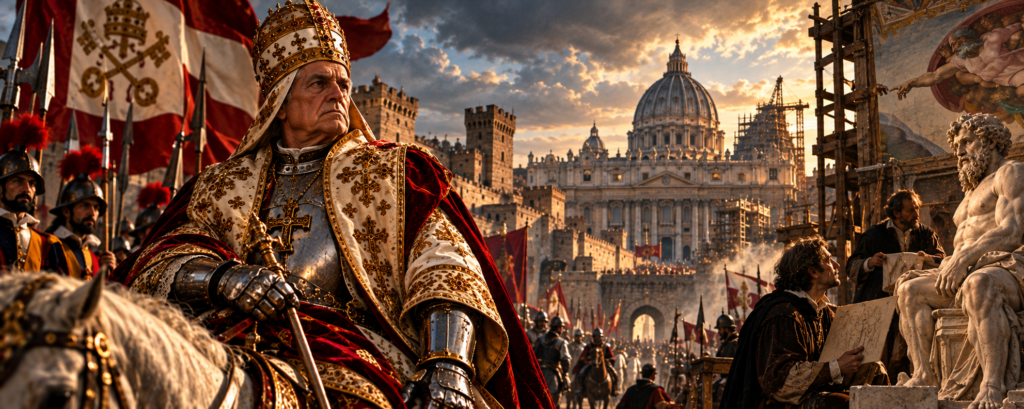
Julius II: The Warrior Pope Who Conquered Cities and Created the Renaissance Vatican
Julius II — 1503–1513
The Pope Who Rode to War
In the bitter winter of 1511, the ruler of the Catholic Church was preparing to take a city by force. Pope Julius II was nearly seventy years old, his health was uncertain, and the cold was severe enough to make campaigning miserable even for experienced soldiers. Yet the man who claimed spiritual authority over western Christianity had placed himself at the center of a military operation against the Italian city of Mirandola. He had no intention of remaining safely in Rome while his commanders fought the war he had demanded.
The siege became one of the most extraordinary spectacles of the Renaissance papacy. Julius supervised operations with a determination that astonished contemporaries, refusing to let his age or the weather interrupt his campaign. When Mirandola finally surrendered, the pope entered the captured city amid circumstances that later accounts embellished into a scene of almost unbelievable martial enthusiasm. The famous image of Julius climbing through a breach in the defenses captures the spirit of his reputation, although the precise details of his entry have been told differently by successive writers.
There was something deeply unsettling about the spectacle. The successor of Saint Peter, whose office represented the spiritual leadership of millions of Christians, had become a military commander directing the conquest of a Christian city. The same pope who celebrated Mass and issued religious decrees was prepared to use artillery, mercenary armies, political intimidation, and military occupation to impose his authority. Julius saw no necessary contradiction between defending the Church and making war on its enemies, even when those enemies were fellow Catholics.
Yet the Warrior Pope was also responsible for one of the most magnificent explosions of artistic creativity in European history. He commissioned Michelangelo to paint the Sistine Chapel ceiling, employed Raphael to decorate the Vatican apartments, and began rebuilding Saint Peter’s Basilica on a scale that would eventually transform the skyline of Rome. His patronage helped create works that millions of people still regard as masterpieces of religious art. The man who surrounded himself with soldiers also surrounded himself with artists capable of expressing humanity’s most ambitious visions of beauty and divine grandeur.
Julius II was therefore neither a simple monster nor an uncomplicated hero of the Renaissance. He was courageous, aggressive, intelligent, impatient, politically ruthless, and capable of inspiring extraordinary artistic achievement. He could speak of liberating Italy while forming alliances that devastated Italian cities, and he could condemn corruption while advancing the interests of his own powerful family. His pontificate reveals a Church struggling to preserve its political independence in a world where spiritual authority increasingly depended upon armies, fortresses, money, and diplomacy.
To understand how a pope became a warrior, it is necessary to begin with a young man whose family connections placed him on the road to power long before he wore the papal tiara.
Giuliano della Rovere: The Making of a Renaissance Prince
Giuliano della Rovere was born on December 5, 1443, in the Ligurian town of Albisola, near Savona. His family was not among the most ancient or powerful dynasties of Italy, but it possessed ambitions that would eventually transform its fortunes. Giuliano’s future changed dramatically when his uncle Francesco della Rovere became Pope Sixtus IV in 1471. The new pope was determined to advance his relatives, and Giuliano became one of the most important beneficiaries of that determination.
Sixtus IV’s pontificate demonstrated how family loyalty could become a governing principle of the Renaissance papacy. He elevated nephews into powerful positions, distributed ecclesiastical offices, and involved relatives in the political struggles of the Italian peninsula. His patronage helped transform the della Rovere family into a major political force. Giuliano learned early that the Church could provide opportunities for wealth, prestige, and territorial influence far beyond the ordinary rewards of a religious career.
In December 1471, Giuliano was created a cardinal while still in his twenties. He accumulated important benefices and ecclesiastical responsibilities, including positions that gave him access to considerable revenue. His advancement was rapid, and his political influence grew alongside his wealth. He was not merely a passive recipient of his uncle’s generosity, however, because he quickly demonstrated an ability to operate within the complicated world of papal diplomacy.
Giuliano developed a reputation for determination, ambition, and an unwillingness to surrender an advantage once he had secured it. He understood the importance of alliances with Italian rulers and foreign monarchs, particularly when those relationships could strengthen his position within the College of Cardinals. His ecclesiastical career became inseparable from the pursuit of political power. By the time he approached the papacy himself, he had spent decades learning how to survive the dangerous competition surrounding the throne of Saint Peter.
His early career also exposed him to the violent consequences of papal family politics. The Italian states were constantly negotiating, threatening, and fighting one another, while Rome’s great aristocratic families struggled to control the papal government. A cardinal could become a diplomat, financier, military patron, and factional leader without abandoning his ecclesiastical title. Giuliano embraced that world with unusual energy.
The Nephew of Sixtus IV
Sixtus IV was one of the most important influences upon Giuliano’s political development. His uncle’s pontificate was marked by artistic patronage, territorial ambition, and aggressive nepotism. The Sistine Chapel itself took its name from Sixtus, who commissioned its construction and earlier decorative program. Giuliano therefore grew up politically within a family that combined cultural magnificence with intense competition for secular power.
The pope’s relatives acquired positions that brought them into conflict with established Italian dynasties. Girolamo Riario, another prominent nephew, became involved in the struggle against the Medici of Florence. The notorious Pazzi conspiracy of 1478 emerged from that wider conflict, culminating in the murder of Giuliano de’ Medici inside Florence Cathedral. The precise extent of Sixtus IV’s knowledge of the assassination plan remains disputed, but the political struggle surrounding it demonstrates the atmosphere in which Giuliano della Rovere learned to operate.
Giuliano’s own advancement continued through appointments, benefices, and diplomatic missions. He acquired experience dealing with the French monarchy, a relationship that would become especially important later. France offered a powerful counterweight to rival Italian factions, but dependence upon foreign rulers carried dangers. Giuliano would eventually discover that the same kingdom capable of protecting his ambitions could threaten the independence of the papacy.
His relationship with the della Rovere family also shaped his understanding of authority. Family advancement was not simply a private indulgence but a means of creating political networks capable of supporting a pontiff. Relatives could command troops, govern territories, negotiate marriages, and protect ecclesiastical interests. Giuliano would criticize the Borgias for their dynastic ambitions, yet his own career had been made possible by similar mechanisms.
This contradiction would remain central to his pontificate. Julius II opposed the Borgia family with extraordinary determination, but he did not reject the political culture that had enabled its rise. He wanted to control that system and direct it toward his own conception of papal power. His ambition was institutional as well as personal, although the distinction was not always easy to maintain.
The Rivalry That Became an Obsession
Giuliano della Rovere’s greatest political enemy was Rodrigo Borgia, the cardinal who became Pope Alexander VI in 1492. Their rivalry developed over years of competition within the College of Cardinals. Both men were wealthy, influential, experienced, and determined to shape the future of the Church. Each understood that the other possessed the resources and connections necessary to become pope.
When Innocent VIII died in 1492, Giuliano was among the principal contenders for the succession. Rodrigo Borgia emerged victorious and took the name Alexander VI. Accusations of electoral corruption circulated immediately, and Giuliano became one of the most prominent opponents of the new pontiff. The defeat intensified a hostility that would dominate the next decade of his life.
Alexander’s election was especially threatening because the Borgia pope intended to advance his children and relatives through the resources of the Church. Giuliano had benefited from his uncle’s nepotism, but he regarded the Borgias as dangerous rivals who might destroy the political influence of his own faction. The struggle was therefore about more than personal dislike. It involved competing visions of who should control the papacy and its territories.
Giuliano eventually sought protection outside Rome, where Alexander’s authority made opposition increasingly dangerous. His connections with France became central to his survival. The French monarchy offered both refuge and the possibility of military pressure against the Borgia government. Yet this alliance would create an enduring irony, because Julius later became one of France’s fiercest enemies.
The rivalry between Giuliano and Alexander reveals the extraordinary political character of the Renaissance papacy. Cardinals behaved like rival princes, foreign monarchs became participants in ecclesiastical disputes, and the election of a pope could determine the balance of power across Italy. Giuliano did not merely want to defeat Alexander in an argument over church administration. He wanted to remove the Borgia dynasty from the center of Italian politics.
Exile, France, and the Threat of Deposition
Giuliano’s opposition to Alexander VI brought him into increasingly dangerous territory. He spent significant periods outside Rome, particularly in France, where he cultivated the support of the monarchy. The French court became an important center of anti-Borgia diplomacy. Giuliano hoped that foreign pressure might weaken Alexander’s position or force concessions.
When Charles VIII invaded Italy in 1494, Giuliano was associated with the French king’s political circle. Some opponents of Alexander hoped that the invasion might lead to a council challenging the pope’s legitimacy. Such proposals reflected the continuing influence of conciliar ideas following the Western Schism. They also demonstrated how readily ecclesiastical reform could become entangled with military intervention.
Alexander survived the French invasion through negotiation and political maneuvering. Giuliano’s hopes of removing him were frustrated, and the Borgia pope remained in office. The experience reinforced Giuliano’s understanding that military power could determine the fate of the papacy. It also taught him that foreign allies could be unreliable.
Over the following years, Giuliano continued opposing Alexander while the Borgia family expanded its influence. Cesare Borgia’s campaigns in the Romagna threatened established rulers and strengthened the pope’s territorial position. Giuliano watched as the Borgias transformed papal authority into an instrument of family conquest. Their success deepened his determination to reverse their achievements.
By 1503, the rivalry had become a struggle over the future of central Italy. Giuliano possessed extensive political experience and influential supporters, but Alexander still controlled the papal throne. The balance changed only when the Borgia pope died unexpectedly in August of that year. Giuliano finally saw the opportunity he had been waiting for.
The Death of Alexander VI and the Collapse of Borgia Power
Alexander VI died on August 18, 1503, after a sudden illness. His son Cesare was also seriously ill, leaving the Borgia family vulnerable at the worst possible moment. Their enemies moved quickly to recover territories and influence lost during the previous decade. Giuliano della Rovere was among those who recognized the extraordinary opportunity created by the pope’s death.
The Borgia political system depended heavily upon Alexander’s personal authority. Cesare had conquered cities and built alliances, but his position was not secure without the support of the papacy. Local rulers who had been driven from their territories began preparing to return. Foreign monarchs reconsidered their commitments, and cardinals calculated how the next election might reshape Italy.
The conclave of September 1503 elected Francesco Todeschini Piccolomini as Pope Pius III. His pontificate lasted only twenty-six days before his death in October. The rapid succession created another opportunity for Giuliano. He had spent decades preparing for a moment when his influence could finally produce victory.
Cesare attempted to preserve his position during the transition. He possessed military resources and hoped to negotiate with the next pope. Yet his illness and the growing hostility of his enemies weakened his bargaining power. Giuliano understood that the Borgia prince could be useful temporarily but dangerous if allowed to retain independent strength.
The collapse of Alexander’s authority therefore became the opening act of Julius II’s pontificate. The new pope would inherit a political landscape shaped by Borgia conquest, French intervention, and the ambitions of Italian rulers. He intended to reorganize that landscape under papal control. His methods would prove every bit as aggressive as those of the family he despised.
The Conclave of 1503: Giuliano Takes the Throne
Giuliano della Rovere was elected pope on November 1, 1503, after one of the shortest conclaves of the period. His victory reflected extensive political preparation and the ability to secure support among influential cardinals. Contemporary observers recognized that promises and negotiations played an important role in the election. The precise details of every agreement remain difficult to reconstruct, but Giuliano’s political skill was unmistakable.
He chose the name Julius II, a name that invited associations with authority and perhaps the grandeur of ancient Rome. His election marked the culmination of a career spent navigating papal politics, foreign alliances, and factional rivalries. He was nearly sixty years old and had little reason to expect an exceptionally long pontificate. Yet he approached the office with extraordinary energy.
Julius immediately faced the question of Cesare Borgia’s territories. The former cardinal had built a powerful position in the Romagna and hoped to preserve it through negotiation. Julius initially dealt with him cautiously, recognizing that Cesare still possessed influence. Once the pope had secured his position, however, the relationship deteriorated.
Cesare was arrested and gradually lost control of the territories he had conquered. Julius intended to restore effective papal authority without allowing the Borgia family to retain a hereditary principality. The distinction was important to him because he regarded the Papal States as possessions of the Church rather than the private property of a pope’s children. His enemies nevertheless observed that the della Rovere family also benefited from papal power.
The new pontiff had defeated his greatest rival’s dynasty, but the victory was only the beginning. Julius wanted to recover territories, strengthen Rome, and establish the papacy as a major Italian power. He would pursue those objectives with an intensity that astonished Europe. The Warrior Pope had arrived.
The Papal States: A Kingdom Without a King
The Papal States occupied a complicated position within Renaissance Italy. They consisted of territories over which the pope claimed temporal sovereignty, but actual control varied enormously. Local rulers, noble families, and city governments often exercised substantial independence. The pope’s legal authority did not always translate into obedience.
This fragmentation created constant opportunities for conflict. Cities such as Bologna, Perugia, and those of the Romagna possessed political traditions and ruling families reluctant to surrender power. Some acknowledged papal supremacy while resisting interference in their internal affairs. Others depended upon foreign alliances to preserve their independence.
Julius regarded this situation as intolerable. He believed that the Church could not exercise genuine political independence while its territories remained divided among ambitious local rulers. A papacy dependent upon the goodwill of Venice, France, or powerful Italian families would always be vulnerable. His solution was to strengthen direct control over the Papal States.
The objective was not entirely unreasonable within the political assumptions of his age. Other European rulers were centralizing authority and weakening semi-independent nobles. Julius wanted the papacy to participate in that process. Yet his determination meant that cities and families resisting papal control would face military coercion.
The distinction between defending church property and expanding papal power was frequently blurred. Julius presented his campaigns as the recovery of territories rightfully belonging to Saint Peter. His opponents saw an ambitious Italian prince using religious authority to justify conquest. Both interpretations contained elements of truth.
The First Campaign: Perugia and Bologna
In 1506, Julius undertook a campaign designed to restore papal authority over Perugia and Bologna. The expedition marked a decisive change in the public role of the pope. Rather than remaining in Rome and relying entirely upon commanders, Julius personally accompanied the movement of his forces. His presence transformed the campaign into a demonstration of papal determination.
Perugia was controlled by the Baglioni family, whose internal conflicts and violent reputation had made the city notorious. Julius pressured its ruler, Gian Paolo Baglioni, into submission. The confrontation ended without the kind of major battle that might have devastated the city. Nevertheless, the outcome demonstrated that papal authority was being enforced through military intimidation.
Bologna presented a more complicated challenge. The city was ruled by Giovanni II Bentivoglio, whose family had dominated its government for decades. Bentivoglio resisted Julius’s demands and sought support from foreign allies. The pope responded with political pressure and military preparations.
The campaign succeeded when Bentivoglio’s position collapsed and he fled Bologna. Julius entered the city in November 1506 amid ceremonies celebrating the restoration of papal authority. The event became one of the defining triumphs of his early pontificate. It also reinforced his conviction that personal intervention could produce results that diplomacy alone had failed to achieve.
Bologna would remain a source of conflict, but Julius had demonstrated his willingness to act like a conquering ruler.
Bologna: A City Caught Between Pope and Prince
Bologna was one of the most important cities in northern Italy. Its wealth, university, commercial connections, and strategic position made it valuable to any ruler seeking influence in the region. The Bentivoglio family had established a political system that combined local support with aristocratic domination. Their removal therefore represented a major change in the city’s government.
Julius presented the campaign as the liberation of Bologna from an illegitimate ruler. Papal propaganda emphasized the restoration of lawful authority and the benefits of direct government by the Church. Yet many inhabitants had reasons to fear the disruption caused by regime change. Political factions quickly began competing for influence under the new administration.
The pope’s entry into Bologna was carefully staged to display triumph and legitimacy. Religious ceremonies accompanied political celebration, reinforcing the idea that papal conquest represented a sacred victory. Julius received honors appropriate to a sovereign ruler. His authority was presented as both spiritual and temporal.
The campaign also revealed the dependence of papal policy upon foreign military relationships. French support had helped make the operation possible, but France possessed its own ambitions in northern Italy. Julius was willing to cooperate with foreign powers when they served his objectives. He would later turn against them when their influence became threatening.
The victory at Bologna therefore contained the seeds of future conflict. Julius had strengthened the papacy, but he had also drawn it more deeply into the dangerous competition among European states. The city would soon become a battleground again. Its inhabitants would pay for the ambitions of rulers who claimed to be protecting them.
The Bronze Pope Who Was Thrown Down
Julius wanted his triumph at Bologna to be remembered. He commissioned Michelangelo to create a monumental bronze statue of the pope, intended for public display in the city. The project represented a remarkable fusion of artistic patronage and political propaganda. Julius wanted an image that would proclaim his authority long after the army had departed.
Michelangelo was primarily celebrated as a sculptor, and the bronze commission presented significant technical challenges. The artist worked on the statue amid tensions with the pope and the demands of other projects. The finished figure showed Julius in a commanding pose, appropriate to a ruler determined to impose obedience. It was installed in Bologna in 1508.
The statue’s survival was brief. In 1511, when anti-papal forces regained control of Bologna, the monument was destroyed. Its bronze was eventually reused, including for artillery associated with the Este rulers of Ferrara. The transformation of a papal statue into material for a cannon became one of the most striking ironies of Julius’s reign.
The episode reveals the fragility of political triumphs expressed through public monuments. Julius had commissioned an image intended to symbolize permanent authority. His enemies destroyed it when the balance of power changed. The same bronze that had represented papal majesty became associated with the machinery of war.
Michelangelo’s lost statue also foreshadowed the turbulent relationship between the artist and the pope. Julius could inspire magnificent works, but his demands were often impatient and politically charged. Artistic achievement and military ambition were never far apart in his imagination. The destruction of the Bologna monument made that connection brutally visible.
Venice: The Republic That Stood in His Way
The Republic of Venice was one of the most powerful states in Italy. Its territories extended across the mainland, and its commercial wealth supported formidable diplomatic and military resources. Venetian expansion had brought it into possession of cities claimed by the papacy. Julius regarded this situation as an unacceptable challenge to his authority.
The conflict centered partly upon territories in the Romagna and surrounding regions. Venice had taken advantage of the collapse of Borgia power to strengthen its position. Julius wanted those territories restored to direct papal control. Negotiations failed to produce a settlement satisfactory to him.
The pope therefore turned toward a coalition of powers that also resented Venetian expansion. France, the Holy Roman Empire, and other rulers possessed competing territorial claims against the republic. Their interests were not identical, but hostility toward Venice created an opportunity for cooperation. Julius believed that an alliance could force the republic to surrender disputed territories.
The resulting League of Cambrai became one of the most dangerous political experiments of his pontificate. It brought together powerful states whose combined military strength threatened to dismantle Venetian influence across northern Italy. Julius participated because the coalition appeared useful to papal interests. He would soon discover that weakening Venice could strengthen France far more than he intended.
The Warrior Pope was learning that victory over one enemy could create a more dangerous rival.
The League of Cambrai: A Dangerous Alliance
The League of Cambrai was formed in December 1508 through agreements among major European powers. Its principal objective was to challenge Venetian territorial expansion. Julius joined the anti-Venetian coalition and supported military action against the republic. The alliance represented a dramatic escalation of the Italian Wars.
In 1509, French forces defeated the Venetians at the Battle of Agnadello. The defeat was devastating and temporarily threatened the republic’s mainland possessions. Cities changed allegiance, and Venice struggled to preserve its territorial position. The coalition appeared to have achieved a spectacular success.
Julius imposed ecclesiastical sanctions against Venice as part of the struggle. Excommunication and other spiritual measures were used alongside military pressure. The pope treated political resistance to his territorial claims as a matter capable of attracting religious punishment. This fusion of spiritual authority and secular warfare became one of the most controversial features of his government.
Yet the success of the coalition created new dangers. France emerged with increased influence in northern Italy, and Julius began fearing that the French monarchy might dominate the peninsula. The pope’s objective had been to strengthen the independence of the Papal States. Instead, his alliance risked placing them beneath the shadow of a powerful foreign ruler.
Julius responded by changing sides. He moved toward reconciliation with Venice and began organizing opposition to France. The reversal was characteristic of his diplomacy, but it also exposed the instability of alliances built upon competing ambitions. The pope who had helped attack Venice now needed its assistance.
From Ally to Enemy: Julius Turns Against France
France had once provided Giuliano della Rovere with refuge and political support against Alexander VI. French military assistance had also helped Julius recover Bologna. Yet by 1510, the pope increasingly regarded French influence as the greatest threat to Italian independence. His former ally had become his principal enemy.
King Louis XII controlled important territories in northern Italy and supported political arrangements that Julius considered dangerous. The pope feared that French power might reduce the Papal States to a dependent position. He also resented French influence over cities and rulers whose obedience he wanted for himself. The relationship deteriorated rapidly.
Julius sought new allies, including Venice and eventually Spain and other powers. His diplomacy became increasingly aggressive as he attempted to build a coalition capable of expelling the French. He presented the struggle as a defense of Italy and the Church. His opponents argued that he was pursuing territorial ambition under the language of liberation.
The conflict was particularly bitter because both sides possessed substantial resources. France could deploy experienced armies, while Julius controlled ecclesiastical sanctions, diplomatic networks, and the political legitimacy of the papacy. Neither side was willing to concede easily. The result was a series of campaigns that devastated parts of northern Italy.
Julius’s hostility toward France would become one of the defining struggles of his final years.
The Siege of Mirandola: A Pope in the Snow
The siege of Mirandola in January 1511 became the most famous military episode of Julius’s pontificate. The city was controlled by the Pico family and occupied a strategic position in northern Italy. Julius wanted to force its submission and weaken forces aligned with his enemies. He personally accompanied the campaign despite the severe winter conditions.
The weather was bitterly cold, and military operations were difficult. Soldiers endured discomfort while artillery and siege preparations continued. Julius refused to abandon the campaign, demonstrating a determination that impressed supporters and astonished critics. His presence placed the pope directly within the dangers of war.
Contemporary and later accounts describe Julius entering Mirandola after its surrender, sometimes emphasizing his willingness to pass through a breach in the defenses. The details have been dramatized over time, but the essential fact remains extraordinary. The pope personally participated in a winter siege against a Christian city. His conduct was far removed from the traditional image of a spiritual shepherd.
The capture of Mirandola strengthened Julius’s reputation as the Warrior Pope. Supporters praised his courage and determination to recover papal authority. Critics regarded the spectacle as evidence that the papacy had become indistinguishable from an Italian principality. Both responses reflected the unusual character of his rule.
Mirandola also revealed the human cost of his ambitions. Sieges disrupted civilian life, damaged property, and exposed inhabitants to hunger, fear, and violence. Julius saw the campaign as necessary to defend the Church’s interests. The people trapped inside the city experienced it as war.
The Warrior Pope in Armor
Julius II became famous for wearing armor and personally accompanying military expeditions. The image has sometimes been exaggerated into a portrait of a pope constantly charging into battle. He was not a conventional battlefield commander leading cavalry assaults with a sword. His military role was primarily political and strategic, although he exposed himself to the dangers of campaigning.
His willingness to appear among soldiers carried enormous symbolic importance. Renaissance rulers often demonstrated authority through personal participation in war. Julius understood that courage could strengthen loyalty and intimidate enemies. His presence suggested that papal commands were backed by personal determination.
The spectacle nevertheless troubled contemporaries who believed the pope should embody spiritual restraint. Christian teaching emphasized peace, charity, and the pastoral responsibilities of religious leaders. A pontiff directing sieges and threatening cities seemed to violate those ideals. The contradiction became especially sharp when the pope’s enemies were fellow Christians.
Julius defended his conduct through the language of necessity. He believed that the Church required secure territories and political independence to fulfill its mission. Foreign domination, rebellious cities, and hostile rulers threatened that independence. Military action could therefore be presented as a duty rather than a personal indulgence.
The argument was powerful within the political assumptions of the age, but it did not eliminate the moral problem. Julius’s campaigns caused suffering, and his ambitions repeatedly drew the Church into wars that might have been avoided. The Warrior Pope became a symbol of the tension between spiritual authority and temporal power. His armor was both a practical instrument and a declaration of how he understood the papacy.
The Holy League: Driving the French from Italy
In 1511, Julius organized the Holy League against France. The coalition brought together the papacy, Venice, Spain, and other powers determined to challenge French influence. Its name suggested a religious mission, but its objectives were fundamentally political and territorial. Julius wanted to expel the French from northern Italy and restore papal independence.
The alliance reflected the extraordinary flexibility of Renaissance diplomacy. Venice, recently attacked by a coalition that included Julius, was now one of his principal partners. Spain possessed its own ambitions in Italy, while the Holy Roman Empire pursued interests that did not always align with those of the pope. The coalition was united more by opposition to France than by a shared vision of peace.
Julius used religious language to strengthen support for the campaign. He portrayed the struggle as a defense of the Church and the liberation of Italy from foreign domination. Yet the armies involved were composed of soldiers serving competing monarchs and states. Their victories and defeats would determine territorial control rather than resolve theological disputes.
The Holy League eventually achieved important successes, but the road was bloody. French forces remained formidable, and the struggle produced devastating battles. Cities were occupied, fortifications damaged, and political alliances repeatedly reversed. Julius’s determination prolonged the conflict even as it helped secure the outcome he desired.
The campaign demonstrated both his political effectiveness and the enormous cost of his methods.
Ravenna: Victory Written in Blood
The Battle of Ravenna, fought on April 11, 1512, was one of the bloodiest encounters of the Italian Wars. French forces under Gaston de Foix confronted the army of the Holy League, which included Spanish and papal troops. The battle involved artillery, infantry, cavalry, and intense fighting. Thousands of soldiers were killed or wounded.
The French achieved a tactical victory, but their commander Gaston de Foix was killed during the fighting. His death weakened the French position despite the battlefield success. The battle demonstrated the destructive power of Renaissance warfare, particularly the increasing importance of artillery and disciplined infantry. It also revealed the instability of victories purchased at enormous human cost.
Julius was not personally commanding the army at Ravenna, but the battle was fought as part of the coalition he had helped create. His political decisions had contributed directly to the conflict. The pope’s determination to expel France from Italy placed thousands of men in the path of destruction. The suffering extended beyond the battlefield into the surrounding region.
Ravenna also became associated with the violence inflicted upon civilians after military victory. Contemporary accounts describe the city suffering severely during the French occupation and sack. The details vary among sources, but the broader devastation is beyond doubt. The war that Julius presented as liberation brought terror to Italian communities.
The battle therefore stands as one of the darkest episodes of his pontificate. It demonstrates how the pursuit of political independence could produce suffering on a scale far greater than the immediate territorial dispute. Julius’s ambitions were not abstract calculations. They were translated into blood, destruction, and the collapse of ordinary lives.
The Council of Pisa: A Pope Challenged by His Own Church
Julius’s conflict with France extended beyond the battlefield. King Louis XII supported efforts to challenge the pope through a council of churchmen. The resulting assembly, often called the conciliabulum of Pisa, began in 1511 and claimed authority to address abuses and the pope’s conduct. Its supporters accused Julius of failing to fulfill his responsibilities and of governing through excessive political ambition.
The council drew upon traditions associated with the Western Schism, when competing papal claims had encouraged arguments for conciliar authority. Some churchmen believed that a general council could act against a pope who endangered the Church. Julius rejected the legitimacy of the assembly. He regarded it as a politically motivated attack supported by his enemies.
The confrontation revealed the continuing tension between papal monarchy and conciliar reform. Julius insisted upon the supremacy of the papal office, while his opponents claimed that extraordinary circumstances justified collective ecclesiastical intervention. The dispute was not merely theological. It was inseparable from the war between France and the papacy.
Julius responded by summoning his own council, the Fifth Lateran Council, which opened in 1512. The assembly was intended partly to counter the rival council and reaffirm papal authority. It also addressed questions of reform and ecclesiastical government. Yet its political origins were unmistakable.
The conflict demonstrated how easily religious institutions could become instruments of secular rivalry. Both sides claimed to defend the Church while pursuing political objectives. Julius ultimately prevailed in the struggle over legitimacy, but the episode exposed the fragility of papal authority. Even the Warrior Pope could be challenged by churchmen invoking the need for reform.
The Fifth Lateran Council
The Fifth Lateran Council opened in May 1512 under Julius II. Its convocation represented a direct response to the schismatic council supported by France. Julius intended to demonstrate that legitimate ecclesiastical authority remained centered upon the pope. The council also provided an opportunity to address broader institutional concerns.
The assembly continued after Julius’s death and concluded under his successor Leo X in 1517. It issued decrees concerning ecclesiastical discipline, preaching, education, and other matters. Yet its reforming achievements were limited compared with the scale of the problems facing the Church. Corruption, financial abuses, and disputes over authority remained unresolved.
The timing is historically significant because Martin Luther’s challenge to indulgence practices emerged in the same year the council ended. Julius did not live to witness the Protestant Reformation, but his pontificate belonged to the institutional world that preceded it. The Church’s wealth, political entanglements, and financial demands would become central subjects of criticism. His grand artistic projects also contributed to the financial pressures later associated with Saint Peter’s.
The council illustrates Julius’s determination to defend papal authority through institutional as well as military means. He was not indifferent to the structure of the Church. He understood that councils, decrees, and ecclesiastical legitimacy mattered. Yet his priorities remained deeply shaped by the political struggle against France.
The Fifth Lateran Council became part of his effort to secure the papacy against enemies both inside and outside the Church.
Michelangelo and the Pope Who Would Not Be Refused
Julius’s relationship with Michelangelo Buonarroti became one of the most famous and turbulent partnerships in art history. The pope recognized the sculptor’s extraordinary talent and wanted to employ it in projects worthy of his own ambitions. Michelangelo possessed a fiercely independent temperament and was not easily controlled. Their encounters became legendary for arguments, frustration, and mutual determination.
The relationship began with plans for an enormous papal tomb. Julius wanted a monument that would proclaim his greatness and preserve his memory. Michelangelo conceived an ambitious sculptural program involving numerous figures. The project promised to become one of the most magnificent funerary monuments ever created.
Yet Julius’s priorities changed as other projects demanded attention and resources. The rebuilding of Saint Peter’s Basilica became increasingly important, and the tomb was delayed. Michelangelo became frustrated by the uncertainty and believed his work was being neglected. The dispute escalated into a personal crisis.
In 1506, Michelangelo left Rome without permission, returning to Florence. Julius was furious and demanded his return. The episode demonstrated the tension between an artist who regarded his work as a personal calling and a pope accustomed to commanding obedience. Their reconciliation required negotiation and political intervention.
The conflict did not end their relationship. Julius continued employing Michelangelo, and the artist eventually undertook the Sistine Chapel ceiling. Their partnership produced extraordinary art precisely because both men possessed immense ambition. Yet the process was often marked by anger, pressure, and competing visions.
The Tomb That Became a Lifelong Burden
The tomb of Julius II became one of the most troubled projects of Michelangelo’s career. The original design was extraordinarily ambitious, involving a vast architectural structure and numerous sculptures. Julius imagined a monument appropriate to a ruler who intended to transform Rome. Michelangelo saw an opportunity to create a masterpiece of sculpture.
The project was repeatedly revised, delayed, and reduced. Julius’s death in 1513 complicated matters further because his heirs and executors sought to enforce contractual obligations. Michelangelo spent decades struggling with the consequences. He later regarded the tomb as a source of immense frustration.
The final monument was installed in San Pietro in Vincoli rather than the new Saint Peter’s Basilica. It was much smaller than the original conception. Nevertheless, it included Michelangelo’s magnificent statue of Moses, one of the most powerful sculptures of the Renaissance. The figure’s commanding presence reflects the grandeur originally envisioned for the project.
The tomb demonstrates Julius’s ambition and the difficulties created by his changing priorities. He wanted artistic immortality but repeatedly redirected resources toward war and architecture. Michelangelo’s frustration arose partly because the pope’s political ambitions interfered with artistic commitments. The resulting struggle became a defining episode in the artist’s life.
Julius’s desire for a monumental tomb also reveals his understanding of legacy. He wanted future generations to remember him as a ruler of extraordinary significance. His military victories might fade, but marble could preserve an image of power. The irony is that the unfinished project became famous partly because of the difficulties he created.
The Sistine Chapel: Heaven Above a Warrior’s Head
In 1508, Julius commissioned Michelangelo to repaint the ceiling of the Sistine Chapel. The chapel had been built under Sixtus IV, Julius’s uncle, and already possessed an important decorative program. Structural problems and damage to the existing ceiling contributed to the decision to undertake new work. Julius wanted a transformation worthy of his pontificate.
Michelangelo initially resisted the commission because he considered himself primarily a sculptor. Painting a vast ceiling presented technical and artistic challenges unlike those he had previously faced. The original program was comparatively limited, but the project expanded into an extraordinary cycle of biblical imagery. Michelangelo ultimately created one of the most ambitious works in Western art.
The ceiling depicts scenes from Genesis, prophets, sibyls, and figures associated with the ancestry of Christ. Its central images include the Creation of Adam, one of the most recognizable works in art history. The figures possess a physical power and emotional intensity that transformed expectations of monumental painting. The project required years of exhausting labor.
Julius followed the work with characteristic impatience. Later accounts describe tensions over progress, payment, and the artist’s methods. Some anecdotes have been embellished, but the broader relationship was undeniably difficult. The pope wanted results, while Michelangelo insisted upon the time necessary to complete his vision.
The ceiling was unveiled in 1512, only months before Julius’s death. The pope attended the solemn Mass marking its completion on November 1. The achievement transformed the chapel and secured Michelangelo’s reputation as one of the greatest artists of the Renaissance. It also created an enduring paradox: one of Christianity’s most celebrated artistic visions had been commissioned by a pope famous for making war.
Raphael and the Rooms of Papal Glory
Julius also employed Raphael, the brilliant young painter from Urbino, to decorate apartments in the Vatican. The pope chose rooms separate from those associated with Alexander VI, reflecting his desire to distance himself from the Borgia predecessor he despised. Raphael began work in 1508 and developed a decorative program of extraordinary intellectual and artistic ambition. The resulting frescoes became among the greatest achievements of the High Renaissance.
The Stanza della Segnatura included the famous School of Athens, a monumental celebration of classical philosophy. Plato and Aristotle occupy the center of a grand architectural space, surrounded by thinkers representing different traditions of inquiry. The fresco reflects Renaissance humanism and the intellectual culture of the papal court. Its magnificence also served the prestige of Julius’s government.
Other paintings explored theology, poetry, law, and the relationship between divine and human knowledge. Raphael’s work presented the papacy as a center of wisdom and cultural authority. The program was not merely decorative. It expressed a vision of Rome as the spiritual and intellectual capital of Christian civilization.
Julius’s patronage gave Raphael access to extraordinary resources and opportunities. The artist’s reputation expanded rapidly, and his workshop became central to the artistic life of Rome. His projects continued under later popes, but Julius had initiated the transformation. The Vatican became a stage upon which Renaissance art reached new levels of ambition.
The contrast with Julius’s military career is striking. While armies fought over cities, Raphael painted scenes celebrating reason, harmony, and the search for truth. The same pope who pursued political domination also sponsored images of intellectual balance. His reign contained both impulses without resolving their contradiction.
The Expulsion of Heliodorus: Art as Political Propaganda
Raphael’s Room of Heliodorus reveals the political meaning of Julius’s artistic patronage particularly clearly. The fresco depicts the biblical story of Heliodorus being driven from the Temple after attempting to seize its treasures. Divine intervention protects sacred property from an intruder. The scene offered an obvious parallel to Julius’s determination to defend the possessions of the Church.
The pope appears within the composition, carried in a ceremonial chair and witnessing the miraculous event. His presence connects biblical history to contemporary papal authority. The message is unmistakable: those who threaten the Church’s possessions risk divine punishment. Art becomes an instrument of political legitimacy.
The fresco was created during the period when Julius was struggling against French influence in Italy. Its imagery reflected the pope’s conviction that the Church’s temporal rights were sacred and required defense. The connection between spiritual authority and territorial sovereignty was presented as natural. Military conflict could therefore be interpreted through the language of divine protection.
Raphael’s artistic brilliance made the message extraordinarily powerful. The figures move through a dramatic architectural space filled with energy and tension. The intruders are overwhelmed by supernatural force, while the pope remains associated with legitimate authority. The composition transforms a political claim into a visual statement of sacred order.
The Room of Heliodorus demonstrates that Julius’s artistic projects were not separate from his wars. They helped explain and justify the political vision behind those wars. The Warrior Pope used painting as effectively as diplomacy to communicate authority. His patronage was magnificent, but it was also deeply political.
Bramante and the Destruction of Old Saint Peter’s
Julius’s most ambitious architectural project was the rebuilding of Saint Peter’s Basilica. The ancient church, associated with the emperor Constantine and the tomb of Saint Peter, had stood for more than a thousand years. By the early sixteenth century, parts of the structure were deteriorating and proposals for renovation had circulated for decades. Julius decided that Rome required a new basilica of unprecedented grandeur.
He entrusted the project to Donato Bramante, one of the leading architects of the Renaissance. Bramante envisioned a monumental building inspired by classical architecture and centered upon an immense dome. The design reflected the ambition to create a church worthy of the papacy’s universal claims. It also promised to transform the physical appearance of Rome.
The decision required the demolition of substantial portions of the old basilica. This was controversial because the ancient church possessed enormous historical and religious significance. Its monuments, tombs, and accumulated memories connected generations of Christians to the earliest centuries of the Church. Destroying parts of it to create a new structure raised serious concerns.
Julius nevertheless pressed forward. On April 18, 1506, the foundation stone of the new Saint Peter’s was laid. The project became one of the most consequential architectural undertakings in European history. Its completion would require more than a century and involve numerous architects and artists.
The new basilica embodied Julius’s desire to create a Rome that would surpass the achievements of earlier ages. Yet it also demanded enormous resources and contributed to the financial pressures surrounding the Renaissance papacy. The magnificence of the project could not be separated from the institutional system that paid for it. Julius’s ambition reshaped the city while creating obligations that would outlive him.
The Price of Magnificence
The artistic and architectural projects of Julius II required substantial financial resources. Michelangelo, Raphael, Bramante, and their workshops needed materials, assistants, and payments. Military campaigns demanded even greater sums for soldiers, artillery, supplies, and diplomacy. The pope’s ambitions placed extraordinary pressure upon papal finances.
The Church possessed extensive revenues from territories, benefices, fees, and other sources. Julius used these resources to support both warfare and cultural patronage. His financial administration was generally more disciplined than that of some predecessors, but the scale of his projects remained immense. The papacy functioned as a major political and economic institution.
The rebuilding of Saint Peter’s became especially important in the later history of church finance. Fundraising for the basilica continued under Julius’s successors and became connected to controversial indulgence practices. The most famous disputes emerged after Julius’s death, particularly under Leo X. It would therefore be inaccurate to place the entire later indulgence controversy directly upon Julius.
Nevertheless, his decision to begin the new basilica created a financial commitment of enormous magnitude. The project symbolized the grandeur of the papacy but also exposed the tension between spiritual ideals and institutional wealth. Critics increasingly questioned whether religious authority should support such costly magnificence. The issue would become explosive during the Reformation.
Julius believed that great buildings could strengthen the Church’s prestige and authority. His critics saw the danger of a papacy more concerned with marble, armies, and monuments than with spiritual reform. Both perspectives reflected genuine aspects of his reign. The price of magnificence was paid not only in money but also in political and religious controversy.
The Pope’s Daughter: Felice della Rovere
Julius II had an acknowledged daughter, Felice della Rovere, born before his election to the papacy. Her existence complicates the image of Julius as a moral alternative to Alexander VI. Although he did not build an extensive dynasty through openly acknowledged children in the same manner as the Borgia pope, he was not free from the personal contradictions of Renaissance clerical life. Felice became an important figure in Roman aristocratic politics.
Felice’s mother was Lucrezia Normanni, and her daughter received opportunities connected to Giuliano’s influence. In 1506, Julius arranged Felice’s marriage to Gian Giordano Orsini, a member of one of Rome’s most powerful noble families. The marriage strengthened political connections between the papacy and the Orsini. It also demonstrated that Julius was willing to use family relationships for strategic purposes.
Felice was an intelligent and capable woman who later managed estates and participated in complex aristocratic affairs. Her career reveals that the daughters of powerful churchmen could exercise influence within the political world of Renaissance Italy. She was not merely a passive beneficiary of her father’s position. Her marriage and property interests placed her within important networks of power.
The comparison with Lucrezia Borgia is unavoidable. Both women were daughters of powerful churchmen, and both became instruments of aristocratic alliance. Yet Felice’s life developed differently, and her father did not attempt to construct a territorial empire through her marriage. The similarities nevertheless expose the limits of Julius’s moral distinction from the Borgias.
His personal conduct was less notorious than Alexander’s, but the structures of family advancement remained familiar.
Nepotism Without the Borgia Name
Julius II condemned the Borgia family’s domination of the papacy, yet his own career had been created through nepotism. His uncle Sixtus IV had elevated him to the cardinalate and provided the offices that made his later success possible. Once Julius became pope, he continued supporting relatives and trusted associates. The della Rovere family remained closely connected to papal power.
His nephew Francesco Maria della Rovere became an important beneficiary of the family’s political position. Through inheritance and papal support, Francesco Maria eventually became Duke of Urbino. The duchy provided the della Rovere family with a major territorial base. Julius’s patronage helped secure its future.
The distinction between Julius and Alexander lay partly in the scale and character of their dynastic projects. Alexander attempted to establish a powerful principality for Cesare through rapid conquest. Julius sought to strengthen direct papal control while also advancing relatives within established political structures. The difference was significant but not absolute.
Renaissance observers often judged nepotism according to whether it served their own interests. A pope’s relatives could be described as loyal defenders of the Church or as greedy opportunists, depending upon political allegiance. Julius benefited from this ambiguity. He could condemn Borgia ambition while presenting della Rovere advancement as legitimate.
His pontificate therefore demonstrates the persistence of family politics within the Renaissance Church. Nepotism was not merely the vice of one notorious pope. It was a structural feature of the institution. Julius modified its direction without escaping its influence.
Accusations About Julius’s Private Life
Julius II attracted hostile accusations concerning his private conduct, including allegations of sexual misconduct and relationships with men. Some opponents used extremely offensive language to portray him as morally corrupt. Such accusations appeared within a political culture where sexual scandal was a common weapon against powerful figures. They must be examined with considerable caution.
The surviving evidence does not establish the more sensational claims as historical fact. Political enemies had strong incentives to damage Julius’s reputation, particularly during his conflicts with France and rival churchmen. Accusations of sexual misconduct could undermine the moral authority of a pope without requiring convincing proof. Their circulation reveals the intensity of opposition rather than necessarily the truth of the allegations.
His acknowledged daughter Felice provides firmer evidence of a sexual relationship before his papacy. That fact is historically significant because Julius occupied high ecclesiastical office and was expected to observe clerical celibacy. Yet it does not validate unrelated accusations about his private life. Each claim must be judged according to its own evidence.
Julius’s reputation was also shaped by his aggressive temperament. Critics described him as angry, impatient, and excessively devoted to war. These characteristics are better supported by the documented record of his political conduct. His military campaigns and confrontations with artists, rulers, and cardinals provide substantial evidence of a forceful personality.
The distinction between documented behavior and hostile rumor is essential. Julius’s place among controversial popes does not depend upon unverified sexual allegations. His wars, political coercion, and use of spiritual authority for territorial objectives provide more substantial grounds for criticism. The historical record is already dramatic without adding unsupported scandal.
The Temper of a Renaissance Pope
Julius was famous for his forceful personality. Contemporaries described a man who could become impatient with delays, angry at resistance, and determined to impose his will. His relationship with Michelangelo provides some of the most memorable examples. Yet similar qualities appeared in his dealings with monarchs, cardinals, and military commanders.
His temperament was not simply a personal weakness. In the political culture of Renaissance Italy, displays of determination could strengthen authority. Rulers who appeared hesitant risked losing allies and encouraging rebellion. Julius cultivated an image of courage and decisiveness. His willingness to accompany military campaigns reinforced that reputation.
The danger was that determination could become inflexibility. Julius sometimes pursued objectives despite enormous political and human costs. His campaigns against Venice and France involved rapid reversals of alliance and prolonged warfare. The desire to secure papal independence could become inseparable from personal pride.
His artistic patronage displayed a similar mixture of vision and impatience. He recognized extraordinary talent but expected artists to satisfy his ambitions. Michelangelo’s frustration reflected the difficulty of working for a patron who could change priorities suddenly. The results were magnificent, but the process was often turbulent.
Julius’s personality therefore shaped both the destructive and creative achievements of his pontificate. His ambition drove armies across Italy and inspired monumental works of art. His determination helped strengthen papal authority while creating enemies. The same qualities produced triumph and conflict.
A Pope Who Wanted to Liberate Italy
Julius’s political program increasingly centered upon the idea of freeing Italy from foreign domination. The French presence in northern Italy became his principal target. He believed that the papacy could not remain independent while powerful foreign armies controlled neighboring territories. His campaigns were therefore presented as a defense of Italian liberty.
The language of liberation possessed genuine appeal. Italian states had suffered repeated invasions since 1494, and foreign monarchs increasingly determined their political fate. Julius understood the danger of allowing France or Spain to dominate the peninsula. His desire to strengthen papal independence reflected real strategic concerns.
Yet his methods often intensified the very conflicts he claimed to oppose. He formed alliances with foreign powers to defeat other foreign powers. Spain became an important partner against France, while the Holy Roman Empire pursued its own ambitions. The result was not a united Italy but a shifting balance of competing influences.
Julius’s vision was also limited by the political realities of his age. He did not seek a modern Italian nation-state. His primary concern was the security and authority of the Papal States. The language of Italian liberation served that objective, even when broader Italian interests were uncertain.
His campaigns nevertheless contributed to the development of ideas about foreign domination and political independence. Later writers remembered him as a ruler who resisted French power with extraordinary determination. His reputation as a defender of Italy coexisted with the suffering caused by his wars. The contradiction remains central to his historical legacy.
The Swiss Guards and the Protection of the Pope
Julius II is associated with the establishment of the Swiss Guard in 1506. Swiss soldiers had already earned a reputation as formidable mercenaries in European warfare. Their discipline and military effectiveness made them attractive to rulers seeking reliable protection. Julius arranged for a contingent to serve the papacy.
The first Swiss guards arrived in Rome in January 1506. Their presence reflected the pope’s concern for personal security and the defense of the papal government. Rome remained vulnerable to factional violence and foreign intervention. Julius wanted soldiers whose loyalty would strengthen his position.
The establishment of the guard became one of the most enduring institutional legacies of his pontificate. The Swiss Guard continues to serve the papacy, although its modern role differs greatly from the military circumstances of the Renaissance. Its origins belong to a world in which the pope was both spiritual leader and territorial sovereign. Armed protection was considered necessary to preserve his authority.
The guard also symbolizes the militarization of Julius’s papacy. He did not regard soldiers as an embarrassment to religious government. He saw them as essential instruments of security and independence. His reign helped normalize the image of a pope surrounded by professional military protection.
The institution survived long after his territorial campaigns ended. It remains a visible reminder of the political dangers that shaped Renaissance Rome. Julius’s decision reflected practical concerns, but it also embodied his conviction that spiritual authority required the capacity for force.
The Final Triumph Over France
By the summer of 1512, the political situation in northern Italy had shifted dramatically. French forces were increasingly pressured by the coalition organized against them. The death of Gaston de Foix at Ravenna had weakened French leadership, while new military threats complicated their position. Julius’s determination began producing the results he had sought.
The French withdrew from much of northern Italy, and their influence temporarily diminished. The Holy League celebrated the outcome as a major victory. Julius could claim that his efforts had helped liberate important territories from foreign domination. The pope’s political reputation reached a new height.
Yet the victory was incomplete. Spain and other powers retained substantial influence in Italy, and the peninsula remained divided. The removal of French forces did not create lasting peace. New alliances and rivalries would continue shaping the region after Julius’s death.
The pope nevertheless regarded the outcome as vindication. He had survived military setbacks, political opposition, and serious illness. His enemies had repeatedly underestimated his determination. The campaign confirmed his belief that aggressive action could secure papal independence.
The triumph came at a personal cost. Julius was aging, and years of political strain had weakened his health. His final months were devoted to consolidating achievements and continuing the work of the Church. The Warrior Pope was approaching the end of his extraordinary career.
The Last Months of Julius II
Julius II died on February 21, 1513, after a period of declining health. He was sixty-nine years old and had ruled for a little more than nine years. His pontificate had transformed the political position of the papacy and the artistic landscape of Rome. Yet many of his projects remained unfinished.
The rebuilding of Saint Peter’s was still in its early stages. Michelangelo’s tomb project remained unresolved, and Raphael continued working on the Vatican apartments. The political settlement in northern Italy was fragile. Julius left behind achievements that would require decades of further work.
His successor, Leo X, inherited a papacy strengthened in some respects but burdened by enormous financial and political commitments. The artistic projects continued, and Rome remained a center of Renaissance culture. Yet the institutional problems of the Church were far from resolved. The coming Reformation would expose tensions that Julius had not addressed.
The death of the Warrior Pope also ended a distinctive style of personal military leadership. Later popes continued pursuing territorial and diplomatic objectives, but few became as closely identified with campaigning in armor. Julius’s image remained exceptional. His courage and aggression became inseparable from his reputation.
He had wanted to make the papacy powerful, independent, and magnificent. In many ways, he succeeded. The question was whether the cost of that success could be reconciled with the spiritual responsibilities of his office. His death left that question unanswered.
The Renaissance Vatican He Left Behind
Julius’s artistic legacy became one of the most enduring achievements of the Renaissance. The Sistine Chapel ceiling transformed religious painting and established Michelangelo as a figure of extraordinary importance. Raphael’s Vatican frescoes created a visual language of intellectual harmony and papal authority. Bramante’s plans for Saint Peter’s initiated a building project that would reshape Rome.
These works were not simply decorations commissioned by a wealthy ruler. They expressed a vision of the papacy as the center of Christian civilization. Julius wanted Rome to rival the grandeur of antiquity while proclaiming the authority of the Church. His patronage brought together some of the greatest artistic talents of the age.
The results continue attracting admiration because their artistic power transcends the political circumstances of their creation. Visitors to the Sistine Chapel encounter Michelangelo’s vision of creation and humanity. Those entering the Raphael Rooms see philosophy, theology, and classical learning represented through extraordinary beauty. The new Saint Peter’s eventually became one of the most recognizable churches in the world.
Yet the origins of these achievements remain inseparable from Julius’s ambitions. The pope commissioned them to glorify the Church and strengthen his own legacy. Their magnificence reflected the wealth and authority of an institution deeply involved in secular politics. The same government that paid artists also financed armies.
Julius’s artistic achievements therefore complicate moral judgment rather than eliminating the need for it. Great patronage does not erase the suffering caused by war. Military aggression does not diminish the artistic brilliance of Michelangelo or Raphael. Both realities belong to the same historical story.
Was Julius II Truly Wicked?
Julius II belongs among the controversial popes because his conduct repeatedly blurred the boundary between spiritual leadership and secular conquest. He personally participated in military campaigns, used ecclesiastical sanctions in territorial disputes, and pursued alliances that contributed to devastating warfare. His determination to strengthen the Papal States involved coercion against Christian cities and rulers. These actions raise serious questions about the proper exercise of religious authority.
Yet his objectives were not simply personal enrichment. Julius genuinely sought to strengthen the independence of the papacy and recover territories he believed belonged to the Church. He feared that foreign domination would reduce the pope to a dependent political figure. His campaigns reflected a strategic vision rather than random cruelty.
His personal conduct also requires careful distinction between fact and accusation. He had an acknowledged daughter, and his family benefited from papal patronage. Hostile claims about other aspects of his private life remain uncertain. His reputation should not be built upon allegations that cannot be substantiated.
The strongest criticism concerns the human consequences of his political choices. Wars fought to defend papal sovereignty devastated cities and killed soldiers and civilians. The pope’s spiritual authority was used to support military objectives. His example demonstrated how easily religious leadership could become absorbed by the logic of state power.
Julius was therefore a compelling contradiction rather than a simple villain. He possessed courage, intelligence, artistic vision, and genuine concern for the institutional independence of the Church. He also displayed aggression, pride, and a willingness to use violence. His greatness and his failures emerged from the same extraordinary ambition.
The Pope Who Built Heaven While Waging War
Julius II left behind a Rome transformed by his determination to make the papacy powerful and magnificent. He had recovered important territories, challenged foreign domination, and strengthened the political authority of the Church. His campaigns demonstrated that a pope could act with the energy of a Renaissance prince. Yet the victories were purchased through warfare that brought suffering to cities and communities across Italy.
His military career remains extraordinary because he personally participated in campaigns rather than directing them entirely from the safety of Rome. The siege of Mirandola became the defining image of his reign, showing an elderly pontiff determined to capture a city despite winter conditions and personal danger. Supporters admired his courage, while critics questioned whether such conduct belonged to the successor of Saint Peter. The spectacle revealed the central contradiction of his papacy.
Julius believed that spiritual independence required political strength. He feared that a weak papacy would become dependent upon France, Venice, Spain, or the great families of Italy. His solution was to strengthen the Papal States through military force and diplomacy. The resulting campaigns secured important achievements but also deepened the Church’s involvement in secular conflict.
His artistic patronage offers an equally powerful image of his ambition. Michelangelo’s Sistine Chapel ceiling, Raphael’s Vatican frescoes, and Bramante’s plans for Saint Peter’s transformed the cultural landscape of Rome. These works expressed a vision of divine authority, intellectual achievement, and monumental beauty. Their creation remains one of the greatest artistic legacies of any pope.
Yet the beauty cannot be separated entirely from the power that commissioned it. Julius used the resources of the Church to finance both artistic magnificence and military campaigns. The same political system that supported Michelangelo also maintained armies and imposed authority upon resistant cities. His achievements reveal the extraordinary possibilities and dangers of concentrated institutional power.
The contrast with Alexander VI is especially revealing. Julius despised the Borgias and worked to dismantle their political empire, yet his own career had been shaped by nepotism and factional rivalry. He advanced relatives and used papal authority to strengthen family connections. His methods differed from Alexander’s, but the underlying political culture remained familiar.
Julius’s legacy therefore resists simple classification. He was not merely a corrupt pope who happened to commission great art, nor was he a heroic patron whose military campaigns can be excused as necessary. He was a ruler who believed that the Church’s spiritual mission required the power of a state. That conviction shaped nearly every major decision of his pontificate.
The human consequences were substantial. Battles such as Ravenna killed thousands, while sieges and occupations disrupted the lives of civilians. Cities became bargaining pieces in struggles among popes, kings, and princes. The language of liberation often concealed the ambitions of competing rulers.
His artistic achievements, however, endured long after the political settlements of his reign collapsed. The French returned to Italy, alliances changed, and the territorial struggles continued under later rulers. The Sistine Chapel ceiling remained, and Raphael’s frescoes continued to define the magnificence of the Vatican. The contrast between temporary political victory and lasting artistic achievement became one of the great ironies of his life.
Julius II died without seeing the completion of the new Saint Peter’s Basilica. He also left Michelangelo’s tomb project unfinished and a political settlement that would not remain secure. His successors inherited both the grandeur and the burdens of his ambitions. The Church would soon confront challenges far greater than the territorial disputes that had dominated his reign.
The Warrior Pope remains unforgettable because he embodied the Renaissance papacy at its most powerful and contradictory. He could inspire visions of heaven while directing campaigns that brought destruction to the earth below. He could defend the independence of the Church while making it resemble a secular monarchy. His reign demonstrated that extraordinary cultural achievement and troubling political conduct could emerge from the same relentless ambition.
In the end, Julius II built monuments that outlived his wars, but the wars remain part of the story those monuments cannot erase. His legacy is written in the marble of Saint Peter’s, the painted figures of the Sistine Chapel, and the political history of a divided Italy. He wanted the papacy to command the respect of kings and the admiration of future generations. He achieved both, but he left behind a question that remains difficult to answer: how much violence can be justified in the name of protecting a spiritual institution?
The answer is not found in the magnificence of the Vatican or the victories of papal armies alone. It lies in the uncomfortable recognition that Julius’s greatness and his failures were inseparable. The same determination that made him a magnificent patron also made him a dangerous political opponent. He remains the Warrior Pope because he never fully distinguished the defense of the Church from the pursuit of power, and because the extraordinary beauty he commissioned continues to stand beside the darker history of the wars he chose to fight.