
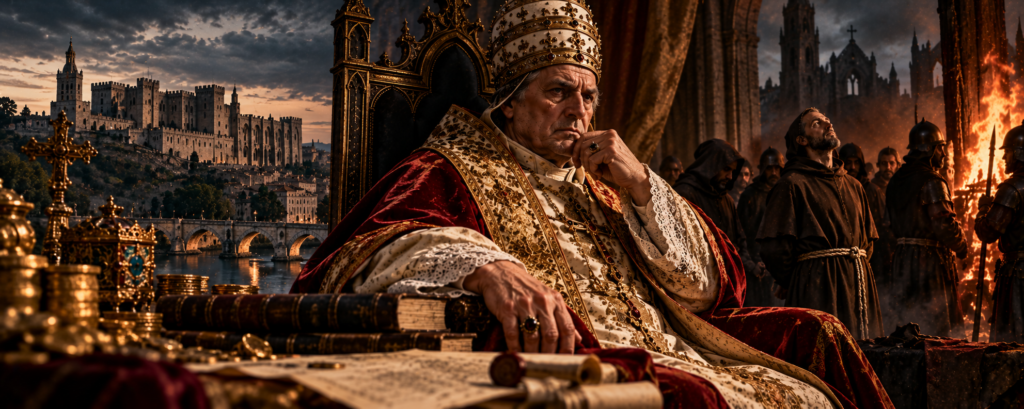
John XXII: The Pope Who Fought Poverty, Accumulated a Fortune, and Was Accused of Heresy
John XXII — 1316–1334
When Jacques Duèse became Pope John XXII in 1316, he was already an old man, and there were good reasons to imagine that his pontificate might be brief. Instead, the elderly lawyer from Cahors would dominate the papacy for more than eighteen years, transforming its finances, fighting an emperor, crushing religious dissidents, and becoming one of the most controversial occupants of the medieval papal throne. His enemies accused him of greed, tyranny, and even heresy, while his defenders could point to an administrator of formidable intelligence who brought order and financial strength to a papacy emerging from years of political uncertainty. By the time he died at Avignon in 1334, John had become a living contradiction: the guardian of orthodoxy accused of doctrinal error, the ruler of an increasingly wealthy Church locked in battle with friars devoted to poverty, and the supreme judge of Christian Europe forced to defend his own beliefs against men who wondered whether a pope himself could become a heretic.
The darkest part of John’s story does not depend upon lurid tales of secret orgies, poisoned chalices, or demonic ceremonies. His reign is disturbing precisely because so much of its severity was conducted through ordinary institutions: papal bulls, ecclesiastical courts, financial regulations, inquisitorial proceedings, excommunications, appointments, and carefully reasoned legal arguments. John was not an incompetent tyrant lashing out randomly at everyone around him, but an extraordinarily capable ruler who believed deeply in the authority of his office and possessed the administrative skill to enforce that belief. When opponents refused to submit, they discovered that the old pope could be patient, methodical, and relentless, and some of those opponents eventually paid with their freedom, their careers, or their lives.
At the center of the conflict stood a deceptively simple question about Jesus Christ and his Apostles: had they owned property? For sections of the Franciscan movement, the answer touched the very heart of Christian perfection because Saint Francis had embraced radical poverty as an imitation of Christ. John approached the question through theology and law, eventually condemning an absolute assertion of Christ’s nonownership as erroneous and heretical, while Franciscan opponents concluded that the pope himself had betrayed the Gospel. The dispute became so bitter that leading Franciscans fled the papal court, joined John’s political enemies, and openly accused the pope of heresy, while other friars who refused submission were prosecuted and, in several notorious cases, burned.
Yet the poverty controversy was only one battlefield in an astonishingly combative pontificate. John fought Louis of Bavaria over imperial authority, supported political campaigns in Italy, expanded the papacy’s control over ecclesiastical appointments and revenues, and presided over an Avignon court increasingly associated with wealth and centralization. Near the end of his life, he then plunged into another theological controversy by preaching that the souls of the blessed did not enjoy the full Beatific Vision until after the resurrection and Last Judgment, a position fiercely criticized by theologians and never formally adopted as Church doctrine. The pope who had spent years defining the boundaries of acceptable belief suddenly discovered what it meant to stand dangerously close to those boundaries himself.
The Old Man Who Refused to Be Temporary
Jacques Duèse was born in Cahors in southern France, probably around the middle of the thirteenth century, although the exact year remains uncertain. His family was prosperous but did not belong to the highest ranks of European nobility, making his eventual rise to the papacy a product of education, ability, patronage, and long ecclesiastical service rather than the overwhelming dynastic influence that had propelled some earlier popes. Jacques became particularly associated with the study and practice of law, and the habits of the jurist would remain visible throughout his pontificate. He tended to approach problems by defining categories, determining jurisdiction, examining precedent, and insisting that once a lawful judgment had been reached, obedience should follow.
His ecclesiastical career advanced steadily through service to powerful patrons, especially within the Angevin political world of southern Italy. He became bishop of Fréjus in 1300, served Charles II of Naples as chancellor, and eventually became bishop of Avignon before Clement V raised him to the cardinalate. By the time Clement died in 1314, Jacques was already an experienced administrator who understood both the political and bureaucratic dimensions of church government. He was not a charismatic young reformer arriving from obscurity, but a seasoned official who had spent decades learning how power actually worked.
Clement V’s death produced a prolonged and bitter conclave in which French, Gascon, and Italian cardinals struggled to agree upon a successor. More than two years passed without a pope, an extraordinary vacancy that exposed the political divisions within the College of Cardinals and threatened the effective administration of the Church. Pressure eventually forced the cardinals toward a compromise, and Jacques Duèse was elected at Lyon on August 7, 1316, taking the name John XXII. His advanced age may have encouraged anyone hoping for a short transitional pontificate, but such expectations, where they existed, proved spectacularly mistaken.
John possessed astonishing energy for a man of his years, and his pontificate quickly became intensely active. He immersed himself in appointments, lawsuits, financial questions, political disputes, theological controversies, and the administration of a Church stretching across much of Europe. His surviving correspondence and legislation reveal a pope unwilling to remain a ceremonial figure while subordinates governed around him. Age had placed him close to death, but it had done nothing to weaken his appetite for control.
That combination of age and energy contributed to the distinctive atmosphere of his reign. John had little reason to behave as though he possessed decades in which to accomplish his objectives, yet he governed for more than eighteen years and gradually accumulated enormous experience on the throne itself. Opponents who expected his death to solve their problems could find themselves waiting year after year while the old pope continued issuing judgments against them. By the end of his reign, John had outlasted many of the crises that were supposed to outlast him.
Avignon and the Making of a Papal Government
John XXII did not create the Avignon Papacy, despite the tendency to associate its development strongly with his reign. Clement V had already remained outside Rome, and the violent factional politics of the Italian city made a permanent return difficult and dangerous. John established himself at Avignon and turned the papal presence there into something increasingly stable, organized, and administratively formidable. Under his government, Avignon became not merely a place where the pope happened to live but the operational center of an international ecclesiastical bureaucracy.
Later generations often portrayed Avignon as a luxurious prison in which French kings controlled obedient popes, but that image is too simple. John was French and operated within powerful French political networks, yet he was not merely a servant of the French monarchy, and he frequently pursued papal objectives that cannot be reduced to royal instructions. Avignon also offered practical advantages over unstable Rome, including greater security and easier access to important political centers in western Europe. Nevertheless, every year the bishop of Rome remained far from Rome strengthened the impression that something fundamental about the papacy had changed.
John accelerated that transformation through administration. The papal chancery processed petitions and issued documents across Christendom, while the papacy became increasingly involved in the provision of benefices, the settlement of disputes, and the management of ecclesiastical revenues. Centralization allowed the pope to intervene more directly in local church affairs that might once have been handled with less Roman involvement. To supporters, this represented order and effective government, but to critics it looked like the growth of an intrusive bureaucracy extending its hands into dioceses, monasteries, and cathedral chapters throughout Europe.
The transformation also required money, and John’s government became exceptionally effective at obtaining it. Papal administration involved diplomats, clerks, judges, messengers, households, political agents, charitable obligations, and expensive involvement in Italian affairs, none of which could be maintained through pious intentions alone. John therefore expanded and systematized financial practices that brought substantial revenue toward Avignon. The result strengthened the papacy while simultaneously giving its enemies one of the most damaging accusations they could make against it.
The Pope and His Treasury
The financial reputation of John XXII became enormous even during the medieval period. Under his government, the papacy increasingly exploited revenues associated with ecclesiastical vacancies, appointments, benefices, annates, reservations, and other rights claimed by the central Church. The precise structure of these financial systems was complicated, and not every payment represented corruption or simony in the technical sense. Yet to clergy and communities watching money leave local institutions for Avignon, technical distinctions could offer little comfort.
John’s defenders could reasonably argue that a government required reliable revenue. The medieval papacy was expected to administer an international Church while participating in diplomacy, supporting missions, maintaining officials, defending its territorial interests, and intervening in political conflicts that could become extraordinarily expensive. John was not simply a private individual stuffing every coin into a personal chest, and papal wealth cannot automatically be treated as personal enrichment. Even so, the concentration of resources under his authority was impossible to separate from the image of his reign.
At his death, John left behind a remarkably well-stocked papal treasury. Medieval accounting makes exact modern comparisons difficult, and surviving figures have been interpreted differently by historians, but the broad reality is clear: the papacy had accumulated substantial reserves under his administration. To an administrator, this could demonstrate prudence and successful financial management. To a Franciscan devoted to apostolic poverty, it could look like evidence that the Church had forgotten what its founder was supposed to imitate.
The symbolism became devastating once John entered the Franciscan poverty controversy. The dispute concerned complicated theological and legal questions rather than a simple choice between greed and holiness, but appearances mattered enormously. A pope governing an increasingly wealthy institution was challenging friars who insisted upon the absolute poverty of Christ and the Apostles. Even before anyone examined the legal arguments, the contrast seemed ready-made for scandal.
The Troubled Children of Saint Francis
Francis of Assisi had died in 1226, but his commitment to radical poverty left his followers with a problem that became increasingly difficult as the Franciscan Order expanded. Francis had embraced a life stripped of possessions, but an international religious organization needed buildings, books, food, clothing, schools, and places in which thousands of friars could live and work. The more successful the order became, the more difficult it was to behave as though it possessed nothing. Medieval canon lawyers and popes therefore developed arrangements allowing Franciscans to use property without owning it in the ordinary sense.
These arrangements were ingenious but awkward. Ownership could formally rest elsewhere, eventually including the Roman Church, while friars retained the use of things required for daily life. A friar could eat food without technically owning the food in the legal framework constructed around the order, and a community could inhabit a building while insisting that the property belonged to another legal owner. Such distinctions protected the Franciscan ideal, but they also created obvious questions about whether ownership and use could really be separated indefinitely.
Within the order, the Spiritual Franciscans demanded an especially strict interpretation of poverty. They feared that legal compromises were slowly transforming Francis’s radical movement into another comfortable religious institution. Some were influenced by apocalyptic currents associated with Joachim of Fiore and by the controversial legacy of the Franciscan thinker Peter John Olivi, although the movement was diverse and should not be treated as a single uniform sect. Their insistence upon poverty could inspire genuine devotion, but it also brought them repeatedly into conflict with their own superiors.
Some Spiritual communities resisted orders, occupied houses, or challenged the authority of mainstream Franciscan leadership, which means the conflict cannot honestly be reduced to peaceful ascetics being attacked merely for wearing poor clothing. Church authorities faced real questions about discipline and obedience within an enormous religious order. John inherited this unstable situation shortly after becoming pope and quickly demonstrated that he had little patience for religious movements claiming exemption from legitimate authority. The controversy was about poverty, but it was equally about who possessed the right to decide what Franciscan poverty actually required.
Obedience Before Poverty
John summoned leading Spiritual Franciscans to Avignon and investigated the disputes dividing their order. In 1317, his bull Quorumdam exigit addressed practices associated with the Spirituals and emphasized obedience to legitimate superiors. John was not declaring that poverty itself was evil, nor was he attempting to force Franciscans into luxurious living. He was insisting that individual friars could not use their own understanding of poverty as justification for defying the authorities responsible for governing their order.
From John’s perspective, the principle was essential. A religious community could not function if every friar treated his private interpretation of the Rule as superior to the judgment of superiors and the pope. If obedience disappeared whenever a monk claimed greater holiness, institutional religious life could fracture into competing groups, each convinced that its own conscience represented the authentic will of God. John’s solution was therefore to make legitimate authority decisive when disputes could not otherwise be resolved.
The Spirituals could see the same situation in almost exactly the opposite way. If Francis had commanded a particular form of poverty because it reflected the life of Christ, then obedience to a superior who compromised that poverty might itself become betrayal. Their highest obligation, as they understood it, was not to administrative convenience but to the Gospel and the Rule they had vowed to follow. A pope could command obedience, but they believed even a pope could not make an unfaithful interpretation spiritually true.
Those competing convictions created an almost impossible conflict. John regarded continued resistance as obstinate disobedience with dangerous doctrinal implications, while the most uncompromising Spirituals regarded submission as abandonment of the religious life they had promised God to live. Neither side considered the dispute trivial, and neither could surrender without appearing to betray something fundamental. In 1318, the consequences became fatal.
The Fires of Marseille
Several Spiritual Franciscans who refused to submit were prosecuted before inquisitorial authorities. Most of the accused eventually reconciled themselves to the Church or accepted the required obedience, but four remained unyielding. On May 7, 1318, those four friars were burned at Marseille after being condemned as heretics. Their deaths became one of the darkest episodes associated with John’s campaign against Franciscan dissent.
The executions require careful description because medieval ecclesiastical procedure formally distinguished between condemnation for heresy and the physical execution of the condemned. Church authorities judged an obstinate heretic and then handed that person to secular power, which carried out the death penalty under secular law. That arrangement did not mean the Church was uninvolved in the resulting execution, since the secular sentence followed directly from an ecclesiastical judgment. The distinction explains the procedure without erasing institutional responsibility for the fire at its end.
John did not personally stand at Marseille directing executioners, and it would be inaccurate to portray the event as though he casually selected four friars and ordered them burned for enjoying poverty. Their prosecution emerged from a complicated dispute involving obedience, Franciscan discipline, and doctrines church authorities regarded as dangerous. Yet John’s policies had defined the terms of the confrontation and made submission to papal authority essential. When the four refused, the machinery of heresy prosecution moved against them.
Their supporters regarded them as martyrs rather than criminals. To such sympathizers, these were men dying because they had taken the poverty of Francis and Christ more seriously than a wealthy ecclesiastical hierarchy could tolerate. Church authorities saw obstinate friars rejecting legitimate judgment and threatening religious order. The flames did not settle which interpretation was morally correct, but they demonstrated which side possessed coercive power.
The Question That Threatened the Franciscan Order
The suppression of the Spirituals did not end John’s difficulties with the Franciscans. Instead, the conflict expanded until it reached the leadership of the wider order and centered upon the theological meaning of Christ’s poverty. Franciscans had long defended the proposition that Christ and the Apostles had possessed no property either individually or collectively, a belief that provided a powerful theological foundation for the order’s own ideal of nonownership. What had once helped distinguish Franciscan spirituality now became the center of a confrontation with the pope.
The question mattered because religious poverty was not merely an economic preference. If Christ himself had lived without property, then complete renunciation could be presented as a particularly perfect imitation of his life. Franciscans could therefore understand their distinctive poverty as rooted directly in the Gospel rather than as an optional discipline invented by their founder. To weaken the doctrine of Christ’s absolute poverty was to threaten the theological prestige of the Franciscan way of life.
John approached the matter as both theologian and lawyer. He became increasingly dissatisfied with the legal arrangement under which the Roman Church was treated as owner of property used by Franciscans who claimed no ownership themselves. Consumable goods presented an especially obvious difficulty because food was destroyed by eating and clothing eventually disappeared through use. John questioned whether the Church could meaningfully be called owner of something over which it exercised little practical control and which vanished through Franciscan consumption.
In 1322, Ad conditorem canonum altered the legal framework that had allowed the papacy to hold ownership of goods used by the Franciscans. John argued that the arrangement had become legally artificial and burdensome. The decision forced the friars to confront directly the relationship between use, possession, and ownership. For defenders of strict Franciscan poverty, the change threatened more than an administrative convenience because it weakened the legal foundation upon which their distinctive ideal had been constructed.
When the Poverty of Christ Became Dangerous
The controversy became still more explosive in 1323 when John issued Cum inter nonnullos. The bull condemned as erroneous and heretical the absolute assertion that Christ and the Apostles had possessed nothing either individually or in common when the proposition was understood in the disputed sense. John did not condemn voluntary poverty itself, and Franciscans continued to exist as an approved religious order. Nevertheless, a theological claim deeply associated with Franciscan identity had now been placed beyond the acceptable boundary of doctrine.
To John’s supporters, the decision corrected an exaggerated claim unsupported by the realities described in Scripture. Christ and the Apostles used goods, received assistance, handled money in certain contexts, and participated in ordinary material life, all of which could be invoked against an absolute theory of nonownership. John also believed the Franciscan legal structure had produced absurdities by pretending that use could always be separated cleanly from possession. His reasoning was not simply a cynical excuse for accumulating wealth.
To his opponents, however, the pope appeared to be rewriting Christian history in order to defend ecclesiastical property. Francis had become one of the most beloved saints in western Christianity precisely because his poverty seemed to recover something radical and authentic about the Gospel. A wealthy papal administration now seemed to be declaring that the theological foundation of that poverty was dangerous. The contradiction became almost impossible to contain.
The issue also raised a serious question concerning earlier papal decisions. Previous popes had approved formulations and legal arrangements that Franciscans believed supported their doctrine. If John could now reject what earlier papal authority had protected, then the apparent stability of papal teaching itself became vulnerable. The dispute was no longer only about whether Christ owned a purse, because it was beginning to ask whether one pope could contradict another and still demand unquestioning obedience.
Michael of Cesena Breaks With Rome
Michael of Cesena, the minister general of the Franciscan Order, had initially cooperated with John in suppressing Spiritual resistance. He was therefore no natural revolutionary and had himself defended institutional discipline against radical friars. John’s broader attack upon Franciscan poverty eventually forced Michael into opposition, revealing how dramatically the controversy had expanded. The man who had once helped enforce obedience now began questioning whether obedience to John remained possible.
The Franciscan General Chapter at Perugia in 1322 defended the traditional proposition concerning the poverty of Christ and the Apostles. John viewed the declaration as a challenge to his authority and continued developing his contrary position. Michael was eventually summoned to Avignon, where the dispute became increasingly personal and dangerous. Remaining at the papal court placed him physically within the reach of a pope already convinced that resistance threatened ecclesiastical order.
Michael increasingly concluded that John’s teaching contradicted earlier authoritative papal statements and therefore could itself be erroneous. This was a revolutionary conclusion because it shifted the argument from whether the Franciscans were obedient to whether the pope deserved obedience on the disputed issue. If John had fallen into heresy, then resisting him might cease to be rebellion and become a Christian duty. The entire hierarchy of accusation could therefore be reversed.
Michael found intellectual support among other Franciscans, most famously William of Ockham. Ockham had been at Avignon while aspects of his own theological work were being examined, but the poverty controversy drew him into a much larger confrontation with the papacy. After studying the competing papal statements, he became convinced that John had fallen into serious error. One of medieval Europe’s most brilliant thinkers was moving toward the extraordinary conclusion that the reigning pope could not simply demand obedience when he contradicted Christian truth.
The Escape From Avignon
By 1328, Michael of Cesena and his companions believed their position at Avignon had become untenable. Michael, William of Ockham, Bonagratia of Bergamo, and others fled the papal court in May and sought the protection of Louis of Bavaria. Their escape transformed an internal Franciscan controversy into an alliance between religious dissidents and one of John’s greatest political enemies. Theology and imperial politics had now become inseparable.
John responded forcefully. Michael was removed from leadership of the Franciscan Order, while the fugitives were excommunicated and denounced for their disobedience. A new minister general more acceptable to papal authority was chosen, and the majority of the order ultimately remained within obedience to Rome. John had succeeded institutionally, but the intellectual conflict continued outside his control.
Ockham became particularly dangerous because he did not merely insult the pope or repeat political propaganda. He developed extensive arguments concerning the limits of papal authority, the possibility of papal heresy, and the right of Christians to resist a pope who departed from the faith. His later political writings were shaped by a broader range of issues than his quarrel with John alone, but the conflict provided an urgent practical setting for those ideas. John’s attempt to impose obedience helped produce one of the medieval papacy’s most sophisticated critics.
The irony was already profound. John had sought to prevent religious fragmentation by asserting the pope’s authority to settle disputed questions. Instead, his policies drove respected Franciscans into the camp of an excommunicated emperor and encouraged them to construct theories explaining why papal authority could fail. The more firmly John insisted that the pope must be obeyed, the more urgently his opponents asked what Christians should do when they believed the pope was wrong.
Louis of Bavaria Enters the Battle
John’s struggle with Louis of Bavaria developed from the disputed imperial election of 1314. Louis and Frederick the Fair of Austria both claimed the German kingship, and John initially withheld definitive recognition while the political struggle continued. Louis strengthened his position dramatically after defeating Frederick at the Battle of Mühldorf in 1322. The victory did not end the larger question of papal involvement in imperial legitimacy.
John objected to Louis exercising imperial rights in Italy without papal recognition and ordered him to justify his actions. Louis refused to accept the pope’s understanding of the situation, and the conflict escalated until John excommunicated him in 1324. In medieval Europe, excommunication of a ruler carried political as well as spiritual consequences because enemies could use it to question allegiance and legitimacy. John was therefore deploying one of the Church’s most powerful spiritual sanctions within a struggle over temporal authority.
Louis retaliated by accusing John of heresy and appealing against him. The Franciscan poverty dispute supplied useful theological ammunition because John’s opponents could argue that the pope had contradicted earlier teaching concerning Christ and the Apostles. What might otherwise have remained an obscure theological controversy now became part of imperial propaganda. Louis could present resistance to John not merely as political independence but as opposition to a corrupt or heretical pope.
The alliance between Louis and the Franciscan fugitives strengthened this argument. Michael of Cesena and Ockham possessed theological expertise that political propagandists lacked, while Louis offered protection they desperately needed. Each side benefited from the other. John’s political enemy gained intellectual critics of the papacy, and John’s religious enemies gained a ruler powerful enough to keep papal authorities from arresting them.
An Emperor Creates an Antipope
Louis eventually carried his challenge into Italy and entered Rome. In January 1328, he received an imperial coronation without John’s authorization, deliberately demonstrating that he rejected the pope’s claim to control his imperial legitimacy. The ceremony represented far more than pageantry because it challenged the relationship between the two greatest universal authorities of Latin Christendom. John remained at Avignon while his enemy attempted to construct an alternative political and ecclesiastical order in Rome itself.
Louis then supported proceedings declaring John deposed. In May 1328, the Franciscan Pietro Rainalducci was elevated as the antipope Nicholas V. The spectacle was extraordinary: an excommunicated emperor had sponsored the supposed removal of the reigning pope and helped install a rival pontiff in Rome. The conflict over poverty, imperial rights, and papal authority had produced a competing papacy.
Nicholas V’s position proved fragile because it depended heavily upon Louis’s political success. As imperial support in Italy weakened, the antipope’s ability to maintain himself collapsed. He eventually submitted to John, and the papal schism created by Louis came to an end. John treated the defeated Nicholas with greater restraint than might have been expected from the ferocity of the preceding conflict, keeping him under controlled conditions rather than arranging a spectacular execution.
The collapse of Nicholas V represented a significant victory for John, but it did not resolve the underlying constitutional dispute. Louis remained John’s enemy, and intellectual critics continued questioning the pope’s claims. The attempt to overthrow John had failed, yet the very fact that an emperor and prominent theologians could imagine deposing a pope revealed how badly the struggle had damaged the image of uncontested papal authority. John had survived, but survival was not the same as reconciliation.
The Political Thinkers Who Fought Back
The conflict with Louis produced enemies whose influence extended far beyond the immediate political struggle. Marsilius of Padua, working with John of Jandun, composed the Defensor Pacis, a radical challenge to papal political power. Marsilius rejected expansive claims of papal coercive authority and developed a theory of political community that sharply restricted the pope’s role. John condemned propositions associated with these thinkers, but condemnation could not make their arguments disappear.
William of Ockham attacked papal authority from a somewhat different direction. His concerns arose strongly from Franciscan theology and the possibility that a pope could become a heretic. Ockham insisted that the Church could not be reduced simply to the will of a reigning pontiff when that pontiff contradicted truth. The argument opened dangerous questions about where ultimate authority actually rested within Christianity.
John therefore found himself fighting not only individual opponents but theories designed to explain why his power should have limits. His aggressive use of papal jurisdiction encouraged adversaries to formulate increasingly sophisticated alternatives. The papacy could excommunicate Louis, but thinkers protected by Louis could ask whether the excommunication itself was legitimate. Institutional force and intellectual resistance began feeding one another.
This consequence makes John’s pontificate especially important in the history of political thought. He did not intend to create critics of papal monarchy, but his policies gave those critics urgency and a concrete enemy. The harder he pushed the boundaries of papal authority, the more clearly opponents tried to define boundaries he should not cross. A pope determined to preserve hierarchy inadvertently helped sharpen some of the most powerful medieval arguments against excessive papal power.
Poverty Becomes a Crime
The wider Franciscan crisis did not disappear after Michael and Ockham fled. Groups often described collectively as Fraticelli continued defending forms of radical poverty and, in some cases, rejecting the legitimacy of papal decisions. The label covered different communities and beliefs, so it would be inaccurate to imagine a single underground organization with one coherent doctrine. What united many of these dissidents was resistance to ecclesiastical authority over questions that had become closely associated with Franciscan poverty.
Some Fraticelli went considerably beyond simple asceticism. Certain groups denounced the established hierarchy, rejected papal legitimacy, or developed apocalyptic interpretations that authorities regarded as threatening to the structure of the Church. Medieval governments did not treat schism and heresy as private matters of conscience, especially when religious dissent appeared capable of producing alternative communities. John therefore saw suppression as defense of ecclesiastical unity rather than persecution for its own sake.
His policies nevertheless made particular claims about poverty legally dangerous. Once a proposition had been condemned, persistent adherence could expose a believer to inquisitorial investigation. A theological interpretation that might once have existed within the broad and contentious Franciscan tradition could now become evidence of heresy. The boundary between extreme devotion and punishable dissent had shifted.
That transformation mattered beyond John’s lifetime. Inquisitorial campaigns against Fraticelli continued under later popes, and communities survived in various parts of Italy despite repeated suppression. John’s legislation provided part of the doctrinal environment in which those campaigns operated. A controversy over how closely friars should imitate Christ had become part of the machinery of religious prosecution.
The Uncomfortable Case of Bernard Délicieux
Bernard Délicieux was another Franciscan whose story reveals the darker atmosphere surrounding church authority in John’s reign. Bernard had become famous in southern France for challenging inquisitorial abuses and supporting communities that believed local inquisitors had acted unjustly. His activism had brought him into conflict with both ecclesiastical and political authorities long before John became pope. By 1317, however, the new papal government provided the setting in which old accusations against Bernard could be pursued decisively.
Bernard faced an extraordinary collection of charges, including obstruction of inquisitorial proceedings, political conspiracy, and alleged involvement through magical means in the death of Pope Benedict XI. The magical accusation should not be accepted simply because it appeared in medieval judicial proceedings, and historians have good reason to treat sensational claims against politically troublesome defendants with caution. Bernard had certainly participated in intense opposition to inquisitorial authority, but that fact does not validate every allegation attached to him. His trial demonstrates how political resistance, religious controversy, and accusations of supernatural crime could become entangled.
He was eventually condemned and sentenced to imprisonment rather than execution. Bernard was already elderly, and the final punishment ensured that a troublesome critic would no longer be able to continue his public campaigns. He died in confinement a few years later. A friar who had challenged the machinery of religious prosecution had ultimately been swallowed by that machinery himself.
John’s personal responsibility for every stage of Bernard’s case should not be exaggerated because the conflicts surrounding Bernard stretched back into earlier pontificates. Nevertheless, the prosecution occurred within John’s wider determination to strengthen ecclesiastical discipline and suppress challenges to established authority. Bernard’s fate therefore belongs within the atmosphere of the reign even if it cannot simply be reduced to a personal vendetta by the pope. Once again, the most unsettling feature is institutional rather than theatrical.
Magic, Poison, and Invisible Enemies
John lived in a world where rulers had genuine reasons to fear assassination, poison, and conspiracy. Medieval political life could be brutally violent, and the possibility that an enemy might attempt to kill a pope was hardly imaginary. At the same time, educated medieval society often accepted that harmful magic might be capable of injuring a victim through supernatural means. The boundary between a political assassination plot and a magical attack could therefore appear far less obvious than it does to a modern observer.
John showed serious concern about sorcery and magical practices. During his pontificate, theological and legal attention increasingly explored the circumstances under which magic might involve demonic invocation, apostasy, or heresy. The pope’s interest did not create medieval belief in magic, which was already ancient and widespread, but it contributed to the developing association between certain magical practices and crimes against the faith. Such connections would become increasingly significant in later centuries.
Reports of plots against John involving poison or magical techniques circulated around the papal court. Some investigations concerned real individuals and documented accusations, but the truth of supernatural claims cannot be established merely because medieval officials took them seriously. Political fear could magnify suspicion, and enemies could be accused of both ordinary conspiracy and occult practices. John’s response was typically administrative: investigate, classify, judge, and punish.
This pattern reveals something fundamental about his personality and government. John confronted uncertainty by attempting to bring it within law and jurisdiction. He did not simply fear hidden enemies in private; he sought institutional mechanisms capable of identifying and prosecuting them. In his hands, anxiety became procedure, and procedure increased the reach of papal authority.
Family, Favor, and Papal Patronage
John XXII also faced accusations connected with nepotism and the advancement of relatives. Like many medieval rulers, he relied upon family members and trusted associates within systems where personal loyalty could be crucial to political survival. Relatives received ecclesiastical advancement and benefited from the opportunities created by John’s position. Such patronage was common, but its frequency does not make its implications irrelevant.
The centralization of papal appointments increased the value of access to the pope. When Rome or Avignon could reserve benefices and intervene directly in ecclesiastical careers, papal favor became an enormously valuable commodity. John used appointments to reward service, strengthen networks, and support the administrative structure of his government. Relatives inevitably benefited within that environment.
This did not mean every family appointment was corrupt or that John’s relatives were necessarily incompetent. Medieval rulers often trusted kin precisely because political betrayal by outsiders could be disastrous. A capable relative might genuinely appear preferable to an unknown candidate whose loyalty could not be guaranteed. The problem was that the same logic could easily transform public office into a network of family advantage.
For critics already suspicious of Avignon wealth, such patronage strengthened the image of a Church becoming increasingly worldly. Benefices produced income as well as spiritual responsibilities, so appointment carried material consequences. When papal relatives advanced while reformers preached poverty, the contrast was politically damaging. John could defend individual decisions, but he could not easily control the larger picture his enemies constructed from them.
A Pope Who Loved Administration
John’s negative reputation can obscure the extraordinary scope of his ordinary government. He reorganized diocesan structures, handled countless ecclesiastical disputes, supported missionary activity, interacted with universities, and maintained diplomatic relations extending far beyond France. His papacy was not consumed exclusively by persecuting Franciscans and fighting Louis of Bavaria. Much of his daily work involved the routine but essential administration of an enormous religious institution.
He also took scholarship seriously. John consulted theologians extensively and participated directly in intellectual disputes rather than relying entirely upon advisers. His decisions concerning Franciscan poverty emerged from sustained theological and legal examination, even when opponents believed his conclusions disastrous. He was capable of listening to complicated arguments because he understood them.
The pope’s canonization of Thomas Aquinas in 1323 offers a striking example of his relationship with intellectual culture. Aquinas had died less than fifty years earlier, and his theological legacy was still the subject of debate in some circles. By canonizing him, John helped strengthen the prestige of a thinker who would become central to Catholic theology. The act sits uneasily beside the image of John as a simple enemy of independent thought.
That contradiction is essential to understanding him. John was not frightened by intellectual argument itself, but he became far less tolerant when argument turned into resistance to papal judgment. Scholars could debate vigorously within boundaries he considered legitimate. The danger began when they claimed that the pope himself lacked authority to close the debate.
The Beatific Vision Crisis Begins
Late in John’s reign, a theological controversy emerged that threatened to reverse the roles of judge and accused. The issue concerned the Beatific Vision, meaning the direct vision of God’s essence enjoyed by the blessed. Catholic doctrine would later be formally defined to teach that purified souls behold God before the resurrection and Last Judgment. John publicly explored a different position.
Beginning around 1331, John preached sermons suggesting that the souls of the righteous did not enjoy the complete vision of the divine essence until after the resurrection of the body and the final judgment. He did not deny that the righteous experienced blessedness after death, but he placed the fullest vision of God at the final consummation. The distinction rested upon his interpretation of Scripture and earlier theological authorities. John believed the matter remained open enough for theological discussion.
The controversy requires an important qualification because John did not solemnly define his disputed view as binding dogma for the entire Church. He presented it in sermons and theological discussion rather than through an irreversible formal definition. Later Catholic discussions of the episode would emphasize precisely this distinction. Treating his sermons as though they were identical to a later ex cathedra definition would therefore distort the historical situation.
Contemporaries, however, did not necessarily find the distinction comforting. A pope’s public preaching carried immense authority regardless of technical categories, and many theologians considered his position seriously mistaken. The question also touched popular religious devotion because Christians prayed to saints and imagined the blessed already enjoying God’s presence. John’s teaching therefore became far more than an obscure academic dispute.
When the Guardian of Orthodoxy Was Accused
John’s established enemies seized upon the controversy immediately. Michael of Cesena and William of Ockham had already accused him of doctrinal error concerning Franciscan poverty, while Louis of Bavaria had political reasons to encourage any argument undermining papal legitimacy. The Beatific Vision dispute offered a new accusation with significance extending far beyond Franciscan circles. The pope who had condemned others for heresy was now being examined for possible error himself.
The controversy spread among theologians, including scholars associated with the University of Paris. French political authorities also became interested, making the dispute potentially dangerous for a pope whose court remained geographically dependent upon a relatively stable relationship with the surrounding French world. John defended his right to discuss the question and emphasized that he was not presenting the position as an irrevocable definition. Nevertheless, criticism became increasingly intense.
The situation exposed an uncomfortable problem in medieval ecclesiology. If a pope could teach theological error publicly, what obligation did Christians have to follow him? If a pope became formally heretical, could he still possess papal authority, and who had the right to determine that he had crossed the line? These questions had already appeared during the Franciscan controversy, but the Beatific Vision dispute gave them broader urgency.
John’s position became increasingly difficult as his health declined. He had spent much of his pontificate insisting that theological disagreement could not automatically justify disobedience. Now he required space for his own theological reasoning to be examined without immediately destroying his legitimacy. The asymmetry between the treatment of a disputed pope and the treatment of condemned dissidents became impossible for his enemies to ignore.
Did John XXII Become a Heretic?
The simplest answer is that John was accused of heresy but was never formally condemned as a heretic. His Beatific Vision position attracted severe criticism, and later polemicists repeatedly used the episode as evidence that an individual pope could personally fall into theological error. Yet John did not impose the controversial teaching as a definitive dogma binding the Church. That distinction is crucial to any accurate account of the controversy.
Shortly before his death, John clarified or modified his position in a way that moved away from the most controversial interpretation of his earlier sermons. The precise theological nuances of his final statement have generated considerable discussion, but he did not die having formally imposed his earlier view upon Catholic doctrine. His successor, Benedict XII, addressed the question definitively in 1336 through Benedictus Deus. The constitution affirmed that purified souls of the just behold the divine essence before the general resurrection.
The episode later became important in debates concerning papal infallibility, although later theological definitions should not simply be projected backward without qualification. The doctrine formally defined at the First Vatican Council in the nineteenth century applied infallibility only under particular conditions, not to every opinion, sermon, or theological speculation uttered by a pope. John’s case therefore does not represent a pope issuing an infallible definition that was later reversed. It represents a pope publicly advancing a controversial theological opinion that did not become the doctrine of the Church.
Even with those qualifications, the episode remains extraordinary. John had spent years using papal authority to determine doctrinal boundaries and punish people who refused to accept his judgments. When his own theology came under attack, he benefited from distinctions between discussion, error, obstinacy, and formal definition. The men burned at Marseille had possessed far less room in which to negotiate their disagreement.
The Unequal Consequences of Being Wrong
The comparison between John’s theological controversy and the Franciscan prosecutions should not be simplified into an assertion that the situations were legally identical. They were not, and the Spiritual Franciscans had been involved in broader questions of obedience and ecclesiastical discipline beyond a single speculative theological opinion. John also believed the Beatific Vision remained an open question upon which discussion was permissible. Historical accuracy requires those distinctions.
Yet the contrast still exposes the relationship between authority and consequence. A friar judged obstinate by church authorities could be condemned as a heretic and eventually handed to secular power for execution. A pope accused of theological error possessed enormous institutional protection, access to scholars, opportunities to clarify his position, and the authority to insist that the matter remained open. Power did not determine truth, but it profoundly influenced what happened to people accused of being wrong.
John himself may never have perceived this as hypocrisy. From his perspective, the cases belonged to different legal and theological categories. He believed the Franciscan dissidents had rejected legitimate authority after proper judgment, whereas he was investigating a question not yet definitively settled. A trained lawyer could regard the distinction as decisive.
His enemies saw something much uglier. They saw a pope who demanded submission from others while preserving intellectual freedom for himself. They remembered imprisoned dissidents and burned friars while theologians respectfully debated the pope’s controversial sermons. The image became another powerful weapon against John’s reputation.
The Death of the Old Pope
By 1334, John XXII had reached an extraordinary age and had spent more than eighteen years on the papal throne. He had survived the expectations of those who may have regarded him as temporary, outlasted political crises, defeated an antipope, fractured opposition within the Franciscan Order, and maintained his authority despite accusations of heresy. His physical strength finally began to fail while the Beatific Vision controversy remained unresolved. Even in decline, however, he continued addressing the theological issue that threatened to overshadow the end of his pontificate.
John died at Avignon on December 4, 1334. He left behind a papacy financially stronger and administratively more centralized than the one he had inherited. He also left behind enemies scattered across Europe, unresolved conflict with Louis of Bavaria, continuing persecution of Franciscan dissidents, and a theological controversy requiring his successor’s attention. Few popes had combined bureaucratic achievement and political antagonism so completely.
The contents of the papal treasury reinforced the reputation already surrounding him. John had accumulated substantial reserves, and reports of papal wealth became inseparable from memories of the poverty controversy. Admirers could see a ruler who had repaired and strengthened papal finances after instability. Critics could see gold piled beneath the authority of a pope who had condemned radical claims about the poverty of Christ.
Benedict XII succeeded him and soon moved to settle the Beatific Vision dispute. In 1336, Benedictus Deus affirmed that purified souls behold the divine essence before the resurrection and final judgment. John’s most controversial theological opinion therefore did not become official Catholic doctrine. The old pope had died before the question was definitively closed against the position associated with his disputed sermons.
The Dark Paradox of John XXII
John XXII belongs among the Wicked Popes not because every accusation made against him was true. Political and religious enemies had powerful incentives to exaggerate his greed, tyranny, and theological corruption. Medieval polemics could be savage, and a pope engaged simultaneously in conflicts with an emperor and rebellious Franciscans was almost guaranteed to become the target of hostile stories. Responsible history must therefore separate documented policy from propaganda.
The documented record is disturbing enough without embellishment. John expanded papal financial centralization, aggressively defended ecclesiastical authority, condemned important Franciscan claims concerning apostolic poverty, and presided over a system in which obstinate religious dissidents could be prosecuted as heretics. Four Spiritual Franciscans were burned at Marseille after refusing submission. Other opponents experienced excommunication, imprisonment, displacement, or exile.
His conflict with Louis of Bavaria demonstrated the political dimension of the same authoritarian instinct. John used spiritual sanctions in a struggle involving imperial legitimacy and Italian power, while Louis retaliated by challenging the pope’s right to rule. Their battle produced an antipope and encouraged political thinkers to articulate far-reaching attacks upon papal supremacy. John’s defense of authority therefore helped create some of the strongest intellectual arguments for limiting it.
The Beatific Vision controversy completed the paradox. John had spent years insisting upon his authority to define dangerous error, only to find his own teaching attacked by theologians. He was never formally condemned as a heretic and should not be presented as though he had imposed a heretical dogma upon the Church. Nevertheless, the spectacle of a reigning pope defending himself against accusations of doctrinal error was extraordinary.
A Church Rich Enough to Persecute Poverty
The most memorable image of John’s reign remains the confrontation between papal wealth and Franciscan poverty. It is tempting to simplify the story into greedy churchmen destroying holy beggars, but the historical reality was considerably more complicated. Franciscan disputes involved genuine questions of discipline, property, obedience, theology, and the practical survival of a large religious organization. John possessed serious legal and theological arguments for rejecting the extreme claims made by some of his opponents.
Complexity, however, does not erase the moral force of the contrast. Francis of Assisi had become famous for stripping himself of possessions and embracing a life intended to resemble the poverty of Christ. His followers developed that ideal into one of the defining characteristics of their order. A century later, some of them found themselves threatened by ecclesiastical authorities for insisting too absolutely upon the principle.
Meanwhile, John’s papacy was becoming wealthier and more administratively sophisticated. Money flowed through systems of benefices, vacancies, reservations, and appointments toward Avignon. The pope could explain why the revenue was necessary, and much of it genuinely supported government rather than private luxury. Yet the image of accumulated treasure existed beside the memory of burned Franciscans.
That contrast became a judgment more powerful than any individual accusation. John could argue that the friars misunderstood property law, theology, and obedience. The friars could answer by pointing toward Christ, Francis, and the Gospel. Between them stood the papal treasury and the authority of the Inquisition.
The Danger of an Efficient Pope
John XXII is particularly unsettling because incompetence cannot explain the darker aspects of his reign. He understood government extremely well. His papacy processed enormous quantities of business, increased revenues, reorganized ecclesiastical structures, handled international diplomacy, and maintained a remarkable degree of administrative energy. He was one of the most effective governmental popes of his era.
Efficiency becomes morally ambiguous when the institution being strengthened possesses coercive power. A disorganized government may issue harsh commands that are never enforced, while an efficient government can make those commands real across great distances. John’s administrative abilities gave his theological and political judgments consequences. A papal decision made at Avignon could reshape the life of a friar hundreds of miles away.
His reliance upon legal categories intensified this effect. Once a disputed belief became defined as heretical, it entered an established system of investigation and punishment. Once a ruler became excommunicated, the sanction entered a political world where legitimacy mattered enormously. Once a benefice became reserved to papal appointment, control over its revenues and occupant shifted toward the center.
John therefore represents a form of power less spectacular than the sword but potentially more durable. He did not need to ride personally at the head of an army to reach his enemies. Documents could travel for him, judges could act for him, and institutions could preserve his decisions. The old pope ruled through parchment as effectively as many kings ruled through soldiers.
When Law Organizes Coercion
The medieval Church did not understand coercion in the same way modern liberal societies generally do. Heresy was regarded not simply as private opinion but as a danger to souls and Christian society. Religious unity was intertwined with political and social order, making persistent doctrinal rebellion appear capable of harming entire communities. John operated within that worldview rather than inventing it.
Recognizing the historical context does not require pretending the consequences were harmless. Inquisitorial systems could imprison people, extract testimony, impose severe penances, and deliver condemned heretics to secular authorities who might execute them. The individual standing before such machinery possessed far less power than the institutions judging him. The theological sincerity of the judges did not eliminate the suffering of the condemned.
John’s importance lies partly in how comfortably he operated within this system. He did not need personal sadism to employ coercive institutions because he believed legitimate authority had both the right and obligation to defend truth. A dissident refusing correction could therefore appear responsible for the punishment that followed. This logic allowed harshness to coexist with a ruler’s belief that he was acting justly.
That combination can be more frightening than simple cruelty. A sadist may know he enjoys suffering, while an administrator convinced of his righteousness can regard suffering as an unfortunate but necessary consequence of law. John appears much closer to the second type. His severity emerged from certainty rather than chaos.
The Pope Who Needed the Freedom He Denied Others
The Beatific Vision controversy remains the perfect final act because it placed John inside the problem he had spent his reign creating for other people. He believed himself entitled to investigate Scripture and theology, consider an unsettled question, defend a controversial interpretation, and eventually clarify his position. Those are reasonable expectations within serious intellectual inquiry. The problem was that some of his opponents had also believed themselves entitled to defend convictions they considered true.
John would have rejected the comparison because he considered the Franciscan disputes already resolved by legitimate authority. The Spirituals and later dissidents were therefore not merely exploring open questions in his eyes; they were refusing correction. His own Beatific Vision position, by contrast, concerned a matter he believed remained unsettled. The distinction was legally coherent within his system.
Yet systems are easiest to trust when someone else bears their penalties. John discovered that accusations of heresy could become politically devastating when directed at the pope himself. Suddenly careful distinctions between speculative theology, formal doctrine, personal opinion, and obstinate error became essential. The man who had insisted upon precise categories all his life now depended upon them.
His critics never forgot the irony. They had watched papal definitions turn Franciscan convictions into dangerous propositions. Now they watched the pope insist that his own disputed proposition did not make him a heretic. The controversy offered a lesson John probably never intended to teach: even the highest authority could need protection from premature certainty.
Gold, Ashes, and Authority
John’s treasury and the ashes of the Spiritual Franciscans represent two radically different sides of the same pontificate. The treasury symbolized a papacy becoming more capable of governing an international institution. The ashes symbolized what could happen when that institution confronted people unwilling to submit. Both belonged to the same system.
It would be unfair to say that John accumulated money merely so he could persecute dissidents. Papal finances served countless purposes unrelated to religious repression, and much of his administrative work was ordinary, constructive, or necessary. Likewise, the Franciscans who opposed him were not all identical saints peacefully accepting every other form of church authority. Historical actors rarely arrange themselves into morally convenient camps.
The darker conclusion survives those qualifications. John strengthened institutions that could gather wealth and enforce belief while insisting that their authority was necessary for Christian order. He regarded challenges to that authority as dangerous enough to justify severe measures. The result was a papacy more powerful than before and a growing body of critics asking whether papal power itself had become dangerous.
Those critics did not disappear when John died. Ockham continued writing, Louis remained in conflict with the papacy, and Franciscan dissent survived despite repression. The intellectual questions raised during the pontificate became part of later debates about church government and political authority. John’s victories could suppress individuals without erasing the ideas that had produced their resistance.
The Judgment of History
John XXII was not the grotesque villain imagined by his fiercest enemies. There is no need to transform him into a secret sorcerer, shameless thief, or theatrical monster in order to make his reign dark enough for the Wicked Popes category. His documented policies provide a far more interesting story. He was an intelligent, disciplined, remarkably capable pope whose confidence in papal authority repeatedly carried him into conflicts where compromise became almost impossible.
He could also be pragmatic and intellectually serious. He consulted scholars, governed carefully, supported institutions, canonized Thomas Aquinas, reorganized dioceses, and left the papacy financially strong. These achievements prevent any responsible account from reducing eighteen years of government to persecution and greed. John was a major medieval ruler precisely because his pontificate contained much more than scandal.
The uncomfortable question is what he did with his strengths. His legal intelligence helped him construct arguments against Franciscan poverty claims. His administrative ability helped those decisions travel throughout the Church. His financial competence gave the papacy resources with which to pursue ambitious policies, while his determination allowed him to fight opponents for years without surrendering.
Strength magnified consequence. When John was correct, his competence could produce effective government. When he was wrong or unnecessarily severe, the same competence could make error far more damaging. The machinery did not care whether the person beneath it believed himself righteous.
The Pope Who Judged Everyone
John XXII died as pope, not as a defeated heretic, and that distinction is essential to his story. Louis of Bavaria had failed to remove him, Nicholas V had failed to replace him, and Michael of Cesena had lost control of the Franciscan Order. John had survived political rebellion, religious revolt, theological attack, and the repeated expectation that an elderly man could not possibly remain on the throne much longer. Measured by endurance alone, his pontificate was an extraordinary triumph.
Yet the enemies he defeated left marks upon history that papal decrees could not erase. William of Ockham continued developing arguments about the limits of papal authority, while the Franciscan poverty controversy remained one of the great ecclesiastical conflicts of the fourteenth century. Louis’s resistance demonstrated that excommunication could not automatically destroy a ruler’s political position. Benedict XII’s later definition of the Beatific Vision confirmed that John’s controversial sermons had not provided the Church’s final answer.
The most disturbing part of John’s legacy remains the imbalance between those who possessed authority and those who stood beneath it. Spiritual Franciscans who refused submission could move from religious dissent to inquisitorial prosecution and, in several cases, execution. John could publicly advance a disputed theological position, face intense criticism, clarify his views, and die peacefully in office. The cases were not legally identical, but the difference in power shaped everything that followed.
That imbalance is what makes John XXII such a compelling Wicked Pope. He was not terrifying because he behaved like a madman, and his reign does not require invented atrocities to become dark. He was terrifying because he represented disciplined, intelligent, legally organized authority convinced of its own necessity. His papacy could classify an idea, condemn it, investigate those who defended it, and punish those who refused to surrender it.
The Franciscan controversy reveals the human cost behind those procedures. The question of whether Christ and the Apostles owned property might sound almost comically abstract to a modern reader, but medieval people understood that the answer touched the nature of Christian perfection and the authority of the Church. Men abandoned careers over it, fled across Europe over it, defied the pope over it, and died over it. Theology was not merely something discussed in classrooms because theology could determine whether a man remained a friar or became a heretic.
John believed that the Church could not survive if every religious dissident placed personal conviction above legitimate authority. His opponents believed the Church could not remain faithful if obedience to a pope became more important than obedience to truth. Both propositions contained dangers, and neither side could find a stable compromise. Once John possessed the institutional power to enforce his answer, however, the debate ceased to occur between equals.
The same pattern appeared in his conflict with Louis of Bavaria. John believed imperial authority could not simply ignore papal rights, while Louis rejected the idea that the pope could suspend his political legitimacy through ecclesiastical judgment. Excommunication followed, propaganda intensified, and an antipope appeared in Rome. A constitutional dispute between pope and emperor became a struggle in which each side attempted to deny the other’s legitimacy.
John survived that confrontation because he was extraordinarily difficult to defeat. His enemies could denounce him, but they could not easily remove him. They could sponsor a rival pope, but they could not make that rival durable. They could accuse John of heresy, but accusations alone could not break the administrative system supporting him.
The financial strength of Avignon formed another part of that resilience. Money allowed the papacy to maintain officials, diplomacy, political campaigns, and a bureaucracy capable of governing across borders. John’s treasury therefore represented something more significant than personal greed. It represented institutional capacity.
That distinction does not make the wealth morally neutral. An institution can use resources responsibly or abusively, just as an individual can. Critics looking at Avignon saw an increasingly wealthy hierarchy while Franciscans argued over whether Christ had owned anything at all. No legal explanation could prevent the comparison from becoming devastating.
John’s reign consequently became a symbol of the widening distance between evangelical poverty and ecclesiastical government. The pope could explain that administering Christendom required resources, while the Franciscans could answer that Christ himself had required almost none. Neither statement completely resolved the practical realities confronting the other side. The tension was built into medieval Christianity itself.
What made John unusual was the intensity with which he forced that tension into the open. He refused to preserve the old legal fiction merely because it protected Franciscan sensibilities. He examined the arrangement, declared it incoherent, and changed it. Once challenged, he continued forward rather than retreating.
That same stubborn intellectual confidence carried him into the Beatific Vision controversy. John believed he had found scriptural and theological grounds for a position that many respected theologians rejected. He preached it publicly because he did not imagine that a difficult question should remain untouched merely because disagreement might become embarrassing. In another setting, such willingness to challenge assumptions could look admirable.
The problem was that John occupied an office capable of punishing people for theological error. Every speculative statement from his mouth therefore carried a weight unavailable to an ordinary scholar. When critics accused him of heresy, the controversy exposed the unresolved tension between a pope’s personal fallibility and the authority attached to his office. John had become the perfect demonstration of why those concepts needed to be distinguished.
He escaped formal condemnation because his controversial sermons were not treated as irreversible dogmatic definitions and because he clarified his position before death. His successor then defined the matter in a direction contrary to the most controversial interpretation of John’s preaching. The Church continued. John remained in the papal succession.
The friars at Marseille had no such institutional cushion. Their refusal to submit was interpreted as obstinacy. Once condemned, they passed from ecclesiastical judgment into the hands of secular authorities and then into the flames.
That difference should not be exaggerated into a false equivalence, but neither should it be ignored. John lived within a hierarchy in which authority influenced who received time to reconsider and who was classified as beyond correction. Theological distinctions mattered, but power determined who had the greatest ability to define those distinctions. The pope stood at the summit of that unequal structure.
This is why John’s reign is ultimately a story about power rather than money alone. His wealth mattered because it strengthened power. His legal training mattered because it organized power.
His theological judgments mattered because they justified power. His political conflicts mattered because they tested the limits of power.
Even his enemies defined themselves through their response to that power. Ockham asked how Christians should resist a pope who became heretical. Marsilius asked how far papal authority should extend into political government.
Louis asked whether an emperor required papal approval to exercise imperial rights. The Spiritual Franciscans asked whether obedience to a pope could require betrayal of the Gospel.
John answered each challenge differently in detail but similarly in principle. Papal authority possessed real jurisdiction, and resistance carried consequences. The institution could not surrender whenever an opponent claimed conscience, theology, or political independence. To John, weakness at the center threatened disorder everywhere.
His critics feared the opposite danger. They saw a central authority increasingly capable of defining its own jurisdiction and punishing those who disputed it. The stronger the papacy became, the more important it was to determine whether any authority stood above the pope. Their answer was that truth did.
John would not necessarily have denied that principle in the abstract. He would simply have insisted that the pope possessed a central role in determining what Christian truth required in disputed cases. The conflict therefore returned to the same impossible question. Who judges the judge when the judge is wrong?
The Beatific Vision controversy ensured that the question could never remain theoretical. John’s own teaching became the object of suspicion. The pope himself entered the courtroom of public theological judgment, even if no earthly tribunal successfully removed him.
His enemies must have savored the reversal. The man who had condemned propositions was now defending propositions. The pope who had demanded explanations was now providing them.
The ruler who had defined heresy was now accused of it. The authority that had placed others under scrutiny could not escape scrutiny forever.
John died before the controversy could destroy him. His death ended an extraordinary pontificate that had begun with an elderly compromise candidate and developed into one of the most consequential papal governments of the fourteenth century. He left behind money, institutions, enemies, arguments, and unresolved wounds. The machinery continued without him.
That may be his darkest legacy. Individual cruelty ends when the cruel individual dies, but administrative systems can survive their creators. A treasury passes to the next ruler, a legal precedent remains available to the next judge, and a definition of heresy can continue shaping prosecutions long after the pope who approved it has been buried.
John XXII understood how to make papal government durable. His successors inherited a stronger financial and administrative institution because of him. They also inherited conflicts created or intensified by the same centralizing energy.
The Wicked Popes category is therefore an appropriate place for John, but not because he fits the familiar stereotype of a medieval pope surrounded by debauchery and murder. His darkness was colder than that. It belonged to ledgers, decrees, tribunals, appointments, excommunications, and theological definitions backed by institutional force.
He could condemn without shouting. He could punish without lifting a sword.
He could alter lives with parchment. The effectiveness of the system made personal theatrics unnecessary.
The people who resisted him understood this better than anyone. Michael of Cesena fled rather than trust himself to the papal court. Ockham sought the protection of an emperor.
Spiritual Franciscans faced inquisitors rather than simply winning arguments. Louis attempted to create another pope because ordinary resistance seemed insufficient.
John’s authority forced his enemies into extraordinary responses. Some became fugitives, some became political theorists, some became schismatics, and some became corpses. His government did not merely answer opposition; it reshaped the lives of the people who dared to maintain it.
Yet John himself remained convinced that he was defending order. Nothing in the historical record requires us to imagine him secretly delighting in suffering. He appears instead as something more complicated and, in some ways, more unsettling: a ruler capable of believing that harsh consequences were justified because the institution he governed had the right to impose them.
That conviction gave his reign its relentless quality. He did not need hatred to continue a prosecution once he believed the law required it. He did not need personal greed to increase papal revenues once he believed the government needed them.
He did not need vanity alone to fight an emperor once he believed papal jurisdiction had been violated. Principle and power could work together perfectly well.
History offers no easy verdict upon such a man. John XXII strengthened the medieval papacy and helped make it more capable of governing an international Church. He also demonstrated how easily institutional strength could become institutional severity when disagreement was interpreted as rebellion.
His theological curiosity showed intellectual seriousness. His response to theological opposition revealed how little room remained when curiosity became defiance.
His financial skill created stability. His wealth damaged the spiritual credibility of a papacy already vulnerable to accusations of worldliness.
His longevity gave him time to accomplish extraordinary things. It also gave him time to accumulate extraordinary enemies.
When he finally died at Avignon, the old pope left behind no simple confession that could resolve these contradictions. He did not admit that the Spiritual Franciscans had been right, nor did the Church later reverse everything he had done concerning Franciscan poverty. His political opponents did not suddenly triumph, and his administrative reforms did not disappear. History remained complicated.
The moral unease remains complicated as well. John was not wrong merely because he was powerful, and his opponents were not automatically right merely because they were persecuted. Some dissidents held extreme positions, some political enemies acted from self-interest, and some accusations against the pope were openly polemical. Recognizing those facts makes the story more accurate without making it comfortable.
What remains after the propaganda is stripped away is still dark enough. A pope overseeing enormous revenues fought men devoted to radical poverty. Religious dissidents were prosecuted and several burned.
An emperor was excommunicated amid a struggle over political authority. Leading thinkers fled the papal court and accused the pope of heresy.
Then John himself preached a controversial theological position and faced accusations that the guardian of orthodoxy had become doctrinally unsound. He clarified his position, died in office, and left his successor to settle the question. The machinery that had been merciless toward weaker opponents proved flexible enough to survive controversy at the top.
That contrast is the heart of John XXII’s story. Power did not necessarily determine what was true, but it profoundly influenced who could afford to be mistaken. A poor friar’s theological obstinacy could lead toward a prison or pyre, while a pope’s disputed speculation could receive councils of theologians and careful clarification.
John’s reign forces us to confront that imbalance rather than hide it beneath medieval terminology. His world genuinely believed heresy endangered souls, and his government genuinely believed obedience preserved Christian unity. Those beliefs explain the severity of the system. They do not erase the people crushed beneath it.
The smoke at Marseille, the fugitives leaving Avignon, the emperor denouncing the pope, and the treasure accumulated within the papal administration all belong to the same historical landscape. None should be isolated from the others. Together they reveal a papacy becoming stronger, richer, more centralized, and more contested.
John XXII stood at the center of that transformation. He was old enough to have been dismissed as temporary, intelligent enough to prove indispensable, stubborn enough to make compromise difficult, and powerful enough to make his convictions matter across Europe. Few popes demonstrate more clearly that administrative competence and moral danger can occupy the same throne.
His story ends not with an invented curse or a sensational legend but with a genuine historical irony. The pope who demanded that others accept the boundaries of orthodoxy discovered that even a pope could find himself accused of crossing them. The man who spent years judging the convictions of friars and emperors learned, in the final chapter of his life, that authority could not prevent others from judging his convictions in return.
John XXII survived that judgment and died wearing the papal crown. The men burned at Marseille did not survive theirs, and the difference between those outcomes cannot be explained by theology alone. It also tells us something about hierarchy, privilege, and the protection enjoyed by those who possess the authority to define the rules.
That is why his pontificate remains so unsettling. John XXII did not need to be the monster imagined by hostile propagandists to become one of the darker figures of the Avignon papacy. The documented story is more powerful because it shows how repression can emerge from intelligence, procedure, and sincere conviction rather than madness.
His reign left Europe with stronger papal administration, a fuller treasury, embittered Franciscans, unresolved political conflicts, and some of the most important questions medieval thinkers ever asked about the limits of religious authority. Those questions survived because John’s opponents understood something his government repeatedly demonstrated. An institution powerful enough to decide what everyone else must believe eventually needs an answer to what happens when the institution itself is wrong.
John XXII never provided an answer capable of satisfying his enemies. Instead, his life became part of the question. His papacy remains a warning written not in legend but in law, money, argument, imprisonment, and fire, showing how easily the defense of order can become a justification for coercion when the people defining order possess the power to punish everyone who disagrees.