
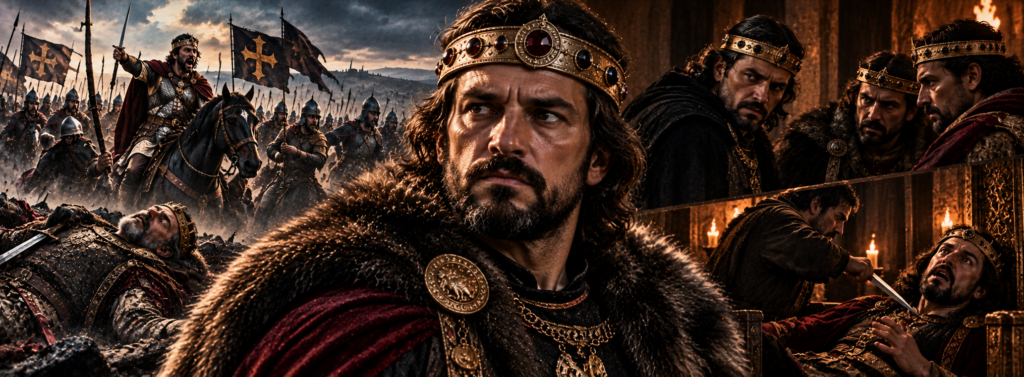
Thorismund: The Visigothic King Murdered by His Brothers
Thorismund (d. 453) | King of the Visigoths, 451–453 | Eldest surviving son of Theodoric I | Fought against Attila the Hun at the Battle of the Catalaunian Plains | Became king after his father was killed during the battle | Ruled the powerful Visigothic Kingdom of Toulouse for approximately two years | Pursued an increasingly independent policy in Gaul | Came into conflict with his brothers and members of the Visigothic aristocracy | Murdered in 453 during a palace conspiracy | Ancient sources connect his brothers Theodoric and Frederic with his overthrow | Theodoric II immediately succeeded him | Theodoric II would himself be murdered in 466 by another brother, Euric | Thorismund’s death became an early example of the violent dynastic politics that repeatedly destabilized Visigothic kingship.
The King Who Survived Attila but Not His Own Family
Thorismund had survived one of the most terrifying armies of the fifth century. He had fought against Attila the Hun on the Catalaunian Plains, been wounded in the chaos, watched the battlefield disappear beneath dead men and horses, and learned that his father, King Theodoric I, had been killed somewhere amid the carnage. Before the blood had dried, the Visigothic prince was proclaimed king. Two years later, he would discover that the most dangerous enemies of his reign were not Huns, Romans, or rival peoples pressing against the borders of his kingdom, but members of his own family.
His death in 453 belongs to one of the darkest patterns in Visigothic history. Thorismund was murdered during a conspiracy in which his brothers Theodoric and Frederic were implicated, and Theodoric immediately succeeded him as king. The exact mechanics of the assassination are obscured by conflicting and fragmentary sources, but the political outcome is unmistakable. A brother died, another brother took his crown, and the Visigothic monarchy moved forward as though royal bloodshed had become one of the possible methods of succession.
There was an especially grim irony in what followed. Theodoric II enjoyed the throne far longer than Thorismund, ruling for roughly thirteen years and becoming an important power in the disintegrating Roman West. Yet in 466, Theodoric was himself murdered by another brother, Euric, who then seized the throne. The man who had benefited from the killing of Thorismund ultimately suffered a remarkably similar fate.
Thorismund’s murder therefore cannot be treated as an isolated palace crime. It stands at the beginning of a chain of fraternal violence that reveals how dangerous Visigothic kingship could be when royal brothers became competing centers of political loyalty. The crown of Toulouse carried enormous power, but there was no rigid system of hereditary succession capable of making one man’s claim unquestionable. A king needed aristocratic support, military prestige, and enough force to prevent his own relatives from becoming alternatives.
Thorismund had inherited the crown at the height of his fame. He was the son of a king who had died fighting Attila, a warrior who had personally participated in the great battle, and the ruler of a kingdom whose power in Gaul was rapidly expanding. None of those advantages saved him. By 453, the palace itself had become more dangerous than the battlefield.
A Kingdom Growing Inside a Dying Empire
To understand why brothers could kill one another for the Visigothic throne, it is necessary to understand what that throne had become. The Visigoths of Thorismund’s generation were no longer merely the wandering followers who had crossed the Balkans, invaded Italy, and shocked the Mediterranean world by sacking Rome under Alaric in 410. They were becoming the rulers of a territorial kingdom embedded inside what remained of the Western Roman Empire. Their kings increasingly possessed cities, tax-producing populations, agricultural lands, armies, and diplomatic influence.
The foundations had been laid during the reigns of Alaric, Athaulf, Wallia, and finally Thorismund’s father, Theodoric I. Wallia reached an accommodation with the imperial government after the chaotic murders of Athaulf and Sigeric in 415, and the Goths were eventually settled in southwestern Gaul in 418. Toulouse emerged as their political center. What had begun as a military people seeking a place within the empire gradually became a state with ambitions of its own.
The relationship with Rome remained deliberately ambiguous. Visigothic kings could present themselves as imperial allies while expanding at imperial expense. They could fight other peoples on Rome’s behalf and then pressure Roman cities when opportunity arose. They inhabited a political world in which treaties were often temporary arrangements between powers that needed one another but did not fully trust one another.
By the time Theodoric I became king, probably in 418, the Visigoths had become one of the most formidable powers in Gaul. Theodoric tested Roman weakness repeatedly, including attempts to expand toward important cities such as Arles and Narbonne. Roman generals resisted him, sometimes successfully, but the long-term direction was obvious. Imperial authority in the West was shrinking while Visigothic power was becoming more territorial and independent.
Thorismund grew up inside this transformation. He was not merely the son of a tribal war leader wandering across imperial territory. He was a prince of an increasingly established kingdom whose royal family commanded armies and negotiated with emperors. That made succession vastly more valuable than it had been in earlier generations.
It also made royal brothers more dangerous to one another. When a crown controls little, there is comparatively little to seize. When it commands much of southwestern Gaul and stands poised to inherit even more from a weakening empire, ambition acquires sharper edges.
The House of Theodoric I
Theodoric I appears to have had several sons, among them Thorismund, Theodoric, Frederic, Euric, and others whose roles are less prominent in the surviving narratives. This large royal family gave the dynasty strength because multiple adult princes could command troops and represent their father in war. It also created a succession problem. Every successful son possessed royal blood, military connections, and potentially his own following among the Gothic aristocracy.
Thorismund appears to have been the eldest or at least the son best positioned to succeed. His presence beside his father during the campaign against Attila suggests significant status. Theodoric II and Frederic were also important political and military figures, while Euric would later demonstrate formidable ability of his own. These were not obscure younger sons quietly dependent upon their elder brother’s generosity.
The Visigothic monarchy did not operate according to a fixed law of primogeniture under which the eldest son automatically inherited and younger brothers simply accepted subordinate roles. Royal lineage mattered greatly, but so did election or recognition by leading Goths, military authority, and political support. The result was a system in which several members of a ruling family might plausibly become king. A successful prince could therefore look at his brother and see both kin and competitor.
Theodoric I’s long reign may have restrained those tensions while he lived. He had ruled for more than three decades by the time Attila entered Gaul. His authority was established, his military reputation substantial, and his position at the center of the kingdom difficult to challenge. His death would remove the figure holding the dynasty together.
That death did not occur quietly in a palace bed. It came during the greatest military crisis western Europe had seen in years. The manner of Theodoric’s death gave Thorismund an extraordinary opportunity to establish himself as his father’s heroic successor.
It also placed the new king on the throne while thousands of armed warriors were still gathered around him. In a monarchy dependent upon military recognition, there could hardly have been a more dramatic setting for an accession. Thorismund became king under the shadow of Attila himself.
Attila Comes West
In 451, Attila the Hun invaded Gaul with a vast coalition of Hunnic and subject forces. His motives were complex and remain debated, involving imperial politics, strategic ambition, and the opportunity presented by instability in the Western Empire. Whatever the precise combination, the invasion threatened Roman and Visigothic interests simultaneously. Former enemies suddenly discovered that they needed one another.
The Western Roman general Flavius Aetius assembled a coalition to confront Attila. Aetius was one of the last great military power brokers of the Western Empire, a man deeply familiar with Hunnic politics who had previously used Hunnic forces in Roman struggles. Now he faced Attila as an enemy. Roman forces alone were insufficient, making the participation of the Visigoths essential.
Theodoric I initially had reasons to hesitate. Rome and the Visigoths had spent decades alternating between cooperation and hostility. Joining Aetius meant risking Gothic lives to defend a Roman Gaul that Theodoric himself had repeatedly tried to dominate. Attila’s advance, however, presented a threat too great to ignore.
The Visigoths entered the coalition. Thorismund accompanied his father and fought as one of the leading Gothic princes. The army that eventually confronted Attila was a patchwork of peoples whose alliances would have seemed improbable under ordinary circumstances.
They met in the region traditionally associated with the Catalaunian Plains, sometimes called the Battle of Chalons, although the precise battlefield location remains debated. The engagement became one of the most famous battles of late antiquity. Later generations sometimes exaggerated it into a simple contest determining the fate of Western civilization, but its actual importance requires no such mythology.
Attila’s army had penetrated deep into Gaul. Aetius and Theodoric stopped him. In the process, Thorismund’s father died.
The Catalaunian Plains
The principal narrative of the battle comes from Jordanes, writing roughly a century later and drawing in part upon the lost history of Cassiodorus and other traditions. Jordanes provides vivid details, but his account must be used carefully because it is literary, retrospective, and not an eyewitness report. According to him, the battle became extraordinarily violent, with control of elevated ground playing an important role. Thorismund himself participated directly in the struggle.
Jordanes reports that Thorismund was thrown from his horse and wounded during the fighting. The detail fits the image of a royal prince personally involved in combat rather than observing from a protected distance. Whether every element of the account can be verified independently is impossible, but Thorismund’s prominence in the battle is credible. He emerged from the encounter with enhanced warrior prestige.
Theodoric I was less fortunate. Accounts differ concerning precisely how he died. One tradition says he fell from his horse and was trampled by his own men; another connects his death with a weapon thrown by an Ostrogoth named Andag. The disagreement itself is a warning against reconstructing a precise cinematic death scene.
What is certain is that the Visigothic king died during the battle. His body was reportedly found only after the fighting had subsided, surrounded by the dead. The loss of such an important ruler in the middle of an enormous military engagement could have thrown the Gothic army into chaos.
Instead, Thorismund was elevated. His father’s death created a succession question at the exact moment when the army needed leadership. Thorismund possessed both the necessary bloodline and the prestige of having fought in the battle.
He was proclaimed king.
The battlefield had taken one king and created another. Thorismund’s accession could hardly have begun with greater drama. He inherited his father’s crown while Attila’s forces remained close enough to threaten another day of fighting.
Aetius Gives Dangerous Advice
After the battle, Attila withdrew into his fortified camp, and the allied forces faced a crucial decision. The Visigoths had lost their king but retained substantial strength. Thorismund reportedly wanted to continue the fight and destroy the Huns if possible. Aetius had different concerns.
Jordanes claims that Aetius advised Thorismund to return quickly to Toulouse because his brothers might seize the kingdom in his absence. The Roman general supposedly feared that completely destroying Attila would leave the Visigoths too powerful, removing a counterweight that Rome could use against them. The story has an almost Machiavellian elegance, but because it comes through Jordanes and reflects later interpretation, its details should not be accepted uncritically.
Nevertheless, the political logic is plausible. Aetius had spent his career balancing competing military powers. A weakened but surviving Hunnic force could restrain the Goths, while a powerful Visigothic kingdom could restrain other enemies. Roman strategy in the fifth century increasingly depended upon manipulating forces the imperial government could no longer dominate directly.
The warning about Thorismund’s brothers is particularly striking in light of what happened two years later. Whether Aetius literally predicted a fraternal coup in 451 cannot be proven. Yet the possibility that other royal sons might compete for the throne was entirely real. Thorismund’s kingship had been proclaimed in the army, but political acceptance in Toulouse still mattered.
Thorismund therefore left the battlefield and returned to his kingdom. Attila escaped complete destruction and eventually withdrew from Gaul. The new Visigothic king arrived at Toulouse with the prestige of a warrior who had helped defeat the most feared conqueror in Europe.
If Jordanes’s story preserves even the broad outline of events, Thorismund had been warned from the first days of his reign that his brothers might threaten him. Two years later, that warning would appear prophetic. The danger waiting in Toulouse had simply been delayed.
The Hero Returns to Toulouse
Thorismund’s return to Toulouse must have been politically charged. He arrived as the successor of a king killed in battle and as a participant in the coalition that had stopped Attila. Military societies placed enormous value on personal courage, and Thorismund’s battlefield experience strengthened his claim. He was not inheriting solely because of birth.
Yet victory could create its own problems. A king who gained exceptional prestige among warriors might become less willing to defer to established aristocratic interests. Thorismund had inherited a kingdom already moving toward greater independence from Rome. The defeat of Attila may have convinced him that the Visigoths no longer needed to behave as subordinate partners within an imperial system.
The evidence for his domestic government is frustratingly limited. His reign lasted only about two years, and surviving sources focus heavily upon military and dynastic events. We therefore cannot reconstruct a detailed program of laws, taxes, court appointments, or administrative reforms. Claims about his personality must be approached with particular caution because later accounts were influenced by the political narratives of his successors.
What does emerge is a ruler pursuing Visigothic interests aggressively in Gaul. Thorismund moved against neighboring powers and appears to have continued the territorial ambitions that had characterized his father’s reign. He was not content simply to preserve the settlement inherited from Rome.
His actions increasingly brought him into the complicated competition for central and southern Gaul. The Roman Empire still claimed these territories, but its ability to defend them depended heavily upon generals and federate allies. Every Visigothic expansion therefore altered the balance between nominal Roman sovereignty and emerging post-Roman kingdoms.
Thorismund’s confidence may have frightened more than Roman officials. A king pursuing an assertive policy could disturb internal Gothic interests as well. His brothers, aristocratic rivals, and men who favored a different relationship with Rome had reasons to watch him carefully.
The Arverni and the Struggle for Gaul
One of Thorismund’s notable campaigns involved the Alans established around Orléans and other groups operating in Gaul. The political geography of the region was extraordinarily fragmented. Roman commanders, federate peoples, local aristocracies, and emerging kingdoms competed over cities and territories whose formal imperial status concealed rapidly changing realities. Thorismund’s Visigoths were among the strongest participants in this contest.
He also turned his attention toward the Arverni in central Gaul. Later sources associate him with an attempt to extend Visigothic influence in that direction. The details are not always clear enough to reconstruct a straightforward campaign narrative, but the pattern fits the broader ambitions of Toulouse. The Visigoths were testing how far their power could reach.
Expansion could strengthen a king by rewarding warriors with plunder, prestige, and territory. It could also threaten aristocrats who feared the ruler was becoming too powerful or pursuing campaigns contrary to their interests. Early medieval kingship required constant negotiation with military elites. Success did not automatically produce loyalty.
Thorismund’s policies have sometimes been contrasted with those of Theodoric II, who after seizing power adopted a relationship with Rome that initially appeared more cooperative. This contrast has encouraged the interpretation that Thorismund was overthrown partly because his aggressive independence threatened both Roman and Gothic interests. There is likely some truth in that political distinction, but the sources do not permit a simple ideological division between an anti-Roman Thorismund and pro-Roman brothers.
All Visigothic kings of this period were capable of cooperating with Rome when useful and fighting Roman interests when advantageous. Theodoric II would later intervene dramatically in imperial politics while expanding Gothic power in Hispania. Euric would go further still, effectively discarding the remaining fiction of Roman subordination.
Thorismund’s independence was therefore not an aberration. It was an early expression of the direction Visigothic power was already moving. The real issue may have been less what he wanted than who would control that expansion.
His brothers had their own ambitions.
Theodoric and Frederic
Theodoric, later known as Theodoric II, was not merely a younger brother living quietly in Thorismund’s shadow. He belonged to the same royal house, possessed aristocratic connections, and had every reason to imagine himself capable of ruling. Frederic likewise became an important military commander and political figure. Together, they represented a formidable internal threat.
The exact development of their conspiracy against Thorismund is poorly documented. Later sources make clear that the brothers were involved in his overthrow, but they do not provide a trustworthy day-by-day record of secret meetings and promises. We do not know precisely when they decided he had to die. We also cannot confidently identify every aristocratic faction supporting them.
Political motives are easier to identify in broad terms. Thorismund’s assertive policies may have alienated influential nobles. Theodoric and Frederic may have promised a different direction, or they may simply have used dissatisfaction as an opportunity to advance their own family interests. Ambition and policy need not have been mutually exclusive motives.
There was also the fundamental danger created by multiple adult royal brothers. Thorismund’s kingship did not make Theodoric’s royal ancestry disappear. Every dispute at court could therefore become a succession dispute. Every noble offended by Thorismund possessed a plausible alternative around whom opposition could gather.
The same pattern would eventually destroy Theodoric. Once he became king, Euric remained another royal brother with military prestige and supporters. The dynasty repeatedly produced men strong enough to rule but unwilling to remain permanently subordinate.
Thorismund was the first brother to discover the lethal consequences. Theodoric would not be the last.
A King Accused of Becoming Unbearable
Some later traditions portray Thorismund as increasingly arrogant or oppressive during his short reign. Such descriptions must be handled cautiously because rulers murdered by successful usurpers often acquire posthumous character defects that conveniently justify their removal. If Theodoric II’s supporters dominated subsequent political memory, portraying Thorismund as intolerable would help transform fratricide into necessary regime change.
This does not mean every negative report is false. Thorismund may genuinely have become overconfident after the victory over Attila. A young king who had inherited power dramatically, enjoyed military prestige, and pursued aggressive expansion could easily clash with aristocrats accustomed to influence. The political structure of Visigothic society made such conflict dangerous.
The challenge is separating personality from propaganda. Terms such as arrogance, tyranny, or cruelty are often judgments rather than measurable facts. Without detailed contemporary evidence, historians cannot diagnose Thorismund’s temperament or reconstruct private behavior with confidence. His enemies certainly had reasons to present him negatively after his death.
What can be observed is political isolation. A king who was murdered after only two years by a conspiracy involving his own brothers had plainly failed to keep enough important men committed to his survival. Whether that failure resulted from cruelty, policy disagreements, personal feuds, or the ambitions of his brothers is harder to determine.
It is entirely possible that several factors converged. Theodoric and Frederic wanted greater power, dissatisfied nobles wanted a different king, and Thorismund’s policies provided a justification around which they could unite. Political assassinations rarely require a single motive.
By 453, whatever coalition had supported Thorismund after the Catalaunian Plains was breaking apart. The king who had been acclaimed amid the army now faced enemies within his own court.
The Conspiracy Tightens
The assassination of a reigning king required more than anger. Thorismund was an experienced warrior surrounded by armed followers. Any conspiracy against him had to overcome his personal defenses and, more importantly, ensure that enough of the elite accepted the replacement afterward. A failed attempt would likely mean execution for everyone involved.
Theodoric and Frederic possessed the crucial advantage of legitimacy. They were not obscure conspirators attempting to place an unrelated adventurer on the throne. They were sons of Theodoric I and brothers of the reigning king. Removing Thorismund could therefore be presented as replacing one member of the royal family with another rather than destroying the dynasty.
That distinction probably made aristocratic participation easier. A noble dissatisfied with Thorismund did not have to gamble upon an entirely new political order. Theodoric offered continuity of bloodline with a change of ruler. In unstable monarchies, that combination can be exceptionally attractive.
The conspiracy appears to have involved members of Thorismund’s immediate environment. Later accounts preserve different details concerning how the attack unfolded. One tradition suggests that a servant named Ascalc or Ascalcus played a direct role, while another emphasizes the involvement of the brothers themselves. These differences caution against presenting a single exact murder scene as unquestioned fact.
What is beyond serious doubt is that Thorismund’s brothers were implicated in the overthrow and that Theodoric benefited immediately. The king was attacked in 453 and killed. His reign, born on a battlefield, ended inside the intimate political world of his own household.
The contrast could hardly be sharper. Attila’s warriors had failed to kill Thorismund in 451. His own family succeeded two years later.
The Murder of Thorismund
Jordanes provides the most vivid surviving account of Thorismund’s death, though his narrative was written generations later and should not be treated as an eyewitness report. According to his version, Thorismund was attacked by a client or servant named Ascalc while ill and undergoing treatment. The attacker wounded him, and Thorismund, despite being injured, managed to seize a stool or similar object and kill some of the conspirators before he was finally overwhelmed. It is a dramatic scene, but its precise details cannot be independently confirmed.
Other traditions simplify the event and place greater emphasis on the fraternal conspiracy. The brothers Theodoric and Frederic are consistently associated with Thorismund’s overthrow. Whether one of them personally struck the fatal blow is less certain than their political responsibility for the coup. Theodoric’s immediate succession leaves little doubt about who ultimately benefited.
Thorismund’s reported resistance is consistent with his reputation as a warrior. If Jordanes preserves an authentic core, the wounded king did not die passively. Yet there is no need to embellish the scene with invented dialogue, precise wounds, or imagined final words. The surviving account is already dramatic enough.
The assassination probably occurred at or near Toulouse, the center of Visigothic royal power, although details of the setting remain uncertain. The king had survived the enormous open battle against Attila only to be trapped by a smaller circle of conspirators. His military skill could not protect him from betrayal inside his own political community.
Thorismund was dead after approximately two years as king. Theodoric II took the throne. There was no prolonged civil war recorded between rival factions, suggesting that the conspirators had secured enough support beforehand to make the transfer effective.
The speed of the succession is one of the strongest indications that this was not merely a spontaneous personal murder. Thorismund’s death functioned as a political coup. The king was removed, and an alternative king was ready.
Did Theodoric II Murder His Brother?
Calling Theodoric II the murderer of Thorismund is broadly justified politically, but precision matters. Ancient and later sources implicate Theodoric and Frederic in the conspiracy that removed their brother. Theodoric then became king. This combination establishes responsibility for the overthrow even if the identity of the person who physically delivered the fatal wound remains uncertain.
The distinction between ordering, organizing, assisting, and personally killing is important. Medieval and late antique political murder frequently involved layers of responsibility. A prince might organize a conspiracy while a servant carried out the attack. A group of nobles might agree upon removal while one participant acted first.
The surviving evidence does not allow us to reconstruct every layer with confidence. We should therefore avoid a theatrical image of Theodoric personally stabbing Thorismund unless a source specifically supports it, and even then the source’s reliability would need consideration. What can safely be said is that Theodoric was a central participant in the coup that resulted in his brother’s death.
Frederic’s involvement also matters because it shows that Thorismund faced opposition from more than one sibling. This was not simply a private quarrel between two brothers competing for a crown. Multiple members of the royal family aligned against the reigning king. Their cooperation indicates a broader political coalition.
Theodoric’s accession completed the coup. Had Thorismund been murdered by an unrelated servant acting from private grievance, the succession might have followed a different path. Instead, the brother implicated in the overthrow immediately became king.
The political verdict is therefore much clearer than the forensic one. We may not know whose hand killed Thorismund. We know whose cause his death served.
Theodoric II Takes the Throne
Theodoric II inherited a powerful kingdom and quickly demonstrated that he was no puppet of Rome. Although his initial policies appear to have restored a more cooperative relationship with the Western Empire, he pursued Visigothic interests aggressively whenever circumstances allowed. His reign would become one of the most consequential periods in the development of Visigothic power.
Theodoric cultivated relationships with Roman aristocrats and participated directly in imperial politics. The most dramatic example came in 455 when he supported the elevation of Avitus, a Gallo-Roman aristocrat with close ties to the Visigoths, to the imperial throne. Theodoric was no longer merely dealing with Roman emperors. He was helping make one.
This development complicates any claim that Thorismund had to be removed simply because he threatened Roman interests. Theodoric II himself became deeply involved in reshaping the empire for Gothic advantage. His methods differed, but the underlying expansion of Visigothic influence continued. The coup changed the king more clearly than it changed the kingdom’s long-term trajectory.
Theodoric also campaigned extensively in Hispania, particularly against the Suebi. In 456, his forces defeated King Rechiar near the Órbigo River and later captured him. Rechiar was executed, demonstrating once again how readily kingship and political violence intersected in the fifth-century West.
Under Theodoric, the Visigoths became increasingly powerful as Roman authority continued to fracture. Yet the king’s own security remained dependent upon the same aristocratic and dynastic structures that had enabled him to overthrow Thorismund. His success could not erase the precedent established by his accession.
A younger brother remained.
His name was Euric.
Frederic: The Brother Who Helped Make a King
Frederic did not become king after Thorismund’s murder, but he remained an important figure during Theodoric II’s reign. His continued prominence supports the idea that he had been a genuine political partner in the overthrow rather than a marginal participant. He commanded Visigothic forces and became deeply involved in the wars shaping Gaul.
In 463, Frederic led a Gothic army against Aegidius, the powerful Roman commander who maintained an independent sphere of authority in northern Gaul after breaking with the imperial government. The two forces met near Orléans. Frederic was killed in the battle.
His death removed one of the brothers involved in Thorismund’s downfall. Unlike Thorismund, Frederic died in open warfare rather than through assassination. Yet his career illustrates how royal princes remained essential military actors even when they did not occupy the throne.
Frederic’s existence may also have helped stabilize Theodoric’s early reign. The brothers who had cooperated against Thorismund could divide responsibilities, with Theodoric ruling and Frederic commanding armies. Such arrangements were effective only as long as fraternal cooperation survived.
The death of Frederic left Theodoric without that particular ally. Other brothers remained, including Euric. The dynastic balance changed again.
Three years after Frederic fell in battle, Theodoric would be dead. The killer would come not from Aegidius’s army or another external enemy but from within the royal family. Thorismund’s fate was about to repeat itself.
Euric Watches and Waits
Euric was another son of Theodoric I and therefore brother to Thorismund, Theodoric II, and Frederic. He grew into one of the most formidable Visigothic rulers of the fifth century. His later achievements make it tempting to imagine that he had always been waiting patiently for an opportunity to seize the crown, but the surviving evidence does not permit such psychological reconstruction.
What can be said is that by 466 Euric possessed enough support to overthrow Theodoric II. The circumstances again reveal the vulnerability of Visigothic kings to their own brothers. Theodoric had ruled for more than a decade, expanded the kingdom’s influence, supported emperors, defeated enemies, and accumulated prestige. None of that made his position unassailable.
Euric’s coup followed the same essential pattern that had brought Theodoric to power. A reigning brother was removed violently. Another royal brother immediately became king. The dynasty continued while the individual monarch changed.
The irony would have been impossible for contemporaries to miss. Theodoric had risen after Thorismund’s assassination in 453. In 466, he was himself assassinated and replaced by Euric. The weapon of succession had turned back upon the man who had once benefited from it.
The exact details of Theodoric’s murder are not fully preserved. As with Thorismund, the political responsibility is clearer than the precise physical mechanics. Euric emerged from his brother’s death as king and ruled until 484.
Unlike Sigeric’s seven-day seizure decades earlier, Euric’s coup produced a long and powerful reign. This demonstrates the uncomfortable truth that political murder could fail disastrously or succeed spectacularly. The morality of the act did not determine its political durability.
The Brother Who Became Greater Than the King He Killed
Euric transformed the Visigothic kingdom into one of the dominant powers of the post-Roman West. During his reign, imperial authority in Gaul collapsed dramatically. The last Western Roman emperor was deposed in Italy in 476, although Roman political institutions and identities continued in various forms. Euric exploited the disintegration with exceptional effectiveness.
He expanded Visigothic control across large parts of Gaul and Hispania. Cities that had once belonged securely to the Roman administrative world fell under Gothic rule. The kingdom ceased behaving like a federate force temporarily settled within the empire and increasingly operated as a sovereign state.
Euric is also associated with the codification of Visigothic law, traditionally connected with the Code of Euric. The surviving evidence concerning the code’s exact form and dating is complex, but his reign clearly represents an important stage in the institutional development of Visigothic monarchy. The kingdom was becoming more than an armed coalition centered upon a king.
That achievement adds another layer of darkness to the dynasty’s succession history. Euric may have been a more effective ruler than the brother he replaced, just as Theodoric’s supporters may have believed him preferable to Thorismund. Political success, however, does not retroactively make fratricide legitimate or inevitable.
The dynasty repeatedly demonstrated that a capable brother could become the greatest threat to a reigning king. Military talent created potential successors. Aristocratic support created alternatives. The absence of rigid primogeniture kept the door open.
Thorismund had walked through that door after his father’s battlefield death. Theodoric and Euric walked through it after brothers were murdered. The Visigothic crown could pass through inheritance, recognition, or blood.
The Curse of the Royal Brothers
It would be misleading to describe the violence within Theodoric I’s family as a literal curse. There was no supernatural force compelling the brothers to murder one another. Their behavior emerged from a political system in which several royal sons could plausibly claim leadership and powerful aristocrats possessed the ability to support whichever candidate best served their interests. The structure encouraged rivalry.
Yet the sequence feels almost cursed because of its repetition. Theodoric I died in battle, allowing Thorismund to become king. Thorismund was murdered in a conspiracy involving Theodoric and Frederic. Theodoric II then ruled until Euric overthrew and killed him.
Three sons of Theodoric I wore the crown. Two of them were murdered by brothers. The third, Euric, survived his reign and died naturally in 484, passing power to his son Alaric II.
The violence was therefore not inevitable. Euric demonstrated that a Visigothic king could consolidate authority strongly enough to avoid assassination. His military successes and territorial expansion may have given him resources and prestige that earlier rulers lacked. He also benefited from the disappearance of several competing brothers.
The grim lesson is that royal families can become most dangerous when several members are simultaneously strong. A weak brother poses little threat. A talented one with aristocratic supporters can become an alternative government waiting to happen.
Thorismund’s family contained too many capable men and too little institutional protection against fraternal competition. The throne became the object around which brotherhood collapsed.
Was Thorismund Really a Failed King?
Thorismund’s short reign makes judgment difficult. His enemies succeeded in killing him, and successful conspirators often control the narrative afterward. Later descriptions of him as arrogant or politically troublesome may preserve genuine memories, but they may also reflect the need to justify Theodoric II’s accession. The murdered king never had the opportunity to write the official version of his own overthrow.
His military reputation was substantial. He had fought at the Catalaunian Plains and survived. His accession appears to have been accepted by the Gothic army, and he continued pursuing territorial opportunities afterward. Nothing in the surviving evidence suggests that he was militarily incompetent.
His greatest failure was political. He did not maintain enough loyalty among the aristocracy or within his own family to protect his throne. For a fifth-century king, that failure was fatal regardless of battlefield ability.
It is possible that Thorismund’s assertiveness accelerated conflict with his brothers. It is equally possible that Theodoric and Frederic would eventually have challenged him under almost any policy because the prize was simply too valuable. The evidence cannot settle the balance between those explanations.
What should be rejected is the assumption that his assassination proves he deserved removal. Successful coups naturally generate narratives explaining why the dead ruler had become intolerable. Historians must examine those claims rather than inherit them.
Thorismund may have been difficult, ambitious, independent, and politically abrasive. He may also have been a king murdered because other powerful men wanted what he possessed. Those possibilities are not mutually exclusive.
The Problem of Fratricide in Visigothic Kingship
The murders of Thorismund and Theodoric II fit a broader pattern of unstable Visigothic succession. Later historians sometimes referred to a supposed “Visigothic disease” or morbus Gothorum, meaning the recurring tendency of Gothic nobles to depose or kill kings. The phrase is associated particularly with later Visigothic history and should not be treated as though contemporaries in 453 were diagnosing a unique ethnic pathology. Political assassination was hardly exclusive to the Goths.
The late Roman world itself was saturated with violent succession. Emperors were murdered by soldiers, generals, courtiers, and rivals. Valentinian III was assassinated in 455. Petronius Maximus was killed weeks later. Majorian was executed in 461 after being deposed by Ricimer.
The Visigoths were therefore operating within a broader political culture where supreme power frequently lacked secure institutional succession. What made their situation distinctive was the continuing strength of aristocratic election and military backing. Royal blood helped create candidates, but it did not automatically settle disputes between them.
Fratricide offered one brutal solution. A brother could possess the correct dynasty, military credibility, and political connections while simultaneously eliminating the incumbent. The kingdom could change rulers without changing royal houses.
This arrangement was attractive to nobles who wanted a new king without revolutionary uncertainty. It was terrifying for the man currently wearing the crown. Every royal brother could become the respectable face of rebellion.
Thorismund discovered this first. Theodoric learned the same lesson thirteen years later.
Rome and the Murdered Gothic Kings
Roman officials had complicated relationships with Visigothic succession. A divided Gothic leadership could benefit imperial strategy by preventing Toulouse from becoming too powerful. At the same time, prolonged instability could make the Goths unpredictable and threaten Roman provinces. Rome therefore had reasons to cultivate particular kings without necessarily wanting the kingdom either destroyed or overwhelmingly strong.
Jordanes’s story about Aetius warning Thorismund of his brothers captures this balancing mentality, whether or not the conversation occurred exactly as described. Aetius supposedly persuaded Thorismund to leave Attila alive partly because the Huns could counterbalance Gothic power. The Roman general understood that allies were safest when no single one became indispensable.
Theodoric II initially maintained useful relations with Roman elites. His support for Avitus demonstrated how far Visigothic influence had advanced. A Gothic king could help determine who wore the imperial purple, an astonishing reversal from the era when Rome had tried simply to contain Gothic migrants.
Thorismund’s assassination may therefore have been welcomed by some Romans if they considered Theodoric easier to manage. Direct Roman orchestration, however, is not established by the evidence. It would be irresponsible to transform Roman interest in the outcome into proof of a Roman conspiracy.
The same caution applies to the role of diplomacy in the brothers’ motives. Theodoric may have favored a different relationship with Rome, but personal ambition and aristocratic faction were almost certainly important. Political killings rarely fit neatly into a single policy disagreement.
Rome remained part of the background to the murder rather than a proven hidden hand. The decisive actors were within the Visigothic royal family and aristocracy. Thorismund was killed because his internal enemies had become strong enough to remove him.
A Dynasty Living Beside the Grave
The family of Theodoric I demonstrates how closely dynastic continuity could coexist with dynastic murder. The same bloodline remained on the throne through Thorismund, Theodoric II, and Euric. To an outside observer, this might look like remarkable stability. Inside the palace, it meant brothers replacing brothers through assassination.
Dynastic continuity can therefore conceal extraordinary violence. The state does not necessarily collapse when a king is murdered. Officials continue working, armies remain assembled, taxes are collected, and another royal figure assumes authority. The machinery of government can make murder appear almost orderly after the fact.
This was one reason fraternal coups could succeed. Theodoric did not need to reinvent Visigothic kingship after Thorismund’s death. He inherited it. Euric later did the same to Theodoric.
The victims themselves disappeared quickly from active politics because their killers controlled the future. Thorismund left no powerful surviving faction capable of restoring him, and death made personal defense impossible. Theodoric’s reign then generated its own achievements and alliances, gradually pushing his murdered brother into the background.
Only the pattern keeps Thorismund visible. His death becomes more significant when viewed beside Theodoric’s later murder. The symmetry exposes the dangerous precedent created in 453.
A brother could become king by helping remove a brother. Once that possibility had been demonstrated, no reigning brother could safely forget it.
The Shadow of the Catalaunian Plains
Thorismund’s death is especially haunting because of where his reign began. The Catalaunian Plains had given him a heroic origin story. He fought beside his father against Attila, survived injury, discovered the old king dead, and was raised to kingship amid the aftermath of battle. It was the kind of accession from which dynastic legends could be built.
Had Thorismund ruled for thirty years, the battle might have become the foundational myth of his reign. Court traditions could have celebrated him as the warrior prince who inherited the crown while defending Gaul from the Huns. His survival would have seemed almost providential to later admirers.
Instead, the battlefield became an ironic prologue. Thorismund survived the enemy whom Roman writers portrayed as the terror of the age. The man who escaped Attila could not escape his brothers.
This contrast reminds us that political danger is not measured solely by the size of an opposing army. A king surrounded by thousands of loyal warriors may be safer on campaign than inside a palace containing a handful of conspirators. Public enemies announce themselves; family rivals can wait.
Thorismund had faced Attila knowing that the Huns intended to defeat him. He faced Theodoric and Frederic inside relationships supposedly defined by kinship. Betrayal derives much of its historical power from that intimacy.
The king’s greatest battle gave him a crown. His family took it away.
Theodoric’s Fate Completes the Circle
When Theodoric II took Thorismund’s throne in 453, he could not have known precisely how his own reign would end. For thirteen years he survived wars, imperial upheavals, and shifting alliances. He became a major figure in western politics. The coup against Thorismund appeared to have succeeded completely.
Then Euric moved against him in 466. Theodoric was murdered, and Euric became king. The same dynastic logic returned with brutal clarity.
The parallel should not be exaggerated into poetic justice imposed by history. Euric had his own motives, supporters, and political circumstances. Theodoric’s murder was not caused by some mystical punishment for Thorismund’s death. It was caused by the continuing instability of royal succession and the ambitions of another powerful brother.
Nevertheless, the symmetry is impossible to ignore. Theodoric had demonstrated that a brother could replace a reigning brother through violence. Euric later used the same solution. The precedent that benefited Theodoric eventually became dangerous to him.
Political systems teach their participants what is possible. A successful coup can normalize methods that previously seemed extraordinary. Once aristocrats have transferred allegiance from one murdered king to his brother, doing so again becomes easier to imagine.
Thorismund’s assassination therefore cast a shadow thirteen years into the future. His death did not merely end one reign. It demonstrated a path to power.
Theodoric walked that path first. Euric followed him.
What We Do Not Know
Thorismund’s story contains significant gaps, and those gaps should remain visible rather than being filled with invented certainty. We do not know the full extent of his domestic policies. We cannot reconstruct every dispute between him and his brothers. We do not possess minutes from the councils in which conspirators decided to remove him.
We also cannot be certain about every physical detail of his murder. Jordanes preserves a vivid account involving illness, an attacker, and Thorismund fighting back despite his wounds. The narrative may contain authentic tradition, but it was written long after the event. It should not be transformed into a forensic transcript.
The motives of Theodoric and Frederic likewise remain partly hidden. Ambition is an obvious factor, but ambition alone may not explain the coalition that supported them. Policy disagreements, aristocratic resentment, fears about Thorismund’s growing authority, and differing approaches toward Rome could all have contributed.
Even Thorismund’s personality is difficult to recover. Hostile descriptions may contain truth, but they were transmitted through political traditions shaped by the men who survived him. The murdered king could not defend his reputation.
These uncertainties do not make the story unknowable. Its central structure is firm. Thorismund became king after his father’s death in 451, ruled for approximately two years, was overthrown and murdered in a conspiracy involving his brothers, and was succeeded by Theodoric II.
That alone is enough to reveal a dynasty in which brotherhood and kingship had become dangerously incompatible.
Why Thorismund Belongs Among the Assassinated Rulers
Thorismund belongs in the Assassinated Rulers & Regicides category not simply because he was a king who happened to be murdered. His assassination was an act of regime change. It removed one ruler, elevated another, altered the leadership of a major kingdom, and established a precedent that would echo through his own family.
His death also demonstrates how regicide can occur without destroying a dynasty. Theodoric did not overthrow the house of Theodoric I. He preserved it by placing himself at its head. This made the assassination politically easier to absorb.
The murder was therefore simultaneously revolutionary and conservative. It violently removed the reigning king while leaving the basic structure of kingship intact. The crown changed heads but not families.
Thorismund’s story also belongs here because of the extraordinary sequence surrounding his dynasty. His successor was one of the men implicated in his death. That successor was later murdered by another brother. The chain turns one assassination into part of a larger history of fraternal regicide.
There is also a broader lesson about the fragility of rulers whose authority depends heavily upon elite consensus. Thorismund possessed royal blood, battlefield prestige, and control of a powerful kingdom. He still could not survive the loss of support among the men closest to power.
Attila had threatened the Visigoths from outside. Thorismund’s brothers proved that a kingdom could contain its own executioners.
The Brother on the Throne
Thorismund’s reign began among corpses. On the Catalaunian Plains in 451, the armies of Attila collided with a coalition of Romans, Visigoths, and allies in a battle whose violence echoed through the histories written afterward. Somewhere in that chaos, King Theodoric I died. His son Thorismund survived, wounded but alive, and emerged from the battlefield as the new king of the Visigoths.
It was an extraordinary beginning. Thorismund possessed the blood of the old king and the prestige of a warrior who had personally faced the Huns. His accession occurred at the moment when Visigothic military power had become indispensable to the defense of Gaul. Few new rulers could have asked for a stronger heroic foundation.
Yet heroism on a battlefield did not settle the politics waiting at Toulouse. The kingdom Thorismund inherited was no longer a wandering military community desperately seeking a place to settle. It was becoming one of the major powers of the western Mediterranean world. Its crown was therefore worth killing for.
The royal family itself contained several plausible kings. Theodoric was capable, ambitious, and well connected. Frederic was a significant military figure. Euric would eventually prove to be one of the greatest expansionist rulers the Visigoths ever produced.
Thorismund’s brothers were not decorative princes. They were political forces.
That reality made every disagreement potentially lethal. A dissatisfied noble did not have to overthrow the entire dynasty in order to remove Thorismund. He could support another son of Theodoric I. The bloodline that strengthened the monarchy simultaneously supplied replacements for the reigning king.
Thorismund appears to have pursued an assertive policy in Gaul. He had survived Attila, inherited his father’s military machine, and ruled at a moment when Roman authority was weakening rapidly. The opportunity for expansion was enormous.
Whether his confidence became arrogance is harder to know. Later sources had reasons to portray a murdered king negatively if doing so justified the brother who replaced him. Thorismund may indeed have alienated important aristocrats, but the accusations against him cannot simply be accepted as neutral descriptions.
What matters is that opposition became organized. Theodoric and Frederic were implicated in the conspiracy. Other members of the Gothic elite must have been willing to tolerate or support the change, because the murder did not produce a prolonged struggle to restore Thorismund.
The king was attacked in 453. The details survive imperfectly. One tradition presents him as wounded while ill and fighting desperately against his attackers even after the assault began.
If that account contains genuine memory, it offers a final glimpse of the warrior who had survived the Catalaunian Plains. Thorismund resisted. His strength was not enough.
He died at the hands of a conspiracy born inside his own political world.
Theodoric II became king immediately afterward. Whatever uncertainty remains about who delivered the fatal wound, the political meaning of the assassination could scarcely be clearer. One brother was removed, and another brother inherited everything his death made available.
The kingdom did not collapse. Armies did not dissolve. Toulouse remained a royal center.
That continuity is part of what makes the murder so disturbing. Political systems can absorb violence with remarkable speed when enough powerful people agree upon the replacement. Yesterday’s king becomes today’s obstacle, and tomorrow’s official history begins under the man who benefited from his death.
Theodoric proved capable of ruling. He developed relationships with Roman aristocrats, intervened in imperial politics, expanded Visigothic influence, and supported Avitus for the imperial throne. His long reign could make Thorismund’s removal appear, retrospectively, like the beginning of a successful new era.
Success does not erase the corpse beneath it.
Thorismund had been king. His claim had been accepted after his father’s death. He had fought for his people in one of the defining battles of the century.
His brothers killed him anyway.
For thirteen years, Theodoric survived the consequences. Perhaps the passage of time made the events of 453 seem safely buried. Frederic eventually died in battle, and Theodoric’s authority became established.
But another brother remained.
Euric had watched the dynasty’s politics unfold. He lived in a royal family where a brother had already replaced a brother through assassination. Whatever his personal involvement in the earlier events, he inhabited a political world in which fraternal murder had been demonstrated to work.
In 466, Theodoric II was murdered.
Euric took the throne.
The symmetry is so perfect that it risks sounding invented, yet the broad sequence is historical. Thorismund was overthrown and killed in a conspiracy involving Theodoric and Frederic. Theodoric became king. Years later, Euric overthrew and killed Theodoric.
There was no supernatural justice in this sequence. Theodoric did not die because history possesses a moral mechanism that punishes fratricide. He died because the political conditions that had allowed him to replace Thorismund still existed.
That is more unsettling than the idea of a curse.
The system itself remained dangerous.
A king depended upon aristocratic support. Royal brothers remained plausible alternatives. Military success created powerful princes, and the absence of rigid hereditary succession allowed factions to shift allegiance without abandoning the dynasty.
Thorismund’s murder had shown everyone how the mechanism worked.
Theodoric benefited from it.
Euric perfected it.
Yet Euric’s reign also demonstrated that the cycle could be broken, at least temporarily. He consolidated power, expanded Visigothic territory, and ruled until his natural death in 484. The brother who came to power through assassination succeeded where the brothers before him had failed in one crucial respect: he survived the throne.
By then, the Western Roman Empire had effectively disappeared as an imperial government in the West. Visigothic kings no longer needed to pretend that their authority was merely temporary or subordinate. The kingdom that Theodoric I had built within Roman Gaul was becoming one of Rome’s successor states.
Thorismund had helped make that transformation possible, but he did not live to see its completion. His reign was cut short before his policies could fully mature. His achievements became overshadowed by the manner of his death.
That is often the fate of assassinated rulers. Death compresses a complicated reign into a final violent image. The years before the murder become a road leading toward it, even though the victim could not know where the road would end.
Thorismund could not have known, riding away from the Catalaunian Plains, that he had only two years left. He had survived the Huns. His father was dead, but his people had helped stop Attila’s invasion of Gaul.
The future must have appeared enormous.
His kingdom was powerful. Rome was weakening. Opportunities for expansion surrounded Toulouse.
The danger was already inside his family.
Perhaps the most haunting tradition connected with Thorismund’s accession is the story that Aetius warned him to hurry home because his brothers might seize the throne. Whether the Roman general truly spoke those words exactly as later writers preserved them cannot be proven. The story may have been sharpened by hindsight precisely because Thorismund’s eventual fate made it seem prophetic.
But the warning captures the truth of his reign even if its wording belongs partly to literary tradition. Thorismund’s brothers were dangerous. The battlefield king returned home quickly enough to prevent them from taking his crown in 451.
He could not prevent them from taking it in 453.
That difference is the tragedy at the heart of his story. Thorismund could respond to an obvious succession crisis immediately after his father’s death. He could ride to Toulouse, present himself as king, and secure recognition while the prestige of battle surrounded him.
What he could not do was live indefinitely in fear of his own blood.
Kingship requires trust somewhere. A ruler cannot personally guard every doorway, inspect every servant, monitor every noble, and treat every brother as an assassin without destroying the relationships upon which government itself depends. Thorismund’s position therefore contained a vulnerability that no battlefield courage could eliminate.
Theodoric and Frederic exploited it.
Thorismund’s assassination belongs among the great fraternal betrayals of late antiquity because it was more than the killing of a man. It was the violent transfer of a kingdom between brothers. The family remained in power, but the meaning of brotherhood had been corrupted by the value of the crown.
Theodoric’s later murder completes the story with brutal clarity. The man who stepped over Thorismund’s body to become king eventually found another brother waiting behind him. The crown had taught the sons of Theodoric I that bloodline created legitimacy, but it had never taught them that bloodline required loyalty.
Instead, royal blood became something dangerously double-edged. It made a man eligible to rule. It also made him dangerous to the brother who already did.
Thorismund had inherited his crown because his father died fighting Attila. Theodoric inherited it because Thorismund was murdered. Euric inherited it because Theodoric was murdered.
Three brothers. One throne. Two assassinations.
Behind that simple sequence lies the transformation of the Visigoths from Roman federates into rulers of an increasingly independent kingdom. Their power grew while Rome’s diminished. Their kings became richer, more ambitious, and more politically consequential.
The throne became more valuable with every Roman weakness.
That value came with a price.
Thorismund paid it first.
He had stood against Attila on one of the bloodiest battlefields of his age and survived. He had watched his father disappear into the carnage and emerged wearing the crown. He returned to Toulouse as a warrior king at the beginning of what might have become a long and transformative reign.
Two years later, the enemy was no longer across a battlefield.
The enemy shared his father, his dynasty, and his royal blood.
Thorismund’s death remains a reminder that some of history’s most dangerous thrones were not lost to invading armies or popular revolutions. They were lost in rooms where the men closest to the king decided that one brother had ruled long enough and another should take his place.
Theodoric II gained Thorismund’s kingdom through that decision.
Thirteen years later, Euric made the same calculation about him.
In the royal house of Theodoric I, the crown passed from father to son on a battlefield and then from brother to brother through murder. The Visigothic kingdom survived every death, growing stronger even as the family ruling it devoured itself. For Thorismund, that survival offered no consolation, because the kingdom he had helped defend against Attila endured by accepting the brother who had taken his throne.
The Huns could not kill him.
His own dynasty could.