
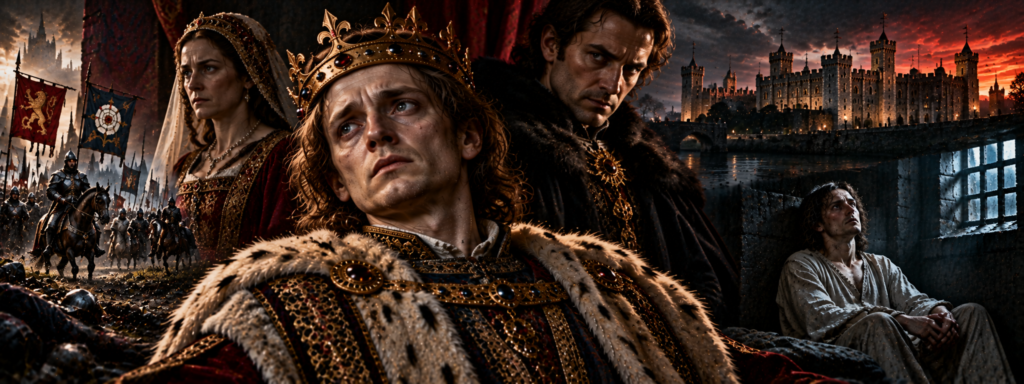
Henry VI: The Broken King Murdered in the Tower After the Wars of the Roses
Henry VI (1421–1471) | King of England, 1422–1461 and 1470–1471 | Imprisoned in the Tower of London and almost certainly murdered after Edward IV’s restoration, although the precise manner of his death remains uncertain
The Last Night of a Fallen King
On the evening of May 21, 1471, England possessed one king too many. Edward IV of the House of York had crushed the last serious Lancastrian army at Tewkesbury, reclaimed London, and restored himself to the throne from which he had been driven only months earlier. His rival, Henry VI, was no longer commanding armies or issuing orders from a royal palace. The forty-nine-year-old Lancastrian king was a prisoner inside the Tower of London, politically ruined, physically vulnerable, and surrounded by enemies who had every reason to ensure that he never emerged alive.
By the following morning, Henry was dead. The official Yorkist explanation maintained that he had succumbed to grief after learning of the destruction of his cause and the death of his only son, Edward of Westminster. It was a convenient story, and perhaps deliberately so. Henry’s death removed the last crowned Lancastrian king at exactly the moment when Edward IV needed to make certain that England could never again rally around him.
Few modern historians accept the idea that Henry simply died of sadness. The timing is too politically useful, and evidence from sources hostile to Edward’s regime strongly suggests deliberate killing. One near-contemporary account, the Historie of the Arrivall of Edward IV, produced from a Yorkist perspective, claimed that Henry died of “pure displeasure and melancholy” after hearing of the Lancastrian disaster. Other chroniclers were far less delicate and accused Edward IV’s government, and sometimes Edward’s brother Richard, Duke of Gloucester, of direct involvement in murder.
Exactly what happened inside the Tower remains uncertain. There is no surviving execution order signed by Edward IV, no trustworthy eyewitness account of the killing, and no universally reliable description of the weapon used. Later writers supplied increasingly graphic details, including claims that Henry was stabbed or struck in the head while praying. The strongest historical conclusion is therefore not that every later murder story is true, but that Henry was almost certainly deliberately eliminated with the approval, explicit or otherwise, of the victorious Yorkist regime.
His death was the final humiliation in one of the strangest royal lives in English history. Henry had inherited the throne as an infant, been crowned king of both England and France, suffered catastrophic political failures, experienced prolonged episodes of mental incapacity, lost his French empire, watched England descend into civil war, been deposed, imprisoned, unexpectedly restored, and deposed again. He had been king twice without ever becoming the warrior monarch his dynasty desperately needed.
The Wars of the Roses produced many violent deaths, but few were as politically calculated as the probable murder of Henry VI. He was not killed while leading cavalry across a battlefield or defending himself against assassins. By May 1471, he had almost no practical power left at all. Henry died because, powerless though he was, his blood and crown still made him dangerous.
Born Beneath the Shadow of Agincourt
Henry VI was born at Windsor Castle on December 6, 1421, the only child of Henry V and Catherine of Valois. His father was already a legend. Henry V’s victory over the French at Agincourt in 1415 had transformed him into the heroic warrior king of English memory, while the Treaty of Troyes in 1420 had recognized him as heir to the French throne and provided him with Catherine, daughter of Charles VI of France, as his bride. The infant Henry therefore entered the world as heir to an extraordinary political project: the creation of a dual monarchy stretching across England and France.
That inheritance became his almost immediately. Henry V died unexpectedly at Vincennes on August 31, 1422, probably from dysentery, leaving his son not yet nine months old. Two months later, the French king Charles VI also died. According to the terms of the Treaty of Troyes, the infant Henry was now theoretically king of both England and France.
The reality was much more complicated. Charles VI’s son, the future Charles VII, refused to accept the settlement that excluded him from the French succession. Much of France remained loyal to the Valois cause, and the Hundred Years’ War continued. The infant king had inherited not a secure double kingdom but a gigantic military commitment that depended upon English commanders preserving his father’s victories.
Government in England was conducted by councils and powerful royal relatives. Henry’s uncle John, Duke of Bedford, became the principal English commander and regent in France, while another uncle, Humphrey, Duke of Gloucester, became an important political figure at home. Cardinal Henry Beaufort, the king’s great-uncle, also exercised enormous influence. The young king therefore grew up surrounded by experienced men whose rivalries shaped his early government.
Henry was crowned king of England at Westminster Abbey in 1429 when he was seven years old. Two years later, he was crowned king of France at Notre-Dame Cathedral in Paris. The ceremonies represented an astonishing claim for a child who possessed little personal control over either kingdom. England expected him eventually to become the successor not merely of Henry V but of the conqueror imagined by the Treaty of Troyes.
The contrast between father and son would eventually become brutal. Henry V had built his reputation through military discipline, aggression, and battlefield success. Henry VI grew into a deeply religious, gentle, and personally conscientious man who showed little enthusiasm for war. Those qualities might have made him admirable in private life, but they were poorly suited to a monarchy whose legitimacy depended upon military victory and control over fiercely competitive nobles.
The Boy King and the Saintly Reputation
Henry’s personality became increasingly apparent as he approached adulthood. Contemporary observers frequently emphasized his piety, modesty, and dislike of violence. He devoted substantial attention to religion and education, founding Eton College in 1440 and King’s College, Cambridge, the following year. These foundations became among the most enduring achievements associated with his reign.
His religious temperament later encouraged the development of an almost saintly reputation. Stories circulated portraying him as unusually chaste, forgiving, and uncomfortable with cruelty. Some admirers eventually treated his political failures as evidence that he belonged more naturally in a monastery than on a battlefield. After his death, a popular cult grew around him, and miracles were attributed to his intercession.
Yet virtues in a private Christian could become weaknesses in a medieval king. Royal government required a ruler capable of managing ambitious magnates, making difficult appointments, disciplining favorites, raising money, and sometimes ordering violence. Henry’s reluctance to confront powerful subjects created opportunities for factional politics. His generosity could also become financially destructive.
The king possessed another serious disadvantage: he had inherited a political situation that even a much stronger ruler might have struggled to manage. England’s position in France was deteriorating, and the costs of maintaining the war were enormous. The aristocracy expected royal patronage while the crown’s resources remained limited. Every military defeat increased criticism of the government.
Henry did not create all these problems, but he lacked the political force necessary to contain them. He tended to trust favored advisers and could be influenced by those around him. Decisions that required sustained attention were often delayed or handled inconsistently. Rival factions learned that controlling access to the king could mean controlling royal policy.
As Henry’s personal rule developed, the heroic legacy of his father became less a source of prestige than an impossible standard. Subjects remembered Henry V as the conqueror of France. His son presided over the gradual destruction of that conquest. Every lost town and defeated army made the difference between the two kings harder to ignore.
Margaret of Anjou Enters the English Court
Henry married Margaret of Anjou in 1445. She was the daughter of René of Anjou and niece by marriage to Charles VII of France, and the union formed part of a diplomatic effort to secure peace in the long Anglo-French conflict. Margaret was approximately fifteen years old when she became queen. She would eventually become one of the most controversial and formidable political figures of fifteenth-century England.
The marriage initially offered hope for stability. Henry appears to have been devoted to Margaret, and she became an increasingly important figure within the royal court. Her intelligence, determination, and willingness to engage directly in politics contrasted sharply with her husband’s more passive temperament. When Henry became incapable of defending his own dynasty, Margaret would effectively fight for it herself.
The marriage negotiations also became associated with the surrender of English-held territory in France, particularly Maine. The concession was politically explosive because many English subjects believed that lands won through decades of warfare were being abandoned without adequate compensation. Critics blamed royal advisers for betraying Henry V’s legacy. Margaret herself later became unfairly burdened with much of the hostility surrounding these policies.
England’s French possessions continued to collapse. Normandy fell to Charles VII’s forces in 1450 after a series of military disasters. Gascony, long connected with the English crown, was lost after the Battle of Castillon in 1453. With the exception of Calais, the great continental empire Henry V had seemed close to securing disappeared during his son’s reign.
The losses intensified domestic anger. Returning soldiers, unpaid retainers, displaced officials, and nobles who had invested fortunes in the French wars all contributed to political instability. The crown’s financial weakness made effective government increasingly difficult. Henry’s reputation suffered because kings were expected to provide victories, justice, and order.
Margaret’s role became increasingly important as the monarchy entered crisis. She had arrived as a teenage diplomatic bride but would become the principal defender of the Lancastrian dynasty. Her enemies later portrayed her as ruthless, foreign, and dangerously ambitious. In reality, much of her political activity arose because Henry himself became progressively less capable of protecting their son’s inheritance.
The Murder of Suffolk and a Kingdom Turning Violent
William de la Pole, Duke of Suffolk, became one of the most powerful figures around Henry during the 1440s. He was closely associated with the king’s government and with the negotiations that produced Henry’s marriage. As military setbacks and financial problems mounted, Suffolk became an obvious target for public anger. Opponents accused him of corruption, treason, and responsibility for the collapse of English power in France.
In 1450, political pressure forced Henry to send Suffolk into exile. The arrangement may have been intended to save him from a harsher fate. He never reached safety. His ship was intercepted in the English Channel, and Suffolk was seized and summarily executed.
The murder revealed the frightening weakness of royal authority. One of Henry’s closest advisers had been effectively kidnapped and killed without lawful trial. The government could neither protect him nor adequately punish those responsible. Violence was beginning to replace ordinary political mechanisms.
That same year, Jack Cade led a major rebellion in southeastern England. The rebels complained about corruption, taxation, military failure, and misgovernment. They entered London, where violence erupted and officials associated with the regime were attacked. The rebellion was eventually suppressed, but it demonstrated how widely dissatisfaction had spread.
Henry responded to crises with his characteristic preference for reconciliation and pardon. Such mercy could be admirable, but it also frustrated men who believed stronger action was required. A king who repeatedly forgave enemies risked appearing incapable of punishing them. In a political culture built around personal lordship and royal justice, weakness invited further challenges.
The stage was therefore being prepared for conflict between rival aristocratic factions. At the center of that struggle stood Richard, Duke of York, a powerful noble with royal blood and a legitimate interest in government. York initially presented himself as a reformer seeking the removal of corrupt advisers. Eventually, his family’s claim would become a direct challenge to Henry’s crown.
Richard, Duke of York, and the Rival Bloodline
Richard, Duke of York, possessed an extraordinary genealogical position. Through both parents, he descended from Edward III. His hereditary claims would later provide the House of York with a powerful argument against the Lancastrian dynasty. At first, however, Richard did not openly demand Henry’s throne.
York’s grievances centered on exclusion from political influence and hostility toward men surrounding the king. He particularly opposed Edmund Beaufort, Duke of Somerset, whom he blamed for military failures in France. The rivalry became increasingly bitter. Henry’s inability to reconcile competing magnates allowed factional hostility to deepen.
The dynastic question was especially sensitive because Henry and Margaret initially had no children. If Henry died childless, the succession would become dangerously uncertain. York’s royal ancestry made him a potential heir or at least a figure whose claims could not be ignored. Every political dispute involving him therefore carried implications beyond ordinary aristocratic rivalry.
Henry’s own ancestry also contained a vulnerability. His grandfather Henry IV had taken the crown from Richard II in 1399, establishing the Lancastrian dynasty through a combination of hereditary claim, political support, and successful usurpation. The memory of that deposition never completely disappeared. If one branch of Edward III’s descendants had seized the crown once, another branch could argue that it possessed a better right.
The political crisis might still have remained manageable if Henry had been able to govern decisively. Instead, his health suddenly collapsed in 1453. The timing could hardly have been worse. England had just lost Gascony, factional rivalries were escalating, and Margaret was pregnant with the heir the Lancastrian dynasty desperately needed.
Henry’s illness transformed a political struggle into a constitutional emergency. The king did not merely become indecisive or withdrawn. He appears to have entered a profound state of mental incapacity. For months, England had a living monarch who could not meaningfully rule.
The King’s Mind Goes Dark
In August 1453, Henry suffered a catastrophic mental breakdown. Contemporary descriptions suggest that he became unresponsive to people and events around him. He reportedly failed to recognize familiar individuals and could not conduct ordinary government. Modern retrospective diagnosis is impossible, and historians have proposed various possibilities, but the severity of the episode itself is not seriously disputed.
The illness had obvious dynastic echoes. Henry’s maternal grandfather Charles VI of France had suffered repeated episodes of severe mental disturbance. Charles sometimes failed to recognize members of his family and experienced periods of profound incapacity. The similarity encouraged later speculation about hereditary vulnerability, although medieval evidence does not permit a confident medical diagnosis.
Margaret gave birth to their only child, Edward of Westminster, in October 1453. According to later reports, Henry showed little or no reaction when the infant prince was presented to him. The birth should have been one of the most important moments of his reign because it provided the Lancastrian dynasty with a male heir. Instead, the king remained mentally absent.
Government could not function indefinitely without an active monarch. Richard, Duke of York, was eventually appointed protector of the realm. His rival Somerset was imprisoned. York had achieved through Henry’s incapacity much of the political influence he had previously sought through opposition.
Henry recovered around Christmas 1454 or early in 1455. His return to awareness immediately changed the balance of power. Somerset was restored to favor, York’s protectorate ended, and the old factional conflict resumed. Men who had briefly controlled government now feared retaliation.
The crisis moved toward armed confrontation. In May 1455, Yorkist forces intercepted the king’s party at St Albans. The resulting battle is traditionally regarded as the opening military engagement of the Wars of the Roses. What had begun as political rivalry was about to become dynastic civil war.
St Albans and the First Blood of the Wars of the Roses
The First Battle of St Albans on May 22, 1455, was relatively small compared with later battles, but its political consequences were enormous. Yorkist forces led by Richard, Duke of York, Richard Neville, Earl of Warwick, and the Neville family’s allies confronted the royal army. Fighting broke out within the town. Several leading Lancastrian nobles were killed.
Among the dead was Edmund Beaufort, Duke of Somerset, York’s hated rival. Henry himself was wounded in the neck by an arrow and taken into Yorkist custody. The king’s capture gave the victors control over royal government. Once again, Henry became less an active ruler than the object through which rival factions exercised power.
The deaths at St Albans also created blood feuds that made reconciliation increasingly difficult. Sons inherited grievances against the men responsible for their fathers’ deaths. Political disputes became personal vendettas. Every new killing produced relatives determined to seek revenge.
Henry continued to prefer reconciliation. In 1458, he attempted to stage a public settlement known as the Loveday, in which rival nobles symbolically demonstrated peace. The spectacle was impressive but superficial. The underlying disputes over power, inheritance, and responsibility for earlier deaths remained unresolved.
Margaret increasingly assumed leadership of the Lancastrian cause. Her priority was protecting the inheritance of her son, Edward of Westminster. York’s political influence threatened not merely her husband’s advisers but the future of her child. As the dynastic dimension became explicit, compromise grew harder.
War resumed in 1459. Yorkist leaders initially fled after their position collapsed at Ludford Bridge, but they returned the following year. The struggle now moved rapidly beyond reform of government. The question was becoming not who would advise Henry VI, but whether Henry VI should remain king.
The King Captured at Northampton
In July 1460, a Yorkist army defeated royal forces at the Battle of Northampton. Henry was again captured. Several prominent Lancastrian nobles died defending him. The king’s repeated capture demonstrated the extraordinary weakness of his personal monarchy.
Richard, Duke of York, returned from Ireland and made his most dramatic political move. In October 1460, he entered Parliament and formally asserted his hereditary claim to the throne. The demand shocked even some of his allies. Removing an anointed king remained a radical step.
A compromise known as the Act of Accord was reached. Henry would remain king for life, but York and his heirs would succeed him, disinheriting Henry’s son Edward of Westminster. For Margaret of Anjou, the settlement was intolerable. Her child’s birthright had effectively been confiscated while his father remained alive.
Margaret and Lancastrian supporters gathered forces in the north. York marched to confront them. At the Battle of Wakefield on December 30, 1460, the Yorkists suffered a devastating defeat. Richard, Duke of York, was killed.
His death did not end the Yorkist claim. It transferred it to his eldest surviving son, Edward, Earl of March. The eighteen-year-old was tall, charismatic, militarily talented, and very different from Henry VI. He would soon transform a disputed hereditary claim into a successful bid for the crown.
The civil war had now passed a point from which ordinary reconciliation was almost impossible. Both sides had lost close relatives in battle and execution. Henry’s son had been disinherited and then restored to Lancastrian hopes, while York’s son inherited his father’s claim and desire for vengeance. England was moving toward one of the bloodiest battles ever fought on its soil.
Edward IV Takes the Crown
Edward of March won an important victory over Lancastrian forces at Mortimer’s Cross in February 1461. Meanwhile, Warwick suffered defeat at the Second Battle of St Albans, allowing the Lancastrians to recover Henry VI. Yet the political momentum increasingly favored Edward. He entered London and was proclaimed king as Edward IV in March.
The rival kings then prepared for a decisive confrontation. On March 29, 1461, their forces met near Towton in Yorkshire during brutal winter weather. The battle was enormous by medieval English standards and produced exceptionally heavy casualties. Yorkist victory shattered the principal Lancastrian army.
Henry, Margaret, and Prince Edward fled north and eventually sought refuge in Scotland. Edward IV established himself as king. The crown had changed hands through military victory rather than peaceful succession. Henry VI’s first reign was over.
The deposed king nevertheless remained alive. As Richard II had demonstrated seventy years earlier, that fact created a serious political problem. Lancastrian supporters could continue fighting in his name. Every surviving noble loyal to Henry possessed a legitimate crowned figure around whom resistance could gather.
Margaret refused to abandon the struggle. She sought assistance from Scotland and France and continued attempting to restore her husband and preserve their son’s inheritance. Henry himself played a far less active role. The contrast between queen and king became increasingly striking.
For Edward IV, the Lancastrian family represented three separate threats. Margaret was the political organizer, Prince Edward was the dynastic future, and Henry was the anointed former king. Destroying the Lancastrian cause would ultimately require neutralizing all three.
The Fugitive King
After Towton, Henry spent several years moving through northern England and Scotland while Lancastrian resistance continued. His life became almost unrecognizable compared with the ceremonial world of his earlier reign. The king who had once been crowned at Westminster and Paris now depended upon a shrinking network of loyal supporters. He became a fugitive in the kingdom he had ruled since infancy.
Lancastrian resistance persisted in northern castles and border regions. Battles at Hedgeley Moor and Hexham in 1464 further weakened the cause. Leading supporters were captured and executed. Edward IV’s government steadily dismantled the remaining military network.
Henry eventually took refuge in Lancashire. Traditions associate him with various houses whose owners risked severe punishment by sheltering him. His movements were necessarily secretive. A former king had become a hunted man.
In July 1465, Henry was captured near Clitheroe. Accounts differ concerning the exact circumstances and the role of betrayal. He was taken south under guard. Edward IV finally possessed his rival.
Henry entered London as a prisoner and was confined in the Tower. The symbolism was unmistakable. The man who had once occupied royal palaces now lived under the authority of the king who had replaced him. Yet Edward did not immediately kill him.
Keeping Henry alive may initially have seemed safer than creating a martyr. His cause appeared broken, Margaret and Prince Edward were abroad, and Yorkist control looked increasingly secure. Henry himself was not a military leader capable of organizing escape or rebellion. Imprisonment could apparently contain him.
That calculation would eventually prove wrong. Henry did not need to lead armies personally to remain dangerous. As long as he lived, political enemies of Edward IV could use him as an alternative king. The opportunity to do exactly that arrived from within the Yorkist regime itself.
Warwick the Kingmaker Turns Against His King
Richard Neville, Earl of Warwick, had been one of the principal architects of Edward IV’s victory. His wealth, military power, and political influence earned him the later nickname “the Kingmaker.” During the early years of Edward’s reign, Warwick expected to remain a dominant figure. The relationship between the two men gradually deteriorated.
One major source of tension was Edward’s marriage to Elizabeth Woodville. The king secretly married her in 1464 despite Warwick’s diplomatic efforts to arrange a foreign royal marriage. Elizabeth came from an English family whose rapid advancement created resentment among established nobles. Warwick increasingly felt excluded from the influence he believed he deserved.
Foreign policy produced additional disagreements. Warwick favored a French alliance, while Edward moved toward Burgundy. The king also demonstrated that he intended to rule independently rather than remain dependent upon the magnate who had helped place him on the throne. Their political partnership turned into rivalry.
Warwick allied himself with Edward’s younger brother George, Duke of Clarence. Together they supported rebellions against the king in 1469. Edward was briefly captured, but Warwick discovered that controlling a reigning monarch was far more difficult than defeating one. His attempt to dominate the government collapsed.
By 1470, Warwick and Clarence had fled England. In one of the most extraordinary reversals of the Wars of the Roses, Warwick reached an agreement with Margaret of Anjou, the woman whose dynasty he had spent years destroying. Former mortal enemies became allies because both now wanted Edward IV removed.
The alliance required the restoration of Henry VI. The imprisoned king suddenly became politically useful again. After years in the Tower, he was about to be brought back into public view. England would witness the astonishing spectacle of a deposed monarch returning to the throne.
The Readeption: Henry VI Becomes King Again
Warwick invaded England in September 1470 while Edward IV faced collapsing support. The Yorkist king fled to the Low Countries rather than risk capture. Warwick entered London in triumph. Henry VI was released from the Tower.
The restored Lancastrian regime became known as the Readeption. Henry was again recognized as king in October 1470, more than nine years after his deposition. The restoration was one of the most extraordinary political reversals in English history. A prisoner had become king without personally winning a battle or organizing the revolution that restored him.
Henry’s physical appearance reportedly shocked observers. Years of captivity and illness had left him frail and diminished. He was paraded publicly as the legitimate monarch, but effective power rested with Warwick and other political leaders. The restored king functioned largely as a dynastic symbol.
This arrangement exposed the fundamental weakness of the Readeption. Henry had not returned because a powerful personal following had rallied around him. He returned because Warwick needed a king under whose authority he could govern. The regime therefore depended upon the continuing success of the alliance that had restored him.
Margaret and Prince Edward remained abroad during much of the Readeption. Negotiations and preparations delayed their return. The absence of the energetic queen deprived the restored regime of one of its strongest Lancastrian leaders. Warwick had to defend a monarchy whose principal royal family was divided geographically.
Edward IV, meanwhile, had not abandoned his throne. Supported by his brother-in-law Charles the Bold, Duke of Burgundy, he prepared to return. The Yorkist king had lost England once, but unlike Henry, he was an experienced military commander. In March 1471, he landed on the English coast.
Within weeks, the fragile Lancastrian restoration began to collapse. Henry’s second reign would last only about six months. His final fall was approaching far more quickly than his supporters understood.
Edward IV Returns From Exile
Edward landed at Ravenspur in Yorkshire with a relatively small force. Like Henry Bolingbroke in 1399, he initially framed his return cautiously, claiming limited objectives rather than immediately announcing his intention to reclaim the crown. As he moved through England, supporters joined him. The Yorkist cause revived with remarkable speed.
George, Duke of Clarence, abandoned Warwick and reconciled with his brother. The defection weakened the Lancastrian coalition at a critical moment. Edward advanced toward London. Henry VI once again became the prisoner of the Yorkist king.
Edward entered the capital in April 1471. Henry was removed from his brief restoration and returned to captivity. The Yorkists now had to defeat Warwick’s army before their victory could be secure. The confrontation came at Barnet on Easter Sunday.
The Battle of Barnet was fought in thick fog. Confusion contributed to disaster within Warwick’s forces, and the Yorkists won a decisive victory. Warwick and his brother John Neville, Marquess of Montagu, were killed. The man who had helped make and unmake kings was dead.
On the same day, Margaret of Anjou and Prince Edward landed in England. Their timing could hardly have been worse. They had arrived expecting to join Warwick and consolidate the restored Lancastrian monarchy. Instead, they discovered that their most powerful ally had already been destroyed.
The remaining Lancastrian forces gathered around Margaret and the prince. Edward IV moved rapidly to prevent them from establishing a secure position. The final confrontation would occur at Tewkesbury. Henry remained imprisoned in London while his wife and only son marched toward catastrophe.
Tewkesbury and the Death of Henry’s Only Son
The Battle of Tewkesbury took place on May 4, 1471. Edward IV’s army confronted the Lancastrian force commanded by experienced nobles and centered politically upon Prince Edward. The Yorkists won a decisive victory. Lancastrian hopes of restoring the dynasty were shattered.
Prince Edward of Westminster was killed during or immediately after the battle. The precise circumstances remain disputed. Some later accounts claimed that he was captured and killed in Edward IV’s presence, while others suggest he died during the fighting. The dramatic stories of his execution cannot be accepted uncritically.
What is certain is that Henry VI’s only legitimate child was dead at seventeen. The dynastic significance was enormous. The direct Lancastrian line represented by Henry and his son had effectively been reduced to one imprisoned former king. Margaret of Anjou was captured.
Several leading Lancastrian nobles sought sanctuary at Tewkesbury Abbey. They were removed, tried, and executed. Edward IV showed little inclination to allow the defeated leadership another opportunity to organize rebellion. Years of civil war had made mercy politically dangerous.
The victory transformed Henry’s position in the Tower. Before Tewkesbury, his son provided the Lancastrian cause with a future. After Tewkesbury, Henry himself became the final central symbol of that cause. He had no surviving son who could immediately replace him, but his existence could still legitimize opposition.
Edward IV returned toward London. Another disturbance led by Thomas Neville, known as the Bastard of Fauconberg, had recently threatened the capital. Although that rising failed, it reinforced the sense that the Yorkist regime needed finality. On May 21, Edward entered London in triumph.
That night, Henry VI died.
May 21, 1471: The Night the Lancastrian King Died
The timing of Henry’s death has always stood at the center of the case for murder. Edward IV returned to London on May 21 after defeating the Lancastrian cause at Tewkesbury. By the following morning, Henry was dead inside the Tower. The sequence was almost too politically convenient to ignore.
The Yorkist account attempted to explain the death without acknowledging violence. The Historie of the Arrivall of Edward IV, written by someone favorable to Edward, stated that Henry died of “pure displeasure and melancholy” after learning of the destruction of his friends and his son’s death. The explanation presented grief as the killer. It also absolved the victorious king of responsibility.
The story is possible in the narrow sense that extreme emotional stress can contribute to physical collapse. Henry had experienced years of illness, imprisonment, defeat, and political trauma. He had just lost his son and the final hope of restoration. Yet the extraordinary timing makes a purely natural death difficult to accept without skepticism.
Other contemporary or near-contemporary sources directly accused the Yorkists of murder. The chronicler John Warkworth wrote that Henry was put to death in the Tower on the night of May 21. The Crowland Chronicle likewise treated his death as the result of violence, although the precise details vary among surviving accounts. These sources are not free from political bias, but their testimony cannot be dismissed.
The political logic is especially powerful. Edward IV had already lost his throne once because opponents could restore Henry. Leaving the Lancastrian king alive after 1471 would invite the possibility of another restoration. The experience of the previous year had demonstrated exactly how dangerous Henry’s continued existence could be.
The question is therefore less whether Edward had motive than how the killing was authorized and carried out. A direct written order was unlikely to survive, if one ever existed. Edward could have commanded the death explicitly, approved it verbally, or allowed trusted men to understand that Henry should not survive the night. Medieval political murder rarely left the kind of paperwork that modern investigators would want.
Richard of Gloucester Enters the Story
One of the most persistent accusations concerning Henry’s death involves Richard, Duke of Gloucester, Edward IV’s younger brother and the future Richard III. Richard was in London on the night Henry died. Later sources placed him directly inside the Tower and sometimes identified him as the murderer. The accusation became particularly influential through Tudor historical tradition.
The strongest early evidence is more restrained. Warkworth stated that Henry was put to death in the Tower and noted that Richard of Gloucester was present. The wording encouraged later writers to connect Richard personally with the killing. It does not conclusively prove that he wielded the weapon.
Later Tudor authors had powerful reasons to blacken Richard III’s reputation. After Henry VII defeated and killed Richard at Bosworth in 1485, the new Tudor dynasty encouraged narratives portraying the fallen Yorkist king as exceptionally cruel and murderous. Richard became associated with a catalogue of deaths, including Henry VI, Prince Edward, George of Clarence, and the Princes in the Tower. Some accusations may have contained truth, while others were embellished by hostile political memory.
There is nevertheless nothing inherently implausible about Richard participating in Henry’s elimination. He was one of Edward IV’s most trusted military supporters and had fought throughout the restoration campaign. If Edward wanted Henry quietly killed, Richard could have been involved in arranging or supervising the act. Presence and opportunity, however, are not proof of personal execution.
The distinction matters. Saying that Richard almost certainly stabbed Henry would go beyond the evidence. Saying that he may have been involved in a killing carried out for Edward IV’s regime is much more defensible. The ultimate political responsibility still leads back to Edward’s government.
Henry’s death benefited Edward IV, not merely Richard. The elimination of the former king secured the restored Yorkist monarchy. Whatever happened inside the Tower should therefore be understood primarily as an act of regime security rather than a private crime committed by one ambitious duke.
How Was Henry VI Killed?
The precise method of Henry’s death remains uncertain. Later accounts described violent wounds, particularly blows or stabbing to the head. Some traditions placed Henry at prayer when the killers entered. These details became part of the image of a saintly king murdered while engaged in devotion.
The devotional setting suited Henry’s posthumous reputation. A pious and helpless king killed while praying could easily be interpreted as a martyr. Supporters who already admired his religious character had reason to preserve such a memory. The scene may therefore reflect hagiographic development as much as historical observation.
Centuries later, Henry’s remains were examined after his body had been moved to St George’s Chapel, Windsor. The examination revealed damage to the skull and hair apparently matted with blood, observations that have often been cited as supporting violent death. The condition and history of the remains complicate interpretation, however, and such evidence cannot reconstruct the exact circumstances of the killing with certainty.
No reliable source establishes a specific weapon beyond doubt. A sword, dagger, or heavy blow has variously appeared in later narratives. The absence of certainty is important because the historical case for murder does not depend upon knowing precisely how Henry died. Political context and near-contemporary testimony provide the stronger evidence.
The killing may have been quick and relatively private. Henry was already imprisoned, isolated, and under Yorkist control. There was no need for elaborate conspiracy once Edward IV had entered London victorious. Those responsible merely needed access to the prisoner.
Unlike a battlefield death, the murder left the government in complete control of the scene. Guards, witnesses, and the body itself were all within royal custody. Edward’s regime could announce whatever explanation it preferred. The Tower’s walls protected not Henry but the secrecy of those who wanted him gone.
The Official Story: Death From Grief
The claim that Henry died from grief deserves attention because it reveals how Edward IV’s government wanted the event understood. According to the Yorkist version, the former king learned of the deaths of his son and leading supporters and succumbed to melancholy. No execution had occurred, and no assassin needed to be identified. Henry had effectively been killed by the collapse of his own cause.
The explanation was politically elegant. Edward could benefit from Henry’s death without appearing to have murdered an anointed king. The defeated Lancastrian monarch became the victim of fate rather than Yorkist violence. His death could be presented as the natural conclusion of military defeat.
The story also exploited Henry’s known vulnerability. He had experienced severe episodes of mental incapacity and periods of withdrawal. A contemporary audience familiar with his history might find emotional collapse plausible. The official narrative therefore used aspects of Henry’s genuine condition to make the explanation more believable.
Yet the coincidence remains extraordinary. Henry survived years of war, imprisonment, mental illness, political humiliation, and the loss of his throne. He then died on the very night Edward IV returned to London after eliminating the principal Lancastrian army. The timing perfectly served the restored king.
Modern historians therefore generally treat the official explanation with deep suspicion. Some uncertainty remains because natural death cannot be absolutely disproven. Historical probability, however, strongly favors deliberate killing. The Yorkist narrative appears less like a medical explanation than political damage control.
The phrase “died of grief” also had the advantage of ending inquiry. Grief leaves no murderer to prosecute and no order to discover. It transformed an intensely political death into a personal tragedy. For Edward IV, that was precisely the story the kingdom needed to hear.
Edward IV’s Motive
Edward IV had already learned what happened when Henry VI was allowed to remain alive. After Towton, he initially permitted his rival to survive in exile. After Henry’s capture in 1465, he imprisoned him rather than ordering his death. Six years later, Warwick released Henry and used him to overthrow Edward.
The Readeption fundamentally changed the calculation. Henry had demonstrated that he could become king again without taking any meaningful action himself. Other men could restore him because his legitimacy supplied what their rebellion lacked. As long as he lived, Edward’s enemies possessed a ready-made alternative monarchy.
The events of 1470–1471 must therefore have convinced Edward that imprisonment was insufficient. The Tower had held Henry for years, yet one political revolution had opened the doors. Another crisis might do the same. Edward could not guarantee that he would never again face rebellion.
Tewkesbury provided an opportunity for final settlement. Prince Edward was dead, Margaret was captured, Warwick was dead, and leading Lancastrian nobles had been executed. Eliminating Henry would destroy the dynasty’s immediate central figure. The Yorkists could finally end the cycle of restoration.
Edward also needed to secure the succession for his own children. His marriage to Elizabeth Woodville had produced heirs whose future depended upon Yorkist control of the crown. A living Henry threatened not only Edward personally but the dynasty he was building. Political murder could therefore be rationalized as dynastic self-preservation.
None of this proves the wording of an order or identifies the killer. It does, however, establish overwhelming motive. Henry’s death solved Edward’s most persistent political problem at exactly the moment when the solution became both possible and useful. The Yorkist king had little reason to keep him alive and powerful reasons not to.
Margaret of Anjou Learns Her World Is Gone
Margaret of Anjou survived the destruction of her dynasty. Captured after Tewkesbury, she was held in English custody for several years. By the time she learned the full extent of the catastrophe, her husband, son, and many of her closest political allies were dead. The struggle she had pursued for nearly two decades had ended in total defeat.
Her reputation had already been transformed by Yorkist propaganda. Enemies portrayed her as a foreign queen whose ambition had plunged England into bloodshed. Later literary tradition intensified the image, turning her into a ferocious and sometimes almost monstrous figure. The historical Margaret was certainly politically aggressive, but much of that aggression developed from the need to defend her husband’s throne and her son’s inheritance.
The death of Prince Edward destroyed the future she had spent years protecting. Henry’s murder then eliminated the king around whom the Lancastrian cause had originally formed. Margaret herself no longer possessed a practical route back to power. Her political importance rapidly diminished.
Louis XI of France eventually negotiated her release in 1475. Margaret returned to France and lived in reduced circumstances. She died in 1482, eleven years after the catastrophe at Tewkesbury. The woman who had once commanded armies and negotiated with kings ended her life far from the English throne.
Her survival creates a striking contrast with the fate of her husband. Margaret had been the more active political opponent of Edward IV, yet she was spared. Henry, passive and imprisoned, was killed. The difference demonstrates that political danger did not depend solely upon personal ability.
Margaret could be removed from England and rendered politically irrelevant. Henry could not. His very identity as a crowned king made him dangerous even when he did nothing. That is why the helpless prisoner in the Tower posed a greater dynastic threat than the formidable queen who had spent years fighting Edward IV.
The Body at Chertsey
Henry’s body was not immediately given the kind of royal burial that might have encouraged political devotion. He was initially buried at Chertsey Abbey in Surrey. The choice placed him away from the principal royal mausoleums and from the political center of London. Like Richard II before him, the deposed king was kept at a symbolic distance from the full dignity of royal burial.
Stories soon developed around Henry’s tomb. Visitors reportedly attributed miracles to his intercession. The king who had been criticized as weak and incompetent during life began acquiring the reputation of a holy man after death. Political failure was reinterpreted as Christian humility.
This transformation was not entirely artificial. Henry had always possessed a reputation for exceptional piety. His educational foundations, personal devotion, and reluctance toward violence provided genuine material for a saintly image. Murder strengthened that reputation by allowing admirers to portray him as an innocent victim of worldly brutality.
Richard III later ordered Henry’s remains transferred to St George’s Chapel at Windsor Castle. The decision may have been intended partly to control and appropriate the growing cult. A royal shrine could enhance dynastic legitimacy if managed carefully. Henry’s body therefore remained politically meaningful long after his death.
Efforts were eventually made to secure his canonization. Henry VII, who founded the Tudor dynasty after Bosworth, had obvious reasons to encourage devotion to a Lancastrian king murdered by Yorkists. The Tudor claim to the throne benefited from presenting Henry VI as a holy predecessor. Politics and sanctity became deeply intertwined.
Henry was never formally canonized. Nevertheless, popular devotion persisted for generations. The failed king who had lost England’s French empire and twice lost his crown became, in death, something his enemies could not easily destroy: a royal martyr in popular memory.
The Saintly King and the Political Martyr
Henry’s posthumous transformation illustrates the unpredictable consequences of political murder. Edward IV’s regime probably killed him because his living body could serve as a rallying point. Death removed that immediate danger. Yet murder also made it possible for supporters to reinterpret his failures as suffering.
A king who had seemed weak could now appear gentle. His inability to dominate violent nobles became evidence of peaceful temperament. His religious devotion overshadowed military incompetence. His imprisonment and death resembled martyrdom.
Miracle stories multiplied around his memory. Pilgrims visited sites associated with him, and offerings were made at his shrine. The growth of the cult demonstrates that medieval subjects did not judge kings solely according to political effectiveness. Holiness could emerge from defeat.
The contrast with Edward IV is striking. Edward was the successful warrior, physically imposing and politically ruthless. Henry was the defeated prisoner. Yet centuries later, it was Henry whom some subjects remembered as almost saintly.
This does not mean that his reign should be romanticized. Henry’s weakness contributed to governmental instability, and his inability to control faction helped create conditions in which civil war became possible. Thousands suffered during conflicts that the monarchy failed to contain. Personal goodness did not automatically produce good government.
His murder nevertheless changed the moral balance of the story. A king could be incompetent without deserving secret execution. By killing a helpless prisoner, the victorious regime transformed a failed ruler into a victim. Yorkist political necessity created Lancastrian martyrdom.
Was Henry Responsible for the Wars of the Roses?
It is tempting to make Henry VI personally responsible for the Wars of the Roses because the conflict erupted during his reign. His weak political leadership unquestionably contributed to instability. He failed to manage rival nobles effectively, relied heavily upon favorites, and could not consistently impose royal authority. His mental incapacity created additional crises.
Yet the wars had causes larger than one man’s personality. England’s aristocracy was heavily militarized after decades of warfare in France. Noble families maintained armed affinities and possessed extensive regional power. The crown’s financial weakness limited its ability to dominate these magnates.
The loss of France intensified every problem. Military defeat destroyed careers, reduced opportunities for patronage, and undermined confidence in the government. Nobles blamed one another for disasters abroad. Returning soldiers brought experience of organized violence into domestic politics.
The dynastic structure was also inherently dangerous. Multiple descendants of Edward III possessed strong royal blood. The Lancastrian monarchy itself had been founded through the deposition of Richard II. Once Henry’s government became vulnerable, rival hereditary claims could be turned into political weapons.
Margaret, York, Warwick, Somerset, Edward IV, and numerous lesser nobles all made choices that escalated the conflict. Henry was often less the architect of events than the object around whom others fought. His crown became the prize through which competing factions sought legitimacy.
The tragedy is that Henry’s personality made him particularly ill-suited to such an environment. A stronger king might have delayed or contained the crisis. A more ruthless ruler might have destroyed opponents before they became existential threats. Henry instead tried repeatedly to reconcile men whose relatives had already killed one another.
The King’s Mental Illness and the Cruelty of Reputation
Henry’s periods of mental incapacity have often dominated descriptions of his reign. Medieval chroniclers struggled to understand his condition, while later historians attempted retrospective diagnoses ranging from schizophrenia to severe depressive or catatonic disorders. Such diagnoses remain speculative because surviving descriptions are limited and filtered through medieval observers. What can be said confidently is that Henry experienced at least one profound episode in which he became incapable of normal royal activity.
The political consequences were devastating. Medieval monarchy was intensely personal. Councils could govern temporarily, but disputes over who possessed authority in the king’s absence inevitably created faction. Henry’s illness therefore magnified existing rivalries.
His condition also shaped later perceptions of weakness. Political opponents could portray him as incapable of kingship. Supporters instead emphasized his innocence and piety. Both interpretations reduced a complicated human being to a convenient symbol.
Modern readers should resist another temptation: treating mental illness as an explanation for every failure of his reign. Many disastrous policies occurred when Henry was functioning normally, while numerous structural problems would have challenged any ruler. His illness mattered greatly, but it was not the sole cause of England’s political collapse.
It also makes his final imprisonment particularly bleak. Henry had spent much of his life being controlled by stronger personalities and rival factions. During periods of incapacity, others governed in his name. Even when mentally present, he was frequently used as the legal center of policies he did not personally drive.
In the Tower, that pattern reached its final form. Henry’s political identity mattered more than his wishes. He did not need to plot against Edward IV to be condemned by circumstance. The crown he had inherited as an infant remained dangerous enough to kill him almost half a century later.
The Tower of London and the Politics of Disappearance
The Tower was both royal residence and state prison, a place where proximity to monarchy could turn into captivity with terrifying speed. Henry knew it in both capacities. During the Readeption, he emerged from confinement to become king again. After Edward IV returned, the same walls enclosed him once more.
The Tower provided ideal conditions for a politically sensitive death. Access could be restricted, guards controlled, and information managed. Unlike a public execution, a killing within the fortress did not require explanation to a crowd. The government could announce the result after the event.
That secrecy helped create centuries of speculation. Later generations imagined hidden chambers, midnight assassins, whispered orders, and blood on stone floors. Some of those images belong to legend rather than evidence. Yet they reflect a genuine historical reality: the public did not know exactly what happened.
The Tower would later become associated with another Yorkist disappearance, that of Edward V and his younger brother Richard in 1483. The Princes in the Tower vanished during the reign of Richard III, producing an even more famous mystery. Henry’s death therefore became part of a broader tradition of royal prisoners whose fate was controlled behind fortress walls.
Such cases reveal why imprisoned kings and princes were uniquely vulnerable. Their captors controlled not only their bodies but the evidence surrounding their deaths. A government could delay announcements, restrict witnesses, and shape official explanations. Political murder could be concealed within administrative secrecy.
Henry entered the Tower as a defeated king and left it as a corpse. The walls preserved no reliable testimony capable of answering every question. That silence was not unusual for medieval political violence. It was one of its greatest advantages.
Edward IV After the Murder
Henry’s death helped give Edward IV something he had rarely enjoyed during his first reign: political security. With Warwick dead, Prince Edward killed, Margaret captured, and Henry eliminated, organized Lancastrian resistance collapsed. Edward would rule for another twelve years without being driven from the throne again. The civil wars temporarily subsided.
His second reign was far more stable than the first. Edward concentrated on royal finances, political control, diplomacy, and the consolidation of Yorkist authority. He became increasingly wealthy and effective as a ruler. The violent struggle of 1470–1471 had taught him the danger of leaving major dynastic threats unresolved.
The contrast between his treatment of Henry before and after the Readeption is revealing. Edward had allowed the former king to survive for years after his capture in 1465. That experiment ended with Henry being restored. After Edward regained power in 1471, the prisoner survived only a matter of weeks and died the night of the king’s triumphant return to London.
The lesson seems obvious. Edward had discovered that a living deposed king was a permanent political weapon. Killing Henry ensured that no future Warwick could simply open the Tower and restore him. The decision was ruthless but politically effective.
Edward’s success did not guarantee the survival of his dynasty. He died unexpectedly in April 1483 at only forty years old. His twelve-year-old son became Edward V. Within months, the boy was deposed by his uncle Richard, Duke of Gloucester.
The Yorkist dynasty then experienced the same problem it had imposed upon the Lancastrians: deposed royal rivals who remained alive. Edward V and his brother disappeared in the Tower. The cycle of dynastic elimination had turned upon the family that had used it against Henry VI.
The Shadow of Richard III
Because Richard, Duke of Gloucester, was present in London when Henry died and later became Richard III, the murder became woven into the darker legend surrounding him. Tudor historians portrayed Richard as a man who advanced through bloodshed. Shakespeare amplified that portrait into one of literature’s greatest villains. Henry VI became one of the victims placed along Richard’s path to the throne.
The historical Richard remains fiercely debated. Modern scholarship has challenged many aspects of Tudor propaganda while acknowledging that some accusations cannot simply be dismissed. His role in Henry’s death belongs in this uncertain territory. He had opportunity and may have had responsibility, but direct personal murder cannot be proven.
Richard’s presence should also not distract from Edward IV. In May 1471, Richard was the king’s younger brother and loyal lieutenant. He had no independent political reason to kill Henry without the interests of Edward’s regime. Any action he took would almost certainly have occurred within the broader Yorkist strategy.
The tendency to blame Richard alone can therefore obscure the nature of the crime. Henry’s death was not primarily the result of a private feud between two men. It was the elimination of a rival monarch after civil war. The regime benefited collectively.
If Richard supervised the killing, Edward remained the king whose throne was secured by it. If another official carried it out, the political responsibility remains similar. The important question is not merely whose hand held the weapon but whose government required Henry to disappear.
That distinction makes Henry’s death more significant than an ordinary assassination. It was an act of dynastic statecraft. A former king was removed because the political system could not safely accommodate two competing sources of royal legitimacy.
A Dynasty Almost Extinguished
With Henry and Prince Edward dead, the direct Lancastrian royal line had been destroyed. Yet Lancastrian blood survived through other branches. One relatively obscure claimant was Henry Tudor, Earl of Richmond, descended through the Beaufort line from John of Gaunt. In 1471, few would have predicted that he would eventually become king.
Henry Tudor spent years in exile while Yorkist politics continued to evolve. Edward IV’s death and Richard III’s accession transformed his prospects. Opponents of Richard increasingly rallied around the exiled Tudor. The dynastic struggle that appeared settled by Henry VI’s murder reopened in another form.
In 1485, Henry Tudor invaded England and defeated Richard III at the Battle of Bosworth. Richard was killed in battle. The victor became Henry VII, founder of the Tudor dynasty. The Lancastrian political tradition had returned through a distant branch.
Henry VII married Elizabeth of York, daughter of Edward IV, symbolically uniting the rival houses. Tudor propaganda later emphasized the idea that this marriage healed the divisions of the Wars of the Roses. The reality was more complicated, but the symbolism proved powerful. The dynasty built its legitimacy partly upon both Lancastrian and Yorkist ancestry.
Henry VI’s memory became useful within this new political landscape. A pious Lancastrian king murdered under Yorkist rule could serve as a spiritual and dynastic predecessor. Henry VII supported efforts toward his canonization. The dead king’s reputation became part of Tudor legitimacy.
Edward IV had killed, or permitted the killing of, Henry to extinguish a rival dynasty. Fourteen years later, a man bearing Henry’s name and Lancastrian blood defeated Edward’s brother and took the crown. Political murder had solved one succession crisis without ending the larger dynastic struggle.
The Murder That Ended a Reign but Created a Martyr
Henry VI’s death demonstrates how differently political power and historical memory can judge the same person. During his lifetime, Henry repeatedly failed at the central tasks expected of a medieval king. He lost territory, struggled to control nobles, endured mental collapse, and twice lost his throne. His enemies could plausibly describe his government as disastrous.
Death changed the frame. Henry was no longer the ruler who had failed to prevent civil war. He became the helpless prisoner killed by victorious enemies. His weaknesses could be recast as innocence, and his piety could become sanctity.
The probable murder also simplified the moral story for later generations. Edward IV was politically successful, but success required eliminating a defenseless man. Henry was politically unsuccessful, but his final helplessness made him sympathetic. History rarely distributes virtue according to competence.
The religious culture surrounding Henry intensified this transformation. Stories of miracles turned his grave into a place of devotion. People who had never experienced his government could encounter him primarily as a holy dead king. Memory separated him from the administrative failures of his reign.
His educational foundations strengthened the positive legacy. Eton College and King’s College survived the dynastic wars that destroyed his monarchy. Buildings, institutions, and devotional traditions preserved aspects of Henry long after the political structures of his reign disappeared. The failed king left achievements that his conquerors could not erase.
The Yorkists succeeded in preventing another Readeption. Henry never returned from the Tower again. Yet by killing him, they helped create the image of Henry VI that proved most enduring: the gentle, suffering king destroyed by a violent age he had never possessed the temperament to master.
Was It Regicide?
Henry had been formally deposed when he died, raising a technical question about whether his killing should be described as regicide. Politically and symbolically, the answer is difficult to avoid. He had been crowned and anointed king of England, restored to the throne only months earlier, and continued to represent a rival claim to Edward IV. He was killed because of that royal identity.
Deposition did not erase sacred kingship in the minds of contemporaries. Richard II had remained dangerous after 1399 precisely because subjects could still regard him as their rightful king. Edward II presented the same problem after 1327. Henry VI belonged to this grim succession of monarchs whose removal from the throne was followed by suspicious death in captivity.
His case is particularly clear because the political motive was immediate. The Yorkists had experienced what happened when a deposed king survived. Henry had been restored once. Killing him ensured that it could not happen again.
The murder therefore functioned as a regicide even if Edward IV’s government refused to acknowledge it as such. Henry was not executed after a public trial or condemned through an openly stated legal process. He simply ceased to live once the victorious dynasty no longer needed to tolerate him. The secrecy itself reflected the political sensitivity of killing an anointed monarch.
Open execution might have provoked outrage. Secret killing allowed Edward to deny responsibility while enjoying the result. Medieval rulers understood the difference. A dead rival was useful; public responsibility for regicide was dangerous.
Henry’s death thus belongs squarely within the Assassinated Rulers & Regicides category. The exact hand remains uncertain, but the political purpose is difficult to misunderstand. England’s former king died because his existence threatened England’s reigning one.
The Last Lancastrian Night
It is impossible to reconstruct Henry’s final hours with certainty. We do not know exactly who entered his chamber, what he understood about his son’s death, or whether he expected to be killed. Any detailed dialogue or dramatic reconstruction would therefore be invention. The surviving evidence permits atmosphere but not certainty.
We can, however, understand the political world closing around him. Warwick was dead. Prince Edward was dead. Margaret was a prisoner. The Lancastrian army had been destroyed.
Edward IV had returned to London victorious. Henry had already experienced deposition, captivity, restoration, and renewed imprisonment. He must have known, to whatever degree his mental and physical condition allowed, that the political landscape had changed completely. There was no powerful faction left capable of opening the Tower doors for him again.
The Yorkist government knew the same thing. For the first time, it possessed the opportunity to eliminate Henry without immediately facing a strong Lancastrian response. His son could not inherit his claim, and his leading supporters could not organize rescue. The moment was ideal.
By morning, the former king was dead. The regime blamed grief. Other observers blamed murder. The timing has ensured that suspicion never disappeared.
Perhaps that uncertainty was intentional from the beginning. A secret death allowed everyone involved to avoid the spectacle of regicide. No scaffold stood in public view, and no executioner lifted an axe before a crowd. The king simply vanished behind the walls of the Tower, and a corpse emerged in his place.
The King Who Was Too Dangerous to Leave Alive
Henry VI spent almost his entire life wearing, losing, recovering, or being imprisoned because of a crown he had inherited before he could speak. He became king at eight months old and grew up beneath the impossible shadow of Henry V. England expected another conqueror and received a deeply religious man who disliked violence, struggled to control his nobles, and eventually suffered episodes of profound mental incapacity. His personal temperament and the brutal political world into which he had been born could scarcely have been less compatible.
He watched the French empire created by his father disappear. Normandy fell, Gascony was lost, royal finances deteriorated, and the political community fractured around him. Men fought over access to his authority until they eventually began fighting over whether he should possess authority at all. The crown that had once united the kingdom became the prize in a civil war.
Henry repeatedly survived disasters that destroyed stronger men. He survived the collapse of English France, the first battles of the Wars of the Roses, capture at St Albans and Northampton, the destruction of Richard of York, the slaughter at Towton, years as a fugitive, and imprisonment in the Tower. Even after Edward IV took his throne, Henry remained alive long enough to become king again.
That restoration sealed his fate. The Readeption of 1470 proved that Henry did not need to be energetic, politically competent, or even free to threaten Edward IV. Other men could remove him from prison, place him on a throne, and govern in his name. His weakness made him useful rather than harmless.
Edward’s return in 1471 destroyed that possibility piece by piece. Warwick fell at Barnet. The Lancastrian army was crushed at Tewkesbury. Henry’s only son died, Margaret was captured, and leading supporters were executed. By the time Edward rode back into London on May 21, the Lancastrian political world had been reduced to one frail prisoner in the Tower.
Before the next day, that prisoner was dead. The official explanation claimed that grief and melancholy killed him. It asked contemporaries to believe that Henry survived decades of turmoil only to die naturally on the exact night when his continued existence became the final obstacle to Yorkist security. The possibility cannot be mathematically excluded, but politically it strains belief.
Near-contemporary sources believed Henry had been killed, and modern historical judgment generally agrees that murder is overwhelmingly likely. Whether Edward IV explicitly ordered the death cannot be demonstrated through a surviving command. Whether Richard of Gloucester personally participated remains uncertain. Whether Henry was stabbed, struck, or killed by some other means cannot be established beyond dispute.
Those uncertainties should remain uncertainties. The famous image of Richard personally murdering Henry may owe more to hostile later tradition than recoverable fact. The scene of the king being killed while praying fits beautifully with the saintly legend that developed after his death, but beauty and historical certainty are not the same thing. The responsible conclusion is narrower and darker: Henry almost certainly died because Edward IV’s restored regime decided, directly or indirectly, that he could not safely be allowed to live.
His murder was therefore not an explosion of uncontrolled rage. It was colder than that. Henry had become a political problem that imprisonment had already failed to solve once, and the Yorkists were not prepared to repeat the experiment. The former king was eliminated at the moment when his enemies finally possessed the power to make the decision permanent.
Yet the killing produced an irony Edward IV could not have anticipated. The politically ineffective king became more powerful in memory after death than he had often been in life. Pilgrims visited his tomb, miracles were attributed to him, and generations remembered his gentleness and religious devotion. The prisoner the Yorkists wanted forgotten slowly became a martyr.
His dynasty also refused to disappear completely. The direct Lancastrian line died with Henry and his son, but the wider bloodline survived. Fourteen years later, Henry Tudor defeated Richard III at Bosworth and founded a new dynasty that deliberately cultivated Lancastrian memory. The Yorkist attempt to extinguish one royal claim helped provide the moral mythology of the dynasty that eventually replaced them.
Henry VI remains one of the strangest kings England ever produced. He was a monarch who seemed temperamentally unsuited to monarchy, a king of France who lost France, a ruler who became a prisoner, a deposed sovereign who astonishingly regained his crown, and a restored king who was again dragged back into captivity. He lived through one of the most violent political transformations in English history without ever becoming comfortable with the violence necessary to survive it.
That may be why his final death in the Tower feels so grimly appropriate to the age that destroyed him. Henry did not die charging across a battlefield beneath the Lancastrian standard. He did not fall with a sword in his hand or perish while commanding the men who fought for his crown. He was locked away after everyone capable of saving him had been defeated, and his enemies controlled the doors.
Somewhere inside the Tower on May 21, 1471, the long struggle between Henry VI and the House of York reached its quietest and most ruthless conclusion. The defeated king had no army left, no son left, no kingdom left, and almost no freedom left. Yet one thing remained that Edward IV could not safely take from him while he lived: the fact that Henry had once been crowned king of England and had already proved that a fallen king could rise again.
By morning, even that danger had been removed. The Yorkists could take his throne twice, imprison his body, destroy his supporters, and kill the heir for whom Margaret of Anjou had fought so fiercely. In the end, however, they apparently decided that none of those victories was secure while Henry himself continued breathing. The king who had seemed too weak to rule had become, in defeat, too dangerous to leave alive.