
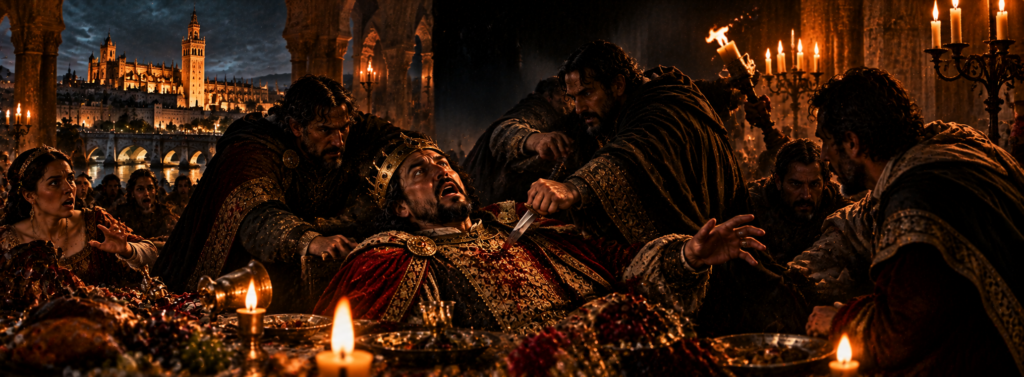
Theudegisel: The Visigothic King Murdered in the Darkness of His Own Banquet
Theudegisel (d. 549) | King of the Visigoths, 548–549 | Also known as Theudigisel, Theudisclus, and Teudiselo | Former military commander under King Theudis | Helped defeat a major Frankish invasion of Hispania | Accused of accepting payment to allow surviving Frankish soldiers to escape | Succeeded Theudis following his assassination in 548 | Accused by Isidore of Seville of sexual misconduct involving the wives of powerful men | Assassinated during a banquet in Seville when the lights were reportedly extinguished | Succeeded by Agila I.
The Night the Lights Went Out
The banquet was supposed to be an occasion of royal hospitality, but somewhere among the men gathered around the Visigothic king were people who had apparently come prepared to murder him. Theudegisel had ruled for little more than a year, yet his brief reign had already become associated with accusations of sexual misconduct, aristocratic resentment, and the abuse of royal power. According to the account preserved by Gregory of Tours, the king was feasting when the lights were suddenly extinguished, plunging the gathering into darkness. Before order could be restored, someone struck him with a sword, and the ruler who had once commanded armies against the Franks was dead.
The assassination took place in Seville in 549, ending one of the shortest reigns in Visigothic history. Theudegisel had succeeded King Theudis, who had himself been murdered the previous year by a man reportedly pretending to be insane. Now the new king had fallen to another carefully timed act of violence, this time carried out in the midst of a gathering that should have been protected by the conventions of royal hospitality. The rapid succession of murders exposed a monarchy in which even the highest position in the kingdom offered remarkably little personal security.
The surviving accounts offer a tantalizing explanation for the conspiracy. Isidore of Seville accused Theudegisel of violating the marriages of powerful men through scandalous sexual behavior, suggesting that aristocratic husbands had compelling reasons to resent him. Gregory of Tours preserved the more theatrical detail of the extinguished lights and the fatal attack during the feast. Together, the two accounts created the enduring image of a sexually predatory king brought down by men who had decided that murder was the only effective answer to his conduct.
Yet the story becomes considerably more complicated when examined closely. Neither chronicler was an eyewitness whose complete account of the conspiracy has survived, and neither provides a reliable list of the men responsible. The allegations against Theudegisel may reflect genuine abuses, but they also belong to a tradition in which murdered kings were frequently portrayed as having deserved their fate. The darkness of the banquet is memorable, but the political darkness surrounding the assassination is even harder to penetrate.
Theudegisel had not always been remembered as a discredited monarch. Before his accession, he was a military commander associated with the successful defense of Hispania against a major Frankish invasion. His ability to control the mountain routes through which the Franks retreated had made him an important figure in the kingdom. The same military prestige that helped carry him to the throne, however, could not protect him from enemies within his own court.
His death raises questions that remain unanswered nearly fifteen centuries later. Were the conspirators principally outraged husbands seeking revenge for the dishonor of their households, or were the accusations of sexual misconduct a convenient justification for a political assassination? Did rival aristocrats exploit the banquet to remove a king whose authority threatened their interests, or had his personal behavior genuinely made his position impossible to sustain? And when the lights went out, how many of the men seated near him already knew that their king would never see another morning?
A Kingdom That Had Learned to Murder Its Kings
Theudegisel inherited a kingdom with a long and bloody history of disputed succession. The Visigoths had established themselves as one of the most powerful successor states of the Western Roman Empire, controlling extensive territories in Gaul and Hispania during the fifth century. Their rulers commanded armies, negotiated with Roman emperors, and exercised authority over cities whose institutions had survived centuries of imperial government. Yet the monarchy remained vulnerable to the ambitions of powerful aristocrats and military commanders.
The problem was not that the Visigoths lacked royal families or traditions of legitimate succession. Hereditary claims mattered, and the descendants of successful rulers could command considerable prestige. Nevertheless, military leadership and aristocratic support were often decisive when the throne became vacant. A king who lost the confidence of influential warriors could find himself threatened by relatives, commanders, or political rivals.
The violent pattern had emerged long before Theudegisel’s lifetime. In 415, King Athaulf was assassinated at Barcelona by a man associated with an earlier political enemy. His successor Sigeric seized power but was himself murdered after a reign traditionally described as lasting only seven days. Wallia then became king, demonstrating how rapidly authority could pass from one faction to another.
The pattern continued during the following decades. Thorismund, who became king after his father died fighting Attila’s forces in 451, was murdered in 453 in a conspiracy associated with his brothers. Theodoric II succeeded him, only to be killed in 466 when another brother, Euric, took the throne. Royal kinship offered no guarantee of loyalty when the crown itself was at stake.
These murders did not mean that every Visigothic king ruled through constant terror. Some monarchs enjoyed lengthy reigns and maintained stable relationships with powerful families. Nevertheless, the repeated elimination of rulers created a political environment in which assassination remained a recognized possibility. A determined faction could remove a king and attempt to legitimize a successor afterward.
Theudegisel entered this world as a military commander rather than as a securely established hereditary prince. His route to the throne would depend upon the same combination of military prestige and aristocratic acceptance that had elevated other powerful men. That background gave him opportunities unavailable to ordinary subjects. It also exposed him to the dangers that had destroyed so many rulers before him.
The Ruins of the Kingdom of Toulouse
The political world of Theudegisel’s career had been transformed by the Battle of Vouillé in 507. Before that catastrophe, the Visigothic kingdom had been centered on Toulouse and controlled much of southwestern Gaul. King Alaric II possessed substantial territories, important Roman cities, and the resources of an established state. His defeat by the Frankish king Clovis shattered that political order.
Alaric was killed during the battle, and the Franks seized much of the Visigothic heartland in Gaul. Toulouse fell, royal treasure was captured, and the surviving Gothic leadership was forced to defend territories farther south. The kingdom retained Septimania and substantial possessions in Hispania, but its geographical center was changing. The political future of the Visigoths increasingly lay south of the Pyrenees.
The disaster also produced a succession crisis. Alaric’s illegitimate son Gesalec became king during the emergency, while the legitimate younger son Amalaric possessed a rival claim. Amalaric was the grandson of Theodoric the Great, the powerful Ostrogothic ruler of Italy. Theodoric intervened to protect his grandson and preserve the surviving Visigothic territories.
Gesalec was eventually displaced and killed after attempting to regain his throne. Amalaric remained under Ostrogothic protection, while Theodoric exercised extensive authority over the Visigothic kingdom. The arrangement preserved the state but introduced powerful Ostrogothic military officials into its government. One of those officials, Theudis, would eventually become king.
Theudis had served Theodoric and established himself as an influential commander in Hispania. Through marriage to a wealthy local woman, he acquired resources that allowed him to maintain a substantial personal military following. His authority grew while Amalaric remained dependent upon his grandfather’s protection. By the time the young king became independent, Theudis had already developed a formidable political position.
Amalaric’s reign ended violently in 531 after a disastrous conflict with the Frankish king Childebert I. Theudis succeeded him, becoming the first of two closely connected rulers whose deaths would define the middle decades of the sixth century. Theudegisel emerged as an important military figure during Theudis’s reign. His own accession would eventually follow another assassination.
The General Before the Crown
Theudegisel’s early life is poorly documented, and the surviving sources provide little secure information about his family or childhood. His name appears in several forms, including Theudigisel, Theudisclus, and the Spanish Teudiselo. He is commonly described as a commander of Ostrogothic background who served within the Visigothic kingdom. Some later genealogical claims attempt to connect him to the Amal dynasty, but the precise details of his ancestry should not be treated as firmly established.
What can be said with greater confidence is that he became an important military leader under King Theudis. The Visigothic kingdom required experienced commanders to defend its territories against Frankish aggression and maintain royal authority across Hispania. Theudis himself had risen through military service, and he understood the importance of capable subordinates. Theudegisel’s prominence therefore developed within a political system that rewarded successful commanders with influence.
His career also reflected the continuing relationship between Ostrogothic and Visigothic elites. Theodoric the Great had once exercised authority over both kingdoms, creating networks of military service and political allegiance that survived his death. Men associated with those networks could hold important positions in Hispania even after the Visigoths became more independent. Theudis was the clearest example, but Theudegisel appears to have belonged to the same broader military environment.
The surviving evidence does not reveal whether Theudegisel possessed the enormous private resources that had strengthened Theudis. We do not know the extent of his estates, the number of warriors personally loyal to him, or the marriages through which he may have formed aristocratic alliances. Such information would help explain his eventual accession, but it has not survived. His military reputation remains the most visible foundation of his political importance.
The event that established that reputation was the Frankish invasion of Hispania in 541. Two powerful Frankish kings launched a campaign that threatened the Visigothic kingdom and forced Theudis to organize a major defense. Theudegisel played an important role in the operations against the retreating invaders. His conduct during that campaign would become one of the few substantial episodes preserved from his life before kingship.
The Frankish Invasion of Hispania
In 541, the Frankish kings Childebert I and Chlothar I invaded Visigothic territory south of the Pyrenees. Their campaign followed decades of rivalry between the Franks and Visigoths, whose earlier confrontation at Vouillé had transformed the political map of western Europe. The Frankish rulers possessed substantial military resources and had already demonstrated their willingness to intervene in Hispania. Their invasion threatened to repeat the disasters that had destroyed the old kingdom of Toulouse.
The invading forces advanced through northeastern Hispania and threatened important cities along their route. Zaragoza became a central focus of the campaign, with later accounts describing a prolonged siege. The city was an important urban and religious center, making its defense politically significant. A successful Frankish conquest could have undermined Visigothic authority across a much wider region.
Gregory of Tours describes the siege through a strongly religious narrative. According to his account, the inhabitants appealed to the protection of Saint Vincent, whose relics were associated with the city. The Frankish rulers eventually withdrew, and Gregory connected their departure to the religious devotion of the defenders. His account is valuable but should not be mistaken for a complete explanation of the campaign’s military outcome.
The Visigoths also organized armed resistance. Theudis’s government needed to prevent the invaders from establishing permanent control and to make their withdrawal costly. Theudegisel was among the commanders associated with the operations against the Frankish army. His role became especially important as the invaders attempted to return north through the Pyrenees.
Mountain routes created opportunities for defenders who understood the terrain. A retreating army burdened with supplies, captives, or plunder could become vulnerable when forced through narrow passages. Theudegisel’s forces reportedly occupied positions that threatened the Frankish withdrawal. The situation offered the possibility of inflicting severe losses upon an enemy already abandoning its campaign.
The operation helped establish Theudegisel’s reputation as a successful commander. He had confronted the same Frankish powers that had destroyed earlier Visigothic kings and threatened the kingdom’s survival. Yet the surviving tradition also attached a damaging accusation to his conduct. The commander who could have destroyed the retreating enemy supposedly allowed some of its soldiers to escape in exchange for payment.
The Mountain Pass and the Price of Escape
Theudegisel’s role in the Frankish retreat is one of the most revealing episodes in his career. The surviving tradition describes his forces blocking or threatening the routes through which the Franks attempted to leave Hispania. The invaders had already suffered difficulties during their campaign, and their withdrawal exposed them to further attack. A commander controlling the mountain passages could place enormous pressure upon an army trying to escape.
According to the account preserved in the historical tradition, Theudegisel inflicted losses upon the Franks but accepted payment to allow surviving forces to continue their retreat. The accusation presents him as both an effective military leader and a man willing to profit personally from the enemy’s desperation. It is an uncomfortable combination, especially because his later reign would be remembered through allegations of misconduct. Yet the circumstances and exact terms of any payment cannot be independently reconstructed.
The account may preserve a genuine negotiated withdrawal. Armies sometimes paid money, surrendered valuables, or offered other concessions to secure passage through dangerous territory. Such arrangements could be practical military decisions rather than straightforward betrayals. Without knowing Theudegisel’s orders, the condition of his troops, or the strategic situation, it is difficult to determine whether accepting payment represented corruption or calculation.
Nevertheless, later interpretations often emphasize the scandalous possibility that he allowed enemies to escape when he could have destroyed them. The accusation fits a wider pattern in which powerful men were judged through stories of greed, lust, and abuse. It may have influenced how subsequent generations understood his character. Yet the surviving evidence does not establish that his contemporaries universally regarded the arrangement as treason.
The campaign itself ended without the Franks establishing lasting control over the territories they had invaded. Theudis’s kingdom survived a major military threat, and Theudegisel emerged as one of the commanders associated with its defense. His military prestige could have strengthened his standing among warriors and aristocrats. In a monarchy where armed support mattered enormously, that prestige had political value.
The episode also reveals an important tension in his career. Theudegisel could be remembered as a defender of the kingdom while simultaneously being accused of exploiting his position for personal advantage. These qualities were not necessarily incompatible in the political culture of the time. Successful commanders could accumulate wealth and influence through warfare, but their conduct could also generate resentment.
Years later, when Theudegisel became king, the same military reputation that had helped elevate him would be overshadowed by a different set of accusations. His brief reign would not be remembered for campaigns against the Franks. It would be remembered for the conduct of his court and the manner of his death.
Theudis: The King Who Was Murdered Before Him
Theudis had become king in 531 after the violent death of Amalaric. His reign lasted approximately seventeen years, making him a comparatively durable ruler in a kingdom repeatedly shaken by assassination and disputed succession. He confronted Frankish aggression, attempted to challenge Eastern Roman power in North Africa, and issued legislation addressing aspects of judicial administration. His government also permitted Catholic church councils despite the monarchy’s adherence to Arian Christianity.
Theudis’s position rested upon a foundation he had spent decades building. He possessed military experience, political connections, and resources acquired through his wealthy marriage. His earlier service under Theodoric the Great had given him authority long before he became king. By the time he occupied the throne, he was already accustomed to exercising substantial power.
Yet his reign ended in 548 when an assassin attacked him inside a royal palace. According to Isidore of Seville, the murderer had pretended to be insane, using the appearance of irrational behavior to conceal his intentions. The deception apparently allowed him to approach the king closely enough to inflict a fatal wound. The exact location and circumstances of the attack remain uncertain.
Isidore preserves an extraordinary detail about the dying king’s response. Theudis supposedly asked his followers not to kill the assassin, believing that his own death was punishment for an earlier act of violence. The historian presents the episode as a moment of moral recognition, although the alleged earlier crime cannot be securely identified. The request for mercy remains one of the most unusual deathbed traditions associated with a Visigothic ruler.
Theudis’s assassination created another royal vacancy. His military commander Theudegisel emerged as the successful successor, taking the throne in 548. The surviving evidence does not establish that Theudegisel arranged his predecessor’s murder. His accession demonstrates that he possessed sufficient support to become king, not that he was responsible for the killing that made the succession possible.
Nevertheless, the political pattern was unmistakable. A powerful commander had become king after the violent death of a predecessor, just as Theudis himself had risen after Amalaric’s downfall. The kingdom once again transferred authority through circumstances marked by bloodshed. Theudegisel inherited not only the crown but also the dangerous political system that had made such transitions possible.
A Soldier Becomes King
Theudegisel’s accession in 548 marked the culmination of a military career that had already brought him considerable prominence. He was not known primarily as the legitimate heir of an established hereditary dynasty. His claim rested upon the political authority he had acquired as a commander and the support necessary to secure recognition as king. The transition reflected the importance of military leadership in Visigothic succession.
The surviving accounts provide little detail about the process through which he obtained the crown. We do not possess a reliable description of an election, an assembly of nobles, or the negotiations that may have preceded his accession. Nor do we know whether he faced an immediate rival claimant. The lack of information makes it difficult to reconstruct the political balance at the beginning of his reign.
His background nevertheless suggests why he could have been an attractive candidate. He had served under Theudis, participated in the defense of the kingdom, and acquired a reputation as a capable military leader. A commander familiar with the army and the political elite might appear well suited to preserve stability after the assassination of a long-serving king. The kingdom needed a ruler capable of maintaining order while foreign threats remained serious.
Yet military success did not guarantee political skill. Commanding soldiers against an invading army required different relationships from governing powerful aristocratic families. A king needed to distribute favors, respect important alliances, and avoid provoking opposition among men who possessed their own military resources. Theudegisel would soon be accused of failing spectacularly in his dealings with the aristocracy.
The length of his reign also deserves attention. Some chronologies describe him as ruling for approximately eighteen months, while Isidore’s reckoning gives a somewhat shorter period. The difference reflects the limitations of the surviving chronological evidence rather than a major disagreement about the sequence of kings. He succeeded Theudis in 548 and was killed in 549.
Whatever the exact number of months, his reign was brief. He did not have time to establish a long administrative record or undertake major reforms that would dominate later historical memory. Instead, the surviving narratives concentrate upon the behavior that allegedly provoked his enemies and the assassination that ended his life. His entire kingship became overshadowed by the circumstances of his death.
The Court of a King Without a Dynasty
Theudegisel’s political position was potentially vulnerable from the beginning. Unlike Amalaric, he could not rely upon a straightforward claim as the legitimate son of a previous Visigothic monarch. Unlike Theodoric the Great, he did not possess a long-established royal dynasty commanding loyalty across several kingdoms. His authority depended heavily upon acceptance by the military and aristocratic elites.
Those elites were not passive servants. Powerful Gothic families possessed land, followers, and influence within the kingdom. Hispano-Roman aristocrats also retained considerable local authority, particularly through property ownership and connections with urban institutions. A successful monarch needed to govern among these groups rather than simply command them.
Royal favor could strengthen a family through appointments, land, military opportunities, and access to the court. Royal hostility could threaten the same family’s position. The king’s personal relationships therefore had political consequences far beyond the palace. An insult to a powerful noble could become a challenge to an entire network of supporters.
Theudegisel’s alleged misconduct involving noblewomen must be understood within this context. Marriages among elite families were instruments of political alliance, property transmission, and social prestige. A king who interfered with those marriages could threaten relationships that supported the political order. Sexual misconduct by a monarch could therefore become a matter of public power rather than merely private scandal.
The surviving sources do not allow us to reconstruct the full social world of Theudegisel’s court. We do not know the names of the women involved in the accusations or the identities of their husbands. We cannot establish the nature of each alleged encounter or determine whether coercion was involved in particular cases. Those gaps are significant because they prevent us from treating a hostile chronicler’s summary as a complete record of events.
What survives is an accusation serious enough to become the principal explanation for a royal assassination. Theudegisel was remembered as a king whose behavior toward women connected to powerful men provoked deadly resentment. Whether that account captures the full motive of the conspirators remains uncertain. Its survival nevertheless reveals how closely sexual reputation and political legitimacy could become intertwined.
The Women at the Center of the Accusations
Isidore of Seville presents Theudegisel’s downfall as the consequence of scandalous behavior involving the marriages of powerful men. His language is strongly condemnatory, portraying the king as a ruler whose sexual conduct violated accepted moral and social boundaries. The accusation has often been summarized as adultery with noblewomen or the seduction of aristocratic wives. Some later retellings describe coercion or sexual predation, but the surviving evidence does not permit every individual allegation to be reconstructed.
The women themselves remain unnamed. Their voices do not survive, and the chroniclers do not provide personal accounts of their experiences. Instead, the narrative focuses upon the dishonor suffered by their husbands and the consequences for the king. That imbalance reflects the patriarchal assumptions of the society in which the story was recorded.
Marriage among powerful families was closely connected to inheritance, alliances, and public reputation. A husband’s status could be damaged by accusations involving his wife, while a woman’s reputation could become entangled in conflicts between men. The king’s superior political position made any such relationship particularly sensitive. Even apparently consensual conduct could carry coercive pressures when one participant possessed royal authority.
The accusations therefore raise questions that cannot be answered with certainty. Were the women willing participants, victims of pressure, or individuals whose relationships were later interpreted through political hostility? Did their husbands act primarily from personal anger, concern for family reputation, or fear that the king was using sexual relationships to weaken their influence? The sources do not provide enough detail to distinguish these possibilities.
It is important not to transform the women into decorative figures in a story about male revenge. If the allegations involved coercion, the women may have suffered serious harm. If the accusations were exaggerated or fabricated, their reputations may have been used as weapons in a political struggle. In either case, their experiences were subordinated to the interests of powerful men.
Theudegisel’s historical reputation rests heavily upon this episode, yet the evidence is strikingly thin. Isidore offers a moral judgment rather than a detailed investigation. He identifies a pattern of misconduct but does not provide names, dates, or individual circumstances. The historian can report the accusation and explain its political significance without pretending to know more than the sources reveal.
Sexual Scandal as a Political Weapon
Accusations of sexual misconduct have appeared repeatedly in the histories of rulers who were overthrown or murdered. Such allegations could reflect genuine abuse, but they could also serve as powerful tools for undermining legitimacy. A king portrayed as unable to control his desires could be presented as unfit to control a kingdom. His private behavior became evidence of public corruption.
In the sixth century, Christian moral expectations gave these accusations particular force. Bishops and chroniclers frequently connected political disorder with sexual sin, greed, pride, and violence. A ruler whose conduct violated accepted moral boundaries could be depicted as deserving punishment. His downfall could then be interpreted as the natural consequence of his wrongdoing.
Isidore’s account of Theudegisel fits this broader pattern. The king is accused of violating the marriages of powerful men and is then murdered by conspirators. The narrative establishes a direct moral relationship between misconduct and death. Yet the existence of such a narrative does not prove that the assassination was motivated exclusively by sexual grievances.
Powerful nobles might have possessed additional reasons to oppose Theudegisel. His attempts to assert royal authority could have threatened established privileges or rival factions. His military background may have made him less dependent upon certain aristocratic families than they wished. The surviving sources do not provide enough information to reconstruct these possible conflicts.
The allegations nevertheless offered a compelling justification for murder. Aristocrats who killed a king could present themselves as defenders of household honor rather than ambitious conspirators. Their actions could be framed as punishment for intolerable royal behavior. Such a narrative might help secure acceptance for the succession that followed.
The possibility of political manipulation should not lead to automatic disbelief. Kings could abuse their authority, and elite women could become targets of exploitation by powerful men. Theudegisel may genuinely have behaved in ways that provoked widespread outrage. The difficulty is that the surviving evidence does not allow us to separate every element of fact from the moral interpretation attached to it.
The most responsible approach is to preserve the tension. Theudegisel was accused of serious sexual misconduct by an important early historian. That accusation became closely associated with his assassination. Whether it provides the complete explanation for the conspiracy remains unknown.
The Meaning of Tyranny in the Sixth Century
Theudegisel is frequently described as a tyrannical ruler, but the term requires careful interpretation. Modern readers often associate tyranny with systematic repression, arbitrary imprisonment, widespread executions, and oppressive government. The surviving evidence for Theudegisel’s reign is too limited to establish such a comprehensive pattern. His reputation rests principally upon accusations of sexual misconduct and the violent circumstances of his death.
In late antique and early medieval writing, tyranny could refer to several forms of illegitimate or abusive power. A ruler might be condemned for cruelty, moral corruption, unlawful accession, or disregard for aristocratic rights. The word did not always imply the existence of a detailed record of administrative oppression. It could also express the judgment that a king had violated the standards expected of legitimate authority.
Theudegisel’s alleged behavior toward noblewomen could therefore support a reputation for tyranny within the values of his society. If he used royal power to interfere with marriages or compel relationships, he would have threatened both personal dignity and aristocratic independence. Powerful families might regard such conduct as an attack upon their status. The king’s behavior could become politically intolerable even without a documented campaign of general repression.
The brevity of his reign makes the problem more difficult. We possess little reliable information about his laws, taxation, military policy, or relations with religious institutions. It would be misleading to invent a long catalogue of atrocities merely because later accounts describe him unfavorably. His historical reputation should remain tied to the accusations actually preserved.
The murder itself also influenced how his reign was remembered. A king killed by conspirators might be portrayed as deserving his fate, especially if the new political order benefited from that interpretation. Later writers could emphasize misconduct while ignoring achievements that no longer served the narrative. The result was a historical portrait dominated by scandal.
Theudegisel may have been an abusive ruler whose enemies eventually retaliated. He may also have been a politically vulnerable king whose personal conduct provided a convenient justification for his removal. The available evidence does not permit a definitive choice between those interpretations. What is certain is that his reputation became inseparable from the violence that ended his reign.
Seville: A City of Power and Conspiracy
Seville was one of the important cities of southern Hispania during the sixth century. Its Roman heritage, commercial connections, and surrounding agricultural resources made it a significant regional center. The city also possessed an influential Christian community and would later become closely associated with major ecclesiastical figures. For a Visigothic king, maintaining authority in such a city mattered politically and economically.
Theudegisel’s assassination is traditionally located in Seville, where he was attending a banquet. The setting suggests that the king was present among members of an elite social circle rather than commanding an army in the field. Royal feasts could bring together nobles, military officers, officials, and other influential guests. They were occasions for hospitality, political negotiation, and the public display of status.
A banquet was not merely a private dinner. The seating arrangements, distribution of food and drink, and proximity to the king could communicate favor and hierarchy. Important guests might use the occasion to seek appointments, strengthen alliances, or settle disputes. The ruler’s presence gave the gathering political significance.
That significance also created danger. A banquet brought the king into relatively close contact with men who might otherwise be separated from him by formal audiences or military precautions. The customs of hospitality could encourage a degree of familiarity. A conspirator who secured a place among the guests might gain an opportunity unavailable in more heavily guarded settings.
The surviving sources do not describe the precise building in which Theudegisel was killed. We cannot reconstruct the room, identify the arrangement of the tables, or determine how many guests were present. Later traditions sometimes add elaborate architectural details, but these should not be mistaken for verified historical information. The essential setting is a royal banquet in Seville.
The location nevertheless contributes to the unsettling nature of the assassination. The king was not killed while defending a city or leading troops against foreign enemies. He died among people who had gathered for a social occasion under the conventions of royal hospitality. The apparent safety of the feast became the opportunity for murder.
The Banquet Before the Murder
Theudegisel’s final banquet has become one of the most memorable scenes in Visigothic history. Gregory of Tours describes the king feasting when the lights were extinguished and he was struck down. The account is brief, but its essential details are unusually dramatic. A ruler surrounded by guests was suddenly deprived of light, and an attacker used the darkness to kill him.
The surviving narrative does not establish whether the conspirators had planned the entire operation in advance or whether the opportunity arose during the gathering. The deliberate extinguishing of the lights strongly suggests preparation, but the precise mechanics remain unknown. We do not know who gave the signal, who controlled the lighting, or how many participants were involved. Later stories supply these details with considerable confidence, but the early evidence does not.
The accusation concerning noblewomen provides a possible motive for the attack. If powerful husbands believed that the king had dishonored their marriages, they may have sought an opportunity to kill him without confronting his guards openly. A banquet could offer that opportunity because important nobles might already possess access to the royal presence. Yet the surviving sources do not identify the individual conspirators as specific injured husbands.
Political motives may also have been involved. Theudegisel had occupied the throne for only a short time, and his authority may not have been fully consolidated. Powerful men who opposed his government could have used personal scandal to justify removing him. The banquet provided a setting in which such enemies might approach the king without attracting immediate suspicion.
The method of attack suggests an awareness of the danger involved in killing a monarch. In a well-lit gathering, a murderer might be identified immediately and attacked by loyal guards or guests. Darkness could conceal the identity of the assailant and create confusion long enough for the killing to succeed. The conspirators, if the operation was coordinated, may have relied upon that confusion.
Theudegisel’s earlier military achievements offered no protection against such a threat. He had once helped trap an invading army in the Pyrenees, using terrain and strategic positioning to place the enemy at a disadvantage. At Seville, the disadvantage was his own. The ruler who had mastered the dangers of mountain warfare was about to become vulnerable within the walls of his own court.
The Moment the Lights Went Out
Gregory of Tours provides the defining image of Theudegisel’s assassination. During the banquet, the lights were extinguished, and the king was killed in the darkness. The account identifies a sword attack but does not preserve a complete sequence of movements or the identity of the person who delivered the fatal blow. The scene has therefore survived as a vivid historical episode surrounded by unanswered questions.
The darkness mattered because it disrupted the normal order of the gathering. A royal banquet depended upon visible hierarchy, with the king occupying the central position of honor. Extinguishing the lights temporarily erased that order and created conditions in which an attacker could act without immediate recognition. The conspirators reportedly turned the physical environment against the man who presided over it.
The precise number of attackers remains uncertain. Some retellings describe several nobles stabbing the king, while others emphasize a single unidentified killer acting amid the confusion. The early accounts establish conspiracy and violent death but do not provide a reliable count of wounds or participants. The familiar image of numerous guests taking turns stabbing the king belongs more securely to later elaboration than to the earliest surviving testimony.
Theudegisel was killed before his reign had lasted two years. His death was not the result of a formal trial, lawful deposition, or battlefield defeat. It was a deliberate act of violence committed during a gathering where he had reason to expect at least the outward observance of hospitality. The killing immediately created another vacancy in the Visigothic monarchy.
The circumstances were especially humiliating for a ruler whose earlier reputation rested upon military command. He was not overcome by a superior army or forced to surrender after a prolonged siege. His enemies apparently exploited proximity, deception, and darkness. The qualities that had once made him a successful commander could not prevent a carefully timed attack.
The banquet became the defining event of his reign because so little else survived in comparable detail. Theudegisel’s political ambitions, administrative decisions, and personal relationships remain largely hidden. His death, however, was memorable enough to be preserved by more than one major historical writer. The king disappeared into the darkness, but the story of that darkness endured.
What Gregory of Tours Actually Tells Us
Gregory of Tours was one of the most important historians of the sixth century. As a bishop writing in Frankish Gaul, he preserved extensive information about royal families, religious disputes, warfare, and political violence. His work is indispensable for understanding the period, but it also reflects his religious convictions and his interest in the affairs of the Frankish kingdoms. His judgments should therefore be considered alongside the political perspective from which he wrote.
Gregory’s account of Theudegisel’s death emphasizes the manner of the assassination. The king was feasting, the lights were extinguished, and someone killed him with a sword. Gregory then used the episode to comment critically upon the tendency of the Goths to kill rulers who displeased them and replace them with others. His narrative therefore combines a specific event with a broader judgment about Visigothic political behavior.
That judgment should not be treated as an objective description of every Visigothic succession. The Franks themselves experienced numerous dynastic murders, civil wars, and violent political struggles. Gregory was well aware of such events, but his criticism of Gothic practices reflected the assumptions and prejudices of his historical environment. The contrast between supposedly unstable Goths and other kingdoms was not as clear as his moral commentary might suggest.
Nevertheless, the assassination itself is consistent with the documented pattern of violent Visigothic succession. Several earlier kings had been murdered, and Theudegisel’s predecessor had died violently only the previous year. Gregory’s broader interpretation may be exaggerated, but it was not invented from nothing. The kingdom had experienced repeated episodes in which political opposition ended with the elimination of a ruler.
Gregory does not provide a complete explanation of the conspirators’ motives. His account is particularly valuable for the extinguished lights and the manner of the attack. It does not independently establish every allegation concerning the king’s sexual conduct. Those accusations are more closely associated with Isidore’s narrative.
The two accounts therefore need to be read together without being treated as identical. Gregory supplies the dramatic method of assassination, while Isidore emphasizes the behavior that supposedly provoked it. Later historians combined these elements into a single story of outraged nobles killing a corrupt king. That synthesis is plausible, but the differences between the sources remain important.
Isidore of Seville and the Accusation of Dishonor
Isidore of Seville wrote his history of the Goths during the seventh century, decades after Theudegisel’s assassination. He was one of the most influential intellectual and ecclesiastical figures of Visigothic Hispania, and his work helped shape later understanding of the kingdom’s past. His account of Theudegisel is brief but highly condemnatory. He portrays the king’s sexual behavior as the principal reason powerful men turned against him.
Isidore’s language emphasizes the violation of marriages belonging to influential families. The accusation suggests that Theudegisel had crossed boundaries that powerful aristocrats considered intolerable. In a society where marriage was closely tied to property, lineage, and political alliances, such behavior could create serious hostility. The king’s personal conduct therefore became a matter of political consequence.
Yet Isidore does not provide a list of victims or a detailed chronology of the alleged misconduct. He does not identify the women, describe their circumstances, or establish whether the relationships involved force. His account is a moral summary rather than a record of individual cases. The historian must therefore avoid transforming it into a fully documented campaign of sexual violence.
The accusation may nevertheless preserve a genuine tradition of aristocratic resentment. Theudegisel’s death was sufficiently notorious to attract explanations, and misconduct involving powerful families would have been a plausible cause of conspiracy. Isidore may have drawn upon accounts circulating within Hispania about the king’s behavior. The problem is that we cannot independently verify their details.
His position as a bishop also influenced the way he understood royal morality. Sexual misconduct, especially adultery and the violation of marriage, was a serious religious offense. A ruler accused of such behavior could be presented as morally unworthy of his position. His violent death might then appear as punishment for the disorder he had created.
The result is a historical portrait that demands both attention and caution. Theudegisel was remembered by an important early writer as a king whose conduct toward married women provoked powerful enemies. That testimony cannot be ignored. It also cannot establish every detail of the scandal without corroborating evidence.
Were the Assassins Outraged Husbands?
The most familiar explanation for Theudegisel’s murder is that powerful husbands conspired to avenge the dishonor of their wives. The interpretation follows naturally from Isidore’s accusation and the circumstances of the banquet assassination. Men whose family reputations had been damaged by the king might have decided that ordinary political remedies were impossible. Killing him could appear to offer both revenge and protection against further abuse.
Such a conspiracy would have been especially dangerous because the participants may have belonged to the aristocratic circles surrounding the throne. Powerful nobles possessed access to royal gatherings and relationships with military officers. They might also command followers capable of supporting a new ruler after the murder. Their social position could make them difficult to punish collectively.
Yet the surviving sources do not identify specific husbands as the killers. We cannot establish whether every conspirator had a personal grievance involving his wife. Nor do we know whether the alleged sexual misconduct was the immediate cause of the assassination or a broader justification attached to it afterward. The familiar story of betrayed husbands taking revenge remains an interpretation rather than a fully documented reconstruction.
Political ambition could have operated alongside personal resentment. A noble who believed his family had been dishonored might also oppose the king’s appointments, military policies, or distribution of resources. Another conspirator might care little about the sexual allegations but welcome the opportunity to remove a political rival. Assassination conspiracies rarely require every participant to share exactly the same motive.
Theudegisel’s brief reign may have made such opposition easier to organize. He had not spent decades cultivating relationships as king, and his authority may still have depended upon the military reputation acquired before his accession. Powerful families could have been testing the limits of his rule. If he antagonized them quickly, his position might have become precarious before he had time to consolidate it.
The banquet therefore may have brought together men whose grievances differed but whose immediate objective was the same. Some may have sought revenge, others political advantage, and still others protection from a ruler they regarded as dangerous. The evidence does not permit us to identify these factions with confidence. What survives is the outcome of their apparent cooperation.
The Problem of the Unknown Murderer
Theudegisel’s assassination is remembered for its method rather than the identity of the person who delivered the fatal blow. Gregory of Tours does not provide a secure name for the killer. Isidore emphasizes the conspirators’ grievances without supplying a complete list of participants. The central figure in the murder therefore remains anonymous.
That anonymity is particularly striking because Theudegisel himself was a king. His name, reign, military career, and death entered the historical record, while the person who killed him disappeared into uncertainty. The darkness of the banquet may have contributed to that anonymity, although the sources do not establish whether the murderer escaped identification at the time. Later generations simply inherited an incomplete account.
Some traditions associate the conspiracy with the accession of Agila I, Theudegisel’s successor. Agila certainly benefited from the vacancy created by the assassination. Yet the surviving evidence does not establish that he personally organized the murder or participated in the banquet. The distinction between succeeding a murdered ruler and arranging his death is essential.
The possibility of a wider aristocratic conspiracy is more strongly supported by the general character of the accounts. The killing appears to have been connected to opposition among powerful men rather than an ordinary criminal attack. The extinguishing of the lights suggests coordination, and the political circumstances made royal assassination a means of changing government. Nevertheless, the exact organization of the plot remains unknown.
We also do not know what happened immediately after the king was killed. The sources do not provide a reliable account of arrests, executions, or attempts by loyal followers to avenge him. It is possible that the conspirators possessed enough support to prevent effective retaliation. It is equally possible that details of the aftermath simply disappeared from the surviving record.
The mystery should not be resolved through invented names or motives. Theudegisel was murdered during a banquet in Seville, and the surviving tradition associates his death with aristocratic hostility. Beyond that, important questions remain unanswered. The uncertainty is part of the history rather than a flaw that needs to be concealed.
The Succession of Agila I
After Theudegisel’s death in 549, Agila I became king of the Visigoths. His accession continued the pattern in which powerful figures emerged after the violent removal of a predecessor. The surviving evidence does not establish a direct hereditary connection that would have made his succession inevitable. His authority depended upon political and military support within the kingdom.
Agila inherited a monarchy already weakened by repeated assassinations. Theudis had been murdered in 548, and Theudegisel followed him into a violent death the next year. Two kings had disappeared within a remarkably short period. Such instability could encourage rival aristocrats to question the strength of royal authority.
Agila’s own reign would prove troubled. He faced serious opposition in southern Hispania, including conflict associated with Córdoba. His military failures weakened his position and contributed to rebellion against his rule. The kingdom remained vulnerable to the same combination of regional resistance and aristocratic rivalry that had endangered earlier monarchs.
Athanagild eventually challenged Agila, producing another struggle for the Visigothic throne. The conflict became especially consequential because Eastern Roman forces intervened in southern Hispania. The empire of Justinian I had already reconquered North Africa and was fighting to control Italy. Visigothic civil conflict offered an opportunity to establish a foothold on the Iberian Peninsula.
Agila was killed in 554, and Athanagild emerged as king. The sequence continued the grim pattern of rulers losing their lives amid struggles for authority. Theudegisel’s assassination had not resolved the kingdom’s political problems. It had merely transferred them to another monarch.
The consequences extended far beyond individual reigns. Eastern Roman intervention helped create the imperial province commonly known as Spania, which would remain a challenge to Visigothic rulers for generations. The political instability of the 540s and 550s therefore contributed to a lasting foreign presence in southern Hispania. The kingdom survived, but its internal divisions had become an opportunity for an ambitious empire.
The Eastern Roman Threat Beyond the Banquet
Theudegisel’s brief reign unfolded during one of the most dramatic periods of imperial expansion in late antiquity. Justinian I was attempting to restore Roman authority over territories that had passed into the hands of successor kingdoms. His armies had destroyed the Vandal kingdom in North Africa and were engaged in a prolonged struggle against the Ostrogoths in Italy. The western Mediterranean was undergoing a major redistribution of power.
Theudis had already confronted the consequences of this expansion. His government attempted to challenge the Eastern Roman position near Ceuta, but the operation ended in defeat. The campaign demonstrated that the Visigoths could not easily project military power across the Strait of Gibraltar against imperial forces. It also revealed the strategic importance of southern Hispania and the North African coast.
Theudegisel inherited this difficult situation in 548. He ruled a kingdom that had survived Frankish invasion but faced a renewed Roman presence in the western Mediterranean. The Ostrogothic kingdom in Italy, once the source of protection and influence in Hispania, was itself fighting for survival. The political arrangements established by Theodoric the Great were rapidly disappearing.
There is little evidence that Theudegisel developed a major independent foreign policy during his short reign. The surviving narratives focus overwhelmingly upon his conduct and death. We cannot confidently attribute particular diplomatic initiatives or military plans to him. His reign was too brief and too poorly documented to support an elaborate reconstruction.
Nevertheless, the wider strategic pressures mattered. A kingdom facing external threats needed political stability and effective military leadership. The assassination of a king removed the central figure through whom military commands and aristocratic relationships were coordinated. Repeated successions could make coherent long-term policy more difficult.
Theudegisel’s death therefore occurred at a dangerous moment. The Visigoths were still adapting to the loss of their Gallic territories, the weakening of Ostrogothic influence, and the return of Roman imperial power to the western Mediterranean. Internal political violence compounded those challenges. The banquet murder was a domestic conspiracy with consequences for a kingdom surrounded by ambitious rivals.
Why Royal Banquets Were Dangerous
The assassination of Theudegisel belongs to a wider history of political violence carried out during feasts and ceremonial gatherings. Royal banquets brought powerful men into close proximity, often under circumstances that emphasized hospitality and trust. The ruler might be surrounded by guests whose public loyalty concealed private hostility. Such occasions could create opportunities for conspirators who would struggle to approach the king elsewhere.
The importance of the banquet lay partly in its social meaning. Eating and drinking together could symbolize political fellowship, reconciliation, and the recognition of hierarchy. A king who hosted nobles demonstrated his ability to distribute hospitality and maintain relationships. Guests who accepted that hospitality participated in a public expression of loyalty.
Murder during such an occasion violated those expectations. The attacker exploited the very setting intended to reinforce political bonds. In Theudegisel’s case, the extinguished lights transformed the feast from a display of royal authority into a moment of confusion and vulnerability. The method made the assassination particularly memorable.
The sources do not establish whether the king was intoxicated when he died. Later accounts sometimes emphasize drunkenness, but such details should not be presented as securely documented unless tied to a specific source. Similarly, elaborate descriptions of locked doors, prearranged signals, and conspirators taking turns stabbing the king belong to later narrative traditions rather than the core early testimony. The historical event does not require these additions to be dramatic.
The essential facts are sufficiently disturbing. A king was attending a banquet in Seville when the lights were extinguished and he was killed. The attack appears to have been associated with powerful enemies who resented his conduct. The murder succeeded despite the king’s position and the presence of people gathered around him.
The episode illustrates how political assassination could exploit the ordinary rituals of government. A feast was not merely entertainment but an occasion through which relationships between ruler and aristocracy were maintained. Theudegisel’s enemies apparently turned that relationship into a means of reaching him. His death transformed hospitality into betrayal.
The Visigothic Disease of Regicide
Later historians sometimes described repeated Visigothic royal murders through the expression commonly known as the morbus Gothicus, or Gothic disease. The phrase reflects the perception that the kingdom suffered from a recurring tendency toward violent succession. It is a memorable expression, but it should not be mistaken for a literal explanation rooted in Gothic ethnicity. Political assassination was hardly unique to the Visigoths.
The Frankish kingdoms experienced numerous murders among royal relatives, including the killing of children and rivals during succession struggles. The Ostrogothic kingdom was also shaken by violent changes of leadership, especially during the wars against Justinian. The Eastern Roman Empire itself experienced conspiracies, depositions, and assassinations. Violence was a widespread feature of political competition in the period.
What made the Visigothic pattern distinctive was the frequency with which kingship could pass to powerful men outside a straightforward hereditary succession. Military commanders and aristocratic factions played important roles in determining who ruled. A king who failed to maintain their support could become vulnerable. The repeated murders created a reputation that later writers found easy to condemn.
Theudegisel’s assassination became a particularly vivid example because it involved a ruler allegedly killed by men whose family honor he had violated. The story combined personal scandal with political conspiracy. It also involved the dramatic extinguishing of lights during a feast, a detail that made the murder unusually memorable. Such episodes helped reinforce the broader image of unstable Visigothic kingship.
Yet the expression should not obscure the political structures behind the violence. Kings depended upon armed followers, aristocratic cooperation, and the ability to distribute resources. Rival claimants could seek support from powerful families or foreign rulers. When those relationships broke down, assassination could appear to offer a rapid solution.
Theudegisel’s death was therefore not evidence of some inherent Gothic appetite for murder. It reflected the dangerous interaction of royal authority, aristocratic privilege, personal grievance, and uncertain succession. Similar conditions produced violence in many other kingdoms. The banquet assassination was one particularly dramatic expression of a much wider political problem.
The King Who Had Defeated the Franks
The contrast between Theudegisel’s military career and his death deserves particular attention. Before becoming king, he had helped defend Hispania against the invasion of Childebert and Chlothar. His forces reportedly threatened the Frankish retreat through the Pyrenees and inflicted serious losses. The campaign established him as a commander capable of confronting powerful external enemies.
Such achievements could provide substantial political prestige. Military success demonstrated courage, leadership, and the ability to protect the kingdom. Soldiers might reward a successful commander with loyalty, while aristocrats could regard him as a useful defender of their interests. In the Visigothic monarchy, those qualities could support a claim to the throne.
Yet battlefield ability did not necessarily translate into successful government. A commander could defeat foreign enemies while alienating domestic supporters. The skills required to control a mountain pass were not the same as those needed to manage the rivalries of powerful families. Theudegisel’s alleged misconduct suggests that his relationship with the aristocracy became dangerously strained.
His death also demonstrates the limitations of military reputation as a form of protection. The men who gathered at the banquet did not need to defeat his army. They needed only to reach him at a moment when he was vulnerable. The king’s earlier victories could not prevent the extinguishing of the lights or the fatal attack that followed.
The contrast is especially striking because Theudegisel had once used the vulnerability of retreating enemies to his advantage. The Franks were reportedly trapped or threatened in mountain passages where their freedom of movement was limited. At Seville, the king himself became the target of a carefully timed operation. His enemies exploited circumstances that reduced his ability to respond.
Theudegisel’s military achievements should therefore remain part of his historical portrait. He was not simply a dissolute ruler whose only significance lay in the scandal surrounding his death. He had played an important role in defending the kingdom before his accession. The tragedy of his career lies partly in the distance between the reputation that helped make him king and the conduct that allegedly brought about his destruction.
Did His Enemies Write His Reputation?
Theudegisel’s historical image is unusually dependent upon writers who were not neutral observers of his reign. Gregory of Tours approached Visigothic politics from a Frankish perspective, while Isidore of Seville wrote within a later Christian intellectual tradition. Both preserved valuable information, but their narratives were shaped by moral judgments and political assumptions. The king himself left no surviving account explaining his actions.
This imbalance creates a serious interpretive problem. Theudegisel’s military career is known through a small number of episodes, while his reign is remembered primarily for sexual scandal and assassination. We possess little information about his administration, relationships with bishops, or attempts to govern the kingdom. The absence of such material does not prove that he accomplished nothing.
A hostile reputation can become self-reinforcing when later writers repeat the same accusations. A king described as sexually corrupt may be treated as having deserved assassination. The murder then appears to confirm the original judgment, because his enemies supposedly acted in response to intolerable behavior. Over time, the distinction between accusation and established fact can disappear.
That process may have influenced the memory of Theudegisel. Isidore’s condemnation provided a moral explanation for the killing, while Gregory’s account supplied a dramatic scene. Later retellings combined the two into a coherent narrative of aristocratic revenge. The result was compelling enough to survive for centuries.
Yet the possibility of hostile exaggeration does not require dismissing the allegations. Theudegisel may genuinely have abused his authority and violated the marriages of powerful families. His enemies may have possessed legitimate grievances, even if their response was murder. The surviving evidence simply does not allow us to reconstruct the full circumstances.
A careful historical portrait must therefore preserve both sides of the problem. The king’s misconduct was alleged by an important early source and may have contributed directly to his death. The details remain insufficiently documented to establish every accusation as fact. His assassination is certain, but the moral explanation attached to it requires qualification.
The Politics of Dishonor and Revenge
Theudegisel’s alleged offenses were particularly dangerous because they involved the households of powerful men. Aristocratic marriages were central to the organization of political society, connecting families through inheritance, alliances, and obligations. A ruler who interfered with those relationships could provoke hostility extending far beyond individual husbands. Entire networks of relatives and supporters might become involved.
Honor also carried public consequences. A powerful noble who believed his household had been dishonored might fear losing prestige among his peers. His response could therefore become a political statement about the limits of royal authority. If the king appeared capable of violating aristocratic households without consequence, other nobles might worry about their own vulnerability.
The situation created the possibility of collective action. Several powerful families might discover that they shared grievances against the same ruler. Their resentment could provide the foundation for a conspiracy. Theudegisel’s brief reign may have offered insufficient time for him to repair such relationships or isolate his opponents.
Yet revenge was not necessarily the only objective. Removing the king also created an opportunity to influence the succession. A faction that controlled the circumstances of the assassination might help determine who occupied the throne afterward. Personal grievance and political ambition could therefore reinforce one another.
The banquet offered a setting where such motives could converge. Men who might not openly challenge the king in battle could approach him under the conventions of hospitality. The extinguished lights reduced the immediate danger of identification. The murder could be completed before loyal supporters understood what was happening.
The surviving sources do not reveal whether the conspirators anticipated the full political consequences of their action. They may have intended simply to eliminate a ruler they hated, or they may have already supported a successor. The evidence does not allow us to reconstruct their plans. What is clear is that the assassination succeeded in removing Theudegisel and opening the throne to Agila.
The Difference Between a Scandal and a Proven Crime
Theudegisel’s story requires careful language because allegations of sexual misconduct can easily become more definite as they pass through repeated retellings. Isidore accused the king of violating the marriages of powerful men. That accusation is historically significant, but it is not equivalent to a surviving collection of individual testimonies. The names and experiences of the women involved are unknown.
Modern descriptions sometimes portray Theudegisel as a serial sexual predator who systematically assaulted noblewomen. Such behavior is possible within the broad accusation, but the surviving evidence does not establish a detailed pattern of coercion involving identifiable victims. Other accounts describe consensual adultery with aristocratic wives. That interpretation is also more specific than the evidence securely permits.
The distinction matters because the women involved were real people whose experiences have disappeared from the record. Treating them as willing participants without evidence could erase the possibility of coercion. Treating every allegation as a documented assault could create certainty where none exists. Historical responsibility requires acknowledging both the seriousness of the accusation and the limits of what can be established.
The same caution applies to the motives of the assassins. If the king’s conduct genuinely involved coercion, powerful relatives may have regarded violence as a response to serious abuse. If the allegations were politically exaggerated, the conspirators may have used sexual scandal to legitimize a struggle for power. The sources do not allow us to determine which explanation best describes every participant.
What can be said is that sexual reputation carried enormous political weight. A king accused of violating elite marriages could lose the trust of families whose support was essential to his government. His behavior could become evidence that he was abusing royal authority. Such accusations were therefore capable of transforming private scandal into public rebellion.
Theudegisel’s assassination demonstrates that danger with unusual clarity. Whether the allegations were entirely accurate, partly exaggerated, or politically exploited, they became attached to a fatal conspiracy. The king’s reputation did not merely suffer after his death. It became part of the explanation for why he was killed.
The Banquet as a Political Execution
Theudegisel was not formally tried or sentenced before his death. The assassination occurred during a banquet, outside any recognizable judicial process. Yet the surviving tradition presents the killing as an act of punishment for misconduct. In that sense, the conspirators appear to have taken upon themselves the authority to decide that the king should die.
This is one reason the episode belongs within the broader history of regicide. The murder was not simply an attack upon an individual who happened to possess a royal title. It removed the reigning monarch and immediately altered the political leadership of the kingdom. The assassination was therefore an act with constitutional consequences, even if the conspirators did not express their objectives in modern political language.
The method also suggests a desire to avoid open confrontation. Theudegisel’s enemies did not challenge him to battle or seek his removal through a publicly recorded assembly. They exploited a social gathering and used darkness to conceal the fatal attack. The king was denied the opportunity to defend his position through the military authority that had helped elevate him.
The assassination can therefore be understood as an informal political execution carried out by men who believed, or claimed, that the ruler had forfeited their loyalty. That interpretation does not make the killing lawful or establish the truth of the allegations. It describes the political logic by which aristocratic conspirators could eliminate a king they regarded as intolerable. Their success depended upon violence rather than an established procedure for removal.
The consequences were immediate. Theudegisel’s reign ended, and Agila became king. The monarchy continued without a prolonged interval in which the murdered ruler’s authority could be restored. The effectiveness of the assassination demonstrated the power of organized opposition within the aristocracy.
Yet the killing did not create lasting stability. Agila’s reign would be challenged by rebellion, military defeat, and another violent succession. The removal of Theudegisel solved the immediate problem of his kingship without resolving the political conditions that made regicide possible. The banquet was therefore both an ending and another beginning in the kingdom’s cycle of violence.
The Legacy of a Reign That Barely Began
Theudegisel ruled for a remarkably short period, leaving behind a historical record dominated by his assassination. His predecessor Theudis had governed for seventeen years and issued legislation that provides evidence of administrative activity. Theudegisel’s own reign offers far fewer opportunities to examine policy or institutional development. The surviving narratives concentrate upon scandal, aristocratic resentment, and murder.
That imbalance makes it difficult to assess his effectiveness as king. We cannot confidently reconstruct his economic policies, diplomatic initiatives, or relations with regional authorities. Nor can we establish that he undertook a systematic campaign of repression. His reputation for tyranny rests upon limited evidence concerning personal conduct and political opposition.
His earlier military career is therefore essential to understanding his significance. Theudegisel had been a prominent commander during a major Frankish invasion and had helped protect the kingdom from external aggression. Such service likely contributed to his political standing. His accession was not simply the elevation of an unknown man who happened to be available after Theudis’s death.
The assassination also illustrates the dangers faced by rulers whose legitimacy depended upon military and aristocratic support. A king could possess sufficient influence to obtain the crown while lacking the relationships necessary to keep it. Powerful families could become enemies if they believed their privileges or households were threatened. Theudegisel’s alleged misconduct may have accelerated precisely such a breakdown.
The kingdom itself continued moving toward a more firmly established political center in Hispania. The loss of Toulouse had transformed Visigothic geography, while the growing importance of cities such as Seville and Toledo reflected the development of a new political order. Theudegisel occupied the throne during this unsettled transition. His death contributed to the instability that would shape the following decade.
His personal legacy remained much narrower. He was remembered as the commander who helped defeat the Franks and the king murdered during a banquet. The contrast between those two episodes gives his career its tragic shape. Military success carried him toward royal authority, but the politics of the royal court destroyed him.
Why Theudegisel Belongs Among the Assassinated Rulers & Regicides
Theudegisel belongs unquestionably among the assassinated rulers of history. He was a reigning Visigothic king deliberately killed during a banquet in Seville in 549. His death was not an accidental battlefield casualty or the result of a formal judicial sentence. It was an act of political violence carried out against the monarch himself.
The circumstances are especially distinctive because of the reported use of darkness. Gregory of Tours describes the lights being extinguished before the king was struck with a sword. The method suggests deliberate exploitation of confusion within a gathering that should have been governed by the conventions of royal hospitality. The assassination transformed a feast into a scene of betrayal.
The allegations concerning noblewomen provide another important dimension. Isidore of Seville accused Theudegisel of violating the marriages of powerful men, connecting his misconduct to the hostility that ended his reign. The accusation suggests a conflict between royal authority and aristocratic honor. Its precise details remain uncertain, but its political significance is unmistakable.
The case also illustrates the difficulty of separating personal revenge from political ambition. Outraged husbands may have participated in the conspiracy, but the surviving sources do not identify them individually. Rival aristocrats may have welcomed the opportunity to remove a king whose authority they opposed. The evidence does not establish a single motive shared by every participant.
Theudegisel’s death belongs to a broader sequence of violent Visigothic successions. His predecessor Theudis had been assassinated in 548, and his successor Agila would die violently in 554. The monarchy remained vulnerable to conspiracies, factional struggles, and military challenges. The banquet assassination was one particularly dramatic expression of that instability.
The story is also a warning against treating hostile historical accounts as complete biographies. Theudegisel may genuinely have abused his authority, but the surviving evidence does not permit a detailed reconstruction of every alleged offense. His military achievements remain historically important even though his death overshadowed them. A responsible account must preserve both the scandal and the uncertainty.
A Crown Extinguished in the Darkness
Theudegisel had spent years building a reputation as a military commander before becoming king of the Visigoths. He had served under Theudis, participated in the defense of Hispania, and confronted the Frankish forces that threatened the kingdom in 541. His military achievements placed him among the influential men capable of claiming royal authority. When Theudis was assassinated in 548, Theudegisel possessed enough support to succeed him.
His rise was remarkable because the Visigothic monarchy was still struggling to establish stable patterns of succession. The old royal dynasty associated with Toulouse had disappeared, and military commanders increasingly occupied positions of enormous political importance. Theudegisel belonged to that world of armed power, aristocratic negotiation, and uncertain legitimacy. His accession demonstrated how military prestige could become the foundation of kingship.
Yet the qualities that helped him obtain the throne did not guarantee that he could retain it. A successful commander needed loyal soldiers, while a successful king needed cooperation from powerful families whose interests extended far beyond the battlefield. Theudegisel’s reign became associated with accusations that he had violated those families through his conduct toward married women. Whether every allegation was accurate remains uncertain, but the hostility attached to his reputation proved deadly.
The surviving sources present a ruler whose personal behavior had become politically dangerous. Isidore of Seville accused him of scandalous sexual misconduct involving the marriages of influential men. The accusation offered a powerful explanation for aristocratic resentment and eventual conspiracy. Yet the historian’s moral judgment does not provide a complete record of the events that preceded the murder.
The women at the center of the allegations remain almost entirely invisible. Their names, experiences, and perspectives were not preserved in the accounts that shaped the king’s reputation. Instead, the narrative emphasizes the dishonor of powerful husbands and the political consequences for Theudegisel. Their absence is a reminder of how frequently the experiences of women disappeared behind the struggles of ruling men.
The assassination itself is remembered through a different kind of darkness. Gregory of Tours describes a banquet in Seville where the lights were extinguished and the king was killed with a sword. The image is simple but deeply unsettling because it transforms a gathering associated with hospitality into an opportunity for murder. The ruler who presided over the feast became its victim.
The exact sequence of the attack remains unknown. We cannot identify the person who extinguished the lights, determine how many conspirators participated, or establish who delivered the fatal blow. Later traditions supply elaborate details, but the earliest evidence does not support every element of those stories. The historical event is sufficiently dramatic without inventing a complete choreography of murder.
Theudegisel’s death was especially humiliating because it occurred away from the battlefield. He had once helped threaten a retreating Frankish army in the mountain passages of the Pyrenees. He had possessed the military skill necessary to confront powerful foreign enemies. Yet the danger that destroyed him came from men who could approach him within his own political circle.
The contrast reveals the limitations of royal power. A king could command armies and possess authority over extensive territories while remaining personally vulnerable to those admitted into his presence. Guards, military prestige, and royal ceremony could reduce danger but never eliminate it. Theudegisel’s enemies apparently understood that weakness.
His death also demonstrates how easily the language of punishment could become entangled with political murder. If the conspirators believed he had dishonored their families, they may have regarded assassination as revenge for genuine wrongdoing. If political ambition played a greater role, the accusations could have provided a convenient justification for removing him. The surviving evidence does not allow us to determine how these motives were distributed among the participants.
The assassination nevertheless achieved its immediate political result. Theudegisel was killed, and Agila I succeeded him. The kingdom did not disappear, and the monarchy continued under another ruler. Yet the transfer of power through murder reinforced the instability that had already marked Visigothic succession.
The following years would demonstrate how little had been resolved. Agila faced rebellion and military defeat, while Athanagild eventually challenged his authority. The conflict helped create an opportunity for Eastern Roman intervention in southern Hispania. The kingdom continued struggling with the consequences of aristocratic rivalry and uncertain royal legitimacy.
Theudegisel’s assassination therefore belongs to a larger history than the scandal of one banquet. It occurred during the transformation of the Visigothic kingdom from a state once centered on Toulouse into a monarchy increasingly rooted in Hispania. The old political arrangements established under Theodoric the Great were disappearing, while new rulers competed to establish authority. Theudegisel occupied the throne at a moment when the kingdom needed stability but repeatedly experienced violence.
His military career suggests that he possessed abilities that might have supported a longer reign. He had demonstrated competence during the Frankish invasion and acquired sufficient prestige to become king. Yet the surviving record provides little evidence of what he might have accomplished had he remained in power. His reign ended before a substantial administrative legacy could emerge.
Instead, his memory became dominated by the accusations preserved by Isidore and the assassination described by Gregory. One writer emphasized the sexual misconduct that supposedly provoked powerful enemies. The other preserved the dramatic method by which the king was killed. Together, their accounts shaped a historical reputation that has endured for nearly fifteen centuries.
The result is a portrait that is compelling but incomplete. Theudegisel appears as a capable soldier, a politically successful commander, an accused abuser of royal authority, and the victim of an aristocratic conspiracy. The surviving evidence supports some of these elements more securely than others. His assassination is certain, while the full truth of the scandal remains beyond recovery.
There is a particular irony in the way his life is remembered. Theudegisel helped defend the Visigothic kingdom against foreign invaders, yet the danger that killed him came from within the society he ruled. He had gained prominence through military service, but his death was not the result of military defeat. He was destroyed by a conspiracy that exploited the rituals of royal hospitality.
The banquet setting gives the story its enduring force. A feast should have represented fellowship between the king and the powerful men gathered around him. It should have reinforced relationships upon which the monarchy depended. Instead, it became the place where those relationships collapsed into violence.
The darkness also carries a symbolic meaning that later generations could hardly resist. The lights were extinguished, the king was struck, and his reign ended before the gathering could return to order. Yet the historical darkness extends beyond the physical scene. The identities of the murderers, the full motives of the conspirators, and the experiences of the women whose marriages were allegedly violated remain unknown.
Those uncertainties should not be concealed beneath an overly confident narrative. Theudegisel may have been a ruler whose misconduct made him intolerable to powerful families. He may also have been a politically vulnerable monarch whose enemies used personal scandal to justify his removal. The surviving accounts do not allow every accusation or motive to be established beyond doubt.
What can be said is that he became king in 548 and was murdered in 549, leaving behind one of the shortest reigns in Visigothic history. His death followed the assassination of Theudis and preceded further violent struggles over the throne. The pattern revealed a monarchy in which the ability to obtain power did not guarantee the ability to survive it. Royal authority remained dependent upon the loyalty of men who could become assassins when their interests changed.
Theudegisel’s story is therefore not merely a tale of a dissolute king punished by outraged husbands. It is a study of the dangerous relationship between personal conduct and political legitimacy, the power of aristocratic resentment, and the vulnerability of rulers who depended upon military and social alliances. It also reveals how historical reputations could be shaped by chroniclers whose moral judgments survived long after the individuals involved had disappeared. The king’s death became more famous than the achievements that had brought him to power.
In the end, Theudegisel was remembered for a moment when royal ceremony failed completely. The men gathered around him had entered a space defined by hospitality, hierarchy, and the presence of the monarch. When the lights went out, those conventions offered no protection. A king who had survived war and risen to the highest office in the kingdom was killed before his reign had lasted two years.
His death did not bring peace to the Visigoths, nor did it end the political rivalries that made assassination possible. Another king took the throne, and the cycle of rebellion, betrayal, and violent succession continued. The banquet in Seville remained a memorable episode because it exposed the fragile boundary between royal authority and the hostility concealed beneath outward obedience. Theudegisel had gained a crown through military prestige, but in the darkness of his own feast, that crown could do nothing to save him.