
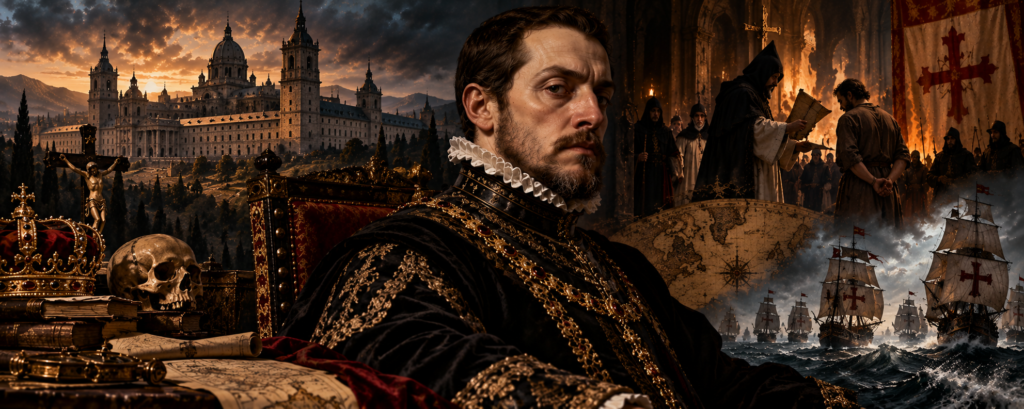
Philip II of Spain: The Prudent King, the Imprisoned Prince, and the Dark Empire of Faith
King of Spain, 1556–1598 | Philip the Prudent
Philip II of Spain did not look like a mad king. He did not rage through his palaces in fits of delirium, claim supernatural powers, or lose himself in the spectacular public eccentricities associated with some of Europe’s most troubled rulers. He was controlled, serious, intensely hardworking, deeply religious, and so cautious that history eventually remembered him as Felipe el Prudente—Philip the Prudent. He spent countless hours reading reports, annotating memoranda, weighing conflicting advice, and attempting to control an empire whose territories stretched from Europe to the Americas and across the Pacific. If anything, Philip’s public image was one of almost unnerving restraint.
Yet behind that restraint lay one of the darkest reigns of sixteenth-century Europe. Philip presided over religious persecution, executions for heresy, the brutal suppression of the Morisco rebellion, decades of warfare in the Netherlands, the destruction of political enemies, and an increasingly expensive struggle to defend Catholic power across Europe. His government became associated with secrecy, suspicion, paperwork, delay, and an almost suffocating determination to know what was happening throughout his scattered dominions. One of his own secretaries was murdered after becoming entangled in the intrigues surrounding Philip’s half-brother, and evidence strongly implicates the king in authorizing the killing. Most disturbing of all, Philip eventually ordered the arrest of his own son and heir, Don Carlos, who died in confinement six months later while rumors spread across Europe that the king had murdered his child.
Philip was not clinically insane, and describing his policies as psychiatric madness would obscure more than it explains. His religious convictions were shared by many contemporaries, his distrust had roots in real conspiracies and betrayals, and the administrative system he constructed was rational even when it became painfully slow. Nevertheless, there was something relentless about his kingship. He believed monarchy carried sacred responsibilities, treated Catholic orthodoxy as inseparable from political order, and often preferred exhausting confrontation to concessions he believed would betray either God or royal authority.
His enemies seized upon these qualities and magnified them. Protestant propagandists helped construct the famous “Black Legend” of Spain, portraying Philip as a cold, fanatical tyrant presiding over inquisitorial torture, colonial cruelty, assassination, and endless war. Dutch rebels had every reason to demonize the king attempting to crush them, while Elizabethan England transformed the defeat of the Spanish Armada into a providential victory over Catholic despotism. Some accusations against Philip were exaggerated or fabricated, but enough genuine violence existed beneath the propaganda to ensure that the darker image never disappeared.
The most unsettling thing about Philip is therefore not that he was mad. It is that he was usually methodical. Persecution could be processed through institutions, executions authorized through paperwork, rebellions discussed in councils, assassination considered as a political solution, and war continued because the alternatives appeared morally unacceptable. Philip’s reign demonstrates how repression does not require a ruler screaming from a throne. Sometimes it arrives quietly, accompanied by memoranda, marginal notes, prayers, sealed letters, and the scratch of a pen across paper.
The Son of the Emperor and the Grandson of the Mad Queen
Philip was born at Valladolid on May 21, 1527, the eldest surviving son of Charles I of Spain, better known internationally as Holy Roman Emperor Charles V, and Isabella of Portugal. His ancestry placed him at the center of the Habsburg dynastic system. Through Charles came the Spanish kingdoms, Burgundian inheritance, Austrian connections, imperial claims, and a rapidly expanding overseas monarchy; through Isabella came another branch of the Portuguese royal house. Philip inherited not simply territories but a conception of monarchy in which family, religion, and political duty were almost impossible to separate.
There was also a darker inheritance. Philip’s paternal grandmother was Joanna of Castile, Juana la Loca, the queen whose disputed mental illness had been used by her husband, father, and eventually her son Charles to justify removing her from effective government. Joanna remained confined at Tordesillas during Philip’s childhood and youth, legally Queen of Castile while Charles governed the kingdom. The family therefore contained a living example of how questions of mental capacity, dynastic legitimacy, and political power could become dangerously intertwined.
Philip’s father prepared him for government with extraordinary seriousness. Charles spent enormous portions of his reign outside Spain, forcing the young prince to assume responsibilities early and surrounding him with advisers who instructed him in administration, religion, diplomacy, and royal conduct. Charles urged caution and piety and repeatedly warned his son about trusting powerful men too easily. Such advice made sense within a court filled with competing factions, but Philip would develop a style of government in which distrust became one of the defining features.
He was intelligent, disciplined, and capable of sustained concentration. Unlike his constantly traveling father, Philip would eventually prefer government from a relatively fixed center, particularly after establishing Madrid as the permanent seat of the royal court in 1561. Documents traveled to the king rather than the king perpetually traveling to his territories. The arrangement offered administrative stability but also encouraged the development of the enormous paper monarchy with which Philip became identified.
His life was shaped from childhood by the expectation that ruling was not merely a privilege but a religious burden. Philip believed kings would answer before God for the souls and political order of their subjects. This conviction helps explain both his extraordinary dedication to government and some of the most destructive decisions of his reign. Compromise could become difficult when political disagreement appeared not simply mistaken but sinful.
Four Marriages and a Dynasty Haunted by Death
Philip married four times, and death followed his marriages with grim regularity. His first wife was Maria Manuela of Portugal, whom he married in 1543. She was his double first cousin, an example of the close dynastic intermarriage that would become increasingly characteristic of the Habsburg family. Their marriage produced the son upon whom the Spanish succession initially depended: Don Carlos, Prince of Asturias.
Maria died in 1545, only days after giving birth to Carlos. Philip was eighteen years old and already a widower. The child survived, but the close relationship between his parents contributed to an extraordinarily concentrated ancestry. Carlos had fewer distinct great-grandparents than would normally be expected, and modern historians have understandably considered whether Habsburg consanguinity contributed to his physical and psychological difficulties. Genetics alone cannot explain everything that followed, but the dynasty’s marriage strategy was beginning to carry dangerous biological consequences.
Philip’s second marriage was considerably more famous. In 1554 he married Mary I of England, the Catholic daughter of Henry VIII and Catherine of Aragon. Mary was eleven years older than Philip and hoped desperately to produce a Catholic heir who might secure England against Protestant succession. The marriage caused intense political anxiety in England because many feared the kingdom would become subordinate to Spanish interests.
Mary believed herself pregnant more than once, but no child came. Her apparent pregnancies ended in humiliation and profound disappointment, while Philip spent substantial periods away from England. When Mary died in 1558, Philip lost both a wife and the possibility of maintaining direct dynastic influence over the English crown.
He subsequently married Elisabeth of Valois, daughter of Henry II of France and Catherine de’ Medici, in 1559. Elisabeth had originally been associated with negotiations involving Don Carlos, and later literature transformed the situation into a tragic romance in which Carlos loved the princess stolen by his father. Friedrich Schiller’s drama and Giuseppe Verdi’s opera Don Carlos made the supposed triangle famous. Historical evidence for a passionate secret romance between Carlos and Elisabeth is extremely weak, however, and the legend should not be confused with documented court life.
Elisabeth’s death in 1568, following complications related to pregnancy, was another severe personal loss. Philip’s fourth marriage, to his niece Anna of Austria in 1570, again demonstrated the Habsburg preference for close dynastic unions. Anna finally produced the surviving male heir Philip needed, the future Philip III, before dying in 1580. By then Philip had buried three wives, several children, and the troubled eldest son who had once been expected to inherit everything.
Don Carlos: The Prince Everyone Feared
Don Carlos was born in July 1545, and his mother’s death shortly afterward deprived him of maternal care from infancy. His childhood soon became a source of anxiety. Contemporary descriptions portray him as physically unusual, difficult, impulsive, and increasingly prone to violent behavior. His health was poor, his body showed some of the effects associated with Habsburg consanguinity, and his temperament alarmed members of the royal household long before the crisis that ultimately destroyed him.
Later stories about Carlos became so grotesque that caution is essential. He was accused of tormenting animals, brutalizing servants, forcing a shoemaker to eat unsatisfactory boots, threatening courtiers, attacking attendants, and engaging in a variety of sadistic acts. Some such stories may contain genuine memories of his violent temperament, but many reached posterity through hostile accounts written after the prince had become a political embarrassment. Treating every lurid anecdote as established fact would reproduce propaganda rather than history.
There is nevertheless strong evidence that Carlos could be dangerously unstable. He possessed a fierce temper, resented people he believed had insulted him, and developed intense hostility toward several of his father’s advisers. His behavior became increasingly difficult to reconcile with the responsibilities awaiting a future king. Philip could not simply ignore the problem because Carlos was not an eccentric younger son who could be hidden in a monastery; he was Prince of Asturias and presumptive heir to the Spanish monarchy.
The crisis intensified dramatically in 1562 when Carlos suffered a serious head injury after falling down a staircase at Alcalá de Henares. His condition became life-threatening, and physicians employed several treatments, including trepanation of the skull. Early modern medicine also surrounded his recovery with religious intervention, including the presence of relics associated with the Franciscan holy man Diego de Alcalá, later Saint Didacus. Carlos eventually survived an illness many expected to kill him.
Popular accounts often claim that the accident suddenly transformed a difficult prince into a violent madman. The chronology is not that neat. Carlos had displayed troubling behavior before the fall, and it is impossible to determine exactly how much neurological damage the injury caused or whether it substantially intensified preexisting problems. His subsequent behavior certainly gave the court little reassurance.
Philip now faced a nightmare familiar to royal dynasties: what happens when the person destined to inherit a vast monarchy appears manifestly unsuited to rule it? Removing an heir was politically dangerous, acknowledging severe incapacity could destabilize succession, and allowing Carlos meaningful military or governmental authority carried obvious risks. Father and son increasingly viewed one another through suspicion and resentment.
The Prince Who Wanted the Netherlands
Carlos became obsessed with obtaining a significant political or military role. The Netherlands offered an especially attractive possibility because unrest there was becoming one of the greatest challenges to Philip’s government. Carlos apparently hoped that his father would entrust him with responsibility in the region, giving him the independent position he craved.
Philip refused.
Instead, the king increasingly relied upon experienced advisers and commanders. Carlos interpreted his exclusion as humiliation and developed intense hostility toward figures he believed stood between him and authority. Among those he reportedly threatened was Fernando Álvarez de Toledo, Duke of Alba, one of Philip’s most formidable military commanders.
The prince’s resentment eventually moved beyond ordinary family conflict. By 1567–1568 he was exploring plans to leave Spain secretly and sought assistance for escape. His exact intentions remain debated, and the romantic picture of Carlos heroically preparing to join Protestant Dutch rebels against his tyrannical father owes much to later anti-Spanish literature. What Philip knew was alarming enough: his heir was attempting clandestine departure and communicating in ways that raised fears of political catastrophe.
A fugitive Prince of Asturias could have become a weapon in the hands of virtually every enemy Philip possessed. French interests, rebellious Netherlanders, German Protestants, or hostile factions might all have exploited him. Even if Carlos had no coherent plan to betray Spain, his mere presence outside Philip’s control could destabilize the monarchy.
For Philip, the family crisis had become a state emergency.
The Night Philip Arrested His Son
On the night of January 18–19, 1568, Philip acted. Accompanied by selected members of his household, he entered Carlos’s rooms and personally participated in securing his son’s arrest. Weapons and potentially dangerous objects were removed, papers were seized, and the Prince of Asturias was placed under confinement.
The scene has attracted enormous dramatic embellishment, but its essential reality is extraordinary enough. A reigning king had concluded that his own heir was too dangerous to remain free. Philip did not immediately place Carlos on public trial, perhaps because any detailed disclosure of the prince’s conduct would humiliate the dynasty and destabilize the succession. Instead, Carlos became a royal prisoner.
His confinement was severe and his health deteriorated. The prince behaved erratically with food, at times refusing nourishment and at others consuming excessively after periods of fasting. He also reportedly attempted to cool himself with large quantities of ice or cold water during the intense summer heat, behavior that may have worsened his physical condition. Carlos died on July 24, 1568, at only twenty-three years old.
Rumors exploded almost immediately. Philip’s enemies claimed the king had murdered his son, and the story became an enormously useful component of the developing Black Legend. Some versions alleged poisoning; others imagined secret execution. Later literature transformed Carlos into an innocent romantic victim destroyed by a jealous and tyrannical father.
The evidence does not support the claim that Philip secretly ordered Carlos murdered. The prince was already physically vulnerable, his behavior during confinement damaged his health, and natural illness provides a credible explanation for his death. Philip’s decision to imprison him remains severe and politically consequential, but imprisonment and murder are not the same accusation.
The tragedy was followed almost immediately by another death. Elisabeth of Valois died in October 1568 following pregnancy complications, only months after Carlos. Later storytellers connected the deaths through the imaginary romance between stepmother and stepson, creating one of Europe’s great fictional royal tragedies. History provides something colder: within a single year Philip lost a deeply troubled son and a wife, while his monarchy entered some of the most violent conflicts of his reign.
Catholicism as Government
Philip’s religious convictions were not decorative. Catholicism shaped his understanding of kingship, morality, political order, and his responsibilities before God. He regarded heresy not simply as private theological disagreement but as a threat to souls and to the stability of Christian society.
That outlook was not unusual among sixteenth-century rulers. Protestant governments also persecuted religious opponents, and Europe had not yet embraced anything resembling modern freedom of religion. What distinguished Philip was the scale of the monarchy he governed, the institutional resources available to him, and his extraordinary determination to prevent Protestantism from establishing itself in his Spanish kingdoms.
The Spanish Inquisition had been established under Ferdinand and Isabella decades before Philip’s birth, so Philip neither invented it nor exercised every function personally. Under his reign, however, royal government strongly supported the defense of Catholic orthodoxy. Protestant circles discovered in Valladolid and Seville during the late 1550s were suppressed, and public autos-da-fé demonstrated the consequences awaiting convicted heretics.
Popular imagination often treats an auto-da-fé as synonymous with burning people alive, but technically it was a public ceremony at which sentences and penances were announced. Those condemned to death were transferred to secular authorities for execution. The distinction did nothing to make the consequences less terrifying for those who died, but historical accuracy matters when describing how the system actually operated.
Philip’s determination to prevent Protestant expansion was reinforced by events elsewhere in Europe. France descended into religious wars, the Netherlands became increasingly rebellious, England under Elizabeth I embraced Protestant rule, and German territories had already broken the religious unity his father Charles V had struggled to preserve. To Philip, these were not arguments for toleration. They were warnings about what happened when heresy was allowed to take root.
A statement often associated with him declares that he would rather lose his realms than rule over heretics. Versions of this sentiment are grounded in Philip’s documented political outlook, but exact quotations vary across sources and translations and should not be treated carelessly. The broader principle, however, accurately reflects his priorities: religious unity could be worth enormous political cost.
That conviction would help set the Netherlands on fire.
The Netherlands Begins to Revolt
Philip inherited the Netherlands from Charles V, but his relationship with the region differed dramatically from his father’s. Charles had been born in Ghent and understood the complicated political traditions of the Low Countries intimately. Philip was Spanish by upbringing and temperament, and after leaving the Netherlands in 1559 he would never return.
The provinces possessed strong local privileges and traditions of political negotiation. Philip’s efforts to strengthen administration and ecclesiastical organization, combined with resistance to taxation and especially his determination to suppress Protestantism, created growing resentment. Calvinism spread despite persecution, while nobles feared the erosion of traditional liberties.
In 1566, waves of iconoclastic violence swept parts of the Netherlands as Calvinist crowds attacked Catholic churches, smashing statues, images, and religious furnishings. To Philip, the destruction confirmed the terrifying connection between heresy and rebellion. He responded by sending the Duke of Alba with troops to restore authority.
Alba established the Council of Troubles, remembered by its enemies as the Council of Blood. Thousands were investigated, property was confiscated, and prominent nobles including Counts Egmont and Horn were executed in Brussels in 1568. The executions shocked Europe because both men had occupied important positions and had not been radical Protestant revolutionaries in the simple sense later narratives sometimes imply.
Repression failed to pacify the provinces. Instead, it deepened hostility and strengthened the revolt associated with William of Orange. What had begun as a complex conflict over privileges, religion, taxation, and governance developed into a prolonged war that would eventually tear the Netherlands apart.
Philip did not wake each morning irrationally determined to destroy a valuable possession. From his perspective, concession to armed rebellion and heresy threatened the foundations of monarchy. The problem was that his insistence on those foundations helped make reconciliation progressively harder.
The Duke of Alba and the Limits of Terror
Alba became one of the most feared figures in the Netherlands, but Philip’s relationship with him demonstrates why portraying the king as simply paranoid toward every successful subordinate is too crude. Philip relied heavily on talented ministers and commanders, yet he also resisted allowing any servant to become indispensable. Court politics encouraged competing factions, and the king often preferred receiving conflicting advice rather than trusting one dominant favorite.
Alba’s methods generated enormous resentment. Executions and confiscations were accompanied by attempts to impose new taxation, and resistance intensified. The Sea Beggars captured Brill in 1572, providing the rebellion with a crucial foothold, while towns increasingly joined the revolt.
Philip eventually recalled Alba in 1573. The decision was not simply an irrational act of jealousy toward a successful general; Alba’s policies had failed to restore durable peace and had become politically toxic. Other governors attempted different combinations of negotiation and force, but the conflict continued.
The Netherlands exposed a fundamental weakness in Philip’s kingship. He could replace governors without resolving the underlying contradiction between local political traditions and his expectations of obedience. He could defeat rebel armies without destroying the networks sustaining rebellion. He could execute heretics without preventing Protestantism from spreading.
The king possessed enormous coercive power, but coercion repeatedly produced consequences that required still more coercion.
The Moriscos and the War in Granada
Religious conformity also produced bloodshed within Spain. The Moriscos were descendants of Muslims who had converted, or whose families had been compelled to convert, to Christianity. Many retained cultural practices associated with their Muslim ancestry, including language, dress, music, customs, and forms of communal identity.
Spanish authorities increasingly viewed these practices with suspicion, fearing that outward conversion concealed continued Islamic belief and potential collaboration with Ottoman or North African enemies. In 1567, measures associated with Philip’s government sharply restricted distinctive Morisco customs in Granada, including aspects of language, dress, ceremonies, and cultural practice. The policy attempted not merely to enforce nominal Christianity but to accelerate cultural assimilation.
Resistance exploded into the Revolt of the Alpujarras in late 1568. Fighting in the mountainous region became brutal, with atrocities committed amid a conflict increasingly shaped by religion, ethnic hostility, local grievances, and fear of foreign intervention. Philip eventually placed major forces into the campaign, and his half-brother Don John of Austria played an important role in suppressing the rebellion.
After the revolt was defeated, tens of thousands of Granadan Moriscos were dispersed into other parts of Castile. Estimates vary, and figures around 80,000 are often given for those forcibly relocated. The intention was partly to break concentrated communities believed capable of renewed rebellion, but the displacement inflicted enormous suffering and uprooted families from regions where their ancestors had lived for generations.
Philip did not order the final expulsion of the Moriscos from Spain; that came under Philip III beginning in 1609. Nevertheless, the policies of Philip II formed an important stage in the increasingly coercive approach that made coexistence more precarious. Religious uniformity was again pursued through state power, and the attempt to erase cultural difference helped produce exactly the rebellion authorities feared.
Lepanto and the Catholic King’s Great Victory
Not every religious conflict ended in frustration. The Ottoman Empire remained a formidable Mediterranean power, and the struggle between Ottoman and Christian states created one of the great military confrontations of Philip’s reign. In 1571 a Holy League involving Spain, Venice, and the papacy assembled a major fleet under the command of Philip’s half-brother Don John of Austria.
The fleets met at Lepanto on October 7, 1571. The resulting battle was one of the largest galley engagements in history and ended in a spectacular Holy League victory. Ottoman losses were severe, thousands of Christian galley slaves were freed, and Catholic Europe celebrated the battle as a providential triumph.
For Philip, Lepanto seemed to vindicate the religious dimension of his monarchy. Catholic powers acting together had defeated a major Ottoman fleet, and his own half-brother emerged as the celebrated commander of the victory. Yet even this triumph contained future complications.
Ottoman naval power recovered more quickly than Christian triumphalism initially suggested, and the strategic balance of the Mediterranean was not permanently transformed by a single battle. Don John’s growing fame also created political complexities. He possessed charisma, ambition, and the prestige of Lepanto, qualities that made him enormously useful but required careful management by a king who disliked uncontrolled initiatives.
Later portrayals sometimes claim that Philip became pathologically jealous of Don John and deliberately destroyed him because he feared his popularity. The relationship was more complicated. Philip relied upon his half-brother repeatedly but also restricted his freedom of action, particularly when Don John developed ambitious schemes involving the Netherlands and potentially England.
At the center of those tensions stood a secretary named Juan de Escobedo.
A Murder in Madrid
The Escobedo affair is one of the darkest and most mysterious episodes of Philip’s reign. Juan de Escobedo served as secretary to Don John of Austria and became deeply involved in the complicated political communications surrounding the Netherlands. Don John wanted greater resources and freedom of action, while Philip and his secretary Antonio Pérez worried about what the ambitious prince and his secretary might be planning.
Suspicion intensified. Pérez presented Escobedo as dangerous and suggested that secrets were being concealed from the king. Philip became convinced that Escobedo posed a serious threat. In 1578, after earlier unsuccessful attempts apparently involving poison, Escobedo was stabbed to death in Madrid.
The evidence strongly indicates that Philip authorized or approved the removal of Escobedo, although the precise chain of responsibility and the information on which he acted remain subjects of historical debate. This was not a conventional judicial execution after public trial. It was political killing carried out secretly.
The affair later became catastrophic for Antonio Pérez. Philip eventually came to suspect that Pérez had manipulated information and perhaps deceived him about Escobedo and Don John. Pérez was arrested in 1579 and spent years entangled in legal proceedings before eventually escaping to Aragon and then abroad.
Pérez became one of Philip’s most damaging enemies. From exile he helped feed the European image of the king as secretive, suspicious, and murderous. Some of his claims were self-serving, but the Escobedo killing gave the darker portrait a foundation in reality.
Philip’s government usually operated through councils, documents, legal forms, and institutional procedures. Escobedo reveals the other side of that world. When the king believed secrecy and dynastic security demanded it, the distance between royal judgment and assassination could become frighteningly small.
Antonio Pérez and the King Who Never Forgot
The Pérez affair exposed Philip’s distrust in its most corrosive form. Pérez had once possessed intimate access to royal information and had participated in the secret politics surrounding Don John. Once Philip lost confidence in him, the former secretary became dangerous precisely because he knew so much.
Years of imprisonment and legal maneuvering followed. Pérez eventually escaped to Aragon, where he attempted to use the kingdom’s traditional legal privileges to protect himself from royal authority. Philip responded aggressively, and the conflict contributed to unrest in Aragon in 1591.
Pérez escaped abroad and became an energetic participant in anti-Philip propaganda. He supplied information and accusations eagerly consumed by the king’s enemies. The former insider could portray the Spanish court as a labyrinth of secrecy, murder, and distrust because he had personally inhabited that labyrinth.
Stories circulated that Philip’s smile concealed a dagger and that apparent favor could precede destruction. Such sayings should not automatically be accepted as literal descriptions of his everyday behavior, particularly when transmitted through hostile political traditions. Yet Philip undeniably cultivated secrecy and could allow investigations to unfold without revealing his intentions.
His caution had a rational basis. He governed a monarchy containing rival court factions, rebellious provinces, foreign spies, ambitious nobles, and officials capable of manipulating information. The problem was that a system built around distrust encouraged the very concealment it feared.
Ministers learned that information was power, factions competed for access, and the king responded by demanding more paper.
The Paper Monarchy
Philip’s reputation as a compulsive micromanager is rooted in something very real: he read an extraordinary quantity of government documentation and personally annotated vast numbers of papers. His surviving marginal notes reveal a ruler concerned with matters ranging from grand strategy to appointments, finances, ecclesiastical questions, household arrangements, and details that might appear trivial beside the enormous problems facing his monarchy.
Calling this a “paperwork addiction” or diagnosing obsessive-compulsive disorder would be irresponsible. Philip’s administrative habits reflected the political technology available to a ruler governing geographically dispersed territories in an age before instantaneous communication. Written reports were essential. Councils processed information, secretaries prepared documents, and the king’s annotations allowed him to intervene from Madrid in affairs thousands of miles away.
Nevertheless, Philip’s desire to retain personal control could create serious delays. Information already traveled slowly from the Netherlands, Italy, the Americas, and other territories. Once reports reached Spain, decisions could pass through councils and secretaries before returning along the same routes. A cautious king who wanted to examine details personally could make the process even slower.
His marginalia reveal impatience as well as meticulousness. Philip complained about unclear handwriting, demanded clarification, questioned recommendations, and sometimes instructed officials to be more concise. Far from loving paperwork for its own sake, he occasionally seemed tormented by the quantity confronting him. The image of a king joyfully reading every scrap of paper in his empire misunderstands a man who was often buried beneath the administrative system he had helped create.
This could become dangerous during military operations. Commanders required decisions based on circumstances that might change before instructions from Spain arrived. Philip could plan carefully, but a plan devised in Madrid might reach a battlefield after the assumptions behind it had already disappeared.
The king wanted information before deciding, yet his empire was too large for information ever to be completely current. His caution protected him from impulsive decisions while simultaneously creating another danger: decisions that arrived too late.
El Escorial: Palace, Monastery, Mausoleum
No building is more closely associated with Philip than San Lorenzo de El Escorial, the enormous complex constructed northwest of Madrid beginning in the 1560s. It combined royal residence, monastery, basilica, library, school, and dynastic mausoleum. Its austere granite appearance became a perfect architectural symbol for later generations imagining Philip as the cold, gloomy monarch of Catholic Spain.
The complex was deeply connected to Philip’s religious and dynastic identity. It commemorated the victory at Saint-Quentin in 1557, associated with the feast of Saint Lawrence, and became a center of royal memory and devotion. Philip took intense interest in its construction, art, books, relics, and religious functions.
Calling El Escorial a place where Philip “locked himself away” for the final decades of his life exaggerates his isolation. He spent substantial time there but continued traveling between royal residences and remained deeply involved in government. He was private and increasingly sedentary, especially as illness worsened, but he did not disappear from political life like a hermit.
His attention to architecture and detail was characteristic of his broader governing style. Philip reviewed plans, considered decoration, selected works of art, and helped shape the religious atmosphere of the complex. El Escorial was not merely a palace where a neurotic ruler hid from the world; it was a deliberate statement about monarchy, Catholicism, learning, dynasty, and death.
The dead were never far away there. Philip intended the complex to house the remains of his dynasty, including his parents Charles V and Isabella of Portugal. Government and mortality existed within the same stone environment, with royal apartments connected closely to sacred space.
As Philip grew older and sicker, that proximity would become increasingly personal.
The King and Thousands of Holy Relics
Philip was an enthusiastic collector of relics, and El Escorial accumulated one of the most extraordinary collections in Catholic Europe. Bones and other objects associated with saints were placed in elaborate reliquaries, reflecting a religious culture in which physical remains were believed capable of connecting the faithful with holy intercession.
Figures given for the collection vary depending on how individual fragments are counted, but inventories ran into many thousands. Later descriptions speak of entire collections of skulls, bones, limbs, teeth, hair, and other sacred remains distributed through the complex. To modern eyes, rooms filled with decorated containers holding fragments of human bodies can appear macabre, but within Philip’s Catholic worldview relic veneration was not an eccentric private cult.
The Protestant Reformation made the collection politically significant as well as devotional. Protestant reformers frequently rejected or attacked the cult of relics, regarding it as superstition or idolatry. Philip’s preservation and accumulation of relics therefore affirmed precisely the Catholic religious culture his Protestant enemies sought to dismantle.
It is tempting to describe the collection as compulsive hoarding or claim that Philip believed thousands of bones created a literal supernatural shield around Spain. That goes beyond what the evidence safely demonstrates. Philip believed in the spiritual efficacy of relics in accordance with Catholic teaching and early modern devotional practice, but that is different from imagining him constructing a magical barrier from saintly body parts.
Still, the atmosphere of El Escorial could be unsettling even without exaggeration. The aging king worked and prayed within a monumental complex containing royal tombs and thousands of fragments associated with the holy dead. The same ruler who tried to preserve Catholic Europe surrounded himself with physical remnants of Catholic sanctity.
Faith, death, monarchy, and memory were built into the walls around him.
Cleanliness, Routine, and the Myth of the Neurotic King
Philip’s personal habits were disciplined, and surviving evidence suggests that he valued order, grooming, cleanliness, and regularity. Later psychological portraits have sometimes expanded these traits into diagnoses of obsessive-compulsive personality, germophobia, chronophobia, or pathological rigidity. Such labels are impossible to establish and risk turning ordinary features of court ritual and personal preference into psychiatric symptoms.
Early modern royal life was highly structured by design. Audiences, meals, religious observances, council meetings, correspondence, and ceremonial access to the monarch followed established patterns because ritual helped govern hierarchy. Philip’s preference for regularity therefore did not make him uniquely abnormal.
Nor is the popular claim that he followed an exact timetable mapped out years in advance and became incapable of responding when an emergency disrupted it supported in such literal form. Philip could alter plans, travel when necessary, respond to crises, and sustain enormously complex military and diplomatic operations. His problem was not an inability to understand change but a tendency toward cautious decision-making within a cumbersome administrative structure.
His cleanliness has likewise been exaggerated by comparisons with the myth that sixteenth-century Europeans almost never washed. Elite hygiene practices varied, and washing hands, faces, bodies, linens, and clothing did not require modern daily immersion bathing. Philip’s concern for clean surroundings and personal grooming may have been notable, but calling it germophobia imposes a modern psychiatric framework without sufficient evidence.
The historical Philip was controlled enough without making him robotic. His routines served a man trying to impose order upon a political life that constantly threatened to overwhelm him.
Portugal and the Empire at Its Greatest Extent
In 1580, a succession crisis in Portugal gave Philip an opportunity to add another kingdom to his already vast monarchy. King Sebastian of Portugal had died without an heir at the disastrous Battle of Alcácer Quibir in Morocco in 1578, and his elderly successor Cardinal Henry died in 1580. Several claimants emerged, including Philip, whose mother had been Portuguese.
Philip backed his claim with military force. The Duke of Alba invaded Portugal, defeated supporters of António, Prior of Crato, and secured Lisbon. Philip was recognized as King of Portugal, creating the Iberian Union under which the Spanish and Portuguese crowns shared a monarch while retaining distinct institutions.
The acquisition dramatically expanded the global reach of Philip’s monarchy. Portuguese possessions and trading networks in Africa, Asia, and Brazil now existed under the same ruler as Spain’s enormous American and Pacific territories. On maps, Philip’s power appeared almost incomprehensible.
Yet the union also expanded the number of places his enemies could attack. Dutch and English opponents of Spain could strike Portuguese shipping and colonies because the Portuguese crown was now attached to Philip. Another magnificent inheritance therefore created another set of vulnerabilities.
This was the paradox of Philip’s entire reign. Every territorial gain increased his prestige and responsibilities simultaneously. The monarchy became more powerful and more difficult to defend at the same time.
England, Elizabeth, and the Road to the Armada
Philip’s relationship with England changed dramatically over the course of his life. He had once been king consort beside Mary I and had hoped their marriage would secure a Catholic future for England. Mary’s death in 1558 placed her Protestant half-sister Elizabeth I on the throne and transformed England gradually into one of Philip’s most dangerous enemies.
The deterioration was not immediate. Philip had practical reasons to avoid driving England into alliance with France, and international politics remained complicated. Over time, however, English support for Dutch rebels, attacks on Spanish shipping and American possessions, and growing religious hostility pushed the kingdoms toward open conflict.
The execution of Mary, Queen of Scots, in 1587 intensified Catholic outrage. Mary had represented an alternative Catholic claimant to the English throne and had become implicated in conspiracies against Elizabeth. Philip eventually supported an enormous invasion project intended to overthrow English resistance and facilitate the landing of forces from the Netherlands.
The Spanish Armada sailed in 1588. Philip’s plan required coordination between the fleet and the army of the Duke of Parma in the Netherlands, an extraordinarily difficult operation given communications, geography, Dutch control of shallow coastal waters, and the limitations of sixteenth-century naval warfare.
Popular tradition often attributes the disaster directly to Philip’s obsessive micromanagement. His strategic decisions certainly influenced the campaign, but responsibility cannot be reduced to one personality defect. Command problems, logistical difficulties, English attacks, unsuitable anchorages, Dutch interference, ammunition expenditure, and severe weather all contributed to the failure.
The Armada fought its way up the English Channel but failed to secure the conditions required to embark Parma’s army. After the fireship attack at Calais and the Battle of Gravelines, the fleet was forced northward and attempted to return to Spain around Scotland and Ireland. Storms wrecked numerous ships and killed thousands of men.
For Protestant England, survival became proof of divine favor. For Philip, it was a terrible military and financial setback, but not the immediate destruction of Spanish naval power later mythology sometimes implies.
Spain remained formidable.
The war continued.
The Myth of Endless Bankruptcy
Philip’s wars were extraordinarily expensive, and his monarchy suffered repeated financial crises. Royal revenues were substantial, including increasing flows of American silver, but obligations were even larger. Military expenditure in the Netherlands, Mediterranean, Atlantic, France, and elsewhere repeatedly exceeded what ordinary revenues could sustain.
Philip’s government suspended payments to creditors several times, most notably in 1557, 1575, and 1596. These episodes are sometimes described loosely as national bankruptcies, although early modern sovereign finance did not operate like modern corporate or personal bankruptcy. The crown renegotiated debts, converted obligations, and restructured relationships with bankers rather than simply declaring the Spanish economy insolvent and walking away.
The claim that Philip bankrupted Spain five separate times during his reign is therefore misleading. Three major suspensions of payment are generally associated directly with his reign, although financial crises inherited from Charles V and different ways of counting restructurings can produce varying totals in popular accounts.
American silver did not make Spain infinitely rich. Much of it moved rapidly toward creditors, military suppliers, foreign merchants, and armies scattered across Europe. The monarchy could receive spectacular treasure shipments and still face an immediate shortage of liquid funds.
Philip’s wars were not simply reckless spending produced by a delusion that God would always rescue him. He confronted genuine strategic threats and inherited conflicts that were difficult to abandon. Yet his unwillingness to surrender major political and religious objectives kept the monarchy committed to wars whose costs repeatedly exceeded available resources.
The empire could possess mountains of silver and still be unable to pay its soldiers on time.
Mutiny and the Spanish Fury
Failure to pay armies could have horrifying consequences. Spanish and allied troops serving in the Netherlands sometimes went months without wages, and mutinies became a recurring problem. Soldiers who believed the crown had abandoned them could seize towns or demand payment through force.
The most infamous catastrophe came in 1576 at Antwerp. Mutinous troops attacked and looted the wealthy city in an event remembered as the Spanish Fury. Thousands of people were killed, buildings burned, and enormous quantities of property were destroyed or stolen.
Philip did not order the massacre. The violence emerged from military mutiny and the breakdown of authority. Yet the financial system sustaining his wars helped create the conditions in which unpaid soldiers became predators upon the populations they were supposedly there to govern.
The atrocity horrified the Netherlands and temporarily united Catholic and Protestant provinces in opposition to foreign troops through the Pacification of Ghent. Once again, coercive imperial policy produced the opposite of its intended effect.
Philip wanted obedience.
Financial exhaustion produced mutiny.
Mutiny produced massacre.
Massacre produced more rebellion.
The cycle of war had begun feeding itself.
The Netherlands Slips Away
By the later decades of Philip’s reign, the Netherlands had effectively fractured. The southern provinces, predominantly Catholic, were eventually brought back under Spanish authority, while the northern provinces increasingly consolidated around the rebellion. The Union of Utrecht in 1579 became a foundation for the emerging Dutch Republic, and in 1581 the rebellious provinces formally repudiated Philip’s sovereignty through the Act of Abjuration.
Philip did not simply acknowledge defeat and walk away. War continued, and Spanish commanders achieved important successes. Alexander Farnese, Duke of Parma, proved an exceptionally capable governor and military commander, recovering major territories and capturing Antwerp in 1585.
Yet the northern rebellion survived. Geography, maritime power, local institutions, foreign assistance, financial resources, and determined resistance made complete reconquest increasingly difficult. Philip’s simultaneous commitments elsewhere prevented him from concentrating indefinitely on one theater.
It is easy in hindsight to call his refusal to compromise insane, but Philip’s reasoning followed the assumptions of dynastic monarchy. Allowing subjects to depose their lawful sovereign because they rejected his religious and political policies threatened a principle extending far beyond the Netherlands. Concession could look like an invitation to rebellion elsewhere.
The tragedy was that defending royal authority so uncompromisingly helped destroy it in the very provinces he was trying to preserve.
Philip would die before the Eighty Years’ War ended. Spain formally recognized Dutch independence only in 1648, half a century after his death.
The war outlived the king who had refused to let the provinces go.
The Black Legend
Philip’s reputation cannot be understood without the propaganda produced by his enemies. Protestant writers in England and the Netherlands portrayed Spain as uniquely cruel, fanatical, deceitful, and tyrannical. Accounts of the Inquisition, colonial atrocities, executions, and political murders circulated widely and became part of what historians later called the Spanish Black Legend.
Some of this propaganda relied upon genuine events. The execution of Egmont and Horn happened. The Council of Troubles imposed severe repression. Escobedo was murdered with royal approval or authorization strongly implicated. The Inquisition prosecuted and executed heretics. The Moriscos suffered coercive cultural policies and mass displacement.
Other accusations were exaggerated, stripped of context, or invented. Philip did not personally sit in torture chambers directing inquisitors. He did not murder Don Carlos because the prince was secretly in love with Elisabeth of Valois. He was not a perpetually emotionless monster incapable of affection, nor was every military action undertaken solely because of religious fanaticism.
The Black Legend succeeded partly because Philip himself was so poorly suited to countering it. He was private, secretive, physically distant from many of his subjects, and disinclined toward the theatrical public relations practiced by some rulers. His enemies filled the silence with their own version of him.
The resulting Philip became almost mythological: the motionless spider at the center of El Escorial, pulling invisible threads while inquisitors burned heretics and assassins eliminated enemies. The caricature was unfair.
It was also built around enough reality to be difficult to destroy.
The Deathbed at El Escorial
By the 1590s Philip’s health was deteriorating badly. Like his father, he suffered from gout, and his final illness involved severe pain, fever, weakness, and ulcerating sores or abscesses that left him increasingly immobile. Later descriptions emphasize the horrific physical deterioration of his body, including the smell produced by infected wounds and the difficulty attendants faced caring for him.
His apartments at El Escorial were arranged so that he could observe religious services in the basilica from his quarters, a feature often described as a window or opening giving him a view toward the high altar. This arrangement reflected the integration of royal residence and monastery that Philip had deliberately created. During his final illness, it allowed the dying king to remain connected to the religious observances that had structured his life.
Popular retellings sometimes turn his last weeks into another story of pathological obsession, claiming that for exactly fifty-three days he stared continuously through the opening while monks chanted without interruption and that he continued signing state papers with a quill forced between grotesquely swollen fingers until his final breath. The underlying picture of prolonged suffering, continued interest in government, and intense religious devotion is well supported; the most theatrical details should be treated cautiously.
Philip’s death was not peaceful in the ordinary sense. His physical condition caused prolonged suffering, and attendants witnessed the progressive deterioration of a ruler who had once controlled access to himself with extraordinary precision. Now privacy became almost impossible as servants and physicians dealt with the intimate realities of disease.
His faith remained central. Philip surrounded himself with religious objects and prepared for death within the monastery-palace he had built partly as a monument to Catholic monarchy and dynastic memory. Relics, altars, royal tombs, monks, government papers, and the dying king existed within the same vast granite complex.
The building had always joined monarchy with mortality.
Now its creator was becoming one of its dead.
Death of the Prudent King
Philip II died at El Escorial on September 13, 1598. He was seventy-one years old and had ruled Spain for more than forty years. His son succeeded him as Philip III.
The monarchy Philip left behind remained one of the greatest powers in the world. Spain possessed enormous territories, the union with Portugal continued, Spanish influence in Italy remained strong, and the American empire was expanding. The Armada’s defeat had not destroyed Spain, and the popular image of 1588 as the instant end of Spanish greatness is a later simplification.
Yet the costs of Philip’s reign were immense. War in the Netherlands remained unresolved. The crown’s finances had repeatedly collapsed into payment suspensions and debt restructuring. Religious conflict had consumed lives and resources, while Spain’s enemies had learned to define themselves partly through opposition to Philip’s monarchy.
His greatest successes were equally complicated. Lepanto had been magnificent but did not destroy Ottoman power. Portugal expanded his empire while exposing Portuguese possessions to Spain’s enemies. Parma’s victories recovered much of the southern Netherlands but could not extinguish the northern Dutch state.
Philip had spent his life trying to secure what he inherited and defend what he believed God had entrusted to him. The result was not collapse, but neither was it the stable Catholic order he had sought.
Was Philip Paranoid?
Describing Philip as clinically paranoid is tempting because secrecy and distrust permeated his government. He received competing reports, guarded information carefully, monitored ministers, worried about disloyalty, and could turn violently against officials once convinced they had deceived him. The Escobedo affair demonstrates that suspicion could have deadly consequences.
Yet Philip also inhabited a world in which conspiracies were real. The Netherlands rebelled. His son attempted clandestine escape. Antonio Pérez manipulated information. England supported his enemies. French factions shifted alliances. Ottoman agents and European spies operated across borders.
Distrust was therefore not detached from reality.
The more interesting question is whether Philip’s caution became counterproductive. By insisting upon detailed information and keeping decisions close to himself, he could slow government. By encouraging multiple channels of advice, he reduced dependence upon individual ministers but fostered factional competition. By concealing intentions, he protected secrets while making subordinates uncertain about what he actually wanted.
His system rewarded caution because Philip himself was cautious. Officials sent more documentation because the king demanded documentation, and the growing volume of information made decision-making more difficult. The monarch attempting to control uncertainty created an administrative world that produced still more paper.
This was not madness.
It was a rational governing style capable of generating irrational consequences.
The Prince in the Locked Room
Nothing darkens Philip’s personal story more than Don Carlos. Whatever propaganda later attached to the prince, Carlos was clearly a deeply troubled young man, and Philip faced a problem for which sixteenth-century monarchy possessed no humane solution. A dangerously unstable heir could not simply be removed from succession through modern constitutional procedures and given psychiatric treatment.
Philip chose confinement.
Carlos died there.
The absence of persuasive evidence for murder does not make the story comfortable. Philip personally participated in the arrest of his son and then kept him isolated while deciding what could be done with him. The prince’s death solved the succession problem in the most terrible possible way, even if Philip neither intended nor ordered it.
Later Europe refused to believe the convenient timing was innocent. Propaganda transformed Philip into the murderer of his son, while literature supplied a romantic motive involving Elisabeth of Valois. Carlos became a freedom-loving victim and Philip the jealous tyrant who destroyed him.
The historical truth is less melodramatic and perhaps more tragic. Carlos probably was dangerous. Philip probably believed imprisonment necessary. A father who ruled much of the known world could find no way to save his heir from himself or the dynasty from its heir.
The king who wanted control over everything could not control his own family.
Philip the Prudent and the Limits of Control
Philip’s nickname is more revealing than accusations of madness. He was called the Prudent because caution, deliberation, seriousness, and attention to detail defined his public kingship. Yet prudence carried to extremes could become hesitation, distrust, rigidity, and an inability to abandon objectives whose costs had become ruinous.
He wanted to know before he acted, but information crossed his empire too slowly. He wanted reliable servants, but powerful servants could become objects of suspicion. He wanted religious unity, but persecution produced resistance. He wanted obedience in the Netherlands, but repression helped create a revolutionary political identity.
He wanted to defend Catholic Europe, but doing so required wars whose financial costs repeatedly overwhelmed royal revenues. He wanted England neutralized, but the Armada failed. He wanted France contained, yet intervention there created further military commitments. He wanted the Moriscos assimilated, but coercion helped provoke rebellion.
None of these failures proves insanity. They reveal the structural limits of early modern monarchy and the danger of treating deeply held principles as objectives that must be pursued regardless of changing circumstances.
Philip could modify tactics.
He found it much harder to modify convictions.
Why Philip II Belongs Among the Mad Monarchs
Philip II belongs in the Mad Monarchs not because he was clinically insane but because his reign sits at the intersection of royal obsession, religious certainty, family catastrophe, political repression, and the frightening possibilities of concentrated power. His enemies called his policies monstrous and fanatical, while later historians have alternately portrayed him as a gloomy despot, heroic Catholic king, bureaucratic micromanager, imperial realist, and prisoner of responsibilities too large for one person.
The psychiatric language often attached to him should be resisted. There is no basis for diagnosing obsessive-compulsive disorder because he read enormous quantities of paperwork, paranoia because he distrusted ministers, germophobia because he valued cleanliness, or some pathological fear of time because he preferred routine. These interpretations transform historical behavior into modern diagnoses without evidence.
Yet removing the diagnoses does not make Philip benign. A sane ruler can persecute religious minorities. A rational government can execute heretics. A cautious king can authorize murder. A devoted father can imprison his son. An intelligent monarch can continue wars that consume lives and treasure because surrender appears worse than continuation.
That is what makes Philip more disturbing than the caricature of a mad fanatic.
He did not need to lose touch with reality to do terrible things.
The Granite King
El Escorial remains perhaps the perfect monument to Philip because it captures the contradictions that defined him. It is palace and monastery, library and tomb, administrative retreat and religious statement. Its vast granite walls suggest permanence, discipline, austerity, and order, precisely the qualities Philip wanted to impose upon his monarchy.
Inside were paintings of extraordinary beauty, books gathered from across intellectual traditions, elaborate religious objects, royal apartments, monks, sacred relics, and the dead of the Habsburg dynasty. Philip was not simply the gloomy fanatic of Protestant propaganda. He appreciated art, music, architecture, gardens, scholarship, and collecting, and his court participated fully in the cultural brilliance of Renaissance Europe.
Yet the beauty existed beside repression. The same king who collected magnificent books supported institutions that censored dangerous ideas. The patron who commissioned great art defended a religious order in which heresy could lead to death. The ruler who treasured sacred objects authorized political actions capable of extraordinary brutality.
That contradiction cannot be resolved by calling him mad.
Philip knew what he believed.
The consequences followed from the beliefs themselves and from the power available to enforce them.
The Empire That Could Not Obey Forever
At the beginning of Philip’s reign, the inheritance from Charles V appeared almost limitless. Spain possessed formidable military power, American wealth was increasing, Habsburg influence dominated much of Italy, and Philip briefly enjoyed the extraordinary position of being married to the Queen of England. By the end of his life, his monarchy was larger in some respects because Portugal and its empire had been added to his crowns.
Yet size concealed fragility. The northern Netherlands had effectively broken away. England had become a determined Protestant enemy. France remained beyond Spanish control despite repeated intervention. Royal finances had undergone repeated crises, while war continued consuming revenue faster than treasure fleets could relieve the pressure.
Philip’s instinct was usually to preserve rather than surrender. He had inherited territories and obligations from his father and believed he had a duty to transmit them intact to his descendants. Letting rebellious provinces go could therefore appear not pragmatic but morally indefensible.
This mentality made retreat extraordinarily difficult. Every conflict became connected to legitimacy, religion, dynasty, or reputation. Compromise in one region might encourage resistance in another, while tolerating heresy could appear to endanger souls as well as government.
The empire consequently became a machine that demanded constant defense. Silver financed soldiers, soldiers defended territories, defending territories created debts, debts consumed future silver, and unpaid soldiers sometimes mutinied and created new rebellions requiring additional soldiers.
Philip sat at the center reading reports from every part of it.
The papers never stopped arriving.
A King Surrounded by the Dead
Death accompanied Philip throughout his life. His mother died after giving birth to Don Carlos. Three of his four wives died before him. Numerous children died young. Don Carlos died in confinement. His half-brother Don John died in 1578, and the generation that had surrounded Philip in youth gradually disappeared.
El Escorial gave this experience architectural form. The royal dead were gathered into the dynastic complex while Philip accumulated relics of saints and attended religious services concerned with salvation, mortality, and eternity. As his health deteriorated, the distance between royal government and preparation for death became increasingly narrow.
Modern readers may find the relics macabre, but Philip did not collect them because he enjoyed horror. They represented sacred continuity within a Catholic worldview being violently challenged across Europe. Protestant iconoclasts smashed images and rejected relic veneration; Philip preserved and honored precisely what they condemned.
The collection therefore reflected both faith and conflict. Bones became symbols in a struggle over what Christianity itself was supposed to be.
Philip spent much of his reign trying to prevent that struggle from permanently dividing Europe.
He failed.
The King Who Could Not Save His Own Vision
Philip’s deepest failure was not the Armada. Fleets can be rebuilt, and Spain remained a great naval power afterward. Nor was it simply the Dutch Revolt, because Spain retained the southern Netherlands and continued fighting effectively for decades.
His larger failure was that coercion could not restore the religious and political unity he believed a properly ordered monarchy required. Protestantism survived persecution. The Dutch rebellion survived military campaigns. England remained Protestant. France did not become a Spanish dependency. Morisco cultural identity did not disappear merely because the crown prohibited customs.
Philip could punish behavior without permanently controlling belief.
That distinction was difficult for a ruler who regarded religious uniformity as part of good government. The Inquisition could discover secret Protestants, but it could not reverse the Reformation elsewhere in Europe. Armies could capture towns, but they could not guarantee what inhabitants believed after soldiers departed.
The problem was not that Philip lacked power.
He possessed astonishing power.
The problem was that there were things power could not accomplish.
The Prudent King in the Dark
When Philip died in 1598, he left his son an empire of staggering scale and equally staggering obligations. Spain was not the ruined corpse later national myths sometimes imagined, nor had the Armada’s defeat suddenly ended its great-power status. Spanish military and political influence would remain formidable well into the seventeenth century.
But the warning signs were everywhere. Debt was chronic. War had become almost permanent. The Netherlands remained divided. Religious enemies surrounded the monarchy, and governing territories spread across multiple continents required an administrative and financial effort no king could completely master.
Philip had spent more than forty years trying.
He worked relentlessly, read mountains of correspondence, scrutinized recommendations, and attempted to remain the final point through which crucial decisions passed. The popular caricature of an indolent despot issuing commands from a dark palace therefore misses the reality. Philip exhausted himself in government.
That makes the outcome more unsettling rather than less.
The king did almost everything his conception of monarchy demanded. He worked. He prayed. He consulted. He read. He deliberated. He defended his faith. He protected dynastic claims. He punished rebellion. He pursued enemies. He attempted to leave his inheritance secure.
And still the problems multiplied.
His son’s mind could not be repaired by royal authority. The Netherlands could not be forced permanently into obedience. Heresy could not be extinguished across Europe. England could not be conquered by one magnificent fleet. Money could not be summoned merely because another war appeared necessary. Ministers could not always be trusted, but neither could a king govern without them.
Philip II’s tragedy was therefore not the tragedy of madness. It was the tragedy of control.
He believed profoundly in order and spent his life constructing systems intended to preserve it. Councils organized information, secretaries carried instructions, inquisitors defended orthodoxy, armies suppressed rebellion, fleets protected communications, monasteries prayed, and thousands of documents accumulated beneath the king’s eyes. Yet the more complicated his monarchy became, the more disorder appeared at its edges.
The image that survives is not of Philip screaming in insanity but of Philip sitting at a desk.
Around him lies the paperwork of an empire.
Somewhere in the palace, another dispatch has arrived from the Netherlands. A secretary is waiting with information about France. Ships are being prepared for another campaign. Creditors want payment. Religious officials have discovered another suspect. A commander wants instructions that may take weeks to reach him. Somewhere beyond Spain, people who have never seen Philip are deciding whether to obey him, resist him, worship as he commands, or take up arms against his authority.
And Philip keeps reading.
That is the darkness at the center of his reign. He was not a mad king detached from reality but an intelligent and disciplined monarch convinced that enough vigilance, enough faith, enough administration, and enough determination could force an enormous and divided world into order. When reality resisted, his instinct was rarely to abandon the principle. It was to work harder, investigate further, send another army, issue another command, consult another council, and read another report.
His son died behind a locked door. His secretary’s rival was murdered in a Madrid street. Heretics burned. Moriscos were uprooted. Antwerp was ravaged by mutinous soldiers. The Netherlands descended into generations of war. The Armada scattered around the British Isles. Royal creditors waited through another suspension of payments, while silver continued crossing the Atlantic and disappearing almost as quickly as it arrived.
Through all of it, Philip remained convinced that he was carrying out the obligations of kingship.
That is why Philip II belongs among the Mad Monarchs even though calling him mad would be historically wrong. His reign demonstrates something far more disturbing than insanity: how far a rational ruler can go when political authority, religious certainty, dynastic duty, and fear of disorder reinforce one another. Madness can excuse terrible behavior by making it seem disconnected from reason. Philip offers no such comfortable explanation.
He was called the Prudent.
He thought carefully.
He prayed intensely.
He read everything he could.
He weighed decisions for agonizing lengths of time.
Then, when he believed God, monarchy, and duty required it, he could choose repression with a perfectly steady hand.
By the end of his life, the king who had spent decades trying to control an empire could barely control his own failing body. He lay within El Escorial surrounded by the architecture of everything he had believed in: monarchy, Catholicism, dynasty, sacred relics, royal tombs, disciplined ritual, and stone intended to outlast generations. Beyond those walls, however, the world had refused to become what Philip wanted it to be.
The Dutch still resisted. Protestantism still existed. England remained unconquered. France remained dangerous. The monarchy remained indebted. His family had been devastated by death, and the heir who would succeed him was not the son upon whom his earliest dynastic hopes had rested.
Philip’s empire survived him, magnificent and burdened, feared and vulnerable at the same time. His descendants would inherit its territories, its enemies, its debts, its religious certainties, and eventually the genetic consequences of the same dynastic marriage system that had helped produce the tragedy of Don Carlos. A century after Philip’s death, the Spanish Habsburg line would end with Charles II, a king whose profound physical problems became the ultimate symbol of a dynasty that had repeatedly married within its own bloodline.
Philip could not have foreseen all of that. He could only govern according to the world he understood, and therein lies the final darkness of his story. Tyranny does not always announce itself through irrationality, and destructive rulers do not always look deranged. Sometimes they are patient, disciplined, devout, meticulous, and absolutely certain that the terrible things they authorize are necessary.
Philip II was not Spain’s mad king.
He was its Prudent King.
And at times, that was considerably more frightening.